and switchback system $66.11. Net returns per of stocking rates and grazing systems. Proc., Western acre for the treatments were heavy continuous Sec. Amer. Sot. Animal Sci. 20: 361-366.
$5.28, moderate continuous $3.03, light contin- MATHIS, GARY W., AND M. M. KOTHMANN. 1968. Re- uous $2.24, switchback system $3.22, Merrill sys- sponse of native range grasses to systems of grazing and tern $3.81. Although returns per acre were highest grazing intensity. Agronomic Research in the Texas from heavy continuous stocking it is doubtful that
they could be sustained at this level. It appears that
M~~R~~~g~~~~y PR-2626’ **Yz3*
9 . 1965. Project 621. Influence of grazing maximum sustained returns could be obtained by managment systems on vegetation composition and live- using the Merrill system of deferred-rotation and stock reaction. Report prepared for CSRS Review. stocking at a rate between 40 and 50 animal units Tex. Agr. Exp. Sta.
per section with adjustments based upon annual MERRILL, LEO B., AND VERNON A. YOUNG. 1952. Range fluctuations of forage production. management Tex. Agr. Exp. Sta. PK. 1449. studies on the Ranch Experiment Station. Literature Cited STODDART, L. A. on range land. J. Range Manage. 13: 251-255. 1960. Determining correct stocking rate JOUBERT, J. G. V. 1958. Two-camp system for Southwest STODDART, LAURENCE A., AND ARTHUR D. SMITH. 1955. Africa. Farming in South Africa 34(3): 33-34. Range Management (2nd Ed.). McGraw-Hill Book Co., KOTHMANN, M. M., AND G. W. MATHIS. 1969. Economics New York.
Sheep Behavior Under Unherded Conditions
on Mountain Summer Ranges1
JAMES E. BOWNS2
Range Ecolo@st, Utah Agricultural Experiment Station,-Utah State University, Logan.
Highlight
Purebred Rambouillet, Targhee and Columbia sheep were observed on mountain summer ranges in southwestern Utah. Under unherded conditions Rambouillet sheep travelled greater distances and spent more time resting, while Columbias travelled the least distances, rested least and grazed longer than the other breeds. All breeds travelled farther in the morning than in the afternoon but grazed longer in the afternoon. There was a tendency for the sheep to water and take salt in the mornings rather than in the afternoons. Overgrazing on established bedgrounds was caused by animals grazing these areas in the evening prior to bedding down. Fencing along the crests of the ridges and more strategic salt placement appear to be the most useful means of improving distribution.
One of the most important prob- lems facing the range manager and livestock man is that of achieving optimum distribution of livestock. Because of high labor costs many stockmen cannot afford competent sheep herders. In some areas, such as southwestern Utah, the trend is to fence sheep into an area and
1 Contribution of the Utah Agricul- tural Experiment Station as Journal Paper No. 1007. Received February 27, 1970; accepted for publication July 3, 1970.
2Special thanks are extended Neil E. West and Cyrus M. McKell for their helpful reviews of this manuscript.
allow them to drift over the entire range at their own discretion.
This study was conducted to de- termine the general behavioral pat- terns of unherded sheep and to ascertain whether behavioral differ- ences existed between breeds. Such information should be valuable in improving sheep and range man- agement.
Study Area
The study area was located in the Coal Creek Drainage of Iron County, Utah, locally kno,wn as the College Ranch. The elevation is approximately 8,500 feet. A com-
bination of spruce and fir grow on the north-facing slopes, and oak- brush (Quercus gambelii) is preva- lent on the south-facing slopes. Within these major types are aspen and open areas characterized pri- marily by Kentucky bluegrass (Poa pratensis) and letterman needle- grass (Stipa lettermanii).
The topography consists of major ridges and small canyons. Water for stock is usually sufficient both in quantity and distribution, being supplied by permanent streams or developed springs piped into troughs.
This study area was purchased in 1943 by Utah State University from a local sheepman. Prior to pur- chase, approximately 3,000 sheep were supported on the 2,789 acres during the summer grazing season. Ogden and Andrews (1957) con- ducted a range survey of this area and classified it as being in fair to poor condition. They attributed poor distribution of the sheep to non-herding and inadequate fenc- ing and suggested that additional fences and a deferred-rotation graz- ing system be put into operation.
breed than either the Targhee or Rambouillet, required more feed and may have been unable to meet their feed requirements under the existing range conditions. Matthews et al. (1967), wo,rking on this same range, noted that the Targhees were apparently better adapted to the available feed and other factors of the environment or possibly were genetically superior to the other breeds for level of productioa. The Columbias exhibited a lower re- productive performance than the other two breeds but produced heavier lambs at weaning.
Table 1. Distances travelled (miles) between breeds and between grazing periods.
Comparisons
Early period Late period Both periods
No. of Mean No. of Mean No. of Mean observations dist. observations dist. observations dist.
Rambouillet vs. 3.2 1.9 2.9
Targhee 12 2.3 3 2.5 16 2.4
Rambouillet vs. 3.2* 1.9 2.9”
Columbia 11 1.8 3 2.2 15 1.9
Targhee vs. 2.3 2.5 2.4
Columbia 10 1.8 3 2.2 14 1.9
+ Differences significant at the 0.05 level.
Methods and Procedures
A direct and continuous method of observation similar to that used by Tribe (1949), Southcott et al. (1962), Herbel and Nelson (1966) and Herbel et al. (1967) was em- ployed in this study. Three breeds of sheep were used. Different colors of paint were used to dis- tinguish the Columbia, Targhee, and Rambouillet breeds. Individ- ual animals were marked on the top of the head, on one hind quarter and on the opposite front shoulder in a manner similar to that described by Tribe (1949). Standard sheep brands and marking paints were used for this purpose. The markings remained visible for the entire grazing season except markings on the head which even- tually rubbed off. The marking pat- tern made it possible to identify particular sheep from nearly any angle.
sheep had preferred areas or “home ranges” and to determine whether any movement off of the bed- grounds occurred during the night. A single sheep was followed, since Southcott et al. (1962) reported that one marked sheep was a re- liable indicator of group activity. Herbel and Nelson (1966) and Her- be1 et al. (1967) used this same pro- cedure with cattle in New Mexico.
The sheep were follolwed on foot rather than horseback, since this procedure allowed the investigator to remain quiet and unobserved. The distance between the observer and the sheep was kept to’ a mini- mum, but a sufficient distance was necessarily maintained toI avoid frightening the animals.
The grazing season was divided into an early grazing period (June, July, and August) and a late graz- ing period (September and Otto ber).
Five animals of each breed were selected at randolm each summer, appropriately marked and returned to the main herd.
During the period of observation, one ewe was randomly selected at approximately noon and o)bserved until she bedded down at night. The same animal was located on the bedground prior to daylight the following day and observed until noon of that day, a procedure which resulted in one sheep being ob- served for one continuous daylight perio’d. This time schedule was em- ployed to ascertain whether the
Because of the differences in sam- ple sizes between breeds and be- tween grazing periods, the statistical analysis of activities was made with a “t” test. Group comparisons were made for all possible combinations between breeds and between graz- ing periods.
Travel distances were co’mputed by tracing sheep movements on an aerial photographic mosaic, and distances were calculated with a map tracer.
This study was conducted in 1965, 1966 and 1967. At first, the study was conducted only during the summer months, but in 1967 the sheep were allowed to remain on
the range until October; forage was so abundant that data were also collected during this late period. Although this resulted in a small sample size during the late period, these data were thought to be sufficiently valuable for in- clusion.
Activities of the sheep were di- vided into five major categories: (a) grazing, (b) resting, (c) trav- elling, but not feeding, (d) water- ing, and (e) taking salt. These five activities accounted for nearly the entire time period between the time the sheep left the bedground and the time they bedded down at night. Minor activities such as ruminating, lying resting, standing resting, etc. could not always be observed because a particular sheep could not be kept in constant view. Attempts to keep a single sheep in constant view necessitated ex- tremely close proximity to the in- dividual which invariably dis- turbed the entire group and changed their activity.
Results and Discussion
Distance Travelled
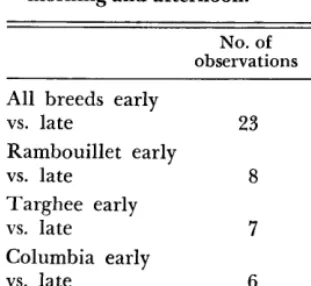
Table 2. Distances travelled (miles) be- tween grazing periods and between morning and afternoon.
No. of Mean observations disk
All breeds early 2.5
vs. late 23 2.2
Rambouillet early 3.2
vs. late 8 1.8
Targhee early 2.3
vs. late 7 2.5
Columbia early 1.8
vs. late 6 2.2
All breeds morning 1.5”
vs. afternoon 47 0.9
*Differences significant at the 0.05 level.
During the early grazing period, the three breeds showed similar but more pronounced differences. The Rambouillets again travelled the greatest distance (3.2 miles) followed in order by the Targhees (2.3 miles) and the Columbias (1.8 miles). A significant difference was again found between the Ram- bouillets and the Columbias.
No significant travel differences were found between breeds during the late grazing period or within breeds when the early period was compared to the late period.
An increase in the distance trav- elled for all breeds occurred be- tween the early and late periods, but these differences were not sig- nificant (Table 2).
The greatest distance travelled was 4.6 miles by a Rambouillet in July. The shortest distance was 1.2 miles by a Columbia, also in July.
An interesting contrast is the dis- tance travelled by all breeds in the morning as compared with the dis- tance travelled during the after- noon. During the morning the sheep travelled an average of 1.5 miles but only 0.9 miles during the afternoon (Table 2). These were significant differences.
Time Spent Grazing
Throughout the entire grazing season the Columbias spent 75.7% of the time grazing, followed in order by the Targhees with 68.7% and the Rambouillets with 67.6%
Table 3. Time (%) spent grazing between breeds and between grazing periods.
Early period Late period Both periods No. of Mean No. of Mean No. of Mean Comparisons observations time observations time observations time
Rambouillets vs. 62.0 87.0 67.6
Targhees 11 66.3 3 74.6 15 68.7
Rambouillet vs. 62.0”” 87.0 67.6
Columbia 11 74.9 3 77.6 15 75.7
Targhee vs. 66.3” 74.6 68.7
Columbia 9 74.9 3 77.6 13 75.7
+ Differences significant at the 0.05 level. ** Differences significant at the 0.01 level.
(Table 3). These differences were not, however, statistically signifi- cant.
During the early grazing period the Columbias spent 74.9% of their time grazing as compared to 66.3% for the Targhees. and 62.0y0 for the Rambouillets. Significant differ- ences were found between the Co- lumbias and Rambouillets and be- tween the Columbias and Targhees.
As the grazing season progressed, the percentage of time spent graz- ing increased for each breed, but the only significant increase was found with the Rambouillets (Table 4).
When the percentage of time spent grazing during the early period was compared to the late period for all b,reeds, a significant increase of from 67.1% to 79.7% was found. These data indicate that as the grazing season pro- gressed or as forage became less available, the time spent grazing in-
Table 4. Time (%) spent grazing be- tween grazing periods.
No. of Mean observations time
All breeds early 67.1””
vs. late 22 79.7
Rambouillet early 62.0”*
vs. late 8 87.0
Targhee early 66.3
vs. late 6 74.6
Columbia early 74.9
vs. late 6 77.6
+ Differences significant at the 0.05 level. ** Differences significant at the 0.01 level.
creased. Other authors have noted the same tendency in grazing ani- mals (Tribe, 1949, and Southcott et al., 1962).
Time Spent Resting
Throughout the entire grazing season all breeds spent about the same amount of time resting. The Rambouillets spent 28.2% of their time resting as compared to 26.5% by the Targhees and 22.2% by the Columbias (Table 5). These slight differences were not statistically significant.
During the early grazing period the Rambouillets again spent the greatest percentage of time resting (33.8%); the Targhees were inter- mediate (30.0y0), and the Colum- bias spent the least time resting (23.9%). Significant differences were found between the Rambouil- lets and Columbias and between the Targhees and Columbias.
As the grazing season progressed the time spent resting decreased for each breed (Table 6). Significant differences between periods were found for the Rambouillets and Targhees. During the late period a significant difference was found between the Rambouillets and Targhees (Table 5).
The average percentage of time spent resting during the early period was greater (29.8%) than that spent during the late period (14.8%) for all breeds (Table 6). These differences were significant at the 1% level of probability.
Table 5. Time (%) spent resting between breeds and between grazing periods.
Early period Late period Both periods
No. of Mean No. of Mean No. of Mean
Comparisons observations time observations time observations time
Rambouillet vs. 33.8 8.7” 28.2
Targhees 11 30.0 3 17.6 15 26.5
Rambouillet vs. 33.8* 8.7 28.2
Columbia 11 23.9 3 18.1 15 22.2
Targhee vs. 30.0” 17.6 26.5
Columbia 9 23.9 3 18.1 13 22.2
+ Differences significant at the 0.05 level.
the early period and for the entire season because of their tendency to shade up earlier and leave the shade later than the other two breeds.
Time Spent Travelling but Not Feeding
Throughout the entire grazing season the Targhees spent the greatest percentage of time trav- elling but not feeding (4.7%) fol- lowed in order by the Rambouillets (4.1 “/o) and the Columbias (2.0%). As the grazing season progressed, the percentage of time travelling but not feeding appeared to in- crease for each breed and for all breeds combined. However, no sig- nificant differences were found for this activity.
Most of the time spent travelling but not feeding occurred in the mornings when the sheep trailed to their preferred shading areas.
Watering and Salting
The sheep generally watered early in the morning, either during or fol- lowing the morning grazing period.
Table 6. Time (%) spent resting be- tween grazing periods.
No. of Mean observations time
All breeds early 29.8**
vs. late 22 14.8
Rambouillet early 33.8””
vs. late 8 8.7
Targhee early 30.0”
vs. late 6 17.6
Columbia early 23.9
vs. late 6 18.1
* Differences significant at the 0.05 level. ** Differences significant at the 0.01 level.
The water on the study area was usually located in the canyon bottoms and the sheep fed down from the ridges into the bottoms to drink. This tendency was not incidental to feeding because the sheep often went considerable dis- tances to water. After the sheep had obtained water they either con- tinued to graze or shaded up. There was little tendency for sheep to water in the afternoons. All verified observations of watering activity in- dicated that 87% of this activity occurred prior to 11:OO A.M. and 73% prior to 8:30 A.M.
When the forage was wet, as after a rain, the sheep did not seem to want or require water. Do,ran (1943) found that sheep spent very little time drinking, and he specu- lated that dew supplied much of their water requirement.
Salting activity also was most pronounced during the morning hours. Although sheep preferred to take salt in the morning, they generally drank first and took salt later. Eighty percent of the veri- fied salting activity took place in the morning, 30y0 of the time prior to 8:30 A.M. Determination of the effect of salt on distribution was difficult because the salt was placed on some bedgrounds, in pre- ferred shading areas, near water, near roads and on established sheep trails. The sheep appeared to be more salt hungry after feeding on wet forage.
Shading
Sheep generally shaded up in groups in the bottoms of canyons
and seemed to favor certain areas and even specific trees. Aban- doned buildings also appeared to be preferred shading areas.
One aspect of this study involved determining whether temperature was the primary factor initiating the daily shading activity. During the entire grazing season the mean air temperature at the time of shading was 58 F, while that of leaving the shade was 64 F. These differences were significant at the 5% level of probability. During the early grazing period the mean air temperature at the time of shad- ing was 62 F and 67 F at the time the shade was left. These differences approached significance at the se- lected 5y0 level of probability. No significant differences were noted during the late grazing period. One observation during the late grazing period showed that sheep shaded up when the temperature was only 38 F.
These data indicate that tem- perature alone did not cause the animals to shade up; rather this be- havior seemed to be initiated after the animals had satisfied their hunger. This conclusion is sup- ported by the observation of higher temperatures when the animals left the shade than when they began to shade up, as well as by the fact that the sheep continued to shade up in the fall when temperatures were quite cool.
Over the entire grazing season, the mean time of shading up, for all breeds, was 10: 12 A.M., and the mean time of leaving the shade was 2:05 P.M.
Morning vs. Afternoon Grazing During this study the sheep dis- played a period of grazing activity in the morning and another in the afternoon separated by a period of rest during the middle of the day. For all breeds and for the entire grazing season, the morning grazing period was significantly shorter (268 minutes) than the afternoon (326 minutes).
appeared to be a more intensive feeding time than was the morning. The evidence for this conclusion is that the sheep graze for a longer period of time in the afternoon, yet travel a shorter distance. The sheep were observed to be more contented during the afternoon and did not search out water or salt as they did in the morning.
Bedding Habits
The usual tendency for sheep in mountainous country is to seek out the highest areas for bedding down. In this study the sheep had a few preferred bedding areas, generally located on high ridge tops free of trees or large shrubs. The same bed- grounds were used throughout the entire grazing season. Weather con- ditions apparently had no effect on the selection of bedgrounds. The same bedgrounds were used on warm July nights and on cold windy nights in September. There was, however, a tendency for the Columbias to use areas other than the more preferred bedgrounds. This breed apparently preferred to bed down in the lower areas rather than trail to the tops of the ridges as did most of the other sheep. Apparently this tendency is related to their shorter travelling distances and longer grazing periods.
During the early part of the graz- ing season the sheep left the bed- grounds before or just after day- light. At daybreak the ewes stood up, collected their lambs, and then moved off the bedgrounds. The animals left together in a large
group, separating into smaller
groups as they fed. Later in the grazing season the sheep often re- mained on the bedgrounds as long as an hour after daylight. No graz- ing occurred on the bedgrounds in the mornings; grazing was initi- ated only after the sheep left the bedding areas.
In the evening the sheep usually reached the bedgrounds before they were ready to bed down, in some instances 2% hours early. They spent this time feeding. Thus,
an overgrazed condition lished bedgrounds results.
at estab-
General Observations
Certain areas of the range were highly preferred by the sheep. These were specific bedgrounds and valley bottoms. If the sheep were not herded or otherwise kept away from these areas, overuse always resulted. Sheep also had a tendency to remain in certain feeding groups, particularly in the morning, but there did not appear to be any
particular family grouping or es- tablishment of home ranges as was observed by Cresswell (1960) and Hunter and Milner (1963). Obser- vations were made of one group of sheep moving through another group without any apparent mix- ing.
No quantitative data were ob- tained on forage preferences, but the following observations were made: (1) The single most impor- tant forage species was Kentucky bluegrass. It was the preferred spe- cies from early in the season until the middle of October. The pro- duction of the grass was rather low, but it continued to grow as long as soil moisture was available. (2) When the forage was wet, the sheep spent their entire grazing time feed- ing on oakbrush and snowberry
(Symphoricarpos spp.). As the for- age began to dry the animals again preferred herbaceous species.
Management Proposals
The results of this study suggest, two main methods of improving the management of both range and sheep. These are the strategic location of fences and salt.
Division fences should be placed on the crest of the ridges and should follow the length of the ridges. The reason for fencing along the ridges is to reduce the amount of time spent on any one bedground and to provide protec- tion for part of the bedground at all times. These fences also would prevent the sheep from crossing from one drainage to another, which would maximize distribution
and also reduce the distance trav- elled. With a rotation grazing system, more uniform utilization of the forage would be obtained, and pastures could be grazed when op- timum conditions for forage and water existed.
More favorable placement of salt also should have a considerable im- pact on distribution. Salt should be moved away from water, bed- grounds, main roads, and trails and placed in less preferred and lightly used areas.
Literature Cited
BENNETT, J. A., D. H. MATTHEWS, AND M. A. MADSEN. 1963. Range sheep breeding studies in southern Utah. Utah Agr. Exp. Sta. Bull. 442. CRESSWELL, E. 1960. Ranging be-
havior studies with Romney Marsh and Cheviot sheep in New Zealand. Animal Behavior 8: 32-38.
DORAN, C. W. 1943. Activities and grazing habits of sheep on summer ranges. J. Forestry 41: 253-258. HERBEL, C. H., F. N. ARES, AND A. B.
NELSON. 1967. Grazing distribu- tion patterns of Hereford and Santa Gertrudis cattle on a southern New Mexico range. J. Range Manage. 20: 296-299.
HERBEL, C. H., AND A. B. NELSON. 1966. Activities of Hereford and Santa Gertrudis cattle on a southern New Mexico Range. J. Range Manage. 19: 173-l 76.
HUNTER, R. F., AND C. MILNER. 1963. The behavior of individual, related, and groups of South County Cheviot Hill sheep. Animal Behavior 11: 507-513.
MATTHEWS, D. H., M. A. MADSEN, AND J. A. BENNETT. 1967. Sheep man- agement studies in southern Utah 1944-1964. Utah Agr. Exp. Sta. Bull. 468.
OGDEN, P. R. AND H. M. ANDREWS. 1957. Unpublished soil and water conservation plan. Soil Conserv. Serv., U.S. Dep. Agr.
SOUTHCOTT, W. H., R. ROE, AND H. N. TURNER. 1962. The effect of size of flock on pasture and sheep pro- duction with special reference to in- ternal parasites and grazing be- havior. Aust. J. of Agr. Res. 13: 880-893.