A Security Proof of KCDSA using an extended
Random Oracle Model
Vikram Singh
∗Abstract
We describe a tight security reduction to the discrete logarithm problem for KCDSA under an extended Random Oracle Model. This is achieved by generalising the signature scheme and producing a se-curity proof for the generalised scheme. We require the application of Randomized Hashing. We also introduce a Challenger to the Random Oracle Model, who is external to the Simulator and Adversary. The Challenger provides oracle returns for one hash function, and chal-lenges which have a low probability of being met. On presentation of a forged signature the Simulator either identifies an edge case which allows solving of a challenge, or solves the discrete logarithm problem. Hence the tight reduction.
Keywords: Cryptography, Provable Security, KCDSA, Tight Re-duction, Discrete Logarithm Problem, Random Oracle Model
Uni-Contents
1 Introduction 3
2 The Generalised KCDSA Signature Scheme 3
2.1 Setup . . . 3
2.2 Key Generation . . . 3
2.3 Signature Generation . . . 4
2.4 Signature Verification . . . 4
2.5 Relationship with KCDSA . . . 4
3 Security Proof of the Generalised KCDSA Algorithm 4 3.1 The Assumptions and Setup . . . 4
3.2 The Simulator’s Responses . . . 6
3.3 The Simulator’s Solution . . . 7
3.4 Costing the Simulator . . . 8
This paper describes a tight security reduction to the discrete logarithm prob-lem for a generalised KCDSA scheme (for which KCDSA and EC-KCDSA are specific cases). The result may alternatively be interpreted as providing a tight security proof for KCDSA under an extended Random Oracle Model assumption. This result is not intended to promote a new signature scheme but to add to the perceived security of KCDSA. For details of the KCDSA algorithm see [1]. It may be assumed throughout that KCDSA is considered with the method of Randomized Hashing applied.
This paper is divided into 4 sections. Section 2 describes the generalisa-tion of KCDSA. Secgeneralisa-tion 3 gives the tight reducgeneralisa-tion to the discrete logarithm problem and Section 4 gives the conclusion.
2
The Generalised KCDSA Signature Scheme
2.1
Setup
The algorithm is performed in a cyclic group G of order q, generated by g. Let elements of G have bit length lp and q be a lq-bit prime. The group is viewed multiplicatively. Let Lbe the space of lq-bit values and let the space of possible messages be M.
Three hash functions are required:
H1 : Zq →L
H2 : Zq×Z∗q →L
H3 : M→L
The hash functions H1 and H2 are related hash functions. The following
relationship holds, where y is the public key defined in Section 2.2 below:
gk=geys ⇒H1(k) =H2(e, s) (1)
A further extension function G is also required for applying Randomized Hashing:
G : L→M
For more details on this extension and Randomized Hashing see [2].
2.2
Key Generation
2.3
Signature Generation
To sign a messagem ∈M, the signer generates k ∈Zq randomly. The signer computes r=H1(k) and extendsr torv=G(r)∈M. The signer computes:
e = r⊕H3(rv⊕m) modq
s = x(k−e)∈Zq
If s= 0, repeat the process. The signature of m is (r, s).
2.4
Signature Verification
To verify the signature, (m, r, s), the verifier first checks that s ∈ Z∗
q, r ∈L and m ∈M. The Simulator then computes
e =r⊕H3(G(r)⊕m) mod q
The signature is valid ifH2(e, s) = r. This relation holds for a valid signature
as geys=gk, thusH2(e, s) =H1(k) =r
2.5
Relationship with KCDSA
We note that ifH1(k) =h(gk),H2(e, s) =h(geys),H3(m) = h(z||m) wherez
is some hash of the public certificate data, this algorithm is the Randomized Hashing version of KCDSA (or EC-KCDSA in an alternative group).
3
Security Proof of the Generalised KCDSA
Algorithm
This section describes a tight reduction of KCDSA to the discrete logarithm problem. In this case, the discrete logarithm problem solved is recovery of the secret x.
3.1
The Assumptions and Setup
H1 H2 g, y Public Values Sign g, y Adversary Forgery (M, R, S) Solution to DLP, Challenge 1 or Challenge 2
Challenger Challenge: 1,2
Sets: α, β
Compare
H3 G
rand
k e,s
e⊕ai
rv r
m r,s
m
Figure 1: A Security Proof Diagram of Generalised KCDSA
In this security proof there are three components to consider. Firstly, there is an Adversary who is capable of forging a message given (other) message signatures, the public data and the output of the hash functions. The Simulator provides the responses to the Adversary’s hash and signature queries. Assume that the Adversary makesQHi hash queries toHi,QG hash
queries to G and Qs signature queries.
In an extension to the usual setup, there is also a Challenger. The Simula-tor may choose the output ofH1,H2,Gand the signature queries. However,
the Simulator must forward H3 queries to the ‘external’ Challenger. The
Challenger provides the responses to the Simulator’s H3 queries. The
pur-pose of the Challenger in the security proof is to absorb the low probability edge cases wherein an Adversary’s forgery does not enable the Simulator to solve the hard problem (in our case, the discrete logarithm problem).
Challenge 1: Given a random subset of L, α ={a0, . . . , aQH2−1}, of size QH2
find u∈M such that H3(u) = ai, for somei.
Challenge 2: Given a random subset ofM,β ={b0, . . . , bQs−1}, of sizeQs find v ∈M such that H3(v) = H3(bi) and v 6=bi, for somei.
As H3 is viewed as a random oracle which is unknown to the Simulator,
it may be assumed that solving Challenge 1 or Challenge 2 has probability QH2+Qs
2lq for each H3 hash query, which can easily be controlled to be a low
probability.
3.2
The Simulator’s Responses
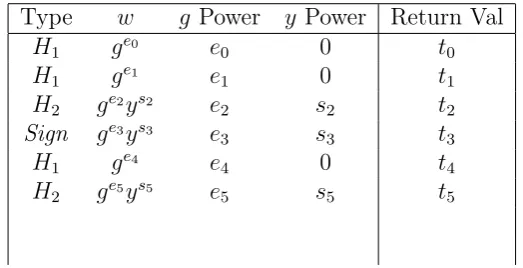
The Simulator’s responses to queries from the Adversary are defined in this section. This will allow us to determine which problems the Simulator can solve, given presentation of a forgery. In order to define correct responses a comparison table is needed. The purpose of this table is to ensure that Equation 1 is satisfied in the Simulator’s responses to hash and signature queries. An example table is given in Table 1.
Type w g Power y Power Return Val
H1 ge0 e0 0 t0
H1 ge1 e1 0 t1
H2 ge2ys2 e2 s2 t2
Sign ge3ys3 e
3 s3 t3
H1 ge4 e4 0 t4
H2 ge5ys5 e5 s5 t5
Table 1: A comparison table excerpt for H1 and H2 queries
The w column of the table is consulted with every query to the hash functions H1 and H2; the table holds the inputs and outputs already given
slet i=j = 0:
H1(k): Simulator calculates w=gk and consults the comparison table.
Ifwis not present, returns randomt ∈Zq and adds (H1,w,k,0,t)
to the table. Otherwise returns corresponding t (to w) listed in table.
H2(e, s): Simulator calculatesw=geysand consults the comparison table.
If w is not present, returns t = e⊕ai, increments i, and adds (H2,w,e,s,t) to the table. Otherwise returns corresponding t (to
w) listed in table.
H3(m): Simulator requests response from Challenger and returns that
response.
G(r): Simulator checks if r has been previously submitted. If so, the previously returned value is returned. Else, the Simulator re-turns a random value rv∈M.
Sign(m): Simulator chooses r ∈ L that has not been submitted to the
G oracle. Simulator sets G(r) = bj ⊕ m, and calculates e =
r⊕ H3(G(r)⊕ m) mod q. Simulator searches for e in the ‘g
Power’ column. For each en = e found, the Simulator adds the corresponding sn to a set Γ. The Simulator then picks an
s randomly from the set Zq\Γ. The Simulator increments j, adds (Sign,geys,e,s,r) to the comparison table, and provides the signature (r,s) to the Adversary.
To conclude, note that each response will appear random to the Adversary as required by the Random Oracle Model.
3.3
The Simulator’s Solution
Let us assume that after a time period τ, the Adversary produces a forgery, (M, R, S), with probability . If the forgery is valid (and M has been previ-ously submitted to the signing Oracle) then we have that:
H2(R⊕H3(G(R)⊕M) modq, S) =R (2)
Set E =R⊕H3(G(R)⊕M) mod q.
Either the Adversary already knows that the output ofH2 isR, or the
found for another table entry or else the Adversary has guessed. So we may assume that genysn =gEyS. The Simulator now considers the corresponding
‘Type’ of tn.
If ‘Type’ is H1, then noting thatS 6= 0 and so en6=E gives:
x= S
en−E
and hence the discrete logarithm problem (DLP) is solved by the Simulator. If ‘Type’ is H2, then ifE 6=en:
x= S−sn
en−E
and hence the DLP is solved by the Simulator. Otherwise, E =en, S =sn and by construction, H2(E, S) = E⊕ai =R for some i, by virtue of being the forgery, thus en=R⊕ai for this i. Hence R⊕H3(G(R)⊕M) = R⊕ai and thus
H3(G(R)⊕M) =ai
Therefore Challenge 1 is solved.
Finally, if ‘Type’ is Sign, then again if E 6= en the DLP is solved by the Simulator. Otherwise E =en thus:
H3(G(R)⊕M) =H3(G(R)⊕m)
By construction G(R) =m⊕bj for some j, hence:
H3(bj ⊕m⊕M) = H3(bj)
As m 6=M, Challenge 2 is solved.
Thus the Simulator either solves the DLP, Challenge 1 or Challenge 2.
3.4
Costing the Simulator
The Simulator only fails if either theGoracle has been exhausted (QG+Qs> 2lq) so a suitabler cannot be found, or that a particular e has been used for
all s (QH2 > 2
lq), so s may not be found. These both require sufficiently
many queries that we may assume that neither can occur. Hence we can assume that the simulator does not fail. The Simulator either solves the DLP, Challenge 1 or Challenge 2.
The probability that Challenge 1 or Challenge 2 is solved withQH3 hash
queries is approximately QH3(QH2+Qs)
2lq . Thus the probability of solving the
DLP is:
˜
≥− QH3(QH2 +Qs)
Simulator requires the following time to complete:
˜
τ =τ+τ0(QH1 + 2QH2 + 2Qs) (4)
Thus the security of the signature scheme is tightly reduced to the DLP because the probability of the Simulator solving DLP given a forgery is high, and the time required is little more than required by the forging Adversary.
4
Conclusion
This paper has described a tight security reduction for a generalised KCDSA scheme with Randomized Hashing to the discrete logarithm problem. Thus security parameters for the two problems can be tightly related. The result is achieved by adding an external Challenger to the Random Oracle Model, which allows the cases where the Simulator doesn’t solve the discrete loga-rithm problem to be absorbed within low probability challenges.
The purpose of the paper is not to propose a new scheme, but to analyse the security of the existing KCDSA scheme. As such, there are two ways the result could be viewed:
1. The result can be seen as a security proof for KCDSA with the Random Oracle Model assumption. An oracle in the model has been extended to encompass not only the usual hash function but also the input ex-ponentiation. However, this does not invalidate the model.
2. The result could be seen as irrelevant to the KCDSA signature scheme. When related to KCDSA, the model assumes that only exponentiations of g and y may be hashed, and this is clearly not the case in the proof.
References
[1] Chae Hoon Lim. The revised version of
KCDSA. Unpublished Manuscript available from
http://dasan.sejong.ac.kr/˜chlim/pub/kcdsa1.ps, 2000.