A New Primitive Location Based Popularity on Delay and Throughput in
Mobile Ad Hoc Networks
#1
PARITALA SURENDRA, M.Tech Student
#2
M.V. RAJESH, Associate professor
DEPT OF COMPUTER SCIENCE AND ENGINEERING
ADITYA ENGINEERING COLLEGE, ADITYA NAGAR, ADB ROAD, EAST GODAVARI, SURAMPALEM, ANDHRA PRADESH -533437
Abstract:
With the coming of keen versatilegadgets and area based applications, client's portability example is observed to be exceedingly subject to changing areas. In this paper, we investigate asymptotic throughput-postpone execution of versatile impromptu systems (MANETs) under an area ubiquity based situation, where clients will probably visit prominent areas. This work gives a correlative point of view contrasted and past studies on elementary scaling laws for MANETs, generally expecting that center points move reliably in the framework. especially, we investigation a phone allocated exhibit with cells of known omnipresence, which takes after a Zipf's law dissemination with predominance sort α. We first direct the examination under customary store-pass on forward perspective, and find that zone differentiation impacts the framework execution unfavorably, which is a direct result of the abuse of potential broadcast openings in standard cells. Induced by this discernment, we encourage advance a novel store-pass on enliven forward perspective to increase the framework correspondence, abusing these potential telecasting. Theoretical impact demonstrate that our proposed plot beats all delay restrict comes to fruition got in standard arrangement for any α.
INTRODUCTION
Regardless of the troublesome nature and discontinuous network of MANETs, it is demonstrated that a steady for every hub
other hand, a couple of utilizations require by far most of their packs to adequately get in contact at the sink free of when they arrive. For example, in regular surroundings watching applications, the passage of bundles is allowed to have a deferral, yet the sink should get by far most of the packages.
WSNs have two urgent QoS necessities: low put off and high information validity, affecting what are called put off fragile applications and high-respectability applications, autonomously. In light of present circumstances, in a system with light load, both necessities can be speedily fulfilled. Regardless, a truly stacked structure will hold on impede, which develops the end-to-end delay. This work courses of action to in the meantime enhance the commitment for high-dependability applications and diminishing the end-to-end delay for deferral shaky ones, notwithstanding when the system is congested. We get the likelihood of potential field from the control of material science and setup a novel potentialbased directing check, which is called validity and postpone disconnected organizing (IDDR). IDDR can give the taking after two cutoff points:
Enhance devotion for high-uprightness applications. The focal accepted is to discover however much support space as could sensibly be typical from the unmoving and also under-stacked ways to deal with store the exceptional groups that may be dropped on the most compelled way. In like manner, the foremost task is to find these unmoving and additionally underloaded ways, then the second undertaking is to hold the packages viably for subsequent transmission. IDDR builds up a potential field according to the depth1 and line length information to find the under-utilized ways. The bundles with high uprightness essential
will be sent to the accompanying hop with more diminutive line length. A framework called Certain Jump by-Bounce Rate Control is planned to make package holding more beneficial.
Diminish end-to-end defer for delay delicate applications. Each application is allocated a weight, which addresses the level of affectability to the delay. Through building close-by element potential fields with different grades as demonstrated by the weight values passed on by bundles, IDDR licenses the packages with greater weight to pick shorter ways. In extension, IDDR in like manner uses the need line to encourage lessen the coating deferral of delay tricky packs.
IDDR typically avoids the dispute between high respectability furthermore, low put off: the high-respectability packages are held on the under stacked routes along which groups will bear enormous end-to-end postpone as an aftereffect of more ricochets, and the deferral unstable packs make an excursion along shorter approaches to approach the sink at the most punctual open door. Using the Lay buoy theory, we show that IDDR is consistent. In addition, the eventual outcomes of anarrangement of diversions drove on the TOSSIM organize demonstrate the profitability and achievability of the IDDR arrange.
Related Work
generally focus on the estimations of deferment and unflinching quality.
Giving Continuous Administration RAP abuses the prospect of speed and proposes a speed monotonic arranging procedure to minimize the extent of missed due dates [7]. In any case, the overall information of framework topology is required. Certain Soonest Due date First (EDF) generally utilizes a medium get to control tradition to give persistent organization [8]. The undeniable prioritization is used as opposed to relying upon control packages as most extraordinary traditions do. SPEED keeps up a longed for movement speed over the framework through a novel blend of feedback control likewise, non-deterministic QoS-careful geographic sending [9]. In [10], a two-skip neighbor information based slant coordinating framework is proposed to enhance progressing execution. The coordinating decision is made considering the quantity of skips from a source to the sink and the two-hop information.
Arrange Model And Definitions
Cell-divided show. Consider a cell allotted framework show as showed up in Fig. 1. There are n flexible center points in a unit square. Parcel the framework into n nonoverlapping cells, individual of comparable range. one by one cell is alloted with a known Fig. 1. A cell-distributed exhibit in which each cell is consigned with a given noticeable quality. A cell of massive shading has huge universality. In a understood cell, an AP is sent in within to help the mind-boggling action stack when store-pass on revive forward perspective is grasped. acclaim. Center points visit a cell self-governingly as showed by its omnipresence, inciting to an inhomogeneous
stationary center point movement. We expect center points can talk with each other exactly when they are in a comparable cell, and one telecasting is restrained for each cell per timeslot. To keep up a key separation from block, differing recurrence are used among the neighboring cells. It is outstanding that restrictive four repetitions are adequate for the framework.
Two-Hop Relay Algorithm Based Capacity and Delay
we utilize traditional two-jump hand-off calculation to research the throughput and deferral. Here we quickly portray the calculation. A bundle is first sent from the origin to an accessible hub, which will go about as a hand-off for the parcel. At that point the parcel is conveyed by the hand-off until it experiences the goal and conveys the bundle.
Parcels are transmitted and steered through the system as per the planning calculation. The calculation chooses which parcel to transmitted at every timeslot without disregarding the natural limitations of the cell-divided system. Since hubs will go about as transfers, there will be different parcels in the support of every hub. In the event that the support is not sufficiently expansive, parcels might be dropped, which will likewise influence the system execution. In the accompanying investigation, we will figure how extensive the cushion should have been to guarantee strength. A booking calculation is steady if cradles of the considerable number of hubs don't flood.
cell i with likelihood pi each timeslot and its support size is nb. At that point the limit of the system is
(1)
where the average delay is for any a and
(2)
Three-Hop Relay Algorithm Based Capacity and Delay
In past area we find that two-jump hand-off calculation brings about an extreme postponement
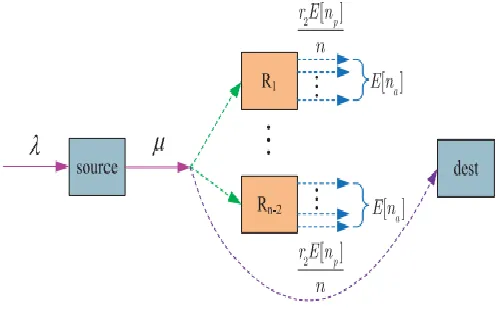
of . This is because of the way that the calculation just concedes a balanced transmission each timeslot in a well known cell in spite of the way that there are different centers in it. Roused by this, we propose a changed hand-off computation to upgrade the framework execution, which utilizes the potential transmission openings as a part of attractive cells and limits groups to three-ricochet ways. We show that the figuring can obtain as far as possible with a constrained typical concede .
A cell is described to be a attractive cell in case it contains at any rate E½nahubs. Moreover, the amount of pervasive cells is E½np in a framework. Since the outstanding cell has a large center thickness, we pass on an AP in within and each midpoint inside the cell can go to the AP in a singular ricochet outline. The centers in the twin pervasive cell substitute to convey packs. Once an open entryway rises for an exchange center point
(canceled basic hand) to interface with the AP, each one of the bundles in its support will be immediately conveyed to each one of the center points inside the telephone. These centers will then go about as enlivened exchanges to forward the package to the objective. Observe that these various revived exchanges are irreplaceably basic, as they bolster the chances of running over the objective essentially.
Three-Jump Transfer Calculation. In the midst of a timeslot, for every cell with no under twin centers:
1) If there exists a S-D coordinate in the cell, erratically select such a couple reliably over each feasible join inside the phone. If the origin has another bundle proposed for the objective, transmit it and after that eradicate it from its support. Else stay sit out of apparatus.2) If there is no S-D match inside the cell, haphazardly assign a hub in the cell as sender. At that point for such a cell.
i) Broadcast transmission. In the event that it is a prevalent cell and the assigned sender has parcels, transmit every one of the bundles in its cradle to every other hub in the cell with the help of AP. In the event that a bundle is gotten by its goal effectively, erase the parcel from the cradles of all hubs holding it. Else stay sit still.
ii) If it is not a famous cell, autonomously pick another hub as collector among the rest of the hubs in the cell. With equivalent likelihood, haphazardly look over the two choices:
been transmitted, transfer the parcel to the assigned recipient. Else stay sit out of gear.
Relay-to-goal transmission. In the event that the sender has a parcel bound for the assigned recipient, broadcast. Once the goal has gotten it, the bundle will be discarded from the supports of all hubs waiting it. Else stay sit out of gear.
Take note of that the calculation plans the single-jump S-D transmissions at whatever point conceivable, while S-R, R-D and communicate telecasting happen autonomously.
Fig. 2. A diagram of the network as seen by the packets telecasting from a origin to its destination. Fig. 1 outlines a little part of a WSN. Assume hub 1 is a hotspot and there are both high uprightness parcels (empty rectangles) and postponement delicate parcels (strong rectangles) from source hubs A, B and C. A usually utilized directing calculation will pick the ideal way for every one of the parcels. For instance, the standard briefest way tree (SPT) directing will forward every one of them to hub 1 as appeared in Fig. 1a. This will bring about clog and along these lines lead to numerous high integrity parcels misfortune and huge end- to-end delay for deferral touchy parcels. A multipath directing calculation as appeared in
Fig. 1b can use more ways to stay away from hotspots. Be that as it may, the low deferral and high throughput are barely met all the while. The reasons are:
Delay-touchy parcels possess the restricted transfer speed and cushions, exacerbating drops of high-trustworthiness ones.
High-honesty parcels hinder the most limited ways, convincing the postponement delicate parcels to travel more bounces before achieving the sink, which expands the deferral.
High-uprightness parcels involve the cradles, which likewise expands the lining deferral of postponement touchy parcels. To beat the above disadvantages, we mean to plan a component which permits the deferral touchy bundles to move along the most limited way and the parcels with loyalty necessities to reroute to keep away from conceivable dropping on the hotspots. Thusly, the information trustworthiness and postponement separated administrations can be given in the same system. Propelled by this understanding, we propose the IDDR plan, a potential-based multi-way dynamic steering calculation.
Sink appeared in Fig. 1d, the connection from hub 1 to the sink is so occupied that hub An or B will sidestep hub 1 and send bundles to the sink along other under-used ways to dodge parcels being dropped. IDDR perceives unmistakable sorts of bundles using the weight values installed into the header of bundles, and after that performs distinctive activities on them. Its foundation is to build appropriate potential fields to make right directing choices for various sorts of bundles. Next the potential- based IDDR calculation will be portrayed in point of interest. draw in broad consideration due to its gigantic administration overhead. It is entirely costly to manufacture a select virtual field for every destination in customary systems where various destinations may be dispersed self-assertively. On the opposite, the potential-based steering calculation is much reasonable for the numerous to-one movement design in WSNs.
Two Schemes Based Minimum Delay Analysis
In the past segment, we get the achievable postponement by developing two plans without transfer repetition. One question emerges: what is the base defer a system can ensure without transfer excess?
In area based situations, deferral can be further enhanced by permitting multi-client gathering in prominent cells, which are characterized as telecast repetition. Here hand-off excess alludes to the repetition set quicken in past works, which could happen in any cell having no less than two hubs. Telecasting repetition happens in cells which have more than E½nahubs. In telecast repetition, a bundle can be gotten by every single other hub in a similar cell in a timeslot surrounding communicating. The pivotal contrast is that, once telecast excess of a bundle brings about, it will
produce various copy conveying transfers for the parcel. What's more, to acquire a similar number of copies, every bundle is needed to be re telecasting various times to various transfers by hand-off repetition since hand-off excess produces at most one copy every time. Take note of that rich hub asset in famous cells empowers telecasting repetition, which in this manner may not work in uniform situations.
Tradeoffs of Delay and Capacity
In past segments, we expect that there is just a solitary starting transfer hub getting bundles from the source. Instinctively, if more starting transfers acquire the bundle, the parcel will be spread all the more rapidly and the deferral might be further moved forward. Nonetheless, the limit will be corrupted. In perspective of this, we utilize hand-off excess to diminish delay and research the postponement limit tradeoff under three-bounce hand-off calculation.
Assume there are m hubs at first holding a reproduction of a given parcel. At that point these hubs are planned as takes after: After k reproductions have been communicated in various well known cells by means of APs, every one of these hubs erase the parcel in its support. At that point quickened hubs from numerous mainstream cells serve as transfers for the parcel until one of them experiences the goal with corresponding capacity.
Theorem 4. The three-hop relay algorithm
CONCLUSION
we examine the effects of area prominence on scaling lawss of MANETs. To start with, we embrace customary two-bounce store-convey forward worldview to dissect the postponement and limit, and find that the execution is more terrible than that of homogeneous situations. By prompting a three-jump store-convey quicken quicken worldview using feasible telecasts in mainstream cells, we demonstrate that the postponement can be diminished up to an element of without giving up the limit with respect to any a. It shows that misusing area prevalence can to a great extent enhance the execution in MANETs. Also, our tradeoff under three-bounce transfer calculation is superior to that of homogeneous situations when a 1. What's more, our outcome can be cover a homogeneous situation by setting, Moreover, an ideal execution can be accomplished when with a practically consistent limit and deferral. In this manner, our examination may give knowledge on the outline and organization of extensive scale area based systems
REFERENCES
[1] J. Burrgess, B. Gallagherr, D. Jenseen, and B. N. Levine, "MaxProp: Steering for vehicle-based disturbance tolerant systems administration," in Proc. IEEE Conf. Comput. Commun., Barcelona, Spain, Apr. 2006, pp. 1–11.
[2] P. Huii, A. Chaintreau, J. Scott, R. Gass, J. Crowcroft, and C. Diot, "Take exchanged systems and the results of human versatility in meeting situations," in Proc. ACM SIGCOMM Workshop Postpone Tolerant Netw., Philadelphia, Dad, USA, Aug. 2005, pp. 244–251.
[3] D. Zha0o, H. Mama, S. Tangg, et al., "COUPON: A helpful structure for building detecting maps in portable
artful systems," to show up in IEEE Trans. Parallel Distrib. Syst., Feb. 2014.
[4] A. Setth, D. Kroekeer, M. Zahariaa, S. Guo also S. Kesshav, "Ease correspondence for rustic web stands utilizing mechanical backhaul," in Proc. twelfth Annu. ACM Int. Conf. Portable Comput. Netw., Los Angeles, CA, USA, Sep. 2006, pp. 334–345.
[5] M. Grossglauseer and D. N. C. Tsee, "Portability expands the limit of impromptu remote systems," IEEE/ACM Trans. Netw., vol. 10, no. 4, pp. 477–486, Aug. 2002.
AUTHORS
Mr. PARITALA SURENDRA, received B.Tech degree in Information Technology. and currently pursuing M.Tech in COMPUTER SCIENCE AND
ENGINEERING at ADITYA ENGINEERING
COLLEGE, Surampalem, East Godavari, a.p, India.
M.V. RAJESH, working as Associate Professor in ADITYA ENGINEERING COLLEGE, Surampalem, East Godavari, a.p, India.. At present, pursuing Ph.D from JNTU Hyderabad. He has experience of 10 years in teaching for Engineering students at UG and PG level . His areas of interest are