American
Society of Range Management
The American Society of Range Management was created in 1947 to advance the science and art of grazing land manage- ment, to promote progress in conservation and sustained use of forage, soil and water resources, to stimulate discussion and understanding of range and pasture problems, to provide a medium for the exchange of ideas and facts among members and with allied scientists, and to encourage professional im-
provement of members.
Membership: Persons shall be eligible for membership who are interested in or engaged in practicing range or pasture man- agement or animal husbandry; administering grazing lands; or teaching, or conducting research, or engaged in extension ac- tivities in range or pasture management or related subjects.
OFFICERS OF THE SOCIETY
PRESIDENT C. WAYNE COOK Utah State University Logan, Utah 84321
JOURNAL OF RANGE MANAGEMENT EDITOR
ROBERT S. CAMPBELL RR7
Quincy, Illinois, 62301
PRESIDENT ELECT E. J. DYKSTERHUIS Texas A.&M. University College Station. Texas 77843
The Journal, published b&monthly, is the official organ of the American Society of Range Management. The Journal aims to publish something of interest to the entire membership in each issue. The Society, however, assumes no responsibility for the statements and opinions expressed by
authors and contributors. EDITORIAL BOARD
ALAN A. BEETLE University of Wyoming Laramie, Wyoming 82071
PAST PRESIDENT MELVIN S. MORRIS University of Montana Missoula, Montana 59801
LORENZ F. BREDEMEIER Soil Conservation Service
P. 0. Box 4248 Madison, Wisconsin 53711
EXECUTIVE SECRETARY JOHN G. CLOUSTON
P. 0. Box 13302 Portland, Oregon, 97213
Subscriptions. Correspondence concern- ing subscriptions, purchase price of single copies and back issues and related business should be addressed to the Executive Sec- retary, P. 0. Box 13302, Portland, Oregon 97213. Subscriptions are accepted on a calendar year basis only. Subscription price is $10.00 per year in the U. S. and insular possessions, Canada and Mexico ; $10.50 in other places. Checks should be made pay- able to the American Society of Range Management. Subscribers outside the United States are requested to remit by International Money Order or by draft on a New York bank.
EVAN L. FLORY 3451 No. Venice St. Arlington, Virginia 22207
BOARD OF DIRECTORS 1965-67
DONALD R. CORNELIUS Agric. Research Serv., USDA
P. 0. Box 245 Berkeley, California 94701
Address Change. Notice of change of address should be received by the Execu- tive Secretary prior to the first day of the month of Journal issue. Lost copies, owing to change of address, cannot be supplied unless adequate notice has been given. Missing Journals. Claims for missing copies of the Journal should be sent to the Executive Secretary within 90 days of pub- lication date. Such claims will be allowed only if the Society or the printing company is at fault.
ROBERT W. HARRIS Pacific Northwest Forest &
Range Experiment Station P.O. Box 3141, Portland, Ore. 97208
HORTON M. LAUDE University of California
Davis, California 95616
ALEX JOHNSTON Canada Agric. Research Branch
Research Station Lethbridge, Alberta
MembershiP Dues. Dues for regular members are $10.00 per year in the United States, Canada and Mexico, $10.50 else- where. Student memberships are $5.00 per year. Life Memberships are $300. Dues in- clude a subscription to the Journal. Re- mittance must be in U. S. funds.
CHARLES L. LEINWEBER Texas A & M University College Station, Texas 77843
1966-68
MARTIN H. GONZALEZ .
Ranch0 Experimental La Campana Apdo. Postal 682 Chihuahua, Chih., Mexico
Posf Office Entry. Second-class post- age paid at Portland, Oregon, and at ad- ditional offices.
RUSSELL D. LLOYD Rocky Mountain Forest &
Range Expt. Sta. ; CSU Fort Collins, Colorado 80521
CHARLES E. POULTON Oregon State University Corvallis, Oregon 97331
Manuscripts. Address manuscripts and correspondence concerning them to the Editor, Journal of Range Management. In- structions to authors appear in the March Journal. Copies are available in the Editor’s
office.
WILLIAM J. MCGINNIES U.S.D.A., Agricultural Res. Serv.
Colorado State University Fort Collins, Colorado, 80521
1967-69
Reprints. Reprints of papers in the Jour- nal are obtainable only from the authors or their institutions.
FRANK W. STANTON Bureau of Land Management
P. 0. Box 3861 Portland, Oregon 97208 SHERMAN EWING
S N Ranch P. 0. Box 160 Claresholm, Alberta
News And Notes. Announcements about meetings, personnel changes and other items of interest to Society members should be sent directly to the Executive Secretary. Printers. The Nebraska Farmer Company, 1420 P Street, Lincoln, Nebraska 68501. Copyright 1967 by the American Society of Range Management.
BOOK REVIEWS
LAURENCE E. RIORDAN 940 E. 8th Ave. Denver, Colorado 80218
DON N. HYDER U.S.D.A., Agricultural Res. Serv.
Dense growths of brush like juniper, mesquite and catclaw can rob your land of productivity. With more range- land needed every day, now is the time to fight such thieves with mechanical brush control.
Now as never before, there is a need for
food. To meet the crisis growing in coun-
tries throughout the world, many range-
land owners are moving to increase
American farm production.
Idle lands are being put into use. And
land now falling short is being brought up
to its full productive potential.
Brush infested rangelands can play a
major part in this program. In most cases,
the key is mechanical brush control.
It was, for Beefmaster cattle breeder
Leo Jasik. His 516-acre ranch near
Pleasanton, Texas could only support
one cow per 15 acres because much of it
was brush-infested. Then he had 120
acres chained and rootplowed,
and
sprigged to Coastal Bermuda grass.
Within four months, Jasik was able to
put 77 cows on the new pasture. Where
one cow grazed before, six cows and their
calves have all the grazing they need
today. He maintains the same stocking
rate year-round.
Beef yields have soared. The calf crop
is up from 90 % to 98%) calves average
100lbs. heavier-and
the Coastal Ber-
muda is 8 in. high, thick and spreading.
Jasik has since improved all 516 acres.
He expects the full costs to be repaid
completely within three years.
Mechanical brush control can help you,
too. Prepare your land for tomorrow’s
needs-and for new profit opportunities
for you.
See your Caterpillar Dealer or conser-
vation contractor.
CATERPILLAR
Preparing the land for tomorrow
Journal
of
RANGE
MANAGEMENT vozu~.tiz~rx,
~;~be~
2
Ediforial. Whaf Are We Going To Do Abouf If? _.-.. _ . . . . _._._ .__._ Charles E. Poulton 63 Supplemenfal Profein Levels for Calves and Yearlings Grazing On Winfer
Bluesfern Pasfure... _____ ___________ ____ ___..___________.._________ _________ ____ . . . ..E. F. Smith, K. L. Gnadt, C. V. DeGeer, D. Richardson, F. W. Borden, and G. F. Krause 64 Economics of Selecfed Alfernafive
Calving Dafes.. _.__ ___________ ____ ___ ___. _____ _._._.__ . ..Robert G. Mueller & Grant A. Harris 67 Effecfs of Herbage Removal on Seedling Developmenf in
Cane Bluesfem Abel E. Bernardon, Donald L. HUSS, and Wayne G. McCully 69 Germinafion of Range Planf Seeds ai
Alfemafing Temperafures...Sigmund J. Ellern and Naphtali H. Tadmor 72 Aerial Phofography and Sfafisfical Analysis for Sfudying Behaviour Paffems
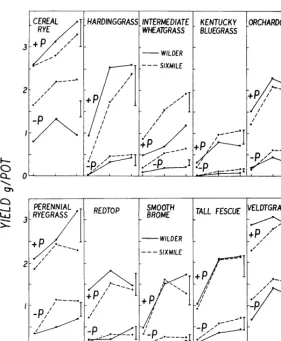
of Grazing Animals _._._____ _ .______ ___ _____.._ _ ._._.__ M. L. Dudzinski and G. W. Arnold 77 Yield and Mineral Composifion of Grass Species Grown on Acid Grassland
Soils... __.___ __ ._________ _ ____ __ _____ F. P. Guerrero, W. A. Williams and W. E. Martin 84 Voles Damage Big Sagebrush in Soufhwesfern Monfana...W. F. Mueggler 88 A Sfep Toward Aufomafic Weighing of
Range Caffle....S. Clark Martin, Kennth K. Barnes, and Leonard Bashford 91 Comparison of Cage Mefhods for Defermining Ufilizafion on Pine-Bluesfem
Range__ ______ _________ ____ ___ ____ _____ __________ _ _________ ________ __._____ . . . ..Harold E. Grelen 94 Commercial Fertilizers Influence Crude Profein Confenf of Four Mixed
Prairie Grasses. _._. . _.._______._... ____ ____ ____ . . .._..___ .--Richard F. Dee and Thadis W. Box 96 Biiferbrush Seed Colleciing-By Machine
or By Hand?...Eamor C. Nord, Edward R. Schneegas, and Hatch Graham 99 Design Considerafions for Small Pipelines for Disfribufion of Livesfock Wafer
on Rangelands. _.______..._ _ __.. _ .___ ________.._ .___________ _ ._________ __ ____.___ -Theodore C. Patterson 104 Technical Noies:
Morfalify of Rock Goldenrod in Sagebrush Stands Sprayed Wifh
2,4-D ____ _._____ .____ __.__ _.__ __ .____ ___ .____.________ _ ______ _.__ ____ _ __._ _______________ _____ . ..William A. Laycock 107 An Adapfafion of fhe Grazed Planf Meihod for Esfimafing Ufilizafion of Thurber Fescue.,... ___. ____._____ .______ _._.__ __.___ ___ _____ _ ___._.________ . . . ..Ralph K. Gierisch 108 Managemenf Nofes:
Brush Confrol-
An Unfinished Job ____________._ :...C. Eugene Conrad 8~ Charles A. Graham 111 Livesfock Grazing Under Mulfiple-Use Policy...Hugh W. Colton 113 Range Improvemenfs and R&urns fo fhe Privafe Land Operafor in fhe Infermounfain Area... _.___ __________.____________ _.__ ___________________._______________ ____ . . ..Dan Freed 115 Exposure May Influence Grassland Esfablishmenf...Claude C. Dillon 117 Book Reviews:
Alaska-A . Challenge in Conservafion (Richard M. Hurd); Common Plants of Longleaf Pine-Bluesfern (R. S. Campbell); Them Were The Days (C. H. Wasser); .___ __ ._.___..._ ____ .___ ____._______ .._.____ _ _______ __________.___________ ____ _ _____ ________ ________ 118
News And Nofes:... ____.__ _ ___.__ ______.__.__________ ______ ___ . ._ _.__._____--.-.-.-._____________________.~...~___.._..___~ __ _ 121 Wifh The Secfions.... _._.______.._ _._ .___ ___ _.___. _._______._ ____ ___ __._ ________________________________________..__.__..._..____ 123 Informafion For Authors.... _______.._ _.__ ___. _._______ _._._ . . . ..Facing page 124
Cover
Phot*Brush
Conirol - An Unfinished
Job
Editorial
What Are We Going
To Do About If?
Charles E. Poulfon
Professor of Range Ecology, Oregon State University, Cowallis, and Member, Board of Directors, ASRM.
Dr. Charles E. Poulton
About what ? The image of
range resources and of range
management in the viewpoint of
the average citizen! I have just finished reading the chapters on
“Grasslands” and on “Wild Ani-
mals” in Allen’s and Leonard’s
third edition, CONsERVING
NATURAL RESOURCES,
PRINCIPLES AND PRACTICE
IN A DEMOCRACY. This expe-
rience renewed my awareness of
and concern about a chronic
“disease” that I believe has in-
fected all together too many of
us in the Range Management
“Profession”. Could we call it
defeatism or “don’t-careitis”? We
are not doing a sufficiently vig- orous and dedicated job of sell-
ing the importance of this tre-
mendous natural resource for
which we are responsible, of
building a greater appreciation
for what modern range manage- ment is, of making “John Doe
citizen” more aware of how so- ciety benefits from healthy, pro-
ductive ranges and what the
livestock industry has been do-
ing to help improve this impor-
tant natural resource, of stimu-
lating a more widespread appre-
ciation that healthy range re-
sources are basic to the produc- tivity of big game populations as well as the western range live-
stock industry. By these omis-
sions, we make it harder for
authors like Allen and Leonard to do a good job when they talk about OUT field and the resources with which we are concerned.
My first reaction upon reading
the above chapters was one of
great disappointment-almost of
anger and disgust-that two
knowledgeable people would cut
range resources so short in writ- ing a book widely used in con-
servation courses across the
country. I was particularly con-
cerned that the philosophy and
attitudes they expounded do not
represent the 1966 brand of
range management which has
seen conflict between the profes- sional and the stockman evapo- rate like the morning fog on a
sunny day-the kind of range
management which is seeing
great programs of resource im-
provement carried to successful
conclusion, the kind of dedica-
tion by both professional and
user that is ‘seeing increase in
Federal permits to livestock
ranchers as a result of good man- agement, research that is dkvel- oping new technology for the im-
provement of important game
ranges-the kind of range man-
agement that is cognizant of the
multiple-use-management con-
cept and is working hard to re-
solve old or fancied conflicts
with forestry and with wildlife
and to prevent conflicts with the
rapidly developing recreational
use of important range lands.
No, I couldn’t blame all these
oversights on the authors of this widely used book.
If we had been doing our job
thoroughly and talking range
management instead of excusing
it or hiding it under such mis-
leading, politically expedient
blankets as “wildlife habitat”, its
importance and nature would
have been so clear to these au-
thors that we might have seen -
two instead of one chapter on
range. The presentation would
have been up to date. It would
have clearly established this re-
source as the food and cover base
for both wildlife and domestic
livestock populations and as the core of watershed protection and quality on millions of acres. The chapter might even have been
titled “Range Resources”. .One
can’t ignore the obvious - ybu know when the sun is shining, if
you’re awake. More than just
lovers are aware of a full moon but it is mighty easy for any of us not to notice the thin sliver of a new moon just peeking up or
(I sometimes wonder) sinking
over the horizon.
There is unrealized opportuni- ty for qualified range people to
write for the layman-to write
voluminously about the wise use
and management of range re-
sources and what they mean to
our national life and to the
world. All you have to do is just
introduce an elementary or sec-
ondary school teacher of Conser- vation or Biology to the true im- portance of range resources and
you will hear exclamations like,
“Oh! Why, I didn’t realize. . . ;
where can I get more informa-
tion? Tell me more!” But, we
are not telling the story of range
resources and range manage-
ment to one of our best allies and
“evangelists”- the conservation
teacher and textbook writer. We are denying them the tools with which to work. WHAT ARE WE GOING TO DO ABOUT IT?
Supplemental Protein Levels
for Calves
and Yearlings
Grazing On Winter Bluesfern
Pasture1
E. F. SMITH, K. L. GNADT, C. V. DeGEER, D. RICHARDSON, F. W. BORDEN, AND G. F. KRAUSE’
Animal Husbandman; Graduate Stu- dent; Research Assistant; Animal Husbandman; Associate Animal Hus- bandman; Statistical Consultant; De- partments of Animal Husbandry and Statistics, Kansas Agricultural Ex- periment Station, Manhattan.
Highlight
safe ior low winter gains. Calves re-
sponded fo additional supplemental One lb/head daily of soybean oil meal pellets was adequate supple- mental protein for yearling sieers grazing winter bluesfern pasture
feed, energy or protein with efficient when followed by summer grazing that permitfed fhe steers to cornPen-
gains.
by young cattle grazing winter bluestem pasture.
Materials and Methods
or more trials and each trial in-
The experiments were con-
ducted from 1952 to 1964 at the
eluded a winter supplemental
Kansas Agricultural Experiment
Station at Manhattan on native
bluestem range six miles north-
feeding period and a summer
west of the campus. The vegeta-
tion is typical true tall grass
prairie. Big bluestem (Andropo-
gon gerardi), little bluestem
(Andropogon scoparius), and in-
dian grass (Sorghastrum nu-
tans), make up between 50 and
60% of the total vegetation on
the ordinary upland and lime-
stone break sites, as described by Anderson and Fly (1955). Each
experiment is a summary of one
other. Ground shelled corn was
fed to the group receiving the
smaller amount of hay to mini- mize the difference in energy in- take. Crude protein intake for the doubled alfalfa hay was ap-
proximately l.O7/lb/head/day;
from the corn and alfalfa com- bined, .76 lb. Salt and a mixture of equal parts by weight of salt
and bonemeal were available
during the winter period.
1 lb of soybean oil meal pellets (.46 lb crude protein) , 1 lb soy-
bean oil meal pellets and 1 lb
Experiment HI - Three trials
were conducted with three ex-
perimental treatment groups of
steers per trial, 10 Hereford steer calves per group, or 30 steers per
treatment. During each winter
grazing period these supplements
were compared (lb/head/day) :
Native bluestem pasture in
Eastern Kansas is highest in nu- tritive value during the first two or three months of the growing season, May through July, and depending somewhat on environ- mental factors, steadily declines in nutritive value to a low in late
winter, February and March.
Traditionally, it has been used
during the spring and summer when it is highest in nutritive value and has been used for win- ter grazing in only a limited way, but its winter use has steadily in- creased.
Cattle gains on bluestem pas- ture are much lower in winter
than in the summer (Smith et
al., 1960) and it is the usual win- ter custom to feed some type of
supplemental feed to increase
weight gains.
This investigation was to de-
termine response to supplemen- tal protein fed at different levels
1Contribution No. 335, Department of Animal Husbandry, Kansas Agri- cultural Experiment Station, Man- hattan.
‘G. F. Krause is now Associate Pro- fessor, University of Missouri, Co- lumbia.
grazing period when no supple- ment was fed. The winter period
usually extended from Novem-
ber or December to April and the
summer period, from April to
August or September. During
the winter when snow covered the grass, an average of 190 lb of grass hay was fed per animal per winter.
Experiment I-Forty-four Hereford heifer calves were di- vided into two treatment groups, one group was fed an average of
2 lb/head/day of soybean oil
meal pellets (.92 lb of crude pro- tein) during the winter grazing period; the other, 2 lb of ground sorghum grain (.23 lb crude pro-
tein). Each group received ap-
proximately the same amount of
supplemental energy. Dicalcium
phosphate was added to the sup- plements to equalize supplemen-
tal phosphorus intake at about
15 g/heifer/day; vitamin A, to
supply 15,000 III/heifer/day. Salt was always available.
Experiment II- Sixty-one Hereford heifer calves were used
in three trials, two treatment
groups per trial, with 10 to 11
heifers per group. During the
winter grazing period one group got twice as much alfalfa as the
ground shelled corn (.56 lb crude
protein), 2 lb soybean oil meal
pellets (.92 lb of crude protein).
Salt and a mixture of salt and
bonemeal (equal parts by
weight) were available during
the winter grazing period.
Experiment IV - Three trials were conducted with two experi- mental groups of yearling Here- ford steers per trial., 10 steers per group, or 30 per treatment. Dur- ing the winter grazing period in each trial one group of steers was fed 1 lb/head/day of oil seed
meal pellets; the other, 2 lb
(Soybean oil meal pellets were
fed in trials 1 and 3 and cotton- seed oil meal pellets in trial 2).
Approximately .42 to .46 lb/
head/day of crude protein was
supplied to the group at the
lower level of supplementation depending on whether cottonseed
or soybean oil meal was fed,
while the intake of supplemental crude protein for the other group was twice that much. The steers were rotated on pastures during
the winter to minimize pasture
differences. During the winter
period a mixture of equal parts by weight of bonemeal and salt and also salt alone were avail- able.
SUPPLEMENTING WINTER RANGE 65
Resulfs
Experiment 1 -A highly sig- nificant (P<.Ol) increase in weight gain was obtained during the winter grazing period and for the combined winter and summer period (P<.Ol) by win- ter supplemental feeding of soy- bean oil meal pellets compared with ground sorghum grain (Table 1) . S ummer gains were higher for steers fed sorghum grain, but not significantly so. Table 1. Protein and energy winter
supplements (2 lb/head/day)1 for heifer calves on winter bluesfern pasture.
soy- Ground bean sorghum oil
Item grain meal
No. of heifers 22 ~- 22 Initial wt, lb 429 432 Daily gain, lb
Winter (146 day) .06 .45:!‘* Summer (147 day) 1.54 1.33 Total (293 day) .80 . Jg:%”
1Dicalcium phosphate was added to equalize phosphorus intake at 15 gms. per head daily; 15000 I.U. vitamin A per heifer daily was in- cluded; salt was always available.
:::*=p<*o1
Experiment II - Differences in weight gain between. heifers fed an average of 7.3 lb/head/day of alfalfa hay and those fed 3.7 lb of alfalfa hay and 2.2 lb of ground shelled corn were not sig- nificant, although those fed the combination tended to perform slightly better (Table 2). The .76 lb of supplemental crude protein supplied by the grain and alfalfa combination was adequate pro- tein for the calves.
Experiment III - During both the winter supplemental feeding period and the combined winter and summer grazing period, steer calves receiving 1 lb of soybean oil meal pellets gained signifi- cantly (P<.O5) less than either steers receiving twice that quan- tity of soybean pellets or those receiving a combination of pel- lets and corn (Table 3). The .56 lb of crude protein supplied per
Table 2. Results from feeding fwo no significant difference in levels of alfalfa hay (in lb/head/ weigh; gain. Each steer was day) fo heifer calves on winter
bluesiem pasture (summary of graded at the close of the test,
three trials).1 using U.S.D.A. Feeder Cattle
Grades, with no significant dif- ^ _ -.
ference in grades between the a11aua
hay
two treatment groups. 2.2 lb gr. 7.3 lb DiscussionItem shelled alfalfa corn hay No. of heifers
Initial wt, lb Daily gain, lb
Winter (127 dav)
30 31
488 492
.54 .34
The larger quantities of pro- tein fed, as the 2 lb/head/day of soybean oil meal (.92 lb of crude protein) and the 7.3 lb of alfalfa hay (1.07 lb of crude protein) Summer (108 day) 1.80 1.82 seemed excessive since calves re- Total (235 day) 1.12 1.02 ceiving lower quantities of pro- ;A mixture of equal parts by weight tein with about the same amount
of salt and bonemeal was available of energy gained just as well. during the winter. Salt was always Results were measured on the available. basis of weight gain only; higher
Table 3. Results from indicated levels of protein and energy (in lbh/head/ day) for steer calves grazing winter bluesfern pasture (summary of three trials).1
1 lb soybean
meal
1 lb soybean meal and 1 lb corn
2 lb soybean
meal No. of steers
Initial wt, lb Daily gain, lb
Winter (126 day) Summer (109 day) Total (235 day)
30 30 30
505 507 508
-35” .51 .60
1.88 1.89 1.87
1.07” 1.16 1.19
1 A mixture of salt and bonemeal (equal parts by weight) was available dur- ing the winter and salt was always available.
*=p<.o5 ,
steer daily by the combination of soybean pellets and corn pro- vided adequate protein supple- mentation to the winter grass.
Experiment IV - The weight gains of yearling steers fed two levels of winter supplemental feed while grazing bluestem pas- ture are presented in Table 4. For the winter feeding period the steers fed 2 lb of oil seed meal pellets gained significantly
(P<.O5) more than those fed 1 lb. There was no significant dif- ference in weight gain during the summer grazing period al- though the steers fed at the lower level gained more. For the combined winter and summer period the two treatments gave
Table 4. Results from indicated levels of supplementation for year- ling steers on winter bluesfem pas- ture (summary of three irials).l
Oil seed meal head/ pellets days
1 lb 2 lb No. of steers 30 30 Initial wt, lb 689 687 Daily gain, lb
Winter (143 day) .45 -71::: Summer (110 day) 2.16 1.95 Total (253 day) 1.20 1.25 1A mixture of salt and bonemeal (equal parts by weight) was avail- able during the winter, salt was al- ways available.
66 SMITH ET AL. Table 5. Composition of feeds in percent.1
Item
Protein Crude N-free
Moist. (N X 6.25) fiber extr. Ca. P. Soybean oil meal pellets
Cottonseed oil meal pellets Ground shelled corn Alfalfa hay
Ground sorghum grain Bluestem pasture”
June August October December February April
8.63 45.93 5.01 29.90 0.33 0.59
7.95 41.63 11.80 28.49 0.16 1.14 12.04 10.08 1.93 70.72 0.01 0.33 8.61 14.71 33.03 35.65 1.20 0.39 11.39 11.75 2.81 69.49 0.03 0.36
9.37 32.67 47.40 .38 .14 8.00 32.12 49.57 .45 .09 4.79 32.62 51.99 .53 .06 4.10 35.67 49.62 .46 .05 3.10 34.58 51.12 .46 .08 2.98 33.60 50.00 .51 .07 1 Analyzed according to A.O.A.C. methods. (1955).
ZBluestem pasture grasses, composite, moisture free basis.
protein levels may not be exces- sive for such functions as repro- duction, stress, or longevity. Tur- man et al. (1964) pointed out that feeding low supplemental levels may be false economy for developing females. Where 2 lb/ calf/day of sorghum grain was fed, supplying only .23 lb of pro- tein, no winter gain was ob- tained. However, the summer gain was large and compensated partially for the lack of winter gain. The combination of 1 lb of soybean meal and 1 lb of corn, supplying a total of .56 lb of crude protein, and ‘the combina- tion of 3.7 lb of alfalfa hay and 2 lb of corn, supplying a total of .76 lb of crude protein gave re- sults as good as did higher levels of protein. McIlvain et al. (1955) has recommended 1 lb/head/day of cottonseed meal for calves on winter range in western Okla- homa. Bohman et al. (1961) re- ported that energy and protein supplements increased gains of beef calves on a semi-desert range and that the protein sup- plement (1 lb/head/day of soy- bean meal or the equivalent) in-
creased gains more than did energy (1 lb of barley). Yearling steers in Experiment IV gained just as well on 1 lb of soybean oil meal as 2 lb where perform- ance was measured by combined winter and summer gain.
Chemical analyses of the grass (Table 5) indicate that addi- tional feed may be used to ad- vantage as the winter progresses and nutritive value of grass de- clines markedly. Extremes in weather as well as grass quality, condition of the animals, and future animal use suggest vary- ing the level of protein to fit local conditions.
Summary
Four experi.ments were con- ducted with young growing beef animals to determine response to various protein levels in win- ter supplement feeds. All experi- mental animals were on native bluestem pasture for a winter and summer season, but supple- ments were fed only during the winter period.
Heifer calves gained more dur- ing the winter supplemental
period and for the year when fed 2 lb/head/day of soybean oil meal pellets than when fed ground sorghum grain. They gained as well on 3.7 lb of alfalfa hay and 2.2 lb of ground shelled corn as when fed 7.3 lb of alfalfa hay. Steer calves gained less when fed 1 lb of soybean pellets than when fed 2 lb, however 1 lb of corn and 1 lb of soybean pellets were just as effective as 2 lb of soybean pellets.
Yearling steers gained just as well when fed 1 lb/head/day of such protein supplement as soy- bean oil meal pellets as when fed 2 lb when the winter grazing period was followed by a sum- mer grazing period that per- mitted low winter gains to be offset.
LITERATURE CITED
ANDERSON, K. L., AND C. L. FLY. 1955. Vegetation - soil relationships in Flint Hills bluestem pastures. J. Range Manage. 8: 163-169.
BOHMAN, V. R., H. MELENDY, AND M. A. WADE. 1961. Influence of dietary supplements on growth of beef calves on semi-desert range. J. Animal Sci. 20:553.
MCILVAIN, E. H., A. L. BAKER, W. R. KNEEBONE, AND D. H. GATES. 1955. Nineteen year summary of range improvement studies. U.S. South- ern Great Plains Field Station Progress Report 5506.
SMITH, E. F., V. D. STEVENS, R. F. Cox, D. L. MACKINTOSH, A. G. PICKETT, AND F. H. BAKER. 1960. Effect of plane of winter nutri- tion on the performance of heifer calves in a wintering, grazing and fattening program. Kansas Agr. Exp. Sta. Bull. 418.
Economics of Selected
Alternative Calving Daies
ROBERT G. MUELLER1 AND GRANT A. HARRIS
Formerly Research Assistant in Ag- ricultural Economics, and Associate Professor of Range Management, Washington State University, Pull- man.1
Highlight
Shifting calving dates from pres- ent early spring to fall or late spring dates offers an opportunity fo in- crease income fo range-based cattle operations in north central or norfh- eastern Washington. Lower death losses and beffer marketing oppor- tunities more than offsei higher winter feed costs. Fall calves also make more efficient use of abundant spring ranges in ihis region, and dry cows make more uniform use of mountain summer ranges.
Ranchers have limited oppor- tunities to adjust or inmate practices which will increase their income. An important part of this restriction can be ac- counted for by the fact that many of the costs of operation are “fixed”, and not subject to change by adjusting numbers of brood cows. Expenses related to depreciation of buildings, equip- ment, and bulls, as well as cash items such as insurance, mort- gage, interest, and property taxes do not vary with level of stock- ing on a given ranch so are known as fixed costs. Thus, if a ranch is not operating at or near capacity, the cost per unit of beef produced will likely be higher than necessary.
Recent studies in Washington have shown that 50 to 80% of the costs in range based cow-calf. operations fall in the category of. fixed costs (Mueller, 1966). This situation has stimulated some ranchers to seek alternative practices, in addition to full stocking, to increase the margin of profit. One such possibility is to shift calving from the tradi-
IRobert G. Mueller is now Pacific
Northwest F i e Id Representative, Tennessee V a II e y Authority, at Pullman, Washington.
tional early spring date (Feb- ruary-March) to fall (Septem- ber-October) or late spring
(April-May) .
It is not possible to determine the economic feasibility of such changes by comparing incomes to actual ranch operations under the different systems because there are too few ranches prac- ticing the proposed changes. It is feasible, however, to construct a hypothetical “model” ranch op- eration and compare “budgets” for this model when the changes have been incorporated. It is the purpose of this paper to report our analysis of the economic op- portunities of these different calving seasons.
Procedure
An “average” 170 brood cow ranch was synthesized, based on data obtained in a survey of ac- tual operations in the region
(Mueller, 1966). Six budgets were calculated for the model, showing income for three early spring calving operations at dif- fering calving percentages, two fall calving operations and one late spring calving operation. The two variations in fall calv- ing considered were (1) a 96% calf crop, and (2) a 107; increase in brood cow numbers, to ad- just for increased grazing ca- pacity using this system.
In this paper, interest on the investment has been omitted from calculation of total ex- penses because ranchers are gen- erally willing to forego this in- come in return for other diffi- cult-to-evaluate income items such as land appreciation, in- come tax advantages, and the value of ranching as a “way of life” (Martin and Jeff eries, 1965). Hired labor has been in- cluded in operating expenses. Operator and family labor was assigned a wage of $1.50/hour.
Results and Discussion Table 1 presents synthesized budgets for a model ranch op- erating at full capacity (170
head) on a program of early spring calving. In Budget 1, an- nual net income above cash costs, depreciation, and the charge for labor is $1,435.00 with a total cost/lb sold of 20.68$. This fav- orable return is due primarily to the relatively high weaned calf crop of 92%.
Budgets 2 and 3 depict the same operation, but with 80 and 70% weaned calf crops. These smaller calf crops are projected on the basis of experience with higher mortality in early spring due to bad weather, calf scours, and other causes. Scours is par- ticularly contagious at this sea- son because the herd is usually confined to a congested feed yard under wet, cold, and un- sanitary conditions.
Initially, the prices projected for cattle were the same in all budgets. However, it was noted that livestock prices are often at a seasonal low in the fall when spring calves are usually mar- keted. An investigation of sea- sonal price fluctuations for the past 10 years at the Spokane and Portland markets revealed that April-May calf prices (when fall calves are sold) were frequently 5t/lb higher than September- November prices. Thus, in cal- culating the relative economic advantage, fall-dropped calves were conservatively given a 2@/ lb price advantage.
68 MUELLER AND HARRIS
Table 1. Summaries of budgets- 170 cow unit with changes in calving dates.
Budget 1 Budget 2 Budget 3 Budget 4 Budget 5 Budget 6 Item Data TCLb@ Data TCLb$ Data TCLb$ Data TCLbq! Data TCLb$ Data TCLb@
Calving Season ESC2 ESC ESC FC3 FC + 104 LSU
Calf crop % 92 80 70 96 96 94
Lb. beef sold 80,650 72,610 64,900 86,300 96,650 84,950
Lb. beef sold/cow 474 427 382 508 517 500
Total Revenue 18,112 16,169 14,298 20,569 22,945 20,232
Operating Expenses 9,581 11.88 9,581 13.20 9,581 14.76 10,686 12.38 11,985 12.40 10,892 12.82
Income net/cash costs 8,531 6,588 4,717 9,883 10,960 9,340
Depreciation 2,596 15.10 2,596 16.77 2,596 18.76 2,596 15.39 2,846 15.35 2,596 15.88 Income net/cash costs
and depreciation 5,935 3,992 2,121 7,287 8,114 6,744
Labor, operator &
family 4,500 20.68 4,500 22.97 4,500 25.70 4,500 20.60 4,500 20.00 4,500 21.17 Income net/cash costs,
depreciation, and
family labor 1,435 -508 - 2,379 2,787 3,614 2,244
Total Cost/cow 98.10 98.10 98.10 104.60 103.27 105.81
Total Cost/cow
no labor 71.63 71.63 71.63 78.13 79.31 79.34
1TCLbqkTotal cost/lb beef sold (@) zESC=Early spring calving
“FC=Fall calving
4FC+lO=Fall calving, 10% increase in brood cows to 187 “LSC=Late spring calving
spring calving. The 96% weaned calf crop in Budget 4 reflects fewer calving difficulties en- countered in fall calving.
In Washington and some other western states many ranchers have an excess of spring and fall grazing. The publicly-owned summer range is often the re- source limiting the size of the cow herd. With fall calving, some ranchers are now produc- ing calves weighing 400 lbs or more for sale by late May. This is usually just before turnout on the publicly-owned range. By selling the calves in late May and breeding in late fall, ’ the load on summer range is re- duced by two factors: (1) no calves are grazed, and (2) bulls, approximately five percent of the herd, won’t have to be turned out with the cows until breed- ing time in late fall after the cows have been removed from the public range. This reduction in summer grazing load, through fall calving, might appeal to both rancher and public adminis- trator. If the summer range is in poor condition, the reduced
grazing pressure would help im- prove range condition.
If, however, a given rancher’s public range allotment is in good condition, he might increase his cow herd to utilize the excess grazing capacity made available by removal of calves and bulls. It is estimated that fall calving could enable ranchers to in- crease co.w herds by at least lo%>. This is particularly true in Washington where excess spring forage is available on low alti- tude annual grass ranges and fall forage is available as aftermath in grain and hay fields.
An additional advantage in utilizing the grazing capacity would be realized because dry cows are more easily distributed over rough ranges, making more efficient use of the entire forage crop. The grazing capacity of a unit is the capacity of the key grazing areas plus whatever for- age can be taken from remote and secondary areas. Lactating cows tend to be poor travelers, returning to find their calves and to drink water to keep milk pro- duction up. An increase of five
to 10% in grazing capacity could be realized on this factor alone. A group of Forest Service ad- ministrators confirmed this esti- mate in conversation with the authors. The results of a 10% in- crease in the cow herd on the model ranch is given in Budget 5. Annual net income has in- creased approximately $800 and total cost/lb of beef sold declined to 20$.
Fall calving might also allow increased use of artificial insemi- nation in beef herds. Since breeding is between November 15 and January 15, the cattle are close to the ranch buildings bet- ter enabling the operator to de- tect heat periods. Artificial in- semination allows a reduction in bull numbers to only a few for cleanup purposes. When consid- ering artificial insemination, each rancher has to evaluate closely all costs associated with keeping bulls, in addition to de- termining if the timing is feasi- ble.
ECONOMICS OF CALVING DATES 69
some ranchers in these areas are
calving later in spring. This
practice enables them to obtain
a higher weaned-calf crop than
earlier calving and to have sala- able calves for the higher calf
prices in February and March.
Budget 6 summarizes costs and
income for late spring calving on the sample model ranch. The net income of $2,244.00 fn Budget 6 compares favorably with Budg- ets 1 and 4 and greatly exceeds Budgets 2 and 3.
Conclusions
Under the conditions imposed in the model ranch of this study, fall calving offers an economic
advantage to early spring calv-
ing. The advantages of fall calv-
ing include: (1) lower death
losses leading to higher percent-
age weaned calves, (2) higher
prices for spring marketed
calves, (3) closer correlation be- tween season of green feed and the calves’ ability to utilize for-
age, (4) the possibility of in-
creasing brood cow numbers on public summer ranges, and (5) the opportunity to use artificial
8
Effecis of Herbage Removal
on Seedling Development in
Cane Bluesfern
ABEL E. BERNARDONI, DONALD L. HUSS, ANDWAYNE G. McCULLY
Graduate Student, Assistant Profes- sor, and Associate Professor respec- tively, Range Science Department, Texas A&M University, College Sta- tion.
Highlight
A single harvesting of as much as 60% of current herbage af any stage of seedling development did nof sig- nificanily depress roof and herbage production of cane bluesfern plants grown in a greenhouse. Ninety per- cent removal was detrimental fo sub- sequent roof and herbage growth.
The major objective of range
management is to obtain maxi-
mum sustained animal produc-
IPresent address: I. N. T. A., Villa Mercedes (San Luis), Argentina.
insemination procedures. Late
spring calving, followed by win-
ter marketing, offers a second
alternative which may be more
profitable than early spring calv- ing.
Marketing flexibility is highly
dependent upon available graz-
ing. In any given year the out-
look for heavier-weight calves
for summer or fall sale may be
more favorable than for lighter
weight calves in spring (Miller,
1963). The rancher who fall
calves has additional flexibility because he can hold his calves for the possibility of more favor- able prices, thus adding the op- tion of a cow-yearling operation.
A natural way to shift to fall
calving would be to breed re-
placement heifers and some cows to calve in the fall. In five suc-
cessive years following such a
practice the entire herd could
be shifted. In this way the
rancher can test the advantages
and disadvantages of fall calv-
ing without committing the en-
tire herd. In essence, he may
practice split calving for about
iJ+
tion consistent with perpetuation of the natural resources. It is im- portant, then, to know the de-
gree to which plants can be
grazed without permanent in-
jury. Little is known in this re- gard concerning seedling grasses.
Criteria are needed for judging
the grazing readiness of grass
seedlings, especially those which can be related to stages of plant
development that can be identi-
fied in the field. The research re- ported here sought to identify and relate such stages to the ef- fects of herbage removal on sub- sequent root and shoot develop- ment.
Review of Literature
A number of related studies
have been conducted to deter-
mine the effects of removing
shoots from grass plants on the subsequent growth of roots. Most
five years, which may in the end turn out to be a better method of operation for him than either spring or fall calving.
All the public land policy im-
plications imposed by fall calv-
ing have not yet been deter- mined. However, public land ad-
ministrators should welcome the
opportunity to decrease the graz-
ing pressure on ranges which
have traditionally been over-
stocked.
LITERATURE CITED
MARTIN, WILLIAM E., AND WILLIAM K. Goss. 1963. Cost-size relation- ships for southwestern Arizona cattle ranches. Univ. Ariz. Agr. Exp. Sta. Tech. Bull. 155.
MARTIN, WILLIAM E., AND GENE L. JEFFRIES. 1965. Relating ranch prices and grazing permit values to ranch productivity. J. Farm Econ. 48: 233-242.
MILLER, HILLARD E. 1963. You can go broke . . . Topping the market with light calves. West Livest. J. 41: 32-36.
MELLER, ROBERT G. 1966. Economies of size and management alterna- tives of commercial cow-calf ranches in Washington. Ph.D. dis- sertation, Wash. State Univ., Pullman.
9
of these studies showed that
cropping (clipping or grazing)
will reduce subsequent plant
growth, especially root growth,
if the cropping is either frequent or excessive. The initial response to grazing or clipping is the in-
terruption of root elongation
(Parker and Sampson, 1931;
Crider, 1955). Continued defolia-
tion reduces the number and
depth of penetration of grass
roots (Jacques, 1937; Albertson
et al., 1953; Ruby and Young, 1953; Cook et al., 1958). The
amount of reduction is directly
related to the intensity and fre-
quency of defoliation (Graber,
1931; Thaine and Heinrichs, 1951;
Albertson et al., 1953; Thaine,
1954).
According to Crider (1955), a
single clipping that removed
ECONOMICS OF CALVING DATES 69
some ranchers in these areas are
calving later in spring. This
practice enables them to obtain
a higher weaned-calf crop than
earlier calving and to have sala- able calves for the higher calf
prices in February and March.
Budget 6 summarizes costs and
income for late spring calving on the sample model ranch. The net income of $2,244.00 fn Budget 6 compares favorably with Budg- ets 1 and 4 and greatly exceeds Budgets 2 and 3.
Conclusions
Under the conditions imposed in the model ranch of this study, fall calving offers an economic
advantage to early spring calv-
ing. The advantages of fall calv-
ing include: (1) lower death
losses leading to higher percent-
age weaned calves, (2) higher
prices for spring marketed
calves, (3) closer correlation be- tween season of green feed and the calves’ ability to utilize for-
age, (4) the possibility of in-
creasing brood cow numbers on public summer ranges, and (5) the opportunity to use artificial
8
Effecis of Herbage Removal
on Seedling Development in
Cane Bluesfern
ABEL E. BERNARDONI, DONALD L. HUSS, ANDWAYNE G. McCULLY
Graduate Student, Assistant Profes- sor, and Associate Professor respec- tively, Range Science Department, Texas A&M University, College Sta- tion.
Highlight
A single harvesting of as much as 60% of current herbage af any stage of seedling development did nof sig- nificanily depress roof and herbage production of cane bluesfern plants grown in a greenhouse. Ninety per- cent removal was detrimental fo sub- sequent roof and herbage growth.
The major objective of range
management is to obtain maxi-
mum sustained animal produc-
IPresent address: I. N. T. A., Villa Mercedes (San Luis), Argentina.
insemination procedures. Late
spring calving, followed by win-
ter marketing, offers a second
alternative which may be more
profitable than early spring calv- ing.
Marketing flexibility is highly
dependent upon available graz-
ing. In any given year the out-
look for heavier-weight calves
for summer or fall sale may be
more favorable than for lighter
weight calves in spring (Miller,
1963). The rancher who fall
calves has additional flexibility because he can hold his calves for the possibility of more favor- able prices, thus adding the op- tion of a cow-yearling operation.
A natural way to shift to fall
calving would be to breed re-
placement heifers and some cows to calve in the fall. In five suc-
cessive years following such a
practice the entire herd could
be shifted. In this way the
rancher can test the advantages
and disadvantages of fall calv-
ing without committing the en-
tire herd. In essence, he may
practice split calving for about
iJ+
tion consistent with perpetuation of the natural resources. It is im- portant, then, to know the de-
gree to which plants can be
grazed without permanent in-
jury. Little is known in this re- gard concerning seedling grasses.
Criteria are needed for judging
the grazing readiness of grass
seedlings, especially those which can be related to stages of plant
development that can be identi-
fied in the field. The research re- ported here sought to identify and relate such stages to the ef- fects of herbage removal on sub- sequent root and shoot develop- ment.
Review of Literature
A number of related studies
have been conducted to deter-
mine the effects of removing
shoots from grass plants on the subsequent growth of roots. Most
five years, which may in the end turn out to be a better method of operation for him than either spring or fall calving.
All the public land policy im-
plications imposed by fall calv-
ing have not yet been deter- mined. However, public land ad-
ministrators should welcome the
opportunity to decrease the graz-
ing pressure on ranges which
have traditionally been over-
stocked.
LITERATURE CITED
MARTIN, WILLIAM E., AND WILLIAM K. Goss. 1963. Cost-size relation- ships for southwestern Arizona cattle ranches. Univ. Ariz. Agr. Exp. Sta. Tech. Bull. 155.
MARTIN, WILLIAM E., AND GENE L. JEFFRIES. 1965. Relating ranch prices and grazing permit values to ranch productivity. J. Farm Econ. 48: 233-242.
MILLER, HILLARD E. 1963. You can go broke . . . Topping the market with light calves. West Livest. J. 41: 32-36.
MELLER, ROBERT G. 1966. Economies of size and management alterna- tives of commercial cow-calf ranches in Washington. Ph.D. dis- sertation, Wash. State Univ., Pullman.
9
of these studies showed that
cropping (clipping or grazing)
will reduce subsequent plant
growth, especially root growth,
if the cropping is either frequent or excessive. The initial response to grazing or clipping is the in-
terruption of root elongation
(Parker and Sampson, 1931;
Crider, 1955). Continued defolia-
tion reduces the number and
depth of penetration of grass
roots (Jacques, 1937; Albertson
et al., 1953; Ruby and Young, 1953; Cook et al., 1958). The
amount of reduction is directly
related to the intensity and fre-
quency of defoliation (Graber,
1931; Thaine and Heinrichs, 1951;
Albertson et al., 1953; Thaine,
1954).
According to Crider (1955), a
single clipping that removed
70
to stop growing for periods rang- ing from 6 to 18 days. When these clippings were repeated period- ically, as in a system of rotation grazing, root growth of all grasses stopped for periods that ranged from 25 to 45 days during the growing season. The percent- age of roots with interrupted growth was proportional to the amount of the foliage which was removed. Schuster (1964) found that, in general, the reduction in root systems of individual forage species on ponderosa-pine- bunch-grass ranges was propor- tional to the amount of use. Heavily grazed plants had roots with progressively fewer, more sparse and shorter branches.
The effects of clipping fre- quency on development of seed- ling grasses was reported by Robertson (1933) and by Thaine and Heinrichs (1951). Robertson found that clipping reduced the growth of both roots and shoots in seedlings of Bouteloua graci- lis, Bromus inermis, Sorghum sudanensis (Robertson’s Holcus sorghum sudanensis), Koeleria cristata, Poa pratensis and Stipa spartea. Of these, Koeleria cris- tata was least affected. He con- cluded that removal of the aerial parts of grass seedlings has an immediate injurious effect which was manifested both above and below ground; and that the ex- tent of injury depended largely upon the nature of the species and frequency of the treatment. Thaine and Heinrichs showed that the total yield of roots on Russian w i 1 d r y e (Elymus junceus Fisch.) declined progres- sively as the number of clippings increased.
Procedure
The study was divided into two parts. First, the ontogenetic expressions were determined for plants of cane bluestem, Andro- pogon barbinodis Lag., grown from seed. Second, the clipping studies were correlated with des- ignated stages of plant develop-
BERNARDON ET AL.
ment as expressed morphologi- cally.
In the second phase, cane blue- stem plants were grown in a greenhouse during the spring and early summer of 1965. This phase pertained to various clip- ping intensities within the pre-, 4-, 8-, and la-tiller stages which were clipped to remove 30, 60, or 90% of the above-ground herbage. Data were subjected to an analysis of variance for a completely randomized d es i g
n
with 10 replications for each treatment. An additional 10 plants were allowed to reach maturity with no clipping. An- thesis of the inflorescence of the primary culm was used as the criterion for maturity. The con- trol plants were purposely con- founded and could not be in- cluded in the analysis of variance of the clipped plants. Mean com- parisons of the clipped and un- clipped plants were subjected to the Student’s “t” analysis.
The various intensities of crop- ping were designed to remove as- signed percentages of foliage
(leaf and stem) weight, and are referred to as degree of use, per- cent use, or utilization. The stub- ble height corresponding to each degree of use was determined from height-weight clipping stu- dies on five additional plants grown to the designated stage of development.
Each plant except the control was clipped to the designated stubble height and was not clipped again. Data collected at the time of clipping included oven-dry weight of clipped leaves and culms, number of tillers, length of plants, and number of nodes and leaves on the princi- pal culm. The roots and all above ground vegetative mater’ial were harvested for all plants at ma- turity of the control plants.
In both phases, the plants were grown in one-gallon cans filled with a potting mixture consist- ing of equal parts of sand, peat moss, and perlite. Each can was
LEGEND - HERBAGE --ROOTS
3 9 I2 ANTHESIS
N”MB6EA OF LEAVES
FIG. 1. Koot and herbage production of cane hluestem plants from seedling cmergencc to maturity.
planted with several caryopses. The emergent plants in all pots were selected for uniformity, and each pot was thinned to leave one seedling. The pots were watered equally with a 20% solution of 10-52-17 fertilizer. The harvested plant material was dried for 8 hr in a forced- draft oven at 60 C prior to weighing.
Resulh and Discussion The first phase of the study revealed that the seminal root grew rapidly until three leaves were unfolded. Beginning at this time, the increase in root weight was very slow until the plant had 12 leaves, after which the initiation and extension of roots proceeded very rapidly. The first tiller buds at the base of the main stem were not evident ex- ternally until nine leaves had unfolded. The number of second- ary stems increased rapidly, and their development generally pro- ceeded concurrently with the rapid increase in root production
UTILIZATION SEEDLING DEVELOPMENT 71
8 hr.
ary culms were produced would be harmful to the plant.
The effect of clipping on sub-
sequent root production varied
with the intensity of the clipping
and the stage of development at
which the clipping was done
(Table 1) . An analysis of vari-
ance of the clipped plants re-
vealed a significant difference
at the .05 level in root develop-
ment due to intensity of use,
regardless of the stage of de-
velopment .
The analysis indicated a de-
cline in root production with
successively greater intensities
of use. However, when the
amount of root production from plants clipped to different inten- sities of use were compared with the amount of roots produced by
the unclipped plants, only the
90% degree of use significantly
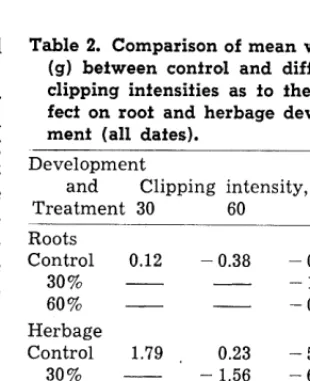
reduced root growth (Table 2).
Light use appeared to stimu- late root production as compared to no use, but this could not be
demonstrated statistically. Aver-
age root production for the con- trol plants was 0.95 g greater than that of 90% use; 0.38 g greater than 60% use; and 0.12 g less than 30% use.
Herbage production from
Table 2. Comparison of mean values (g) befween control and differenf clipping infensifies as fo fheir ef- fecf on roof and herbage develop- menf (all dafes).
Development
and Clipping intensity, %
Treatment 30 60 90
Roots
Control 0.12 - 0.38 - o*glj::’
30% - - - 1.07”
60% - - - 0.57”
Herbage
Control 1.79 , 0.23 - 5.18” 30% - - 1.56 - 6.97”
60% - -- - 5.41*
* Significant difference at 95% prob- ability level.
plants subjected to varying de-
grees of use followed the same
pattern as root production
(Table 1). Although the light de- gree of use appeared to stimulate
herbage production, only the
plants which were clipped most
severely differed significantly
from the unclipped plants in
yield of herbage (Table 2).
Even though an interaction
between intensity and tiller
stage could not be statistically
demonstrated, it appeared that
90% use at the 8-tiller stage de- pressed the yields of both root and herbage more severely than
Table 1. Characferisfics of cane bluesfem plank harvested by clipping af different intensifies af various sfages of seedling developmeni and compared to unclipped plank.
Days Number Herbage Root
Tiller between Percent of weight weight,
Stage Clippings removal tillers grams1 grams
PRETILLER 0 90 13.6 12.01 2.13
60 14.8 16.99 2.65
30 14.3 15.74 2.74
4 11 90 15.4 11.41 2.34
60 16.8 15.57 2.52
30 15.7 18.28 3.29
8 11 90 15.4 11.41 2.34
60 16.8 15.57 2.52
30 13.6 16.69 3.17
12 13 90 16.4 9.99 2.00
60 14.8 13.50 2.22
30 17.7 17.69 2.98
CONTROL 16 0 14.0 15.34 -____- 2.93
1 Sum of weight of above ground vegetative material removed at matura- tion plus weight of material removed at clipping. Oven-dried at 60 C for
clipping at any other stage of de-
velopment (Table 1) . This may
be related to the ontogenetic de-
velopment of seedlings. Root
and shoot development were
slow until 3 or 4 tillers were
initiated (Fig. 1). Development
of both was concurrent and rapid after this stage. Therefore, exces-
sive removal of photosynthetic
material during this period could
have a very adverse affect on
subsequent development. The
effects of herbage removal prior to this stage could be offset with sufficient time to recover and re- moval after this stage could be partially offset with greater root
and herbage development prior
to clipping.
This study has shown that if
further development of grass
roots is interrupted for 6 to 18
days, as recorded by Crider
(1955)) this interruption is not
reflected in total production
after post-harvest intervals rang- ing up to 51 days except with re- moval of 90% of the herbage.
Both Robertson (1933) and
Thaine and Heinrichs (1951)
demonstrated that repeated har-
vesting of seedlings was detri-
mental. The results from this
study indicate that seedlings can be harvested judiciously the first year without damage, provided
the harvesting is neither exces-
sive nor prolonged.
This study has shown that as much as 60% of the herbage can be removed from new plants at
any stage of development with-
out depressing the production of either roots or herbage. Although
it was not demonstrated conclu-
sively, there was some indication
that a single harvesting of 30%
of the herbage might stimulate
subsequent growth.
Summary and Conclusions
The effects of removing 30, 60, and 90% of the herbage at sev-
eral stages of development (pre-
tiller, 4-tiller, 8-tiller, and 12-
tiller stage) was studied using
first-year plants of cane blue-