Short Redactable Signatures Using Random
Trees
⋆Ee-Chien Chang Chee Liang Lim Jia Xu Department of Computer Science
National University of Singapore
{changec, xujia}@comp.nus.edu.sg
Abstract. A redactable signature scheme for a string of objects sup-ports verification even if multiple substrings are removed from the orig-inal string. It is important that the redacted string and its signature do not reveal anything about the content of the removed substrings. Existing schemes completely or partially leak a piece of information: the lengths of the removed substrings. Such length information could be crucial for many applications, especially when the removed substring has low entropy. We propose a scheme that can hide the length. Our scheme consists of two components. The first component H, which is a “colli-sion resistant” hash, maps a string to an unordered set, whereby existing schemes on unordered sets can then be applied. However, a sequence of random numbers has to be explicitly stored and thus it produces a large signature of size at least (mk)-bits where m is the number of objects andk is the size of a key sufficiently large for cryptographic operations. The second component uses RGGM tree, a variant of GGM tree, to gen-erate the pseudo random numbers from a short seed, expected to be of sizeO(k+tklogm) wheretis the number of removed substrings. Unlike GGM tree, the structure of the proposed RGGM tree is random. By an intriguing statistical property of the random tree, the redacted tree does not reveal the lengths of the substrings removed. The hash functionH
and the RGGM tree can be of independent interests.
Key words:Redactable Signature Scheme, Random Tree, Privacy
1
Introduction
We are interested in a signature scheme for strings of objects whereby the au-thenticity of a string can be verified even if it is redacted, that is, some substrings have been removed. Let x =x1x2. . . xm be a string, for example a text docu-ment where each object can be a character or a word, or an audio file where each object is a sample. The string x is signed by the authority and both the string and its signature (x,s) are passed to another party, say Alice. Alice wants to show Bob x but Bob is not authorized to view certain parts of the string,
sayx2x3x4andx7. Thus, Alice shows Bobex=x1⋄x5x6⋄x8. . . xmwhere each
⋄ indicates the location of a removed substring. On the other hand, Bob may want to verify the authenticity ofex. A redactable signature scheme allows Alice to produce a valid signaturees for the redacted stringxe, even if Alice does not have the authority’s secret key. From the new signaturees, Bob can then verify that exis indeed a redacted version of a string signed by the authority.
Unlike the usual signature schemes, redactable signature scheme has addi-tional requirement on privacy: information of the removed strings should be hidden. In this paper, we consider the stringent requirement that, Bob could not obtain any information of any removed substring, except the fact that a non-empty substring has been removed at each location⋄. This simple requirement turns out to be difficult to achieve. Existing schemes are unable to completely hide a piece of usually important information: the length of each removed sub-string. Note that information on length could be crucial if the substring has low entropy. For example, if the substring is either “Approved” or “Not Approved”, then its length reveals everything. There are scenarios and applications where the lengths of the removed strings should not be hidden. As noted by Johnson et al. [JMSW02], semantic attack could be possible in some scenarios if the length information is hidden. On the other side, there are also applications where the fact that a string has been redacted must be hidden. Our scheme can be modi-fied to cater for the above scenarios. The redactable signature scheme proposed by Johnson et al. [JMSW02] employs a Merkle tree [Mer80] and a GGM tree [GGM86] to generate a short signature. However, it is easy to derive the length from the structures of the redacted Merkle and GGM trees. A straightforward modification by introducing randomness into the tree structure also does not hide the length completely. Schemes by Johnson et al. [JMSW02] (set-homomorphic signatures) and Miyazaki et al. [MHI06] are designed for unordered sets and are not applicable for a string. A way to extend their schemes to strings is by assign-ing a sequence of increasassign-ing random numbers to the objects [MHI06]. However, this leads to large signatures since the random numbers have to be explicitly stored, and more importantly, it is insecure since the gaps in the sequence reveal some information about the number of removed objects.
In this paper, we propose a scheme that can hide the lengths of the removed substrings. Our scheme incorporates two components: a hash, and a random tree with a hiding property. We first give a schemeRSS using the first component, and then another scheme SRSS with both components. The first component hashes a string of objects to an unordered set. For the unordered set, existing redactable schemes [MHI06,JMSW02] on unordered sets can be applied. The schemeRSSsatisfies the requirements on unforgeability and privacy preserving under reasonable cryptographic assumptions. However, it produces a large sig-nature. Essentially, the main portion of the signature is a sequence of random numbershr1, r2, . . . , rmi, where eachri is associated with thei-th object in the string.
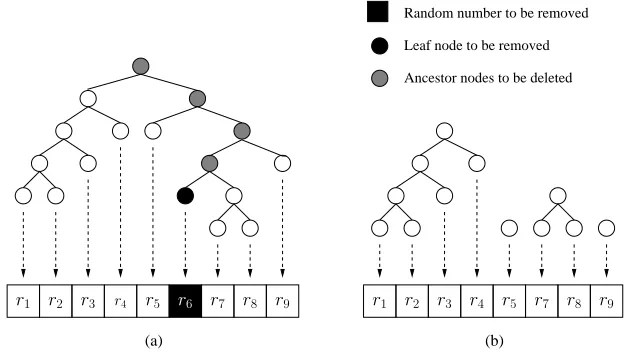
seedt. If a substring is removed, the corresponding random numbers have to be removed accordingly. Thus, generating the random numbers iteratively starting from the seed violates privacy, since the seedt reveals all the random numbers. We employ a variant of GGM binary tree to generate theri’s in a top-down manner, where theri’s are at the leaves, and the seedtis at the root. Unlike the GGM tree which is balanced, we use a random binary tree where thestructure of the binary tree is random. After a substring is removed, the associated leaves and all their ancestors are to be removed, resulting in a collection of subtrees (Figure 1). The roots of the subtrees collectively form the new seed et for the redactedri’s. Note that from the structures of the subtrees, an adversary might still derive some information of the length of a removed substring. Our main observation is that, by choosing an appropriate tree generation algorithm, the structure of the subtrees reveals nothing about the size of the original tree. Consider a game between Alice and Bob. Suppose Alice randomly picks a binary tree and it is equal likely that the tree contains 1000 leaves or 9 leaves. Now Alice redacts the tree by removing one substring and only 8 leaves are left. From the structure of the remaining subtrees (for example Figure 1(b)), Bob tries to guess the size of the original tree. Now, if Alice employs a tree generation algorithm with the hiding property, Bob cannot succeed with probability more than 0.5. This hiding property is rather counter-intuitive. Since the size of the tree is involved in the tree generation and thus intuitively the information about the size of the tree is spread throughout the tree. Thus it is quite surprising that the global information on size can be completely removed by deleting some nodes.
(a) (b)
Ancestor nodes to be deleted Leaf node to be removed Random number to be removed
r1 r2 r3 r4 r5 r6 r7 r8 r9 r1 r2 r3 r4 r5 r7 r8 r9
Fig. 1. Redacting the tree in (a) by removingr6, gives rise to the redacted tree (b).
Contribution and Organization.
FromHwe obtainRSS, a redactable signature scheme for strings. Unlike previ-ously known methods,RSSis able to hide the lengths of the removed substrings. We show that RSS is secure against chosen message attack (Theorem 2) and privacy preserving (Theorem 3) under resonable assumptions, which are weaker than random oracle assumption. However, the signature size is large. It consists of km+kt+κbits, whereκ is the size of the signature produced by a known redactable signature scheme for unordered sets, m is the number of objects in the redacted string, t is the number of substrings removed, and k is a security parameter (e.g.k= 1024).
2. We observe a hiding property of a random tree (Theorem 4). Based on the observation, we propose RGGM, a pseudo random number generator which can be viewed as a randomized version of GGM [GGM86]. If multiple substrings of pseudo random numbers are to be removed, we can efficiently find a new seed that generates the retained numbers, and yet it is computationally difficult to derive the content and length of each removed substring from the new seed, except the locations of the removed substrings.
3. We proposeSRSS by incorporating RGGM intoRSS. The expected size of the signature is inκ+O(k+ktlogm).SRSS is secure against chosen message attack (Corollary 5) and privacy preserving (Corollary 6).
2
Related Work
Johnson et al. [JMSW02] introduced redactable signature schemes which en-able verification of a redacted signed document. Signature scheme with simi-lar property has also been proposed for XML documents [SBZ01], where the redaction operation is to remove XML nodes. Redactable signatures are exam-ples of homomorphic signatures which are introduced by Rivest in his talks on “Two New Signature Schemes” [Riv01] and formalized by Johnson et al. [JMSW02]. Micali et al. [MR02] gave a transitive signature scheme as the first construction of homomorphic signatures. They also asked for other possible “sig-nature algebras”. The notions on homomorphic sig“sig-natures can be traced back to incremental cryptography, introduced by Bellare, Goldreich and Goldwasser [BGG94,BGG95]. Recently, Ateniese et al. [ACMT05] introduced sanitizable sig-nature scheme [KL06,IKTY05,STT06,MHI06,YSLM08] allowing a semi-trusted censor modifies the signed documents in a limited and controlled way.
The redactable signature scheme on strings is closely related to directed tran-sitive signature scheme [MR02,Yi07]. It is possible to convert a directed trantran-sitive signature scheme to a redactable signature scheme on strings. However, existing directed transitive signature schemes do not provide privacy in the sense that the resulting signatures reveal some information about the removed substrings.
3
Formulation and Background
A string is a sequence of objects from an object space (or alphabet)O. For example,Ocan be the set of ASCII characters, collection of words, or audio sam-ples, etc. After a few substrings are removed fromx, the stringxmay break into substrings, say x1,x2, . . . ,xu. The redacted string (ex,e), which we call
anno-tated string1, is represented by the string
e
x=x1kx2k. . .kxuand anannotation
e=hm, b1, b2, . . . , bviwherekdenotes concatenation,bi’s is a strictly increasing
sequence indicating the locations of the removed substrings,mis the number of objects inxe, andv∈ {u−1, u, u+ 1}. For eachi,bi indicates that a non-empty substring has been removed in between the bi-th and (1 +bi)-th locations. If b1= 0 orbv =m, this indicates that a non-empty substring has been removed at the beginning or end of the string respectively. For example, (abcda,h5,0,3i) is a redacted string of the originalxxxabcyyyda. For convenient, we sometimes use a sequence of objects like hx1, x2, x3, . . . , xmi and a string of objects like x1x2x3. . . xminterchangeably.
Let us define a binary relation≻between annotated strings. Given two an-notated strings X1 = (x1,e1) andX2 = (x2,e2), we say X1 ≻ X2, if either x2
can be obtained from x1 by removing a non-empty substring inx1, and thee2
is updated frome1 accordingly, or there is aX s.t.X1≻ X andX ≻ X2.
Definition 1 (Redactable Signature Scheme [JMSW02]) A redactable sig-nature scheme with respect to binary relation⊢, is a tuple of probabilistic poly-nomial time algorithms (KGen,Sign,Verify,Redact), such that
1. for any messagex, σ=SignSK(x)⇒VerifyPK(x, σ) =TRUE;
2. for any messagesxandy, such thatx⊢y,
VerifyPK(x, σ) =TRUE∧σ ′=
RedactPK(x, σ, y)⇒VerifyPK(y, σ ′) =
TRUE,
where(PK,SK)←KGen(1k)andk is the security parameter.
Both Johnson et al.[JMSW02] and Miyazaki et al.[MHI06] presented a redactable signature scheme w.r.t superset relation. Johnson et al.[JMSW02] also gave se-curity definition for homomorphic signature schemes. We adapt their definition for redactable signature scheme. Let⊢ denote a binary relation. For any setS, letspan⊢(S) denote the set{x:∃y∈S, s.t.y⊢x}.
Definition 2 (Unforgeability of Redactable Signature Scheme [JMSW02]) A redactable signature schemehKGen,Sign,Verify,Redactiis(t, q, ǫ)-unforgeable against existential forgeries with respect to ⊢ under adaptive chosen message attack, if any adversary A that makes at mostq chosen-message queries adap-tively and runs in time at most t, has advantage AdvA ≤ ǫ. The advantage of an adversary A is defined as the probability that, after queries on ℓ (ℓ ≤q) messages x1, x2, . . . , xℓ, A outputs a valid signature σ for some message x 6∈
span⊢({x1, x2, . . . , xℓ}). Formally,
AdvA=Pr
(PK,SK)←KGen(1k); ASignSK = (x, σ);
VerifyPK(x, σ) =TRUEandx6∈span⊢({x1, x2, . . . , xℓ})
,
where the probability is taken over the random coins used byKGen,SignandA.
Redactable signature schemes have an additional security requirement on privacy [ACMT05]: the adversary should not be able to derive any information about the removed substrings from a redacted string and its signature.
Definition 3 (Privacy Preserving) A redactable signature scheme
hKGen,Sign,Verify,Redacti is privacy preserving if, given the public key PK
and any annotated stringsX1,X2,X, such that X1≻ X andX2≻ X, the
follow-ing distributions S1 andS2 are computationally indistinguishable:
S1={σ:σ=RedactPK(X1,SignSK(X1;r1),X;r2)},
S2={σ:σ=RedactPK(X2,SignSK(X2;r1),X;r2)},
where r1 and r2 are random coins used by Sign and Redact respectively, and
public/private key(PK,SK)is generated byKGen.
4
RSS
: Redactable Signature Scheme for Strings
We proposeRSS, a redactable signature scheme for strings that is able to hide the lengths of the removed substrings. Our approach is as follows: we first propose a hash functionHthat maps an annotated stringexand an auxiliary inputyto an unordered set. This hash is “collision resistant” and satisfies some properties on substring removal. Using H and some known redactable signature schemes for unordered sets, we have a redactable signature scheme for strings.
4.1 Hashing strings to unordered sets
LetHbe a hash function that maps an annotated stringXand an auxiliary input
y, which could be a sequence of numbers from a finite field, to a (unordered) set of elements from some universe. In our construction (Table 1), Hmaps the input to a set of 3-tuples fromZn×Zn×Zn, wherenis some chosen parameter. Definition 4 (Collision Resistant) His(t, ǫ)-collision-resistant if, for any algorithm Awith running time at mostt,
Pr[X16≻ X2 ∧ H(X2,y2)⊂ H(X1,y1)]≤ǫ,
where (X1,X2,y2) is the output of A on input y1, and the probability is taken
over uniformly randomly chosen y1 and random coins used byA.
To be used in constructing a secure string redactable signature scheme, be-sides collision resistance, the hash functionHis also required to be 1)“redactable”: given X1, X2 and y1, such that X1 ≻ X2, it is easy to find y2 such that
H(X1,y1) ⊃ H(X2,y2); 2) privacy preserving: H(X2,y2) must not reveal any
4.2 Construction of H
We present a hash functionH(·,·) in Table 1 based on some hash functionh.
Letnbe a RSA modulus, andh:Zn→Znbe a hash function. Givenx=x1x2. . . xm associated with annotation e,r =r1r2r3. . . rm, andw =w1w2w3. . . wm, where for eachi,xi, ri, wi∈Zn(i.e.x,randw are strings over alphabetZn), we defineHas
H((x,e),(r,w)),{ti:ti= (xi, ri, (w Qi
j=1h(rj)
i modn)),1≤i≤m}.
Table 1.Definition ofH(·,·).
Remarks on the construction of H.
1. The witness w should be consistent with the annotation e, because w is supposed to implicitly describe the locations of the removed substrings. For any 1 < i ≤ m, wi−1 6= wi means a non-empty substring has been removed just
between xi−1 and xi. If2 w1 6=g, this indicates that a non-empty substring is
removed from the front of the stringx. We assume that there are no substrings removed from the end of a string. Because of this correspondence, we may omit the explicit annotationein the use ofHfor simplicity.
2. It is crucial that the value of ri is explicitly represented in ti for each i (Table 1). If theri’s are omitted, then it is easy to find collisions.
Lemma 1 The hash function H as defined in Table 1, is (poly1(k),poly12(k))
-collision-resistant for any positive polynomials poly1(·) and poly2(·), where k
is the security parameter, i.e. the bit length of n, assuming that h is division intractable3 and always outputs odd prime integers, and Strong RSA Problem is hard.
Appendix A gives the proof sketch. Basically, the proof reduces Strong RSA Problem or Division Problem [GHR99] to the collision finding problem.
4.3 Construction of RSS
We construct a redactable signature scheme RSS, which consists of four algo-rithms TGen,Sign,Verify, andRedact, for strings with respect to binary rela-tion ≻ based on the hash function H defined in Table 1 and some redactable signature schemeSSSfor sets with respect to superset relation⊇.
2 Heregis an element of large order fromZ∗
n. If there are no redaction at the front of x,w1=g. See the use ofHin Table 3.
The signer chooses a RSA modulus n and an element g of large order in Z∗
n. Bothnand g are public. Let the object space beZn , that is, a string is a sequence of integers fromZn. Leth:Zn→Znbe a collision resistant hash which satisfies the division intractable property [GHR99] and always outputs odd prime numbers4. In practice, hash function likeh(x) =SHA1(x)k1 may be sufficient. Let
SSS = (keygen,sig,vrf,rec) be a redactable signature scheme for unordered sets w.r.t superset relation ⊇. The signer also needs to choose the public and secret key pair (PK,SK), which is actually used by the underlying signature scheme SSS. The details of KGen,Sign,Verify, and Redact are presented in Table 2, Table 3, Table 4 and Table 5.
The final signature of a string x1x2. . . xm consists of m random numbers r1, r2, . . . , rm, the witnessesw1, w2, . . . , wmwhere ri, wi ∈Zn for eachi, and a signature sconstructed by SSS. Recall that witness wi’s imply the annotation of stringx1x2. . . xm.
KGen. Given security parameterk.
1. Choose a RSA modulusn, and an elementgof large order inZn. 2. Run key generating algorithmkeygenon input 1k to get key (PK,SK). 3. Output (n, g,PK) as public key andSKas private key.
Table 2.RSS:KGen.
Sign. Givenx=x1x2. . . xmand its associated annotatione=hmi.
1. Let wi = g for each i. Choose m distinct random numbers r1, r2, . . . , rm. Let r=r1r2r3. . . rmandw=w1w2w3. . . wm. Compute
t=H((x,e),(r,w)).
2. Sign the settusingSSSwith the secret keySKto obtains:
s=sigS K(t).
3. The final signature consists of the random numbersri’s, witnesses wi’s, and the signatures. That is,
(r,w,s) or (r1, r2, . . . , rm; w1, w2, . . . , wm; s)
Table 3.RSS:Sign.
4 Gennaro [GHR99] gave a way to construct a hash function that is division intractable
Verify. Given a stringx=x1x2. . . xm associated with annotatione, its signature (r,w,s), the public informationn, g, and the public keyPKofSSS.
1. Ifeandware not consistent, outputFALSE. 2. Compute t=H(x,(r,w)).
3. (r,w,s) is a valid signature ofx underRSS, if and only ifsis a valid signature oftunderSSS, i.e.
vrfP K(t,s) =TRUE.
Table 4.RSS:Verify.
Redact. Given a stringx =x1x2. . . xmassociated with annotation e, and its sig-nature (r,w,s), wherer=r1r2. . . rm, w=w1w2. . . wm,the public informationn, g, public key PK for SSS, and (i, j) the location of the string to be removed (that is xixi+1. . . xjis to be removed).
1. Update e to obtain new annotation ˆe. Compute u=Qjk=ih(rk),to update the witnesses in the following way: for eachℓ > j, updatewℓ
ˆ
wℓ←wuℓ modn.
2. Let xˆ = x1x2. . . xi−1xj+1. . . xm, ˆr = r1r2. . . ri−1rj+1. . . rm and wˆ = w1w2. . . wi−1wˆj+1wˆj+2. . .wˆm. Compute
ˆt=H((ˆx,ˆe),(ˆr,wˆ)).
3. Compute
ˆs=recP K(t,s,ˆt) wheret=H((x,e),(r,w)).
4. Output (ˆr,wˆ,ˆs) as the signature of (ˆx,ˆe).
Table 5.RSS:Redact.
Theorem 2 RSSis(t, q, ǫ1
1−ǫ2)-unforgeable against existential forgeries with
re-spect to relation ≻, if SSSis(t+qt0, q, ǫ1)-unforgeable against existential
forg-eries with respect to superset relation⊇, andHis(t+qt1, ǫ2)-collision-resistant,
where t0 is the running time of H andt1 is the time needed by RSS to sign a
document.
Theorem 3 The redactable signature schemeRSSis privacy preserving (as de-fined in Definition 3), assuming that hash function hsatisfies the property: the two distributions X=gh(U1)h(U2) modnand Y=gh(U
′
1) modn are
computa-tionally indistinguishable, where n is a RSA modulus, g is an element of large order in Z∗
n and Ui’s and Uj′’s are all independent uniform random variables overZn.
The proof sketch of Theorem 3 is in Appendix C. Interestingly, RSS is privacy preserving, without any assumptions on the privacy preserving property ofSSS. This is because the relevant information is already removed byHduring redaction.
4.4 Efficiency
The size ofsdepends onSSS, and let us assume it requiresκbits. The number of distinctwi’s is about the same as the number of redactions occurred. Sowi’s can be represented in t(k+⌈logm⌉) bits, where t is the number of substrings removed, andkis the bit length ofn. Thus the total number of bits required is at mostk(m+t) +t⌈logm⌉+κ. One may ignore the termt⌈logm⌉since it is used to specify the locations of removed substrings, which could be treated as part of the message. Hence, the size of signature is essentiallykm+kt+κ. The dominant term iskm, which is the total size of the random numbersri’s.
Disregarding the time taken by the scheme SSS, and the time required to compute the hashh(·), during signing,O(m) ofk-bits exponentiation operations are required. During redaction, ifℓconsecutive objects are to be removed between position iand j, andt′ number of redactions have been made after positionj,
then the number ofk-bit exponentiation operations is at mostℓ(t′+ 1), which is
inO(ℓm). During verification,O(tm) number ofk-bits exponentiation operations are required. Hence, our scheme is suitable for small t, which is reasonable in practice. In sum, the main drawback ofRSS is the size of its signature. In the next section, we will reduce its size using a random tree.
5
RGGM: Random tree with Hiding property
We propose RGGM, a variant of GGM tree [GGM86] to generate a sequence of pseudo random numbers, where the structure of the tree is randomized. This generator provides us with the ability to remove multiple substrings5 of pseudo
random numbers, while still being able to generate the retained numbers from a short seed. The expected size of the new seed is in O(k+tklogm) wheret is the number of removed substrings,mis the number of pseudo random numbers, and kis a security parameter. More importantly, the new seed does not reveal any information about the size nor the content of the removed substrings.
5 A substring is as a subsequence where all the elements are consecutive elements in
Pseudo random number generation. To generatem pseudo random numbers we employ a method similar to that in the redactable signature scheme proposed by Johnson et al. [JMSW02], which is based on the GGM tree [GGM86]. Let G: K → K × Kbe a length-doubling pseudo random number generator. First pick an arbitrary binary tree T with m leaves, where all internal nodes of T have exactly two children, the left and right child. Next, pick a seedt∈ K uni-formly at random, and associate it with the root. The pseudo random numbers r1, r2, . . . , rmare then computed fromtin the usual top-down manner along the
binary tree.
Hiding random numbers. Ifriis to be removed, the associated leaf node and all its ancestors will be removed, as illustrated by the example in Figure 1(b). The values associated with the roots of the remaining subtrees, and a description of the structure of the subtrees, form the new seed, whereby the remaining random values rj’s (j 6= i) can be re-computed. By the property of G, it is computationally difficult to guess the removed valueri from the new seed.
TreeGen: Givenm, output a binary treeT withmleaves:
1. Pick apuniformly at random from{1,2, . . . , m−1}. 2. Recursively generate a treeT1 withpleaves.
3. Recursively generate a treeT2 withm−pleaves.
4. Output a binary tree withT1 as the left subtree andT2 as the right subtree.
Table 6.TreeGen: a random tree generation algorithm
Unlike the method proposed by Johnson et al. [JMSW02], our treeT is ran-domly generated. If the tree is known to be balanced (or known to be of some fixed structure), some information on the number of leaf nodes removed can be derived from the redacted tree. Our random trees are generated by the proba-bilistic algorithmTreeGenin Table 6. Note that descriptions of the structure of the tree are required for the regeneration of the random valuesri’s.
At the moment, for ease of presentation, the descriptions are stored together with the seed. This increases the size of the seed. To reduce the size, we can replace the description by another short random seed ˆt, which is assigned to the root. The random input required in Step 1 of the algorithm can be generated from ˆ
t usingG. A difference between the two methods of storing the (redacted) tree structure information is that in the former, we will have a information theoretic security result, whereas in the later, the security depends on the security ofG.
Notations. Given a binary tree T, its leaf nodes can be listed from left to right to obtain a sequence. We call a subsequence of consecutive leaves a sub-string of leaves. After multiple subsub-strings of leaves and all of their ancestor nodes are deleted, the remaining structures form a redacted tree6 represented by two
sequences, T = hT1, T2, . . . , Tvi and b =hm, b1, b2, . . . , bui. whereTi’s are the
subtrees retained, and each bi indicates that a substring was removed between thebi-th and (bi+ 1)-th locations in the remaining sequence of leaf nodes. Let qi be the number of leaves that were removed in this substring. We call the se-quence hm,(b1, q1),(b2, q2), . . . ,(bu, qu)itheoriginal annotationofb. Thus, the total number of leaf nodes removed is Pui=1qi.
Let us consider this process. Given an original annotationb1=hm,(b1, q1),
(b2, q2), . . . ,(bu, qu)i, for a string of sizem, a random treeT of sizem+Pui=1qi is generated usingTreeGen, and then redacted according tob1. LetRED(b1) be
the redacted tree.
From an adversary’s point of view, he has RED(b1), represented as (T,b),
and wants to guess the qi’s in the original annotation b1, or the original total
number of leaf nodes. We want to show that the additional knowledge ofTdoes not improve his chances, compared to another adversary who only has b. It is suffice to show that, given anyband any two possible original annotations b1
andb2, the conditional probabilities of obtaining (T,b) are the same. That is,
Theorem 4 For any redacted tree(T,b), any distributionBon the original an-notation, and b1 = hm,(b1, q1),(b2, q2), . . . ,(bu, qu)i, b2 = hm,(b1, q′1),(b2, q2′),
. . . ,(bu, qu′)i,
Prob(RED(B) = (T,b)| B=b1) =Prob(RED(B) = (T,b)| B=b2)
The proof is given in Appendix D.
6
SRSS
: A Short Redactable Signature Scheme for
Strings
RSS produces a large signature, whose main portion is a sequence of true ran-dom numbers ri’s. We can combine RGGM with RSS to produce a short sig-nature by replacing theri’s with pseudo random numbers generated by RGGM. Let us call this combined schemeSRSS, short redactable signature scheme for strings.
It is easy to show that SRSS is unforgeable and privacy preserving from Lemma 1, Theorem 2, Theorem 3, Theorem 4, and the fact that RGGM is a pseudo random number generator.
Unforgeability. From the definition of cryptographic secure pseudo random number generator and Theorem 2, we conclude thatSRSS is unforgeable.
Corollary 5 For any positive polynomials (inκ)tandq,SRSS is(t, q, ǫ1
1−ǫ2)
-unforgeable against existential forgeries with respect to≻, ifSSSis(t+qt0, q, ǫ1)
-unforgeable against existential forgeries with respect to ⊇, H is (t +qt1, ǫ2)
-collision-resistant, andGis a cryptographic secure pseudo random number gen-erator, wheret0is the running time ofH,t1is the time needed bySRSS to sign
a document, and κis the security parameter.
Privacy. From the definition of cryptographic secure pseudo random num-ber generator, Theorem 3 and Theorem 4, we conclude that SRSS is privacy preserving.
Corollary 6 The redactable signature schemeSRSSis privacy preserving (as defined in Definition 3), assuming that the hash functionhsatisfies the property: the two distributions X =gh(U1)h(U2) modn and Y =gh(U
′
1) modn are
com-putationally indistinguishable, and G is a cryptographic secure pseudo random number generator, wheren is a RSA modulus,g is an element of large order in Z∗
n and Ui’s and Uj′’s are all independent uniform random variables over Zn, andh(·)is used to defineHin Table 1.
Efficiency. The improvement ofSRSSis in signature size. Given the unredacted string, the size of the signature is κ+ 2k, where κis the signature size ofSSS, andk is the length of each seed. Recall that we need two seeds in RGGM, one for the generation of the numbers, and the other for the tree structure.
Iftsubstrings are removed, the signature size is κ+tk+O(ktlogm), where the termtkis for the witness, and O(ktlogm) is required for the RGGM.
7
Other variants
7.1 Allowing removal of empty substring
Both RSS and SRSS do not allow removal of empty substrings. In fact, it is considered to be a forgery if a censor declares that a substring has been removed but actually he/she doesnot remove anything.
It is desirable to allow removal of empty substrings in some application sce-narios. This can be achieved by slight modifications to our schemes. To sign a string x1x2. . . xm, special symbol ♮ is inserted to obtain the expanded string
e
x=♮x1♮x2♮ . . . ♮xm♮which will be signed directly using RSS or SRSS. To re-move a substring x0, the expanded substring ofx0 is actually removed. In the
case where a substring has already being removed in front or at the end of x0,
7.2 Hiding the fact that the string is redacted
There is a question on whether one should hide the location of a removed sub-string or even the occurrence of redaction. This requirement is also known as invisibilityortransparency[ACMT05,MHI06]. For a small object space, if invisi-bility is satisfied, a censor may take a long signed string, remove some substrings to form an arbitrary “authentic” short string. Nevertheless, some applications may need invisibility.
Here is a simple variation of RSS that achieves this. To sign a string, sim-ply add a special symbols ♯in-between any two consecutative objects. Sign the expanded string and then immediately redact it by removing all ♯’s. Redaction and verification is the same as before.
However, this variant produces a large signature even if we useSRSS. Fur-thermore, the computation during verification is high. At leastΩ(m2)
exponen-tiation operations are required.
To reduce the size of signature, there is an alternative: sign all the pairs of objects. To sign the string x = x1x2x3. . . xm, first generate random numbers
r1, r2, . . . , rm such that rikxi’s are distinct. Next, let t be the set of all pairs
{(rikxi, rjkxj)}i<j and employ SSS to signt. When an objectxiis to be removed, simply remove all the pairs that involvexi from t.
Since the role ofri is to ensure that all elements are distinct, the size of each ri can be smaller than the random numbers required byRSS.
8
Discussion and Conclusion
We considered a simple but difficult requirement in redactable signature scheme: hiding the lengths of the removed substrings. We exploited an intriguing statis-tical property of random trees, and employed a hash from strings to unordered sets to achieve the requirement. Although the signature is short, its size still depends on the number of substrings removed and the length of the string. In contrast, there are known schemes for unordered sets, whose signature size is a constant. Intuitively, the larger signature size is the price that we need pay for the ordering information. To keep the same ratio of message space size to the signature space size, the signature size of string with length m should be aboutmlogmtimes larger than that for corresponding unordered set. The com-putation time required during verification is high for long strings when many substrings are removed. It is interesting to find a practical way to organize the string hierarchically, so as to achieve speedup.
References
[ACMT05] Giuseppe Ateniese, Daniel Chou, Breno Medeiros, and Gene Tsudik. San-itizable signatures. InESORICS, pages 159–177, 2005.
[BGG94] Mihir Bellare, Oded Goldreich, and Shafi Goldwasser. Incremental cryp-tography: The case of hashing and signing. In CRYPTO, pages 216–233, 1994.
[BGG95] Mihir Bellare, Oded Goldreich, and Shafi Goldwasser. Incremental cryp-tography and application to virus protection. InSTOC, pages 45–56, 1995. [CLX09] Ee-Chien Chang, Chee Liang Lim, and Jia Xu. Short redactable signatures
using random trees. InCT-RSA, pages 133–147, 2009.
[GGM86] Oded Goldreich, Shafi Goldwasser, and Silvio Micali. How to construct random functions. J. ACM, 33(4):792–807, 1986.
[GHR99] Rosario Gennaro, Shai Halevi, and Tal Rabin. Secure hash-and-sign signa-tures without the random oracle. InEUROCRYPT, pages 123++, 1999. [IKTY05] Tetsuya Izu, Nobuyuki Kanaya, Masahiko Takenaka, and Takashi Yoshioka.
Piats: A partially sanitizable signature scheme. In ICICS, pages 72–83, 2005.
[JMSW02] Robert Johnson, David Molnar, Dawn Song, and David Wagner. Homo-morphic signature schemes. InCT-RSA, pages 244–262, 2002.
[KL06] Marek Klonowski and Anna Lauks. Extended sanitizable signatures. In
ICISC, pages 343–355, 2006.
[Mer80] Ralph Merkle. Protocols for public key cryptosystems. InSP, page 122, 1980.
[MHI06] Kunihiko Miyazaki, Goichiro Hanaoka, and Hideki Imai. Digitally signed document sanitizing scheme based on bilinear maps. In ASIACCS, pages 343–354, 2006.
[MR02] Silvio Micali and Ronald Rivest. Transitive signature schemes. InCT-RSA, pages 236–243, 2002.
[Riv01] Ronald Rivest. Two new signature schemes.
Presented at Cambridge seminar, 2001.
http://www.cl.cam.ac.uk/Research/Security/seminars/2000/rivest-tss.pdf. [SBZ01] Ron Steinfeld, Laurence Bull, and Yuliang Zheng. Content extraction
sig-natures. InICISC, pages 163–205, 2001.
[STT06] Manabu Suzuki, Isshiki Toshiyuki, and Keisuke Tanaka. Sanitizable signa-ture with secret information. Technical report, Dept. of Mathematical and Computing Sciences, Tokyo Institute of Technology, 2006.
[Yi07] Xun Yi. Directed transitive signature scheme. InCT-RSA, pages 129–144, 2007.
[YSLM08] Tsz Hon Yuen, Willy Susilo, Joseph K. Liu, and Yi Mu. Sanitizable signa-tures revisited. InCANS ’08: Proceedings of the 7th International Confer-ence on Cryptology and Network Security, pages 80–97, 2008.
A
Proof of Lemma 1
Lemma 1. The hash function Has defined in Table 1, is (poly1(k),poly1
2(k)
)-collision-resistant for any positive polynomials poly1(·) and poly2(·), where k
intractable7 and always outputs odd prime integers, and Strong RSA Problem
is hard.
Proof. (Sketch) Suppose there exists a probabilistic polynomial time algorithm
A, which takes as input (r1,w1), and outputs (x1,e1),(x2,e2), and (r2,w2),
such that ((x2,e2),(r2,w2)) is a collision with ((x1,e1),(r1,w1)) with noticeable
probability.
We first consider the special case where w1 = hg, g, . . . , g
| {z } m g’s
i and e1 = hmi.
Letx1 =x1,1x1,2. . . x1,m,x2=x2,1x2,2. . . x2,m′,r
1 =hr1,1, r1,2, . . . , r1,mi,r2 =
hr2,1, r2,2, . . . , r2,m′i,w
2=hw1, w2, . . . , wm′ifor somem′< m. By the definition
of collision, we have
(x1,e1)6≻(x2,e2) ∧
H((x2,e2),(r2,w2)) ={t2,1, . . . , t2,m′} ⊂
H((x1,e1),(r1,w1)) ={t1,1, . . . , t1,m}, where for eachi,t1,i= (x1,i, r1,i, (g
Qi
j=1h(r1,j) modn)) and
t2,i= (x2,i, r2,i, (wi Qi
j=1h(r2,j) modn)).
There are two different cases of collisions: 1)x2 is not a substring ofx1, e.g.
x1=abc,x2=cb; 2)x2is a substring ofx1 but their annotationse1ande2are
incompatible, e.g.x1=abc,w1=ggg,e1=h3i, andx2=ac,w2=gg,e2=h2i.
Case 1: x2 is not a substring of x1. the sequence ht2,1, t2,2,· · ·, t2,m′i must
be a re-permutation of some subsequence of the sequence ht1,1, t1,2,· · ·, t1,mi. Thus, there must be a swap of positions, i.e. there are indicesa, b, canddsuch that a < b,c < d, andt1,a=t2,dandt1,b=t2,c. That means,
(x1,a, r1,a, gA) = (x2,d, r2,d, wEFd ), and (x1,b, r1,b, gAB) = (x2,c, r2,c, wcE), whereA=Qai=1h(r1,i), B=Qbi=a+1h(r1,i), E=Qci=1h(r2,i), F =Qdi=c+1h(r2,i).
Next we can conduct a case analysis based on whetherEF dividesA, to find a contradiction with our assumptions. IfEF does not divideA(with noticeable probability), we could solve the Strong RSA Problem based on algorithm A
using similar techniques in the proof of Theorem 5 in [GHR99]; otherwise we could solve the Division Problem [GHR99].
Case 2: x2 is a substring of x1 but they have incompatible annotations. Let
e3 be the annotation such that (x1,e1)≻(x2,e3). Let w3 = w3,1. . . w3,m′ be
the witness obtained from step 1 of Table 5 when redacting ((x1,e1),(r1,w1))
to produce a signature for the annotated substring (x2,e3). We know
H((x2,e3),(r2,w3))⊂ H((x1,e1),(r1,w1))
and
H((x2,e2),(r2,w2))⊂ H((x1,e1),(r1,w1)).
Because distinct random numbersr1,i’s and r2,j’s are involved in the output of
H, we conclude thatH((x2,e3),(r2,w3)) =H((x2,e2),(r2,w2)). We also know
w2 and w3 implies different annotations e2 ande3, so w2 6=w3. That means
there exists an indexi,1≤i≤m′, such that
w2,i6=w3,i andw2Q,i=w Q
3,i modn, (1) where Q=Qij=1h(r2,j) is an odd number. Recall thatn=pq,p= 2p′+ 1, q=
2q′+ 1 andp, q, p′, q′are all prime numbers. Letλ(n) =lcm(p−1, q−1) = 2p′q′.
SupposeQis coprime withλ(n). Thenw2Q,i =w3Q,i modn impliesw2,i =w3,i,
which is a contradiction with Eq 1. So we conclude that the odd numberQand λ(n) = 2p′q′have common factors, i.e.,p′ orq′dividesQ. W.L.O.G., we assume
p′|Q.
Because h(·) outputs odd prime number only, there must exist ξ,1 ≤ ξ ≤
m′, h(r
2,ξ) = p′. Consequently, 2h(r2,ξ) + 1 divides n, and we can factorize n
efficiently by trying everyh(r2,i),1≤i≤m′.
In the beginning of the proof, we assume thatw1 =hg, . . . , gi. For case 1,
it is easy to generalize the proof for general w1 = hw1,1, w1,2, . . . , w1,mi using similar techniques in the proof of Theorem 5 in [GHR99], by randomly guessing the index aand settingw1,a=s; for case 2, there is no need of changes in the proof.
B
Proof of Theorem 2
Theorem 2. The schemeRSSas constructed in Table 3, Table 4 and Table 5, is (t, q, ǫ1
1−ǫ2)-secure against existential forgeries with respect to≻, ifSSSis (t+
qt0, q, ǫ1)-secure against existential forgeries with respect to ⊇, andH is (t+
qt1, ǫ2)-collision-resistant, wheret0 is the running time of Hand t1 is the time
needed byRSS to sign a document.
Proof: We prove this theorem using proof by contradiction. LetORSS andOSSS
denote the oracles for Signalgorithms of RSS and SSSrespectively, and both use the same public/private key (PK,SK). Suppose there exists an adversaryA
againstRSS, such thatAruns in time at mostt, makes at mostqchosen-message queries to ORSS, and has advantage AdvA > ǫ
3 = 1−ǫ1ǫ2. Let x1,x2, . . . ,xℓ
denote the ℓ(≤ q) messages (annotated strings of objects) chosen by A, and (σi,ri) be the reply fromORSS for query xi. Let (x,(σ,r)) denote the output
ofA.
AdvA=Pr(VerifyPK(x,(r, σ)) =TRUE ∧ x6∈span≻(x1,x2, . . . ,xℓ))> ǫ3.
1. Run algorithmA. 2. Receive queryxi from A.
3. Choose a random coin ri, and compute H(xi,ri). Make query H(xi,ri) to
OSSSand get replyσi.
4. Reply (σi,ri) toAcorresponding to the queryxi. 5. If receiving another query fromA, go to Step 2. 6. Receive output (x,(σ,r)) fromA.
7. Output (H(x,r), σ).
The number of queries made toOSSS by B equals to the number of queries
made to (simulated)ORSS byA. The running time ofB is at mostt+qt
0.
With probability larger thanǫ3, (x,(σ,r)) is an existential forgery w.r.t to
RSS, formally
Pr(VerifyPK(x,(r, σ)) =TRUE ∧ x6∈span≻(x1,x2, . . . ,xℓ))> ǫ3.
Supposexi6≻xfor anyi. BecauseHis (t+qt1, ǫ2)-collision-resistant and real
running time (taking the time for signing into account) ofAis at most t+qt1,
we have
Pr ∨ℓ
i=1(H(x,r)⊆ H(xi,ri))
≤ǫ2.
Hence, Pr
vrfPK(H(x,r), σ) =TRUE∧
H(x,r)6∈span⊇(H(x1,r1),H(x2,r2), . . . ,H(xℓ,rℓ))
> ǫ3(1−ǫ2) =ǫ1.
That means B is an existential forger againstSSS: B runs in time at most t+qt0, makes at mostqqueries toOSSS, and has advantage larger thanǫ1. This
is a contradiction with our assumption thatSSSis (t+qt0, q, ǫ1)-secure against
existential forgeries.
Hence, our hypothesis that there exists such adversaryAis wrong. In other words,RSS is (t, q, ǫ1
1−ǫ2)-secure against existential forgeries with respect to≻.
C
Proof of Theorem 3
Lemma 1. If the distributions ofX1 andX2 are computationally
indistinguish-able, then for any constant integersℓ, m >1, the distributions ofXℓ andXmare computationally indistinguishable, where for any integer N > 1, XN represents the random variable gh(U1)h(U2)h(U3)...h(UN) modn, n is a RSA modulus, g is
an element of large order in Z∗
n and Ui’s are all independent uniform random variables overZn.
Proof: (Sketch) Let X ∼ Y denote that the two distributions X and Y are computationally indistinguishable. For any ℓ≥2,X1 ∼X2 impliesXℓ ∼Xℓ+1.
Hence,
Xℓ∼Xm.
Theorem 3. The redactable signature scheme RSS is privacy preserving (as defined in Definition 3), assuming that hash functionhsatisfies the property: the two distributionsX=gh(U1)h(U2) modnandY=gh(U
′
1) modnare
compu-tationally indistinguishable, wherenis a RSA modulus,g is an element of large order inZ∗
nandUi’s andUj′’s are all independent uniform random variables over Zn.
Proof: W.L.O.G, we represent the three stringsx1,x2 andxas stated in
Defi-nition 3 in following way:
x1=x1x2x3. . . xa1y1xa1+1. . . xa2y2xa2+1. . . xaℓyℓxaℓ+1. . . xm x2=x1x2x3. . . xa1z1xa1+1. . . xa2z2xa2+1. . . xaℓzℓxaℓ+1. . . xm
x=x1x2x3. . . xa1⋄xa1+1. . . xa2⋄xa2+1. . . xaℓ ⋄xaℓ+1. . . xm
xis a string of sizemwithℓsubstrings being redacted at locationsa1, a2, a3, . . . , aℓ.
xcan be obtained fromx1by removing non-empty substringsy1,y2, . . . ,yℓ, or
fromx2 by removing non-empty substringsz1,z2, . . . ,zℓ.
For any sequenceb=hb1, b2, . . . , bmi, define h(b) as
h(b) = m Y
i=1
h(bi).
Denote withry,i (orrz,i) the sequence of random numbers associated with sub-stringyi(orzi) respectively. Denote withr1=hr1,1, r1,2, . . . , r1,mithe sequence of random numbers, which are associated withxi’s and chosen when signingx1.
Denote with r2 =hr2,1, r2,2, . . . , r2,mi the sequence of random numbers, which are associated withxi’s and chosen when signingx2. All r1,i and r2,i are inde-pendent uniform random numbers over the set of odd numbers inZn.
The signature ofxunder RSS by redactingx1 is
σ1=RedactPK(x1,SignSK(x1),x)
= (δ1,r1=hr1,1, r1,2, r1,3, . . . , r1,mi,w1=hw1,1, w1,2, w1,3, . . . , w1,mi) where for each 0≤i≤ℓ, assuminga0= 0, aℓ+1=m+ 1, h(ry,0) = 1,
w1,ai+1=w1,ai+2=. . .=w1,ai+1 =g
Qi
j=0h(ry,j) modn (2)
andδ1 is the signature underSSSof the following setH1
H1=H(x,(r1,w1)) =
s:s=
xi, r1,i,
w
Qi
j=1h(r1,j)
1,i modn
Similarly, the signature ofxunderRSS by redactingx2 is
σ2=RedactPK(x2,SignSK(x2),x)
= (δ2,r2=hr2,1, r2,2, r2,3, . . . , r2,mi,w2=hw2,1, w2,2, w2,3, . . . , w2,mi) where for each 0≤i≤ℓ, assuminga0= 0, aℓ+1=m+ 1, h(rz,0) = 1,
w2,ai+1=w2,ai+2=. . .=w2,ai+1=g
Qi
j=0h(rz,j) modn (3)
andδ2is the signature under SSSof the following setH2
H2=H(x,(r2,w2)) =
s:s=
xi, r2,i,
w
Qi
j=1h(r2,j)
2,i modn
.
Notew1,i’s and w2,i’s can be written in form of g
Q
h(·) modnas in
Equa-tion 2 and 3. So w1 and w2 are indistinguishable. Furthermore, w
Qi
j=1h(r1,j)
1,i modnandw
Qi
j=1h(r2,j)
2,i modnare indistinguishable for eachi. As a resultH1
is indistinguishable fromH2, and δ1 is indistinguishable fromδ2.
Hence,σ1andσ2 are computationally indistinguishable.
D
Proof of Theorem 4
.
Theorem 4. For any redacted tree (T,b), any distributionBon the original annotation, andb1=hm,(b1, q1),(b2, q2), . . . ,(bu, qu)i,
b2=hm,(b1, q1′),(b2, q′2), . . . ,(bu, q′u)i,
Prob(RED(B) = (T,b)| B=b1) = Prob(RED(B) = (T,b)| B=b2)
Proof: (Sketch)
1. Consider the random tree generation algorithm TreePermGen in Table 7, which takes in random permutations as the source of randomness. The distribu-tion of the random trees generated byTreePermGenis the same as the distribu-tion by TreeGen (Table 6). To see that, consider the root and its left subtree. The distribution of the size of the left subtree is the same for both algorithms. This observation can be generalized to the distribution of the whole tree.
Given a permutationπ and an original annotationb′, let us write A(π) as
the tree generated by TreePermGen. Recall that the tree is to be redacted by removing some leaves and all their ancestors, and the leaves to be removed are specified by an original annotationb′. Let us writeA(π,b′) as the redacted tree.
2. We now analyze original annotations of these special forms:
TreePermGen: Givenm, output a binary treeT withmleaves. During the execution of this algorithm, each node inT is associated with a subset of{1,2, . . . , m}. Denote by πma permutation onmelements{1,2, . . . , m}.
1. Randomly pick aπm−1.
2. LetS be a collection of sets, which is initially empty. LetT be an empty tree. 3. LetA={1,2,3, . . . , m}and associate it to a new nodep. AddAintoS, and insert
pintoT as the root node. 4. Fori= 1 tom−1,
(a) Find the setA∈ Ss.t.πm−1(i)∈A. Letpbe the node that is associated with
A. RemoveAfromS.
(b) DivideAinto two setsAleftandAright, where
Aleft=A∩ {1,2, . . . , πm−1(i)}, and
Aright=A∩ {πm−1(i) + 1, . . . , m}.
(c) Create two children forpand insert them intoT. AssociateAleft andAright
to the left and right children respectively. AddAleftandAright into S.
5. Output the final treeT, without the sets associated to its nodes.
Table 7.TreePermGen, a tree generation algorithm using random permutation.
for somei0andu. Under annotationb1, thei0-th substring that is being removed
haskitems. Let the last item in thisi0-th removed substring be thev-th item in
the original string, that is,v=bi0+k+
Pi0−1
j=1 qj. In contrast, under annotation
b2 the i0-th substring that is removed has k+ 1 items. Note that the tree on
which b1 is applied has m leaf nodes, and the tree on which b2 is applied has
m+ 1 leaf nodes, wherem=M +Puj=1qj andqi0 =k.
We want to show that, for any redacted tree, represented as (T,b), and any
b1andb2 as defined above, we have
m|{πm−1:A(πm−1,b1) = (T,b)}| = |{πm:A(πm,b2) = (T,b)}| (4)
Since a permutation is uniformly chosen in Step 1 ofTreePermGen, the con-ditional probability of obtaining (T,b) givenb1 is
1
(m−1)!|{πm−1:A(πm−1,b1) = (T,b)}| (5) and the conditional probability givenb2 is
1
m!|{πm:A(πm,b2) = (T,b)}| (6) From (4), we have (5)=(6), which is the result of this theorem forb1 andb2.
3. Given aπm−1, we associate it withmpermutations ofmelements. For each
πm,j(i) =
incr(πm−1(i)) ifi < j,
v ifi=j,
incr(πm−1(i−1)) otherwise,
(7)
where incr(x) = (
x ifx < v,
x+ 1 otherwise. (8)
In other words, we can associateπm−1tom permutations ofmelements by
insertingv into mpossible places in πm−1, and incrementing items larger than
v by one. For example, given the permutationh3,2,1,4iwhich generates a tree with the 2ndand 3rd leaf nodes removed,v= 3. Upon insertingv in between 2 and 1 in the permutation, the resultant permutation ish4,2,3,1,5i.
4. We claim thatπm−1andπm,j, for eachj, all lead to the same redacted tree. That is, for anyj
A(πm−1,b1) =A(πm,j,b2) (9)
5. There arem ways to insertv into πm−1. Thus, for anyπm−1, there arem
permutationπmthat leads to the same redacted tree. For a fixed 1≤v ≤m, (5) and (6) together maps a (πm, v, j) for any 1≤j≤m, to exactly oneπm−1, and
everyπm−1 is mapped to one (πm, v, j) for some j. Thus (5) and (6) together is a bijective mapping and this process will generate all possible πm from all possible πm−1, and we have the equality (4) and the result forb1 and b2. We
can generalize the claim to anyb1andb2that differs in more than one removed