THE COMPARISON OF IMAGE MANIFOLD METHOD AND VOLUME ESTIMATION METHOD
IN CONSTRUCTING 3D BRAIN TUMOR IMAGE
SHAMSHIYATULBAQIYAH BINTI ABDUL WAHAB
THE COMPARISON OF IMAGE MANIFOLD METHOD AND VOLUME ESTIMATION METHOD
IN CONSTRUCTING 3D BRAIN TUMOR IMAGE
SHAMSHIYATULBAQIYAH BINTI ABDUL WAHAB
A thesis submitted in partial fulfillment of the requirements for the award of the degree of
Master of Science (Mathematics)
Faculty of Science Universiti Teknologi Malaysia
To my beloved family and the person who loves me,
ACKNOWLEDGEMENTS
Bismillahirrahmanirrahim. In the name of Allah, The Most Greatest and Most Merciful. Praise Upon the Beloved Prophet, His Family and Companion. There is no power except by the power of Allah and I humbly return my acknowledgement that all knowledge belong to Allah. Alhamdulillah, I thank Allah for granting me this opportunity to broaden my knowledge in this field. Nothing is possible unless He made it possible.
First and foremost I would like to express my deepest appreciation to my supervisor, Associate Professor Dr. Norma bt Alias for her enthusiastic guidance, invaluable help, encouragement and patient for all aspect during this dissertation progress. Her numerous comments, criticism and suggestion during the preparation of this dissertation are gratefully praised.
I wish to express my thanks to Cik Maizatul Nadirah bt Mustaffa and Encik Mahardhika Candra Prasetyahadi who actually work tirelessly and patiently to guide me the most how to work with MATLAB software and 3D Image Slicer software until the completion of this thesis.
I acknowledge, appreciate, and return the love and support of my family, without whom I would be lost. To my father, Hj. Abdul Wahab bin Ibrahim and my mother, Hjh. Pauziah bt Natak, thank you very much for your continuous support. I also would like to express my thanks to my beloved siblings which gives me moral support through-out this dissertation.
ABSTRACT
ABSTRAK
TABLE OF CONTENTS
CHAPTER TITLE PAGE
TITLE DECLARATION DEDICATION ACKNOWLEDGEMENT ABSTRACT ABSTRAK
TABLE OF CONTENTS LIST OF FIGURES LIST OF TABLES
LIST OF ABBREVIATIONS LIST OF SYMBOL
LIST OF APPENDICES
i ii iii iv v vi vii x xii xiii xiv xv
1 INTRODUCTION
1.1 Introduction
1.2 Background of the Problem 1.3 Statement of the Problem 1.4 Objectives of the Research 1.5 Scope of the Research
1.5.1 The chart of the Research Scope 1.6 Significance of Study
1.7 Thesis Organization
2 LITERATURE REVIEW 2.1 Introduction
2.2 3D Image Visualization
2.3 Geodesic Active Contour Model (GAC) 2.4 Additive Operator Splitting (AOS)
9 9 12 14
3 METHODS FOR CONSTRUCTING 3D IMAGE FROM 2D IMAGES
3.1 Introduction
3.2 GAC model using AOS scheme 3.3 Model of the Problem
3.3.1 Initial Boundary Value Problem (IBVP) 3.3.2 Linear System Equations (LSE)
3.3.3 Iterative Method 3.3.4 Gauss Seidel
3.4 Edge Detection using AOS and GAC for the Brain Tumor MRI Images
3.5 Result for the Edge Detection on a Brain Tumor 3.6 Image Manifold (IM) Method
3.6.1 Semi-Implicit Scheme for Subjective Surfaces
3.7 Volume Estimation (VE) Method
3.7.1 Chronology for Volume Estimation (VE) Method
3.8 Computational Platform System
15 15 17 18 19 21 22 23 25 26 28 29 30 32
4 IMAGE MANIFOLD METHOD 4.1 Introduction
4.2 Selected MRI Images
4.2.1 Edge detection by using GAC-AOS method
4.3 The Process of Constructing 3D Brain Tumor
33 34 35
4.4 Result for 3D visualization and Volume calculation
4.5 The Chart of the 3D Image Construction.
42
43
5 VOLUME ESTIMATION METHOD
5.1 Introduction
5.2 Selected MRI Images
5.3 The Process of Volume Calculation 5.4 3D Visualization
5.5 Volume result
45 46 48 50 51
6 RESULT AND ANALYSIS 6.1 Introduction
6.2 Discussion 6.3 Conclusion
52 52 54
7 CONCLUSION AND FURTHER WORK 7.1 Conclusion
7.2 Direction for Future Work
56 57
REFERENCES 58
APPENDIX APPENDIX A APPENDIX B
LIST OF FIGURES
FIGURE NO. TITLE PAGE
1.1 2D MRI brain image with edge detection 3
1.2 The selected area of brain tumor image 3
1.3 The chart of research scope for constructing 3D medical image
8
3.1 Initial partitioning of matrix A 22
3.2 The chart of algorithm for edge detection on brain tumor MRI
24
3.3 Edge detection process of the brain tumor MRI image based on the Gauss-Seidel method
25
3.4 Illustration on how to perform the calculation of volume estimation for two brain tumor contours
31
3.5 Illustration on how to perform the calculation of volume estimation for three brain tumor contours
31
4.1 Three MRI images selected from different angle. 34 4.2 The process of edge detection on the brain tumor for
front view image.
35
4.3 The process of edge detection on the brain tumor for side view image.
35
4.4 The process of edge detection on the brain tumor for top view image.
36
4.6 Choose a file and select the data 38 4.7 The data is loaded and displayed in the three windows 39
4.8 Creating the volume 40
4.9 Creating the 3D model 41
4.10 3D brain tumor visualization 43
4.11 The chart of the process in constructing 3D image 44 5.1 Six MRI images selected from different sizes. 46 5.2 Six cropped brain tumor at different sizes. 47 5.3 Edge detection on a brain tumor at different sizes. 47
5.4 Create Matlab folder 49
5.5 Run the programming in Matlab 49
5.6 Calculation of the volume 49
5.7 Time execution 50
LIST OF TABLES
TABLE NO. TITLE PAGE
4.1 Volume of tumor for IM method 42
5.1 Result for volume of tumor 51
6.1 Comparison of the edge detection results for IM and VE methods
53
6.2 Comparison of the volume and time execution results between IM and VE methods
53
6.3 Comparison of the 3D image visualization between IM and VE methods
LIST OF ABBREVIATIONS
2D - Two dimensional
3D - Three dimensional
ACM - Active Contour Method
AOS - Additive Operator Splitting
IBVP - Initial Boundary Value Problem
IM - Image Manifold
GAC - Geodesic Active Contour
LSE - Linear System of Equation
LIST OF SYMBOLS
β Weighted of energy Gradient operator Image domain
ρ Acceleration parameter
g Stopping function
v Positive constant
τ Time
k Number of iterations D The distance function
The initial scaling factor
s The smoothing parameter
ϕ (x, y, z) Distance function
Vg Volume of manifold Initial image
LIST OF APPENDIXES
APPENDIX TITLE PAGE
A Matlab File for Edge detection 63
CHAPTER 1
INTRODUCTION
1.1 Introduction
A brain tumor is a growth of abnormal cells and normal cells in an inappropriate place in the brain. Clinically, magnetic resonance imaging (MRI) is widely used for brain tumor detection. MRI is a medical imaging technique and used in radiology to investigate the anatomy and function of the body in both health and disease. MRI scanners use a strong magnetic fields and radio waves to form images of the body in two dimensional images (2D).
Based on the segmentation of 2D brain tumor images, early diagnosis and
treatment of brain tumor become inaccurate prediction. It is because 2D images do not present the overall natural tumor images in 3D visualization. In this project, we
visualisation becomes an important area of researcher to provide a new tool, devices, procedures, propose an accurate diagnosis and recommends a treatments strategy.
This project will propose two different numerical methods of 3D image construction. The methods are Image Manifold (IM) and Volume Estimation (VE). IM method describes an approach of 3D model reconstruction from 2D MRI image. The construction will be from three points of view; front view, side view and top view of 2D MRI images. All of these can be done using 3D Slicer software. VE method is an automatic procedure of calculation region of brain tumor in 2D MRI images and this method was proposed by K. Krechetova et al, 2008. In this project, we will use the VE method to construct 3D images by using a few 2D MRI images which is from the various size of brain tumor images visualization. IM and VE methods will provide the practical improvements to the reliability of medical diagnosis process by constructing the 3D visualization of brain tumor.
1.2 Background of the Problem
One of the problems in constructing 3D image is we need to join the contour of 2D MRI images. In order to get the contour of 2D images, we need to apply the result from previous study in Active Contour Model.
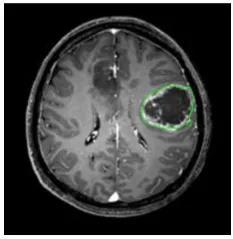
The result obtained was the edge detection on brain tumor 2D MRI images. The figures below show the result of edge detection from the previous study.
Figure 1.1 : 2D MRI brain image with edge detection
Figure 1.2 : Enlargement of the edge detection from Figure 1.1
1.3 Statement of the Problem
This study is to investigate the enhancement of 2D brain tumor image (MRI) based on GAC and AOS methodology. The enhancement process from 2D to 3D image visualization will be obtained by implementing IM and VE methods. The study will focus on the performance comparison between IM and VE methods to visual 3D brain tumor images in terms of volume calculation and the quality of 3D visualization quality.
1.4 Objective of the Research
The objectives of this study are:
i. To apply the edge detection method of 2D MRI brain tumor image based on AOS technique in constructing 3D image.
ii. To construct high resolution of the 3D images using IM and VE methods based on (i).
iii. To implement (ii) using 3D Slicer Software and MATLAB version R2011.
1.5 Scope of the Research
The scope of research will focus on constructing 3D brain tumor image and calculating the volume of the brain tumor by using IM and VE methods. The solution for IM method can be done by using 3D Slicer software while VE method can be done in MATLAB version R2011a. The application of AOS modelling in detecting the contour of 2D MRI image for both IM and VE methods will be considered. This experiment will be applied to real MRI brain tumor images of a patient from Hospital Kubang Kerian, Kelantan.
1.5.1 The Chart of the Research Scope
1.6 Significance of Study
This project expecting a successful application of GAC and AOS strategies to obtain the edge detection of 2D images. The selected contour line of 2D MRI brain tumor images will be used to construct the 3D image by applying the IM and VE methods. Based on the comparison of numerical performance of IM and VE methods, the significance of the project will assume that IM is better than VE in terms of visualization. Finally, the result of this project is significance to enhance the medical images to 3D visualization of medical imaging since the methods have an interesting application in reconstructing a high resolution of 3D medical images.
1.7 Thesis Organization
This thesis consists of six chapters. Chapter 1 describes the introduction of AOS model. In this chapter, we presented the result from previous study, introducing IM and VE methods under consideration, objectives, scope, and significance of the research.
Chapter 2 focuses on the literature review of previous studies related to constructing 3D images and also IM and VE methods. We also describe the use and application of GAC method and AOS scheme in constructing 3D image.
In Chapter 4, we will describe the implementation of IM method in constructing 3D image based on the edge detection of 2D brain tumor MRI images. We will perform this method by using 3D Slicer software.
In Chapter 5, we will describe the implementation of VE method to join the 2D images and calculate the volume of the 3D image. We will perform this method in Matlab programming.
In Chapter 6, we will analyse the results based on the expected volume calculation obtained by both methods. We will also make a comparison of the performance between the two methods. In this chapter, we also state the conclusions of this research based on the results that are shown in Chapter 4 and Chapter 5 and relate them with our objectives in Chapter 1.
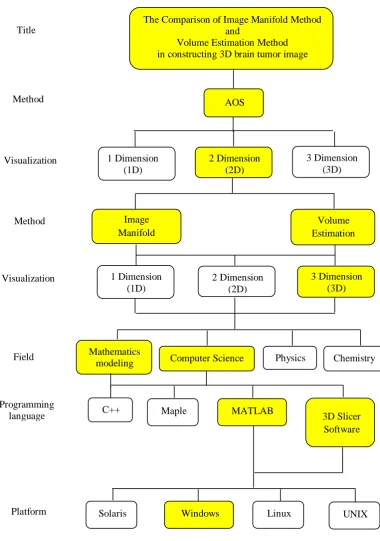
The Comparison of Image Manifold Method and
Volume Estimation Method in constructing 3D brain tumor image Title AOS Image Manifold Volume Estimation 3 Dimension (3D) Method 1 Dimension (1D) 2 Dimension (2D) Visualization
Figure 1.3: The chart of research scope in constructing 3D brain tumor image. Field Programming language Platform 3 Dimension (3D) Method 1 Dimension (1D) 2 Dimension (2D) Visualization Mathematics
modeling Computer Science Physics Chemistry
C++ Maple MATLAB
3D Slicer Software
REFERENCES
A. Bardera et al. (2009). Image Segmentation Using Access Entropy. Journal Signal Processing Systems, vol.54, no.1-3, pp 205-214.
A. Sisojevs and A. Glazs.Volume Estimation of 3D Object Modelled By Parametrical Iso-Surfaces. Conference “Biomedical Engineering“
Antoine Rosset et al. (2004). OsiriX: An Open Source Software for Navigating in Multidimensional DICOM Images. Journal of Digital Imaging, vol.17, no.3, pp 205-216.
Bjourn Hamre (1998). Three-dimensional Image Registration of Magnetic Resonance (MRI) Head Volumes. Thesis.
C. Liu, J. Ma, and G. Ye (2007). Medical Image Segmentation by Geodesic Active Contour Incorporating Region Statistical Information. Fourth International Conference on Fuzzy System and Knowledge Discovery FKSD, vol. 3, pp. 63-67.
Che Rahim, C. T. (2009). Numerical Method: Algorithm and Matlab Programming. Third Edition. Johor: Universiti Teknologi Malaysia.
Christian Wachinger, Mehmet Yigitsoy, Erik-Jan Rijkhorst and Nassir Navab.
Manifold Learning for Image-Based Breathing Gating in Ultrasound and
MRI. Medical Image Analysis 16 (2012) 806–818.
D. Krishnan, P. Lin and X.-C. Tai. An Efficient Operator-Splitting Method for Noise
Removal in Images. Communications In Computational Physics. Vol. 1, No. 5, Pp. 847-858.
G. M. Clarke et al. (2012). 3D Pathology Volumetric Technique: A Method for Calculating Breast Tumour Volume from Whole-Mount Serial Section
Images. International Journal of Breast Cancer Volume 2012, Article ID 691205, 9 pages.
Goldenberg, R., Kimmel, R., Rivlin, E., and Rudzsky, M. (2001). Fast Geodesic Active Contours. IEEE Transaction on Image Processing. 10 (10), 1467-1475.
Guy Rosman, Lorina Dascal, Xue-Cheng Tai and Ron Kimmel. On Semi-implicit Splitting Schemes for the Beltrami Color Image Filtering. J. Math Imaging Visual (2011) 40: 199–213.
Han, Z., and Liu, X. (2010). An Additive Operator Splitting Method for Microscopic Image Segmentation. IEEE Transaction on Image Processing.
Hunt., Lipsman, R. L., and Rosenberg, J. M. (2001). A Guide To MATLAB for Beginners and Experienced Users. First Edition. United States of America. Cambridge University Press.
Joachim Weickert (2000). Efficient Image Segmentation Using Partial Differential Equations And Morphology. Journal of Pattern Recognition.
J.West, J.B.M. Warntjes and P.Lundberg (2011). Novel Whole Brain Segmentation and Volume Estimation Using Quantitative MRI. Journal European Society of Radiology 2011.
K. Krechetova, A. Glaz and A. Platkajis (2008). 3D Medical Image Visualization and Volume Estimation of Pathology Zones. (Eds.): NBC 2008, Proceedings 20, pp. 532–535
Kitara Kadhim Al-Shayeh and Muzhir Shaban Al-Ani (2009). Efficient 3D Object Visualization via 2D Images. Journal of Computer Science and Network Security, vol.9 no.11
Kuhne, G., Weickert, J., Beir, M., and Effelsberg, W. (2002). Fast Implicit Active Contour Models. In Proceedings of the 24th DAGM Symposium on Pattern Recognition. Springer-Verlag, 133-140.
Kuleshov A.P. and Bernstein A.V. Tangent Bundle Manifold Learning for Image Analysis. Sixth International Conference on Machine Vision (ICMV 2013), Proc. of SPIE Vol. 9067, 906720.
Manuel Ferre et al. (2007). 3D Image Visualization and Its Performance in Teleoperation. HCI International Conference (HCII 2007), Peking, China.
Martin Grochulla (2007). Additive Operator Splitting. Seminar Numerical Algorithms for Image Analysis.
R. Kimmel (2002). 3D Shape Reconstruction from Autostereograms and Stereo. J. Visual Comm. and Image Representation, vol. 13, pp. 324-333.
R. Malladi and J.A. Sethian (1996). Image Processing: Flows under Min/Max Curvature and Mean Curvature. Graphical Models and Image Processing, vol. 58, no. 2, pp. 127-141.
R. Malladi and J.A. Sethian (1998). A Real-Time Algorithm for Medical Shape Recovery. Proc. IEEE Int‟l Conf. Computer Vision, pp. 304-310.
R. Malladi and J.A. Sethian (2000). Subjective Surfaces: A Geometric Model for Boundary Completion. International Journal of Computer Vision 46(3), 201– 22.
Rosdiana, S. (2010). Two Dimensional Active Contour Model on Multigrids For Edge Detection of Images. Master of Science, Universiti Teknologi Malaysia, Skudai.
Stephen M. Pizer, et al.(2003). Deformable M-Reps for 3D Medical Image Segmentation. International Journal of Computer Vision 55(2/3), pp58-106, Kluwer Academic Publishers, Netherland.
Sun K. Yoo et al. (2006). 3D Visualization for Tele-medicine Visualization. The International Conference on Computational Science and Applications (ICCSA 2006), LNCS 3980, Glasgow, UK, pp 335-345.
T. Deschamps (2001). Curve and Shape Extraction with Minimal Path and Level -Sets Technique - Applications to 3D Medical Imaging. PhD thesis, Universite´ Paris-IX Dauphine.
T. Deschamps (2004). Fast Evolution of Image Manifolds and Application to Filtering and Segmentation in 3D Medical Images. IEEE Transactions on Visualization and Computer Graphics, Vol.10, No.5.
Q. Zhang et al.(2007). Rapid Voxel Classification Methodology for Interactive 3D Medical Images Visualization. The 10th International Conference on Medical Image Computing and Computer Assisted Intervention, in Brisbane, Australia, pp 86-93, 2007.
V. Caselles, R. Kimmel, and G. Sapiro (1997). Geodesic Active Contour. International Journal of Computer Vision., vol. 22, no. 1, pp. 61-79..
Weickert, J., Ter Haar Romeny, B. M., and Viergever, M. A. (1998). Efficient and Reliable Schemes for Nonlinear Diffusion Filtering. IEEE Transactions on Image Processing.7 (3), 398-410.
Xin Shu, Xiao-Jun Wu. A Novel Contour Descriptor For 2D Shape Matching and Its Application to Image Retrieval. Image and Vision Computing 29 (2011) 286– 294.
Yongjie Zhang, Thomas J.R. Hughes and Chandrajit L. Bajaj. An Automatic 3D Mesh Generation Method for Domains with Multiple Materials. Computer Methods Application Mechanical Engineering. 199 (2010) 405–415.