A Study on Strength and Performance Characteristics of Pervious Concete
GRANDHE RAVITEJA
, Pg Student
Dr. P. LAKSHMAIAH CHOWDARY
, Professor
DEPARTMENT OF CIVIL ENGINEERING
BHEEMA INSTITUTE OF TECHNOLOGY AND SCIENCE,ADONI
ABSTRACT
Pervious cement has assortments of names, for example, permeable concrete, penetrable cement, no-fines concrete and
permeable asphalt. It is an uncommon sort of cement with high penetrability rate with porosity utilized for roadways applications
that permit water from precipitation and other sources to go straightforwardly through in this way diminishing the spillover from a
site and allowing revive.
The present research focuses about drawing out the most effective permeable cement by fluctuating water bond
proportions and size of aggregate. The fundamental properties examined incorporate porosity, compressive quality and water
penetrability. These properties were looked at with those for regular concrete. Although water penetrability is the most vital
normal for the pervious cement, there is no settled strategy for its measurement. In this way, a trial technique to survey the water
piousness of pervious cement is developed. Fine Pervious cement is considered as FPC, Coarse Pervious cement is considered as
CPC, Nominal Pervious cement is considered as NPC. Water bond proportions utilized are 0.28,0.30,0.32 and 0.34.
It is seen that out of all shifting water concrete proportions from 0.28 to 0.34, FPC 3 got the most elevated compressive
quality and later it diminished. CPC 2 got the most astounding compressive quality and later it diminished. NPC 1 got
the most noteworthy compressive quality and later it diminished. Anyway there is a great deal of deviation in
compressive qualities from review of cement since it is pervious concrete. It looks clear that with increment in water
bond proportion there is decline in Porosity rate and piousness.and chemically stabilized and reinforced soil also giving
a brief information of the behavior of stress of soil before and after adding the chemical and fiber.
1.1 Background
1.1.1 Pervious concrete
Conventional standard weight Portland bond concrete is commonly utilized for black-top improvement. The immune idea
of the solid asphalts adds to the all-encompassing water flood into the waste structure, over-stacking the foundation and causing
unnecessary flooding in made spaces. Pervious cement has progressed toward winding up basically common amidst consistent
decades, as a result of its potential obligation in unwinding environmental issues. Pervious bond is a kind of bond with essentially
high-water powerlessness emerged from standard weight concrete. It has been for the most part created for debilitating water out
of the ground surface, with the target that storm water surge is reduced and the ground water is empowered. Figure 1.1 shows the
Available online: https://edupediapublications.org/journals/index.php/IJR/ P a g e | 719 Figure 1.1 Pervious concrete pavements
Pervious concrete has been made in various countries in order to meet Environmental Protection Agency (EPA) storm
water heading necessities. The American Society for Testing and Materials (ASTM) Concrete Committee (C09) has focused on
this strong and molded a subcommittee to deal just with pervious strong creation, properties and use [3]. European countries have
made pervious bond, for water vulnerability and in addition for sound osmosis. In Japan, pervious concrete has been asked about
for the utilization in for road surfaces and also to help vegetation along stream banks [5,6].
In Australia, pervious bond has been delivered for key execution in association with Water Sensitive Urban Design
(WSUD) which hopes to upgrade required water quality and sum in a urban area. Pervious strong squares have been used as one
of the permeable black-top structures. Figure 1.2 exhibits an instance of pervious Solid Square used to meet WSUDrequirements.
Figure 1.2 Pervious Concrete block
1.1.2 Environmental effect of cement usage
In 2003, the world's Portland bond generation achieved 1.9 billion tones. The most crowded nations on the earth,
specifically China and India, created 41.9% and 5.2% separately of the world's concrete yield. As the interest for solid expands,
current Portland bond creation will be generously expanded. Since one tone of concrete creation discharges 0.93 tones of CO2 into
the air, bond generation contributes essentially to an Earth-wide temperature boost which prompts bothersome environmental
change. Consequently it is fundamental for the solid business to know about the outcomes of using naturally unpleasant bond.
Each exertion ought to be made to limit the utilization of Portland bond in cement blends. In cement blends, Portland concrete
ought to be somewhat supplanted with an assortment of demonstrated strengthening cementitious materials, for example,
characteristic pozzolans, fly fiery remains and ground-granulated impact heater slag. Generous utilization of these
ccementationsmaterials will create naturally inviting cement blends.
1.2 Benefits of Pervious Concrete
Pervious cement is a generally new clearing material esteemed for its utilization as a tempest water best administration
practice. It has ecological advantages, for example, water contamination expulsion and keeping up ground water levels. As
indicated by Tennis et al. (2004), pervious solid gathers car liquids, for example, oil and radiator fluid and keeps them from being
washed into adjacent streams or lakes amid rainstorm. Tennis et al. (2004) likewise exhibits the aftereffects of two investigations
that indicated high water poison expulsion rates for pervious cement. The tests performed demonstrated 82 and 95% aggregate
suspended solids evacuation for pervious cement, individually.
Pervious cement additionally has different advantages. It might expand driver wellbeing by forestalling standing water on
arrive usage by diminishing the requirement for detainment bowls. A few urban areas are presently charging property proprietors
affect expenses dependent on the measure of impenetrable surface territory on their property. Pervious cement may help property
proprietors stay away from these Effect charges (Tennis et al., 2004).
As per Hendricks (1998) pervious cement likewise diminishes street clamor. This is on the grounds that the pore structure
permits the air between the tire and the asphalt to circumvent, delivering a lower recurrence street commotion. The consequences
of an examination led in Belgium, taken straightforwardly from Hendricks (1998), are delineated in here demonstrates that
pervious cement created the most reduced decibel dimensions of althea asphalts at all four traffic speeds tried.
1.3 POROSITY
The quality and auxiliary execution of pervious cement is more factor than conventional cement, and depends basically
on the porosity (Crouch et al., 2003). More prominent porosities (likewise called void substance and void proportions) will take
into account expanded invasion rates, however will enormously diminish the compressive quality. This must be considered amid
the blend structure and position of pervious cement. Prescribed porosities extend from 15 to 25% (Tennis et al., 2004). The
porosity free on both the water-to-concrete proportion, and the compaction exertion. ACI Committee 522recommends at least 10
psi of vertical power for compaction. Tennis et al. (2004) report that water-to-bond proportions somewhere in the range of 0.27
and 0.30 are most usually utilized.
Haselbach and Freeman (2006) report that porosity not just differs with evolving water-to-bond proportions and compaction
exertion, yet additionally changes with profundity of the asphalt. This vertical porosity dispersion is caused by the surface
compaction of the pervious cement compacting the highest point of the asphalt more than the base. Haselbach and Freeman (2006)
expected that the vertical porosity dispersion is direct all through the profundity of the example. The vertical porosity conveyance
could make upkeep activities, for example, vacuuming progressively powerful on the grounds that diminished porosity at the
highest point of the asphalt will trap solids in spillover close to the surface. Since more noteworthy porosities may result in lower
qualities, the vertical porosity dispersion may diminish the rigidity at the base of the asphalt. Since asphalts frequently bomb
because of the development of tractable breaks at the base of the asphalt, the vertical porosity conveyance ought to be considered
in the plan of pervious solid asphalts.
The porosity is the proportion of the volume of voids to the aggregate volume of the example. Despite the fact that
porosity is an ordinarily announced property of pervious cement, there is still some disarray as to its definition. A portion of the
voids in pervious cement are not viable in transporting water through the material. The voids that are dynamic in transporting
water through the material are every now and again called the "compelling voids". A few techniques for finding the porosity of
pervious cement just figure the viable voids.
1.4 USES OF PERVIOUS CONCRETE:
The significance of solidarity for pervious solid plan is as yet undecided, so the essential
Uses of pervious cement have been restricted to walkways, walkways, bicycle paths and parking garages. In these applications the
pervious cement is generally exposed to moderately light and low recurrence stacking. Albeit pervious cement has been utilized
for some low-traffic streets and shoulders, it isn't generally utilized as a road clearing material. This could be because of its decline
in quality from customary solid, worries over surface strength, or essentially in light of the fact that pervious cement is a generally
new item and has not yet had sufficient energy to substantiate itself. ACI Committee 522 states that "Little field information exists
on the long haul toughness of pervious cement in northern atmospheres." For extended applications, extra research and testing
must be done to decide how to fuse the diverse quality and sturdiness parts of pervious cement into fruitful asphalt plans. There is
Available online: https://edupediapublications.org/journals/index.php/IJR/ P a g e | 721 technique, architects might be reluctant to plan pervious solid asphalts for street applications. This could be restricting its
employments.
Despite the fact that pervious cement is definitely not a typical street clearing material, it is being utilized far and wide as a best
layer on streets. In Europe, it is utilized as a best layer to lessen traffic clamor, increment slip obstruction, and counteract water
pooling on the surface of the street. In any case, in this application solidify defrost harm is an extensive concern in view of the
higher probability that the pervious best layer will stay immersed (Van Gamer et al., 2003).
1.5 Cost of Pervious Concrete
Regardless of the various natural advantages of pervious cement, if the expense of pervious cement isn't practically
identical to that of customary asphalts, the utilization of pervious solid will in all probability be constrained. As indicated by
Wanielista and Chopra (2007), the underlying expense of pervious cement can be up to1.5 times the underlying expense of other
regular clearing techniques. They ascribe this expanded expense to the necessity for progressively gifted laborers amid the
arrangement of pervious cement, and to the expanded thickness of pervious required because of its flimsier quality.
In a report arranged for the leader of Bellevue Community College, McMillan (2007) reports truly practically identical expenses
for the establishment of customary and pervious cements in the Seattle territory. After expressly reaching a considerable lot of the
customary and pervious solid installers in her general vicinity, McMillan (2007) created cost establishment gauges extending from
$3 to $11.24 per square foot for conventional cement, and going from $4 to $9 per square foot for pervious cement. On their site,
the EPA (2008) additionally reports tantamount expenses for customary and pervious cements. The EPA (2008) records both the
expense of customary cement and the expense of pervious concrete as $2 to $6 per square foot.
Nonetheless, to completely comprehend the expense of pervious solid one must look more remote than simply the establishment
cost. Pervious cement may have numerous potential money saving advantages, for example, disposing of the requirement for
customary check and canal frameworks, underground channeling, maintenance bowls, and site reviewing necessities to avoid
water pending. The utilization of pervious cement may enhance arrive use by taking out the requirement for maintenance bowls.
Pervious cement does not add water to existing sewer frameworks. This may spare urban communities cash that would somehow
or another be spent expanding the limit of sewer frameworks, or may spare organizations cash by maintaining a strategic distance
from tempest water affect charges.
Another cost issue for pervious cement is the upkeep. So as to keep the pervious solid working legitimately, and avert obstructing,
numerous pervious solid asphalts must be cleaned every so often. Normal methods for cleaning pervious cement incorporate
weight washing and vacuum clearing. Wanielista and Chopra (2007) inferred that the two strategies were similarly powerful, and
regularly expanded invasion rates by 200% or more. Pervious cement may likewise require a thicker layer of base material than is
required for conventional cement to take into consideration expanded water stockpiling. This will likewise influence the general
asphalt cost.
Pervious cement is a potential answer for taking out probably some tempest water overflow. The abnormal state of interconnected
full scale porosity in pervious cement successfully limits overflow from cleared zones. Also, pervious cement has different
preferences. For example, pervious cement is calmer to drive on than common asphalt since the permeable asphalt ingests sound
(Oleo et al., 2003). Pervious cement can evacuate storm water more rapidly than customary cement (Schaefer et al., 2006) which
results in enhanced slide opposition.
In any case, pervious cement has a few confinements averting across the board application to typical roadways. The confinements
of pervious cement are connected to quality, solidness, and support. Pervious cement has low compressive and flexural quality
cement contains at least fine total, quality depends fundamentally on the communication between bond glue and coarse total. The
high porosity in pervious cement decreases compressive and flexural quality. Concrete for asphalt applications commonly has
compressive quality running from 3,000 to 4,000 psi (Kosmatka et al., 2002). Then again, customary compressive quality of
pervious cement is in the range from 800 to 3,000 psi (Tennis et al., 2004).
1.6 Objectives of examination
1) A number of pervious cement blends was delivered by differing size of coarse total from 4.75 mm to 20 mm,
2) The fundamental properties contemplated incorporate porosity, compressive quality and water penetrability. These
properties were contrasted and those for customary cement.
3) Although water porousness is the most critical normal for the pervious cement, there is no entrenched strategy for its
evaluation. In this way, an exploratory strategy to evaluate the water penetrability of pervious cement is produced.
4) A measurable examination is improved the situation porosity and penetrability to survey the idea of the bend and
condition is created.
5) Comparisons were finished with Water concrete proportions, porosity and penetrability to know the variety.
1.7Scope of the examination
1) Grade of cement utilized was M30.
2) Fine Pervious cement is considered as FPC, Coarse Pervious cement is considered as CPC, Nominal Pervious cement is
considered as NPC.
3) Water bond proportions utilized are 0.28,0.30,0.32 and 0.34.
4) FPC1 – 0.28 w/c proportion, FPC2 – 0.30 w/c ratio,FPC3 – 0.32 w/c ratio,FPC4 – 0.34 w/c proportion, (10 mm total)
5) CPC1 – 0.28 w/c proportion, CPC2 – 0.30 w/c ratio,CPC3 – 0.32 w/c ratio,CPC4 – 0.34 w/c proportion. (20 mm total)
6) NPC1 – 0.28 w/c proportion, NPC2 – 0.30 w/c ratio,NPC3 – 0.32 w/c proportion, NPC4 – 0.34 w/c proportion. (10 mm -
20 mm total)
II.EXPERIMENTAL INVESTIGATION
Concrete is a composite material with heterogeneous properties that are fundamentally subject to the sum and properties
of the constituents. The Concrete blend configuration is a fundamental device in all parts of solid innovation and its prime
goal is to accomplish the required compressive quality and functionality. Very much created blend structure strategies are
along these lines prime devices in anchoring manageable mechanical solid development methods.
4.2 IS METHOD
The IS strategy suggested the amendment factors for various w/c proportions, usefulness and for shape coarse total. The
amounts of fine and coarse total are determined with help of conditions, which depend on explicit gravities of the fixings.
Accordingly plastic thickness of cement determined from yield condition is commonly anticipated that would be nearer to
genuine plastic thickness got in research facility. In this way real concrete utilization will be near that focused in the main
preliminary blend itself.
The blend proportion for pervious cement is kept up as 1:6 and size of total is differed to check the variety in pressure,
porosity and penetrability. As the review of cement is M30 it is kept up that 350 kg/m3 was kept steady differing size of total and
Available online: https://edupediapublications.org/journals/index.php/IJR/ P a g e | 723 4.3 Mix Design for M30 Grade of Concrete
Table No. 4.1 Mix Design of M30 Grade
Grade Designation M30
Type of Cement OPC 53 Grade
Maximum Nominal size
of Aggregate
20 mm
Minimum content of
Cement
350 Kg/m3
Maximum Water
Cement ratio
0.28
Specific Gravity of
Cement
3.15
Specific Gravity of
Coarse Aggregate
2.62
LIQUID LIMIT TEST: Results
Compressive Strength Test
Compressive quality of pervious cement is typically observed to be lower than customary cement because of its high porosity.
Compressive qualities are in the scope of 500 psi to 4000 psi (3.5-28 Map).For every arrangement of tests, a lot of standard size
3D square were made. The span of 3D shape 150×150×150 mm was made for compressive quality estimation as appeared in
Figure. The shape were tried in various relieving days (3, 14, 28& 56 - days) as per the test strategies given in the Indian Standard
IS: 516-1959.
Compressive strength testing Machine
For the investigation reason the compressive testing machine of 2000KN limit (CTM Digital) in the solid research center at the
stacking rate of 0.2-0.4 N/mm2 s. The compressive quality of the solid examples is
Water Permeability Test
The penetrability is characterized essentially as the proportion of the simplicity with which any liquid can go through the voids
present in a permeable media. The interconnected voids present in a past solid example are in charge of the porousness of the
example, which is straightforwardly subject to the porosity, pore sizes, and pore harshness. Porousness as a novel capacity for
water to enter through permeable cement was communicated in millimeter every second (mm/s). The porousness is a standout
amongst the most critical attributes to qualify pervious cement. As a result of the absence of institutionalized porousness test
strategy, falling-head contraption is received to decide penetrability of Pervious cement. The test mechanical assembly appeared in
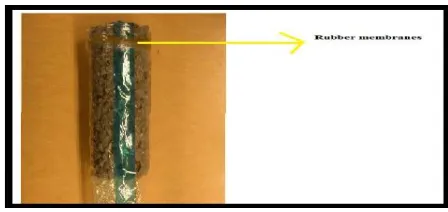
Figure. In this test every example is fixed with oil jam and put into latex film to avert spillage along their sides amid testing. The
fixed example was set into the example holder at the base of the standing channel. Tests were then soaked with water to a
dimension over the solid example test. Water was permitted to course through the example by opening the base valve. Beginning
head was settled at 305 mamboed the example and the time expected to achieve a last head of 50 mm was recorded. The
estimation is rehashed multiple times for each example to decide a mean esteem.
(a) Falling-head apparatus
(b)Specimens for permeability test
The water driven conductivity k is then determined by the condition
Where,
a =Cross segment of the graduated standing funnel over the example in mm2,
L = Length of the example in mm
A= Cross segment of the example mm2
t= Time for head drop from h0 to h1 in sec
h1= Initial head of 305 mm
Available online: https://edupediapublications.org/journals/index.php/IJR/ P a g e | 725 k = Hydraulic conductivity coefficient in mm/s
The water powered conductivity can be identified with inherent porousness by utilizing the connection K =k ρ g / μ
Where ρ is the thickness of the liquid, g is the quickening because of gravity and μ is the dynamic Viscosity of the liquid. At the
point when water is utilized as the penetrating liquid, the Equation 3.3 can be streamlined as
K (m2) = K (m/s) x 10-7
Porosity Test
Porosity is viewed as a standout amongst the most imperative pore structure highlights of pervious cements that manage a few of
its mechanical and practical properties. Porosity or void substance of a permeable material is communicated as a rate esteem and is
characterized as the volume of pores in the material to the aggregate volume of the material. The porosity test was done at 28 days
of age. An estimation of under 15% is considered as low porosity while 30% is a high estimation of porosity for pervious cements.
A sensible normal incentive for primer auxiliary and hydrological configuration is 20% .The aggregate porosity in pervious
cement incorporates detached porosity and associated porosity, which is the essential impacting variable of water porousness
Porosity test
The equation for connected porosity 𝑃1 is as follows
A caliper was utilized to gauge and compute example volume 𝑉1 the example was inundated in water until the point when it is
loaded up with water before its load in water 𝑊1 is estimated. Thusly, the example was removed from water and dried, and after
that its load in air 𝑊2 when its weight is steady was estimated as appeared in Figure.
Standard value = From standard values table
RESULTS
The aftereffects of the trial examination are introduced in this section. This part gives the aftereffects of pervious cement
without fine total and the customary cement. The connections among thickness, porosity, compressive quality and water
6.2 Compressive quality
Table 6.1 outlines the compressive qualities of every example. The examples were tried at the age of 3, 14, 28 and 56 days for
water restored customary concrete and pervious cement. The compressive qualities create with age for ordinary concrete and
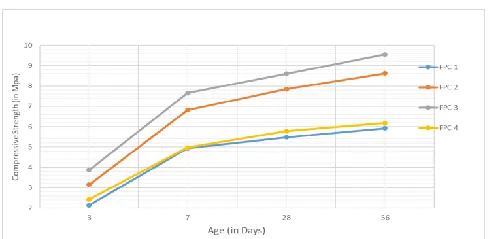
pervious cement. The 3D square compressive quality shows the normal of three test outcomes. The Graphical Representations of
the above outcomes are appeared underneath with different Combinations.
Table 6.1 Compressive Strength
Sino Mix
Designation
Compressive Strength (in
Map)
3 14 28 56
1 FPC 1 2.14 4.93 5.48 5.92
2 FPC 2 3.14 6.82 7.84 8.62
3 FPC 3 3.87 7.65 8.60 9.55
4 FPC 4 2.43 4.97 5.78 6.18
5 CPC 1 2.99 6.40 7.11 7.89
6 CPC 2 4.10 9.46 10.51 11.35
7 CPC 3 3.46 7.73 8.88 9.86
8 CPC 4 3.52 7.30 8.59 9.53
9 NPC 1 4.67 9.55 11.11 11.89
10 NPC 2 4.52 9.14 10.51 11.46
11 NPC 3 3.06 5.86 6.81 7.22
12 NPC 4 3.73 7.46 8.29 8.79
Available online: https://edupediapublications.org/journals/index.php/IJR/ P a g e | 727 Fig 6.2 Figure showing the Variation of Compressive Strength of Coarse Pervious Concrete (CPC)
Fig 6.3 Figure showing the Variation of Compressive Strength of Nominal Pervious Concrete (NPC)
Fig 6.1, 6.2 and 6.3 speaks to the Variation of Compressive Strength with Age (3, 7, 28 and 56 Days). From the above
Graphical portrayals, it tends to be presumed that FPC3 Mix displays higher compressive Strength in the event of Fine Pervious
Concrete (FPC). Blends of CPC 2 and NPC 1 displayed enhanced quality attributes if there should be an occurrence of Coarse
Pervious Concrete and Nominal Pervious Concrete individually.
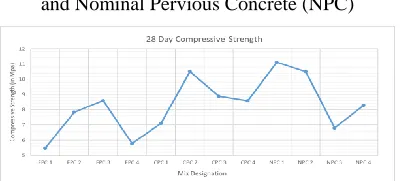
Fig 6.4, 6.5 and 6.6 speaks to the 7 – Days and 28 Days Compressive Strength of all Mixes of Fine Pervious Concrete (FPC),
Coarse Pervious Concrete and Nominal Pervious Concrete (NPC). It tends to be seen that the NPC1 blend displays better quality
contrasted with the various Concrete Mixes.
Fig 6.4 Variation of 7 – Day Compressive Strength of different mixes of Fine Pervious Concrete (FPC), Coarse Pervious Concrete
and Nominal Pervious Concrete (NPC)
Fig 6.5 Variation of 7 – Day Compressive Strength of different mixes of Fine Pervious Concrete (FPC), Coarse Pervious Concrete
Fig 6.6 Variation of 3, 7, 28 & 56 Days of Compressive Strength of different mixes of Fine Pervious Concrete (FPC), Coarse
Pervious Concrete and Nominal Pervious Concrete (NPC)
6.3 Porosity and Permeability Coefficient
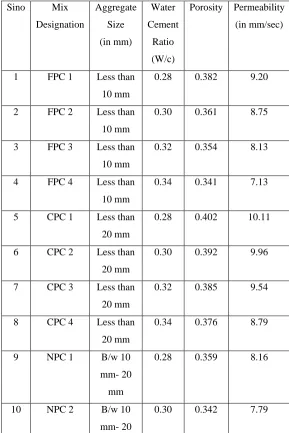
Table 6.2 demonstrates the deliberate properties of all PC blends, including porousness coefficient and porosity. Normal
outcomes from the trial examine were abridged in this table. The tests yielded a scope of qualities from around 7 mm/s to 10 mm/s
for penetrability coefficient. It very well may be seen from Table 6.2 that the most noteworthy penetrability coefficient
accomplished in this investigation is 10.1 mm/s for blend CPC1, which was created from coarse total. Blend FPC4 has the most
reduced penetrability coefficient of 8 mm/s, which was created from fine total.
The thickness of PC is around 1800 kg/m3.Graphical Representations appeared beneath show the impact of porosity on
penetrability coefficient for CPC. In spite of the fact that there is a prominent disperse in the plotted information, the penetrability
coefficient by and large increments when the porosity increments. Figure 4illustrate the impact of porosity on porousness
coefficient for FPC.The most astounding penetrability coefficient of around 10.1 mm/s can be seen when the porosity is higher
than 40.2%.The littlest penetrability coefficient of around 7.13 mm/s can be seen when the porosity is higher than 34.1%.
Table No. 6.2 Porosity and Permeability
Sino Mix
Designation Aggregate Size (in mm) Water Cement Ratio (W/c)
Porosity Permeability
(in mm/sec)
1 FPC 1 Less than
10 mm
0.28 0.382 9.20
2 FPC 2 Less than
10 mm
0.30 0.361 8.75
3 FPC 3 Less than
10 mm
0.32 0.354 8.13
4 FPC 4 Less than
10 mm
0.34 0.341 7.13
5 CPC 1 Less than
20 mm
0.28 0.402 10.11
6 CPC 2 Less than
20 mm
0.30 0.392 9.96
7 CPC 3 Less than
20 mm
0.32 0.385 9.54
8 CPC 4 Less than
20 mm
0.34 0.376 8.79
9 NPC 1 B/w 10
mm- 20
mm
0.28 0.359 8.16
10 NPC 2 B/w 10
mm- 20
Available online: https://edupediapublications.org/journals/index.php/IJR/ P a g e | 729 mm
11 NPC 3 B/w 10
mm- 20
mm
0.32 0.335 7.54
12 NPC 4 B/w 10
mm- 20
mm
0.34 0.312 7.32
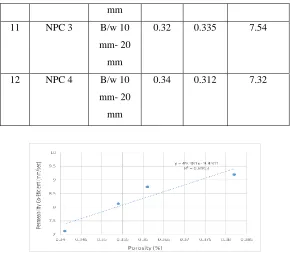
Fig 6.6 Effect of porosity on permeability coefficient for FPC
Fig 6.7 Effect of porosity on permeability coefficient for CPC
Fig 6.8 Effect of porosity on permeability coefficient for NPC
These Figures demonstrate that porosity assumed a critical job in the PC example penetrability coefficient. These
progressions can be predominantly ascribed to the decline in functionality of the blend structures as the W/C is balanced.
Conventional strategies for estimating the usefulness of a PC blend are not powerful for blends, as they by and large have
insignificant droop notwithstanding when the W/C is underneath the ideal dimension. With expanded usefulness, more prominent
densification happens notwithstanding when and porosity diminished. This more prominent densification prompted decline in
porousness that was watched for the different blend plans.
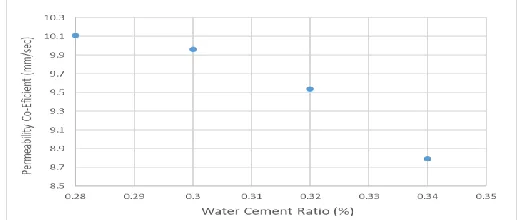
Figure 6.9, 6.10 and 6.11 demonstrate the impact of W/C on penetrability coefficient for FPC, CPC and NPC. The most elevated
porousness coefficient accomplished in this investigation is 10.1 mm/s for blend CPC1. Blend FPC4 has the most reduced
porousness coefficient of 7.13 mm/s. Results demonstrated that decrease in porousness coefficient caused by size of total was
more than that by W/C. Results indicate great connection between porousness coefficient and W/C, supporting the end that more
prominent usefulness prompts a denser example with littler penetrability coefficient. Lab blends had the most noteworthy
porousness coefficient, had the least W/C.
Fig 6.9 Effect of Water Cement Ratio on permeability coefficient for FPC
Fig 6.10 Effect of Water Cement Ratio on permeability coefficient for CPC
Fig 6.11 Effect of Water Cement Ratio on permeability coefficient for NPC
6.5 Effect of Water Cement Ratio on Porosity:
Figure 6.12, 6.13& 6.14 demonstrate the impact of W/C on Porosity for FPC, CPC and NPC. The most elevated Porosity
accomplished in this investigation is 0.402% for blend CPC1. Blend FPC4 has the most reduced Porosity of 0.312 %. Results
demonstrated that decrease in Porosity caused by size of total was more than that by W/C. Results indicate great connection
among Porosity and W/C, supporting the end that more prominent usefulness prompts a denser example with diminished porosity.
Available online: https://edupediapublications.org/journals/index.php/IJR/ P a g e | 731 Fig 6.12Effect of Water Cement Ratio on Porosity for FPC
Fig 6.13Effect of Water Cement Ratio on Porosity for CPC
III. CONCLUSION
7.1 Compressive quality
(a) Fine Pervious Concrete (FPC):It is seen that out of all differing water bond proportions from 0.28 to 0.34, FPC 3 got the most
astounding compressive quality and later it diminished. Water concrete proportion 0.32 got more quality around contrasted with
other water bond proportions.
(b) Coarse Pervious Concrete (CPC):It can be unmistakably expressed that out of all changing water bond proportions from 0.28
to 0.34, CPC 2 got the most astounding compressive quality and later it diminished. Water bond proportion 0.30 got more quality
around contrasted with other water concrete proportions.
(c) Nominal Pervious Concrete (NPC) :It is seen that out of all changing water bond proportions from 0.28 to 0.34, NPC 1 got the
most elevated compressive quality and later it diminished. Water bond proportion 0.28 got more quality around contrasted with
other water concrete proportions.
Anyway there is a ton of deviation in compressive qualities from review of cement since it is pervious cement.
7.2Permeability Coefficient
(a) Fine Pervious Concrete (FPC): It looks clear that with increment in water bond proportion there is decline in penetrability
coefficient. FPC 1 is noted to have more noteworthy penetrability and there after it decreased with increment in water concrete
proportions.
(b) Course Pervious Concrete (CPC): It looks clear that with increment in water bond proportion there is decline in penetrability
coefficient. CPC 1 is noted to have more noteworthy penetrability and there after it diminished with increment in water bond
proportions.
(c) Nominal Pervious Concrete (NPC): Similar pattern was seen in Nominal pervious concrete, diminishing of porousness
coefficient with increment in W/C proportion.
However, on a general examination between FPC, CPC and NPC, it was discovered that NPC is having lower penetrability
expanding strength to concrete.
7.3Porosity
(a) Fine Pervious Concrete (FPC): It looks clear that with increment in water bond proportion there is decline in Porosity rate. FPC
4 is noted to have slightest porosity.
(b) Course Pervious Concrete (CPC): It looks clear that with increment in water bond proportion there is decline in Porosity rate.
CPC 4 got slightest porosity esteems contrasted with other coarse pervious solid extents.
(c) Nominal Pervious Concrete (NPC): Similar pattern was seen in Nominal pervious concrete, diminishing of Porosity rate with
increment in W/C proportion.
In any case, on a general examination between FPC, CPC and NPC, it was discovered that NPC is having lower Porosity rate
expanding quality of cement by decreasing voids.
7.4 Recommendations for further work
Proposals for future research work can be outlined as pursues:
1) The impact of time on the properties of pervious cement ought to be explored
2) The pore structure ought to be researched in light of its impact on the water porousness of pervious cement.
3) A stopping up test for a blend of pervious cement ought to be completed to assess the long haul execution of pervious
Available online: https://edupediapublications.org/journals/index.php/IJR/ P a g e | 733 4) A point by point think about is expected to create joined pervious concrete and pervious mortar for asphalt application
having sufficient water penetrability, quality, volume strength and sturdiness.
5) A sturdiness of pervious concrete, pervious mortar and mix of pervious cement and mortar ought to be explored to utilize the asphalt structure.
REFERENCES:
1.
Alamo S.O., Jimson A.A. what's more, Oluremi J.R, Evaluation of Structural Performance of PerviousConcrete inConstruction, International Journal of Engineering and Technology, 2 (2012):pp.829-836.
2. AlaicaA.L. ,Dolatabadi M.H. Subic A. what's more, Schemata M.,Optimizing the quality and porousness of pervious
solid, Paper arranged for introduction at the penetrable asphalt structure and innovation session of the yearly meeting of the
transportation relationship of Canada Halifax, Nova Scotia,(2010):pp.1-19.
3. Aoki, Y. what's more, Sriravindrarajah, R., Shrinkage of environ-rationally well disposed feasible permeable solid,
Proceedings of the global meeting on reasonable cement construction.Ratnagiri, India, (2007):pp.1-
4. Aoki Y., Sriravindrarajah R. furthermore, Khabbaz H., Environmentally agreeable reasonable pervious solid, Proceedings
of the twentieth Australasian meeting on the mechanics of structures and materials, Toowoomba, Australia, (2008).
5. Aoki, Y., Sriravindrarajah, R. furthermore, Khabbaz, H.,Effect of fly powder execution of pervious cement, In
Supplementary continuing of tenth CANMET/ACI universal meeting on late advances in solid innovation and supportability issue.
Seville, Spain, (2009):pp.1-8.
6. Aoki Y., Ravindrarajah R. furthermore, KhabbazH.,Properties of pervious cement containing streak Road Materials and
Pavement Design,13(2012): pp.1– 11
7. Aoki, Y., Sriravindrarajah, R., &Khabbaz, H., Properties of pervious cement containing streak, Road Material sand
Pavement Design, (2012): pp.1– 11.
8. Bradley J. Putman. also, Andrew I. Neptune, Comparison of test example planning systems for pervious solid asphalts,
Construction and BuildingMaterials,25(2011):pp. 3480– 3485
9. Bashan H., Halo Wu. Xiang Shoo. also, Burdette.E.G., Laboratory assessment of porousness and quality of
polymer-adjusted pervious solid ,Construction and Building Materials, 24(2010):pp. 818– 823
10. Carson M., Tittarelli F. also, BertoliniL ,Use of no-fines concrete as a building material:Strength, strength properties and