CONTRACT MANAGEMENT PRACTICES AND COMPLETION OF ROAD CONSTRUCTION PROJECTS BY THE COUNTY GOVERNMENT OF
MACHAKOS, KENYA
GLORIA SYOMBUA MULINGE D53/NKU/PT/33337/2014
A RESEARCH PROJECT SUBMITTED TO THE BUSINESS SCHOOL IN PARTIAL FULFILMENT OF THE AWARD OF A MASTERS OF BUSINESS ADMINISTRATION (PROJECT MANAGEMENT OPTION) OF KENYATTA
UNIVERSITY
ii
DECLARATION
This research project is my original work and has not been submitted for a degree course or any other award in any other University.
Student’s Sign __________________ Date _________________________ Gloria Mulinge
D53/NKU/PT/33337/2014
This research project has been submitted for examination with my approval as the university supervisor.
Signature ……… Date ………..
Ms. Gladys Kimutai Lecturer,
School of Business,
iii
DEDICATION
iv
ACKNOWLEDGEMENT
v
TABLE OF CONTENTS
DECLARATION... ii
DEDICATION... iii
ACKNOWLEDGEMENT ... iv
LIST OF TABLES ... vii
LIST OF FIGURES ... viii
ABBREVIATIONS AND ACRONYMS ... ix
OPERATIONAL DEFINITION OF TERMS ... x
ABSTRACT ... xi
CHAPTER ONE ... 1
INTRODUCTION... 1
1.1 Background of the Study ... 1
1.2 Statement of the Problem ... 10
1.3 Research Objectives ... 11
1.4 Significance of the Study ... 12
1.5 Scope of the Study... 13
1.6 Limitations of the Study ... 13
CHAPTER TWO ... 15
LITERATURE REVIEW ... 15
2.1 Introduction ... 15
2.2 Theoretical Review ... 15
2.3 Empirical Literature ... 19
2.4 Summary of Literature Review and Gaps ... 29
2.5 Conceptual Framework ... 31
CHAPTER THREE ... 32
RESEARCH METHODOGY ... 32
3.1 Introduction ... 32
3.2 Research Design ... 32
3.3 Target Population ... 33
3.4 Sampling Techniques and Sample size ... 33
3.5 Data Collection Procedure ... 35
3.6 Validity of Instruments... 36
3.7 Reliability of Instruments ... 36
3.8 Data Analysis Procedure and Presentation... 36
3.9 Ethical Considerations... 38
CHAPTER FOUR ... 41
RESEARCH FINDINGS AND ANALYSIS ... 41
4.1 Introduction ... 41
vi
4.3 Respondent’s Characteristics ... 42
4.4 Contractor Management Practices ... 44
4.5 Contractor Prequalification ... 49
4.6 Contractor Payment Methods ... 52
4.7 Contract Change Management Practices... 58
4.8 Road Projects Completion ... 67
4.9 Regression Model ... 70
CHAPTER FIVE ... 73
SUMMARY, CONCLUSIONS AND RECOMMEDATIONS ... 73
5.1 Introduction ... 73
5.2 Summary ... 73
5.3 Conclusions ... 75
5.4 Recommendations ... 76
5.5 Recommendations for Further Studies ... 77
REFERENCES ... 78
APPENDIX ONE; INTRODUCTORY LETTER ... 71
APPENDIX TWO; QUESTIONNAIRE ... 72
vii
LIST OF TABLES
Table 3.1:Sampling Frame ... 35
Table 3.2; Operational Definition of Variables ... 38
Table 4.1: Contract Management ... 49
Table 4.2: Contractor Prequalification ... 52
Table 4.3: Factors Affecting Payment to Contractors... 56
Table 4.4: Contractor Behaviour over Non-payment... 58
Table 4.5: Contract Change Management Practices ... 61
Table 4.6: Contract Change on Road Projects ... 64
Table 4.7: Supervision of contracts... 67
Table 4.8: Road Performance Metrics ... 69
Table 4.9: Model Summary ... 70
Table 4.10: ANOVA ... 70
viii
LIST OF FIGURES
Figure 2.1; Conceptual framework Source ... 31
Figure 4.1: Employee Distribution by Gender... 42
Figure 4.2: Length of Time Employed ... 43
Figure 4.3: Level of Employee Education ... 44
Figure 4.4: Completion Rate of Contractors ... 45
Figure 4.5: County Government Supervision ... 46
Figure 4.6: Prequalification of Contractors ... 49
Figure 4.7: Reasons for Delay ... 52
Figure 4.8: Contract Change Management Practices ... 59
Figure 4.9: County Supervision of Contractors ... 64
ix
ABBREVIATIONS AND ACRONYMS CIPS Chartered Institute of Purchasing and Supply CM Contract Management
CSC Contract Selection Criteria GNP Gross National Product
HSSE Health Security Safety and Environment KPI Key Performance Indicators
KURA Kenya Urban Roads Authority
x
OPERATIONAL DEFINITION OF TERMS Contractor
prequalification
Screening of construction contractors by project owners or their representatives according to a predetermined set of criteria deemed necessary for successful project performance
Contractors’ payment practices
The approach in which construction products and services are priced and paid for.
Contract Change Management Practices
Alteration on conformance of contractor or supplier with contract terms, specifications, service level agreements Contractor
Supervision Activities
Monitoring and evaluating contractor performance
Contract Management The process of systematically and efficiently managing contract creation, execution, and analysis for the purpose of maximizing financial and operational performance and minimizing risk
Project Completion The degree of achievement of certain effort or undertaking which relates to the prescribed goals or objectives that form the project parameters
xi ABSTRACT
1
CHAPTER ONE INTRODUCTION 1.1 Background of the Study
Project management in the construction industry has been a key component in efficient and sustainable construction methods especially in developing countries. The area of construction industry is very important in the economic development of any nation especially in developing countries such as in expanding economy like in Sub Saharan countries (Ibironke, 2008). An efficient construction sector is a pre- requisite to operative national development since building civil and industrial engineering works are usually a major contributor to Gross Fixed Capital Formation, Gross Domestic Product and National Employment (Oyewobi & Ogunsemi, 2010). The concerns on performance of road construction and its effect on the economy continues to be a concern globally with more prominence in the developing countries of Africa and Asia. For the past two decades the growth of the Nigerian construction industry has indicated its success on the great contribution to the gross national product of the country, which was 1.72 as per 2007(Federal Bureau of Statistics). Aminudin (2006) indicated that up to 30% of construction is rework, labour being at only 40% to 60% of efficiency in potential and at least 10% of materials get wasted. It is suggested that rework costs could be ominously higher than figures reported in the previous literature (Love & Smith, 2006).
2
industries in its nature as it contains a large number of parties as consultants, cents, contractor’s shareholders, stakeholders and regulators. Performance of the construction industry is normally affected by factors such as insufficient funds, shortage of foreign exchange , political priorities inappropriate contract conditions, poverty, withdrawal by donors, human capacity social-cultural conditions , corruption and occurrence of unexpected events for instance wars and draughts , are considered to the major factors towards poor performance of the projects more so in the developing countries (Idoko, 2008), (Jekale, 2004), (Andersen, 2008). In many ways, the pace of the economic growth of a given nation can be measured by physical infrastructures development, for instance buildings, roads and bridges. The failure of any construction project is mainly related to the problems and failure in performance (Hough, 2007) Moreover, there are many reasons and factors that attribute to such problems.
3
unrealistic target planning, setting or causes originating from the definite construction normally in most cases the problems arise from both.
It is significant that the Kenyan road construction projects history is marked by ups and downs with high performance by the national government being perceived today and a decade ago as apprehended in the succeeding empirical studies. The Kenyan construction industry has performed relatively well, not accidentally (Wels, 2007), amongst others. The dominance of small scale contractors is uttered by specific characteristics of the industry, for instance the wide dispersion of the flexibility in scale of production, demand, standardization of materials and climatic control on use of materials, of which some can be immense. Low quality capital demand for entry, more so for crafted-based jobs (Chan, 2001). This study sought to establish how the road construction and contract management practices are faring in the devolved system of governance.
4
indicators have been evaded because as appraisals concentrate on finances Ibironke (2008).
Good reputations of companies build by project success and also initiating new projects. The penalties may rather be in terms of productivity loss, surplus expenditures via means of repair and rework, retest in the short term and re-inspection. At the long term, deprived efficient can offend reputation. If the company continues with the same trend it might have to close its shop as well for want of new projects. When a number of construction companies start to neglect the efficient facets of their projects, they begin to reflect on the country’s reputation (Hyvari, 2006). Assisting the construction companies to recognize the crucial aspects responsible for acquiring the desired efficient level success aspects and also to find the attributes unpleasantly affecting the project efficient, has been the motivating aspect behind this study. It is comprehended that intensification of the success factors and minimization of failure aspects ensure the construction industry realizes its efficient goals (Iyer and Jha, 2006). In Nyeri County, effectual construction projects can deliver a solid platform for reviving the economy and for building a more balance and self-determining economy during stable political conditions. In 2013, negligence of such services, systems and institutions, however, has affected the efficient of life of the residents and their environment and health (Kemps, 2012).
1.1.1 Completion of Projects
5
quality. Nonetheless, measuring project success is a composite task since success is tangible and can barely be agreed upon (Xiao & Proverbs, 2003). A comprehensive project is a product of complex series of activities that integrate skills and knowledge to produce a valuable result (Elger, 2008). Project completion has been well-defined as the degree of accomplishment of certain effort or activity which relays to the prearranged goals or objectives that form the project restraints (Ahmad, Ismail, Nasid, Rosli, Wan &Zainab, 2009).
Projects activities are blended by several factors. Timely activities of projects is a concoction of many important issues influencing cost accounting, repairs, quality control and maintenance, production management, supply chain, stores, safety and health (Amin, 2011). It is the completion of a project that enables achievement of the desired performance indicators in three key areas: scope, schedule and budget (Alvarado, Silverman & Wilson, 2005). A project is fruitful if it contents all three legs of the triple constraint, explicitly, specification/performance, cost and time, Greer (1999). Thomsett (2002) in an broad scrutiny of 20 failing projects over a period of 18 years extended this norms of success as: satisfies stakeholder groups, meets functional necessities, meets quality requirements and prospects, within cost and deadline, delivers continued and definite benefits and provides the team with skilled satisfaction and learning.
6
challenges in project efficiency, road contractor’s performance metrics and other contextual problem that appear in many aspects of road construction more so in developing countries. Most of the road projects fail in performance of time, others in cost performance whereas other fail in other performance indicators. There are additional indicators for problems of road contractor’s performance in developing countries for instance project management, management between participants, feedback, and monitoring and leadership skills. In addition, cultural, economic and political issues are three vital indicators correlated to failures of road projects' performance in the Country (Becerik, 2007).
Contractors are major determinants of road completion projects. A feature of road Construction Firms in the developing countries is that, often they are thought to be one-man enterprises, having low capital and financial base and also lacking the necessary managerial skills to sufficiently face up to the many and problematic challenges they continually have to encounter in a distinctive developing economy such as Kenya’s Bundi(2011). Despite the shortfalls, the contractors in the developing countries play a major role in the economy. It is contended that, given that these so-called small firms provide a structural base to the economy and also determine the productivity of investment and, accordingly, the rate of development in decentralized and rural areas of the economy, their evaluation of the factors influencing effective and efficient delivery of road construction projects would go a long way in helping to develop a useful framework for improving construction performance in the sector (Ganessan, 2003).
7
who described the main categories of constraints during construction process as reworks/repairs, defects, material allocation, unnecessary handling and waste of materials. Rework in construction projects is mentioned to as the unnecessary effort of rebuilding a process or activity that was erroneously applied in the first instance. Rework can result from an array of factors such as omissions, failures, errors, changes, poor coordination and communication and ultimately the profit margins as well.
1.1.2 Contract Management Practices
It is a common practice for organizations to involve contractors or suppliers in one way or another to support in providing service or product to meet its intended requirements in some form of contracts that require being managed (Kumar and Markeset, 2007). Contract management can be summarized as the process of systematically and efficiently managing contract formation, implementation, and analysis for the purpose of exploiting financial and operational performance and minimizing risk. (Bhardwaj, 2011). Contract management practice is a continuous concept with many features. It refers the conformance of contractor or supplier with contract terms, specifications, service level agreements or Key Performance Indicators and other elements of the commercial agreement (CIPS, 2012). You cannot achieve completion of contracted projects without contract management practices in place. This is so because performance key outcome priority is cost, quality, speed and flexibility which also inform contract management (Ketchen and Hult, 2006).
8
effective contract management has emerged as a crucial function to advance profitability, support acquiescence and manage risks (Prosidian consulting, 2011).Contract management has attracted attention because while some risks can be transferred to the contractor/sub-contractors in terms of financial compression for not finishing a project, the ultimate risk still lies with the operating organization to convey positive aftermaths which limit exposure to liability (Limberakis, 2012).Bautista and Ward (2009) commends that, the whole of procurement team should also be involved in managing the post award contracting activities.
Contract Administration processes and activities such as monitoring and measuring contractor performance, handling contract change and contractor payment process should be combined with other departmental essential processes such as financial management, customer service, schedule management, performance management and risk management (Hotterbeekx, 2013). Studies have shown that organizations that have established developed contract management processes are able to produce a great deal in surplus savings and have a distinctive competitive advantage over their competitors (Rendon, 2007). On the other hand, incompetent management of contracts eventually lead to poor operational control, high risks, low customer satisfaction and unwanted costs (Saxena, 2008). This study evaluated if this is the situation with road construction projects in the County of Machakos
1.1.3 Road Construction in Machakos County
9
of its budget to development, a big percentage of which is going to new roads. According to the governor of Machakos the county government has a determined master-plan that will ensure the face of the county lifted by the envisioned planned Machakos City that provided at attractive lease terms to develop housing to cater for Nairobi city and Konza techno city which is 15 Km from Machakos. Machakos is set to become the dormitory for those two cities and therefore there is certainly a high increase in roads construction activities (Machakos County report, 2013).
However, like any other part of the world Machakos County has had its own share of challenges in meeting the time deadlines of its construction projects. Indeed most of projects currently on-going have not been performing to expectations in terms of timeliness. Indeed most of the projects started in the last two years are way behind the set time schedules they were meant to be completed (Department of public works and Housing, 2014). Olatunji, (2010) avers that most projects are finally completed to specification more or less, although they are seldom on time. Cokins, (2006), Chai and Yusuf (2013), while stressing the importance of completing construction projects on time and within budget contends that “time is essence” and that time is “revenue”. This indicates that any delay in meeting the project completion time certainly interprets to loss of revenue.
10
magnitude. Bundi (2011) did a survey on encounters in the management of procurement facilities within the Kenya Urban Roads Authority. She found that political interventions and insufficient allocations of funds obstruct accomplishment of KURA activities although the authority fully implements procurement policies. Nyamwaro (2011) did a study on the analysis of encounters facing the project enactment a case study of Ministry of Roads Projects. The study comprehended that lack of awareness and poor communication on POA used in the enactment of the Ministry's Projects were the major challenges facing project implementation.
1.2 Statement of the Problem
11
management practices by the government in the developing world resulting in poor workmanship by contractors and engineers (Okuwoga & Adeyinka, 2008).
This has been reinforced by studies in the Kenyan construction industry that have made findings to the effect that cost overrun, delayed completion period, conflicts in the complicated vendor relationship, poor contract management practices, extortion and bribery, poor risk mitigation and poor quality work are the norm rather than exception in the undertaking of contracted construction projects (Kibuchi and Muchungu, 2012; Cleland and Bidanda, 2009; Lepartobiko, 2012; Chuah et al., 2010). With a dearth of studies on the effects of contract management practices on the completion of road projects, this study not only sought to fill the gap but, establishes the contract management practices by the nascent county government with reference to Machakos County.
1.3 Research Objectives
The following are the general and specific research objectives of this study.
1.3.1 General Objective
The study sought to investigate the effects of contract management practices on the completion of road projects by the County Government of Machakos.
1.3.2 Specific Objectives
12
ii. To find out the role of contractors’ payment practices on the completion of road projects by the County Government of Machakos, Kenya
iii. To assess the influence of contract-change management practices on the completion of road projects by the County Government of Machakos, Kenya
iv. To determine the effects of contractors’ supervision activities on the completion of road projects by the County Government of Machakos, Kenya
1.3.3 Research Questions
Of particular interest to this study were answers to the research questions;
i) How does contractor pre-qualification process affect the completion of road projects by the County Government of Machakos, Kenya?
ii) How do contractors’ payment practices affect the completion of road projects by the County Government of Machakos, Kenya?
iii) Which is the effect of contract change management practices on the completion of road projects by the County Government of Machakos, Kenya? iv) Which is the effect of contractor supervision activities on the completion of
road projects by the County Government of Machakos, Kenya?
1.4 Significance of the Study
13
government understand the challenges and the needed critical success factors in order to boost project completion rates and increase the number of customers, revenues and profitability. The general public, who are the beneficiaries of the projects are likely to get nuanced details and challenges affecting the construction of roads of in this county. This study provides reference point to future researchers and academicians in the area of construction and factors affecting completion of projects.
1.5 Scope of the Study
Due to development efforts road construction in the County of Machakos was selected. Only tarmacked roads were considered that were constructed under the commissioning of the county government of Machakos. The respondents to the study were the county government officials with knowledge on contract management practices by the County government and completion of road projects by virtue of the positions they occupy in the county government. The investigation of effects of contract management practices on completion of road projects were limited to the study variables contract prequalification process, contractors’ payment practices, contract change management practices and contractor supervision activities. Other factors that affect both the construction of roads and contract management practices were not investigated.
1.6 Limitations of the Study
14
15
CHAPTER TWO LITERATURE REVIEW 2.1 Introduction
The chapter contains a review of literature arranged as follows; theoretical review in a framework that outlines the theories to guide the study, an empirical review based on study variables, a conceptual framework outlining the graphic relationship between variables and a summary of literature review that expose gaps to be filled by the study.
2.2 Theoretical Review
2.2.1 Critical Chain Project Management Theory
This study was based on the Critical chain project management theory. It is named after the crucial element; the extended chain of dependent resourced errands in the project. The goal of the solution is to safeguard the period or rather the duration of the project, and thus completion date, beside the effects of individual task resource and structural dependency, variation, and uncertainty. The road construction projects by County Government are afflicted by this structural, resource dependence on principal and variation constrains making this theory ideal.
16
deliver additional projects over all, in the same extent of time, and at no escalation in operating expense, therefore significantly refining the bottom line (Youngman, 2009).
2.2.2 Principal-Agency Theory
According to Chiappori and Salanie (2003) as cited by Salim (2013); and Oluka and Basheka (2012) the underlying principle of the principal-agency theory is that there should be a clear understanding of the needs of the principal and ability of the agent to meet these needs to reinforce desired performance (Ketchen and Hult, 2006). This is the expected arrangement between County Government and the multitude of contractors engaged in the Government construction value chains.
Indeed, when procurement contract is well defined and planned, the principal and agents find it easy to meet needs of each other in an effectual way resulting to timely implementation of the contract (Oluka and Basheka, 2012). The principal-agent theory can proudly be applied to this study with a case as a principal and contractors or service providers or suppliers as agents. The theory becomes significant to the study as it highlights the need for robust contract requirements and specifications as well as the objective process of monitoring contractors’ performance. When contract requirements roles and responsibilities are well defined, the agents and principals find it easy to meet needs of each other in a more effective way resulting to timely execution of the contract in determined performance level.
2.2.3 Bureaucratic Approach Theory
17
evil. Weber’s bureaucratic approach which considers the organization as a portion of the wide society based on principles for instance specialization, structure, stability/predictability, democratic and rationality is seen here as the most significant and practical model to this study. Weber listed various preconditions for the occurrence of bureaucracy. These include the growth in population and space being ran, and the convolution growth of administrative tasks being carried out and the existence of a financial economy resulting in a necessity for a more effective administrative system.
Development of communication and technologies has made more efficient administration possible but also the rationalization and democratization of culture resulted in demands that the new system delights everyone equally (Weber, 1947). Weber’s supreme bureaucracy is categorized by hierarchical organization with defined lines of authority in a stable area of activity, inaction taken on the grounds of unrecorded and written rules, bureaucratic representatives demanding expert training, rules executed by neutral officials and carrier development depending on technical recommendations. In large organizations, and under well distinct conditions, the organizational structure may be bureaucratic. The crucial elements of a bureaucratic organization include the use of standard procedures and methods for performing work and high degree of control to safeguard standard performance.
18
entails high levels of specialized skills. The standard bureaucracy structure is based on functions, span of control and specialization. According to Luthens (1986), each organization structure contains both de-centralization and centralization. The modern organizational structures show quite a strong propensity to decentralization. While identifying bureaucracy as the most effective form of organization, and even crucial for the modern state, Weber, nonetheless saw it’s weakness being impersonal, rigid, self-perpetuating and empire building, dislocation of objectives, cost of controls, and concern to improve status (Hicks and Gullet, 1975).
19 2.3 Empirical Literature
Empirical literature is organized according to the study objectives as show below;
2.3.1 Completion of Projects
A successful road construction project is measured by timely completion of projects. The completion of road construction projects in a timely manner is often a critical factor and measure of project success. In the recent years, there has been a growing interest in the use of projects as the building blocks in strategic management of organizations (Weiss & Potts, 2012). The achievement of any road construction project is highly reliant on its completion time from start to delivery of results. This has a straight or rather bearing on management decisions for instance budgets, targets and standards (Seddon, 2008). There is available proof from literature on ways to use projects for the controlling of organizational process to organize the organization for its competitive survival and future (Cleland& Ireland, 2007). Today, project management techniques are basically used as the principal means by which strategic and operational issues are managed.
20
project management success and project success (measured against the objectives of the project). He further distinguishes success criteria as the measures against which success or failure of a project is measured while success factors are the inputs that lead either directly or indirectly to the success of the project.
Construction works involve high daily expenses that can’t be met by the contractors when progress payments by the owners are delayed. H asseb et al., (2011) noted that a road construction project’s success depends on meeting objectives within time and budget limits. s a result of this, there are several road construction projects that are delivered within time and budget but fail to meet the expectations of end users. Equally, the challenge of timely road construction project delivery can take multiple dimensions depending on the road construction project’s environment. n han a, Frimpong et al., (2003) identified five factors as the major causes of delays to road construction projects. These include monthly payment difficulties to contractors, material procurement difficulties, poor contract management, poor technical performance and material price rises.
21
in the tendering process. Delays in road construction projects can be avoided by use of effective contract management. The major challenges impeding completion of road construction projects can be resolved through the use of effective contract management because they are basically human, materials and logistics trinity.
According to Frimpong et al., (2003) major delay occur during road construction project implementation stage, therefore factors like poor contractor management, monthly payment difficulties, poor technical performances material procurement and escalation of material prices donated during construction of groundwater road construction projects in developing countries. In most of Kenyans construction setting, delays. In completion of road construction projects are widespread more so due to poor reporting structures and prevalent corruption (DFID, 2013). This study built on these past studies by examining the role of contract management in completion of construction road construction projects.
2.3.2 Contract Prequalification Process
22
supplier with contract terms, specifications, service level agreements or Key Performance Indicators (KPI) and other elements of the commercial agreement (CIPS, 2012). Performance key outcome priority is cost, quality, speed and flexibility (Ketchen and Hult, 2006). According to BG Group (2014) Contractor performance management include the following areas: Health Security Safety and Environment (HSSE); Operations; Quality; Delivery; Payment; Receipt; Expediting and inspection.
Prequalification is defined as the screening of construction contractors by road construction project owners. Quite interesting are the criteria presented by the Palaneeswaran and Kumaraswamy (2001). The following groups of criteria have been suggested: Responsiveness, promptness, realism, completeness, Meeting deadlines, correctness and valid information, totality in providing information, Responsibility, obeying the law and complying with local government regulations, standards and bylaws, quality system, safety system and Competence, resourse (financial, machinery, plant and equipment, human resources), experience, constraints (current workload, subcontracts, guarantees).
23
contractor sentimentality. Criteria can be followed in selection of contractors. Mills (2005) found that the apparent importance of various selection criteria between contractor and client diverges greatly. Furthermore, Ng, Skitmore and Smith (1999) found that several consultants’ perceptions of which selection criteria were significant differed ominously to each other and the client. As such, industry stakeholders were shown to think contrarily in respect to the significance of various selection criteria. This variety of thought should be valued. It also suggests that industry people originating from different disciplines are possibly biased towards their own objectives. Broader stakeholder involvement allows for a greater understanding of prequalification systems and how they affect people.
24 2.3.3 Contractors’ Payment Practices
A growing number of incomplete road construction projects have led many to pose many questions as to what is behind the failure in providing such an extremely needed commodity. One may wonder whether such a failure is in anyway concerned with architecture, practices and attitudes of the people or is it just a thing to be attached on socio-economic platform of the society that is cost escalation and unethical practices by players (Mirema & Mhando, 2005). Road construction projects should be finalized within estimated budget. Abdullah, Aftab, Azis & Rahman, (2010) examined that construction cost is one of the most important criteria of success of road construction projects throughout the maturation of the road construction project and is of high apprehension to those who take part in the construction industry. In order to successfully manage construction project, various procurement strategies have been presented.
25
It is always necessary to define ways and processes in the contract to penalize or award on the basis of compliance with the agreement. Choy, Chow, Lee and Chan (2007) state that conflicts regarding payments hinders an organization from practicing proper contract management. It is significant to devise ways of measuring progress and set actual acceptance standards. A study by Njie et al. (2005) reviews relevant literature and recognizes several pricing and payment schemes used in the global building industry. This research road construction project assumes payment systems to refer to the method in which construction products and services are priced and paid for. Standard forms of contracts for building works frequently require the client to make intermittent payment of the sum agreed with the contractor. It is the principles behind these contracts with respect to their tender/pricing and payment processes. Njie et al. (2005) demonstrates the most common standard forms of building contracts with their related existing payment systems. The original payment systems such as the incentive contracting, stage payments, trust funds/accounts, direct payment, mobilization advance payment and the mechanic’s lien can be used with any contracting system. Ordinary forms for civil engineering projects, notably the FIDIC and ICE, use the same payment systems as their equivalent JCT contracts.
2.3.4 Contract Change Management Practices
26
causes cost overrun and complains to contractors which could affect the relationship and contractor’s performance. t has cited that the threat of contract termination significantly improves the completion of road construction projects (Hassan, 2009).
There is a growing body of knowledge emphasizing the presence of contract termination clauses in construction for diverse reasons. According to study by Grimsey and Lewis (2004) contract termination clauses can be defined as the processes undertaken to maintain the integrity of the contract, and ensure that the roles and responsibilities contractually demarcated are fully understood and carried out to the contracted standard. Termination is the process that ensures that process that safeguards that all involved parties to a contract fully meet their responsibilities, in order to satisfy the strategic business goals and the operational objectives of the contract of the customer (Weele and Puil, 2013).
27
Effective change management process has to look into the cost, time and quality considerations for the road construction project. According to Zhao,Lv,Zuoand Zilante (2009) contract change management is one of the project management practice that determine problems when change occurred in a road construction project or lessen change that may occur and upset the movement of the road construction project. Also Hwang and Low (2012) outlined the process of change management to encompass of four indispensable principles to identify changes, to evaluate changes, to implement changes and to learn from past experiences. In other words a change management process should seek to anticipate possible change, identify change that is before now occurred, arrange for preemptive measure and synchronize changes across the entire project stakeholders, which can be achieve by an integrated solution for coordinating everything involved for the purpose of the change.
28
construction project performance, hence affecting the integrity of the construction industry.
2.3.5 Contractor Supervision Activities
Performance pointers measure and evaluate success against a specific goal. No contract arrangement can guarantee a problem free in road construction project execution; it is the quality of the people, management system of the company and contractor that are the best guarantor of success according to a study by (Bhardwaj, 2011). These need to be continuously monitored and evaluated. Key performance indicators are used to track and evaluate the Contractor’s performance in conforming to the contract requirements. The process begins by selecting performance indicators that are relevant for the procurement environment. This is followed by identifying and collecting appropriate data for each performance indicator to establish a baseline on the level of performance (Path, 2012).
range of performance indicators can be developed to monitor a contractors’ performance, and the particular indicators used differ in accordance to the contract specifications, the level of risk associated with contract failure by the supplier, and the worth of the procurement (Path, 2002). This has been supported by Miller (2005) who observes that, just because everything can be measured doesn’t mean that everything has to be measured. Performance measurement entails the measuring of the right things for the right people at the right time. t’s about measuring what’s significant to the business. t’s about the quality of the measures and not the quantity (Miller, 2005).
29
risks that are mentioned in contracts than of other types of risk. Contractor performance is focusing on the characteristics of each road construction project, the contractor’s degree of participation, and how that influences contractor performance. Abbasnejad and Moud (2013) found that most road construction projects writhed from delays, imposing major damage on contractors, and that these damages were intolerable and deeply influenced the contractor performance, which has been found to vary among nations for a long time.
2.4 Summary of Literature Review and Gaps
30
31 2.5 Conceptual Framework
The schematic diagram below represents the diagrammatic representation of the relationship between the study variable
Independent variables Dependent variable
Figure 2.1; Conceptual framework Source: Researcher (2016) Contractors’ payment practices
Schedule of payment Mode of payment Promptness Payment schemes
Completion of road projects Time
Cost Quality Accuracy Speed Contract change management
practices
Policies on contract change Ease of change
Bureaucracy involved Cost overrun
Contractor supervision activities Promptness of supervision Templates of supervision Number/quality of
supervisor
Contract requirements Contract failures Contract prequalification process
Fairness Capacity Rules/policies
32
CHAPTER THREE RESEARCH METHODOGY 3.1 Introduction
The study sought to assess the effects of contract management practices on the completion of road construction projects by the county government of Machakos, Kenya. This chapter provides a framework of methodology that be used in the study. It gives an insight into the research design, target population, sample size, data collection instruments and procedures, data analysis and presentation.
3.2 Research Design
A research design is a proclamation of the essential elements of a study and constitutes the blue-print for the collection, measurement and data analysis (Cooper & Schindler, 2008) hence a logical and systematic plan prepared for directing a research study (Shajahan, 2005). The study adopted a descriptive survey design. Sekran (2007) observed that descriptive survey research is projected to produce statistical information about aspects of a phenomenal being studied by running a questionnaire to a sample of individuals. The descriptive design was particularly ideal because all the data on the indicators of contract management practices and completion of road construction projects was in numerical form suitable for quantitative description. The likert scale that was utilized provided quantitative data that was analyzed in a quantitative manner.
33
collected and analyzed in order to describe the specific phenomena in its current trends, current events and linkages between different factors at the current time (Kothari, 2004). Descriptive research design was used because it enables the researcher to generalize the findings to a larger population. The design not only enables the description of activities that delay the completion of road construction projects by the county government of Machakos, Kenya but also describe the exact phases and processes affected by the process.
3.3 Target Population
A population or universe for a study is any group of persons or institutions which have one or more characteristics in common that are of interest to the researcher (Saunders, 2008). The study was conducted in the area administratively delineated as Machakos County. The study was conducted in the Machakos County because of rapid urbanization, industrial activities and high population density. This enabled gathering of comprehensive information needed by the study. The staff of county government in the management cadre and with knowledge due to their work experience on the completion of road construction projects forms the focus of this study. The respondents included the staff of the County government. There are 458 members of staff in the management cadre of Machakos (Human Resources Department, 2016).
3.4 Sampling Techniques and Sample size
34 3.4.1 Sampling Techniques
In the selection of respondents to the research instruments, the researcher intends to use stratified sampling and simple random sampling techniques. Stratified sampling ensures that all categories of the study case are included in the sample (Kothari, 2004). Stratified sampling was used to ensure that officials from all the departments in the county government that have a direct impact on completion of road construction projects are included in the sample. This ensured that some comprehensive data on the effects of contract management practices on the completion of road construction projects by the county government of Machakos, Kenya is collected with respondents equitably represented from all the departments of the County government. Stratified sampling ensured that members of staff from the projects department, finance department, monitoring and evaluation department and quality assurance department of the County government were represented in the sample. After the stratification, simple random sampling based on the first letter on the names of the officials was used to ensure objectivity and equal opportunity for participation in the study (Nondu, 2010). Simple random sampling was used to ensure that all the members of staff have an equal chance of participating in the study.
3.4.2 Sampling Frame and Sample Size
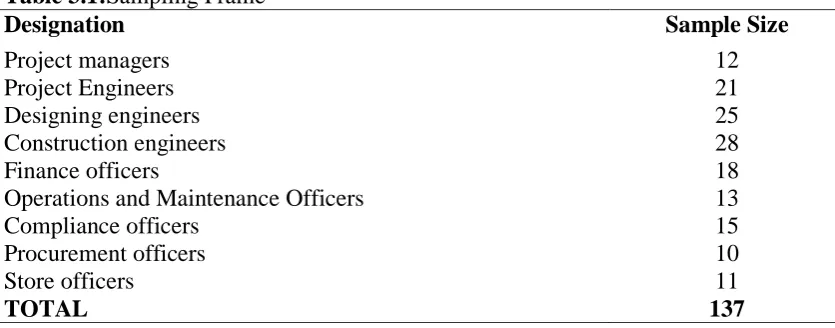
35
sample for this study was of size 145 respondents. The sample size represents a threshold of 30% of the population to enable their statistical representation in the sample as advised by Mugenda & Mugenda (2003).
Table 3.1:Sampling Frame
Designation Sample Size
Project managers 12
Project Engineers 21
Designing engineers 25
Construction engineers 28
Finance officers 18
Operations and Maintenance Officers 13
Compliance officers 15
Procurement officers 10
Store officers 11
TOTAL 137
3.5 Data Collection Procedure
36 3.6 Validity of Instruments
Face and content validity were administered on the questionnaires. Kothari (2004) points out that validity is the degree to which a test measures what it is supposed to measure. After piloting the questionnaires were edited to ensure that it measures up to high degree of face and content validity. Additionally, the expert opinions of the project supervisor further refined the validity of the instrument.
3.7 Reliability of Instruments
Reliability is the level of internal steadiness or stability of the measuring device over time. According to Orodho (2009) reliability is the ability of a research instrument to steadily induce the same responses from respondents in a study. The ultimate initiative in ensuring reliability is to providing simple and clear instructions to the respondents. A pilot study was carried out to correct any mistakes in the measuring tool. After the pilot study, the instruments were edited to eliminate inconsistencies, ambiguities and other grey areas that might hinder the consistency of responses from the instruments among the many respondents. Cronbach alpha co-efficient was used to determine the reliability of the research instrument with a co-efficient of 0.8 deemed sufficient.
3.8 Data Analysis Procedure and Presentation
37
computation of descriptive statistics which was analyzed with the support of Statistical Package for Social Sciences (SPSS) version 20.
The descriptive analysis yielded tables, charts, mean and standard deviation to describe the data and enable making of meaning from the data. Additional analysis was conducted using a multiple linear regression analysis which enabled establishment of the exact strength of the association among the variables under study. The model for the multiple regression analysis was as follows;
Y =β0+ β1X1+ β2X2+ β3X3+ β4X4 + ε
Where,
Y = Completion of roads project X1= Contract prequalification process
X2 = Contractors payment practices
X3 = Contract change management
X4 = Contractor supervision activities
ε = Error term
38 3.9 Operationalization of the Variables
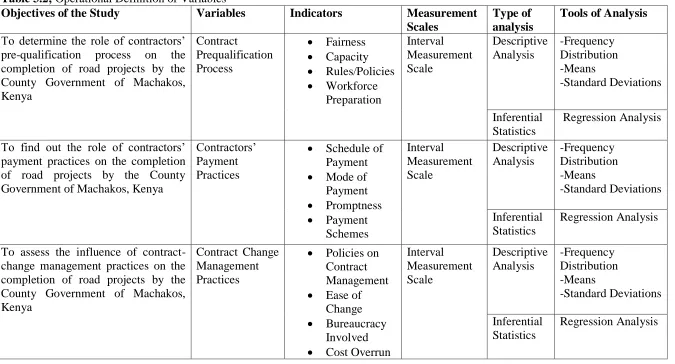
Table 3.2; Operational Definition of Variables
Objectives of the Study Variables Indicators Measurement
Scales
Type of analysis
Tools of Analysis To determine the role of contractors’
pre-qualification process on the completion of road projects by the County Government of Machakos, Kenya Contract Prequalification Process Fairness Capacity Rules/Policies Workforce Preparation Interval Measurement Scale Descriptive Analysis -Frequency Distribution -Means -Standard Deviations Inferential Statistics Regression Analysis To find out the role of contractors’
payment practices on the completion of road projects by the County Government of Machakos, Kenya
Contractors’ Payment Practices
Schedule of Payment Mode of Payment Promptness Payment Schemes Interval Measurement Scale Descriptive Analysis -Frequency Distribution -Means -Standard Deviations Inferential Statistics Regression Analysis
To assess the influence of contract-change management practices on the completion of road projects by the County Government of Machakos, Kenya
Contract Change Management Practices
Policies on Contract Management Ease of
Change Bureaucracy
Involved Cost Overrun
39 To determine the effects of
contractors’ supervision activities on the completion of road projects by the County Government of Machakos, Kenya
Contractors’ Supervision Activities
Promptness of Supervision Templates of
supervision Number/qualit y of supervisors Contract requirements Interval Measurement Scale Descriptive Analysis -Frequency Distribution -Means -Standard Deviations -Correlation Analysis Inferential Statistics Regression Analysis
40 3.10 Ethical Considerations
41
CHAPTER FOUR
RESEARCH FINDINGS AND ANALYSIS 4.1 Introduction
This chapter examined the research findings and thereafter data analysis. The study sought to examine contract management practices and completion of road construction projects by the county government of Machakos, Kenya. In order to address the general research objective, three research objectives were formulated. The study’s specific research objectives included examination of the role of contractors’ pre-qualification process, contractors’ payment practices, and contract change management practices on their influence of completion of road projects by the County. The research findings were examined using descriptive statistics such as frequency distribution, means and standard deviation. These results were presented in pie charts, bar graphs and tables. In order to make conclusions on the relationship between diverse variables then the inferential statistics were used. The inferential statistics used in the study is multiple linear regressions.
4.2 Response Rate
42
indicates that the results are sufficient for generalization as they can be considered a representative of the study population.
4.3 Respondent’s Characteristics
The respondents’ characteristics were examined using gender distribution, age distribution, and education levels.
4.3.1 Gender Distribution
The gender distribution results were illustrated through figure 4.1 below. The results indicated that 55.80% of the respondents were male while 44.2% of the respondents were female. The high number of the male respondents was attributed to the fact that construction industry is often and generally male denominated. This is due to the nature of work that makes it more attractive to the male gender. The gender aspect is critical in the road construction projects completion rates in the sense that levels of commitment and availability to supervise the road construction projects may vary across the gender.
Figure 4.1: Employee Distribution by Gender Source: Research Data (2016)
Male, 55.80% Female, 44.20%
, 0 , 0
Gender
Male
43 4.3.2 Length Worked at Machakos
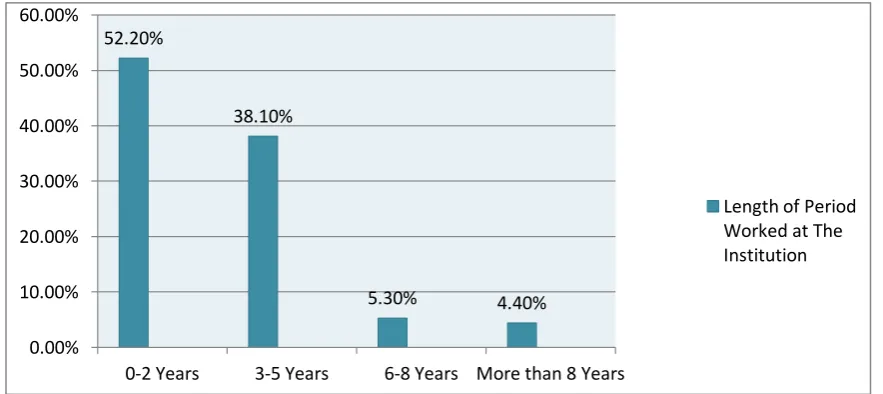
In the context of the length of period worked at Machakos, the results were illustrated using figure 4.2 below. The results indicated that 52.2%, 38.10%, 5.30% and 4.40% of the respondents had worked for 0-2 years, 3-5 years, 6-8 years, and more than 8 years respectively. The length of the period worked in their respective institutions is an indication of their experience levels in their functions and therefore the validity of their results. The results indicated that slightly less than half of the respondents had worked for more than 2 years and were therefore highly knowledgeable on the aspects addressed by the research. It is also worth noting that the county governments have only been in existence for a fairly short period of less than four years. The length of time worked at Machakos County is critical for the completion of the road projects in the county in the context that the persons who have stayed longer in the county are well familiar with the road network in the county and have also networked with diverse stakeholders.
Figure 4.2: Length of Time Employed Source: Research Data (2016)
52.20%
38.10%
5.30% 4.40%
0.00% 10.00% 20.00% 30.00% 40.00% 50.00% 60.00%
0-2 Years 3-5 Years 6-8 Years More than 8 Years
44 4.3.3 Education Level
The educational level was examined using figure 4.5 below. The results indicated that 4.4%, 16.8%, 54.0%, and 24.8% of the respondents had PhD, Masters, Degree and Diploma level educational levels. The level of education is critical in ensuring that the respondents have the required technical know-how on the aspects being asked. In this context it was worth noting that 75.2% of the respondents had degree level education.
Figure 4.3: Level of Employee Education Source: Research Data (2016)
4.4 Contractor Management Practices
The contract management levels were examined through use of completion rate of roads, road supervision rates, engagement of unqualified contractors, delay in paying contractors, changing of contract documents, and failure to supervise contractors.
PhD, 4.40%
Masters, 16.80%
Degree, 54.00% Diploma, 24.80%
Education Level
PhD
Masters
Degree
45 4.4.1 Completion Rate of Roads
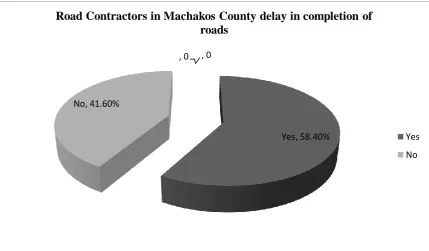
The results for the completion rates of roads were examined through figure 4.4 below. The results indicated that 58.40% of the respondents agreed that there was delay in completion of roads at Machakos County while 41.6% of the respondents disagreed. The road constructions are often faced by diverse challenges that affect their completion rates including stakeholder management, funds availability, equipment availability and the general work pace of the contractor.
Figure 4.4: Completion Rate of Contractors Source: Research Data (2016)
4.4.2 Road Contractors Supervision
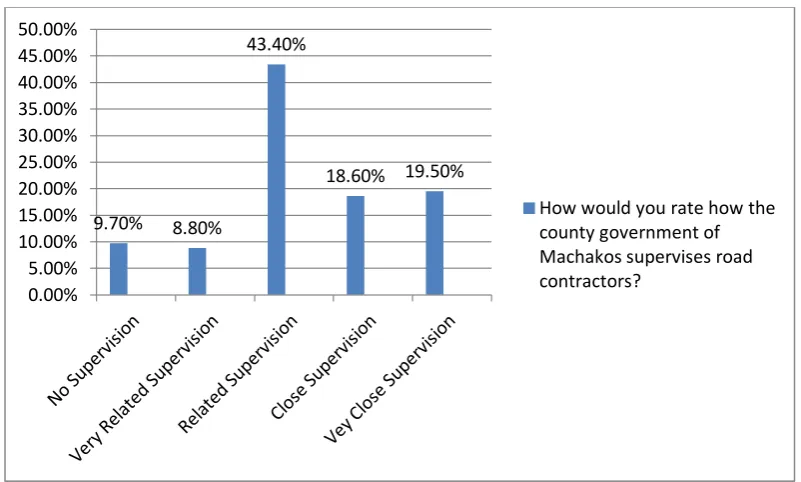
In the context of supervision levels, the respondents were asked on the diverse levels in which County Government of Machakos undertook supervision levels. In this context, 9.7%, 8.8%, 43.4%, 18.6%, and 19.5% of the respondents indicated that there was no supervision, very related supervision, related supervision, close supervision
Yes, 58.40% No, 41.60%
, 0 , 0
Road Contractors in Machakos County delay in completion of roads
Yes
46
and very close supervision respectively. Supervision of the contractors is a key element of the work being completed on time as it ensures that the work developmental milestones are met on time and with the required quality. Therefore, supervision ensures on the timeliness of the work development as well the quality of the delivered work.
Figure 4.5: County Government Supervision
Source: Research Data (2016)
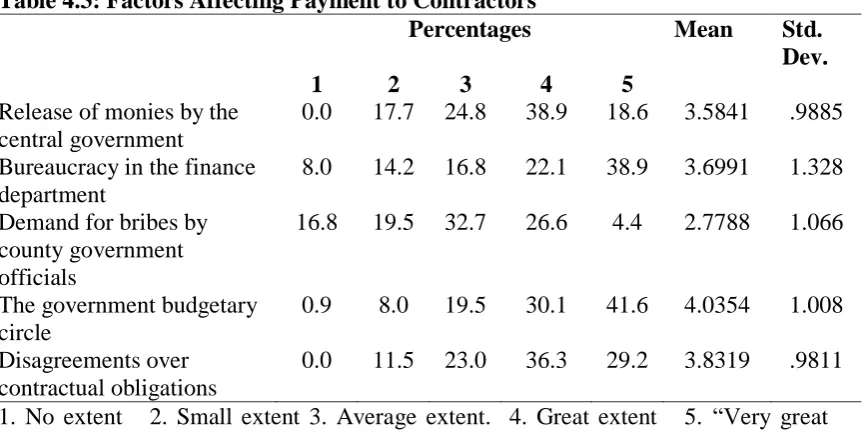
4.4.3 Contract Management Practices Effect on Road Construction Projects In the context of the delays in the payment of contractors, 7.1%, 19.5%, 32.7%, and 40.7% of the respondents indicated that county government of Machakos delayed in payment of contractors to a small extent, average extent, great extent and very great extent respectively. The delays in the payment of the contractors have an effect of the completion of the construction projects. This is due to the fact that contractors may go slow or compromise the quality of work and then arm twist the county government to pay them. In the context of the changing of contract documents, 17.7%, 38.9%,
9.70% 8.80%
43.40%
18.60% 19.50%
0.00% 5.00% 10.00% 15.00% 20.00% 25.00% 30.00% 35.00% 40.00% 45.00% 50.00%
47
29.2%, and 14.2% of the respondents indicated that county government of Machakos changed contracts to a small extent, average extent, great extent and very great extent respectively. Finally, 20.4%, 52.2%, and 27.4% of the respondents indicated that the county government of Machakos failed to supervise contractors to no extent, small extent, and average extent respectively.
Upon the prompt that whether they engaged unqualified contractors, 49.6% responded they never engaged them, 30.1% agreed they engaged them at small extent, while 20.4% agreed they averagely engaged unqualified contractors. None of the subjects responded to engaging them to either a great extent or very great extent. On average most respondents felt that project managers engaged unqualified contractors at a small extent, with a mean score of 1.7080 and a deviation of .78696. The information in the table shows a relatively strict adherence to definition of procurement and planning which by the Principal-Agent results to timely implementation of the contract (Oluka and Basheka, 2012). 38.9% of the respondents felt that the project managers considered on average changing contract documents, 17.7% at small extent, 29.2% great extent and 14.2% at a very great extent.
The means (denoted by µ) and standard deviations (denoted by σX) of indicators of
contract management practices were calculated. The interpretation was undertaken as follows. The scores of the mean 1<µ<1.5,1.5< µ<2.5, 2.5<µ<3.5, 3.5<µ<4.5, and 4.5<µ≤5 to be interpreted as the respondents on average perceived that there was no extent, small
extent, average extent, great extent and very great extent of influence of the indicator on
road construction projects in relations to the given metric respectively. The standard deviation
(σX) scores; 0<σX<0.5, 0.5<σX<1, and σX≥1 to be interpreted as responses clustered around
48
distributed around the mean implying high consensus, moderate consensus and lack of
consensus on a given metric respectively.
The mean score for engaging unqualified contractors was 1.708, for delay in paying contractors was 4.070, for changing of contract documents was 3.398, and for failure to supervise contractors was 2.070. On average, the respondents perceived that delay in paying contractors had a great extent of influence (3.5<µ<4.5) on road construction projects. On the other hand, the respondents on average perceived that changing of contract documents had an average extent of influence (2.5<µ<3.5) on road construction projects. The respondents’ average perception of the influence of failure to supervise contractors as well as engaging unqualified contractors on road construction projects was that to a small extent (1.5< µ<2.5), each indicator had an influence on the road construction projects.
49 Table 4.1: Contract Management
Percentages Mean Std.
Dev.
1 2 3 4 5
Engaging unqualified contractors
49.6 30.1 20.4 0 0 1.708 .78696 Delay in paying
contractors
0.0 7.1 19.5 32.7 0 4.070 .94223 Changing of contract
documents
0.0 17.7 38.9 29.2 0 3.398 .94055 Failure to supervise
contractors
20.4 52.2 27.4 0 0 2.070 .69071 1. No extent 2. Small Extent 3. Average Extent. 4. Great extent 5. Very great extent
Source: Research Data (2016) 4.5 Contractor Prequalification
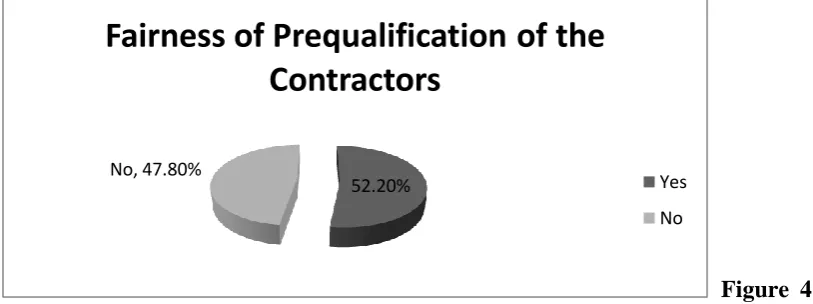
The respondents were asked whether they thought the county government issued contracts fairly based on the merit and qualifications brought forward to them. The following figure is a graphical representation of the results.
Figure 4.6 Fairness of Prequalification of Contractors
Source: Research Data (2016)
4.5.1 Emphasis of Different Contractor Prequalification Process
Half of the subjects of this study were of the opinion project managers emphasized on the contractor’s training at 50.6%, while 41.6% thought project managers did so at a small extent. Only 2.7% of the respondents felt the managers did so on rare occasions as those who thought the managers did so at very great extent were represented by
52.20% No, 47.80%
Fairness of Prequalification of the
Contractors
Yes
50
1.7% of the respondents. 3.5% were of the opinion that training of the contractor was important to the project manager.
Clearance with government bodies bore significant effect on the procuring entity as none of the respondents thought it was not important or has very minimal importance. 45.1% of the respondents greatly thought clearance with government entities was important, 31.9% thought they were important only on average and 23% thought very crucial to have clearance with government entities. Machinery is also important to the procurer as none of the respondents disagreed or agreed to a small extent. 38.9% of the subjects thought capacity of the contractor was either greatly important or very greatly important to the procurer. Only 22.1% of the respondents felt that capacity of the contractor was important to an average extent. Table 4.2 is a summary of the percentages.
The study sought to find out the extent to which respondents on average perceived various indicators are emphasized in the contractor prequalification process. The means (denoted by µ) and standard deviations (denoted by σX) of indicators of
contractor pre-qualification process were calculated. The interpretation was undertaken as follows. The scores of the mean 1<µ<1.5, 1.5< µ<2.5, 2.5<µ<3.5, 3.5<µ<4.5, and 4.5<µ≤5 to be interpreted as the respondents on average perceived that there was no extent, small extent, average extent, great extent and very great extent of emphasis on the indicator in the contractor prequalification process of road construction projects respectively.
The standard deviation (σX) scores; 0<σX<0.5, 0.5<σX<1, and σX≥1 to be interpreted
51
mean, and responses widely distributed around the mean implying high consensus, moderate consensus and lack of consensus on a given metric respectively.
On average, the respondents’ perception was that a great extent of emphasis (3.5<µ<4.5) is put on the capacity of the contractor (machinery owned) in the contractor prequalification process of road construction projects (mean score=3.684). The mean scores for training of the contractor, experience of the contractor, past performance of the contractor, clearance with other government bodies (KRA, HELB, PPOA) were 3.051, 3.384, 3.347 and 3.461 respectively. These mean scores were in the range 2.5<µ<3.5, which implied that on average, the respondents’ perception was that an average extent of emphasis is placed on training of the contractor, experience of the contractor, past performance of the contractor, and clearance with other government bodies (KRA, HELB, PPOA) in the contractor prequalification process of road construction projects.
The standard deviations for all the metrics on contractor prequalification were moderately distributed around the mean implying moderate consensus (0<σX<0.5) on
the extent of emphasis placed on each indicator in the contractor prequalification process of road construction projects. Therefore, there was moderate consensus amongst respondents on the extent of emphasis placed on training of the contractor (σX=0.956), experience of the contractor (σX=0.874), and past performance of the
contractor (σX=0.851) in the contractor prequalification process of road construction
52
standard deviation of 0.615, as well as capacity of the contractor (machinery owned) which has a standard deviation of 0.518.
Table 4.2: Contractor Prequalification
Percentages Mean Std.Dev
1 2 3 4 5
Training of the contractor 2.7 41.6 50.6 3.5 1.7 3.051 0.956 Experience of the contractor 0.0 11.5 23.9 34.5 30.1 3.384 0.874 Past performance of the
contractor
0.0 14.2 21.2 37.2 27.4 3.347 0.851 Clearance with other
government bodies ( KRA, HELB, PPOA)
0.0 0.0 31.9 45.1 23.0 3.461 0.615
Capacity of the contractor (machinery owned )
0.0 0.0 22.1 38.9 38.9 3.684 0.518 1. No extent 2. Small extent 3. Average extent 4. reat extent 5. “Very great extent”
Source: Research Data (2016)
4.6 Contractor Payment Methods
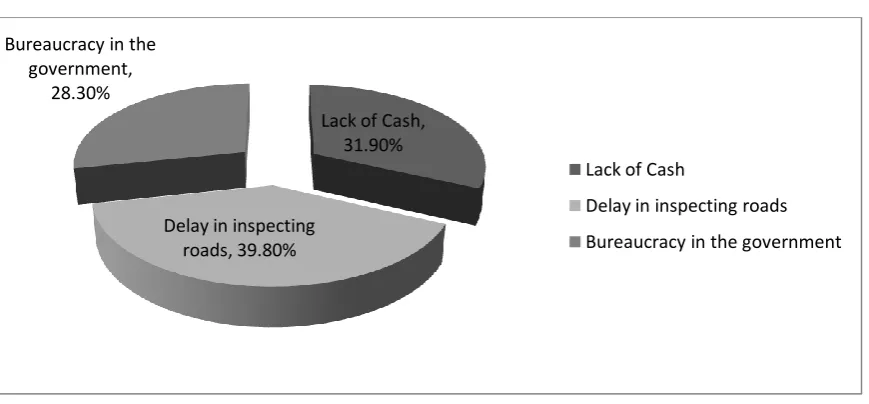
Delayed payments are the money amount not delivered to the contractors in the pre-agreed upon time between the procurer and the contractor.
Figure 4.7: Reasons for Delay
Source: Research Data (2016)
Lack of Cash, 31.90%
Delay in inspecting roads, 39.80% Bureaucracy in the
government, 28.30%
Lack of Cash
Delay in inspecting roads