Available online: https://pen2print.org/index.php/ijr/ P a g e | 560
Investigation of Performance of Twin Screw Compressor Using FEA
#1 B.SAI KIRAN P.G SCHOLAR
#2 B.PRAVEEN KUMAR ASSISTANT PROFESSOR
DEPARTMENT OF MECHANICAL ENGINEERING
TALLA PADMAVATHI COLLEGE OF ENGINEERING,SOMIDI,WARANGAL,T.S.
ABSTRACT
A twin screw compressor with 5 teeth is designed, modeled and analyzed deformations, stresses, frequencies, directional deformations and shear stresses. The modeling and assembly is done in Creo 2.0. Static Structural analysis, Modal analysis are done on the twin screw compressor by varying rotational speeds 2000rpm, 4000rpm, 5000rpm to determine deformations, stresses and frequencies. Random Vibration analysis is done at speed 5000rpm to determine directional deformations and shear stresses. The analysis is done using materials Steel, Titanium alloy and Nickel Alloy. Analysis is performed in Ansys 14.5.
I.INTRODUCTION
A mechanical device that expands the gas pressure by lessening its volume is a compressor. A sort of gas compressor is an air compressor.
Rotary compressor
The refrigerant is compressed by a roller rotary motion ascended eccentrically with a cylinder enclosing it in this type of compressor. The function is similar to that of the reciprocating compressor that is refrigerant is compressed to high pressure (Condenser Pressure) & high
temperature from low pressure(evaporator
pressure), pressure difference is maintained between the evaporator & the condenser and refrigerant flow is created from evaporator to condenser.
Rotary Screw Compressor
It is a sort of gas compressor that utilizes a mechanism of rotary type positive displacement. They are normally utilized to supplant piston
compressors where vast volumes of air with high-pressure are required, either for huge industrial applications or to work high-control air devices, for example, jackhammers.
The process of gas compression of a rotary screw is a ceaseless sweeping movement, so a very little flow surging or pulsation is present, as happens with piston compressors.
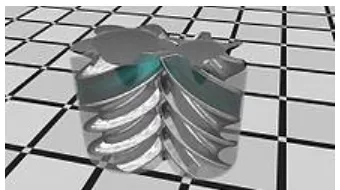
Fig 1: - The twin-screw compression action with a 6 lobe female screw & a 5 lobe male screw and one sets of cavities compression is featured: through intake port air is sucked in, compressed (appeared by the change from cyan to red) and discharged through the outlet port.
II.LITERATURE SURVEY
Nikhil M. Patel, Prof. B.B.Shah, Dr.A.Raman [1], studied an acceptable procedure for optimisation of the screw mechanical device form, size, and dimension is delineate here, which ends within the most applicable style. Compressors so designed deliver the goods higher delivery rates and higher efficiencies than
those exploitation ancient approaches. Huagen
Wu [2], exhibited FEM for computation of compressor compression loads. 3D elements were mapped with every rotor. Chamber
Available online: https://pen2print.org/index.php/ijr/ P a g e | 561 corresponding to rotor surface. The compression
loads are figured by incorporating the moment and force at every element node. To check the FEM, set up of a test rig was done, and each rotor axial forces were measured by the sensor which are placed between the bearings. The aftereffects of hypothetical computation by the FEM are in great concurrence with the measured data.
III.MODELING OF TWIN SCREW COMPRESSOR
The reference for the model is taken from the journal “Design and analysis for screw compressor”, by Nikhil M. Patel, Prof. B.B.Shah, Dr.A.Raman, Journal of information,
knowledge and research in mechanical
engineering, ISSN 0975 – 668X| NOV 12 TO OCT 13 | VOLUME – 02, ISSUE – 02 specified as [1] in References chapter. In the model specified in the above journal paper, the teeth taken are 4. In this thesis, number of teeth taken are 5. The twin screw compressor with 5 teeth is done in 3D modeling software Creo 2.0.
Fig 2 :- Final assembly of screw compressor
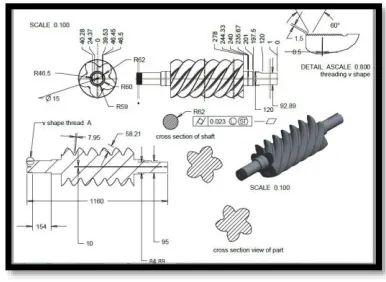
Fig 3:-2D drafting of screw compressor.
IV.ANALYSIS OF TWIN SCREW COMPRESSOR
Boundary conditions of static analysis are taken from the below journal paper
“Design and analysis for screw compressor”, by Nikhil M. Patel, Prof. B.B.Shah, Dr.A.Raman, Journal of information, knowledge and research in mechanical engineering, ISSN 0975 – 668X| NOV 12 TO OCT 13 | VOLUME – 02, ISSUE – 02 specified as [1] in References chapter.
Static Structural analysis is performed on the twin screw compressor by varying the rotational speed 2000rpm, 4000rpm and 5000rpm using materials Steel, Titanium and Nickel to determine deformations, stresses and strains.
Available online: https://pen2print.org/index.php/ijr/ P a g e | 562 Fig 4: - Rotation velocity applied on the shaft
2000 rpm
NICKEL ALLOY
ROTATIONAL SPEED – 5000rpm
Fig 5:-Total deformation of twin screw compressor at 5000rpm using Nickel alloy
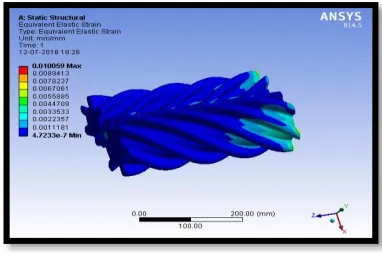
Fig 6:-Strain of twin screw compressor at 5000rpm using Nickel alloy
Fig 7:-Stress of twin screw compressor at 5000rpm using Nickel alloy
Fig 8:-Total deformation 1 of twin screw compressor at 5000rpm using Nickel alloy
Fig 9:- Total deformation 2 of twin screw compressor at 5000rpm using Nickel alloy
Available online: https://pen2print.org/index.php/ijr/ P a g e | 563 Fig 11:-Directional deformation of twin screw
compressor at 5000rpm using Nickel alloy
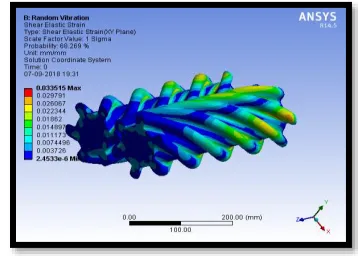
Fig 12:-Shear Strain of twin screw compressor at 5000rpm using Nickel alloy
Fig 13:-Shear Stress of twin screw compressor at 5000rpm using Nickel alloy
V.RESULTS AND DISCUSSIONS
STATIC STRUCTURAL ANALYSIS
SPEED - 2000 rpm
Steel Titani
um Nickel Total
Deformation (mm)
0.00154 5
0.0020
22 0.0029321
Stress
(MPa) 10.418 5.676 12.262
Strain 0.00068 075
0.0006 744
0.0009679 6
At 2000rpm, the deformation value is less when Steel is used and Stress value is less when Titanium alloy is used. The stress is reducing for Titanium alloy by about 45.5% when compared with that of Steel & by about 53.7% when compared with that of Nickel Alloy.
SPEED - 4000 rpm
Steel Titanium Nickel Total
Deformati on(mm)
0.00738
02 0.0083082
0.01172 9
Stress
(MPa) 41.672 22.704 49.048
Strain 0.00024 323
0.0002697 9
0.00038 718
At 4000rpm, the deformation value is less when Steel is used and Stress value is less when Titanium alloy is used. The stress is reducing for Titanium alloy by about 45.5% when compared with that of Steel & by about 53.7% when compared with that of Nickel Alloy.
SPEED – 5000 rpm
Steel Titanium Nickel
Total Deformati
on (mm)
0.011532 0.012982 0.01832
6
Stress
Available online: https://pen2print.org/index.php/ijr/ P a g e | 564
Strain 0.000380
05
0.000421 55
0.00060 497
At 45000rpm, the deformation value is less when Steel is used and Stress value is less when Titanium alloy is used. The stress is reducing for Titanium alloy by about 47.05% when compared with that of Steel & by about 56.7% when compared with that of Nickel Alloy.
MODAL ANALYSIS
At 2000rpm, the deformation and frequency values are more when Steel is used and less when Nickel alloy is used. At mode 3, the frequency is reduced for Nickel alloy by about 18% when compared with that of Steel and by about 5.5% when compared with that of Titanium alloy. By reducing frequencies, vibrations in the component will decrease. At 4000rpm, the deformation and frequency values are more when Steel is used and less when Nickel alloy is used. At mode 3, the frequency is reduced for Nickel alloy by about 18% when compared with that of Steel and by about 5.5% when compared with that of Titanium alloy. By
reducing frequencies, vibrations in the
component will decrease. At 5000rpm, the deformation and frequency values are more when Steel is used and less when Nickel alloy is used. At mode 3, the frequency is reduced for Nickel alloy by about 18% when compared with that of Steel and by about 5.5% when compared with that of Titanium alloy. By reducing frequencies, vibrations in the component will decrease.
RANDOM VIBRATION ANALYSIS
The directional deformation value is less when Nickel alloy is used and Shear Stress is less when Titanium alloy is used. The stress value is decreasing for Titanium alloy by about 22.5% when compared with that of Steel and by about 29.35% when compared with that of Nickel alloy.
VI.CONCLUSION
Static Structural analysis, Modal analysis are done on the twin screw compressor by varying rotational speeds 2000rpm, 4000rpm, 5000rpm
to determine deformations, stresses and
frequencies. Random Vibration analysis is done at speed 5000rpm to determine directional deformations and shear stresses. The analysis is done using materials Steel, Titanium alloy and Nickel Alloy.
By observing static structural analysis results, at all speeds, the deformation value is less when Steel is used and Stress value is less when Titanium alloy is used. The stress is reducing for Titanium alloy by about 45.5% when compared with that of Steel & by about 53.7% when compared with that of Nickel Alloy.
By observing modal analysis results, at all speeds, the deformation and frequency values are more when Steel is used and less when Nickel alloy is used. At mode 3, the frequency is reduced for Nickel alloy by about 18% when compared with that of Steel and by about 5.5% when compared with that of Titanium alloy. By
reducing frequencies, vibrations in the
component will decrease when Nickel alloy is used.
By observing Random Vibration analysis results, the directional deformation value is less when Nickel alloy is used and Shear Stress is less when Titanium alloy is used. The stress value is decreasing for Titanium alloy by about 22.5% when compared with that of Steel and by about 29.35% when compared with that of Nickel alloy.
REFERENCES
1. Nikhil M. Patel, Prof. B.B.Shah, Dr.A.Raman, Design and analysis for
screw compressor, Journal of
Available online: https://pen2print.org/index.php/ijr/ P a g e | 565 668X| nov 12 to oct 13 | Volume – 02,
Issue – 02
2. Huagen Wu, Yuan Ma, Ziwen Xing,
theoretical and experimental
investigation of compression loads in twin screw compressor, International Compressor Engineering Conference, 2004.
3. Yang, Shyue-Cheng, Tsang-Lang Liang , study of a single screw compressor with a conical teeth gate rotor, vol. 32, no. 3-4, 2008.
4. David Buckney, Ahmed Kovacevic , Nikola Stosic , Design and evaluation of rotor clearances for oil-injected screw compressors, Proc imeche Part E: J Process Mechanical Engineering 2017, Vol. 231(1) 26–37.
5. Sun-Seok Byeon , Jae-Young Lee , Youn-Jea Kim, Performance Characteristics of a 4 × 6 Oil-Free
Twin-Screw Compressor, Energies
2017, 10, 945.
6. Feilong Liu , Xueli Liao ,Quanke Feng, Martijn Van Den Broek , Michel De Paepe , Deformation Analysis of the Main Components in a
Single Screw Compressor , 9th
International Conference on
Compressors and their Systems 2015. 7. Jian Li, Feilong Liu ,Quanke Feng
,Weifeng Wu , A New Design of the
Tooth Profile for Single Screw
Compressors 2012.
8. Ekaterina Chukanova, Nikola Stosic, Ahmed Kovacevic, Ashvin Dhunput , Investigation of Start Up Process in Oil Flooded Twin Screw Compressors , International Compressor Engineering Conference (2012).
9. He Xueminga , Han Mingb , Deng Yang, Lu Yi, Hua Chenliang , Rotor profile generation method for twin screw compressors based on bi-direction , Applied Mechanics and Materials Vols.229-231.
10. David Buckney, Ahmed Kovacevic , Nikola Stosic , Design and evaluation of rotor clearances for oil-injected screw compressors , July 19, 2016.
11. David Jensen , A New Single Screw Compressor Design That Enables A New Manufacturing Process,