An Efficient Secure Oblivious Transfer
Hung-Min Sun1, *Yalin Chen2, Jue-Sam Chou3
1
Dept. Computer Science, National Tsing Hua University [email protected]
2
Institute of Information Systems and Applications, National Tsing Hua University
*: corresponding author
3
Department of Information Management, Nanhua University [email protected]
Abstract
As traditional oblivious transfer protocols are treated as a cryptographic primitive,
they are usually executed without the consideration of possible attacks, e.g.,
impersonation, replaying, and man-in-the-middle attacks. Therefore, when these
protocols are applied in certain applications such as mental poker playing, some
necessary mechanism must be executed first to ensure the security of subsequent
communications. But doing this way, we found that almost all of the resulting
mechanisms are not efficient enough in communicational cost which is a significant
concern for commercial transactions. Inspired by these observations, we propose a
novel secure oblivious transfer protocol based on bilinear pairing which not only can
provide mutual authentication to resist malicious attacks but also is efficient in
communicational cost, other than its original functions.
Keywords: oblivious transfer, mutual authentication, ID-based cryptosystem, bilinear
pairing, communicational cost, ECDLP, DLP, impersonation, MIMA, KCI
1. Introduction
Oblivious transfer (OT) is an important tool for designing secure protocols and
has been widely used in various applications like fairly signing contracts, obliviously
searching database, playing mental poker games, privacy-preserving auctions, secure
multiparty computations, and so on. It is a protocol by which a sender can send some
messages to a receiver without the receiver's knowing which part of the messages can
be obtained. In 1981, Rabin [1] first proposed the concept of interactive OT scheme,
in which a sender sends an encrypted message to a receiver and the receiver can
decrypt the message with probability 1/2. Rabin used the proposed OT to design a
protocol, hoping that two parties can exchange their secrets fairly and simultaneously.
In his protocol, the initiator signs each message flow to make the message flow be
authentic to the receiver. In 1985, Even, Goldreich, and Lempel [2] presented a more
encrypted messages to a chooser with the chooser being able to decrypt one of them
that he had chosen. Moreover, by evoking their OT multiple times they presented a 12
contract-signing protocol to achieve the goal that one party cannot obtain the other
party's contract signature without showing his own. In 1986, Brassard and Crepeau [3]
further extended OT to 1-out-of-12 n OT (OT , also known as "all-or-nothing"), the 1n
case of sending n messages to a chooser with only one of them can be obtained by the
chooser. Meanwhile, they pointed out that OT is a useful cryptographic primitive 1n
for implementing a multi-party mental poker game against player coalition. Except for
the above interactive versions, Bellare and Micali [4] first proposed a non-interactive 2
1
OT in 1989. It is a means that one user can obliviously transfer something to
another who is equipped with two public keys.
Based on interactive and non-interactive OT schemes, Naor et al. proposed 12
some related OT works [5-9] during 1999 to 2001 such as, adaptive OT [6], proxy OT
[7], distributed OT [8] and how to construct an efficient OT or 1n OTkn from OT 12
[5, 9]. Here, the OTkn scheme -- a chooser is allowed to privately choose k messages
from n encrypted messages from a sender -- is the last form in OT spectrum. In 2002,
Mu et al. [10] proposed three OTkn schemes which are directly constructed from
RSA encryption, Nyberg-Rueppel signature, and ElGamal encryption scheme
respectively, and claimed that their schemes induce a significant improvement in
communicational cost. In 2004, Ogata and Kurosawa [11] proposed another OTkn
scheme (which can be employed in an either adaptive or non-adaptive manner) based
on RSA blind signature. They claimed that their scheme can be applied in oblivious
key search -- a database supplier first commits n data (through a CD-ROM or DVD)
to a customer, and the customer can then search a keyword on the pay-per-view basis
without revealing the keyword to the database supplier. After that, three OTkn
schemes were proposed [12-14] in 2005. Among them, Chu et al. claimed that their
method [12] is the most efficient one because it needs only 2 rounds to send 1024k
bits from the chooser to the sender and 1024*(k+1)+n*|Data| bits from the sender to
the chooser, where |Data| presents the bit length of Data, a plaintext or ciphertext. In
2006, Parakh [15] proposed an elliptic-curve based algorithm to allow two parties
exchanging their secrets in a non-simultaneous manner with one-quarter success
probability. Further, they used the proposed algorithm to implement a novel OT 12
scheme, having the advantage of providing the same security level with only 160-bit
key instead of 1024-bit key needed in RSA. In the same year, for coping with all
possible attacks encountered in an open network, Kim et al. [16] modified
Bellare-Micali non-interactive OT scheme by appending the sender's signature to 12
make the sender undeniable about his sent messages and be authenticated by the
(we will describe this in Section 3). In 2007, Halevi and Kalai [19] proposed another 2
1
OT scheme by using smooth projective hashing and showed that the used
RSA-composite in their scheme needs not be a product of safe primes. Also in 2007,
Camenish et al. and Green et al. proposed two related studies [17, 18] respectively,
both focusing on the security of full simulatability for the sender and receiver which
can resist against the selective-failure attack [6]. In 2009, Chang [20] presented an
n k
OT scheme using both the RSA blind signature and Chinese Remainder Theorem;
however, we think that their scheme did not consider the overhead of using a public
board; i.e. it needs an additional secure-access mechanism to keep malicious users
from computing other's secrets on the public board.
After surveying all of the above-mentioned OT schemes, we found that only [1]
and [16] does consider protection from all possible attacks. In other words, almost all
of the traditional OT schemes lack the consideration of adding security features.
Therefore, if we wish such OT protocols to resist against various attacks, we should
run them through secure channels. This however would incur extra communicational
overhead. For this reason, in this paper, we will propose a novel solution that
combines an OTkn scheme with a secure mechanism encompassing some security
features such as, mutual authentication, the resistance of man-in-the-middle (MIMA)
attack, replaying attack, and key compromise impersonation (KCI) attack. We refer to
the combination as "authentic OT". Except for the security enhancement, our
authentic OT also can improve communicational efficiency. This is because the
number of rounds needed by a traditional OT scheme running under a secure channel
is at least three (one for the secure mechanism and two for the traditional OT scheme
itself), whereas our secured authentic OT scheme just needs two. Thus, as compared
with traditional OT schemes, our scheme promotes not only in the aspect of security
but also in the communicational efficiency.
The rest of this paper is organized as follows. The introduction has been presented
in Section 1 and the preliminaries will be shown in Section 2. In Section 3, we will
review Kim et al.'s scheme and show their weaknesses. After that, we show our
protocol in Section 4. Then, the security analysis and communicational cost
comparisons among the related works are made in Section 5. Finally, a conclusion is
given in Section 6.
2. Preliminaries
In this section, we will introduce the security requirements for an authentic OT,
the axiom and principles of bilinear paring, and the intractable problems used in this
2.1 Security requirements of an authentic OT scheme
In a traditional OT, there are two parties, a sender S (who has n messages m1,
2
m , ..., mn to be obliviously transferred to a chooser, where n2) and a chooser
C (who chooses 1, 2, ..., k messages among the transferred messages from
the sender in advance, where {1,..., k}{1,2,... ,n}, kn). The protocol should
meet the following security requirements:
(1) Correctness: C should obtain the valid data which he had chosen at the end of
the protocol if SandCproperly run the protocol.
(2) Chooser's privacy: In the protocol, the choices of the chooser should not be known to the sender or other third party. More precisely, the
chooser's encrypted choice can be any clear choice with the same
probability, i.e. for an encrypted message y and any clear message x,
Pr[x|y] = Pr[x]. This property is known as Shannonperfect secrecy.
(3) Sender's privacy: At the end of the protocol run, the chooser cannot get any knowledge about the messages that he did not choose. More formally,
the ciphertext sent by the sender is semantically secure (i.e. the
ciphertext can not be distinguished non-negligibly better than
random guessing).
Except for the above three concerns, to guard against security threats, the
following attacks must be considered in our authentic OT scheme.
(1) Impersonation attack: In the protocol, each party must authenticate the counterpart as the intended party as claimed. That is, it should be a
mutual-authentication OT.
(2) Replaying attack: An adversary could obtain plaintexts by only replaying old messages that a chooser had sent to a sender before.
(3) Man-in-the-middle attack (MIMA): MIMA is an attack that an adversary slinkingly intercepts the communicational line between two
communicating parties and uses some means to make them believe
that they are talking to the intended party. But indeed, they each
other are talking to the adversary.
(4) KCI attack: KCI attack means that when S(C)'s private key is compromised by an adversary, the adversary can impersonate C(S) to communicate with
2.2 Bilinear paring
Let G1 and G2 be two groups of order q, where q is a large prime, G1 be a
subgroup of the additive group of points on an elliptic curve E/Fp, and G2 be a
subgroup of the multiplicative group of a finite fieldFp*2. A bilinear mapping is
defined as e :G1G1→G2 between these two groups. The mapping must satisfy the
following properties:
(1) Bilinear: A mapping e :G1G1→G2 is bilinear if e(aP, bQ)= e(P,Q)abfor all P,
QG1and all a, bZq*.
(2) Non-degenerate: The mapping does not map all pairs in G1G1 to the identity in
2
G .
(3) Computable: There is an efficient algorithm to compute e(P, Q) for any P, QG1.
(4) If P is a generator forG1 then e(P, P) is a generator forG2.
(5) Commutative: For all P1,P2G1, e(P1,P2) = e(P2,P1).
(6) Distributive: For all P1,P2,P3G1, e(P1P2,P3) = e(P1,P3)e(P2,P3).
2.3 Diffie-Hellman problems
Let a,b,cR Zq* and G g, G1 P, and G2 g(e(P,P)), each
be a group of prime order q. In the following, we describe some well known
intractable Diffie-Hellman problems that we will use in this paper.
(1) The Computational Diffie-Hellman (CDH) problem: CDH problem is that in G,
given (g, ga, gb), finding the element C gab.
(2) The Decisional Diffie-Hellman (DDH) problem: DDH problem is that in G, given (g, ga, gb, gc), deciding whether c=ab.
(3) The Bilinear Computational Diffie-Hellman (BCDH) problem: BCDH
problem is that given (P, aP, bP, cP) in G1, finding e(P,P)abc in G2.
According to Boneh and Frank's study [23], the BCDH problem is no harder
than the CDH problem in G1 or G2.
(4) Chosen-Target CDH (CTCDH) problem: Let H:{0,1}* G be a hash function, T() be a target oracle which returns a random element in G, and
c
)
( a helper oracle, where c is a random integer from *
q
Z . Also let qt be the
number of queries for T() and qh the number of queries for ()c. The
CTCDH problem is to find l pairs, (j1,v1), ..., (jl,vl), satisfying vi =
and qt be l-1 and l, respectively. The CTCDH problem can then be rephrased
as that knowing T(j1), ..., T(jl) via querying the T() oracle, and (j1,v1), ...,
) ,
(jl1 vl1 via querying the helper oracle ()c, try to find the lth pair (jl,vl).
The CTCDH problem is proposed and considered as a hard problem by
Boldyreva in 2002 [21]. The former version of this problem in RSA is
proved by Bellare et al. in [22].
3. Review of Kim et al.'s protocol
In this section, we first review Kim et al.'s protocol in Section 3.1 then
cryptoanalyze the security weaknesses of their protocol in Section 3.2.
3.1 Kim et al.'s protocol
In 2006, Kim et al. proposed a secure verifiable non-interactive OT (NIOT)
protocol based on RSA.Their method, improved from Bellare-Micali non-interactive
OT, hopes to enable a receiver to authenticate the sender and prevent the sender from
denying what he had sent. The protocol is described as follows and also illustrated in
Fig 1.
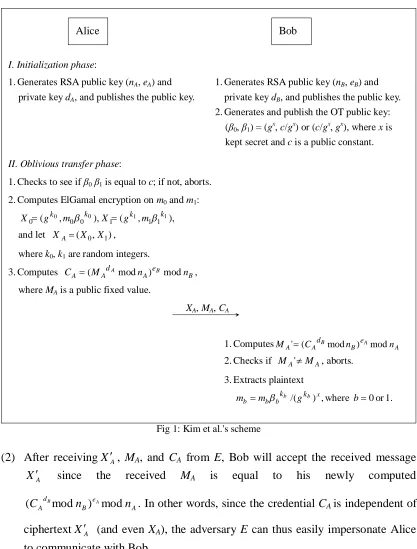
In the initialization phase of the protocol, Bob makes the choice via setting the OT public key (0,1); i.e. he will obtain m0 if (0,1) = (g
x
, c/gx), or m1 if
) ,
(0 1 = (c/gx, gx), where c is a public constant. In the oblivious transfer phase, for the security requirement of non-repudiation, Alice would use her private key dA and
Bob's public key (nB ,eB) to create the credential CA. Bob then verifies CA by using
his private key dB and Alice's public key (nA ,eA). They claimed that a valid
credential can make Alice unable to repudiate the fact that she had sent the message.
3.2 Cryptanalysis of Kim's NIOT scheme
Although, Kim et al. claimed that in their scheme, Bob can authenticate Alice and
prevent from Alice's denial of what she had sent by checking whether
A e
B d
A
A C n n
M ( Bmod ) Amod holds or not. However, the encrypted message, X
A, has
never been signed by Alice. Hence, it exposes a serious vulnerability that an
adversary E can impersonate Alice to communicate with Bob. We describe this impersonation attack as follows:
(1) When E intercepts XA , CA and MA sent from Alice to Bob, he can compute
another couple (X0,X1)( XA) for a pair of arbitrary messages (m0', m1') in
Fig 1: Kim et al.'s scheme
(2) After receivingXA , MA, and CA from E, Bob will accept the received message
A
X since the received MA is equal to his newly computed
A e
B d
A n n
C B A
mod ) mod
( . In other words, since the credential CA is independent of
ciphertextXA (and even XA), the adversary E can thus easily impersonate Alice
to communicate with Bob.
Moreover, other than the above described drawback, their scheme has another
shortcoming. If nA > nB, then message MA cannot be recovered by Bob. This is known
as the reblocking problem [23] and can make legal Alice can not be authenticated by
Bob.
1.Checks to see if β0β1 is equal to c; if not, aborts.
2.Computes ElGamal encryption on m0 and m1: ( 0, 0), ( 1, 1),
1 1 1
0 0 0
k k k
k m X g m
g
X
and let XA(X0,X1), where k0, k1 are random integers.
3.Computes CA MA A nA B nB
e
d mod ) mod
(
,
where MA is a public fixed value.
XA, MA, CA
1.ComputesMA CA B nB A nA
e
d mod ) mod
( '
2.Checks if MA'MA, aborts. 3.Extracts plaintext
mb mbbkb/(gkb)x,where b0or 1.
I. Initialization phase:
1.Generates RSA public key (nA, eA) and
private key dA, and publishes the public key.
Bob Alice
1.Generates RSA public key (nB, eB) and
private key dB, and publishes the public key.
2.Generates and publish the OT public key: (β0, β1) = (gx, c/gx) or (c/gx, gx), where x is
kept secret and c is a public constant.
4. Proposed protocol
For the simplicity of key distribution and management, an ID-based public key
cryptosystem is often suggested in user identity authentication. In this section, we
present our ID-based authentic OTkn protocol based on bilinear paring (proposed by
Boneh and Franklin in 2001 [24]).
Our scheme also consists of the two phases: (1) initialization phase, and (2)
oblivious transfer phase. We describe them as follows.
In phase (1), we adopt the same system parameters as used in [24]. In addition,
there exists a key generation center (KGC) who initially chooses an additive group
P
G1 of order q, a multiplicative group G2 e(P,P) of the same order,
where e is a bilinear mapping, i.e. e : G1G1 G2, and three one-way hash functions:
H:{0,1}* {0,1}l, H2:G1 {0,1}l, and H1 which maps a string (a user's ID) to an
element in G1, i.e.H1: *
} 1 , 0
{ G1. Moreover, KGC also selects *
q Z
s as its
private master key and computes the corresponding system public key as Ppub = sP.
Then, KGC publishes the system parameter set {G1, G2, q, e, P, Ppub, H, H1, H2}.
After that, when a user U (sender/chooser) registers his identifier IDU to KGC, KGC
can compute a public/private key pair Upub/Upriv for him, where Upub=H1(IDU) and
Upriv = sUpub.
In phase (2), when a sender who has public/private key pair Spub/Spriv and
possesses n messages, m1, m2, ..., and mn, wants to obliviously transfer k messages
of them,
1
m ,
2
m , ..., and k
m , to a chooser (whose public/private key pair is
Cpub/Cpriv), where 1, 2, ..., and k are the k choices selected by the chooser in
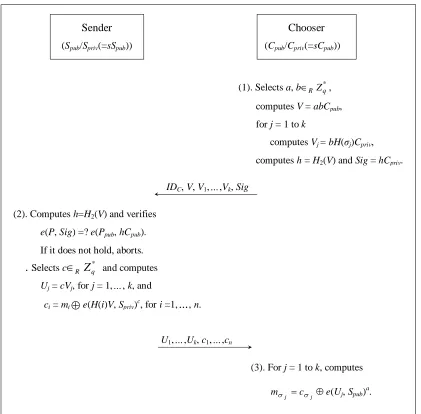
advance, they will execute the following steps. We also depict them in Fig.2.
Step (1): The chooser randomly chooses two integers a, b *
q Z
, and computes
pub abC
V , and Vj bH(j)Cpriv, where j=1, 2, ..., k. After that, he generates a
signature on V by computing hH2(V)and Sig hCpriv Then, he sends IDR, V,
Fig. 2: The proposed k-out-of-n authentic OT protocol
Step (2): After receiving IDR, V, V1,...,Vk and Sig from the chooser, the sender
computes hH2(V) and verifies the chooser's signature by checking whether
the equation e(P,Sig)= e(Ppub,hCpub) holds or not. If it holds, he believes that
the chooser is the intended party as claimed. Then, the sender randomly chooses
an integer c *
q Z
, and computes Uj cVj and ci mi e c
priv S V i
H() , )
( , where
j = 1,...,k and i = 1,...,n. He then sends U1,...,Uk,c1,...,andcn to the chooser.
Step (3): After receiving the message U1,...Uk,c1,...,andcn from the sender, the
chooser can obtain the intended plaintexts by computing
j
j σ
σ c
m e a
pub j S U , ) (
Sender
(Spub/Spriv(=sSpub))
IDC, V, V1,...,Vk, Sig
(2). Computes h=H2(V) and verifies
e(P, Sig) =? e(Ppub, hCpub).
. Selects cR Zq* and computes If it does not hold, aborts.
Uj= cVj, for j = 1,..., k, and
ci= mie(H(i)V, Spriv)c, for i =1,..., n.
U1,...,Uk, c1,...,cn
(1). Selects a, bR Zq*, computes V = abCpub,
for j = 1 to k
computes Vj = bH(σj)Cpriv,
Chooser
(Cpub/Cpriv(=sCpub))
computes h = H2(V) and Sig = hCpriv.
j j c
m e(Uj, Spub)a.
for j = 1,...,k.
5. Security analysis
In this Section, we use the following claims to show that our protocol not only can
achieve mutual authentication, chooser's privacy and sender's privacy but also can
resist against active attacks such as relay attack, KCI attack and man-in-the-middle
attack.
Claim 1: The proposed protocol is correct.
Proof: After the protocol run, the chooser can obtain the exact k messages which he
selected by computing
j
σ
c e(Uj,Spub)a
=
j
σ
c e ( a
pub priv jC S cbH( ) , )
=
j
σ
c e (H( j)bcsCpub,Spub)a
=
j
σ
c e (H( j)abCpub,sSpub)c
=
j
σ
c e ( c
priv jV S
H( ) , ) = j
σ m .
Claim 2: The proposed protocol can achieve mutual authentication.
Proof: First, it can be easily seen that the sender can authenticate the chooser by
verifying the chooser's signature, Sig, as described in Step (2). Next, we show how
the chooser can authenticate the sender. For that the ciphertext ci (= mi e(H(i)V,
Spriv)c ) contains the sender's private key Spriv (= sSpub), the chooser can compute
the plaintext j
σ
m only via using the sender's public key Spub (also refer to the
equation in Claim 1). This means that only the true sender can produce the right
i
c s and thus the chooser can authenticate the sender.
Claim 3: The proposed protocol can achieve the chooser's privacy.
Proof: For each of the chooser's choices σj{1,2, ...,n}, it is randomized and signed as
Vj = bH(σj)Cpriv by C in Step (1), where b is a random number and Cpriv is the
chooser's private key. We argue that nobody except for the chooser can know the
choice σj because even an attacker can steal the chooser's private key Cpriv, he
cannot obtain bH(σj) from Vj due to the hardness of ECDLP. That is, he can not
bH(σj)Cpriv= Vj}; that is, A consists of all the possible ordered pairs satisfying the
equation. If we are given a value Vj, then under the fixed value Cpriv, there only
exists an unique value bH(σj) satisfying the equation. Under a collision-free
one-way hash function, once σj has been determined, the value of b is determined
as well. That is, the relationship between b and σj is one-to-one. Having this
observation and the dimension of σj is n, we can see that there are n (b, σj) pairs in
A. In other words, Pr[σj|Vj] = Pr[σj] = 1/n. This achieves the Shannon perfect
secrecy. Therefore, the proposed protocol has chooser's privacy.
Claim 4: The proposed scheme can achieve the sender's privacy.
Proof: Assume that there exists a valid but malicious chooser Ĉ who plays the role of
the chooser wants to obtain more than k plaintexts in the protocol. If he could
succeed, then the sender's privacy is violated. However, we will prove that it is
computationally infeasible for Ĉ to obtain the (k+1)th plaintext . We use the
following two arguments, (I) and (II), to show that Ĉ can obtain at most k
plaintexts after running the proposed protocol. In argument (I), we discuss that Ĉ
must follow the protocol to form the values V and Vjs; otherwise, he can not
obtain the k plaintexts that he had chosen. In argument (II), we show that if Ĉ
intends to obtain the (k+1)th plaintext, then he will face the intractable CTCDH
problem under the assumption that H(.) is a random hash function.
Argument (I): Ĉ must follow the protocol to form the values of V (= abĈpub) and
Vj (= bH(σj)Ĉpriv); otherwise, he can not obtain the k plaintexts, m1,...,mj,
which he had chosen.
In the following, we further divide this argument into two cases: (a) Ĉ fakes V
but forms Vjs honestly, and (b)Ĉ fakes the values of V and Vjs.
(a) If Ĉ is dishonest in forming V but forms Vjs as in the original protocol. For
example, without loss of generality, he replaces V with a specified XG1 and
computes Vj = bH(σj)Ĉ priv. Then, the sender will compute Uj = cVj, ci =
mie(H(i)X, Spriv)c, and send them back to Ĉ. As a result, Ĉ can not decrypt
j
c ( j
σ
c =
j
m e(Uj,Spub)a) to obtain the k plaintexts since e(Uj,Spub)a is
obviously not equal to e(H(σj)X, Spriv)c. For obtaining the k plaintexts, Ĉ may
try another way and compute e(H(i)X, Spriv)c. But this is computationally
secrecy c. Moreover, to extract c from Uj is an ECDLP.
(b) Similarly, without loss of generality, except for the replacement of V with X, Ĉ fakes Vj as H(σj)X. Under this construction, the value of Uj computed by the
sender would be Uj = cVj = cH(σj)X and the target ciphertext cj would be
j
m e(H(σj)X, Spriv)c, or equivalently, cj mj e (cH(j)X,Spriv) .
Although, Ĉ knows the value of cH(σj)X (since it just equal to Uj received
from the sender), Ĉ still can not compute e(cH(j)X,Spriv) without the
knowledge of Spriv. From above description, we know that when the setting of
Vj is H(σj)X, Ĉ can not obtain mj. Not to mention, Ĉ sets Vj as H(σj)Y, where
Y(X) is an element in G1. In summary, Ĉ can not obtain the k plaintexts
under the violation of setting the values, V and Vjs .
Argument (II): If Ĉ intends to obtain the (k+1)th plaintext, then he will face the intractable CTCDH problem under the assumption that H(.) is a random hash
function.
That Ĉ wants to obtain plaintext mi implies Ĉ would have the knowledge of
e(H(i)V, Spriv)c (=e(Uj, Spub)a) (In fact, Ĉ could know k of the n values, e(H(i)V,
Spriv)c, for i=1 to n, since e(H(i)V, Spriv)c = e(Uj, Spub)a, for i = σj and j =1 to k.) Let
e(H(i)V, Spriv)c = y(i) be an element in G2. According to argument (I), for obtaining
k plaintexts, Ĉ can not change the structures of V(=abĈpub) and Vj(=bH(σj) Ĉpriv).
In this situation, y(i) only can be decomposed as y(i) = e(H(i)abĈpub, Spriv)c =
e(abH(i)Ĉpriv, Spub)c. Moreover, under the assumption that H(.) is a random hash
function and the fact that Ĉ has the knowledge of a, b, Ĉpriv, and Spub, y(i) can be
represented as (gi)c, where gi = e(abH(i)Ĉpriv, Spub) and is a random element in G2.
Consequently, the problem Ĉ really faces is that knowing k pairs of (σ1, (gσ1) c
), (σ2,
(gσ2) c
), ..., and (σk, (gσk)
c
), where (gσj)
c
= e(Uj, Spub)a, find the (k+1)th pair (σk+1,
(gσk+1) c
) without the knowledge of sender's one-time secrecy c. This is known as
the intractable CTCDH problem introduced in Section 2.3. Therefore, the chooser
can not obtain the (k+1)th plaintext; he can just obtain the exact k plaintexts that he
had chosen.
According to arguments I and II, we have proven Claim 4 that our scheme has
the sender's privacy.
Proof: Suppose that an adversary eavesdropped on a chooser's OT request (containing
IDC, V, Vjs, and Sig) and replayed it later. After receiving the sender's new
response (U1,...,Uk, c1, ...,cn) computed from the replayed V and Vjs, the adversary
can not obtain the selected k plaintexts by computing j
m =
j
c e(Uj, Spub)a
since he did not know the value of a embedded in the replayed message V. More
precisely, it is computationally infeasible for the adversary to extract the value a
from the eavesdropped V abCpub due to the hardness of ECDLP.
Claim 6: The proposed scheme can resist against man-in-the-middle attack (MIMA).
Proof: MIMA is an attack that an adversary E slinkingly intercepts the communication
line between two communicating parties and uses some means to make them
believe that they are talking to the intended party as claimed. But indeed, they
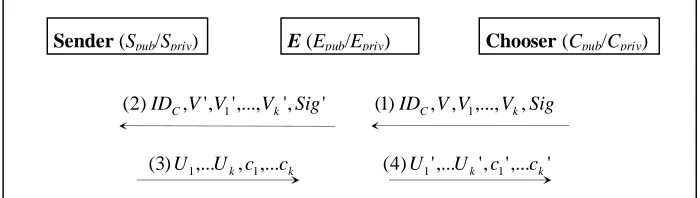
each are talking to E. Fig. 3 illustrates the scenario of such a MIMA. We first
argue that the adversary E cannot succeed in this scenario since he can not generate the valid message (2), (IDC, V', V1', ..., Vk', Sig'), in Fig 3. More
clearly, he can not forge a valid signature Sig' in message (2) to be verified
successfully by the sender without the knowledge of chooser's private key Cpriv. In
addition, it is also hard for E to forge valid message (4), (U1', ..., Uk', c1', ...,
'
n
c ), to be accepted by the chooser. Since that for embedding a meaningful mi'
into ci', E must have the knowledge of e(H(i)V, Spriv)c. Though, E can choose
another random nonce c' such that Uj' = c'Vj , he still has to know the
sender's private key Spriv to form the valid ci'(=mi e(H(i)V, Spriv)
c'
) . Therefore,
without the knowledge of Spriv, E can not launch a MIMA attack.
Fig. 3: The scenario of MIMA attack
Claim 7: The proposed scheme can resist KCI attack.
Proof: We show this claim by using the following two directions. (i) and (ii).
(i) Suppose that a sender's private key Spriv (=sSpub) had been compromised by an
adversary E and E tries to impersonate chooser C to communicate with the Sender (Spub/Spriv) E (Epub/Epriv) Chooser (Cpub/Cpriv)
' ,... ' , ' ,... ' ) 4
( U1 Uk c1 ck
k k c c
U U ,... , ,... )
3
( 1 1
' , ' ,..., ' , ' , ) 2
sender. It can be easily seen that E would fail since that although C can forge
V as abCpub, however, without the chooser's private key, E could not forge
'
j
V and Sig' to be verified successfully by the sender. Therefore, E could not
succeed in this kind of attack.
(ii) Suppose that a chooser's private key Cpriv (=sCpub) had been compromised by an
adversary E and E tries to impersonate sender S to communicate with chooser C.
We argue that E would fail in such an attack since he could not know the
sender's private key Spriv to compute the valid ciphertextci.
5.2 Communicational cost comparisons
In this paper, we focus our comparisons on communicational cost of our
non-adaptive authentic OTkn protocol with the same type of other existing OTkn
protocols. They are Chu et al.'s [12] (which is, to our best knowledge, the most
efficient OTkn scheme to date), Mu et al.'s [10], Naor et al.'s [5], and recent works
[13, 14, 18, 20]. It is well known that when considering the communicational cost of a
protocol, the number of rounds is always a dominant factor while compared with its
needed data size in transmission. From this point of view, we know that our scheme is
the most efficient for it just requires two rounds, including its security features.
Moreover, except for the reduction in number of rounds our scheme makes, we go a
step further to analyze the needed size of transmitted messages both from the chooser
to the sender and from the sender to the chooser, respectively. Before the comparison,
we describe some underlying facts and used notations.
Facts: Generally, for the same security level, a RSA cryptosystem requires key length of 1024 bits while an ElGamal or ECC-based cryptosystem only needs 160 bits. The
ciphertext for RSA, ElGamal and ECC-based cryptosystem is 1024 bits, 1024 bits,
and 160 bits, correspondingly.
Notations: We use |string/action| to present the bit length of a string, or the needed bit length an action performs.
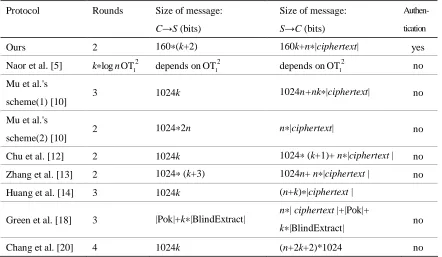
After the description of the facts and notations, we can now use them to estimate
the needed transmission data size (NTDS) of our scheme and the above-mentioned
protocols. In our protocol, each of the variables V, V1, ... , Vk, Sig, U1, ... , Uk
Table 1: Needed rounds and data size comparisons among protocols
Protocol Rounds Size of message:
C→S (bits)
Size of message:
S→C (bits)
Authen-
tication
Ours 2 160*(k+2) 160k+n*|ciphertext| yes
Naor et al. [5] k*log nOT12 depends on 2 1
OT depends onOT12 no
Mu et al.'s
scheme(1) [10] 3 1024k
1024n+nk*|ciphertext| no
Mu et al.'s
scheme(2) [10] 2 1024*2
n n*|ciphertext| no
Chu et al. [12] 2 1024k 1024* (k+1)+ n*|ciphertext | no Zhang et al. [13] 2 1024* (k+3) 1024n+ n*|ciphertext | no Huang et al. [14] 3 1024k (n+k)*|ciphertext |
Green et al. [18] 3 |Pok|+k*|BlindExtract| n*| ciphertext |+|Pok|+
k*|BlindExtract| no
Chang et al. [20] 4 1024k (n+2k+2)*1024 no
the sender to the chooser. Naor et al.'s scheme [5] has the most expensive
communicational cost since they construct their OTkn scheme by evoking an OT 12
primitive logn times. Thus, the NTDS in their scheme is about logn times of an 2
1
OT 's work. As for the non-adaptive scheme of Green et al.'s [18] (in it, there are two
types of schemes, adaptive and non-adaptive), the communicational cost is expensive
as well due to the complication of the protocol. It is because in the transfer phase, the
sender first sends n ciphertexts to the chooser, and then the sender and the chooser
together run a proof-of-knowledge (Pok) sub-protocol for assuring the correctness of
the ciphertexts. If the proof is valid, the chooser and the sender run the BlindExtract
sub-protocol k times for extracting the k blind choices, cooperatively. The chooser can
then use the k extracted blind choices to decrypt the ciphertexts. The NTDS of other
studies can be estimated in the same manner. We show the comparison results in
Table 1.
From Table 1, we can conclude that other than possessing authentication
mechanism, our protocol is the most efficient both in communicational cost and
NTDS while compared with the other work.
6. Conclusion
An OT scheme which is secure and efficient in both communicational cost and
OT schemes, we found that it is necessary to combine an OT scheme with some
security services to improve the communicational efficiency in certain security
needed application environments such as, mental poker playing, oblivious key
searching. Therefore, in this paper, we proposed a novel k-out-of-n authentic oblivious
transfer protocol based on bilinear pairing to reach the two goals (security and
efficiency). We have proved that our scheme not only can satisfy the mutual
authentication, the sender's privacy, and the chooser's privacy but also can resist
against replaying, impersonation, MIMA, and KCI attacks. Further, we have
compared our scheme with other non-adaptive k-out-of-n OT schemes in the aspect of
needed rounds, NTDS, and authentication. We have shown that our scheme is the
most efficient not only in communicational cost but also in data size needed in
transmission. In addition, it is the sole solution that has mutual authentication in OT
scheme nowadays.
Reference
[1] M. O. Rabin, "How to exchange secrets with oblivious transfer, "Technical Report
TR-81, Aiken Computation Lab, Harvard University, 1981.
[2] S. Even, O. Goldreich, and A. Lempel, "A randomized protocol for signing
contracts," Communications of the ACM 28, pp. 637-647, 1985.
[3] G. Brassard, C. Crepeau, and J.-M. Robert, "All-or-nothing disclosure of secrets,"
Proc. Advances in Cryptology:CRYPTO'86, LNCS 263, pp. 234-238, 1986.
[4] M. Bellare and S. Micali, "Non-interactive oblivious transfer and applications,"
Proc. of Advances in Cryptology: CRYPTO'89, LNCS 435, pp.547-557, 1989.
[5] M. Naor and B. Pinkas, "Oblivious transfer and polynomial evaluation," Pro. of
the 31th Annual ACM Symposium on the Theory of Computing (STOC'99),
pp.245-254, ACM, 1999.
[6] M. Naor and B. Pinkas, "Oblivious transfer with adaptive queries," Proc.
Advances in Cryptology: CRYPTO'99, LNCS 1666, pp. 573-590, 1999.
[7] M. Naor, B. Pinkas and R. Sumner, "Privacy preserving auctions and mechanism
design, " Proc. of the 1st ACM Conference on Electronic Commerce, 1999.
[8] M. Naor and B. Pinkas, "Distributed oblivious transfer," Proc. Advances in
Cryptology: ASIACRYPT'00, LNCS 1976, 2000.
[9] M. Naor and B. Pinkas, "Efficient oblivious transfer protocols," SODA'01,
pp.448-457, 2001.
[10] Y. Mu, J. Zhang, and V. Varadharajan, "m out of n oblivious transfer," Proc. of
the 7th Australasian Conference on Information Security and Privacy (ACISP'02),
LNCS 2384, pp. 395-405, 2002.
20(2-3), pp.356-371, 2004.
[12] C. K. Chu, W. G. Tzeng, "Efficient k-out-of-n oblivious transfer Schemes with
adaptive and non-adaptive queries," PKC 2005, LNCS 3386, pp. 172-183, 2005.
[13] J. Zhang, Y. Wang, "Two provably secure k-out-of-n oblivious transfer schemes,"
Applied Mathematics and Computation, vol.169, pp. 1211-1220, 2005.
[14] H. F. Huang, C. C. Chang, "A new design for efficient t-out-n oblivious transfer
scheme," Advanced Information Networking and Applications 2, ANIA 2005, pp.
28-30, 2005.
[15] A. Parakh, "Oblivious transfer using elliptic curves," Proc. of the 15th
International Conference on Computing, IEEE, pp. 323-328, 2006.
[16] S. Kim and G. Lee, "Secure verifiable non-interactive oblivious transfer protocol
using RSA and Bit commitment on distributed environment," Future Generation
Computer Systems, 2006.
[17] J. Camenish, G. Neven, and A. Shelat, "Simulatable adaptive oblivious transfer,"
EUROCRYPT 2007, LNCS 4515, pp. 573-590, 2007.
[18] M. Green, S. Hohenberger, "Blind identity-based encryption and simulatable
oblivious transfer," Cryptology ePrint Archive 2007/235, 2007.
[19] S. Halevi, Y. T. Kalai, "Smooth projective hashing and two-message oblivious
transfer," Cryptology ePrint Archive, 2007/118, 2007.
[20] C. C. Chang and J. S. Lee, "Robust t-out-of-n oblivious transfer mechanism
based on CRT," Journal of Network and Computer Applications, 32(2009),
pp.226-235, 2009.
[21] A. Boldyreva, "Threshold signatures, multisignatures and blind signatures based
on the gap-diffie-hellman-group signature scheme," Proc. of the Public-Key
Cryptography (PKC'03), pp.31-46, 2003.
[22] M. Bellare, C. Namprempre, D. Pointcheval, and M. Semanko, "Power of RSA
inversion oracles and the security of Chaum's RSA-based blind signature
scheme," Proceedings of Financial Cryptography (FC'01), LNCS 2248,
pp.319-338, 2001.
[23] L.M. Kohnfelder, "On the signature reblocking problem in public-key
cryptography," Communications of the ACM, vol. 21(2)179, 1978.
[24] D. Boneh and M.K. Franklin, "Identity-based encryption from the Weil Pairing,"