An Efficient ID- based Directed Signature Scheme
from Bilinear Pairings
1
B. Umaprasada Rao, 1P. Vasudeva Reddy, 2T. Gowri
1. Department of Engineering Mathematics, Andhra University, Visakhapatnam, A.P, India. 2. Department of Electronics and communication Engineering, ASCET, Gudur, A.P, India.
Abstract:
A directed signature scheme allows a designated verifier to directly verify a signature issued to him, and a third party to check the signature validity with the help of the signer or the designated verifier as well. Directed signatures are applicable where the signed message is sensitive to the signature receiver. Due to its merits, directed signature schemes are suitable for applications such as bill of tax and bill of health. In this paper, we proposed efficient identity based directed signature scheme from bilinear pairings. Our scheme is efficient than the existing directed signature schemes. In the random oracle model, our scheme is unforgeable under the Computational Diffie-Hellman (CDH) assumption, and invisible under the Decisional Bilinear Diffie-Hellman (DBDH).
Keywords:
Directed signature, ID-based cryptography, CDH problem, DBDH problem.
Introduction:
message may contain a confidential agreement or a private information between the signer and the recipient. For example, signatures on medical records, tax information and most business transactions. To address this problem, Chaum and Van Antwerpen [6] introduced the concept of undeniable signatures. In an undeniable signature scheme, one party can verify a signature only by interaction with the legitimate signer through a conformation protocol. Therefore the signer can control when and by whom his signatures can be verified. Because undeniable signatures have various applications in the security of e-commerce, such as licensing software, auction and electronic voting, many variants of undeniable signature appear, such as FDH undeniable signature [6] and threshold undeniable signatures[17,18] are only verified with the cooperation of the signer. It is very inconvenient and impractical in real life. As an alternative approach to undeniable signatures, designated confirmer signatures [5] was proposed by Chaum in 1994. In this scheme a designated confirmer signatures allows certain designated parities to confirm the authenticity of a document with out the need for the signer’s input. At the same time many signature types with controlled verifiability are proposed, such as limited verifier signature, designated verifier signature [10]. These schemes mainly focus on the ability of verification which is limited. However we may meet the following situation [23].
responsibility to acknowledge this hospital records when Bob may not be convenient to do so.
The aforementioned signature schemes with verifiability restriction seem to not be suitable for the above situation, as the verifier cannot prove validity of a signature to the others in a designated verifier signature and only the recipient can acknowledge a signature to a third party in a limited verifier signature. In [15], to solve the above problem, Lim and Lee proposed a new type of signature: directed signature, based on Guillou-Quisquater signature scheme [9].
In 2004, Lal and Kumar [13] suggested another scheme based on Schnorr’s signature. However, no formal model was present in [15] and [13]. In 2005, Laguillaumie et al. [12] studied the universally convertible directed signatures and presented a concrete scheme which is provably secure in the random oracle model [3]. In 2006, Lu and Cao [16] independently presented a formal model for directed signatures, and proposed such a scheme based on the RSA assumption. In 2007, Lu et al. [17] studied the notion of threshold directed signatures, and presented a (t, n) threshold directed signature scheme from bilinear pairings, in which they proved that their scheme is existentially unforgeable based on the computational Diffie-Hellman (CDH) assumption.
revocation, storage and distribution) and the computational cost of certificate verification incur the main complaint against traditional public-key cryptosystems.
To eliminate the burden of certificate management, Shamir introduced the notion of identity-based cryptography [19]. In an identity-based cryptosystem, a user’s public-key is just his publicly available identity (e.g. real name, email address, or IP address), hence no extra effort is necessary for ensuring the authenticity of a public-key, the complexity of the certificate management is released. ID-based cryptography is supposed to provide a more convenient alternative to conventional public key infrastructure. However, the study of directed signatures in the identity-based setting is far from satisfactory. In 2005, an ID-based signature scheme was proposed by Wang [21]. However, there is neither a formal model nor rigorous security proof in [21]. Besides, it also does not support public verification.
Recently, in 2008, Xun Sun et al. [20], proposed an ID-based directed signature scheme from bilinear pairings. The scheme is based on modified SOK identity based signature scheme due to Bellare et al. [2]. Also, based on the work of Libert and Quisquarter [14], they proved that their scheme is existentially unforgeable and invisible in the random oracle model based on CDH and DBDH assumptions respectively.
In 2009, Jianhong Zhang et al. [23] proposed and ID-based directed signature scheme using Water’s signature scheme [22]. They proved that their scheme is secure against existential unforgeability and invisibility in the standard model.
scheme [23]. The proposed scheme is unforgeable and invisible in the random oracle model under the CDH and DBDH assumptions respectively.
The rest of the paper is organized as follows: Section 2 briefly describes the necessary background concepts; Section 3 presents syntax and security model of ID-based directed signature scheme in the random oracle; Our ID-ID-based directed signature scheme is proposed in Section 4; Security proof and efficiency analysis of the proposed scheme are given in Section 5. Finally, we conclude our work in Section 6.
2. Preliminaries
In this section, we will briefly review the basic concepts on bilinear pairings and some related mathematical problems.
2.1 Bilinear Pairings
Let G1 be a additive cyclic group generated by ,p whose order is a prime ,q and
2
G be a multiplicative cyclic group of the same order .q A bilinear pairing is a map
1 1 2
:
e G ×G →G with the following properties:
1. Bilinear: e aP bQ
(
,)
=e P Q(
,)
ab, for allP Q, ∈G1and all ,a b∈Zq*.2. Non –degenerate: There exists P Q, ∈G1 such thate P Q
(
,)
≠1.3. Computable: There is an efficient algorithm to compute e P Q
(
,)
for all ,P Q∈G1. 2.2 Computational problemsNow, we give some computational problems, which will form the basis of security for our scheme.
Decisional Diffie-Hellman Problem (DDHP): For a b c, , ∈R Zq*, given ,P aP, ,
bP cP decide whether c≡abmod .q
Computational Diffie-Hellman Problem (CDHP): For a b c, , ∈R Zq*, given ,
P aP, bP, ComputeabP.
2.3Hess-ID- based signature scheme
To prepare for the proposed scheme, we first give a review of the ID-based signature scheme [11] given by Hess as follows.
Setup: The Private Key Generator (PKG) chooses s∈R Zq* as his master secret key and
computes the global public keyPpub=sP. The PKG also selects a map-to-point hash
function H1:{0,1}*→G1*and another cryptographic hash function
* *
2
:{0,1} q. h ×G →Z
PKG publishes system parameters params<G G e P P1, 2, , , pub,H h1, >and the master key s
< > is kept secret.
Extract: Given the public identity information on ID compute the secret key for the identity asdID =sQID. The component QID =H ID1( ) plays the role of the corresponding public-key.
Signature: To sign a messageM∈{0,1}*, using the secret keydID, the signer chooses an arbitrary P1∈G1* picks a random integerk∈zq*.
Then signer computes
1 1 ( , ) , ( , ), . k ID
R e P P
V h M R
U Vd kP
=
=
= +
The signature on message M is *
1
( , )U V G Zq
Verification: To verify the signature σ =( , )U V of an identity ID on a message M, the verifier computes R=e U P e Q( , ) ( ID,−Ppub)V.He accepts the signature if and only ifV =h M R( , ).
3. Syntax and Security model for Identity-Based Directed Signature Scheme
An ID-based directed signature scheme (ID-DS) in the random model consists of the algorithms<Setup, Extract, Sign, DVerify, PVerify >. In the following, we give the detail definitions of their algorithms:
-System initialization (Setup): The Private Key Generator (PKG) generates the system parameters params and the master keyx, params are made public, while x is kept secret. Params are implicit input to all the following algorithms.
– Key extraction (Extract): Given an identity ID and the master keyx, the PKG
computes the private key dID and sends it to the corresponding user through a secret
channel.
– Signature generation (Sign): On input signer’s identityIDs, the verifier’s identityIDv, a message M and the private key dIDs , the signerIDs generates his
signatureσ on M designated toIDv.
– Direct verification (DVerify): Given signer’s identityIDs, verifier’s identity
IDv and the corresponding private keydIDv, a message M and a signatureσ , this algorithm
checks the validity of σ to output 1 (valid) or 0 (invalid).
– Public verification (PVerify): On input signer’s identityIDs, verifier’s identity
IDv, a message M, and a purported signatureσ , a third party T, with an Aid provided by
3.1 Security Notions
The security of identity based directed signature scheme in the random oracle modal consists of two properties: unforgeability and invisibility.
Unforgeability: The standard security notion for digital signature schemes is existential unforgeability against adaptively chosen message attack [8]. Cha and Cheon generalized this notion to identity-based signature schemes [4]. [11] and [17] independently formalized this notion for directed signatures under their respective settings. Developed in the same line with [4, 8, 16], Xun Sun et al.[20] defined the following game between a challenger and a PPT attacker A for existential unforgeability of ID-DS schemes.
Setup: The challenger C runs the private key generation algorithm of ID-DS algorithm, it gives A the resulting system parameters and master secret to itself.
Oracle queries: A adaptively makes a number of different queries to the challenger C. Each query can one of the following.
Extract query:A requests the private key of any identityID. The challenger runs the extract algorithm on ID and forwards the output dID to A.
Signing query: A request a signature of a signer IDs to a designated verifier IDvon message M. The challenger runs the extract algorithm to obtain a private key dIDs ofIDs, then runs the signature generation algorithm onIDs,IDv, M and dIDs to obtain a signature
σ
, which is forwarded to A.Public verify query: A submits (IDs,IDv, M,
σ
) to C the challenger. The challenger returns ⊥to A, ifσ
turns out to be invalid with respect to (IDs,IDv, M). Otherwise, the challenger produce an Aid on behalf of the signers IDs or the designated verifierIDv, then forwards Aid to A.Hash query: When the involved hash functions are modeled by random oracles,
A also performs adaptive queries to the hash functions. The challenger usually responds by randomly picking an element from the output space of the hash function.
Forgery: A outputs signer’s identityIDs*, a verifier identityIDv*, a message *
M , and a signatureσ*. A succeeds if the following situation holds:
1. σ* is valid (as verified byIDv*) with respect toIDs*, IDv*andM*. 2. A has not made extract query onIDs*.
3. σ* was not returned by a previous sign query on (IDs*,IDv*,M*).
A’s advantage in the above game is defined as AdvA =Pr[ succeeds].A Where the probability
is taken over all coin tosses made by the challenger and A.
Definition1(Unforgeability): An ID-based directed signature scheme is
( , t , ε qE, qS, qDv, qPv,qH)− unforgeable, if there is no adversary who runs in time at most
t, makes at most qE Extract oracle queries, qS Sign oracle queries, qDv DVerify oracle
queries, qPv PVerify oracle queries, andqH Hash oracle queries, and has advantage at
least ε in the above game.
Invisibility: The invisibility property requires that it should be (computationally)
consider the following game between a PPT distinguisher D and a challenger as described in [20].
Setup: The challenger runs the Setup algorithm of the ID-DS scheme to obtain the public parameters params and the master secret. It then gives params
to D and keeps the master secret to itself.
Phase1: D adaptively makes a number of different queries to the challenger. Each query can be either an Extract query, a Sign query, a DVerify query, a
PVerify query or a Hash query. The challenger responds to these queries in the same way as in the unforgeability game.
Challenge: Once D decides that Phase1 is over, it outputs a signer identityIDs*, a verifier identityIDv*, and a message *
M , and submits them to the challenger. The constraint is that IDv* must have not been submitted for the Extract oracle. The challenger then generates a random bit b∈{0,1},if b=1,the challenger produces a signatureσ*on (IDs*,IDv*, M*) in the same way as the Sign query. Otherwise, it picks a random *
σ from the signature space. In both cases *
σ is forwarded to D.
Phase2: D again adaptively performs several oracle queries as it did in Phase 1, subjected to the following restrictions.
– D cannot make an Extract query onIDv*.
– D cannot make a DVerify or a PVerify query on (IDs*, *
,
IDv *
, M σ*).
Guess: Finally D outputs a bit '
{0,1}.
b ∈ D succeeds if '
b=b.
D’s advantage in the above game is defined as Pr[ succeeds]- .1 2
D
Adv = D
Definition2(Invisibility): An ID-DS scheme is ( , t , ε qE, qS, qDv, qPv,qH)−invisible, if
there is no adversary who runs in time at most t, makes at most qE Extract oracle
queries, qS Sign oracle queries, qDvDVerify oracle queries, qPv PVerify oracle queries,
andqH Hash oracle queries, and has advantage at least ε in the above game.
4. Proposed ID-Based Directed Signature Scheme (ID-DS)
In this section, we give our proposed ID- based directed signature (ID-DS) scheme from bilinear pairings in the random oracle model. Our scheme is based on the Hess ID-based signature scheme. The proposed scheme is described as follows:
Setup: The PKG chooses x∈R Zq* as his master secret key and computes the global
public-key Ppub asxP. The PKG also selects a hash functions H H1, 2:{0,1}∗ →G1∗ and
another cryptographic hash functionh:{0,1}∗×G2 →Zq*, e:G1×G1→G2 where
1 2
G andG be additive and multiplicative group of prime order q, let P be a generator ofG1. Params < G G e P P1, 2, , , pub,H H h1, 2, >,
Master key <x>.
Extract: Given an identity ID∈{0,1}∗. The PKG computes QID =H ID1( )∈G1then computes the user private keydID =xQID∈G1.
Signature: To sign a message M∈{0,1}∗ to a designated verifierIDv, the signature with identity IDs and private key dIDs perform the signature.
1. The signer chooses an arbitrary P1∈G1∗ and picks a random integers r k1, ∈Z*q.
2. ComputeU =e P P( , )1 k, L=r Q1 IDs.
3. Compute V=h (H, U) where H =H2
(
IDs IDv M U e d, , , , ( IDs,r Q1 IDv))
.4. ComputeW =VdIDs+kP1. The signature is
σ
=(
V W L, ,)
.DVerify: Given a purported signature
σ
=(
V W L, ,)
on signatureIDs, verifier IDv and message M, IDv verifies it with his private key dIDv as follows.1. ComputeU =e W P e Q( , ). ( IDs,−Ppub)V . 2. ComputeH =H IDs IDv M U e d2( , , , , ( IDv, ))L .
Accept the signature ifV =h H U
(
,)
. Reject it otherwise.P Verify: Given a purported signature
σ
=(
V W L, ,)
on signatureIDs, verifier IDv and message M, to enable third party T to verify it either IDs or IDv computes Aid=e d( IDv, )L =e d( IDs,r Q1 IDv) and send it to T.
Now T computesU =e W P e Q( , ). ( IDs,−Ppub)V andH =H2
(
ID ID M U Aids, v, , ,)
.Accept the signature if V =h H U( , ). Reject it otherwise.
5. Security and Efficiency Analysis
5.1 Proof of correctness
To show correctness of our scheme, we show that the DVerify algorithm is consistent with the signature algorithm because
,
( , ). (e W P e QIDs −Ppub)V
1 1 1 1 ( , ). ( , ) ( , ). ( , ). ( , ) ( , ) . ( , ) . ( , ) ( , ). ( , ) . ( , ) V
IDs IDs pub
V
IDs IDs pub
V K V
IDs IDs pub
K V
IDs pub IDs pub
e Vd KP P e Q P
e Vd P e KP P e Q P
e d P e P P e Q P
e Q P e P P e Q P
U = + − = − = − = − =
Correctness of PVerify algorithm is straightforward.
5.2 Security Analysis
In the following, we will show that our scheme satisfies the existential unforgeability and invisibility. Their proofs are same as given in the [20] based on the work of [14].
Theorem 1 (Unforgeability): If a PPT forger A has an advantage ε in forging a
signature of ID-based directed signature when running in time t and asking qHi queries
to random oraclesH ii( =1, 2),qEqueries to the Extract oracle, qS queries to sign oracle,
qDv queries to the Dveirfy oracle and qPv queries to the Pverify oracle, then the ' '
( , )ε t −CDH problem can be solved with probabilityε'.
Theorem 2 (Invisibility): If a PPT distinguisher D has an advantage ε in breaking the
invisibility of our ID-based directed signature when running in time t and asking qHi
queries to random oraclesH ii( =1, 2), qE, qS, qDv, qPvqueries to the Extract oracle, queries
to sign oracle, quires to the Dveirfy oracle and quires to the Pverify oracle, respectively, then the ' '
5.3 Efficiency Analysis
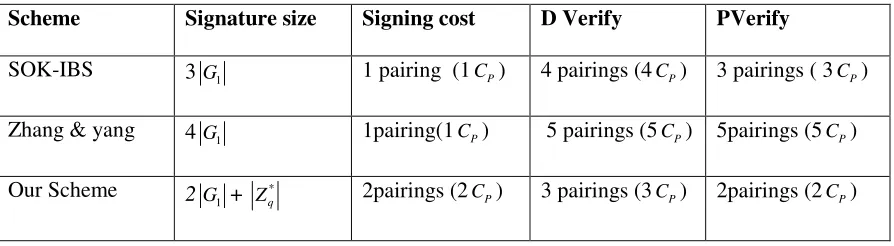
We now analyze the efficiency of our proposed scheme and compare it with the related schemes including the Xun Sun et al. ID-DS scheme [20] and Jianhong Zhang et al. ID-DS scheme [23]. The comparison is summarized in table1. We consider only computations of pairings, we don’t consider hash function evaluation, point addition in G1 and multiplication in G2 as they are much cheaper than the computation of pairing.
We note that the computation of pairing is the most time consuming. Although there has been many papers discuss the complexity of pairings and how to speedup the pairing computation [1, 7], the computation of pairing is still time consuming. Let CPbe the
computational cost to perform one pairing operation.
When compared with Xun Sun et al. ID-DS scheme [20], our scheme is efficient in signing and verifications due to the fact that the schemes required one more pairing computation for verifications and in signature generation process, our scheme requires one more pairing computations.
When compared with Jianhong Zhang et al. ID-DS scheme [23], our scheme is efficient in signing and verifications due to the fact that the schemes require two more pairing computation for verifications and in signature generation process our scheme requires one more pairing computations.
Table 1. Comparison of our scheme with previous schemes
Scheme Signature size Signing cost D Verify PVerify
SOK-IBS 3G1 1 pairing (1CP) 4 pairings (4CP) 3 pairings ( 3CP)
Zhang & yang 4G1 1pairing(1CP) 5 pairings (5CP) 5pairings (5CP)
Our Scheme 2
1
G + *
q
6. Conclusions
The directed signature, due to its unforgeability and verifiable directedness properties, is very useful in some practical applications, where a signed message is personally or commercially sensitive. In this paper, we proposed efficient identity based directed signature scheme from bilinear pairings. The number of pairing operations involved in the verification process of our scheme is less than the previous identity based directed signature schemes, so our scheme is efficient than the existing directed signature schemes. In the random oracle model, our scheme is unforgeable under the Computational Diffie-Hellman (CDH) assumption, and invisible under the Decisional Bilinear Diffie-Hellman (DBDH) assumption.
References
[1] P.S.L.M.Barreto, H.Y.Kim, B.Lynn and M.Scott, Efficient algorithms for pairing- based cryptosystems, Advances in Cryptology-Crypto 2002, LNCS 2442, Springer-Verlag, 2002, pp.354-368.
[2] M.Bellare, C.Namprempre, G.Neven, Security proofs for identity-based identification and signature schemes, Advances in Cryptology - EUROCRYPT’04, LNCS 3027, Springer-Verlag, 2004, pp.268–286.
[3] M.Bellare, P.Rogaway, Random oracles are practical: a paradigm for designing efficient protocols, Proceedings of the First Annual Conference on Computer and Communications Security, ACM Press, 1993, pp.62–73.
[5] D.Chaum Designated Confirmer Signatures. In: De Santis, A. (ed.) EUROCRYPT 1994, Springer, Heidelberg, LNCS 950, 1995, pp.86–91.
[6] D.Chaum, H.van Antwerpen, Undeniable Signatures. In: Brassard, G. (ed.) CRYPTO 1989, Springer, Heidelberg, LNCS 435,1990, pp. 212–216.
[7] S.D.Galbraith, K. Harrison, and D.Soldera, Implementing the Tate pairing, ANTS 2002, LNCS 2369, Springer-Verlag, 2002, pp.324-337.
[8] S.Goldwasser, S.Micali, R.L.Rivest, A digital signature scheme secure against adaptive chosen-message attacks, SIAM Journal on Computing 17(2), 1988, pp.281– 308.
[9] L.C.Guillou and J.J. Quisquater, A practical zero-knowledge protocol fitted to security microprocessors minimizing both transmission and memory. Advances in Cryptology,Eurocrypt-88, LNCS 330, 1988, pp.123 - 128.
[10] M.Jakobsson, K.Sako, R.Impagliazzo, Designated Verifier Proofs and Their
Applications, In: Maurer, U.M. (ed.) EUROCRYPT 1996, Springer, Heidelberg, 1996, LNCS 1070, pp.143–154.
[11] F.Hess, Efficient identity based signature schemes based on pairings, Selected Areas in cryptography, SAC 2002, Springer-Verlag, 2003, pp.310-324.
[12] F.Laguillaumie, P.Paillier, D.Vergnaud, Universally convertible directed signatures, Advances in Cryptology - ASIACRYPT’05, LNCS 3788, Springer-Verlag, 2005, pp. 682–701.
[13] S.Lal, M.Kumar, A directed signature scheme and its applications, see: arXiv: cs/0409036, 2004.
[15] C.H.Lim, P.J.Lee, Modified Maurer-Yacobi’s scheme and its applications, Advances in Cryptology - AUSCRYPT’92, LNCS 718, Springer-Verlag, 1992, pp.308–323.
[16] R. Lu, Z. Cao, A directed signature scheme based on RSA assumption, International Journal of Network Security 2 (3), 2006, pp.182–421.
[17] R. Lu, X. Lin, Z. Cao, J. Shao, X. Liang, New (t, n) threshold directed signature scheme with provable security, Information Sciences 178 (3), 2008, pp.756–765.
[18] R. Lu, Zhen.F, Zhou.Y, Threshold undeniable signature scheme based on conic. Applied mathematics and computation 162, 2005, pp.165–177.
[19] A. Shamir, Identity based cryptosystems and signature schemes, Advances in Cryptology - CRYPTO’84, LNCS 196, Springer-Verlag, 1984, pp.47–53.
[20] X. Sun, Jian-hua Li, Gong-liang Chen, and Shu-tang Yung, Identity-Based Directed Signature Scheme from Bilinear Pairings, eprint.iacr.org/2008/305.pdf.
[21] Y. Wang, Directed signature based on identity, Journal of Yulin College 15 (5), 2005, pp.1–3.
[22] B.Waters, Efficient Identity-based encryption without random oracles, in: Cramer, R. (ed.) EUROCRYPT 2005, LNCS 3494, Springer, Heidelberg 2005, pp.114–127.
[23] J.Zhang, Y.Yang and Xinxin Niu, Efficient Provable Secure ID-Based Directed Signature Scheme without Random Oracle, Proceedings of the 6th International Symposium on Neural Networks: Advances in Neural Networks, LNCS, Vol. 5553,2009, Springer-Verlag, pp.318-327.