© 2015, IJCSMC All Rights Reserved 230 Available Online at www.ijcsmc.com
International Journal of Computer Science and Mobile Computing
A Monthly Journal of Computer Science and Information Technology
ISSN 2320–088X
IJCSMC, Vol. 4, Issue. 7, July 2015, pg.230 – 239
RESEARCH ARTICLE
EFFECTIVE APPROACH FOR CLOUD
SECURITY USING NICE-D
Nikita T. Ramteke
1, Y.V. Chavhan
21Department of Computer science, Savitaribai Phule Pune University, India 2
Department of Electronics, Savitaribai Phule Pune University, India
Abstract - Research has been evolved in the field of cloud security recently this few years. Where an attacker has the ability to explore various vulnerabilities of a system so that they can easily deploy further attacks. In network system including cloud especially in infrastructure-as-service (IaaS) cloud, the detection of attacks becomes very difficult. Therefore, existing system proposed multi-phase vulnerability detection measurement and countermeasure selection using NICE.
Existing NICE model uses signature based IDS i.e. SNORT [1]. In this paper, we improved the intrusion detection accuracy of NICE by using dynamic intrusion detection system (NICE-D). Dynamic IDS monitors the incoming traffic flow and anomalous time slot, and accordingly generates the new signature to identify the future intrusions over cloud system. The system and security evaluations demonstrate the efficiency and effectiveness of the proposed solution. Different attack scenarios have been considered for system evaluation.
Keywords – Iaas, SNORT, IDS, cloud, NICE-D.
I. Introduction:
© 2015, IJCSMC All Rights Reserved 231
provide software-as-a-service (SaaS), platform-as-a-service(PaaS), or infrastructure-as-a-service (IaaS) via the cloud and second is
security issues faced by their customers. This paper aims for significantly prevent the virtual machines to become vulnerable from
being compromised over the cloud server using multi-phase distributed vulnerability detection, measurement, and countermeasure selection mechanism called NICE-D.
In recent studies it have shown that, users those who are migrating to the cloud systems consider security as the most important factor. A recent Cloud Security Alliance (CSA) survey shows that among all security issues, abuse and notorious use of cloud computing is considered as the top security threat, in which attackers can exploit vulnerabilities in clouds and utilize cloud system resources to deploy attacks [1]. Traditional data centers, where system administrators have full control over the host machines, vulnerabilities can be detected and patched by the system administrator in a centralized manner. However, patching known security holes in cloud data centers, where cloud users usually have the privilege to control software installed on their
managed VMs, may not work effectively and can violate the Service Level Agreement (SLA). Furthermore, cloud users can install
vulnerable software on their VMs [3], which essentially contributes to loopholes in cloud security. Main task is to establish an effective vulnerability/attack detection and response system for accurately identifying attacks and minimizing the impact of security breach to cloud users.
In a cloud system [8] where cloud users have shared infrastructure, abuse and nefarious use of the shared infrastructure benefits attackers to exploit vulnerabilities of the cloud and also use its resource to deploy attacks in more easily and efficiently. As cloud users are sharing their computing resources it creates beneficial environment for attackers.
II. Proposed System:
In this paper, we propose NICE-D (Network Intrusion detection and Countermeasure selection in virtual network systems with Dynamic IDS) to establish a defense-in-depth intrusion detection framework. For better attack detection [2], NICE-D incorporates attack graph analytical procedures into the intrusion detection processes [2]. In NICE-D, we improve existing intrusion detection algorithms; NICE-D employs a reconfigurable virtual networking approach to detect and counter the attempts to compromise VMs, thus preventing zombie VMs.
The earlier contributions to NICE [1] are presented as follows:
1. We devised NICE-D [2], a new multi-phase distributed network intrusion detection and prevention framework in a virtual
networking environment that captures and inspects suspicious cloud traffic without interrupting users’ applications and cloud services.
2. NICE can improve the attack detection probability and improve the resiliency to VM exploitation attack without interrupting existing normal cloud services [1].
3. NICE employs a novel attack graph approach for attack detection and prevention by correlating attack behavior and also
suggests effective countermeasures [1].
4. NICE optimizes the implementation on cloud servers to minimize resource consumption. Our study shows that NICE consumes less computational overhead compared to proxy-based network intrusion detection solutions.
Advanced Contributions:
1. Use of Dynamic intrusion detection system [2].
2. Proposed system will be able to improve the false alarm rate [2].
© 2015, IJCSMC All Rights Reserved 232
III. System Architecture
Fig1. System architecture
Intrusion detection systems are commonly used by network administrators to monitor the traffic being exchanged between different network segments. And by replacing the traditional local server-based network environments with cloud-based network infrastructure, system administrators will need to purchase additional services from the cloud provider so that they can deploy their own network intrusion detection systems. For this reason NICE-D is incorporated for cloud security. Fig 1. Shows system architecture where there is Control Center consisting of VM profiling, Attack Analyzer and Network Controller. Cloud Servers are associated with Cloud centre and in each cloud server we have NICE-D agent that will provide security. The main discussion is mainly about the effective design of an intrusion detection system that can be integrated with the available services in cloud networks. The main idea is to provide intrusion detection as a service for the cloud users. The required intrusion detection framework has some desired criteria, where we have NICE-D at every cloud server associated with the control centre.
IV. Algorithm Used:
A. Dynamic IDS:
Step 1: Start
Step 2: capture traffic ,packet Step 3: built time series
© 2015, IJCSMC All Rights Reserved 233
In first stage using a temporal sliding-window approach, traffic is captured and then aggregated in flows. This is done using different levels of traffic aggregation. Simple traffic metrics such as number of bytes flows in each time slot, time series are built.
In the second stage unsupervised detection algorithm begins. Output of previous stage is used in this stage as a input. Filtering rules helps to provide characteristic of attack [8]. But when the network operator deal with the unknown attack, the characterization of attack may became much more difficult as it require good, easy, simple information as the input [8]. To deal with this issue, new traffic signature is developed by combining relevant filtering rules. Developed signature will detect the attack coming in future. This is the important step toward autonomous security.
B. Alert Correlation Algorithm
Attack graph is a modeling tool to illustrate possible multihost, multistage attack paths that are important to understand threats and then to decide appropriate countermeasure [2]. In an attack graph, each node represents either precondition or consequence of an exploit [2]. Attack graphs are used to provide information about the current security situation in the system.
If any event is recognized as potential treat then we can apply specific countermeasure to mitigate the impact of that attack.
To represent the attack and the result of such actions, we extend the notation of MulVAL logic attack graph as presented by Ou et al. [12] and define as Scenario Attack Graph (SAG) [1]. We consider the definition of SAG as explained in the [1].
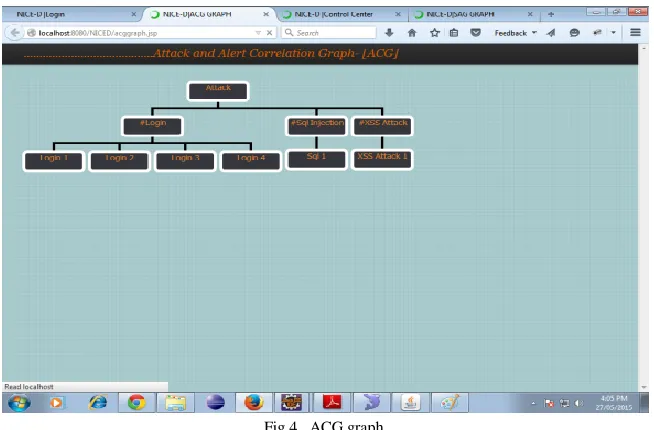
For correlating the alerts, we refer to the approach described in [15] and define a new Alert Correlation Graph (ACG) to map alerts in ACG to their respective nodes in SAG [1]. To keep track of attack status, we track the source and destination IP addresses for attack activities [1].
Definition of alert correlation graph is used from [1].
© 2015, IJCSMC All Rights Reserved 234
C. Countermeasure Selection Algorithm
© 2015, IJCSMC All Rights Reserved 235
the system [1]. For the source node vAlert, all the reachable nodes are collected into a set T [1]. Alert is generated only after the attacker has performed the action, The probability of vAlert is set to 1 and calculated the new probabilities for all of its child nodes in the set T [1].
For all alerts t ϵ T the applicable countermeasures in CM are selected and new probabilities are calculated according to the effectiveness of the selected countermeasures [2]. The change in probability of target node gives the benefit for the applied countermeasure [1]. We compute the Return of Investment (ROI) for each benefit of the applied countermeasure based on. The countermeasure which when applied on a node gives the least value of ROI, is regarded as the optimal countermeasure. Finally, SAG and ACG are also updated before terminating the algorithm [1].
V. NICE System Component
There are basically four major components that will be included in our system. They are,
Nice-D
VM Profiling
Attack Analyzer
Network Controller
Nice-D
The NICE-D is a Network-based Intrusion Detection System (NIDS) with dynamic IDS installed in each cloud server [2]. It scans the traffic going through the bridges that control all the traffic among VMs and in/out from the physical cloud servers [2]. The traffic generated from the VMs on the mirrored software bridge will be mirrored to a specific port on a specific bridge using SPAN, RSPAN and ERSPAN methods. This method is efficient to scan the traffic in cloud server as all traffic in the cloud server needs go through it.
VM Profiling
Virtual machines in the cloud can be profiled to get important information about their state, services running, open ports
[1].Important factor in VM profile is its connectivity with other VMs [1]. Knowledge of services running on a VM is necessary to verify the authenticity of alerts pertaining to that VM. Information about any open ports on a VM and the history of opened ports plays important role in determining how vulnerable the VM is.
Attack Analyzer
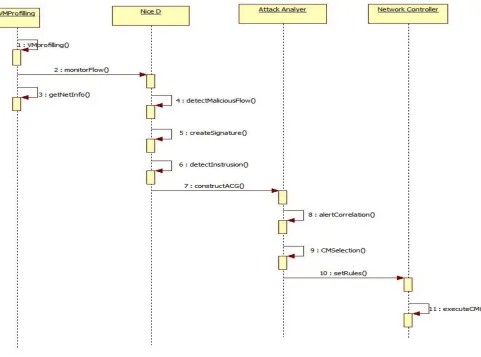
© 2015, IJCSMC All Rights Reserved 236 Fig 2. Sequence diagram for Nice system Components
Network Controller
© 2015, IJCSMC All Rights Reserved 237
VI. Results and Discussion
Fig 3. SQL attack
Above figure shows the attack demonstration for sql attack. Here different sql attacks have been performed using sql keywords where attacker can try to perform attack using sql queries and in that case our system will capture those attacks and will block the respective ip address. Our system shows the effectiveness by detecting such type of attack over cloud server. Also XSS attack, Login attempt attack have been demonstrated.
Fig 4 . ACG graph
© 2015, IJCSMC All Rights Reserved 238 Fig 5 . SAG graph
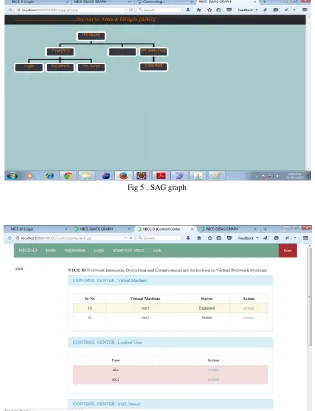
Fig 6. Network Controller
Above figure shows that there is control where controller can observe the status and actions to be taken on attacks and here the controller can reset all the values also.
Conclusion:
© 2015, IJCSMC All Rights Reserved 239
References:
[1] Chun-Jen Chung, Student Member, IEEE, Pankaj Khatkar, Student Member, IEEE, Tianyi Xing, Jeongkeun Lee, Member,
IEEE, and Dijiang Huang Senior Member, IEEE-“NICE: Network Intrusion Detection and Countermeasure Selection in Virtual Network Systems”- IEEE TRANSACTIONS ON DEPEDABLE AND SECURE COMPUTING, 2013.
[2] Nikita, Y. chavan “NICE-D: A MODIFIED APPROACH FOR CLOUD SECURITY” IJSR volume 2 issue 12, 2014.
[3] Coud Sercurity Alliance, “Top Threats to Cloud Computing v1.0,” https://cloudsecurityalliance.org/topthreats/csathreats. v1.0.pdf, Mar. 2010.
[4] M. Armbrust, A. Fox, R. Griffith, A.D. Joseph, R. Katz, A. Konwinski, G. Lee, D. Patterson, A. Rabkin, I. Stoica, and M. Zaharia, “A View of Cloud Computing,” ACM Comm., vol. 53, no. 4, pp. 50-58, Apr. 2010.
[5] B. Joshi, A. Vijayan, and B. Joshi, “Securing Cloud Computing Environment Against DDoS Attacks,” Proc. IEEE Int’l
Conf. Computer Comm. and Informatics (ICCCI ’12), Jan. 2012.
[6] H. Takabi, J.B. Joshi, and G. Ahn, “Security and Privacy Challenges in Cloud Computing Environments,” IEEE Security
and Privacy, vol. 8, no. 6, pp. 24-31, Dec. 2010.
[7] “Open vSwitch Project,” http://openvswitch.org, May 2012.
[8] Z. Duan, P. Chen, F. Sanchez, Y. Dong, M. Stephenson, and J. Barker, “Detecting Spam Zombies by Monitoring Outgoing
Messages,” IEEE Trans. Dependable and Secure Computing, vol. 9, no. 2, pp. 198-210, Apr. 2012.
[9] G. Gu, P. Porras, V. Yegneswaran, M. Fong, and W. Lee, “BotHunter: Detecting Malware Infection through IDS-driven
Dialog Correlation,” Proc. 16th USENIX Security Symp. (SS ’07), pp. 12:1-12:16, Aug. 2007.
[10] G. Gu, J. Zhang, and W. Lee, “BotSniffer: Detecting Botnet Command and Control Channels in Network Traffic,” Proc.
15th Ann. Network and Distributed Sytem Security Symp. (NDSS ’08), Feb. 2008.
[11] Michael Armbrust, Armando Fox, Rean Griffith “Above the Clouds: A View of Cloud Computing” Tech. Rep.
UCB/EECS-2009-28, EECS Department, U.C. Berkeley, Feb 2012.
[12] Ms. Parag K. Shelke, Ms. Sneha Sontakke, Dr. A. D. Gawande “Intrusion Detection System for Cloud Computing “International Journal of Scientific & Technology Research Volume 1, Issue 4, May 2012.