TECHNICAL UNIVERSITY OF CLUJ-NAPOCA
ACTA TECHNICA NAPOCENSIS
Series: Applied Mathematics, Mechanics, and Engineering Vol. 63, Issue II, June, 2020
DETERMINATION OF THE FOAM AND THE FREEZING POINT OF THE
MIXTURE SOLUTIONS FOR EXHAUSTING THE LIQUIDS FROM THE
BOTTOM OF THE WELL WITH THE AID OF AUTOMATIC DEVICES
INTRODUCING IN THE WINTER PERIOD
Horatiu Raul OLAR, Petru Constantin GHERMAN, Lazar AVRAM, Marius STAN
Abstract:In the present study we will focus on introducing liquid foam substances into gas wells using automatic devices during winter when temperatures are low and a solution such as methanol or triethylene glycol is needed in the water plus foam mixture to avoid frost, so that we proceeded to the laboratory of physico-chemical determinations to determine the freezing point of a mixing pallet, respectively of the tendency of foaming of these mixtures, foaming necessary to evacuate the liquids from the bottom of the well, with subsequent application in the field..
Key words:gas wells, automated devices, solutions, experiments, laboratory
1. INTRODUCTION
Currently, at more than 90% of the gas wells in Romania, the accumulation of liquids in the depth zone is recorded, the average flow per well is about 5000 Nm3 / day, the static pressures at the wells are about. 10 bar, at 70% of the wells daily production is below 3000 Nm3. At these flows and pressures there is accumulation of liquids in the deep area, resulting in the permanent tendency of self-flooding and stop from production.
In the following drawing we will present the evolution in time of a gas well:
Graph 1 - Evolution over time of the production of a
natural gas well
As can be seen from the above graph, after about 10 years after the production of a gas well, it would tend to be exhausted, so that a large number of operations performed by the existing personnel are needed, of which we
mention the use of field compressors and compressor stations, the need to introduce of foam substances in gas wells to facilitate the discharge of water from the bottom of the well, like solid subunit or superunit sticks, depending on their efficiency on each individual probe, or the introduction of liquid foam, using lubricators, or newer of the automatic devices for introducing foam substances into the probe, where the daily cycle is established, the latter having several benefits, among which we mention the need to refill them once every 10 days ( a container of 500 liters).
2. THE EXPERIMENTAL PART
We present below the principles of the protection for explosion type for electric equipment and non-electic equipments
The proportion of introduction of liquid foam into wells, unanimously accepted, is 1: 9 where the number 1 represents the liquid foam and the figure 9 represents an industrial water solution with methanol or triethylene glycol. In the following we want to present two experiments performed in the laboratory where we want to determine the behavior of this mixture of 1: 9 from the point of view of the foaming tendency and of establishing the freezing point in different situations.
2.1The first experiment:
For this purpose, an internal method and laboratory equipment were used in accordance with the American standard ASTM D 892-03. [1], the Petrotest apparatus having an adjustable plate (0-310 ˚C), a 500 ml graduated cylinder immersed in a glass vessel with a temperature sensor, inside the cylinder there is a porous stone (pore size = 50.7 micrometers)
connected to a rotometer (divisions 0-110 mm) by means of which the dry air is bubbled in the sample.
Method description:
Approximately 2.5 liters of distilled water was transferred into the glass vessel and placed on the hob of the Petrotest appliance, the vessel into which the graded cylinder will be inserted. In the graded cylinder different solutions were introduced into the mix according to the experiments below and then the stopper rod with the tip of which is the porous stone connected to the rotor using which controls the air flow to be introduced into the sample. The temperature of the hob is set at 47 ˚C (estimated value of the temperature at the depth of a gas well at 1250 m). When the temperature of the solution in the glass vessel has reached the set temperature, dry air (up to the 15 mm split of the rotameter) is bubbled in the graded cylinder until a foam is set to its maximum height. At the same time with the beginning of the air bubble, the stopwatch is started and the height at which the foam has reached is noted by reading the cylinder gradations at different time intervals. When the 0
5000 10000 15000 20000 25000 30000 35000 40000
0 10 20 30 40 50 60
G
a
s
p
ro
d
u
ct
io
n
Duration in years
The evolution in time of a gas well
Natural EruptionCompression in 1 step
Compression in 2 steps
Compression in 2 steps + spumogenic substances
Compression in 3 steps + spumogenic substances
foam has reached around the 500 ml split of the graded cylinder, with the help of the exhaust valve, the air is removed from the sample and the time required to break the foam from the
maximum volume to the smooth surface of the sample is measured.
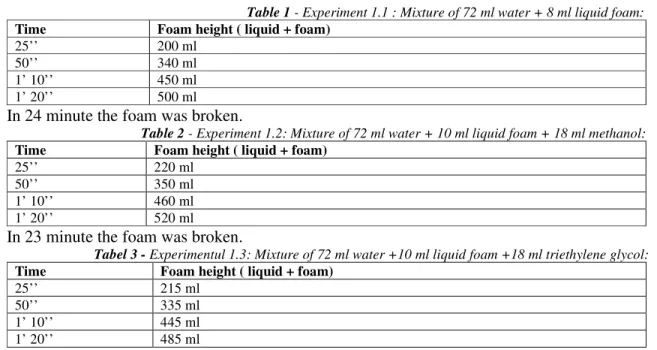
The following measurement results were obtained:
Table 1 - Experiment 1.1 : Mixture of 72 ml water + 8 ml liquid foam:
Time Foam height ( liquid + foam)
25’’ 200 ml
50’’ 340 ml
1’ 10’’ 450 ml
1’ 20’’ 500 ml
In 24 minute the foam was broken.
Table 2 - Experiment 1.2: Mixture of 72 ml water + 10 ml liquid foam + 18 ml methanol:
Time Foam height ( liquid + foam)
25’’ 220 ml
50’’ 350 ml
1’ 10’’ 460 ml
1’ 20’’ 520 ml
In 23 minute the foam was broken.
Tabel 3 - Experimentul 1.3: Mixture of 72 ml water +10 ml liquid foam +18 ml triethylene glycol:
Time Foam height ( liquid + foam)
25’’ 215 ml
50’’ 335 ml
1’ 10’’ 445 ml
1’ 20’’ 485 ml
In 21 minute the foam was broken. From experiments 1.1; 1.2; 1.3 results in substantially equal values of the foaming tendency, so that the mixtures formed from methanol or triethylene glycol, using the proportions of 1: 9 foam - water + methanol or water + triethylene glycol, do not influence the foaming.
1.2 The second experiment:
Determination of the freezing point of the different mixtures by which we intend to observe the frost resistance of the mixture of 1: 9 having in the composition methanol or triethylene glycol.
For this, an internal method and laboratory equipment were used in accordance with the Romanian standard STAS 39/80. [2], the appliance used being the Julabo FP 50 cooler having an oil bath that can cool to -50 ℃. The
unit also contains a controller with digital warning / control / display / temperature control display for the oil bath, from which the operator can set the desired temperature.
Method description: The transparent plastic container containing the sample to be analyzed (approx. 100 ml of sample) was immersed in the oil bath of the cooler (with a support to which it is attached). With the help of the control panel, the temperature we want to have in the bathroom is typed, gradually decreasing until it is observed on the transparent walls of the container with the sample of ice crystals forming
For the frost resistance of the 1:9 mixture having methanol in composition the following measurement results were obtained:
Table 4 - Experiment 2.1 :
Mixture of: Freezing
point (˚C)
Duration of time the first ice crystals formed (min)
Liquid foam (ml) Water (ml) Methanol (ml)
10 81 9 -8.5 5
Table 5 - Experiment 2.2 :
Mixture of: Freezing
point (˚C)
Duration of time the first ice crystals formed (min)
Liquid foam (ml) Water (ml) Methanol (ml)
Table 6 - Experiment 2.3 :
Mixture of: Freezing
point (˚C)
Duration of time the first ice crystals formed (min)
Liquid foam (ml) Water (ml) Methanol (ml)
10 75 15 -16 5
Table 7 - Experiment 2.4 :
Mixture of: Freezing
point (˚C)
Duration of time the first ice crystals formed (min)
Liquid foam (ml) Water (ml) Methanol (ml)
10 72 18 -19.5 5
Table 8 - Experiment 2.5 :
Mixture of: Freezing
point (˚C)
Duration of time the first ice crystals formed (min)
Liquid foam (ml) Water (ml) Methanol (ml)
10 69 21 -22.5 5
Table 9 - Experiment 2.6 :
Mixture of: Freezing
point (˚C)
Duration of time the first ice crystals formed (min)
Liquid foam (ml) Water (ml) Methanol (ml)
10 66 24 -26.5 5
The results of experiments 2.1 - 2.6 are embodied in the exact mixing recipes necessary for the formation of solutions so that the automatic devices for introducing the foam into the gas wells are functional and the fluid inside does not freeze, thus:
Table 10. Recipe: liquid foam +water+methanol for a 500 liters container:
Current number
Liquid foam
(liters) Water (liters) Methanol (liters) Freezing Point ˚C
1 50 405 45 -8.5
2 50 390 60 -12.5
3 50 375 75 -16
4 50 360 90 -19.5
5 50 345 105 -22.5
6 50 330 120 -26.5
For the frost resistance of the 1: 9 foam + water and triethylene glycol mixture, the following measurement results were obtained:
Table 11 - Experiment 3.1 :
Mixture of: Freezing
point (˚C)
Duration of time the first ice crystals formed (min) Liquid foam (ml) Water (ml) triethylene glycol (ml)
10 73 17 -9 5
Table 12 - Experiment 3.2 :
Mixture of: Freezing
point (˚C)
Duration of time the first ice crystals formed (min) Liquid foam (ml) Water (ml) triethylene glycol (ml)
10 69 21 -13 5
Table 13 - Experiment 3.3 :
Mixture of: Freezing
point (˚C)
Duration of time the first ice crystals formed (min) Liquid foam (ml) Water (ml) triethylene glycol (ml)
10 65 25 -16 5
Table 14 - Experiment 3.4 :
Mixture of: Freezing
point (˚C)
Duration of time the first ice crystals formed (min) Liquid foam (ml) Water (ml) triethylene glycol (ml)
10 61 29 -19 5
Table 15 - Experiment 3.5 :
Mixture of: Freezing
point (˚C)
10 57 33 -22 5
Table 16 - Experiment 3.6 :
Mixture of: Freezing
point (˚C)
Duration of time the first ice crystals formed (min) Liquid foam (ml) Water (ml) triethylene glycol (ml)
10 53 37 -25.5 5
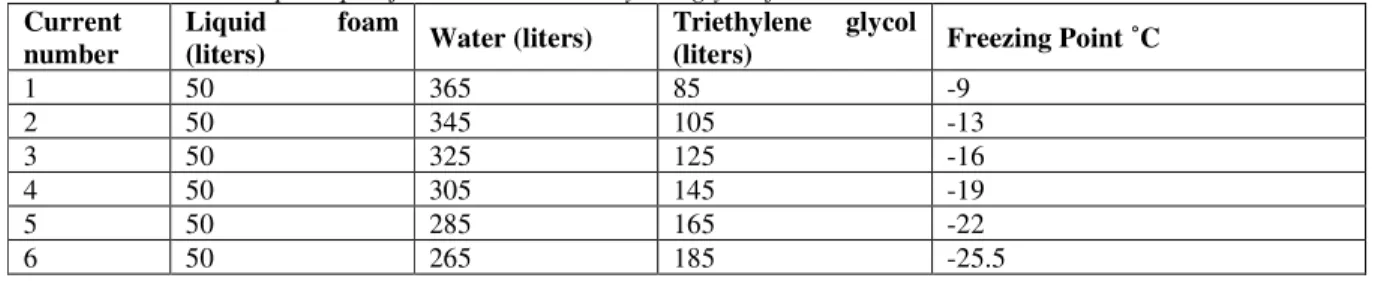
The results of experiments 3.1 - 3.6 are embodied in the exact mixing recipes necessary for the formation of solutions so that the automatic devices for introducing the foam into the wells are functional and the fluid inside does not freeze, thus:
Table 17- Recipe: liquid foam +water+ triethylene glycol for a 500 liters container:
Current number
Liquid foam
(liters) Water (liters)
Triethylene glycol
(liters) Freezing Point ˚C
1 50 365 85 -9
2 50 345 105 -13
3 50 325 125 -16
4 50 305 145 -19
5 50 285 165 -22
6 50 265 185 -25.5
Note: From an economical point of view the price of methanol is much lower than the price of triethylene glycol, so this is a recipe that can be used by the reserve in special situations, namely in the absence of methanol. The internal method of determining the freezing point has an error of ± 1 ˚C.
3. CONCLUSIONS
From the first experiments, with the help of the Petrotest device, we determined the foaming tendency of the different solutions formed from methanol or triethylene glycol, using the proportions of 1: 9 foam - water + methanol or water + triethylene glycol and we noticed that methanol and triethylene glycol do not influence the foaming, and this is a very important thing in the operations of evacuating the water from the bottom of the wells with the help of the foam in composition with methanol or triethylene glycol during the winter period.
Following the experiments in different compositions of foam + water + methanol and foam + water + triethylene glycol, we determined the freezing point, which is also very important because the results from the centralizing tables were obtained: Table 10 and Table 17, recipes that in the meantime they
applied in practice on automatic devices to introduce foam substances in gas wells at different temperatures below 0 ˚C, the solutions remained liquid, the pumps worked in good conditions, and the gas wells brought their water from the bottom to the surface and had produced under normal conditions.
4. REFERENCES
1. ASTM D 892-03 - Standard Test Method for Foaming Characteristics of Lubricating Oils
2. STAS 39/80 - Liquid petroleum products. Determination of freezing point
3. Site experiments within a Gas Production Section
DETERMINAREA SPUMARII SI A PUNCTULUI DE CONGELARE A SOLUTIILOR IN AMESTEC PENTRU EVACUAREA LICHIDELOR DIN TALPA SONDEI CU
AJUTORUL DISPOZITIVELOR AUTOMATE DE INTRODUS SPUMANT PE PERIOADA DE IARNA
Rezumat: In prezentul studiu ne vom axa pe introducerea substantelor spumogene lichide in sondele de gaze cu ajutorul dispozitivelor automate pe perioada de iarna cand sunt temperaturi scazute si este nevoie de solutie cum ar fi metanolul sau trietilenglicolul in amestec cu apa+spumant pentru evitarea inghetului, astfel incat am procedat in laboratorul de determinari fizico-chimice la determinarea punctului de congelare a unei palete de amestecuri, respectiv a tendintei de spumare a acestor amestecuri, spumare necesara evacuarii lichidelor din talpa sondei.
Horatiu Raul OLAR, Sngn Romgaz Sa, Sucursala Targu Mures, Mures, Romania, Phd Student Drilling Production Department, The Petroleum-Gas University Of Ploieşti,
[email protected], 0749332312 Home Adress: Street Salcâmilor Nr 23a Sc B
Ap 5 Târgu Mures, Jud Mures, ROMANIA
Petru Constantin GHERMAN, SNGN ROMGAZ SA, SUCURSALA TARGU MURES, MURES, ROMANIA
Lazar AVRAM, PHD HABIL. DRILLING PRODUCTION DEPARTMENT, The Petroleum-Gas University of Ploieşti, UPG Ploiesti, Ploiesti, ROMANIA