INTERNATIONAL JOURNAL OF APPLIED RESEARCH AND TECHNOLOGY ISSN 2519-5115
RESEARCH ARTICLE
Improving Water Quality through Nanotechnology
1Paras Porwal 2Abhinav Sharma
Deen DayalUpadhyay Kaushal Kendra Mahatma Gandhi Chitrakoot Gramodaya Vishwavidyalaya Satna- 485 331
Madhya Pradesh, India
Corresponding author:
Paras Porwal
Received: December 13, 2016 Revised: December 19, 2016 Published: December 31, 2016
ABSTRACT
Clean water is a necessity of life, as it is the most essential commodity responsible for the existence and survival of life on the earth. Unfortunately, it is becoming polluted & scarce day by day with the rapidly growing global population, improvement of living standard and also with the global climate change. Providing clean water at affordable prices to people of the 21st century is a major challenge. It is prerequisite to implement basic water treatment in the affected areas (mainly in developing countries) where water and waste water infrastructure are often at infant stage. Therefore, water purification technology requires novel approaches for effective administration and conservation of water resources. Nanotechnology holds its wider application in advancing water and wastewater treatment through the use of advanced filtration materials which improve the treatment efficiency as well as increase water supply through safe use of unconventional water sources. Recent advances in nanotechnology put forward leapfrogging opportunities to develop next-generation water supply systems.
Keywords- Nanotechnology, nanomaterials, water and waste
INTRODUCTION
Water is best described by Leonardo Da Vinci as ‘the vehicle of nature’ (‘vetturale di natura’). Globally, water consumption is increasing at more than double the rate of the world’s population growth. Due to the rapid increase in the population, pollution (as a result of rapid industrialization) and climate change (causes highly uneven rainfall patterns), in combinations they are likely to produce a drastic decline in water supply in the coming decades. So, providing clean water at affordable prices to the peoples of 21st century is a major challenge. The continuous growing pressures on water supplies force us to make use of unconventional water sources (e.g., contaminated fresh water, wastewater, seawater, storm water and brackish water). In spite of the use of conventional methods for water treatment such as chlorination and radiation there is further more research work is needed to overcome the present problem. There is a serious health risk to human beings due to the presence of large quantity of toxic metals (mercury, lead, cadmium, zinc etc.). Therefore, there is an immediate need to develop newer technologies that can detect and eliminate toxic contaminants from wastewaters in an efficient and economically feasible ways.
Nanotechnology promises not only to overcome these challenges faced by traditional water and wastewater treatment technologies, but it also provide novel opportunities that could allow best economic utilization of unconventional water sources to expand the water supply. Several problems involving water quality can be resolved or diminished to a greater extent by using nanoabsorbent, nanocatalysts, bioactive nanoparticles, nanostructured catalytic membranes, nanopowder, nanotubes and magnetic nanoparticles (Mamadou et al., 2005).Among all these,
nanomaterials have numerous physicochemical properties which make them unique and attractive separation media for water purification. Water treatment technologies include filtration using membranes, chemical treatment, heat and ultraviolet treatment and distillation. They try to remove solid and other contaminants, or to neutralize them, and many treatments have a long history of use in systems for producing water for domestic, industrial and agricultural use (OECD, 2011).This review incites the recent potential of nanotechnology and its applications for water treatment & purification technologies.
Nanotechnology and water purification
Nanotechnology is the development and use of materials, devices and systems having in nanometer architecture. It is identified as an emerging & innovative technology in the area of science and technology that has the capability to overcome the shortcomings of traditional water treatment technologies. It also provides environmental protection against toxic contaminants, undesirable byproducts and waste materials.
Need of nanomaterials in water purification
efficiency. When compared with the conventional water treatment technologies such as membrane based treatment, activated carbon, UV-based filtration, electro dialysis and distillation, the nano based systems could provide the following advantages (Pradeep and Anshup, 2009a): 1. Higher efficiency of removal even at
very low concentration of adsorbents. 2. Functionalization capability of
nanomaterials leads to specific uptake. 3. Low waste generation.
Application of Nanomaterials in Water Purification
Although a large number of the traditional technologies are effective like solvent extraction, activated carbon adsorption and most common chemical oxidation but are costly and time consuming. The ability to remove toxic contaminants efficiently from these environments to a safe level is thus becomes important. Nanotechnology promises to significantly enhance the efficacy of many water purification technologies such as adsorption, ion exchange, oxidation, reduction, filtration, membranes, and disinfection processes. Nanomaterials are not used only in the water
treatment, but also in the water quality monitoring through sensing and detection. Nanomaterials offer a great advantage through particles and filter systems which can bind and remove or inactivate pollutants within water, land, and air. Nanomaterials such as carbon nanotubes (CNT), nanoparticles, zeolites and dendrimers plays a vital role in the development of more efficient and cost effective water filtration processes (Reynolds 2007, Mamadou et al., 2005 and Moore et al., 2004). These nanomaterials are cheaper, more durable and led to more efficient water treatment (Brame et al.2011, Theron et al., 2008 and Watlington 2005). The importance of nanostructure materials has been studied in the field of water purification, desalination, waste water treatment, water recycle and reuse (Diallo et al., 2009; Cloete et al., 2010; Hotze and Lowry, 2010).
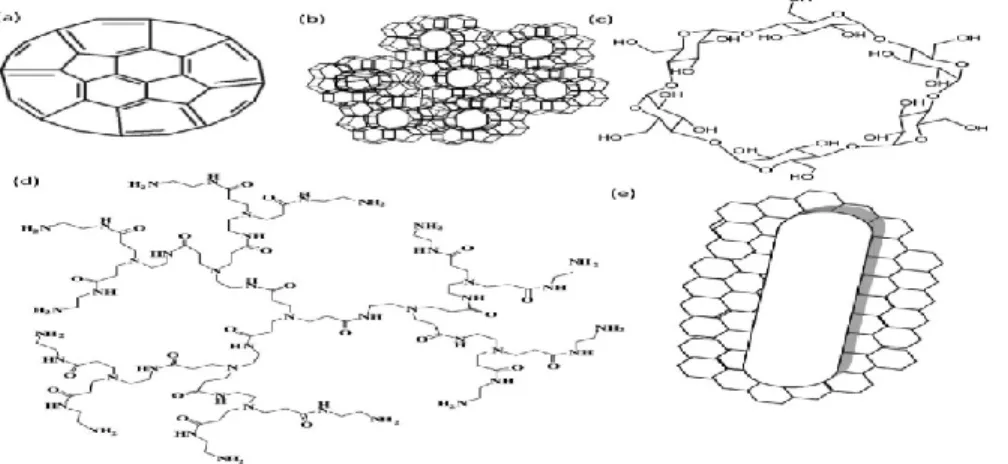
Some of the widely used nanomaterials like carbon nanotubes, nanoscale zeolites, dendrimers, magnetic nanoparticles etc. for water remediation are discussed here (Fig. 1) & Table 1 indicate nanomaterials enabled water purifications.
Carbon Nanotubes (CNTs)
Carbon nanotubes (CNTs) are nanoscale cylinders of graphite with outstanding properties like high mechanical strength and large specific surface area (Fig. 1). The physicochemical properties of CNTs provides an important means for the designing of desired surface properties of carbon nanotubes that can modify the filtration and purification of water (Martínezet al., 2010). Carbon nanotubes are mainly classified into single-walled carbon nanotubes [(SWNTs) outer diameter in the range of 1-3 nm with inner diameter of 0.4-2.4 nm)] and multi-walled carbon nanotubes [(MWNTs) outer diameter ranging from 2-100 nm)]. CNTs membranes can remove almost all kinds of water contaminants, including turbidity, bacteria, viruses, and organic contaminants and they can potentially be used in the same way as ultra and microfiltration membranes. These membranes can be cleaned through a process of ultrasonication and autoclaving. These structures are promising for high permeability, high selectivity membranes due to the small CNT diameter (as small as 0.7 nm) and predictions of rapid flux through their hollow interior. These membranes demonstrate fast mass transport of both gases and water. Although having smaller diameter gas permeances of CNTs are equal to or higher than that of commercial polycarbonate membranes with diameter of 10 nm (Sholl et al., 2006 and Corry, 2008). This is possible due to the higher pore density of CNTs as compared to
polycarbonate membranes. Further research studies indicate that they are more durable, heat resistant, easy to clean and can be reused. Carbon nanotubes have also been evaluated for their salt adsorption capacity. Yang et al., (2013) showed that plasma treatment of carbon nanotubes resulted in ultrahigh salt adsorption capacity exceeding 400% by weight. Carbon nanotube technique is best substitute to reverse osmosis (RO) and other desalination techniques mainly when the solutes concentration is high (Risbud, 2006). The material for the carbon nanotubes is producible in large quantities; however, fabrication of large surface areas after incorporation of nanotubes will be a key step to enable their commercialization (Pendergast and Hoek, 2011).
Zeolites
Table-1:Nano technological Approaches for Water Purification
Nanotechnlogy Properties Current Applications Advantages
Carbon Nanotube Membranes
CNT is simply a
nanometer-sized rolled-up
atomically smooth
graphene sheet which forms a perfect seamless cylinder. CNT have high surface areas, high permeability,
good mechanical and
thermal stability.
These membranes can remove almost all kinds of water contaminants, including turbidity, bacteria, viruses and organic contaminants.
These are recognized as promising for desalination.
CNT provides faster flow rates than RO and UF, possibly because of the smooth interior of the nanotubes.
Desalination using carbon nanotube filters could cost less, more durable and easier to clean and reuse than conventional membranes.
Cyclodextrin Nanoporous Polymer
Cyclodextrin is a polymeric compound composed of particles with well-defined cylindrical cavities that can trap organic contaminants.
Cyclodextrin is
mechanically tough and low resistance to fouling.
These have been shown to remove a range of organic contaminants,
including benzene, polyaromatic
hydrocarbons (PAHs), fluorines,
nitrogen containing contaminants,
acetone, fertilizers, pesticides,
explosives & many others.
They are not affected by air moisture and can be used in humid regions. Cheap to manufacture and can be produced directly from starch.
Nanoscale TiO2
Photocatalysts TiOphotocatalytic 2 functions as both a reducing agent and an adsorbent.
TiO2 breaks down almost all organic contaminants. It is also super-hydrophilic and, therefore, able to absorb biological contaminants and heavy metals, including arsenic.
Nanoscale TiO2 provides larger surface area and faster photocatalysis than larger TiO2 particles.
Nanocrystalline microspheres are easier to use.
Zeolites Zeolites are adsorptive
materials with
lattice-structures that form pores.
Synthetic zeolites are
usually made from silicon-aluminum solutions or coal fly ash, and are used as sorbents or ion exchange media in cartridge or column filters.
Zeolites are generally used for the removal of metal contaminants. Zeolites made from coal fly ash can absorb a variety of heavy metals including lead, copper, zinc, cadmium, nickel, and silver from wastewater.
Zeolite silver compound has been
proven effective against
microorganisms, including bacteria and mold. The silver in this compound provides residual protection against
regrowth of these biological
contaminants.
Zeolites can be produced cheaply, as their source materials are found naturally and abundantly available.
Magnetic
nanoparticles Magnetic nanoparticles are adsorbents used for water treatment.
Magnetoferritin enabled forward
osmosis is intended for desalination, though other contaminants can also be removed, depending on the type of membrane that is used.
Magnetic nanoparticles enable both
chemical disinfection and
photocatalytic destruction of
waterborne pathogens while ensuring retention of the nanomaterials.
Magnetic nanoparticles can be
Zeolite crystals consist of a three-dimensional (3D) cross-linked (Si/Al)O4
tetrahedral structure which contains cavities that allow for the movement and containment of ions and water molecules (Lobo, 2003). The Si/Al ratio is an important property of zeolite. The charge imbalance due to the presence of aluminum in the zeolite determines the ion exchange properties of zeolite and induces potential acidic sites. As the Si/Al ratio increases, the cation content decreases, the thermal stability increases and the surface selectivity changes from hydrophilic to hydrophobic. The cation type, size, charge density, location and the extent to which it is exposed to the adsorbate molecules have a strong effect upon both adsorption capacity and selectivity (Jake et al., 2004).
The effect of Hydrogen ion concentration on the reducing efficacy of zeolites with different Si/Al molar ratios was investigated; the result reveals that zeolites were more effective in reducing bromate at slightly acidic pH (Zhang et al., 2006). The ozonation of zeolite improve the reducing efficiency of zeolites and also enhanced the removal of dissolved organic carbon (DOC).
The reduction efficiencies were not closely related to their Si/Al ratios (Jake et al., 2004). Studies show the adsorption of phenol on zeolites depends on both Si/Al ratio and on the pore size. The zeolites have the capacity to remove phenol from water (Damjanovi et al., 2010). Hydrophobic zeolites which possess higher content of Si show higher affinities for phenol adsorption (Wiesner et al., 2007).
Natural zeolite was used as an adsorbent in submerged membrane system for wastewater treatment. Synthetic zeolite clinoptilolite, chabasite and phillipsite were used for the separation of heavy metals (copper, nickel, zinc) from water and effective for removing of NH+4 cations from waste water (Zhan et al., 2010 and Zhang et al., 2011). The removal efficiency of ammonia was further increased by ozonation (Guan et al., 2010). The adsorption efficiency of natural zeolite can be customized by desired surface modification (Zhan et al., 2010).The presence of zeolite minerals in sand enhance their purification efficiency. Due to the stronger swelling properties zeolites retain the impurities for a
Nanoscale
ZeroValent Iron It functions simultaneously as an adsorbent and a reducing agent NZVI can be used to treat a wide range.
NZVI can be used to treat a wide range of common environmental contaminants including chlorinated
methanes, chlorinated benzenes,
pesticides, organic dyes,
thrihalomethanes, PCBs, arsenic,
nitrate, and heavy metals such as mercury, nickel, and silver.
NZVI is more reactive and has a large surface area than granular ZVI. NZVI has been shown to be effective across a broad range of soil pHs, temperatures, and nutrient levels.
Self Assembled Monolayers on Mesoporous supports
Made from glass or ceramic materials with nanoscale pores to which a monolayer
of molecules can be
attached.
Both the monolayer and the mesoporous support can be functionalized to remove specific contaminants.
SAMMS are designed for removing metal contaminants from drinking water, groundwater, and industrial waste streams SAMMS remove 99.9 % of mercury, lead, chromium, arsenic, radio nuclides, cadmium, and other metal toxins.
SAMMS have exhibited faster
longer time and also increase the sorption capacity. (Wang et al., 2007).
Fullerenes
Fullerenes are the class of molecules that are composed entirely of carbon. Buckminsterfullerene was the first of these molecules that was discovered in 1985 and contains 60 carbons in the form of a hollow spherical cage consisting of 12 pentagonal and 20 hexagonal faces (Fig. 1). Fullerenes are useful for the inactivation of waterborne bacterial viruses (Badireddy et al., 2007) and in the development of anti-fouling agents for membranes used in water and wastewater treatment where biofouling is known to be a critical limitation (Mallevialle et al., 1996). Fullerenes were not used too much in water disinfection but some of the types have potential applicability. Hydroxylated C60 or
fullerol (somewhat non-toxic) exhibit photochemical activity which can be exploited for disinfection or degradation (Sayes et al., 2004). The research findings reveals that the ability of C60 and C70
fullerenes to cleave DNA and inactivate viruses, bacteria, and kill tumor cells (Tsao et al., 2001 and Yamakoshi et al., 2003) suggesting that they might be used for water disinfection (Pickering et al., 2005).
Carbon nanotubes (another class of fullerenes) have been reported to exhibit antimicrobial properties (Kang et al., 2007 and Narayan et al., 2005) which can be exploited in numerous ways for disinfection applications. The antimicrobial mechanisms of carbon nanotubes are miscellaneous in addition to photocatalytic production of reactive oxygen species (ROS) that inactivate viruses and cleave DNA causing the disruption of the structural integrity of the bacterial cell envelope resulting in leakage of intracellular components and interruption of energy transduction. Antimicrobial nanoparticles can overcome
the critical challenges related with traditional chemical disinfectants (e.g., free chlorine and ozone) such as harmful disinfection by-products and short-lived reactivity. Antimicrobial nanoparticles could enhance existing technologies like UV inactivation of viruses, solar disinfection of bacteria and biofouling prone membrane filtration. The ROS producing properties (Arbogast et al., 1991 and Vileno et al., 2006) of fullerenes might be harnessed to generate oxidizing species to enhance destruction of organic compounds in water (Bottero et al., 2006). There are also promising applications for fullerene-polymer composites in pressure-driven membranes. The strength of the CNTs coupled with reported antibacterial properties may find use in creating membranes that resist breakage or inhibit biofouling.
Dendrimers
PAMAM (poly amidoamine) dendrimers (Fig. 1) family initiated from an ethylenediamine core with a branch cell multiplicity of two were the first complete dendrimer family to be synthesized and characterized. Recently, PAMAM dendrimer modified membranes using nanofiltration techniques have gain extensive attention for water purification. Dendritic membranes can use at harsher
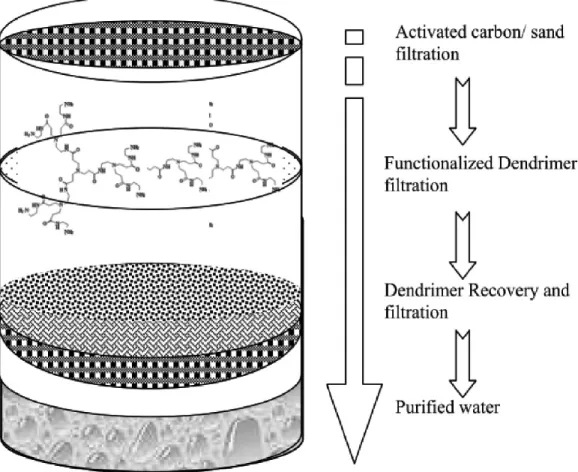
conditions such as high temperature (e.g. 80°C) and acid medium (pH 2-9) (Wang et al., 2008). The dendrimer enhanced filtration (DEF) process (Fig. 2) has many applications including the recovery of toxic metal ions including cations (e.g., copper, silver, gold and uranium), anions (e.g., perchlorate, nitrate and phosphate), and organic compounds (e.g., pharmaceuticals and pesticides).
Fig. 2 Overview of Dendrimer Enhanced Filtration process.
From industrial wastewater, the extraction of valuable metals (e.g., uranium) from aqueous solutions generated during in situ recovery mining and the remediation of groundwater contaminated by anions (e.g., perchlorate). The globular shape and large size of dendrimers makes them easier to
filter than linear polymers. Dendrimers also bind and deactivate bacteria and viruses (Diallo, 2006 and Dillo et al., 2005). Dendrimers with Ethylene Diamine (EDA) core and terminal NH2 groups are used to
dendrimers are much larger than those of linear polymers with amine groups. The dendrimers with hydrophobic cavities and positively charged internal groups selectively bind ClO4- over more hydrophilic
anions such as Cl-, NO3-, SO42- and HCO3-
(Diallo et al., 2007). Dendritic polymers have also been successfully used as delivery vehicles for antimicrobial agents such as Ag(I) and quaternary ammonium chlorides (Chen et al., 2003 and Baloghet al., 2001).
Cyclodextrins
Cyclodextrins (CD) are crystalline, homogeneous, nonhygroscopic substances, the family of cyclic oligosaccharides which are composed of particles with well-defined cylindrical cavities that can trap organic contaminants. Cyclodextrins are built up from glucopyranose units. The naturally occurring cyclodextrins are α, β and γ types consisting of 6, 7 and 8 glucopyranose units respectively (Fig. 1). Cyclodextrin polymer can be changed in the form of powder, granular beads or thin film that finds its use in different applications and devices. The polymer has also exhibited many times greater bonding with organic contaminants than activated carbon. In addition to being used for water treatment (even at low contaminant concentrations) they are also used for in situ groundwater treatment or for cleaning oil and organic chemical spills (Los et al., 1998). Cyclodextrin polymer has been shown to have a loading capacity of approximately 22 mg of organic contaminants per gram of polymer as compared to 58 mg per gram for activated carbon. Cyclodextrin polymer (cheap to manufacture) can be produced directly from starch with 100% conversion. Mass production is estimated to convey the cost of cyclodextrin polymer below the price of activated carbon and zeolites (Zemanet al., 1996). Cyclodextrin remove a wide range of organic contaminants, benzene,
polyaromatic hydrocarbons (PAHs), fluorines, nitrogen-containing contaminants, acetone, fertilizers, pesticides, explosives, and many others (Min et al., 2001). Cyclodextrin can be used in humid region (moisture resistant) without becoming saturated and deactivated, not lose capacity of regeneration. So, they can be reused indefinitely. It has also been shown to not leach the adsorbed contaminants.
Report suggested that cyclodextrin reduces these contaminants to parts-per-trillion, versus activated carbon and zeolites, which reduce contaminants to parts-per-million. The role of cyclodextrin and their derivatives methylated beta-CD and hydroxypropyl beta-CD in the inhibition of chemical degradation of organophosphorus pesticides was studied (Zhang et al., 2006). Cyclodextrins form solid inclusion complexes with a very wide range of solid, liquid and gaseous compounds by a molecular complexation. In these complexes a guest molecule is held within the cavity of the cyclodextrin host molecule. Dendritic cyclodextrinnanosponges is used for the removal of organic pollutants from water. For the effective purification of variety of water and environmental pollutants functionalized cyclodextrin was impregnated with ceramic porous filters (Arkaset al., 2006).Cyclodextrin functionalized mesoporous silica adsorbents have been developed for removal of pesticides from aqueous media. Sawickiet al., 2006 demonstrated that synthesized material have the potential for removal of specifically p, p'substituted diphenyl-based pesticides such as DDT and DDE. Studies suggest that the rate of lead removal by Carboxymethyl-beta-cyclodextrin (CMCD) was higher than removal by KNO3 (Neilson
(α-, β- and γ- cyclodextrins) are used for separation of highly potent toxic compound of cyanobacteria (Cyanotoxin) from drinking water supplies (Chen et al., 2011).
Recent application of Nanotechnology in Water purification
Nanotechnology has made possible the development of novel submicron materials which are capable of fighting waterborne disease caused by microbes. Metallic nanoparticles are the most promising nanomaterials with antimicrobial activity due to their physicochemical properties. Numerous natural and engineered nanomaterials like silver (nAg), titanium oxide (TiO), fullerene (C60) and carbon
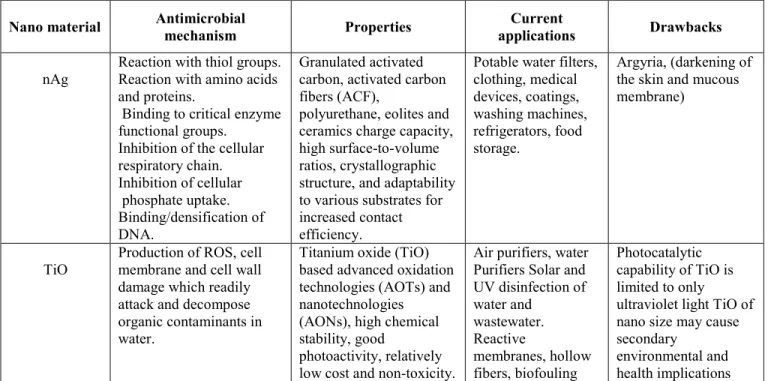
nanotubes (CNT) are known to have antibacterial properties and are under consideration as disinfecting agents for water treatment (Li et al., 2008). Table 2 demonstrates the potential benefits of nanomaterials for drinking water disinfection (Goyal et al., 2011). Nanometric Titanium dioxide (Conc. between 10-100
ppm) has shown antimicrobial properties against Escherichia coli, Bacillus subtilis and Pseudomonas aeruginosa through membrane damage mechanisms (Sadiqet al., 2010). The antibacterial activity of fullerene water suspensions (nC60) has been reported
in different bacteria in low-salts media over a wide range. The potential of (nC60) for the
disinfection and microbial control has been confirmed in results (Lyon et al., 2008). Ion concentration polarization is used to utilized desalinate seawater using an energy efficient process (Kim et al., 2010). Yangali Quintanilla et al. (2011) desalinated red sea water using forward osmosis and reverse osmosis. With the modification in the surface charge properties of the CNT they could result in higher desalination efficiency (Ahn et al., 2012). Graphene based membranes are being recently developed for desalination due to their fast water transport properties and good mechanical properties (Nair et al., 2012; Xue et al., 2013; Choi et al., 2013; Mi, 2014).
Table 2 Applications of nanomaterials utilizing antimicrobial properties.
Nano material Antimicrobial mechanism Properties applications Current Drawbacks
nAg Reaction with thiol groups. Reaction with amino acids and proteins.
Binding to critical enzyme functional groups. Inhibition of the cellular respiratory chain. Inhibition of cellular
phosphate uptake. Binding/densification of DNA.
Granulated activated carbon, activated carbon fibers (ACF),
polyurethane, eolites and ceramics charge capacity, high surface-to-volume ratios, crystallographic structure, and adaptability to various substrates for increased contact efficiency.
Potable water filters, clothing, medical devices, coatings, washing machines, refrigerators, food storage.
Argyria, (darkening of the skin and mucous membrane)
TiO Production of ROS, cell membrane and cell wall damage which readily attack and decompose organic contaminants in water.
Titanium oxide (TiO) based advanced oxidation technologies (AOTs) and nanotechnologies (AONs), high chemical stability, good
photoactivity, relatively low cost and non-toxicity.
Air purifiers, water Purifiers Solar and UV disinfection of water and
wastewater. Reactive
membranes, hollow fibers, biofouling
Photocatalytic capability of TiO is limited to only ultraviolet light TiO of nano size may cause secondary
resistant surfaces. (i.e., nanotoxicity, adsorption carrier of organic and inorganic contaminants). Nanotechnology
based membrane
Physically compromise cell envelope.
Enhanced mechanical properties (e.g., strength, modulus and dimensional stability); chemical and thermal stability; Inorganic organic
nanocomposite membranes.
Hybrid protein polymer biomimetic membranes. Aligned-carbon nanotube
membranes.
Organic
contaminants like Pest, Herb, & Insecticides, Industrial effluents and inorganic contaminats like arsenic, lead can be removed by nanotechnology based membrane Nanotechnology based membrane Seawater desalination.
Membrane fouling, ageing and chemical or mechanical damage; high cost manufacturing.
CONCLUSION
Nanotechnology shows incredible results and come up with a solution to the growing demands for waste water treatment and the quality of life for millions of people in the different countries. A number of exciting, new and innovative water treatment technologies have been made possible through the beginning of nanotechnology, but these technologies still require further more research and development. For example, although carbon nanotubes (CNTs) have potential for the removal of metal contaminants but their toxicity is unknown. A risk assessment is needed to determine the benefit of using a known or potential contaminant to remediate another contaminant before the widespread implementation of nanotechnology based water treatment. Advances in nanotechnology could potentially alleviate water access issues. Nanotechnology will likely to play a key role in water industry areas: monitoring, desalinization, purification, and wastewater treatment
(Loncto et al., 2007). Ensuring reliable access to inexpensive and clean sources of water is an overriding global challenge for nanotechnology prior to its widespread use.
REFERENCES
Ahn, C.H., Baek, Y., Lee, C., Kim, S.O., Kim, S., Lee, S., Kim, S.H., Bae, S.S., Park, J., and Yoon, J. (2012). Carbon nanotube-based membranes: fabrication and application to desalination, J. Ind. Eng. Chem., 18, 1551-1559.
Arbogast, J.W., Darmanyan, A.P., Foote, C.S., Rubin, Y., Diederich, F.N., and Alvarez. (1991). Photophysical properties of C60, J. Phys. Chem., 95(1):11-12.
Arkas, M., Allabashi, R., Tsiourvas, D., Mattausch, E.M., and Perfler, R. (2006). Organic/inorganic hybrid filters based on dendritic and cyclodextrin "nanosponges" for the removal of organic pollutants from water, Environ. Sci. Technol. 40(8), 2771
-2777.
Organic/inorganic hybrid filters based on dendritic and cyclodextrin "nanosponges" for the removal of organic pollutants from water, Environ. Sci. Technol., 40(8): 2771
-2777.
Badireddy, A.R., Hotze, E.M., Chellam, S., Alvarez, P., and Wiesner, M.R. (2007). Inactivation of bacteriophages via photosensitization of fullerol nanoparticles, Environ. Sci. Technol., 41(18), 6627-6632. Balogh, L., Swanson, D.R., Tomalia, D.A., Hagnauer, G.L., and McManus, A.T. (2001). Dendrimer silver complexes and nanocomposites as antimicrobial agents, Nano. Lett., 1:18-21.
Bottero, J.Y., Rose, J., and Wiesner, M.R. (2006). Nanotechnologies: Tools for sustainability in a new wave of water treatment processes, Int. Environ. Assess. Manag., 2(4): 391-395.
Brame, J., Li, Q., and Alvarez, P.J.J. (2011). Nanotechnology enabled water treatment and reuse: emerging opportunities and challenges for developing countries, Trends Food Sci& Tech., 22, 618-624.
Chen, L., Dionysiou, D.D., and O'Shea, K. (2011).Complexation of microcystins and nodularin by cyclodextrins in aqueous solution, a potential removal strategy, Environ. Sci. Technol., [Epub ahead of print].
Chen, Y., Wang, L., Jiang, S., and Yu, H.J. (2003). Study on novel antibacterial polymer materials preparation of zeolite antibacterial agents and antibacterial polymer composite and their antibacterial properties, J. Polym. Mater., 20:279-284.
Choi, W., Choi, J., Bang, J., Lee, J.H. (2013).Layer-by-layer assembly of graphene oxide nanosheets on polyamide membrane for durable reverse-osmosis applications, ACS Appl. Mater.Interfaces. 5, 12510
-12519.
Cloete, T.E., Kwaadsteniet, M., Botes, M., and Lopez-Romero, J.M.
(2010).Nanotechnology in Water Treatment Applications.Norfolk, Caister Academic Press.
Corry, B. (2008). Designing carbon nanotube membranes for efficient water desalination, J. Phys. Chem., 112:1427
-1434.
Damjanovi, L., Raki, V., Rac, V., Stosic, D., and Auroux, A. (2010). The investigation of phenol removal from aqueous solutions by zeolites as solid adsorbents, J. Hazard. Mater, 184(13), 477-484.
Diallo, M., Christie, S., Swaminathan, P., Johnson, J.H.Jr., and Goddard W.A. (2005). Dendrimer enhanced ultrafiltration. 1. Recovery of Cu (II) from aqueous solutions using PAMAM dendrimers with ethylene diamine core and terminal NH2 groups,
Environ Sci Technol., 39, 1366-1377.
Diallo, M., Duncan, J., Savage, N., Street, A., and Sustich, R. (2009). Nanotechnology solutions for improving water quality, Norwich, NY, William Andrew, pp. 585
-588.
Diallo, M.S. (2006). Water treatment by dendrimer enhanced filtration, US Patent Application, US 1006/0021938 Al.
Diallo, M.S., Falconer, K., Johnson, J.H., and Goddard, W.A. (2007). Dendritic anion hosts: perchlorate binding to G5-NH2 poly
(propyleneimine) dendrimer in aqueous solutions, Environ. Sci. Technol., 41(I8):6521-6527.
Frechet, J.M.J., and Tomalia, D.A. (2001). Dendrimers and other dendritic polymers, Wiley and Sons: New York.
removal among four selected natural zeolites, J. Hazard. Mater., 183, 616-621. Hotze, M., and Lowry, G. (2010).Nanotechnology for sustainable water treatment in Hester RE and Harrison RM, Sustainable Water, London, RSC, 138
-164.
Jake, V., Herges, W., and Johnson, R.D. (2004). Arsenic-interactions stabilize a self-assembled As 2 L 3 supramolecular complex, Angew. Chem. Int. Ed., 5831
-5833.
Kang, S., Pinault, M., Pfefferle, L.D., and Elimelech, M. (2007). Single-walled carbon nanotubes exhibit strong antimicrobial activity, Langmuir, 23:8670-8673.
Kazemimoghadam, M. (2010).New nanopore zeolite membranes for water treatment, Desalination, 251, 176-180. Kim, Y.J., Choi, J.H. (2010). Enhanced desalination efficiency in capacitive deionization with an ion-selective membrane, Sep. Purif. Technol., 71, 70-75. Komarneni, S. (1992).Nanocomposites, J. Mater. Chem., 2(12):1219-1230.
Kumakiri, I., Yamaguchi, T., and Nakao, S. (2000). Application of a zeolite a membrane to reverse osmosis process, J. Chem. Eng., Jpn. 2000, 33:333-336.
Li, Q., Mahendra, S., Lyon, D.Y., Brunet, L., Liga, M.V., and Alvarez, P.J. (2008). Antimicrobial nanomaterials for water disinfection and microbial control: potential applications and implications, Water Res., 42(18), 4591-4602.
Lobo, R.F. (2003).Handbook of Zeolite Science and Technology, Marcel Dekker, Inc., New York, NY.
Loncto, J., Marlan, W., and Lynn, F. (2007). Nanotechnology in the water industry, Nanotech.Law Bus., 4 (2):157-159.
Los Alamos National Laboratory. (1998). Nanosponges Soak Up Contaminants and Cut Cleanup Costs, Dateline Los Alamos, April, 1-3.
Lyon, D.Y., Brown, D.A., and Alvarez, P.J. (2008). Implications and potential applications of bactericidal fullerene water suspensions: effect of nC60 concentration,
exposure conditions and shelf life, Water Sci. Technol., 57(10):1533-1538.
Mallevialle, J., Odendaal, P., and Wiesner, M.R. (1996). Membrane Processes in Water Treatment, McGraw-Hill: New York.
Mamadou, S.D., and Savage, N. (2005).Nanoparticles and water quality, J. Nano. Res., 7, 325-330.
Martínez, H.A.L., Velasco, S.C., and Castaño, V.M. (2010). Carbon nanotubes composites: processing, grafting and mechanical and thermal properties, Curr. Nanosci., 6(1), 12-39.
Mi, B. (2014). Graphene oxide membranes for ionic and molecular sieving, Science, 343, 740-742.
Min, M., Dequan, L. (2001).Cyclodextrin Polymer Separation Materials, U.S. Patent Application 20010008222.
Moore, T.T., Mahajan, R., Vu, D.Q., and Koros, W.J. (2004).Hybrid membrane materials comprising organic polymers with rigid dispersed phases, AICh. J, 50(2), 311
-321.
Nair, R.R., Wu, H.A., Jayaram, P.N., Grigorieva, IV and Geim, A.K. (2012). Unimpeded permeate of water through helium-leak tight graphene-based membranes, Science, 335, 442-443.
Narayan, R.J., Berry, C.J., and Brigmon, R.L. (2005).Structural and biological properties of carbon nanotube composite films, Mater. Sci. Eng., 123:123-129.
National Nanotechnology Initiative. What Is Nanotechnology? Available: http://www.nano.gov/html/
facts/whatIsNano.html [accessed 23 October 2009]
from contaminated soils by nontoxic soil-washing agents, J. Environ. Qual., 32(3):899-908.
OECD. (2011). Fostering nanotechnology to address global challenges: water, Available at:
http://www.oecd.org/dataoecd/22/58/476018 18.pdf.
Pendergast, M.M., and Hoek, E.M.V. (2011).A review of water treatment membrane nanotechnologies, Energy Environ. Sci., 4, 1946-1971.
Pickering, K.D., and Wiesner, M.R. (2005).Fullerol-sensitized production of reactive oxygen species in aqueous solution, Environ. Sci. Technol., 39(5), 1359-1365. Reynolds, K.A. (2007). Water quality monitoring: lessons from the developing world, Water Condition. Purif., 39, 66-68. Risbud, A. (2006). Carbon drinking water from the ocean, Tech. Rev., June 12.
Sadiq, I.M., Chandrasekaran, N., and Mukherjee, A. (2010).Studies on effect of TiO2 nanoparticles on growth and
membrane permeability of Escherichia coli, Pseudomonas aeruginosa, and Bacillus subtilis, Curr.Nanosci, 6(4), 381-387.
Sawicki, R., Mercier, L. (2006). Evaluation of mesoporous cyclodextrin-silica nanocomposites for the removal of pesticides from aqueous media, Environ. Sci. Technol., 40(6), 1978-1983.
Sayes, C.M., Fortner, J.D., Guo, W., Lyon, D., Boyd, A.M., and Ausman, K.C. (2004).The differential cytotoxicity of water-soluble fullerenes, Nano.Lett., 4(10), 1881-1887.
Sholl, D.S., and Johnson, J.K. (2006). Making high-flux membranes with carbon nanotubes, Science, 312(5776):1003-1004. Svenson, S., and Tomalia, D.A. (2005).Dendrimers in biomedical applications reflections on the field, Adv. Drug Deliv. Rev., 57(15), 2106-2129.
Theron, J., Walker, J.A., and Cloete, T.E. (2008). Nanotechnology and water treatment: applications and emerging opportunities, Crit. Rev. Microbiol., 34, 43
-69.
Tsao, N., Luh, T.Y., Chou, C.K., Wu, J.J., Lin, Y.S., and Lei, K.Y. (2001).Inhibition of group A streptococcus infection by carboxyfullerene, Anti. Agents Chem., 45(6), 1788-1793.
Vileno, B., Marcoux, P.R., Lekka, M., Sienkiewicz, A., Feher, T., and Forro, L. (2006).Spectroscopic and photophysicalproperties of a highly derivatized C60fullerol, Adv. Funct. Mater,
16(1): 120-128.
Wang, J., Cheng, Y., and Xu, T. (2008).Current patents of dendrimers and hyperbranched polymers in membranes, Recent Pat. Chem. Eng., 1, 41-51.
Wang, S.J., Ma, J., Yang, Y.X., Zhang, J., Qin, Q.D., and Liang, T. (2007). Influence of nanosized TiO2 catalyzed ozonation on
the ammonia concentration in Songhua River water, Huan Jing KeXue, 28(11):
2520-2525.
Wang, X., Yolcubal, I., Wang, W., Artiola, J., Maier, R., and Brusseau, M. (2004).Use of cyclodextrin and calcium chloride for enhanced removal of mercury from soil, Environ.Toxicol. Chem., 23(8):1888-1892. Watlington, K. (2005). Emerging nanotechnologies for site remediation and waste water treatment, Available at: http://nepis.epa.gov/Adobe/PDF/P1003FG4. pdf.
Wiesner, M.R., and Bottero, J.Y. (2007). Environmental Nanotechnology: Applications and Impacts of Nanomaterials, 1sted. The McGraw-Hill: New York.
Yamakoshi, Y., Umezawa, N., Ryu, A., Arakane, K., Miyata, N., and Goda, Y. (2003). Active oxygen species generated from photoexcited fullerene (C60) as
potential medicines, J. Am. Chem. Soc., 125(42), 12803-12809.
Yang, H.Y., Han, Z.J., Yu, S.F., Pey, K.L., Ostrikov, K., and Karnik, R. (2013).Carbon nanotube membranes with ultrahigh specific absorption capacity for water desalination and purification, Nat. Commun., 4(2220), 1
-8.
Yangali, Q.V., Zhenyu, L., Valladeres, R., Li, Q., and Amy, G. (2011). Indirect desalination of red sea water with forward osmosis and low pressure reverse osmosis for water reuse, Desalination, 280, 160-166. Zeman, L.J., Zydney, A.L. (1996). Microfiltration and Ultrafiltration: Principles and Applications, Marcell Dekker: New York.
Zhan, Y., Zhu, Z., Lin, J., Qiu, Y., and Zhao, J. (2010). Removal of humic acid from aqueous solution by cetylpyridinium bromide modified zeolite, J. Environ. Sci., 22(9), 1327-1334.
Zhang, A.P., Luo, F., Chen, S.W., and Liu, W.P. (2006). Effects of cyclodextrins on hydrolysis of malathion, J. of Environ. Sci., 18(3):572-576.