Refereed paper
Complex adaptive systems (CAS): an
overview of key elements, characteristics
and application to management theory
Beverley Ellis MA PhD FHEA MBCS CITP
Subject Lead/Principal Lecturer in Health Informatics, School of Health, University of Central Lancashire, Preston, UK
Stuart Ian Herbert BA(Hons) FBCS CITP
Director and Independent Health Informatician, SI Herbert & Associates Ltd
Introduction
There are various governance models that guide current quality improvement programmes used by health services.1,2This paper summarises a review of com-plex adaptive system explanations of problems in networked organisations. It draws on examples from primary care informatics, which include workarounds and use of financial incentives to overcome obstacles.
Complex adaptive systems (CAS) is a framework that assists thinking about the nature of quality im-provement programmes in primary care organisations (PCOs). The review includes practical frameworks, designed to ensure delivery of health service quality improvements enabled by developments in primary care informatics. The findings should improve our
ABSTRACT
Objective To identify key elements and character-istics of complex adaptive systems (CAS) relevant to implementing clinical governance, drawing on lessons from quality improvement programmes and the use of informatics in primary care.
Method The research strategy includes a literature review to develop theoretical models of clinical governance of quality improvement in primary care organisations (PCOs) and a survey of PCOs.
Results Complex adaptive system theories are a valuable tool to help make sense of natural phenomena, which include human responses to problem solving within the sampled PCOs. The research commenced with a survey; 76% (n16) of respondents preferred to support the implemen-tation of clinical governance initiatives guided by outputs from general practice electronic health records. There was considerable variation in the way in which consultation data was captured, recorded and organised. Incentivised information sharing led to consensus on coding policies and models of data recording ahead of national
con-tractual requirements. Informatics was acknow-ledged as a mechanism to link electronic health record outputs, quality improvement and resources. Investment in informatics was identified as a devel-opment priority in order to embed clinical govern-ance principles in practice.
Conclusions Complex adaptive system theory usefully describes evolutionary change processes, providing insight into how the origins of quality assurance were predicated on rational reductionism and linearity. New forms of governance do not neutralise previous models, but add further dimen-sions to them. Clinical governance models have moved from deterministic and ‘objective’ factors to incorporate cultural aspects with feedback about quality enabled by informatics. The socio-technical lessons highlighted should inform healthcare man-agement.
understanding of management approaches and the control of new organisational forms.
Method
We carried out a literature review and developed a theoretical framework that facilitates interpretation of the case studies upon which this series of papers is based.2 Approaches that suit CAS are identified and examined. Complexity thinking introduces new and different metaphors and provides a language for under-standing the nature of responses to quality improve-ment programmes in PCOs. The review discusses concepts dealing with relations, interdependencies, governance and managerial responses to quality im-provement programmes in PCOs.
Results
Complex adaptive systems
Complex adaptive system ideas are associated with developments in order thinking. The second-order view of systems describes recursive interactions
between layers of systems (control loops and feed-back); principles that guide a variety of systems to achieve their purpose by ‘the return of information to form a closed loop’.3
The ideas of feedback, non-linear causation and self-regulation mark the move towards a collaborative, network-based understanding of governance.
In 1984, the Santa Fe Institute in New Mexico studied the behaviour of CAS. A state between stable and unstable behaviour was discovered, attributable to interactions between agents and elements within a system. Activity was simulated using simple rules applied by each of a network of moving digital agents (boids).4–6The idea of ‘simple rules’ has subsequently been applied by organisational theorists as a way of interpreting the complex behaviour found in organ-isational communities.7–13
Key elements, features and management principles that characterise CAS are summarised in Table 1.
Complex interactions and interdependencies emerge within CAS which cannot be understood or predicted simply by studying individual elements of the system; novel system behaviour emerges. Humans possess the capacity to reflect, which may result in alternative paths of action to those prescribed within simple rules. The interacting component units within CAS result in a system-wide governance, because influence is exer-cised both by the system on the units and by the units
Table 1 CAS elements and management principles
Core CAS elements Features Management principles
Multiple agents with schemata
Informal, collaborative networks of individuals that partner and contribute to solution making Connectivity and interdependence between agents
Degrees of connectivity
Respect democratic principles that lead to mutual adjustment; jointly steer courses of action
Self-organising networks Holistic patterns formed through human interactions
Causation Feedback
Adjust the fitness landscape: offer incentives, and longer term rewards by setting priorities. Apply simple design principles because they turn into rules; ensure that lines of communication flow across
network, so authority and legitimacy become vested in the process as a whole, not on the perspective of one
Coevolution Innovative pathways of governance emerge – a variety of what is known as ‘emergent behaviour’ in CAS
Appreciate and monitor the implications of feedback, non-linear and mutual causation
System adaptation Networks represent additions to hierarchies
on the system – termed ‘mutual causation’. Quality assurance is introduced next, a formal framework within which quality health care is currently delivered within PCOs.
Quality assurance
Quality assurance is associated with the application of scientific methods to management and 20th century industrial production. Its aim is to increase the pro-portion of products without faults. Quality improve-ment in health care is sometimes bedevilled by the difficulty of defining universal measures of a ‘best’ (or sometimes even ‘good’) outcome for patients, bearing in mind the very variable case mix receiving health care and the considerable uncertainty about cause and effect in some individual (and occasionally general) cases. This makes it particularly suited to a CAS approach, and both outcome-oriented and process-oriented measures need to be considered to effectively evaluate performance from a user/service satisfaction perspective. There is a consensus that the key charac-teristics of a healthcare quality assurance framework14 include:
. Leadership Senior management should actively
participate in quality assurance programmes, as partners rather than pharaohs.
. Organisational characteristics The organisation
should provide moral and material support.
. Characteristics of the health professionals They should be willing to take part in the programme and be responsive to findings.
. Technical quality of monitoring system Efficient
data collection processes are necessary in order to minimise the costs of quality measurement.15
Performance is measured before the use of change strategies and is repeated at intervals, termed the quality improvement cycle. The quality improvement cycle requires monitoring systems to review aspects of performance on a continuing basis. It presents in various forms that include ‘plan–do–study–act’15 and ‘plan–do–check–act’16cycles. Developments in infor-matics and improved availability of performance data has led to transparency of outputs and public disclos-ure of the performance of healthcare providers.17,18 The following section reviews the formulation of the quality improvement cycle proposed as part of the European Foundation of Quality Management (EFQM)a Excellence Model.
European Foundation of Quality
Management Excellence Model
The government explicitly commended the EFQM Excellence Model as a management framework for clinical governance,19–22as a model that provides:
an enhanced focus on aspects of excellence that are becoming increasingly important such as the manage-ment of partnerships and knowledge ... explicit focus on the value to users of the ‘plan, do, check, act’ cycle; a need to relate everything that is done, and the measurements taken, to what policy and strategy is seeking to achieve. (www.efqm.org)
The EFQM Excellence Model reflects a logic known as RADAR which consists of the elements: results, ap-proach, deployment, assessment and review. Advo-cates of the EFQM Excellence Model suggest it has an inherent capacity to reflect the processes of quality service provision. The EFQM Excellence Model posits that five sub-criteria need to be addressed:
1 processes are systematically designed and managed 2 processes are improved as needed, using inno-vation in order to fully satisfy, and generate increas-ing value, for customers and other stakeholders 3 products and services are designed and developed
based on customer needs and expectations 4 products and services are produced, delivered and
serviced
5 customer relationships are managed and enhanced.
The model is based on nine criteria. Five of these are ‘enablers’ and four are ‘results’. The ‘enabler’ criteria cover what an organisation does. The ‘results’ criteria cover what an organisation achieves. ‘Results’ are caused by ‘enablers’ and feedback from ‘results’ helps to improve ‘enablers’. The EFQM Excellence Model is a non-prescriptive framework that recognises there are many approaches to achieving sustainable excel-lence in all aspects of performance. The model is based on the premise that excellent results with respect to performance, customers, people and society are achieved through partnerships, resources and processes. In essence, the model subscribes to Deming’s philosophy of continuous plan–do–study–act, and to his notion of production as a cooperative task undertaken by a network of semi-autonomous individuals who sub-scribe to the common goal of producing high-quality outputs.23 Processes are driven by self-assessment, achieving objectives and controlling risks. The EFQM describe self-assessment as a comprehensive, system-atic and regular review of an organisation’s activities and results, these referenced against an objective stan-dard of business excellence. NHS organisations use outputs from self-assessment as part of their business planning processes, applying the model as a basis for operational and project review.
aEFQM is the trademark of The European Foundation of
Primary care informatics
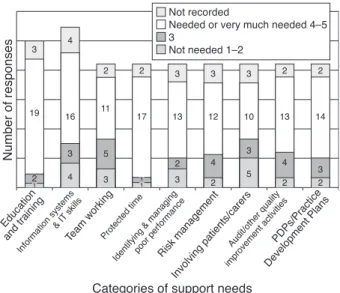
The publication of high-profile cases of unacceptable levels of performance, typified by the reports of the Shipman Inquiry,24perturbed GPs’ professionalism. Case study findings, including those from a small-scale survey, with questionnaires circulated across a PCO sample (42% response rate – 57% GPs, 33% primary healthcare team nurse members, 10% man-agers), suggest that the need to develop information systems and provide evidence of conformance with acceptable standards was seen as irrefutable. Overall, the results provide valuable insight into the develop-ment of key themes (see Figure 1). An emphasis on a positive approach, and the sharing of information, were widely considered a vital part of the change process:
. self-assessment and sharing of associated outputs through feedback was perceived as a valuable method to local governance of quality improvement
. measures of quality/effectiveness of practice became
increasingly transparent, visible and incentivised. For example, there was clear linkage to key organisational performance indicators, e.g. the National Service Framework (NSF) for Coronary Heart Disease.
The findings provide useful insight into the attitudes, perceptions and opinions of those involved in implementing clinical governance within the PCO sample:
‘We’ll have a phase of them getting their data straight, for 12 months or so, but in the future we can be pretty confident that the information we have is an accurate reflection of quality.’ (PCO Clinical Governance Manager)
Benchmarked results (in terms of quality assurance mechanisms) encourage a levelling of performance by reducing variation of practice supported via peer review. Cowleyet al(2003) report that: ‘The advent of the NSF for Coronary Heart Disease (CHD) in 1999, a com-prehensive public health programme, with its mile-stones and targets, acted in some part as a balancing process, made practices stop and think ‘‘How can we do this as well as everything else?’’.’19To enable this to be delivered in the complex environment of primary care, the Health Informatics Programme for CHD (HIP for CHD), funded by the Department of Health (DoH), began in 2000 and ran until 2003. It developed practical tools and quality methods that clinicians used both interactively in the consultation and for continuous learning, together with methodologies that enabled general practices to become ‘learning organisations’.
Discussion
This study shows how emergent behaviours can co-alesce and form informal structures, which may then be readily formalised. Key activities developed in response to the introduction of clinical governance include:
. standardised coding
. improved data collection techniques
. development of indicators for the purpose of com-parison and feedback
. monitoring
Figure 1 Support needs of practices (based on GP, primary healthcare nurse, care team and manager
. self-evaluation
. benchmarking
. peer review
. making specific arrangements for achieving changes in performance.
Analysis shows that structure emerges as a patterning of behavioural themes. Where contractual changes resonate with emergent patterns, the changes are more likely to be accepted.
Conclusion
The local responses described in this paper were subsequently formalised within a revised UK contract for primary care in 2004, which provided an oppor-tunity for drawing together the various and disparate quality improvement strands: ‘These included organ-isation policy context; care and treatment; new ways of working and the increased use of technology in sup-port of these processes’.19
Drivers included incentive payments for target achievement. Key messages included feedback from, and computerisation of, previously disconnected pro-cesses, and the need for cooperation amongst semi-autonomous agents – clinicians, managers, adminis-trators and informaticians – to sustain and improve the quality of outputs.
REFERENCES
1 Ellis B. Complexity in practice: understanding primary care as a complex adaptive system.Journal of Informatics in Primary Care2010;18:135–40.
2 Ellis B.Managing Governance Programmes in Primary Care: lessons from case studies of the implementation of clinical governance in two primary care trusts. PhD Thesis, University of Central Lancashire (UCLan), Preston, 2008. 3 Papert S. Introduction. In: McCulloch WSThe
Embodi-ments of Mind. Cambridge, MA: MIT Press, 1965. 4 Reynolds CW. Flocks, herds and schools: a distributed
behaviour model. Proceedings of SIGGRAPH 1987. Computer Graphics1987;21:25–34.
5 Kauffman SA. Origins of Order: self organisation and selection in evolution. Oxford: Oxford University Press, 1993.
6 Gell-Mann M. The Quark and the Jaguar. New York; Freeman, 1994.
7 Anderson P. Complexity theory and organization sci-ence.Organization Science1999;10:216–32.
8 Cilliers P. Complexity and Post-Modernism. London: Routledge, 1998.
9 Kernick D. The demise of linearity in managing health services; a call for post-normal healthcare. Journal of Health Service Research and Policy2002;7:121–4.
10 Kernick D. Complexity and healthcare organisation. In: Sweeney K and Griffiths F (eds)Complexity and Health-care: an introduction. Oxford: Radcliffe Publishing, 2002.
11 Kernick D (ed)Complexity and Healthcare Organisation: a view from the street. Oxford: Radcliffe Publishing, 2004. 12 Stroebel CK, McDaniel RR Jr, Crabtree BFet al. How complexity science can inform a reflective process for improvement in primary care practices.Joint Commis-sion Journal on Quality and Patient Safety/Joint Com-mission Resources2005;31:438–46.
13 Meek JW, De Lauduranty J and Hewell WH. Complex systems, governance and policy administration conse-quences.Emergence: Complexity and Organization2007; 9:24–36.
14 Roper W and Cutler C. Health plan accountability and reporting: issues and challenges.Health Affairs 1998; 17:152–5.
15 Donabedian A. Quality assessment and assurance: unity of purpose, diversity of means.Inquiry1988;25:173–92. 16 European Foundation for Quality Management (EFQM). The EFQM Excellence Model. Public and voluntary sector version. Brussels: EFQM, 1999.
17 Honeyman A.Consultancy or Control? Models of change management at the interface between the modernisation agency, primary care groups and an Inner London Health Authority. MSc Thesis, 2001.
18 Cowley C, Daws L and Ellis B. Bridging the gap. Informatics in Primary Care2003;4:207–14.
19 Jackson S. Exploring the possible reasons why the UK Government commended the EFQM excellence model as the framework for delivering governance in the new NHS.International Journal of Healthcare Quality Assur-ance1999;12:244–53.
20 National Health Service Executive.Clinical Governance in the New NHS.Health Service Circular 1999/065. 21 National Health Service Executive. Governance in the
New NHS. Health Service Circular 1999/123.
22 National Health Service Executive.An Organisational Development Resource for Primary Care Groups.1999. 23 Deming WE.Out of Crisis. Cambridge, MA: MIT Centre
for Advanced Engineering Study, 1986.
24 Smith J.The Shipman Inquiry. First report. Volume 1: death disguised. Manchester: The Shipman Inquiry, 2002.
CONFLICTS OF INTEREST
None.
ADDRESS FOR CORRESPONDENCE
Dr Beverley Ellis School of Health
University of Central Lancashire Preston PR1 2HE
UK
Email: [email protected]