ORIGINAL ARTICLE
Development of a dual-expression
vector facilitated with selection-free PCR
recombination cloning strategy
Liting Cao, Yancheng Zhou, Lin Huang, Shiqi Dong and Yue Ma
*Abstract
The conventional procedure for the construction of recombinant expression vector of a target gene includes PCR cloning and restriction enzyme mediated subcloning, which is time-consuming and sometimes troublesome because of the inefficiency of ligation. A variety of ligase-independent PCR cloning strategies have been developed, but they either involve complicated PCR procedures or need other DNA modifying enzymes. In this study, we report the design, and construction of an omnipotent expression vector pOmni, with which a target gene can be easily cloned through innovative selection-free PCR recombination cloning strategy with only one pair of primer and two times of PCR in one work day, without using any restriction enzymes, ligase and other DNA modifying enzymes. Fur-thermore, the target gene cloned in pOmni is ready to be high-efficiently expressed in either Escherichia coli cells or eukaryotic cells because of the elaborate design of compatible T7 promoter and CMV promoter expression elements in the vector. The cloning capability and reliability of selection-free PCR recombination cloning with pOmni were validated through cloning of 6 DNA fragments with length from 315 to 4557 bp, and the dual-expression function of the vector was verified through the cloning and expression of EGFP in E. coli BL21 and HeLa cells. pOmni developed in our study provides a powerful tool for gene cloning and expression, and is of special value for researches in which both prokaryotic and eukaryotic expression of a target gene are necessary.
Keywords: PCR cloning, Prokaryotic expression, Eukaryotic expression, Lysis gene E, Positive selection
© The Author(s) 2017. This article is distributed under the terms of the Creative Commons Attribution 4.0 International License (http://creativecommons.org/licenses/by/4.0/), which permits unrestricted use, distribution, and reproduction in any medium, provided you give appropriate credit to the original author(s) and the source, provide a link to the Creative Commons license, and indicate if changes were made.
Introduction
Expression of a target gene in prokaryotic cell or/and eukaryotic cell has become a common research goal or a basic experimental procedure for profound researches of genes of interest since Herbert Boyer and Stanley N. Cohen initiated the genetic engineering era. PCR has been indispensible for gene cloning because it can pro-vide target gene fragments in vitro in large amount and short time without the limitation of restriction sites. As a result, the mainstream strategy for the construction of recombinant expression vector includes two clon-ing steps: PCR clonclon-ing (clonclon-ing of PCR amplified target gene into cloning vector) and restriction enzyme medi-ated subcloning of target gene from cloning vector into
expression vector. Direct cloning of PCR amplified target gene into expression vector via double-restriction of PCR products is optional, but the uncertainty of the accuracy of artificially synthesized restriction site in PCR primers makes trouble-shooting difficult if the cloning experi-ment fails.
T-A cloning (Marchuk et al. 1991) is the most com-monly used PCR cloning strategy because many cheap commercial T-A cloning kits are available. Blunt-end PCR cloning kit is also available, but it has in fact the same drawback like T-A cloning because both of them are ligase-dependent. The ligation efficiency of blunt-ends and 3′mononucleotide overhang is usually unsat-isfied, especially when inserts are comparatively long. Restriction enzyme mediated subcloning is more time-and-money consuming because two times of double-restriction and gel purification are needed. Almost 1 week is necessary even for an experienced researcher to
Open Access
*Correspondence: [email protected]
construct recombinant expression vector of a target gene by means of above cloning strategy.
Many ligase-independent PCR cloning strategies have been developed in order to overcome the inefficiency of ligase dependent PCR cloning, such as ligation independ-ent cloning (Aslanidis and Dejong 1990; Rashtchian et al.
1992; Li and Evans 1997; Weeks et al. 2007), recombi-nase-mediated cloning (Walhout et al. 2000; Cheo et al.
2004), and PCR-mediated cloning (Shuldiner et al. 1990; Tillett and Neilan 1999; Ent and Löwe 2006; Zuo and Rabie 2009; Bryksin and Matsumura 2010).
Among PCR-mediated cloning strategies, the so-called restriction-free cloning (Ent and Löwe 2006) and overlap extension PCR cloning (Bryksin and Matsumura 2010) utilizes identical technical mechanism and can be used to clone PCR amplified target gene directly into expres-sion vector. In this cloning strategy, PCR amplified target gene is inserted into plasmid vector by means of a lineal recombination PCR using circular vector as template and target gene PCR products as primers, which contains two primer-introduced terminal sequences homologous to correspondent sequences in the vector. ‘PCR recombina-tion cloning (PCRRC)’ would be a better terminology for this cloning strategy because it is a simulation of natural double-cross homologous recombination, in which the vector sequence between the two homologous region is replaced by the cloned target gene and results in nicked circular recombinant plasmid. Although the PCRRC strategy in these two reports is more straightforward, efficient and reliable compared with other PCR-mediated cloning strategies, a restriction enzyme (DpnI) diges-tion step is still necessary to eliminate template vector as selection for recombinant plasmids.
In order to overcome above mentioned inconven-ience of constructing recombinant expression vector of a
target gene, we elaborately designed and constructed an omnipotent expression vector designated as pOmni that has two advantageous technical features. First, pOmni is a vector facilitated with selection-free PCRRC function, which makes DpnI digestion in reported PCRRC strat-egy (Ent and Löwe 2006; Bryksin and Matsumura 2010) unnecessary. This technical innovation of pOmni makes it possible to construct a recombinant expression vector in 8 h by starting with the PCR amplification of the target gene. Second, pOmni is a pro/eukaryotic dual-expression vector containing compatible eukaryotic CMV expres-sion elements and prokaryotic T7 expresexpres-sion elements, which would greatly benefit researches in which both prokaryotic and eukaryotic expression of a target gene are necessary.
Materials and methods
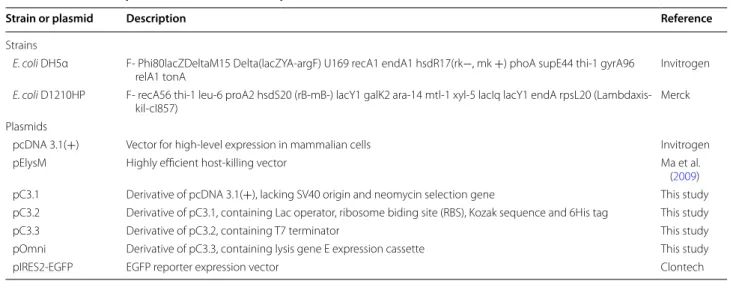
Bacterial strains, plasmids, and cultivation conditions All bacterial strains and plasmids used in this study are listed in Table 1. All E. coli strains were cultured in Luria– Bertani (LB) medium (Sambrook and Russell 2001) or on LB agar plates containing 100 mg/l ampicillin except that for competent cell preparation.
DNA synthesis and manipulation
All mutational primers and regular primers were designed with Primer Premier 5.0, and PAGE-purification grade primers were synthesized by Sangon Biotech Co. Ltd. (Shanghai, China). All PCR products were visualized through agarose-gel electrophoresis if necessary. Plasmid DNA was isolated using the ‘E.N.Z.A Plasmid Mini Kit’ (Omega Bio-Tek, USA). PCR products were gel-purified using the “E.N.Z.A Gel Extraction Kit (Omega Bio-Tek, USA)” when needed. Transformation of Escherichia coli
in all cloning experiment was conducted according to the
Table 1 Strains and plasmids used in this study
Strain or plasmid Description Reference
Strains
E. coli DH5α F- Phi80lacZDeltaM15 Delta(lacZYA-argF) U169 recA1 endA1 hsdR17(rk−, mk +) phoA supE44 thi-1 gyrA96
relA1 tonA Invitrogen
E. coli D1210HP F- recA56 thi-1 leu-6 proA2 hsdS20 (rB-mB-) lacY1 galK2 ara-14 mtl-1 xyl-5 lacIq lacY1 endA rpsL20
(Lambdaxis-kil-cI857) Merck
Plasmids
pcDNA 3.1(+) Vector for high-level expression in mammalian cells Invitrogen
pElysM Highly efficient host-killing vector Ma et al.
(2009)
pC3.1 Derivative of pcDNA 3.1(+), lacking SV40 origin and neomycin selection gene This study
pC3.2 Derivative of pC3.1, containing Lac operator, ribosome biding site (RBS), Kozak sequence and 6His tag This study
pC3.3 Derivative of pC3.2, containing T7 terminator This study
pOmni Derivative of pC3.3, containing lysis gene E expression cassette This study
standard chemical transformation protocol (Sambrook and Russell 2001).
Vector design and construction
pOmni was designed and constructed based on com-monly used eukaryotic expression vector pcDNA 3.1(+) through a series of PCR-mediated mutation.
Intermediate vector pC3.1 was firstly constructed through mutation of pcDNA 3.1(+) with primer set 5′CTCGGTCGTTCGGCTGCG3′ and 5′GGCGCGTGG GGATACCC3′, by which the SV40 origin and neomycin selection gene region was deleted. MutanBest Kit (Takara Bio, Dalian, China) was used for PCR-mediated mutation according to manufacturer’s manual. In brief, the PCR products amplified with above primer set and pcDNA 3.1(+) as template were gel purified, phosphorylated, self-ligated, and transformed into DH5α.
Intermediate vector pC3.2 was constructed based on pC3.1 by means of the same mutation protocol men-tioned above with primer set 5′GCTAGCGGAATG TAGCGGATAACAATTCCCCTCTAGAAATAATTTT
GTTTAACTTTAAGAAGGAGATATACCATG GGC
AGC AGC CAC CAT CAT CAC CAC CAC GTTTAAA
CTTA AGCTTGGTACCGAGC3′ and 5′ CAGCTTG
GGTCTCCCTATAGTGAGT3′, by which the Lac opera-tor (shaded sequence), a ribosome biding site (RBS, italic sequence), a Kozak sequence (framed sequence) (Kozak
1987) and a 6His tag (bold sequence) were introduced between T7 promoter and BGH Poly(A) site.
Intermediate vector pC3.3 was constructed based on pC3.2 by means of the same mutation protocol men-tioned above with primer set 5′CTAGCATAACCCCTT GGGGCCTCTAAACGGGTCTTGAGGGGTTTTTTG
TTCGAAGGCGGTAATACGGTTATCCACAG 3′ and
5′ AGCCATAGAGCCCACCGCA 3′, by which T7 termi-nator (underlined sequence) for prokaryotic expression was introduced into a site downstream BGH Poly(A) site.
The destination vector pOmni was constructed based on pC3.3 by means of reported PCRRC strategy (Ent and Löwe 2006; Bryksin and Matsumura 2010) with lit-tle modification. Lysis gene E expression cassette without cI857 supressor gene was amplified with Q5 high-fidel-ity DNA Polymerase (New England Biolabs, USA) from the host-killing vector pElysM (Ma et al. 2009) with
primer set 5′GGGCAGCAGCCACCATCATCACCAC
CACACCTACCAAACAATGCCCC3′ and 5′GCAACT
AGAAGGCACAGTCGAGGCACAGAAGCTTGGCT GCAGTAC3′. The 5′ termini of the forward and reverse primer contain an extra 22nt sequence (underlined sequence) respectively homologous to 6His tag region and BGH reverse sequencing primer biding region in pC3.3. A 20 μl recombination PCR (95 °C 30 s, 60 °C 45 s, 72 °C 3 min, 20 cycles) was conducted using 250 ng gel
purified PCR products of lysis gene E expression cassette as primer and 5 ng pC3.3 as template. 5 μl recombina-tion PCR product was directly used to transform E. coli
D1210HP that provides temperature-dependent tran-sregulation of the expression of lysis gene E. All transfor-mants were cultured on Amp-LB plate overnight at 28 °C. 10 colonies were randomly picked and cultured in 5 ml Amp-LB at 28 °C for 1 h and then half of the cultures was aliquoted into a new sterilized tube and cultured at 42 °C overnight. The clone that grew at 28 °C but not at 42 °C is the positive clone harboring pOmni (Genbank Accession number: KY608793).
Establishment of selection‑free PCRRC strategy with pOmni
DNA fragments with length of 315, 1041, 2504, 3486 and 4557 bp were amplified from irrelevant DNA templates with Q5 high-fidelity DNA polymerase according to regular PCR procedure, respectively. All forward prim-ers and revprim-erse primprim-ers contain 5′CAGCCACCATCA
TCACCACCAC3′ and 5′TGCACGTAATTTTTGACGC
ACG3′ at the 5′ termini respectively, which are homolo-gous to correspondent sequences flanking the lysis gene E expression cassette in pOmni (Fig. 2).
Individual PCR product was cloned into pOmni through a 20 μl recombination PCR using Q5 high-fidelity DNA polymerase, which contained 5 ng pOmni as template and 100–200 folds (molar ratio) gel-purified PCR product as primer. All recombina-tion PCRs were conducted with the same thermal cycling parameter (95 °C 30 s, 60 °C 45 s, 72 °C 3 min). 5 μl products of recombination PCR was directly used to transform DH5α competent cells, and all trans-formation product was cultured on Amp-LB plate at 37 °C overnight. The quantity of clones of individual cloning was count, and then 10 clones from individual cloning were randomly picked and regular colony PCR with correspondent primer set was conducted to con-firm positive clones.
Cloning and expression of EGFP
Complete coding sequence of EGFP gene was amplified from pIRES2-EGFP (Clontech, USA) and cloned into pOmni according to the same selection-free PCRRC pro-tocol with primer set 5′CAGCCACCATCATCACCA
CCACATGGCCA CAACCATGGTGAG3′ and 5′TGCA
A randomly picked pOmni-EGFP clone was cultured in 5 ml Amp-LB overnight, and the recombinant vector was extracted. 500 ng pOmni-EGFP was used to transfect HeLa cells with TransFectin (Bio-Rad, USA) according to the manufacturer’s instruction. The expression of EGFP in transfected HeLa cells was checked and photographed by confocal laser scanning microscope (Zeiss LSM 780).
Results
Vector design and construction
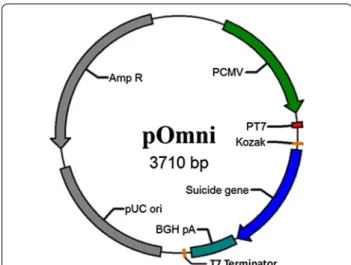
The designed vector pOmni (Fig. 1) was constructed on the basis of pcDNA 3.1(+) through four times of PCR-mediated mutation, in which one is deletion and three are insertions. Through two times of insertion muta-tion, the Lac operator and ribosome biding site (RBS) was introduced downstream T7 promoter originally used for sequencing in pcDNA 3.1, and T7 terminator was
introduced downstream BGH Poly(A) site so as to real-ize the controlled expression of cloned gene in E. coli. A Kozak sequence ‘ACCATGG’ was introduced at the position 5 bp downstream RBS, which makes the start-ing codon in the Kozak sequence can be shared in both eukaryotic and prokaryotic expression. A 6His tag was also introduced adjacent to the Kozak sequence, and as a result, the cloned target gene can be expressed as a 6His tag fusion protein (Fig. 2).
In order to realize a selection-free PCRRC function in the designed vector, the expression cassette of lysis gene E of bacteriophage Phi-X174 as suicide gene was intro-duced into pOmni between the 6His tag region and BGH Poly(A) site (Fig. 2). As a result, PCR products containing two primer-introduced terminal sequences (5′CAGCCA
CCATCATCACCACCAC3′ and 5′TGCACGTAATTTT
TGACGCACG3′) that are homologous to the region flanking lysis gene E expression cassette can be inserted into pOmni and substitute lysis gene E expression cas-sette by means of PCRRC strategy, and the transformants of recombinant vector can be selected automatically.
Selection‑free PCRRC strategy with pOmni
In order to validate the reliability, capability and efficiency of selection-free PCRRC strategy based on pOmni, five amplified DNA fragments varying in length from 315 to 4557 bp were cloned by means of selection-free PCRRC strategy. The results showed that all the 5 PCR products were successfully cloned, which proved the reliability and capability of pOmni-based PCRRC strategy. Colony PCR of 10 randomly picked clones of each cloning test showed 100% positive clone rate, which confirmed the efficiency of selection-free function of pOmni. The cloning effi-ciency (number of clones formed per transformation) of selection-free PCRRC with pOmni was negatively corre-lated to the length of cloned fragments (Table 2), which is in agreement with the result in another PCRRC reported (Bryksin and Matsumura 2010).
Fig. 1 Physical map of pOmni. Suicide gene (expression cassette of lysis gene E of bacteriophage Phi-X174) is to be replaced by cloned gene in PCRRC strategy so as to serve as positive selection gene for recombinant vector
Pro/eukaryotic dual‑expression capability of pOmni
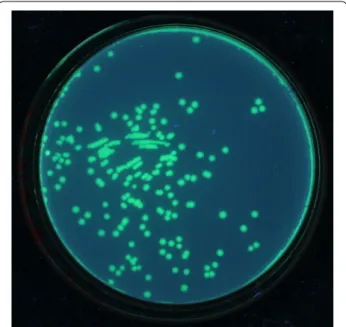
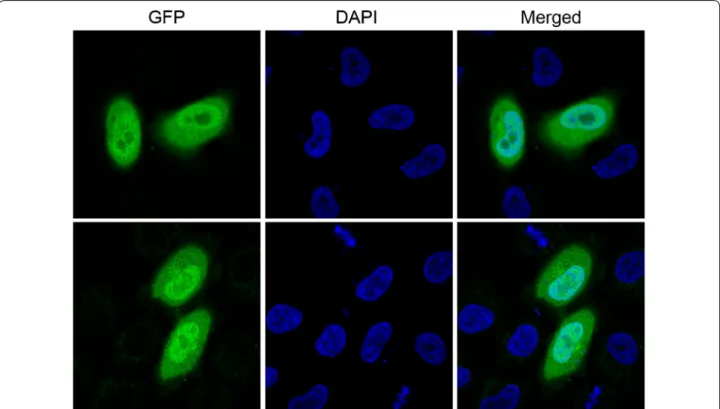
In order to verify the dual-expression capability of pOmni, EGFP gene was cloned into pOmni by means of selection-free PCRRC strategy. The result showed that about 150 clones grew after transformation of BL21 with 5 μl untreated recombination PCR products. All trans-formant clones showed strong green florescence under long-wave ultraviolet light (Fig. 3), which indicates that a target gene cloned with pOmni via PCRRC strategy can be correctly and high-efficiently expressed in E. coli. The 100% positive clone rate (150/150) in EGFP cloning experiment reconfirmed the selection-free function of pOmni-based PCRRC strategy. Clear green fluorescence all over the cytoplasm of HeLa cells transfected with pOmni-EGFP was showed by confocal laser scanning microscopy (Fig. 4). It indicates that a target gene cloned in pOmni via PCRRC strategy can also be high-efficiently expressed in eukaryotic cells.
Discussion
The reported PCRRC (Ent and Löwe 2006; Bryksin and Matsumura 2010) has been the most simple and efficient strategy of all ligase-independent PCR cloning strategies because the other strategies either involve complicated PCR procedures (Shuldiner et al. 1990; Tillett and Neilan
1999; Zuo and Rabie 2009) or need other DNA modify-ing enzymes (Aslanidis and Dejong 1990; Rashtchian et al. 1992; Li and Evans 1997; Weeks et al. 2007). How-ever, they are not truly restriction enzyme independent because DpnI digestion as positive selection for recom-binant vector is indispensible in the reported PCRRC strategy. This is because the transformation efficiency of the supercoiled vector as template in recombination PCR is more efficient than the nicked recombinant plasmid formed in recombination PCR, which means unaccep-table background (false positive) clones would take place without DpnI digestion.
The important innovation of the designed vector is the utilization of the lysis gene E of bacteriophage Phi-X174 as positive-selection gene in pOmni (Fig. 2), which makes DpnI digestion step longer necessary in reported PCRRC and results in decreasing the time and money cost of cloning. To the author’s knowledge, no suicide gene-dependent positive selection mechanism has been used in reported ligase-independent PCR cloning strate-gies. The expression product of lysis gene E is lethal to
E. coli (Henrich et al. 1982; Witte et al. 1990, 1992) and some other Gram-negative bacteria (Ronchel et al. 1998; Katinger et al. 1999; Marchart et al. 2003; Wei et al. 2011) through tunnel formation on cell membrane (Witte et al.
1990, 1992). Lysis gene E is an ideal positive-selection gene for cloning vector because the lethal efficiency of lysis gene E expression product to commonly-used E. coli cloning strains is as high as 99.999% (Ma et al. 2009). Another technical advancement in pOmni compared with the reported lysis gene E-dependent cloning vector (Ma et al. 2009) is the exclusion of suppressor gene cI857 from the lysis gene E expression cassette, which makes culturing of transformants at 42 °C as positive selection measure unnecessary.
These elaborate designs make pOmni a selection-free PCRRC vector having following advantages. (1) The selection-free PCRRC strategy with pOmni is the sim-plest and fastest one of all reported ligase-independent PCR cloning strategies, by which a target gene can be cloned in one work day with only one pair of primer and two times of PCR by starting with the amplification of the target gene, without using any tool enzymes except high-fidelity DNA polymerase. (2) The selection-free PCRRC strategy with pOmni is highly efficient and reli-able. 6 DNA fragments with length from 315 to 4557 bp were successfully cloned in the validation experiments,
Table 2 Cloning capability and efficiency of selection-free PCRRC with pOmni
Length of cloned
fragments (bp) Number of clones Positive clone rate (positive/negative)
315 473 10/0
1041 312 10/0
2504 138 10/0
3486 74 10/0
4557 36 10/0
and the 100% positive clone rate of 10 randomly-picked clones in each cloning experiment was verified by means of colony PCR. (3) The selection-free PCRRC strategy with pOmni is of special value for cloning of large PCR fragments. To our knowledge, cloning of PCR fragments larger than 2500 bp with conventional T-A cloning strat-egy is usually difficult, but all 3 large DNA fragments (2504, 3486 and 4557 bp) were easily cloned in our vali-dation experiments.
Other two technical details of the design consummate pOmni as a PCRRC vector. First, the 6His tag sequence in the 22 bp upstream homologous recombination region (5′CAGCCACCATCATCACCACCAC3′, 6His tag under-lined) was redesigned (compared with 6His tag sequence in the famous pET serial vectors) to ensure the efficiency of recombination PCR. As a result, all validation experi-ments cloning DNA fragexperi-ments with different length suc-ceeded without any optimization of the recombination PCR parameters. Second, the deletion of episomal SV40 origin and neomycin selection gene region of pcDNA 3.1 diminished the size of the designed vector by more than 2 kb, which would greatly increase the capability of the designed vector to clone large PCR products.
Pro/eukaryotic dual-expression vector is of special application value for researches in which both prokary-otic and eukaryprokary-otic expression of a target gene are necessary. In DNA vaccine researches, for example,
prokaryotic expression of the candidate gene is usually necessary to prepare antiserum for verification of the antigenicity of the candidate gene or to prepare antigen for monitoring the efficiency of the DNA vaccine (eukar-yotic expression vector of the target gene). The introduc-tion of prokaryotic expression elements and the precise design of the compatible RBS and Kozak sequence endow pOmni with pro/eukaryotic dual-expression capabil-ity, which was validated by cloning and expression of reporter gene EGFP in E. coli and HeLa cells in this study. pOmni has two technical advantages compared with the only pro/eukaryotic dual-expression vector pDual GC (Agilent, USA) that we know. (1) pOmni is much smaller in size (3.7 vs. 6.6 kb) that means higher cloning capabil-ity for large DNA fragments. (2) pOmni has selection-free PCRRC function as discussed above, but with pDual GC, a target gene has to be cloned by means of traditional and troublesome restriction-mediated cloning method.
Abbreviations
PCRRC: PCR recombination cloning; PCR: polymerase chain reaction; CMV: cytomegalovirus.
Authors’ contributions
designed the selection-free PCR recombination cloning strategy and the vector pOmn, revised the manuscript and gave final approval of the version to be published. All authors read and approved the final manuscript.
Acknowledgements
This study was financially supported by Natural Science Foundation of Chong-qing, China (cstc2013jjB0156), which is gratefully acknowledged. We thank Shujuan Yu for technical assistance in confocal laser scanning microscopy.
Competing interests
The authors declare that they have no competing interests.
Availability of data and materials
The dataset supporting the conclusions of this article is available in the Gen-Bank repository (Accession Number: KY608793).
Funding
Natural Science Foundation of Chongqing, China (cstc2013jjB0156).
Publisher’s Note
Springer Nature remains neutral with regard to jurisdictional claims in pub-lished maps and institutional affiliations.
Received: 18 February 2017 Accepted: 9 April 2017
References
Aslanidis C, Dejong PJ (1990) Ligation-independent cloning of PCR products (Lic-PCR). Nucleic Acids Res 18:6069–6074
Bryksin A, Matsumura I (2010) Overlap extension PCR cloning: a simple and reliable way to create recombinant plasmids. Biotechniques 48:463–465 Cheo DL, Titus SA, Byrd DR, Hartley JL, Temple GF, Brasch MA (2004) Concerted
assembly and cloning of multiple DNA segments using in vitro site-specific recombination: functional analysis of multi-segment expression clones. Genome Res 14:2111–2120
Ent FVD, Löwe J (2006) RF cloning: a restriction-free method for inserting target genes into plasmids. J Biochem Biophys Methods 67(1):67–74 Henrich B, Lubitz W, Plapp R (1982) Lysis of Escherichia coli by induction of
cloned ΦX174 genes. Mol Gen Genet 185(3):493–497
Katinger A, Lubitz W, Szostak MP, Stadler M, Klein R, Indra A, Huter V, Hensel A (1999) Pigs aerogenously immunized with genetically inactivated (ghosts) or irradiated Actinobacillus pleuropneumoniae are protected against a homologous aerosol challenge despite differing in pulmonary cellular and antibody responses. J Biotechnol 73:251–260
Kozak M (1987) An analysis of 5′-noncoding sequences from 699 vertebrate messenger RNAs. Nucleic Acids Res 20:8125–8148
Li C, Evans RM (1997) Ligation independent cloning irrespective of restriction site compatibility. Nucleic Acids Res 25:4165–4166
Ma Y, Li AX, Wang YC, Xie MQ, Li J, Zhang S, Wang QJ (2009) Construction and experimental application of a highly efficient temperature-selection T-vector. Biotech Appl Biochem 53(4):247–251
Marchart J, Dropmann G, Lechleitner S, Schlapp T, Wanner G, Szostak MP, Lubitz W (2003) Pasteurella multocida- and Pasteurella haemolytica -ghosts: new vaccine candidates. Vaccine 21(25–26):3988–3997 Marchuk D, Drumm M, Saulino A, Collins FS (1991) Construction of T-vectors, a
rapid and general system for direct cloning of unmodified PCR products. Nucleic Acids Res 19:1154
Rashtchian A, Thornton CG, Heidecker G (1992) A novel method for site-directed mutagenesis using PCR and uracil DNA glycosylase. PCR Methods Appl 2:124–130
Ronchel MC, Molina L, Lubitz W, Molin S, Ramos JL, Ramo C (1998) Characteri-zation of cell lysis in Pseudomonas putida induced upon expression of heterologous killing genes. Appl Environ Microbiol 64:4904–4911 Sambrook J, Russell DW (2001) Molecular cloning: a laboratory manual, 3rd
edn. Cold Spring Harbor Laboratory Press, New York
Shuldiner AR, Scott LA, Roth J (1990) PCR-induced (ligase-free) subcloning: a rapid reliable method to subclone polymerase chain reaction (PCR) products. Nucleic Acids Res 18:1920
Tillett D, Neilan BA (1999) Enzyme-free cloning: a rapid method to clone PCR products independent of vector restriction enzyme sites. Nucleic Acids Res 27(19):e26
Walhout AJ, Temple GF, Brasch MA, Hartley JL, Lorson MA, Heuvel SVD, Vidal M (2000) GATEWAY recombinational cloning: application to the cloning of large numbers of open reading frames or ORFeomes. Methods Enzymol 328:575–592
Weeks SD, Drinker M, Loll PJ (2007) Ligation independent cloning vectors for expression of SUMO fusions. Protein Expr Purif 53:40–50
Wei M, Guan LY, Wang QY, Liu Q, Zhang YX (2011) Establishment of Edwards-iella tarda ghosts. System J Microb 31(3):1–5
Witte A, Wanner G, Bl¨asi U, Halfmann G, Szostak MP, Lubitz W (1990) Endog-enous transmembrane tunnel formation mediated by Phi-Xl74 lysis protein E. J Bacteriol 172:4109–4114
Witte A, Wanner G, Sulzner M, Sulzner M, Lubitz W (1992) Dynamics of Phi-X174 protein E-mediated lysis of Escherichia coli. Arch Microbiol 157:381–388