J
ournal of
F
isheries
S
ciences.com
E-ISSN 1307-234X© 2013
www.fisheriessciences.com
SHORT COMMUNICATION KISA BİLGİLENDİRME
EFFECTS OF STRING DIAMETER PREFERENCE OF
Sepia officinalis DURING (L. 1758) SPAWNING IN
CAPTIVITY
Halil Şen
∗Ege University Fisheries Faculty Aquaculture Department, Urla, İzmir, Turkey
Abstract:
The aim of this study was to determine the importance of string diameter preference on spawn-ing performance of Sepia officinalis. For this purpose, seven strspawn-ings, 3.0, 4.0, 6.0, 8.0, 10.0, 12.0, and 14.0 mm in diameter were chosen in one meter length. After that two batches of strings for spawning of the cuttlefish were hanged on the two experimental tanks. Eggs were counted daily to determine which string aor stringss were preferred by the cuttlefish. The mean mantle length and body weight of the individuals used in the experiment were 12.97±1.46 cm and 231.5±48.9 g (n= 22), respectively. The string diameter preference in the cuttlefish were 6-8>10-12>3-4 mm with regards to egg numbers (χ2; P<0.01). Finally, the present results showed that the 6 and/or 8 mm strings in diameter can be selected for spawning of cuttlefish in terms of aquacultural or biological studies.
Keywords: Captivity, Reproduction, Sepia officinalis, Spawning, String diameter Özet:
Kontrol Altında Sepia officinalis (L. 1758)’in
Yumur-talamasında İp Çapı Tercihi
Bu çalışmanın amacı, Sepia officinalis’in yumurtalama verimi üzerine ip çapı tercihinin önemi olup olmadığını saptamaktır. Bu amaçla, 1 metre uzunluğunda ve 3.0, 4.0, 6.0, 8.0, 10.0, 12.0, ve 14.0 mm çaplarında yedi ip seçildi. Daha sonra ipler iki grup olarak sübyelerin yu-murtlaması için deney tanklarına asıldı. Sübyeler tarafından kaç tane yumurta yumurtladığını ve hangi ip çapını veya çaplarını tercih ettiklerini tespit etmek için günlük kontroller yapıldı. Denemede ortalama manto boyları ve ağırlıkları sırasıyla, 12.97±1.46 cm ve 231.5±48.9 g (n= 22) olan bireyler kullanıldı. Sübyelerde ip çapı tercihi yumurta miktarı (χ2; P<0.01) dikkate alındığında 6-8>10-12>3-4 mm oldu. Sonuç olarak, şimdiki sonuçlar akuakültür ve biyolojik çalışmalarda sübyenin yumurtlaması için 6 ve/veya 8 mm çapında iplerin seçilebileceğini göstermiştir.
Anahtar Kelimeler: Tutsaklık, İp çapı, Üreme, Sepia officinalis, Yumurtlama
∗ Correspondence to: Halil ŞEN, Ege University Fisheries Faculty Aquaculture Department, 35440, Urla,
İzmir-TURKEY
Tel.: (+90 232) 752 11 62
E-mail: [email protected]
Introduction
Sepia officinalis is one of the most easily
cul-tured cephalopods (Richard 1971; Pascual 1978; Boletzky and Hanlon 1983; Forsythe et al. 1994; Lee et al. 1998; Domingues et al. 2001a,b, 2002, 2003a), and is a commercially important species throughout the world (Roper et al. 1984). It is highly adaptable to life in captive conditions (Forsythe et al. 1994; Domingues et al. 2001a,b, 2002, 2003a,b, 2005, 2006; Skyes et al. 2006; Şen 2009). Its life cycle in the laboratory varies from less than 6 months to 17 months with tem-perature, feeding regime and culture density (Richard 1971; Forsythe et al. 1994; Domingues et al. 2006). In the wild, cuttlefish live for 2 years on average, and the spawning period varies con-siderably with temperature (Guerra 2006), with females usually being much larger and older when they start spawning compared to laborato-ry-cultured cuttlefish.
Moreover, it’s known that cuttlefish lay their eggs on various things especially floating things such as wood or branches of some macroalga and corals, fish net and/or other manmade objects (Choue, 1966; ; Arnold et al., 1972; Okutani, 1978; Boletzky and Boletzky, 1973; Şen, 2009). Nevertheless, there is only one information can be found from the Boletzky’s (1983) study in the literature. So far, the data related to appropriate diameter of strings or other materials for laying eggs of S. officinalis hasn’t been indicated in terms of rearing or culture studies. Therefore, preference to string diameter may be important while spawning of the cuttlefish in captivity. The aim of this study was to determine the im-portance of string diameter preference on spawn-ing performance of S. officinalis.
Materials and Methods
The experimental animals were captured off the Izmir Bay by trammel nets on April 3, 2012. Totally 22 S. officinalis (11 males and 11 fe-males) were selected and placed in an open flow-through filtered sea water system with two cylin-drical polyester tanks (450 L volume) in indoor facilities of the Fisheries Faculty of Ege
Univer-low market price fish species (i.e. Sardine
pil-chardus, Engrualis encrasicolus) by hand. The
following day, uneaten part or remains were re-moved by siphoning. The mean mantle length and body weight of the individuals using the ex-periment were 12.97±1.46 cm and 231.5±48.9 g (n= 22), respectively.
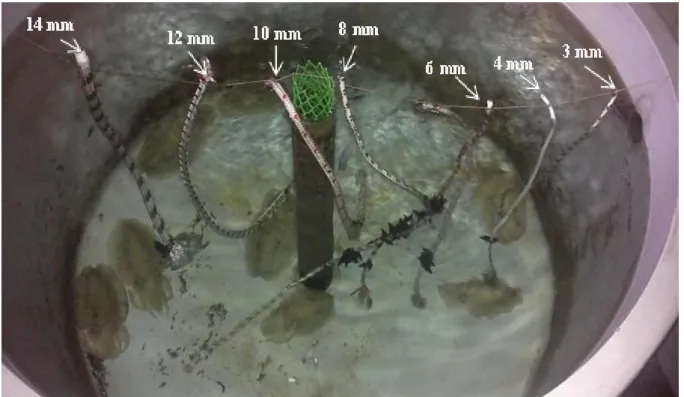
The seven strings, 3.0, 4.0, 6.0, 8.0, 10.0, 12.0, and 14.0 mm in diameter were chosen in one meter length. After that two batches of strings for spawning of the cuttlefish were hanged on the experimental tanks (Figure 1.). Daily control was carried out for how many eggs were laid on the strings and which string diame-ter or diamediame-ters were preferred for spawning by the cuttlefish.
The obtaining data were given as mean ± SD values in the text. The differences among means of the spawned egg numbers and the spawning numbers on chose string diameters were tested using chi-square test to determine any signifi-cance (P<0.01).
Results and Discussion
The salinity, pH, O2 saturation and temperature in
tanks were measured as 37±0.2‰, 8.1±0.1, 65±5%, and 16.5±1°C, respectively. The experi-ment lasted 14 days. During this period the cut-tlefish mated multiple times in the tanks. Addi-tionally, it’s observed that after each mating the males generally allowed females to feed first. Al-so, agonistic behaviour occurred frequently in the tanks. Furthermore, total 53 spawning occurred and total 1519 eggs were laid on the strings. There were significant differences among string diameters (P<0.01) based on the egg numbers. On the other hand, there wasn’t any significance between string diameters according to the spawn-ing numbers (P>0.01). The strspawn-ing diameter pref-erence in the cuttlefish were 6-8>10-12>3-4 mm in diameters with regards to egg numbers (P<0.01) (Table 1.). However, the 14 mm in string diameter was excluded from the statistical analysis because it was hardly chosen.
sults indicated that the cuttlefish prominently pre-ferred the 6 and 8 mm in string diameters (P<0.01). The 14 mm in string diameter was cho-sen hardly ever. Therefore using this diameter is inadvisable according to the present study. Also, Boletzky (1983) said that S. officinalis lays its eggs on the oblong object, not more than 1 cm in diameter. The current results generally in agree-ment with that of the Boletzky (1983)’s findings.
Conclusions
Finally, the present results showed that the 6 and/or 8 mm in diameter of strings can be select-ed for spawning of cuttlefish in terms of aquacul-ture or biological studies. Unfortunately, the ac-tual evidences couldn’t be compared with any studies related to this subject. However, more de-tailed behavioural and/or physiological studies on why cuttlefish prefer the definite diameter for spawning is needed.
Figure 1. A general view of laying eggs on the strings and the cuttlefish from the one of the experimental tank.
Table 1. The total numbers of chosen string diameters and eggs. Diameter
(mm) 3 4 6 8 10 12 14*
Total egg
numbers 120
a 111a 360b 358b 292c 236c 42*
Total spawning
number
References
Arnold, J.M., Singley, C.T., Williams-Arnold, L.D., (1972). Embriyonic development and post hatchling survival of the Sepiolid squid
Euprymna scolopes under laboratory
condi-tions, The Veliger, 14: 361-364.
Boletzky, S.V., (1983). Sepia officinalis. Boyle P.R. (ed) Cephalopod life cycles. Vol.1. Ac-ademic Press, London, pp.31-51.
Boletzky, S.V., Boletzky, M.V., (1973). Observa-tion embriyonic and early postembryonic development of Rossia macrosoma (Mollus-ca: Cephalopoda), Helgolender wiss Meer-esunters, 25: 135-161.
Boletzky S.v., Hanlon R.T. (1983) A Review of the Laboratory Maintenance, Rearing and Culture of Cephalopod Molluscs, Memoirs
of the National Museum Victoria, 44: 147–
187.
Choe, S., (1966). On the eggs, rearing, habits of the fry and growth of some Cephalopoda,
Bulletin of Marine Science, 16: 330-348.
Domingues P., Kingston T., Sykes A., Andrade J., (2001a). Growth of young cuttlefish,
Se-pia officinalis (Linnaeus, 1758) at the upper
end of the biological distribution tempera-ture range, Aquaculture Research, 32: 923-930.
doi:10.1046/j.1365-2109.2001.00631.x
Domingues P., Sykes A., Andrade J., (2001b). The use of Artemia or mysids as food for hatchlings of the cuttlefish Sepia officinalis
Linnaeus, 1758; effects on growth and sur-vival throughout the life cycle, Aquaculture International, 9: 319-331.
doi:10.1023/A:1020416811568
Domingues P., Sykes A., Andrade J., (2002). The effects of temperature in the life cycle of two consecutive generations of the cuttlefish
Sepia officinalis (Linnaeus, 1758), cultured
in the Algarve (South Portugal), Aquacul-ture International, 10: 207-220.
doi:10.1023/A:1024803802486
Domingues P., Sykes A., Sommerfield A., Al-mansa E., Lorenzo A., Andrade J. (2003b). Effects on feeding live or frozen prey on growth, survival and the life cycle of the cut-tlefish Sepia officinalis (Linnaeus, 1758),
Aquaculture International, 11: 397-410.
doi:10.1023/B:AQUI.0000004195.92236.3a
Domingues P., DiMarco F., Andrade J., Lee P. (2005). The effects of diets with amino acid supplementation on the survival, growth and body composition of the cuttlefish Sepia of-ficinalis, Aquaculture International, 13(5): 423-440.
doi: 10.1007/s10499-005-6978-9
Domingues P.M., Bettencourt V., Guerra A. (2006) Growth of Sepia officinalis in captiv-ity and in nature, Vie et Milieu, 56: 109–120. Forsythe J., DeRusha R., Hanlon R., (1994)
Growth, reproduction and life span of Sepia
officinalis (Cephalopoda: Mollusca) cultured
through seven consecutive generations,
Journal of Zoolology London,233: 175-192.
doi:10.1111/j.1469-7998.1994.tb08582.x
Guerra A., (2006). Ecology of Sepia officinalis,
Vie et Milieu, 56: 97-107.
Hanlon, R.T., Messenger, J.B., (1996). Cephalo-pod behaviour. Cambridge University Press; 230 pp.
Lee P., Turk P., Forsythe J., DiMarco F., (1998). Cephalopod culture: physiological, behav-ioural and environmental requirements.
Suisanzoshoku, 46(3): 417-422.
Okutani, T., (1978). Studies on early life history of decaodan Mollusca. VII Eggs and newly hatched larvae of Sepia latimanus Quoi ans
Gaimard, Venus (Japanese Journal of
Malacalogy), 37: 245-248.
Sykes A., Domingues P.M., Correia M., Andrade J.P., (2006). Cuttlefish culture – State of the art and future trends, Vie et Milieu, 56: 129-137.
Şen H., (2009). Kontrollü Koşullarda Sübye (Se-pia officinalis L.)’ nin Yumurtlaması, Yu-murtaların Gelişimi ve İnkübasyonu,
Jour-nal of FisheriesSciences.com,3(3): 169-180.