This specification describes the situation of the Proximus network and services. It will be subject to modifications for corrections or when the network or the services will be modified. Please take into account that modifications can appear at any moment. Therefore, the reader is requested to check regularly with the most recent list of available specifications that the document in one's possession is the latest version.
Proximus can't be held responsible for any damages due to the use of an outdated version of this specification.
Whilst every care has been taken in the preparation and publication of this document, errors in content, typographical or otherwise, may occur. If you have remarks concerning its accuracy, please send a mail to the following address [email protected] and your remark will be transmitted to the right Proximus department.
IMS Corporate VoIP: General Version: 1.3 of April 22, 2014 Page A
SPECIFICATION USER NETWORK INTERFACE (PROTOCOL)
IMS CORPORATE VoIP
General
IMS Corporate VoIP: General Version: 1.3 of April 22, 2014 Page a
TABLE OF CONTENTS
0.
DOCUMENT HISTORY ... 3
1.
SCOPE ... 4
2.
REFERENCES ... 5
2.1. Normative references ... 5
2.2. Informative references ... 5
3.
SYMBOLS, DEFINITIONS AND ABBREVIATIONS ... 7
3.1. Symbols ... 7
3.2. Definitions ... 7
3.3. Abbreviations ... 7
4.
GENERAL ... 9
4.1. Structure of the document ... 9
4.2. Corporate VoIP products ... 9
4.2.1.Business Trunking ... 9
4.2.2.I-Office multi ... 10
4.3. Reference point ... 10
4.3.1.Business Trunking ... 10
4.3.2.I-Office multi ... 10
5.
IP-P(A)BX types and operational modes ... 12
5.1. IP-P(A)BX types ... 12
5.2. Operational modes ... 12
6.
IP CONNECTIVITY ... 13
6.1. Introduction ... 13
6.2. Access network types ... 13
6.2.1.Explore VPN ... 13
6.2.2.Internet Access ... 14
6.3. User network topology ... 16
6.3.1.General ... 16
6.3.2.Single IP-P(A)BX ... 16
6.3.3.Multiple IP-P(A)BXs ... 16
IMS Corporate VoIP: General Version: 1.3 of April 22, 2014 Page b
SPECIFICATION USER NETWORK INTERFACE (PROTOCOL)
8.
QUALITY OF SERVICE AND CALL ADMISSION CONTROL ... 19
8.1. Quality of Service (QoS) ... 19
8.2. Call admission Control ... 19
8.2.1.Call limiter on IMS application server ... 19
8.2.2.Call admission control on IP-PABX ... 20
9.
NAMING, NUMBERING AND ADDRESSING ... 21
9.1. Naming ... 21
9.1.1.General ... 21
9.1.2.Business Trunking ... 21
9.1.3.I-Office multi ... 21
9.2. Numbering ... 21
9.2.1.General ... 21
9.2.2.Business Trunking ... 21
9.2.3.I-Office multi ... 21
9.1. IP addressing ... 21
9.1.1.Explore VPN ... 21
9.1.2.Internet Access ... 21
10.
LOAD BALANCING ... 22
0.
DOCUMENT HISTORY
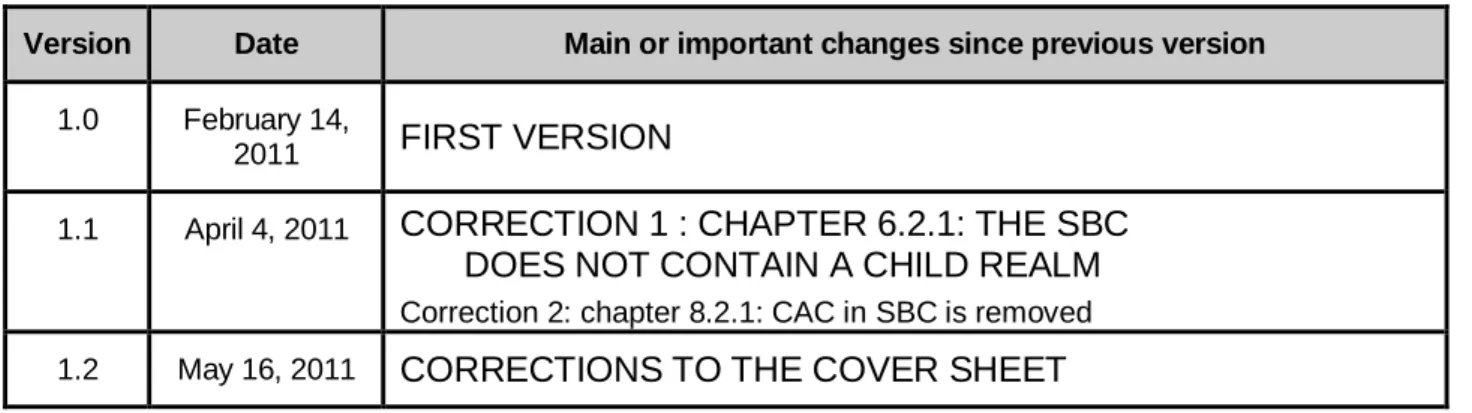
Every update of this document results in a complete new version with new version number and release date.
Version Date Main or important changes since previous version
1.0 February 14,
2011
FIRST VERSION
1.1 April 4, 2011
CORRECTION 1 : CHAPTER 6.2.1: THE SBC
DOES NOT CONTAIN A CHILD REALM
Correction 2: chapter 8.2.1: CAC in SBC is removed1.2 May 16, 2011
CORRECTIONS TO THE COVER SHEET
Proximus public limited company of Belgian Public Law, exercising its activities under the commercial name Proximus, located in
Bd. du Roi Albert II 27, B-1030 Brussels, Belgium,VAT BE 0202.239.951, Brussels Register of Legal Entities, Giro BE50 0001 7100 3118 Page 4 of 25
1.
SCOPE
This document defines general aspects of the VoIP interface, of the Proximus IMS network, for IP-P(A)BXs.
This specifications is applicable for the following IMS equipment and software packages: Alcatel-Lucent LSM - software package Release 7.6
AcmePacket SBC - software package 7.0.0
Broadsoft application server – software package Release 16
This document is part of a set of documents describing the UNI interface of the Proximus IMS Network, for IP-P(A)BXs. Other documents in this set are:
BGC IMS Corporate VoIP – UNI specification – SIP signalling – Business Trunking with IMS services [1]
BGC IMS Corporate VoIP – UNI specification – SIP signalling – Wireless Office Extended [2] BGC IMS Corporate VoIP – UNI specification – SIP signalling – iOffice multi [3]
BGC IMS Corporate VoIP – UNI specification – Testing BGC IMS VoIP – UNI specification – Fax over IP [36]
2.
REFERENCES
Whenever a date of edition is mentioned, the document with this date should be consulted. If no date is present, the latest version of this document should be consulted.
2.1.
Normative references
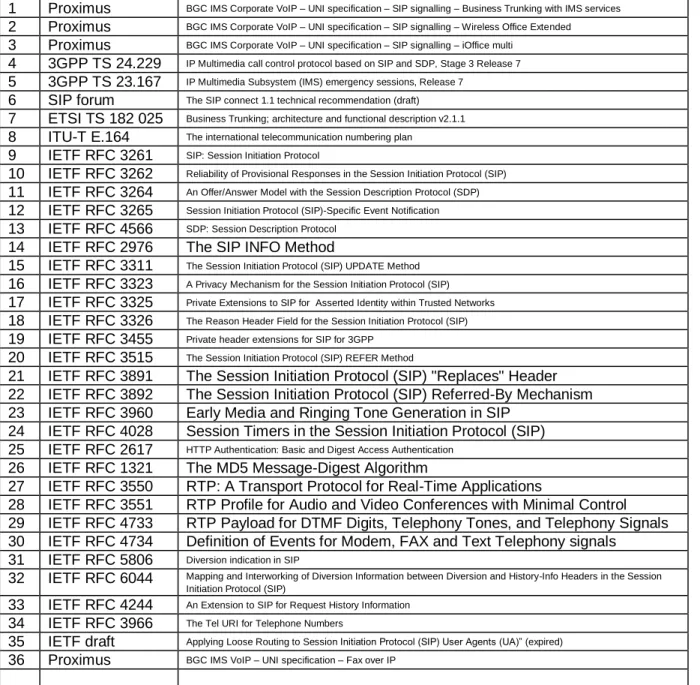
1 Proximus BGC IMS Corporate VoIP – UNI specification – SIP signalling – Business Trunking with IMS services
2 Proximus BGC IMS Corporate VoIP – UNI specification – SIP signalling – Wireless Office Extended
3 Proximus BGC IMS Corporate VoIP – UNI specification – SIP signalling – iOffice multi
4 3GPP TS 24.229 IP Multimedia call control protocol based on SIP and SDP, Stage 3 Release 7
5 3GPP TS 23.167 IP Multimedia Subsystem (IMS) emergency sessions, Release 7
6 SIP forum The SIP connect 1.1 technical recommendation (draft)
7 ETSI TS 182 025 Business Trunking; architecture and functional description v2.1.1
8 ITU-T E.164 The international telecommunication numbering plan
9 IETF RFC 3261 SIP: Session Initiation Protocol
10 IETF RFC 3262 Reliability of Provisional Responses in the Session Initiation Protocol (SIP)
11 IETF RFC 3264 An Offer/Answer Model with the Session Description Protocol (SDP)
12 IETF RFC 3265 Session Initiation Protocol (SIP)-Specific Event Notification
13 IETF RFC 4566 SDP: Session Description Protocol
14 IETF RFC 2976 The SIP INFO Method
15 IETF RFC 3311 The Session Initiation Protocol (SIP) UPDATE Method
16 IETF RFC 3323 A Privacy Mechanism for the Session Initiation Protocol (SIP)
17 IETF RFC 3325 Private Extensions to SIP for Asserted Identity within Trusted Networks
18 IETF RFC 3326 The Reason Header Field for the Session Initiation Protocol (SIP)
19 IETF RFC 3455 Private header extensions for SIP for 3GPP
20 IETF RFC 3515 The Session Initiation Protocol (SIP) REFER Method
21 IETF RFC 3891 The Session Initiation Protocol (SIP) "Replaces" Header
22 IETF RFC 3892 The Session Initiation Protocol (SIP) Referred-By Mechanism
23 IETF RFC 3960 Early Media and Ringing Tone Generation in SIP
24 IETF RFC 4028 Session Timers in the Session Initiation Protocol (SIP)
25 IETF RFC 2617 HTTP Authentication: Basic and Digest Access Authentication
26 IETF RFC 1321 The MD5 Message-Digest Algorithm
27 IETF RFC 3550 RTP: A Transport Protocol for Real-Time Applications
28 IETF RFC 3551 RTP Profile for Audio and Video Conferences with Minimal Control
29 IETF RFC 4733 RTP Payload for DTMF Digits, Telephony Tones, and Telephony Signals
30 IETF RFC 4734 Definition of Events for Modem, FAX and Text Telephony signals
31 IETF RFC 5806 Diversion indication in SIP
32 IETF RFC 6044 Mapping and Interworking of Diversion Information between Diversion and History-Info Headers in the Session Initiation Protocol (SIP)
33 IETF RFC 4244 An Extension to SIP for Request History Information
34 IETF RFC 3966 The Tel URI for Telephone Numbers
35 IETF draft Applying Loose Routing to Session Initiation Protocol (SIP) User Agents (UA)” (expired)
36 Proximus BGC IMS VoIP – UNI specification – Fax over IP
Table 2: normative references
Proximus public limited company of Belgian Public Law, exercising its activities under the commercial name Proximus, located in
Bd. du Roi Albert II 27, B-1030 Brussels, Belgium,VAT BE 0202.239.951, Brussels Register of Legal Entities, Giro BE50 0001 7100 3118 Page 6 of 25
3.
SYMBOLS, DEFINITIONS AND ABBREVIATIONS
3.1.
Symbols
For the purpose of the present document, the following symbols apply: None.
3.2.
Definitions
For the purpose of the present document, the following definitions apply:
IP-P(A)BX: The IP P(A)BX constitutes an Enterprise’s collection of network elements that provides packetized voice call origination and termination services using the Session Initiation Protocol (SIP) and the Session Description Protocol (SDP) for signalling and the Real-time Transport Protocol (RTP) for media traffic.
3.3.
Abbreviations
For the purpose of the present document, the following abbreviations apply: 3GPP ADSL AKA ATM CAC CE Codec BGC BiLAN DHCP
3th Generation Partnership Project Asymetric Digital Subscriber Line Also Known As
Asynchronous Transfer Mode Call Admission Control Customer edge Coder/decoder Proximus
Proximus Interconnect of LANs Dynamic Host Configuration Protocol DDI
Ethane
Direct Dialling In
Ethernet aggregation network ETSI
FR HTTP
European Telecommunications Standards Institute Frame relay
Hyper Text Transfer Protocol IETF IMS IP IP-VPN LAN LSM
Internet Engineering Task Force IP Multimedia Subsystem Internet Protocol
IP Virtual Private Network Local area network Lucent Session Manager
NAT Network Address Translation
NGN NNI
Next Generation Network Network Network Interface P(A)BX
PBX PE QoS
Private (Automatic) Branch Exchange Private Branch Exchange
Provider Edge Quality of Service
RFC Request For Comment
RTP Real Time Transport Protocol
SBC Session Border Controller
SDP SDSL
Session Description Protocol Symmetric Digital Subscriber Line
Proximus public limited company of Belgian Public Law, exercising its activities under the commercial name Proximus, located in
Bd. du Roi Albert II 27, B-1030 Brussels, Belgium,VAT BE 0202.239.951, Brussels Register of Legal Entities, Giro BE50 0001 7100 3118 Page 8 of 25
SIP SRST
Session Initiation Protocol
Survivable Remote Site Telephony
TS Technical Specification
UNI User Network Interface
VC VDSL VLAN
Virtual Circuit
Very high bitrate Digital Subscriber Line Virtual LAN
VoIP VRF WAN xDSL
Voice over IP
Virtual Routing and Forwarding Wide area network
4.
GENERAL
4.1.
Structure of the document
The structure of this document mainly covers the following aspects:
IP-P(A)BX types and operational modes
IP connectivity: in this chapter necessary information for IP-P(A)BX vendors regarding IP connectivity will be present. This includes ao.
o Access network types: a short description of the available access types.
o User network Topology: information about the possible topologies at the user’s network side
o VLAN information
Codec support: this chapter provides information about the supported codecs
Quality of Service (QoS) and Call Admission Control (CAC): this chapter contains information
regarding the CAC and QoS capabilities and mechanisms of the IMS.
Naming, Numbering and addressing: this chapter contains information regarding the naming,
numbering and (IP) addressing conventions and the capabilities and mechanisms needed in the IP-P(A)BX to comply.
Load balancing
Customer SBC
4.2.
Corporate VoIP products
The general aspects covered in this document may differ according to the corporate VoIP product. In such case the concerned aspect will be discussed per product separately.
In IMS Corporate VoIP two products are envisaged:
SIP Business Trunking
SIP i-Office multi
4.2.1.
Business Trunking
Business Trunking is a connection for large IP-P(A)BXs. The IP-P(A)BX can access the IMS network via a so-called Network-to-Network interface aka the NNI mode or Non-registration based mode.
Business Trunking configurations can consist of 1 or more SIP trunks. Reasons to create a multiple SIP trunks may be a multi-zonal numbering plan or a redundant access.
Business Trunking has 2 modes of operation:
Business Trunking with IMS services. This offers advanced services for IP-P(A)BX users using
the Broadsoft application server capabilities.
Business Trunking without IMS services aka Wireless Office. This offers advanced services for
IP-P(A)BX users using the Proximus mobile network capabilities. This does not make use of the Broadsoft application server capabilities but corresponds to a peering or transit routing scenario. The behaviour for SIP Business Trunking with IMS services is the subject of the document “BGC IMS Corporate VoIP – NNI specification – SIP signalling – Business Trunking with IMS services”.
The behaviour for SIP Business Trunking without IMS services is the subject of the document “BGC IMS Corporate VoIP – NNI specification – SIP signalling – Business Trunking without IMS services”.
Proximus public limited company of Belgian Public Law, exercising its activities under the commercial name Proximus, located in
Bd. du Roi Albert II 27, B-1030 Brussels, Belgium,VAT BE 0202.239.951, Brussels Register of Legal Entities, Giro BE50 0001 7100 3118 Page 10 of 25
4.2.2.
I-Office multi
i-Office multi is a connection for smaller IP-P(A)BXs. The IP-P(A)BX can access the IMS network via a User-to-Network interface aka the UNI mode or Registration based mode.
i-Office multi configurations consist of 1 SIP trunks.
The behaviour for SIP i-Office multi is the subject of the document “BGC IMS Corporate VoIP – UNI specification – SIP signalling – iOffice multi”.
4.3.
Reference point
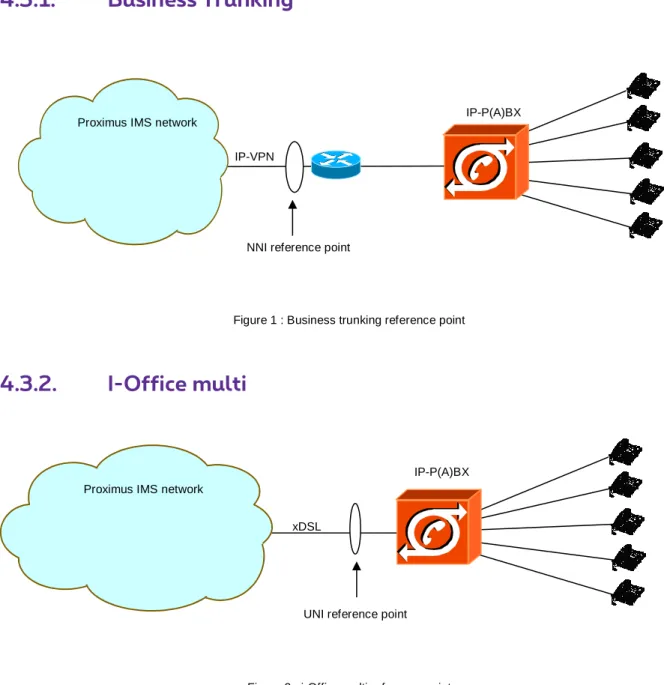
All characteristics described in this set of UNI-specifications are applicable at the reference points indicated in the figures below.
4.3.1.
Business Trunking
Figure 1 : Business trunking reference point
4.3.2.
I-Office multi
Figure 2 : i-Office multi reference point
IP-P(A)BX Proximus IMS network
NNI reference point IP-VPN
IP-P(A)BX Proximus IMS network
xDSL
Proximus public limited company of Belgian Public Law, exercising its activities under the commercial name Proximus, located in
Bd. du Roi Albert II 27, B-1030 Brussels, Belgium,VAT BE 0202.239.951, Brussels Register of Legal Entities, Giro BE50 0001 7100 3118 Page 12 of 25
5.
IP-P(A)BX types and operational modes
5.1.
IP-P(A)BX types
The terminology of PBX and PABX refers back to the PSTN/ISDN world, where the automation level of the user’s PBX was an important difference with regard to interconnection. The following types of customer equipment can be distinguished.
1. An IP-PABX (IP Private Automatic Branch Exchange) is used in case we are dealing with larger equipment, able to handle all telephonic features and services we can expect from an advanced technology. Important in this case is the handling of DDI functionality, where the IP-PABX is connected by means of SIP trunk(s). The identification of an IP-PABX is done by making use of the one to one mapping of (fixed) IP-addresses.
2. IP-PBX (IP Private Branch Exchange). This mnemonic is used in case we are dealing with smaller equipment, able to handle most important telephonic features and services we can expect from a lower range technology.
Note: in general, we use the mnemonic IP-P(A)BX.
5.2.
Operational modes
The following operational modes for IP-P(A)BX can be distinguished. Both are allowed, but with preference for the Non-Proxy case.
1. Non-Proxy IP-P(A)BX (IP-PABX without NAT). Concretely this means that the IP-PABX acts as a relay only for the signalling part of the phone call, the voice traffic between the sender (IP) phone and the receiver (IP) phone is not relayed through the IP-P(A)BX (except for some cases where media resources needs to be allocated in IP-P(A)BX).
2. Proxy IP-P(A)BX. Signalling and media are always passing the IP-P(A)BX. This way of working can have negative impact on the bandwidth of IP network, and consumes extra unnecessary resources in the IP-P(A)BX.
6.
IP CONNECTIVITY
6.1.
Introduction
IP-P(A)BXs can use different types of IP connectivity in order to gain access to the Proximus IMS Network. It is obvious that depending on the size of the IP-P(A)BX some access types are unusable, e.g. a very large IP-P(A)BX shall not be connected over one xDSL line.
Also different topologies (e.g. single IP-P(A)BX or multiple IP-P(A)BXs) at the user’s side can be supported, depending on the access network.
2 types of network are possible :
Explore VPN, for Business Trunking, addressed to large IP-P(A)BXs
Public Internet for I-Office Multi, addressed to smaller IP-P(A)BXs
6.2.
Access network types
6.2.1.
Explore VPN
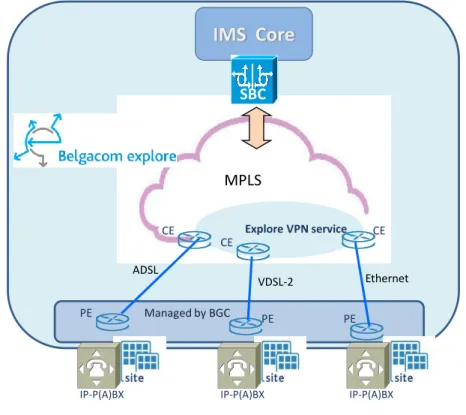
The following IPVPN access methods are available:
Ethernet access with the adequate end-2-end Quality of Service;
Leased line access with the adequate end-2-end Quality of Service;
SDSL access with the adequate end-2-end Quality of Service;
ADSL/VDSL Office are possible by the implementation of IP QoS prioritisation but without bandwidth guarantees.
Figure 3 : Explore VPN access methods
MPLS
Explore VPN service
ADSL
Ethernet VDSL-2
PE
CE
PE PE
CE CE
Managed by BGC
IP-P(A)BX IP-P(A)BX IP-P(A)BX
IMS Core
Proximus public limited company of Belgian Public Law, exercising its activities under the commercial name Proximus, located in
Bd. du Roi Albert II 27, B-1030 Brussels, Belgium,VAT BE 0202.239.951, Brussels Register of Legal Entities, Giro BE50 0001 7100 3118 Page 14 of 25
Each customer (defined by an IP VPN VRF) will have a dedicated VLAN between the Explore IP VPN PE’s and the IMS Catalysts.
Each customer’s IP VPN will also be identified at the access side (aka the south side) of the Acme SBC by the following element:
A Parent Realm (or context) in the SBC defining the customer’s VPN and ensuring its privacy and security;
6.2.2.
Internet Access
The following Multi access methods are available :
ADSL
VDSL2
6.2.2.1.
ADSL
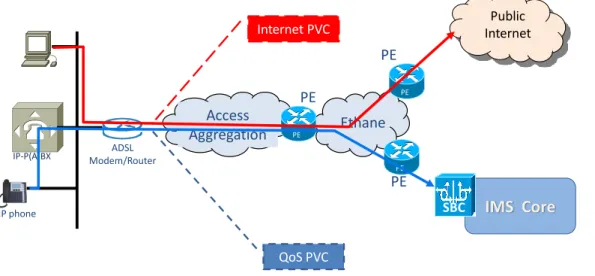
When IP –P(A)BX is connected to Public Internet via ADSL, the ADSL modem/router will receive a dynamic IP address using DHCP. Between the ADSL modem/router and the Proximus IMS, a dedicated QoS PVC is used : this dedicated PVC provides QoS treatment of the voice traffic over the internet traffic, which uses another VC named Internet PVC.
Figure 4 : ADSL internet access method
On IP QOS level, each voice packet is marked as priority by IP-PBX (via DSCP value of the Type of Service field of IP header), then forwarded towards the priority queue (expedited forwarding).
The classification criteria for VoIP traffic on the ADSL modem/router is based on destination IP address written in each IP packet.
In case the QoS PVC is unavailable, a fallback mechanism has been implemented enabling to route the voice traffic via Internet PVC (without QoS).
The ADSL modem/router is doing NAT without a SIP ALG active.
The IP Phone (System Phone) takes contact with the IP P(A)BX. The IP P(A)BX translates then this call to a SIP call towards IMS and its group SIP account, located on the IP P(A)BX itself.
IP-P(A)BX uses :
IP-P(A)BX Modem/RouterADSL
Ethane Access Aggregation PE Public Internet PE
IMS Core
PE PE SBC IP phone PE PE QoS PVC Internet PVC
port 5060 for SIP signalling of the VoiP calls,
fixed range of UDP ports 16384 – 16399 for the RTP stream of the VoIP calls.
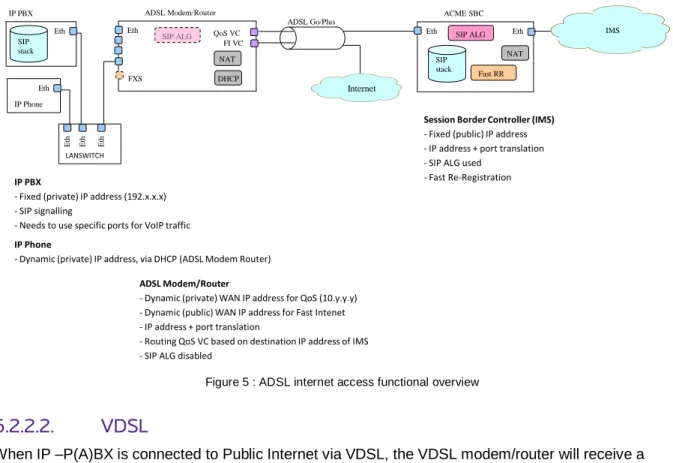
Figure 5 : ADSL internet access functional overview
6.2.2.2.
VDSL
When IP –P(A)BX is connected to Public Internet via VDSL, the VDSL modem/router will receive a dynamic IP address using DHCP. Between the VDSL modem/router and the Proximus IMS, a dedicated QoS VLAN is used : this dedicated VLAN provides QoS treatment of the voice traffic over the internet traffic, which uses another VC named Internet PVC.
Figure 6 : VDSL internet access method
Eth ADSL Modem/Router QoS VC FXS DHCP NAT ADSL Go/Plus FI VC Eth ACME SBC SIP ALG NAT SIP stack Eth IMS Fast RR Internet IP PBX
- Fixed (private) IP address (192.x.x.x) - SIP signalling
- Needs to use specific ports for VoIP traffic
ADSL Modem/Router
- Dynamic (private) WAN IP address for QoS (10.y.y.y) - Dynamic (public) WAN IP address for Fast Intenet - IP address + port translation
- Routing QoS VC based on destination IP address of IMS - SIP ALG disabled
Session Border Controller (IMS)
- Fixed (public) IP address - IP address + port translation - SIP ALG used
- Fast Re-Registration
SIP ALG
Eth Eth Eth
LANSWITCH Eth IP Phone SIP stack Eth IP PBX IP Phone
- Dynamic (private) IP address, via DHCP (ADSL Modem Router)
IP-P(A)BX Modem/RouterVDSL
Ethane
Access
Aggregation
PE
Public Internet PEIMS Core
PE PE SBC IP phonePE
PE
QoS VLAN (VLAN 20) Internet VLAN (VLAN 10)Proximus public limited company of Belgian Public Law, exercising its activities under the commercial name Proximus, located in
Bd. du Roi Albert II 27, B-1030 Brussels, Belgium,VAT BE 0202.239.951, Brussels Register of Legal Entities, Giro BE50 0001 7100 3118 Page 16 of 25
On IP QOS level, each voice packet is marked as priority by IP-PBX (via DSCP value of the Type of Service field of IP header), then forwarded towards the priority queue (expedited forwarding).
The classification criteria for VoIP traffic on the VDSL modem/router is based on destination IP address written in each IP packet.
In case the QoS VLAN is unavailable, a fallback mechanism has been implemented enabling to route the voice traffic via Internet VLAN (without QoS).
The VDSL2 modem/router is doing NAT with a SIP ALG active.
The IP Phone (System Phone) takes contact with the IP P(A)BX. The IP P(A)BX translates then this call to a SIP call towards IMS and its group SIP account, located on the IP P(A)BX itself.
IP-P(A)BX uses :
port 5060 for SIP signalling of the VoiP calls,
fixed range of UDP ports 16384 – 16399 for the RTP stream of the VoIP calls.
Figure 7 : VDSL internet access functional overview
6.3.
User network topology
6.3.1.
General
The following cases can be highlighted according to the structure of customer site.
6.3.2.
Single IP-P(A)BX
In this case the customer enterprise spans only one site, where the IP-P(A)BX is located; the routing plan is simplified and centralized.
6.3.3.
Multiple IP-P(A)BXs
in this case the enterprise can span a number of sites, where we can have:
Multi-IP-P(A)BX centralized: the different sites are interconnected by a WAN, so that all remote sites can reach call handling resources at the main site and they are engineered with SRST
Eth VDSL2 Modem/Router QoS VLAN FXS SIP ALG DHCP NAT SIP stack VDSL2 Res FI VLAN Eth ACME SBC NAT SIP stack Eth Fast RR Internet IMS SIP ALG VDSL Modem/router
- Dynamic (private) WAN IP addrss for QoS (10.y.y.y) - Dynamic (public) WAN IP address for FI - IP address + port translation
- Routing on QoS VLAN based on destination IP address - SIP ALG used
Session Border Controller (IMS)
- Fixed (public) IP address - IP address + port translation - SIP ALG notused -NoFast Re-Registration Eth Eth Eth
LANSWITCH Eth IP Phone SIP stack Eth IP PBX IP PBX
- Fixed (private) IP address (192.x.x.x) - SIP signalling
- Needs to use specific ports for VoIP traffic
IP Phone
capability (the gateway feature that allows survivability for voice services also in case of central IP-P(A)BX failure).
Multi-IP-P(A)BX distributed: each site has its own call handling resources; the routing plan to be configured on each IP-P(A)BX is more complex and requires coordination when changes apply (routing between sites for private calls are in charge of IP- P(A)BX).
Proximus public limited company of Belgian Public Law, exercising its activities under the commercial name Proximus, located in
Bd. du Roi Albert II 27, B-1030 Brussels, Belgium,VAT BE 0202.239.951, Brussels Register of Legal Entities, Giro BE50 0001 7100 3118 Page 18 of 25
7.
Codecs
In principle the Proximus IMS network does not restrict the codecs that can be used. However, in order to ensure interoperability with all types of VoIP endpoints (e.g. CPEs, IP-P(A)BXs, media gateways,..) every IP-P(A)BX shall support the following codecs:
G.711 A-law
G.729
Remark: for the support of T.38 for fax see “BGC IMS VoIP - UNI specification - FAX over IP v1.0.docx” [36]
The recommended and preferred packetisation time is 20 msec. In any case it shall not be higher then 30 msec.
In practice an IP-P(A)PBX is allowed to use any codec (e.g. G.722) as preferred codec as long as the two above mentioned codecs are offered as well. Both mandatory codecs shall be put in the SDP part of the SIP signalling message no later than at the 3th and 4th place, leaving room for 2 other more preferred
codecs.The IP-P(A)BX is allowed to send a maximum of 8 codecs per m-line and/or maximum 16 SDP
attributes in its SDP offer. Proximus does not guarantee the correct working when using other codecs.
When using another codec than the 2 mandatory codecs it shall be taken into account that the Proximus network will not guarantee the codec is used towards all destinations. In such cases “fallback” to any of the 2 mandatory codecs will happen.
Remark: In order to ensure the correct working of the “fallback” procedure some tests shall be done during the certification of an IP-P(A)BX.
8.
QUALITY OF SERVICE AND CALL ADMISSION
CONTROL
8.1.
Quality of Service (QoS)
Besides the support of QoS marking of the VoIP packets, one important issue regarding QoS is the dimensioning of the access in terms of available bandwidth. The dimensioning of the number of voice channels depends of customer’s choice. Proximus will recommend a maximum number of simultaneous calls supported in function of the available guaranteed bandwidth.
When using the G.729a codec, the bandwidth requirement per voice channel (or simultaneous call) is:
o 30Kbps on a FR link which includes Ethernet and Leased line access methods
o 45Kbps on an ATM link which includes xDSL access methods
When using the G.711 codec, the bandwidth requirement per voice channel (or simultaneous call) is:
o 90Kbps on a FR link which includes Ethernet and Leased line access methods
o 110Kbps on an ATM link which includes xDSL access methods
Important remark about fax calls: Fax calls can use the G.711 codec or the T.38 codec. For more information see “BGC IMS VoIP – UNI specification – Fax over IP” [36].
It is thus very important to take into account these parameters to properly dimension the bandwidth per site towards the VoIP platform.
Important remark about Proxy/Non-Proxy IP-PABX:
In case of Non-Proxy IP-P(A)BX the voice traffic between the sender phone and the receiver phone is not relayed through the IP-P(A)BX.
In case of Proxy IP-P(A)BX, the signalling and the voice traffic between the sender phone and the receiver phone are relayed through the IP-P(A)BX.
This difference has an impact on the bandwidth of the site where the IP-P(A)BX is located since 1 call between 2 remote phones uses 2 voice channel on the site where the IP-P(A)BX is located.
8.2.
Call admission Control
Call admission control means controlling the number of simultaneous calls in an IP-P(A)BX configuration. This can be applied at 2 different locations:
Call limiter on IMS application server: does not take into account the bandwidth usage but is rather a static configuration
CAC in IP-P(A)BX.
8.2.1.
Call limiter on IMS application server
The call limiter on IMS application server is an administrative parameter.
Broadsoft has parameter settings which can limit the number of calls, for the customer/enterprise in general, and per SIP trunk.
The customer/enterprise call limit parameter determines the number of call licenses for the complete enterprise. It has a direct relation with the license cost.
Proximus public limited company of Belgian Public Law, exercising its activities under the commercial name Proximus, located in
Bd. du Roi Albert II 27, B-1030 Brussels, Belgium,VAT BE 0202.239.951, Brussels Register of Legal Entities, Giro BE50 0001 7100 3118 Page 20 of 25
Remark: in case of multiple SIP trunks, the enterprise call limit shall be equal to or greater than the sum of SIP trunk call limits.
8.2.2.
Call admission control on IP-PABX
Some IP-P(A)BX types are also supporting the call admission control. The feature implementation is strongly depending on vendor, and does not fit in the scope of this specification. Important to know is that the only point in the chain for Corporate VoIP environment is clearly the point of call handling: IP-PABX. The IP-PABX is aware of all call handling and connectivity. This is the most logic point to apply any kind of CAC.
9.
NAMING, NUMBERING AND ADDRESSING
9.1.
Naming
9.1.1.
General
Each IP-P(A)BX has one pbxPUID or PilotID. This is a non-dialable public identity. Example: [email protected]
9.1.2.
Business Trunking
to be completed
9.1.3.
I-Office multi
to be completed
9.2.
Numbering
9.2.1.
General
An IP-P(A)BX has a series of number ranges containing consecutive numbers or individual numbers, which are all public dialable numbers.
Ranges always start with a number ending with 0 (for 10), 00 (for 100), 000 (for 1000).
9.2.2.
Business Trunking
For Business Trunking, there can be ranges of 10, 100, and 1000 consecutive numbers.
9.2.3.
I-Office multi
For I-Office Multi, only ranges of 10 numbers are supported (but this could evolve in the future).
9.1.
IP addressing
9.1.1.
Explore VPN
to be completed
9.1.2.
Internet Access
to be completed
Proximus public limited company of Belgian Public Law, exercising its activities under the commercial name Proximus, located in
Bd. du Roi Albert II 27, B-1030 Brussels, Belgium,VAT BE 0202.239.951, Brussels Register of Legal Entities, Giro BE50 0001 7100 3118 Page 22 of 25
10.
LOAD BALANCING
Load balancing capabilities are currently under development and will be detailed here in a later version of the document.
11.
Customer SBC
This version of the corporate VoIP UNI specifications do not take into account the presence of an SBC function at the customer premises.
For the support and remote management of such customer SBC possibly an update of this specification is needed.