저작자표시-비영리-변경금지 2.0 대한민국 이용자는 아래의 조건을 따르는 경우에 한하여 자유롭게
l 이 저작물을 복제, 배포, 전송, 전시, 공연 및 방송할 수 있습니다. 다음과 같은 조건을 따라야 합니다:
l 귀하는, 이 저작물의 재이용이나 배포의 경우, 이 저작물에 적용된 이용허락조건 을 명확하게 나타내어야 합니다.
l 저작권자로부터 별도의 허가를 받으면 이러한 조건들은 적용되지 않습니다.
저작권법에 따른 이용자의 권리는 위의 내용에 의하여 영향을 받지 않습니다.
이것은 이용허락규약(Legal Code)을 이해하기 쉽게 요약한 것입니다. Disclaimer
저작자표시. 귀하는 원저작자를 표시하여야 합니다.
비영리. 귀하는 이 저작물을 영리 목적으로 이용할 수 없습니다.
의학석사
학위논문
Molecular characterization of FZD4,
LRP5, and TSPAN12 in familial
exudative vitreoretinopathy
가족성삼출유리체망막병증에서
FZD4, LRP5, TSPAN12
의
분자유전학적
연구
2014
년
2
월
서울대학교
대학원
의학과
검사의학
전공
A thesis of the Degree of Master of Science
가족성삼출유리체망막병증에서
FZD4, LRP5, TSPAN12
의
분자유전학적
연구
Molecular characterization of FZD4,
LRP5, and TSPAN12 in familial
exudative vitreoretinopathy
February 2014
The Department of Medicine,
Seoul National University
College of Medicine
Soo Hyun Seo
가족성삼출유리체망막병증에서
FZD4, LRP5, TSPAN12
의
분자유전학적
연구
지도교수 박 성 섭
이 논문을 의학석사 학위논문으로 제출함
2013 년 10 월
서울대학교 대학원
의학과 검사의학 전공
서수현
서수현의 의학석사 학위논문을 인준함
2013 년 12 월
위 원 장
(인)
부위원장
(인)
Molecular characterization of FZD4,
LRP5, and TSPAN12 in familial
exudative vitreoretinopathy
by
Soo Hyun Seo
A thesis submitted to the Department of Medicine in
partial fulfillment of the requirements for the Degree of
Master of Science in Medicine (Laboratory Medicine) at
Seoul National University College of Medicine
December 2013
Approved by Thesis Committee:
Professor Chairman
Professor Vice chairman
Professor
i
ABSTRACT
Introduction: Familial exudative vitreoretinopathy (FEVR) is a rare hereditary disorder characterized by failure of peripheral retinal vascularization. Clinical manifestation of the disease can be variable, ranging from nonsymptomatic vascular anomalies in the peripheral retina to bilateral retinal detachments with blindness. FEVR is genetically heterogeneous, and it is found in various modes of inheritance. Autosomal dominant inheritance is the most common form in FEVR and FZD4, LRP5, and TSPAN12 are known to be associated with the disease. These genes are essential components of wingless (Wnt) pathway and pathogenic mutations affecting the function of these genes result in abnormal retinal vascular formation. In the Korean population, there had not been any report on the molecular identification of FEVR. We performed mutation screening for FZD4, LRP5 and TSPAN12 in patients with clinical diagnosis of FEVR. Identification of the molecular spectrum in Korean FEVR patients will be helpful in establishing an effective testing strategy, as well as providing informative genetic counseling for the family members of the proband.
Methods: Mutational studies were carried out in 42 unrelated patients with diagnosis of FEVR during 2008 to 2012 at Seoul National University Hospital. Diagnosis of FEVR was established by ophthalmic examinations. All patients had been previously screened for NDP mutation, which were found to be negative. Sequencing analyses for three causal genes (FZD4, LRP5, and
ii
via Multiplex Ligation-dependent Probe Amplification.
Results: Two previously reported mutations (c.313A>G, c.1282_1285delGACA), four novel pathogenic mutations (c.160C>T, c.539_540delAG, c.653_676dup24, c.1210_1211delTT) and a whole gene deletion of FZD4 were found in 11 patients. Three novel missense variants (c.456C>G, c.470T>C, c.676T>A) were also found. A previously reported mutation of c.3361A>G in LRP5 was detected in three patients, and two novel missense variants (c.731C>G, c.4098C>G) were detected in two patients. In case of TSAPN12, a previously reported mutation, c.212_218delGCTGTTT was found in one patient, and three more novel missense variants (c.56T>G, c.194C>T, c.484G>A) were found in another three patients.
Conclusions: In this study, we have identified four known mutations, four novel pathogenic mutations and a whole gene deletion in 15 patients. In cases of novel missense variants detected in nine patients, five of them were considered as pathogenic according to the predictions by in-silico analyses and allele frequencies in normal control group. Among 20 patients with pathogenic mutation detected, 13 were due to FZD4 mutations, showing the largest proportion of this gene in attribution to the autosomal dominant FEVR (13/42 patients, 31.0%). By applying this result, testing strategy of FEVR starting with screening for FZD4 mutations can be applied in the clinical fields. Genetic counseling of asymptomatic family members as well as proband will be helpful in further management and prevention of the disease progression.
iii
---
Keywords: Familial exudative vitreoretinopathy, FZD4, LRP5, TSPAN12 Student number: 2012-21692
iv
CONTENTS
Abstract ... i
Contents ... iv
List of tables and figures ... v
List of abbreviations ... vi
Introduction ... 1
Materials and Methods ... 5
Results ... 13
Discussion ... 23
References... 26
v
LIST OF TABLES AND FIGURES
Table 1. Genes of the Familial Exudative Vitreoretinopathy ... 4
Table 2. Primer sequences for PCR amplification and sequencing in this study ... 9
Table 3. Pathogenic mutations identified in 15 FEVR patients ... 17
Table 4. Novel missense variants identified in 9 FEVR patients ... 18
Table 5. Novel synonymous variants identified ... 19
Fig 1. Sequence electropherogram of 8 pathogenic mutations. ... 20
vi
LIST OF ABBREVIATIONS
FEVR Familial Exudative Vitreoretinopathy ROP Retinopathy of PrematurityPHPV Persistent Hyperplastic Primary Vitreous PCR Polymerase Chain Reaction
1
INTRODUCTION
Familial exudative vitreoretinopathy (FEVR) is a rare hereditary disorder characterized by failure of peripheral retinal vascularization, first described by Criswick and Schepens in 1969 (1). Clinical manifestation of the disease can be variable, ranging from nonsymptomatic vascular anomalies in the peripheral retina to bilateral retinal detachments with blindness. According to the staging system proposed (2), affected eyes can be classified into one of the following five stages. Stage 1 denotes the presence of a peripheral retinal avascular zone, and stage 2 with retinal neovascularization. Eyes were further subdivided into those without subretinal or intraretinal exudate (stage 2A) and those with exudate (stage 2B). Eyes with extensive exudate resulting in extramacular retinal detachment were classified as stage 3, and when retinal detachment involved macula, it was classified as stage 4. Total retinal detachment was considered as stage 5.
FEVR is genetically heterogeneous, and it is found in various modes of inheritance (Table 1). Autosomal dominant inheritance is the most common form in FEVR and to date, FZD4, LRP5, TSPAN12 are known to be associated with the disease. An additional FEVR related genetic locus (EVR3) has been mapped to chromosome 11p12-p13, but not yet identified (3). Recently, novel gene named ZNF408 has also been suggested as one of the causal gene for autosomal dominant FEVR (4). In cases of autosomal dominant FEVR, around half of the patients are found to carry a genetic mutation. Though the proportion of each gene attributing to this disease
2
differs between the study populations, it is known that usually 4-40% is found in FZD4, 12-25% in LRP5, and 3-10% in TSPAN12. LRP5 gene is also known to be the only gene associated in the autosomal recessive inheritance thus far. X-linked FEVR is caused by mutations in NDP gene, which is also known as a causal gene of Norrie disease. Norrie disease is one of the NDP-related retinopathies, showing clinically overlapping phenotypes with X-linked FEVR.
Four genes known to be associated with FEVR (NDP, FZD4, LRP5, and
TSPAN12) are the essential components of wingless (Wnt) pathway in the
retina. Norrin protein encoded by NDP gene, which is not a typical Wnt pathway ligand, binds to the receptor complex of Wnt pathway composed of FZD4 and LRP5 and act as a ligand. The Wnt/β-Catenin pathway is activated when Norrin binds to the seven-pass transmembrane Frizzled (FZD) receptor along with its coreceptor, low-density lipoprotein receptor-related protein (LRP) (5). Among several FZD proteins and 2 LRP proteins, only FZD4 and LRP5 are reported to act as receptors for Norrin in the retina, activating the pathway critical for the retinal vascular development. Another causative gene, TSPAN12, is also known to form a receptor complex with FZD4 and LRP5. Thus, pathogenic mutations affecting the function of these three genes result in abnormal retinal vascular formation. And though they may show different inheritance patterns, the resulting phenotypes will overlap.
Due to variable clinical manifestation, there are several other retinal diseases that resemble FEVR, such as retinopathy of prematurity (ROP), Coats disease, and persistent hyperplastic primary vitreous (PHPV). Among them,
3
retinopathy of prematurity (ROP) is known as the best phenocopy for FEVR, which also present with peripheral avascularity, retinal neovascularization or retinal detachments. But unlike FEVR, the progression of ROP tends to follow a predictable timeline of progression (6). FEVR does not follow a predictable timeline of progression, occurring throughout childhood and adulthood, and thus, the accurate diagnosis of FEVR is important for long-term monitoring.
Until now, there had not been any report on the molecular identification of FEVR in Korean patients. We performed mutation screening for FZD4, LRP5 and TSPAN12 in patients with clinical diagnosis of FEVR. Identification of the molecular spectrum in Korean FEVR patients will be helpful in establishing an effective testing strategy, as well as providing informative genetic counseling for the family members of the proband.
4
Table 1. Genes of the Familial Exudative Vitreoretinopathy.
Gene Symbol
Full Name Chromosom al Locus
Reference Sequence
Inheritance Pattern
NDP Norrie disease (pseudoglioma)
Xp11.3 NG_009832.1 NM_000266.3
X-Linked
FZD4 Frizzled-4 11q14.2 NG_011752.1
NM_012193.3
Autosomal Dominant
LRP5 Low-density
lipoprotein receptor-related protein 5
11q13.2 NG_015835.1 NM_002335.2
Autosomal Dominant / Autosomal Recessive
TSPAN12 Tetraspanin-12 7q31.31 NG_023203.1
NM_012338.3
Autosomal Dominant
ZNF408 Zinc finger protein 408
11p11.2 NC_000011.9 NM_024741.2
Autosomal Dominant
EVR3 Exudative
vitreoretinopathy 3
5
MATERIALS AND METHODS
1. PatientsMutational studies were carried out in 42 unrelated patients with diagnosis of FEVR during 2008 to 2012 at Seoul National University Children’s Hospital. Diagnosis of FEVR was established by ophthalmic examinations. All patients had been previously screened for NDP mutations and gross gene deletion/duplication, which were found to be all negative. Informed consent was obtained from all individuals.
6
2. Methods
1) Target Genes
Three genes known to cause autosomal dominant FEVR (FZD4, LRP5, and
TSPAN12) were sequenced. Genetic testing began with sequence analysis of
all coding exons and its flanking intronic regions of FZD4. If a pathogenic mutation was not identified in FZD4, sequence analysis of all coding exons and its flanking intronic regions of LRP5 were performed. LRP5 mutation negative cases were followed by sequence analysis of TSPAN12.
2) DNA extraction
Whole blood was collected from patients in EDTA blood collection tubes and the DNA was extracted using Gentra PureGene blood kits (Gentra Systems, Minneapolis, MN, USA) according to the manufacturer’s instructions.
3) Primer design
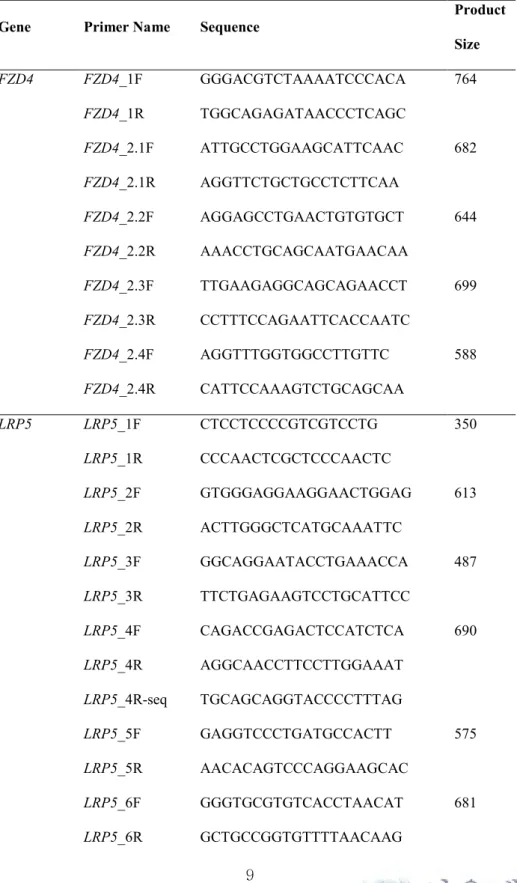
Primers for 3 target genes were designed to cover all coding regions and its flanking intronic regions (Table 2). Reference sequences registered in Gene Database of NCBI were used.
7
4) Polymerase Chain Reaction (PCR)
PCR reactions were carried out using primers specific for all coding exons. Each polymerase reaction contained 1 µL of genomic DNA (50–100 ng/µL) and 2 µL of each forward and reverse primer (10 pmol/µL) in a total volume of 50 µL. Reactions were subjected to a temperature of 94°C for 5 min, followed by 35 cycles at 94°C for 30 sec, 55°C for 30 sec, 72°C for 1 min, and a final extension step at 72°C for 7 min. Amplified products were confirmed by electrophoresis using 2% agarose gel containing 0.5 ug/mL ethidium bromide on 100V for 30 minutes.
5) Sequencing Analysis
The amplified products were first purified using QIAquick 96 well PCR purification kit (Quiagen, Valencia, CA), then sequenced on an ABI 3730 analyzer using a BigDye Terminator v3.1 Cycle sequencing kit (Applied Biosystems, Foster City, CA, USA). Sequences were analyzed using Sequencher 5.1 (Gene Codes Co, Ann Arbor, MI).
6) Gene dosage analysis
Gross gene deletions and duplications for FZD4 and LRP5 were screened via Multiplex Ligation-dependent Probe Amplification (MLPA) using the SALSA P285-C1 LRP5-NDP-FZD4 (MRC-Holland, Amsterdam, Netherlands). PCR products were analyzed on an ABI 3130 analyzer with Genemarker ver. 1.51 (Softgenetics, State College, PA, USA).
8
7) Interpretation of detected variants
Sequence variants detected by sequence analysis were searched in databases, The Single Nucleotide Polymorphism Database (dbSNP) and the Human Genome Mutation Database (HGMD: www.hgmd.cf.ac.uk). Pathogenicity of novel sequence variants was determined according to its effect on the function of the protein. Nonsense, frameshift, splice site mutations were considered pathogenic, and synonymous variants without predicted splicing effect were considered benign. In cases of missense variants, in-silico prediction results from SIFT, Polyphen, and Mutation Taster were considered when determining the pathogenicity. Splice site predictions and allele frequencies of each variant in the healthy control group were also taken into account. Conservation of amino acid residue was assessed by multiple alignments with other species.
9
Table 2. Primer sequences for PCR amplification and sequencing in this study.
Gene Primer Name Sequence
Product Size
FZD4 FZD4_1F GGGACGTCTAAAATCCCACA 764
FZD4_1R TGGCAGAGATAACCCTCAGC
FZD4_2.1F ATTGCCTGGAAGCATTCAAC 682
FZD4_2.1R AGGTTCTGCTGCCTCTTCAA
FZD4_2.2F AGGAGCCTGAACTGTGTGCT 644
FZD4_2.2R AAACCTGCAGCAATGAACAA
FZD4_2.3F TTGAAGAGGCAGCAGAACCT 699
FZD4_2.3R CCTTTCCAGAATTCACCAATC
FZD4_2.4F AGGTTTGGTGGCCTTGTTC 588
FZD4_2.4R CATTCCAAAGTCTGCAGCAA
LRP5 LRP5_1F CTCCTCCCCGTCGTCCTG 350
LRP5_1R CCCAACTCGCTCCCAACTC
LRP5_2F GTGGGAGGAAGGAACTGGAG 613
LRP5_2R ACTTGGGCTCATGCAAATTC
LRP5_3F GGCAGGAATACCTGAAACCA 487
LRP5_3R TTCTGAGAAGTCCTGCATTCC
LRP5_4F CAGACCGAGACTCCATCTCA 690
LRP5_4R AGGCAACCTTCCTTGGAAAT
LRP5_4R-seq TGCAGCAGGTACCCCTTTAG
LRP5_5F GAGGTCCCTGATGCCACTT 575
LRP5_5R AACACAGTCCCAGGAAGCAC
LRP5_6F GGGTGCGTGTCACCTAACAT 681
10
LRP5_7F GACATCAACATTTAGCCATGTGA 580
LRP5_7R TGGCCTCAAACTCTTGGACT
LRP5_8F AGATCTTGCCACTGCACTCC 670
LRP5_8R GTCCCTTCCCATCTGTCCTT
LRP5_9F TGAAAGGTGCGTGTGTGTTT 679
LRP5_9R TGTGTGTCTACCGGACTTGC
LRP5_9R-seq TTTGATTAGCTTGAACTGCGTTA
LRP5_10F TGCCTGTAATCCCCACCTAC 601
LRP5_10R CGAAGGAACTCCATGACCTC
LRP5_10R-seq GCCACCATCAAGGCTAATGA
LRP5_11F GAGTGAGCCACTGTGGGAAT 688
LRP5_11R ACAGGGATTAGCTGGGACCT
LRP5_12F GGATCTTGCTGGTTTTCCAA 608
LRP5_12R AGTGCACAACCTACCCAACC
LRP5_13F GATAGCACCACTGCAGTCCA 617
LRP5_13F-seq CGTCTTTCCCGTGGACCT
LRP5_13R TCCTCCCTCTGCTAAGGACA
LRP5_14F AGAAGTGTGGCCTCTGCTGT 545
LRP5_14R GGCTGTGAAAGAGCCTGTGT
LRP5_15F GTTGGATTTAGGGCCTACCC 634
LRP5_15R CTCAGAACCCCAGCCTACAG
LRP5_16F CCTGTCCAAAGCATGGAATC 533
LRP5_16R GTTCTGCGGCAAAAGAAAAC
LRP5_17F GGGCAGTTCAGACTGATGGT 567
LRP5_17R AGAAAGGAGGGCAAAGGAAG
11
LRP5_18R TGCAAGCAAAGGTTTTCAGA
LRP5_19F GAGGGTGGGTGGAGACTGTA 583
LRP5_19R GGGTAATCTTGCTGCCTGAC
LRP5_20F CCACGTTACCCTGAGGTTG 647
LRP5_20R TCCACACCTACAGTGCCAAA
LRP5_21F GCACATTTCCAACAGGACAC 517
LRP5_21R TAGGAGGTGGATTTGGGTGA
LRP5_22F CAAGGCAGGTACTTGGAAGG 518
LRP5_22R TAGTGTGGTTGGCAGAGCAG
LRP5_23F TAGAGGTGGGACCATTGAGG 600
LRP5_23R CACCCCATCACAGTTCACAT
TSPAN12 TSPAN12_1F CCCTATCCTGCAGAGGTGAA 695
TSPAN12_1R GCCGGGTTAGTCATTCAAAC
TSPAN12_2F TTTTCTTTTCCCAGCAGGTG 572
TSPAN12_2R ATCCAGGGGTGGATTTCTTT
TSPAN12_3F TTTGGTGCCTAGGACATGATT 520
TSPAN12_3R AGGAGGACAGGCAACTGCTA
TSPAN12_4F TTGGGGTAGGAAAGCTACCA 530
TSPAN12_4R
TTCAAATAATCTCTTGTGAAACG AA
TSPAN12_5F TTTCCCCATCTGCTTCTGAG 508
TSPAN12_5R GTGGGTGAGTTCCCAAGAGA
TSPAN12_6F TTGTTGGTGATTTCCTTGAGC 579
TSPAN12_6R GAAGAAAAGCAGGCCATGAA
TSPAN12_7F
TGACAGATATAGCTCTGGGTACA AAA
12
TSPAN12_7R TTTCTTCTGCTTCTCCCCATA
TSPAN12_8F CAGCTTTCCCTGAGAACCAC 665
13
RESULTS
We surveyed 42 unrelated patients with clinical diagnosis of FEVR. Six of them were girls and 36 were boys. Mean age of diagnosis was 18 months (range: 19 days – 6 years old). Among 42 patients, four of them had another family member with the diagnosis of FEVR.
1) Mutation analysis of FZD4
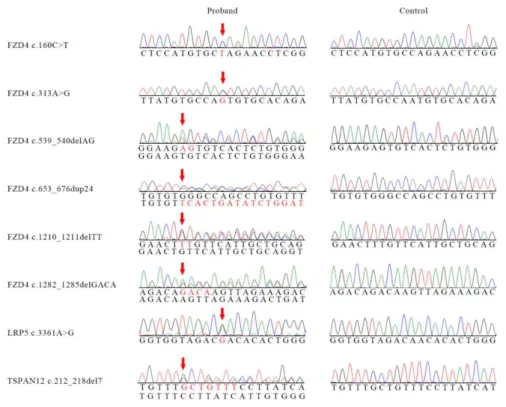
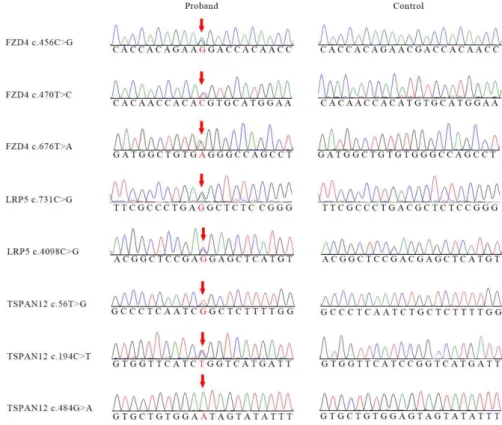
Sequence analysis and gene dosage analysis of all coding exons of FZD4 were carried out in 42 patients with FEVR. 2 previously reported mutations, 7 novel variants and a whole gene deletion were found in 14 patients (Table 3). Previously reported variant of c.313A>G (p.Met105Val) was recurrently found in 4 patients and c.1282_1285delGACA(p.Asp428Serfs*2) in 2 patients (7, 8). One patient was found to carry a whole gene deletion of FZD4, which was detected by MLPA. Among 7 novel variants found in FZD4, one was a nonsense mutation (c.160C>T, p.Gln54*) and three were frameshift mutations (c.539_540delAG, p.Glu180Valfs*9; c.653_676dup, p.Phe218_Val225dup; c.1210_1211delTT, p.Leu404Valfs*54) (Fig 1). Others were missense variants (c.456C>G, p.Asn152Lys; c.470T>C, p.Met157Thr; c.676T>A, p.Trp226Arg) (Fig 2). Nonsense and frameshift mutations were considered as pathogenic novel mutations without further analysis. All novel missense variants were evaluated further by using in-silico predictions and assessing allele frequencies in healthy population.
14
Among the patients with mutation detected in FZD4, three had another family member also diagnosed as FEVR. Among them, two were available for the testing and they were screened for each pathogenic mutation detected in the proband. A cousin of a patient with c.313A>G and a sister of a patient with c.470T>C were also found to carry the same mutations as the probands.
2) Mutation analysis of LRP5
Sequence analysis and gene dosage analysis of all coding exons of LRP5 were carried out in 31 patients, excluding those with pathogenic FZD4 mutations detected. Patients with novel missense variants in FZD4 were included in LRP5 sequencing. A previously reported mutation of c.3361A>G (p.Asn1121Asp) was detected in three patients, and two novel missense variants were detected in two patients (c.731C>G, p.Thr244Arg; c.4098C>G, p.Asp1366Glu). Additionally, 4 novel synonymous variants with no amino acid change were found and all considered benign (Table 5).
3) Mutation analysis of TSPAN12
Sequence analysis of all coding exons of TSPAN12 was carried out in 28 patients, excluding those with pathogenic LRP5 mutations detected. Again, patients with novel missense variants in LRP5 were included in TSPAN12 sequencing. One previously reported mutation, c.212_218delGCTGTTT (p.Cys71Serfs*8), was found in one patient, and three more novel missense variants (c.56T>G, p.Leu19Arg; c.194C>T, p.Pro65Leu; c.484G>A, p.Val162Ile) were found in another 4 patients. Interestingly, c.484G>A was
15
found as a homozygote variant. The patient with c.484G>A variant had a brother who was also diagnosed as FEVR, but he was homozygous for guanine at the position 484 in TSPAN12 gene.
4) Pathogenicity of Novel Missense Variants
In cases of novel missense variants detected in 9 patients, pathogenicity of each variant was assessed by considering allele frequencies in normal population, conservation of a given amino acid, and in-silico prediction results (Table 4). Variants that are predicted to be pathogenic by more than 2 in-silico analysis and not found in the normal control group were considered as likely pathogenic. Among eight missense variants, five (c.456C>G and c.470T>C in FZD4, c.731C>G and c.4098C>G in LRP5, c.56T>G in TSPAN12) were considered as likely highly pathogenic mutations. They were predicted to be pathogenic by at least two in-silico analyses and all positioned in well conserved region among species. None were found in the normal control group. In cases of c.470T>C (p.Met157Thr) variant of FZD4 and c.731C>G (p.Thr244Arg) variant of LRP5, pathogenic mutations had also been previously reported in the same amino acid position. p.Met157Lys and p.Met157Val in FZD4 were reported as causative mutations in exudative vitreoretinopathy patients (9, 10), and p.Thr244Met of LRP5 was previously reported in an osteoporosis-pseudoglioma syndrome patient.
Other three missense variants (c.676T>A in FZD4, c.194C>T and c.484G>A
in TSPAN12) were considered as less likely pathogenic. Despite the
16
patient who carried the mutation of c.3361A>G in LRP5 gene, suggesting that this novel variant in FZD4 is less likely to be the causative mutation. However, considering the previous report describing the double mutation in both FZD4 and LRP5 which resulted in a severe phenotype, there might be a contribution of this variant to the phenotype shown in this patient. c.194C>T (p.Pro65Leu) variant of TSPAN12 was not considered as likely pathogenic mutation since both proline and leucine shared hydrophobic characteristics and it was predicted to be disease causing only by a single prediction analysis. c.484G>A (p.Val162Ile) variant of TSPAN12 was predicted to be likely pathogenic by in-silico analyses, but since the proband’s symptomatic brother was not carrying this specific variant, it was considered benign.
17
Table 3. Pathogenic mutations identified in 15 FEVR patients.
Gene ID Sex Age at diagnosis Base Change Amino Acid Change Effect Reference
FZD4 Case 47 M 3Y c.160C>T p.Gln54* Nonsense novel Case 2 F 3Y c.313A>G p.Met105Val Missense (7) Case 33 M 8M c.313A>G p.Met105Val Missense (7) Case 38 M 2M c.313A>G p.Met105Val Missense (7) Case 43 M 2M c.313A>G p.Met105Val Missense (7) Case 44 M 3Y c.539_540delAG p.Glu180Valfs*9 Frameshift novel Case 42 M 2Y c.653_676dup24 p.Phe218_Val225dup Frameshift novel Case 28 M 2Y c.1210_1211delTT p.Leu404Valfs*54 Frameshift novel Case 1 F 20D c.1282_1285delGACA p.Asp428Serfs*2 Frameshift (8) Case 46 M 2Y c.1282_1285delGACA p.Asp428Serfs*2 Frameshift (8) Case 52 M 4Y Whole Gene Deletion novel LRP5 Case 5 F 11M c.3361A>G p.Asn1121Asp Missense (11)
Case 25 M 10M c.3361A>G p.Asn1121Asp Missense (11) Case 50 M 2M c.3361A>G p.Asn1121Asp Missense (11)
18
Table 4. Novel missense variants identified in 9 FEVR patients.
Gene Base Change Amino Acid
Change
Occurrence in control group
SIFT Polyphen Mutation
Taster
Conservation Significance FZD4 c.456C>G p.Asn152Lys 0/182 alleles Deleterious Probably
Damaging
Disease causing
Well conserved Likely Pathogenic c.470T>C p.Met157Thr 0/182 alleles Deleterious Benign Disease
causing
Well conserved Likely Pathogenic c.676T>A* p.Trp226Arg 0/182 alleles Deleterious Probably
Damaging
Disease causing
Well conserved Less Likely Pathogenic LRP5 c.731C>G p.Thr244Arg 0/174 alleles Deleterious Probably
Damaging
Disease causing
Well conserved Likely Pathogenic c.4098C>G p.Asp1366Glu 0/182 alleles Deleterious Probably
Damaging
Disease causing
Well conserved Likely Pathogenic
TSPAN12 c.56T>G p.Leu19Arg 0/176 alleles Deleterious Possibly
Damaging Disease causing Conserved (except for C. elegans) Likely Pathogenic c.194C>T ** p.Pro65Leu 0/176 alleles Tolerated Benign Disease
causing Conserved (except for C. elegans) Unknown Significance c.484G>A *** p.Val162Ile 0/184 alleles Tolerated Possibly
Damaging Disease causing Conserved (except for C. elegans) Less Likely Pathogenic * This variant was detected in a patient with c.3361A>G mutation in the LRP5 gene.
** This variant was detected in two unrelated patients. *** This variant was detected as a homozygote.
19
Table 5. Novel synonymous variants identified.
Gene Base Change Occurrence in
patients LRP5 c.480C>G 1/42
c.1110C>T 1/42 c.2160C>T 1/42 c.4650C>T 1/42
20
21
22
5) Molecular characterization of FEVR
We have identified 4 known mutations, 4 novel pathogenic mutations and a whole gene deletion in 15 patients, allowing 35.7% of patients to be genetically confirmed as FEVR. When five novel missense variants considered as likely pathogenic are taken into account, 20 patients were diagnosed as FEVR with a defined genetic cause (20/42 patients, 47.6%). Among them, FZD4 mutations were most common (13/42 patients, 31.0%), followed by LRP5 (5/42, 11.9%) and TSPAN12 (2/42, 4.8%).
23
DISCUSSION
Familial exudative vitreoretinopathy is a very rare disease with unknown prevalence. But the frequency of this disorder is likely to be underestimated, since almost 90% of affected individuals may be asymptomatic. It has been reported that up to 58% of asymptomatic family members of FEVR patients have angiographic findings consistent with FEVR (13). Therefore, in cases with a confirmed proband in the family, early identification and treatment should be recommended for preservation of visual acuity. Unfortunately, the parents of the proband often do not consent on genetic testing, due to guilty feelings and responsibilities. This may have also resulted in underestimation of familial cases in Korea. The role of genetic testing in the family members as well as proband should be more emphasized for the purpose of genetic counseling and the prevention of disease progression.
The proportion of FEVR patients who are genetically diagnosed by the detection of pathogenic mutations is known to be around 40~50% (13). In this study, we have identified 4 known mutations, 4 novel pathogenic mutations and a whole gene deletion in 15 patients, allowing 35.7% of patients to be genetically confirmed as FEVR. When five novel missense variants considered as likely pathogenic are taken into account, 20 patients can be diagnosed as FEVR with a defined genetic cause (20/42 patients, 47.6%). Three recurrent mutations, c.313A>G and c.1282_1285delGACA in FZD4 and c.3361A>G in LRP5, were frequently detected in our patient group. c.313A>G in FZD4, which was detected in 4 unrelated patients in this study,
24
had been previously reported Japanese and Chinese FEVR patients, suggesting this mutation occurs frequently in the Asian population.
Among 20 patients, 13 were due to FZD4 mutations, showing the largest proportion of this gene in attribution to the autosomal dominant FEVR (13/42 patients, 31.0%) in the Korean population. This proportion was similar to the previously reported ones (7, 9). The proportion of LRP5 was 11.9% (5/42 patients), which seemed to be slightly lower than those reported in other populations (8, 9, 11, 14) but still higher than TSPAN12. Only one patient was confirmed with a previously reported pathogenic mutation in TSPAN12 and another patient carried a likely pathogenic mutation (2/42 patients, 4.8%). This result can be applied to the testing strategy of FEVR in the clinical field. Screening for FZD4 mutations could be the primary step in evaluation of FEVR, though the proportions of each gene contributing to this disease in this study may have a limitation in reflecting the true proportion in our population, since the patients were not recruited based on the autosomal dominant inheritance pattern on the primary.
In cases of TSPAN12, there were two cases suspected to have gross gene deletions but not confirmed in the present study. One of them was a patient carrying a deletion in chromosome 7, del(7) (q31.2q34), which was detected by chromosome analysis. Since TSPAN12 is located at 7q31.31, this patient may be carrying a whole gene deletion. Another case is the patient with a homozygous variant of c.484G>A in TSPAN12. The homozygous state of this rare variant may imply gross deletion of the gene. Clearer explanation will be provided when gene dosage analysis for TSPAN12 is performed.
25
The causative genes of FEVR are involved in other retinal diseases that resemble FEVR. NDP mutations are related to Norrie disease, Persistent hyperplastic primary vitreous (PHPV), Retinopathy of prematurity (ROP) and Coats disease. FZD4 mutations are also found in ROP. Since a borderline of many retinal disorders may not be clear enough to make a diagnosis solely based on clinical findings, disease categorization based on the causal gene might be necessary. Also, genotype-phenotype correlation would be helpful in defining the role of each gene participating in the Norrin-related pathway and the consequence of retinal vascular development process.
In the present study, pathogenic mutations were not detected in over half of the patients. Mutations in the newly discovered gene, ZNF408, or in the not-yet defined gene, EVR3, may contribute additionally. In cases with no mutation found in this study, further analysis in search of the novel gene constituting for FEVR will be needed.
In conclusion, we showed the mutation spectrum of 3 genes, FZD4, LRP5
and TSPAN12, in the Korean FEVR patients. FZD4 mutations were the most
common in cases of autosomal dominant FEVR, thus testing strategy of FEVR starting with screening for FZD4 mutations can be applied in the clinical fields. Genetic counseling of probands and asymptomatic family members would be helpful in further management and prevention of the disease progression.
26
REFERENCES
1. Criswick VG, Schepens CL. Familial exudative vitreoretinopathy. American journal of ophthalmology. 1969;68(4):578-94.
2. Pendergast SD, Trese MT. Familial exudative vitreoretinopathy. Results of surgical management. Ophthalmology. 1998;105(6):1015-23. 3. Downey LM, Keen TJ, Roberts E, Mansfield DC, Bamashmus M, Inglehearn CF. A new locus for autosomal dominant familial exudative vitreoretinopathy maps to chromosome 11p12-13. American journal of human genetics. 2001;68(3):778-81.
4. Collin RW, Nikopoulos K, Dona M, Gilissen C, Hoischen A, Boonstra FN, et al. ZNF408 is mutated in familial exudative vitreoretinopathy and is crucial for the development of zebrafish retinal vasculature. Proceedings of the National Academy of Sciences of the United States of America. 2013;110(24):9856-61.
5. MacDonald BT, Tamai K, He X. Wnt/beta-catenin signaling: components, mechanisms, and diseases. Developmental cell. 2009;17(1):9-26. 6. Ranchod TM, Ho LY, Drenser KA, Capone A, Jr., Trese MT. Clinical presentation of familial exudative vitreoretinopathy. Ophthalmology. 2011;118(10):2070-5.
7. Kondo H, Hayashi H, Oshima K, Tahira T, Hayashi K. Frizzled 4 gene (FZD4) mutations in patients with familial exudative vitreoretinopathy with variable expressivity. The British journal of ophthalmology. 2003;87(10):1291-5.
27
8. Nikopoulos K, Venselaar H, Collin RW, Riveiro-Alvarez R, Boonstra FN, Hooymans JM, et al. Overview of the mutation spectrum in familial exudative vitreoretinopathy and Norrie disease with identification of 21 novel variants in FZD4, LRP5, and NDP. Human mutation. 2010;31(6):656-66. 9. Toomes C, Bottomley HM, Scott S, Mackey DA, Craig JE, Appukuttan B, et al. Spectrum and frequency of FZD4 mutations in familial exudative vitreoretinopathy. Investigative ophthalmology & visual science. 2004;45(7):2083-90.
10. Robitaille JM, Zheng B, Wallace K, Beis MJ, Tatlidil C, Yang J, et al. The role of Frizzled-4 mutations in familial exudative vitreoretinopathy and Coats disease. The British journal of ophthalmology. 2011;95(4):574-9. 11. Qin M, Hayashi H, Oshima K, Tahira T, Hayashi K, Kondo H. Complexity of the genotype-phenotype correlation in familial exudative vitreoretinopathy with mutations in the LRP5 and/or FZD4 genes. Human mutation. 2005;26(2):104-12.
12. Poulter JA, Ali M, Gilmour DF, Rice A, Kondo H, Hayashi K, et al. Mutations in TSPAN12 cause autosomal-dominant familial exudative vitreoretinopathy. American journal of human genetics. 2010;86(2):248-53. 13. Kashani AH, Learned D, Nudleman E, Drenser KA, Capone A, Trese MT. High Prevalence of Peripheral Retinal Vascular Anomalies in Family Members of Patients with Familial Exudative Vitreoretinopathy. Ophthalmology. 2013.
14. Boonstra FN, van Nouhuys CE, Schuil J, de Wijs IJ, van der Donk KP, Nikopoulos K, et al. Clinical and molecular evaluation of probands and
28
family members with familial exudative vitreoretinopathy. Investigative ophthalmology & visual science. 2009;50(9):4379-85.
29
국문
초록
서론: 가족성삼출유리체망막병증(familial exudative vitreoretinopathy,
FEVR)은 진행성 시력 상실을 일으킬 수 있는 유전적 질환으로,
망막의 혈관이 정상적으로 형성되지 않아 안저 검사상 주변부 망막
부위에 무혈관 부위가 나타나고 황반부의 변위, 망막박리 및
망막주름과 신생혈관 등의 소견을 보인다. 임상적으로는
무증상에서부터 시력 상실까지 다양한 임상 양상을 보일 수 있어
증상만으로는 정확한 진단이 어려울 수 있다. FEVR 은
상염색체우성유전, 상염색체열성유전, 성염색체열성유전으로
다양하게 유전될 수 있으며 이 중 상염색체우성유전이 가장 높은
비율을 차지하고 있는 것으로 알려져있다. 본 연구는 FEVR 의
분자유전학적 원인을 규명하기 위해 FEVR 이 의심되는 환자
42 명에 대해, 상염색체우성 유전자로 밝혀진 FZD4, LRP5,
TSPAN12의 모든 exon과 인접 부위의 염기 서열을 분석하였다.
방법: 2008 년도부터 2012 년 사이 서울대학교 어린이 병원 소아
안과를 방문하여 가족성삼출유리체망막병증으로 진단된 환자들을
대상으로 하였으며, NDP 유전자 검사에서 돌연변이가 검출되지
않은 환자들 42 명에서 상염색체우성유전의 원인 유전자인 FZD4,
30
결과: 총 11명의 환자에서 FZD4 유전자의 돌연변이를 확인하였으며,
그 중 2 개는 기보고 돌연변이(c.313A>G, c.1282_1285delGACA), 4개는 기존 보고가 없는 새로운 돌연변이(c.160C>T, c.539_540delAG, c.653_676dupTCACTGATATCTGGATGGCTGTGT,
c.1210_1211delTT)였고, 한 명은 유전자가 결핍된 것을 확인하였다.
그 외에도 3 명의 환자에서는 기존의 보고가 없는 missense variants
(c.456C>G, c.470T>C, c.676T>A )가 FZD4 에서 검출되었다. LRP5
유전자에서는 기보고 돌연변이인 c.3361A>G 가 세 명의 환자에서
발견되었고 두 명의 환자에서 두 개의 새로운 missense variants
(c.731C>G, c.4098C>G) 를 검출하였다. TSPAN12 유전자에서는
기보고된 돌연변이인 c.212_218delGCTGTTT 가 한 명의 환자에서
검출되었으며 새로운 missense variants (c.56T>G, c.194C>T,
c.484G>A)가 다른 세 명의 환자에서 검출되었다.
결론: 본 연구를 통해 20 명의 환자 (20/42, 47.6%)가
분자유전학적으로 진단되었다. 확진된 20 명의 환자 중 13 명은
FZD4 유전자의 돌연변이를 가지고 있어 우리나라
가족성삼출유리체망막병증 환자에서 이 유전자가 차지하는 비중이
큰 것을 알 수 있었다. 향후 이 질환에 대한 효율적인 유전자
검사를 위해 가장 빈도가 높은 FZD4 유전자부터 차례로 검사하는
전략을 세우는 것이 도움이 될 것이다. 본 연구의 결과를 바탕으로,
31
검사뿐 아니라, 가족 상담 및 산전 진단을 통해 질병의 관리와 예방
차원에서도 관련 유전자의 검사가 중요한 역할을 할 것으로
생각된다.
---
주요어 : 가족성삼출유리체망막병증, FZD4, LRP5, TSPAN12