Sharif University of Technology
Scientia IranicaTransactions D: Computer Science & Engineering and Electrical Engineering www.scientiairanica.com
Mixed integer programming of security-constrained
daily hydrothermal generation scheduling (SCDHGS)
M. Karami
a;, H.A. Shayanfar
a, J. Aghaei
band A. Ahmadi
ca. Center of Excellence for Power System Automation and Operation, Department of Electrical Engineering, Iran University of Science and Technology, Tehran, P.O. Box 16845-148, Iran.
b. Department of Electrical and Electronic Engineering, Shiraz University of Technology, Shiraz, P.O. Box 71555-313, Iran. c. Department of Electrical Engineering, Islamic Azad University, Parsian Branch, Parsian, P.O. Box 79681-15356, Iran. Received 20 July 2012; received in revised form 27 Novmber 2012; accepted 6 March 2013
KEYWORDS Daily Hydrothermal Generation Scheduling (DHGS);
Security-Constrained Unit Commitment (SCUC);
Valve point loadings; Dynamic ramp rate; Prohibited operating zones;
Tighter approximated MILP formulation.
Abstract. This paper presents the application of Mixed-Integer Programming (MIP) approach for solving Daily Hydrothermal Generation Scheduling (DHGS). In restructured power systems, Independent System Operators (ISOs) execute Security-Constrained Unit Commitment (SCUC) program to plan a secure and economical hourly generation schedule for daily/weekly-ahead market. DHGS is a highly dimensional mixed-integer optimization problem, which might be very dicult to solve when applied for realistic power system; therefore, we use MIP. This approach allows precise modeling of hydro and thermal systems that are represented in high detail. It includes valve point loadings, Prohibited Operating Zones (POZs), dynamic ramp rate limits, non-linear start-up cost functions of thermal units, variable fuel cost, operating services, fuel and emission limits of thermal units and variable head water-to-power conversion function of hydro plants. To assess the approach, a study case based on an IEEE 118 bus system is performed. The eectiveness of the proposed model is shown on dierent test systems.
c
2013 Sharif University of Technology. All rights reserved.
1. Introduction
Daily Hydrothermal Generation Scheduling (DHGS) is an important issue in economical operation of power systems. Short-term hydrothermal coordination con-sists of determining the optimal usage of available hydro and thermal resources during a scheduling period of time (1 day-1week), in order to satisfy a forecasted energy demand at minimum total cost [1]. The Main objective is focused on the optimal use of water resources for minimizing the production cost of thermal plants, considering the practical constraints related to thermal plants, hydroelectric system and electrical power system (satisfying power demand constraint).
*. Corresponding author. Tel.: +98 919 336 5357; Fax: +98 021 88880098
E-mail address: [email protected] (M. Karami)
Therefore, DHGS is a large-scale non-linear and com-plicated constrained power system optimization prob-lem that can be solved using dierent optimization techniques as, for example, Lagrangian Relaxation (LR) [2], Dynamic Programming (DP) [3], Mixed In-teger Programming (MIP) [4], Benders Decomposition (BD) [5] and various intelligent techniques [6-8].
In competitive markets, the main objective of a generation company (GENCO)'s generation scheduling is to maximize its prot. A GENCO's prot is the dierence between its revenue and expenses (i.e., capital and operating costs). In contrast to GENCOs' objective, ISO, as the key market entity, has the authority and responsibility to commit and dispatch system resources and curtail loads for maintaining the system security (i.e., balancing load demands and satisfying fuel, environmental, and network security requirements) [9,10]. Market operators in various
ISOs apply the Standard Market Design (SMD) for scheduling a secure and economically viable power generation for the day-ahead market. One of the key components of SMD is Security-Constrained Unit Commitment (SCUC), which utilizes the detailed mar-ket information submitted by participants, such as the characteristics of generating units, availability of transmission capacity, generation oers and demand bids, scheduled transactions, curtailment contracts, and so on [9,11]. Therefore, it is very important for GENCOs and ISOs to consider a rigorous and compre-hensive model of both hydro and thermal units in daily hydrothermal generation scheduling in a competitive environment [12,13].
Recent papers [12-15] propose the 0/1 mixed-integer linear programming approach that allows pre-cise but separate modelling of hydro and thermal subsystems, and don't consider network security re-quirements. This paper combines both thermal and hydro subsystems from the ISO point of view.
Almost all of the aforementioned works have modelled the DHGS problem without considering the dynamic constraints of hydro units (e.g. minimum up time and down time) and hydro plant ramp rate constraints. As a result, the solution may contain some unsatisfactory behavior such as frequent switching of hydro units. Frequent cycling of hydro units in daily operations is usually not allowed because of the resulting mechanical stress. Minimizing hydro unit cycling with minimum up time, minimum down time and plant ramp rate constraints may also help to decrease wear and tear costs and other start-up costs of hydro units which can depend on the frequency of cycling constraint violations.
In addition, none of those papers solved UC with unit's prohibited zone limit. The Prohibited Operating Zones (POZs) in the input-output curve of generator are due to steam valve operation or vibration in a shaft bearing. Since it is dicult to determine the actual prohibited zone by actual performance testing or operating records, normally the best economy is achieved by avoiding operation in areas that are in actual operation. In practical operation, adjustment of the generation output of a unit must avoid operation in the prohibited zones. Hence we can say that not con-sidering POZs in DHGS problem could fail to provide feasible solutions, because the optimal solution may require generating units to operate in their respective prohibited zones.
Furthermore, precise modelling for both hydro and thermal units operating characteristics usually result in higher nonlinear, non-smooth and non-convex functions. Valve point loading is an example of such type of cost function. Power plants commonly have multiple valves that are used to control the power output of the unit. When steam admission valves
in thermal units are rst opened, a sudden increase in losses is registered, which results in ripples in the cost function; then there is a need for use of non-dierentiable and non-convex functions [1]. Detailed modeling of start-up costs requires using exponen-tial functions [1]. Furthermore, taking into account ramp limitations, a precise modeling of contribution of the unit to the spinning reserve of the system requires the use of complex restrictions, usually for-mulated as nonlinear constraints [16,17]. Minimum up and down time constraints also require the en-forcement of conditions usually expressed as nonlinear constraints [16]. Modelling of hydro system consid-ers variable head water-to-power convconsid-ersion function of hydro units, canals between reservoirs, inows, topology of river-catchments, water rights, dependence of the hydro units characteristics with the head of upstream and downstream reservoirs, reservoirs vol-ume, etc. This makes the model linear and non-concave [14].
The method used in this paper is based on MIP approach because Security Constrained Daily Hydrothermal Generation Scheduling (SCDHGS) is a mixed-integer optimization problem with a large number of 0-1 variables, continuous and discrete con-trol variables, and a series of prevailing equality and inequality constraints. MIP method could obtain a better solution than LR method, which would result in wider applications of MIP method in power markets. In addition, it is easier to add constraints to MIP model, and nonlinearities of the problem can be accurately incorporated by using piecewise linear approximation, and no signicant eort is needed to change the algorithm, which will speed up the development of a program and facilitate its applications to large-scale power systems [18,19].
In this paper, MIP approach is proposed for solving Security Constrained Daily Hydrothermal Gen-eration Scheduling (SCDHGS) problem, which consid-ers more practical constraints and rigorous modeling of thermal and hydro units than previous works in the area to the best of our knowledge. The main contributions of this paper can be summarized as:
(a) Presentation of linear formulation for valve point loading;
(b) Using dynamic ramp rate limit instead of x ramp rate limit;
(c) Using exible method for considering multi POZs for thermal units and multi-head for hydro units.
This paper is organized as follows: In Section 2, the optimal Daily Hydrothermal Generation Schedul-ing model is formulated as a 0/1 mixed-integer linear programming problem. Section 3 presents the case
studies, and provides results with detailed discussion. Finally, conclusions are stated in Section 4.
2. SCDHGS formulation based on MIP
The objective of SCDHGS is to determine an optimum schedule of generating units for minimizing the cost of supplying energy and ancillary services with con-sidering network security constraints. In this paper network, security constraints include both transmission ow and bus voltage constraints. In the case of a hydro company, the production costs are negligible. As it is reported in [14], the start-up costs have real impact on the short-term scheduling of hydro generation. Start-up costs are mainly caused by the increased mainte-nance of windings and mechanical equipment and by malfunctions of the control equipment. Therefore, we consider modeling of start-up costs of hydro plants to avoid unnecessary start-ups. Thus, the objective function is formulated as follows:
minX
t2T
( X
i2I
[F (i; t) + AiZ(i; t) + B(i; t) + C(i; t)]
+X
j2J
AjY (j; t)
9 =
; ; (1)
where the rst term represents thermal operating cost including fuel, shutdown, start-up costs and valve point loadings cost; the second term represents the start-up cost of hydro units over the given period. The list of symbols is presented in the Nomenclature section. As mentioned earlier, in practice, with considering valve point loading eects on hydrothermal scheduling, the linear function of fuel cost thermal has non-dierentiable points, and there is a need for use of non-dierentiable and non-convex function [1]. Next section provides an alternative linear formulation of this problem that allows us to tighter the approximated MILP formulations for unit commitment problems in Security Constrained Daily Hydrothermal Generation Scheduling. In addition, nonlinear constraints such as start-up costs, minimum up and down time constraints and maximum and minimum power output constraints are converted into linear constraints.
2.1. Thermal units' model
2.1.1. Piecewise linear approximation of nonlinear fuel cost function considering POZ
Practical generating thermal units have prohibited operating zones due to some faults in the machines or their accessories such as pumps, boilers, etc. [20]. A unit with prohibited operating zones has discontinuous input-output characteristics (Figure 1). As shown in Figure 1, the quadratic production cost function
Figure 1. Piecewise linear fuel cost curve with M prohibited zones.
can be accurately approximated by a set of piecewise blocks [21]. The analytic representation of this linear approximation with M POZs is:
F (i; t) =M+1X
n=1
n(i; t)F (pun 1(i)) + bn(i)n(i; t)
8i 2 I; 8t 2 T; (2)
P (i; t) =
M+1X n=1
[pu
n 1(i)n(i; t) + n(i; t)]
8i 2 I; 8t 2 T; (3) n(i; t) 0 n = 1; 2; ; M + 1;
8i 2 I; 8t 2 T; (4) n(i; t) [pdn(i) pun 1(i)]n(i; t)
n = 1; 2; :::; M + 1; 8i 2 I; 8t 2 T; (5)
M+1X n=1
n(i; t) = I(i; t) 8i 2 I; 8t 2 T; (6)
n(i; t) 2 f0; 1g n = 1; 2; ; M + 1;
8i 2 I; 8t 2 T; (7) where:
pu
0(i) = pmin(i) and pdM+1(i) = pmax(i):
2.1.2. Valve point loadings cost
For more practical and accurate modeling of SCDHGS problem, the nonlinear fuel cost function needs to be modied due to the consideration of valve-point eects, which is referred to as a sharp increase in fuel loss, which is added to the fuel cost curve due to the wire
Figure 2. Linear approximation of absolute sinus function of valve point loading cost.
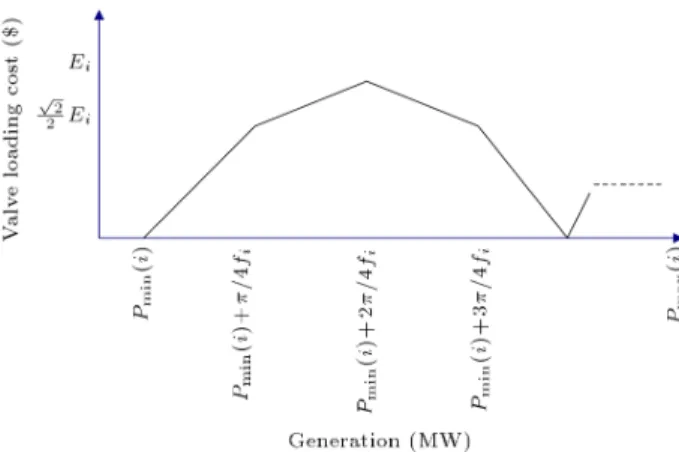
drawing eects, when steam admission valve starts to open [22]. Previous works [23-25] implement absolute sinus function of power generated by thermal units, considering valve point loadings, but this function is very non-smooth and non-convex, and can be an obstacle in MIP model. To overcome this obstacle, we proposed this linear formulation to cope with valve point loadings (Figure 2).
C(i; t) = 2fiei 8
> > < > > :
p 2 Pki
n=0[ 4n+1(i; t) 4n+4(i; t)]
+ 2 p2Pki
n=0[ 4n+2(i; t) 4n+3(i; t)]
9 > > = > > ;
8i 2 I; 8t 2 T; (8) where fi and ei are coecients of valve point eects
for ith thermal unit, and n(i; t) is power generated by
nth block.
p(i; t) =pmin(i)I(i; t)
+
ki
X
n=0
4n+1(i; t) + 4n+2(i; t)
+ 4n+3(i; t) + 4n+4(i; t)
8i 2 I; 8t 2 T; (9)
4fi1(i; t) 1(i; t)
4fiI(i; t)
8i 2 I; 8t 2 T; (10)
4fin(i; t) n(i; t)
4fin 1(i; t)
8i 2 I; 8t 2 T; n = 2; 3; ; xi; (11)
n(i; t) 2 f0; 1g 8i 2 I; 8t 2 T;
n = 1; 2; ; xi; (12)
where:
ki= oor[fipmax(i) p min(i)];
and:
xi= oor[4fipmax(i) p min(i)]:
Constraint (9) states that the power output of unit i at hour t is the sum of minimum power output, if the unit is on, plus the power generated in each block. Constraint (10) limits the power generated in rst block; this power should be greater than zero and smaller than or equal to =4fi, that is \power length"
of each block. In this constraint, I(i; t) is used ensuring that power generated of rst block is equal to zero, if unit i is o at hour t. To limit the generated power in each block, n(i; t) is introduced in Constraints (10) to
(12). This binary variable equals one, if the generated power of unit i at hour t has exceeded block n. 2.1.3. Dynamic ramping up/down limit
Ramp rate limit restricts the power output between two successive operating periods. The generators respond to hourly system load uctuations by increasing or decreasing the produced power. In this section, we use dynamic ramp rate with M POZs, and ramp rate is the function of power generation (Figure 3).
RUL(p(i; t)) =
M+1X n=1
RULn(i)n(i; t)
8i 2 I; 8t 2 T; (13)
RDL(p(i; t)) =
M+1X n=1
RDLn(i)n(i; t)
8i 2 I; 8t 2 T: (14) Constraints (13) and (14) indicate dynamic ramp limit with M POZs. The binary variables are used to indicate which operating zone has been selected. Another formulation for dynamic ramp rate is proposed in [26].
Figure 3. Ramping up limit as a stepwise linear function of generation with M POZs.
Figure 4. Piecewise linear start-up cost.
2.1.4. Stair-wise formulation of the time-dependent start-up cost function
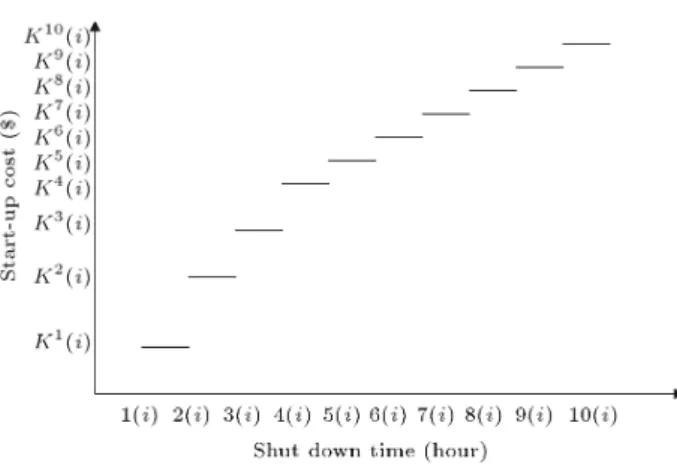
The start-up cost is modeled as a nonlinear (exponen-tial) function of the number of hours a unit has been o. Two dierent formulations for linear formulation of time-dependent start-up cost function are proposed in [27,28]. In [27,28], the start-up cost is modeled as a linear function of the number of hours a unit has been o (Figure 4). In this paper, the formulation of [27] is implemented, and by using large enough number of NL, start-up cost approximates the original exponential model.
B(i; t) =XNL
=1
K(i)w(i; t) 8i 2 I; 8t 2 T:
(15) The above equation represents the time varying start-up cost linear function, and K(i) is the cost of the th
discrete interval of the start-up cost of unit i. w(i; t)
is the binary variable and equals 1, if unit i is started-up at the beginning of hour t, and it has been o for hours.
NL
X
=1
w(i; t) = y(i; t) 8t 2 T; (16)
s(i; t 1) =
NL 1X =1
w(i; t) + (i; t)
8i 2 I; 8t 2 T; (17) NLwNL(i; t)
i(t) siwNL(i; t) y(i; t) + 1
8i 2 I; 8t 2 T; (18) w(i; t)2f0; 1g 8i2I; 82; 8t2T:
(19) Constraint (16) forces only one of the binary variables to be equal to 1, if unit i is started up. Eq. (17) relates
the variables to the time counter through a dummy variable (i; t). A Dummy variable is used when unit i is started up at hour t, which has been o for NL hours or longer, or is used when unit i is o at hour t. 2.1.5. Minimum Up Time (MUT) and Minimum
Down Time (MDT)
Linear expressions of minimum up time and minimum down time are stated as follows:
B(i)
X
t=1
[1 I(i; t)] = 0 8i 2 I; l; (20)
T1
X
=t
I(i; ) UT (i)y(i; t)
8i 2 I; T1= t + UT (i) 1;
8t = B(i) + 1; ; UT (i) + 1; (21)
X
=t
[I(i; ) y(i; t)] 0
8i 2 I; 8t = UTi+ 2; ; ; (22) C(i)
X
t=1
I(i; t) = 0 8i 2 I; (23)
T2
X
=t
[1 I(i; )] DT(i)Zi(t)
8i 2 I; T2= t + DT(i) 1;
8t = C(i) + 1; ; DT (i) + 1; (24)
X
=t
[1 I(i; ) z(i; t)] 0
8i 2 I; 8t = DT (i) + 2; ; ; (25) where:
B(i) = minf; (UT (i) U0(i))I0(i)g;
and:
C(i) = minf; [DT (i) s0(i)][1 I0(i)]g:
Once a unit is committed, it should not be turned o for a minimum number of hours. Eq. (20) is related to the initial status of the units if B(i) is less than UT (i), and this equation forced the unit to be on. Eq. (21) satisfy MUT limit for consecutive periods, and Eq. (22) satisfy MUT limit for the last hours. Once a unit decommitted, it should not be turned on for a minimum number of hours, and Constraints (23)-(25) enforce the MDT limit.
2.1.6. Power output limits
These constraints ensure that the power generated from each unit is constrained by the practical capacity limits of the thermal unit. Ramp-up rate limit, and the start-up and shut-down ramp rates limits are considered; therefore, they are more practical constraints and allows us to have rigorous modeling of thermal and hydro units in SCDHGS problem.
pmin(i)I(i; t)p(i; t)p(i; t) 8i2I; 8t2T;
(26) p(i; t)pmax(i) fI(i; t) z(i; t+1)g+SD(i)Z(i; t+1)
8i 2 I; 8t 2 T; (27) p(i; t + 1) p(i; t) SU(i)y(i; t + 1) + RUL(p(i; t))
8i 2 I; 8t 2 T; (28) p(i; t 1) p(i; t) SD(i)Z(i; t) + RDL(p(i; t))
8i 2 I; 8t 2 T: (29) Constraint (26) indicates that generation output limits and power output of each unit for each period is greater than minimum power output if unit is on and less than the upper limit of unit. The next constraint show the upper limit of real power generation of unit i at time study. Constraint (28) indicates the start-up ramp rate and Ramp-Up Limit (RUL), and Constraint (29) refers to the shut-down ramp rate and Ramp-Down Limit (RDL). In a majority of published papers, RUL and RDL were assumed xed, but in this paper, we use dynamic ramp rate to give a more accurate model.
The other thermal generation units constraints considered are: system spinning and operating reserve requirements [29], shut-down time counter [27] and log-ical status of commitment [30]. Beside the previously described thermal generation unit constraints, this paper also considers additional system-wide constraints such as fuel constraints and emission limits [28,31-33] in this formulation for representing the interactions among electricity market, fuel market and environ-ment. For the sake of brevity, the formulation of these constraints is not included in this paper. However, the interested reader is referred to mentioned references, where a precise formulation for these constraints is provided.
2.2. Cascaded-hydro units' model
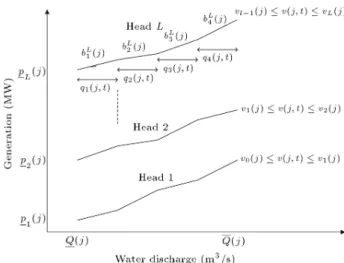
This section considers not only the nonlinear depen-dence between power generation, water discharge and head, but also the variable head of the associated reservoir (Figure 5), in order to obtain more realistic and feasible results. In most papers, the eect of the variation of head has been neglected and head is
Figure 5. Three-dimensional piecewise linear non-concave unit performance curve for hydro plant j at hour t.
assumed xed. For example, Ref. [30] presented a homogenous Interior Point (IP) method to solve the STHTC problem. Many constraints were considered in the model and eectiveness of the proposed model has been reported for medium-size and large-size case studies, but the eect of the variation of head has been neglected and head is assumed xed to avoid nonlin-earities, which allows using a single unit performance curve. Since this simplication may lead to inaccura-cies, in our paper, the eect of the variation of head is considered, and the proposed MILP model takes into account the accurate representation of the variation of performance curves with the reservoir head. Therefore, relationships between water discharge, generated power and multi-head of reservoir are presented in the set of curves instead of single unit performance curve. Moreover, to prevent unnecessary commitments and loss of water during maintenance and start-up period, the start-up cost of hydro plants are considered in the model. The proposed model takes into account head-dependent reservoirs with MIP formulations, as well as hydro plants, connected both in parallel and series (Figure 6). The number of heads for power plants is considered to be L in the following formulations (Figure 5).
2.2.1. Volume and head
In this part, the general formulations of hydro power plants with L heads are presented:
v(j; t) v0(j) 8j 2 J; 8t 2 T; (30)
v(j; t) vL(j)L 1(j; t)
+XL
n=2
vn 1(j)[n 2(j; t) n 1(j; t)]
8j 2 J; 8t 2 T; (31) v(j; t) vL 1(j)L 1(j; t)
+
L
X
n=3
vn 2(j)[n 2(j; t) n 1(j; t)]
8j 2 J; 8t 2 T; (32) 1(j; t) 2(j; t) L 1(j; t)
8j 2 J; 8t 2 T; (33) where 0(j; t) = 1.
Constraint (30) states that the volume of each hydro plant at each period should be greater than the minimum content of that hydro plant. Constraints (31) and (32) appoint right head corresponding to volume. It should be noted that Constraints (33) avoid the combination 0-1 for variables n(j; t). Note that
n(j; t) is equal to 1 when (n + 1)th head is used.
2.2.2. Piecewise linearization of variable head water-to-power conversion function
The power output of a hydro unit is, in general, a nonlinear function of the turbine discharge rate and the net head or, equivalently, the volume of the stored water in the reservoir. Due to the reservoirs small storage capacity and uctuations of water discharge and power output, which aects the plant head, a multi head reservoir is included in the proposed general MIP formulations. The linear relationship between generated powers, discharged water and variable head can be described by Constraints (34) and (35) as follow:
p(j; t) pk(j)I(j; t) X
n2N
qn(j; t)bkn(j)
p(j) "
(k 1) k 1X
n=1
n(j; t) + L 1X n=k
n(j; t)
#
0
8j 2 J; 8t 2 T; 1 k L; (34)
p(j; t) pk(j)I(j; t) X
n2N
qn(j; t)bkn(j)
+ p(j) "
(k 1) k 1X
n=1
n(j; t) + L 1X n=k
n(j; t)
#
0
8j 2 J; 8t 2 T; 1 k L: (35) The denition of the parameters and variables can be found in the Nomenclature Section.
2.2.3. Water discharge limits Q(j; t) = Q(j)I(j; t) +X
n2N
qn(j; t)
8j 2 J; 8t 2 T: (36) In the above constraint, Q(j; t) is water discharge of hydro plant j at hour t, and Q(j) is minimum water discharge of hydro plant j if it is on. For ooding prevention and irrigation requirements, the following constraint is needed.
(j; t) Q(j; t) + s(j; t) (j; t)
8j 2 J; 8t 2 T: (37) (j; t) and (j; t) are minimum and maximum water discharge of hydro plant j at hour t, respectively. Also, s(j; t) is the spillage of hydro plant j at hour t. Here, we use two blocks for linearization of the spillage-volume curve [14], which can be incorporated into the MIP problem.
q1(j; t) Q1(j)I(i; t) 8j 2 J; 8t 2 T; (38)
q1(j; t) Q1(j)h1(j; t) 8j 2 J; 8t 2 T; (39)
qn(j; t) Qn(j)hn 1(i; t)
8j 2 J; 8t 2 T; 8n 2 N; (40) qn(j; t) Qn(j)hn(j; t)
8j 2 J; 8t 2 T; 8n 2 N: (41) Constraints (38) and (39) restrict the rst block of water discharge, and Constraints (40) and (41) restrict other blocks of water discharge. Qn(j) is maximum water discharge of the nth block of hydro plant j. hn(j; k) is the binary variable and equal to one, if the
water discharge of hydro plant j at hour t exceeds the nth block.
2.2.4. Logical status of commitment
Constraint (42) is related to logical relationships be-tween three binary variables, i.e. start-up status, shut-down status and status of unit at each time. Besides, Constraint (43) is used for avoiding the simultaneous commitment and decommitment of each unit.
y(j; t) z(j; t) = I(j; t) I(j; t 1)
8j 2 J; t 2 T; (42) y(j; t) + z(j; t) 1 8j 2 J; t 2 T: (43) 2.2.5. Security constraints
In this paper, the transmission constraints will be formulated as linear constraints, based on a DC power ow model. DC power ow network model is more accurate than the linear power ow model. The physical ow in a transmission network is governed by Kircho's Current Law (KCL) and Kircho's Voltage Law (KVL), which are taken care in DC model. In contrast, the linear power ow model considers only KCL [34]. With DC power ow model, transmission constraints are formulated as linear constraints, and the practical constraints related to thermal plants, hydroelectric systems are represented by piecewise linear approximation; therefore, SCDHTG is a Mixed Integer Linear Programming (MILP) problem.
DC power ow equation in steady state:
NGXb
i=1
Pit PbtD= Lb
X
l=1
Plt 8b; 8t 2 T; (44)
Flt=X1
l(ls lr) 8b; 8t 2 T: (45)
Transmission ow limits in the base case: Fmax
lt Flt Fltmax 8l; 8t 2 T: (46)
The other hydro generation unit constraints can be consideredas: Initial and nal volume [14], water balance [30] and operating services [31]. Precise formulation for these constraints is formally dened in the mentioned references.
3. Case studies
We apply 3 case studies, consisting of a modied IEEE 118-bus system, to illustrate the impact of two important kinds of nonlinear behavior, which includes prohibited operating zone and valve point loading eects on SCDHGS. A modied IEEE 118-bus system is the largest SCUC test case with publicly available data that we could nd in literature, and has 54 thermal generating units (33 coal-red units, 11 gas-red units and 10 oil-gas-red units) and 8 hydro plants.
Table 1. Hourly load distribution over 24-hour period. Hour Load (MW) Hour Load (MW)
1 2730 13 3120
2 2574 14 2964
3 2262 15 3432
4 1560 16 3510
5 1950 17 3315
6 2340 18 3471
7 2730 19 3666
8 3042 20 3822
9 3198 21 3900
10 3432 22 3510
11 3471 23 3393
12 3276 24 3198
The peak load of 3900 MW occurs at hour 21. The IEEE test system used in [35] is also used here to test the performance of the proposed MIP optimization problem of SCDHGS. We use the same data for thermal units and constraint settings as described in [35]. The valve loading coecients and POZ data are given in [36], and the hourly load distribution over the 24-h 24-horizon is given in Table 1. For 24-hydro plants we use 3 performance curves and each performance curve is modeled through 4 blocks, as shown in Figure 5. The other detailed hydro generating unit data are taken from [14]. All cases in this section are calculated using a Pentium IV, 3 GHz personal computer with 1GB RAM. The models were implemented in GAMS, using CPLEX solver [37]. In each case, we run SCDHGS and DHGS solution by excluding transmission and voltage constraints, and then compare the results for nding the eect of security constraints on each case.
3.1. Case 1: SCDHGS problem, considering valve loading cost and not considering POZs
In this section, we focus on Valve Loading Cost (VLC) of thermal units and ignore POZs. Thermal units 5, 10, 11, 28, 36, 43, 44 and 45 have valve loading cost. The commitment schedule is shown in Table 2, in which 1 and 0 represent ON/OFF states of units at dierent hours, and hour 0 represents the initial condition. The daily operating cost is $782347.41. In this system, economical units (such as 4-5, 11, 44 and 45) are used as base units, and expensive units (such as 1-3, 6-9 and 46-51) are not committed at all, but when valve loading cost eect is considered, expensive thermal unit 52 should be committed in order to satisfy the load at peak hour. The remaining units are committed accordingly to satisfy hourly load demands, and the total generated power by thermal and hydro units in the period of study is equal to
Table 2. Case 1: With VLC and without POZ. Daily cost = $782347.412
Hours (0-24)
1-3 1000000000000000000000000 4-5 1111111111111111111111111 6-10 1000000000000000000000000 11 1111111111111111111111111 12-18 0000000000000000000000000 19 1111111111111111111111100 20-21 1111111111111111111111111 22-23 1000000000000000000000000 24-25 1111111111111111111111111 26 1000000000000000000000000 27-29 1111111111111111111111111 30-38 1000000000000000000000000 39 1111111111100000000000000 40 1111111111111111111111111 41-43 1000000000000000000000000 44-45 1111111111111111111111111 46-51 1000000000000000000000000 52 1111111111111111111111111 53-54 1000000000000000000000000 Hydro1 1111111111111111111111110 Hydro2 1111111111111111111111110 Hydro3 1111111111111111111111110 Hydro4 1111111111111111111000000 Hydro5 1111111111111111111111111 Hydro6 1100000000000011111111110 Hydro7 1111111111111111111110000 Hydro8 1111111111111111111111111
58631.12 MW and 15234.88 MW, respectively. For nding the eect of security constraints on this case, we calculate DHGS solution by excluding transmission and voltage constraints; transmission ow violations will occur on lines 41,126,136-139 at hours 19-23. The daily operating cost is $756321.518, which is cheaper than those considered security constraints. Compared with earlier situation, unit 4, 44 and expensive thermal unit 52 are decommitted at hours 1-24. Correspondingly, inexpensive thermal unit 10, 39 and hydro 4 are committed at certain hours (e.g., 1-24, 11-24 and 19-23) to compensate the reduced supply and to satisfy the physical constraints.
3.2. Case 2: SCDHGS problem, considering POZs and not considering valve loading cost
In this section, we ignore valve loading cost. Thermal units 7, 10, 30, 34, 35 and 47 have POZs limitations.
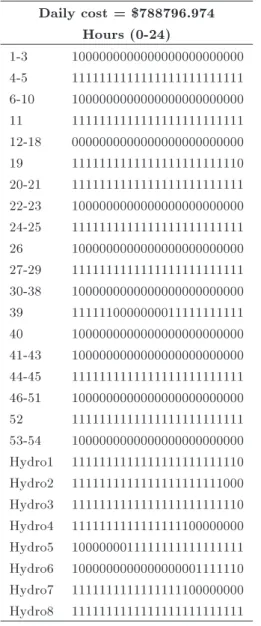
Table 3. Case 2: Without VLC and with POZ. Daily cost = $788796.974
Hours (0-24)
1-3 1000000000000000000000000 4-5 1111111111111111111111111 6-10 1000000000000000000000000 11 1111111111111111111111111 12-18 0000000000000000000000000 19 1111111111111111111111110 20-21 1111111111111111111111111 22-23 1000000000000000000000000 24-25 1111111111111111111111111 26 1000000000000000000000000 27-29 1111111111111111111111111 30-38 1000000000000000000000000 39 1111110000000011111111111 40 1000000000000000000000000 41-43 1000000000000000000000000 44-45 1111111111111111111111111 46-51 1000000000000000000000000 52 1111111111111111111111111 53-54 1000000000000000000000000 Hydro1 1111111111111111111111110 Hydro2 1111111111111111111111000 Hydro3 1111111111111111111111110 Hydro4 1111111111111111100000000 Hydro5 1000000011111111111111111 Hydro6 1000000000000000001111110 Hydro7 1111111111111111100000000 Hydro8 1111111111111111111111111
SCDHGS has a daily operating cost of $788796.97, as shown in Table 3. Compared with Case 1, thermal units 19 and 39 are committed at certain hours (e.g., 23, 14-24), and thermal unit 40 that was o in all 24 hours has been on. If we compare the daily operating cost of this case with respect to Case 1, it can be seen that the daily operating cost, considering prohibited operating zones, is higher than that of Case 1. Also, the total generated power of thermal and hydro units at the scheduling period is equal to 58360.49 MW and 15505.51 MW, respectively. Consequently, the total generated power of thermal units has been decreased in comparison with Case 1, but generated power of hydro units has been increased. When we calculate DHGS solution by excluding transmission and voltage constraints, transmission ow violations occur on the same line in Case 1, but at dierent hours. The daily operating cost is $748329.91, which is cheaper than what those security constraints are
considered. Compared with earlier situation, unit 4, 19, 44 and expensive thermal unit 52 are decommitted at hours 1-24. Correspondingly, inexpensive thermal unit 10, 40 and hydro 4, 5, 7 are committed at certain hours (e.g., 1-24, 11-24 and 17-23, 1-6, 17-22) to compensate the reduced supply and to satisfy physical constraints.
3.3. Case 3: SCDHGS problem with valve loading cost and POZs
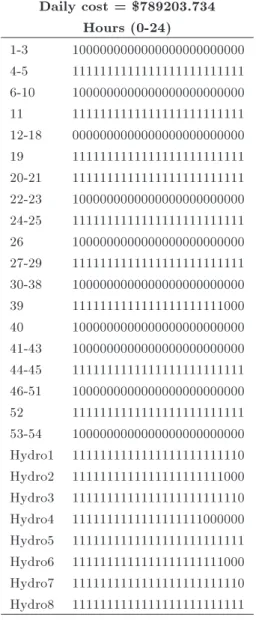
In this part, we consider the eects of valve loading cost and POZs on the optimal solution. The commitment schedule is shown in Table 4. The daily operating cost with considering valve loading cost and POZs is 789203.7343. For a better description, total generated power by thermal and hydro units for all case studies, over a 24-h period, is shown in Figure 7(a) and (b), respectively. Compared with Case 1, thermal units 19 and 39 are committed at certain hours (e.g.,
23-Table 4. Case 3: With VLC and with POZ. Daily cost = $789203.734
Hours (0-24)
1-3 1000000000000000000000000 4-5 1111111111111111111111111 6-10 1000000000000000000000000 11 1111111111111111111111111 12-18 0000000000000000000000000 19 1111111111111111111111111 20-21 1111111111111111111111111 22-23 1000000000000000000000000 24-25 1111111111111111111111111 26 1000000000000000000000000 27-29 1111111111111111111111111 30-38 1000000000000000000000000 39 1111111111111111111111000 40 1000000000000000000000000 41-43 1000000000000000000000000 44-45 1111111111111111111111111 46-51 1000000000000000000000000 52 1111111111111111111111111 53-54 1000000000000000000000000 Hydro1 1111111111111111111111110 Hydro2 1111111111111111111111000 Hydro3 1111111111111111111111110 Hydro4 1111111111111111111000000 Hydro5 1111111111111111111111111 Hydro6 1111111111111111111111000 Hydro7 1111111111111111111111110 Hydro8 1111111111111111111111111
Figure 7. Total generated power by thermal and hydro units in 3 case studies.
24, 12-21) and thermal unit 40 that was on in all 24 hours has been o and hydro units 6, 7 and are commited at more hours to compensate the reduced supply for decommitting of thermal unit 40, and to satisfy physical constraints. If we compare the daily operating cost of this case with respect to Cases 1 and 2, it can be seen that the daily operating cost, with considering the prohibited operating zones, is higher. Also, the total generated power of thermal and hydro units at the scheduling period is equal to 58993.96MW, 14872.04 MW, respectively. Consequently, the total generated power of thermal units has been increased in comparison with Case 1, but generated power of hydro units has been decreased, because of the additional practical constraint such as valve loading cost and POZs. For quick reference, the three case tests are briey described in Table 5.
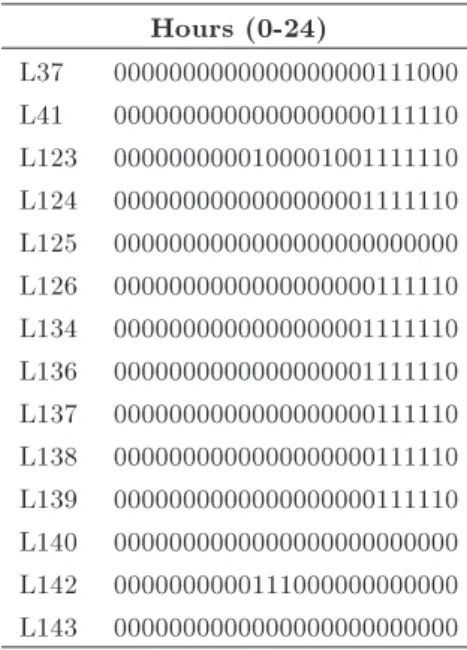
When we calculate DHGS solution by excluding transmission and voltage constraints, transmission ow violations occur on the same line in Case 1, but at dierent hours, beside the lines 140 and 143. Tables 6-8 show all the transmission ow violations on congested lines, for three case studies, without considering the security constraints in which 1 and 0 represent con-gested/uncongested status of lines at dierent hours, and hour 0 represents the initial condition. The daily operating cost is $747226.2916, which is cheaper than those considered with the security constraints. Compared with earlier situations, unit 4, 19, 43, 44 and expensive thermal unit 52 are decommitted at hours 1-24, and hydro 6, 7 are decommitted at certain hours (e.g., 1-18, 17-23). Correspondingly, inexpensive thermal units 10 and 40 are committed at certain hours (e.g., 1-24) to compensate the reduced supply and to satisfy the physical constraints. For more explanation,
Table 5. Daily operating cost in 3 cases.
With security constraints Without security constraints Daily operating cost ($) Daily operating cost ($)
Case 1 782347.412 756321.518
Case 2 788796.974 748329.915
Case 3 789203.7343 747226.2916
Table 6. Congested/uncongested status of violated lines in Case 1 (with VLC and without POZ).
Hours (0-24)
L37 0000000000000000000111000 L41 0000000000000000000111110 L123 0000000000100001001111110 L124 0000000000000000001111110 L125 0000000000000000000000000 L126 0000000000000000000111110 L134 0000000000000000001111110 L136 0000000000000000001111110 L137 0000000000000000000111110 L138 0000000000000000000111110 L139 0000000000000000000111110 L140 0000000000000000000000000 L142 0000000000111000000000000 L143 0000000000000000000000000
Table 7. Congested/uncongested status of violated lines in Case 2 (without VLC and with POZ).
Hours (0-24)
L37 0000000000000000000111000 L41 0011001000000000000111000 L123 0000000001000000111111100 L124 0000000001001000100111100 L125 0000000000000000000000000 L126 0000000001000000100000100 L134 0000000001001000100111100 L136 0000000001001000100111100 L137 0000000000000000100000100 L138 0000000000000000100000100 L139 0000000000000000000000100 L140 0000000000000000000000000 L142 0000000000000000011111000 L143 0000000000000000000000000
it can be seen from Tables 2-4 that POZ and VLC constraints cause changes in the amount of power generated by thermal and hydro units that have these constraints, and no changes in the condition of their unit commitment schedule. Figure 8 represents the
Table 8. Congested/uncongested status of violated lines in Case 3 (with VLC and POZ).
Hours (0-24)
L37 0000000000000000000011000 L41 0001000000010000100111000 L123 0000000000111001100111110 L124 0000000000111001100000000 L125 0000000000010001100000000 L126 0000000000111001100000000 L134 0000000000111001100000000 L136 0000000000111001100000000 L137 0000000000111001100000000 L138 0000000000111001100000000 L139 0000000000111001100000000 L140 0000000000010001100000000 L142 0000000000000000000111110 L143 0000000000011001100000000
Figure 8. Hydro units hourly load dispatch for Case 3.
hydro generation scheduling for Case 3, called hydro unit hourly load dispatch.
4. Conclusions
In this paper, the thorough and comprehensive MIP formulations for solving SCDHGS problem are pro-posed. The objective is to minimize the total cost while providing the total demand. The proposed framework consists of many practical constraints such as prohibited operating zones, valve point loadings, dynamic ramp rate, and fuel and emission limitations for thermal units. Furthermore, for hydro plants,
the multi performance curve with spillage and time delay between the reservoirs are considered. The main feature of the proposed framework refers to the linear nature of the formulations, which is very important for application of the model in large scale and real size power system. Therefore, the proposed scheme is practical to generate the appropriate information for ISOs, to decide how much power is generated by each generator. The results of implementing the proposed model show that the solution time of the problem is rationale. The research work under way is to present a stochastic model for SCDHGS.
Nomenclature
Indices
i Thermal unit index j Hydro unit index
t Time interval (hour) index Constants
Conversion factor equal to 3:6 10 3(Hm3s/m3h)
Number of periods of the planning horizon
(j; t) Minimum water discharge of unit j at hour t (m3/s)
(j; t) Maximum water discharge of unit j at hour t (m3/s)
ij Time delay between reservoir of plant
i and reservoir of plant j (h) Ai Shut down cost of unit i ($)
Aj Start-up cost of unit j ($)
bn(i) Slope of block n of fuel cost curve of
unit i ($/MWh)
bn(j) Slope of the volume block n of
the reservoir associated to unit j (m3/s/Hm3) (1 Hm3=106 m3)
bk
n(j) Slope of the block n of the performance
curve of k unit j (MW/m3/s)
ben(i) Slope of segment n in emission curve
of unit i
DT (i) Minimum down time of unit i (h) ei Valve loading coecient
fi Valve loading coecient
F (pu
n 1(i)) Cost of generation of (n 1)th upper
limit in fuel cost of unit i
F (j; t) Forecasted natural water inow of the reservoir associated to plant j in period t (Hm3/h)
K(i) Cost of the th discrete interval of the
start-up cost of unit i ($/h) I0(i) Initial status of unit i (0/1)
L Number of variable head
M Number of prohibited operation zones MSR(i) Maximum sustained ramp rate
(MW/Min)
MU Maximum number of the units that can be on at the same time
NL Number of blocks of the piecewise linearization of the variable cost function
pmin(i) Minimum power output of unit i (MW)
pmax(i) Maximum power output of unit i
(MW)
pn(j) Minimum power output of plant j for performance curve n (MW)
p(j) Capacity of plant j (MW) pd
n(i) Lower limit of nth prohibited zone of
unit i (MW) pu
n 1(i) Upper limit of (n 1)th prohibited
zone of unit i (MW)
Q(j) Minimum water discharge of hydro plant j if is on (m3/s)
Qn(j) Maximum water discharge of block n of plant j (Hm3)
RDLn(i) Ramp down limit for block n (MW)
RULn(i) Ramp up limit for block n (MW)
s0(i) Time periods of unit i has been
shut-down at the beginning of the planning horizon (h)
s(j) Maximum spillage of unit j (m3)
smax(i) Maximum hour unit i can be o (h)
SD(i) Shut-down ramp rate limit of unit i (MW/h)
SU(i) Start-up ramp rate limit of unit i (MW/h)
UT (i) Minimum up time of unit i (h)
U0(i) Time periods of unit i has been on-line
at the beginning of the planning horizon (h)
v0(j) Minimum content of the reservoir
associated to plant j (Hm3)
v0(j) Reservoir content at the beginning of
the study time (Hm3)
V(j) Reservoir content at the end of the
study time (Hm3)
vn(j) Maximum content of the reservoir j
Variables
n(i; t) Binary variable equal to 1, if block n of
fuel cost curve of unit i at hour t has been selected
n(j; t) Binary variable equal to 1, if variable
head n + 1 of unit j at hour t has been selected
n(i; t) Binary variable equal to 1, if power
output of unit i at hour t has exceeded block n
n(i; t) Generation of block n of fuel cost curve
of unit i at hour t (i; t) Dummy variable (h)
n(i; t) Generation of block n of unit i at hour
t of valve point loadings curve
n(j; t) Volume block n for the reservoir of
hydro plant j at hour t (MW) B(i; t) Start-up cost of unit i at hour t ($) bn(i) Slope of power block n of fuel cost
curve of unit i ($/MWh) bl
n(j) Slope of the block n of the performance
curve l of hydro plant j (MW/m3/s)
c(i; t) Valve point loadings cost of unit i at hour t ($)
F (i; t) Fuel cost of unit i at hour t ($) hn(j; t) Binary variable equal to 1 if the water
discharge of unit j at hour t has exceeded block n
I(i; t) Binary variable equal to 1, if unit i is on-line at hour t
I(j; t) Binary variable equal to 1, if hydro plant j is on-line at hour t
Iun(i; t) Binary variable equal to 1, if block n
of ramping up limit curve of unit i at hour t has been selected
p(i; t) Power for bid on spot market at hour t (MW)
p(j; t) Maximum power output of unit i at hour t (MW)
p(j; t) Maximum power output of unit j at hour t (MW)
Q(j; t) Water discharge of unit j at hour t (m3/s)
qn(j; t) Water discharge of block n of unit j at
hour t (m3/s)
RDL(p(i; t)) Ramping down limit of unit i at hour t (MW)
RUL(p(i; t)) Ramping up limit of unit i at hour t (MW)
s(i; t) Time periods in which unit i has been shut-down at hour t (h)
s(j; t) Spillage of the reservoir associated to unit j at hour t (m3/s)
v(j; t) Water content of the reservoir associated to plant unit j at hour t (Hm3)
w(i; t) Binary variable equal to 1, if unit i is
started up at the beginning of hour t and it has been oine for hours y(i; t) Binary variable equal to 1, if unit i is
started up at the beginning of hour t y(j; t) Binary variable equal to 1, if unit j is
started up at the beginning of hour t z(i; t) Binary variable equal to 1, if unit i is
shut-down at the beginning of hour t z(j; t) Binary variable equal to 1, if unit j is
shut-down at the beginning of hour t Sets
I Set of thermal units J Set of hydro units
N Set of indices of the blocks of the piecewise linearization of the unit performance curve
T Set of indices of the periods of the market time horizon
Set of the discrete intervals of the start-up cost function for thermal units j Set of upstream reservoirs of plant j
References
1. Wood, A.J. and Wollenberg, B.F., Power Generation Operation and Control, John Wiley & Sons, Inc, 2nd Edn., New York, USA (1996).
2. Guan, X., Ni, E., Li, R. and Luh, P.B. \An
optimization-based algorithm for scheduling hy-drothermal power systems with cascaded reservoirs and discrete hydro constraints", IEEE Transactions on Power Systems, 12, pp. 1775-1780 (1997).
3. Yang, J.S. and Chen, N. \Short term hydrothermal coordination using multi-pass dynamic programming", IEEE Transactions on Power Systems, 4, pp. 1050-1056 (1989).
4. Giuntoli, M. and Poli, D. \A novel mixed-integer linear algorithm to generate unit commitment and dispatch-ing scenarios for reliability test grids", International Review Electrical Engineering (IREE), 6(4), pp. 1971-1983 (2011).
5. Sifuentes, W.S. and Vargas, A. \Hydrothermal
scheduling using benders decomposition: accelerating techniques", IEEE Transactions on Power Systems, 22, pp. 1351-1359 (2007).
6. Srinivasa Rao, C. et al. \A modied genetic approach to hydrothermal system with thyristor controlled phase
shifter under open market system", International Re-view Electrical Engineering (IREE), 2(1), pp. 507-514 (2007).
7. Gavrilas, M. and Stahie, V. \Cascade hydro power plants optimization with honey bee mating optimiza-tion algorithm", Internaoptimiza-tional Review Electrical Engi-neering (IREE), 6(5), pp. 307-314 (2011).
8. Zoumas, C.E., Bakirtzis, A.G., Theocharis, J.B. and Petridis, V. \A genetic algorithm solution approach to the hydrothermal coordination problem", IEEE Transactions on Power Systems, 19, pp. 1356-1364 (2004).
9. Shahidehpour, M., Yamin, H. and Li, Z., Market
Operations in Electric Power System, New York, Wiley (2002).
10. Fu, Y., Shahidehpour, M. and Li, Z. \AC contingency dispatch based on security-constrained unit commit-ment", IEEE Transactions on Power Systems, 21(2), pp. 897-908 (2006).
11. Fu, Y., Shahidehpour, M. and Li, Z.
\Security-constrained unit commitment with AC constraints", IEEE Transactions on Power Systems, 20(3), pp. 1538-1550 (2005).
12. Arroyo, J.M. and Conejo, A.J. \Optimal response of a thermal unit to an electricity spot market", IEEE Transactions on Power Systems, 15(3), pp. 1098-1104 (2000).
13. Conejo, A.J., Contreras, J., Arroyo, J.M. and de la Torre, S. \Optimal response of an oligopolistic gen-erating company to a competitive pool-based electric power market", IEEE Transactions on Power Systems, 17(2), pp. 424-430 (2002).
14. Conejo, A.J., Contreras, J. and Villamor, F.A. \Self-scheduling of a hydro producer in a pool-based elec-tricity market", IEEE Transactions on Power Systems, 17(4), pp. 1265-1272 (2002).
15. Gonzalez, J.G. and Castro, G.A. \Short-term schedul-ing with cascaded and head-dependent reservoirs based on mixed, integer linear programming", IEEE Power Tech `01 Conference, Porto, Portugal, September (2001).
16. Wang, C. and Shahidehpour, M. \Ramp-rate limits in unit commitment and economic dispatch incorporating rotor fatigue eect", IEEE Transactions on Power Systems, 9(3), pp. 1539-1545 (1994).
17. Yan, H., Luh, P.B., Guan, X. and Rogan, P.M.
\Scheduling of hydrothermal power systems", IEEE Transactions on Power Systems, 8(3), pp. 1358-1365 (1993).
18. Daneshi, H., Choobbari, A.L., Shahidehpour, M. and Li, Z. \Mixed integer programming method to solve security constrained unit commitment with restricted operating zone limits", IEEE Int. Conference on Elec-tro/Information Technology EIT, pp. 187-192 (May 2008).
19. Fu, Y. and Shahidehpour, M. \Fast SCUC for large-scale power systems", IEEE Transactions on Power Systems, 22(4), pp. 2144-2151 (2007).
20. Orero, S.O. and Irving, M.R. \Economic dispatch of generators with prohibited operating zones: A genetic algorithm approach", Proc. Inst. Elect. Eng., Gen., Transm., Distrib., 143(6), pp. 529-534 (1996).
21. Bradley, S.P., Hax, A.C. and Magnanti, T.L., Applied Mathematical Programming, Addison Wesley Publish-ing Company, ReadPublish-ing, Massachusetts (1977).
22. Victoire, T., Jeyakumar, A. \Hybrid PSO-SQP for dynamic economic dispatch with valve-point eect", Electr Power Syst Res 2004, 71(1), pp. 51-9 (2004).
23. Walters, D.C. and Sheble, G.B. \Genetic algorithm so-lution of economic dispatch with valve point loading", IEEE Transactions on Power Systems, 8(3), pp. 1325-1332 (1993).
24. Selvakumar, A.I. and Thanushkodi, K. \A new particle swarm optimization solution to non-convex economic dispatch problems", IEEE Transactions on Power Systems, 22(1), pp. 42-51 (2007).
25. Amjady, N. and Rad, H.N. \Non-convex economic dis-patch with AC constraints by a new real coded genetic algorithm", IEEE Transactions on Power Systems, 24(3), pp. 1489 -1502 (2009).
26. Li, T. and Shahidehpour, M. \Dynamic ramping
in unit commitment", IEEE Transactions on Power Systems, 22(3), pp. 1379-1381 (2007).
27. Arroyo, J.M. and Conejo, A.J. \Optimal response of a thermal unit to an electricity spot market", IEEE Transactions on Power Systems, 15(3), pp. 1098-1104 (2000).
28. Li, T. and Shahidehpour, M. \Price-based unit com-mitment: a case of Lagrangian relaxation versus mixed integer programming", IEEE Transactions on Power Systems, 20(4), pp. 2015-2025 (2005).
29. Li, Z. and Shahidehpour, M. \Security-constrained unit commitment for simultaneous clearing of energy and ancillary services markets", IEEE Transactions on Power Systems, 20(2), pp. 1079-1088 (2005).
30. Bisanovic, S., Hajro, M. and Dlakic, M. \Hydrother-mal self-scheduling problem in a day-ahead electricity market", Electric Power System Research, 78(9), pp. 1579-1596 (2008).
31. Wu, L., Shahidehpour, M. and Li, T. \Stochastic security-constrained unit commitment", IEEE Trans-actions on Power Systems, 22(2), pp. 800-811 (2007).
32. Li, T. and Shahidehpour, M. \Risk-constrained gen-eration asset arbitrage in power systems", IEEE Transactions on Power Systems, 22(3), pp. 1330-1339 (2007).
33. Ahmadi, A., Aghaei, J., Shayanfar, H.A. and Rabiee, A. \Mixed integer programming of multi objective hydro-thermal self scheduling", Applied Soft Comput-ing, 12, pp. 2137-2146 (2012).
34. Parvania, M. and Fotuhi-Firuzabad, M. \Demand re-sponse scheduling by stochastic SCUC", IEEE Trans-actions on Smart Grid, 1(1), pp. 89-98 (2010).
35. [Online]. Available: http://motor.ece.iit.edu/data/ SCUC 118test.xls
36. [Online]. Available: http://motor.ece.iit.edu/data/ 118 nonsmooth.xls
37. Brooke, A., Kendrick, D. and Meeraus, A.,
GAMS: A User's Guide. Redwood City, CA: The Scientic Press, 1990. [Online]. Available: http://www.gams.com/docs/document.htm.
Biographies
Mehdi Karami was born in Abadeh, Iran, in 1979. He received his BSc and MSc degrees in Electrical Engineering in 2002 and 2004, from Tehran University and Iran University of Science and Technology (IUST), respectively. Currently, he is pursuing his PhD degree at IUST in electrical engineering. His research interests include application of articial intelligence to power system control, power system restructuring, power system economics and optimization. He is a member of Iranian Association of Electrical and Electronic Engineers (IAEEE).
Heidar Ali Shayanfar was born in Zabol, Iran, in 1951. He received his BSc and MSE degrees in Elec-trical Engineering in 1973 and 1979, respectively, and his PhD degree in electrical engineering from Michigan
State University, U.S.A., in 1981. Currently, he is a full professor at Electrical Engineering Department of Iran University of Science & Technology (IUST), Tehran, Iran. His research interests are in the application of articial intelligence to power system control design, dynamic load modeling, power system observability studies and voltage collapse. He is a member of Ira-nian Association of Electrical and Electronic Engineers (IAEEE) and IEEE.
Jamshid Aghaei received his BSc degree in Electrical Engineering from Power and Water Institute of Tech-nology (PWIT) in 2003, and his MSc and PhD degree from Iran University of Science and Technology (IUST) in 2005 and 2009, respectively. His research interests are renewable energy systems, smart grids, electricity markets and power system operation and restructuring. He is a member of Iranian Association of Electrical and Electronic Engineers (IAEEE).
Abdollah Ahmadi was born in Janah, Iran, 1984. He received his BS degree in Electrical Engineering from Shiraz University, Shiraz, 2007, and his MS degree in Electrical Engineering from Iran University of Science and Technology (IUST), Tehran, 2011. His research interests include power system operation and economic in deregulated market environment, load and price forecasting.