Bugs as Deviant Behavior: A General Approach
to Inferring Errors in Systems Code
D a w s o n E n g l e r , D a v i d Y u C h e n , S e t h H a l l e m , A n d y C h o u , a n d B e n j a m i n C h e l f C o m p u t e r S y s t e m s L a b o r a t o r y
S t a n f o r d U n i v e r s i t y S t a n f o r d , C A 9 4 3 0 5 , U . S . A .
Abstract
A major obstacle to finding program errors in a real sys- tem is knowing what correctness rules the system must obey. These rules are often u n d o c u m e n t e d or specified in an ad hoc manner. This paper demonstrates tech- niques that automatically extract such checking infor- mation from the source code itself, rather t h a n the pro- grammer, thereby avoiding the need for a priori knowl- edge of system rules.
The cornerstone of our approach is inferring pro- grammer "beliefs" that we then cross-check for contra- dictions. Beliefs are facts implied by code: a dereference of a pointer, p, implies a belief that p is non-null, a call to "tmlock(1)" implies that 1 was locked, etc. For be- liefs we know the programmer must hold, such as the pointer dereference above, we immediately flag contra- dictions as errors. For beliefs that the programmer may hold, we can assume these beliefs hold a n d use a sta- tistical analysis to rank the resulting errors from most to least likely. For example, a call to "spin_lock" fol- lowed once by a call to "spin_tmlock" implies that the programmer may have paired these calls by coincidence. If the pairing happens 999 out of 1000 times, though, then it is probably a valid belief and the sole deviation a probable error. The key feature of this approach is that it requires no a priori knowledge of truth: i f two beliefs contradict, we know that one is an error without knowing what the correct belief is.
Conceptually, our checkers extract beliefs by tailor- ing rule "templates" to a system - for example, finding all functions that fit the rule template " < a > must be paired with < b>." We have developed six checkers t h a t follow this conceptual framework. They find hundreds of bugs in real systems such as Linux and OpenBSD. From our experience, they give a dramatic reduction in the manual effort needed to check a large system. Com- pared to our previous work [9], these template checkers find ten to one hundred times more rule instances and derive properties we found impractical to specify man- ually.
Permission to make digital or hard copies of all or part of this work for personal or classroom use is granted without fee provided that copies are not made or distributed for profit or commercial advan- tage and that copies bear this notice and the full citation on the first page. To copy otherwise, to republish, to post on servers or to
redistribute to lists, requires prior specific permission and/or a fee. SOSP01 Banff, Canada
© 2001 ACM ISBN 1-58113-389-8-1/01/10°..$8.00
1 Introduction
We want to find as many serious bugs as possible. In our experience, the biggest obstacle to finding bugs is not the need for sophisticated techniques nor the lack of either bugs or correctness constraints. Simple tech- niques find m a n y bugs and systems are filled with both rules and errors. Instead, the biggest obstacle to find- ing m a n y bugs is simply knowing what rules to check. Manually discovering any significant n u m b e r of rules a system must obey is a dispiriting adventure, especially when it must be repeated for each new release of the system. In a large open source project such as Linux, most rules evolve from the uncoordinated effort of hun- dreds or thousands of developers. The end result is an ad hoc collection of conventions encoded in millions of lines of code with almost no documentation.
Since manually finding rules is difficult, we instead focus on techniques to automatically extract rules from source code without a priori knowledge of the system. We want to find what is incorrect without knowing what is correct. This problem has two well-known solutions: contradictions a n d common behavior. How can we de- tect a lie? We can cross-check statements from m a n y witnesses. If two contradict, we know at least one is wrong without knowing the truth. Similarly, how can we divine correct behavior? We can look at examples. If one person acts in a given way, it may be correct behav- ior or it may be a coincidence. If thousands of people all do the same action, we know the majority is probably right, a n d any contradictory action is probably wrong
without knowing the correct behavior.
Our approach collects sets of programmer beliefs,
which are then checked for contradictions. Beliefs are facts about the system implied by the code. We ex- amine two types of beliefs: MUST beliefs and MAY be- liefs. MUST beliefs are directly implied by the code, and there is no doubt t h a t the programmer has that belief. A pointer dereference implies t h a t a programmer must believe the pointer is non-null (assuming they want safe code). MAY beliefs are cases where we observe code features that suggest a belief b u t may instead be a co- incidence. A call to "a" followed by a call to "b" implies the programmer may believe they must be paired, b u t it could be a coincidence.
Once we have a set of beliefs, we do two things. For a set of MUST beliefs, we look for contradictions. Any contradiction implies the existence of an error in the code. For a set including MAY beliefs, we must separate valid beliefs from coincidences. We start by assuming all MAY beliefs are MUST beliefs a n d look
for violations (errors) of these beliefs. We then use a statistical analysis to rank each error by the probability of its beliefs. If a particular belief is observed in 999 out of 1000 cases, then it is probably a valid belief. If the belief happens only once, it is p r o b a b l y a coincidence.
We apply the above approach by combining it with our prior work [9]. T h a t work used system-specific static analyses to find errors with a fixed set of manually found and specified rules ( e . g . , " s p i n _ l o c k ( 1 ) must be paired with s p i n _ u n l o c k ( l ) ' ) . It leveraged the fact t h a t ab- stract rules commonly m a p to fairly simple source code sequences. For example, one can check the rule above by inspecting each p a t h after a call to " s p i n _ l o c k ( l ) " to ensure t h a t the p a t h contains a call to " s p i n _ u n l o c k (1)." While effective, this previous work was limited by the need to find rules manually. This p a p e r describes how to derive rule instances automatically: our system infers the pairing rule above directly from the source code.
Experience indicates t h a t this approach is far bet- ter t h a n the alternative of manual, t e x t - b a s e d search to find relevant rule instances. The analyses in this paper automatically derive all the rule instances previously hand-specified in [9], as well as an additional factor of ten to one hundred more. Further, we now check prop- erties t h a t we formerly gave up on (see Section 7). We d e m o n s t r a t e t h a t the approach works well on complex, real code by using it to find hundreds of errors in the Linux and OpenBSD operating systems. Many of our bugs have resulted in kernel patches.
Section 2 discusses related work. Sections 3-5 give an overview of the approach, and Sections 6-9 apply it to find errors. Section 10 concludes.
2 Related Work
There are m a n y methods for finding errors. The most widely used, testing and manual inspection, suffer from the exponential number of code p a t h s in real systems and the erratic nature of h u m a n judgment. Below, we compare our approach to other m e t h o d s of finding errors in software: t y p e systems, specification-based checking, and high-level compilation. We close by comparing our work with two systems t h a t dynamically infer invari- ants.
T y p e s y s t e m s . Language t y p e systems probably find more bugs on a daily basis t h a n any other approach. However, m a n y program restrictions--especially t e m p o - ral or context-dependent r e s t r i c t i o n s - - a r e too rich for an underlying t y p e system or are simply not expressed in it. While there has been some work on richer frame- works such as T y p e S t a t e [23], Vault [6], and aspect- oriented programming [17], these still miss m a n y sys- tems relations and require p r o g r a m m e r participation. Further, from a tool perspective, all language approaches require invasive, strenuous rewrites to get results. In contrast, our approach t r a n s p a r e n t l y infers richer, system- specific invariants without requiring the use of a specific language or ideology for code construction.
Traditional t y p e systems require p r o g r a m m e r s to lace a fixed t y p e system throughout their code. We take the opposite approach of inferring an ad hoc t y p e sys- tem implicit in programs and then p u t t i n g this into the compiler. As a side-effect, we show t h a t code features believed to require specification can be pulled from the source directly (see Section 7).
Specifications.
Another approach is to specifycode and then check this specification for errors. An extreme example of this approach is formal verifica- tion. It gains richness by allowing the p r o g r a m m e r to express invariants in a general specification, which is then checked using a model checker [19, 22], theorem provers, or checkers [13, 20]. While formal verification can find deep errors, it is so difficult and costly t h a t it is rarely used for software. Further, specifications do not necessarily mirror the code t h e y a b s t r a c t and suffer from missing features and over-simplifications in prac- tice. While recent work has begun attacking these prob- lems [5, 15, 18], verifying software is still extremely rare. The SLAM project [2] is a promising variation on this approach. It extracts and then model checks a Boolean variable p r o g r a m skeleton from C code. However, it re- quires considerably more effort t h a n our approach, a n d appears to check a more limited set of properties.
Recent work has developed less heavyweight check- ers, n o t a b l y the e x t e n d e d static t y p e checking (ESC) project [7], which checks interface-level specifications and LCLint [11], which statically checks p r o g r a m m e r source annotations. However, these approaches still re- quire more effort t h a n those in this paper. The speci- fications required by these approaches scale with code size. In contrast, our analyses cost a fixed a m o u n t to construct b u t t h e n repay this cost by a u t o m a t i c a l l y ex- tracting checking information from large i n p u t codes. In a sense, our work is c o m p l e m e n t a r y to these other ap- proaches, since the information e x t r a c t e d by our anal- yses can be used to check t h a t specifications correctly describe code.
The Houdini assistant to ESC [12] is one effort to de- crease the manual labor of a n n o t a t i o n - b a s e d approaches. Houdini uses annotation t e m p l a t e s to a u t o m a t i c a l l y de- rive ESC annotations, then uses those annotations to statically find r u n t i m e errors in Java programs. One difference between our approach and theirs is t h a t we allow for much noisier samples when deriving our rule templates, then we use statistical analysis to r a n k the derived rules.
H i g h - l e v e l C o m p i l a t i o n . Many projects have em- b e d d e d hard-wired application-level information in com- pilers to find errors [1, 3, 4, 8, 21, 24]. These projects find a fixed set of errors, whereas we derive new checks from the source itself, allowing detection of a broader range of errors. T h e checking information we e x t r a c t could serve as inputs to suitably modified versions of these other checkers.
D y n a m i c i n v a r i a n t i n f e r e n c e . The two most sig- nificant projects in this area are Dalkon and Eraser. Dalkon is the most similar project to ours in terms of deriving p r o g r a m rules [10]. Daikon dynamically moni- tors program execution to reconstruct simple algebraic invariants. It s t a r t s with a set of mostly linear build- ing block hypotheses ( t h a t a variable is a constant, t h a t it is always less t h a n or greater t h a n another variable) and validates each hypothesis against each execution trace. If a trace violates a hypothesis, the hypothe- sis is discarded. C o m p a r e d to static analysis, d y n a m i c monitoring has the advantage t h a t noise and undecid- ability is less of a concern: by definition, an executed p a t h is possible, and at runtime, all values can be deter- mined. However, the accuracy of d y n a m i c monitoring
has a cost. Daikon is primarily intended to help un- derstand programs. It has found very few errors and would have several significant difficulties in doing so: it can only see executed paths, requires test cases t h a t ad- equately exercise the code it monitors, and can only ob- serve how code works in the tested environment. Static analysis does not have any of these problems.
In terms of desire to find bugs, the Eraser system is most similar to our work [21]. Eraser dynamically detects data races by monitoring which locks protect which variables. Inconsistent locking is flagged as an error. Eraser has been effective at finding real bugs [21]. However, because it is dynamic it has similar limitations to Daikon: it only sees a limited n u m b e r of paths, re- quires the ability to monitor code, a n d can only flag an
e r r o r when a path is executed.
Of course, dynamic information can be quite useful. In future work we intend to explore how static analy- sis can be augmented with dynamic monitoring. One possibility is using profile data to rank bugs.
3 Methodology
This section introduces our approach and terminology for finding bugs. The goal of our approach is to extract beliefs from code and to check for violated beliefs.
We restrict our attention to beliefs t h a t fit generic rule
templates.
An example template is"<a>
must be paired with <b>." In this example, the bracketed let- ters < a > and < b > represent positions in our template that the extraction process should fill with concrete el- ements from the code. We call these positionsslots
and code elements that fill slotsslot instances.
Possible slot instances for slots < a> and < b> could be the function calls l o c k and u n l o c k respectively.The remainder of this section explains how we ap- ply a template to a new, unknown system and end up with hundreds of automatically-detected bugs. We be- gin with a detailed example of a null-pointer-use checker. This example introduces a general approach t h a t we call
internal consistency.
We then present a detailed description of a locking-discipline checker, which intro- duces an approach we callstatistical analysis.
We con- clude by describing the system we use to implement our checkers and the systems that we check.3.1 Example: null
pointer consistency
This subsection illustrates how internal consistency can find errors by applying it to one of the simplest possible problems: detecting null-pointer uses statically. Con- sider the following code fragment, which compares the pointer card against null and then dereferences it:
/ * 2 . 4 . 1 : d r i v e r s / i s d n / a v m b l / c a p i d r v , c : * / 1: i f ( c a r d == NULL) {
2: p r i n t k ( K E R N _ E R R " c a p i d r v - ~ d : . .. 7,d!\n", 3: c a r d - > c o n t r n r , id) ;
4: }
At line 1, the check card == NULL implies the belief that card is null on the true path of the conditional. However, at line 3 the dereference c a r d - - ~ c o n t r n r im- plies the belief that card is not null: a contradiction. A consistency checker can find such errors by associat- ing every pointer, p, with a
belief set
a n d flagging cases where beliefs contradict. For our example, p's belief set could contain nothing (nothing is known about p), "null" (p is definitely null), "not null" (p is definitelynot null), or both "null" a n d "not null" (p could be ei- ther). Any code element, or
action,
implying a belief that contradicts p's current belief set is an error.Note that, while not relevant for the error above, the comparison action at line 1 also implies that p's belief set should contain both "null" and "not null" before line 1. Otherwise, this check is pointless. This implied belief set is useful in a different piece of code:
/ * 2 . 4 . 7 : d r i v e r s / c h a r / m x s e r , c * /
l : i n t m x s e r _ w r i t e ( s t r u c t t t y _ s t r u c t * t t y , . . . ) { 2 : s t r u c t m x s e r _ s t r u c t * i n f o = t t y - > d r i v e r _ d a t a ;
3 : u n s i g n e d l o n g f l a g s ; 4 :
5: i f ( ! t r y l[ ! i n f o - > x m i t _ b u f ) 6 : r e t u r n (0) ;
~: . . .
At line 2, 1;ty--~driver_data dereferences t r y , b u t at line 5 the check ! t r y implies t r y could be null. Either the check is impossible and should be deleted, or the code has a potential error and should be fixed. The following beliefs are inferred on each line:
Line 1: entry to mxser_write. Assuming we do not have inter-procedural information, the checker sets t t y ' s belief set to "unknown," otherwise we set it to its value at the caller.
Line 2: the checker sets t t y ' s belief set to "not null." Lines 3 a n d 4 have no impact on the belief set. We say
a belief set is
propagated
when it moves from one action to another. In this case, the belief set after line 2 is propagated forward through lines 3 and 4 to line 5.Line 5: implies a belief set for t t y containing both "null" a n d "not null." However, the only path to this condition has a belief set of "not null," which contradicts the implied belief set.
We formalize the framework for internal consistency check- ers below.
3.2 General internal consistency
Consistency checkers are defined by five things: 1. The rule template T.
2. The valid slot instances for T. 3. The code actions that imply beliefs.
4. The rules for how beliefs combine, including the rules for contradictions.
5. The rules for belief propagation.
The rule template T determines what property the checker tests. The checker's job is to find a n d check valid slot instances for the template, T. For example, the null- pointer checker's template is
"do
not dereference null pointer < p > , " and all pointers are potentially valid slot instances for < p > . Each slot instance has an associated belief set. At each action, we consider how that action effects the belief sets for each slot instance. For the checker above, if an action is a dereference of a pointer p, the action can either (1) signal an error if p's belief set contains the belief "null," or (2) add the belief "not null" to p's belief set. If an action implies a belief, wemust also consider how t h a t belief propagates to other actions. A comparison, p == NULL, propagates the be- lief that p is "null" to all subsequent actions on its true branch, the belief that p is "not null" to all subsequent actions on its false branch, and the belief that p could be either "null" or "not null" when these paths join. In general, beliefs can propagate forward, backward, from caller to callee, between functions that implement the same abstract interface either within the same program or across programs, or to any other piece of
related code.
We give a more complete discussion of related code in Section 4.2.
More formally, for any slot instance v, we denote its belief set as B~. The null checker associates each pointer p with a belief set Bp that can take on the values
Bp
={null} (p
is definitely null),Bp = {notnull} (p
isdefinitely not null), or
Bp = {null, notnull} (p
could be either null or not null). By convention an empty belief set, Bp = 0, means nothing is known about p.Most actions have no impact on the current belief sets other t h a n propagating them forward unaltered to the next statement. The null checker above had two actions t h a t imply beliefs: dereferences and compar- isons. These actions affect the belief set of one valid slot instance, i.e. the pointer, p, that is dereferenced or compared to null. A dereference of pointer p im- plies the belief
notnuU (Bp = {notnuii})
a n d gives an error if p's belief set containsnull (null E Bp).
Comparison implies two things. First, p's belief set prior to the comparison contains both null a n d notnull
(Bp : {null, notnull}).
An error is given if the be-liefs are known more precisely (error if
Bp = {null}
orBp = {notnuU})).
Second, after the conditional, p isnull on the true path
(B~ = {null}),
and not null on the false(Bp = {notnull} ).
One complication when propagating beliefs is what happens when different paths join. The null checker takes the union of all beliefs on the joining paths. For the first example, card's belief set is
Bp = {null}
on the true path after the comparison card==
NULL, Bp ={notnull}
on the false path, b u t becomes Bp ={null,
notnull}
when the paths join after line 4.3.3 Example: statistical lock inference
This subsection illustrates how statistical analysis can find errors in sets of MAY beliefs. We use statistical analysis to rank MAY belief errors from most to least probable.
Consider the problem of detecting when a shared variable v is accessed without its associated lock l held. If we know which locks protect which variables, we can readily check this rule using static analysis. Unfortu- nately, most systems do not specify "lock < l > protects variable < v > . " However, we can derive this specifica- tion from the code by seeing what variables are "usu- ally" protected by locks. If v is almost always protected by l, it may be worth flagging cases where it is not.
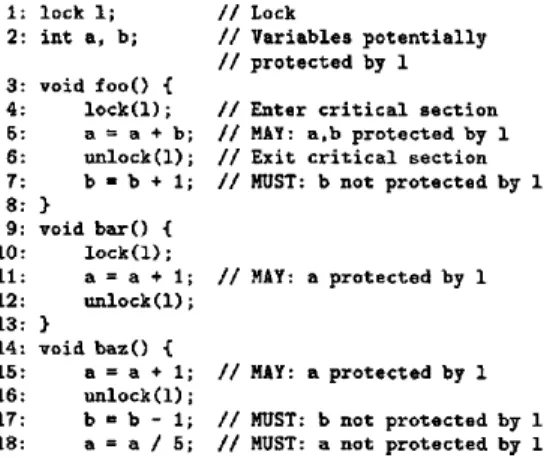
Consider the contrived code example in Figure 1 with two shared variables, a and b, that may or may not be protected by a lock 1. Here, a is used four times, three times with 1 held, and once without 1 held. In contrast, b is indifferently protected with 1: not protected twice, and protected once in a plausibly- coincidental situation. Intuitively, a is much more plau-
I: l o c k i ;
2: i n t a, b;
3: v o i d f o o O { 4: l o c k ( 1 ) ; 5: a = a + b;
8: u n l o c k ( l ) ; 7: b = b + 1;
8: }
9: v o i d b a r ( ) { I 0 : l o c k ( 1 ) ; 11: a = a + 1; 12: u n l o c k ( l ) ;
1 3 : }
14: v o i d b a z O {
1 5 : a = a + I;
16: u n l o c k ( i ) ;
1 7 : b = b - 1;
18: a = a / 5; 19: }
/ / Lock
/ / V a r i a b l e s p o t e n t i a l l y / / p r o t e c t e d by 1
/ / E n t e r c r i t i c a l s e c t i o n / / MAY: a , b p r o t e c t e d by 1 / / E x i t c r i t i c a l s e c t i o n / / MUST: b n o t p r o t e c t e d by 1
/ / MAY: a p r o t e c t e d by 1
/ / MAY: a p r o t e c t e d by 1
/ / MUST: b n o t p r o t e c t e d by 1 / / MUST: a n o t p r o t e c t e d by i
Figure 1: A contrived, useful-only-for-illustration exam- ple of locks a n d variables
sibly protected by 1 t h a n b. This belief is further strength- ened by the fact t h a t a is the only variable accessed in the critical section at line 11 - either the acquisition of i is spurious (locks must protect
something)
a n d should be fixed, or the programmer believes 1 protects a.Our checking problem reduces to inferring if code
believes l
protects v. If a use of variable v protected bylock l implied the MUST belief t h a t l protects v, then we could check the rule above using internal consistency. However, the protected access could simply be a coinci- dence, since accessing unprotected variables in critical sections is harmless. Thus, we can only infer t h a t code
may
believe ! protects v. We call this type of belief a MAY belief.How can we check MAY beliefs? I n all cases we con- sider in this paper, the MAY belief reduces to whether or not candidate slot instances should be checked with a rule T. For the example above, should a given variable a a n d lock 1 be checked with the template "variable a must be protected by lock 1?" A n effective way to de- termine if such a MAY belief is plausible is simply to act on it: check the belief using internal consistency and record how often the belief satisfied its rule versus gave an error. We can use these counts to rank errors from most to least credible (essentially ranking the belief by how often it was true versus its negation). The more checks a belief passes, the more credible the (few) vio- lations of it are, and the higher these errors are ranked. The highest ranked errors will be those with the most examples a n d fewest counter-examples, the middle will be beliefs violated much more often, and the b o t t o m er- rors will be from almost-always violated beliefs. W h e n inspecting results, we can start at the top of this list a n d work our way down until the noise from coinciden- tal beliefs is too high, at which point we can stop.
For the code above, we would treat both MAY be- liefs, ' t protects a" and ' t protects b," as MUST be- liefs. Before checking whether a lock protects a variable, though, we must first determine whether the lock is held at all. Beliefs about locks propagate both forward a n d backward from l o c k and u n l o c k actions: l o c k ( l ) im- plies a belief that 1 was not locked before, b u t locked afterwards, a n d u n l o c k ( i ) implies a belief t h a t 1 was
locked before, b u t unlocked afterwards. (As a side- effect, this checker could catch double-lock a n d double- unlock errors.)
Using the lock belief sets, we can then record for each variable (1) how it was checked with the rule (once for each access: four times for a, three for b) and (2) how many times the variable failed the check. I.e., the n u m b e r of times it was accessed where Bl = {unlocked}
(one for a, two for b). Since a is usually protected by 1, the unprotected access at line 18 is probably a valid er- ror. Since b has more errors t h a n correct uses, we would usually discard it. (Programmers are usually right. If they are not, then we have much bigger concerns t h a n a few concurrency bugs.) More generally, we use the "hypothesis test statistic" to rank errors based on the ratio of successful checks to errors. This statistic favors samples with more evidence, and a higher ratio of ex- amples to counter-examples. We discuss this statistic further in Section 5.
3.4 General statistical analysis
For this paper, the only MAY beliefs that concern us are whether a particular set of slot instances can be checked with a rule template T. Thus, conceptually, a statistical checker is an internal consistency checker with three modifications:
1. It applies the check to all potential slot instance combinations. I.e., it assumes that all combina- tions are MUST beliefs.
2. It indicates how often a specific slot instance com- bination was checked a n d how often it failed the check (errors).
3. It is augmented with a function, rank, t h a t uses the count information above to rank the errors from all slot combinations from most to least plau- sible.
For the lock checker above, this would mean that the checker would consider all variable-lock pairs (v, l) as valid instances. For each pair (v, l), it emits an error message at each location where v was used without lock I held, and a "check" message each time v was accessed. For the code above, there are two possible slot combi- nations, (a, 1) and (b, 1). The instance (a, 1) has four check messages (lines 5, 11, 15, 18) and one error (line 18). The instance (b, 1) has three check messages (lines 5, 7, 17) and two errors (lines 7 and 17).
There are two practical differences between inter- nal consistency and statistical checkers. First, for good results, statistical analysis needs a large enough set of cases. In contrast, an internal consistency checker can give definitive errors with only two contradictory cases. Second, to make the universe of slot instances more manageable, a statistical checker may use an optional pre-processing pass that filters the universe of possible slot instances down to those that are at least moderately plausible.
This technique applies to m a n y types of system rules. While internal consistency flags all cases where there are conflicting beliefs as errors, statistical analysis can be used even when the set of checks a n d errors is noisy.
sm i n t e r n a l _ n u l l _ c h e c k e r state decl any_pointer v;
/* Initial start state:,match any pointer c o m p a r e d to NULL in code, put it in a ~null ~ state on true path, ignore it on false path. */ start :
{ (v == NULL) } ==> true=v.nu11, f a l s e = v . s t o p i { (v != NULL) } ==> true=v.stop, false=v.null
/* Give an error if a p o i n t e r in the null state is dereferenced in code. * /
v.nall:
{ *v } ==> { err("Dereferencin E NULL ptr!"); } }
Figure 2: A simple metal extension t h a t flags when pointers compared to null are dereferenced.
3.5 How we implement checkers
We write our analyses in metal (see Figure 2), a high- level state machine (SM) language for writing system- specific compiler extensions [9]. These extensions are dynamically linked into xgcc, an extended version of the GNU gcc compiler. After xgcc translates each in- p u t function into its internal representation, the exten- sions are applied down each execution path in that func- tion. The system memoizes extension results, making the analyses usually roughly linear in code length.
Metal can be viewed as syntactically similar to a
"yacc" specification. Typically, SMs use patterns to search for interesting source code features, which cause transitions between states when matched. P a t t e r n s are written in an extended version of the base language (GNU C), and can match almost arbitrary language constructs such as declarations, expressions, and state- ments. Expressing patterns in the base language makes them both flexible and easy to use, since they closely mirror the source constructs they describe.
The system is described in more detail elsewhere [9]. For our purposes, the main features of extensions are t h a t they are small a n d simple - - most range between 50 and 200 lines of code, and are easily written by system implementers rather t h a n compiler writers. Many of the errors we find leverage the fact t h a t our analyses can be aggressively system-specific.
A key feature of how we inspect errors is that we first rank them (roughly) by ease-of-diagnosis as well as likelihood of false positives. Our ranking criteria places local errors over global ones, errors t h a t span few source lines or conditionals over ones with many, serious errors over minor ones, etc. We then inspect errors starting at the top of this list a n d work our way down. W h e n the false positive rate is "too high," we stop. Thus, while our checkers report many errors, we rarely inspect all of them.
Static analysis is scalable, precise, and immediate. Once the fixed cost of writing an analysis pass is paid, the analysis is automatic (scalability), it can say ex- actly what file a n d line led to an error and why (pre- cision), and it does not require executing code (imme- diacy). Further, static analysis finds bugs in code that
cannot be run. This feature is i m p o r t a n t for OS code,
the bulk of which resides in device drivers. A typical site will have have less t h a n t e n (rather t h a n hundreds)
of the required devices. 3.6 What systems we check
We have applied our extensions to OpenBSD and Linux. The bulk of our work focuses on two Linux snapshots: "2.4.1" and "2.4.7." Version 2.4.1 was released roughly when the first draft of this paper was written; 2.4.7 roughly when the final draft was completed. Which version we check is determined by which was current when the checker being described was written. Thus, both represent a hard test: live errors, unknown until we found them. We occasionally select example errors from other more intermediate snapshots, b u t we mainly report results from released versions for reproducibil- ity. Finally, we also apply several of our checkers to OpenBSD 2.8 to check generality.
The main caveat with all of our results is that we are not Linux or OpenBSD implementers, a n d could get fooled by spurious couplings or non-obvious ways that apparent errors were correct. We have countered this by releasing almost all of our bugs to the main kernel implementers. Many have resulted in immediate kernel patches.
The next two sections continue the discussion of methodology, describing MAY a n d MUST beliefs in more detail. The rest of the paper evaluates the methodology with case studies.
4 Internal Consistency
Internal consistency finds errors by propagating MUST beliefs inferred at one code location to related locations. Any belief conflict is an error. We introduced internal consistency by describing a null pointer checker in Sec- tion 3. In this section we describe other applications of the same general technique a n d provide a more detailed description of the technique itself. Section 6 and Sec- tion 7 then present two case studies of using it to find errors.
Table 1 gives a set of example questions t h a t can be answered using MUST beliefs. For example, as dis- cussed in Section 7, we can use code beliefs to determine if a pointer, p, is a kernel pointer or a dangerous user pointer. If p is dereferenced, the kernel must believe it is a safe kernel pointer. If it passes p to a special "paranoid" routine, it must believe p is an unsafe user pointer. It is an error if p has both beliefs.
Consistency within a single function is the simplest form of these checkers: if a function f treats pointer p as an unsafe pointer once, it must always treat p as unsafe. Consistency checkers can go beyond self- consistency, though. Code can be grouped into equiva- lence classes of related code t h a t must share the same belief set. We can then propagate beliefs held in one member to all members in the equivalence class. This gives us a powerful lever: a single location that holds a valid MUST belief lets us find errors in any code we can propagate that belief to. Therefore, we have two primary objectives: (1) finding MUST beliefs, and (2) relating code. The more beliefs found, the more appli- cable the checker. The more code we can relate, the fur- ther we can propagate beliefs, and thus the more likely it is we will find at least one location t h a t holds a valid MUST belief. We discuss each of these two objectives briefly below.
4.1
Inferring MUST beliefs
We infer MUST beliefs in two ways: (1) direct obser- vation and (2) implied pre- and post-conditions. Direct observation uses standard compiler analyses to compute what code m u s t believe by tracking actions t h a t reveal code state. The null-pointer checker described in Sec- tion 3, for example, can use two direct observations: setting a pointer p to null, and checking if p is null. The first is an explicit state change, while the second is an observation of state. After changing state, the program- mer must believe the changes took effect. Similarly, af- ter observing state, the programmer must believe the observation is true. Note that beliefs inferred from di- rect observation are validated in that we can compute their t r u t h ourselves.
The second m e t h o d of inferring beliefs is based on the fact t h a t m a n y actions in code have pre- a n d post- conditions. For example, division by z implies a be- lief that z is non-zero, a n d deallocation of a pointer, p, implies a belief t h a t it was dynamically allocated (pre- condition) and will not be used after the deallocation (post-condition). If we further assume t h a t code intends to do useful work, we can infer t h a t code believes that actions are not redundant. In Section 3 we observed that a check of p against null implies a belief t h a t the check was not spurious. Similarly, a m u t a t i o n such as setting p to q implies a belief t h a t p could have been dif- ferent from q. As Section 6 a n d Section 8 demonstrate, flagging such redundancies points out where program- mers are confused a n d hence have made errors. 4.2 Relating code
Code can be related both at an implementation level, when there is an execution path from action a to action b, or at an abstraction level, when a a n d b are related by a common interface abstraction or other semantic boundary. We consider each below.
C o d e r e l a t e d b y i m p l e m e n t a t i o n . A n execution path from a to b allows us to cross-check a's beliefs with b's, typically using standard compiler analysis. In addition to obvious beliefs about shared data, we can also cross-check their assumed execution context a n d fault models. For example, if a calls b, b usually inherits a's fault model: if a checks foo for failure, b must as well (b must be at least as careful as a). Conversely, a inherits the faults of b: if b can fail, a can as well.
C o d e r e l a t e d a b s t r a c t l y . If a a n d b are imple- mentations of the same abstract routine, interface, or abstract d a t a type, we can cross-check any beliefs that this relationship implies.
If a a n d b implement the same interface, they must assume the same execution context a n d fault model. In addition, they must also have the same argument re- strictions, produce the same error behavior, etc. Exam- ple contradictions in these categories include: a exits with interrupts disabled, b with them enabled; a checks its first argument p against null, b dereferences p di- rectly; a returns positive integers to signal errors, b re- t u r n s negative integers. We can even perform checks across programs, such as checking t h a t different Unix implementations of POSIX system calls have the same argument checks a n d r e t u r n the same error codes. Fi- nally, if a a n d b are equivalent, this implies we can also (symmetrically) cross-check the different pieces of code
Template
Action
Belief
"Is < P > a null p o i n t e r ? " *p Is n o t null.
Section 6 p == n u l l ? null on true, n o t - n u l l on false.
"Is < P > a d a n g e r o u s user p o i n t e r ? " p passed to c o p y o u t or c o p y i n Is a d a n g e r o u s user pointer.
Section 7 *p Is a safe s y s t e m pointer.
" M u s t IS_ERR be used t o check Checked w i t h IS_ERR M u s t always use IS_ERR. r o u t i n e < F > ' s r e t u r n e d result?" N o t checked w i t h IS_ERR M u s t n e v e r use IS_ERR. Section 8.3
T a b l e 1: Q u e s t i o n s t h a t can be inferred using i n t e r n a l consistency. R a n k i n g t h e results is n o t necessary because a single c o n t r a d i c t e d belief m u s t be an error. A nice feature: c o n t r a d i c t i o n s let us check c o d e w i t h o u t knowing its c o n t e x t or state.
t h a t use a against those t h a t use b.
How can we tell w h e n we can r e l a t e code at an ab- s t r a c t level? O n e way, of course, is by divine i n t e r v e n - tion: if we know a a n d b are t h e same, we can cross-check t h e m . Lacking this knowledge, we m u s t find t h e s e re- lationships automatically. O n e simple t e c h n i q u e is to r e l a t e t h e s a m e r o u t i n e to itself t h r o u g h t i m e across dif- ferent versions. O n c e t h e i m p l e m e n t a t i o n b e c o m e s sta- ble, we can check t h a t any modifications do n o t violate invariants i m p l i e d by t h e old code. A n o t h e r way to re- late code is to exploit c o m m o n idioms t h a t i m p l y t h a t two i m p l e m e n t a t i o n s p r o v i d e t h e s a m e a b s t r a c t inter- face. A c o m m o n idiom is t h a t routines whose addresses are assigned to t h e s a m e function pointer or passed as a r g u m e n t s to t h e s a m e function t e n d to i m p l e m e n t t h e s a m e a b s t r a c t interface. O u r m o s t i m p o r t a n t use of this trick is to cross-check t h e m a n y i m p l e m e n t a t i o n s of t h e s a m e interface w i t h i n a single OS, such as different file s y s t e m s t h a t e x p o r t t h e s a m e v i r t u a l file interface to t h e host OS a n d different device drivers t h a t all i m p l e m e n t an i n t e r r u p t h a n d l e r (see Section 7).
5 Statistical analysis
S t a t i s t i c a l checkers find errors in M A Y beliefs. T h e y use statistical analysis to filter o u t coincidences from M A Y beliefs by o b s e r v i n g typical b e h a v i o r over m a n y examples.
We sort t h e errors from statistical analysis by t h e i r r a n k i n g according to t h e z statistic for p r o p o r t i o n s [14]:
z(n, e) = ( e / n - p o ) / x / ( p o * (1 -
vo)ln
where n is t h e p o p u l a t i o n size (the n u m b e r of checks), c t h e n u m b e r of c o u n t e r e x a m p l e s (errors), e t h e n u m b e r of e x a m p l e s (successful checks: n - c), Po t h e probabil- ity of t h e e x a m p l e s a n d (1 - p0) t h e p r o b a b i l i t y of t h e counter-examples. T h i s statistic m e a s u r e s t h e n u m b e r of s t a n d a r d errors away t h e observed ratio is f r o m an e x p e c t e d ratio. W e typically assume a r a n d o m distri- b u t i o n w i t h p r o b a b i l i t y p0 = 0.9. T h e ranking, z, in- creases as n grows a n d t h e n u m b e r of c o u n t e r - e x a m p l e s decreases. Intuitively, t h e p r o b a b i l i t y of an o b s e r v e d re- sult also increases w i t h t h e n u m b e r of samples. For t h e purposes of bug finding, perfect fits are relatively un- interesting. E r r o r cases reside where t h e r e are at least s o m e n u m b e r of c o u n t e r - e x a m p l e s . Given e n o u g h s a m - ples, derivation can infer a wide r a n g e of rule instances. Table 2 gives a set of e x a m p l e questions t h a t can be answered using s t a t i s t i c a l checkers.
T h e r e are a couple of t h i n g s to n o t e a b o u t this rank- ing approach. F i r s t , it can b e a u g m e n t e d w i t h addi-
tional features. O n e useful a d d i t i o n is c o d e t r u s t w o r t h i - ness: c o d e w i t h few errors is m o r e reliable for e x a m p l e s of correct p r a c t i c e t h a n c o d e w i t h many.
Second, it has an i n t e r e s t i n g inversion property. If
z(N, E)
r a n k s instances t h a t satisfy a t e m p l a t e T , t h e n it is c o m m o n l y useful to also r a n kz(N, N - E),
which c o m p u t e s -~T. Often, if t e m p l a t e T is useful, its nega- t i o n -~T is useful as well. W e call this t h einverse prin-
ciple.
T h i r d , statistical analysis, like internal consistency, can exploit t h e non-spurious principle. M a n y proper- ties m u s t b e t r u e for at least one element: a lock m u s t p r o t e c t s o m e variable or routine; a security check m u s t p r o t e c t s o m e sensitive action. For such cases, an e m p t y t e m p l a t e slot signals a d e r i v a t i o n error. For example, if t h e lock checker in Section 3.3 finds t h a t a lock 1 has no variable v such t h a t t h e r a t i o of checks t o errors for (1, v) gives an a c c e p t a b l e r a n k
(z(checks, checks-errors)),
t h e n we know t h e r e is a p r o b l e m : e i t h e r o u r analysis does n o t u n d e r s t a n d lock bindings, or t h e p r o g r a m has a serious set of errors. In general, this i d e a can be t r i v - ially a p p l i e d to t h e s t a t i s t i c a l analysis of any p r o p e r t y t h a t m u s t have at least one m e m b e r . In s o m e cases, we can also use it to i m m e d i a t e l y p r o m o t e a M A Y belief to a M U S T belief w i t h o u t a n y statistical analysis. For e x a m p l e , a critical section t h a t only accesses a single s h a r e d variable implies t h a t t h e c o d e m u s t believe t h a t t h e variable is p r o t e c t e d by t h e critical s e c t i o n ' s lock.
5.1
Handling noise
O n e concern w h e n deciding if M A Y beliefs are t r u e is noise f r o m b o t h coincidences a n d i m p e r f e c t analy- sis. T h e r e are t h r e e key f e a t u r e s we use to c o u n t e r such noise: large samples, r a n k i n g error messages, a n d h u m a n - l e v e l operations.
First, we can easily g a t h e r large r e p r e s e n t a t i v e sets of b e h a v i o r a l samples by basing our a p p r o a c h on s t a t i c analysis, which allows us to e x a m i n e all paths. W h i l e these p a t h s are i n h e r e n t l y noisy, t h e r e are so m a n y t h a t we can derive m a n y p a t t e r n s a n d o n l y use t h e m o s t p r o m i s i n g candidates.
Second, we can c o u n t e r noise in our error messages by using t h e z s t a t i s t i c value to r a n k errors f r o m m o s t to least credible. We can t h e n inspect t h e s e errors a n d s t o p o u r search once t h e false positive r a t e is d e e m e d t o o high. T h i s step is in s o m e sense t h e m o s t crucial. A naive use of t h e z s t a t i s t i c w o u l d be to use it to r a n k beliefs r a t h e r t h a n errors. O u r initial a p p r o a c h did j u s t t h a t : we selected a t h r e s h o l d t, c a l c u l a t e d z for each belief, a n d t r e a t e d t h o s e beliefs a b o v e t h e t h r e s h o l d as
MUST beliefs. We then checked rules using these beliefs and threw all of the resultant errors in the same pool. The problem with this approach is its sensitivity to t's value. If t is too low, we drown in false positives. If it is too high, we do not find anything interesting. However, ranking error messages r a t h e r t h a n beliefs completely avoids these problems: we can s t a r t inspecting at the top where the most extreme cases are (and thus the false positive rate is lowest). Noise will increase steadily as we go down the list. W h e n it is too high, we stop. Switching to this approach m a d e a notable difference in building effective checkers.
Finally, our analyses are also aided by the fact t h a t code must be u n d e r s t o o d by humans. I m p o r t a n t oper- ations are usually gifted with a special function call, set of d a t a types, and even specific naming conven- tions. In fact, we can commonly use these
latent speci-
fications
to cull out the most easily understood results(e.g., when deriving paired functions to give priority to pairs with the substrings "lock," "unlock", " a c q u i r e , "
" r e l e a s e " , etc.) We discuss this further below.
5.2
Latent specifications
Latent specifications are features designed to communi-
cate intent to other programmers and idioms t h a t im- plicitly denote restrictions and context. Because t h e y are encoded directly in program text, extensions can easily access t h e m to determine where and what to check, as well as what conditions hold at various points in the code. Leveraging these encodings makes our approach more robust t h a n if it required t h a t programmers write specifications or a n n o t a t e their code, since in practice, it is an event worth remarking when t h e y do. Statistical analysis checks (and in some cases internal consistency checks) leverage latent specifications to filter results and to suppress false positives.The most primitive latent specifications are nam- ing conventions. Familiar substrings include "lock," "unlock," "alloc," "free," "release," "assert," "fatal," "panic," "spl" (to m a n i p u l a t e interrupt levels), "sys_" (to signal system calls), "Antr" (to flag interrupt han- dlers), "brelse" (to release buffer cache blocks), and "ioctl" (as an annotation for buggy code). Our statis- tical analysis passes use these as auxiliary information when flagging potentially interesting functions.
At a slightly higher-level, most code has cross-cutting idioms t h a t encode meaning. For example, error p a t h s are commonly signaled with the r e t u r n of a null pointer or a negative (or positive) integer. These annotations allow checkers to detect failure p a t h s at callers, and er- ror p a t h s within callees.
Code is also interlaced with executable specifica- tions. For example, debugging assertions precisely s t a t e what conditions must hold when a routine runs. An- other example is routines such as BUG in Linux and pemic in BSD. These calls serve as precise annotations marking which p a t h s cannot be executed (since the ma- chine will have rebooted after either call). Our checkers use t h e m to suppress error messages on such paths.
Finally, specifications can be completely transpar- ent b u t shared across all code in a given domain. E x a m - ples include the popular rules t h a t null pointers should not be dereferenced and t h a t circular locking is bad. A compiler extension can directly encode this information.
6 Internal Null Consistency
The next four sections are case studies evaluating our approach: this section and the next focus on internal consistency, while Section 8 and Section 9 focus on sta- tistical analysis.
This section implements a generalized version of the internal consistency checker in Section 3. It finds pointer errors by flagging three t y p e s of c o n t r a d i c t o r y or r e d u n d a n t beliefs:
1. Check-then-use: a pointer p believed to be null is subsequently dereferenced.
2. Use-then-check: a pointer p is dereferenced b u t subsequently checked against null. Note t h a t this is only an error if no other p a t h leading to the check has the opposite belief t h a t p is null. 3. R e d u n d a n t checks: a pointer known to be null
or known to be not null is subsequently checked against null (or not null). As above, all p a t h s leading to the check must have t h e same known value of p.
Check-then-use and use-then-check violate the rule "do not dereference a null pointer < p > . " T h e y t e n d to be h a r d errors t h a t cause system crashes. R e d u n d a n t checks violate the rule "do not test a pointer < p > whose value is known." While violations do not cause crashes directly, t h e y can flag places where p r o g r a m m e r s are confused.
Conceptually, as described earlier in the paper, t h e checker associates a belief set with each pointer p. The beliefs in the list can be one or more of: (1)
null,
(2)not-null,
or (3) unknown (the e m p t y list). The checkerrules are straightforward:
1. A dereference of pointer p adds the belief not-null to p's belief set. It is an error if the belief set contained
null.
2. A pointer checked against null (or non-null) im- plies two beliefs. First, it propagates backwards the belief t h a t the pointer's value is unknown (i.e., it could be either null or not null). The checker flags an error if p is known to have a more precise belief. Second, the check propagates forward the belief t h a t p is null on the true p a t h and non-null on the false path.
For simplicity, we implemented each error t y p e using a different extension. The implementation is straightfor- ward. For example, the full check-then-use checker is written in less t h a n 50 lines (Figure 2 gives a s t r i p p e d down version). It puts every pointer p c o m p a r e d to null in a " n u l l " s t a t e and flags subsequent dereferences as errors. The others follow a similar p a t t e r n except t h a t t h e y make sure t h a t the error would occur on all p a t h s before reporting it.
Unlike most checkers, the most interesting challenge for these is limiting their scope r a t h e r t h a n broadening it: preventing beliefs from violating a b s t r a c t i o n bound- aries, suppressing impossible paths, and deciding on the b o u n d a r y between "good" p r o g r a m m i n g and spurious checks.
T e m p l a t e ( T ) E x a m p l e s (E) P o p u l a t i o n ( N ) "Does lock < L > protect < V > ? " Uses of v protected by 1 Uses of v "Must < A > be paired with < B > ? " paths with a a n d b paired paths with a "Can routine < F > fail?" Result of f checked before use Result of f used "Does security check < Y> protect < X > ? " y checked before x x
"Does < A > reverse < B > ? " Error paths with a a n d b paired Error paths with a "Must < A > be called with interrupts a called with interrupts disabled a called
disabled?"
Table 2: Templates derivable with statistical analysis; the statistical methods are necessary to counter coincidental couplings. These were ranked using z ( N , E). A commonly useful trick is to use z ( N , N - E ) to derive --T.
Our checkers must ensure that some beliefs do not flow across black-box abstraction barriers. For example, macros can perform context-insensitive checks, which add the n u l l belief to a pointer's belief set. However, this belief is not one we can assume for the macro's user. Thus, we do not want it to propagate outside the macro since otherwise we will falsely report deref- erences of the pointer as an error. Almost all false pos- itives we observed were due to such macros. To re- duce these, we modified the C pre-processor to anno- tate macro-produced code so we could truncate belief propagation. One counter-intuitive result is t h a t un- like almost all other checkers, both use-then-check and redundant-check generally work best when purely lo- cal so as to prevent violations of potential abstraction boundaries.
A second problem is t h a t the check-then-use checker is predisposed to flag cases caused by the common id- iom of checking for an "impossible" condition and then calling "panic" (or its equivalent) to crash the machine if the condition was true:
i f ( ! i d l e )
panic("No idle process for CPU ~ d " , cpu); idle->processor = cpu;
Here, panic causes a machine reboot, so the dereference of a null i d l e is impossible. These calls are essentially latent specifications for impossible paths. To eliminate such problems, all checkers, including those in this sec- tion, pre-process the code with a 16-line extension that eliminates crash paths, thereby removing hundreds of false positives.
Finally, we must decide on a threshold for redun- dancy a n d contradiction errors. Checks separated by a few lines are likely errors, b u t separated by 100 could be considered robust programming practice. We arbitrar- ily set this threshold to be roughly 10 executable lines of code.
6.1 Results
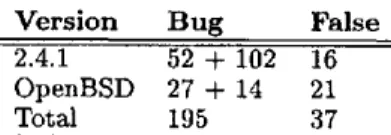
Table 3 shows the errors found in Linux. Some of the more amusing bugs were highlighted in Section 3.1. In the check-then-use example bug, the desire to print out a helpful error message causes a kernel segmentation fault. The second example in Section 3.1 demonstrates the most common use-then-check error idiom: a deref- erence of a pointer in an initializer followed by a subse- quent null check. This example code was cut-and-paste into ~.wenty locations.
While the redundant-checks checker found far fewer errors, it did provide evidence for our hypothesis that redundancy and contradiction is correlated with general
C h e c k e r B u g F a l s e
check-then-use 79 26
use-then-check 102 4 redundant-checks 24 10
Table 3: Results of r u n n i n g the internal null checker on Linux 2.4.7.
confusion. Two such r e d u n d a n t cases follow the exam- ple below where, after an allocation, the wrong pointer value is checked for success.
/ * 2 . 4 . 7 / d r i v e r s / v i d e o / t d f x f b . c * /
f b _ i n f o . r e g b a s e _ v i r t = i o r e m a p _ n o c a c h e ( . . . ) ;
if ( ! fb_inf o. regbase_virt ) return -ENXIO ;
fb_info.bufbase_virt = ioremap_nocache(... ) ;
/* [META: .meant fb_info.bufbase_virt !] * /
if ( ! fb_info, regbase_virt )
iounmap (fb_info. regbase_virt ) ;
Contradiction also flagged 10 suspicious locations where a contradictory pointer check of trap_bur pointed out an error:
/ * 2,4.7/drivers/char/cyclades.c */ i f ( ! t r a p _ b u r ) {
p a g e = g e t _ f r e e _ p a g e (GFP_KFJ~/EL) ;
/* [META: missing read barrier] */ if (imp_bur)
free_page (page) ;
Here, a missing cache "read barrier" will potentially al- low an access to a stale pointer value held in tmp_buf; the other similar locations had spurious synchronization code.
6.2 Discussion
The main results of this section are: (1) the ideas t h a t r e d u n d a n t a n d contradictory observations can be used to find errors and (2) demonstrating that even contra- diction checking for simple beliefs can find m a n y errors in real code.
The checkers in this section can be generalized to find other redundancies and contradictions. There are m a n y opportunities for such checks since essentially ev- ery action in source code implies a set of beliefs. Ex- ample checks include warning when: (1) a critical sec- tion does not access some shared state; (2) a structure field is never read or its precision is under-utilized; (3) a write m u t a t i o n is never read; (4) functions that cannot fail are checked; (5) general expressions in conditionals are impossible or redundant; (6) paths violate assertion conditions. One contribution of our work is the realiza- tion that traditional compiler optimization passes, such
as dead code elimination a n d constant propagation, can become error checkers with only minor re-tooling.
7 A Security Checker
This section describes a checker t h a t finds security er- rors. It uses internal consistency to check slot instances for the rule template "do not dereference user pointer < p > , " a n d latent specifications to automatically sup- press false positives from kernel "backdoors." W i t h o u t these techniques, we could only check a fraction of ker- nel code because we could not determine which pointers were dangerous. W i t h it, we readily found 35 security holes in Linux and OpenBSD.
7.1 The problem
Operating systems cannot safely dereference user point- ers. Instead they must access the pointed-to data using special "paranoid" routines (e.g. c o p y i n and copyout on BSD derived systems). A single unsafe dereference can crash the system or, worse, give a malicious party control of it. W i t h a list of pointers passed from user- level, static analysis can readily find such errors. Un- fortunately, from experience, the m a n u a l classification of pointers is mystifying. The worst offenders, device drivers, make up the bulk of operating systems, inter- act extensively with user code, b u t follow no discernible convention for denoting user pointers. Those routines t h a t do follow some vague n a m i n g convention tend to have a mixture of safe pointers passed in by the kernel a n d unsafe pointers passed raw from the user or fabri- cated from i n p u t integers. Thus, if we cannot classify these dangerous pointers we will miss all security holes in the largest source of such errors.
We solve this problem by using internal consistency to derive which pointers are believed to be user pointers a n d then checking that they are never treated as kernel pointers (dereferenced). The rules for this checker are as follows:
1. Any pointer t h a t is dereferenced is believed to be a safe kernel pointer.
2. Any pointer t h a t is sent to a "paranoid" routine is believed to be a "tainted" user pointer. 3. Any pointer t h a t is believed to be both a user
pointer a n d a kernel pointer is an error.
The checker refines this process by also considering ar- guments to functions abstractly related through func- tion pointers. If two functions / a n d / ' are assigned to function pointer
fp
and / treats its ith parameter p as a user pointer, t h e n / ' must also treat its i t h parame- ter p' as a user pointer. As with our other consistency checkers, if one use is correct, this technique can check all other related uses.7.2 Implementation
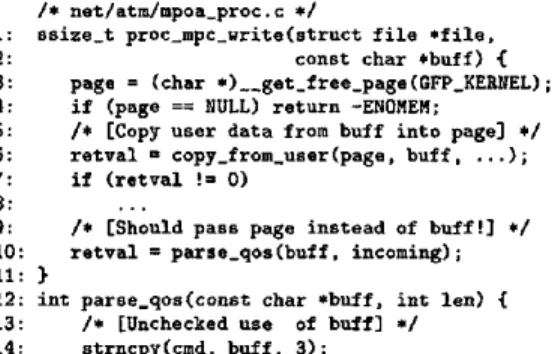
Below, we discuss the checker implementation, false pos- itive suppression, and the m a n u a l effort needed to re- target the checker to a new system. We use a security hole from Linux 2.3.99 (shown in Figure 3) as a r u n n i n g example to clarify our description of the implementa- tion. The checker finds this hole as follows. First, the call to to the paranoid routine copy_from_user (line 6) implies the belief that b u f f is tainted. Second, b u f f is
/* net/atm/mpoa_proc.c */
I: ssize_t proc_mpc_write(struct file *file,
2: c o n s t c h a r * b u f f ) {
3: p a g e = ( c h a r * ) _ _ g e t _ f r e e _ p a g e ( G F P K E R N E L ) ;
4: if (page == NULL) return -ENOMEM;
5: /* [Copy user data from buff into page] */ 6: retval = copy_from_user(page, buff, ...); 7: if (retval != O)
8:
9: /* [Should pass page instead of buff!] */ I0: tetra1 = parse_qos(buff, incoming); ii: }
12: i n t p a r s e _ q o s ( c o n s t c h a r * b u f f , i n t l e n ) { 13: / * [ U n c h e c k e d u s e of b u f f ] * / 14: s t r n c p y ( c m d , b u f f , 3 ) ;
Figure 3: 2.3.99 Security error: the driver carefully copies the user memory to a safe location (in page) b u t then immediately passes the unsafe user pointer b u f f to parse_qos, which reads from it using s t r n c p y . A strik- ing feature is t h a t this error is amidst a fair a m o u n t of safety-conscious boilerplate, down to the programmer using a c o n s t qualifier on b u f f to ensure that b u f f is not accidentally mutated.
passed to parse_qos (line 10), which then passes it to s t r n c p y (line 14), which will in t u r n dereference it, im- plying b u f f is a safe kernel pointer. Since these beliefs conflict, the checker emits an error.
T h e c h e c k e r works in two passes: a global deriva- tion pass, which computes summaries a n d checks function- pointer assignment, a n d a local checking pass, which checks function calls and pointer dereferences using the summaries computed by the first pass.
The global pass first computes three summaries: (1) a transitive closure of all functions t h a t taint their pa- rameters, (2) a transitive closure of all functions t h a t dereference their parameters, and (3) every function pointer assignment (including assignments from static structure initialization). The results of this pass are passed to the next step through three text files.
The two transitive closure operations use essentially the same technique. For the tainted list, we would like to know all functions whose parameters are eventually (through some execution path) passed to a paranoid routine. This can h a p p e n directly, as in line 6 of the above example or indirectly, as in line 2 of the following made-up function leo:
I : v o i d f o o ( s t r u c t f i l e * f , c h a r * b u f f ) {
2: ssize_t sz = proc_mpc_write (f, buff);
The dereferencing list is computed in exactly the same manner. The function parse_qos dereferences its pa- rameter b u f f directly through the call to s t r n c p y at line 14. Any functions t h a t call parse_qos passing one of their own parameters as the first argument to parse_qos are also marked. The result of these two passes are emit- ted as two lists (a tainting list a n d a dereference list) of the form (fn,
i),
which indicates functionfn
taints or dereferences its i t h parameter.After the summaries are completed, we use the three summaries to check for conflicts in function pointer as- signment: it is an error for a function pointer to be assigned one function that dereferences its i t h parame- ter and another t h a t taints its i t h parameter. I.e., we flag an error if function pointer