CityofChicago
www.cityofchicago.org/restaurant
LICENSING • PERMITTING
• INSPECTIONS
BACP Small Business Solution Station BACP City Hall, Room 805
or make an appointment by calling 312-744-2086. (See C-1 for the BACP Small Business Solution
Station flyer for more information)
Helpful Hint Your local Alderman’s office and Chamber of Commerce have lists of
available sites. The information in this guide will save you time by showing you what you’ll need in advance and which City agencies can assist you. Since each business is unique, this information serves only as a guide and is subject to change. If you have any questions, please contact us at [email protected] and we will be glad to help.
Restaurant Start-up Timeline
Note: Refer to corresponding numbers below for detailed information.
For the complete Restaurant Start-up Guide, please visit
www.cityofchicago.org/restaurant
1 Develop a business plan and determine legal entity
Before meeting with a BACP consultant, you should develop a business plan and determine your legal entity (i.e., Limited Partnership (LP), Limited Liability Partnership (LLP), Limited Liability Corporation (LLC), Corporation, or Not-for-Profit Corporation (NFP)). There are several resources available to help you:
1) Visit the Small Business Solution station every Tuesday (business counseling), Wednesday (legal assistance) and Thursday (financial assistance/loans) and get free business
counseling from our trusted non-profit partner agencies.
2) Visit your local Chamber of Commerce, who can assist you on developing business plans (see C-5 of the Restaurant Start-up Guide for a list of Chambers of Commerce and other delegate agencies in the city of Chicago)
3) Visit the business library at Harold Washington Library, 400 S State St. 4th floor 2 Prepare for Initial Consultation with BACP Business Consultant
Schedule an appointment with a BACP consultant by either calling 312-74-GOBIZ or visiting www.cityofchicago.org/restaurant
Interactive Zoning Map
www.cityofchicago.org/zoningmap
Also see Restaurant License and Zoning Reference Guide on F-2 If there is an outstanding violation, the permitting and licensing process may
be delayed until the violation is cleared. You
could be financially responsible for correcting
any violations. Prior to meeting with a BACP consultant, fill out the Restaurant Start-up Worksheet (see
pg 7 of the guide). Additional copies are available at www.cityofchicago.org/restaurant and BACP
x Describe your restaurant activity (e.g., liquor, fast-food)
x Identify potential sites and bring photos, if available (note: photos do not need to be printed out. They could be on your camera or phone)
x Check whether your potential sites have outstanding building violations. Go to www.cityofchicago.org/dob > Look Up Building Permits, Inspections and Violations Online
Obtain a Chicago Food Service Sanitation Certificate
All restaurants are required to have at least one employed person on the premises at all times who has a valid City of Chicago Food Service Sanitation Certificate. At the time of application, one must provide proof of Sanitation Certificate. (see C-10 of the Restaurant Start-up Guide for a list of training providers)
Register with the appropriate government entity (see C-3 of the Restaurant Start-up Guide for more information)
x If you plan to do business as a Sole Proprietor or General Partnership in Illinois, under an assumed name (a name other than your own), obtain an Assumed Name Certificate from the Cook County Clerk’s Office
x Obtain a State of Illinois File Number through Illinois Secretary of State
x Obtain Federal Employer Identification Number (FEIN) through Internal Revenue Service (IRS)
x Obtain an Illinois Department of Revenue (IDOR) Account ID (formerly IBT#) through IDOR
During your appointment with a BACP consultant, the consultant will guide you through the entire process, which will include checking for potential location restrictions, determining any Public Way Use permit requirements, and discussing food safety requirements.
3 Get Zoning and Location Approval
The City of Chicago is divided into a variety of zoning districts that reflect the diversity of business and neighborhood uses. Each zoning district has different regulations regarding the types of business activities that are permitted. It is imperative that you check the zoning requirements of your proposed business location carefully.
Before taking out a business loan, signing a lease, or applying for a business license, ensure that the site where you intend to operate is in an appropriately zoned area and that it complies with the Chicago Municipal Code. There are also other location restrictions (e.g., liquor dry area) that your business consultant can check for you. The Municipal Code is frequently updated so a new owner needs to check current zoning and code regulations; do not assume the previous owner's zoning designation applies to your business.
If construction is necessary, apply for building permits and submit the following
documents to the zoning department via Department of Buildings e-plan (see Section E-11 of the Restaurant Start-up Guide for E-plan User Guide) :
Helpful Hint To avoid delays, you should begin license application concurrently with permit application. Chicago Department of
Revenue 33 N. LaSalle Street
Suite 700 312-744-7275 or
pay online at
www.cityofchicago.org/finance
Helpful Hint Even if you are not doing any construction, you will need to submit a site plan and a floor plan. See D-1
for examples.
If you are using a self-certified architect, you
are strongly encouraged
to request an on-site food
consultation. To schedule
your on-site consultation, email
x Architectural plans, floor plans and plat of survey for zoning approval (see E-2 of the Restaurant Start-up Guide for more information on when a building permit is necessary)
x If you have not met with a BACP consultant, submit the first page of the Restaurant Start-up Worksheet(see form 1 in the Restaurant Start-up Guide)
x If your establishment’s occupancy will be more than 100 or you will be applying for a liquor license, submit an application for occupancy capacity signs for zoning approval (see form 2 in the Restaurant Start-up Guide)
If construction is not necessary, submit the following documents to your BACP consultant:
x If applying for a liquor license, include floor plans and plat of survey for zoning approval (see D-1 of the Restaurant Start-up Guide for examples)
x If your establishment’s occupancy will be more than 100 or you will be applying for a liquor license, submit an application for occupancy capacity signs for zoning approval. (see form 2 in the Restaurant Start-up Guide)
If applying for a liquor license or a Public Place of Amusement (PPA) license, you must meet location restrictions. For example, your restaurant has to be more than 100 feet (or 200 feet, if applying for PPA) away from a library, church, school, hospital or home for the aged or indigent (see F-5 and F-11 of the Restaurant Start-up Guide for detailed
information on restrictions and regulations). Submit a payment of $250 to BACP for an on-site location approval. This fee will be credited toward your license fee. This approval will be valid for one year from the date of approval.
Outstanding Debt - Any outstanding debts to the City owed by the business owner or an officer of the business must be paid before a license can be issued. These debts include past due parking tickets, water bills, child support payments, or any other type of administrative hearing fines imposed by the City. This also includes Illinois Sales Tax owed. If you have debt, you may apply for a license; however, a license will not be issued until all debt has been paid or you enter into a payment plan with the City. To find out if you have any debt and to find out about payment options, visit the Chicago Department of Revenue.
4 Obtain Building Permits– If construction or alterations are necessary
Once zoning has approved your architectural plans and location, the Department of Buildings will review your architectural plans. You should have already submitted the following through e-plan (see E-11 of the Restaurant Start-up Guide for E-plan User Guide):
x Zoning approved architectural plans
x Kitchen equipment specifications and menus. (see E-3 of the Restaurant Start-up Guide standard plan process checklist)
Once plans have been approved, a building permit will be issued. 5 Complete License Application
Once zoning has approved your plans and location, submit your completed application for a retail food establishment license to BACP either online or in-person. You will also need to submit:
For more information on BASSET training, visit
Illinois Restaurant Association.
www.illinoisrestaurants.org
Helpful Hint Any use permit on public way requires City Council
approval and the application process may
take from 60-120 days.
Begin this process as early as possible to prevent any
delays. Helpful Hint City of Chicago Business
Licenses are non-transferable. Each restaurant and each location must have its own license in order to
operate.
Helpful Hint If a business is found to
be operating without a Retail Food Establishment
License or other required city license a Cease and
Desist Order will be issued and the operations will be close immediately. x Business Information Sheet (BIS) (see form 3 in the Restaurant Start-up Guide)
x Lease or proof of ownership of the property x Chicago Food Service Sanitation Certificate
If applying for a liquor license, begin your liquor license application. The liquor license application can only be completed in-person (see section F-1 through F-10 of the Restaurant Start-up Guide for a detailed list of all requirements, including eligibility requirements)
x Submit zoning-approved occupancy capacity sign application
x Submit proof of liquor liability insurance and a Beverage Alcohol Sellers and Servers Education and Training (BASSET)
x Schedule fingerprint-based criminal background check for any person with 5% or more ownership
If applying for a Public Place of Amusement (PPA) license, begin your PPA license
application. The term PPA includes but is not limited to bowling alleys, businesses with 2+ pool tables, nightclubs and dance clubs, and karaoke. PPA licenses application can only be completed in-person. It is important to note that there are additional zoning and location restrictions(see F-11 of the Restaurant Start-up Guide for a detailed list of requirements) 5a If your site requires Public Way Use or other permits, begin the application process with
your BACP consultant. There are six (6) major types of use permits:
1. Sign installation permit - If you are installing a sign, submit a sign permit application to DOB (see form 4 in the Restaurant Start-up Guide)
2. Signs, canopies, and/or lights - If the site will have signs, or canopies, that will project into a public way, submit the application to BACP (see G-11 of the Restaurant Start-up Guide for Public Way Use Bundle Permit Application and form5)
3. Sidewalk café – If you are planning to have a sidewalk café, submit an application to BACP (see G-25 of the Restaurant Start-up Guide for Sidewalk Café
Application Information Package and form 6)
4. If your site has a driveway, you must get a driveway permit (see G-53 of the Restaurant Start-up Guide for the application process and form 7 for an application)
5. If you do not have approved alley access for deliveries, your site needs a loading zone to load and unload deliveries. Submit a loading zone permit application to your alderman’s office (see G-51 of the Restaurant Start-up Guide)
6. If your site needs a standing zone for non-commercial vehicles (e.g., drop-off and pick-up), submit a standing zone permit application to your alderman’s office (see G-51 of the Restaurant Start-up Guide)
Make your final payment and prepare for inspections
x If you are not applying for a liquor license, the Department of Public Health will contact you within 3 days of payment to schedule an inspection. The inspector will not come until you have confirmed that you are ready.
x If you are applying for a liquor license, you will schedule a license taskforce inspection through your BACP consultant. The taskforce inspection includes inspectors from BACP, Department of Buildings, Department of Fire, and the Department of Public Health. On the day of the inspection, the taskforce will arrive within a 3-hour window.
Helpful Hint If you conducted any construction, all permits
must have passed final inspections prior to license inspections.
6 Building Inspections – If construction is necessary
We are excited to offer a team-based building inspection for your restaurant construction. Previously offered only to larger buildings, this service is now available for any restaurant undergoing construction.
Prior to constructing your kitchen, schedule a free, optional on-site food consultation to ensure that your kitchen construction meets all relevant health codes. To schedule your on-site consultation, contact [email protected].
To schedule the team-inspection option, refer to E-2 of the Restaurant Start-up Guide for instructions.You will also have the option of scheduling individual inspections but these requests can take longer to accommodate.
7 Quick Guide to the Licensing Taskforce and Food Safety Inspections
Completion of this checklist does not guarantee inspection approval. This information is provided to help you prepare for the necessary inspection(s) in starting your restaurant. Fire Inspection – Liquor License (for a detailed fire inspection checklist, see H-6 of the Restaurant Start-up Guide)
Fire inspectors will visit your facility and check for safety measures. Their primary concern is verifying that you have proper exit structures in case of an emergency. They will verify that stairs, chimney, heating, and duct systems are in good condition and that aisles and exits are easily accessible and all fire extinguishers are in good working order.
Below are a few of the more common reasons why applicants fail fire inspections:
x
Inadequate water supply for the automatic sprinkler systemx
Impaired or non-existent access to elevators or man hoistsx
Combustible construction debris or trash onsitex
Non-working, non-illuminated exit and stairs signsx
Storage under stairsx
Storage around heat-producing appliancesx
Extinguishers that are not charged and/or tagged from current year’s inspectionx
Blocked aisles and exit areas/doorsx
Accumulation of debris that creates a potential fire hazardx
Lack of panic bar on locked exitsBuilding Inspection (SIP) – Liquor License and Occupancy Capacity Sign (for a detailed building inspection (SIP) checklist, see H-2 of the Restaurant Start-up Guide)
Below are a few of the more common reasons why applicants fail building inspections:
x
Structural defects (Roof, walls or floor joists need repair, etc.)x
Undersized exit doors, corridor width or stairwaysx
Insufficient number of exits or improper swing of the exit doorx
Locking devices on exit doorsHelpful Hint Refer to pg 24 of the Health Inspection Guide for a readiness checklist.
Helpful Hint Updates to this list will be
posted on-line at:
www.cityofchicago.org/restaurant
x
Lack of exit signs or emergency lightingx
Lack of stamped, approved plans on construction sitex
Open building permits (i.e., final inspections not completed and passed) BACP Inspection – Incidental Liquor License for Restaurants and Tavern (for a BACP inspection checklist, see H-5 of the Restaurant Start-up Guide)Below are a few of the more common reasons why applicants fail BACP inspections:
x
The layout of the restaurant does not meet requirements of Incidental-Consumption on Premises licensex
Restaurant floor layout does not match the floor plan that was approved and submitted to BACP and zoningx
Public Notice of Liquor License Application is not visibly postedHealth Inspections (Food Protection) – Retail Food License (for a detailed list of requirements, see H-7of the Restaurant Start-up Guide for a complete guide to health inspection)
Chicago Department of Public Health inspects your facility to ensure food safety and proper sanitation. Inspections focus on food-handling practices, proper temperatures, personal hygiene, facility maintenance, and pest control. For the inspection, you or a person with a food sanitation certificate must be present at the time of inspection.
Below are a few of the more common reasons why applicants fail the initial health inspection:
x
Not ready for inspection, or physical build-out not completedx
Food equipment not installed and/or not operating properlyx
Cooking ventilation system not installed and/or not operating properlyx
Lack of three-compartment sink that is large and deep enough to completelysubmerge cooking utensils in food preparation areas
x
Lack of utility/mop sink with a backflow preventer for housekeeping practicesx
Lack of plumbing back-flow devices at various plumbing fixturesx
Lack of adequate hand washing stationsx
Lack of hot water at sinks or dishwashersx
Unsealed gaps in walls, joints and pipingx
Inadequate refrigeration (temperature is above 40 degrees Fahrenheit in refrigerators/coolers and above 0 degrees Fahrenheit in freezers)x
Restrooms not operationalx
Pest on site, no pest control log availablex
Doors not sufficient to prevent pestsIF YOU REQUIRE ANY RE-INSPECTIONS, PLEASE CONTACT [email protected] TO SCHEDULE.
R
ESTAURANT
S
TART
-
UP
W
ORKSHEET
CONTACT
Primary contact person: _________________________________________________________________________ First name MI Last name
Relationship to license applicant: Self Expediter Lawyer Other:____________________ Contact phone number: _________________________________________________________________________ Contact e-Mail address: _________________________________________________________________________ If not license applicant, name of the applicant: _______________________________________________________
BUSINESS ACTIVITY
Prepare food on premises: Yes No If yes, type of food __________________________________ Serve liquor/beer/wine: Yes No
Amusement/entertainment: Yes No If yes, describe ______________________________________ Private event rooms: Yes No
Private events/banquets: Yes No If yes, max number of seats____________________________ Sit-down bar: Yes No If yes, number of seats/stools__________________________ Outdoor seating:
Patio: Yes No Sidewalk Café: Yes No Roof top deck: Yes No
Retail Sale: Yes No If yes, what will you be selling?_________________________ Wholesale: Yes No
Hours food will be served: _______________________________________________________________________ Hours liquor will be served: _______________________________________________________________________ Total Seating: less than 50 50-100 100-200 greater than 200
Number of Employees: 1-4 5-10 11-20 21+
By signing below, I understand that any changes to business activity may impact licensing and zoning approvals. I will notify BACP and zoning of those changes.
Signature
Official use only: Name of Business Consultant:
Date:
Official use only: Notes
Official use only: Notes
Official use only: Notes
LOCATION
Any building permits: Yes No If yes, permit number
________________________________________________________________________________________________________ Street Number(s) Street Name Apt/Suite _______________________________________________________________________________ City State Zip Code Most Recent Use of Space
Rough Square Footage: 0-4,500 sf 4,501-10,000 sf 10,001+ sf Outstanding violations*? Yes No
Existing signage/canopy? Yes No
Any dedicated onsite parking on the property (i.e., not street)? If yes, # of spaces ____________
Street Number(s) Street Name Apt/Suite _______________________________________________________________________________ City State Zip Code Most Recent Use of Space
Rough Square Footage: 0-4,500 sf 4,501-10,000 sf 10,001+ sf Outstanding violations*? Yes No
Existing signage/canopy? Yes No
Any dedicated onsite parking on the property (i.e., not street)? If yes, # of spaces ____________
_______________________________________________________________________________ Street Number(s) Street Name Apt/Suite _______________________________________________________________________________ City State Zip Code Most Recent Use of Space
Rough Square Footage: 0-4,500 sf 4,501-10,000 sf 10,001+ sf Outstanding violations*? Yes No
Existing signage/canopy? Yes No
Any dedicated onsite parking on the property (i.e., not street)? If yes, # of spaces _______ 1
1
1
*Go to www.cityofchicago.org/buildings > Look Up Building Permits, Inspections, and Violations Online
If you plan to do business as a Sole Proprietor or General Partnership in Illinois under an assumed name (a name other than your own), you will need to obtain an Assumed Name Certificate from the Cook County Clerk’s Office. You may register:
x Online by downloading and printing an application: www.cookctyclerk.com > Vital Records > Assumed Business Name Registration;
x By mail: Bureau of Vital Records, Attn: Assumed Name Unit, P.O. Box 642570, Chicago, IL, 60664-2570; or
x In-person: Bureau of Vital Records, Assumed Name Unit, 50 W. Washington, West Concourse Level, Suite 114, in Chicago.
Please call Cook County Clerk’s Office at 312-603-7790 for more information.
If you plan to do business as a legal business entity in Illinois, regardless of if you are based in
Illinois or not, you will need to register with the Illinois Secretary of State:
x Illinois based businesses may file a new application as a Limited Partnership (LP), Limited Liability Partnership (LLP), Limited Liability Corporation (LLC), Corporation, or Not-for-Profit Corporation (NFP). You will be provided a State of Illinois File Number, which you will need to provide on your license application.
x Businesses not based in Illinois are considered “foreign” and must file an application for authority to transact business in Illinois. You will be provided a State of Illinois File Number, which you will need to provide on your license application.
Register:
x Online: www.cyberdriveillinois.com > Business Services; x By mail: 501 S. 2nd St., Room 350, Springfield, IL, 62756; or x In-person: 69 W. Washington, Suite 1240, in Chicago.
Please call Illinois Secretary of State’s Office at 312-793-3380 for more information. Obtain a Federal Employer Identification Number (FEIN)
A Federal Employer Identification Number (FEIN) is also known as a Federal Tax Identification Number, and is used to identify a legal business entity. Businesses are required to obtain a FEIN to file and pay any federal tax obligation.
You may register for a FEIN with the United States Internal Revenue Service (IRS): x Online @ www.irs.gov > Businesses > Employer ID Numbers (FEINs);
x By mail @ Internal Revenue Service, Attn: EIN Operation, Cincinnati, OH, 45999; or x In-person @ 230 S. Dearborn, in Chicago.
Please call IRS at 800-829-4933 for more information.
R
EGISTER WITH
A
PPROPRIATE
G
OVERNMENT
E
NTITIES
Obtain an Illinois Department of Revenue (IDOR) Account ID (formerly Illinois Business Tax Number (IBT))
You must register with the Illinois Department of Revenue if you conduct business in Illinois or with Illinois customers. This includes sole proprietors (individual or husband/wife), and all legal business entities, including exempt organizations, who plan to hire employees, buy or sell products wholesale or retail, or manufacture goods.
You may apply for an IDOR Account ID Number:
x Online @ http://www.revenue.state.il.us/Businesses/ > Business Registration;
x By mail @ Central Registration Division, Illinois Department of Revenue, PO Box 19476, Springfield, IL, 62794-9476; or
x In-person @ 100 W. Randolph, in Chicago.
Please call Illinois Department of Revenue at 800-732-8866 for more information.
Why is a permit required?
A building permit is required to ensure that the project you are constructing conforms to the minimum standards of the Chicago Building Code. The Chicago Building Code exists to safeguard the public health, safety and welfare.
What are you building?
If you are repairing existing elements on any buildings, you can use the Easy Permit Process.
If your project requires architectural drawings, then you must obtain proper building permits and go through the Standard Plan Review.
Standard Plan Review
The Standard Plan Review (SPR) process is intended for small to mid-size new construction and alteration projects. Architectural drawings prepared by a licensed architect are required. Building permit applications must be created online and architectural plans must be submitted online via e-plan. Projects meeting the following criteria are eligible for SPR:
x Buildings not greater than 80 feet high
x Business and mercantile projects not greater than 150,000 square feet
x Residential projects with not more than 40 dwelling units
x Excavation work and foundations not more than 12 feet deep
x Removal of non-load bearing interior partitions
x Tents and platforms (over 400 sq. ft.)
x Projects using the Small Project Program and the Self-Certification Permit Program
x Projects NOT using a green technology (green roof, rain water harvesting, solar panels, solar thermal panels, wind turbines and geothermal systems)
Only architects, structural engineers and expediters can submit building permit applications for the SPR process. These individuals must sign up for a City of Chicago login account. The login account will allow them to submit a permit application online. Architects and structural engineers must hold a current State of Illinois license. Expediters must hold a current City of Chicago Expediter License.
O
VERVIEW OF
B
UILDING
P
ERMIT
P
ROCESS
Disclaimer: This list is indicative only and non-exhaustive. For more information, go to www.cityofchicago.org/buildings
Types of Projects That Require Permits
x Additions – room, upper floor, expansion to next unit
x Attic – finish, renovate
x Basement – finish, renovate
x Boiler – install, replace
x Carport – install, replace
x Chimneys – replace, erect
x Conversion of units – single to multiple, or multiple to single
x Deck – build, replace
x Demolition – garage, home, building
x Driveways – installation
x Electrical system – alteration, expansion
x Fence – taller than 5 feet, may not exceed 6 feet. For Landmark buildings only, a permit is needed for any solid fence of any height visible from a public street
x Furnace – install, replace
x Garage – build attached, detached
x Gut rehab – complete modernization
x Hot Water Heater – install, replace
x Masonry – replace, install face brick
x Natural light and ventilation – skylight
x New Construction – homes, high-rise, retail, business
x Plumbing system – construct, alteration
x Porch – build, replace, enclose, renovate
x Security alarm – install
x Siding replacement – For Landmark buildings only
x Roof – slope less than 5-in-12
x Ventilation system – mechanical, supply
x Windows and exterior doors – For Landmark buildings only
A building permit is NOT required for the following repair or replacement work:
x Interior finishes such as carpet, hardwood flooring, tile, paint and wallpaper
x Interior non-fire rated ceiling tiles (excluding grid)
x Cabinetry and furniture without electrical and plumbing connections
x In-kind replacement of non-fire rated interior doors
x At grade non-combustible walkways and patios
x Fences max. 5’-0” high on private property (excludes landmark buildings and landmark districts)
x Vinyl, aluminum, wood, EIFS or other similar nonstructural exterior finishes on all one story buildings except hazardous occupancy (excludes landmark buildings and landmark districts)
x Temporary tents max. 400 sq. ft. that comply with all zoning and construction type setback requirements and are not less than 2 feet from all property lines and not less than 6 feet from all residential buildings and erected for not more than 60
consecutive days
W
HEN
D
O
I
NEED A
B
UILDING
P
ERMIT
?
Add
iti
ona
l re
qu
ire
m
en
ts
a
nd
re
str
icti
o
ns a
p
ply
if
y
o
ur
bus
ine
ss
ha
s a
n
y o
f the
fol
lo
w
ing
a
ct
iv
it
ie
s
All Restau ran ts Restaurant Occupancy More Than 100 Liquor Licens e – C o ns um pti o n of Premi se s (C OP) Liquor Licens e – Ta ve rn Outdoor Patio/Caf é Liquor Licens e – Late HourPublic Place of Amus
em ent (A ) (B) (C) (D) (E ) (F) (G)
License Requi
rements Retail F o od E stab lishm ent
License xLease or pro
o f of ownership of the property x Ta x num bers (I llinois and F ederal) x Ownership inf o rm ation x Ci ty o f Ch ic ag o Fo o d Service S anitat ion C ertifica te x
Valid photo I
.D.
x
Departm
ent of P
ublic H ealth inspec tion In addition t o requirem ents l isted in colum n A
, need to apply
for
occupancy capaci
ty
si
gn
. See form
3 of the
Restau rant Sta rt-u p Gui d e . In addition t o requirem ents l isted in colum n A , C O P liquor license: x Individual H isto ry F o rm x Sp o u sa l Af fi d av it x Fi ng
er print based
crim inal backg round check x Manag er S tatem ent x Fi nancial Disc losure Fo rm x C ertifica te of Liquor Liabili ty x BA SS ET C ertificate x Occupancy capac ity s ig n applicati on x Business s tructu re docum ents x Si
te and flo
o
r plans
x
Fo
od service m
enu
x
More than 100 f
ee t away from a library, church, school, hosp ital or hom
e for th
e ag ed or indig ent x In spections by BA C P , DOB-SI P
, Dept. of P
ublic Health, and Fire In addition t o requirem ents l isted in colum n C
, a tavern liquor
license requir es: x In spections by DOB-P lum bing, and DOB-Ventilat ion A n Outdoor P atio Li cense is requir
ed to s
ell
alcoholi
c beverag
es in a
privatel
y owned outd
oor location adja cent t o prem ises w ith ei ther a tavern, or C O P license. In addition to requ irem ents listed in colum n C or D, outdoor pat io requ ires (for m o re deta iled inform ation se e S ection
G-25 of the
Rest aur ant St art -u p Gui d e ): x Outdoor floor p lan x Si dew alk C afé P erm it if w
ill be ope
rating on the public sidewalk Businesses wish ing to rem
ain open beyond t
h
e
reg
u
lar tim
e of c
losing
(2
a.m
. Monday throug
h
Saturday,
and 3 a.m
. on
Sunday) m
ay obtain a
Late H
o
ur Liquor L
icense. In addition t o requirem ents l isted in colum n C or D, late hour liquor l icense app lica tion
requires: xReg
istered vo ter petiti on x C ertified m ail public notice m ailing In addition t o requirem ents l isted in co lu mn A an d C, PP A
requires: xInspections by
DOB-El ectrical, DOB-P lum bing, DOB-Ventilati on x
More than 200 f
ee t away f rom a church, school, hospital, or bu ilding used exclusiv ely for
educational purposes
O
therw
ise
not
e
d,
s
ee S
ec
tion F
o
f t
h
e c
o
mple
te R
e
st
aura
nt
Sta
rt-up
G
u
id
e for
more
de
taile
d i
n
fo
rm
ation.
Vis
it
w
w
w
.c
ityofc
h
icago
.o
rg
/r
e
sta
u
ran
t
<Z oning and pa
rki n g re qui re me nts c o nti
nued on n
e xt pa ge>
R
EST
A
U
R
A
N
T
L
ICENSE AND
Z
ONING
R
EFERENCE
G
UIDE
13Visit w ww.cit yo fchicago .o rg/ zo ningm ap to che ck f o r t h e zo ning de signati o n o
f your pro
p e rt y All Restau ran ts Restaurant Occupancy More Than 100 Liquor Licens e – C o ns um ption of Premi se s (C OP) Liquor Licens e – Ta ve rn Outdoor Patio/C af é Liquor Licens e – Late Hour
Public Place of Amus
em ent 1 (A ) (B) (C) (D) (E ) (F) (G) Zoni ng Requi rements Note: * requi re sp e cial u se per m it s Zoning distri cts t h at all o w
restaurants: xB1
,B 2 ,B3 x C1,C 2,C 3 x DC ,D X ,DS x M1, M 2, M3 x PM D #1B ,PM D #2 , PM D #3 , PM D #4 , PM D #5 , PM D #6 , PM D #7 , PM D #8 , PM D #9 , PM D #1 0 , P M D# 11, P M D# 12, P M D#13, P M D#15 Sa me a s c o lu mn A Zoning distri cts t h at all o w restaurants wi th C O P liquor l icense: Li mi ted Re staurant (i.e., no
sit-down bar) – S
am e as colum n A Gen e ral Re staura n t (i.e.,
with a
sit-down bar) –
x B3 x C1, C 2 , C 3 x DC , DX , D S x M1, M2, M3 x PM D #1B ,# 2,# 3 , # 4, # 5 , #6 , # 7 , # 8 , # 9 , # 1 0, #11, # 12, #13 Zoning distri cts t h at allow tavern liquor license: x B3 * x C1, C 2 , C 3 x DC , DX , D S x M1, M2, M3 x PM D #1B ,# 2, # 3 , # 4, #5 , # 6 , # 7 , # 8 , # 9,
#10, #11, #12
, #13
New tavern li
censes
cannot
be issued to any
location that i s w ithin 400 feet of existing
tavern in a
B3 zoning distric t Zoning distri cts t h at all o w outdoor pat io/ café: At grou nd l e ve l (e.g .,
side walk caf
é) x B1 , B2 , B3 x C1, C 2 , C 3 x DC , DX , D S Abov e gr ound l evel (e.g ., roof-top pat io) x B3 * x C1* , C2* , C3* x DC , DX , D S Sa m
e as colum
n C or D Zoning distri cts t h at
allow Banquet H
alls: B3, C1, C 2 , C 3 , D C , D X , D S Sma ll and m e di um venu es (occupancy sm al ler t h an 1,000): B 1 ,B 2,B 3 , C 1 , C2
, C3
, DC , DX , D S Fo
r other z
o ning distric ts, please contac t a zoning represen tativ e Fo r l arge v e nu es (m ore
than 1,000 occupancy) , please conta
ct a z
o ning representa tive Parki ng Requi re m e nts Dis trict
s B1, B1
.5, B2, C1, C
2
, M1, M2 – No parking requirement
for fir
st 4,00
0 square fe
et then 2.5 s
p
ace
s per 1,00
0 square fe
et
Dis
trict
s B3, C
3
, M3 – N
o
parking requirem
ent for fir
st 10,0
00 square f
eet then 2.5
space
s per 1,000
square f
eet
District
s B5, C
5
, M5 – N
o
parking requirem
ent for fir
st 35,0
00 square f
eet or 2 x the lot a
rea (whiche
ve
r is gr
eater), th en 1. 33 spac es per 1,000 s quare f eet
When calculating your parkin
g s
p
ace requir
ements
, you mus
t
round-up
to the neares
t whole number (e.g
., 1.33 to 2).
Note: F o r properties w ith m u lt iple bus ines se s, the s quare footage allotm ent i s s h ared. F o r exam ple, if another bus in es s has alr eady claimed 3,0 00 s quare
feet in a
B3 district
and your restaurant
is 2,000 s
quare
fe
et, you will only get a waiv
e
r for the fir
st 1
,000 s
quare
feet.
You will ne
ed 3 s
p ac es fo r y o
ur additional 1,000 square feet.
Distric ts B1 , B1 .5 , B2 , C1, C 2 , M 1 , M 2 – 1
space per 10 persons capacity; no par
king requirem ent f o r li ve theater v enues w ith less th
an 150 seat
s Distric ts B5, C 5 , M5-Banquet H alls r equire 1
space per 10 persons capacity; f
o r all others, no parking requi rem ent fo r f
irst 35,000 square
feet o
r 2 x lot ar
ea
(w
hichever is
gr
eater)
then 1.33 spaces per 1,000 sq f
t Requi red Forms Restaurant S ta rt-U p W o rksheet (f orm 1) Basic I n form ation S h eet (form 3 ) Sa me a s c o lu mn A p lu s: A pplication for Occupancy C apacity S ig n s (form 2 ) Sa me a s c o lu mn A p lu s: A pplication for Occupancy C apacity S ig n s (form 2 ) Sa me a s c o lu mn A p lu s: A pplication for Occupancy C apacity S ig n s (form 2 ) A pplication for S ide W alk Caf
é (
fo rm 6) No additiona l form s required Sa me a s c o lu mn A p lu s: A pplication for Occupancy C apacity Si gn s ( fo rm 2)
1 Note: A
new P P A licens e will requir
e a zoning
va
riation
if within 125 fee
t of an R
1 , R 2 , or R 3 r e si dential zo ning dis trict 14
This checklist is neither official nor complete, but is provided for your information to expedite the correction of most deficiencies found during the Business License Inspection.
An official Fire Code violation notice identifying all deficiencies found during the fire inspection will be mailed to you within a few days.
Below are a few of the more common reasons why applicants fail fire inspections: Poor condition of stairs
Improper wall & ceiling material No stair rails
Improper flame spread rating Storage under stairs
Decorations, drapes, curtains are not
fire retardant
Improper ceiling or sidewalls Plaster holes in ceilings and walls Fire extinguishers not charged Fire extinguishers expired Fire extinguishers not present Fire extinguishers not visible Blocked aisles
Obstruction around smoke pipes and vents
Working exit and directional lights not present
Defective chimney
Non-working hood and duct system Incorrect storage of fuel
Inward swing of exit door Overcrowding
Exit door swings onto sidewalk Exits locked from inside and do not
have panic bar
Exits in need of repair Exits blocked
No entry to building No entry to basement
F
IRE
D
EPARTMENT
I
NSPECTION
C
HECKLIST
During the on-site location approval, BACP inspectors will check for the following to determine if any exterior location restrictions exist that would prohibit issuance of a liquor license.
In order to obtain a liquor license, the property line of your establishment cannot be within 100 ft of: The property line of any public library except the Harold Washington Library.
The property line of any school other than institutions of higher learning. The property line of a hospital.
The property line of any home for the aged or indigent persons The property line of a home for veterans, their spouses, or children. The property line of a military base or naval station.
Any church. In the case of a church, City policy is that the distance of 100 feet shall be measured to the nearest part of any building exclusively used for worship services or educational programs and not to property boundaries. In addition, the fact that a church is improperly zoned is not a factor in determining whether the church is subject to the 100-foot prohibition.
Applicant premises for a Tavern license located in a B3 Zoning District cannot be within 400 feet of an existing licensed tavern (property line to property line measurement).
BACP inspectors will check for the following during a license inspection based on the applicability to your business:
Incidental-Consumption on Premises activity must be secondary to another licensed activity (i.e., food service or amusement).
Incidental-Consumption on Premises applicant must have adequate commercial kitchen and dining facilities when liquor service is intended to be secondary to food (i.e., restaurant). The outdoor patio location is adjacent to the primary premises and has a perimeter clearly defined by barriers.
No dwelling or lodging units are accessible by the public directly from the premises (except in a hotel, private club, or when dwelling unit is occupied by applicant to be licensed).
The majority of applicant's customers may not be children.
Separate and adequate toilet facilities must be maintained for men and women.
Floor plans clearly/completely indicate intended use of areas and match the construction and layout of premises.
Construction is completed; equipment, fixtures, and furniture are in place according to plans. Public Notice of Liquor License Application posted within 5 days of making application and remaining clearly visible from the public way for a full 45-day period after the application date.
BACP
I
NSPECTION
C
HECKLIST
If you are applying for certain business licenses, including liquor and public place of amusement, and/or applying for an occupancy capacity sign (required when the total occupancy by the public is 100 persons or more), Department of Buildings (DOB) inspectors will inspect your establishment to ensure that the building and commercial space provide a safe environment for patrons, customers and employees. DOB inspections focus on the safety of occupants. For example, a building inspector will check to make sure fire separation is included, an adequate number of exits are provided and are not blocked, and that an occupancy sign/drawing is posted, if required. Additionally, your license application may require an inspection from a DOB electrical, ventilation, and or plumbing inspector and other city departments who review your space for compliance to their respective codes.
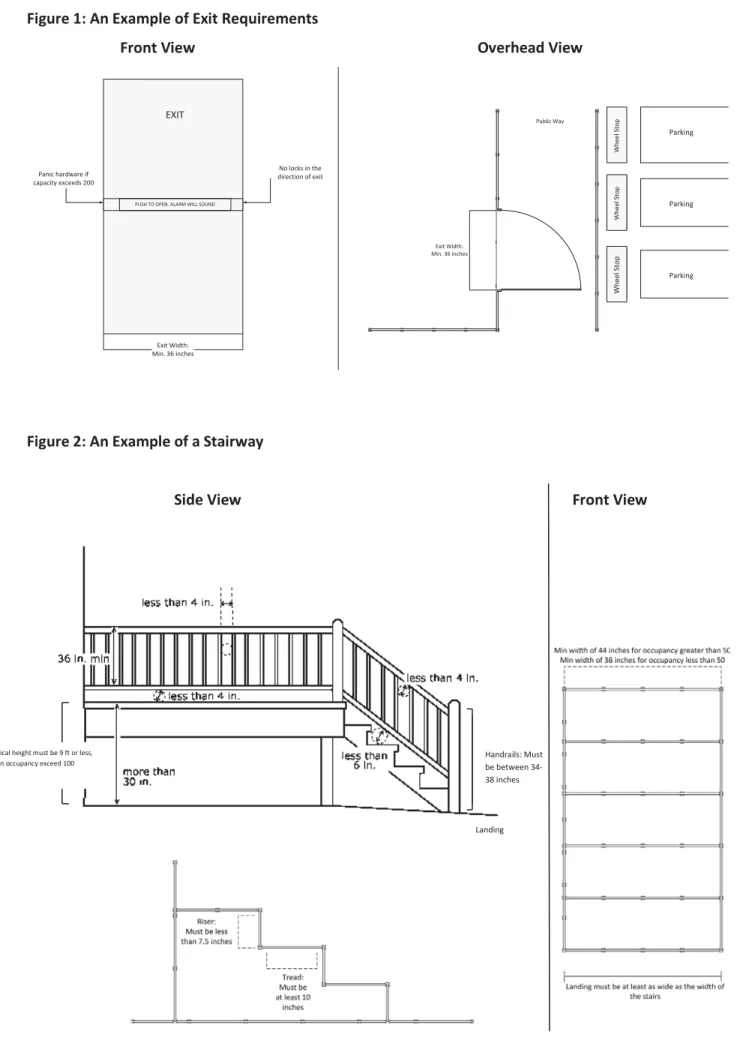
A DOB building inspector, from Special Inspections (SIP), will check for the following, based on the applicability to your business (Disclaimer: The below list is indicative only and non-exhaustive. For more information, including the “Chicago Building Code” and “Code Clarifications and Interpretations,” go to www.cityofchicago.org/buildings) Exit Requirements (see Figure 1 for a diagram)
Sufficient number of exits
Capacity Minimum
Number of Exits
50 or less 1
51 to 300 2
301 to 1000 3
1000+ 4
A minimum of two exits are required from every building, floor, space or room, except as outlined in Municipal Code (13-160-050). Also refer to the Municipal Code (13-196-050, 13-88-160, 13-84-170) Exits must be free of obstructions. Refer to the Municipal Code (13-160-070, 15-4-880)
Where more than one means of exit is required from any room, space or floor of a building, they must be located remotely from one another
Revolving doors may be used as required exits in occupancies of 100 persons or less. Refer to the Municipal Code (13-160-270)
The means of exit from one story to another and to an outside exit must be continuous and uninterrupted From any point in the establishment, the travel distance to the nearest exit must be less than 150 ft Exit doors must swing in the direction of exit (i.e., swings out from inside to outside). This includes all doors along the exit path.
Exit doors must be at least 36 inches wide
Exit doors cannot have a key face lockset on the exiting side. This includes no slide-blots or similar devices.
Exit doors cannot project onto a public way without the use of public way approval and must be protected with wheel stops/fixed barricade on the alley or parking side. Refer to the Municipal Code (13-160-070, 15-4-090, 15-4-880) See Figure 1
Panic hardware must be installed on exit doors when total capacity exceeds 200 Every exit and its pathway (e.g., public hall and stair well) must be well illuminated
Exits designated with electric, battery back-up, exit signs, in good working order and in a metal frame housing
D
EPARTMENT OF
B
UILDINGS
I
NSPECTION
C
HECKLIST
Stairway Requirements (see Figure 2 for a diagram)
Stairways must be clear of debris and no storage under stairways
Stairways must be constructed of noncombustible materials when occupancy exceeds 100 persons. Refer to the Municipal Code (13-160-330)
The underside of stairways of combustible stairways (when allowed) must be protected by noncombustible materials to provide at least 1-hour fire resistance
All stairs and corridors used as exits must be at least 44 inches wide. Stair width is defined as the clear width of the stair tread used as the walking surface.
x Exception: Stairs and corridors in buildings with a total occupancy of 50 persons or less above the grade level, shall not be less than 36 inches wide.
If a stairway is used as an exit, it cannot have winder steps; generally wedge shaped.
Vertical height of a flight of stairs between landings or between a floor and a landing must be 9 ft. or less, when occupancy exceeds 100 persons
The width of a stairway, including the landing, shall not decrease in the line of travel. Refer to the Municipal Code (13-160-210 and 13-160-310)
Depending on occupancy classification, the height of each stair riser must be 7.5 inches or less and they all must be equal in height. The minimum width of a tread must be 10 inches. The surface of treads and landings should not cause danger of slipping. Refer to the Municipal Code (13-160-300). All new stairs are required to have 7 inch risers and 11 inch treads.
The ends of handrails must be returned and joined into the wall
Height to the top of handrail(s) must be between 34 – 38 inches, measured from the stair tread or floor x If the width of stairs is less than 44 inches, then a handrail on at least one side must be provided x If the width of stairs exceeds 44 inches, handrails must be provided on both sides
x If the width of stairs is greater than 88 inches, an intermediate handrail(s) must be provided Guardrails, installed at a minimum height of 42 inches above the finished floor, cannot have balusters or a pattern providing a ladder effect. Balusters spaced at 4 inches apart. See Figure 2
Enclosure Requirements
All stairways must be enclosed with wall and partitions providing fire resistance x A building that is three stories or lower: One-hour rated fire resistance x A building that is higher than three stories: Two-hour rated fire resistance Heating plants and boilers must be enclosed by walls, partitions, floors and ceilings
x For occupancies less than 200: One-hour rated fire resistance x For occupancies over 200: Two-hour rated fire resistance All assembly rooms
x Capacity under 300: One-hour rated fire resistance x Capacity over 300: Two-hour rated fire resistance
To prevent spread of fire from floor to floor, all stairs, shafts and openings in floors and roof must be enclosed
Basements with a capacity of over 100 persons, in restaurants and nightclubs, must be sprinklered Class A fire doors or shutters installed on both sides of openings in a fire wall
Class B fire doors provided at openings in vertical shafts, stair wells, and other openings Minimum one hour fire resistant ceiling provided between basement and first floor Fire doors cannot be propped open
Miscellaneous Requirements
Proper building permits must be present for any construction and have received final construction approvals from the required inspection trades; as well as Certificate of Occupancy letter issued (if required for that permit)
Foundation must be sound (e.g., no cracks)
Exterior facade must be in sound condition (e.g., no tuck pointing required) Fire extinguishers must have up-to-date tags and be properly charged One carbon monoxide detector must be installed on every floor
Curtains, scenery, and decorations shall be flame retardant for occupancies over 100 persons. Refer to the Municipal Code (15-4-620)
The building must not have any structural problems (e.g., ceilings, floors, and roof are in good condition) Occupancy capacity sign is correct and properly displayed with the city approved and stamped drawing belonging to that specific issued occupancy capacity sign; the current physical space/layout must match that drawing. Exit diagrams must be posted for public places of amusements. Refer to the Municipal Code (13-84-400 and 4-156-380)
Figure 1: An Example of Exit Requirements
Front View Overhead View
Public Way
Wheel Stop
Wheel Stop
Wheel Stop
Parking
Parking
Parking Exit Width:
Min. 36 inches EXIT
No locks in the direction of exit Panic hardware if
capacity exceeds 200
PUSH TO OPEN. ALARM WILL SOUND
Exit Width: Min. 36 inches
Figure 2: An Example of a Stairway
Side View Front View
Landing Handrails: Must be between 34-38 inches
Vertical height must be 9 ft or less, when occupancy exceed 100
D
EPARTMENT OF
P
UBLIC
H
EALTH INITIAL HEALTH
I
NSPECTION
C
HECKLIST
The items listed in this checklist are the areas that the public health inspectors will be looking during your initial health inspection.
For the complete Guide to Your Initial Health Inspection, visit www.cityofchicago.org/restaurant HAND WASHING SINKS FOR EMPLOYEES
Hand sinks at the following locations :
a) Within each restroom - if less than 5 employees per shift, 1 unisex bathroom for the entire establishment, including for customers, is sufficient, otherwise separate restrooms for both men and women are required
b) Within the kitchen - at least one hand sink, provided that hand sink is within 25 feet of all food prep areas, the 3 compartment sink and the dish machine. Two or more hand sinks are required if there are separate rooms in the kitchen area (one hand sink per room, provided that hand sink is within 25 feet of all food prep areas, the 3
compartment sink and/or the dish machine).
c) Within the bar area – a separate hand sink is required within the bar area, if present. Hand sinks are fully functional and provide warm water
Single service soap and towel dispensers at all hand washing sinks TIME AND TEMPERATURE RELATIONSHIPS
Note: It is important that you turn refrigerators and freezers on at least 48 hours and your hot-holding equipment on at least 24 hours prior to your inspection.
Freezers maintained at 0°F or less
Cold holding equipment that holds potentially hazardous foods maintained at 40°F or less Hot holding equipment that holds potentially hazardous foods maintained at or above 140°F Equipment for cooling of potentially hazardous foods such as shallow pans, chill paddles, or other rapid cooling equipment such as blast chillers are functioning
Equipment for reheating potentially hazardous foods to 165°F for 15 seconds functioning PROTECTION FROM CONTAMINATION
Multiservice utensils are being washed and sanitized using one of the following methods: a) by hand in a stainless steel 3-compartment sink with an attached drain board and grease
trap/ interceptor(wash-rinse-sanitize) – Note: each compartment must be large and deep enough to completely submerge your largest piece of equipment or utensil that is to be washed, rinsed and sanitized.
b) Test kit available to measure sanitizer
c) high temperature dish machine with rinse water reaching at least 180°F for 30 seconds or a low temperature dish machine that conforms to NSF standards
Facility can maintain water at 110°F to 120°F (note: temperature requirement is higher than hand sinks) at the 3-compartment sink
Faucet on the 3 compartment sink must reach all 3 compartments A prep sink is highly recommended, though not required
WATER / HOT WATER
Potable supply of hot and cold water is available and protected from backflow contamination. Facility can maintain hot water of at least 120°F at all faucets (non-hand washing)
LIQUID WASTE DISPOSAL
All liquid waste properly drains to an approved and fully functioning sewage disposal system All sinks drain properly
Floor drains and floor sinks are functioning properly A separate mop/slop sink with a backflow preventer VERMIN
Facility is free from insects and rodents
Outside doors and screen doors are in good repair and rodent proofed Facility is constructed and maintained so as to prevent entrance of vermin Air curtains are operating properly and in good repair
FOOD SERVICE SANITATION CERTIFICATE
At least one employee has a City of Chicago Food Service Sanitation Certificate if potentially hazardous food is to be prepared, served or handled
GENERAL FOOD SAFETY REQUIREMENTS
Food items and food related products are protected from dirt, unnecessary handling, over-head leakage, and other forms of contamination
Hazardous substances (e.g. chemicals, cleaning supplies) are properly labeled and stored separately from food products
FOOD STORAGE / DISPLAY / SERVICE
Sneeze guards at consumer self-service operations All food storage containers have lids
Food products are properly labeled
Shelving is a minimum of 6” off of the floor
Restrooms are not used for the storage of food, equipment, or supplies EQUIPMENT / UTENSILS / LINENS
All equipment and utensils (e.g. stoves, grills, refrigerators, tables, sinks.) are clean and well maintained
Inoperable equipment has been repaired, replaced or removed from the facility Damaged or unapproved utensils have been repaired or replaced
Utensils are properly protected during storage
Exhaust ventilation installed above cooking equipments and filters are clean and well maintained
Adequate lighting is provided throughout the facility
Light fixtures have approved safety covers (light shields or shatter-proof bulbs) A thermometer, accurate to + or -2°F, is provided at each refrigerator and freezer
An accurate metal probe thermometer, suitable for measuring food temperatures, is readily available Cleaning equipment and soiled linens are properly stored
PHYSICAL FACILITIES
Plumbing is in good repair
All sinks are fully operable with hot and cold water at each faucet Outside trash bin lids are closed
Outside premises and refuse areas are clean and well maintained Toilet facilities are clean, well maintained and in good working order All restrooms have ventilation/exhaust (or a window with a screen) Self-closing doors in toilet and dressing rooms are working properly Clothing and personal effects are stored separately from food products Floors are clean, well maintained and in good repair
Walls, ceilings and windows are clean, well maintained and in good repair There are no living quarters within the facility
SIGNS / REQUIREMENTS
Hand washing signs are properly posted No smoking signs are properly posted
Customers are notified to obtain clean table ware when returning to self-service areas such as salad bars and buffets
Consumer advisory is provided for ready-to-eat foods containing undercooked meat or raw egg
R
ESTAURANT
S
TART
-
UP
W
ORKSHEET
CONTACT
Primary contact person: _________________________________________________________________________ First name MI Last name
Relationship to license applicant: Self Expediter Lawyer Other:____________________ Contact phone number: _________________________________________________________________________ Contact e-Mail address: _________________________________________________________________________ If not license applicant, name of the applicant: _______________________________________________________
BUSINESS ACTIVITY
Prepare food on premises: Yes No If yes, type of food __________________________________ Serve liquor/beer/wine: Yes No
Amusement/entertainment: Yes No If yes, describe ______________________________________ Private event rooms: Yes No
Private events/banquets: Yes No If yes, max number of seats____________________________ Sit-down bar: Yes No If yes, number of seats/stools__________________________ Outdoor seating:
Patio: Yes No Sidewalk Café: Yes No Roof top deck: Yes No
Retail Sale: Yes No If yes, what will you be selling?_________________________ Wholesale: Yes No
Hours food will be served: _______________________________________________________________________ Hours liquor will be served: _______________________________________________________________________ Total Seating: less than 50 50-100 100-200 greater than 200
Number of Employees: 1-4 5-10 11-20 21+
By signing below, I understand that any changes to business activity may impact licensing and zoning approvals. I will notify BACP and zoning of those changes.
Signature
Official use only: Name of Business Consultant:
Date:
Official use only: Notes
Official use only: Notes
Official use only: Notes
LOCATION
Any building permits: Yes No If yes, permit number
________________________________________________________________________________________________________ Street Number(s) Street Name Apt/Suite _______________________________________________________________________________ City State Zip Code Most Recent Use of Space
Rough Square Footage: 0-4,500 sf 4,501-10,000 sf 10,001+ sf Outstanding violations*? Yes No
Existing signage/canopy? Yes No
Any dedicated onsite parking on the property (i.e., not street)? If yes, # of spaces ____________
Street Number(s) Street Name Apt/Suite _______________________________________________________________________________ City State Zip Code Most Recent Use of Space
Rough Square Footage: 0-4,500 sf 4,501-10,000 sf 10,001+ sf Outstanding violations*? Yes No
Existing signage/canopy? Yes No
Any dedicated onsite parking on the property (i.e., not street)? If yes, # of spaces ____________
_______________________________________________________________________________ Street Number(s) Street Name Apt/Suite _______________________________________________________________________________ City State Zip Code Most Recent Use of Space
Rough Square Footage: 0-4,500 sf 4,501-10,000 sf 10,001+ sf Outstanding violations*? Yes No
Existing signage/canopy? Yes No
Any dedicated onsite parking on the property (i.e., not street)? If yes, # of spaces _______ 1
1
1