Sedges in the mist: A new species of Lepidosperma
(Cyperaceae, Schoeneae) from the mountains
of Tasmania
George T. Plunkett1, Karen L. Wilson2, Jeremy J. Bruhl1
1 Botany, School of Environmental and Rural Science, University of New England, Armidale NSW 2351
2 National Herbarium of New South Wales, Royal Botanic Gardens and Domain Trust, Sydney, Mrs Macquaries
Road, Sydney NSW 2000
Corresponding author:George T. Plunkett ([email protected])
Academic editor:Lyubomir Penev | Received 22 May 2013 | Accepted 5 October 2013 | Published 7 November 2013
Citation: Plunkett GT, Wilson KL, Bruhl JJ (2013) Sedges in the mist: A new species of Lepidosperma (Cyperaceae,
Schoeneae) from the mountains of Tasmania. PhytoKeys 28: 19–59. doi: 10.3897/phytokeys.28.5592
Abstract
The status of a putative new species of Lepidosperma from the mountains of south-western Tasmania, Australia, was investigated. Phenetic analysis (Flexible UPGMA Agglomerative Hierarchical Fusion and semi-strong hybrid multidimensional scaling) was conducted on a database derived from morphological and anatomical characters scored from herbarium material, culm anatomy slides and scanning electron micrographs of fruit. The results of the analysis support the recognition of a new species, here described
as Lepidosperma monticola G.T.Plunkett & J.J.Bruhl. The distribution, habitat and conservation status
are discussed.
Keywords
Lepidosperma inops, Lepidosperma monticola, species limits, phenetics, new species
Introduction
Lepidosperma Labill. (Cyperaceae) is a genus of c. 75 described species (Barrett and Wilson 2012) and up to 230 species based on current estimates of undescribed taxa (Barrett 2012). Australia is the centre of diversity for Lepidosperma, which also occurs in southern China, South-east Asia, New Caledonia and New Zealand. Species of www.phytokeys.com
Copyright George T. Plunkett et al. This is an open access article distributed under the terms of the Creative Commons Attribution License 3.0 (CC-BY), which permits unrestricted use, distribution, and reproduction in any medium, provided the original author and source are credited.
George T. Plunkett et al. / PhytoKeys 28: 19–59 (2013)
20
Lepidosperma often form important components in diverse habitats that include beach dunes, forest and woodland, sedgeland and alpine heath (Barrett 2013).
The present study was initiated following the inspection by GTP of several specimens that had been identified as Lepidosperma inops F.Muell. ex Rodway. Eight of the specimens, collected in south-western Tasmania, appeared morphologically and ecologically distinct from the rest of the specimens, which were collected in the east of the state and attributable to L. inops sens. strict. We intuitively segregated them as a putative new species, referred to as Lepidosperma sp. Eldon Bluff (A.M. Buchanan 9981). Subsequent plant collections in Tasmania and a visit to the Tasmanian Herbarium (HO) further strengthened our initial impression.
The aims of the study were (1) to determine the status and limits of this putative new entity and (2) to investigate its resemblance to morphologically similar named species of Lepidosperma.
Materials and methods
Study material
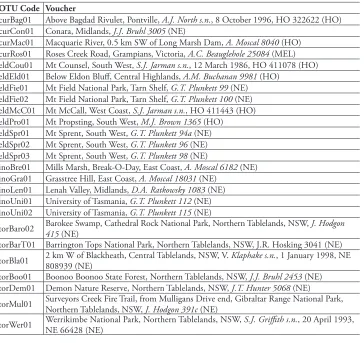
A total of 25 specimens were used for the phenetic analysis (Table 1). Lepidosperma curtisiae K.L.Wilson & D.I. Morris, L. inops and L. tortuosum F. Muell.were sampled on the basis of morphological similarity to L. sp. Eldon Bluff. Specimens recently collected in Tasmania and existing specimens from the N.C.W. Beadle Herbarium (NE) were used in the analysis. Specimens on loan from the National Herbarium of Victoria (MEL) and HO for a previous study (Hodgon et al. 2006) were also used, with permission.
Anatomy
Hand-cut cross-sections of culms were made in 50% ethanol using half a double edged razor blade from pickled (70% ethanol) or rehydrated herbarium material. Sections were stained in 1% safranin in 50% ethanol for c. 15 min then washed in increasing concentrations of ethanol before staining in 0.5% fast green in 95% ethanol for three to seven minutes depending on size. Sections were then transferred to increasing con-centrations of histolene before mounting on glass slides with Eukitt mountant.
Photosynthetic pathway was inferred from anatomy using the ‘maximum cell distance count’ criterion as applied to Cyperaceae (Bruhl et al. 1987; Bruhl and Wilson 2007).
Scanning electron microscopy
were also used. Fruit were mounted onto an aluminium stub with double-sided carbon tabs and gold-coated using a JEOL MP-19020NCTR NeoCoater (JEOL Ltd., Tokyo). Images were captured with a JEOL JCM-5000 benchtop SEM (JEOL Ltd., Tokyo) at 10 kV. In total three fruit were imaged from L. curtisiae, four from L. inops, seven from L. sp. Eldon Bluff and two from L. tortuosum.
Characters
A character list was constructed primarily from that used by Hodgon (2001) and augmented by Barrett (2007a, b). Further characters were added based on differences among specimens observed by the authors. A total of 131 morphological and 22 anatomical characters were scored for each individual specimen (Appendix 1).
Table 1.Specimens of Lepidosperma used in phenetic analysis. First three letters of operational taxonomic unit (OTU) code: cur = L. curtisiae; eld = L. sp. Eldon Bluff; ino = L. inops; tor = L. tortuosum. Localities are in Tasmania unless another State is specified.
OTU Code Voucher
curBag01 Above Bagdad Rivulet, Pontville, A.J. North s.n., 8 October 1996, HO 322622 (HO) curCon01 Conara, Midlands, J.J. Bruhl 3005 (NE)
curMac01 Macquarie River, 0.5 km SW of Long Marsh Dam, A. Moscal 8040 (HO) curRos01 Roses Creek Road, Grampians, Victoria, A.C. Beauglehole 25084 (MEL) eldCou01 Mt Counsel, South West, S.J. Jarman s.n., 12 March 1986, HO 411078 (HO) eldEld01 Below Eldon Bluff, Central Highlands, A.M. Buchanan 9981 (HO)
eldFie01 Mt Field National Park, Tarn Shelf, G.T. Plunkett 99 (NE) eldFie02 Mt Field National Park, Tarn Shelf, G.T. Plunkett 100 (NE) eldMcC01 Mt McCall, West Coast, S.J. Jarman s.n., HO 411443 (HO) eldPro01 Mt Propsting, South West, M.J. Brown 1365 (HO) eldSpr01 Mt Sprent, South West, G.T. Plunkett 94a (NE) eldSpr02 Mt Sprent, South West, G.T. Plunkett 96 (NE) eldSpr03 Mt Sprent, South West, G.T. Plunkett 98 (NE)
inoBre01 Mills Marsh, Break-O-Day, East Coast, A. Moscal 6182 (NE) inoGra01 Grasstree Hill, East Coast, A. Moscal 18031 (NE)
inoLen01 Lenah Valley, Midlands, D.A. Ratkowsky 1083 (NE) inoUni01 University of Tasmania, G.T. Plunkett 112 (NE) inoUni02 University of Tasmania, G.T. Plunkett 115 (NE)
torBaro02 Barokee Swamp, Cathedral Rock National Park, Northern Tablelands, NSW, 415 (NE) J. Hodgon torBarT01 Barrington Tops National Park, Northern Tablelands, NSW, J.R. Hosking 3041 (NE) torBla01 2 km W of Blackheath, Central Tablelands, NSW, V. 808939 (NE) Klaphake s.n., 1 January 1998, NE torBoo01 Boonoo Boonoo State Forest, Northern Tablelands, NSW, J.J. Bruhl 2453 (NE) torDem01 Demon Nature Reserve, Northern Tablelands, NSW, J.T. Hunter 5068 (NE)
torMul01 Surveyors Creek Fire Trail, from Mulligans Drive end, Gibraltar Range National Park, Northern Tablelands, NSW, J. Hodgon 391c (NE)
George T. Plunkett et al. / PhytoKeys 28: 19–59 (2013)
22
Morphological characters were scored from herbarium specimens with the aid of a Leica M8 stereomicroscope. Morphological dimensions were measured once per OTU, consistently using a steel rule, electronic callipers or the microscope eyepiece graticule for each character. Fruit and perianth characters were assessed under the stereomicroscope and from SEM images. Anatomical characters were scored from permanent double-stained slides viewed under a Zeiss Axiolab compound microscope.
Analysis
Data were organised using DELTA ver. 1.04 (Dallwitz 1980) and later transferred to PATN ver. 3.12 (Blatant Fabrications) for cluster and ordination analysis (Appendix 2). Characters with multiple states scored for several OTUs were converted to multiple binary characters. Univariate characters and those used only for descriptive purposes were removed prior to analysis, as were characters that had missing values for the majority of OTUs. All characters were weighted equally in the analysis. Phenograms were produced from classification analysis run using Flexible UPGMA Agglomerative Hierarchical Fusion (β = -0.1). Three-dimensional ordination plots of semi-strong hybrid multidimensional scaling (SSH MDS) were generated. Lowest stress in the ordination analysis was achieved with 400 random starts and 100 iterations. Principal component correlation (PCC) was used to determine the importance of characters in the ordination analysis.
Our species concept is consistent with that of de Queiroz (1998, 1999, 2007), which equates species with segments of separately evolving metapopulation lineages. Here we base the delimitation of species on phenetic distinguishability, ecological differentiation, and diagnosability. The presence of one of these properties provides evidence that a lineage is evolving separately and can be recognised as a species, and the presence of additional properties provides greater confidence (de Queiroz 2007). Operationally we use a morphological species concept combined with implicit use of the biological species concept (lack of gene flow and geographical separation) and an ecological species concept (most similar species occurring in distinctly different habitats).
In the phenetic analyses, our criteria for accepting the putative species as a distinct entity were: (1) the OTUs representing L. sp. Eldon Bluff should form discrete groups distinct from all other groups of OTUs in the analyses and (2) the OTUs within these groups should show an amount of dissimilarity comparable to that of the known species included in the analyses.
Results and discussion
Phenetic analysis
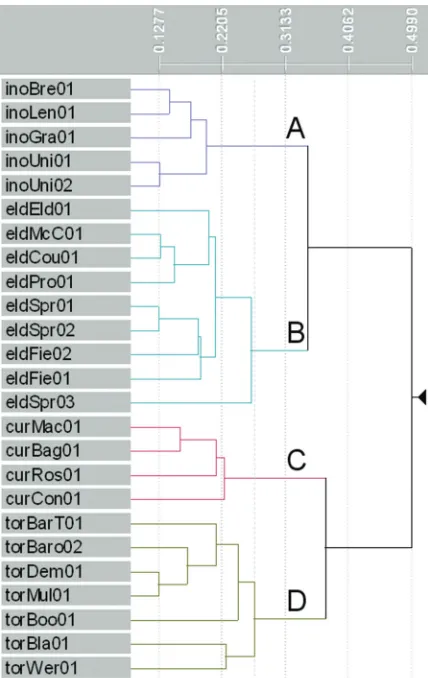
dissimilarity within these four groups are comparable. Groups A and B in the phenogram contain individuals of L. inops and L. sp. Eldon Bluff, respectively. These groups are most similar to one another, as expected, though clearly distinct. The L. inops group shows the lowest dissimilarity among individuals, possibly because of the lower number of OTUs used for that species. Group C contains individuals of L. curtisiae and shows low dissimilarity among individuals, again possibly related to the low number of OTUs used. Group D contains individuals of L. tortuosum and displays the highest dissimilarity among individuals, reflecting the morphological variation sampled in this species.
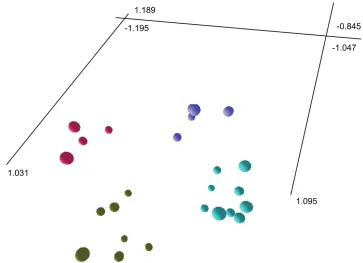
The ordination plot produced from SSH MDS (stress value 0.1535; Figure 2) recovered the same four groups as the phenogram. Individuals of L. curtisiae and L. inops respectively form the two most closely spaced groups, with individuals of L. Figure 1. Phenogram produced from cluster analysis of three described and one putative species of
Lepidosperma (β = -0.1). Major groups: AL. inops (purple) BL. sp. Eldon Bluff (turquoise) CL. curtisiae
George T. Plunkett et al. / PhytoKeys 28: 19–59 (2013)
24
Figure 2. Three-dimensional ordination from semi-strong hybrid multidimenstional scaling of three described and one putative species of Lepidosperma. L. curtisiae (top left; pink); L. inops (top right; pur-ple); L. sp. Eldon Bluff (bottom right; turquoise); L. tortuosum (bottom left; green-grey). Ordination oriented to highlight separation of groups of operational taxonomic units. See Appendix 1 for characters and Appendix 2 for data.
tortuosum forming the most distantly spaced group. Individuals of L. sp. Eldon Bluff form a distinct group that is close to the group containing L. inops.
The PCC values for the ordination analysis (Table 2) indicate that the most important characters were mostly vegetative and inflorescence morphology characters, with one fruit character and three anatomical characters.
Scanning electron microscopy
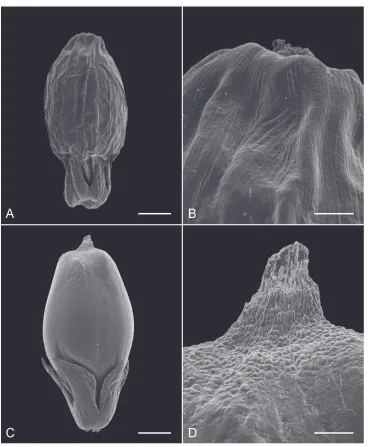
Figure 3. Scanning electron micrographs of fruit with perianth (A, C) and fruit apex (B, D).
A, B Lepidosperma inops (A. Moscal 18031) C, DL. sp. Eldon Bluff (G.T. Plunkett 100). Scale bars =
0.5 mm (A, C), 0.1 mm (B, D).
George T. Plunkett et al. / PhytoKeys 28: 19–59 (2013)
26
Taxonomy
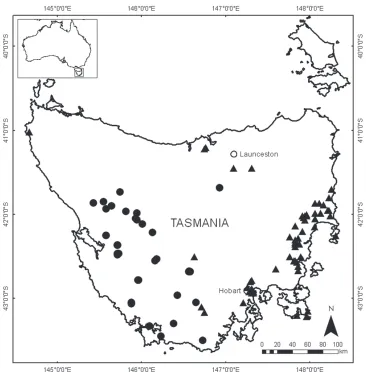
The results of the phenetic analysis provide strong support for the acceptance of L. sp. Eldon Bluff as a distinct entity. In both the phenogram (Figure 1) and ordination (Figure 2) a discrete group is formed by OTUs representing L. sp. Eldon Bluff. This group shows a level of dissimilarity that is comparable to those of the known species of Lepidosperma included in the analysis. The SEM images also show that L. sp. Eldon Bluff has distinctive fruit (Figure 3). This evidence provides strong support for the recognition of L. sp. Eldon Bluff as a separate species from L. inops. The ecological and geographic isolation of these two entities adds further support to this inference (Figure 4; Table 3). Lepidosperma sp. Eldon Bluff is described below as L. monticola sp. nov.
Lepidosperma monticola G.T.Plunkett & J.J.Bruhl, sp. nov. urn:lsid:ipni.org:names:77133478-1
http://species-id.net/wiki/Lepidosperma_monticola
Remarks. Lepidosperma monticola is distinguished from L. inops in having a minutely colliculate fruit apex, its longest culms being greater than half the length of the leaves, and the angle between the outermost leaves of the ramets being 20° or greater.
Type. AUSTRALIA: Tasmania: Mt Field National Park, Tarn Shelf, c. 100 m N of Dobson Hut, 26 April 2012, G.T. Plunkett 99, J.J. Bruhl & C.J. Prychid; holotype: HO; isotype: AD, BOL, BRI, BRIP, CANB, CHR, GENT, K, MEL, MO, NE, NSW, NY, P, PERTH, PRE. (Figure 5).
Short-rhizomatous perennial, forming dense clumps. Leaves markedly distichous, up to 8 cm long, innovations forming flat fans (ramets) with angle of 20–27° between Table 2. Principal component correlation of characters and ordination vectors from semi-strong hybrid multidimensional scaling ordination of three described and one putative species of Lepidosperma. Characters with a maximum correlation (r2) higher than 0.7 are included. See Appendix 1 for characters and Appendix 2 for data.
No. Character X Y Z r2
128 Fruit style cap indumentum -0.718 0.3 0.628 0.845 9 Culm margin hairs: orientation 0.645 -0.12 -0.755 0.834 38 Leaf lamina margin hairs: orientation 0.407 -0.667 -0.624 0.767
2 Culm length 0.129 0.18 -0.975 0.765
17 Angle of ramet -0.643 0.34 0.686 0.74
outer leaves; lamina well-developed, isobilateral, shallowly biconvex, ± rigid, striate, to 65 mm long, 1–1.5 mm wide, margins glabrous or scabrous with prickle hairs antrorse; sheaths 10–25 mm long, pale yellow-brown to mid-brown, often with tinge of red-pink, not resinous, margin glabrous; ligule subulate to acute, glabrous. Culms shallowly biconvex or rhombic in cross-section, 30–55 mm high, 0.8–1.4 mm wide, 1/2–2/3 length of longest leaves, pale yellow-brown at base, margins glabrous or scabrous with prickle hairs antrorse. Photosynthetic pathway ‘maximum cell distance count’ >1, C3. Inflorescence obovate in outline, a reduced panicle of 1–3 spikelets, 7–12 mm long, 2.5– 5(–10) mm wide; involucral bract equal to or up to twice as long as the inflorescence, 9–24.5 mm long, sheath pink-red to dark red-brown at least proximally; rachis not flexous or reflexed. Spikelets 5–6.5 mm long, 1–2 mm diameter, with single bisexual flower; prophylls acute or emarginate, puberulous. Glumes 4, all of similar length; lowest 2 sterile, mucronate, outer face scabrous, with raised midrib; fertile glumes c. 6 mm long, apex subulate, midrib indistinct, outer face puberulous, margins glabrous. Perianth scales 6(–8), acute to acuminate, glabrous, 0.8–1.6 mm long. Anthers c. 1.4 mm long excluding apiculus; apiculus 0.4 mm long, glabrous. Nut elliptical in outline, pale green to mid brown depending on maturity, with 3 discolorous and raised ribs, c. 3 mm long, 1.4–1.7 mm diameter; style cap truncate, minutely colliculate.
Distribution and habitat. Restricted to the South West, Central Highlands, West Coast and Mt Field regions of Tasmania; in alpine heath, herbfields, open forest and moorland at altitudes greater than about 700 m (Figure 6). At Tarn Shelf (Figure 4) and Mt Sprent this species grows in skeletal humus over or amongst rock outcrops, in epacrid–Proteaceae–Myrtaceae heath or Gymnoschoenus sphaerocephalus sedgeland.
Conservation status. On the basis of our current knowledge, this species would not warrant listing under either the International Union for Conservation of Nature Red Table 3. Selected morphological and ecological attributes separating Lepidosperma monticola and L. inops. Ranges presented are absolute.
L. inops L.monticola, sp. nov.
Morphological character^
Culm length to leaf length ratio 0.27–0.37 0.53–0.7
Involucral bract length 27–59 mm 9–25 mm
Fruit – distal surface smooth minutely colliculate Angle of ramet (i.e. between
outermost leaves) 9–15° 20–27°
Ecology
Habitat Grassy woodland or sclerophyll forest occasionally subalpine woodland †Alpine heath, herbfield,
Altitude 20–500 m 700–1170 m
^Measurements from five specimens of L. inops and nine of L. monticola, fruit observations from four and seven specimens respectively.
†The vegetation at Eldon Bluff for A.M. Buchanan 9981 (HO) at 1080 m is described as “Open Eucalyptus
George T. Plunkett et al. / PhytoKeys 28: 19–59 (2013)
28
Figure 4.Comparison of habitat and habit of Lepidosperma inops and L. monticola.A, BL. inops (G.T.
Plunkett 112) at University of Tasmania campus, Hobart C, DL. monticola (G.T. Plunkett 99, J.J. Bruhl
& C.J. Prychid) at the type locality, Tarn Shelf, Mt Field National Park. Scale bars = 1 cm. Arrows indicate
George T. Plunkett et al. / PhytoKeys 28: 19–59 (2013)
30
Figure 6.Distribution of Lepidosperma inops (solid black triangles) and L. monticola (solid black circles) from herbarium specimen data. Cities indicated by open circles. All specimens seen by G.T. Plunkett (see Appendix 3 for vouchers).
List (IUCN 2012), Australian Environment Protection and Biodiversity Conservation Act 1999 or Tasmanian Threatened Species Protection Act 1995. All populations known from herbarium material occur within National Parks, Regional Reserves or Conservation Areas.
Derivation of epithet. Named from the Latin mons,montis (mountain) and -cola (dweller), referring to the distribution of this species on the mountains of Central and South Western Tasmania.
Kirkpatrick s.n. (HO); Sticht Range, 20 km S of Tullah, 920 m, 16 Apr. 1990, P.A. Collier 4678 (HO). Mt Field: Shelf above University Hut, Lake Dobson, 1120 m, 1 Jan. 1949, W.M. Curtis s.n. (HO). South West: Elliot Range, summit, 900 m, 15 Jan. 1985, S.J. Jarman s.n. (HO, MEL, NSW); Mt Rugby, 1120 m, 16 Feb. 1978, S.J. Jarman s.n. (HO). West Coast: Mt Darwin, 1100 m, 8 Mar 1974, D.A. Ratkowsky s.n. (HO); Mt Dundas, summit, 860 m, 1 Mar. 1894, L. Rodway s.n. (HO); Range extending S to SE from Mt Curly, 5 Feb. 1985, S.J. Jarman 263 (HO).
Phenology. Flowers November to February. Fruits December to April.
Acknowledgements
We thank HO and MEL for use of loan material, the staff at HO for use of facilities, ac-cess to specimens and specimen data and fieldwork tips, and NE for acac-cess to facilities and specimens. We acknowledge permission from National Parks and Wildlife in Tasmania to collect in areas under their management. Thanks also to Cate McGregor for mapping advice, Chrissie Prychid for assistance in the field and Ian Telford for constructive sug-gestions. GTP acknowledges receipt of an Australian Postgraduate Award (APA Scholar-ship), an Australian Biological Resources Study APATop-up grant, a UNE Botany Top-up Scholarship and funding from the School of Environmental and Rural Science.
References
Barrett RL (2007a) New species of Lepidosperma (Cyperaceae) associated with banded iron-stone in southern Western Australia. Nuytsia 17: 37–60.
Barrett RL (2007b) Lepidosperma gahnioides, a new species of Cyperaceae from the Raven-sthorpe region, Western Australia. Nuytsia 17: 61–66.
Barrett RL (2012) Systematic studies in Cyperaceae tribe Schoeneae: Lepidosperma and allied genera. PhD, The University of Western Australia, Perth.
Barrett RL (2013) Ecological importance of sedges: a survey of the Australasian Cyperaceae genus Lepidosperma. Annals of Botany 111: 499–529. doi: 10.1093/aob/mct008
Barrett RL, Wilson KL (2012) A review of the genus Lepidosperma Labill. (Cyperaceae: Schoe-neae). Australian Systematic Botany 25: 225–294. doi: 10.1071/SB11037
Bruhl JJ (1995) Sedge genera of the world: Relationships and a new classification of the Cyper-aceae. Australian Systematic Botany 8: 125–305. doi: 10.1071/SB9950125
Bruhl JJ, Stone NE, Hattersley PW (1987) C4 acid decarboxylation enzymes and anatomy in sedges (Cyperaceae): First record of NAD-Malic enzyme species. Australian Journal of Plant Physiology 14: 719–728. doi: 10.1071/PP9870719
Bruhl JJ, Wilson KL (2007) Towards a comprehensive survey of C3 and C4 photosynthetic pathways in Cyperaceae. Aliso 23: 99–148.
George T. Plunkett et al. / PhytoKeys 28: 19–59 (2013)
32
de Queiroz K (1998) The general lineage concept of species, species criteria, and the process of speciation — A conceptual unification and terminological recommendations. In: Howard DJ, Berlocher SH (Eds) Endless forms. Oxford University Press, New York, 57–75. de Queiroz K (1999) The general lineage concept of species and the defining properties of the
species category. In: Wilson RA (Ed) Species. Massachusetts Institute of Technology Press, Massachusetts, 49–89.
de Queiroz K (2007) Species concepts and species delimitation. Systematic Biology 56: 879– 886. doi: 10.1080/10635150701701083
Hodgon J, Bruhl JJ, Wilson KL (2006) Systematic studies in Lepidosperma (Cyperaceae: Sch-oeneae) with particular reference to L. laterale. Australian Systematic Botany 19: 273–288. doi: 10.1071/SB06007
IUCN (2012) IUCN Red List Categories and Criteria: Version 3.1. Second edition. Gland, Switzerland and Cambridge.
Appendix 1
Annotated character list used for phenetic analysis of species of Lepidosperma and de-scription of L. monticola sp. nov. Modified from DELTA ver. 1.04 database output.
Vegetative morphology:
#1. Rhizomes <whether long or short>/ 1. long <shoots spreading>/ 2. short <shoots clumped>/
• If long and short, both states scored
#2. Culms <length including inflorescence>/ mm long/
• Measured from base of plant (i.e. base of leaf sheaths) to the most distal inflorescence spikelet
#3. Culms <width at mid-third>/ mm wide/
• The greatest dimension in elliptical/flattened culms. Measured in the mid-third of culm length
#4. Culms <thickness at mid-third>/ mm thick/
#5. Culms width to thickness ratio <at mid-third>/ • Longest culm measured
#6. Culms <when dried; whether striate>/ 1. striate/
2. not striate/
#7. Culms <whether deeply grooved>/ 1. <deeply> grooved/
2. not <deeply> grooved/
• One or more deep grooves obvious at 10x magnification on fresh or dried material
#8. Culm margins <indumentum>/ 1. glabrous/
2. scabrous/ 3. puberulous/ 4. pilose/
George T. Plunkett et al. / PhytoKeys 28: 19–59 (2013)
34
#9. Culm margin hairs <orientation>/ 1. antrorse/
2. retrorse/ 3. divergent/
#10. Culm margin hairs <whether clumped>/ 1. clumped/
2. evenly spaced/
#11. Culm margin hairs <whether embedded in resin>/ 1. embedded in resin/
2. not embedded in resin/
#12. Culm margin hairs <position >/ 1. restricted to the apex of culm/ 2. along the upper third of culm/ 3. continuous along culm/ 4. along the lower third of culm/ 5. along mid-third of culm/
#13. Culms <length relative to leaves>/ 1. longer than leaves/
2. more or less equal to leaves/ 3. shorter than leaves/
• Culm length includes inflorescence (see character 2)
#14. Culm bases <colour>/ 1. green/
2. yellow-green/ 3. pale yellow/
4. pale yellow-brown <straw-coloured>/ 5. pale brown <pallid>/
6. orange-brown/ 7. mid brown <tan>/
8. dark brown <dark chocolate>/ 9. black-brown <intense dark brown>/ 10. pink-brown/
#15. Culm to leaf ratio <of lengths>/
• Relative lengths of longest culm and leaf
#16. Leaves <whether equitant>/ 1. equitant/
2. not equitant/
#17. Leaves <angle of fan (ramet) in degrees; Barrett 2007a>/ degrees/
• Measured as the angle between the two outermost leaves on a single complete ramet/fan
#18. Leaves <longest leaf; length>/ mm long/
#19. Leaf sheaths <length>/ mm long/
#20. Leaf sheaths <colour>/ 1. green/
2. yellow-green/ 3. pale yellow/
4. pale yellow-brown <straw-coloured>/ 5. pale brown <pallid>/
6. orange-brown/ 7. mid brown <tan>/
8. dark brown <dark chocolate>/
9. black-brown <intense dark chocolate>/ 10. pink-brown/
11. red-brown/ 12. red-pink/ 13. dark red/ 14. purplish/ 15. black/
• Assessed under dissecting microscope
#21. Leaf sheaths <whether resinous>/ 1. resinous/
2. not resinous/
• Unopened sheath observed; comment on quantity
#22. Leaf sheath margins <opacity>/ 1. translucent/
George T. Plunkett et al. / PhytoKeys 28: 19–59 (2013)
36
#23. Leaf sheath margins <indumentum>/ 1. glabrous/
2. scabrous/ 3. puberulous/ 4. pilose/
• Along margin towards apex
#24. Leaf sheath face <indumentum>/ 1. glabrous/
2. scabrous/ 3. puberulous/ 4. pilose/
#25. Ligule <apex shape>/ 1. caudate/
2. accuminate/ 3. acute/ 4. obtuse/ 5. rounded/ 6. emarginate/ 7. lobed/ 8. truncate/
#26. Ligule <indumentum>/ 1. glabrous/
2. scabrous/ 3. puberulous/ 4. pilose/
• Refers to the apex of the ligule.
#27. Leaf lamina <whether well-developed and photosynthetic at maturity>/
1. well-developed <photosynthetic, and at least some leaves shortly or distinctly laminate>/
2. reduced <functionally elaminate; leaves with lamina much reduced or absent>/
#28. Leaf lamina <whether rigid or flaccid>/ 1. rigid/
2. flaccid/
#29. Leaf lamina <longest leaf; length>/ mm/
#31. Leaf lamina <thickness in mid-third; not equivalent to width>/ mm thick/
#32. Leaf lamina <width to thickness ratio>/ • Measured in mid-third of lamina length
#33. Leaf lamina <general shape in cross-section>/ 1. dorsiventrally flattened/
2. terete/ 3. semiterete/
4. isobilaterally oblong/ 5. isobilaterally flattened/ 6. isobilaterally fusiform/
#34. Leaf lamina <colour of margins>/ 1. with red margins/
2. with colourless margins/
3. with concolorous margins <i.e., margins same colour as faces>/ 4. with brown margins/
5. with golden-orange margins/
#35. Leaf lamina <when dried; whether finely striate>/ 1. striate/
2. not striate/
#36. Leaf lamina <whether deeply grooved>/ 1. deeply grooved/
2. not deeply grooved/
#37. Leaf lamina margins <indumentum>/ 1. glabrous/
2. scabrous/ 3. papillose/ 4. puberulous/ 5. pilose/
• Assessed along whole length of lamina
#38. Leaf lamina margin hairs <orientation>/ 1. antrorse/
2. retrorse/ 3. divergent/
George T. Plunkett et al. / PhytoKeys 28: 19–59 (2013)
38
2. evenly spaced/
#40. Leaf lamina marginal hairs <whether embedded in resin>/ 1. embedded in resin/
2. not embedded in resin/
#41. Leaf lamina marginal hairs <position >/ 1. restricted to the lamina apex/
2. along the upper third of lamina/ 3. continuous along lamina/ 4. along the lower third of lamina/ 5. along the lower half of lamina/ 6. along mid-third of lamina/ 7. along upper half of lamina/
#42. Leaf lamina to sheaths ratio <of lengths>/
Inflorescence morphology:
#43. Inflorescence <outline; i.e. overall plane shape>/ 1. broadly ovate/
2. ovate/
3. narrowly ovate/ 4. linear/
5. oblong/
6. narrowly oblong/ 7. circular/
8. elliptic/
9. narrowly elliptic/ 10. obovate/
11. narrowly obovate/ 12. oblate/
13. fan-shaped/ 14. narrowly rhombic/ 15. broadly rhombic/
#44. Inflorescence <form>/ 1. single spikelet/ 2. panicle-like/
• Measured from the base of the lowest primary inflorescence bract to tip of distal spikelet.
#46. Inflorescence <width at widest point>/ mm wide/
#47. Inflorescence <number of nodes on primary axis>/ noded/
• Score the maximum number per specimen; start with lowest node
#48. Inflorescence lowest internode <length along main axis>/ mm long/
• Measured from the base of lowest primary inflorescence bract to the base of the next sheath on the main inflorescence axis.
#49. Inflorescence lateral branches <number per node>/ per node/
• Scored for first lateral branch only
#50. Inflorescence lateral branches <whether elongated>/
1. elongated <branch visible above sheath of inflorescence bract>/ 2. contracted <not visible beyond sheath>/
• Scored only where lateral branches with more than one spikelet were present.
#51. Inflorescence lateral branches <longest branch; length>/ mm long/
• Measured from lowest node to tip of the distal spikelet
#52. Proximal <inflorescence> lateral branch <length>/ mm long/
#53. Proximal <inflorescence> lateral branch <width>/ mm wide/
#54. Involucral bract <total length>/ mm/
#55. Involucral bract to inflorescence ratio <of total lengths>/
#56. Involucral bract sheath <length>/ mm/
George T. Plunkett et al. / PhytoKeys 28: 19–59 (2013)
40
2. yellow-green/ 3. pale yellow/ 4. pale yellow-brown 5. pale brown/ 6. orange-brown/ 7. mid brown/ 8. dark brown/ 9. black-brown/ 10. pink-brown/ 11. red-brown/ 12. red-pink/ 13. dark red/ 14. purplish/ 15. black/ 16. grey/
#58. Involucral bract sheath <indumentum>/ 1. glabrous/
2. scabrous/ 3. puberulous/ 4. pilose/
#59. Involucral bract sheath apex <indumentum>/ 1. glabrous/
2. scabrous/ 3. puberulous/ 4. pilose/
#60. Involucral bract sheath margin <opacity>/ 1. translucent/
2. opaque/
#61. Involucral bract sheath ligule <whether with a free limb>/ 1. with a free limb/
2. without a free limb/
#62. Involucral bract sheath ligule <apex shape>/ 1. caudate/
8. truncate/
#63. Involucral bract sheath ligule <indumentum>/ 1. glabrous/
2. scabrous/ 3. puberulous/ 4. pilose/
#64. Involucral bract lamina to sheath ratio <of lengths>/
#65. Involucral bract <whether with a well-developed lamina>/ 1. lamina well-developed <photosynthetic>/
2. reduced <non-photosynthetic at maturity>/
• Lamina well-developd or much narrower than sheath or mucro-like or absent
#66. Involucral bract lamina <length>/ mm long/
#67. Involucral bract lamina <width>/ mm wide/
#68. Involucral bract lamina <shape in cross-section>/
1. isobilaterally flattened <or elliptical> along entire length <of lamina>/
2. triangular at lamina apex <but becoming isobilaterally elliptical above ligule; e.g. L. tortuosum>/
3. triangular along entire length <of lamina>/
4. triangular at lamina apex <and becoming half-rhombic towards base>/ 5. triangular at lamina apex <and becoming trullate towards base>/ 6. triangular at lamina apex <and becoming circular towards base>/ 7. circular along entire length/
8. dorsiventrally flattened along entire length/
9. dorsiventrally flattened at apex <and becoming oblong at base>/
10. dorsiventrally crescentiform at apex <and becoming isobilaterally elliptical to-wards base>/
#69. Involucral bract lamina <indumentum>/ 1. glabrous/
2. scabrous/ 3. puberulous/ 4. pilose/
George T. Plunkett et al. / PhytoKeys 28: 19–59 (2013)
42
2. caudate/ 3. subulate/ 4. acuminate/ 5. acute/ 6. obtuse/ 7. rounded/
#71. Rachis <whether flexuous>/ 1. flexuous/
2. not flexous/
• Spikelet-bearing axis of inflorescence.
#72. Rachis <whether reflexed>/ 1. reflexed <e.g. L. tortuosum>/ 2. not reflexed/
Spikelet and floral morphology:
#73. Spikelet prophyll <shape of apex>/ 1. obtuse/
2. truncate/ 3. emarginate/ 4. acute/
#74. Spikelet prophyll margin <indumentum>/ 1. glabrous/
2. scabrous/ 3. puberulous/ 4. pilose/
#75. Spikelet prophylls outside <abaxial> face <indumentum>/ 1. glabrous/
2. scabrous/ 3. puberulous/ 4. pilose/
#76. Spikelet prophyll keel <indumentum>/ 1. glabrous/
#77. Spikelets <number per inflorescence>/ 1. less than 30/
2. more than 30/
#78. Spikelets <number per lowest lateral branch>/ per lowest lateral branch/
#79. Spikelets <length excluding any pedicel>/ mm long/
• Measure spikelet from base to apex
#80. Spikelets <diameter>/ mm diameter/
#81. Sterile floral bract apex <shape>/ 1. aristate/
2. subulate/ 3. acuminate/ 4. acute/ 5. obtuse/ 6. rounded/ 7. truncate/ 8. emarginate/
#82. Sterile floral bract midrib <whether raised>/ 1. raised/
2. flush/
#83. Sterile floral bract <whether mucronate>/ 1. mucronate/
2. muticous <not mucronate>/
#84. Sterile floral bract outside (abaxial) face <indumentum>/ 1. glabrous/
2. scabrous/ 3. puberulous/ 4. pilose/
#85. Sterile floral bract margins <form of margin indumentum>/ 1. glabrous/
George T. Plunkett et al. / PhytoKeys 28: 19–59 (2013)
44
#86. Sterile floral bracts <number per spikelet>/ per spikelet/
#87. Fertile floral bracts <number per spikelet>/ per spikelet/
#88. Fertile female floral bract apex <shape>/ 1. aristate/
2. subulate/ 3. acuminate/ 4. acute/ 5. obtuse/ 6. rounded/
#89. Fertile floral bracts <whether mucronate>/ 1. mucronate/
2. muticous <not mucronate>/
#90. Fertile floral bract midrib <whether obvious at 10x>/ 1. apparent/
2. indistinct/
#91. Fertile floral bract midrib <indumentum>/ 1. glabrous/
2. scabrous/ 3. puberulous/ 4. pilose/
#92. Fertile floral bracts outside face <indumentum; abaxially, excluding midrib and margins>/
1. glabrous/ 2. scabrous/ 3. papillose/ 4. puberulous/ 5. pilose/
#93. Fertile floral bracts inside face <indumentum; adaxially, excluding margins>/ 1. glabrous/
2. scabrous/ 3. puberulous/ 4. pilose/
2. scabrous/ 3. puberulous/ 4. pilose/
#95. Fertile floral bract nerves <number visible with 10x magnification>/
#96. Female-fertile flowers <includes bisexual flowers; number>/ per spikelet/
#97. Male flowers <number>/ per spikelet/
#98. Female-fertile floral bracts <length>/ mm long/
#99. Female-fertile floral bracts <width; measured in situ>/ mm wide/
#100. Total number of flowers per spikelet/
#101. Stamens <number per flower>/ per flower/
#102. Anther <length excluding apiculus>/ mm long excl. apiculus/
#103. Anthers <width>/ mm wide/
#104. Anther apiculus <length>/ mm long/
#105. Anther apiculus <indumentum>/ 1. glabrous/
2. scabrous/
#106. Style branches <number>/ per pistil/
Fruit and perianth morphology:
George T. Plunkett et al. / PhytoKeys 28: 19–59 (2013)
46
#108. Perianth scale <shape>/ 1. narrow ovate/
2. ovate/
3. broadly ovate/ 4. circular/
#109. Perianth scale apex <shape>/ 1. caudate <drawn into long tail>/ 2. subulate/
3. acuminate/ 4. acute/ 5. rounded/ 6. obtuse/
#110. Perianth scale apex <indumentum>/ 1. glabrous/
2. indumented/
#111. Perianth scale apex hairs <position>/ 1. restricted to the very tip/
2. not restricted to the tip <and extending proximally>/
#112. Perianth scale fused base <maximum length>/ mm/
#113. Perianth scale free limb <maximum length>/ mm/
#114. Perianth scale <width>/ mm/
• Measured at widest part of scale
#115. Perianth scales <whether overlapping at the base >/ 1. overlapping/
2. not overlapping/
#116. Fruit <length including perianth>/ mm long including perianth/
#117. Fruit <length excluding perianth>/ mm long excluding perianth/
• At widest diameter
#119. Fruit <shape in broadest lateral view>/ 1. spherical/
2. ovate <widest near base>/ 3. oblong <with parallel sides>/ 4. elliptical <widest in middle >/ 5. obovate <widest near apex>
#120. Fruit ribs <whether distinct from fruit faces>/ 1. discolorous with faces/
2. concolorous with faces/
#121. Fruit ribs <whether raised>/ 1. raised <above face of fruit>/
2. not raised <ribs more or less flush with surface of nut>/ 3. sunken <below face of fruit>/
#122. Fruit ribs <colour>/ 1. green/
2. pale green/ 3. pale yellow/ 4. yellow-brown/ 5. pale brown/ 6. orange-brown/ 7. mid brown/ 8. dark brown/ 9. red-brown/ 10. black/
#123. Fruit face <colour at maturity>/ 1. green/
George T. Plunkett et al. / PhytoKeys 28: 19–59 (2013)
48
#124. Fruit faces <whether wrinkled at maturity>/ 1. wrinkled/
2. not wrinkled/
#125. Fruit style cap <length>/ mm/
#126. Fruit style cap apex <shape>/ 1. truncate/
2. rounded/ 3. obtuse/ 4. acute/
#127. Fruit style cap <colour>/ 1. green/
2. pale green/ 3. pale brown-green/ 4. yellow-green/ 5. pale yellow/ 6. yellow-brown/ 7. pale brown/ 8. orange-brown/ 9. mid brown/ 10. dark brown/ 11. red-brown/ 12. black/
• Record if fruit immature, recently mature or well mature.
#128. Fruit style cap <indumentum>/ 1. glabrous/
2. scabrous/ 3. papillous/
4. <minutely> colliculate/
#129. Fruit style base <presence fused on top of style cap>/ 1. present/
2. absent/
#130. Fruit style base <length>/ mm/
Culm anatomy
• As seen in cross-section. Many characters are from or modified from Metcalfe (1971) with others from Bruhl (1995) and our subsequent work. Cross-sections made from mid-third of culm.
#132. Culms <shape in cross-section>/ 1. triangular/
2. circular/
3. truncated circular/ 4. subhemispherical/ 5. square/
6. trullate or rhombic/ 7. crescentiform/ 8. fusiform/
9. broadly elliptical/ 10. elliptical/
11. narrowly elliptical/ 12. ovate/
13. ‘almond-shaped’<ovate with one margin acute and the other obtuse or rounded>/
14. oblong/
15. shallowly hexagonal/
16. ‘Swiss-escutcheon-shaped’<shaped like a Swiss escutcheon, which is an elab-orated heart shape with two convex sides and a truncate apex with a short projection in the middle >/
#133. Culm margins <shape in cross-section>/ 1. rounded <e.g. in L. viscidum>/
2. obtuse/ 3. acute/ 4. acuminate/
#134. Culm stomata <position relative to epidermal cells>/ 1. raised/
2. flush/ 3. sunken/
#135. Culm vascular bundles <number>/
#136. Culm vascular bundles <number of distinct size classes>/
George T. Plunkett et al. / PhytoKeys 28: 19–59 (2013)
50
2. absent/
• Individual vascular bundles surrounded by chlorenchyma cells
#138. Culm vascular bundles enclosed within parenchyma <presence>/ 1. present/
2. absent/
• Individual vascular bundles surrounded by parenchyma cells
#139. Culm vascular bundles between chlorenchyma and parenchyma <presence>/ 1. present/
2. absent/
• Individual vascular bundles may be positioned between, and contacting both, chlorenchyma and parenchyma, i.e. not completely surrounded by one tissue type.
#140. Culm sclerenchymatous fibre caps <presence>/ 1. present/
2. absent/
#141. Culm sclerenchymatous fibre girders <presence>/ 1. present/
2. absent/
• Girders connecting vascular bundles and epidermis.
#142. Culm sclerenchymatous fibre girders between vascular bundles <presence>/ 1. present <e.g. in L. concavum (J.J. Bruhl 2574)>/
2. absent/
#143. Culm sclerenchymatous fibre strands <presence>/ 1. present/
2. absent/
#144. Culm sclerenchymatous fibre strands <whether all contacting epidermis>/ 1. all contacting epidermis/
2. some not contacting epidermis/
• Some small strands occur which are surrounded by mesophyll or parenchyma and do not contact the epidermis or vascular bundles.
#145. Culm pith or parenchyma <whether homogeneous or heterogeneous>/ 1. homogeneous/
2. heterogeneous/
cells have relatively thick cell-walls, usually associated with the vascular bundles; and (2) ‘translucent tissue’ where the cells are generally larger and have thin cell-walls.
#146. Culm pith or parenchyma <heterogeneous morphology>/ 1. vascular bundle ‘rings’ surrounding translucent tissue/
2. large amount of pith with thin ‘bridges’ between opposite vascular bundles/
#147. Culm multicellular trichomes <whether present>/ 1. absent/
2. present singularly/ 3. present in groups/
#148. Culm epidermal zones <relative width>/ 1. wider costally/
2. equal in width/ 3. wider intercostally/
#149. Culm epidermal cell silica bodies <presence>/ 1. present <within thin-walled epidermal cells>/ 2. absent <and epidermal cells thick walled>/
#150. Culm epidermal cell silica bodies <distribution>/ 1. throughout epidermis/
2. restricted to margin epidermis/
#151. Culm epidermal ‘silica cells’ <position relative to non-silica epidermal cells>/ 1. raised/
2. flush/ 3. sunken/
• ‘Silica cells’ are epidermal cells containing one or more silica bodies
#152. Culm sub-epidermal sclerenchymatous strands and/or girders width <mean number of cells>/
• Mean of counts of five adjacent strands and/or girders. Within each strand and/ or girder count the number of sclerenchymatous cells adjacent to the epidermis as seen in cross-section. Counted in mid-third of section if possible.
#153. Culm sub-epidermal sclerenchymatous strands and/or girders length <mean number of cells>/
George T. Plunkett et al. / PhytoKeys 28: 19–59 (2013)
52
Appendix 2 Dataset of
Lepidosperma
species from DELTA file.
Operational taxonomic unit (
OTU) code in first column. Characters marked with * not included in phenetic
analysis. See Table 1 for OTU details and Appendix 1 for character list.
Character curBag01 curCon01 curMac01 curRos01 eldCou01 eldEld01 eldFie01 eldFie02 eldMcC01 eldPro01 eldSpr01 eldSpr02 eldSpr03 inoBre01 inoGra01 inoLen01 inoUni01 inoUni02 torBar o02 torBarT01 torBla01 torBoo01 torDem01 torMul01 torWer01 1* 2 1/2 2 2 2 2 2 2 2 2 2 2 2 2 2 2 2 2 2 2 2 2 2 2 2 2 99 116 93 185 31 43 51 35 48 41 51 55 39 49 17.5 45 45 56 341 233 423 350 319 343 502 3 1.23 1.34 1.21 1.21 1.18 1.23 0.8 0.81 0.97 1.3 1.4 1.24 1.31 0.74 0.83 1.02 0.72 0.67 1.44 0.83 0.82 1.55 1.21 1.07 0.82 4 0.39 0.41 0.72 0.65 0.36 0.44 0.36 0.39 0.46 0.27 0.51 0.28 0.39 0.42 0.47 0.41 0.35 0.38 0.62 0.61 0.6 0.77 0.55 0.45 0.66 5 3.15 3.27 1.68 1.86 3.28 2.8 2.22 2.08 2.11 4.81 2.75 4.43 3.36 1.76 1.77 2.49 2.06 1.76 2.32 1.36 1.37 2.01 2.2 2.38 1.24 6* 2 1 2 1/2 1 1 1 1 1 1 1 1 1/2 2 2 2 1 1 1 1 1 1 1 1 1 7* 2 2 2 2 2 2 2 2 2 2 2 2 2 2 2 2 2 2 1/2 2 1/2 1/2 1/2 2 2 8 2 2 2 2 2 1&2 1&2 1/2 2 2 1/2 1/2 1/2 1 1 1/2 1/2 1/2 2 2 2 2 2 2 1/2 9 3 3 3 3 1 1 1 1 1 1 1 1 1 1 1 1 3 3 1/3 1 3 3 3 10 2 2 2 2 2 1 1/2 1/2 1/2 2 1/2 2 2 1 2 2 1/2 1 1 2 2 1/2 11* 2 2 2 2 2 2 2 2 2 2 2 2 2 2 2 2 2 2 2 2 2 2 2 12 3 3 3
2& 3/5
3 3 2/4 1/3 3 3 3 2/3 2/3 2 1 2 3 3 3 3 3 3 3 13 3 3 3 3 3 3 3 3 3 3 3 3 3 3 3 3 3 3 1 2 1 1 1 1 1 14* 3/5 3 3/5 3/5 2/3 3/4 3/5 3 2/4 1/3-4 3 3 3 3 3 3/5-7 3 3 3 7-11- 13 11/12 3 2/3/5 3/5 3/12 15 0.36 0.47 0.54 0.82 0.56 0.59 0.58 0.7 0.66 0.53 0.57 0.69 0.6 0.35 0.27 0.34 0.37 0.31 1.45 1.16 3.38 1.66 1.29 1.66 1.56 16* 1 1 1 1 1 1 1 1 1 1 1 1 1 1 1 1 1 1 1 1 1 1 1 1 1 17 10 10 15 6 22 20 20 20 23 24 26 27 25 12 15 15 15 9 7 5 5 8 5 6 7 18 272 246 173 225 55 73 88 50 73 77 79 80 65 139 65 133 121 181 235 227 125 211 247 207 321 19 40 34 25 26 16 22 25 12 14 23.5 22 22 12 29 15 30 19.5 36.5 35 26 50 25 23 20 31 20 3/5 4/7 3/5 4/5 3/4- 5/12 3/12
1/3- 4/5- 12 3/5- 12 3/4- 5/7- 12
5/7- 12 3/5- 7/12 3/5- 7/12 2/3- 4/5- 7/11
3/5 4/5-7 4/5-7 3/5-7 1/5-7 3/4- 5/7 2/4- 5/7- 12
8/11 /12
3/4-5
3/4
3/4-5
George T. Plunkett et al. / PhytoKeys 28: 19–59 (2013) 54 Character curBag01 curCon01 curMac01 curRos01 eldCou01 eldEld01 eldFie01 eldFie02 eldMcC01 eldPro01 eldSpr01 eldSpr02 eldSpr03 inoBre01 inoGra01 inoLen01 inoUni01 inoUni02 torBar o02 torBarT01 torBla01 torBoo01 torDem01 torMul01 torWer01 47 7 8 7 7 2 3 2 1 3 3 2 2 2 2 2 2/3 2 3 3 3 4 4 4 3 5 48 8 8 10.5 9.5 1 3.5 2.5 2 2.5 2 2.5 4.5 2 6.5 5.5 2 4 2 7 4 2.5 3 3 49* 1 1 1 1 1 1 1 1 1 1 1 1 1 1 1 1 1 1 1 1 1 1 1 1 50 1/2 1/2 1/2 1/2 2 1 2 2 2 51 16 16 15 22 6.5 5 7 8 8.5 7.5 5 6.5 6 5 7.5 6 6.1 12.5 9 12 11 9.5 11 11 52 16 16 15 22 6.5 5 7 8 8.5 7.5 5 6.5 6 5 7.5 6 6.1 12.5 9 12 11 9.5 11 11 53 4 2.5 3 5 1.5 1 2 2 1.5 1 1.5 2 1.5 2 4 2 1.5 7.5 3 7 8 5 2.5 7 54 19 2.5 21.5 22 9 12 20.5 13 10.5 24.5 12 9.5 10.5 52 27 59 49 41 13 9.5 28 11 8 9.5 10 55 0.63 31 0.72 0.63 1.29 1.26 1.71 1.44 1.05 2.33 1.41 1.12 1.17 5.2 4.91 4.92 4.45 5.32 1.08 1.06 2.33 1 1.07 0.86 0.91 56 10 1.07 10.5 10 5 5.5 7.5 7 5.5 8 7 5.5 5.5 10 6.5 9 7.5 5.5 3 2 4 4 2 2.5 2.5 57 5/7- 16 5 5/7 5/7-8 7/11 /13 5/7- 11 5/7-8
George T. Plunkett et al. / PhytoKeys 28: 19–59 (2013)
58
Appendix 3
Index to numbered collections of Lepidosperma seen by G.T. Plunkett All specimens are in HO unless otherwise indicated.
Allan, M.s.n. 30 Sept. 1975 HO 135425, s.n. 19 Oct. 1979 HO 515594 (L. inops).
Beauglehole, A.C. 25084 MEL (L. curtisiae).
Brown, M.J. 1365 (L. monticola).
Bruhl, J.J. 630 (L. monticola); 2407 NE (L. inops); 2453 NE (L. tortuosum); 3005 NE (L. curtisiae).
Buchanan, A.M. 3293, 3018a, 7276, 7629 (L. inops); 9981 (L.monticola); 10880 (L. inops); 12360 (L. monticola); 13324, 14710, 15288 (L. inops).
Coates, F.s.n. 25 Jan. 1990 HO 127069 (L. inops).
Collier, P.A. 945, 1015, 1391, 1488, 1500, 1628, 1900, 2338, 2522, 2560, 3247 (L. inops); 3844 (L. monticola); 4016, 4105, 4354 (L. inops); 4405, 4678 (L. monticola), 5254 (L. inops).
Curtis, W.M. s.n. 1 Jan. 1949 HO 135483 (L. inops); s.n. 1 Jan. 1949 HO 135412, s.n. 1 Jan. 1949 HO 135486, s.n. 1 Jan. 1949 HO 135489, s.n. 7 Mar. 1949 HO 135487 (L. monticola); s.n. 10 Sept. 1951 HO 135488, s.n. 3 Dec. 1972 HO 24548, s.n. 28 Oct. 1978 HO 135485, s.n. 28 Oct. 1978 HO 534984 (L. inops).
Davies, F.E. 1241 (L. inops).
Dobson, A.T. 77290 (L. monticola).
Duncan, F. 2, 1120, s.n. 22 Mar. 1994 HO 317251, s.n. 1 Aug. 1995 HO 314343, s.n. 1 Aug. 1995 HO 314344, s.n. 31 Aug. 1995 HO 314345 (L. inops).
Griffith, S.J.s.n. 20 Apr. 1993 NE (L. tortuosum).
Hodgon, J. 391c NE, 415 NE (L. tortuosum).
Hosking, J.R. 3041 NE (L. tortuosum).
Hunter, J.T. 5068 NE (L. tortuosum).
Jackson, W.D.s.n. 1 Apr. 1960 HO 24549, 30 Aug. 1983 HO 68636 (L. inops).
Jarman, S.J. 157, 180, 235, 263, s.n. 16 Feb. 1978 HO 411020, s.n. 20 Dec 1978 HO31334, s.n. 13 Dec. 1979 HO 411752 (L. monticola); s.n. 12 Aug. 1980 HO 319561 (L. inops); s.n. 8 Feb. 1984 HO 412112, s.n. 21 Mar. 1984 HO 412037, s.n. 15 Jan.1985 HO 443183, s.n. 4 Mar. 1986 HO 412044, s.n. 12 Mar. 1986 HO 411078, s.n. 10 Apr. 1986 HO 412047, s.n. date unknown HO 411443 (L. monticola).
Klaphake, V.s.n. 1 Jan. 1998 NE (L. tortuosum)
Moscal, A. 214, 397, 409 (L. inops); 1776, 1795, 4636 (L. monticola); 6182 NE (L. inops); 8022, 8039 (L. monticola); 8040 (L. curtisiae); 8254, 8285, 8291, 8363 (L. monticola); 9441, 18031 NE (L. inops); 19548, 28626 (L. monticola).
Plunkett, G.T. 94a, 94b, 95, 96, 98, 99, 100 (L. monticola); 112, 115 (L. inops) all NE.
Rao, C.V.s.n. 1 Jan. 1956 HO 135544 (L. inops).
Ratkowsky, D.A. 545, 1082 NE, s.n. 1 Jan. 1974 HO 135490 (L. inops); 8 Mar. 1974 HO 135415 (L. monticola).
Rodway, L. s.n. 1 Mar. 1892 HO 26449 (L. inops); s.n. 1 Mar. 1894 HO 26450 (L. monticola).
Smith, J.M.B. 342 (L. monticola).
Williams, K.J.s.n. 18 May 1987 HO 531508 (L. inops).
Wilson, K.L. 6522, 6662 (L. inops).
George T. Plunkett et al. / PhytoKeys 28: 19–59 (2013)