ARTIGO ORIGINAL
Strategy to Control Methicillin-Resistant
Staphylococcus Aureus
: The 5 Year Experience
of a Hospital
Estratégia para Controlar o
Staphylococcus Aureus
Resistente à Meticilina:
A Experiência de Cinco Anos de um Hospital
1. Comissão de Controlo de Infeção. Unidade Local de Saúde de Matosinhos. Matosinhos. Portugal. 2. Serviço de Infeciologia. Unidade Local de Saúde de Matosinhos. Matosinhos. Portugal. 3. Comissão de Antimicrobianos. Unidade Local de Saúde de Matosinhos. Matosinhos. Portugal. Recebido: 01 de Agosto de 2013 - Aceite: 23 de Dezembro de 2013 | Copyright © Ordem dos Médicos 2014
David PERES1, Isabel NEVES1,2,3, Fernanda VIEIRA1, Ilda DEVESA1 Acta Med Port 2014 Jan-Feb;27(1):67-72
RESUMO
Introdução: O Staphylococcus aureus resistente à meticilina é um dos microrganismos multirresistentes mais frequentemente
impli-cados em infeções associadas a cuidados de saúde. Definiu-se como objetivo implementar uma estratégia multimodal para controlar este microrganismo num hospital.
Material e Métodos: Procedimento baseado em rastreio ativo e medidas de isolamento numa população selecionada (doentes pro-venientes de outras instituições de saúde e lares ou com historial de internamento/ staphylococcus aureus resistente à meticilina;
doentes dos cuidados intensivos e intermédios e, nos restantes serviços, rastreio aos contactos diretos se detetado um novo caso de staphylococcus aureus resistente à meticilina e, desde 2012, hemodialisados). Outras ações paralelas: (1) revisão das normas
Precauções Básicas e Isolamento; (2) reforço dos pontos de desinfeção alcoólica das mãos; (3) sessões de esclarecimento aos profissionais de saúde; (4) folha ‘Alerta de staphylococcus aureus resistente à meticilina’ no processo dos doentes; (5) panfleto de
in-formação aos doentes/ visitas; (6) monitorização do procedimento através de auditoria e (7) descolonização de doentes nos cuidados intensivos e intermédios, com rastreios de follow-up.
Resultados: Entre 2007 e 2012 registou-se um decréscimo da proporção de staphylococcus aureus resistente à meticilina de 66% para 57% e da densidade de incidência de 1,80 para 0,68 casos por mil dias de internamento (p < 0,001; RR 0,38; IC95%: 0,29-0,49).
Discussão/Conclusão: De acordo com dados europeus publicados, referentes a isolados no sangue e líquor, Portugal foi o país com maior proporção de staphylococcus aureus resistente à meticilina em 2011. Utilizando este critério de inclusão, o nosso hospital
revelou uma proporção de staphylococcus aureus resistente à meticilina inferior à média nacional (34% versus 55%). A estratégia
multimodal demonstrou ser eficaz na diminuição dos casos de staphylococcus aureus resistente à meticilina. Salvaguarda-se a
neces-sidade de realizar vigilância epidemiológica deste agente, bem como monitorização da aplicação do procedimento, com feedback aos
profissionais de saúde.
Palavras-chave:Staphylococcus aureus Resistente à Meticilina; Controlo da Infecção; Portugal.
ABSTRACT
Introduction: Methicillin-resistant Staphylococcus aureus remains one of the principal resistant pathogens causing serious
healthcare-associated infections. The objective of this study was to control and monitor methicillin-resistant Staphylococcus aureus cases using
multimodal strategy in a Portuguese hospital.
Material and Methods: Multistep procedure involving isolation measures and active surveillance cultures in a selected population (patients from other hospitals and nursing homes; history of hospitalization/ methicillin-resistant Staphylococcus aureus; intensive
and intermediate care patients and, in other inpatient services, direct contacts of newly detected methicillin-resistant Staphylococcus aureus patients and, since 2012, patients doing hemodialysis). Other parallel activities: (a) review of isolation and standard precautions
policy, (b) reinforcement of alcohol-based handrubs at point of patient care, (c) information sessions to health professionals, (d) tar-geted information flyer for health professionals, (e) information leaflet for patients/ visitors; (f) procedure monitoring by audit (g) patient decolonization in intensive and intermediate care units, with follow-up screenings.
Results: Between 2007 and 2012, methicillin-resistant Staphylococcus aureus surveillance detected a decrease in proportion from
66% to 57% and, in density of incidence, from 1.80 to 0.68 cases per thousand days of hospitalization (p < 0.001; RR 0.38; CI95%:
0.29-0.49).
Discussion/Conclusion: According to published European data, using blood and cerebrospinal fluid isolates only, Portugal was the country with the highest level of methicillin-resistant Staphylococcus aureus in 2011. Using this inclusion criteria, our hospital reveled
a proportion of methicillin-resistant Staphylococcus aureus below its national level (34% versus 55%) in 2011. Fighting
methicillin-resistant Staphylococcus aureus using a multimodal strategy is being effective in a high endemic level hospital, but perseverance is
needed through continuous surveillance of cases, feed-back to professionals and procedure audits.
Keywords: Methicillin-Resistant Staphylococcus aureus; Infection Control; Staphylococcal Infections; Portugal.
INTRODUCTION
Staphylococcus aureus is a microorganism present in
a healthy individual’s skin and nasal microbial population. Most strains are sensible to several antibiotics and
infec-tions are efficiently handled. However, there are strains that are methicillin-resistant which are also resistant to several antibiotics, making the treatment of
Staphylococ-35
35 anos a p
rom
ov
er
as
ciê
CA
P
ORT
UGUE
SA
ARTIGO ORIGINAL cus aureusand expensive. methicillin-resistant (MRSA) infection difficult 1 The lack of therapeutic alternatives is a source of concern national and internationally, as a re-sult of which the Infectious Diseases Society of America included MRSA in the ‘bad bugs, no drugs’ list, known by
the ESKAPE mnemonic.2 As Grundmann et al. describe, there is evidence that nosocomial MRSA infections in-crease morbidity, mortality risk and costs.3
MRSA is currently the multi-resistant microorganism most frequently isolated in hospitals all over the world4 .
Such is the case in Portugal, with a methicillin-resistance rate of 47.5% described by Melo-Cristino et al in 2003,5
Referring to Blood and LCR isolates alone, more recent data shows that Portugal is the European country with the highest MRSA proportion, reaching 55% in 2011.4
Historically, MRSA was a microorganism associated with nosocomial infections; however, more recently, strains with different phenotypes emerged in the community,6 leading Klevens et al. to propose MRSA to be classified
as associated with healthcare (differentiating those detected in the hospital versus those detected in the
community) and acquired in the community.7 This last study estimated that approximately 18,650 deaths and 94,360 invasive MRSA infections occurred in 2005 in the US, establishing that ‘it represents a serious public health concern, primarily related with healthcare but no longer
confined to hospitals or other healthcare institutions’.7 In fact, a recent Portuguese study, using molecular biology methods, revealed the extensive dissemination of MRSA in hospitals and in the community.8
In the hospital, the sources of cross-transmission of this bacteria are infected or colonized patients.9
According to Henderson ‘within the hospital, the primary route of transmission, from patient to patient, seems to be from the hands of healthcare professionals’.10 The
risk of colonization/infection by MRSA increases with hospital stay, underlying disease severity, number of surgeries and manipulations and previous exposure to antibiotics.9 According to Solberg, MRSA prevalence in a
certain healthcare institution depends (1) on a constant introduction of these microorganisms due to new hospital admissions, (2) on the institution’s reservoirs due to colonization and spread between patients and professionals and (3) on the proportion of strains that became resistant due to antibiotic selective pressure.11 This study aimed to apply a multimodal strategy in order to control this microorganism in a hospital with endemic levels of MRSA.
MATERIAL AND MÉTHODS
Concerning an approximately 400-bed hospital, a multimodal strategy was implemented in 2008, in order to prevent and control MRSA. This involved the following measures: (1) universal application of basic precautions (including five-step handwashing); (2) active screening and isolation measures in a selected population and (3) patient decolonisation in specific cases, together
with continuous monitoring within the particular epidemiological surveillance system used in this health institution.
We implemented the following actions, in order to specifically address these objectives: (1) publication of the procedure ‘Estratégia Global para Prevenção e Controlo do MRSA’ (Global Strategy for MRSA Prevention
and Control) as a standard approved by the hospital’s Board; (2) revision of the standards ‘Precauções Básicas em Controlo de Infeção’ (Basic Precautions for Infection
Control) and ‘Precauções de Isolamento em Controlo de Infeção’ (Isolation Precautions for Infection Control); (3)
strong emphasis on alcohol-based hand disinfection, at the entrance and in every ward and room, as well as in every hospital bed (except in Paediatrics), beyond other locations where healthcare takes place (for instance, treatment rooms, medical offices) or considered to carry a similar risk (for instance, clean/dirty areas, medication preparation rooms); (4) holding training sessions for health professionals (including nursing and medical directors, as well as members of the different departments involved in infection control); (5) implementation of the
‘Folha alerta de MRSA – Informação aos Profissionais
de Saúde’ (MRSA Alert Sheet – Information for Health
Professionals) inserted on the clinical record of every MRSA-positive patient; (6) delivery of the information sheet ‘Saiba mais sobre o MRSA’ (Knowing more about
MRSA) given to MRSA patients and visitors; (7) holding an active nasal swab screening, with PCR real-time detection of the mecA gene, with the result obtained in
approximately two hours and (8) procedure audit. The basic pillar of the strategy comprises the immediate implementation of contact isolation measures and active screening on the following situations: a) patients transferred from other hospitals and elderly care homes (with a stay above 24h) or long-term care units; b) patients in ICU (Intensive Care Unit) and IMC (Intermediate Care Unit): on admission to these units when coming from other departments where a nasal swab screening has been performed more than 48h ago, at discharge from ICU/IMC where the nasal screening was performed more than 48 hours ago and at each seven days of hospital stay in these units; c) in the remaining departments: to direct contacts (patients in the same ward) whenever a new MRSA case is detected on a culture requested for clinical reasons and d) patients with MRSA colonisation and/or infection history (information recorded in the discharge letters from previous hospital stays and, in patient´s medical record, by the responsible doctor and nurse). Since 2012, this active screening is also applied to patients on haemodialysis. The contact isolation measures are lifted with a negative nasal swab (except if another reason exists to keep them, for instance, due to colonisation or infection by another ‘resistant microorganism); otherwise, the patients should remain in isolation until discharge.
ARTIGO ORIGINAL in patients admitted to the ICU/IMC or in patients where
this may have clinical benefit (for instance in the event of multiple MRSA infections) and with the agreement of the Department of Infectious Diseases. The decolonisation of health professionals is only recommended in the face of a suspicious persistent colonisation related with cross-transmission (this case must be followed by the Occupational Health Department and the HICC – Hospital Infection Control Committee). The procedure for decolonisation comprises nasal saline rinses and 2% mupirocin ointment twice/day during five days and a daily bath with antiseptic soap active against MRSA also for five days.
Once the decolonisation is performed, its efficacy must be monitored by three follow-up screenings (the first 48 hours upon decolonisation and weekly thereafter), until a low-risk of colonisation is achieved. If the first decolonisation fails, the procedure may be repeated once again.
Following the hospital epidemiological surveillance system, whenever a new case of MRSA is detected, the Microbiology Laboratory will give an alert to the HICC and patient’s data is obtained and recorded in an in-hospital system database. Thereafter the department where the patient is staying is contacted in order to ensure that the isolation measures have been implemented and to determine if subsequent screening should be carried out in other patients. In the case of a transferred patient or in the case of discharge to ambulatory care, a telephone or email contact alert should be made with the receiving institution.
In order to monitor the efficacy of the implemented strategy, we use two indicators proposed by Horan and Gaynes:12 the incidence proportion (in which the numerator stands for the methicillin-resistant strains and the denominator is the total of Staphylococcus aureus
isolates) and the incidence density rate (in which the numerator stands also for the methicillin-resistant strains and the denominator stands for the number of days of isolation). Data statistical analysis used the OpenEpi software.13 Duplicate elimination Clinical and Laboratory Standards Institute criteria were used in laboratory data.14
RESULTS
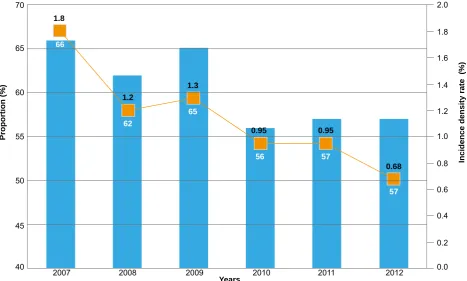
In 2007, when the strategy was implemented, the MRSA proportion was 66%, declining to 62% the following year, although increasing to 65% in 2009 (Fig. 1). We found a decrease from 65 to 56% in 2010 and a steady rate of 57% in 2011 and 2012. When considering the incidence rate indicator, we found a decrease from 1.80 to 1.20 cases per 1,000 days of hospital stay from 2007 to 2008. We found a slight increase to 1.30 in 2009 and a decline to 0.95 in 2010 and 2011. A new decrease occurred in 2012 to 0.68.
DISCUSSION
According to Bristish15 and North-American16-18
recommendations we followed a multimodal strategy, with an active screening together with isolation measures, in MRSA colonised or infected patients. Several healthcare institutions have implemented strategies based on these recommendations: Yang et al. describe that, from 102
Figure 1 – MRSA incidence proportion and density rate between 2007 and 2012 in Years Pedro Hispano Hospital
Proportion (%)
Incidence density rate (%)
2007 2008 2009 2010 2011 2012
40 0.0
45
0.2 50
0.4 55
0.6 60
0.8 65
1.0 70
1.8
66
1.2
62
1.3
65
0.95
56
0.95
57
0.68
57
ARTIGO ORIGINAL hospitals in the USA, 44% followed an MRSA active screening protocol and that a MRSA decolonisation
procedure existed in approximately 25% of them.19 A
phased strategy has been applied in one USA Hospital Centre: a first baseline stage, a second stage including active screening and decolonisation applied to patients admitted to intensive care and a last stage in which this strategy was applied to any hospital admission. The authors found an incidence density reduction of 0.89; 0.74 (p = 0.15 comparing with baseline) and 0.39 cases
(p < 0.001 compared with baseline), respectively, per
thousand days of hospital stay, reaching the conclusion that the universal active screening allowed for a relevant MRSA reduction during the stay and 30 days upon discharge. This study also describes that, if MRSA cases identification were obtained through culture requested only for clinical reasons (therefore without implementing the active screening) only 17.8% of the cases would be detected.20 In addition, in a Spanish hospital, the
authors obtained a reduction by implementing an active screening and decolonisation strategy in a selected group of patients (patients admitted from other hospitals) from 0.56 to 0.07 cases per one thousand days of hospital stay.21 Fraser et al. also obtained a reduction from 6.38 to 3.32 cases (p = 0.04; RR 0.53; 95%CI:
0.28-0.97) per one thousand days of stay by applying a decolonisation and active screening in an 18-bed ICU.22 Also, in a British study involving six hospitals, some issues were raised regarding the difficulty to implement a combined strategy with active screening and universal decolonisation, namely: difficulty in completing universal screening (including only 88% of the cases) or in the decolonization process (reaching 41% of the cases alone) due to patient’s mobility and hospital short stay, as well as due to the absence of patient’s physical structural isolation , raising some doubts regarding the role of decolonization in risk reduction in a hospital environment, and preferring to emphasize the importance of infection control precautions.23 In fact, it is not enough to implement active screenings and good practice by the professionals in order to comply with basic isolation and other precautions, if structural conditions are lacking. It is also important to remark that nasal mupirocin routine decolonisation is not recommended by several authors due to the risk of resistance, as well as due to the lack of long-term efficacy.15-17 However, Coia et al. and more
recently Liu et al. confirm that its selective use may be
useful in specific group of patients15,24 as the protocol that
we implemented in which it was defined to decolonize only the patients admitted to the ICU and to the IMC, or in very specific situations. Even not using decolonisation, Martinez-Capolino et al. have described a reduction on
the incidence of MRSA nosocomial infection in a 47-bed ICU, simply relying onactive screening (at admission and weekly) and isolation measures of positive patients during the whole stay (0.63 to 0.31 cases per thousand days of hospitalization).25 Several studies analysed under
an efficacy and cost-effectiveness point of view question the application of universal (i.e. for all patients) active screenings versus that in selected groups of patients,
without current agreement on this matter. Hospitals should consider local epidemiological data, infection control practice and the population characteristics in order to reach a decision.26
In the strategy that we implemented, we opted to carry out active screening in a selected group of patients considered at higher risk, with ongoing MRSA or previous hospital stay MRSA, patients coming from other healthcare institutions and elderly-care institutions; patients admitted to the ICU or IMC; direct contacts (patients within the same ward) with new MRSA cases and, since 2012, in patients on haemodialysis. We also opted for a quick screening test using a real-time PCR technique which, although more expensive than culture techniques, allows for a reduction in the time of isolation measures while waiting for the result and consequently reduces the possible occurrence of adverse events related to inappropriate isolation of a patient, as described in other studies.27,28
This strategy has proven to be effective, and we found a statistically significant reduction from 1.80 to 0.68 cases per thousand days of hospitalisation (p
< 0.001; RR 0.38; 95%CI: 0.29-0.49) over a 5-year period. Nevertheless, this decrease was not sustained, with an increase in 2009 which may be explained by failure in the application of the protocol. Several steps may have failed, namely screening sampling in patients in whom it was specifically indicated; holding a screening without the simultaneous implementation of contact isolation measures and failure in signalling the patients in isolation (observed in surveillance audits and subsequently corrected). These audits have also allowed for the identification of other patients in risk, in the cross transmission of this microorganism, namely in patients on haemodialysis.
If you consider the ‘proportion of MRSA’ indicator, according to data from the European Antimicrobial Resistance Surveillance Network, Portugal was the country with the highest proportion of MRSA in 2011.4
Twenty-two Portuguese hospitals participated in this network with 1,507 samples (only blood and CSF). Using this inclusion criterion, our hospital presented a proportion of MRSA lower than the national average in 2011 (34% versus 55%).
ARTIGO ORIGINAL CONCLUSIONS
The implementation of a multimodal strategy in a hospital with MRSA endemic values allowed, over a five-year period, for a reduction of the incidence proportion and density rate of this multi-drug resistant microorganism. This was based on active screening of a selected group of patients admitted to ICU/IMC, and consisted in the implementation and monitoring of isolation measures, upon patients with MRSA colonisation or infection, suspected or confirmed, and their subsequent decolonisation. We consider that the implementation of this strategy as a rule, approved by the Administration of the institution, allowed for cross-sectional application to every admission department. Finally, beyond an epidemiological surveillance system, the continuous monitoring of the application of these procedures through audit is required, with feedback information for health professionals.
ACKOWLEDGEMENTS
The authors wish to acknowledge all professionals from the Unidade Local de Saúde de Matosinhos for their
commitment in the daily application of good practices in infection control and more specifically in meeting the strategy for MRSA control.
CONFLICTS OF INTEREST
The authors declare that there were no conflicts of interests in writing this manuscript. The authors also declare that the results described in this study were partly presented as a poster at the 7as Jornadas de Actualização em Doenças Infecciosas do Hospital Curry Cabral. Lisboa; January 2010 (1st Prize); 22nd European
Congress of Clinical Microbiology and Infectious Diseases. London; April 2012 and 2nd International Conference on Prevention & Infection Control. Geneva; June 2013.
FINANCIAL SOURCES
This manuscript has been written without any scholarship or any other financial support.
REFERENCES
1. Stefani S, Varaldo PE. Epidemiology of methicillin-resistant staphylo-cocci in Europe. Clin Microbiol Infect. 2003;9:1179-86.
2. Boucher HW, Talbot GH, Bradley JS, Edwards JE, Gilbert D, Rice LB. Bad bugs, no drugs: no ESKAPE! An update from the Infectious Dis-eases Society of America. Clin Infect Dis. 2009;48:1-12.
3. Grundmann H, Aires-de-Sousa M, Boyce J, Tiemersma E. Emergence and resurgence of meticillin-resistant Staphylococcus aureus as a pub-lic-health threat. Lancet. 2006;368:874-85.
4. EARSS (2012) Antimicrobial resistance surveillance in Europe 2011. Annual Report of the European Antimicrobial Resistance Surveillance Network (EARS-Net). Stockholm: European Centre for Disease Preven-tion and Control. [Consultado 2013 Mar 22]. Disponível em: http://www. ecdc.europa.eu.
5. Melo-Cristino J, Alves AF, Amorim JM, Diogo J, Lito LM, Lopes P, et al. Estudo multicêntrico de resistência aos antimicrobianos em nove hos-pitais portugueses – Comparação de resultados num intervalo de uma década. Rev Port Doenças Infect. 2006;3:7-15.
6. Appelbaum C. Microbiology of antibiotic resistance in Staphylococcus aureus. Clin Infect Dis. 2007;45:S165-70.
7. Klevens RM, Morrison MA, Nadle J, Petit S, Gershman K, Ray S, et al. Invasive methicillin-resistant Staphylococcus aureus infections in the United States. JAMA. 2007;298:1763-71.
8. Espadinha D, Faria NA, Miragaia M, Lito LM, Melo-Cristino J, de Len-castre H; et al. Extensive dissemination of methicillin-resistant Staphy-lococcus aureus (MRSA) between the hospital and the community in a country with a high prevalence of nosocomial MRSA. PLoS One. 2013;8:e59960.
9. French GL. Antimicrobial resistance in hospital flora and nosocomial infections. In: Mayhall CG, editor. Hospital epidemiology and infection control. 3rd Ed. Philadelphia: Lippincott Willians & Wilkins; 2004. 10. Henderson DK. Managing methicillin-resistant staphylococci: a
para-digm for preventing nosocomial transmission of resistant organisms. Am J Med. 2006;119:S45-52.
11. Solberg CO. Spread of Staphylococcus aureus in hospitals: causes and prevention. Scand J Infect Dis. 2000;32:587-95.
12. Gaynes R, Horan T. Surveillance of nosocomial infections. In: Mayhall CG, editor. Hospital epidemiology and infection control. 3rd Ed. Philadel-phia: Lippincott Willians & Wilkins; 2004.
13. OpenEpi: Open Source Epidemiologic Statistics for Public Health. [homepage na Internet]. Atlanta: Rollins School of Public Health. [Con-sultado 2013 Mai 07]. Disponível em: http://www.openepi.com. 14. CLSI. Analysis and presentation of cumulative antimicrobial
susceptibi-lity test data. Approved Guideline – 2nd Ed. CLSI document M39-A2.
Pennsylvania: Clinical and Laboratory Standards Institute; 2005. 15. Coia JE, Duckworth GJ, Edwards DI, Farrington M, Fry C, Humphreys
H, et al. Guidelines for the control and prevention of meticillin-resistant Staphylococcus aureus (MRSA) in healthcare facilities. J Hosp Infect. 2006;63:S1-44.
16. APIC. Guide to the elimination of methicillin-resistant staphylococcus aureus (MRSA) Transmission in hospital settings. Washington: Associa-tion for Professionals in InfecAssocia-tion Control and Hospital Epidemiology; 2007. [Consultado em 2013 Maio 07] Disponível em: http://www.apic. org.
17. Siegel JD, Rhinehart E, Jackson M, Chiarello L, HICPAC. Management of multidrug-resistant organisms in healthcare settings, 2006. Am J In-fect Control. 2007;35:S165-93.
18. Calfee DP, Salgado CD, Classen D, Arias KM, Podgorny K, Anderson DJ, et al. Strategies to prevent transmission of methicillin-resistant Staphylococcus aureus in acute care hospitals. Infect Control Hosp Epi-demiol. 2008;29:S62-80.
19. Yang Y, McBride MV, Rodvold KA, Tverdek F, Trese AM, Hennenfent J, et al. Hospital policies and practices on prevention and treatment of infections caused by methicillin-resistant Staphylococcus aureus. Am J Health Syst Pharm. 2010;67:1017-24.
20. Robicsek A, Beaumont JL, Paule SM, Hacek DM, Thomson RB Jr, Kaul KL, et al. Universal surveillance for methicillin-resistant Staphylococcus aureus in 3 affiliated hospitals. Ann Intern Med. 2008;148:409-18. 21. Rodríguez-Baño J, García L, Ramírez E, Lupión C, Muniain MA,
Ve-lasco C, et al. Long-term control of endemic hospital-wide methicillin-resistant Staphylococcus aureus (MRSA): the impact of targeted active surveillance for MRSA in patients and healthcare workers. Infect Control Hosp Epidemiol. 2010;31:786-95.
22. Fraser TG, Fatica C, Scarpelli M, Arroliga AC, Guzman J, Shrestha NK, et al. Decrease in Staphylococcus aureus colonization and hospital-acquired infection in a medical intensive care unit after institution of an active surveillance and decolonization program. Infect Control Hosp Epi-demiol. 2010;31:779-83.
23. Reilly JS, Stewart S, Christie P, Allardice G, Smith A, Masterton R, et al. Universal screening for meticillin-resistant Staphylococcus aureus: interim results from the NHS Scotland pathfinder project. J Hosp Infect. 2010;74:35-41.
24. Liu C, Bayer A, Cosgrove SE, Daum RS, Fridkin SK, Gorwitz RJ, et al. Clinical practice guidelines by the infectious diseases society of america for the treatment of methicillin-resistant Staphylococcus aureus infec-tions in adults and children. Clin Infect Dis. 2011;52:e18-55.
Di-ARTIGO ORIGINAL
giovine B, et al. Impact of active surveillance on meticillin-resistant Staphylococcus aureus transmission and hospital resource utilisation. J Hosp Infect. 2010;74:232-7.
26. Harbarth S, Hawkey PM, Tenover F, Stefani S, Pantosti A, Struelens MJ. Update on screening and clinical diagnosis of meticillin-resistant Staph-ylococcus aureus (MRSA). Int J Antimicrob Agents. 2011;37:110-7.
27. Stelfox HT, Bates DW, Redelmeier DA. Safety of patients isolated for infection control. JAMA. 2003;290:1899-905.