JEEECCS, Volume 2, Issue 3, pages 19-28, 2016
An Overview on the Universal Mobile
Telecommunications Systems
Silvia Bituleanu Orange Shop Pitesti
Pitesti, Arges [email protected]
Silvia Bituleanu
University POLITEHNICA of Bucharest Doctoral School of Electronics Communications
and Information Technology Bucharest, Romania [email protected]
Abstract – In this paper it is presented the main types of Universal Mobile Telecommunications Systems (UMTS) technologies with their evolution over time. Also the main characteristics of UMTS technology are analyzed, including the new features for each of them. A statistical study on the interest in the academic world by publishing scientific articles in the field is shown at the end of this paper as well. This analysis was done based on two types of database: (1) indexed database - Science Direct; (2) the database of open access - Google Scholar. If Google Scholar Academic results represent the scientific material of any scientific quality level related to UMTS technology, the analysis of the Science Direct database gives a clear picture of high-level scientific publications and highly topical.
Keywords- Universal Mobile Telecommunications Systems (UMTS), Long Term Evolution (LTE), Wideband Code Division Multiple Access (WDCMA), Global System for Mobile Communications (GSM)
List of abbreviations:
2G Second Generation (Wireless communication system)
3G Third-Generation (Cell-Phone Technology) 4G Fourth Generation (wireless/mobile
communications) BSC Base Station Controller
EDGE Enhanced data rates for GSM Evolution ETSI European Telecommunications Standards
Institute
FDD Frequency – Division Duplexing GPRS General Packet Radio Service
GSM Global System for Mobile Communications HSPA High Speed Packet Access
IMT International Mobile Telecommunication IP Internet Protocol
IS The Intelligent Network Subsystem ITU International Telecommunications Union LTE Long Term Evolution
Mbps Megabits Per Second
MMS Multimedia Messaging System NMT Nordic Mobile Telephony NSS The Network Subsystem SCP Secure Copy
SMS Short Message Service
STM Standard Synchronous Transfer Mode TDD Time Division Duplex
UMTS Universal Mobile Telecommunications System
WAP Wireless Application Protocol
WCDMA Wideband Code Division Multiple Access
I. INTRODUCTION
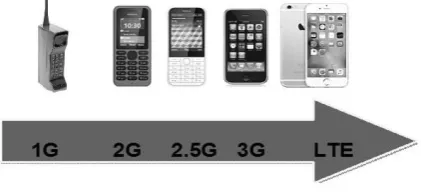
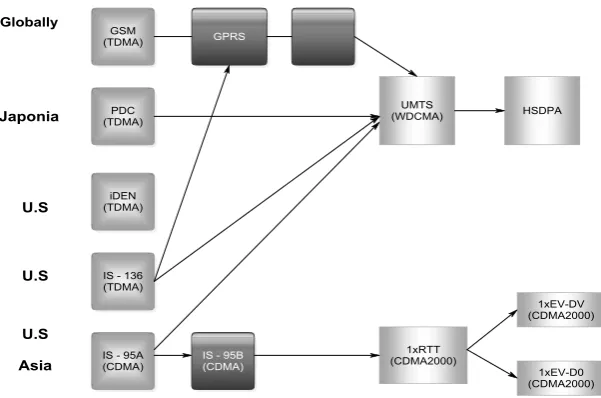
Mobile communications are now regarded as a necessity, fastest growing and most requested technology. The first generation (1G) of cell phones was introduced in 1980 and it was focused mainly on voice transmission via radio technology analogue based on Nordic Mobile Telephony (NMT). The second generation (2G) was launched in 1991 based on digital radio technology, and in the same period was introduced SMS text message. The Global System for Mobile Communications (GSM) and 2G network enhancements, such as General Packet Radio Service (GPRS) data network, are seen as a step that reinforces the 2G and 3G networks (see Figure 1).
3G cellular networks enable operators to offer a wide range of advanced services such as video calls and broadband wireless data based on Wideband Code Division Multiple Access (WDCMA). Cellular networks based on Long Term Evolution (LTE) technology offers the most advanced voice and data services with low latency and a significantly high transfer speed. The LTE network is currently implemented in Romania with a transfer speed of 300 Mbps.
Figure 1. Evolution of Mobile Communications
around the 1980s it was achieved great progress in the field that allowed the designers of telecommunication systems in the 1990s to implement a new system, which has led many GSM and GPRS network capacity improvements.
UMTS allows access to all international mobile multimedia services including roaming and voice
networks combines the "circuit - switched" networks with properties "packet-switched". This system reuses many components GSM and GPRS systems being defined from scratch. Evolution of wireless communications in terms of parameters characteristic is shown in Figure 2.
Figure 2. Evolution wireless communications in terms of parameters characteristic
This paper is divided into eight sections and conclusions. In sections 2, 3, 4, 5 and 6 are the main types of mobile communication technology, GSM, GPRS, EDGE, 3G, LTE concerned. For each technology presents specific parameters and what brought news.
In the last part of the paper conducted a study on the evolution of scientific research, global and national UMTS.
II. GLOBAL SYSTEM FOR MOBILE
COMMUNICATIONS –GSM
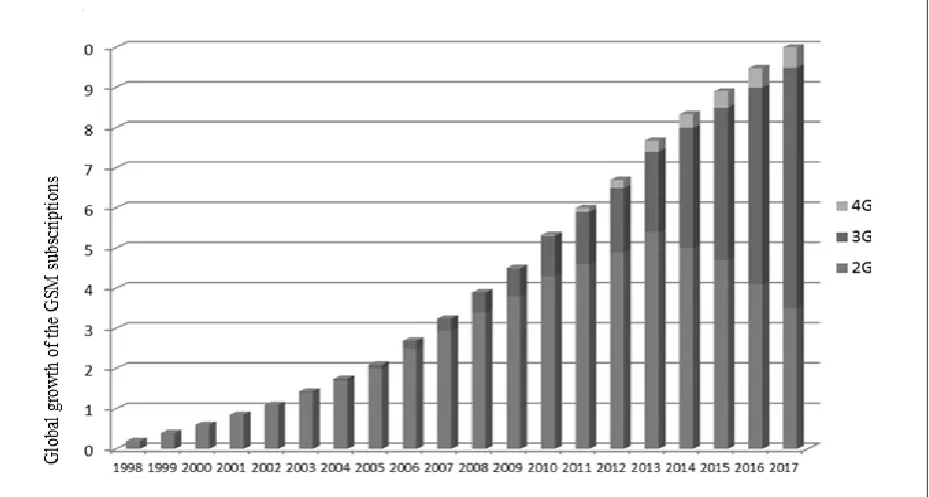
In the early 1980s the global mobile communications system triggered an unprecedented change in the way people communicate with each other. While in the past analog wireless system was used only by a few people, GSM was used in 2010 to over 3 billion customers worldwide [1] (see Figure 3). This new system has made improvements in all areas of telecommunications and reduced-price balance for both infrastructure equipment and mobile devices.
GSM system was originally created as a toggle switch that establish a connection between two users directly and exclusively on each network interface between all nodes of the system. Network nodes are connected via the Internet leading to the emergence of broadband connections.
Earlier GSM call establishes a direct connection between two users who subsequently used exclusively for that conversation. As shown in Figure 4, switching center uses a switching matrix to connect any part of any part of the original destination.
Figure 4. Circuit switched GSM (adapted from [1])
Once established the connection, the conversation is then transmitted through the transparent matrix switches between the two sides. If a party wishes to terminate the call switching center becomes active again just to remove the connection from switching matrix. This approach is identical in both mobile and fixed networks. In the past fixed telecommunications network was created only for voice communications, which is why an analog connection was created between the parties. In the mid-1980s, the analog technology was replaced by digital technology in the switching center. This translates into the fact that the calls are not transmitted in analog format from the transmitter to the receiver. Instead, switching center turn analog signal into a digital signal and digital signal is transmitted to the finals switching center. There digital signal is converted back into the analog signal and sent this signal to the final block.
Although a mobile phone network consists of several switching centers to cover a particular geographic area, however it is not possible to estimate in advance of the call switching center that will initiate a particular subscriber. This means that the software used to manage subscribers and fixed network call routing cannot be used global system for mobile communications. Instead of a static routing mechanism to appeal is required in the core network, flexible mobility management architecture to know the current location of the subscriber and the subscriber can route calls anytime. Also it need to have flexibility in routing architecture a call in progress because the subscriber can travel during the call and may leave the coverage area of the radio transmitter network that was established call. Between fixed network software and the mobile switching center there is a big difference, hardware and software which are responsible for treating switching matrix, are mostly identical.Therefore, most telecom equipment vendors - such as Siemens,
Alcatel -Lucent, Huawei, Ericsson and Nokia offer their switching centers for both fixed and mobile networks. Only the software in the switching center decide if the hardware is used in a fixed or mobile network (see Figure 5).
Figure 5. Software changes required to adapt a fixed telephone
switching center for wireless network (adapted from [1])
Without standards, which are defined by the International Telecommunication Union (ITU) would not be possible to initiate international calls and network operators were bound by the original suppliers regarding delivery network components that they hold. Many of ITU standards do not apply globally since most countries have defined their own national extensions so that suppliers can sell their equipment.
In addition, the interconnection of networks in different countries is complicated by defining extensions to each country.
Global system for mobile communications for the first time established a common standard for wireless networks across Europe, which was adopted and other countries outside Europe. This is the main reason that subscribers can travel worldwide GSM networks based on roaming agreements with each. This common standard substantially reduced research and development costs for hardware and software and also contributed to the possibility of selling them at world level, requiring only minor adjustments depending on local market of each country. European Institute for Telecommunications Standards (ETSI), which is also responsible for a number of other standards, was the main body responsible for the creation of the GSM standard.
The smallest unit of transmission speed in a telecommunications network is switched signal level 0 (DS0) digital channel. It has a fixed transmission speed of 64 kbps. Such a channel can be used to transfer speech or data is called a user data channel.
SS-7 signaling data (see Figure 6). A single connection E-1 31 DS0s is not sufficient to connect two switching centers between them. An alternative is
a connection 3 on twisted pair or coaxial cables. E-3 A connection is defined in a rate of E-34.E-368 Mbps, which corresponds to 512 DS0s.
Figure 6. Architecture connection type E-1 (adapted from [1])
For a higher transfer speed and more distance, the optical system uses standard synchronous transfer mode (STM). The table below illustrates certain data transfer and DSO number that is transmitted on channel fiber pair.
TABLE I. DATA TRANSFER AND THE NUMBER OF DSO
CHANNELS
STM
level Speed (Mbps)
Connections approx DSO No
STM-1 155.52 2300
STM-4 622.08 9300
STM-16 2488.32 37000
STM-64 9953.28 148279
For switched virtual circuits over IP optical Ethernet links are often used between network nodes of the same locations. Transfer speed is 1Gbps and is the de facto standard for IP based communications through fiber or copper cabling. Therefore network equipment are built much cheaper.
The GSM network is divided into three subsystems:
• Radio network or BSS (Base Station Subsystem) contains all nodes and wireless functionality needed to connect mobile subscribers by radio network interface.
• The core network or NSS (Network Subsystem) contains all nodes and functionality needed to switch calls, subscriber management and mobility management.
The intelligent or IS (Intelligent Network Subsystem) database contains optional features that bring network SCP. One of the most important features that you bring a mobile network is prepaid service that allows subscribers to hold monthly account with a certain amount of money that can be used for calls, SMS and data services.
III. GPRS(GENERAL PACKET RADIO SERVICE)
While GSM has the highest coverage of all cellular mobile communications systems, however there are two features that make data transmission inappropriate:
The long establishing data connections - tens of seconds;
Low transfer rate of only 9.6Kbps, which is insufficient for most applications.
GSM network was originally conceived as a circuit switched voice in which resources or data sessions are set at the beginning of the call and reserved by the user until the end of the call (see Figure 7).
GPRS is a packet-switched service for mobile data communication. With this technology, data is not sent as large, complete. The information shared in small packets that are sent separately. The recipient knows how they are reassembled. GPRS brings a lot of advantages. For example, not only during connection (as in the case of voice) but also GPRS data volume is measured. This means that the user pays only the amount of data transferred and not connection time. GPRS messages will be used mainly to provide specialized information services that are easy to configure and easy for the user.
Another big advantage of this new service consists in providing a constant bandwidth which means the sender need not to worry about on a permanent or temporary bottleneck in the way of communication. This is particularly important for a voice call and any blockage of communication would distort the voice call. In addition circuit switched connections have a constant delay time determined by the time between sending and receiving his bit at the other end. As the distance between sender and receiver is higher so the delay time is greater. If it can be guaranteed a constant delay in receiving necessary to add additional damper unexpected delay especially if voice calls (see Figure 7).
Figure 7. Exclusive Connections circuit switched (adapted from
[1,12])
For multiple data sessions would be much better to be solicited and received release them after transmission, as shown in Figure 8. This is done by collecting data in packets before sending them into the network.
This method is called to transmit packet-switched data.
network further. It is noteworthy that IP packets can also be sent through circuit switched data connections GSM. On the other hand, GPRS is a packet switching
network with end-to-end IP packets sent and packet switched from end-to-end (see Figure 8).
Figure 8. Data Transmission form of packet-switched (adapted from [1])
Other advantages brought GPRS network are:
By allocating flexible bandwidth by air interface, GPRS low transfer speed exceeds that offered GSM. Transfer speed network can theoretically reach up to 170kbps;
Multimedia Messaging System (MMS) is the main feature of GPRS user's permitting to send images, audio / video as well as text messages. In addition, GPRS supplied mobile phone the power to navigate
the Internet at speeds through dial-up active sites WAP (Wireless Application Protocol);
Charging by volume and not on time is another great advantage to users because they pay only for that download page and not to the time when they read that page[1, 2, 13, 14]. For wireless phone operators GPRS offers the advantage of not being wasted scarce resources on the air interface of data connections inactive, which can be used by other users performing an active data connection (see Figure 9).
Figure 9. Monitoring the amount of data
GPRS network significantly reduces the start time of the call. If GSM data connection initiation take up to 20 seconds in the same GPRS network takes less than 5 seconds.
IV. THE ENHANCED DATA RATES FOR GSM
EVOLUTION (EDGE)
EDGE is a technology that has brought an improvement and GPRS technology is often called Enhanced GPRS. EDGE uses the same equipment as the GSM network and with a few minor improvements designed to offer higher transfer rate, often considered a step towards 3G network. The same technology is also known as the 2.5 G [5, 6]
This new technology gives users a chance to increase the capacity of data transfer at a speed of at least three to four times higher than what it offers GPRS. While GPRS is a mobile data service, EDGE is a digital mobile phone technology. Enhanced data
rates for global evolution radio are standard-based high-speed mobile data. EDGE technology is that global mobile communications system provides the ability to manage generation three services being developed for mobile network operators that fail to win the UMTS spectrum.
This service enables multimedia services such as emails, entertainment and video conferencing to be easily accessible from wireless terminals [4, 15, 17].
traffic and will automatically switch to EDGE mode when needed [18, 24].
V. THE THIRD GENERATION (3G) TECHNOLOGY
Third generation (3G) is the generic term used for the next generation of mobile communications systems. It was created to support the effective delivery of a range of multimedia services. In addition, it offers more efficient systems for transmission through the air (over-the-air) existing services, such as voice, text and data.
The main features of 3G systems, known collectively as IMT - 2000 are [10, 11]:
are used at world level;
are used for all mobile applications;
provide support for both packet-switched (PS packet switched) and circuits switched data (circuit-switched CS);
higher transfer speeds of up to 2Mbps (depending on the mobility and speed);
provides greater efficiency of spectrum;
transmission Rate:
- transfer rate of up to 2Mbps from inside buildings or mobile stations in easy movement with a speed of up to 10km / h;
- 384 kbps for terminals that move at speeds of up to 120km / h in crowded places;
- 144 kbps in uncrowded areas or when traveling at high speed terminals;
internet access;
transmitted in circuit-switched and packet switched;
services real-time location services and multimedia;
simultaneous invocation of the various services;
worldwide roaming;
willingness to provide user location and radio interface used;
high level of security for data transmissions;
smooth transition from second generation systems to third generation.
IMT-2000 3G is a set of requirements defined by the ITU (International Telecommunications Union) and "2000" it represents the publishing
year and 2000 MHz frequency.[25, 26] The most important proposal IMT-2000 is UMTS (Universal Mobile Telecommunications System).
3G has control methods uplink and downlink for both power and improves spectrum use through common channels in radio interface (see Figure 10).
Figure 10. Evolution of 3G standards worldwide
230 MHz spectrum allocated to 3G systems is divided into two bands: from 1885 to 2025 MHz and 2110-2200 MHz respectively, of which 60 in
Figure 11. The frequency spectrum allocated to 3G systems [adapted from 25]
In the European region is expected to be used for the land component of a spectrum of 155 MHz in the following way: a spectrum of 2x60 = 120 MHz for duplex frequency division FDD and two sub-bands of 20 MHz, respectively 15MHz communications duplex time division TDD (Figure 11).
VI. THE 3RD GENERATION PARTNERSHIP PROJECT
(3GPP) BASED ON THE LONG TERM EVOLUTION TECHNOLOGY
Long Term Evolution (LTE) technology is the latest standard in mobile network technology tree being made for wireless data communications for mobile terminals and high speed data. This technology is based on GSM / EDGE and UMTS / HSPA increasing capacity and speed on a different radio interfaces and core network based on improved (CN - core network). This technology was developed by 3rd Generation Partnership Project (3GPP) and is specified in Release 8 series of documents (see Figure 12).
Figure 12. Communication standard LTE (adapted from [3])
Currently, the new generation of internet users want to access the internet wherever they are. These applicants will emerge as new technologies provide access to services such as:
• TV interactive;
• Mobile Video Blogging; • Advanced online games; • Download music; • Professional services;
• Social networks (Facebook, Twitter, LinkedIn, Instagram) [7].
LTE is the technology that met all the requirements they expressed their Internet users, and can be characterized by:
- high-level performance and capacity; - spectrum flexibility;
- simplicity;
- wide range of terminals;
High-level performance and capacity - is characterized by the transfer rate of 100Mbps to 300Mbps in the downlink and up through sub 10ms response speed (Figure 13) [26].
Figure 13. Download speed HSPA / LTE (adapted from [26])
Flexibility spectrum - LTE supports bandwidth flexible 1.4 MHz, 3MHz, 5MHz, 10MHz, 15MHz, 20MHz, supports TTD (Time-Division Duplexing), FDD (Frequency-Division Duplexing) and Half-Duplex FDD and can operate both the current spectra and the new ones introduced by telecom operators (Figure 14) [27].
Figure 14. Spectrum bandwidth and flexibility for LTE
VII. EVOLUTION OF SCIENTIFIC RESEARCH IN THE
FIELD OF UMTS
The research in mobile communications domain are found in numerous studies and scientific articles published in journals, monographs, courses. These papers have been published at various international scientific events (conferences, workshops).
In what follows we conducted a statistical study on research mobile communications, both internationally and in Romania. The study includes the following areas of analysis:
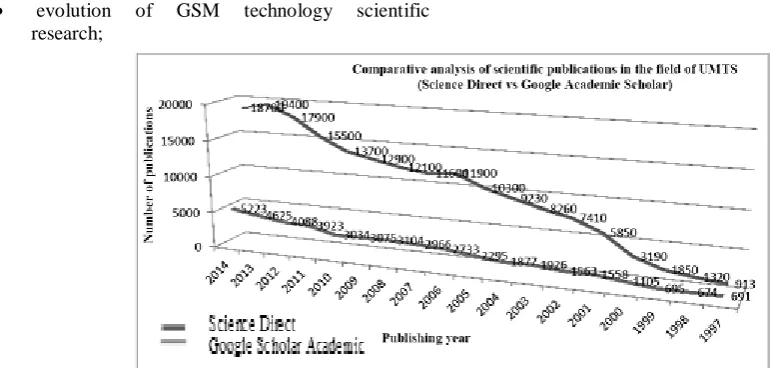
evolution of GSM technology scientific research;
scientific developments of the GPRS technology;
scientific developments of the EDGE technology;
scientific developments of 3G technology;
LTE evolution of scientific research;
Statistical data were collected from two databases internationally representative:
Google Scholar;
Science Direct.
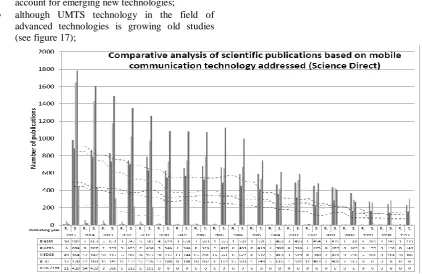
Analyzing the obtained data we conclude:
research in the field is current UMTS and shows a continuous growth trend (see figure 15);
Romania has an average of 1.2% of valuable scientific research (indexed database) – see figure
16.
Figure 16. Scientific research on Universal Mobile Telecommunications System - UMTS published in Science Direct (Roman authors and
foreign authors)
Scientific Research of Romania in the UMTS account for emerging new technologies;
although UMTS technology in the field of advanced technologies is growing old studies (see figure 17);
Figure 17. Comparative analysis of scientific publications based on mobile communication technology addressed
CONCLUSION
It is certain that mobile communication systems is a necessity and are the fastest growing and most requested technology. Dynamics of these types of technologies is very high. In the evolutionary process of UMTS focus was primarily on increasing the speed of data transfer, and this led to obtain near real-time communications. Also, with the development of UMTS technology has been considered and improved
levels of security for data submitted. One major beneficiary of mobile communications systems development is digital television.
Looking from the point where mobile communications is in this moment, we can conclude that:
Evolution of 3GPP Long Term Evolution (LTE) technology represents a major breakthrough in the cell by introducing REL 8;
enable operators to provide high performance broadband Internet for the whole population through a combination of higher bit rate and transfer system - in both uplink and downlink how - with a low latency
LTE reduced cost per bit;
LTE determined the increase provisioning services offering more services at lower costs and increase user satisfaction;
offers flexibility of use LTE frequency bands both existing and new ones;
LTE uses a simple architecture and open interfaces.
Almost exponential development of mobile communications systems is closely linked to scientific research in this area. Analyzing graphs presented in the last section of this report can be seen a downward trend over time, interest in UMTS 'old' and a growing trend for UMTS technologies with high degree of novelty.
The statistic data of 2015 cannot be considered significant by the fact that the calendar year is not over yet and many publications appear in Science Direct and Google Scholar with a certain time delay.
ACKNOWLEDGMENT
Work under PhD stages, contract numbers: SD04/46 and SD04/04.
REFERENCES
[1] Sauter, Martin - From GSM to LTE : an introduction to
mobile networks and mobile broadband;
[2] Bluetooth Special Interest Group, „Bluetooth Specification
Version 2.0 + EDR [vol. 0]‟, November 2004,
http://www.bluetooth.org;
[3] J.-H. Jo and N. Jyand, „Performance Evaluation of Multiple IEEE 802.11b WLAN Stations in the Presence of Bluetooth
Radio Interference‟, IEEE International Conference on
Communications, Anchorange, USA, vol. 26, May 2003, pp. 1163 – 1168;
[4] A. Laurie and B. Laurie, „Serious Flaws in Bluetooth Security
Lead to Disclosure of Personal Data‟, 2003,
http://www.thebunker.net/security/bluetooth.html;
[5] Bluetooth Special Interest Group, „Bluetooth Specification
Version 1.1 Part K:2 – Service Discovery Application Profile‟, February 2001, http://www.bluetooth.org;
[6] Bluetooth Special Interest Group, „Bluetooth Specification
Version 1.1 Part K:5 – Serial Port Profile‟, February 2001, http://www.bluetooth.org;
[7] Bluetooth Special Interest Group, „Bluetooth Specification
Version 1.1 Part K:7 – Dial-Up Networking Profile‟, February 2001, http://www.bluetooth.org;
[8] 3GPP, „AT Command Set for User Equipment (UE)‟, TS
27.007
[9] Bluetooth Special Interest Group, „Bluetooth Specification
Version 1.1 Part K:9 – The LAN Access Profile‟, February 2001, http://www.bluetooth.org;
[10] Bluetooth Special Interest Group, „Personal Area Network
Profile Version 1.0‟, February 2003,
http://www.bluetooth.org;
[11] Bluetooth Special Interest Group, „Bluetooth Specification
Version 1.1 Part K:12 – File Transfer Profile‟, February 2001, http://www.bluetooth.org;
[12] ETSI TS 03 64 V5.1.0 (1997-11), “Digital Cellular
Telecommunications system (Phase 2+); General Packet Radio Service (GPRS); Overall Description of the GPRS Radio Interface; Stage 2 (GSM 03.64, v. 5.1.0)”;
[13] ETSI. GSM 02.60, “General Packet Radio Service (GPRS);
Service description; stage 1,” v. 7.0.0, Apr. 1998.
[14] H. Nakamura, H. Tsuboya, M. Nakano, and A. Nakajima,
“Applying ATM to Mobile Infrastructure Networks,” IEEE Commun. Mag., vol. 36, no. 1, Jan. 1998.
[15] K. Zangi, A. Furuskar, and M. Hook, “EDGE: Enhanced Data
Rates for Global Evolution of GSM and IS-136,” Proc. Multi Dimensional Mobile Commun. 1998.
[16] www.siemens.com/mobile
[17] www.ericsson.com/technology/EDGE.shtml
[18] www.mobilegprs.com/edge.htm
[19] www.nuntius.com/solutions24.html
[20] www.business2.com/webguide/0,1660,36843,00.html
[21] www.umtsworld.com/technology/edge.htm
[22] www.privateline.com/Cellbasics/Nokiaedge_wp.pdf
[23] www.siemens.ie/mobile/technologies/edge.htm
[24] www.mtconsultancy.nl/eng/edge_E.htm
[25] www.3g-generation.com/gprs_and_edge.htm
[26] www.opencae.cz/hw/hw_standard_gsm.html
![Figure 5. Software changes required to adapt a fixed telephone switching center for wireless network (adapted from [1])](https://thumb-us.123doks.com/thumbv2/123dok_us/7807222.2085327/3.595.322.534.117.225/figure-software-changes-required-telephone-switching-wireless-network.webp)
![Figure 7. Exclusive Connections circuit switched (adapted from [1,12])](https://thumb-us.123doks.com/thumbv2/123dok_us/7807222.2085327/4.595.300.503.567.640/figure-exclusive-connections-circuit-switched-adapted-from.webp)
![Figure 8. Data Transmission form of packet-switched (adapted from [1])](https://thumb-us.123doks.com/thumbv2/123dok_us/7807222.2085327/5.595.86.545.396.540/figure-data-transmission-form-packet-switched-adapted.webp)
![Figure 11. The frequency spectrum allocated to 3G systems [adapted from 25]](https://thumb-us.123doks.com/thumbv2/123dok_us/7807222.2085327/7.595.333.526.359.531/figure-frequency-spectrum-allocated-g-systems-adapted.webp)