Journal of Electrical Engineering,
Electronics, Control and Computer Science –
JEEECCS, Volume 4, Issue 14, pages 1-6, 2018
Optimisation of the Wireless Sensor Network
with the Multi-hop LEACH protocol for
the Smart Grid
Anshu Prakash Murdan
Dept. of Electrical and Electronic Engineering, University of Mauritius
Reduit, Mauritius
Pranishta Nowbut
Dept. of Electrical and Electronic Engineering, University of Mauritius
Reduit, Mauritius
Abstract—With a major paradigm shift from power grids to smart grids in the electricity generation and consumption system, ongoing researches and implementations promise higher energy efficiency, reliability and security. For enabling a two-way communication between consumers and the electricity companies, the smart grid requires a robust and fast communication network. The Wireless Sensor Network can be integrated to the Passive Optical Network as a fiber-wireless sensor network. The PON is therefore, used for both smart grid and as a broadband access network. The design of the WSN, with proposed approach within the cluster of nodes improves the network’s stability, energy dissipation and lifetime. The results yield a better network’s performance and longer longevity.
Keywords—smart grid; wireless sensor network; passive optical network
I. INTRODUCTION
After the computer and the Internet, the Internet of Things (IoT) is now taking over at an unprecedented rate. The vision of a world where all devices sense and process data from the physical world, connect them to the Internet and communicate with each other without any human intervention is IoT [1]. One of its main application is the Smart Grid. The main motive to shift from the existing power grids to a smart grid is a low-carbon future. The primary aim is to lower the Green House Gases (GHG) emissions and to replace the ageing infrastructure of the grid. With an increase in population, the energy demand is also on the rise. Furthermore, the deployment of Renewable Sources of Energy (RES) like the Photovoltaic system (PV) and wind, the electricity transmission and distribution systems require a better infrastructure. With a better monitoring and control of the power system, for instance fault detection and meeting peak demand with the distributed generation, and a better energy usage control for the consumers, the smart grid can provide a reliable and efficient two-way communication system [2]. From wireless to wired communication systems, to integration of
heterogeneous appliances and sensors, the smart grid has to provide a seamless flow of data. The Neighbouring Area Network (NAN) involves the collection of data and interaction between numerous users’ premises to a base station with communication technologies like IEEE 802.11 (Wi-Fi) mesh networks, IEEE 802.16m (WiMAX) or coaxial cables. On the other hand, the Wide Area Network (WAN) requires communication network for long transmission range as it involves application like monitoring and controlling of the power system. Here cellular (Long Term Evolution (LTE) General Packet Radio Service (GPRS), Universal Mobile Telecommunications Service (UMTS)), optical fiber or even WiMAX can be used. [3]. The main objective of the Fiber-Wireless Sensor Network (Fi-WSN) is the integration of the optic and wireless technologies and form a gateway such that both their advantages are exploited to provide a reliable and energy-efficient communication network [4]. The fiber optic provides a high bandwidth while the wireless network increases the flexibility and mobility of the network [5], [6]. With the deployment of low-cost wireless sensor nodes over a region for real-time monitoring, the WSN has shown great promises in sensing data and wirelessly communicate it to the base station for further processing. However, these sensor nodes are limited by their low memory, battery power and processing capacity [7].
The Low Energy Adaptive Clustering (LEACH) Protocol cluster-based routing method minimizes the energy consumption, as well as makes the network more stable and long lasting [8]. The multi-hop approach adopted uses intermediate nodes that act as relays for the transmission of data to the Cluster Head (CH) in a cluster. With the shortest distance for data transmission between the nodes, the energy of the network will be further conserved for a longer time.
II. RELATEDWORKS
2
implementation and challenges of a shared network for the smart grid and broadband access network at the users’ premises. For the Smart Grid communication network, WSN has been considered in several works. For smart metering, the wireless technologies used can be integrated within a Wireless Sensor Networks (WSN) [11]. In [12], the authors presented an algorithm with a distributed clustering algorithm where the Cluster Head (CH) is elected according to the degree of energy attenuation in each round and the degree of the sensor nodes’ effective coverage within the WSN deployment’s region. This ensures that the energy consumed within the WSN is evenly distributed in terms of coverage. In [13], [14] and [15], the authors proposed energy-efficient designs for heterogeneous WSNs, with the advanced nodes and the normal nodes. With a multilayered architecture, there is a CH in the first layer and in the second layer a CH within each cluster formed, proposed by [16]. Clustering can further be optimized with aggregation of data over passing hops. In [17], this is adopted in multi-hopping protocols used for WSNs. In [18] and [19], the authors proposed WSN prototypes, where hardware implementation were discussed.
III. SYSTEM DESIGN
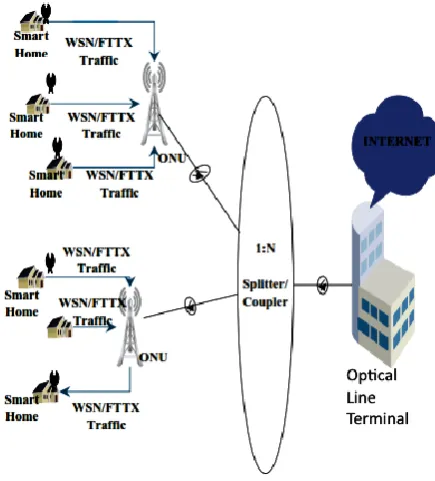
This section presents the WSN design scheme for the “first/last mile” of the communication network for the smart grid infrastructure shown in Figure 1. The design uses the LEACH protocol – a cluster-based routing protocol [20] and Multi-hop technique with the Djiktra’s Algorithm.
Fig. 1. Fi-WSN System Model
Figure 1 also illustrates the Optical Network Unit (ONU) serving as gateway for the data from the WSN as well as for the FTTX traffic. Adopting a similar network model as LEACH Protocol [20], the WSN
employs both normal nodes with initial energy given as 𝐸 and advanced nodes among the normal nodes as a heterogeneous WSN. These advanced nodes have an energy of 𝐸0 × (1 + a). Hence, the total initial energy of the network is calculated using the following:
𝐸𝑖 = 𝑛 × 𝐸0 × (1 + 𝑚(1 + a)) (1)
The network is further optimized using the multi-hop approach, as the data transmission distance, hence, the energy dissipated will be reduced.
Fig. 2. LEACH protocol cluster formation with multi-hop algorithm and data transmission path
A. Cluster Formation
Step 1: Setup phase with Cluster Head Selection
The Cluster Heads (CHs) are dynamically elected based on an optimal probability model adopted. At the start of each round, the sensor nodes can choose to become a CH depending on a predetermined fraction of nodes.
Step 2: Member Nodes Selection during setup phase During the setup phase, once a CH is selected, it broadcasts an advertisement (ADV) message to all the nodes in the network. The non-Cluster heads sensor nodes receive this message and send an acknowledgement (ACK) to connect to that CH based on the Received Signal Strength (RSS). If the RSS is high enough, then the sensor node forms a cluster with that CH. After the response from the sensor nodes, the CH creates a transmission schedule for its member nodes based on Time Division Multiple Access (TDMA).
B. Intra-cluster Multi-hop Approach
Step 3: Data transmission using the Multi-hop approach
Then distance between the node and the other sensor nodes are calculated. Comparing the minimum distance for transmitting the data, the shortest path will be formed. If the distance, 𝑑𝐶𝐻 is the minimum, the node sends the data to the CH itself, otherwise it considers the minimum path to the other member node and sends the data.
Step 4: Steady phase
The steady phase begins when the clusters are already formed and the member nodes in each cluster send the sensed data to their CH. After collecting the data, the CH performs data aggregation before transmitting it to the BS according to a TDMA schedule created by the BS for all CHs during that round.
IV. SIMULATION RESULTS
The simulation of the WSN was performed on MATLAB 8.6 (MATLAB R2015b) using the design parameters summarized in Table 1. The performance metrics to evaluate the WSN design are the number of dead nodes and the remaining energy.
Number of dead nodes: The time until the death of the first node indicates the stability of the network. As the number of dead nodes increases, the network becomes less stable.
Remaining energy: It is the residual energy of each and every sensor nodes in the network.
TABLE 1: Parameters for the simulation of WSN
Parameter Value
Number of nodes 50
Fraction of advanced nodes among the normal nodes
100x100m
Network Dimension 50x50m
Position of Base Station 0.1
Optimal Election Probability 0.1
Initial Energy of the Node 0.5J
Energy Used by Transmitter 50nJ/bit
Energy Used by Receiver 50nJ/bit
Transmit Amplifier for free space 10pJ/bit/m
Transmit Amplifier for free space 0.0013pJ/bit/m
Energy for Data Aggregation 5nJ/bit/message
Maximum Number of Rounds 1000
Data Packet Size 4000 bits
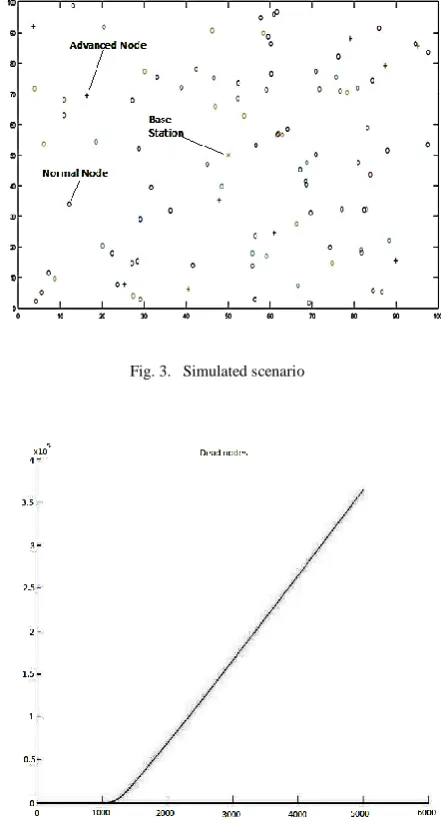
The simulation is done within a region of 50m x 50m where 50 sensor nodes are randomly deployed. Figure 3 shows the simulation environment of the WSN. Then applying the clustering protocol, the sensor
nodes in the WSN are configured to transmit data via the CH to the BS, which is placed at the center of the network in the simulated system. The simulation result for the number of dead nodes is shown in Figure 4 (a) and Figure 4 (b). As seen in the figures, the first node’s death occurs in the proposed system after a large number of rounds, compared to the LEACH protocol. As the number of rounds increases, we can see the rapid increase in the number of dead nodes for the LEACH protocol in the next rounds compared to that of the proposed system.
Fig. 3. Simulated scenario
Fig.4. (a) Number of dead nodes per round for LEACH Protocol
4
Fig. 4 (b): Number of dead nodes per round for the proposed design
R e m ain in g e n e rg y
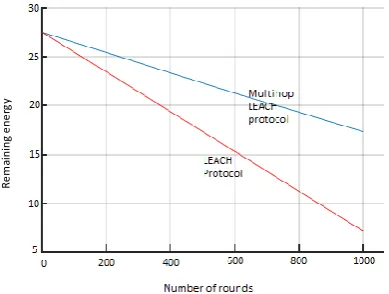
Fig. 5. Remaining energy of the nodes per round
V. CONCLUSION
For an energy-efficient and seamless two-way communication network for the smart grid, the Fi-WSN has been investigated. The fiber optic network provides a fast, robust and reliable communication with a high bandwidth and low delay rate. The wireless sensor network, on the other hand, employs the wireless technologies for the nodes communication and provide mobility, reliable and energy-efficient mechanisms. Analysing the “first/last mile” of the communication network, the system was optimized using the multi-hop mechanism in the LEACH protocol. Additionally, a heterogeneous WSN was simulated. From the simulations results, it can be concluded that, the multi-hop approach for the data transmission instead of the single hop has brought improvements in terms of network’s stability, energy efficiency and consequently it has increased the WSN’s longevity. Future extension to this design can be done to optimise the Fiber network. By using the Multi-hopping algorithm for Inter-Cluster data transmission,
that is, data transmission from the cluster heads to the base station. It can be improved further by using other protocols and applying optimization methods such as multi-layered clustering and data aggregation in every hop in multi-hop mechanisms. Hardware implementation can be done using Arduino or Raspberry Pi as the sensor nodes, and wireless technology protocols like the Zigbee. Continuing the communication network of the Smart Grid, the integration of the WSN and fiber network can be shown in a simulated environment and methods to optimize the system like low delay rate, and energy-saving modes of the network can be implemented. After the data transmission to the ONU, there has to be a prioritization mechanism as both FTTX traffic and data from WSN are present there.
REFERENCES
[1] Aloi, G., Caliciuri, G., Fortino, G., Gravina, R., Pace, P., Russo, W. and Savaglio, C. (2016). A Mobile Multi-Technology Gateway to Enable IoT Interoperability. 2016 IEEE First International Conference on Internet-of Things Design and
Implementation (IoTDI).
[2]International Renewable Energy Agency (IRENA) and Energy Technology Systems Analysis Programme (ETSAP), (2015).
Renewable Energy Integration in Power Grids | Technology Brief.
[online] Available at:
http://www.irena.org/DocumentDownloads/Publications/IRENAET SAP_Tech_Brief_Power_Grid_Integration _2015.pdf
[Accessed 11 Dec. 2016].
[3] Kuzlu, M., Pipattanasomporn, M. and Rahman, S. (2014). Communication network requirements for major smart grid applications in HAN, NAN and WAN. Computer Networks, 67, pp.74-88.
[4]Fang, X., Misra, S., Xue, G. and Yang, D. (2012). Smart Grid — The New and Improved Power Grid: A Survey. IEEE
Communications Surveys & Tutorials, 14(4), pp.944-980.
[5]Hassan, Q. (2016). Innovative research and applications in next-generation high performance computing. 1st ed. IGI Global, 2016, p.381.
[6] Maier, M. and Levesque, M. (2014). Dependable Fiber-Wireless (FiWi) Access Networks and Their Role in a Sustainable Third Industrial Revolution Economy. IEEE Transactions on Reliability, 63(2), pp.386400.
[7] Abdelgawad, A. (2016). Distributed Kalman Filter with Fast Consensus for Wireless Sensor Networks. International Journal of
Wireless Information Networks, 23(1), pp.82-88.
[8] Al-Karaki, J. and Kamal, A. (2004). Routing techniques in wireless sensor networks: a survey. IEEE Wireless
Communications, 11(6), pp.6-28
[9]Erol-Kantarci, M. and Mouftah, H. (2011). Wireless multimedia sensor and actor networks for the next generation power grid. Ad
Hoc Networks, 9(4), pp.542-551.
[10]Kantarci, B. and Mouftah, H. (2012). Energy efficiency in the extended-reach fiber-wireless access networks. IEEE Network, 26(2), pp.2835.
[11]Pilloni, V. and Atzori, L. (2011). Deployment of Distributed Applications in Wireless Sensor Networks. Sensors, 11(12), pp.7395-7419.
Wireless Sensor Networks in the Mobile Environment. Sensors, 15(12), pp.3110831124.
[13]Smaragdakis, G., Matta, I. and Bestavros, A. (2004). SEP: A Stable Election Protocol for Clustered Heterogeneous Wireless Sensor Networks. Second International Workshop on
Sensor and Actor Network Protocols and Applications.
[14]Yun-Zhong, D. and Ren-Ze, L. (2015). Research of energy efficient clustering algorithm for multilayer wireless heterogeneous sensor networks prediction research. Multimedia Tools and
Applications.
[15] Thiriveni, G. and Ramakrishnan, M. (2016). Distributed Clustering based Energy Efficient Routing Algorithm for Heterogeneous Wireless Sensor Networks. Indian Journal of
Science and Technology, 9(3).
[16]Guan Xin, Wu HuaYang and Bi DeGang, 2008, EEHCA: An Energy-Efficient Hierarchical Clustering Algorithm for Wireless Sensor Networks. Information Technology Journal, 7: 245-252.
[17]Kumar, D. (2013). Performance analysis of energy efficient clustering protocols for maximising lifetime of wireless sensor networks. IET Wireless Sensor Systems.
[18]Zhang, J., Song, G., Wang, H. and Meng, T. (2011). Design of a wireless sensor network based monitoring system for home automation. International Conference on Future Computer
Sciences and Applications (ICFCSA), pp.57-60.
[19] Xianzhe, H. (2011). Room temperature amd humidity monitoring and energy-saving system. International Conference on
Computer Science and Education (ICCSE),
pp.537-540.
[20] Heinzelman, W., Chandrakasan, A. and Balakrishnan, H. (2002a). An application specific protocol architecture for wireless microsensor networks. IEEE Transactions on Wireless