05-10-2010
Deliverable DS4.3.2:
Report on Development Infrastructure
Usage and Adoption
Deliverable DS4.3.2
Contractual Date: 30-06-2010 Actual Date: 05-10-2010 Grant Agreement No.: 238875
Activity: SA4
Task Item: T3
Nature of Deliverable: R (Report) Dissemination Level: PU (Public) Lead Partner: DANTE Document Code: GN3-10-134v2
Authors: W. Zurowski (DANTE), G. Kramer (DANTE)
Abstract
This deliverable reports on the usage and adoption of the software development infrastructure that was specified in DS4.3.1 "Specification of Software Development Infrastructure".
Table of Contents
Executive Summary 1
1 Introduction 2
2 Development Infrastructure Usage and Adoption 4
2.1 System Development Tools 4
2.1.1 Version Control System 4
2.1.2 Bug Tracking System 5
2.1.3 Release Planning Tool 6
2.1.4 Build Management System 7
2.1.5 Continuous Integration Server 8
2.1.6 Developer Portal System 9
2.2 User Interaction Tools 9
2.2.1 Wiki 9
2.2.2 User Portal System 9
2.2.3 Mailing List System 10
2.2.4 Virtual Machine Software 11
3 Conclusions 12
References 13
Glossary 14
Table of Tables
Table 1.1: Tools recommended in DS4.3.1 2
Table 2.1: SVN adoption 5
Table 2.2: JIRA adoption 6
Contents
Table 2.6: Confluence wiki adoption 9
Table 2.5: Confluence user portal adoption 10
Executive Summary
To enable the multiple international GN3 software development teams to work together effectively, a software development infrastructure was created at the start of the GN3 project. To determine what tools this infrastructure should comprise, the different roles and responsibilities of all stakeholders involved were considered. The results of this process were recorded in the deliverable DS4.3.1 "Specification of Software Development Infrastructure" [DS4.3.1].
This deliverable follows up the introduction of the development infrastructure, assessing how it has been received within the GN3 software development community by reporting on its usage and adoption. This includes identifying where previously recommended tools have not been adopted and why they have been replaced with other tools instead. Conclusions are also drawn on where additional tools may be introduced in the future to improve the operation and interactions of the infrastructure, and on considerations for further development.
The document comprises the following sections: Introduction
Establishes the context of this follow-up report by listing the tools identified in DS4.3.1 "Specification of Software Development Infrastructure" [DS4.3.1].
Development Infrastructure Usage and Adoption
Summarises the usage and future development plans for each of the tools listed in the Introduction. Conclusions
Offers an evaluation of the points made in the document, and identifies factors to consider when developing the infrastructure.
1
Introduction
This deliverable reports on the usage and adoption of the software development infrastructure that was specified in DS4.3.1 "Specification of Software Development Infrastructure" [DS4.3.1]. DS4.3.1 identified the different parties involved in GN3 software development in order to determine what tool infrastructure would be required to enable them to meet their responsibilities and collaborate effectively with each other.
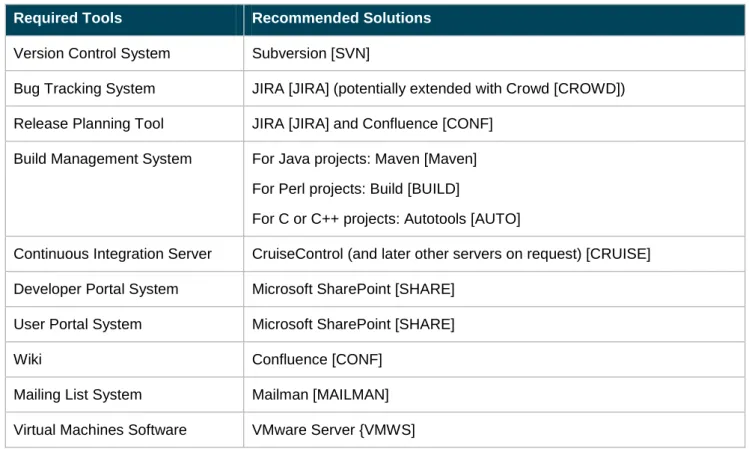
The factors considered in producing a list of recommended tools included tool usability and compatibility, feedback on tool usage in GN2, and the usefulness of the tools in aiding collaboration. As a result, DS4.31 identified the following tools:
Required Tools Recommended Solutions Version Control System Subversion [SVN]
Bug Tracking System JIRA [JIRA] (potentially extended with Crowd [CROWD]) Release Planning Tool JIRA [JIRA] and Confluence [CONF]
Build Management System For Java projects: Maven [Maven] For Perl projects: Build [BUILD]
For C or C++ projects: Autotools [AUTO]
Continuous Integration Server CruiseControl (and later other servers on request) [CRUISE] Developer Portal System Microsoft SharePoint [SHARE]
User Portal System Microsoft SharePoint [SHARE]
Wiki Confluence [CONF]
Mailing List System Mailman [MAILMAN]
Virtual Machines Software VMware Server {VMWS]
Introduction
This deliverable reports on the usage and adoption of these tools, and identifies where additional tools have been introduced or may need introducing in the future.
Note that the procedures and processes for using infrastructure tools are outside the scope of this document. These are designed by SA4 (Software Governance) T1 (Best Practices).
2
Development Infrastructure Usage and
Adoption
This section reports on the usage and adoption of the tools that were identified as being needed to build and operate a software development support infrastructure for all software development teams within GN3.
2.1
System Development Tools
2.1.1
Version Control System
Subversion 1.4.2 (SVN [SVN]), which had already been used successfully in GN2, has been implemented as a Version Control System.
2.1.1.1
Usage
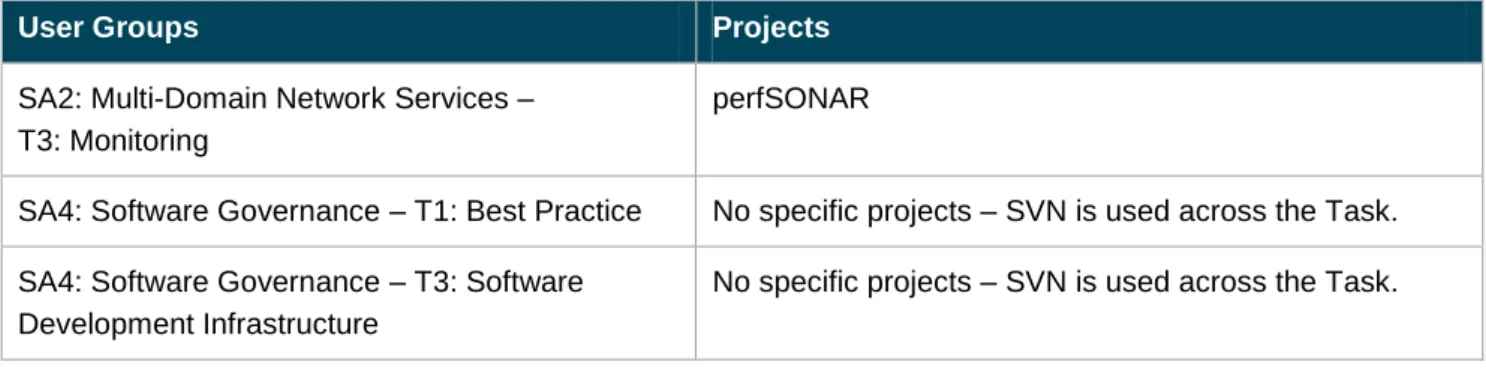
SVN has been adopted by the following projects and activities.
User Groups Projects
JRA2: Multi-Domain Network Service Research – T2: Hybrid Network Provisioning
Stitching framework prototype
JRA3: Multi-Domain User Application Research – T3: GÉANT Multi-domain Bus (GEMBus) – Composable Network Services
No specific projects – SVN is used across the Task.
SA2: Multi-Domain Network Services – T5: Workflow Tools
Common Framework AutoBAHN
AMPS cNIS I-SHARe
Development Infrastructure Usage and Adoption
User Groups Projects
SA2: Multi-Domain Network Services – T3: Monitoring
perfSONAR
SA4: Software Governance – T1: Best Practice No specific projects – SVN is used across the Task. SA4: Software Governance – T3: Software
Development Infrastructure
No specific projects – SVN is used across the Task.
Table 2.1: SVN adoption
Further projects and activities are expected to adopt SVN as they are getting ready to start code development (not all projects have entered this phase yet).
2.1.1.2
Further Development
It has been recognised that the access rights and privileges that project members use to access Subversion repositories should be connected to their Intranet accounts and privileges. This will be implemented by SA4 T3 by the end of September 2010.
The Subversion server is upgraded only to fix security issues.
2.1.2
Bug Tracking System
JIRA 4.1.1, a browser-based bug, issue, task and defect tracking system developed by Atlassian Pty Ltd [JIRA], has been selected as a bug tracking system. It has been adopted both as a ticketing system for service desk activities (like the SA4 activity itself), and as a bug tracker in development projects. It has been successfully connected to the GÉANT Active Directory, via the Atlassian Crowd service [CROWD], which provides a single user base for both SharePoint-based websites and services provided by SA4 T3.
2.1.2.1
Usage
JIRA has been adopted by the following projects and activities.
User Groups Projects
JRA2: Multi-Domain Network Service Research – T2: Hybrid Network Provisioning
No specific projects – JIRA is used across the Task.
JRA3: Multi-Domain User Application Research – T3: GÉANT Multi-domain Bus (GEMBus) – Composable Network Services
Development Infrastructure Usage and Adoption
User Groups Projects
SA2: Multi-Domain Network Services – T3: Monitoring
perfSONAR
SA2: Multi-Domain Network Services – T5: Workflow Tools
Common Framework AutoBAHN
AMPS cNIS I-SHARe SA4: Software Governance – T2: Quality
Assurance
No specific projects – JIRA is used across the Task.
SA4: Software Governance – T3: Software Development Infrastructure
GÉANT Forge GÉANT Download Service Desk
NA1 Management GÉANT Intranet
GÉANT Project Office
Table 2.2: JIRA adoption
More projects and activities are expected to adopt JIRA once they are advanced enough to require bug tracking.
2.1.2.2
Further Development
JIRA is upgraded only to fix security issues.
2.1.3
Release Planning Tool
A release planning tool based on Confluence [CONF] and JIRA [JIRA], both developed by Atlassian, has been implemented. However, it has not been adopted to date. Instead dotProject [dotPro] is being used (e.g. by SA2 T5) as an alternative. This application has previously been used successfully by PSNC who have the largest user base.
2.1.3.1
Usage
Confluence+JIRA is not currently being used. SA2 T5 decided to use a separate product called dotProject [dotPro], an open-source, web-based project management application, for release planning.
Development Infrastructure Usage and Adoption
2.1.3.2
Further Development
JIRA seems to fulfil most of the requirements for a release planning tool on its own. However, Confluence is also used as a user portal system and wiki (see 2.2.2 User Portal System and 2.2.1 Wiki), so remains a key element of the infrastructure.
As dotProject has proved popular with a large section of the user base, SA4 T3 is assessing the feasibility of deploying dotProject for all GÉANT participants (there is a possibility that dotProject could also be used as a project management tool). A key factor is whether it is possible to manage its user base in Atlassian Crowd [Crowd]. PSNC is currently investigating the integration of Crowd and dotProject.
2.1.4
Build Management System
SA4 T3 provides a repository for Maven [Maven] (version 2.0 onwards), an Apache software project management and information tool. Maven requires the repository as a central location for storing and retrieving artefacts created by the projects. Other build management tools, such as Build for PERL or Automake for C/C++, do not require a similar facility, and are therefore outside the scope of SA4 T3.
2.1.4.1
Usage
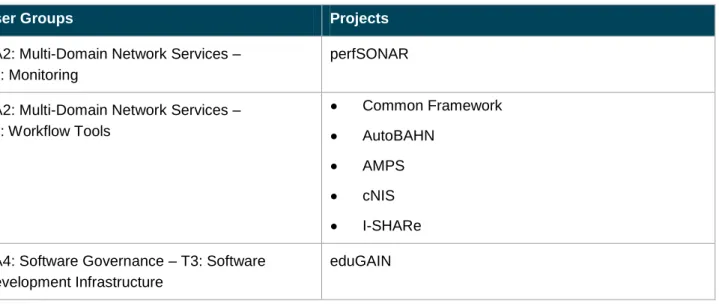
Maven has been adopted by the following projects and activities.
User Groups Projects
SA2: Multi-Domain Network Services – T3: Monitoring
perfSONAR
SA2: Multi-Domain Network Services – T5: Workflow Tools
Common Framework AutoBAHN
AMPS cNIS I-SHARe SA4: Software Governance – T3: Software
Development Infrastructure
eduGAIN
Table 2.3: Maven adoption
Although SA4 T3 recommended Maven as the best build management tool, it is currently mainly being used in SA2, the main development activity. That the tool has not been adopted more widely may be due to it requiring some usage training. Also, not all activities and projects need to build software (often builds are done by SA2).
Development Infrastructure Usage and Adoption
2.1.4.2
Further Development
It has been recognised that the access rights and privileges that project members use to access the Maven repository should be connected to their Intranet accounts and privileges. It will be implemented by SA4 T3 by the end of September 2010.
2.1.5
Continuous Integration Server
Hudson 1.360 [HUDSON], an open source build system, has been implemented as a continuous integration system, in place of the originally proposed CruiseControl tool [CRUISE]. CruiseControl lacked access control, and required one installation per project. After consultation with SA2 T5, Hudson was selected instead because it allows multiple projects to be hosted with separate rights management and administration.
2.1.5.1
Usage
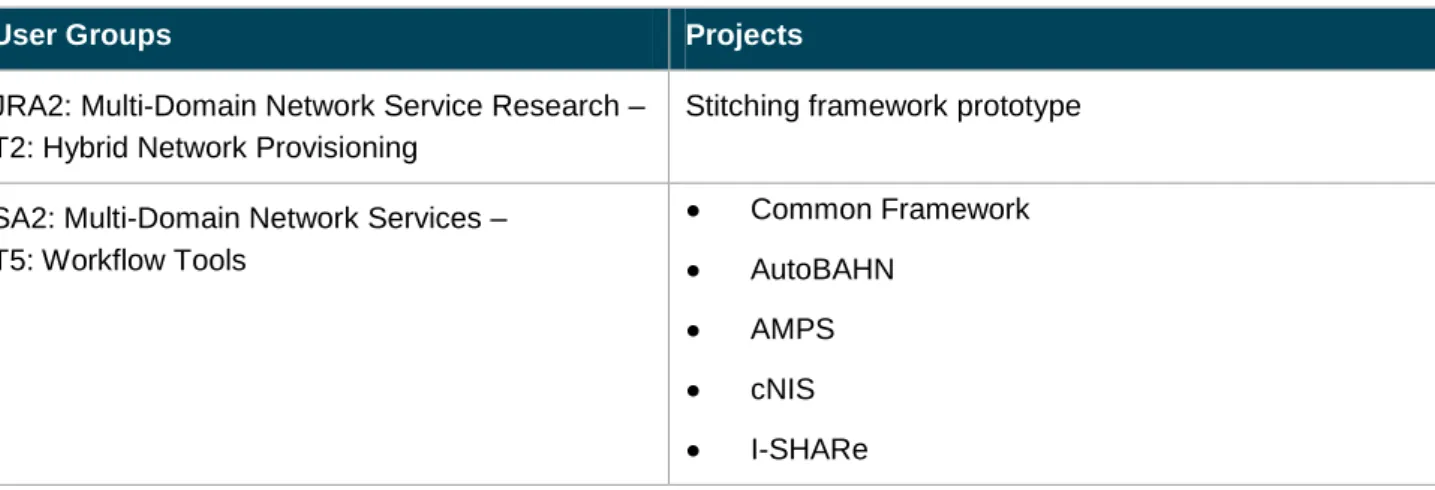
Hudson has been adopted by the following projects and activities.
User Groups Projects
JRA2: Multi-Domain Network Service Research – T2: Hybrid Network Provisioning
Stitching framework prototype
SA2: Multi-Domain Network Services – T5: Workflow Tools
Common Framework AutoBAHN
AMPS cNIS I-SHARe
Table 2.4: Hudson adoption
Continuous integration ensures that quality control processes are frequently applied as software is developed, so that at release time the software's quality is ensured. As this is good practice, SA4 T3 expect that more activities and projects will adopt Hudson over time.
2.1.5.2
Further Development
SA4 T3 is currently considering whether to add Atlassian’s continuous integration server Bamboo [BAMBOO] to Hudson, as it integrates with JIRA. A test instance will be deployed and evaluated by the end of August 2010, after which a decision will be taken on whether to put it into production.
Development Infrastructure Usage and Adoption
2.1.6
Developer Portal System
A developer portal system has been implemented in SharePoint as part of the GÉANT Intranet. As such it is outside the scope of the SA4 activity and is managed by the GÉANT Project Office as part of NA1 Management.
2.2
User Interaction Tools
2.2.1
Wiki
The GÉANT project provides two wikis. One is part of the Intranet, implemented in SharePoint; the other is Atlassian Confluence 3.0.1. Only the latter is within the scope of SA4 and has been adopted by SA2 T5.
2.2.1.1
Usage
The Confluence wiki has been adopted by the following projects and activities.
User Groups Projects
SA2: Multi-Domain Network Services – T5: Workflow Tools
cNIS I-SHARe
Table 2.5: Confluence wiki adoption
The Confluence wiki has not been widely adopted as most activities and projects use either the SharePoint Intranet or their own legacy wikis instead. SA4 T3 is considering replacing the Confluence wiki with GÉANT Forge which offers similar functionality (see 2.2.2 User Portal System). This would make the infrastructure more streamlined.
2.2.1.2
Further Development
Confluence is upgraded only to fix security issues.
2.2.2
User Portal System
Due to a lack of resources to implement a user portal system in SharePoint, it has instead been implemented in Atlassian Confluence 3.1.2, and is known as GÉANT Forge. Although this is a recent addition to the infrastructure, it has been well-received by projects eager to present their work to the general public.
Development Infrastructure Usage and Adoption
2.2.2.1
Usage
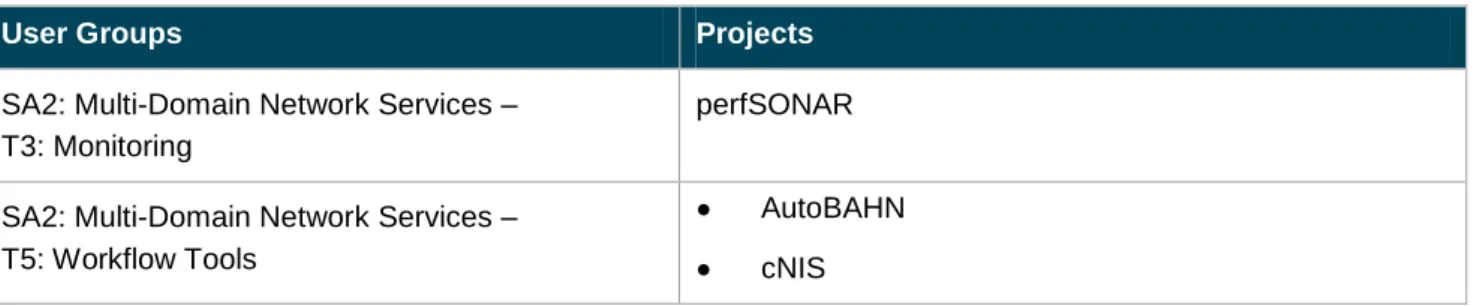
The Confluence user portal system has been adopted by the following projects and activities.
User Groups Projects
SA2: Multi-Domain Network Services – T3: Monitoring
perfSONAR
SA2: Multi-Domain Network Services – T5: Workflow Tools
AutoBAHN cNIS
Table 2.6: Confluence user portal adoption
Interest in GÉANT Forge is increasing and SA4 T3 expect that its usage across activities and projects will increase significantly.
2.2.2.2
Further Development
To promote the wider adoption of GÉANT Forge by the GÉANT community, SA4 T3 is planning to announce it to Task Leaders and Activity co-ordinators.
Confluence is upgraded only to fix security issues.
2.2.3
Mailing List System
The GNU mailing list management system Mailman 2.1.12rc2 [MAILMAN] has been implemented.
2.2.3.1
Usage
The Mailman mailing system is the most widely adopted system, used by most GN3 activities.
2.2.3.2
Further Development
Development Infrastructure Usage and Adoption
2.2.4
Virtual Machine Software
VMware Server 1.0.4 [VMWS], which had already been used successfully in GN2, has continued to be used as a virtual machine system.
2.2.4.1
Usage
VMware Server has been adopted by the following projects and activities.
User Groups Projects
SA2: Multi-Domain Network Services – T3: Monitoring
perfSONAR
Table 2.7: VMware Server adoption
2.2.4.2
Further Development
The virtual machine software is in high demand. However, since the end of GN2, sufficient resources – i.e. hardware capable of running multiple (>16) virtual machines simultaneously – have not been available. SA4 is currently applying for the budget necessary to buy new machines capable of running VMware Server.
VMware Server 1 is to be upgraded to version 2, to resolve various problems with perfSONAR's virtual machines, which are running Linux distributions with the latest version of the operating system. Otherwise the virtual machine software is upgraded only to fix security issues.
3
Conclusions
The infrastructure has been adopted most widely by SA2 Multi-Domain Network Services, especially by Task 3, Monitoring, and Task 5, Workflow Tools. The JRAs have been slower to adopt the development infrastructure but take-up is spreading and is expected to increase over time. Some tools, such as the mailing list system Mailman, are used across the project; the bug tracking system JIRA is also used across all three Activity types – networking, service and joint research.
Where there are plans to develop a tool further, the rationale is primarily to secure the benefits of integration. For example, users’ access rights and privileges for the repositories of the version control system Subversion and for the build management system Maven are being linked to their Intranet account rights and privileges. Similarly, the benefits of integration (with JIRA) are the reason for investigating the possibility of adding a second continuous integration server, Bamboo, alongside Hudson.
For the most part, upgrades are implemented only to fix security issues.
Where appropriate, SA4 T3 has adjusted the initial infrastructure specification in response to subsequent events or knowledge, the lack of take-up of the release planning tool Confluence+JIRA, for example, and the technical unsuitability of the continuous integration server CruiseControl. In both cases, project members were instrumental in identifying alternatives (dotProject and Hudson, respectively).
Implementing the software development infrastructure has required a level of effort that was not anticipated. For example, it proved crucial to set up a Service Desk within SA4 T3, to handle developers’ infrastructure requests. Information Technology Infrastructure Library (ITIL) training was very useful in outlining the benefits of a Service Desk and how it should be managed.
In addition, development effort was necessary to create unplanned infrastructure elements such as the user portal system GÉANT Forge. Currently, most of the project’s developers are members of SA2; only limited development resource is available within SA4. This constraint should be borne in mind if new or existing tools within the software development infrastructure need to be enhanced or adapted in the future.
Where insufficient hardware resource has limited the take-up of the infrastructure, as with the virtual machine software VMware Server, investment is being sought.
SA4 T3 will continue to maintain and improve the software development infrastructure throughout GN3, and actively promote its usage and adoption.
References
[AUTO] http://www.gnu.org/software/libtool/manual/automake/Autotools-Introduction.html#Autotools-Introduction
[BAMBOO] http://www.atlassian.com/software/bamboo/
[BUILD] http://search.cpan.org/dist/Module-Build/lib/Module/Build.pm
[CONF] http://www.atlassian.com/software/confluence/
[CROWD] http://www.atlassian.com/software/crowd/
[CRUISE] http://cruisecontrol.sourceforge.net/
[dotPro] http://www.dotproject.net/
[DS4.3.1] https://intranet.geant.net/sites/Services/SA4/Deliverables/DS431/Documents/GN3-09-099-DS4-3-1_Specification_of_Software_Development_Infrastructure.pdf
[HUDSON] http://hudson-ci.org
[JIRA] http://www.atlassian.com/software/jira/
[MAILMAN] http://www.gnu.org/software/mailman/http://www.gnu.org/software/mailman/index.html
[Maven] http://maven.apache.org/
[SHARE] http://sharepoint.microsoft.com/Pages/Default.aspx
[SVN] http://subversion.tigris.org/
Glossary
AMPS Advance Multi-domain System
AutoBAHN Automated Bandwidth Allocation across Heterogeneous Networks
cNIS Common Network Information Service
GEMBus GÉANT Multi-domain Bus
ITIL Information Technology Infrastructure Library – a set of concepts and practices for IT services
management, development and operations
JRA Joint Research Activity
NA Networking Activity
perfSONAR Performance Service Oriented Network Monitoring Architecture
SA Service Activity
SVN Subversion