ISSN: 2147-611X
www.ijemst.com
Using Open-Response Fraction Items to
Explore the Relationship Between
Instructional Modalities and Students’
Solution Strategies
Jessica F. Shumway1, Patricia S. Moyer-Packenham1, Joseph M. Baker2, Arla Westenskow1, Katie L. Anderson-Pence3, Stephen I. Tucker4, Jennifer Boyer-Thurgood1, Kerry E. Jordan1
1Utah State University 2
Stanford University
3University of Colorado, Colorado Springs 4Virginia Commonwealth University
To cite this article:
Shumway, J.F., Moyer-Packenham,
P.S., Baker, J.M., Westenskow, A., Anderson-Pence,
K.L., Tucker, S.I., Boyer-Thurgood,
J., & Jordan, K.E. (2016). Using open-response fraction
items to explore the relationship between instructional modalities and students’ solution
strategies.
International Journal of Education in Mathematics, Science and Technology,
4
(2), 112-132. DOI:10.18404/ijemst.20845
This article may be used for research, teaching, and private study purposes.
Any substantial or systematic reproduction, redistribution, reselling, loan, sub-licensing,
systematic supply, or distribution in any form to anyone is expressly forbidden.
Authors alone are responsible for the contents of their articles. The journal owns the
copyright of the articles.
Volume 4, Number 2, 2016
DOI:10.18404/ijemst.20845
Using Open-Response Fraction Items to Explore the Relationship Between
Instructional Modalities and Students’ Solution Strategies
Jessica F. Shumway, Patricia S. Moyer-Packenham, Joseph M. Baker, Arla Westenskow, Katie L. Anderson-Pence, Stephen I. Tucker, Jennifer Boyer-Thurgood, Kerry E. Jordan
Article Info
Abstract
Article History
Received: 17 February 2015
The purpose of this study was to explore the relationship between instructional modality used for teaching fractions and third- and fourth-grade students’ responses and strategies to open-response fraction items. The participants were 155 third-grade and 200 fourth-grade students from 17 public school classrooms. Students within each class were randomly assigned to two instructional treatment groups: a virtual manipulatives representations (VMR) instruction group and a physical manipulatives and textbook representations (PMTR) instruction group. A conversion mixed methods analysis was used to examine quantitative and qualitative data. The quantitative analysis showed achievement outcomes were the same for both groups. The qualitative analysis revealed shifts in learning that were otherwise hidden with solely quantitative achievement results. Specifically, the results indicated VMR group success in understanding fractions as relationships and PMTR group success in maintaining conceptualization of the whole. Overall, the results of this study corroborate previous research indicating the importance of both types of instructional modalities, showing that virtual manipulatives and physical manipulatives are effective instructional tools with positive effects on student learning. The study expands existing research by offering an opportunity to explore the nuances of students’ fractions understanding and provide a window into students’ shifts in fraction learning.
Accepted: 29 September 2015
Keywords
Virtual manipulatives Physical manipulatives Fractions
Instructional modalities Open-response items
Introduction
Elementary teachers use a variety of instructional modalities when teaching children early fraction concepts. Their instruction often includes physical, pictorial, and symbolic representations. Some teachers use virtual manipulatives (Moyer, Bolyard, & Spikell, 2002), which combine representations (e.g., pictorial and symbolic) and representational modalities (e.g., visual and haptic). Studies indicate that using multiple representations and modalities in fraction instruction develops and expands students’ understanding of fractions (Behr, Lesh, Post, & Silver, 1983; Moyer-Packenham & Westenskow, 2013; Sowell, 1989).
The purpose of this study was to explore the relationship between instructional modalities used for learning fraction concepts—specifically using virtual manipulatives or physical manipulatives with textbooks—and students’ solution strategies on open-response fraction items. We employed a conversion mixed methods approach (Teddlie & Tashakkori, 2006) to analyze open-response items, which we coded and quantitized for quantitative and qualitative analysis. Open-response items provide windows into students’ thinking processes and strategies for solving mathematics tasks (Cai, 2000; Cai, Magone, Wang, & Lane, 1996; Lane, 1993). This study complements and extends previous studies by using open-response items to examine these phenomena in depth using qualitative analysis with a large sample of participants (n = 355).
examples for the Results section to highlight patterns and interesting features of students’ responses and strategies on these open-response items.
The examples we selected highlight key themes that emerged in our analyses, namely, shifts in learning from pretest to posttest and small differences between the groups’ responses and strategies. Furthermore, through the process of this rigorous qualitative analysis of 355 students’ strategies, we developed a classification scheme of the strategies that emerged (see Appendix A), which we anticipate will be helpful to the research community.
Representations, Instructional Modalities, and Fraction Learning
As children develop their understandings of number and quantities from whole numbers to rational numbers, they often struggle with understanding that a fraction represents a relationship. Children have difficulty understanding the meaning of the denominator, keeping track of the whole, and thinking multiplicatively (Behr & Post, 1992; Kamii & Clark, 1995; Smith, 2002). To help children overcome these challenges, representations are often at the heart of teaching and learning the persistently difficult concept of fractions
.
Research (e.g., Cramer, Post, & delMas, 2002; Sowell, 1989) and mathematics learning theories (e.g., Bruner, 1966; Cobb, 1995) emphasize the important role played by various conceptual representations in students’ learning. Representations include signs, symbols, models, images, or objects that stand for a particular reality (Cai, 2005; Goldin & Shteingold, 2001) and are used to mediate and express learning. Representations can be used as an instructional aid to make sense of mathematics and to externally represent and express students’ internal mental models of mathematics. Cai (2005) termed pedagogical representations as those representations used by teachers and students to explain and learn concepts. Solution representations “are the visible records generated by a solver to communicate thinking of the solution processes” (p.137). In the current study, pedagogical representations were considered during fraction instruction and learning, while solution representations were considered in the analyses of students’ pictorial and symbolic responses to open-response test items.
Pedagogical Representations
Pedagogical representations are often categorized as physical, pictorial, or symbolic. Various pedagogical representations illuminate different aspects of a fraction concept. Students need a variety of representations to support their understanding of fraction concepts (National Council of Teachers of Mathematics, 2000). Physical representations typically include physical manipulative models that a student can touch, handle, and manipulate to explore a mathematical concept. Fraction circles and fraction bars are two common examples of physical manipulatives. Pictorial representations are non-animated pictures, which provide a visual image that relates to physical examples, such as a region-model drawing that illustrates ¾ of a pie. Examples of symbolic representations include numerals, words, and equations.
When learning fractions, students often struggle with symbolic representations, specifically, understanding symbolic fraction notation and the meaning of the numerator and denominator (Behr & Post, 1992). Bruner (1966) proposed that these pedagogical representations help children make sense of their world when used in stages: first through enactive means (i.e., the manipulation of physical objects) that then connect with iconic (visual images, pictures) and symbolic (words, numbers, symbols) representations. The obvious advantage of physical manipulatives in mathematics learning is the concrete action of physically manipulating objects to learn mathematics concepts. Different from physical manipulatives, virtual manipulatives often provide students opportunities to work physically with iconic representations. Additionally, one of the unique advantages of virtual manipulatives is that they often directly link iconic and symbolic representations.
Using Physical Manipulatives to Learn Fraction Concepts
extended Sowell’s (1989) meta-analysis by identifying moderators of physical manipulatives’ effectiveness (e.g., an object’s perceptual richness, level of guidance during learning, and students’ age).
Using Virtual Manipulatives to Learn Fraction Concepts
Clements and McMillian (1996) suggested possibilities for thinking outside of the typically designated categories of physical, pictorial, and symbolic because technology provides new ways of thinking about what is “concrete” or “physical.” For example, many virtual manipulatives, defined as “an interactive, Web-based visual representation of a dynamic object” (Moyer, Bolyard, & Spikell, 2002, p. 373), do not fit neatly into distinct categories and often combine representations and modalities. By engaging with virtual manipulatives, students leave the concrete portion of Bruner’s concrete-pictorial-abstract model (1966) and go beyond the pictorial phase, because virtual manipulatives provide a dynamic visual or pictorial model (Moyer, Niezgoda, & Stanley, 2005). A recent meta-analysis of 82 effect size scores from 32 studies comparing the effects of using virtual manipulatives on student achievement with other methods of instruction indicates that virtual manipulatives have moderate effects on student achievement during instruction when compared to other types of instruction (Moyer-Packenham & Westenskow, 2013).
Using Physical and Virtual Manipulatives to Learn Fraction Concepts
Several recent studies compare elementary students’ achievement when using physical manipulatives versus virtual manipulatives to learn fractions (e.g., Burns & Hamm, 2011; Manches, O’Malley, & Benford, 2010; Melideo & Dodson, 2009; Mendiburo & Hasselbring, 2011). These studies indicate that physical manipulatives and virtual manipulatives are equally effective for fraction instruction. For example, Burns and Hamm (2011) randomly assigned 91 third-grade students to complete a lesson using either physical or virtual manipulatives to learn fraction concepts. Using a pretest-posttest design, Burns and Hamm (2011) found that both types of manipulatives were effective in teaching third-grade students fraction concepts.
Moyer-Packenham and Westenskow’s (2013) meta-analysis reported that when virtual and physical manipulatives are combined during instruction and compared with other instructional treatments, there are moderate effects on student achievement. The meta-analysis results indicated that both virtual manipulatives alone and virtual manipulatives combined with physical manipulatives have instructional features that positively impact students’ mathematics achievement. The implications of these results were interpreted through the lens of embodied knowledge, which proposes that students’ interactions with, and connections among, multiple embodiments of mathematics concepts aids students’ learning of abstract concepts (Dienes, 1973; Lakoff & Nunez, 2000). The present study represents an important extension of the existing research. Rather than using only pretest and posttest multiple-choice scores, as many studies have done in the past, the present study looks more closely at the test items that were open-response. By examining and coding 355 third- and fourth-grade students’ responses and strategies on open-response fraction items, this study takes an in-depth look at the patterns that emerged from hundreds of students’ solutions and strategies when different instructional modalities were used.
Purpose and Research Questions
The purpose of this study was to explore the relationship between instructional modalities and students’ solution strategies on open-response fraction items. Participants were enrolled in a larger study aimed at examining differences in achievement and variables that predict performance when manipulatives are used for mathematics instruction. Detailed descriptions about the larger study are discussed in separate publications (see Moyer-Packenham et al., 2013; Moyer-Moyer-Packenham et al., 2014). In the current study, we explored the following research question: What is the relationship between instructional modality (virtual manipulatives or physical manipulatives with text-based materials) and students’ solution strategies on open-response fraction tasks?
Method
Participants and Setting
two treatment groups (virtual manipulatives representations or physical manipulatives and text-based representations) using within-class random assignment. Teachers who taught the Virtual Manipulatives Representations (VMR) groups used primarily virtual manipulatives representations to teach fraction concepts during a 2-3 week unit of instruction. Teachers who taught the Physical Manipulatives and Textbook Representations (PMTR) groups used primarily physical manipulatives and text representations to teach the 2-3 week unit of instruction.
Data Source and Data Collection
The main source of data in this project was the open-response fraction items, which were two of the 19 items that students completed on pretests, posttests, and delayed-posttests in the larger project. The open-response items on these tests asked students to draw a picture and/or write an explanation to justify their solutions. Unlike the larger study, which sought to examine overall achievement and predictive variables, this examination took an in-depth look at students’ solutions to open-response items. Researchers used the open-response items to assess students’ responses and representations, identify students’ errors, and examine students’ strategies. Using open-response items to assess students’ mathematical reasoning and strategies reveals aspects of students’ thinking beyond the correct/incorrect information provided by multiple-choice questions (Cai, 1995; Cai, 2000; Silver, 1992).
Each open-response fraction item selected for this analysis was a matched question (i.e., similar or the same) that appeared on the pretest and posttest. There were two sets of matched questions for third grade and two sets of matched questions for fourth grade. The two third-grade open-response items that appeared on both the pretest and posttest were the Chocolate Bar task and the Candy Cane task. These two tasks required students to draw a picture (a fraction model) to explain their solutions. In fourth grade, two open-response items that appeared on the pretest and posttest were the Comparing Fractions task and the String task. The Comparing Fractions task asked students to draw a picture using the context of a candy bar (region model). The String task asked students to partition and shade the given whole to create equivalent fractions (length model).
Data Analysis
Researchers analyzed the open-response data using a conversion mixed methods approach (Teddlie & Tashakkori, 2006). In this analysis method, researchers first used qualitative coding techniques to analyze students’ various types of responses and strategies, then quantified the coded qualitative data by assigning numerical codes for each response-type and strategy-type, and finally summarized the data using quantitative and qualitative methods.
Coding and Major Categories
Researchers used an iterative interpretation process of students’ responses, coding, analysis, discussion, and reconsideration to define codes, categories, scores, and descriptions of students’ errors and strategies (Cai, Lane, & Jakabcsin, 1996; Cai et al., 1996). To ensure inter-rater reliability, pairs of coders conducted the analyses together for the open-response questions. The first phase of inductive analysis involved establishing major categories based on emergent themes in students’ responses (Patton, 1990). Pairs of coders interpreted, analyzed, and coded students’ responses for correct solutions, incorrect solutions, and themes that fit between the correct and incorrect categories (e.g., partially correct answers, error patterns, strategies). Two coders evaluated and coded each student’s responses together. When coding differed between the two coders, a consensus was reached through discussion and/or a third coder’s analysis. Coders assigned numerical codes to students’ responses (see Appendix A). Tables and graphs were used to compare frequencies of responses and strategies, visually analyze the responses of each group, and compare the students’ errors and strategies between the VMR and PMTR groups of students.
Reconsideration
in the initial phase of coding, while the other three items were recoded for strategies because errors were a stronger theme in the initial phase of coding.
Data Summary
Finally, researchers compiled and summarized the data, focusing on trends in students’ responses and differences in strategies between the two treatment groups. The data were not normally distributed, hence, a non-parametric Mann-Whitney U analysis was conducted to test for variance in responses (including students’ errors) and strategies between the VMR and PMTR groups. Cross-tabulation frequency tests assisted researchers in locating qualitative differences in the frequencies of solutions and strategies between the VMR and PMTR groups.
Tables and graphs were used as tools to summarize the patterns and trends in the data and to facilitate the process of creative synthesis (Patton, 1990). Creative synthesis entailed “bringing together of the pieces that have emerged into a total experience, showing patterns and relationships” of instructional modalities, students’ responses to the tasks, and their strategies for solving the fraction tasks which assisted us in interpreting the results of the study (Patton, 1990, p. 410).
Results
Our research question focused on the relationship between the representational modalities (VMR or PMTR) used to learn fraction concepts and students’ responses and strategies to open-response fraction items. A Chi-square test of the distribution of types of responses (χ2 = 134.26) and types of strategies (χ2 = 189.91) indicated that neither were normally distributed. Therefore, individual Mann-Whitney U tests were used to assess the differences in strategies and responses in the VM and PMT groups.
Results of these tests indicated that the groups were similar in regards to types of responses (p = .966) and use of strategies (p = .413). The Mann-Whitney U corroborated prior research (e.g., Burns & Hamm, 2011; Manches et al., 2010; Melideo & Dodson, 2009; Mendiburo & Hasselbring, 2011; Moyer-Packenham et al., 2013) indicating no numerical achievement differences between the groups, hence researchers in this project aimed to explore the more nuanced patterns in students’ responses and strategies.
Researchers selected specific student work examples for the Results section to highlight patterns and interesting features of students’ responses and strategies on these open-response items. The examples that were selected highlight key themes that emerged in our analyses, namely, shifts in learning from pretest to posttest and small differences between the VMR and PMTR groups’ responses and strategies. This section is organized around each of the four open-response items. Third grade is presented first, followed by fourth grade. The results of each open-response item are presented in the following parts: Part 1, Open-Response Item; Part 2, Responses; and Part 3, Strategies (see Appendix A for coding keys; see Appendix B for frequencies of students’ response- and strategy-type).
Third-Grade Chocolate Bar Task: Determining the Fractional Amount of a Region
Open-Response Item
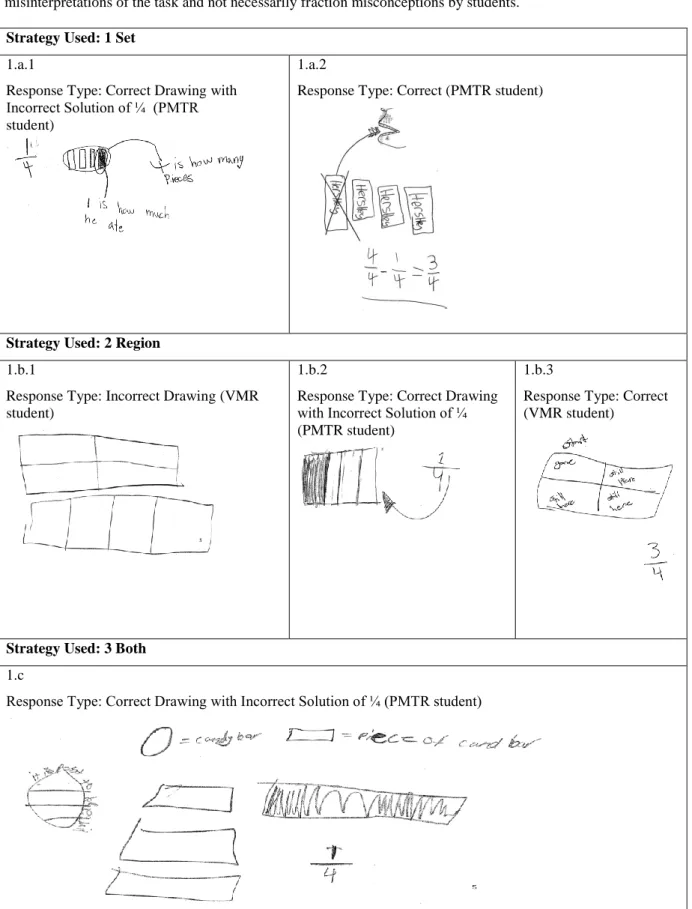
The third-grade Chocolate Bar task assessed students’ understanding of part-whole concepts (see Appendix A). The question presented students with a chocolate bar broken into four equal pieces with one piece eaten. Students determined the fraction of the original chocolate bar that was left (3/4), explaining their solution by drawing a picture. Figures 1 and 2 show examples of students’ responses and strategies to the task.
Responses
students did not answer the question, “What fraction of the original chocolate bar is left?” Therefore, these are misinterpretations of the task and not necessarily fraction misconceptions by students.
Strategy Used: 1 Set 1.a.1
Response Type: Correct Drawing with Incorrect Solution of ¼ (PMTR student)
1.a.2
Response Type: Correct (PMTR student)
Strategy Used: 2 Region 1.b.1
Response Type: Incorrect Drawing (VMR student)
1.b.2
Response Type: Correct Drawing with Incorrect Solution of ¼ (PMTR student)
1.b.3
Response Type: Correct (VMR student)
Strategy Used: 3 Both 1.c
Response Type: Correct Drawing with Incorrect Solution of ¼ (PMTR student)
Figure 1. Examples of Chocolate Bar Task response type codes grouped by strategy
pieces. The student’s set model demonstrated her understanding that the candy bar was broken into four equal pieces and Jake ate one of those pieces. Her symbol of ¼ shows that she was linking her pictorial representation to a symbolic fraction notation. Despite demonstrating her understanding of these key concepts, the student did not respond with ¾ as the amount of the original chocolate bar that is left. This was common for many students in both instructional groups in Grade 3.
A larger percentage of PMTR students (84% PMTR students; 75% VMR students) created a correct drawing in their responses. These correct drawings provide insight into students’ fraction understanding, and in some cases, their misinterpretations of the task. The incorrect drawings, on the other hand, provide insight into aspects of students’ fraction understanding as well as into their fraction misconceptions. Example 1.b.1 shows a VMR student’s response that was coded as “Incorrect Drawing.” This drawing indicates that the student understood the need to partition a region into four equal parts, but he did not shade any of the partitions to represent a fractional amount.
Strategies
There were two main types of models students used for solving this open-response item: a region model and a set model. The context of the chocolate bar in this task encouraged students to draw a region model (see 1.b.1, 1.b.2, 1.b.3). However, the wording of the task, “Jake broke a chocolate bar into four equal pieces,” provides an action that may have led students to draw a set model (thinking about the chocolate bar in individual pieces; see 1.a.1, 1.a.2).
The most common strategy for solving the Chocolate Bar task in both the VMR and PMTR groups was the use of a region model; however, more VMR students used the region model (81% of VMR students; 67% of PMTR students). More PMTR students (22%) used the set model for solving the Chocolate Bar task than did VMR students (9%). Figure 1 illustrates examples of students’ use of these two types of models. Example 1.c showed one student’s use of both models, highlighting different aspects of the student’s conceptual understanding of fractions. The region model shows her understanding of partitioning while the set model highlights her understanding of shading 1 out of 4 pieces and linking that representation to the notation ¼.
Third-Grade Candy Cane Task: Determining the Fractional Amount of a Set
Open-Response Item
The Candy Cane task asked third-grade students to determine a fractional amount of a set of 10 candy canes. The pretest asked students to determine one-fifth of the set of 10 candy canes while the posttest asked students to identify two-fifths of the set. This task required that students understand that the relationship of red candy canes to the total number of candy canes was two out of five (posttest), to understand that two groups of five consisted of 10 candy canes, and to determine that if each group of five candy canes consisted of two red candy canes then two groups of five would have 4 candy canes.
Responses
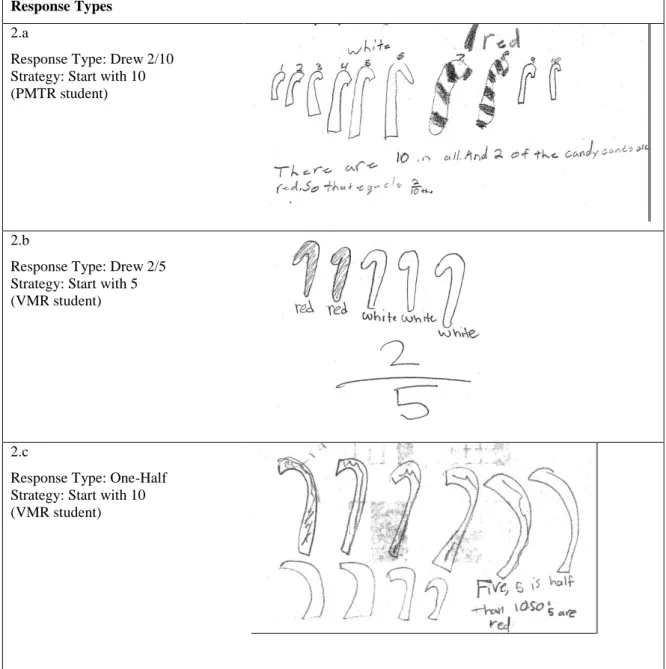
The majority of students’ responses on the posttest contained three types of errors. Figure 2 provides an example of each type of error: one-half, drew 2/5, and drew 2/10. The most common error for both groups was “Drew 2/10.” Example 2.a shows that the PMTR student understood he needed 10 candy canes (“There are 10 in all.”), but as he worked to determine how many candy canes to color red, he focused only on the numerator (of 2/5) and did not recognize that there must be two groups of five candy canes (“And 2 of the candy canes are red.”) Thus, he responded with 2 of the 10 candy canes being red (“So that equals 2/10th.”). This type of error made up 37% of the PMTR group’s responses and 27% of the VMR group’s responses.
Response Types 2.a
Response Type: Drew 2/10 Strategy: Start with 10 (PMTR student)
2.b
Response Type: Drew 2/5 Strategy: Start with 5 (VMR student)
2.c
Response Type: One-Half Strategy: Start with 10 (VMR student)
Figure 2. Examples of the three response types showing students’ errors on the Candy Cane task Example 2.c illustrates the “One-Half” response type. In this example, the student responded to the Candy Cane task with a drawing representing one-half. The student drew 10 candy canes and focused on the denominator of 5 within 2/5 to determine that she should color 5 of the canes red. While incorrect, this approach shows some relational thinking in that the student is considering a fractional amount of 10. This error made up 11% of the PMTR group’s responses and 20% of the VMR group’s responses.
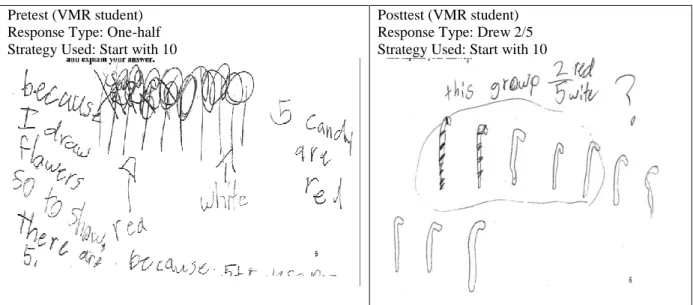
Although students’ correct responses remained low on the Candy Cane task posttest, there were many observable changes in students’ responses and strategies from pretest to posttest. However, these responses often changed from one type of error to another type of error. Nevertheless, even the change in errors provides insight into students’ fraction conceptions. Figure 3 shows an example of one student’s pretest and posttest responses and strategies for the Candy Cane task.
this understanding. Rather, the pretest response only showed that she possibly knew half of 10 is 5 and pinpointed a relationship between 10 and 5.
Pretest (VMR student) Response Type: One-half Strategy Used: Start with 10
Posttest (VMR student) Response Type: Drew 2/5 Strategy Used: Start with 10
Figure 3. Example of a student’s pretest and posttest responses on the Candy Cane task.
Strategies
The “Start with 10” strategy (2.a in Figure 2 and Figure 3) was the most commonly used strategy on the Candy Cane task (55% of the VMR group’s strategies; 62% of the PMTR group’s strategies). Typically, the “Start with 10” strategy was tied to the “Drew 2/10” response and the “One-Half” response, as seen in example 2.a in Figure 2 and Figure 3 respectively, which accounts for the predominant use of this strategy.
Fourth-Grade Comparing Fractions Task: Evaluating a Comparison of Two Fractions
Open-Response Item
The Comparing Fractions task required fourth-grade students to evaluate a comparison of two fractions presented in a region model context (candy bar) then draw a picture to justify their evaluation of the comparison. The pretest focused on the comparison of unit fractions (1/4 and 1/5) while the posttest asked students to compare two fractions close to one whole (2/3 and ¾). On the pretest, students were asked to evaluate if Mark is correct in saying that ¼ of his candy bar is smaller than 1/5 of the same candy bar. On the posttest, students determined if Mark is correct in saying that 2/3 of his candy bar is smaller than ¾ of the same candy bar.
Responses
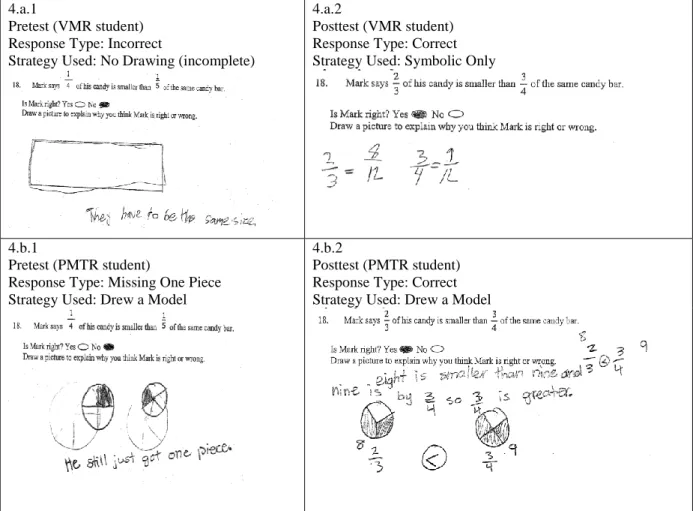
Overall, the most common response type for both groups was a correct response, and very few students’ responses on the posttest fell within the error categories. The frequencies of the error patterns were nearly identical in both groups (see Appendix B). While these error types were not common on the posttest, it is interesting to see growth from pretest to posttest when incorrect solutions or error-types occurred on the pretest. Figure 4 provides two examples of students’ growth between the pretest and posttest response.
4.a.1
Pretest (VMR student) Response Type: Incorrect
Strategy Used: No Drawing (incomplete)
4.a.2
Posttest (VMR student) Response Type: Correct Strategy Used: Symbolic Only
4.b.1
Pretest (PMTR student)
Response Type: Missing One Piece Strategy Used: Drew a Model
4.b.2
Posttest (PMTR student) Response Type: Correct Strategy Used: Drew a Model
Figure 4. Examples of students’ pretest and posttest response types and strategies for the Comparing Fractions task
Strategies
The two main strategies for comparing 2/3 and ¾ were to do so symbolically or through drawing models of the fractions. Overall, most students (75% of VMR; 82% of PMTR students) drew some type of representation to help them solve the task.
While “Drew a Model” was the most common strategy for this task, it is interesting to see the way that the use of this strategy changed from pretest to posttest for many students. Figure 5 illustrates three examples of students’ pretests and posttests using the “Drew a Model” strategy.
If we only look at students’ correct and incorrect answers, it appears that these three students did not exhibit change in their fraction learning from pretest to posttest. However, a qualitative analysis provides deeper insight into students’ knowledge gains. Example 5.a.1 shows a student’s correct response and use of a circle model for solving the task. Her sentences explain that the ¼ piece is bigger than the 1/5 piece. This same student also responded correctly on the posttest (see 5.a.2) and again drew a model, but this time she used a rectangular model. The way she lined up the two rectangular models indicated her clearer understanding of comparing two fraction representations. On the pretest she focused on comparing the partitioned pieces. On the posttest, her representations show her knowledge of comparing fractions with the same size whole. Her dotted line from the 2/3 model to the ¾ model allows us to infer that she understands she is comparing the shaded regions.
notations show growth in demonstrating understanding, despite the test score remaining the same from pretest to posttest.
5.a.1
Pretest (PMTR student) Response Type: Correct Strategy Used: Drew a Model
5.a.2
Posttest (PMTR student) Response Type: Correct Strategy Used: Drew a Model
5.b.1
Pretest (VMR student)
Response Type: Correct Drawing, Missing Explanation
Strategy Used: Drew a Model
5.b.2
Posttest (VMR student)
Response Type: Correct Drawing, Missing Explanation Strategy Used: Drew a Model
5.c.1
Pretest (PMTR student) Response Type: Incorrect Strategy Used: Drew a Model
5.c.2
Posttest (PMTR student) Response Type: Incorrect Strategy Used: Drew a Model
Figure 5. Examples of students’ pretest and posttest response types and strategies for the Comparing Fractions task
developed understandings. Example 5.c.2 shows two wholes of the same size with comparatively more accurate partitions of thirds and fourths. While there is marked growth in understanding in using the same size whole to compare fractions, the student continues to struggle with precise partitioning to help him solve the task accurately. Nevertheless, the manner of partitioning is improved.
Fourth-Grade String Task: Developing and Modeling Equivalent Fractions
Open-Response Item
The fourth-grade String task assessed students on representing fractions equivalent to one-half. The String task provided students with a series of representations equal to one-half (i.e., 3/6, ½, and 5/10) and asked students to partition a given whole into fractional amounts equal to one-half. The task provides insight into students’ understanding of fractions equivalent to one-half, which is often their starting point for understanding equivalent fractions and comparing fractions. The wording for this task seemed to be confusing for students and likely impacted students’ responses.
Responses
Overall, the percentage of correct responses was similar in both groups (45% of the VMR group; 43% of the PMTR group). Many students demonstrated correct responses on the pretest, too, however, their symbolic notations tied to their drawings and/or their explanations often provided a glimpse into solidified or new fraction conceptions. Examples 6.a.1 and 6.a.2 show a student’s “Correct” response on both the pretest and posttest. On the pretest the student renames 5/10 and 11/22 as ½ and 3/6 to prove her solution. On the posttest, rather than just listing equivalent fractions, she used the equal sign and further explained that 11/22 is equal to the examples in the test question (5/10, 3/6, and ½).
While 7.a’s test score on this question did not change from pretest to posttest, the inclusion of the equal sign and her written reasoning provide more insight into her fraction understanding and show more precision in her response. Similarly, examples 6.b.1 and 6.b.2 show a “Correct” response on both the pretest and posttest. The student’s sentence on the posttest, “These are the same except there in smaller pieces,” explains his understanding that equivalent fractions on this task are the same shaded region, no matter how many partitions are used to cut up that region.
Some students’ responses showed correct thinking in the context of a misinterpretation of the task. Examples 6.c.1 and 6.c.2 provide an instance of a misinterpretation of the question on the pretest, followed by a correct interpretation on the posttest. Even within this misinterpretation of the question on the pretest, the student’s explanation revealed some understanding of equivalent fractions.
The student’s “Technically Correct” response on the pretest (see 6.c.1) overlooks her correct conception that amounts can be equivalent even if they do not visually look the same or are shaded in the same way. Her response on the posttest showed a correct interpretation of the question and revealed more information about her conception of equivalent fractions. This student’s response on the posttest (see 6.c.2) revealed new or solidified understandings of equivalent fractions (i.e., all of these fractions are equal to ½) and also showed that she correctly understood the question.
Strategies
6.a.1
Pretest (PMTR student) Response Type: Correct
Strategy Used: Pieces on Each Side
6.a.2
Posttest (PMTR student) Response Type: Correct
Strategy Used: Pieces on Each Side
6.b.1
Pretest (VMR student) Response Type: Correct
Strategy Used: Partitioned One Side
6.b.2
Posttest (VMR student) Response Type: Correct
Strategy Used: Partitioned One Side
6.c.1
Pretest (VMR student)
Response Type: Technically Correct Strategy Used: Pieces on Each Side
6.c.2
Posttest (VMR student) Response Type: Correct
Strategy Used: Pieces on Each Side
Figure 6. Examples of students’ pretest and posttest response types and strategies for the Strings task.
Discussion
Third-Grade Open-Response Items
Drawing a Fractional Amount
The third-grade open-response fraction items assessed students’ abilities to draw and name fractional amounts of a region and a set. Students’ responses to the Chocolate Bar task showed that the PMTR group had a higher percentage of correct drawings (84% of PMTR students; 75% of VMR students). This small percentage difference may have resulted because the VMR groups did not have as much time as the PMTR groups to practice physically drawing the fraction models because they spent more time with models on the computer. The VMR group may have needed more opportunities to draw fraction models or translate their understandings to pictorial representations. It is also possible that the more time students spend drawing fraction models, the more they interact with the concept of the whole. In contrast, the VMR applets provide the whole; hence, it could be possible that the students in the VMR group did not need to consider the whole when using the applets. Maintaining conceptualization of the whole is critical to students’ development of fraction understandings (Behr et al., 1983), and it is possible that VMR students did not have as many opportunities to develop this key idea since the whole was already provided in the applets.
There was also a difference in VMR and PMTR students’ pictorial representations on the Chocolate Bar task. Twenty-two percent of the PMTR group’s strategies were based on the set model, while only 9% of the VMR group used a set model to solve the task. This result could have been influenced by the predominant use of region models in the virtual manipulatives applets. Dienes’ (1973) notion of embodied knowledge supports the interpretation of this study’s results indicating that students learn abstract fraction concepts by interacting with multiple embodiments and making connections among representations of these concepts. If students lacked opportunities to draw representations, interact with the concept of the whole, or make connections between set and area models, this lack of opportunity to interact with the concept in one embodiment or another sometimes manifested in a student’s posttest solution strategy.
Errors that Show Understanding
Both the VMR and PMTR groups performed poorly on the Candy Cane task, likely due to the difficulty level this task entailed for third-grade students. Nonetheless, students’ errors on this task provide insight into their thinking and understanding of fractions. The errors on the Candy Cane task showed that PMTR students paid more attention to the whole (i.e., 10 candy canes) while the VMR students paid more attention to a fractional amount named in the task (i.e., 2/5). An analysis of the errors for the Candy Cane task showed that more PMTR students made the error of “Drew 2/10” (37% of the PMTR group’s responses versus 27% of the VMR group’s responses) while the VMR group more often made the “One-Half” error and the “Drew 2/5” error (20% VMR versus 11% PMTR; 21% VMR versus 10% PMTR). This difference in errors gives insight into students’ conceptual understanding of fractions.
For example, students who drew 10 candy canes and then colored 2 candy canes, were likely thinking in terms of whole numbers, not fractional amounts. The task states “10 candy canes” and “two-fifths of the candy canes are red;” hence, students drew 10 candy canes and focused on the whole number “two” in “two-fifths” to represent 2 red candy canes. In contrast, students who drew 2/5 were likely thinking in terms of fractions because they drew a model that represented a fractional amount presented in the task—the fraction of 2/5. They understood the fractional relationship of 2/5 and could model it, but did not use that model to extend it to 10 candy canes. Instead those who drew 10 candy canes but represented 2 as red focused more on the 2 as a whole number rather than the relationship of the numbers expressed by the fraction. Similarly, the “One-Half” error signals some understanding of a fractional amount or part of a whole, as students saw the 10 candy canes as the whole and knew half that amount is 5 (using the 2 or the 5 in 2/5).
Fourth-Grade Open-Response Items
Shifts in Learning
The fourth-grade open-response fraction items assessed students on comparing two fractions (specifically, 2/3 and ¾) and naming and partitioning fractions equivalent to ½. The pretest and posttest examples in the Results section were chosen to highlight how test scores can conceal students’ new or solidified fraction understandings post-instruction. A qualitative analysis of students’ responses and strategies on these open-response items reveal important shifts in fraction learning, despite a student’s score remaining constant. These shifts in learning occurred in both the VMR and PMTR groups. Both concepts—comparing fractions and equivalent fractions— are easily visible when assessed with open-response items. However, there are fraction sub-concepts and skills that students need before they can successfully understand comparing fractions and equivalent fractions, which are not readily visible through a quantitative analysis. For example, Westenskow and Moyer-Packenham (in press, 2016) developed an “iceberg model” for equivalent fractions in which the tip of the iceberg above the water line represents equivalent fractions understanding while sub-concepts such as naming, modeling, identifying, and comparing fractions sit below the water line and are necessary skills for equivalent fraction understanding.
The examples of students’ pretest and posttest response types and strategies for the Comparing Fractions and String tasks highlight these shifts in learning that occur below the water line. “Drew a Model” was the most common strategy for the Comparing Fractions task and the pretest-posttest examples in Figure 5 illustrate the shifts in learning that occurred below the water line. Some students’ responses indicated no numerical change from pretest to posttest, however drawings revealed clearer understanding of comparing two fraction representations, specifically, the important concept of comparing fractions with the same size whole. Similarly, the pretest-posttest example provided in Figure 6 for the String task showed a student’s shift in learning as she used symbols and words to more precisely describe an equivalent relationship. Her score on this open-response item remained constant from pretest to posttest, but a qualitative look at her drawings highlighted a shift in understanding the concepts below the tip of the iceberg for equivalent fraction understanding.
Implications and Recommendations
Solution Representations
An analysis of students’ responses and strategies through their solution representations (Cai, 2005) provided insight into students’ errors, thought processes, internal representations, abilities to model tasks in order to justify a solution, and strategies. Representations revealed that students in the third-grade VMR group needed more opportunities to draw representations during instruction. Students’ representations also suggest that virtual manipulatives provide students with multiple opportunities to develop part-whole understandings of fractions and further their understandings of fractions as relationships. We also propose that students in the PMTR group had more opportunities to develop understandings about the whole and that the size of the whole is important. We learned that this is particularly difficult for students in the context of a set model.
Pedagogical Representations
Use of Virtual and Physical Manipulatives
Making Connections
A beneficial quality of many virtual manipulatives applets is their simultaneous linking of pictorial and symbolic representations (Moyer-Packenham & Westenskow, 2013). Physical manipulatives do not typically contain the simultaneous linking affordance; therefore, many researchers have described the importance of transparency and linking representations when using physical manipulatives to teach concepts (Cramer, Post, & delMas, 2002). The results of this study further support these claims. On the Candy Cane task, errors that show fractional knowledge (versus errors that show students’ reliance on whole number knowledge) may be the result of the simultaneous linking affordance of the virtual manipulatives applets. However, it is possible that students in the VMR group also needed more time to physically draw and partition the representations, which could account for the PMTR’s better performance on drawing representations in the Chocolate Bar task. Furthermore, Dienes’ notion of embodied knowledge provides a lens for considering the simultaneous linking features in virtual manipulatives as well as instructional strategies for providing students opportunities to interact with concepts within multiple embodiments as ways to improve the use of virtual and physical manipulatives in fraction instruction.
Future Studies
Our research lays the groundwork for future studies about how affordances of virtual manipulatives and physical manipulatives are useful in teaching specific fraction concepts. This study may lead to future examinations of how students develop their understanding of fractions as representations of the relationship between two quantities, rather than incorrectly interpreting fractions as representing two whole numbers. Another research extension could be exploring the affordances of drawing pictorial representations or using physical manipulatives with different sized wholes (e.g., pattern blocks) to develop students’ abilities to maintain conceptualization of the whole.
This study contributes to a growing body of literature showing that virtual manipulatives and physical manipulatives are equally beneficial. Our results lead us to believe that a combination of instructional modalities are necessary in order for students to develop deep and connected understandings of rational numbers (e.g., Jordan & Baker, 2011). This type of analysis with a large sample of students complements both small-scale interview studies as well as large-scale quantitative studies. Our analysis of four open-response items for a large sample of students, combined with within-class random assignment, provides broad data about the importance of both virtual and physical manipulatives instructional modalities on students’ fraction learning. Testing outcomes were the same for students using virtual manipulatives or physical manipulatives. At the same time, the complexity of such learning is maintained by observing and coding students’ responses and strategies beyond the “correct” and “incorrect” codes typical of large-scale studies. Through an analysis of students’ responses and strategies, we found errors and misconceptions that are common in the literature (e.g., Behr et al., 1983; Smith, 2002), VMR group success in understanding fractions as relationships, and PMTR group success in maintaining conceptualization of the whole.
Acknowledgements
Funding for this project was provided by a SPARC grant from the Vice-President for Research Office at Utah State University.
References
Behr, M., Lesh, R., Post, T., & Silver, E. (1983). Rational number concepts. In R. Lesh & M. Landau (Eds.),
Acquisition of mathematics concepts and processes (pp. 91-125). New York: Academic Press.
Retrieved from http://www.cehd.umn.edu/rationalnumberproject/83_1.html
Behr, M. J., & Post, T. R. (1992). Teaching rational number and decimal concepts. In T. R. Post (Ed.),
Teaching mathematics in grades K-8: Research-based methods (2nd ed.) (pp. 201-248). Boston: Allyn
and Bacon.
Bruner, J. S. (1966). Toward a theory of instruction. Cambridge, MA: Belknap Press.
Cai, J. (1995). A cognitive analysis of U.S. and Chinese students’ mathematical performance on tasks involving computation, simple problem solving, and complex problem solving. Journal for Research in
Mathematics Education Monograph Series 7. Reston, VA: National Council of Teachers of
Mathematics.
Cai, J. (2000). Mathematical thinking involved in U.S. and Chinese students’ solving of process-constrained and process-open problems. Mathematical Thinking and Learning, 2(4), 309-340.
Cai, J. (2005). U.S. and Chinese teachers’ constructing, knowing, and evaluating representations to teach mathematics. Mathematical Thinking and Learning, 7(2), 135-169.
Cai, J., Lane, S., & Jakabcsin, M. S. (1996). The role of open-ended tasks and holistic scoring rubrics: Assessing students’ mathematical reasoning and communication. In P. C. Elliott (Ed.), Communication in
mathematics, K-12 and beyond (pp. 137-145). Reston, VA: The National Council of Teachers of
Mathematics.
Cai, J., Magone, M. E., Wang, N., & Lane, S. (1996). Describing student performance qualitatively.
Mathematics Teaching in the Middle School, 1(10), 828-835.
Carbonneau, K. J., Marley, S. C., and Selig, J. P. (2012). A meta-analysis of the efficacy of teaching mathematics with concrete manipulatives. Journal of Educational Psychology. Advance online publication. doi: 10.1037/a0031084
Clements, D., & McMillan, S. (1996). Rethinking ‘concrete’ manipulatives. Teaching Children Mathematics, 2(5), 270-279.
Cobb, P. (1995). Cultural tools and mathematical learning: A case study. Journal for Research in Mathematics
Education, 26(4), 362-385.
Cramer, K. A., Post, T. R., & delMas, R. C. (2002). Initial fraction learning by fourth- and fifth-grade students: A comparison of the effects of using commercial curricula with the effects of using the Rational Number Project curriculum. Journal for Research in Mathematics Education, 33(2), 111-144.
Dienes, Z. P. (1973). Mathematics through the senses, games, dance and art. Windsor, UK: The National Foundation for Educational Research.
Goldin, G., & Shteingold, N. (2001). Systems of representations and the development of mathematical concepts.
The roles of representation in school mathematics, 1-23.
Jordan, K. E., & Baker, J. B. (2011). Multisensory information boosts numerical matching abilities in young children. Developmental Science, 14, 205-213.
Kamii, C, & Clark, F. B. (1995). Equivalent fractions: Their difficulty and educational implications. The
Journal of Mathematical Behavior, 14(4), 365-378.
Lakoff, G., & Nunez, R. E. (2000). Where mathematics comes from: How the embodied mind brings
mathematics into being. New York: NY: Basic Books.
Lane, S. (1993). The conceptual framework for the development of a mathematics assessment instrument for QUASAR. Educational Measurement: Issues and Practice, 12(2), 16-23.
Manches, A., O’Malley, C., & Benford, S. (2010). The role of physical representations in solving number problems: A comparison of young children’s use of physical and virtual materials. Computer &
Education, 54, 622-640.
McNeil, N., & Jarvin, L. (2007). When theories don’t add up: Disentangling the manipulatives debate. Theory
Into Practice, 46(4), 309-316.
Melideo, S., & Dodson, F. (2009). Directly from pedagogy to practice: Incorporating virtual manipulatives in the elementary classroom. The Teacher Educator’s Journal, 16, 28-35.
Mendiburo, M., & Hasselbring, T. (2011). Technology’s impact on fraction learning: An experimental comparison of virtual and physical manipulatives. Society for Research on Educational Effectiveness.
Miles, M. B., & Huberman, A. M. (1994). An expanded sourcebook: Qualitative data analysis (2nd ed.). Thousand Oaks, CA: Sage Publications, Inc.
Moss, J., & Case, R. (1999). Developing children’s understanding of the rational numbers: A new model and an experimental curriculum. Journal for Research in Mathematics Education, 30(20), 122-147.
Moyer, P. S. (2001). Are we having fun yet? How teachers use manipulatives to teach mathematics. Educational
Studies in Mathematics, 47, 175-197.
Moyer, P. S., Bolyard, J. J., & Spikell, M. A. (2002). What are virtual manipulatives? Teaching Children
Mathematics, 9(4), 196-201.
Moyer, P. S., Niezgoda, D., & Stanley, J. (2005). Young children’s use of virtual manipulatives and other forms of mathematical representations. In W. J. Masalski & P. C. Elliot (Eds.), Technology-supported
mathematics learning environments: Sixty-seventh yearbook (pp. 17-34). Reston, VA: National Council
of Teachers of Mathematics.
manipulatives with other instructional treatments in third- and fourth-grade classrooms. Journal of
Education, 193(2), 25-39.
Moyer-Packenham, P.S., Baker, J., Westenskow, A., Anderson-Pence, K., Shumway, J.F., & Jordan, K. E. (2014). Predictors of achievement when virtual manipulatives are used for mathematics instruction.
Journal of Research in Mathematics Education (REDIMAT), 3(2), 121-150.
Moyer-Packenham, P. S. & Weskenskow, A. (2013). Effects of virtual manipulatives on student achievement and mathematics learning. International Journal of Virtual and Personal Learning Environments, 4(3), 35-50.
National Council of Teachers of Mathematics (NCTM). (2000). Principles and Standards for School
Mathematics. Retrieved from http://www.nctm.org/fullstandards/document/
Patton, M. Q. (1990). Qualitative evaluation and research methods (2nd ed.). Newbury Park, CA: Sage Publications, Inc.
Reimer, K., & Moyer, P. S. (2005). Third-graders learn about fractions using virtual manipulatives: A classroom study. Journal of Computers in Mathematics and Science Teaching, 24(1), 5-26.
Silver, E. A. (1992). Assessment and mathematics education reform in the United States. International Journal
of Educational Research, 17, 489-502.
Smith, J. P. (2002). The development of students' knowledge of fractions and ratios. In B. Litwiller & G. Bright (Eds.), Making sense of fractions, ratios, and proportions (pp. 3-17). Reston, VA: National Council of Teachers of Mathematics.
Sowell, E. J. (1989). Effects of manipulative materials in mathematics instruction. Journal for Research in
Mathematics Education, 20(5), 498-505.
Teddlie, C. & Tashakkori, A. (2006). A general typology of research designs featuring mixed methods.
Research in the Schools, 13(1), 12-28.
Westenskow, A. & Moyer-Packenham, P. S. (in press, 2016). Using an iceberg model to examine equivalent fraction learning trajectories when students with mathematical learning difficulties use different manipulatives. International Journal for Technology in Mathematics Education.
Author Information
Jessica F. Shumway
Utah State University 2605 Old Main Hill Logan, Utah USA
Contact e-mail: [email protected]
Patricia S. Moyer-Packenham Utah State University
2605 Old Main Hill Logan, Utah USA
Joseph M. Baker Stanford University
401 Quarry Road Stanford, California USA
Arla Westenskow Utah State University
2605 Old Main Hill Logan, Utah USA
Katie L. Anderson-Pence
University of Colorado, Colorado Springs
1420 Austin Bluffs Parkway Colorado Springs, Colorado USA
Stephen I. Tucker
Virginia Commonwealth University
1015 W. Main Street Richmond, Virginia USA
Jennifer Boyer-Thurgood Utah State University
2605 Old Main Hill Logan, Utah USA
Kerry E. Jordan Utah State University
Appendix A
Overview of Open-Response Problems, Response Types Codes, and Strategies Used Codes
Problem Model Big Ideas Response Types Strategies Used
Third Grade Chocolate Bar
Jake broke a chocolate bar into four equal pieces and ate one piece. What fraction of the original chocolate bar is left? Explain using a picture that your answer is correct.
Region Partition a region, name a fraction (Part-whole understanding, identify fraction (1/4 and 3/4) of a whole)
1 Incorrect Drawing
2 Correct Drawing Only
3 Correct Drawing ¼
4 Correct Drawing and Answer (3/4) 1 Set 2 Region 3 Both 0 Other Candy Cane
Sally has 10 candy canes. Two-fifth of the candy canes are red while the others are white. How many of the candy canes are red? Draw a picture and explain your answer.
Set Partition a set based on a given fraction and name number of objects (Fractional amount (2/5) of a set of 10 candy canes; Relationship btw whole number amount to total number of candy canes;
Grouping)
1 No answer/Incomplete
2 One-half
3 Drew 2/5
4 Drew 2/10
5 Correct
1 Start with 5
2 Groups of 5
3 Start with 10
4 Other
Fourth Grade Comparing Fractions
Mark says 2/3 of his candy is smaller than 3/4 of the same candy bar.
Is Mark right? Yes No
Draw a picture to explain why you think Mark is right or wrong.
Region Evaluate a comparison of two fractions (2/3 and ¾).
Close to a whole Draw given fractions
1 Incorrect
2 Missing one piece
3 Subtracted two fractions
4 Compared numerator or denominator as whole numbers
5 Correct Drawing (explanation incomplete or missing)
6 Correct
1 Symbolic only
2 Drew a model
3 No drawing or no attempt
String The shaded part of each string below shows a fraction.
Length Partition a given whole
This fraction string shows 3/6:
A.
Here is another fraction that is equal to the one in A
B.
Here is another fraction that is equal to one in A and B.
C.
Shade in the fraction strings below to show two different fractions that are equal to the ones shown in A, B, C. Explain your picture.
Equivalent names for ½
(Developing and modeling equivalent fractions)
2 Technically Correct
3 Correct
2 Pieces on Each Side
3 Other
4 No Strategy
Appendix B
Percentage of Response Types and Strategies Used on the Third-Grade Chocolate Bar Problem VMR
% (n = 73)
PMTR % (n = 82) Response Types
1 Incorrect Drawing 25% 16%
2 Correct Drawing Only 8 17
3 Correct Drawing with Incorrect Solution of ¼ 42 37
4 Correct Drawing and Correct Solution of 3/4 25 30
Strategies Used
1 Set 9 22
2 Region 81 67
3 Both 3 4
4 Other 7 7
Percentage of Response Types and Strategies Used on the Third-Grade Candy Cane Problem VMR
% (n = 73)
1 No Answer/Incomplete 19% 24%
2 One-half 20 11
3 Drew 2/5 21 10
4 Drew 2/10 25 37
5 Correct 15 18
Strategies Used
1 Start with 5 18 8
2 Groups of 5 11 15
3 Start with 10 55 62
4 Other 16 15
Percentage of Response Types and Strategies Used on the Fourth-Grade Comparing Fractions Problem VMR
% (n = 94)
PMTR % (n = 106) Response Types
Incorrect 29% 26%
Missing One Piece 3 5
Subtracted Two Fractions 2 2
Compared As Whole Numbers 8 6
Correct Drawing, Missing Explanation
18 22
Correct 40 39
Strategies Used
Symbolic Only 4 3
Drew a Model 75 82
No Drawing/Attempt 21 15
Percentage of Response Types and Strategies Used on the Fourth-Grade String Problem VMR
% (n = 94)
PMTR % (n = 106) Response Types
Incorrect 34% 31%
Technically Correct 21 26
Correct 45 43
Strategies Used
Partitioned One Side 7 5
Pieces on Each Side 50 56
Other 27 26