The University of San Francisco
USF Scholarship: a digital repository @ Gleeson Library |
Geschke Center
Doctoral Dissertations Theses, Dissertations, Capstones and Projects
2017
The Educational Dimensions of Filipina Migrant
Workers’ Activist Identities
Rowena Magdalena Tomaneng
University of San Francisco, [email protected]
Follow this and additional works at:https://repository.usfca.edu/diss
Part of theEducational Methods Commons, and theWomen's Studies Commons
This Dissertation is brought to you for free and open access by the Theses, Dissertations, Capstones and Projects at USF Scholarship: a digital repository @ Gleeson Library | Geschke Center. It has been accepted for inclusion in Doctoral Dissertations by an authorized administrator of USF Scholarship: a digital repository @ Gleeson Library | Geschke Center. For more information, please [email protected].
Recommended Citation
Tomaneng, Rowena Magdalena, "The Educational Dimensions of Filipina Migrant Workers’ Activist Identities" (2017).Doctoral Dissertations. 334.
The University of San Francisco
THE EDUCATIONAL DIMENSIONS OF
FILIPINA MIGRANT WORKERS’ ACTIVIST IDENTITIES
A Dissertation Presented to
The Faculty of the School of Education International and Multicultural Education Department
In Partial Fulfillment Of the Requirements of the Degree
Doctor of Education
by
Rowena M. Tomaneng San Francisco
i
ABSTRACT
The Educational Dimensions of Filipina Migrant Workers’ Activist Identities
There are 10.4 million Filipino/a migrant workers worldwide, with the large
majority of Filipina migrants working in traditional gendered labor such as domestic
work, care giving, nursing, teaching, and factory work (Ruiz, 2013). Because of the
private nature of household work, Filipina migrants are vulnerable to mental and physical
abuses from their employers in addition to labor exploitation. While researchers
recognize migrants’ agency and acknowledge migrants as political and social actors, few
studies connect Filipina migrant workers’ activist identities to the political education they
receive from grassroots organizations in the Philippines, United States, and other
countries. Consequently, the purpose of this qualitative study is to research the roles that
political education, critical pedagogies, and community organizing play in developing a
social justice mindset among Filipina migrants who are members of the Filipino Migrant
Center (FMC), Long Beach in Southern California. FMC engages in organizing
low-income members of the Filipino community around issues and concerns affecting them,
provides services, and conducts research and educational work. This study investigates
the experiences of six Filipina migrant workers and three staff members involved with
the FMC in order to examine the issues that Filipina migrants face, and the ways in which
political education and the practice of activism developed their sense of empowerment
and ability to transform the negative conditions of their lives. The study links FilCrit
pedagogy, transnational feminism, and social movements as theoretical sites that can
teach us how Filipina migrant workers engage in learning the socio-historical and
ii
SIGNATURE PAGE
This dissertation, written under the direction of the candidate’s dissertation committee
and approved by the members of the committee, has been presented to and accepted by
the Faculty of the School of Education in partial fulfillment of the requirements for the
degree of Doctor of Education. The content and research methodologies presented in this
work represent the work of the candidate alone.
Rowena M. Tomaneng May 12, 2017 __________ Candidate
Dissertation Committee
Shabnam Koirala-Azad, Ph.D. May 12, 2017___________ Chairperson, Dissertation Committee
Emma Fuentes, Ph.D May 12, 2017___________
iii
DEDICATION
I dedicate this dissertation to David and Felix. You have been with me from the
beginning of this journey, providing your love, understanding, and support every step of
the way. I am always inspired by your kindness, consideration of others, and outrage
when injustices happen. These are indeed the times that try one’s soul but with you and
Felix at my side, I am confident I can keep pushing forward with my equity and social
justice work within and beyond educational institutions.
David, you have always been generous to share our lives with the many
communities that I support, the students that I served at De Anza College and the broader
Filipino community in the South Bay. Thank you for supporting meetings, retreats,
rallies, marches, community dialogues and events. You embraced my comrades in the
Filipino community and welcomed them into our family.
Felix, you probably don’t remember all the details, but since you were a baby up
until the age of six years, you too spent many hours with Mom while she was
volunteering as a community organizer in San Jose. You were always so easy to bring
along, and even now, it warms my heart that you believe in fairness and understand why
people fight for their human rights.
iv
ACKNOWLEDGEMENTS
This research project would not have been possible without the influence, love,
encouragement, and support of the following:
My doctoral advisor and dissertation chair, Dr. Shabnam Koirala-Azad, for
providing me a model of the human rights education practitioner and researcher that I
seek to be. I remember when I first met you during the new graduate student mixer back
in the fall of 2013. Your warm welcome to new students made an impact and I knew that
I had made the right choice of applying to the International Multicultural Education
department at USF. I am inspired by your participatory action research on the social and
education inequities in Nepal and your focus on globalization and transnational social
justice movements. I appreciate your thoughtful guidance through this process and the
insights you have provided me to improve my research.
My dissertation committee members, Dr. Emma Fuentes and Dr. Lois Lorentzen,
for your support of and feedback on this project. I appreciate your praxis as teachers and
researchers in the academy and as change agents in the community. Your deep
commitments to addressing educational inequities of students of color and im/migrant
student populations inspire myself and others to engage in these struggles.
My colleagues at De Anza College for providing me peer mentorship,
professional support, and friendship for over two decades. And, to my 2017 cohort for
providing thoughtful comments on my writing and being supportive through this
apprehensive but beautiful process. A special thanks to Manuel Perez. Our text message
check-ins always lifted my spirit when the pressures of our professional and personal
v
To all the organizations I have been associated with: The Coalition for Justice and
Accountability (CJA), Critical Filipina and Filipino Studies Collective (CFFSC),
FilsGlobe San Francisco Bay Area Alliance, Filipino Community Support, Silicon Valley
(FOCUS-SV), Filipino Youth Coalition (FYC), MALAYA, National Alliance for
Filipino Concerns (NAFCON-USA), People’s Association for Worker’s and Immigrants
(PAWIS), and others who have allowed me to join their various social justice struggles.
My research participants for taking the time to share your hopes, dreams, survival
stories, and your social justice struggles. Your courage, strength, resilience, and
willingness to help others are truly a reflection of diwang pinay, the spirit of the Filipina.
A special thanks to Mara Ibarra, Terrie Cervas, Joselyn De Guzman, Joanna
Concepcion, Napolean “Nap” Alba, and my mother Nenita De Joya Tomaneng, for their
support during the data collection phase, including Tagalog translation.
To my parents, Nenita and Rufino, my brother and sisters, Neil, Emma, and
Agnes, and the rest of the De Joya and Tomaneng clans for your encouragement, love
and support of all I do. To my Lolo (grandfather) Crosby, who passed away during my
childhood. My house was filled with stories of his valuable role and service to his village
in Mindoro, Philippines. My mother called him a faith healer and described how many
villagers came to him to ease their pains. My Lolo’s legacy lives on with his children and
grandchildren, and my family members struggling in the Philippines and working abroad
as migrant contract workers. This dissertation is for all of you, so you find hope and
inspiration in the transnational activism across the globe and the growing social
vi
TABLE OF CONTENTS
DISSERTATION ABSTRACT……….. i
DEDICATION………. iii
ACKNOWLEDGEMENTS……… v
LIST OF TABLES………... ix
LIST OF FIGURES………... x
CHAPTER I: THE RESEARCH PROBLEM... 1
Introduction………...…... 1
Background and Need ………...…... 4
Statement of the Problem………...…... 6
Purpose of the Study………...…... 8
Research Questions………...…... 8
Conceptual and Theoretical Framework………...…... 9
Filipino/a critical pedagogy………...…... 9
Transnational feminist theory………...…... 11
Social movement theory………...…... 13
Delimitations………...…... 14
Educational Significance………...…... 14
Background of the Researcher………...…... 15
CHAPTER II: LITERATURE REVIEW……… 18
Restatement of the Problem………...…... 18
Overview…….………...…... 18
Origins of Filipina Migrant Labor, the Philippine State, and Globalization... 19
Filipino Migrant Labor and American Colonialism of the Philippines... 20
Filipino/a Migrant Labor and Globalization………...…... 24
Third World/Transnational Feminism and Filipina Social Justice Struggles... 27
Filipina Migrants as Racialized Subjects... 28
Third World and Transnational Feminism... 31
Filipina Migrants and Transnational Feminism... 33
Critical Pedagogies, Individual and Group Empowerment, and Social Movements. 37 Critical Pedagogy... 38
Ethnic Studies Pedagogy... 39
Filipino/a Critical Pedagogy... 42
Individual and Group Empowerment and Social Movements... 44
Summary………...…... 49
CHAPTER III: RESEARCH DESIGN AND METHODOLOGY……… 50
Restatement of the Purpose of the Study………...…... 50
vii
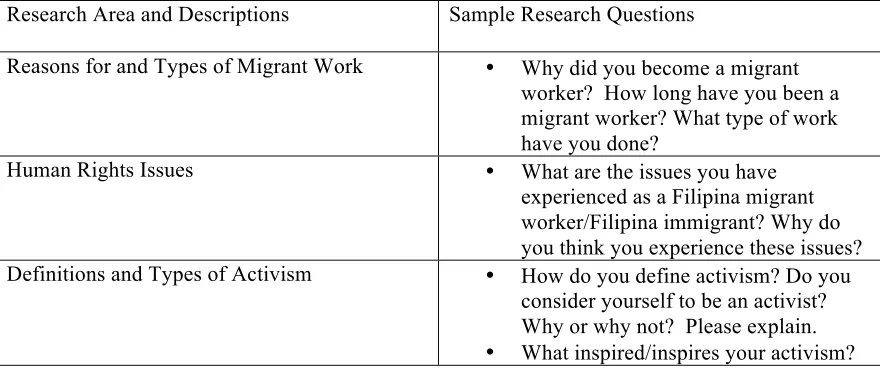
Research Questions…...…... 52
Research Design…...…... 53
Setting and Participants…...…... 56
Research Site…...…... 56
Access…...…... 60
Participants and Sampling…...…... 61
Data Collection…...…... 62
Narrative Interviews... 62
Participant Observation…...…... 63
Collection of Artifacts…...…... 63
Data Analysis…...…... 63
Role of Researcher…...…... 64
Ethical Considerations and Protection of Human Subjects... 66
CHAPTER IV: FINDINGS, PART ONE……… 68
Introduction………...………….……... 68
Profiles of Research Participants………...………...………....……... 69
Review of Overarching Research Question………...……… 74
Findings According to Sub-Research Question #1………...………... 74
Findings According to Sub-Research Question #2……….………... 81
Findings According to Sub-Research Question #3………...………... 84
Findings According to Sub-Research Question #4………...………... 90
Findings According to Sub-Research Question #5………...………... 97
Summary………...………... 102
CHAPTER V: FINDINGS, PART TWO………..103
Introduction………...………. 103
Findings According to Participant Observation………...………... 103
Findings According to Collection of Artifacts………...………... 115
Summary………...………... 130
CHAPTER VI: SUMMARY, DISCUSSION, LIMITATIONS, RECOMMENDATIONS, CONCLUSION………... 131
Summary………...………... 131
Discussion………...………... 134
Limitations………...………... 148
Recommendations………...…………... 149
Conclusion………...………...151
Researcher’s Personal Reflection………...………...152
REFERENCES………....………. 155
APPENDICES Appendix A: Approval from University of San Francisco’s Institutional……...… 162
viii
Appendix B: Letter of invitation………. 163
Appendix C: Consent Form for Filipina Migrant Worker………... 165
Appendix D: Consent Form for Filipino Migrant Center Staff………... 168
Appendix E: Interview Questions for Filipina Migrant Workers, English……….171
Appendix F: Interview Questions for Filipina Migrant Workers, Tagalog.………173
Appendix G: Interview Questions for Filipina Migrant Center Staff…………..… 175
Appendix H: Diwang Pinay Program Zine………. 177
Appendix I: Kursong Oryentasyon para sa mga Migranteng Pilipino………... 191
ix
LIST OF TABLES
Table Page
1. Research Area and Questions……… 53
2. Demographic Profiles of Filipina Migrant Worker Participants ………….. 68
x
LIST OF FIGURES
Figure Page
1. Filipino Migrant Center (old office)……….. 56 2325 E 3rd St, Long Beach, CA 90814
2. Filipino Migrant Center (new office) ………... 56 2125 Santa Fe Avenue, Long Beach, CA 90810
3. Filipino Migrant Center (front of new office) ……….. 57 2125 Santa Fe Avenue, Long Beach, CA 90810
4. Filipino Migrant Center Participants at Inaugural Day March……….. 59 January 2017
5. MIGRANTE Southern California and Filipino Migrant Center Alliance…. 60
6. Researcher with NAFCON-USA Banner, Washington D.C. 2010………... 65
7. Filipino Migrant Center (inside new Office with Hiyas) ……….. 105 2125 Santa Fe Avenue, Long Beach, CA 90810
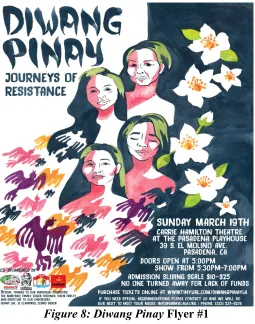
8. Diwang Pinay Flyer #1……….. 107
9. Diwang Pinay Flyer #2……….. 111
10. Filipino Migrant Center Newsletter January-February 2017………. 116
11. Filipino Migrant Center Community Platform Information Flyer…………. 118
12.Kursong Oryentasyon para sa mga Migranteng Pilipino (cover page) …... 119
1
CHAPTER I
THE RESEARCH PROBLEM Introduction
In 1998, a dictionary in Greece was reported to have defined a Filipina (or
'Filipineza') as a "domestic worker from the Philippines or a person who performs
non-essential auxiliary tasks.” This definition caused a major controversy and debate within
the Philippine government because it raised attention to the government’s ongoing
practice of exporting Filipino/a human labor and services as a revenue generating
enterprise for the nation. A few years later, Realuyo (2002) published “Four Million,” a
poetic tribute to the harsh realities of overseas Filipina migrant workers’ lives. Part IV of
this poem, titled “Filipineza,” alludes to the 1998 controversy and interrogated the
popular global image of Filipinas as domestic workers by crafting a powerful and poetic
counter story. In the poem, the narrator, a maid, voices,
If I became the brown woman mistaken
For a shadow, please tell your people I’m a tree.
Or its curling root above ground, like fingers without a rag,
Without the buckets of thirst to wipe clean your mirrorlike floors (Realuyo, 2002).
In the above passage, the metaphor of a tree with strong roots is used to represent the
Filipina maid; she is confident and powerful, refusing to be a shadow, refusing to be
defined only as a domestic worker.
Philippines Migrants Rights Watch (2011) also presents counter narratives of the
experiences of overseas Filipina workers. The migrant workers included in the volume
2
prison-like conditions due to lack of vacation, wage theft, and forced additional labor
outside of signed contracts. For instance, while working in Saudi Arabia, Jean Rosario
narrated facing sexual harassment by her employer while living in a prison-like
environment. She described her employers holding back her salary of $200 per month
and having it remitted directly to the Philippines. Rosario was not allowed to have days
off nor leave the property (Philippine Migrants Rights Watch, 2011). Sally Lopez spoke
of being a caregiver to an elderly woman in Singapore but was also expected to be a maid
and cook for an additional 15 people who lived in adjoining condominium units owned
by her employer. She also left her only son with a family that began to mistreat him, so
she had to transfer him to an orphanage (Philippines Migrants Rights Watch, 2011).
Marizen Santos, another worker, wrote a letter to her parents thanking them for their
sacrifices so she could pursue higher education abroad. While in school in New York, she
worked as a domestic and babysitter to fund her education and experienced the
challenges of migrant workers. She closed her letter in the following way:
We are a sociological imagination, Ma and Pa. We are a product of labor
migration. Our family story is personal and public at the same time; our
story is the story of countless OFWs [Overseas Filipino Workers] and
their families told in different ways and experienced in different settings
but they are the same. But let our story be not only a part of a tapestry of
stories of millions of OFWs and their families. Let our story and that
tapestry influence change for the better, even how small. (Philippine
Migrants Rights Watch, 2011, p. 95)
3
the commodification of Filipino bodies within the global economy. She also underscores
the need for taking collective action for social change and strengthening of Filipino
communities.
These Filipina migrant stories and my personal experiences ground my
dissertation research interest in studying the lives of Filipina migrant workers in the
United States. This topic is significant to me because I have family members who have
been or are currently OFWs in Saudi Arabia, Australia, England, Germany, and Taiwan.
Through social media, I am given a window to what my cousins are experiencing: long
work hours, dangerous work conditions, loneliness for their families, and yearning for
homeland. One of my female cousins, for example, was even kept prisoner in her
employer’s household. She was not allowed to go outside of the residence and she was
also denied food on a regular basis. Fortunately, she was able to escape through the aid of
a neighbor who took pity on her.
Since 2001, I have also served as a community advocate and organizer for
Filipino immigrant and migrant workers in Santa Clara County, California. In this
experience, I became familiar with political education and activist curriculum and
delivered various workshops ranging from digital literacy, public speaking, Philippine
history, Filipino American history, and activism. Within the context of Philippine
colonial history and globalization, I want to study the ways that the intersection of race,
class, and gender oppressions impact the lives of Filipina migrant workers and how they
come to choose a life of political activism for social justice and human rights. More
specifically, I am interested in how a decolonizing education, grounded in the praxis of
4
victim to empowered change agent.
Background and Need
Ruiz (2013) estimated a total of 10.4 million Filipino/a migrant workers
worldwide. The Center for Migrant Advocacy(2012) reported to the U.N. Commission
on Migrant Workers that overseas Filipino/a workers (OFWs) are employed in over 238
countries. They have continued to play a central role in the Philippine’s Labor and
Employment Plan in the creation of jobs and over 20 billion dollars remitted annually to
the national economy. The Philippine Labor and Employment Plan (2011) also
documented the high percentage of women migrants working in traditional gendered
labor such as domestic work, care giving, nursing, teaching, and factory work:
It is of interest to note that majority of OFWs were women workers. Statistics
revealed that three-fifths (61.6%) of annual deployment of new hires over the past
nine years were women who had to leave their homes and endure years of
separation from their families… women were dominant in three (3) major
occupation groups: services (55.7%) e.g., domestic workers or caregivers;
professionals and technical 13 workers (27.7%) e.g. nurses and teachers; and
production and related workers (11.2%) e.g. factory workers (pp. 12-13).
Additionally, the largest percentages of Filipino/a migrants work in East Asia, Western
Asia, Southeast Asia, Australia, Europe, and North America. In 2012, the demographics
of Filipino/a migrant workers showed 330, 040 working in Saudi Arabia, 259,546
working in United Arab Emirates, 131, 180 working in Hong Kong, 172, 690 working in
Singapore, 104, 622 working in Qatar, 38, 407, working in Malaysia, and 25,261 working
5
estimated about two million Filipino migrants reside in the United States with over
360,000 Filipino migrants in Canada. In America, the majority of Filipino migrants are
working in major urban cities such as Los Angeles, San Francisco, San Diego, San Jose,
New York, Honolulu, Chicago, and Las Vegas
(http://www.migrationpolicy.org/programs/data-hub/charts/international-migrant-population-country-origin-and-destination).
The feminization of migrant labor from the Philippines is alarming from a gender
and rights perspective. The United Nations (1993) upheld, “Women are entitled to the
equal enjoyment and protection of all human rights and fundamental freedoms in the
political, economic, social, cultural, civil or any other field”
(http://www.un.org/documents/ga/res/48/a48r104.htm). These rights include the right to
physical and mental health and the right to positive work conditions free from
discrimination and mistreatment. However, because of the private nature of
domestic/household work, Filipina migrants are vulnerable to mental and physical abuses
from their employers. Take the recent story of three Filipina domestic workers who
escaped employer abuse and forced labor in Kuwait (Migrant-Rights.org, 2015). The
women reported that their employer had taken away their passports, verbally and
physically abused them on a regular basis, denied their leaving the employer’s home, and
denied phone use to contact their families
(http://www.migrant-rights.org/2015/04/three-filipina-domestic-workers-flee-abuse-and-forced-labor-in-kuwait/). Additionally,
experiencing sexual harassment and even sexual assault are not rare instances for Filipina
6
Statement of the Problem
While researchers recognize migrants’ agency and acknowledge migrants as
political and social actors, research is limited that connects Filipina migrant workers’
activist identities to the political education they receive from grassroots organizations in
the Philippines, United States, and other countries. Transnational feminist scholars, for
example, provide a deep analysis of the problems of gendered migration and labor in
relation to uneven global economic development (Mohanty, 2003; Parreñas, 2001; 2005;
2008; Rodriguez, 2010). These scholars argue that the majority of the jobs created by
globalization for women are temporary, low-wage contractual work with poor working
conditions. They also highlighted women migrants’ struggles with sexual violence and
harassment. However, these studies give a limited view on how Filipina migrant workers
have responded to the economic, political, and social inequities of their lives.
Other studies on migration and labor have focused on the impact of U.S.
colonialism, globalization, and the role of the Philippine State (Fujita-Rony, 2003;
Rodriguez, 2010; Baldoz, 2011). For example, Rodriguez (2010) argued that it was under
U.S. colonialism that Filipinos/as became equated with cheap labor. While the United
States was establishing the Philippine colony in the early twentieth-century, the
agricultural industry in the western United States and the newly acquired Hawaiian
territory recruited Filipino workers in response to a labor shortage due to anti-immigrant
sentiment against Chinese and Japanese workers. Baldoz (2011) further examined the
intersection of American imperialism and Filipino immigration histories, focusing on the
impact of empire on Filipino migration, race relations, and American law. For example,
7
United States due to fear of wage competition and the desire for racial purity. Studies
such as this also documented that Filipino migrant workers protested wage inequity, poor
living conditions, and the brutal violence directed toward them, but further exploration is
needed on the educational practices that developed their oppositional consciousness.
Educational perspectives have centered on the inclusion of decolonizing
education in the teaching of Filipino/a American students in high schools, colleges, and
universities (Daus-Magbual, 2010; Tintiangco-Cubales, 2007; 2009; Viola, 2009; 2014).
These studies analyzed the impact of ethnic studies curriculum, student leadership
development, and activism in raising students’ political consciousness. This research
were primarily qualitative investigations, providing students an avenue to tell their stories
and be heard by a broader audience while at the same time demonstrating to other
educators the value of an ethnic studies-based pedagogy. Viola (2014), for example,
located the experience of one high profile Filipina American activist, Melissa Roxas,
within a FilCrit pedagogy which is rooted in the idea that Filipino/a lived experiences
within colonial, neocolonial, and imperialist contexts are transformative sites of
knowledge production. FilCrit pedagogy is also informed by “the transnational praxis of
those who actively and humbly witness, learn, and challenge the barbaric consequences
of a global capitalist system that is impeding human potential” of a diasporic Filipino
community (Viola, 2014, p. 22). Roxas was exposed to activism through participation in
grassroots organizations and received critical pedagogy rooted in Philippine and Filipino
American studies curriculum. Additional Filipino/a American activist experiences need to
8
Purpose of Study
The purpose of this qualitative study is to explore the educational dimensions of
Filipina migrant workers’ activist identities within the context of their involvement in a
community-based migrant center. Specifically, this dissertation researches the roles that
political education, FilCrit pedagogy, and community organizing play in developing an
activist and social justice mindset among Filipina migrant workers who are members of
the Filipino Migrant Center (FMC) Long Beach in Southern California. FMC engages in
organizing low-income members of the Filipino community around issues and concerns
affecting them, provide services, and conducts research and educational work.
Research Questions
The overarching research question for this study is: “How do Filipina migrant
workers learn to be activists?” Five related sub-research questions include:
1. What are the human rights issues experienced by Filipina migrant workers
that inspire them to be activists?”
2. How do Filipina migrant workers characterize their motivation for
participating in community-based migrant centers?
3. In what ways do community-based migrant centers play a role in Filipina
migrant workers learning activism?
4. How do Filipina migrant workers perceive and experience the political
education and activist curriculum they receive from community-based
migrant centers?
5. In what ways does FilCrit pedagogy play a role in Filipina migrant activist
9
Theoretical and Conceptual Framework
As discussed in the introduction, the purpose of this qualitative study is to explore
the educational dimensions of Filipina migrants’ activist identities in relation to political
education, community organizing curriculum, and the praxis of activism. When analyzing
the narratives of Filipina migrant activists, the dissertation utilizes three perspectives in
its theoretical and conceptual framework: FilCrit pedagogy will serve as the primary
theoretical lens, followed by transnational feminist theory and social movement theory.
These three theories share a concern for social justice, human rights, analysis of power,
and the potential for individual, community, and state government transformation.
Applying these theories allow multiple perspectives to be used to interpret the data
collected through participant oral interviews, participant observations, written documents,
and visual artifacts. More importantly, these three theoretical lenses will most likely
provide a fuller portrait of how Filipina migrant workers develop self-agency and why
they become activists.
Filipino/a critical pedagogy
Filipino/a critical (FilCrit) pedagogy argues for the inclusion of a decolonizing
education and praxis in relation to developing a Filipino/a American identity committed
to social change (Daus-Magbual, 2010; Tintiancgo-Cubales, 2007; 2009; Viola, 2012;
2014). FilCrit pedagogy draws from critical pedagogy and the seminal work of Brazilian
Educator, Paulo Freire (1970), whose educational model centered on consciousness
raising, dialogue, reflection, and praxis - that in the expansion of these individual acts,
collective action for social transformation can take place. Through adoption of a
10
conscientization, gaining an awareness of the economic, political, and socio-historical
conditions that have impacted Filipino/a lives and communities.
FilCrit also builds upon Philippine Studies, which examines the social, economic,
cultural, and political impact of Spanish and United States colonialism on the Filipino
people. The existing scholarship (Agoncillo & Alfonso, 1969; Constantino, 1970; 1975;
Enriquez, 2004; Shaw & Francia, 2002; Schirmer & Shalom; 1998) consistently argues
that Spanish colonialism and American colonialism negatively shaped the Philippine
economy and political institutions, hindering industrial growth. The scholarship also
explores the ways in which Filipino/a identity was shaped by the western education
provided by Spanish priests and America teachers. Constantino (1970) and Enriquez
(2004), for example, hold that a recovery of core Filipino values was necessary for a
process of decolonization to take place.
Moreover, FilCrit pedagogy relies on Filipino/a American studies (Baldoz, 2011;
Choy, 2003; Delmendo, 2004; Fujita-Rony, 2003; Posadas, 1999; Strobel; 2001), which
analyzes Filipino/a American experiences within an Ethnic Studies framework;
specifically, in relation to immigration/migration patterns, labor, race relations,
citizenship, and political engagement. Delmendo (2004) and Ignacio (2004) examine the
cultural propaganda used by the American press to justify the Philippine-American War.
Filipino/as were racialized as backward, uncivilized brown others who would only
benefit as a people if they came under the control of the United States government. Other
researchers such as Posada (1999) and Choy (2003) call attention to early migration of
Filipina nursing students during the post-war years. In summary, all of the approaches
11
knowledge and what we come to understand as the cultural norm must be critically
analyzed in relation to socio-historical, cultural, economic, and political contexts. The
researcher will explore to what extent FilCrit pedagogy can clarify the political
educational experiences of Filipina migrant activists.
Transnational feminist theory
Transnational feminist theory critiques Western mainstream feminism for its
marginalization of women of color/third world women’s experiences and rejects
hegemonic Western feminism because it is a colonizing discourse (Lindio-McGovern,
2013; Lyons, 2007; Mendoza, 2002; Mohanty, 2003; Mohgadam, 2010; Parenñas, 2008;
Sandoval, 2001; Yeoh & Huang, 2010). Transnational feminism also recognizes the
differences in women’s local conditions and encourages building solidarity around shared
oppressions. Sandoval (2001), for example, questions the traditional paradigm of
feminism for its exclusion of women of color’s experiences with intersectionality or
multiple oppression. She argues that if we are to truly understand the social, economic,
and political inequities that third world women face, it is necessary to include an
anti-racist feminist framework, linked to a decolonizing and anti-capitalist feminist critique.
She further links Third World women’s struggles in the United States to global
movements rooted in the process of decolonization.
Transnational feminist scholarship extends its analysis to include a critique of
global capitalism and militarism because women and children are often victimized by
these events. Global capitalist restructuring and militarization have resulted in economic
insecurity and impoverishment, forced migration, increased labor exploitation, and high
12
class, race/ethnic, and gender relations situated in the political, cultural, and economic.
Her text provides a deep analysis of global capitalism and wage labor in relation to the
impact on region, family members, and friends. She also explains that the majority of the
jobs created by globalization are for women living in poor, economically,
underdeveloped countries. The jobs are temporary, low-skilled, and low-wage contractual
work with poor working conditions.
Transnational feminism also has roots in postcolonial theory, which analyzes and
responds to the cultural legacies of colonialism and, to the human consequences of
controlling a country and establishing settlers for the economic exploitation of the native
people and their land. Said (1978) and Spivak (1988) examine knowledge production in
relation to social and political power, specifically how representations of colonizer and
colonized resulted in an “othering” and removal of subjectivity. Spivak (1988) calls this a
type of “epistemic violence” that contributes to sustaining colonialism and
neocolonialism (p. 24). Moreover, Mendoza (2002) wrote,
feminist transnational postcolonial studies have been able to call into question
and destabilize the boundaries of nation, race, gender and sexuality that were built
into earlier feminist internationalist and globalist theories and have revealed the
complex relationship of national feminisms. (p. 320)
The researcher will explore to what extent transnational feminist theory can shed light on
the stories shared by Filipina migrant activists, particularly in relation to their economic,
cultural, social, and transnational political experiences within the context of globalization
13
Social movement theory
The nature of social movements, in relation to political, cultural, and social
impact, is examined in social movement theory (Anyon, 2005; Della Porta and Diani
(2006); Boggs, 2012; Kelly, 2003; Negron-Gonzales, 2009; Pulido (2006); Rodriguez &
Balce, 2004; Tadiar, 2009; Toribio, 1998). These studies provide a lens as to how and
why individuals engage in collective action by contextualizing movements economically,
culturally, historically, and politically. These studies examine the impact of Marxist
ideologies, race-based ideologies, and/or Humanism on social movements in and outside
the United States. Kelley (2003), for example, argued for the recovery of activists’ ideas
and visions, exploring how social movements “enable participants to imagine something
different, to realize things need not be this way” (p. 9). Anyon (2005) explores social
movements in relation to repertoires of action, including the art, literature, music and
song produced by social movements to raise political critiques and inspire activism.
Filipina American scholars (Rodriguez & Balce, 2004: Tadiar, 2009; Toribio,
1998) document the origins, ideological stance, and community organizing work of
Filipino political activists and cultural workers since the 1980s. Toribio (1998), for
example, analyzes the political and cultural work of the Katipunan ng mga
Demokratikong Pilipino (KDP, Union of Democratic Filipinos), which had organized a
massive amount of activity in a thirteen year span - from demonstrations to theater
production, numerous publications, and systematic political education of its members,
modeled after the CPP’s basic courses. Rodriguez and Balce (2004) and Tadiar (2009)
research the transnational activism taking place in the United States and Philippines, also
14
The researcher will explore to what extent social movement theory can contribute to a
fuller understanding of Filipina migrant activists’ experiences within and outside of
transnational social movements.
Delimitations of the Study
The delimitations of the study relate to the selection of the research site and
participants. The research site of a Filipino community-based migrant center in Southern
California was chosen due to convenience sampling; specifically, the FMC was selected
due to its organizational membership within the National Alliance for Filipino Concerns-
United States (NAFCON-USA). The scope of this study is restricted to include FMC staff
and Filipina migrant workers who actively participate in the center’s services, educational
workshops, and political campaigns. This group is the most appropriate to this study, as
participant experiences will most likely reveal the complexities of activist identities
within the context of globalization and gendered labor. Also, the group will most likely
shed light on the role that a migrant center plays in developing community organizers.
Moreover, participants’ attitudes and experiences were gathered in several ways in order
to better understand their relationship to the center, its staff, and other members. Filipina
migrant workers and FMC staff were asked to share in oral interviews, describe orally or
in writing important personal or organizational artifacts, and be observed in educational
workshops, activist trainings, and public actions.
Educational Significance
Formed in 2003, NAFCON-USA is a national multi-issue alliance of Filipino
organizations and individuals in the United States advocating for Filipino communities in
15
NAFCON-USA members are involved in over 23 cities in the United States, and include
youth and students organizations, church organizations, immigrant and migrant centers,
women’s centers, legal advocate groups, and educators. Alliances such as
NAFCON-USA have developed organizing models that are drawing Filipina migrants to become
politically involved in meaningful ways for themselves and their transnational
community. NAFCON-USA member organizations, such as the FMC, Long Beach in
Southern California, rely on various educational models to engage migrant workers and
their allies, in addition to providing numerous opportunities for migrant workers to learn
the range of skills needed to carry out legal and political campaigns. With more
knowledge in this area, researchers in multiple fields, such as education, ethnic studies,
Philippine studies, political science, sociology, and women and gender studies, can better
understand the role that political education and critical pedagogies play in developing an
activist mindset and commitment to social justice and change. Teachers who teach social
justice issues at multiple levels will also gain from activist education models that may
emerge, especially as related to curriculum content and pedagogical tools. Additionally,
community organizers and youth leaders can benefit from these Filipina activist stories as
they may uncover potential models of community organizing in relation to political
education curriculum, critical pedagogies, and activist identities.
Background of the Researcher
Madison (2012) and Creswell (2012) discuss the importance of researcher
reflexivity and addressing ethical issues in conducting qualitative research. The
researcher must be transparent and aware of her role in the study and honor and respect
16
local and national roles within NAFCON-USA since the alliance’s inception in 2003. As
a scholar-teacher-activist at De Anza College in Santa Clara County, the researcher was
one of the community organizers who developed and delivered political education
curriculum and activist training to several Santa Clara County grassroots organizations
whom later became NAFCON-USA members: Filipino Community Support, Silicon
Valley (FOCUS, SV), Filipino Youth Coalition (FYC), and People’s Association for
Workers’ and Immigrants (PAWIS). As a founding member the Critical Filipina and
Filipino Studies Collective (CFFSC), a member organization of Filipinos for Global
Justice Not War Coalition (FilsGlobe), the researcher also presented academic and
community-based research perspectives of Filipino issues across academic institutions,
academic discipline-based associations, and community institutions such as churches and
community centers.
The Critical Filipina and Filipino Studies Collective began in 2002 as group of
community-engaged educators, scholars, and teachers mostly in the San Francisco Bay
Area, seeking to analyze and inform everyone about global, social, and economic justice
issues impacting the Filipino diaspora. My work with CFFSC focused on developing and
conducting political education workshops for students and potential allies in academic
networks across the disciplines. Filipinos for Global Justice Not War Coalition included
the Committee for Human Rights in the Philippines (CHRP), San Francisco State
University’s League of Filipino Students (LFS), the youth and student group Bagong
Bayan (BB), Critical Filipina and Filipino Studies Collective (CFFSC), and the People’s
17
Additionally, the researcher also served as the national communication and public
relations officer for NAFCON-USA for two years, from 2008-2010. In this role, the
researcher conducted research and fact-finding in order to develop press releases and
other campaign documents to be used across NAFCON-USA membership organizations
and amongst individual and group-based allies. Currently, the researcher supports fund
development for NAFCON-USA campaigns and sponsored events, including typhoon
disaster relief in the Philippines, the International Migrants Alliance (IMA) conference,
and Salupongan International’s campaign to support schools for the Lumad people in
Mindanao. The International Migrants Alliance (IMA) began in 2008 and includes 120
member organizations in 30 countries. IMA includes grassroots organizations of
migrants, refuges, and displaced people (http://wearemigrants.net/about/). Salupongan
International (SI) is a solidarity network inspired by the aspirations of the Manobo
Talaingod tribe who united their villages and defended their ancestral land and rainforest
from being destroyed by corporate loggers decades ago in the Southern Mindanao Region
18
CHAPTER II LITERATURE REVIEW Restatement of the Problem
While researchers recognize migrants’ agency and acknowledge migrants as
political and social actors, research is limited that connects Filipina migrant workers’
activist identities to the political education they receive from grassroots organizations in
the Philippines, United States, and other countries. Transnational feminist scholars
provide a deep analysis of the problems of gendered migration and labor in relation to
uneven global economic development. However, these studies gave a limited view on
how Filipina migrant workers have responded to the economic, political, and social
inequities of their lives. Other studies on migration and labor have focused on the impact
of U.S. colonialism, globalization, the role of the Philippine State, and how Filipino
migrant workers protested wage inequity and racial discrimination. But, further
exploration is needed on the educational practices that developed their oppositional
consciousness. Educational perspectives have centered on the inclusion of decolonizing
education in the teaching of Filipino/a American students in high schools, colleges, and
universities in order to develop their self-agency. Additional Filipino/a American activist
experiences need to be analyzed to explore the transformational potential of using FilCrit
pedagogy.
Overview
Three themes are explored in the literature review for this study. Emphasis is
placed on research spanning the last 20 years, from 1994-2015 in order to show the
19
Policy, and the impact on Filipina lives. Classic texts familiar to researchers are included
that address Migration Studies, Philippine Studies, Transnational Feminist Studies, and
Education Theory in order to show the impact of U.S. colonialism and global capitalism
on the Philippine state and its people. Theme I focuses on the origins of Filipina migrant
labor in relation to U.S. colonialism of the Philippines, and growth of Filipina migrant
labor within the context of the Philippine government’s Labor Employment Policy and
globalization. Theme II surveys the experiences of Filipina Migrant workers and how
their lives are impacted by multiple oppressions. Literature centering on third world
feminist and transnational feminist perspectives in relation to Filipina social justice
struggles are also reviewed. Lastly, Theme III surveys models of critical pedagogies,
including ethnic studies based pedagogy, as they relate to decolonizing education,
development of self-agency, and social movements.
I. Origins of Filipina Migrant Labor, the Philippine State, and Globalization
If we consider the harm that the Philippine government has done to its people—
40 years of profiting from the overseas sale of Filipino/a labor and services with no
improvement in employment and overall economy at home, we have to raise questions of
why the Philippine government is failing at developing the country’s infrastructure and
basic industries that will create jobs? Exploring scholarship regarding Philippines-U.S.
colonial history will provide rich information about how the Philippine nation and its
peoples have been impacted culturally, economically, politically, and socially by U.S.
colonialism. Emphasis will be placed on the origins of Filipino migrant labor in the
United States during the colonial period (1904-1946), and the emergence of Filipina
20
independence. Critical perspectives of the Philippines neocolonial condition under the
United States are discussed to give further context on the rise of export labor in the
Philippines as an economic strategy realized by the Philippine Labor Employment Plan.
Additionally, research studies on the outmigration ofFilipinas and their entrance into
low-wage contractual domestic work as a product of globalization are surveyed in the
context of their increased deployment to countries in the Global North.
Filipino/a Migrant Labor and American Colonialism of the Philippines
There are numerous scholars that have written about colonialism of the
Philippines by the United States, rooting the problem of increasing Filipino/a labor export
to the Philippines neocolonial condition under the United States despite Philippine
Independence being granted in 1946. The existing Philippine Studies scholarship
(Agoncillo & Alfonso, 1969; Constantino, 1970; 1975; Schirmer & Shalom, 1998)
consistently argues that Spanish colonialism and American colonialism negatively shaped
the Philippine economy and political institutions. Agoncillo and Alfonso (1969) and
Constantino (1975) historically examine how Spain implemented land ownership and
taxation programs such as the encomienda and hacienda systems with economic profits
going to the Catholic Church, colonial government, and political elites. The United States
redistributed ownership of land to political elites instead of local farmers, focusing on
mining and exporting crops. Because national liberation from Spain was not fully
realized due to the onset of American colonialism after the 1896 Philippine Revolution,
the Philippine economy remained semi-feudal and semi-colonial with established
landholders/political elite leading the country and financially profiting from exploitation
21
The seminal study done by Schirmer and Shalom (1998) describe the Philippines
and the Filipino people as having a colonial history that began in 1565 under Spain
through the end of the Spanish-American War in 1898. In 1899, the United States
Government began the Philippine-American War because they wanted possession of the
lands they had helped to liberate from Spanish control. Conquest of the Philippines would
expand America’s political presence in the Pacific and give them a strategic military
base. After hundreds of thousands of Filipino casualties, the United States gained the
Philippines as a colonial territory in 1902 through 1946, the end of World War II.
Schirmer and Shalom (1998) also claim the Philippine economy remained dependent on
U.S. markets with the passing of legislation such as the Bell Trade Act of 1946, which
imposed economic conditions on the Philippines just days before independence. Key
points of the legislation include giving U.S. citizens parity with Filipinos in the right to
own corporations engaged in exploitation of natural resources, unlimited free trade for
eight years, and setting quotas on exportation of products that would compete with U.S.
goods (Schirmer & Shalom, 1998, p. 88). The United States was also given a 99-year
lease on designated military bases in the country with the signing of the RP-Military
Bases Agreement in 1947 (Schirmer & Shalom, 1998, p. 96).
The existing Filipino American Studies literature (Baldoz, 2011; Choy, 2003;
Fujita-Rony, 2003; Rodriguez, 2010) analyzes how the United States educated the
Filipino elite so they could run the Philippine government in support of American values,
and also connected American colonialism to Filipinos becoming equated with cheap
labor. In order to establish its colonial state, the U.S. collaborated with the remaining
22
(2010) study indicates, these collaborators were given key positions in the new colonial
government so they could mediate between the American colonizers and the Filipino
masses. Also, the “Pensionado” program was established to provide an American
education to selected Filipino students from across the regions. The goal was to have
these students, who were now trained in American Democracy, take up government and
civil service positions when they returned to the Philippines (Rodriguez, 2010, p. 5).
These efforts, coupled by the institutionalization of an American-based public education
system in the Philippines, would later result in a Philippine Independent Government that
continued to be linked ideologically through its colonial education to the United States.
Fujita-Rony (2003) points out while America was establishing the Philippine
colony, the agricultural industry in the western United States and the newly acquired
Hawaiian territory experienced a labor shortage due to anti-immigrant sentiment directed
towards Chinese and Japanese laborers. The Chinese Exclusion Act of 1882 and The
Gentlemen’s Agreement of 1907 were legislative responses to the racism directed at both
Chinese and Japanese laborers. These laws limited the labor pool for a growing industry
and recruiters soon turned to the new colony of the Philippines. To Rodriguez (2010),
The importing of Filipino workers became a means of addressing both the
economic and political imperatives of the United States during this period. First,
the colonial migrant labor system could assure that the United States of a
continuous pool of cheap foreign labor. Moreover, because Filipinos were U.S.
nationals, they did not pose the kinds of political tensions for the U.S. government
that workers from other countries did (p. 4).
23
even after Independence from the U.S. was declared in 1946. To Posada (1999) and Choy
(2003) U.S. trained Filipina nurses, for example, joined the export cheap labor pool as
early as 1948 through the State Department’s Exchange Visitor Program. Filipina nurses
were given the “opportunity” to do clinical work in the United States. However, this
“opportunity” was also a strategy to address the nursing shortage Americans faced.
Choy’s (2003) study also includes interviews with Filipina nurses in New York City and
other areas of the United States, and from these interviews, Choy (2003) found
exploitation of foreign-trained nurses through temporary work visas.
Baldoz (2011) extends Rodriguez’s (2010) economic analysis and examined the
intersection of American imperialism and Filipino immigration histories, focusing on the
impact of empire on Filipino migration, race relations, and American law. For example,
Baldoz (2011) analyzes the nativist attempts to restrict Filipino male laborers from
entering the United States due to fear of wage competition and the desire for racial purity.
Baldoz (2011) conducts archival research (sources include personal accounts,
newspapers, labor records, and, most important, legal cases) to examine both the
experiences of Filipinos as nationals (not American citizens, yet not aliens under colonial
and immigration policies) and the reactions of American politicians, lawmakers, nativist
organizations, and social scientists (1920s and 1930s). By the early 1970s, President
Ferdinand Marcos established the Federal Labor Export Program and Filipinas were
actively recruited to work in foreign countries.
In Pernia’s (2011) view, the Philippine government’s labor policy has actively
promoted overseas employment since President Marcos’s Presidential Decree (PD) 442,
24
due to migration often results in family breakdown. Apart from the psychosocial
disadvantages that befall the children, overseas Filipino workers (OFWs) themselves
have to bear various psychosocial costs in their workplaces. Capones (2013) study further
discusses Philippine labor market trends and policies, showing the increase in flow of
Filipino/a migrants in the global economy. She notes, for example, in 2011, there were
1,687, 831 OFWs deployed across the world, with Saudi Arabia, United Arab Emirates,
Singapore, Hong Kong, and Qatar being the top five destination countries. Laborers and
Unskilled workers also constituted 32.7 percent of the OFWs deployed. In terms of
remittances, the total amount remitted in 2011 was $20,116, 992, with OFWs in the
United States remitting $8,481,164 (Capones, 2013, pp. 6-13).
Filipino/a migrant labor and globalization
To further contextualize the Philippine government’s reliance on Filipino/a labor
export, research studies on the outmigration ofFilipinas and their entrance into low-wage
contractual domestic work as a product of globalization is also valuable to survey. In the
context of globalization, Phizacklea (2001) writes about the relationship between
women’s migration, employment, and the state in industries such as domestic work. Her
study includes both a voluntarist and structuralist approach, in which the former focuses
on human agency and wage-earning access and the latter focuses on women’s migration
as determined by economic necessity. She describes migration as an expression of
uneven economic development rooted in European colonialism and labor exploitation
(Phizacklea, 2001 pp. 319-321). In the view of Burn (2005) gender inequality links to
globalization. She explores the commodification and dehumanization of women
25
“Economic globalization refers to the integration and rapid interaction of economies
through production, trade, and financial transactions by banks and multinational
corporations, with an increased role for the World Bank, International Monetary Fund,
and World Trade Organization” (p.151). She also points out the majority of the jobs
created by globalization for women are mostly in the service sector, temporary, low-wage
contractual work with poor working conditions. This is problematic for Burn (2005)
because wealthy women’s economic/labor force participation is increased at the expense
of “confining migrant women to low-status gendered roles” (p.153).
Pre-dating Parreñas’ (2001) critical study on Filipina domestic workers, Tadiar
(1997) examines the growth of Filipina migrant labor from the Philippines and the
erasure of Filipina migrants’ subjectivity. To Tadiar (1997), the numerous media
accounts of violence against Filipina domestics represent female workers as helpless
bodies without subjectivity, as labor commodities with no agency. Additionally, Tadiar
(1997) argues that the commodification of Filipina labor is a new industrial slavery, “the
concrete operation and effect of the gendering and racializing constitution of domestic
labour which is carried out in and through local cultures of both ‘sending’ and ‘receiving’
countries, a conglomeration of processes mediated by transnational capital” (p. 157).
Moreover, Tadiar (1997) explores the ways in which Filipina migrant workers became
symbols of the Philippine nation state within globalization. Different from the belief that
globalization transcends nationalism, the global production of Filipina migrant labor
reinforces Philippine nationalism as protecting Filipina migrants from harm equates to
26
Parreñas’ (2001) research on Filipina domestic workers in Rome and Los Angeles
is a significant contribution to Migration Studies in the context of globalization. Parreñas
(2001) asserts the outmigration of Filipinas to work as domestics is a product of
globalization within the context of the Philippines’ export-based economy. In-depth
interviews with domestic workers highlight the gendered international division of
reproductive labor, and the dislocation of transnational families. For example, while
Filipina mothers are recruited to work for privileged white women in the Global North,
they must hire poor women in the Philippines to take care of their own children. Parreñas
(2005) also turns her focus on the experiences of children of transnational households,
arguing that traditional gender roles are both transformed and maintained, leaving
children confused. Filipina migrant workers are able to participate in the global labor
force but they are still expected to handle the “nurturing” of children left at home. In
mainstream discourse, if a husband does not provide care, the migrant mother is
perceived as abandoning her children.
The Center for Migrant Advocacy’s (2014) policy brief also analyzes the
feminization of migration in the Philippines and the impact on Filipina migrant workers.
The report describes the feminization of migration as referring to the rising number of
women migrating on their own and the gendered roles that women occupy as migrant
workers. For more than 20 years, over fifty percent of migration outflow from the
Philippines has been composed of women because of the sustained demand from
countries all over the world for their skills in domestic work, care giving, and
27
income for women. The policy brief also concludes that the realities of lower wages and
higher vulnerabilities often faced by Filipina migrants are a result of the gendered roles.
In the context of the United States, Francisco and Rodriguez (2014) focus on the
“global remittance trend” in relation to Filipino/a contemporary migration flows in order
to better understand undocumented migration of Filipinos to the United States. They link
the emergence of this “global remittance trend” to neoliberal economic orthodoxy backed
by international institutions like the World Bank and the International Monetary Fund
(IMF). As a result, the Philippine State has functioned as a “labor broker” and
commodified its own people for the sake of economic development. The study
incorporates interviews of several Filipino and Filipina workers to show their experiences
as emigrants to the United States, how they connect to the global remittance trend, and
the impact of family separation.
II. Third World/Transnational Feminism and Filipina Social Justice Struggles
As the focus of this study will be on how Filipina migrant workers experience
political education and activism, scholarship on intersectionality is valuable in relation to
development of self-agency. The cultural racialization of Filipinas and other Asian/
Pacific Islander women adds another layer of oppression to the gender subordination
already experienced by women historically and worldwide. This section emphasizes
Asian women experiences with racial, class, and gender oppression. First, popular United
States/Western constructs of Asian-ness are analyzed beginning with Said’s (1979)
concept of Orientalism and how it is related to the commodification and sexual
exploitation of Asian women. Second, this section reviews the literature of third
28
movements within and outside of the Philippines. A survey of these feminist perspectives
underscores the importance of Filipina migrant workers developing a collective identity,
practicing solidarity, and community organizing for social justice.
Filipina migrants as racialized subjects
In considering how U.S. colonialism impacted the Philippine economy and
government structure, it is important to examine the concept of race and Filipina migrant
labor. How and in what contexts have Filipinas become racialized subjects? How have
constructs of race relegated Filipinas to second-class citizens? The social construction of
race is historically rooted in European colonialism and the subjugation of colonized
peoples in the Americas, Africa, and Asia. For Yosso (2006) race categories are meant to
“differentiate groups based primarily on skin color, phenotype, ethnicity, and culture for
the purpose of showing the superiority or dominance of one group over another. The
social meanings applied to race find their justification in an ideology of racial superiority
and white privilege” (p. 5). Said’s (1979) analysis of colonial discourse is relevant to
racial constructions of Asian and Pacific Islander women. Said (1979) examines Europe’s
economic relationship and cultural construction of the East/Orient as illustrative of
colonial/imperialist structures. Orientalist discourse constructs a differential power
relationship between West and East, in which the East is culturally and economically
backward, inferior, and less powerful than the West. At the same time, the East is
constructed as mysterious and exotic, a fantasy subject to western consumption.
Orientalist discourse is present in written and visual narratives of the
Philippine-American War during 1899-1902. Philippine-American media racialized Filipinos, ascribing
29
(2009), the Philippine-American War “as race war: a war rationalized in racial terms
before U.S. publics, one in which U.S. soldiers came to understand Filipino combatants
and noncombatants in racial terms, and one in which race played a key role in bounding
and unbounding American violence against Filipinos” (p. 169). Shaw and Francia (2002)
and Ignacio, de la Cruz, Emmanuel, and Toribio (2004) published groundbreaking
cultural histories documenting the American subjugation and racialization of the Filipino
people. A Visual lexicon already familiar to the American people—degrading images of
Native Americans, Blacks, and Chinese—was used in the government propaganda
supporting the Philippine-American War. A few of the racist stereotypes of Filipinos
included black-skinned pickanninies and thick-lipped primitive savages who were
backwards and dumb (Ignacio et al, 2004, pp. 81-95). Cinema was also used for
American colonization and the creation of Imperialist fictions. American inventor
Thomas Alva Edison’s film studio produced a series of films depicting the
Philippine-American War, presenting re-enactments of U.S. troops advancing against and capturing
Filipino soldiers. The larger than life image of the subjugated Filipino led to
diminishment of a people’s capacity and contributed to the dehumanization of Filipinos
(Deocampo, 2002, pp. 223-227).
Delmendo (2004) also examines the cultural propaganda used by American
publications to justify the Philippine-American War. Filipino/as were racialized as
backward, uncivilized brown others who would only benefit as a people if they came
under the control of the United States government. The study includes a detailed analysis
of the 1904 children’s book and comic, Brownies in the Philippines. Delmendo wrote,
30
primitive prehistory that naturalized Filipinos’ colonization by locating them both at the
spatial and temporal periphery of American nation-building” (p. 47). Here, Delemendo
(2004) points to the book’s representation of the American victory in the
Philippine-American War as an event of a long ago past. However, the reality in the Philippines was
the Filipino military struggle for national liberation continued many years after the
supposed 1902 American victory.
The writings of Shah (2003) and Hagedorn (2003) address contemporary forms of
Asian and Pacific Islander women’s racialization, identifying stereotypes created and
perpetuated by the U.S. media industry. Shah (2003) argues that mass media produces
stereotypical images of the tragic submissive and sexual expert rooted in histories of
European and American colonialism and imperialism in Asia. Resulting stereotypes
included Asian women as traditional, backward, submissive, and victimized. Also, the
western male imaginary constructed the submissive Asian woman as willing sex-slave.
Following Said’s (1979) study, Shah (2003) claims the perpetuation of these stereotypes
is rooted in the West’s ongoing distortions of the East as a means to continue the
exploitation of Asian Labor and maintain unjust economies. In like vein, Hagedorn
(2003) argues that movies and film continue to be powerful artistic forms that manipulate
audiences though use of sound and image. More specifically, Hollywood films colonize
the imagination of viewers by the distorted representations of Asian women as sexy,
sleek, slant-eyed, cunning, and sexual exotics. Trivializing or casting people women of
color as exotics discounts their humanity, and they become merely objects to be