The Probabilistic Methodology for Distinguishing Node Failures in Mobile
Wireless Networks
1CH Sri Krishna Satyanarayana swamy,2K.C.Pradeep 1
M.Tech(Student),2Sr.Asst. Professor in Department of Computer Science & Engineering Kakinada Institute of Engineering and Technology,AP,INDIA
Abstract
The Wireless Mobile Network is work of "nodes"-from a couple to a few hundreds or even thousands, where every node is associated with one mobile. A node in a wireless mobile network that is equipped for using out some procedure and assemble mobile data and speaking with other associated nodes in the network. The nodes to perform transmissions not effectively, there are some issues may emerge in that they are 1) if node failure will happen in any stage, 2) security issues emerges because of transmission includes number of nodes, 3) expanding transmission time because of more number of nodes will be dynamic at a time to finish a specific assignment. To take care of this issue we propose new calculations are 1) node detecting and node failure for movement location, 2) finding courses and give security utilizing neighborhood keys, 3) which node includes to play out the activity that present node just to be dynamic at a time other to rest mode utilizing node booking plan. The way toward identifying the fizzled or harmed nodes in the wireless network is excessively mind boggling due, making it impossible to its dynamic topology and exhibiting of gigantic number of nodes in it. Sometimes the association may get loss amid the time of recognition, it makes us to put in the troublesome position. So as to lessen these complexity and challenges, we approach the probabilistic strategy to supplant the fizzled node with great node to actuate the transmission of information and decrease the time complexity amid the time of correspondence.
Keywords:-Wireless sensor networks, neighborhood
node, node failure, sensor node scheduling , fault tolerance, Security.
I. Introduction
Wireless Mobile Network (WSN) as the name recommends it's a network structure where each
II. Related Work
This paper[10] proposes slope directing with two-bounce data for mechanical wireless mobile networks to improve continuous execution with vitality productivity. Two-jump data steering is embraced from the two-bounce speed based directing, and the proposed steering calculation depends on the quantity of jumps to the sink rather than separate. Also, an affirmation control plot decreases vitality utilization and computational complexity. The reenactment comes about demonstrate a decrease in end-to-end postpone and improved vitality proficiency. In paper[3], The current multipath directing conventions for wireless mobile networks exhibit the adequacy of traffic circulation over numerous ways to satisfy the Quality of Service (QoS) necessities of various applications. In any case, the execution of these conventions is very influenced by the attributes of the wireless channel and might be even mediocre compared to the execution of single-way approaches. In particular, when numerous nearby ways are being utilized simultaneously, the communicated idea of wireless diverts brings about between way impedance which fundamentally debases end-to-end throughput. In this paper, a Low-Interference Energy-productive Multipath Routing convention (LIEMRO) is proposed to enhance the QoS prerequisites of occasion driven applications. Moreover, with a specific end goal to advance asset usage over the built up ways, LIEMRO utilizes a quality-based load adjusting calculation to control the measure of traffic infused into the ways. The execution pick up of LIEMRO contrasted with the ETX-based single-way steering convention is 85%, 80%, and 25% regarding information conveyance proportion, endto-end throughput, and network lifetime, separately. Moreover, the conclusion to-end dormancy is enhanced over 60%. In paper[4,5].
The expanding interest for ongoing applications in Wireless Mobile Networks (WSNs) has made the Quality of Service (QoS) based correspondence conventions a fascinating and hot research theme. Fulfilling Quality of Service (QoS) prerequisites (e.g. data transmission and defer imperatives) for the diverse QoS based uses of WSNs raises huge difficulties. All the more exactly, the networking conventions need to adapt up to vitality limitations, while giving exact QoS ensure. In this way, empowering QoS applications in mobile networks
requires vitality and QoS mindfulness in various layers of the convention stack. In a considerable lot of these applications, (for example, multimedia applications, or ongoing and mission basic applications), the network traffic is blended of defer touchy and postpone tolerant traffic. Consequently, QoS steering turns into a critical issue. In this paper, an Energy Efficient and QoS mindful multipath steering convention (shortened in a matter of seconds as EQSR) is recommended that amplifies the network lifetime through adjusting vitality utilization over various nodes, utilizes the idea of administration separation to permit defer touchy traffic to achieve the sink node inside a worthy deferral, lessens the conclusion to end postpone through spreading out the traffic over numerous ways, and builds the throughput through presenting information excess. EQSR utilizes the remaining vitality, node accessible cradle size, and Signal-toNoise Ratio (SNR) to foresee the best next jump through the ways development stage. In view of the idea of administration separation, EQSR convention utilizes a lining model to deal with both constant and non-continuous traffic[6,7]. By methods for reproductions, the execution of the steering convention can be assessed and contrasted and the MCMP (Multi-Constraint Multi-Path) directing convention. Reenactment comes about have demonstrated that the convention accomplishes bring down normal postponement, more vitality reserve funds, and higher bundle conveyance proportion than the MCMP convention. In this paper, author[6] proposes another limited nature of administration (QoS) directing convention for wireless mobile networks (WSN) is proposed in this paper.
of the decent variety in information to traffic while thinking about dormancy, unwavering quality, remaining vitality in mobile nodes, and transmission control between nodes to give QoS measurements a role as a multi-target issue. The proposed convention can work with any medium access control (MAC) convention, gave that it utilizes an affirmation (ACK) instrument. Broad reenactment consider with situations of 900 nodes demonstrates the proposed convention beats all practically identical best in class QoS and confined directing conventions. Also, the convention has been executed on mobile bits and tried in a mobile network test bed.
III. Failure Detection Approach
In this section, we first use an example to illustrate our approach, and then present a core building block of our approach.
Fig 1(a) Time t
We use the example in Fig. 1 to illustrate our approach. In this example, for simplicity, we assume no packet losses and that each node has the same circular transmission range. At time t, all thenodes are alive, and node N1 can hear heartbeat messages from N2 and N3 (see Fig. 1(a)). At time t+1 , node N2 fails and N3 moves out of N1 ’s transmission
range (see Fig. 1(b)). By localized monitoring, N1 only knows that it can no longer hear from N2 and N3 , but does not know whether the lack of messages is due to node failure or node moving out of the transmission range.
Fig 1(b) Time t+1 Location estimation is helpful to resolve this equivocalness: in view of area estimation, N1 gets the likelihood that N2 is inside its transmission extend, finds that the likelihood is high, and henceforth guesses that the nonattendance of messages from N2 is likely because of N2 's disappointment; also, N1 acquires the likelihood that N3 is inside its transmission run, finds that the likelihood is low, and subsequently guesses that the nonappearance of messages from N3 is likely on the grounds that N3 is out of the transmission go. The above choice can be enhanced through hub joint effort. For example, N1 can communicate a request about N2 to its one-bounce neighbors at time t + 1, and utilize the reaction from N4 to either affirm or remedy its guess about N2 . The above case shows that it is imperative to deliberately join confined observing, area estimation and hub joint effort, which is the major of our approach[9].
IV. Hub Failure Detection
At the point when a remote hub assumes the part of middle of the road hub, it fills in as a switch that can get and forward information parcels to its neighbor nearer to the goal hub. We apply Binary plan to identify and recover information if there should be an occurrence of any hub disappointment in a versatile impromptu system.
When communicating something specific from source to goal, first the most brief way is found. At that point in view of the criticism sent by the double plans the hub disappointment is recognized assuming any. On the off chance that the hub disappointment is recognized, the hub is reconstructed and afterward the information is sent in a similar way to the goal hub. In MANET, a remote hub can be the source, the goal, or a transitional hub of information transmission. At the point when a remote hub assumes the part of middle hub, it fills in as a switch that can get and forward information parcels to its neighbor nearer to the goal hub. Because of the idea of an impromptu system, remote hubs tend to continue moving as opposed to remain still. In this way the system topology changes every once in a while. The system execution is enhanced by modifying the fizzled hub and sending the bundles in a similar way. Along these lines the normal end-to-end defer is reduced[10].
System Deployment
Arrangement, with regards to organize organization, alludes to the way toward setting up another PC or framework to the point where it prepared for gainful work in a live domain. Every gadget in a MANET is allowed to move autonomously toward any path, and will in this manner change its connects to different gadgets as often as possible. Each must forward activity disconnected to its own particular utilize, and subsequently be a switch. The essential test in building a MANET is preparing every gadget to consistently keep up the data required to appropriately course.
V. Proposed Method
In this paper, we propose a novel probabilistic approach that reasonably consolidates restricted checking, area estimation and hub joint effort to recognize hub disappointments in versatile remote systems. In particular, we propose two plans. In the main plan, when a hub A can't get notification from a
neighboring hub B, it utilizes its own data about B and parallel input from its neighbors to choose whether B has fizzled or not. In the second plan, An assembles data from its neighbors, and uses the data together to settle on the choice. The principal plot acquires bring down correspondence overhead than the second plan. Then again, the second plan completely uses data from the neighbors and can accomplish better execution in disappointment discovery and false positive rates.
VI. Result and Analysis
This section gives the detail analysis of the simulation results. Proposed protocol is evaluated against the existing protocol MinRoute. Different parameters like queue length, packet drop, packet delivery ratio, energy consumption in the node are considered to evaluate the results and we will explain them with the help of graphs. The simulation is conducted for 49 nodes and based on MinRoute papers the values are taken and compared.
Packet delivery ratio: The packet delivery ratio is
number of packets successfully received by the sink node.
Fig 2.Packet delivered versus time
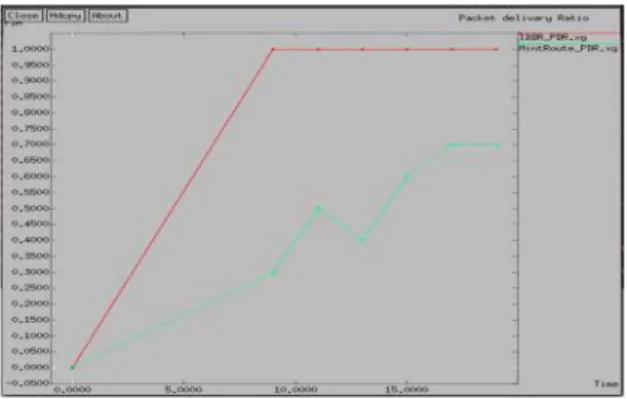
The graph in the Figure 2 represents packet delivered
versus time. From the graph it’s confirmed that
proposed method have better packet delivery ratio compared to MinRoute. Almost all packets are delivered in the proposed system as we can see in the graph[9].
Energy consumption:Due to energy is scares
resource in the wireless sensor nodes it’s very
Fig 3.Energy consumption versus time.
The energy consumption of proposed protocol IDDR is compared with the MinRouteprotocol as depicted in Figure 3. The energy at the node is initially 99J. As the time goes on the energy consumption is less in proposed method compared to MinRoute.
Packet drop:The number of packets dropped over
the time is referred as packet drop.
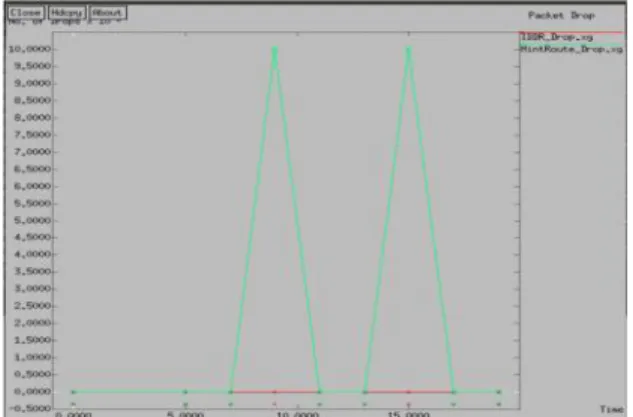
Fig 4.Packet drop versus time
The graph in the Figure 4 shows packet drop of the proposed system and the existing system. Over the time packet drop occurs in MinRoute protocol whereas the IDDR works well. Since IDDR scatters different packets according to situation, the packet drop is zero.
Queue length:The queue length field represents the
number of packets present in the queue over a time.
Fig 5. Queue length versus time
As the simulation time goes and number of packets increases the IDDR maintains more packets in queue than the MinRoute. So IDDR makes efficient usage of the queue. The graph in the Figure 5 shows the maximum utilization of queue by the proposed method[10].
VII. Conclusion
In Wireless Sensor networks are transfer the information in unreliable wireless environment this may arise different types of node failure and security issues in the unreliable wireless environment. To solve the issues some of the mechanism to be introduced and solved manually. To implement the problem using the following methods 1) To sense the node and Dynamic Discovering Routes are used to detect if any failure occurs in the communication process- Testing based Procedure cross validation Algorithm implemented. 2) Security using neighbourhood keys- Security Aware Routing Protocol and 3) Node Scheduling Scheme using –
Adaptive Node scheduling Algorithm to be implemented. This algorithm will increase the performance of node detection and decrease the security issues of the user related information.
References
[1] Ruofan JinDetecting Node Failures in Mobile Wireless Networks: A Probabilistic Approach
[2] T. Chen, J. Tsai, and M. Gerla, “QoS routing
performance in multihop multimedia wireless
networks,” in Proc. IEEE Int. Conf. Universal
Personal Commun., 1997, pp. 557–561.
[3] M. Caccamo, L. Zhang, L. Sha, and G. Buttazzo,
sensor networks,” in Proc. IEEE Real-Time Syst. Symp., 2002, pp. 39–48.
[4] J. Ben-Othman and B. Yahya, “Energy efficient
and QoS based routing protocol for wireless sensor
networks,” J. Parallel Distrib. Comput., vol. 70, no. 8,
pp. 849–857, 2010.
[5] "Dynamic Routing for Data Integrity and Delay Differentiated Services in Wireless Sensor Networks" Jiao Zhang, Member, IEEE, FengyuanRen, Member, IEEE, Shan Gao, Hongkun Yang, and Chuang Lin, Senior Member, IEEE
[6] P. T. A. Quang and D.-S. Kim, “Enhancing real -time delivery of gradient routing for industrial
wireless sensor networks,” IEEE Trans. Ind. Inform.,
vol. 8, no. 1, pp. 61–68, Feb. 2012.
[7] C.-Y. Wan, S. B. Eisenman, and A. T. Campbell,
“CODA: Congestion detection and avoidance in sensor networks,” in Proc. 1st Int. Conf. Embedded
Netw. Sensor Syst., 2003, pp. 266–279.
[8] L. Georgiadis, M. J. Neely and L. Tassiulas,
“Resource allocation and cross-layer control in
wireless networks,” Found. Trends Netw., vol. 1, no.
1, pp. 1–144, 2006.
[9]B. Hinneburg, X. Hinneburg, and A. Keim, ―An
efficient approach to clustering in large multimedia databases with noise,‖ in Proc. 4th Int. Conf. Knowl.
Discovery Data Mining, 1998, pp. 58–65.
[10] P. Kumar, ―A new shared nearest neighbor
clustering algorithm and its applications,‖ in Proc.
Workshop Clustering High Dimensional Data Appl. 3rd SIAM Int. Conf. Data Mining, 2002, pp. 105–
125.
Mr.K.C.Pradeep working as Sr.Asst. Professor in