Powerful Mechanism To Avoid Denial Of Service Attack For
Providing Data Security Using Software Puzzle
B.V.Pavan Krishna Akhil1,R.P.S.P.Veerraju2
1Student, M.Tech (CSE), Lingayas Institute Of Management And Technology, A.P., India. 2
Associate Professor, Dept. of Computer Science & Engineering, Lingayas Institute Of Management And Technology, A.P., India.
Abstract —Network is a gathering of hubs that interrelate with each other for switch over the data. This data is vital for that hub is saved secretly. Attacker in the framework may catch this private data and twisted. So security is the real issue. There are a few security Attacks in network. One of the real scares to web analyze is DDoS Attack. It is a vindictive push to suspending or suspends administrations to destination hub.–Denial of administrations (DOS) and Distributed Denial of administrations (DDoS) are the significant issue against network security and digital security that permit a customer to perform exceptionally costly and key operations, before the network administrations are given to the regarded customer. However An Attacker might have the capacity to control the DOS and DDOS or implicit illustrations preparing Unit (GPU) and have the capacity to crush customer perplexes. In this paper we concentrate how to safeguard DOS and DDOS Attacker for being controlling the puzzlesolving strategies. So now we present another customer riddle alluded to as Software Puzzle. It is not at all like past riddle, which produce their riddle calculations ahead of time, a riddle calculation in the present programming riddle plans is haphazardly created simply after a customer solicitation is gotten from the server side. t the Denial-of-administration and disseminated DoS Attack a customer riddle strategy is actualized. Keeping in mind the end goal to avert further Attack in network and to improve the security the solicitation that is given by the customer and the document sent by the server to customer is in scrambled structure. One downside of existing framework is if the assailant distinguishes the port, he can barge in or meddle in the correspondence and surge DOS Attack and can hack conveying information. The strategy utilized is clarified as takes after. To start with the customer needs to explain a riddle produced by the server. At that point the customer checks the inactivity of the document that must be gotten to from server database. The customer can test the inactivity of the server by inputting the comparing server IP address, number of bundles, and the length of information in bytes. In the wake of handling the inactivity checking parameters, ping measurements of the server and the rough round excursion the reality of the situation will become obvious eventually shown in the outcome. The
customer then encodes the solicitation and sends the solicitation to server. AES Algorithm is utilized to play out the encryption and decoding. The server after getting the solicitation needs to unscramble the solicitation utilizing the customer port number and IP address. The server sends the asked for record by encoding the document. At last the customer gets the record, unscrambles the substance and read it. Subsequently it can be inferred that more solid correspondence can be performed amongst server and customers and dynamic interchanges stays unaffected even within the sight of DDoS Attacks.
Keywords—Denial of Service(DoS), Code Protection, GPU Programming, Distributed Denial Of Service (DDoS), Security, Software Puzzle.
I.INTRODUCTION
is inflexible avoidance of DDoS attacks deception in the combination up of justifiable traffic and illegitimate traffic. It is difficult to discover the attack packets from the diverse traffic in the avoidance progression, particularly when the harass message packets masquerade to be normal messages. For exemplar, in signature -based pattern corresponding Intrusion Detection network, it is not easy to differentiate illegitimate packets from legitimate messages packets. In universal, according to the uniqueness, DDoS attacks can be divided into the following types:
1. Volume-based attacks: Distributed Denial of Service attacks ,This type sends huge collection of junk data packets to cause the network devices to be overloaded, which leads to enlarge the networks bandwidth. Hence further more incoming requests are dropped and network will be blocked.
2. Protocol-based attacks : The most familiar forms of denial of service attack are traffic flooding attacks . N traffic flooding attack the attackers send a great number of ostensibly legitimate UDP, Transmission Control Protocol/Internet Protocol, ICPM packets in network host. This will cause a more traffic in the network . 3. Application-based attacks :The attacks of this type often mail the consequent application-layer; main focus of this network attack is to deny the service of application layer. The low rate of traffic can also lead serious degradation of service.
II.LITERATURE REVIEW
The paper "A Network for Denial-of-Service Attack Detection Based on Multivariate Correlation Analysis"[1],They propose a methodology called as MAC which takes after a triangular region to concentrate correlative element. This uses a limit based inconsistency indicator, which contains an activity profile that is typical movement profiles. At the point when new bundles are lands in the system it produce the system movement profile. This activity profile is contrasted and the measurable information of typical movement profile, by which it recognize a DDoS attack. This paper “DDoS Detection Method Based on Chaos Analysis of Network Traffic Entropy “[2],paper they
going to detect a DDoS by Chaos Analysis and Entropy. The entropy has been used in anomaly detection of DDoS attacks. It describes the degree of concentration and dispersal characteristic of traffics .But the entropy depends only on the values computed by each packet field, while the connection information or the relationship between each field has been ignored. In our approach, the volume of network traffic is pre-processed by entropy-based methods. Then, by using chaotic analysis on the entropy of source IPs and destination IPs, DDoS attacks are detected.
The paper “Discriminating DDoS Attacks from Flash Crowds Using Flow Correlation Coefficient” [3],the
DDoS attack is detected by using a similarity based algorithm is used. And also they used a flow correlation and coefficient as a metric to find a DDoS attack. Flow correlation which defines a stastiscal relationship between two edge routers .The coefficient defines a specific property of attack. They execute software on every router to count the number of packets for every flow and record this information for a short term at every router. If the packet size is greater than the threshold value it will dropped.
This paper "Versatile Selective Verification: An Efficient Adaptive Countermeasure to Thwart DoS Attacks" [4],Adaptive Selective Verification (ASV), which is a conveyed versatile instrument for obstructing assailants endeavors to refuse assistance to honest to goodness customers taking into account particular Verification. This plan utilizes data transmission as cash, however the level of security utilized by the customers progressively conforms to the present level of DDoS assault. At an abnormal state, the customers exponentially increase the quantity of solicitations they send in sequential time way, up to an edge limit. The server executes a reservoirbased arbitrary testing strategy to viably test from an arrangement of approaching parcels utilizing limited space method. This empowers versatile transfer speed installments with server express whose size stays little and consistent paying little respect to the activities of the attacker.
III.RELATEDWORK
Software puzzle can be easily solved by an attacker using Graphical processing unit software. In software puzzle scheme the puzzle function will not be known in advance. Hence the client will use CPU resource only to solve the puzzle challenge. Also the cost of client computation to solve the puzzle will be large when compared to the cost of server computation which includes the puzzle generation and puzzle verification steps. Even if the attacker returns an arbitrary number as solution to the puzzle so as to exhaust the servers time for puzzle verification, the server time is much smaller than the service time or database process time and the returned answer will be rejected with high probability. The existing client puzzle scheme assume that the client solves the puzzle using legacy CPU resource only. But this is not always true. A malicious client may solve the puzzle using GPU (Graphic Processing Unit) component is almost a standard configuration in modern desktop computers, laptop computers, and even smartphones. In the proposed network it is possible to track the individual client
behaviour through client’s IP address. Nonetheless, if
be attractive in practice. A new type of client data, called software puzzle, to defend against GPU-inflated DoS and DDoS attacks. Unlike the existing client data schemes which publish a puzzle function in advance, the software puzzle scheme dynamically generates the
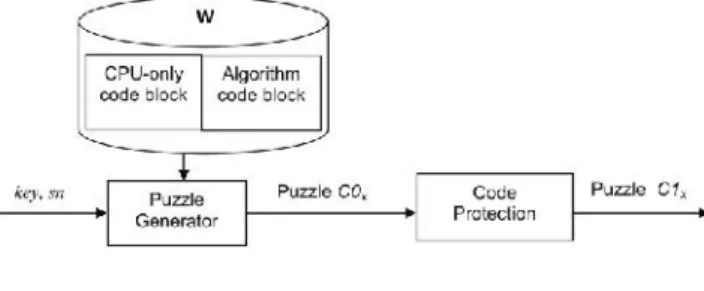
puzzle function P(•) in the form of a software core C upon receiving a client’s request. Specifically, by
extending DCG technology which produces machine instructions at runtime, the proposed scheme randomly chooses a set of basic functions, assembles them together into the data core C, constructs a software data C0 x with the data core C and a random challenge x. If the server aims to defeat high-level attackers who are able to reverse-engineer software, it will obfuscate C0 x into an enhanced software puzzle. After receiving the software puzzle sent from the server, a client tries to solve the software puzzle on the host CPU, and replies to the server, as the conventional client data scheme does. However, a malicious client may attempt to offload the data task into its GPU. In this case, the malicious client has to translate the CPU software puzzle into its functionally equivalent GPU version because GPU and CPU have totally different instruction sets designed for different applications. Note that this translation cannot be done in advance since the software puzzle is formed dynamically and randomly. As rewriting/translating a software puzzle is time-consuming, which may take even more time than solving the data on the host CPU directly; software puzzle thwarts the GPU inflated DoSattacks.
Fig. 1 Overview of Network Architecture
IV.PROPOSED METHODOLOGY
Here in this segment paper narrates about the methodologies that are incorporated in the experiment as depicted in the figure 1.
Step 1: Here in this step requests for a web transaction is received from all the clients by the web server along with the parameter like date, time and client IP to store in the database. Then all this data from the database will be retrieved in a vector for pre-processing, where selected data like IP is fetched in a single dimension vector for clustering process.
Step 2: Here Single dimension vector of IP addresses of the client that was fetched in the past step is been set to fuzzyC Means clustering process. Fuzzy C means
clustering (FCM) technique which eventually helps to analyse the patterns of the IP through interactive clustering. =1/ where m is any real number whose value should be greater than 1, uij is the degree of membership of xi in the cluster j, xi is the i th of d-dimensional measured data, cj is the d-dimension centre of the cluster.
Then the optimization of the clusters is carried out by the fact of fuzzy portioning which yields fine grained clusters which in turn indicates the abstract patterns of the input client IP.
Step 3: The clustered IP are then considered for their higher priority using the entropy distribution factor of Shannon information gain. Here information gain is used to identify the most important and fluent IP address in the clusters which frequently affecting the web server for its performance. This can be given with the following equations 2. IGR( C ) = -∑ (| Ci | / | C | )
log (| Ci | / | C | ) ....(2) Where Ci is the frequency of the IP address add in Cluster C.
Step 4: Decision trees are generally meant for the decision taking rules which indulge in putting conditions like if - else till to reach a decision. But here in our experiment of identifying DOS attack decision tree takes a two dimensional vector which is loaded with the attributes like IP address and their information gain values. Here each of the indices of the vector is feed to the tree to form the nodes and at every levels of the tree with respect to the Shannon information gain values. Then these values are keep accumulating the at the respective nodes to get the weighted decisions for judging attack level. Then this attack level is normalized in between the range 0 to 100 to get the desired level of software puzzle.
Step 5: This level of attack is been send to proxy server for puzzle generation process with a reference key generated through MD5 algorithm. Once the proxy server receives the attack level it identifies the expression desired to tackle the attack in its raw form.
ALGORITHM 1: FCM Let X = {x1, x2, x3 ..., xn} be the set of data points and V = {v1, v2, v3 ..., vc} be the set of centers.
Step 0: Start
Step 1:Randomly select ‘c’ cluster centers.
Step 2: Calculate the fuzzy membership using c
'µij': =1/ ∑ (dij/dik)(2/m-1)
k=1
Step 3: Compute the fuzzy centers ‘vj’using vj: =∑ni=1 ( µij)mxi/ (∑ni=1( µij)m), for all j=1,2,…c
Step 4: Repeat step 2) and 3) until the minimum 'J' value is achieved or ||U (k+1) -U (k) || < β. where, ‘k’ is the iteration step. ‘β’ is the termination criterion between [0, 1].with ‘U’ = (µij) n*c ´ is the fuzzy
Then the variables in the expression is set to change the variables by assigning random number from 1 to 9. Once the expression is having the real numbers, then this is been evaluated using infix expression evaluation method as mentioned in the algorithm.
V.EXPERIMENTAL RESULT
Software Puzzle is a best way for providing security to the data.It mainly focuses on enhancing the data security from DOS attacks which became serious threat now a days.Software Puzzle will strengthen the data security with the strong puzzle that is attached with the data.The Sender will generate the software puzzle spontaneously and attach that software puzzle to the data and send the data to the receiver..Then the receiver should solve the puzzle inorder to receive the data from the sender.Therefore,only the authorized users who are eligible to receive the data can easily solve the puzzle and receive the data successfully.Hence DOS attackers cannot access the data as the data is highly secured with a strong software puzzle.
VI.CONCLUSION & FUTURE SCOPE
Software Puzzle scheme is used so that the puzzle function used is not known in advance. Hence, malicious client cannot solve the puzzle using GPU software. The proposed network provide even more security using conventional cryptographic techniques. In this scheme it is possible for the client to authenticate the server and vice versa. The communication between client and the server is more reliable in this network. Active communications remains unaffected even in the presence of DoS and DDoS attack. Also, the probability of hacking is also very less in this scheme. This idea can be extended to thwart DoS attackers which exploit other inflation resources such as Cloud Computing. future scope of this paper network can be enhance to generate more complex puzzles for variable operands and operators.
REFERENCES
[1] R. Shankesi, O. Fatemieh, and C. A. Gunter,
“Resource inflation threats to denial of service
countermeasures,” Dept. Comput. Sci., UIUC,
Champaign, IL, USA, Tech. Rep., Oct. 2010. [Online]. Available:http://hdl.handle.net/2142/17372
[2] J. Green, J. Juen, O. Fatemieh, R. Shankesi, D. Jin,
and C. A. Gunter, “Reconstructing Hash Reversal based Proof of Work Schemes,” in Proc. 4th USENIX
Workshop Large-Scale Exploits Emergent Threats, 2011.
[3] Y. I. Jerschow and M. Mauve, “Non-parallelizable and non-interactive client puzzles from modular square
roots,” in Proc. Int. Conf. Availability, Rel. Secur., Aug.
2011, pp. 135–142.
[4] R. L. Rivest, A. Shamir, and D. A. Wagner, “Time -lock puzzles and timed-release crypto,” Dept. Comput.
Sci., Massachusetts Inst. Technol., Cambridge, MA, USA, Tech. Rep. MIT/LCS/TR-684, Feb. 1996.
[Online]. Available:
http://citeseerx.ist.psu.edu/viewdoc/summary?doi=10.1. 1.110.5709
[5] W.-C. Feng and E. Kaiser, “The case for public work,” in Proc. IEEE Global Internet Symp., May 2007,
pp. 43–48.
[6] D. Keppel, S. J. Eggers, and R. R. Henry, “A case for runtime code generation,” Dept. Comput. Sci. Eng.,
Univ. Washington, Seattle, WA, USA, Tech. Rep. CSE-91-11-04, 1991.
[7] E. Kaiser and W.-C. Feng, “mod_kaPoW:
Mitigating DoS with transparent proof-of-work,” in
Proc. ACM CoNEXT Conf., 2007, p. 74.
[8] NVIDIA CUDA. (Apr. 4, 2012). NVIDIA CUDA C Programming Guide, Version 4.2. [Online]. Available: http://developer.download.nvidia.com/
[9] X. Wang and M. K. Reiter, “Mitigating bandwidth
-exhaustion attacks using congestion puzzles,” in Proc.
11th ACM Conf. Comput. Commun. Secur., 2004, pp. 257–267.
[10] M. Jakobsson and A. Juels, “Proofs of work and bread pudding protocols,” in Proc. IFIP TC6/TC11
Joint Working Conf. Secure Inf. Netw., Commun. Multimedia Secur., 1999, pp. 258–272.
[11] D. Kahn, The Codebreakers: The Story of Secret Writing, 2nd ed. New York, NY, USA: Scribners, 1996, p. 235.
[12] K. Iwai, N. Nishikawa, and T. Kurokawa,
“Acceleration of AES encryption on CUDA GPU,” Int.
J. Netw. Comput., vol. 2, no. 1, pp. 131–145, 2012.
[13] B. Barak et al., “On the (Im)possibility of obfuscating programs,” in Advances in Cryptology (Lecture Notes in Computer Science), vol. 2139. Berlin, Germany: Springer-Verlag, 2001, pp. 1–18.
[14] H.-Y. Tsai, Y.-L. Huang, and D. Wagner, “A graph
approach to quantitative analysis of control-flow obfuscating transformations,” IEEE Trans. Inf.
Forensics Security, vol. 4, no. 2, pp. 257–267, Jun. 2009.
http://www.ehow.com/how_12074039_createApplet-c.html#ixzz24Lsk0OJQ
[16] J. Bailey. (Oct. 28, 2014). How to Install Java on an iPhone, eHow Contributor. [Online]. Available:http://www.ehow.com/how_5659673_install-java-iphone.html#ixzz24jIAyKiM
[17] J. Ansel et al., “Language-independent sandboxing of just-in-time compilation and self-modifying code,” in
Proc. ACM SIGPLAN Conf. Program. Lang. Design Implement., 2011.
Mr.B.V.Pavan Krishna Akhil is a student of Lingayas Institute Of Management And Technology, Madalavarigudem, Vijayawada. He is presently pursuing his M.Tech in CSE from JNTU, Kakinada. He has obtained B.Tech in CSE, from JNTU, Kakinada.