
25
CONSTRUCTION EVOLUTION OF DEEP SOIL LOOSENING
EQUIPMENT IN ROMANIA IN THE COUNTRY SPECIFIC SOIL
CONDITIONS
BĂDESCU M.1), CROITORU ŞT.1), PETCU A.2), MARIN E.2), BORUZ S.1), IVAN GH.2),
VLĂDUŢ V.2), MATACHE M.2), CUJBESCU D.2), VOICEA I.2)
1)University of Craiova; 2)INMA Bucharest
Keywords: depth, aeration, equipment, working body, soil
ABSTRACT
This paper presents the main achievements of the largest manufacturers of deep soil loosening machines and equipment, highlighting the specific characteristics of each device, so that they achieve a very good job loosening in depth, using an low energy source for the same working width.
INTRODUCTION
Romania faces a degree of deterioration of soil quality through erosion, acidification, alkalization, excess of moisture or drought, salinization, compaction etc. The main process of soil degradation by extension and socio-economic impact is the erosion by water, which together with landfall over 7 mil hectares of farmland. The second most important factor in soil degradation is periodic waterlogging affecting 3.8 million ha of agricultural land and forest land 0.6 million and excess frequent drought manifests approx. 7.1 million ha of farmland and 0.2 million hectares of forest. A primary process naturally encountered is salinization, which is largely enhanced by some ameliorative improperly applied techniques such as damming, drainage and irrigation.
An important role in soil degradation occupies anthropogenic soil compaction and crusting. Compaction is found on about 1.3 mil. hectares of arable soil being due mainly weight and / or too frequent use of agricultural equipment, especially in humid conditions unsuitable soil or the too dry soil or too wet soils; the last ones is mainly a result of higher load on a tractor of the arable area. Crust and filling soil pores (2.2 mil. ha) occurs mostly silty and clayey soils with low organic matter content, higher horizon structure destroyed as a result of intensive agricultural work and repeatedly made improper moisture conditions, with poor vegetation cover that allows maximum impact of raindrops.
Excess of moisture on the surface is due to the existence, from the depths of 35 ... 40 cm, a hard layer permeable to water and air (B horizon clay iluvial), fine texture of the deposits that were formed the soils (ex. black and brown poor soils humifere clay, compact, vertisols).
On the other hand, the intensive use of soils under chemicalized and mechanized agriculture, while they suffer a progressive compaction processes. In most cultivated soils at different depths to form a thick compact layer of 15 ... 20 cm hard permeable to water and air, which promotes the expansion of the excess of moisture in the upper layers, while the volume of water due to soil plants reduce pedological drought occurring in years with less precipitation.
26
To prevent and remove the deficiencies shown and at the same time increasing the efficiency of land improvement works is necessary to apply a set of agroimprovement measures, where the soil deep loosening of particular importance.
In terms of pedology, the soil interested in works deep soil loosening belongs to the following main types and subtypes:
- Podzolic clay-iluvial usually pseudo-gleyed;
- Brown forest soils, podzolic often, pseudo-gleyed; - Some reddish-brown forest soils;
- Vertisols (Smolna);
- Some marshy grounds and Solonetzs clay; - Some chernozems leachate (clay).
The area occupied in our country with the soils with a high degree of deterioration of soil quality is about 19.8% of the total agricultural area. Emergency order to implement improvement works was established agropedology experts, taking into account the intensity of manifestation of the negative characteristics of the soil, the expected efficiency of the work, the slope of territorial organization, the possibilities for mechanization etc. From these points of view that the urgency first lies an area of about a 1.3 million hectares, spread in 36 counties. In Table 1, for each county in the country, after the emergency distribution of agricultural lands that require deep soil loosening works.
MATERIAL AND METHOD
Among the deep loosening works stands by scarification and subsoiling.
Scarification: consists in loosening soil profile (45 ... 80 cm) with special equipment called scarifier, performing cutting, breaking, grinding and loosening the soil without turning the cut material. This paper aims at improving the system of movement of water in the soil, favoring the excess of infiltration from the surface to depth, low bulk density (Da)
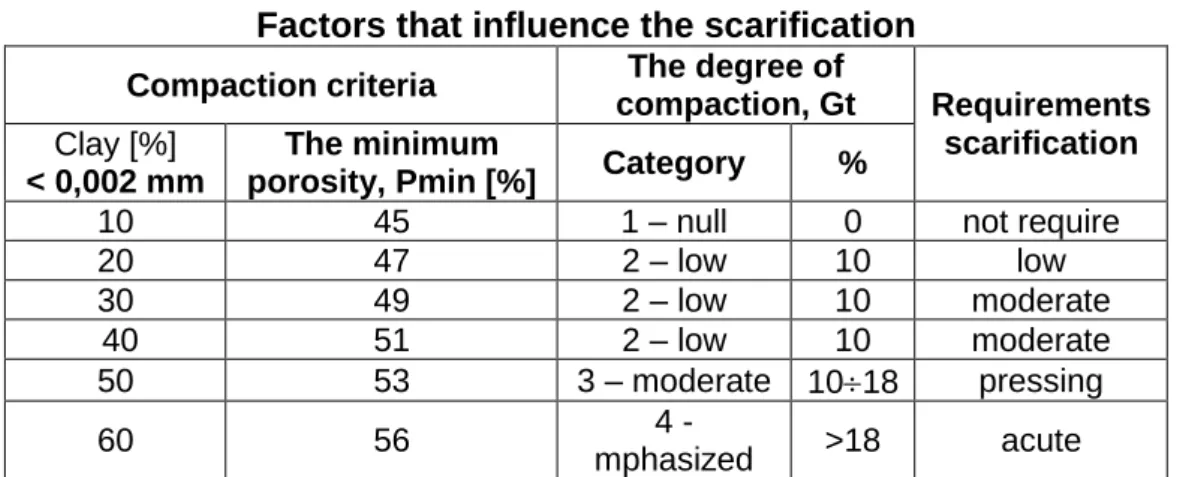
due to increased porosity, reduced penetration resistance, increased microbiological activity in the field, creating favorable conditions for development of roots etc. The effectiveness of this work depends, among others, the need and opportunity for its execution. Among the factors that make this work required a special role is the degree of compaction „Gt" ' (Table 1).
Table 1 Factors that influence the scarification
Compaction criteria The degree of
compaction, Gt Requirements scarification Clay [%]
< 0,002 mm
The minimum
porosity, Pmin [%] Category %
10 45 1 – null 0 not require
20 47 2 – low 10 low
30 49 2 – low 10 moderate
40 51 2 – low 10 moderate
50 53 3 – moderate 1018 pressing
60 56 4 -
mphasized >18 acute
The degree of compaction is determined by the minimum total porosity of the soil,
pmin, the porosity depends on the texture and the total effective soil pe with the relation:
27
autumn, after harvest, and for planting spring before and after plowing or spring prior to preparation of the seedbed).
The depth of execution has value betwen 4580 cm, depending on the profile of the soil and the position hardpan thickness (a thick soil layer 1520 cm, located at different depths, compacted, impervious and impenetrable, which prevents deep water penetration and favors the appearance of excess moisture in the upper layers).
The time interval between two works of scarification depends on soil texture was 4 ... 5 years on clay soils, 56 years on the clay loam, silty soils 79 years, 9 ... 10 sandy loam soil and 1012 years on soil salinity.
Basically, the job is running with scarifiers driven by the tractors PTO with oscillatory or vibratory movements to depths of 6080 cm and above.
If the work is combined with the work of the excess water drain, the efficiency of scarification is maximal.
Subsoiling: is a deep loosening (Fig. 1), with periodic character, specific to perennial crops established on sloppy land (vineyards, fruit trees), argillaceous arable land and those predisposed to hardpan (Fig. 2). Hardpan is an impermeable layer of soil that occurs due to the performance of surface work and plowing at the same depth for several years in a row. The work is executed with working of different types, fixed or oscillating fin curved or straight, different from the tractor wheels fitted with two or more bodies (up to 5 chisels, deep loosening equipment) that destroy the hardpan and loosens the soil up to 50 ... 60 cm, and even more on the entire surface or in strips.
Fig. 2 - Deep loosening Fig. 3 - Example of hardpan
Subsoiling effectiveness depends among others to the depth of execution below 40 cm, the field crops being ineffective and too large depths are expensive. In orchards and vineyards, subsoiling executed at 3 ... 4 years, with the deep loosening plow for vineyard is to partially restore unblocking effects.
Subsoiling effect is obtained and in soil work stir-upper (deep loosening equipment), a piece attached to the plow, which loosens the low-arable layer on depth of 5 ... 15 cm, without bringing it to the surface. The stir-up of the low-arable layer seeks to ease the penetration of water and air in depth, enhancing aerobic microbiological processes, increasing the pool of nutrients from the soil, heating soil low-arable layer and encouraging the plant root system.
Agrotechnical indices for deep loosening of the soil
To make deep loosening in the soil under optimal conditions is necessary to take into account a series of agrotechnical indices of which is specifyed the following:
28
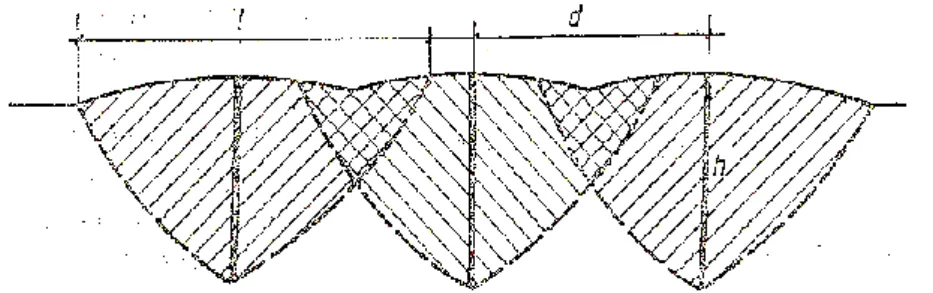
- Working width of a working body (l) depends on the depth of loosening (h) between which there is usually dependent relationship l = 2h.
- The lateral distance between the two bodies of work (d) is determined by the indices (h) and (l) showing a double-raising area (Fig. 3). Distance between two active bodies must be chosen depending on the soil type (light, medium and heavy). Thus, light soils and light to medium work 3-4 working bodies, and on medium to heavy soils, their number is reduced, following the subsequent passage to act on previously uncultivated range.
Fig. 3 - The distance between the active organs of the scarifier:
l - working width; d - distance between two active bodies; h - the working depth
Direction of loosening work is recommended to be oriented perpendicular to the drainage channel (where appropriate) thereby allowing excess water to drain into the collection channel. If the soil has a high degree of compaction is recommended that the work shold be done after two perpendicular directions. On slopes, deep soil loosening runs usually parallel to the contours to remove the danger of erosion.
The time of work execution of deep loosening may have a more prolonged effect only when running under optimal conditions of humidity. Optimum moisture conditions are fulfilled when the humidity is between 60 ... 90% of active humidity interval. At less than 60% moisture, the soil is too dry, resulting large lumps who are worked hard and has a high energy consumption. In the process of loosening the soil must break fissures and cracks forming irregular structural elements and must be moved relative to each other, side and pushed to the surface, so you can no longer recover the original settlement. Humidity greater than 90%, reduces to a simple loosening of soil cutting by working bodies.
The age of deep loosening work performance is recommended to be in summer, during July-August and autumn after harvesting the crop before plowing. Deep loosening may continue into October, if not intervening the wet periods, especially if the land is not for other winter crops. Also deep loosening must be preceded by application of organic fertilizers and, where appropriate, the application of phosphate fertilizers and amendments to remove excess water, etc.
Working process and construction of equipments for deep loosening the soil
Conventionally, the group of machinery for soil aeration works can be classified according to the purpose of the work performed in the following subgroups, with the names used most frequently:
- Cultivators for deep loosening called chisels used for loosening the plowed layer; - Scarifiers, used for loosening preparatory works;
- Loosening equipments used for periodic renewal for unblocking work;
- Machines for deep loosening of soil used to increase air and water permeability of soil layers.
29
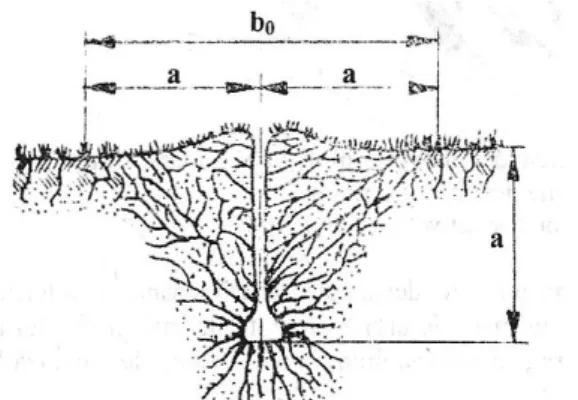
Fig. 4 - Section of soil processed by afânareadâncă by a body working
Given the mode of action of working bodies (active) the machines for deep loosening of soil can be fitted with: simple working bodies, untrained (Fig. 5a) and complex working organs, having different driven sides through various mechanisms from the tractors PTO (Fig. 5b, c).
Fig. 5 - The main types of deep loosening machines a - with working untrained; b, c - with working mobile (trained)
1 - active body; 2 - support; 3 - frame (front support)
In the case of the deep soil loosening machines with untrained working bodies, they execute the working only because they are towed, not receiving more movements. Rigid working bodies are mounted on a fixed support to the machine. Different machines for deep loosening of soil works on similar principles, they distinguished between them, mainly by the shape and type of working bodies and the working depth.
The main technical characteristics of the equipment used in loosening the soil are presented in Table 2.
Table 2 Technical characteristics
Description characteristic
Type of machine Deep loosening
equipment Chisel Cultivators
Active Body Type rigid Elastic, tense or
rigid
Elastic, elastic tense or rigid The angle of attack of the active
organs [] 30 30 60
The distance between the active
bodies [cm] min.75 min. 70 min. 55…60
The width of the working area (furrow)
active bodies [cm] cca. 30…50 cca.25…30 cca. 20
The height of the frame [cm] 70…90 70…80 70
30
RESULTS AND DISCUSSIONS
Although in Romania the land area occupied requiring deep soil loosening works is considerable (about 3,000,000 hectares or 19.8% of total agricultural area), a long time there were no specific equipment required.
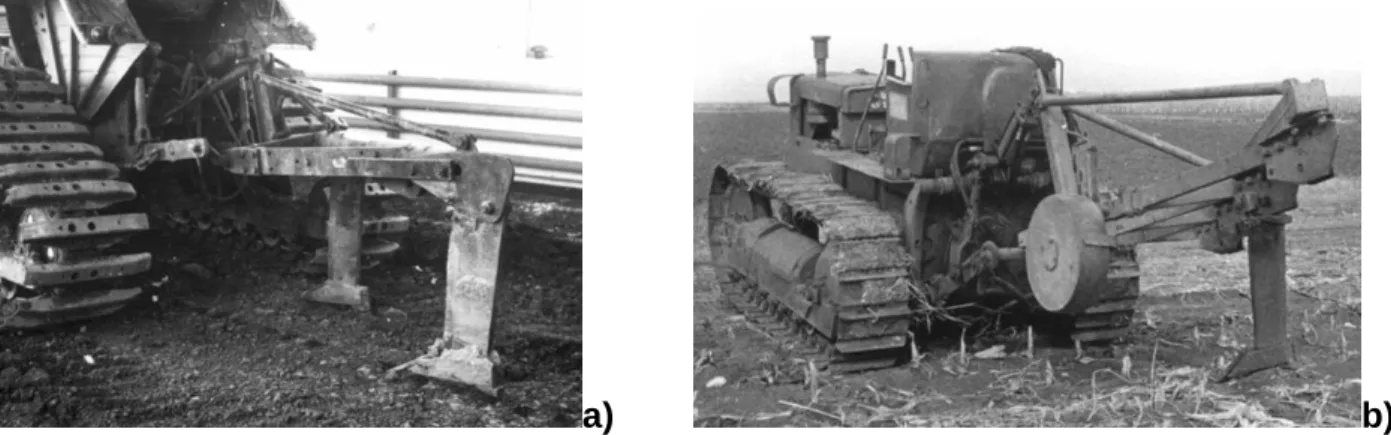
A first attempt to fill this gap represented a stir-upper Olt type, which were composed of a flat chisel plow and a straight support, mounted to two pieces instead of component carriers 1 and 3, on the plow PP- 3-30 (Figure. 6a).
In aggregate with a 47.8 kW tractor on wheels (U-650 M, in figure 6 the tractor is fitted with semitracks for paddy fields), stir-upper Olt type achieve a maximum working depth up to 28 cm, and the act of a couple of two wheeled tractors of the same loosening soil power to a depth of up to 37 cm.
Mounted on the PSP-4-35 plow worn instead component carrier no. 3 (Fig. 6b), one stir-uper type Olt in aggregate with a 47.8 kW tracked tractor (S-650) achieved a maximum working depth of 55 cm, the distance between adjacent paths is 140 cm.
a) b)
Fig. 6 - Stir-uper type Olt, mounted on the plows frame PP-3-30 / PSP-4-35
Although they were produced in relatively large numbers (about 1200 units) due to poor performance (low working depth, excessive fuel consumption) and reduced reliability of this type of stir-uper was little used in production.
For the works execution of deep loosening of soil was used the machines MID-02, equipped with mole devices (fig. 7).
Fig. 7 – Loosening equipment MID-02 with mole device
31
Due to high fuel consumption and very low reliability, the use of the machinery MID-02 to work deep soil loosening has not spread.
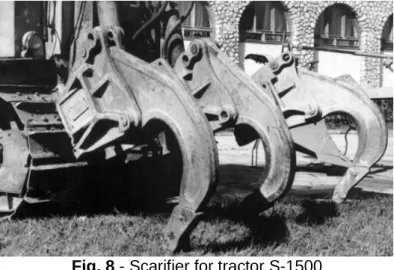
A broader use when working deep loosening soil was met at S-1500 LS tractors equipped with scarifiers (fig. 8).
Fig. 8 - Scarifier for tractor S-1500
Designed for construction works, land reclamation, deforestation etc., S-1500 LS tractors are equipped with a scarifier with three active organs with 1125 mm teeth spacing and depth of their constructive work of 40 cm.
As a result, the work of loosening scarifiers active bodies are put to work when working at depths much greater than those for which they were designed, resulting in an abnormal mode of operation, the additional energy consumption.
To eliminate these drawbacks, INMA Bucharest has designed and built an body for deep soil loosening especially for S-1500 LS tractor, called A-120, which is mounted on the scarifier, the central position (Fig. 9).
Fig. 9 - Loosening body A-120 for tractor S-1500 LS [1]
The construction of the support allows the installation of loosening chisels widths between 63100 mm. In hard soil conditions it is achieved maximum working depth of 90 cm, tensile force reaching 811103 daN, fuel consumption exceeding 90 l / hectares.
Due to the high cost of the work and the limited number of 110 kW tracked tractors existing in agricultural units, the machine was not introduced into production.
32
The mounted deep loosening equipment SP-3 (5) is intended for working deep loosening of soil at depths of up to 40 ... 50 cm, the distance between active organs can be adjusted between 520 and 1040 mm, 130 mm in fixed steps. Raising chisel width is 60 mm, and the mass of the car, with the three active components is 950 kg.
Fig. 10 - Subsolierul purtat SP-3(5) echipat cu 3 / 5 organe active [1]
In working on a podzol soil type, moisture layer having worked for 20 ... 23%, the speed of the tractor A-1800 was 2.10 km / h, a wheel slippage of 14-20% with a working capacity during the exchange of 0.47 hectares and an average fuel consumption of 50 l / hectares (fig. 11).
Fig. 11 - Mounted deep loosening equipment SP-3 (5) at work [1]
Deep loosening equipment SP-3 (5) was introduced in series production at enterprise Mechanics of Arad, but its use in operation was conditional on wheeled tractors of 132 kW (A-1800).
33
Fig. 12 - Deep loosening equipment 5 bodies active for the S-1500 tractor [2]
To use the vibration for work deep soil loosening at ICSITMUA it was made a model of deep loosening equipment SV-2 (Fig. 13). Deep loosening equipment was equipped with two active bodies, rigidly mounted to the frame, and a vibrator with two rotating unbalanced masses (of the type used in construction compaction tables) perform periodic movement of the entire machine, not just the active bodies.
Fig. 13 - Subsolier vibrator SV-2, cu mase rotative neechilibrate [3]
Also as experimental model in Oradea was made a machine for deep soil loosening with working vibrators involved in two orthogonal planes (Fig. 14).
Fig. 14 - Machine for loosening soil with working vibrators operated in two orthogonal planes [4]
Designed to work in the aggregate 132 kW tractor wheel (A-1800), at depths of 40 to 80 cm, the machine was equipped with two working bodies. In the absence of a 132 kW tractor wheel (A-1800) equipped with independent power at 1000 rev / min for driving active bodies in the experimental model used an electric motor of 50 kW at 975 rev / min, driven from an external network. Weight fully equipped machine was 2950 kg.
Due to the complexity and lack of constructive tractors equipped with 132 kW PTO for operating vibrators, the machine has not been expanded in series production.
34
establish cereals rehabilitated and conservative system, as and regular work subsoiling low-arable layer, working in aggregate with high power tractors.
Fig. 15 - Chisel plow PC7-0 [1] Fig. 16 - Chisel plow and deep loosening equipment PC13-0S [1]
Fig. 17 - Technical equipment with active bodies involved for deep soil loosening EAA [5]
CONCLUSIONS
Deep soil loosening machines with working untrained executing the process so only because the machine is towed, not receiving more movements. Rigid working bodies are mounted on a fixed support to the machine. Different machines for deep loosening of soil works on similar principles, they distinguished between them, mainly by the shape and type of working bodies and the working depth.
Working bodies for loosening equipment can be fixed, reciprocating or oscillating coulter only driven by the PTO of the tractor. Equipment with working swing makes a good loosening depth and decreases energy consumption for necessary work to great depths, but have a higher design complexity, less reliable and more expensive compared to those with fixed working bodies.
In Romania are produced relatively few organs for loosening / deep loosening of soil: carved FP7 cutters and deep loosening equipment PC13-OC (S) with vertically oscillating blade and chisel plow oscillating SPV - 45 and SPS - 50, for work in vineyards and greenhouses or solariums.
BIBLIOGRAPHY
1. Technical fact INMA Bucharest;
2. Technical fact Întreprinderea Mecanică Arad;
3. Technical fact ICSITMUA;
4. Technical fact CR-SMA Oradea;
![Fig. 10 - Subsolierul purtat SP-3(5) echipat cu 3 / 5 organe active [1]](https://thumb-us.123doks.com/thumbv2/123dok_us/8072652.2138520/8.892.118.774.204.399/fig-subsolierul-purtat-sp-echipat-cu-organe-active.webp)
![Fig. 14 - Machine for loosening soil with working vibrators operated in two orthogonal planes [4]](https://thumb-us.123doks.com/thumbv2/123dok_us/8072652.2138520/9.892.286.609.710.916/fig-machine-loosening-working-vibrators-operated-orthogonal-planes.webp)
![Fig. 17 - Technical equipment with active bodies involved for deep soil loosening EAA [5]](https://thumb-us.123doks.com/thumbv2/123dok_us/8072652.2138520/10.892.79.790.142.652/fig-technical-equipment-active-bodies-involved-deep-loosening.webp)
