Basim A. Hassan
,Haneen A. Alashoor
Department of Mathematics, College of Computers Sciences and Mathematics
A r t i c l e I n f o ABSTRACT
Received
7/6/2015
Accepted
7/9/2015
In this paper, a new type nonlinear conjugate gradient method based on the Scale Matrix is derived. The new method has the decent and globally convergent properties under some assumptions. Numerical results indicate the efficiency of this method to solve the given test problems.
Keywords: Conjugate gradient, Descent condition, global convergent, Numerical
results.
INTRODUCTION
In this paper, we consider the unconstrained optimization problem :
n
R x x f( )
min (1)
where f is smooth and its gradient g is available. For solving this problem, starting from an initial guess ,x0 Rn.
Conjugate gradient methods are very efficient for solving large-scale unconstrained optimization problems (1). The iterates of conjugate gradient methods are obtained by:
,
1 k k k
k x d
x (2)
with
1 k
d
0 k if
0 k if
1 1
k k k k
d g
g
) 3 (
where step size k is positive, gk 1 f(xk 1) and k is generated by the definition of conjugated directions :
0
1 k
T k Gd
d (4)
where G is the Hessian of f at the point xk 1
In addition, k is a step length which is computed by carrying out some line search. In this paper we analyze the general results on convergence of line search methods with the following line search rules. We consider line searches that satisfy the Wolfe (WP) conditions:
k T k k k
k k
k d f x d g
x
f( ) ( ) 1 (5)
k T k k T k k
k d d d g
x
g( ) 2 (6)
where dk is descent direction, i.e. :
0 k T kd
g (7)
and 0 1 2 1 . More performance profile, is given in [3].
Different conjugate gradient algorithms correspond to different choices for the scalar parameter k. We list some of these methods
k T k k T k CD k k T k k T k DY k k T k k T k FR k d g g g d y g g g g g
g 1 1 1 1 1 1
,
, (8a)
These methods have strong convergence properties, but they may have modest practical performance due to jamming. On the other hand, the methods of Polak and Ribiere (PR) [11], Hestenes and Stiefel (HS) [8], and Liu and Storey, (LS) [9] with the parameters:
, ,
, 1 1
2 1 1 k T k k T k LS k k T k k T k HS k k k T k PRP
k gd
y g d y y g g y g ) 8 ( b
in general, may not be convergent, but they often have better computational performances. Dai and Liao [4] used the secant condition of quasi-Newton methods that is
k k
k B y
v 1 (9)
where Bk 1 is an approximation of the inverse Hessian. It is symmetric positive definite. For quasi-Newton methods, the search direction
1 k
d can be calculated in the form:
1 1
1 k k
k B g
d
.
(10)It is necessary to modify and extend these methods to make them suiTable for large problems [10]. For this reason, in the present article we prefer the scalar matrix approach. By taking the scalar approximation to the Hessian inverse:
0
, 1
1 1
1 k k
k I G
B
.
(11)If we apply the secant Equation to the chosen approximations xk and xk 1, our task is to find a scalar k 1 satisfying:
k k
k y
v 1
.
(12)The corresponding scalar matrix Bk 1 k 1I.
Then the direction:
1 1
1 k k
k g
d
.
(13)The structure of the paper is as follows. In section 2, we present the new conjugate gradient method and new Algorithm. Section 3 global Convergence is studied. In Section 4, numerical results are presented and in Section 5 we give brief conclusions and discussions.
Derivation a new formulae
kand
Algorithm
In this section, we derive a new conjugate gradient method based expression of the denominator dkTGvk. From (3) and (4) we get: 0 ) ( 1 1 1 k T k k k T k k T k k k k T k Gd d Gd g Gd d g Gd d ) 14 (
as a result,
k T k k T k k Gv d Gv g 1
.
(15)On the other hand, a class of the quasi-Newton condition where the approximation of the Hessian inverse is presented by appropriate scalar matrix. This scheme is also analyzed in [2], where the step length k 1 is computed by:
k k
k1 v / y
.
(16)The corresponding scalar matrix:
n n k I G * 1
1
.
) 17 (
Therefore, we can define a new denominator nonlinear conjugate gradient method:
k T k k k n n T k k k n n k T k k T k v d v I d v I d Gv d 1 1 * 1 1 * 1 1 ) 18 (
k T k k k T k BSI k v d y g 1
1 (19)
where 1
1
1 k
k . If the line search is exact,
then : k T k k k T k BSI k v d g g 1 1
1 (20)
This completes the derivation.
Now we can obtain the new conjugate gradient algorithm, as follows :
New Algorithm (BSI Algorithm) :
Step 1. Initialization. Select x1 Rn and the parameters 0 1 2 1. Compute f(x1) and
1
g . Consider d1 g1 and set the initial guess 1 1/g1 .
Step 2. Test for continuation of iterations. If
6
1 10
k
g , then stop.
Step 3. Line search. Compute k1 0 satisfying the Wolfe line search condition (4) and (5) and update the variables xk 1 xk kdk.
Step 4. Compute k conjugate gradient parameter which defined in (20).
Step 5. Compute the search direction dk1 as in (3). If the restart criterion of Powell
2 1
1 k 0.2 k
T
k g g
g , is satisfied, then set dk1 gk1 otherwise set k k 1 and continue with step 2.
Convergence analysis
In [3] and throughout this section we assume that f is strongly convex and Lipschitz continuous on the level set
) ( ) ( : R x
L0 n f x f x0
.
(21)Assumption A : There exist constants 0 and L such that :
)
( ) (
f x f y T x y x y2 (22)
and ) ( ) (
f x f y Lx y (23)
for all
x
and y from L0.Now we have the following theorem, which illustrates that the new conjugate gradient method can guarantee the descent property with the Wolfe line searches.
Theorem (3.1) :
Suppose that k in (2) satisfies the Wolfe conditions (4) and (5), then the direction dk 1
given by (3) with (20) is a descent direction.
Proof :
Since d0 g0, we have gT0d0 g0 2 0.
Suppose that T k 0
kd
g for all k n. Since k1
and dkTvk are positive then k 1dkTvk 0. Thus,
we have 12/ 1T k 0
k k k
k g dv . If gkT1dk 0, we
get : . 0 ) ( 2 1 1 1 1 1 1 k k T k k k T k k T k g d g g g d g ) 24 (
If T1 k 0, k d
g by k1dkTvk dkTyk gkT1dk gkTdk and gTkdk 0,we find that k1dkTvk gTk1dk, and hence, 1 / 1 T k 1
k k k T
k d d v
g . So, we have :
. 0 1 1 1 ) ( 2 1 2 1 1 1 1 1 2 1 2 1 1 1 1 1 1 k k k T k k k T k k T k k T k k k k k T k k k T k k T k g g v d d g d g v d g g d g g g d g ) 25 (
The following Lemma is the result for general iterative methods :
Lemma (3.1) [12,13]
Suppose that Assumption A is satisfied and consider any method with Equation (2) where
k satisfies Equation s (4) and (5). Then,
) d (g 1 2 2 k T k
k dk
Assumption A and Lemma (3.1) lead to the following lemma. This lemma is immediately obtained by using the result.
Lemma(3.2) [5,13]
Suppose that Assumption A hold and that
k satisfies
2 , 0 1 1 1 k d g d g k T k k T k k
.
) 27 (Then, the (xk) generated by Equation s (2) and
) 3
( either terminates at a stationary point or converges in the sense that :
0 inf
lim k
k g
.
) 28 (
Now, we shall present the convergence analysis of our Algorithm BSI :
Theorem (3.2) :
Suppose that Assumption A holds. Then, Algorithm BSI either terminates at a stationary point or converges in the sense that
0 inf
lim k
k g .
Proof : In equality mean that, for all k n.
0
1 kT k
k d v (29)
Hence, we get k 0 for all k n. Moreover, by Theorem (3.1), we have that, for all k n.
0 1 1 1 1 1 k T k k T k k T k k T k k T k k T k k T k k T k k d g d g d g d g d g y d d g v d
The definition of search direction and Formula (20) ensure that :
) 30 (
, )
( 1 1
1 1 1 1 1 k k T k k T k k k T k k k T k k T k d g v d d g g g d g ) 31 (
and hence, for all k n, k T k k T k k T k k T k k k T k k d g d g d g v d d
g 1 1
1 1
1 1
0 (32)
These facts guarantee that k satisfies the condition in Lemma (3.2). Therefore, Algorithm BSI is globally convergent.
Numerical Results
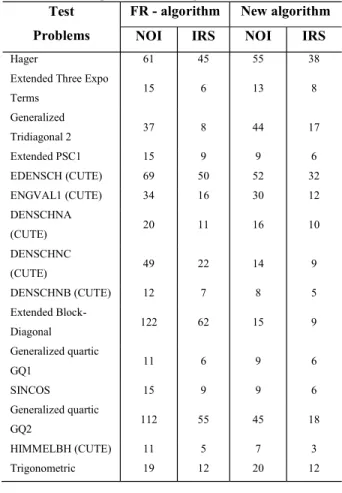
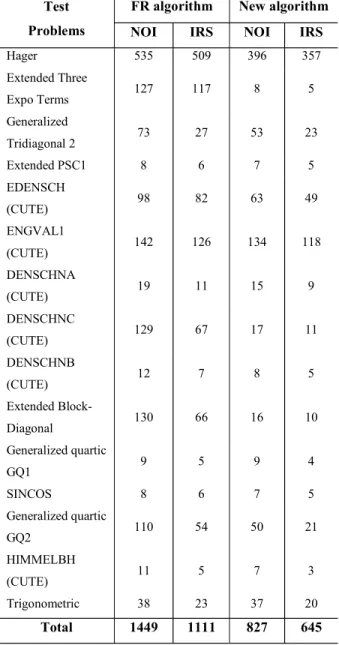
In this section, we report some results of the numerical experiments. We test the new algorithm and compare its performance with those of FR method whose results be given by [7] by solving the 15 benchmark problems from [1].
All codes of the computer procedures are written in Fortran. The parameters are chosen as follows :
9 . 0 , 001 . 0 , 5 . 0 ,
10 6 1 2
In the following Tables, the numerical results are written in the form NOI/IRS, where NOI, IRS denote the number of iteration, the number of restart respectively, n denotes the dimension
of the test problems.
From the numerical results, we can see that the proposed method performs better than the FR method for some problems.
Table 6: Comparison of the algorithms for n 100. Test
Problems
FR - algorithm New algorithm NOI IRS NOI IRS
Hager 61 45 55 38
Extended Three Expo
Terms 15 6 13 8
Generalized
Tridiagonal 2 37 8 44 17
Extended PSC1 15 9 9 6
EDENSCH (CUTE) 69 50 52 32
ENGVAL1 (CUTE) 34 16 30 12
DENSCHNA
(CUTE) 20 11 16 10
DENSCHNC
(CUTE) 49 22 14 9
DENSCHNB (CUTE) 12 7 8 5
Extended
Block-Diagonal 122 62 15 9
Generalized quartic
GQ1 11 6 9 6
SINCOS 15 9 9 6
Generalized quartic
GQ2 112 55 45 18
HIMMELBH (CUTE) 11 5 7 3
Total 602 323 346 191
Table 7: Comparison of the algorithms for n 1000. Test
Problems
FR algorithm New algorithm
NOI IRS NOI IRS
Hager 535 509 396 357
Extended Three
Expo Terms 127 117 8 5
Generalized
Tridiagonal 2 73 27 53 23
Extended PSC1 8 6 7 5
EDENSCH
(CUTE) 98 82 63 49
ENGVAL1
(CUTE) 142 126 134 118
DENSCHNA
(CUTE) 19 11 15 9
DENSCHNC
(CUTE) 129 67 17 11
DENSCHNB
(CUTE) 12 7 8 5
Extended
Block-Diagonal 130 66 16 10
Generalized quartic
GQ1 9 5 9 4
SINCOS 8 6 7 5
Generalized quartic
GQ2 110 54 50 21
HIMMELBH
(CUTE) 11 5 7 3
Trigonometric 38 23 37 20
Total 1449 1111 827 645
Conclusions and Discussions
In this paper, we have proposed new a nonlinear CG- algorithms based on the Scaled Matrix defined by (17) under some assumptions. The new algorithm has been shown to be globally convergent and satisfies the descent property. The computational experiments show that the new kinds given in this paper are successful. Table 6 and Table 7 give comparisons between the new-algorithm and FR algorithms whose results be given by [7] for convex optimization. Table 8 saves the new algorithm of (42)% NOI and (41)% IRS
of overall against the standard FR algorithm, especially for our selected group of test problems.
Table 8: Relative efficiency of the new Algorithm.
Tools NOI IRS
Algorithm with
FR k
100 % 100 %
New Algorithm 57.19 % 58.29 %
References
[1] Andrie N. (2008) ' An Unconstrained Optimization Test functions collection ' Advanced Modeling and op miza on. 10, pp.147-161.
[2] Barzilai. J. Borwein. J. M. (1988). Two point step size gradient method IMA J.Numer Numer. Anal. 8, pp. 141 148. [3] Cao W. and Wang K. (2010) ' Global
convergence of a new conjugate gradient method for modified Liu-Storey formula' Journal of East China Normal University (Natural Science), 1, pp.44-51.
[4] Dai Y. and Liao Z. (2001). New conjugate conditions and related nonlinear conjugate gradient methods. Appl. Math. Op m. 43, pp. 87-101.
[5] Dai, Y. and Yuan Y. ( 1999) ' A non-linear conjugate gradients method with a strong global convergence property' SIAM J. Op miza on,10, pp.177-182.
[6] Fletcher, R. (1987) ' Prac cal Methods of Optimization (second edition). John Wiley and Sons, New York.
[7] Fletcher, R. and Reeves C. (1964) ' Function minimization by conjugate gradients ' Computer J. 7, pp.149-154. [8] Hestenes, M. R. and S efel E. L. (1952) '
Method of conjugate gradients for solving linear systems' J. Research Nat. Standards 49, pp.409-436.
[10] Nocedal J. and Wright S. J. (1999). Numerical Optimization. Springer. New York .
[11] Polak, E. and Ribiere, G. (1969) ' Note for Convergence Direction Conjugate, Revue Francaise Informant, Research. Opera onal, 16, 35-43.
[12] Zoutendijk G., 1970. Nonlinear Porgramming, computational methods, in:
Integr and Nonlinear Programming, North-Holland, Amsterdam, pp. 37-86.