Secrecy Sustain Broadcast Assessment for Collective
Information in Cloud Computing
V. Ujjwala #1, J.Haribabu #2, R.Lakshmi Tulasi #3
#1Student of M.Tech (CSE) and Department of Computer Science Engineering,
#2 Associate professor in QIS Institute of Technology,
#3professor in QIS Institute of Technology, Ongole.
ABSTRACT:
Cloud computing could be a mode of method that shares computing resources considerably than enclose native servers or personal devices to regulate productions. Cloud information storage has varied compensations over native info storage. Client will transmit their info on cloud and retrieve those uploaded information from anytime and anyplace with none further burden. It condenses value by assign computing and tortuous, storage resources with associate on command provisioning mechanism counting on a forfeit use business type. The User doesn’t ought to agonize concerning storage and maintenance of cloud information. because the information is keep at the isolated place however users can get the confirmation a propos keep information. thence Cloud information storage ought to have some procedure which is able to detail storage correctness and integrity of data keep on cloud. Users will resort to a third-party auditor (TPA) to ascertain the honesty of outsourced information and be agonize gratis. TPA ought to be ready to competently audit the cloud information storage exclusive of difficult the native copy of data. Specifically, our involvement during this work are often potted because the following aspects: Stimulate the Public
Auditing procedure of information storage safety in Cloud Computing and supply a privacy conserving auditing rule, i.e., our proposal supports associate exterior auditor to audit user’s outsourced info within the cloud while not learning info on the info gist. In difficult, our theme accomplish batch auditing wherever many delegated auditing trip from completely different users are often execute at the same time by the TPA.
Keywords— Cloud computing, public auditing, Trusted TPA, security, data Storage, access control.
I. INTRODUCTION:
Cloud Computing, provides net primarily based provision and exploit of technology. this can be cheap and further stalwart processors, along by means that of computer code as a service (SaaS) computing design, area unit alter information into information centres on comprehensive. Increasing network and versatile network connections build it even potential that users will currently use prime quality overhaul from information and impart remote on information centers. Storing information into the cloud counsel nice facilitate to users since they don’t enclose to worry concerning the labour of hardware issues. These internet-based on-line services do give huge amounts of space for storing and customizable computing possessions, this computing platform shift, however, is pass up the responsibility of native machines for information maintenance at a similar instant. consequently, users area unit at the interest of their cloud service suppliers for the accessibility and integrity of their information on one dispense; though the cloud services area unit far more potent and reliable than own computing devices and broad vary of equally internal and external threats for information integrity quiet exist. samples of outages and information loss prevalence of noteworthy cloud storage services emerge from time to time. On the opposite hand, since users might not maintain a neighbourhood copy of farm out data, there live on varied incentives for cloud service suppliers (CSP) to behave undependably regarding the cloud users regarding the standing of their outsourced in order. Our effort is in coincidence with the primary few ones during this discipline to contemplate scattered information storage security in Cloud Computing.
II. PROBLEM STATEMENT
The Cloud and Threat Model
just try to assess if the cloud provider is able to provide security. cloud data storage service involving three different entities. the cloud user (U), who has large amount of data files to be stored in the cloud; the cloud server (CS), which is managed by cloud service provider (CSP) to provide data storage service and has significant storage space and computation resources (we will not differentiate CS and CSP hereafter.); the third party auditor (TPA), who has expertise and capabilities that cloud users do not have and is trusted to assess the cloud storage service security on behalf of the user upon request. Cloud users dynamically interact with the CS to access and update their stored data for various application purposes. The traditional cryptographic technologies for data integrity and availability, cannot work on the outsourced data without a local copy of data. it is not a practical solution for data validation by downloading them due to the expensive communications, especially for large size files. The ability to audit the correctness of the data in a cloud environment can be formidable and expensive for the cloud users. Therefore, it is crucial to realize public auditability for CSS, so that data owners may resort to a third party auditor (TPA), who has expertise and capabilities that a common user does not have, for periodically auditing the outsourced data. This audit service is significantly important for digital forensics and credibility in clouds. The users may resort to TPA for ensuring the storage security of their outsourced data, while hoping to keep their data private from TPA. We consider the existence of a semi-trusted CS as [11] does. Namely, in most of time it behaves properly and does not deviate from the prescribed protocol execution. However, during providing the cloud data storage based services, for their own benefits the CS might neglect to keep or deliberately delete rarely accessed data files which belong to ordinary cloud users. Moreover, the CS may decide to hide the data corruptions caused by server hacks or Byzantine failures to maintain reputation. We assume the TPA, who is in the business of auditing, is reliable and independent, and thus has no incentive to collude with either the CS or the users during the auditing process. TPA should be able to efficiently audit the cloud data storage without local copy of data and without bringing in additional on-line burden to cloud users. However, any possible leakage of user’s outsourced data towards TPA through the auditing protocol should be prohibited. the audit delegation and authorize CS to respond to TPA’s audits, the user can sign a certificate granting audit rights to the TPA’s public key, and all auditsfrom the TPA are authenticated against such a certificate.
III. RELATED WORK
The public auditability in their defined “provable data possession” (PDP) model for ensuring possession of data files on untrusted storages. Their scheme utilizes the RSAbased homomorphic non-linear authenticators for auditing outsourced data and suggests randomly sampling a few blocks of the file. However, the public auditability in their scheme demands the linear combination of sampled blocks exposed to external auditor. When used directly, their protocol is not provably privacy preserving, and thus may leak user data information to the auditor. Juels et al.[11] describe a “proof of retrievability” (PoR) model, where spot-checking and error-correcting codes are used to ensure both “possession” and “retrievability” of data files on remote archive service systems. However, the number of audit challenges a user can perform is fixed a priori, and public auditability is not supported in their main scheme. Although they describe a straightforward Merkle-tree construction for public PoRs, this approach only works with encrypted data. Dodis et al. [5] give a study on different variants of PoR with private auditability. Shacham et al. [13] design an improved PoR scheme built with full proofs of security in the security model defined in [11]. Similar to the construction in [8], they use publicly verifiable homomorphic non-linear authenticators that are built from provably secure BLS signatures. Based on the elegant BLS construction, a compact and public verifiable scheme is obtained. Again, their approach does not support privacypreserving auditing for the same reason as [8]. The propose allowing a TPA to keep online storage honest by first encrypting the data then sending a number of pre-computed symmetric-keyed hashes over the encrypted data to the auditor. The auditor verifies both the integrity of the data file and the server’s possession of a previously committed decryption key. This scheme only works for encrypted files, and it suffers from the auditor statefullness and bounded usage, which may potentially bring in online burden to users when the keyed hashes are used up.
IV. Design Goals
The privacy-preserving public auditing for cloud data storage under the aforementioned model, our protocol design should follow the security and performance.
Public Audit: It allows TPA to verify the correctness of the cloud data on demand without retrieving a copy of the whole data
Privacy-Preserving: to ensure that there exists no way forTPA to derive users’data content from the information collected during the auditing process.
Batch Auditing: It enable TPA with secure and efficient auditing capability to cope with multiple auditing delegations from possibly large number of different users simultaneously.
Light Weight: It allow TPA to perform auditing with minimum communication and computation overhead.
V. The System Model:
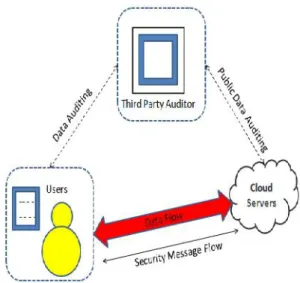
The system model consist three different entities: the cloud user, the cloud server (CS) and the third-party auditor (TPA). As shown in fig. 1.The cloud user is the one who has large amount of data files that are stored in the cloud; the cloud server is the one who provides the data storage service like resources, software to the user. The cloud server is managed by cloud service provider; the third- party auditor is the one who has belief to access the cloud storage service for the benefit of user whenever user request for data access. The TPA has capabilities and competence that the user does not have. They can also interact with cloud server to access the stored data for different purpose in different style. Every time it is not possible for user to check the data which is stored on cloud server that arrives online burden to the user .so that‟s why to reduce online burden and maintain that integrity cloud
Fig. The architecture of cloud data storage.
user may resort to TPA. The data stored on cloud server is come from internal and external attacks ,which is having data integrity threads like
hardware failure, software bug, hackers, and management errors. The Cloud Server can maintain reputation for its self-serving. The CS might even decide to hide these data correction incidents to user. So that‟s why here we are giving third-party auditing service for users to gain belief on cloud.
VI. Proposed Schemes
The public auditability is a main drawback of cloud computing technology. In this paper secure public auditing scheme for cloud storage provide more security compared previous technology. In this paper public Auditing system and discuss two straightforward schemes and their demerits. Then we present our main result for privacy preserving Public auditing to achieve the before mentioned design Goals. Finally, we show how to extent our main scheme to batch auditing and encryption algorithms. The batch Auditing used to audit the group of details.
The proposed problem is multi write and problem of TPA if Third-party-auditor not only uses data but also modify the data than how data owner or user will know about this problem. Here the user has two types’ keys, one of which only the owner knows called private key and another one which is known to anyone called public key. We match both the data it must be same as the sent one on the sender cannot deny that they sent it . The downloading of data for its integrity verification is not feasible task since it’s very costly because of the transmission cost across the network.
1. Public Auditing:
Public auditing scheme algorithms are
1. KeyGen, 2.SigGen, 3.GenProof 4. Verify Proof. KeyGen is a key generation algorithm that is run by the user to setup the scheme. SigGen is used by the user to generate verification Meta data. GenProof is run by the cloud server to generate a proof of data storage correctness. Verify Proof is run by the TPA to audit the proof from the cloud server.
2. Batch Auditing:
Secure privacy-preserving public auditing in Cloud Computing, TPA may concurrently handle multiple Auditing delegations upon different users’requests. The individual auditing of these tasks for TPA can be tedious and very inefficient. Given A auditing delegations on A distinct data files from A different users, it is more advantageous for TPA to batch these multiple tasks together and audit at one time.
Access control mechanisms are tools to ensure authorized user can access and to prevent unauthorized access to information systems. The following are six control statements should be consider ensuring proper access control management as in
1. The Access to information.
2. Manage user access rights.
3. Encourage good access practices.
4. Control access to the operating systems.
5. Control access to network services.
6. Control access to applications and systems.
The proposed the problem can be generalized as how can the client find an efficient way to perform periodical integrity verifications without the local copy of data files, as in. If any two users or more users are using a data, one is writing a data while one is reading a data than it may be wrong read by 1 user, so to resolve data inconsistency is become an important task of the data owner and another problem how to trust on TAP is not calculated. If TPA become intruder and pass information of data or deleting a data than how owner know about this problem are not solved. Integrity and consistency. Proposed scheme in this virtual machine.
Advanced Encryption Standard (AES) are used where client encrypt and decrypt the file. In this virtual machine, this mechanism solves the problem of unauthorized access of data. In this suggested scheme that can be used for integrity and consistency of data.
VII. Algorithm for Data Integrity Verification:
1. Start
2. TPA generates a random set like public key pk, private key sk and signature σ on each block (Verification metadata).
3. CS computes root hash code based on the filename/blocks input.
4. CS computes the originally stored value.
5. TPA decrypts the given content and compares with generated root hash.
6. After verification, the TPA can determine whether the integrity is breached.
7. Stop
Fig. Graph
Fig . Process flow
VIII. CONCLUSION:
party is used to resolve any kind of conflicts between service provider and client.
REFERENCES:
[1] M. Arrington, “Gmail disaster: Reports of mass email deletions,” Online at http://www.techcrunch.com/2006/
12/28/gmaildisasterreports- of-mass-email-deletions/, December 2006.
[2] J. Kincaid, “MediaMax/TheLinkup Closes Its
Doors,” Online at
http://www.techcrunch.com/2008/07/10/ mediamaxthelinkup-closesits- doors/, July 2008.
[3] Amazon.com, “Amazon s3 availability event: July 20, 2008,” Online at
http://status.aws.amazon.com/s3-20080720.html,2008.
[4] S. Wilson, “Appengine outage,” Online at http://www. cioweblog. com/50226711/appengine outage.php, June 2008.
[5] B. Krebs, “Payment Processor Breach May Be Largest Ever,” Online at http://voices.washingtonpost.com/securityfix/2009/ 01/payment processor breach may b.html, Jan. 2009.
[6] G. Ateniese, R. Burns, R. Curtmola, J. Herring, L. Kissner, Z. Peterson, and D. Song, “Provable data possession at untrusted stores,” in Proc. of CCS’07, Alexandria, VA, October 2007, pp. 598– 609.
[7] M. A. Shah, R. Swaminathan, and M. Baker, “Privacypreserving audit and extraction of digital contents,” Cryptology ePrint Archive, Report 2008/186, 2008.
[8] Q. Wang, C. Wang, J. Li, K. Ren, and W. Lou, “Enabling public verifiability and data dynamics for storage security in cloud computing,” in Proc. of ESORICS’09, volume 5789 of LNCS. Springer-Verlag, Sep. 2009, pp. 355–370.
[9] A. Juels and J. Burton S. Kaliski, “Pors: Proofs of retrievability for large files,” inProc. of CCS’07, Alexandria, VA, October 2007, pp. 584–597.
[10] Cloud Security Alliance, “Security guidance for critical areas of focus in cloud computing,” 2009, http://www. cloudsecurityalliance.org.
[11] H. Shacham and B. Waters, “Compact proofs of retrievability,” in Proc. of Asiacrypt 2008, vol. 5350, Dec 2008, pp. 90–107.
[12] M. A. Shah, M. Baker, J. C. Mogul, and R. Swaminathan, “Auditing to keep online storage services honest,” in Proc. Of HotOS’07. Berkeley, CA, USA: USENIX Association, 2007, pp. 1–6.
[13] G. Ateniese, R. C. Burns, R. Curtmola, J. Herring, L. Kissner, Z. N. J. Peterson, and D. X. Song. Provable data possession at untrusted stores. In Proceedings of the 2007 ACM Conference on Computer and Communications Security, CCS 2007, pages 598–609, 2007.
Author: