NICKEL–CATALYZED CYCLOADDITIONS OF ENE–ALLENES
Njamkou Ngasseu Noucti
A dissertation submitted to the faculty at the University of North Carolina at Chapel Hill in partial fulfillment of the requirements of the degree of Doctor of Philosophy in the
Department of Chemistry in the School of Science.
Chapel Hill 2015
© 2015
ABSTRACT
Njamkou Ngasseu Noucti: Nickel–Catalyzed Cycloadditions of Ene–Allenes (Under the direction of Erik J. Alexanian)
ACKNOWLEDGEMENTS
Despite the challenges and difficulties, I can honestly say that I’ve truly enjoyed my time spent in North Carolina.
First and foremost, I would like to thank everyone and anyone involved in the making of the person I’ve become today. My childhood neighbors, Dean and David, for helping a single mother from Cameroon raise her children in a foreign land, my algebra teacher Mr. Schweer, for allowing me to realize the excellence within me– your influence has stretched far beyond the four walls of that eighth–grade classroom. My high school chemistry teachers, Dr. Monzik and Mrs. Sabatka, for introducing me to chemistry and encouraging me to pursue a career in the sciences, and of course, my research advisors and mentors both past and present.
Professor Christopher Cummins, thank you with the deepest sincerity for giving me the opportunity to work in your research group. The skills and knowledge I gained working in your lab have been invaluable in my doctoral career and I am certain will continue to be of great use in my future scientific ventures.
Dr. Sandra Lee, thank you for the training you gave me while I was at Merck. Thank you for all your advice, lessons, and for wholly supporting my decision to pursue a doctoral degree. In large part because of you, I was able to fully make the most of my doctoral career.
To the rest of my committee members– Dr. Marcey Waters, Dr. Jeff Johnson, Dr. Maurice Brookhart, and Dr. Simon Meek– thank you for your support and assistance with my academic and professional endeavors.
To all the many people who contributed their time, instrumentation and advice to my projects– Dr. Peter White, Dr. Marc Ter Horst, Dr. Habibi Sohrab, and Dr. Shubin Liu– thank you for your help.
Lastly, but most certainly not the least, I would like to thank my family and friends for their endless support these past five years. To my mother, Odette, your positive attitude is truly inspirational. You are an amazing human being and the best mother anyone could ask for. Thank you for your constant motivation and for always encouraging me to shoot for the moon and be the best person I can be. My cousins, Dubonnet, Patricia, Nathalie, Thierry, Ismaël, Priscille, Diana, and Grace–Meryl, thank you for your encouragement and in your own unique way, for helping me keep a smile on my face. To my aunt, Marie and my cousins Claire, Nathalie, and Isabelle, thank you for always keeping your door open to me no matter the day or time.
TABLE OF CONTENTS
LIST OF FIGURES ………...….….ix
LIST OF TABLES ………..xii
LIST OF ABBREVIATIONS ………...xiii
NICKEL–CATALYZED REACTIONS OF ENE–ALLENES………...……...1
INTRODUCTION ……….……….………...1
CHAPTER 1. [2+2+2] CYCLOADDITION REACTIONS ………..…………3
Background ……….3
Reaction optimization …….………9
Scope evaluation ………….………..12
Mechanistic discussion ……….………15
Asymmetric [2+2+2] cycloaddition reactions ………..16
Summary ………...19
CHAPTER 2. ALKENYLATIVE CYCLIZATION REACTIONS ………...………...…20
Background ………...20
Reaction optimization ……….………..…26
Scope evaluation ……….………...27
Mechanistic discussion ……….………29
Post–substrate modifications ………31
CHAPTER 3. [2+2] CYCLOADDITION REACTIONS ……….………..………33
Background ………...33
Reaction optimization ………….………..36
Scope evaluation ……….………..38
Mechanistic discussion ……….………....40
Summary ………...43
APPENDIX I. LIGAND STRUCTURES ………...………..………...44
APPENDIX II. EXPERIMENTAL PROCEDURES ………...…………...45
APPENDIX III. SELECT SPECTRA AND CRYSTALLOGRAPHIC DATA ...97
LIST OF FIGURES Chapter 1.
Figure 1. Biologically–relevant carbocyclic compounds………..1
Figure 2. Electronic interactions in the Diels–Alder reaction………...3
Figure 3. Representative scope of radical–cation Diels–Alder reaction. ……….4
Figure 4. Representative scope of radical–anion hetero Diels–Alder reaction………...…4
Figure 5. Alternative synthesis of cyclohexanes using [2+2+2] cycloaddition reactions…..…5
Figure 6. Early examples of alkyne cyclotrimerization………5
Figure 7. Volhardt’s racemic synthesis of estrone………6
Figure 8. Proposed cycle for Co–catalyzed [2+2+2] cycloaddition ………...6
Figure 9. Rhodium–catalyzed [2+2+2] cycloaddition reactions using multiple alkynes……..7
Figure 10. Generating molecular complexity with [2+2+2] cycloaddition reactions………...8
Figure 11. [2+2+2] cycloaddition reactions using multiple alkene components………..8
Figure 12. Scope of ene–allene substrates………..…13
Figure 13. Evidence of an O–bound nickel enolate……….………...14
Figure 14. Scope of external alkene………15
Figure 15. Crystal structure of 2l………....15
Figure 16. Plausible mechanism for Ni–catalyzed [2+2+2] cycloaddition reactions of ene– allenes and alkenes………16
Figure 17. Ligand survey in asymmetric Ni–catalyzed [2+2+2] cycloaddition reactions…..17
Figure 18. Background [2+2+2] cycloaddition reactions in the absence of phosphine ligand……….18
Chapter 2.
Figure 20. Early examples of cross coupling reactions….………..20
Figure 21. Proposed cycle for Ni–catalyzed Kumada coupling….……….21
Figure 22. Transition–metal–catalyzed coupling reactions…..………...21
Figure 23. Combined Shapiro/Suzuki reactions………..22
Figure 24. Alkenylative cyclization of ene–ynes………....23
Figure 25. . Proposed cycle for the Pd–catalyzed cyclizations of ene–ynes and vinyl stan- nanes……….23
Figure 26. Proposed cycle for the Ni–catalyzed cyclizations of ene–ynes and boronic acids……….……...24
Figure 27. Ru–catalyzed ethenylative cyclizations of ene–ynes ………..……..25
Figure 28. Proposed cycle for Ru–catalyzed alkenylative cyclization reactions of ene–ynes and ethylene……….……….25
Figure 29. Ni–catalyzed alkenylative cyclization of ene–allenes………...26
Figure 30. Scope of alkenylative cyclization reactions………...28
Figure 31. Crystal structure of 3k………...…28
Figure 32. Proposed cycle for Ni–catalyzed alkenylative cyclizations of ene–allenes……...29
Figure 33. DFT calculations of β–hydride elimination vs. reductive elimination pathways of A using L = PBu3 and n = 2 (units in kcal/mol).………….………...………...30
Figure 34. Post–substrate modifications of alkenylative cyclization products (X = C(CO2Et)2)………31
Chapter 3. Figure 35. Biologically–active cyclobutane–containing compounds……….33
Figure 36. A cyclobutane–mediated synthesis of Ascosalipyrrolidinone………...34
Figure 37. Synthesis of cyclobutanes………..34
LIST OF TABLES Chapter 1.
Table 1. Initial screen of Ni–catalyzed [2+2+2] cycloaddition reactions of ene–allene 1…..10 Table 2. Ligand optimization of Ni–catalyzed [2+2+2] cycloadditions……….……11 Table 3. Exploring the addition time of ene–allene 1………...………..11 Chapter 2.
Table 4. Initial results for Ni–catalyzed alkenylative cyclization reactions of ene–allenes…27 Chapter 3.
LIST OF ABBREVIATIONS AcOH
Ar MeCN PhH Bu Cp dr dba DCM DMSO EDG ESI er Equiv Et EWG HOMO HMPA hr IR IRC Kcal
Acetic Acid Aryl
Acetonitrile Benzene Butyl
Cyclopentadienyl Diastereomeric ratio Dibenzylideneacetone Dichloromethane Dimethylsulfoxide Electron donating group Electronspray ionization Enantiomeric ratio Equivalent(s) Ethyl
Electron withdrawing group
Highest occupied molecular orbital Hexamethylphosphoramide
Hour(s) Infrared
LDA LUMO Me Mol NMR Rf Ph Pr THF NTs PBu3 PCy3 NEt3 TFA OTf PMes3 SFC TMS P(2–MePh)3 P(4–FPh)3 PPh3
Lithium diisopropylamine
Lowest occupied molecular orbital Methyl
Mole
Nuclear magnetic resonance Retention factor
Phenyl Propyl
Tetrahydrofuran 4–Toluenesulfonamide Tributylphosphine Tricyclohexylphosphine Triethylamine
Trifluoroacetic acid Trifluoromethanesulfonate Trimesitylphosphine Self–consistent field Trimethyl silyl
NICKEL–CATALYZED REACTIONS OF ENE–ALLENES
Introduction.
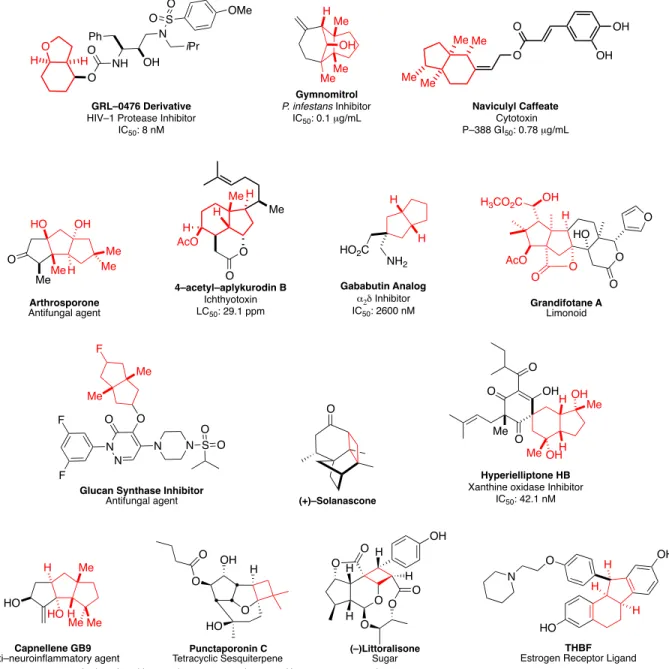
Carbocyclic motifs are ubiquitous in biologically relevant compounds1 (Figure 1) yet can
Figure 1. Biologically–relevant carbocyclic compounds.
O H Me AcO H Me H 4–acetyl–aplykurodin B Ichthyotoxin LC50: 29.1 ppm
MeMe Me Me OH OH O O Naviculyl Caffeate Cytotoxin P–388 GI50: 0.78 µg/mL
HO Me Me Me H OH Me O Arthrosporone Antifungal agent H H HO2C
NH2
Gababutin Analog
α2δ Inhibitor IC50: 2600 nM
HO H Me H Me Me Capnellene GB9 Anti–neuroinflammatory agent H O O O O HO OH AcO H3CO2C
O
Grandifotane A Limonoid GRL–0476 Derivative
HIV–1 Protease Inhibitor IC50: 8 nM O H H O O NH N S O O OMe OH Ph iPr Me Me Me Gymnomitrol
P. infestansInhibitor IC50: 0.1 µg/mL
Me Me F O N N O F
N N S
F
O O
Glucan Synthase Inhibitor Antifungal agent H H Me Me O OH O O Me OH OH Hyperielliptone HB Xanthine oxidase Inhibitor
IC50: 42.1 nM
O N OH HO H H H THBF Estrogen Receptor Ligand
CHAPTER 1. [2+2+2] CYCLOADDITION REACTIONS
Background.
Perhaps the most well developed methodology for the synthesis of stereochemically complex six–membered rings is the Diels–Alder reaction (Figure 2).4 Though diastereo– and enantioselective processes have been reported, the application of this mode of reactivity to the synthesis of complex carbocycles remains limited by the electronic and steric constraints of the reactions.5
A concerted [4+2] cycloaddition, the stereochemical outcome of the Diels–Alder reaction
is dictated by orbital symmetry.5a, 5b As such, the reacting orbitals must be electronically matched and consequently, the Diels–Alder reaction is typically limited to a select combination of substituents on the diene and dienophile reagents. For example, although electron–poor
Figure 2. Electronic interactions in the Diels–Alder reaction.
EDG
EDG
EDG EDG electron–rich diene, electron–rich dienophile
radical cation Diels–Alder few examples known
electron–rich diene, electron–poor dienophile
normal–demand Diels–Alder many examples known
electron–poor diene, electron–rich dienophile
inverse–demand Diels–Alder many examples known
electron–poor diene, electron–poor dienophile
radical anion Diels–Alder few examples known EWG
EDG
EWG EDG
EDG
EWG
EDG EWG
EWG
EWG
dienophiles react well with electron–rich dienes and vice–versa, the analogous reaction where both reacting partners are of the same electronic polarity is rare.
Yoon and coworkers recently disclosed a mild, intermolecular, high–yielding Diels– Alder reactions using traditionally incompatible substrates (Figure 3).6 The reaction proceeds
via a radical–cation pathway and provides Diels–Alder products using electron–rich dienes and dienophiles, however, electron–poor dienophiles or electron–poor dienes do not react under these conditions.
Yoon also disclosed analogous radical anion hetero–Diels–Alder reactions using electron–poor substrates (Figure 4).7 However, formal [4+2] cycloaddition reactions with electron–poor dienes and electron–poor alkenes are rare.
Multicomponent transition–metal– COR2 COR1 O COR1 R2 5 mol % Ru(bpy)3Cl2
iPr2NEt (3 equiv) LiBF4 (2 equiv) H2O (10 equiv)
MeCN visible light O COPh Ph 86% yield O CO(2–furyl)
77% yield O
O COPh Me 73% yield O COPh
58% yield Me Me
Figure 4. Representative scope of radical–anion hetero Diels–Alder reaction.
Figure 3. Representative scope of radical–cation Diels–Alder reaction.
R2 EDG R 2 EDG Me Me OMe 98% yield Me Me OMe 91% yield Me Me Me Me OMe 98% yield Me Me OMe 62% yield
(3 mol % catalyst loading used O Me Me Me Me H H
R1 R3 R1 Me
visible light
Ru(bpz)2(BArF)2 (0.5 mol %) air, CH2Cl2, rt
catalyzed cycloaddition reactions offer a complimentary approach towards the synthesis of these carbocyclic structures (Figure 5).
Interest in transition–metal–catalyzed [m+n+o] cycloaddition reactions dates back to 1866. Marcelin Berthelot, the French chemist and politician, reported that cyclotrimerization of acetylene could be achieved with high reaction pressures and temperatures (Figure 6a).8 The simultaneous formation of three σ bonds in one transformation was a significant synthetic feat for its time, however, due to the harsh thermal conditions required to effect the transformation, low yields and mixtures of products were obtained. The German chemist Walter Reppe revolutionized this field in 1948 with the discovery that transition metal catalysts could be used to achieve the transformation under milder conditions (Figure 6b).9 Whereas Berthelot’s procedure required temperatures as high as 400 ºC, Reppe used nickel catalysis to achieve a similar transformation at 70 ºC, obtaining the
Figure 5. Alternative synthesis of cyclohexanes using [2+2+2] cycloaddition reactions.
EWG EWG EWG EWG EWG EWG + + Diels–Alder/
reduction CycloadditionReaction
few examples
known stereoselectivehigh–yielding
400 ºC a) Berthelot, 1866:
b) Reppe, 1948:
THF, 70 ºC OH OH HO HO OH OH 95% yield
A:B (1:1) HO
OH HO
A B
Ni(CO)2(PPh3)2
product in 95% yield, albeit as a 1:1 mixture of regioisomers. Acetylene cyclotrimerization is an exothermic process (ΔH = –142 kcal/mol)10 but without the aid of a catalyst, high temperatures are needed to compensate for the entropy of activation for the termolecular transition state required in the concerted reaction. Though thermodynamically feasible, the uncatalyzed reaction is thus entropically disfavored. In general, the termolecular transition state is avoided with transition metal catalysis, allowing the reaction to proceed under milder conditions. Since Reppe’s revolutionary discovery, it has been demonstrated that cycloaddition reactions can be catalyzed by a variety of transition–metals, including Ti, Zr, V, Nb, Mo, W, Fe, Ru, Os, Co, Rh,
Ir, Ni, Pd, Cu, and Au.11 Moreover, these reactions now enjoy extensive applications in chemical synthesis.12 A well known example of such an application comes from Vollhardt’s racemic synthesis of the hormone estrone using a key cobalt–catalyzed [2+2+2] cycloaddition reaction of acetylene derivatives (Figure 7).1ll
Vollhardt proposed ligation of a coordinatively unsaturated cobalt species to the diyne moiety followed by an oxidative coupling to generate a
Figure 7. Vollhardt’s racemic synthesis of estrone.
Me H H O CpCo(CO)2 SiMe3 Me3Si
HO Me3Si
Me3Si
O H
Me
[2+2+2] cycloaddition H
O H Me H H dl–estrone
Figure 8. Proposed cycle for Co–catalyzed [2+2+2] cycloaddition.
RL H H H RL H H H CpCo CpCo H RL
Me3Si SiMe3
CpCo
Me3Si Me3Si
H RL
CpCo(CO)2
2 CO Me3Si
Me3Si
five–membered cobaltacycle intermediate (Figure 8). Coordination and insertion of the third acetylenic component followed by reductive elimination completed the catalytic cycle and furnished the observed cycloaddition product. The completed synthesis of estrone was accomplished in 21.5% overall yields and in six synthetic steps from commercially available 2– methyl cyclopentenone.
Since Vollhardt’s publication on the total synthesis of estrone in 1980, the area of cycloaddition chemistry has grown significantly with many investigators contributing to the field. For example, Evans13 and Shibata14 have respectively reported inter– and intramolecular Rh–catalyzed [2+2+2] cycloaddition reactions using one alkene and two alkyne components, furnishing cycloaddition products in high yields with excellent enantiocontrol (Figure 9). Despite the significant advancements that have been made, the great majority of [2+2+2] cycloaddition protocols rely heavily on the use of alkyne π–components, greatly limiting the stereochemical complexity generated from these reactions (Figure 10).
TsN
H
TsN
Ph 89% yield 98.5:1.5 er [RhCl(COD)2] (5 mol %)
(S)–Xyl–P–PHOS (12 mol %) AgBF4 (20 mol %)
THF, 60 °C 3 equiv
1 equiv
CO2Me
Ph
CO2Me
H a) Evans, 2005:
EtO2C EtO2C
Me
CO2Et CO2Et MeO2C
10 mol % [Rh(H8–BINAP)]BF4 CH2Cl2, rt
H H
Me CO2Me EtO2C
EtO2C
CO2Et CO2Et
82% yield 99:1 er b) Shibata, 2008:
To fully realize the complexity–generating capabilities of cycloaddition reactions, investigators have sought to minimize the use of alkyne components, replacing them with less
R2 R2 R R R1 R1 R R
R2 R2
R1 R1 no stereocenters created R R
R2 R2
R1
R1
up to 6 stereocenters created * * ** * * R R
R2 R2 R1 R1 R R R1 R1 R R
R2 R2
R1
R1
up to 2 stereocenters created R2 R2 * * R R
R2 R2
R1
R1
up to 4 stereocenters created
*
** *
R2 R2
R1
R1
R
R
3 alkynes
2 alkynes + 1 π-system
1 alkyne + 2 π-systems
3 π-systems
multiple alkynes employed low stereochemical complexity
few alkynes employed high stereochemical complexity
Figure 10. Generating molecular complexity with [2+2+2] cycloaddition reactions.
R1
R2
R
LnNi0 COMe H Me O H H Me O Me O 68% yield 4:1 dr Ni(COD)2 (20 mol %)
PPh3 (40 mol %)
THF, rt 5 equiv R R2 R1 H H
3 sigma bonds 5 contiguous stereocenters
EtO2C EtO2C
CO2Et
MeO2C
H [Rh(C2H4)2Cl]2 (2.5 mol %)
AgOTf (5 mol %) (R)–H8–BINAP (6 mol %) EtO2C
EtO2C
PhMe, 100 °C CO2Et
Ar
62% yield 83:17 er 2 equiv
CO2Me
Ar
[2+2+2] cycloaddition a) Montgomery, 1999:
b) Alexanian, 2011:
electron–rich and consequently, less reactive alkene components. In 1999, Montgomery reported Ni–catalyzed [2+2+2] cycloaddition reactions of ene–allenes and enones (Figure 11a).15 The reactions proceeded in good yields with modest diastereoselectivities, however only enone components were reported in the publication. Using allenes as alkyne surrogates, the Alexanian group in 2011 published a Rh–catalyzed [2+2+2] cycloaddition method for the synthesis of trans–fused hydrindanes furnishing products in moderate yields and modest enantioselectivity (Figure 11b).16 To further maximize the potential of these reactions to rapidly and efficiently generate molecular complexity, we have developed [2+2+2] cycloaddition methods with ene– allenes and external alkenes, achieving reactivity with a diverse array of alkene and allene π– components to selectively furnishing cis–fused hydrindane products with up to five contiguous stereocenters (Figure 11c).17 Herein we discuss the results of our findings.
Reaction optimization.
diastereomer (entry 1). Using a more electron–withdrawing (entry 2) or electron–donating (entry 3) monodentate phosphine ligand did not influence the chemoselectivity of the reaction, leading to a 55% and 86% isolated yield of the alkenylative cyclization product 3a, respectively.19 The results presented in entries 1–3 suggest that electronic factors do not contribute significantly to the product selectivity of the reactions. To test this hypothesis, we modified the steric environment around the phosphine ligand and to our satisfaction, we discovered that the use of bulky monodentate phosphine ligands led to the selective formation of the desired [2+2+2] cycloaddition product as a single diastereomer (Entry 4–5). The reaction is sensitive to heat and a significant drop in yield is observed at higher reaction temperatures (entry 5). At these high temperatures, precipitation of Ni–black from the reaction mixture is observed and the lack of active catalyst in solution is a plausible explanation for the low yields obtained. Although minor
Table 1. Initial screen of Ni–catalyzed [2+2+2] cycloaddition reactions of ene–allene 1.
Entry EtO2C EtO2C
CO2Me O
OtBu
EtO2C EtO2C
CO2Me CO2tBu Ni(COD)2
Ligand
EtO2C EtO2C
CO2Me CO2tBu
Ni(COD)2
(equiv)
Ligand Ligand
(equiv) Solvent Temp. (°C) 2 3
Isolated Yield (%)
1
3b
2
4
0.25 P(4–FPh)3 1 PhMe 100 0
0.1 PBu3 0.2 PhH 45 0
0.1 P(2–MePh)3 0.2 PhH 45 71 < 5
0.25 PPh3 1 THF 23 0
55 86 44 H H H H (1 equiv)a (5 equiv)
Solvent Temperature
5 0.1 P(2–MePh)3 0.2 PhMe 100 14 0
a Ene–allene added over 0.75 hours; b Ene–allene added over 1.25 hours.
well as non– phosphine ligands were generally low (less than 15% isolated yields) and in certain cases, no reactivity was observed.
We thus continued our investigation with a survey of bulky
monodentate phosphine ligands (Table 2). A general correlation between the cone angle of the phosphine ligand20 and the isolated yield can be observed. Although the use of tricyclohexyl phosphine only resulted in trace formation of the [2+2+2] cycloaddition product, a 38% isolated yield was obtained with the bulkier tri–tert–butyl phosphine ligand (entries 1–2). Trispentafluorophenyl phosphine, with similar steric properties to tri–tert– butyl phosphine resulted in
Table 3. Exploring the addition time of ene–allene 1.
1 86
1.25 90
Entry Time (hrs)Addition Yield (%)Isolated
1 2 3
0.75 71
EtO2C
EtO2C
CO2Me
O
OtBu
EtO2C
EtO2C
CO2Me
CO2tBu
Ni(COD)2
P(2–MePh)3 H
H
(1 equiv) (5 equiv)
PhH, 45 ºC
2 68
4
1 2
Table 2. Ligand optimization of Ni–catalyzed [2+2+2] cycloadditions.
P(tBu)3 182 38
P(2–MePh)3 194 71
PMes3 212 64
Cy–JohnPhos 226 34
Entry Ligand Cone Angle (°) Isolated Yield (%)
1
2
4
5
6
PCy3 170 trace
P(C6F5)3 184 29
3 EtO2C EtO2C
CO2Me O
OtBu
EtO2C EtO2C
CO2Me CO2tBu Ni(COD)2
Ligand H
H (1 equiv)a (5 equiv)
PhH, 45 ºC
a Ene–allene added over 0.75 hours.
a 29% yield of the cycloaddition product 2a (entry 3). Interestingly, even with contrasting electronic profiles, tri–tert–butyl phosphine and trispentafluorophenyl phosphine behave similarly in terms of both chemoselectivity and reaction yields, further illustrating the primary importance of the steric contribution of the phosphine ligand. A 71% isolated yield is obtained with tri–ortho–tolyl phosphine and ligands with larger cone angles such as trimesityl phosphine and cyclohexyl Johnphos led to lower isolated yields of the [2+2+2] cycloaddition product (entry 4–6). Lastly, the addition time of the ene–allene substrate was explored (Table 3). Significant amounts of substrate degradation was observed with an addition time of 0.75 hours, however, an improvement in yield was achieved by extending the addition time to 1.25 hours, resulting in a 90% isolated yield of the cycloaddition product (Entries 1–3). Slow addition of the ene–allene lowers the effective substrate concentration and lowers the rate of substrate dimerization, leading to more efficient [2+2+2] product formation. Without a sufficient amount of ene–allene substrate in solution however, the catalyst is unstable and eventually precipitates out of solution, leading to the lower reaction yield observed in entry 4. Having thoroughly examined the reaction parameters, the optimal reaction conditions were identified as follows: ene–allene substrate (1 equiv. added over 1.25 hours) and external olefin (5 equiv.) with Ni(COD)2 (0.1 equiv.) and tri–ortho–tolyl phosphine (0.2 equiv.) in benzene at 45 ºC.
Scope evaluation.
Although malonate–tethered substrates worked best for this transformation (Figure 12, 2b, 2f–2i), we were also able to demonstrate reactivity with oxygen– and nitrogen–tethered substrates (2c–2d). Even simple carbon tethers which do not benefit from a Thorpe–Ingold effect21 were tolerated (2e), however, a higher catalyst loading was required to compensate for
the lower reactivity of this substrate. On the alkene component of the tethered substrate, acrylates (2b–2e, 2i) as well as styrenes (2f–2g) were viable substrates. Even unactivated, terminal olefins participated in these reactions though without the bias of a substituent on the olefin, the resultant product was isolated as a 1:1 mixture of diastereomers (2h). All other products were isolated as single diastereomers. Acrylonitriles were unreactive and in sharp contrast to Montgomery’s 1999 nickel–catalyzed [2+2+2] cycloaddition reactions, neither were enones, with both substrates resulting in the quantitative isolation of unreacted starting material (2j). Presumably these olefinic species are good ligands for nickel and strongly ligate to the metal center, preventing the desired product–forming reductive elimination step to occur.
Crystallographic evidence for such a coordination was provided by Montgomery (Figure 13).22 The oxygen– bound nickel enolate was also characterized by 1H and 13C NMR, elemental analysis,
X
R
CO2tBu
Benzene, 45 °C
H
H OtBu
O
10 mol % Ni(COD)2 20 mol % P(2–MePh)3
(5 equiv)
X tBuO2C
CO2tBu H
H
60% yield X = C(CO2Et)2
X
CO2tBu H
H
72% yield 50:50 dr X = C(CO2Et)2 EtO2C
CO2tBu H
H
52% yieldb
O EtO2C
CO2tBu H
H 41% yield
X
Ar
CO2tBu H
H
51% yield X = C(CO2Et)2 Ar = (4–CO2Me)C6H4 X
R
(1 equiv)a
TsN MeO2C
CO2tBu H
H 35% yield
X
Ph
CO2tBu H
H
34% yield X = C(CO2Et)2
X R
CO2tBu H
H
not observed X = C(CO2Et)2 R = COMe, COPh, CN X
CO2CH2CF3 CO2tBu H
H
60% yield X = C(CO2Et)2
a Ene–allene added over 1.25 hours; bRun with 30 mol % Ni(COD)
2 and 30 mol % P(o–Tol)3.
Figure 12. Scope of ene–allene substrates.
2
2b 2d
2e 1
2g
2h
2b 2c
2c
2f
and IR, with all experimental data supporting an O–bound enolate structure. With certain external π–components, Montgomery demonstrated that insertion occurs to ultimately give carbocyclic products. We propose that acrylate insertion does not outcompete enolate– coordination and for this reason, we do not observe [2+2+2] cycloaddition products with enone substrates.
The reaction is also tolerant of a variety of external alkene components (Figure 14). Acrylates were viable substrates, giving the corresponding
cycloaddition products in modest to excellent yields (2a, 2k–2m). Although high yields were obtained with tert– butyl acrylate and
2g 2h
X MeO2C
CO2Me
81% yield X = C(CO2Et)2
X MeO2C
CO2(2–Naphth)
61% yield X = C(CO2Et)2
X MeO2C
CO2tBu
X MeO2C
CO2CH2CF3 90% yield X = C(CO2Et)2
37% yield X = C(CO2Et)2
X MeO2C
SO2Ph
74% yield X = C(CO2Et)2
TsN MeO2C
34% yieldc
X
MeO2C
27% yieldd
X = C(CO2Et)2
H H H H H H H H H H H H H H X
MeO2C H H Me H H R1 R2 X R R1
Benzene, 45 °C
H
H 10 mol % Ni(COD)2
20 mol % P(2–MePh)3
X
R
1 equiva
R2 5 equiv
26% yieldb
X = C(CO2Et)2
a Ene–allene added over 1.25 hours; b run with 30 mol % Ni(COD)
2 and 30 mol % dppb; c run with 25 mol % Ni(COD)
2 and 50 mol % PBu3; d run with 25 mol % Ni(COD)2 and 100 mol % P(4–FPh)3.
H
H
2a 2k
2m 2n
2p 1 2o 2q 2l 2 O Ph
[NiII] O
Ph
[NiII] O
Ph Ni(COD)2
TMEDA
Figure 13. Evidence of an O–bound nickel enolate.
methyl acrylate, less efficient reactivity was observed with electron–poor substituents on the ester (2l–2m). Vinyl sulfone, an ethylene surrogate, also participated in the transformation (2n) and in addition, the reaction was also tolerant of styrenes (2o). With olefins less prone to spontaneous
polymerization such as vinyl sulfone, the equivalents of the external alkene component could be lowered without significant reduction in the reaction yield (70% yield obtained using 1.5 equivalents of vinyl sulfone, 61% yield using 1.1 equivalents of vinyl sulfone).23 Lastly, disubstituted olefins such as indene (2p) and norbornene (2q) were also tolerated, generating the observed polycyclic compounds with five contiguous stereocenters set with excellent diastereoselectivity.
The stereochemical assignments were made using 2D NMR spectroscopy (see Appendix III for full spectra) and confirmed with an x–ray structure of the naphthyl derivative 2l (Figure 15).24 The x–ray structure confirms the cis stereochemistry at the ring junction of the bicycle as well as the trans relationship of the ester and the ring junction.
Mechanistic Discussion.
Similar to the work of Vollhardt11l, Montgomery14, and others12,13, we propose an initial coordination of the tethered substrate followed by an oxidative coupling to yield the cis–fused 5– 5 bicyclic intermediate 5 (Figure 16). The nickel catalyst is oxidized to Ni(II) in the oxidative coupling event; coordination of the external olefin to the electron–deficient Ni center followed
by 1,2–insertion of the olefin is hypothesized to generate the seven–membered metallacycle 6. The regiochemistry of the insertion is determined by the polarization of the alkene. 25 Reductive elimination from intermediate 6 then furnishes the observed [2+2+2] cycloaddition
product and regenerates the catalytic Ni species.
It has been demonstrated that bulky monodentate phosphine ligands increase the propensity of reductive elimination26 and similarly, we believe that the positive results obtained with bulky monodentate ligands (Table 1–2) are due to their ability to facilitate reductive elimination of intermediate 6. We do not have insight into the relative rates of each step of the catalytic cycle, however, it is widely accepted that reductive elimination events between two carbon sp3 centers is challenging.27 It is of little surprise therefore, that facilitating this step of the transformation advantageously affects the overall efficiency of the reaction.
Asymmetric [2+2+2] cycloaddition reactions.
For these studies, vinyl sulfone was used in place of tert–butyl acrylate. The switch of the standard substrate to vinyl sulfone had a two–fold advantage. Firstly, the presence of a chromophore facilitated analysis by chiral HPLC and secondly, the enhanced stability of vinyl sulfone allowed for, in certain cases, near stoichiometric use of the external alkene component.
X
R
X
R
Ni0L n
X
R
NiIIL n X
NiIIL n R2 R1 R Oxidative Coupling 1,2 Addition
Ni0L n X R R1 R2 Coordination
R1 R2
Reductive Elimination H H H H H H
Figure 16. Plausible mechanism for Ni–catalyzed [2+2+2]
cycloaddition reactions of ene–allenes and alkenes. 6
2 1
4
Figure 17. Ligand survey in asymmetric Ni–catalyzed [2+2+2] cycloaddition reactions.
PPh2
PPh2
(R)–BINAPa
trace product
(R)–DIFLUORPHOSa
30% yield, 7.0% ee O O O O F F F F PPh2 PPh2
(R)–SEGPHOSa
30% yield, 4.5% ee O O O O PPh2 PPh2 O O
(R)–MonoPhosa
trace product P N
O
O
(S)–MonoPhosa
trace product P N
OMe
PPh2
(S)–MOPb
33% yield, 2.9% ee 25% yield, 2.7% eec
P
(S)–NMDPPb 78% yield, 2.2% ee 70% yield, 6.0% eec,d P(4–MePh)2
P(4–MePh)2
(R)–tol–BINAPa
23% yield, 2.3% ee
O
O
(R)–N–benzyl–N–methyl MonoPhosa
no product formation P N
Ph EtO2C
EtO2C
CO2Me
SO2Ph
EtO2C
EtO2C
CO2Me
SO2Ph
Ni(COD)2 (20 mol %)
Ligand (20 or 40 mol %) H
H 1 equiv 5 equiv
PhH, 45 ºC or
PhMe, 100 ºC 74% when L = P(2–MePh)
3 N N O Isopropyl–PyBOXa trace product PPh2 N O Ph Oxaoline Ligand trace product
P(3,5–CF3Ph)2
P(3,5–CF3Ph)2
MeO
MeO MeO
OMe
(R) BTFM–Garphosa,c
no product formation
O O PPh2 PPh2 Me Me H H DIOPa,c trace product O N iPr iPr
a Reaction run with 20 mol % ligand in toluene at 100 ºC; b reaction run with 40 mol % ligand in benzene at 45 ºC; c COD
ligand was reduced with a balloon of hydrogen gas prior to the introduction of substrates; d run with 80 mol % ligand in
benzene at 45 ºC.
PPh2
PPh2
(R)–Phanephosa
Although efficient reactivity was obtained with bulky monodentate phosphine ligands in the racemic reactions (Table 1–2), the scarcity of commercially–available chiral monodentate phosphine ligands prompted us to begin with a screen of diverse chiral bidentate phosphine ligands (Figure 17). Low yields were expectedly obtained but to our great disappointment, very low levels of enantioinduction were achieved. The best results, obtained with (R)–difluorphos only gave a mere 7% ee. (S)–Neomenthyldiphenyl phosphine, a chiral monodentate ligand, also did not perform well under our reaction conditions. Hydrogenation of the COD ligand 28 prior to the introduction of the reaction substrates also had minimal impact on the enantiomeric outcome. The consistent low levels of enantioinduction obtained prompted us to run experiments in the absence of phosphine ligand (Figure 18). Although there is a significant background reaction with tert–butyl acrylate, no reactivity is observed with vinyl sulfone. The results imply that the external alkene component plays a dual role in these transformations, serving both as a substrate and ligand. Unfortunately, poor reactivity was also observed with bicyclo[2.2.2]octane chiral diene ligands. (Figure 19). Nonetheless, it is evident from the results presented in Table 1 and Table 2 that the choice of phosphine ligand influences the yield of the reactions. One possible explanation is that the external alkene and the chiral phosphine both serve as ligands at different
EtO2C EtO2C
CO2Me
CO2tBu
EtO2C EtO2C
CO2Me COtBu Ni(COD)2 (20 mol %) H
H
1 equiv 5 equiv
PhH, 45 ºC
36% yield
EtO2C EtO2C
CO2Me
SO2Ph
EtO2C EtO2C
CO2Me SO2Ph Ni(COD)2 (20 mol %)
H
H
1 equiv 5 equiv
PhH, 45 ºC
trace product (1)
points in the catalytic cycle. However, the exact contribution of each cannot be determined at the present moment.
Summary.
A novel [2+2+2] cycloaddition reaction of tethered ene–allenes and external alkenes using bulky monodentate phosphine ligands and an inexpensive nickel catalyst system has been developed. Slow addition of the ene–allene substrate is necessary and the reaction performs best at lower temperatures (45 ºC). The reaction is highly regio– and diastereoselective and efficiently builds three carbon–carbon σ–bonds in one step and can be used to generate up to five contiguous stereocenters in one synthetic transformation.
Figure 19. Chiral diene ligands in Ni–catalyzed [2+2+2] cycloaddition reactions.
EtO2C EtO2C
CO2Me
EtO2C EtO2C
MeO2C
Ni(COD)2 (10 mol %)
H
H 1 equiv 5 equiv
PhH, 45 ºC
trace product O
O Ph
O
O Ph
Ph
CHAPTER 2. ALKENYLATIVE CYCLIZATION REACTIONS Background.
Chemical reactions that rapidly generate molecular complexity in an atom–
economical fashion are of high value in organic synthesis. Of these reactions, transition metal catalyzed coupling reactions have emerged as one of the premiere methods for the preparation of complex molecular
structures.29
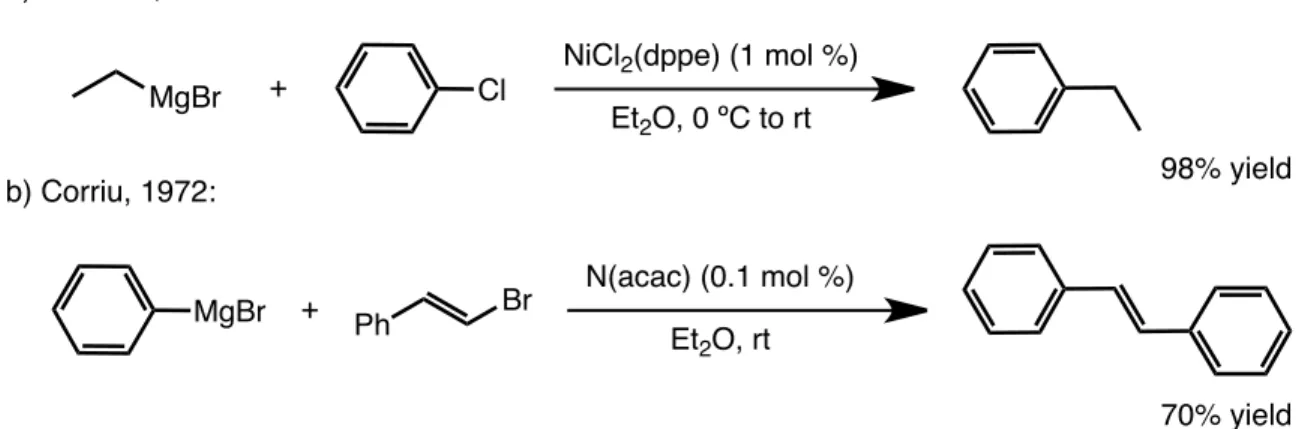
The first transition metal catalyzed cross coupling reactions of Csp2 halides were independently reported by Kumada and Corriu in 1972 (Figure 20). 30 Reacting
Figure 20. Early examples of cross coupling reactions.
MgBr + Cl
NiCl2(dppe) (1 mol %)
Et2O, 0 ºC to rt
MgBr + Ph Br N(acac) (0.1 mol %) Et2O, rt a) Kumada, 1972:
b) Corriu, 1972: 98% yield
70% yield
X
X = Cl, Br, I OTs, OTf oxidative
addition reductive
elimination Ni0L
n
LnNiII X
R MgBr X MgBr
LnNiII R R
Grignard reagents with aryl or vinyl halides in the presence of a Ni catalyst system, Kumada and Corriu obtained high yields of the desired cross–coupling products.
The mechanism for this transformation was proposed to begin with oxidative addition of the aryl halide with the electron–rich Ni(0) catalyst (Figure 21). The Ni(II) intermediate thus generated was hypothesized to undergo a transmetalation with the organomagnesium coupling partner, followed by a reductive elimination to regenerate the active catalyst and reveal the observed coupling product.
A major drawback of the Kumada and Corriu systems, however, is the highly reactive organomagnesium reagents used for the transformation. Use of these reagents affects the
Figure 22. Transition–metal–catalyzed coupling reactions.
X
X = Cl, Br, I OTs, OTf Pd
(PPh 3)4 p–Me
Ph Sn
Bu 3 X = Br Sti
lle coup ling Pd (PPh 3) 4 X = I Negishi coupling Pd(PPh 3)4 Na2CO
3
R = p –CN,
X = C l
PhB(O H)2
Suzu ki co
uplin g Pd(O Ac)2 NBu3 Methy
l acry late
X = I Heck coupling Pd C l2 (PPh 3 )2
CuI X =
I So n o g o s h ir a c o u p li n g 98% yield CO2Me 81% yield NiCl 2(dp pe) EtMg Br X = Cl Kumada coupling nBu C5H11 82% yield ClZn C 5H 11 CN 80% yield
73% yield p–NO
substrate compatibility of the reaction, limiting it to base–tolerant components. Consequently, much of the early development of cross–coupling reactions focused on the development of milder variants of the Kumada and Corriu reactions. Such efforts led to the development of many novel cross coupling reactions including the Negishi 31, Suzuki 32, Stille 33, Sonogashira 34, and Heck 35 reactions (Figure 22). Since the discovery of these reactions in the 1970s, the field of transition metal catalyzed cross coupling reactions has rapidly evolved. To further realize the utility of these reactions in complex molecule synthesis, tandem reactions have been developed whereby organometallic intermediates are generated in–situ and diverted towards various coupling processes.
For example, in 1995 Keay and coworkers reported one–pot Shapiro–Suzuki reactions for the synthesis of vinyl arenes (Figure 23).36 Keay proposed an initial Shapiro reaction to generate a vinyl lithium intermediate. Exposing the lithiated species to boron isopropoxide yielded a boronic ester that participated in a Pd–catalyzed Suzuki coupling reaction to furnish the observed products. Similarly, we sought to develop one–pot cyclization/coupling reactions using our developed Ni–catalyzed [2+2+2] cycloaddition reactions.
Reactions of this nature are well known with enynes and organometallic reagents are typically used to achieve synthesis of value–added complex molecules. Kibayashi gave an early
NHNTris
1. nBuLi (3 equiv) hexane/TMEDA –78 ºC to 0 ºC 2. B(OiPr)3
3. Pd(OAc)2 (5 mol %) PPh3 (10 mol %) Bromobenzene Na2CO3
PhMe, reflux
55 % yield
Li B(OiPr)2
st
e
p
1
step 2
st
e
p
3
vinyl lithium boronic ester
example of a stannane–mediated alkenylative cyclization of malonate–tethered ene–ynes (Figure 24a).37 It was hypothesized that the reaction proceeded via an acid–mediated carbopalladation of the alkyne (Figure 25) to generate and alkyl–palladium intermediate. The intermediate alkyl– palladium species then reacted with a vinyl stannane in a Stille cross–coupling reaction to furnish the alkenylative cyclization product in a one–pot, two–step cyclization/coupling reaction
Figure 25. Proposed cycle for the Pd–catalyzed cyclizations of ene–ynes and vinyl stannanes.
BnO2C BnO2C
Pd2(dba)3•CHCl3 (5 mol %) AcOH (2 equiv) 18–crown–6 (0.3 equiv)
MeCN, reflux BnO
2C BnO2C
TMS PdOAcLn
BnO2C BnO2C
SnBu3 (2 equiv) TMS BnO2C
BnO2C
Pd2(dba)3•CHCl3 (5 mol %) AcOH (2 equiv) 18–crown–6 (0.3 equiv)
SnBu3
MeCN, reflux
BnO2C
BnO2C
a) Kibayashi, 1997:
86% yield (2 equiv)
Ni(COD)2 (10 mol %)
ZnCl2 (20 mol %)
ZrCp2Cl
THF, rt b) Montgomery, 2002:
80% yield (2 equiv)
COPh
PhOC
TsN
Ni(COD)2 (10 mol %) PBu3 (15 mol %)
CsF (2 equiv) B(OH)2
MeOH, 80 ºC
TsN c) Cheng, 2013:
93% yield (2 equiv) Ph Ph TMS TMS
sequence. The reactions performed optimally in the absence of phosphine ligand and displayed functional group compatibility on the stannane coupling partner; however, only unsubstituted ene–ynes were presented in the publication.
Montgomery in 2002 published a similar Ni–catalyzed transformation with greater steric compatibility (Figure 24b)38 and recently, the Cheng group disclosed sequential cyclization– Suzuki coupling reaction of N–tosyl amine–tethered ene–ynes for the synthesis of substituted pyrrolidines (Figure 24c).39 The reaction was tolerant of a wide array of substitution patterns on both the ene–yne and boronic acid, furnishing alkenylative cyclization products in moderate to excellent yields.
Unlike the Kibayashi system, Cheng’s alkenylative cyclization reaction was proposed to proceed via an initial oxidative coupling of the ene–yne reagent (Figure 26). Methanol–assisted protonolysis generated a Ni–alkoxide and transmetallation from boron mediated by the fluoride
Figure 26. Proposed cycle for the Ni–catalyzed cyclizations of ene-ynes and boronic acids.
TsN TsN
Ph
Ph
Transmetallation
Oxidative Coupling Reductive
Elimination
TsN
Ph
NiIIL n
TsN Ph
NiII
H
OMe
Protonation
B(OH)2F B(OH)2
CsF +
TsN Ph
NiII
H
Ph
Ni0L n
salt led to the formation of a vinyl–Ni intermediate. Reductive elimination was proposed to lead to the formation of the alkenylative cyclization product and regenerate the active catalyst. Reactions of the type shown in Figure 24 are well known with pre–functionalized organometallic fragments (e.g. stannanes, boranes, zincates, aluminates)40 and indeed many of these reactions utilize Stille, Suzuki, or Negishi terminating steps.41 However, few are the applications of this mode of reactivity using unfunctionalized alkene fragments in a
cyclization–Heck coupling process. A rare example of an ethenylative cyclization reaction of ene–ynes was published in 2003 by Mori (Figure 27). 42
Mori proposed that upon oxidative coupling of the ene– yne substrate and subsequent insertion of ethylene, the ruthenacycle intermediate
X
X Cp*RuCl(cod) (5 mol %)
ethylene (1 atm)
R2
R1 R1
R2 PhMe, rt H H BnO BnO 78% yield TsN H H 83% yield BnN H H 49% yield O
CO2Me
H MeO2C
MeO2C
72% yield
H
CO2Me BnO
BnO
89% yield
Figure 27. Ru–catalyzed ethenylative cyclizations of ene–ynes.
X X R [Ru] X R [Ru] X [Ru] R X [Ru] R H α β [Ru] R X R
Figure 28. Proposed cycle for Ru–catalyzed alkenylative
underwent β–hydride elimination followed by a C–H reductive elimination to produce the observed alkenylative cyclization product (Figure 28). Although variations in the tethers were presented in Mori’s publication, there is little mention of substituent effects on the alkene or alkyne functionalities of the tethered substrate. Additionally, Mori does not discuss applications of this chemistry to substituted external alkenes. Realizing an opportunity to contribute to this
growing field, we sought to apply our Ni–based methods towards the development of a general class of alkenylative cyclization reactions (Figure 29). Herein we report the results of our findings.
Reaction optimization.
We began our studies of Ni–catalyzed alkenylative cyclization reactions with ene–allene 1a and commercially–available tert–butyl acrylate (Table 4). It was determined that slow addition of the ene–allene substrate was necessary to minimize undesired substrate dimerization. In addition, five equivalents of the external alkene component were used to compensate for undesired acrylate polymerization. Although bidentate phosphine ligands generally led to poor reactivity,43 use of triphenylphosphine in THF at room temperature led to a 44% isolated yield of the desired alkenylative cyclization product (entry 1). Using the electron–poor tris(4– fluorophenyl)phosphine had minimal impact on the reaction efficiency; however, to our delight, the use of the small and electron–rich ligand tributyl phosphine led to an optimal 86% isolated
Figure 29. Ni–catalyzed alkenylative cyclizations of ene–allenes.
Functional group tolerant High yielding
Diastereoselective R1
R2
R R1
Alkenylative cyclization
H
H Ni catalysis
R
R2
yield of the desired diene product (entry 2–3). Larger electron–rich ligands, such as tri–tert– butyl phosphine did not produce any alkenylative cyclization product and instead, gave the
[2+2+2] cycloaddition product in a 38% isolated yield (entry 4, see Chapter 1 for related discussion).44
Taking these factors into consideration, we identified the optimal reaction conditions to be Ni(COD)2 (0.1 equiv.), tributylphosphine (0.2 equiv.), ene–allene (1 equiv. added over 1.25 hours), and external alkene component (5 equiv.) in benzene at 45 ºC (Table 4, entry 3).
Scope evaluation.
Although methylene tethers were not well tolerated, nitrogen– and oxygen– tethered substrates reacted with similar efficiencies to the malonate tethered substrates, giving the corresponding products in 90% and 82% yields respectively (Figure 30, 3a–3c). With respect to the external alkene component, a variety of electronic and sterically diverse components readily
Entry EtO2C EtO2C
CO2Me
O
OtBu
Ni(COD)2 Ligand
EtO2C EtO2C
CO2Me CO2tBu
Ni(COD)2 (equiv)
Ligand Ligand
(equiv) Solvent Temp. (°C) Isolated Yield (%)
1
3b
2
4
0.25 P(4–FPh)3 1 PhMe 100
0.1 PBu3 0.2 PhH 45
0.1 PtBu 0.2 PhH 45
3
--0.25 PPh3 1 THF 23
55
86
44 H
H
(1 equiv)a (5 equiv)
Solvent Temperature
a Ene–allene added over 0.75 hours; b ene–allene added over 1.25 hours.
1a 3a
participated in the alkenylative cyclization reaction. For example, reactivity was even observed with unactivated olefins such as cyclopentene and 1–hexene, giving 49% and 60% isolated yields respectively (3d–3e). In addition, electron–poor alkene such as acrylates (3a–3c), acrylonitriles (3f), vinyl sulfones (3g), and styrenes (3h–3i) gave the corresponding products in modest to excellent yields. Lastly, trans–
and cis– disubstituted alkenes,
exemplified by ethyl crotonate (3j)
and indene (3k), reacted under our conditions, albeit with higher catalyst loadings, to furnish alkenylative cyclization products in 41% and 36% yields respectively. In the case of 3k, isomerization to the thermodynamically favored tetrasubstituted olefin, in conjugation with the aromatic system, was observed.
Initial stereochemical assignments were made using 2D NMR spectroscopy (see Appendix III for full spectra) and later confirmed with an x–ray structure of the indenyl substrate 3k (Figure 31). 45 The x–ray structure confirms the cis
Figure 31. Crystal structure
Figure 30. Scope of alkenylative cyclization reactions.
X MeO2C
CN
61% yield X = C(CO2Et)2
H
H R1
X RO2C
R1
H
H R
2
5 equiv
Ni(COD)2 (10 mol %)
PBu3 (20 mol %)
X
CO2R
1 equiv a
PhH, 45 °C R2
X MeO2C
CO2Et
41% yield b
X = C(CO2Et)2
H
H Me
X MeO2C
49% yield X = C(CO2Et)2
H
H
X MeO2C
60% yield X = C(CO2Et)2
H
H nBu
H
TsN
Me H
H 36% yield c
MeO2C
X MeO2C
SO2Ph
40% yield X = C(CO2Et)2
H
H
X MeO2C
52% yield X = C(CO2Et)2
H
H
CF3
X MeO2C
66% yield X = C(CO2Et)2
H
H
Me X
MeO2C
CO2tBu
86% yield X = C(CO2Et)2
H
H
TsN MeO2C
CO2tBu
90% yield H
H
O EtO2C
CO2tBu
82% yield H
H
a Ene–allene added over 1.25 hours; b Run with 30 mol % Ni(COD)
2 and 60 mol % PBu3; c Run with 25 mol % Ni(COD)
2 and 50 mol % PBu3.
3a 3b 3c
3d 3e 3f
3g 3h 3i
3j 3k
stereochemistry of the disubstituted N–tosyl pyrrolidine and the isomerization of the olefin.
Mechanistic discussion.
We propose an initial coordination of the ene–allene followed by oxidative coupling to give the bicyclic intermediate 5 (Figure 32). Insertion of the external olefin leads to the seven– membered nickelacycle 6. It is well known that small, electron–rich phosphine ligands can facilitate β–hydride elimination.46 With the small and electron–rich tributyl phosphine ligand,20 we propose β–hydride elimination from 6 followed by C–H product–forming reductive elimination to furnish the observed alkenylative cyclization product.47
The regioselectivity of the olefin insertion step is determined by the polarization of the olefin, however, in the absence of such a polarizing effect, we observe that steric interactions become a determinant factor (Figure 30, 3e).48 With these unactivated olefins (eg. 1–hexene), insertion occurs to place the alkyl
chain in the least sterically encumbering position, ultimately leading to the product regioisomer observed in 3e.
To obtain further insight into the ligand selectivity observed with our intermolecular nickel–catalyzed reactions, we turned to computational studies.49 DFT calculations using B3LYP
R1
R2
Ni0L n
X
CO2R
NiIIL n X
NiIIL n
R2 R1 RO2C
X
NiIIL n
R2 R1 RO2C
H
α β
LnNi0 X
RO2C R1 R2 H H H H H H H H X
CO2R
X
CO2R
Figure 32. Proposed cycle for Ni–catalyzed alkenylative
cyclizations of ene–allenes.
were performed for the two reaction pathways: ([2+2+2] cycloaddition and alkenylative cyclization) with L=P(C4H9)3 (Figure 33). The Pople’s standard 6-311+G(d)was used for all elements. Calculations were performed with Gaussian 09 DO1 package with tight SCF convergence and ultrafine integration grids. For transition-state structure searches, a single-point frequency calculation was performed to ensure that the final structure obtained (i) has only one imaginary frequency and (ii) the vibration mode of the negative frequency corresponds to the bond formation that is anticipated. In addition, intrinsic reaction coordinates (IRC) were calculated to verify the relevance of transition-state structures.
Methyl acrylate and a dimethyl malonate tether were used as a model substrate to
+ NiLn
n = 2
Figure 33. DFT calculations of β–hydride elimination vs. reductive elimination pathways of A
simplify the calculations. The difference in the activation energies of the reductive elimination and β–hydride elimination pathways was determined to be 28 kcal/mol. This large difference in activation barriers is in agreement with our experimental observations and explains why no formation of the [2+2+2] cycloaddition product is detected with this catalyst system.50
Post–substrate modifications.
The products formed in these reactions are structurally interesting and present many avenues for product diversification. Taking advantage of the acidic protons present in the products, a 5–exo cyclization can be used to construct isomeric fused 5–5 carbocyclic structures (Figure 34, eq. 1–2).51
As expected, treating 3a with excess LDA resulted in the formation of an octahydropentalene core in 37% yield as a 1.2:1 mixture of diastereomers (Figure 34, eq. 1). To achieve complete conversion, excess base was required to compensate for acidic protons also present in the product. Although the excess base ensures complete reaction of the starting material, it could also be responsible for the epimerization of the product. Interestingly, only the product resulting from the kinetically–favored 5–exo cyclization is obtained while the product resulting from the slower 5–endo cyclization pathway is not observed (eq. 1–2).52
Figure 34. Post–substrate modifications of
alkenylative cyclization products (X = C(CO2Et)2).
X
CO2Me
CO2tBu H H H X H H MeO2C
CO2tBu
Diels–Alder X H H R R2 X H H R R2 X
CO2Me H
H X
H
H MeO2C
CO2tBu H
H H
CO2tBu
~1.2:1 mixture of diastereomers 37% yield (unoptimized)
not observed LDA (3.0 equiv)
THF –78 ºC to rt
LDA (3.0 equiv)
THF –78 ºC to rt
Yields have not been optimized, however it is worth noting that this transformation may be used to achieve a two–step synthesis of cis–fused octahydropentalene cores present in many natural occurring compounds (Figure 1).
Products of this nature may also participate in Diels–Alder reactions (eq. 3).53 Using diene products formed in our alkenylative cyclization reactions, a Diels–Alder reaction can facilitate rapid access to complex molecular architectures from simple acyclic, achiral reagents. The transformations discussed herein represent a subset of the many possible avenues of post– reaction modifications available with this class of products.54
Summary.
CHAPTER 3. [2+2] CYCLOADDITION REACTIONS Background.
The cyclobutane functionality is present in many natural and bioactive molecules (Figure 35).55 In addition, as demonstrated by Suffert 56 and others 57, the inherent ring strain of
cyclobutanes (26 kcal/mol)58 allows them to serve as useful synthetic intermediates (Figure 36). For example, Suffert’s 2001 total synthesis of ascosalipyrolidinone sequentially uses two key cyclobutane intermediates: the first undergoing a 6π–disrotatory cyclization and the second a cascade ring opening process to relieve ring strain and generate a cis–fused decalin intermediate which was further elaborated to the natural product. Despite their importance and utility as synthetic intermediates, protocols for the selective synthesis of cyclobutane units are limited
O Pt
O O
O H3N
H3N
paraplatin chemotherapy drug
O
OH
pentacycloanammoxic acid anammoxosome membranecomponent
OH H Me Grandisol Pheromone Me HO H H Artochamin H Cytotoxin H H H NHCOCH3 OMe O MeO MeO MeO β–Lumicolchicine Cytotoxin OH OMe Me Me HO Me
(Figure 37). Because of improper orbital overlap, thermal [2πs+2πs] cycloaddition reactions are symmetry forbidden transfor–
mations; although they are symmetry allowed, [2πs+2πa] cycloaddition reactions lead to a high–energy cyclobutane confor– mer and for these reasons, concerted thermal [2+2] cycloaddition reactions are rarely observed (Figure 37a). Non– concerted [2+2] photocyclo– additions of olefins have been shown to lead to cyclobutane products. The earliest application of the photochemical [2+2]
Figure 36. A cyclobutane–mediated synthesis of Ascosalipyrrolidinone.
Br HO
TMS
HO Pd(PPh3)4
Bu3Sn SnBu 3
SnBu3 TMS
6π disrot. HO HO TMS SnBu3 HO OH H H O H N RO O Ascosalipyrrolidinone PhH, 90 ºC
O OH
H
H
6 steps from cyclohexenone
Δ
+
homo lumo
[2πs+2πs] cycloaddition symmetry forbidden
homo
lumo
[2πs+2πa] cycloaddition geometrically forbidden
a) Thermal [2+2] cycloaddition:
b) Photochemical [2+2] cycloaddition:
O O sunlight carvone carvone camphor via: O I I activated copper
14 % yield
c) Reducing metal conditions:
+ +
cycloaddition reaction is the “Italian–sunlight” mediated total synthesis of carvone camphor (Figure 37b). The reaction, discovered by the Italian chemist Giacomo in 1908, features an intramolecular [2+2] cycloaddition of carvone to yield a single isomer of the camphor derivative. Intermolecular variants of this reaction are known, however, the selectivity is highly substrate dependent and mixtures of isomers are usually obtained.59 Additionally, predicting the major isomer can be challenging.60 Alternatively, under reducing metal conditions (e.g. Hg, Na, Mg, Sn, Cu), 1,4–dihalobutanes can react to form cyclobutane products however the metals used in these transformations are often pyrophoric or highly toxic.61 In addition, the yields obtained are often quite low due to competing elimination pathways (Figure 37c). An alternative route towards the synthesis of these valuable products involves transition–metal–catalyzed [2+2] cycloaddition reactions. For
example, Toste in 2007 published [2+2] cycloaddition reactions of tethered styrenes and substituted allenes using a cationic gold catalysis and in 2011, Mascereñas reported [2+2] cycloaddition reactions of ene–dienes using a ruthenium catalytic system (Figure 38a and 38b). 62 , 63 However, these reactions typically require styrene or diene components and substituted
Figure 38. Allenes in [2+2] cycloaddition reactions.
X Ph X Ph H H
5 mol % Ph3AuCl 5 mol % AgBF4
DCM, rt X = C(CO2Me)2
Me
Me
80 % yield
X X
H
H
10 mol % RuH2Cl2(PiPr3)2
DCE, 45 ºC X = C(CO2Me)2
Me 86 % yield
Me X R1 X R1 H H Ni Catalysis R3
up to 95 % yield R3 a) Toste, 2007:
b) Mascereñas, 2011:
c) Noucti, Alexanian, 2014:
R2
R2 This work
allenes as reactions partners. We sought to develop a general, catalytic [2+2] cycloaddition transformation tolerant of a broader range of π–components (Figure 38c). Herein we report the results of our findings.64
Reaction optimization.
During the course of our studies of the intermolecular reaction of tethered ene–allene substrates with external alkene components, we noted that the use of large bite–angle phosphine ligands such as Xantphos 65 led to the exclusive formation of a cyclobutane as a single diastereomer without incorporation of the external alkene component (Figure 39, eq. 1). At 100 ºC the product is isolated as a 1:1 mixture of diastereomers however, decreasing the temperature
to 80 ºC led to a diastereoselective reaction, albeit in reduced yields (eq. 2). Removing the
O
OtBu
Ni(COD)2 (10 mol %) Xantphos (10 mol %)
5 equiv
PhMe, 100 ºC
EtO2C EtO2C
CO2Me
1 equiv
CO2Me H
H
44% yield
mixture of diastereomers
EtO2C EtO2C
O
OtBu
Ni(COD)2 (10 mol %) Xantphos (10 mol %)
5 equiv
PhMe, 80 ºC
EtO2C EtO2C
CO2Me
1 equiv
CO2Me H
H
25% yield
1 diastereomer
EtO2C EtO2C
Ni(COD)2 (10 mol %) Xantphos (10 mol %)
PhMe, 80 ºC
EtO2C
EtO2C
CO2Me CO
2Me H
H
48% yield
1 diastereomer EtO2C
EtO2C
(1)
(2)
(3)

![Table 1. Initial screen of Ni–catalyzed [2+2+2] cycloaddition reactions of ene–allene 1](https://thumb-us.123doks.com/thumbv2/123dok_us/8229072.2181418/24.918.114.814.159.574/table-initial-screen-ni-catalyzed-cycloaddition-reactions-allene.webp)


![Figure 16. Plausible mechanism for Ni–catalyzed [2+2+2]](https://thumb-us.123doks.com/thumbv2/123dok_us/8229072.2181418/30.918.380.806.103.405/figure-plausible-mechanism-for-ni-catalyzed.webp)
![Figure 17. Ligand survey in asymmetric Ni–catalyzed [2+2+2] cycloaddition reactions. PPh2PPh2(R)–BINAPatrace product(R)–DIFLUORPHOSa30% yield, 7.0% eeOOOOFFFFPPh2PPh2(R)–SEGPHOSa30% yield, 4.5% eeOOOOPPh2PPh2OO(R)–MonoPhosatrace productP NOO(S)–MonoPhosat](https://thumb-us.123doks.com/thumbv2/123dok_us/8229072.2181418/31.918.139.780.102.997/asymmetric-catalyzed-cycloaddition-binapatrace-difluorphosa-eeooooffffpph-monophosatrace-monophosat.webp)
![Figure 19. Chiral diene ligands in Ni–catalyzed [2+2+2] cycloaddition reactions.](https://thumb-us.123doks.com/thumbv2/123dok_us/8229072.2181418/33.918.118.812.110.257/figure-chiral-diene-ligands-ni-catalyzed-cycloaddition-reactions.webp)