“ONE LINE FLOWS, YEAH I GOT SOME OF THOSE”: GENRE, TRADITION, AND THE RECEPTION OF RHYTHMIC REGULARITY IN GRIME FLOW
Alexander Harvey Marsden
A thesis submitted to the faculty at the University of North Carolina at Chapel Hill in partial fulfilment of the requirements for the degree of Master of Arts in the Department of Music
Chapel Hill 2017
© 2017
ABSTRACT
Alexander Harvey Marsden: “One Line Flows, Yeah I Got Some of Those”: Genre, Tradition, and the Reception of Rhythmic Regularity in Grime Flow
(Under the direction of Jocelyn Neal)
TABLE OF CONTENTS
LIST OF FIGURES……….…...vi
CHAPTER 1: THE HISTORY AND AESTHETICS OF GRIME…...………...…….1
Introduction………..………1
The Prehistory of Grime in London’s Clubs: International Stylistic Influences and the Development of a Scene………...5
Grime’s Beginnings………...9
Grime’s Unrealized Crossover Promise and its DIY Scene………....11
The Nostalgic Resurgence of Grime………...15
Grime, Analysis, and Intersubjectivity: Mapping the Discourse and Argument…….….18
CHAPTER 2: REGULARITY IN GRIME FLOW..……….….22
How to Rap British: Flow and Genre………..22
Regularity of Flow in “That’s Not Me”………..23
Grime Flow Regularity Beyond “That’s Not Me”………..31
Categorizing Grime Flow………...…36
CHAPTER 3: “I GOT THE WHOLE CROWD BUBBLING LIKE A CRACK POT”: REGULARITY, PARTICIPATION, AND PLEASURE……….41
Introduction: What is Engaging about Regularity in Rap Flow?...41
Repetition and Participation………...43
Listening to EDM: Process Pleasure and Perceptual Play………..45
Rhythmic Layers in the “That’s Not Me” Beat………...48
Grime Flow: Stimulating Process Pleasure……….56
Conclusion………...………..64
BIBLIOGRAPHY……….……….68
DISCOGRAPHY.………..71
LIST OF FIGURES
Figure 1 - “That’s Not Me” chorus and first verse. Grid transcription……….25
Figure 2 - “That’s Not Me” chorus and first verse. Traditional notation……….…26
Figure 3 - Rhythmic repetition in “That’s Not Me” chorus, bars 2-4………....28
Figure 4 - Rhythmic correspondence in “That’s Not Me” chorus, bars 5 and 7………29
Figure 5 - Motivic consistency in “That’s Not Me,” bars 9-11………..30
Figure 6 - Cadence patterns in “That’s Not Me,” bars 9-16………30
Figure 7 - “That’s Not Me” bars 9-16, cadences highlighted………31
Figure 8 - “Pow 2011” chorus and first verse. Grid transcription……….32
Figure 9 - “Pow 2011” chorus and first verse. Traditional notation………..33
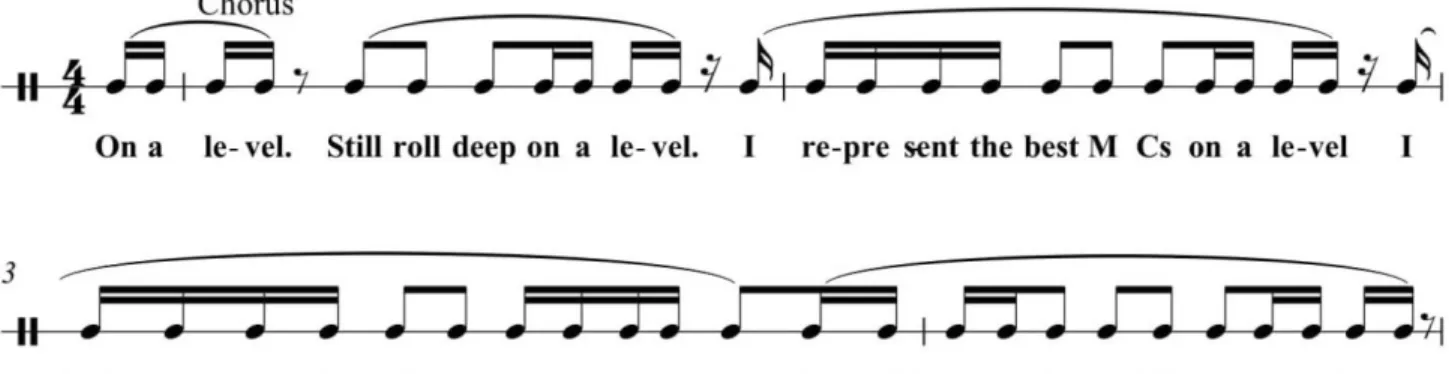
Figure 10 - “On a Level” chorus and first verse. Grid notation……….34
Figure 11 - “On a Level” chorus and first verse. Traditional notation………...35
Figure 12 - “That’s Not Me” beat………49
Figure 13 - “That’s Not Me” beat patterns……….50
Figure 14 - “That’s Not Me” third verse (1:54-2:21). Grid notation………..59
Figure 15 - “That’s Not Me” third verse (1:54-2:21). Traditional notation………...60
Figure 16 - “That’s Not Me” first verse (0:41-1:08). Grid notation………...61
Chapter 1: The History and Aesthetics of Grime
Introduction
In the introduction to his 2014 hit, “That’s Not Me,” the British grime rapper Skepta boasts, “one line flows, yeah I got some of those.”1 In grime parlance, “one line flows” are patterns within
lyrics where a rapper will finish every line of text of a verse with the same word or phrase. “One line flows” were a particularly common and distinctive stylistic feature of grime rapping in the genre’s early heyday in the early to mid-2000s.2 This brief moment acts as a framing device, as Skepta reaffirms his credentials within the genre and places the ensuing performance within this particular style. But, in so doing, Skepta is also implicitly participating in the never-ending process of differentiating and delineating among rap genres. This process inevitably involves politically charged questions about originality, homogenization, and localization.
This thesis takes as its case study grime, and proposes a model of its distinctive characteristics, focusing particularly on flow. Grime is undoubtedly British in its origins. Its stylistic influences, which have determined grime’s distinctive flow style, betray the unique configuration of genres and performance practices that are the result of the UK’s, and more specifically London’s position in the international movement of people, media, and musical styles
across the Black Atlantic.3 In addition, grime’s history as a dance music, its origins in a geographically specific EDM (electronic dance music) scene and lineage of dance genres, and the distinct role of the MC in this scene—itself a legacy of Caribbean-influenced performance practices—have shaped the genre and its characteristic style of flow.4 Indeed, the early scene and
the particular performance role of the MC in it have been central to the nostalgic, back-to-basics self-image of grime since the commercial resurgence, beginning with the release of “That’s Not Me.”
Throughout this thesis, I use the terms “flow” and “beat” as they are conventionally used in grime and hip-hop discourse. Generally speaking, “flow” is the way in which rappers deliver their lines. In this thesis, I predominantly focus on the characteristic rhythmic features of grime flow, but “flow” is a broadly defined term that can also encompass vocal timbre and the degree to which a rapper anticipates or lags behind the pulse. “Beat” is more clearly defined in grime and hip-hop discourse; it is the instrumental track over which an MC raps. The beat is often composed by someone other than the MC. This artist is known as the producer.
I follow Skepta in viewing “one line flows” as a characteristic lyrical device for grime MCs, but I also argue that “one line flows” are illustrative of broader characteristic features of grime flow. In this thesis, I argue that grime flow, in general, has greater tendency towards regularity than other styles of flow. In particular, it is significantly more regular than many American hip-hop styles of the 1990s and 2000s, which have been the focus of much of the academic work on
3 The concept of “Black Atlantic” was coined by Paul Gilroy to describe the shared cultural space of African and Afrodiasporic populations around the Atlantic. Paul Gilroy, The Black Atlantic: Modernity and Double
Consciousness, (Cambridge, MA: Harvard University Press 1993)
rap.5 Thus, as well as attempting to grapple analytically with regularity, this thesis is, in part, an answer to Oliver Kautny’s call for a “‘regionalized’ view on hip-hop cultures and their poetics,” to counteract a hitherto primary focus on American hip-hop.6
Regularity, as I refer to it in this thesis, is a concept that manifests in many musical domains. Broadly speaking, it implies repetition and predictability. With regards to harmony, for example, it might describe a chord sequence that repeats throughout a verse. Alternatively, one could describe a simple, unvarying verse-chorus song structure as being regular. When used to describe rap flow, it might describe phrase length, rhyme schemes, structures of accents, and rhythmic patterns. By contrast, irregularity implies a relative lack of repetition and unpredictable and surprising musical structures.
In this analytic consideration of regularity, this thesis enters into long-standing theoretical debates about repetition, predictability, and complexity. These debates have been particularly central to pop music analysis, in which analysts have sometimes highlighted complexity as a means of legitimizing an otherwise maligned genre (and, by extension, the study of it). Indeed, an early trend in academic analyses of hip-hop flow was towards identifying and lauding complex structures and rhythmic patterns. Kautny argues against this tactic, cautioning against academic hip-hop analysts “focusing on the aspects [of rap music] which fit their values best.”7 Writing
5 The relationship between hip-hop and grime is hotly contested. MCs and others in grime discourse have adopted various positions in this debate including: that grime is a completely distinct tradition from hip-hop; that grime is a subgenre of hip-hop, and; that grime is the UK’s version of, or answer, to hip-hop. These debates are complicated and raise historiographical questions of influence, and political and ethical questions about articulation international commonalities or local particularities of Black Atlantic cultures. For the purposes of this thesis, however, I
emphasise both grime’s distinct history and musical stylistic features, and, as a rap genre, the clear debt of influence it pays to American hip-hop.
6 Oliver Kautny, “Lyrics and Flow in Rap Music” in The Cambridge Companion to Hip-Hop,ed. Justin Williams, (Cambridge: Cambridge University Press, 2015), 114
against a trend in early rap analysis essays to predominantly focus on irregular and intricately woven patterns of flow, he argues that, “[i]t is easy to fall into the ‘trap of complexity,’” overlooking the fact that complex flows are not appreciated by all members of the hip-hop community.”8 He concludes that “the study of flow needs a corrective,” of which his sketching of
the “articulative” dimensions of flow is one approach.9
As a way of avoiding the “trap of complexity,” I take grime flow’s regularity seriously, and ask how listeners and fans might find it pleasurable or engaging. Through an analysis of “That’s Not Me,” I argue that it encourages a kind of heightened and participatory attention in its listeners, and that small rhythmic changes and shifts in accent placement within a predominantly regular framework continuously stimulate the listener’s creative play of attention and entrainment.10 In other words, I would argue that this style of flow is a crucial part of what makes grime sound so rhythmically exciting and energetic, and that it encourages its listeners to move along with it.
In this thesis, then, I identify a tendency towards regularity as a characteristic feature of grime flow, one that is a result of the genre’s function as a dance music, and the performance traditions it inherited from other Caribbean-influenced music scenes in the UK. I argue that grime flow, in its regularity, encourages its audience to listen to it in an actively and bodily engaged manner.
8 ibid, 115. These “articulative” dimensions include the degree to which a rapper’s speech style is slurred or clipped, and the degree to which they place their syllables before or after the beat.
9 ibid, 115
In so doing, by proposing a model of the pleasures of this regular style of flow for its listeners, I contribute to academic discourse about what listeners engage with in rap. This model may be instructive for other styles of flow and other dance-oriented rap genres and styles, and so does not describe a model of listening that is necessarily unique to grime. Nevertheless, this model is distinct from accounts of rap’s value that focus predominantly on texts, as well as from those that highlight complex and intricate flow patterns, which tend also to deal primarily with less dance-oriented styles of hip-hop, such as gangsta rap and jazz rap.
The Prehistory of Grime in London’s Clubs: International Stylistic Influences and the Development of a Scene
The distinctive flow style and performance function of grime MCs are, in no small part, the legacy of the genre’s genealogy. This genealogy reflects the unique mixing of popular musical styles in Britain’s post-imperial cities, in which American styles compete with, and are refracted through Caribbean and Northern European influences. The history of rap in the UK, in particular, reflects both the international spread of American hip-hop, facilitated largely by multinational record labels and media platforms, and the longer-term, if more geographically limited germination of Caribbean rap styles and performance practices.11 In this chapter, I trace this history, introduce the genre, and briefly survey the academic literature on grime.
Since the 1950s, following the first waves of migration from what were then British colonies in the Caribbean, popular music styles from Trinidad and, in particular, Jamaica have had
11 For a broader survey of the influence of hip-hop on various styles of British popular music, see David
a strong foothold in London, Birmingham, and other large cities. In the 1960s, labels such as Island Records began to import records from Jamaica to sell to recent migrants as well as to white British fans. The influence of these musical styles on music that emerged from the UK was particularly clear in the late 1970s. For example, the “second wave” ska revivalist movement, as represented by bands such as The Specials, The Selector, and Madness, explicitly imitated the sounds and rudeboy sartorial style of early ‘60s Kingston, Jamaica.
However, it was not only the music styles themselves that were influential in the UK, but also the particular performance practices that accompanied them. Since the 1960s, Jamaican-style sound systems had operated in London, Birmingham, and elsewhere. “Sound systems” refers to a business model in which DJs would be hired to provide music for parties and club nights, and would bring with them a proprietary set of large speakers and a closely guarded personal record collection.12 DJs would also hire MCs to act as hype men, singing, praising the DJ and the club, encouraging people to dance, and rapping short phrases.13 Audiences appraised sound systems by the performance skills of the DJ and MC, the quality and distinctiveness of their record collection, and the quality, tone, and power of the speakers.
These sound systems, and the role of the MC in them, helped shape Britain’s club culture in the late 1980s and ‘90s, and the music that was produced in this scene. The UK’s first nightclubs devoted to electronic dance music (EDM), such as the famous Shoom in Southwark, opened in
12 The term “sound system” is also used to refer to the sets of speakers themselves.
London in the late ‘80s.14 As well as being directly inspired by the all-night house and techno clubs
of Ibiza, a popular holiday destination for young Britons, these clubs were influenced by sound systems.15 Other institutions of London’s EDM culture, most notably pirate radio stations, similarly drew on sound system culture.16 In clubs and on air, MCs would accompany DJs by
rapping over the records in a manner reminiscent of MCs at sound systems.
The first music to be produced in this scene was hardcore rave. This style, which was popular in the late ‘80s and early ‘90s in clubs and at large outdoor raves, was influenced more by American house and techno, and trance from the Low Countries, than by Caribbean dance music styles. However, MCs remained a part of the scene, albeit infrequently featured on records, and the later styles of British EDM drew more obviously from Caribbean styles.17
Jungle, or drum n’ bass, as it came to be known, combined the keyboards and vocal samples of rave, low basslines borrowed from dub and dancehall, and, most distinctively, sped up and timbrally altered drum breakbeats from hip-hop.18 Unlike in hardcore rave, MCs were occasionally
14 Simon Reynolds, Energy Flash: A Journey Through Rave Music and Dance Culture, 3rd edition, (New York: Soft Skull Press, 2012), p.38
15For an academic account of this scene, from a sociological perspective, see, Thornton, Sarah. Club Cultures:
Music, Media and Subcultural Capital. Cambridge: Polity Press, 1995.
16 Pirate radio stations, so named after 1960s stations, such as Radio Caroline, which escaped Britain’s broadcasting laws by transmitting from offshore ships, proliferated in London in the 1980s and ‘90s. These largely youth-run stations would have a broadcast range of only a few miles and would often be set up in tower blocks to boost their range. They were illegal and the police targeted them, saying that their broadcasts could interfere with the radio communications of the emergency services. Many of these stations were devoted to electronic dance music. For more on this, see Alice Nicolov, “The history of UK pirate radio – and why it’s still here,” Dazed, January 19, 2017, http://www.dazeddigital.com/music/article/34394/1/pirate-radio-history-and-future, accessed July 2, 2017.
17 It is worth noting that while Caribbean popular music performance styles and practices have been highly
influential on grime rapping, many grime MCs do not have family backgrounds in the Caribbean. Black grime MCs, to say nothing of the many non-black grime musicians, are just as likely to have family who migrated to the UK from Ghana, Nigeria, Somalia, and elsewhere in Africa than the Caribbean.
featured on jungle records, but the producer—rather than the MC—was still credited as the main artist behind a record. A particularly famous example of a jungle track featuring an MC is M Beat’s “Incredible,” which features General Levy rapping in a dancehall style, with heavy use of Jamaican patois.19
Jungle flourished in the UK in the mid-90s, before it was overtaken in the late ‘90s in London’s clubs by UK garage.20 This style again reflected British dancers’ tastes for faster tempos
than those preferred by American producers. Simon Reynolds describes how the style first developed around 1997 after DJs started playing contemporary American R & B records, by artists such as Brandy and Monica, at faster speeds.21 British producers soon started to make their own
tracks that replicated the sound of these manipulated American records. Unlike jungle, which had used heavily manipulated sampled drum beats, they used synthesized drums, with characteristic “shuffling” hi-hats, but they did use low, syncopated basslines, similar to those featured in jungle. UK garage was popular in Britain’s clubs, and its more forgiving tempos and timbres made it more amenable to popular crossover.22 In addition, UK garage fit the mold of mainstream pop
more easily than jungle and hardcore rave, as it was more orientated around vocalists than these earlier genres. Garage singers such as Craig David and production/vocalist teams such as Oxide
19 M-Beat ft. General Levy, “Incredible,” Renk Records, RENKT42, 1994, 12” record
20 Drum n’ bass was, however, the first Britain EDM genre to spread beyond the UK’s club culture. Although it lost its pole position in the UK’s EDM culture, it maintained a significant international following off dancefloors.
21 Reynolds, Energy Flash, 419
and Neutrino achieved success in the UK Singles chart in the late ‘90s and the first two years of the new millennium with party hits and songs about young love.
Alongside the increasing public popularity of these “good times” tracks, a parallel stream of development in UK garage was the increasing prominence of MCs and rappers. As with jungle, MCs remained a key part of the scene in which UK garage was produced and performed, but increasingly they were also featured on records, and even identified as the main artists in UK garage. MCs such as Ms Dynamite, and crews of MCs and producers, such as Heartless Crew and Pay As U Go Cartel (whose member Wiley, real name Richard Cowie, went on to be key figure in grime) released garage tracks but drew on the model of American rappers and hip-hop crews for their public and artistic personae as the primary, rather than secondary, authors of this music. Indeed, the turbulent career of the most well-known UK garage crew, So Solid Crew, even inspired moral panics in the British press in a similar vein to those in the American press surrounding hip-hop groups such as N.W.A, particularly following the conviction of Carl Morgan, one of their members, for murder in 2005.
Grime’s Beginnings
male.23 More Fire Crew’s 2001 single, “Oi” is illustrative of this shift in imagery and sound.24 Released before the label “grime” had emerged, More Fire Crew described themselves as UK garage at the time, but their lyrics and music video provided the blueprint for later grime tracks.25 They rap about their personal and collective prowess, and make threats against any other MCs who dare to challenge them. In the video, shots of More Fire Crew rapping in London council estates, at parties, and in carparks are interspersed with shots of people doing tricks on motorcycles.
Musically, “Oi” also contains a number of features that would become increasingly common in, and characteristic of grime. For example, the orchestral synthesizer timbre doubling the bassline in much of the track is a recurring technique in grime production, one that is frequently used to create a quasi-cinematic, “dark,” and dramatic mood in tracks such as Skepta’s “Shutdown.”26 The slight distortion on the square wave synthesizer patches used for the bassline
is another common grime production technique. Wiley’s early 2000s instrumental tracks, such as “Igloo,” “Eskimo,” and “Ice Rink” made use of similar synth timbres, and were highly influential on other grime producers.27 “Oi’s” pattern of changing synthesizer timbres every eight bars is
another central feature of grime beats. At 135bpm, “Oi” is also close to grime’s typical tempo of 140bpm.
23 Notable exceptions include Shystie, Lady Sovereign, Lady Leshurr, and Lady Chann 24 Platinum 45 featuring More Fire Crew, “Oi!” FTL FTL009, 2001, 12” record
25 “More Fire Crew,” Designer Magazine, n.d., http://designermagazine.tripod.com/MoreFireCrewINT1.html, accessed May 31st 2017
26 Skepta, “Shutdown,” on Konnichiwa, Boy Better Know BBKS004CD, 2016, compact disc
Grime’s Unrealized Crossover Promise and its DIY Scene
The popularity of “Oi” and Wiley’s instrumentals contributed to a growing sense of interest and excitement around this new style emerging from London. Other focal points were Wiley’s new, loose-knit crew Roll Deep and their shows on Rinse FM, a major pirate radio station, and Roll Deep member Dizzee Rascal’s track “I Luv U.”28 This record, originally self-released in 2002 as a “white label,” sold highly.29
The 18-year old Dizzee Rascal was given a record contract with the prominent independent label, XL Records. His first album, Boy in Da Corner, marked grime’s first breakthrough moment into public consciousness.30 In 2003, it won the prestigious Mercury Music Prize, thus propelling Dizzee Rascal, real name Dylan Mills, into Britain’s newspapers and mainstream radio stations.
Dizzee Rascal’s sudden critical and commercial success created a sense of commercial promise in the grime scene, further strengthened by the chart success of former More Fire Crew member Lethal Bizzle’s 2004 hit “Pow! (Forward).”31 A number of grime MCs, including Bizzle
(real name Maxwell Owusu Ansah), Wiley, and Kano were signed by major labels and prominent independent labels in the period from 2002 to 2005. However, for the most part, the albums and singles they released were commercially unsuccessful, and within a few years, these MCs were
28 Dizzee Rascal, “I Luv U,” no label DS – 001, 2002, 12”
29 “White labels” were self-released records pressed in limited runs, often of only a few hundred records, primarily for use by DJs.
dropped from their labels. The first foray of grime into a more public and commercial space fizzled out.
The exception to this trend was Dizzee Rascal, whose second and third albums, Showtime (2004) and Maths+English (2007) sold over 100,000 copies in the UK.32 His musical style,
however, drifted further from that of “I Luv U.” Although he retained his distinctive vocal timbre, his stylistic influences became increasingly diverse and increasingly international. Maths+English sampled James Brown and featured a collaboration with the American rap group UGK. He achieved true mainstream success in the UK with his fourth album Tounge N’Cheek (2009), on which he collaborated with dance/pop producers Calvin Harris and Armand Van Helden, and which included four #1 singles.33 The Calvin Harris-produced single, “Bonkers,” which Rascal performed in the 2012 Olympic opening ceremony, is representative of this crossover style. Rascal raps lyrics about partying over a four-on-the-floor house beat, with a mid-heavy electropop synthesizer timbre.34
Other British MCs produced similar house and electropop inflected party tracks, perhaps with a similar eye on the crossover market, with varying degrees of commercial success. Skepta’s 2009 electropop-esque “Rolex Sweep,” failed to chart higher than number 86, whereas Wiley’s 2008 “Wearing My Rolex,” reached #2 on the UK singles charts.35 Around 2007-2009 a number of younger MCs, including Tinchy Stryder, Chipmunk, and Tinie Tempah were signed by major
32 Dizzee Rascal, Showtime, XL Recordings XLCD181, 2004, compact disc. Dizzee Rascal, Maths+English, XL Recordings XLCD273, 2007, compact disc.
33 Dizzee Rascal, Tounge N’Cheek, Dirtee Skank Recordings STANK007CD, 2009, compact disc 34 Dizzee Rascal, “Bonkers,” on Tounge N’Cheek
labels. The dance-pop singles and albums they released were similarly aimed at a more mainstream audience. They frequently collaborated with pop singers and more high-profile American artists, and released songs about romance, such as Tinchy Stryder’s “Number 1,” and Chipmunk’s “Oopsy Daisy.”36
As with the earlier wave of major-label signings, these artists largely failed to generate commercial success beyond a second album. 37 During the extended period of repeated tantalizations of commercial breakthroughs, and subsequent slow, ignominious declines for individual MCs, the London-based scene of clubs and radio stations (many of them now legitimate) nevertheless continued. As well as continuing to support MCs and grime, the scene also incubated new genres, including dubstep, UK funky, and bassline. Reverting to the model of the pre-grime UK EDM, these genres were less MC-centric and, in the case of UK funky and bassline, were more explicitly dance music.
Grime artists weathered these changing fashions by developing a grime-specific infrastructure, tangential to the commercial scene but mainly built around older pillars of the UK underground dance scene.38 Grime producers, MCs, and others involved in grime began producing and distributing DVD series, such as Risky Roadz and Lord of the Mics, that featured MC clashes,
36 Tinchy Stryder feat. N-Dubz, “Number 1,” Island Records 2701362, compact disc. Chipmunk, “Oopsy Daisy,” Jive 88697588692, compact disc.
37 Tinie Tempah has been the exception to this rule. His third album, Youth, was released in April 2017 and reached number nine in the UK album charts.
shows, and documentary footage of the scene. They also produced music videos for the digital television station dedicated to UK “urban” music, Channel U. In the 2010s, YouTube channels such as SB.TV and GRM Daily superseded these early digital video platforms. Alongside the developing platforms for grime MCs to cheaply disseminate video content, a number of grime artists who had either not been signed by major labels, or refused contracts with them, also established other means of independently generating income and nurturing the scene. They set up their own record labels, which often had links to other business interests and musical projects. JME (real name Jamie Adenuga) and Skepta’s Boy Better Know is the most prominent of these. Named after their crew, Boy Better Know also had a show on the radio station Rinse FM, and continue to sell T-shirts and other branded clothing.
Although they were engaged in building a self-sustaining infrastructure that was not dependent on major label contracts, these relatively underground MCs and producers were not immune to the lure of potential crossover success. This was reflected in the pop-friendly style of some of the singles they released, such as Skepta’s “Rolex Sweep,” which was initially released on his label Boy Better Know.
Despite that, the fact that the MCs, both “underground” and those signed to major labels, had somewhat drifted away from it in the late 2000s, the “classic” grime style of the earlier half of the decade still retained devoted fans and some degree of critical prestige and excitement. Since grime’s breakthrough into widespread public consciousness in 2003, critics and fans had identified it as Britain’s equivalent to American hip-hop. Thus, even while MCs moved towards more international styles in the late 2000s, grime, as it was encapsulated in recordings and videos from 2002 to 2005, maintained cultural significance for British pop critics.39 This continued aesthetic
interest in the grime of early Dizzee Rascal, Wiley, and others, who were either still active in the underground scene or actively pursuing crossover success, combined with the entrepreneurial infrastructure assembled by independent grime artists, laid the foundations for the nostalgic resurgence of grime in the 2010s.
The Nostalgic Resurgence of Grime
A prominent early example of a nostalgic grime release was Lethal Bizzle’s “Pow 2011.”40 Since the release of his 2004 hit, “Pow! (Forward),” Bizzle’s career had been slowly dwindling. “Pow 2011” was a remake of “Pow! (Forward)” and the MCs featured on it—including Wiley, Kano, Chipmunk, and JME—make repeated references to their longevity in the scene, or their triumphant return to it.41 The track was Bizzle’s biggest hit since 2005, reaching number 33 on the UK singles chart.
After the success of “Pow 2011,” there was a renewed journalistic interest in telling the history of the genre and mining it for forgotten gems, particularly following the 2012 release of White Label Classics, a compilation of the grime crew Ruff Sqwad’s beats from the mid-2000s, by No Hoods No Hats, a grime record label that has ties to London’s elite visual art scene.42 A key
could believe in,” The Guardian, January 11, 2010,
https://www.theguardian.com/music/musicblog/2010/jan/11/notes-noughties-grime-dubstep, accessed July 1, 2017. As well as being one of the most important historians of UK EDM, Reynolds was also an influential figure in a circle of cultural studies scholars, political philosophers, and bloggers whose online writings imbued grime with futurist or accelerationist political significance. Reynolds, alongside Mark Fisher, Jeremy Gilbert, and Alex Williams, saw grime and other UK EDM genres as rare examples of genuine innovation in a pop music landscape otherwise addicted to nostalgia and recycling, which in turn reflected an inability to imagine different political futures.
40 Lethal Bizzle, “Pow 2011,” 360 Records, compact disc.
theme of these histories was technology and the do-it-yourself approach of the genre’s early producers.43 That many artists had relied on pirated music production software, cheap PCs, Playstations, and near-obsolete VHS cameras was a marker of the genre’s early gritty authenticity, which had ostensibly been lost in its push for crossover success.
Skepta’s 2014 single, “That’s Not Me,” which heralded the beginning of a sustained resurgence in grime, similarly harked back to the DIY approach to technology in the early years of grime. Its video was shot on VHS, reminiscent of the Channel U videos and self-produced DVDs of a decade earlier.44 This deliberately anachronistic visual style was also used for Novelist’s 2015 “Endz” and Wiley’s 2017 “Handle Ya Business Freestyle.”45 Key lyrical themes
in these releases were longevity, a commitment to the scene, and explicit rejections of earlier attempts at gaining mainstream fame by acquiescing to major label demands.46 Sonically, “That’s Not Me,” and Skepta’s follow-up hit “Shutdown,” similarly draw on the stylistic norms of early grime, as I shall discuss in the next chapter. The synth lines, both in timbre and rhythm, are reminiscent of classic grime beats, as is the overall stripped-back production style.
43 See, for example, Dan Hancox, “A History of Grime, by the people who created it,” The Guardian, December 6, 2012, https://www.theguardian.com/music/2012/dec/06/a-history-of-grime, accessed July 1, 2017.
44 UZI, “Skepta ft JME – That’s Not Me,” Youtube video, posted by Underdogpsychosis, March 16, 2014.
https://www.youtube.com/watch?v=6YJ0dNAz9TI, accessed April 29, 2016.
45 Novelist, “Novelist – Endz [Official Video],” Youtube video, posted by MMMYEHChannel, October 19, 2015,
https://www.youtube.com/watch?v=1GYYYZbGEuU, accessed July 19, 2017. Wiley, “Wiley-Handle Ya Business Freestyle-Official Video,” Youtube video, posted by Wiley, January 11, 2017,
https://www.youtube.com/watch?v=emNNgX2NY_Q, accessed July 19, 2017.
A number of factors sustained the resurgence of grime following the release of “That’s Not Me.” First, a number of major British MCs, including Wiley and Dizzee Rascal, have produced tracks with similarly nostalgic “classic” grime styles. Second, the scene has been reinvigorated by a number of younger MCs, who grew up listening to the early grime tracks of the older generation. The most prominent of these are Stormzy, Novelist, and Meridian Dan, all of whom produce tracks in the mold of early-mid 2000s grime. Third, there has been more media and industry interest in grime in the last two years. For instance, the Music of Black Origins Awards, a major music industry award show in the UK, added a “Best Grime Act” category in 2014; grime acts are playing larger venues and to larger audiences, such as Stormzy’s appearance at the 2017 Glastonbury festival; and grime MCs have even been credited with helping to bring about Jeremy Corbyn’s electoral upset in the 2017 UK parliamentary elections.47 Fourth, since 2014, grime has spread internationally, to a greater degree than ever before. In particular, it has established a niche but dedicated fan following in the USA. This was in part due to a handful of high-profile North American rappers expressing interest in grime. Kanye West brought dozens of grime MCs on stage during a performance of his “All Day” at the 2015 BRIT Awards, and Drake has become an honorary member of Boy Better Know.
This recent resurgence in grime has been accompanied by a slew of short documentary films, recounting the genre’s staggered history, exploring forgotten or overlooked aspects of the scene, and following the rising fortunes of its stars. Perhaps taking their cues from earlier
47 A number of grime MCs, most prominently JME, endorsed Corbyn and campaigned for the Labour party. Although newspapers, such as The Guardian, largely treated this support as little more than a curiosity before the election, some suggested after the election that these endorsements had significantly helped boost Labour-leaning youth turnout in the election. For example, see Roisin O’Connor, “How UK Rappers helped Jeremy Corbyn in the General Election,” The Independent, June 9, 2017,
journalistic lionizations of the London EDM scene’s creativity, such as Simon Reynolds’ influential histories of this music, these documentaries frequently wax most lyrically about the early grime scene and its networks of institutions and performance spaces, as opposed to focusing solely on particularly influential individuals. For example, GQ’s The Business of Grime celebrates the DIY entrepreneurial spirit of the grime scene and FACT magazine’s Eskimo Dance – 13 Years of Reloads focuses on grime’s longest running club night.48 Pirate Mentality, Toby Robson’s 2017 film for SBTV and Channel 4, solicits nostalgic recollections of pirate radio sessions, self-produced DVDs, and key records shops in London. The film culminates in a recreation of a star-studded pirate radio-style session on the former premises of Rhythm Division, a record shop in London’s Bow district that sold grime white label records.49
Grime, Analysis, and Intersubjectivity: Mapping the Discourse and Argument
The focus on the scene, as opposed to the individual, as the locus of creative energy in recent grime documentaries is echoed in much of the academic work on grime. For example, in the sole academic monograph devoted to London’s rap scene, Richard Bramwell primarily analyses grime and other forms of rap music using the tools of literary and film analysis, alongside his ethnographic research into its social function in London’s youth culture. Drawing on the work of critics such as Paul Gilroy and Henry Louis Gates, Bramwell argues that Caribbean oral poetry forms, in which he includes both grime and hip-hop, function in an essentially different way to
48 Ewen Spencer, “The Business of Grime: Full Documentary British GQ,” Youtube video, posted by British GQ, July 26, 2016, https://www.youtube.com/watch?v=3_2AVogIb5c, accessed June 30, 2017.
Edward Henry Jones, “Eskimo Dance – 13 Years of Reloads – Documentary,” Youtube video, posted by
FACTmagazine, November 13, 2015, https://www.youtube.com/watch?v=QEAHE7SOX5s, accessed June 30, 2017.
49 Toby Robson, “Pirate Mentality: How Pirates Made Grime,” Youtube video, posted by All 4, February 17, 2017,
Western art forms.50 He argues that the latter engenders a withdrawal to a “private subjectivity,”51 whereas the former is characterized by “intersubjectivity.”52 Drawing on Bourdieu to contrast a petit bourgeois aesthetic of individuality and atemporal spirituality with a popular culture that focuses on “being in the present,”53 Bramwell argues that the aesthetics of London’s rap musics
are markedly orientated towards the everyday and sociality. He goes so far as to write that “[t]he work of MCs, whether in cyphers or on stage, is valued not so much for its semantic content as for its social function.”54
Given that grime has been demonized by a number of UK newspapers and media figures for supposedly promoting violence and anti-sociability, there is much to sympathize with in Bramwell’s call for a contextualized understanding of grime aesthetics as being profoundly social.55 Other sociologists and cultural studies scholars have also argued that youth in the UK embrace and exploit grime in the performative creation of identity and as a tool of resistance.56
50 Paul Gilroy, The Black Atlantic. Henry Louis Gates, “The ‘Blackness of Blackness’: A Critique of the Sign and the Signifying Monkey,” Critical Inquiry vol. 9, no.4, 1983.
51 Richard Bramwell, UK Hip-Hop, Grime and the City: The Aesthetics and Ethics of London’s Rap Scenes, (New York and London: Routledge, 2015) 8
52 ibid, 9 53 ibid, 9
54 ibid, 71. Cyphers are informal and improvised performance events, in which rappers and other performers jam and compete, usually standing in a circle.
55 ibid, 2
56See, for example, Nabeel Zuberi, “‘New Throat Fe Chat’: The Voices and Media of MC Culture,” in Black
Popular Music in Britain Since 1945, eds. Jon Stratton and Nabeel Zuberi, (Farnham, Ashgate, 2014)
To the extent that these scholars employ close reading as part of their methodological apparatus, they tend towards analysis of lyrics or of grime iconography. When they do address it as music, they frequently treat it as another set of symbols to be interpreted hermeneutically. In so doing, they highlight musical parameters such as grime’s distinctive timbres and textures, at the expense of detailed discussions of melody or rhythm, in discussions of the “dark” or “cold” mood of the tracks.57 What listeners might find distinctive or pleasurable about the sound of grime, beyond its symbolic content, is therefore beyond the scope of their research questions.
One result of this focus on symbolism and cultural analysis, I would argue, is that grime’s function as a dance music is overlooked, as is the MC’s role in facilitating dance. In my own listening, for example, it is grime’s rhythmic energy that I find most compelling. For me, the distinctive, rhythmically regular style of flow employed by many grime MCs is a key part of this sense of energy and liveliness. Furthermore, the capacity of an MC’s flow to heighten this sense of energy, to make me want to move and dance to this music, is not one I experience frequently in other rap genres.
In this thesis, then, I aim to explore how flow in grime can create this sense of rhythmic energy. In chapter two, I start by identifying a key characteristic feature of grime flow, its tendency towards rhythmic regularity, particularly when compared to flow styles in canonical hip-hop of the ‘90s and ‘00s. I draw on the methodologies and terminologies of the analyses of hip-hop flow by Adam Krims and Kyle Adams, but I argue that their complexity-orientated mode of analysis is stylistically inappropriate for grime flow, given its rhythmic regularity. I propose a modified
analytic approach that engages with the characteristics of regular flow toward an understanding of grime’s priorities and values in explicitly musical construction and form.
The third chapter addresses the question of what, if anything, listeners might find valuable and exciting in grime flow’s rhythmically regularity. I turn to music theoretical discussions of repetition and analyses of groove, particularly in EDM, informed by music cognition. I argue that the regularity of grime flow invites the listener to participate and to entrain in a more engaged manner. In a context of grime’s highly syncopated and metrically ambiguous beats, the small shifts in accent placement and limited rhythmic variation within grime flow serve to continuously stimulate the listener’s creative capacity to perceptually attend and entrain to different rhythmic patterns within the beats.
Chapter 2: Regularity in Grime Flow
How to Rap British: Flow and Genre
The question of how to cultivate an “authentic” and localized rapping style—one that is somehow distinct from American styles that dominate global hip-hop markets—has vexed rappers around the world. Despite the long and complicated history of rapping in the UK outlined in chapter one, grime rappers and historians have also repeatedly grappled with the question of what an “authentically” British style of rap may be. Undoubtedly, answers to this question often center on regional accent, slang, and local lyrical topics. However, as in other discussions of rap’s localization, the more ambiguous phenomenon of flow is also sometimes invoked as a marker of grime’s distinctive rapping voice.
What constitutes “grime flow,” however, is unclear. Grime MCs do not share a single, uniform style, and the genre’s somewhat porous boundaries and wide variety of influences result in a wide range of flow styles among MCs identified as grime. Nevertheless, there are some stylistically characteristic features shared by a number of core grime MCs, which fans and MCs associate with the genre’s distinctiveness.
make less use of syncopation or irregular stress placement than many other forms of rapping, particularly canonical American hip-hop of the late ‘80s, ‘90s, and early ‘00s.58 Grime’s regular style of flow is, I argue, a key stylistic marker of its genre identity to its performers and fans.
Regularity of Flow in “That’s Not Me”
“That’s Not Me” and its deliberately lo-fi video were successful as performances of nostalgia and assertions of authenticity.59 “That’s Not Me” was widely received as a back-to-basics release by Skepta, a welcome return to a raw, authentic grime style after a number of years in which purist fans accused the grime scene, including Skepta himself, of diluting the genre’s distinctive character in an effort to achieve crossover success. 60 In a short documentary released with the video for “That’s Not Me,” Skepta confirms this interpretation of his release, saying that he feels free from commercial pressures, and that he has returned to simply making music that he and his friends like.61 Given the reception of “That’s Not Me” and Skepta’s claims to authenticity through the performance of nostalgia, I suggest that this track offers analysts a window into what grime MCs and fans consider normative practices in “authentic” and “old-school” grime.
To my ears, Skepta’s flow in “That’s Not Me” is indeed representative of many of the norms of grime flow, particularly with regard to regularity. His flow exhibits regularity in a number of ways, the most obvious of which are phrase length, rhyme scheme, and rhyme placement. In
58 By this is I am referring to such subgenres as gangsta rap, reality rap, and jazz rap.
59 When he received his MOBO award for best video, Skepta proudly stated that the video was produced for only £80. MOBO Awards, “Skepta ft. JME. Best Video Award Acceptance Speech at Mobo Awards. 2014,” Youtube
video, posted October 22, 2014, https://www.youtube.com/watch?v=Rj-iv1mGfXM, accessed April 29, 2016.
60 Noisey Staff, “Noisey UK’s 25 Best Tracks of 2014: 10-1,” Noisey, December 9, 2014,
http://noisey.vice.com/en_uk/blog/noisey-uks-25-best-tracks-of-2014-top-ten, accessed April 29, 2016.
these ways, in addition to the images, narrative, and choice of vocabulary, the structure of his flow is a key means of performing the evocation of the past.
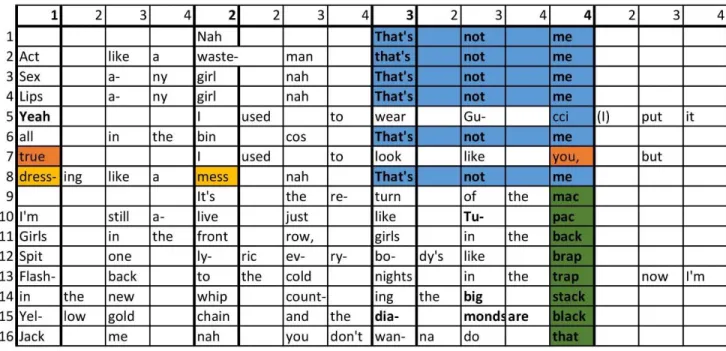
Figures 1 and 2 use two different transcription methods to highlight the regularity of Skepta’s flow in “That’s Not Me.” They both include the chorus and the first half of Skepta’s first verse. Figure 1 draws attention to text and the means by which grime MCs create rhythmic accents through the delivery of text, namely rhymes and the double tracking of individual words and phrases.62 Each row of the grid represents one bar, with the numbers in bold text representing crotchet beats and the numbers in plain text representing semiquaver subdivisions. The shaded cells highlight rhymes, with different colors representing different rhymes. The text in bold indicates the words that are double-tracked, either by a single rapper, or by a crew joining in on crucial phrases.63
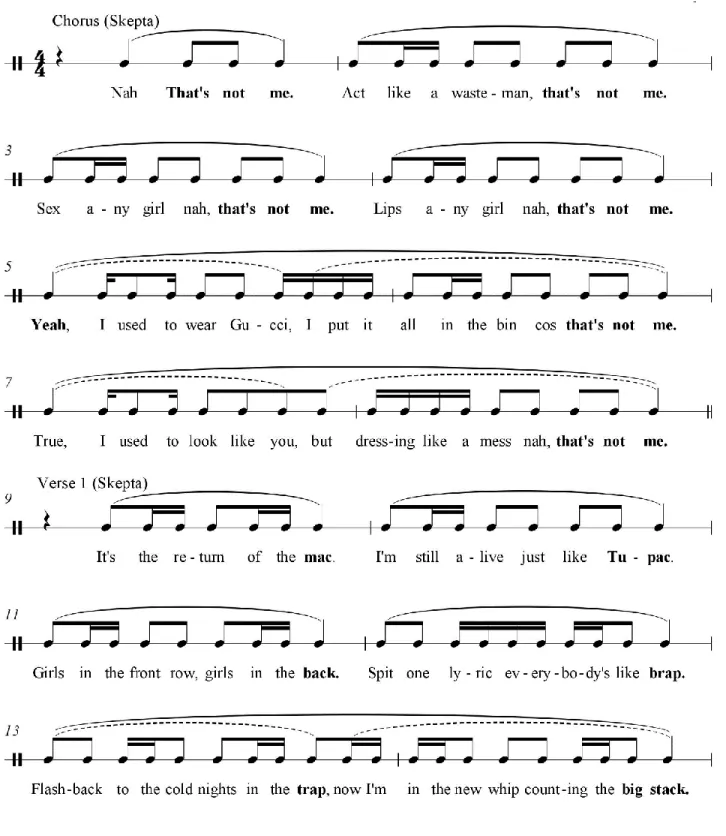
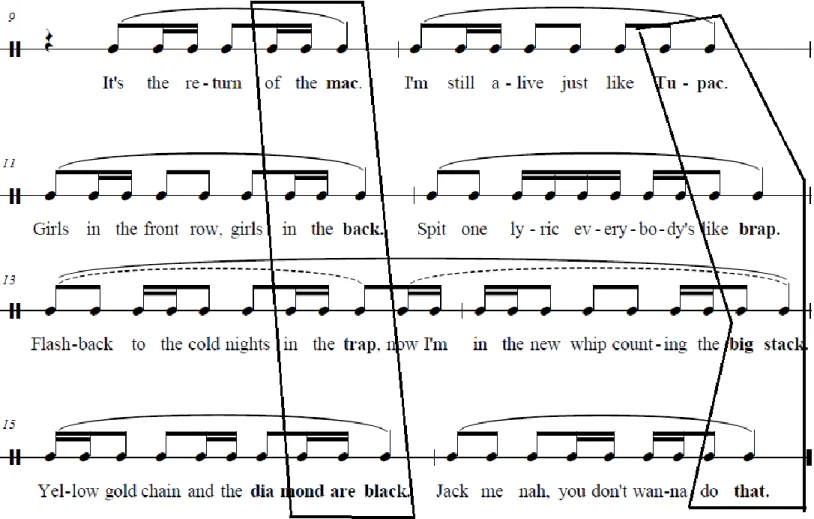
Figure 2 uses conventional Western rhythmic notation. As such, it draws attention to the percussive and non-textual dimensions of Skepta’s flow, including the lengths of his phrases and the rhythms he uses. The slurs in this transcription mark the syntactic units of Skepta’s lyrics. Double-tracked words are again marked with bold text.
62 My transcription method in Figure 1 is adapted from those of rap analysts Adam Krims and Kyle Adams. See Adam Krims, Rap Music and the Poetics of Identity, (Cambridge: Cambridge University Press, 2000); and Kyle Adams, “On the Metrical Techniques of Flow in Rap Music,” Music Theory Online, 15, no.5, 2009.
Figure 1. “That’s Not Me” chorus and first verse. Grid transcription.
Regarding phrase lengths, I suggest that in rap, syntactic units of lyrics are the primary determining factor in marking musical phrases. The regularity of Skepta’s phrase lengths is most immediately evident in Figure 2. Most phrases are just one bar in length, and align with the start and end of the bar. Skepta’s less frequent two-bar phrases also align exactly with the two-bar hypermetrical units of the beat (discussed further in chapter 3). In Figure 2, the dotted slurs mark antecedent and consequent sub-units within these two-bar phrases. Skepta’s flow thus contains a high degree of “correspondence between syntactic units and metrical units,” which Kyle Adams, writing in 2009, argues that the majority of then contemporary (American) rap aims to avoid.64
Skepta’s rhyme schemes are highly regular, as is made plain in Figure 1. This regularity is due, in no small part, to his frequent use of a single rhyming syllable throughout this section. The
uniformity of color in bars 9-16 (Figure 1) makes clearly visible how Skepta uses a single rhyme throughout this first half of the verse. The chorus is also highly regular. The repetition of the track’s tagline, “that’s not me,” in bars 1-4, 6, 8, combined with the “–ci” on beat 4 in bar 5 produces an AAAAAABA rhyme scheme throughout the chorus. Furthermore, the potential disrupting effect of the non-rhyme, “you” in bar 7 is lessened by it being the antecedent line in a two-line phrase, and by this word being the antonym of the rhymed word heard throughout the rest of the chorus.65
Skepta’s placement of his rhymes within the bar is also highly regular. Throughout the extract transcribed in Figures 1 and 2, and indeed throughout all but three of Skepta’s phrases in “That’s Not Me,” Skepta places his main end-rhyme on the fourth beat of the bar. This regularity of rhyme placement is represented by the thick band of shaded cells on beat four of Figure 1. The regularity of rhymes is a particularly common feature of grime flow, although the end-rhyme need not always fall on the fourth beat. For example, JME, the other MC featured on “That’s Not Me” places his end-rhymes on beat 3 in the final verse of the track. I will discuss some implications for listeners’ entrainment of this shift in end-rhyme placement in chapter 3, but of relevance to this analysis, the metric placement of the rhymes at the level of the beat reinforces the predictable patterns of rhythm in this performance.
As already mentioned, rhyme placement is one of the key ways in which rappers create rhythmic accent. Thus, the regularity of Skepta’s rhyme placement also contributes to another facet of his flow’s regularity, namely the regularity of his rhythmic delivery. Skepta’s rhythms are close to what EDM scholar Mark Butler identifies as “even” rhythms, those that reinforce the basic meter
by subdividing it into units of equal length.66 As Figure 2 shows, Skepta makes next to no use of syncopation. He also makes limited use of offbeat accents, either in his rhymed or in double-tracked syllables. Furthermore, his only offbeat double-double-tracked accents are either in a chain of accented syllables, as in bar 15 and the “not” of the “that’s not me” tagline, or act as a lead-into an end-rhyme, as in bars 10 and 14, thus further reinforcing the meter.67
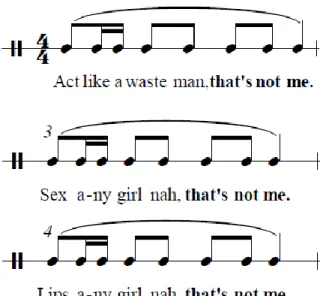
Figure 3. Rhythmic repetition in “That’s Not Me” chorus, bars 2-4.
The sense of regularity in Skepta’s flow in “That’s Not Me,” is also the result of his consistent use of a few rhythmic motives, or rhythmic cells. Unsurprisingly perhaps, this is most
66 Mark Butler, Unlocking the Groove: Rhythm, Meter, and Musical Design in Electronic Dance Music, (Bloomington: Indiana University Press, 2006) 82
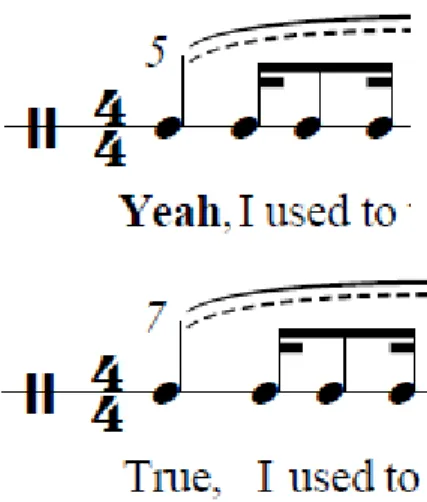
prominent in the chorus, where bars 2, 3, and 4 all use the same rhythm, as shown in Figure 3. Similarly, as shown in Figure 4, Skepta uses a distinctive syncopated rhythm at the beginning of both bars 5 and 7, which are the corresponding antecedent bars in the pair of two-bar phrases in the second half of the chorus.
Figure 4. Rhythmic correspondence in “That’s Not Me” chorus, bars 5 and 7
His repetition of rhythmic cells in the verse is slightly less blunt and more varied, but a small number of rhythmic cells still suffuse his lines. The first three lines of verse 1 show a high degree of motivic consistency, as demonstrated in Figure 5. These lines, bars 9-11 in Figure 2, are dominated by a three-note rhythm first heard at the beginning of bar 9. This cell, marked x in Figure 5, is immediately repeated and expanded (x1 in Figure 5). Skepta then further transforms
and extends it on the first beat of bar 10 (x2 in Figure 5) and bar 11 then combines the first half of
bar 10, with the second of bar 9.
semiquavers. In the consequent phrase, there is a full quaver gap between the penultimate and final syllables. To my ears this consequent patterns sounds more conclusive, perhaps because the semiquavers in the antecedent phrase create a sense of continuing motion. Figure 7 highlights these cadence patterns in bars 9-16.
Figure 5. Motivic consistency in “That’s Not Me,” bars 9-11
Figure 7. “That’s Not Me” bars 9-16, cadences highlighted.
Grime Flow Regularity Beyond “That’s Not Me”
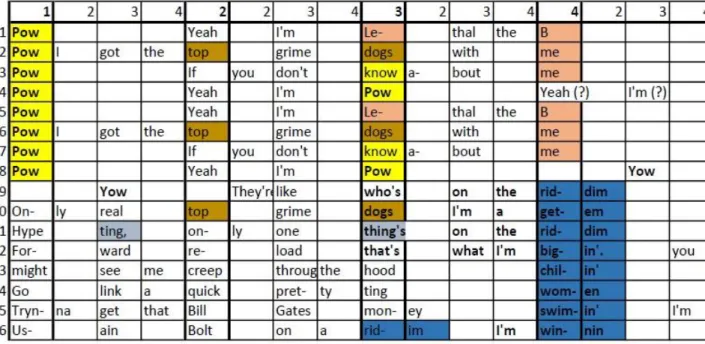
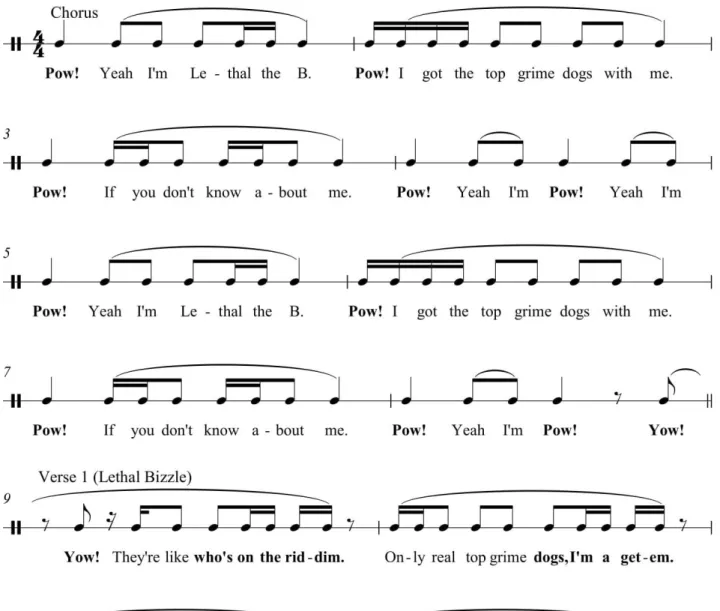
Those features of Skepta’s “That’s Not Me” that show a high degree of regularity can also be seen in two other grime tracks that perform nostalgia and make authenticity claims on that basis, Lethal Bizzle’s “Pow 2011” and Wiley’s “On a Level” (2014).68 Like Skepta, Lethal Bizzle uses
one end-rhyme throughout the chorus and his verse, and he places his main end-rhymes uniformly on beat 4, as shown in Figure 8. His rhythms are similarly, if not more, even, and his double tracked
accents and phrase lengths again reinforce the meter, as shown in Figure 9. Lethal Bizzle also uses small rhythmic motifs in a similar manner to Skepta. For instance, in the first four bars of his verse (bars 9-12 of Figure 4) Bizzle uses the same rhythm on beats 3 and 4. Lethal Bizzle’s flow in “Pow 2011” is thus similar to Skepta’s in containing a high degree of regularity.
Figure 8. “Pow 2011” chorus and first verse. Grid transcription.
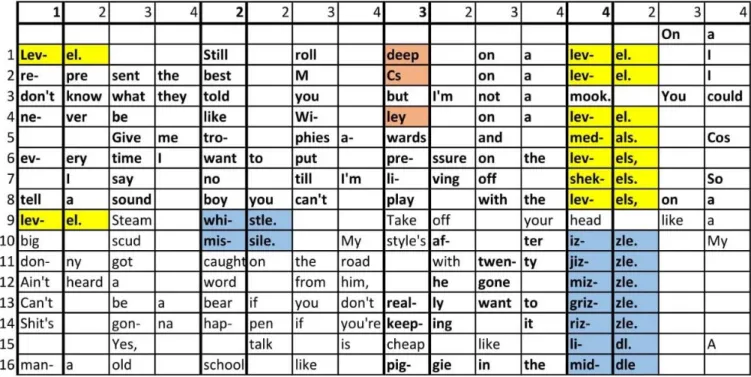
Wiley’s 2014 single “On a Level,” which was produced by Skepta, contains numerous references to both Wiley’s long career and the history of the scene.69 Wiley’s flow also displays a
high degree of regularity, although it is slightly less regular than Skepta’s or Lethal Bizzle’s. In
Figure 10. “On a Level” chorus and first verse. Grid notation.
the portion transcribed in Figure 10, his end rhymes fall on beat four in all but two of the lines, in addition to the “on a level” tags which he uses to bookend the chorus. The first verse starts with a short two beat phrase that places the end rhyme on beat two. A more usual bar-length phrase follows, again ending on beat two, before another two-beat phrase reverts the end-rhyme placement to beat four. This brief momentary deviation from the regular rhyme placement scheme functions to further mark the start of the verse. Like “That’s Not Me” and “Pow 2011,” Wiley’s rhyme scheme in “On a Level” is highly regular. He uses one end rhyme throughout the chorus and another throughout the first half of the verse.
Figure 11), thus creating a small syntactic accent that works against the meter. Despite brief moments like these, his choice of rhythms and use of double-tracked accents in the verse generally reinforce with the meter.
These three representative tracks are indicative of the relatively high degree of regularity in grime flow. To be clear, I do not want to argue that such regularity is the sole defining feature of grime rapping. As suggested in the introduction to this chapter, fans and musicians categorize British MCs and their rapping styles using a number of parameters including, but not limited to, the timbral and rhythmic qualities of the beats they rap over, their regional accent and slang, and the contents of their lyrics. Furthermore, although I would argue that there is a greater tendency towards rhythmic regularity in grime MCs’ flow than in many other rap genres, and that such regularity is a characteristic feature of grime flow, there is nevertheless considerable stylistic variety among grime MCs. Absolute regularity is not a necessary quality of grime flow, as shown by the degree to which Wiley’s flow is less regular than those of Skepta and Lethal Bizzle. Other rappers who identify as, or who are identified by fans as grime MCs, such as Ghetts or D Double E, have highly individual and distinctive styles of flow that do not fit easily into the model I have described above. Yet both rappers are understood by fans to be grime MCs, primarily because they participated in the London scene out of which grime emerged.
Categorizing Grime Flow
Significantly, however, its regularity does differentiate it from the canonic flow styles of late ‘80s, ‘90s and early ‘00s American hip-hop, which largely defined the listening context in which grime was initially heard and against which it was measured in the UK in the early-mid ‘00s. Indeed, a common refrain in the critical reaction to Dizzee Rascal’s Boy in da Corner was to note how distinct his rapping sounded from American hip-hop artists.70
The music theorist Adam Krims categorizes broad styles of flow in his landmark 2000 monograph Rap Music and the Poetics of Identity, which was the first major attempt to analyze rapping as a distinctly musical process.71 Krims’ notation and his taxonomy of rapping styles have been highly influential.72 He categorizes flow into three main types, which he associates with
particular eras of hip-hop history and particular genres of hip-hop. Although hip-hop sub-genres and rapping styles have changed substantially in the decades since the publication of Krims’ book, his taxonomy is nevertheless useful for identifying broad stylistic trends in hip-hop flow.
Krims labels the first of his types of flow as the “‘sung’ rhythmic style” because it mirrors the “rhythms and rhymes” of sung popular music.73 He writes, “characteristic of the sung style are
rhythmic repetition, on-beat accents (especially strong beat ones), regular, on-beat pauses […] and strict couplet groupings.”74 He also suggests that “sung” flow tends to be slower than his other two
types.
70 For example, NME’s reviewer, Louis Pattison wrote that “you never heard hip-hop sound this brutal, this alien, this foreign. No scratch that, this English.” Louis Pattison, “Dizzee Rascal: Boy in da Corner” NME, n.d., http://www.nme.com/reviews/album/reviews-dizzee-rascal-7140, accessed May 29th, 2017.
71 Krims, Rap Music and the Poetics of Identity
72 Krims established the now commonplace practice of notating rap in metrical grids, with one row for each bar. 73 Krims, Rap Music and the Poetics of Identity, 49-50
Krims describes the second and thirds types as “effusive.” He writes that this term “refers to a tendency in rap music to spill over the rhythmic boundaries of the meter, the couplet, and, for that matter, of duple and quadruple groupings in general.”75 Broadly, he argues that rappers in the
late ‘80s and ‘90s employed a number of techniques to make their flows more “complex.”76 Krims
writes that these techniques “may involve staggering the syntax and/or the rhymes; it may involve relentless subdivision of the beat; it may involve repeated off-beat (or weak-beat) accents; or it may involve any other strategy that creates polyrhythms with four-measure groupings of 4/4 time.”77
Krims splits the effusive styles into “percussion-effusive” and “speech-effusive.”78 He
suggests that in the former, the rapper is using their voice like a percussion instrument, using “a combination of off-beat attacks with a sharply-attacked and crisp delivery”79 in order to create patterns of articulation that “subdivide regular rhythmic units.”80 In “speech-effusive” rapping, the
MC uses a flow that is akin to natural speech to outline rhythms that are “irregular and complex, weaving unpredictable polyrhythms.”81
Other rap analysts identify a similar trend towards greater “complexity” as hip-hop matured and diversified from the late ‘80s onwards. For example, Kyle Adams explicitly portrays the “sung”
75 ibid, 50
rap style of Kurtis Blow (real name Curtis Walker) in his 1984 track “Basketball” as being exemplary of an earlier, more simplistic developmental stage of rap.82 Adams writes, “Walker’s reliance on end rhyme and his coordination of accented syllables with accented beats makes the lyrics sound more like a nursery rhyme than a work of poetry.”83
Adams insists that this comparison is not meant as a value judgement, but throughout his essay he highlights the means by which rappers use complex and irregular structures to demonstrate their sophistication. These means include using multiple internal rhymes, irregular rhyme schemes and phrase lengths, enjambment, and frequent, unpredictable offbeat accent placement. Arguing in 2009 that such complex, intricate techniques were common in rap of the ‘90s and ‘00s, he writes, “the majority of rap today focuses on placing rhymed and accented syllables in irregular locations, and on avoiding correspondence between syntactic units and metrical units.”84
Grime flow’s highly regular rhyme schemes and phrase lengths, as well as its general lack of syncopated rhythms, distinguish it from the irregular, “complex” styles of hip-hop flow identified by Krims and Adams. Instead, grime flow resembles Krims’ “sung” style flow in a number of key ways. Like “sung” flow, grime flow uses on-beat accents far more frequently than off-beat accents. It also makes frequent use of rhythmic repetition and couplet groupings. It also does not exhibit the characteristic techniques that Krims argues ‘90s hip-hop rappers used to make their flows more complex.85
82 Kurtis Blow, “Basketball,” Polydor 881 529-1, 1984, 12” record.
83 Kyle Adams, “On the Metrical Techniques of Flow in Rap Music,” para. 33 84 ibid, para.9, emphasis added
Despite these similarities between grime flow and Krims’ “sung” flow, there are nevertheless crucial differences. Most crucially, regardless of its regularity, it would be hard to characterize grime flow as “sing-songy” or as resembling “much of sung pop or rock musics” in its rhythms.86 Indeed, with its fast tempo, its high density of syllables, its occasional use of
nonsense words, and its sharp, crisp style of delivery—which I would argue grime flow shares with “percussion effusive” flow—grime flow resembles neither singing nor speech. In this sense, grime flow bears some resemblance to “percussion effusive” flow. Like hip-hop rappers employing this style of flow, grime MCs often sound like they are using their voices like percussion instruments. However, while grime flow may share this percussive aspect, it is not effusive, in Krims’ sense. Unlike in “percussion effusive” flow, the sharp attacks of grime flow fall predominantly on the beat.
While grime flow does share some qualities with both “sung” and “percussion effusive” styles, then, it is distinct from both. Despite its regularity, it is not nursery rhyme-like or “sing-songy” and yet it is percussive, in spite of its relative lack of complexity. In this sense, it is distinct from the flow styles that have long been at the center of global hip-hop markets and media. Although the question of what it would mean to rap in an authentically British way remains murky, grime flow’s distinctive qualities, conventions, and terminology, such as “one line flows” allow it to function as a marker of genre and geographic identity, and by extension authenticity, for grime MCs.
Chapter 3: “I Got the Whole Crowd Bubbling Like a Crack Pot”: Regularity, Participation,
and Pleasure
Introduction: What is Engaging about Regularity in Rap Flow?
Grime flow’s regularity raises questions of how the voice functions in grime and what listeners find engaging about this style. At first glance, by virtue of its regularity, grime flow may seem simple and potentially unengaging. However, observation of the scene yields the opposite impression. Instead of tuning out, listeners are intensely focused on MCs and their flow, as evidenced by the degree to which an MC can whip up excitement from a dancing crowd in clubs or at a concert.
The questions of what might be engaging about grime’s regular flow style are brought into sharper focus by Adam Krims’ and Kyle Adams’ narratives of increased complexity and, by implication, sophistication in hip-hop flow styles. For Krims, the different styles of flow lend themselves to different functions and modes of listening due primarily to their relative degrees of regularity and complexity. In the analyses of both Krims and Adams, effusive flows function to create dynamic and intricate rhythmic interest for listeners, and to create a sense of non-normativity and aesthetic sophistication.
listener (and dancer) participation.”87 Adams’ characterization of early rap styles as being akin to
nursery rhymes also suggests a similar function of invited listener participation through easily memorizable lyrics and predictable rhythmic patterns.
Following Adams and Krims, we might think that the similar regularity of grime flow might lend it a similarly nursery rhyme-like participatory quality for its listeners. I would argue, however, that while grime flow shares sung flow’s regularity, the former’s percussive qualities combined with its lyrical density mean that it does not invite participation in the easy, sing along song-like way that sung flow does. What, then, do grime fans find engaging about regular grime flow? To put this question another way, if grime flow’s regularity makes it less appropriate for the kinds of complexity-oriented rap analysis outlined in chapter two, how might we describe the pleasure and interest listeners find in grime flow?
In seeking to answer this question I turn to analytic literature on groove, as well as music theory and cognition work on the pleasures of repetition, and consider how regular grime flow relates to the layering of syncopated rhythms in grime beats. Through an analysis of “That’s Not Me,” I argue that grime flow maintains and encourages an exciting and highly participatory sense of engagement on the part of its listeners, by mirroring and amplifying the listener’s own capacities for flexible and creative perception of these rhythmic layers. This sense of participation and engagement in turn resonates with and amplifies the focus on the scene and on communal performance spaces in the nostalgic self-image of the genre.