RELIGIOUS INVOLVEMENT AMONG YOUTH OF HIGHER AND LOWER SOCIOECONOMIC BACKGROUNDS: EXPLORING INFLUENCES ON EDUCATIONAL EXPECTATIONS
AND ORIENTATIONS
Bo Hyeong Jane Lee
A thesis submitted to the faculty of the University of North Carolina at Chapel Hill in partial fulfillment of the requirements for the Master’s degree in the Department of Sociology.
Chapel Hill 2012
ii ABSTRACT
BO HYEONG LEE: Religious Involvement among Youth of Higher and Lower Socioeconomic Backgrounds: Exploring Influences on Educational Expectations and Orientations
(Under the direction of Lisa Pearce)
iii
TABLE OF CONTENTS
LIST OF TABLES AND FIGURES……….………...…iv
I. INTRODUCTION………...1
II. BACKGROUND AND THEORY………...2
III. DATA AND METHODS………...8
IV. STATISTICAL RESULTS AND OVERVIEW………....14
V. EMERGENT THEMES FROM QUALITATIVE DATA……….18
VI. DISCUSSION AND CONCLUSION………....28
iv
LIST OF TABLES AND FIGURES
Table
1. Youth’s Interview Transcripts by Religious Affiliation
and Family Socioeconomic Status (SES), NSYR Wave 2……….13 2. Ordered Logistic Regression Results of Youth’s Educational Expectations
on Demographic, Religious, and Family SES Characteristics, NSYR Wave 2………….15 Figure
1. Predicted Probabilities of Educational Expectations on the Interaction
between Religious Attendance and Family SES, NSYR W2………16 2. Predicted Probabilities of Educational Expectations (collapsed categories)
I. INTRODUCTION
In the ongoing inquiry into the relevance of religion in the lives of youth, many scholars have found that religious involvement among adolescents is significantly correlated with a number of positive outcomes, including physical, emotional, and social well-being (Evans et al. 1995, Regnerus 2003, Wallace & Williams 1997), and in particular, related to educational expectations, academic achievement, and staying on track in school (Muller & Ellison 2001, Regnerus & Elder 2003). Organized religious participation provides youth with opportunities to learn and practice various forms of cultural capital, form and maintain social and organizational ties, and develop a “sense of moral order” through relationships with role models—all of which are likely to have a positive impact on education (Smith 2003).
However, taking into account the socioeconomic contexts that critically shape individual experiences of both religion and education, some research suggests that the positive impact of religious involvement may be dampened by the structural constraints faced by lower-SES youth (Schwadel 2008), while others find that the lack of institutional support for lower-SES families renders the impact of structured religious participation even more significant
(Regnerus & Elder 2003). The literature remains largely inconclusive about how the relationship between youth’s religiosity and educational outcomes may be moderated by family socioeconomic status (SES).
The aim of this project is to explore the processes through which religious involvement influences the educational expectations and orientations of youth, using (1) evidence from survey data analyses showing the relationship between religious involvement and educational expectations is modified by family socioeconomic status, and (2) an
2
to educational orientations in unique ways based on one’s family socioeconomic background. I use survey data and interview data drawn mostly from Wave II of the National Study of Youth and Religion (2005) to show that the relationship between religious involvement and educational expectations is moderated by family socioeconomic status, and that various mechanisms play into this relationship.
II. BACKGROUND AND THEORY Educational Trajectories of Youth
Education stands as one of the experiences most central to American youth,
especially in considering the implications it may have for the trajectory of youth transitions into adulthood. Drawing from the broader body of educational research, there are critical distinctions to be made among various measures of education, including educational aspirations, expectations, planning, and attainment (Brookover et al. 1975, Mau 1995, Trusty 2000, Schoon & Parsons 2002, Feliciano 2006). Here, aspirations refer to the general educational goals and ambitions expressed by youth; expectations capture the levels of education that youth more concretely and realistically foresee to complete in the future;
planning indicates the specific course of actions that individuals prepare for and carry out as
a means to reach higher levels of education; and attainment identifies the number of years or level of education actually completed at a given point in time.
While there is support in the literature for considerable associations between many of these educational measures and parents’ expectations or students’ level of success in school, studies show that adolescent educational aspirations have come to be fairly high and
3
considering that adolescents from higher family socioeconomic backgrounds are more likely to have better educational opportunities, as well as greater access to financial resources and social networks (Schulenberg et al. 1984, Breen & Jonsson 2005), youth express high and stable aspirations to attend college independent of their own academic performance or parents’ education levels (Mickelson 1990). Scholars thus suggest that it is more so the variations in youth’s expectations and planning that help to predict later educational
attainment (Trusty 2000, Feliciano 2006). Also, perhaps shifting the focus of empirical work on education more towards exploring the complexities of youth’s educational experiences,
educational orientations may be considered as ways in which youth internalize and
externalize their understanding of education’s value and meaning in comparison to other aspects of their lives, such as religion and family. Overall, there is much empirical evidence that would suggest that the risk of not having high or comparable completed levels of
education is now greater than ever (McCall 2000, Rumberger & Palardy 2005), which makes the question of youth’s transition into post-secondary education an especially important one to understand how subsequent experiences in the life course may unfold. Based on the evidence cited here, the focus of this paper is to examine how the impact of religious
involvement on the educational expectations and orientations of youth varies based on family socioeconomic status.
Religion among Youth in Relation to Education
Religion is a significant part of the lives of many youth in the US. According to Smith and Denton’s Soul Searching: The Religious and Spiritual Lives of American
4
percent of all teens attend a religious organization that also sponsors youth groups. More than fifty percent of teens report that their families pray regularly, and about sixty percent of teens report that faith is extremely important in their daily lives.
Because youth is also a time with heavy investments in educational activities and planning, it is important to study the significance of religious involvement as it relates to educational outcomes during this stage of the life course. As a number of studies focusing on the effects of religion on education find (Brown & Gary 1991, Regnerus 2000, Regnerus & Elder 2003), religious involvement among youth indeed shows a positive relationship with various measures of education. Especially among the highest and lowest academically performing students, higher parental educational expectations, more communication with parents about schooling, more advanced course taking, and more time spent on school
assignments are found to be closely associated with youth religiosity (Muller & Ellison 2001). In the literature linking youth and religion to education more broadly, one
longstanding perspective focuses on differences in educational outcomes by specific religious affiliations, perhaps most notably between Protestants and Catholics (Lenski 1961, Coleman et al. 1982). Echoes of this perspective are evident in more recent work by scholars who find a negative relationship between conservative Protestant affiliations and individual
educational aspirations and attainment; strong attitudes of divine control in everyday life and strict gendered stereotypes held by women are found to be significant to this relationship (Keysar & Kosmin 1995, Damell & Sherkat 1997, Sherkat 2000, Beyerlein 2004).
5
participate in religious institutions are likely to benefit from developing (1) a “sense of moral order” by which decisions are guided by moral directives, role models, and religious leaders; (2) community and leadership skills, coping skills, and cultural capital; and lastly, (3) social and organizational ties, whereby network closure and extra-community skills may be achieved. In particular, related to the third dimension of social and organizational ties, substantial empirical evidence has been found to support that participation in a religious institution contributes to more positive educational aspirations, expectations, and norms of achievement through ties with adults and “important others” in a multigenerational
community of support (Bankston & Zhou 1996, Coleman 1988, Portes 1998, Rauner 2000). While most of the aforementioned studies examining the link between religion and education employ survey data analyses and provide considerable evidence for this overall association, a central aim of the present study will be to elaborate upon specific mechanisms and examine through interview responses how different family socioeconomic backgrounds may modify youth’s experiences of religion and education.
Socioeconomic Context as a Moderator of Religious Influence
6
in and outside of school (Lin and Dumin 1986, Coleman 1988, Portes 1998, Jodl et al. 2001, Hitlin 2006). As such, the significance of youth’s socioeconomic status (SES) backgrounds raises important theoretical questions for the interplay between religious involvement and educational experiences.
Foremost, in examining socioeconomic differences across religious organizations at large, it is notable that the distribution of American religious groups by SES has remained largely stable and persistent for several generations (Smith & Faris 2005, Pyle 2006).
Significant differences in educational outcomes across religious affiliations may be attributed at least in part to the already existing structure of inequality across religious groups
differentiated by social class. This stratified religious structure is, indeed, so closely associated with broader social inequalities in the US that considerations of such sustained socioeconomic differences are essential to examining religious effects on individual expectations and experiences (Keister 2003, McCloud 2007, Davidson 2008).
7
backgrounds and youth’s religious conduct. Results show youth from households with parents of lower than average levels of education and income are more likely to be
characterized as “adapters,” with lower levels of formal religious conduct and inconsistent religious participation, which may be attributed to logistical challenges in attending religious services on a regular basis as a result of limited transportation, frequent residential moves, and irregular or inflexible parents’ work schedules.
Even so, in a robust study of religion’s impact on youth “on-track” school performance in different neighborhood contexts, Regnerus and Elder (2003) examine whether involvement in religious organizations in less affluent areas—despite such aforementioned limitations and challenges—can actually offset conditions of poor
opportunity and high risk. As the authors discuss, religious organizations often establish and reinforce norms of pro-social attitudes and behaviors, and in doing so, have critical potential for providing participatory and social capital-building communities amid environments of low institutional support to youth (Leventhal and Brooks-Gunn 2000). Through a series of multi-level models using survey data from the National Longitudinal Study of Adolescent Health and framing socioeconomic contexts as neighborhood risk, the authors find religious service attendance to function as a protective mechanism with greater impact on youth’s “on-track” school performance more so in high-risk neighborhoods than in low-risk ones
(Regnerus & Elder 2003).
Indeed, scholars of religion and education have to date contributed in various ways to an extensive discussion on the relationship between religion and education, addressing relevant questions about the possible effects of socioeconomic differences on this
8
multi-method approach the mechanisms of how religious involvement influences youth’s educational expectations and their orientation toward education, taking into account the differing nature of religion and educational trajectories for youth from different family SES backgrounds during their transitions into adulthood.
III. DATA AND METHODS
The National Study of Youth and Religion
This study uses, first, data from the survey component of Waves I and II of the National Study of Youth and Religion (NSYR) to examine the interaction effect between religious participation and family SES upon youth’s educational expectations. The NSYR is a longitudinal and nationally representative study that was launched in 2002 with the aim of researching the shape and influence of religion and spirituality in the lives of American youth. In the first wave, a random-digit-dial sample of adolescents between the ages of 13 and 17 in English and Spanish speaking households (N = 3,290) were surveyed by telephone, as was one parent of each respondent. Then, in 2005, the Wave II survey was conducted with a similar design, interviewing Wave I respondents on many of the same topics but not re-interviewing the parents (N = 2,604). The present analysis consists of mainly measures of youth’s educational expectations from Wave II, regressed on demographic and religious measures from Wave II and family socioeconomic characteristics provided by parents from Wave I.
9
the survey in Wave I, a stratified quota subsample of participants was selected for follow-up in-person interviews (N = 267), representing a range of demographic and religious
characteristics and taking into account region, urban/suburban/rural, age, sex, race,
household income, religion, and school type. Subsequently, Wave II interview participants between the ages of 16 and 21 were selected from all those who participated in the Wave I in-person interviews and also participated in the Wave II survey (N = 119). Participants were paired to their original interviewer from Wave I as much as possible, and the majority of interviewers and participants were matched on gender and race, with all black participants interviewed by minority interviewers. A total of sixteen Wave II interviewers conducted 119 interviews across 28 states—each interview lasting an average of 107 minutes and digitally recorded.
Survey Measures and Analysis
RELIGIOUS INVOLVEMENT
10
FAMILY SOCIOECONOMIC STATUS
As employed in a number of previous studies on religion and social class differences, socioeconomic status (SES) may be delineated as the integrated and accumulated effects of education, income, and occupation on an individual’s position in society (Smith & Faris 2005, McCloud 2007). Broadly, the concept of social class may indeed include questions of how certain group boundaries are externally ascribed or reflexively constructed as subcultural identities. However, social class in the present analysis will be more in accordance with Bourdieu’s (1985) approach and examined as persistent and relevant social structure, on account of the large role that differential material conditions play in shaping the trajectory of individual’s lives.
Adapted from Lareau’s (2003) study of divergent family processes in varying
socioeconomic contexts1, distinctions across different family socioeconomic backgrounds in the present analysis are made based on parents’ occupational status, highest level of parents’ education, and household income. Given that parents’ occupational prestige is not readily available in the NSYR data, I use parents’ occupational status, which is defined as either mother or father working full-time; highest level of parents’ education (i.e. mother and/or father with less than high school education, high school or some college education, or a bachelor’s degree or higher); and household income, which is determined by the approximate combined income of parents as reported at Wave 1.
I create a composite ‘Family SES’ variable using these socioeconomic measures to match youth respondents to either higher or lower family SES groups. Youth of higher2
1
Lareau differentiates SES groupings (middle class, working class, poor) primarily based on parents’ occupational prestige—e.g. level of authority in the workplace, educational requirements for jobs
2
11
family SES backgrounds are generally identified as having at least one parent working full-time, at least one parent with a bachelor’s degree or higher, and a household income of more than $50,0003 (Family SES=1). Youth of lower family SES backgrounds are identified by parents working irregularly or part-time, parents with less than a bachelor’s degree, and a household income of less than $50,000 (Family SES=0). This ‘Family SES’ variable4 is used as a moderating variable in the survey analysis regarding the relationship between religious attendance and educational expectations. The Family SES variable is also used to identify interview cases as belonging to the higher or lower family SES category, and analyses proceeded to compare these groups in the ways they talk about religion, educational plans and orientations, and the interface between the two.
EDUCATIONAL EXPECTATIONS
The measure for educational expectations consists of youth’s responses to the question: “Given realistic limitations, how much education do you think you will actually complete?” Categories for this ordinal variable include: (a) less than high school, (b) high school, (c) vocational of technical school, (d) some college or associate’s degree, (e) bachelor’s degree, and (f) graduate degree or professional school.
ANALYTIC METHOD AND CONTROLS
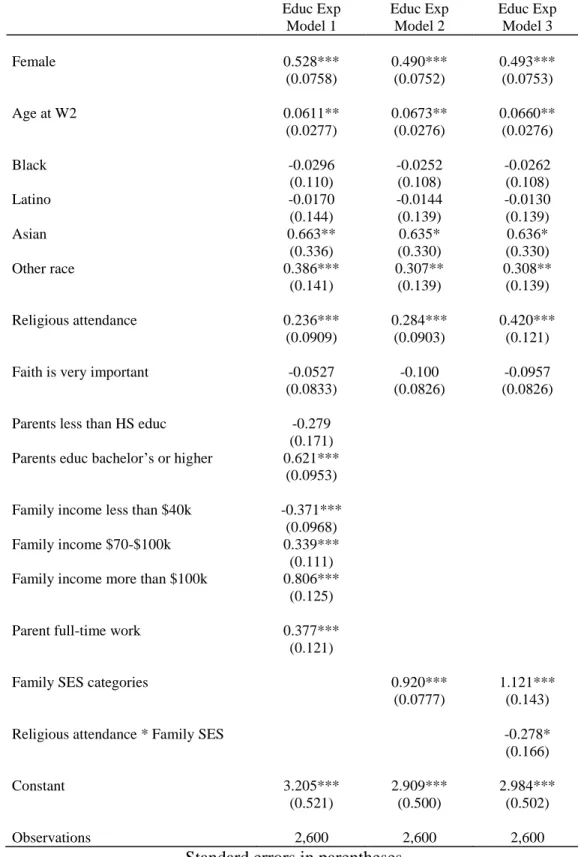
In examining the statistical relationships between measures of religious involvement, family SES, and educational expectations, I use ordered logistic regression models, since educational expectations is measured with an ordinal variable. First, I assess whether
3
$50,000 selected to approximate the US median household income (US Census Bureau)
4
12
religious involvement and family SES have independent and statistically significant relationships with educational expectations—testing separate measures of family SES in Model 1 and a composite measure of family SES in Model 2. I then investigate whether there is a statistically significant interaction between religious attendance and family SES that helps to explain variations in educational expectations, as will be shown in Model 3. In all models, gender, age, and race/ethnicity are included as controls.
Analysis of Qualitative Interview Data
For the inductive examination of youth’s religious involvement in relation to their orientations toward education, the analysis is guided by emergent themes, focused on a subsample of religious youth selected from the initial Wave II sample of 119 interview participants. This analysis explores how religious involvement impacts youth’s educational experiences, as opposed to whether there is such an influence—namely, to examine the process more so than the presence of the effect already identified through the survey data analysis. Therefore, the qualitative data analysis focuses on a subsample of religious participants (n=84). The distinction between whether youth are or are not included in the “religious” subsample is based on: (1) whether the individual self-identifies as “religious” in the interview, and (2) expresses some form of active religious involvement, either by
institutional participation, such as religious service attendance, or private practice, such as prayer or meditation. Preliminary coding and matching between survey and interview data show that some youth who provide a response other than “non-religious” to the survey question about religious affiliation do not affirm their religious identification in their
13
Employing again the ‘Family SES’ variable5 used in the statistical analysis to group the subsample of interviewed religious youth, I identify 41 interviewed youth as having lower family SES backgrounds and 43 youth as being of higher family SES backgrounds (see Table 1 for the delineation of interview transcripts by family SES and religious affiliation).
Table 1. Youth’s Interview Transcripts by Religious Affiliation and Family Socioeconomic Status (SES), NSYR Wave 2.
Total Transcripts
(Proportion of Total) Lower SES Higher SES Mainline Protestant 27 0.23 14 0.52 13 0.48 Conservative Protestant 11 0.09 6 0.55 5 0.45 Catholic 15 0.13 6 0.40 9 0.60 Black Protestant 11 0.09 7 0.64 4 0.36 Mormon/LDS 7 0.06 4 0.57 3 0.43 Jewish 6 0.05 2 0.33 4 0.67 other religion 7 0.06 2 0.29 5 0.71
not religious or religiously active 35 0.29 21 0.60 14 0.40
As an additional tool for research, I used Dedoose, a web-based qualitative analysis application, which allows for qualitative data and quantitative indicators for given cases to be integrated and effectively explored. This interface was particularly useful in the present study to match quantitative family SES data with interview transcripts, specific sections, and
5
14
analytic codes therein. Applying Charmaz’s approach of qualitative coding (2006) to guide the analysis by the emergence of categories rather than using predetermined ones, I employ inductive reasoning to identify patterns and conceptual categories from analytical and theoretical interpretation of the data. After conducting a full reading of all 84 interviews followed by “open” coding of the transcripts, I used “focused” coding to explore and develop themes around the meanings that youth of various backgrounds associate with education and religious involvement. Sections of the interview that came to be particularly important to the “focused” coding process included the Family, Religion, School, Organized Activities and Work, and Future Plan and Prospects sections.
IV. STATISTICAL RESULTS AND OVERVIEW
15
Table 2. Ordered Logistic Regression Results of Youth’s Educational Expectations on Demographic, Religious, and Family SES Characteristics, NSYR Wave 2.
Educ Exp Educ Exp Educ Exp Model 1 Model 2 Model 3
Female 0.528*** 0.490*** 0.493***
(0.0758) (0.0752) (0.0753)
Age at W2 0.0611** 0.0673** 0.0660**
(0.0277) (0.0276) (0.0276)
Black -0.0296 -0.0252 -0.0262
(0.110) (0.108) (0.108)
Latino -0.0170 -0.0144 -0.0130
(0.144) (0.139) (0.139)
Asian 0.663** 0.635* 0.636*
(0.336) (0.330) (0.330)
Other race 0.386*** 0.307** 0.308**
(0.141) (0.139) (0.139) Religious attendance 0.236*** 0.284*** 0.420***
(0.0909) (0.0903) (0.121) Faith is very important -0.0527 -0.100 -0.0957 (0.0833) (0.0826) (0.0826) Parents less than HS educ -0.279
(0.171) Parents educ bachelor’s or higher 0.621***
(0.0953) Family income less than $40k -0.371***
(0.0968) Family income $70-$100k 0.339***
(0.111) Family income more than $100k 0.806***
(0.125) Parent full-time work 0.377***
(0.121)
Family SES categories 0.920*** 1.121***
(0.0777) (0.143)
Religious attendance * Family SES -0.278*
(0.166)
Constant 3.205***
(0.521)
2.909*** (0.500)
2.984*** (0.502)
Observations 2,600 2,600 2,600
16
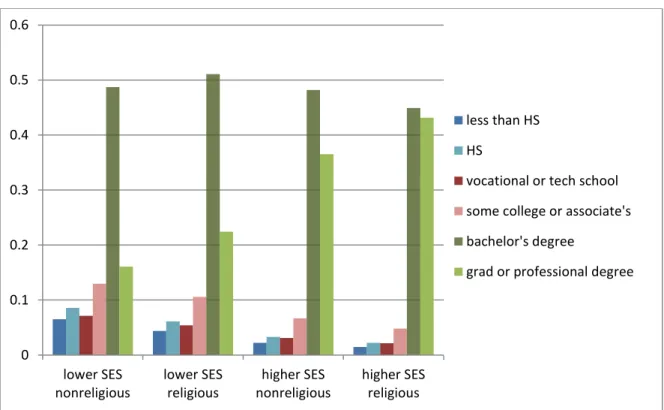
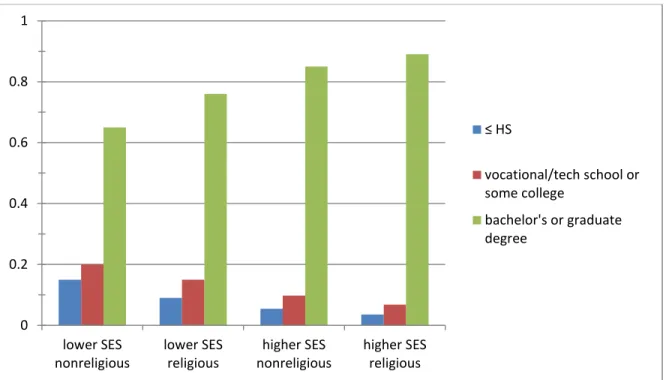
Illustrating graphically the interaction between religious attendance and family SES, Figures 1 and 2 display the predicted probabilities of expecting to achieve a certain level of education for four distinct groups of analysis: youth of lower family SES backgrounds who do and do not attend religious services, and youth of higher family SES backgrounds who also do and do not attend religious services. In particular, differences across groups and the impact of religious attendance in each reveal notable patterns at the ‘bachelor’s degree’ and ‘graduate or professional degree’ education levels. While religious attendance raises the educational expectations of lower SES youth for both ‘bachelor’s degree’ and ‘graduate or professional degree’ categories, religious attendance for higher SES youth raises only educational expectations at the ‘graduate and professional degree’ level.
Figure 1. Predicted Probabilities of Educational Expectations on the Interaction between Religious Attendance and Family SES, NSYR W2.
0 0.1 0.2 0.3 0.4 0.5 0.6
lower SES nonreligious
lower SES religious
higher SES nonreligious
higher SES religious
less than HS
HS
vocational or tech school
some college or associate's
bachelor's degree
17
Figure 2. Predicted Probabilities of Educational Expectations (collapsed categories) on the Interaction between Religious Attendance and Family SES, NSYR W2.
Critical comparison of these predicted probabilities—displayed more simply as collapsed categories6 in Figure 2—further reveals that the difference in educational expectations at the ‘bachelor’s or graduate degree’ level between religious and non-religious lower SES youth is about twice as great as that of religious and non-religious youth from higher SES
backgrounds7. However, this overview of results still does not fully address the question of what processes and mechanisms contribute to the distinct influences of religious attendance for youth from higher and lower family socioeconomic backgrounds. The primary goal of the following discussion will be to elaborate upon and add texture to the understanding of how
6
Results for ordered logistic regression and predicted probabilities recalculated for (a) high school or less than high school; (b) vocational/technical school, some college, or associate’s degree; and (c) bachelor’s or graduate/professional degree
7
Predicted probability values at the ‘bachelor’s or graduate/professional degree’ level: lower SES nonreligious (0.649), lower SES religious (0.749), higher SES nonreligious (0.847), higher SES religious (0.896)
0 0.2 0.4 0.6 0.8 1
lower SES nonreligious
lower SES religious
higher SES nonreligious
higher SES religious
≤ HS
vocational/tech school or some college
18
religious involvement may impact youth’s educational experiences through emergent themes that are identified in the NSYR’s Wave II interview transcripts.
V. EMERGENT THEMES FROM QUALITATIVE INTERVIEW DATA
In illustrating the larger frame of how youth talk about religion and education, it is evident that the impact of youth’s religious involvement is preceded by varying
19
personal sense of religiosity were found in the responses of highly religious youth struggling against the odds of lower SES constraints, but more generally, religious youth from higher SES backgrounds were just as likely as their lower SES counterparts to say that they pray when prompted with specific questions about their private religious practices. Moreover, such personal aspects of religiosity, as reflected in the interviews, seem to operate mostly independent of family SES contexts, which also supports the non-significant measure of personal religiosity in the statistical analysis.
Meaning of “Being Religious” among Youth
Consistent for many youth of lower family SES backgrounds, the discourse of what it means to be religious is often associated with various major aspects of well-being or life events, including living a healthy life, getting a good education, raising a family, etc.— articulated by some as the “good life.” In a sense, religious involvement is described as encouraging youth and enhancing the course of youth’s well-being and educational opportunity. Two teenage boys whose parents have less than a college education and who live in neighborhoods that interviewers describe as being economically depressed elaborate on their experiences of being religious as follows:
Male Participant 1: As far as when I, when we left the church, that was then [two years ago]. And now, where I’m at now, I’m understanding it more as it’s helping me to live a good life. Like the things I decide to do, definitely make the right choices and things like that, and so I’m happy with what’s going on in my life now…
I try to pray every night… Just that he continues to watch me and to protect me, bless me, financially, physically, spiritually, just pray for my mother, for my pastor, for my father, my family, all my needs.
20
that God is good because I’m healthy, like I’ve outgrown my asthma, I have no enemies, at least none that’s like, antagonize me on a regular basis if at all. Um, my girl is like everything that I ever wanted in life and like she’s what makes me happy. You know, she came in my life at the right time, when I was finished with all the nonsense I was doing and I was getting focused on school. That’s when I met her and we been in the same school for four years and that’s, I don’t know, I think it’s cool, I definitely believe that God is a good guy. He always on time.
Especially in the second teenage boy’s response, the participant’s identification with
becoming religious and his belief in God as a “good guy” coincide with his recovered health, restored relationships, and refocusing on school. Although there is not substantial support in the interview transcripts for the hypothesis that prayer and other forms of private religious practices are more common among lower SES religious youth (Davidson 2008, Schwadel 2008), religious involvement in both cases above appears to be expressed in conjunction with an empowered sense of hope and encouragement toward numerous practical matters.
In contrast, the discourse of youth of higher family SES backgrounds more frequently involves descriptions of their experience of religion in reference to their family involvement and religious service attendance. More so in line with the framework of institutional religious participation leading to benefits to youth that are transferrable to other settings (Smith 2003), the discussions of higher SES youth’s involvement in activities sponsored by religious organizations make for a stronger basis for the argument that religious participation may positively impact youth’s educational opportunities. This is illustrated in the conversations involving the following two teenage participants whose parents have completed a graduate or professional degree and make an income of more than $100,000 per year:
21
Female Participant 1: We go to church… Um, like, once a month. We’re very um, very faithful to our church. My great, great, great, great, great somebody help found one of the most historic black churches in the area, um, United Methodist right on um, I don’t know what street. But it’s the oldest, one of the oldest Black churches in the area, and my grandfather grew up in that church and my dad grew up in that church, I’ve grown up in that church, my children will grow up in that church. You know, it’s a family tradition. We don’t go anywhere else, so if we can’t make it to church, we won’t make it to church, we’re not going somewhere else; we go to our church. Interviewer: So we’ve talked a little bit about religion, um, I want to talk a little bit more
about that. Would you call yourself a Catholic?
Male Participant 3: Yeah. I mean I believe in God, and I taught some CCD
[Confraternity of Christian Doctrine] and I felt, I guess I felt that it wasn’t important that the kids weren’t that into it. Not that I really, I wouldn’t say that I follow it by the book, but I mean I go to church… Um, my mom, she’s still religious so we still go to church and stuff… I just kind of go through the motions.
I: Do you go weekly? MP3: Yeah. I: And do your sisters go? MP3: Yeah.
I: And when you say we go through the motions, what do you mean? MP3: Well my mom, I don’t really find church that interesting. But we go.
Building upon the findings that religious service attendance is, in fact, a more common form of practicing religion among individuals of higher family SES backgrounds (Davidson 2008, Pearce and Denton 2011, Schwadel 2008), the interview responses of higher SES youth further reveal that how youth talk about their religious involvement is largely discussed in reference to religious service attendance and family participation. Although neither
22
Orientations toward Education and Religious Connections: Conceptual Associations
between Religiosity and Education
Youth’s varying orientations toward education and their conceptual associations between religious involvement and going to college or doing well in school are also found to manifest differently depending on varying family SES backgrounds. Among many lower SES youth, religious involvement is discussed as a positive influence toward educational endeavors—empowering youth to incorporate education into being a part of their
expectations and identity. Prompted to describe her understanding of what is the “good life,” one participant who is a young mother of a three-month-old child from a lower SES family background provides the following responses to the interviewer:
Interviewer: One phrase that some people use is that they want to have a good life. What does a good life look like?
Female Participant 2: I guess it’s having a good relationship with your family, having a good job, and a good relationship with God.
Interviewer: Okay. Do you know people who you look at and say they’re living a good life?
Female Participant 2: Mhum (yes)… Some of my friends, they’re out of school, going to work, going to college and very religious, just very happy, got everything anyone would want.
I: When we talked two years ago your parents were going pretty regularly to a Baptist church. What’s going on with church stuff now? FP2: I go every once in a while and everyone wants to see the baby…
I: Do you pray at all? FP2: Yes. I: What do you pray about? FP2: My baby. Going back in August [community college]. And getting a job, that’s basically it.
23
background describes how the lives led by his religious friends generally differ from those of his other friends:
Male Participant 4: Well, I notice that my religious friends, they’re more positive people you know, they doing school and they not into, involved in a lot of other stuff. They keep theirselves busy, they usually never have to worry about, I mean, they never think about using drugs or being getting pregnant and all that, as opposed to my friends who’s not so religious, that’s an everyday life you know. They not using condoms, they using drugs, you know, they drinking, and not to degrade my friends but, sometimes they seem kinda like, (laughs) I don’t know.
Based on overall responses provided by youth in reference to education, it appears that the extent to which lower SES youth are able to engage in actual educational planning remains largely conditional upon the resources and opportunities available to them at various stages of their lives. However, the discourse of lower SES religious youth, in particular, sheds light upon their distinctively positive orientations toward education, which are likely to have a positive influence on the formation of and commitment to higher educational
expectations—even if there may be some delay in their educational trajectories, as many lower SES youth work or take breaks from schooling due to financial strain.
In contrast, while more regular institutional religious involvement among higher SES youth may theoretically suggest a higher likelihood of the direct impact of organized
24
religious youth’s responses. As the following conversation with a devout Catholic teenage girl who recently began attending a private college illustrates:
Interviewer: How big of an impact would you say religion and spirituality have on your life?
Female Participant 3: I’d say it’s pretty big, they’ve definitely helped shape my morality… it’s shaped a lot of what I believe is right and wrong.
Interviewer: How hard or easy has it been for you to maintain your faith or the kind of religious person that you are?
Female Participant 3: Um, it’s been hard, I feel like I’ve done a really bad job at school maintaining my religious connection. Like it would have been easy to have gone to mass, but I guess, if my mom were there and she was going, I’d go… But like now, I don’t know, that sense of like involvement, I just don’t feel like I make it a priority here.
This pattern is especially apparent among higher SES girls who identify as Mormon or Latter Day Saints (LDS), for whom loyalty to religious practice and beliefs often stands at odds with individual educational expectations or career aspirations. As one teenage girl articulates in her candid responses about religion and future plans:
Interviewer: Okay, what are your religious beliefs, do you believe in heaven and hell? Female Participant 4: Yes I do. I believe in, um, there’s the telestial, the celestial, and the
terrestrial. The celestial kingdom is our top goal, but you have to be married in the temple... I believe um, in families being sealed together in the temple… for all eternity, and not just until death do us part.
I: Do you want to get married someday? FP4: Yes, I do... I think it’s like a lot about our church. It’s based a lot on family and on marriage and like on the family unit, so I guess it’s always been the kind of thing where like, your dream is to go get married. I: Is there any particular age you think it would be good to get married at?
FP4: I want to have a lot of my school done because I think it’s hard to like, having seen different couples, it’s hard to like balance your marriage… It’s been hard during my school now, during college, often I would try and just get things done school-wise and so I wasn’t able to be as spiritual as I would like to have been on my own.
25
youth form between religion and education. For this young female participant, not only is schooling difficult to balance with marriage, but getting married is described as being her “dream,” and schooling described as posing a critical challenge to her spirituality.
26
participation especially among higher SES youth is clear, as will be reiterated in the following excerpts.
Social and Institutional Mechanisms of Religiosity that Impact Education
Reflecting rather lucidly the impacts of youth’s religious participation upon social networks and support, as well as the practice of community and leadership skills in an organizational setting (Smith 2003), the social and institutional mechanisms of religious involvement are especially evident in the experiences outlined by higher SES religious youth. Three teenage participants—identified as Catholic, mainline Protestant, and Mormon/LDS, respectively, and expressing varying degrees of personal religiosity—provide vivid
illustrations of various forms of social and institutional support through religious organizations, all of which contribute significantly to educational opportunities.
Interviewer: Tell me about being a CCD teacher, how did that come about? Male Participant 3: Uh, community service.
I: So what did you do? Did you teach them Catholic doctrine or did you just have discussions or? MP3: No, not discussions, well I taught 5th grade. So it was more like worksheets and activities and stuff.
I: So you did it because you yourself wanted to do some community volunteering? MP3: Yeah, it wasn’t required by school.
I: But was any of your motivation that it would look good on your resume?
MP3: Yeah, well, I wasn’t planning on going to Catholic college. But uh, it ended up being a lot of Catholic schools just because I ended up applying to small liberal arts colleges, mostly Catholic.
Interviewer: How have your feelings about your church changed in the last couple of years?
27
Interviewer: Okay, so you mentioned you’ll start in the fall at [Religiously Affiliated University]. Female Participant 6: MmHmm (yes).
Interviewer: Okay, was there any reason you chose that particular college or university? Female Participant 6: Well, I guess like, even though I really wanted to go back East, I
always kind of knew I was gonna go to [Religiously Affiliated University]. Both my parents went there and my brother went there and he’s gonna go there again. My dad teaches there.
I: Oh, your dad teaches there? FR: Yeah, he teaches like a part-time class, journalism. My dad writes for the paper actually.
The above opportunities of community service, financial support, and family connections are facilitated to a great extent by the institutional nature of higher SES youth’s religious
participation. In exploring the social and institutional impacts of religious involvement in the responses of lower SES religious youth, the following participant, who would be the first male in his family to go to college on a scholarship to play basketball for his school, seeks guidance from his deacon uncle and presents an especially telling case.
Interviewer: I wanted to ask if there’s anyone else who’s been significant in your life over the past couple of years, any adult who’s been real significant?
Male Participant 5: Like I said my high school coach, as far as basketball and the guidance that she gives me. My uncle, he’s a deacon and I used to kind of talk basketball with him and how it related to religion. And he kind of grew me up with it, taking me to different leagues and teaching me with his sons. So it was just basketball and church with him.
Interviewer: Is he going to the church you’re now going to or the one you used to go to? Male Participant 5: Well, we was all mostly, my family was at the one that I used to go to,
but some things happened there and we’ve all moved on.
Indeed, some social and institutional impacts of religious involvement may also be identified in the experiences of lower SES youth, but regular participation in the same religious
28
institutional mechanisms in conjunction with what it means for youth to be religious and how their educational trajectories relate to their religiosity together provide a more complete picture of how religious involvement may contribute differently to the educational experiences of youth from varying socioeconomic backgrounds.
VI. DISCUSSION AND CONCLUSION
29
constraints for lower SES youth to be able to draw upon the sort of social-institutional resources that are much more readily accessible for higher SES youth.
In essence, the role of religious involvement in encouraging youth of lower family SES backgrounds supports the claim that structured religious participation is perhaps rendered even more significant in the absence of other institutional support (Regnerus & Elder 2003), but the structural constraints discussed by Schwadel and others (2008) are very much a reality that pose challenges to positive religious influences and cannot be ignored. New questions raised as a result of analyses in the present study include whether differences in religious experiences and religious institutional structures may serve as mechanisms for reproducing inequalities that exist in society at large, as well as how the influence of religious involvement might compare with the range and variation of other resources that higher and lower SES youth have access to in pursuing their educational and occupational goals.
One of the main limitations of this study is that qualitative data was not collected specifically to address the research questions that were the focus of this analysis. Especially in the interviews, which were designed to cover a broad range of topics, many of the
questions relevant to education were not probed for further explanation. However, seeing such clear connections between religion and education surface even from such limited data bolsters my confidence in the significance of educational orientations and social-institutional mechanisms in the experiences of religious youth. I wish to highlight the contributions of the discussion on how religious youth of higher and lower family SES backgrounds
30
31
REFERENCES
Bankston, C.L., III and M. Zhou. 1996. The Ethnic Church, Ethnic Identification, and the Social Adjustment of Vietnamese Adolescents. Review of Religious Research, 38:18-37.
Beyerlein, K. 2004. Specifying the Impact of Conservative Protestantism on Educational Attainment. Journal for the Scientific Study of Religion, 43(4):505-518.
Bourdieu, P. 1985. Distinction: A Social Critique of the Judgment of Taste. Trans. R. Nice. Cambridge: Harvard University Press.
Breen, R., and J. Jonsson. 2005. Inequality of Opportunity in Comparative Perspective: Recent Research on Educational Attainment and Social Mobility, Annual Review of
Sociology, 31: 223-243.
Brookover et al. 1975. Sociology of education. Homewood, Illinois: Dorsey Press. Brown, D.R., and L.E. Gary. 1991. Religious Socialization and Educational Attainment
Among African Americans: An Empirical Assessment. Journal of Negro Education, 60:411-426.
Charmaz, K. 2006. Constructing Grounded Theory. London: Sage.
Clydesdale, T. 2007. The First Year Out: Understanding American Teens after High School. Chicago: University of Chicago Press.
Coleman, J. 1988. Social capital in the creation of human capital. American Journal of
Sociology, 94:95–120.
Coleman, J., T. Hoffer, and S. Kilgore. 1982. High School Achievement: Public, Catholic,
and Private Schools Compared. New York: Basic Books.
Darnell, A., and D.E. Sherkat. 1997. The Impact of Protestant Fundamentalism on Educational Attainment. American Sociological Review, 62(2):306-315.
Davidson, J.D. 2008. Religious Stratification: Its Origins, Persistence, and Consequence.
32
Evans, T.D., F. Cullen, R.G. Dunaway, and V. Burton, Jr. 1995. Religion and crime reexamined: The impact of religion, secular controls, and social ecology on adult criminality. Criminology, 33:195–217.
Glock, C. 1962. On the study of religious commitment. Religious Education, 57:98-110. Hauser, R.M., and D.K. Anderson. 1991. Post-High School Plans and Aspirations of Black
and White High School Seniors: 1976-86. Sociology of Education, 64: 263-277. Hitlin, S. 2006. Parental Influences on Children’s Values and Aspirations: Bridging Two
Theories of Social Class and Socialization. Sociological Perspectives, 49: 25-46. Jacobs, J.A., D. Karen, and K. McClelland. 1991. The Dynamics of Young Men's Career
Aspirations. Sociological Forum, 6:609-639.
Jodl, K.M., A. Michael, O. Malanchuk, J.S. Eccles, and A. Sameroff. 2001. “Parents’ Roles in Shaping Early Adolescents’ Occupational Aspirations. Child Development, 72: 1247-1265.
Keister, L.A. 2003. Religion and Wealth: The Role of Religious Affiliation and Participation in Early Adult Asset Accumulation. Social Forces, 82:175-207.
Keysar, A., and B.A. Kosmin. 1995. The Impact of Religious Identification on Differences in Educational Attainment among American Women in 1990. Journal for the Scientific
Study of Religion, 34(1):49-62.
Lareau, A. 2003. Unequal Childhoods: Class, Race, and Family Life. Berkeley: University of California Press.
Lenski, G. 1961. The Religious Factor. New York: Doubleday.
Lin, N., and M. Dumin. 1986. Access to occupations through social ties. Social Networks, 8(4):365-385.
Mau, W.C. 1995. Educational planning and academic achievement of middle school students: A racial and cultural comparison. Journal of Counseling and Development, 73(5): 518-526.
33
Mickelson, R.A. 1990. The attitude-achievement paradox among black adolescents.
Sociology of Education, 63: 44-61.
Muller, C., and C. Ellison. 2001. Religious involvement, social capital, and adolescents’ academic progress: Evidence from the National Longitudinal Study of 1988.
Sociological Focus, 34:155–83.
Parcel, T.L., and M.J. Dufur. 2001. Capital at Home and at School: Effects on Student Achievement. Social Forces, 79:881-912.
Portes, A. 1998. Social capital: its origins and applications in modern sociology. Annual
Review of Sociology, 24: 1-24.
Pyle, R.E. 2006. Trends in Religious Stratification: Have Religious Group Socioeconomic Distinctions Declined in Recent Decades? Sociology of Religion, 67(1): 61-79. Regnerus, M. 2000. Shaping schooling success: Religious socialization and educational
outcomes in urban public schools. Journal for the Scientific Study of Religion 39:363–70.
Regnerus, M. 2003. Religion and Positive Adolescent Outcomes: A Review of Research and Theory. Review of Religious Research, 44(4): 394-413.
Regnerus, M., and G.H. Elder. 2003. Staying On Track in School: Religious Influences in High and Low Risk Settings. Journal for the Scientific Study of Religion, 42(4):633-649.
Rumberger, R.W., and G.J. Palardy. 2005. Does Segregation Still Matter? The Impact of Student Composition on Academic Achievement in High School. Teachers College
Record, 107: 1999-2045.
Schoon, I., and S. Parsons. 2002. Teenage Aspirations for Future Careers and Occupational Outcomes. Journal of Vocational Behavior, 60: 262-288.
Schulenberg, J.E., F.W. Vondracek, and A.C. Crouter. 1984. The Influence of the Family on Vocational Development, Journal of Marriage and Family, 46(1): 129-143.
34
Sherkat, D.E. 2000. ‘That They Be Keepers of the Home’: The Effect of Conservative Religion on Late Transitions into Housewifery. Review of Religious Research, 41(3): 344-358.
Smith, C. 2003. Theorizing Religious Effects Among American Adolescents. Journal for the Scientific Study of Religion, 42:1 17–30.
Smith, C. and M.L. Denton. 2005. Soul Searching: The Religious and Spiritual Lives of
American Teenagers. New York: Oxford University Press.
Smith, C., M. L. Denton, R. Faris, and M. Regnerus. 2002. Mapping American adolescent religious participation. Journal for the Scientific Study of Religion, 41(4): 597-612. Smith, C., and R. Faris. 2005. Socioeconomic Inequality in the American Religious System:
An Update and Assessment. Journal for the Scientific Study of Religion, 44(1): 95-104.
Teachman, J.D., and K. Paasch. 1998. The Family and Educational Aspirations. Journal of
Marriage and the Family, 60: 704-714.
Trusty, J. 1998. Family influences on educational expectations of late adolescents. The
Journal of Educational Research, 91: 260-270.
Trusty, J. 2000. High Educational Expectations and Low Achievement: Stability of
Educational Goals across Adolescence. The Journal of Educational Research, 93(6): 356-365.