globalization
Master Political Science, Leiden University
Dr. M. Spirova
Flemming van de Graaf (1070274)
12 January 2015
1. Introduction 2
1.1 Relevance 3
1.2 Research question 4
2. Theoretical framework 5
2.1 From political attitudes to political behavior 5 2.2 Theories on the effects of early life attitudes on political behavior 6 2.3 Acquiring political attitudes through education 8
2.4 Similar research 10
2.5 Explaining globalization attitudes 11
3. Method 13
3.1 Case selection and variables 13
3.2 Measures 16
3.3 Method of analysis 19
3.4 Limitations of the method 19
4. Analysis of the internationally oriented activities of Hofstad Lyceum 20
4.1 International activities 21
4.2 International projects 22
4.3 International trips 23
4.4 International exchanges 23
4.5 Other internationally oriented activities 24
4.6 Bilingual program 25
5. Analysis on the influence of internationally oriented activities on attitudes towards
globalizati-on 26
5.1 Selection of discussed questions 26
5.2 General analysis 28
5.3 Outcome per question 29
5.4 General trends 44
6. Conclusion 45
6.1 The influence of different categories of internationally oriented activities 45
6.2 Influence on political attitudes 46
6.3 Limitations 48
References 50
Abstract
Most high schools provide a diverse range of internationally oriented activities in which students
are able to participate. These activities give students the opportunity to get to know other countries
and develop their international interest. Hofstad Lyceum is a school that provides more than 20
in-ternationally oriented activities to their students. The influence of these activities on the attitude
to-wards globalization has been remained rather unclear. Using both a questionnaire and more various
qualitative analyses of the activities the influence of these activities on the attitude towards
globali-zation has been researched. The activities of Hofstad Lyceum can be put into three categories.
In-ternational exchanges have more influence on the attitude towards globalization than inIn-ternational
projects and international trips. The results of the questionnaire suggest that these activities have
both positive and negative influence on the attitude towards globalization. It shows that
internatio-nally oriented activities do not or only margiinternatio-nally increase the political knowledge. On the other
hand students seem to have more social willingness to experience the world. All in all,
nally oriented activities have to be seen as an incentive ‘to stimulate students’ interest in
1. Introduction
During the second half of the 19th century states start becoming interdependent, a process gradually
spreading all over the world. This process has evolved into what we now know as globalization, a
concept which conveys a widespread sense of the transformation of the world (The Adelphi Papers
2002, 15). Globalization can be looked upon at both economic- and political level. Thus, countries
have become economically interdependent and developed into more integrated economic markets.
Likewise, we have seen a political shift from a more nationally oriented to a more internationally
oriented political system. In current politics international organizations such as the European Union
and United Nations are becoming increasingly prominent and predominant. As a result, attitudes
towards globalization are becoming equally predominant in politics. As this thesis seeks to research
the attitudes towards globalization, it will focus on both economic- and political globalization.
Not only is globalization a difficult concept to define for researchers, also students making
use of various ways of dealing with this term. Therefore a precise definition is required, in order to
be able to measure the attitudes of students towards globalization. In addition, it remains rather
unclear how these attitudes are formed. Earlier research on political socialization suggests that there
is a relationship between attitudes of young people and the beliefs that young people develop. This
leads to a presumed connection between those early attitudes of young people and later behavior
(Hahn 1998, 19). Likewise, researchers of political socialization have found a connection between
attitudes in adulthood and attitudes formed in early life (Almond & Verba 1963, Campbell et al.
1964, Langton 1969). In other words, the attitudes that people gain in early life seem to have an
in-fluence on later political behavior.
The afore mentioned connection has not yet been tested for one aspect. This aspect is the
attitude towards globalization. As a political attitude is formed in an early stage of life it is likely
that this is also the case for the attitude towards globalization. However, there is little evidence as to
how this attitude is formed and what factors influence attitudes towards globalization. In several
researches education has been mentioned as an important factor of influencing the attitudes formed
in early life towards political behavior (Dee 2003). Since formal education is obligatory in most
Western democracies it is an important factor in the education of young adults. Therefore, this
specifi-cally my research focuses on internationally oriented elements of education to see in what ways
they influence the attitudes towards globalization.
Formal education is meant to help to develop young adults through presenting different
poli-tical attitudes, including attitudes towards globalization. In Dutch high schools the current social
studies curriculum comprises only a small amount of mandatory education about globalization.
Only if students choose the more in depth school subject “social science” they will meet with more
theoretical approaches. Therefore this research does not focus on the actual amount of time spent on
globalization in classes, as this amount of time is only very limited. However, there are several
ex-tra-curricular school activities during the formal educational period of an early adult that may
influ-ence his/her attitude towards globalization.
These voluntary extra-curricular internationally oriented activities (from now on called
in-ternationally oriented activities), differ among schools. Since they can influence the availability and
content of these activities, schools can play an important role in developing an attitude towards
glo-balization. Some examples of extra-curricular activities which schools may (or not) provide are:
international projects, internationally oriented examples in teaching, cultural exchanges with
fo-reign schools, the amount of attention spent on globalization in school — e.g. information on
moni-tors or posters in the hallway about international projects, and finally international guest presenters.
In this way schools possess strong tools to influence their students’ attitudes towards globalization,
their educational background giving students an active international experience. As students get in
touch with- and get educated about-foreign cultures, this will influence them. Hence the assumption
that the attitude towards globalization of young adults is likely to be influenced by the amount of
internationally oriented educational activities at a particular school.
This thesis argues that socialization theory expects us to see a more positive attitude towards
globalization as students participate in more internationally oriented activities.
1.1 Relevance
This research gives more insight into the possibility of “training” political attitude. In a broader
sen-se it shows if students are trainable in global citizenship within the context of school activities. As
political attitudes are formed in early life this research shows to what extent this attitude toward
globalization of students can be influenced by participating in internationally oriented activities.
in internationally oriented activities For example, students could be made more internationally
oriented by letting them join internationally oriented activities.
Within political science, globalization and international politics have become increasingly
important, as we see more cooperation at an international level, such as the European Union and the
United Nations. If states believe that students need to be educated in a more global-citizenship, this
research may show ways how to do so. It aims to show in what ways this global-citizenship can be
trained and developed. Therefore, this kind of internationally oriented activities might become a
primary resource in promoting internationalization to citizens.
Internationally oriented activities are usually expensive and time consuming for schools and
governments. This research provides a stronger background for continuing these activities, since
they are not only fun projects but also contribute to a more positive attitude towards globalization.
More specific, it could provide high schools with a good foundation to promote their activities as
more than just a nice trip to another country. These trips help students to become more
internatio-nally oriented and engaged. Also, students may be well-prepared for the time when they apply for
an international job, with a more positive attitude towards foreign cultures, companies and contacts
attitudes-mostly.
1.2 Research question
This research seeks to explore different approaches by schools towards the use of international
acti-vities influence the attitudes towards globalization of high school students in the Netherlands.
The-refore, this research focus on a school with more than 20 internationally oriented activities. Thus I
have arrived at the following research question: to what extent does being exposed to
international-ly oriented education have an influence on the attitude of students towards globalization? To answer
this question I have analyzed Hofstad Lyceum in The Hague by conducting a questionnaire among
their students and analyzing their internationally oriented activities. Hofstad Lyceum is chosen
be-cause it is a school with a high amount of internationally oriented activities.
To answer this research question the connection between political attitudes and political
be-havior is explained. As there are several ways of acquiring political attitudes the impact of
educati-on educati-on political attitudes is explored. The argument of this research bases itself educati-on several studies
towards the influential factors on political attitudes. The method section explains selection of
Hof-stad Lyceum and the way this research is conducted. Furthermore, this research analyses the
Hofstad Lyceum are analyzed. The analysis discusses the trend of all the compered means of the
answers of the questions showing a small increase or decrease for both difference between year and
difference between the amount of internationally oriented activities in which a student participated.
It points out that more questions need to have a negative result when more looked at the group of
students who have been in more than three internationally oriented activities. Finally, this thesis
provides an interpretation of the presumed influence claiming that we should see these
internatio-nally oriented activities as a stimulus for students to become more internatiointernatio-nally active. The results
of these activities tend to be more visible after high school when students are able to put these
acti-vities into more context. For example, students follow college or university in another country. This
influence seem to be most present for student that are already interested in these internationally
oriented activities and therefore are also more internationally interested.
2. Theoretical framework
2.1 From political attitudes to political behavior
Political attitudes should be seen as attitudes that students are being primarily taught at home and at
school. We speak of political behavior when an (young) adult uses political attitudes to actively
par-ticipate in (global)politically oriented activities. In that sense, these political attitudes become in
that way attitudes towards globalization. While this research is only measuring attitudes it assumes
that these attitudes toward globalization lead to globally oriented political behavior.
Political attitudes develop in early life, while a period of consolidation of political attitudes
begins after late adolescence (Hatemi et al. 2009, 1152-1153). During this period we see that people
may become politically active, as they can now officially vote. Furthermore, by then people have
developed their political attitudes and are able to decide if they want to be active in politics or
within a political context. In other words, they are able to convert their political attitudes into
politi-cal behavior.
One main aspect of political behavior, which is often being researched, is political
participa-tion. Political participation is then defined by the ‘standard socioeconomic status model,' developed
most fully by Verba and Nie (1972; see also Almond and Verba 1963; Barnes and Kaase 1979;
Mil-brath 1965; Verba et al., 1978; Verba et al., 1995). In this model, political attitudes form — together
with individuals' resources (i.e., time, money, skills) — an important factor predisposing individuals
atti-tudes are assumed to be determinants of political behavior. These findings show that political
attitu-des seem to influence political behavior and are therefore meaningful in attitudinal research.
2.2 Theories on the effects of early life attitudes on political behavior
Political attitudes of young people have long been studied in several political socialization studies
(Hahn 1998, 19). As political attitudes develop over time, young adults become aware of their
poli-tical preferences and their polipoli-tical identity. Several polipoli-tical attitudes influence the creation of their
political identity, which is usually formed in late adolescence. This political identity, in its turn,
con-tributes to the way these young adults will act politically when becoming adults. As the origin of
these political attitudes may differ, there are different reasons for different political behavior. Thus,
this study explores the connection between early life attitudes and political behavior.
The connection between early life attitudes and political behavior has been laid down into
two theories. First, researchers established a link between adult attitudes and attitudes formed in
early life. This research claims that experiences in childhood and youth influence adult political
atti-tudes. The term political here is meant in the broadest sense, from political interested to becoming
politically active (Almond & Verba 1963; Campbell et al. 1964; Langton 1969). Second, there
see-ms to be a link between adult attitudes and adult political behavior (Hahn 1998, 19). In other words,
adult attitudes seem to influence the way adults act politically. For example, adults who believe that
they are able to influence public policy were found to be more politically active than adults who
believed they were not able to influence public policy. This relation might also work the other way
around. Adults who believe that they are not able to influence public policy were found to be less
politically active than adults who believed they were able to influence public policy (Almond &
Verba 196; Campbell converse; Miller & stokes 1964; Hahn 1998, 19). This theory is supported by
longitudinal studies which argue that political attitudes and behavior of youth do indeed predict
adult civic participation (Conway, Daminco: in press; Miller & Krimmel, 1997).
Becoming politically involved requires a development of political attitudes. These political
attitudes develop in early life (Hahn 1998, 19). More specifically, late adolescence is seen as the
formative phase for establishing social orientations (Inglehart 1977). Longitudinal research on the
development of political attitudes over time by young adults shows that students are gaining more
stable political attitudes as they are being exposed to political stimulus during their high school
pe-riod (Hatemi et al. 2009, 1145). In addition, several longitudinal studies on the stability of political
where attitudes are more susceptible to change during adolescence, but once ‘‘crystallized’’ in early
adulthood remain relatively stable (Alwin & Krosnick 1991; Beck & Jennings 1991; Markus 1986;
Sears and Funk 1999). However, we need to be aware that several researchers found evidence that
certain phobias, preferences, and behaviors are innate (Garcia & Koelling, 1966; Hammock &
Young, 2005; Marks & Nesse, 1994; Mineka & Cook, 1986). Therefore, this research tries to
ack-nowledge the different influential factors and seeks to explain the importance of educational
expe-riences which are neither innate nor inheritable. There are several ways of obtaining information
and gaining experience which form political attitudes in early life. For example, what is learnt from
people’s own experience in the family and from their parents, the community where they
participa-te, what they observe in the media, the wider political culture in their country and the economic
si-tuation, as well as by going to school and being in that social environment (De Weerd et al. 2005,
30; Hahn 1998, 20). All of these aspects influence the political attitudes of young adults.
A significant number of research bears into the influence of parents on political attitudes
(Converse 1964, e.g., Alwin, Cohen, and Newcomb 1991; Jencks et al. 1972; Jennings and Niemi
1982; Miller and Glass 1989). These researches all detect parental effects on political attitudes. In
political socialization literature there is a discussion whether similarity between parent and child
political attitudes stems directly from parental socialization (Beck & Jennings 1975; Searing,
Wright, and Rabinowitz 1976) or whether it represents an indirect influence of parents through
sha-red social class, race, religion, place of residence, and other elements of the social environment
(Acock 1984; Glass, Bengtson, and Dunham 1986).
A way of researching the role of parents is by twin methodology, dealing with twins who
grew up in the same family environment. Peter K. Hatemi et al. (2009) show by twin methodology
that the parental role is more complex. They state that the role of shared environment in the
devel-opment of liberal and conservative attitude orientations is especially strong during teenage years.
This shared environment comprises both family- and parental influence. In their research it remains
unclear whether formal education should be seen as shared environment or unique environment as
both twins go to school. As a matter of fact, they might go to the same school, thus being exposed to
the same formal educational environment. If they go to the same school this may as well be seen as
shared environment, next to family environment.
In addition, Hatemi et al. (2009) claim that unique (or unshared) environmental influences
show, at best, modest change during childhood and adolescence. In other words, unique
political attitudes. Furthermore, the research points out that whereas the influence of unique
envi-ronment experiences remains relatively constant throughout most parts of life, the increasing
impor-tance of the shared environment in adolescence points toward the overall environment becoming
strongly determinative of late adolescent political attitudes (Hatemi et al. 2009, 1150). This shows
that education in either the shared environment or unique environment seem to have a contribution
in developing late adolescent political attitudes.
The role of parents in developing political attitudes may also be looked upon as shaping
knowledge. In other words, it appears that young adults are learning from their parents which
politi-cal attitudes go with what other politipoliti-cal attitudes (i.e., the ‘‘what goes with what’’ identified by
Converse (1964) as being at the core of ideology) (Hatemi et al. 2009, 1150). Research by Hatemi
et al. (2009) suggests that children may be gaining a default heuristic from their parents; a process
of heuristic acquisition in adolescence which then changes to heuristic application in adulthood
(1152). This reveals a much more nuanced process where social orientations are not established in
this period, but social learning processes are. It also implies that parents do not have a significant
impact on shaping their children’s actual opinion towards which political attitude is good or bad.
Thus, we expect political attitudes to be taken along with young adults on their way to adulthood,
due to some combination of personal experiences and shared genetic inheritance (Hatemi et al.
2009, 1152-1153).
2.3 Acquiring political attitudes through education
As stated earlier late adolescence is classified as the formative phase for establishing social
orienta-tions. With political attitude constituting one of these social orientations, the period of adolescence
is well suited for researching political attitudes. During this period education, as mentioned above,
is one of the ways to influence and build political attitude. Every young adult in the Netherlands
takes part in some kind of education during their adolescence. This education takes place in schools
where young adults spend approximately 30 hours a week. To ensure political attitudes are
develo-ped the school subjects social studies and social science have been embedded in the school
curricu-lum. Unlike the other influencing factors on political attitudes, the curriculum of the subjects social
studies and social science has been set in a binding national program. This research analyses the
impact of education on political attitude, since school is the second place besides home where
researches as schools are contribute to research more easily. Schools have no financial interest in
the research and they may use the result in their advantage.
In school and especially in the higher grades in high school, students develop norms and
va-lues and are encouraged to form an opinion of their own, addressing the conflicting interests of
in-dividuals and institutions (Cogan & Derricott 2000, 56). The subjects social studies and social
sci-ence, which address the development of norms and values, are therefore taught in the higher grades.
This justifies making the higher grades of high school the focus of this research.
This research looks at the internationally oriented activities which students meet at their
school, for three main reasons. First,where the proposed influence of these extra-curricular
interna-tionally oriented activities on attitude towards globalization occurs in this research, they could be
implemented with relatively little effort in the formal educational system to improve the attitude
towards globalization. Second, the influence of extra-curricular internationally oriented activities in
schools can be measured relatively easily, as it is straightforward to determine the amount of these
activities. Third, these internationally oriented activities entail a more active experience and are
the-refore expected to influence political attitudes. As stated by several researchers this political attitude
results into more globally oriented political behavior (Almond & Verba 1963; Campbell, Converse,
Miller and Stokes 1964; Hahn 1998, 19).
Like Hahn (1998), this research assumes that young adults gain political attitudes by active
experience instead of only receiving information. This assumption is also supported in research
fo-cusing on the relationship between interest and engagement. The researchers highlight the
relati-onship between interest in politics and citizenship (De Weerd et al. 2005, 27; Oesterreich 2002 and
Schulz et al. 2010). Their studies argue that for gaining interest in politics two factors in particular
are central to the awakening of such interest (Whiteley 2014). First, they highlight the position of
political education in the school curriculum, particularly looking at the time devoted to it and status
allocated to it. The second factor relates to the nature of classroom practice in political education.
One of the main influences is classroom climate (Whiteley 2014). It is claimed that in classes which
are conducted in an open classroom climate with room for negotiation, conflict and constructive
disagreement, generating Interest in politics is more probable. These researchers also highlight the
importance of interactive discussion based activities that create a more active participation by
stu-dents and result in a higher degree of political interest (Whiteley 2014). If you are interested in
ca-pable of understanding the political process. The same logic seems appropriate for students
beco-ming more interested in globalization.
In social science and social studies classes most education is information based. Even so, an
active methodology is expected to create more interest in politics and students are therefore more
likely to gain a positive attitude toward politics. So, during or besides those information based
clas-ses an activity experience with globalization and internationalization is considered to be influential
on political attitude, as argued above. Students can participate in several projects and other context.
In this way there is a difference between just being there and actually taking part. If they are able to
participate, not because they have been told to, but because they can see the value of becoming
in-volved, they reach the stage of engagement and are therefore more probable to be able to participate
(Roland-Lévy & Ross 43-45). Therefore, this research looks at a more active aspect of learning.
This more active aspect of learning is highly present in internationally oriented activities.
Therefore, the logic mentioned in the paragraphs above is also expected to be applicable for the
in-terest in globalization. An open climate may not only exist in a classroom but can also be created
within the framework of an internationally oriented project, thus increasing interest in globalization.
This political interest influences the attitudes towards globalization, that results into more globally
oriented political behavior (Almond & Verba 1963; Campbell, Converse, Miller and Stokes 1964;
Hahn 1998, 19). All in all, the above researches show that this active methodology of instructing
participants influences political attitudes, thus advancing the likelihood of participation in politics
when the students become adults.
2.4 Similar research
Within similar attitudinal research several reasoning’s have been designed. Chui & Leung (2013)
study Hong Kong University and explored the attitudes toward globalization among students. This
study provides an empirical framework for measuring globalization attitudes within the context of a
school. As this research does not investigate the possible factors influencing globalization attitudes
more research is needed. Moreover, as the globalization attitudes are not defined, it primarily
provi-des an empirical framework for measuring globalization attituprovi-des for this study.
Zhao (2010) points out the importance of letting teacher trainees acquire an understanding
of several interventions, which promote awareness of the importance of intercultural issues, on
glo-bal attitudes. Teachers should focus on the understanding of gloglo-balization in terms of educational
diverse students. They could provide internationally oriented extra-curricular activities, such as
meetings with students from other countries, which contribute to the so-called ‘global
competence’ (Ko, Boswell and Yoon 2013, 2). Additionally, several interventions which have been
implemented and have promoted awareness of the importance of intercultural issues, have a
positi-ve impact on students’ intercultural competences, including a “global” competence’ (Klak &
Mar-tin 2003; Ko, Boswell and Yoon 2013, 2). As both studies focus on the impact of teachers and
pro-motional actions on intercultural issues, they do not focus on actual interaction with foreign
orien-ted activities, including interaction with international students or international institution.
2.5 Explaining globalization attitudes
Globalization is a widely used term within political science literature. There are several definitions
that try to define globalization. They usually contain the growth of transactions and
interdependen-ce among countries (Scholte 2005, 56). As this research focuses on a broader coninterdependen-cept of
globaliza-tion, also the more liberal definition is taken into account. This more liberal definition refers to the
process of removing officially imposed constraints of movement of resources and people across
countries, creating an ‘open’ world (Scholte 2005, 56). In addition, there is also a focus on the more
universal aspect of globalization. In this case, globalization describes a process of dispersing
va-rious objects and experiences to people in parts of the world (Scholte 2005, 57). This research
com-bines the definitions and sees globalization as the process of becoming more interdependent, liberal
and universal.
According to the chosen definition, globalization contains several aspects towards which
students may develop an attitude. Attitudes towards globalization convey personal attitudes towards
globalization within the contexts of the earlier mentioned definition. For example, the extent to
which students want to study abroad. This is an example of becoming more liberal and gain a more
positive attitude towards these internationally oriented activities. If students are more positive about
globalization and the liberalization process of globalization, they feel more positive towards the
op-portunities they gain by globalization and are more likely to consider using the opportunity.
A political attitude- and in this case attitude towards globalization-can, as mentioned earlier,
be influenced by formal educational activities. Internationally oriented activities are expected to
broad set of internationally oriented activities the attitude towards globalization will be more
positi-ve than that of students in a school without a broad set of internationally oriented activities. This
hypothesis will be tested by conducting a survey of students from Hofstad Lyceum – see the method
3. Method
This research uses both a quantitative- and a qualitative approach. The qualitative analysis
concen-trates at the internationally oriented activities of Hofstad Lyceum and the influence these activities
are expected to have. The quantitative approach is a questionnaire-based analysis of the attitudes
towards the internationally oriented activities of Hofstad Lyceum. Both approaches are explained
while also the limitations are highlighted.
3.1 Case selection and variables
Hofstad Lyceum is a school for higher general secondary education (HAVO) and
pre-uni-versity education (VWO) in The Hague. Hofstad Lyceum teaches approximately 1000 students. In
addition, the school provides a bilingual program and started an iPad program last school year. All
students are aged between eleven and twenty. The school is multi-cultural in the sense that its
stu-dents come from different ethnic- and cultural backgrounds, in all years and levels of the school.
However, higher general secondary education forms seem to be more mixed than pre-university
education. The school is situated in an urban neighborhood — in the South West of The Hague -
that can be regarded as above average, based on socio-economic living conditions. Hofstad Lyceum
offers several extra subjects which students may choose in their senior years. For example, the
school teaches social science where it is not obligatory for schools to do so. If this had not been the
case this might have been an interfering factor in the analysis.
Hofstad Lyceum is a school with a special interest in global activities and has had contacts
with schools from at least six different countries over a period of more than five years (Interview,
Van Nispen). These six countries with whom Hofstad Lyceum has had long-established contact are
Spain, Germany, Japan, Austria, England and Kenya (Interview, Van Nispen). It can therefore
is a UNESCO school and was an ELOS school for 10 years. The school decided to stop using the 1 2
logo as they planned on becoming a UNESCO school (Interview, Van Nispen). The UNESCO label
includes the same goals and aims as the ELOS label. To keep it accessible they chose to only case
out one label which became the UNESCO label. This UNESCO status means that the school needs
to meet certain criteria; one of the criteria is that Hofstad Lyceum has to offer a number of
internati-onally oriented activities to its students.
Hofstad Lyceum provides six major international projects. These six major international
projects are:
Table 1. International projects
In addition, there are thirteen trips to foreign cities. These trips are: International projects
- The international sports tournament with schools from Barcelona and Rapperswill-Jona,
- The international Lego League - an international Lego robot
challenge-- The Shell Eco marathon
- `The big Europe-trip” (first year)
- “A Cultural trip around the world” (second year)
- The MUNESCO project
The UNESCO is an organization of the United Nations which promotes education for all children in the
1
world and educates students about being internationally connected, being tolerant and use solidarity towards one another (UNESCO 2014). Schools are able to promote these principles and get recognition for it. A school may call itself a UNESCO school when it contributes to several aspects of globalization within the school program. The four main elements which need to be covered in the school activities and projects are: world citizenship, peace and human rights, intercultural learning and sustainability (UNESCO 2014). If a school lives up to the requirements of UNESCO it is allowed to call itself a UNESCO school. In Holland only twenty-two schools are classified as being a UNESCO school. Hofstad Lyceum is the only UNESCO school in The Hague.
ELOS is a school where students are prepared for the international society and to be a global citizen. Stu
2
Table 2. International trips
The school also provides five exchanges with schools from other countries. These exchanges are:
Table 3. International exchanges
Not all projects, trips and exchanges are mandatory. However, every student has a minimum of two
projects to participate in during the first and second year. From then on participation in projects is
voluntary. Moreover, there are visits from students from Romania, Bulgaria and Japan. Also
tea-chers and other staff cooperate within international contacts. These contacts are with Barcelona and
Oviedo. Special celebration ceremonies at the opening of the school year, Christmas and Easter also International trips
- A week to Rome, Prague or Barcelona (students may only choose one of them)
- A two day trip to Xanten
- A two day trip to Trier
- Three trips which are for students who follow the bilingual program
- One day trips to Woodbridge and Colchester
- A week to Sussex, Bourne College and to London
International exchanges
- An exchange with the IGS Franzsches Feld from Braunschweig
- An international week “Europe, that's us!” in Aurich
- A Future Energy project contains a mutual exchange with the IGS Franzsches Feld from Braunschweig
- An exchange with the Ichikawa High School in Tokyo
focus on internationalization. For example, the partnership with the school in Kenya is highlighted.
Likewise, the upcoming international projects are promoted at these occasions. The bilingual
pro-gram (TTO) includes even more international trips. The students are offered to go on three trips in
their first three years of school (Interview, Van Nispen). The diversity and number of activities
pro-vide a range of opportunities for all students to participate- and to engage in internationally oriented
activities.
The independent variable measures the degree of extra-curricular internationally oriented
activities. The following indicators are used: first, the number of activities indicates to what extent
students are exposed to internationally oriented activities. Second, the number of exchanges shows
how often students are able to go to a foreign country and get into contact with foreign students.
Third, the amount international projects point out how many times students are educated in
interna-tional projects. Finally, guest lecturers from foreign countries or multinainterna-tionals are counted to see if
the students are exposed to international views by foreign lecturers.
The dependent variable deals with the attitude towards globalization. The indicators are
ba-sed on the above mentioned research of Wing Hong Chui & Elliot W.Y. Leung (2013). In this
re-search the indicators are defined as follows: first, the survey looks at the ethnocentric tendency, the
interest in foreign affairs, orientation towards international volunteer activities and orientation
to-wards international study activities. The indicator orientation toto-wards international study activities
is added to these indicators, since international study activities are particularly relevant when
stu-dents are preparing for college and university. In this period stustu-dents develop their interest and
atti-tudes towards international study activities.
Having a bilingual education program may influence the suggested relationship between the
amount of international activities and the attitude towards globalization, since bilingual education
may stimulate the interest in — and knowledge of — international affairs in its own right. Students
who are getting taught in English may develop a more “international” attitude. To make sure that
having a bilingual education program is not creating the suggested relationship, the participation in
the bilingual program is also included in the questionnaire. In order to establish the influence of
‘being taught within a bilingual program,' this variable functions as a test variable.
3.2 Measures
All students included in this analysis have answered a questionnaire. This questionnaire was
creates a higher validity in honest answers since the students can speak freely about their opinions.
In addition, the questions in the first section were asked randomly. This also positively influences
the validity of the research. Within Hofstad Lyceum the junior- and senior year students of both
higher general secondary education and pre university education have been questioned. The total
comprises approximately 300 students.
This research specifically focuses on the junior and senior year students. The reason for
using both first- and fifth year lies in the fact that these years are most suitable for comparison.
Most educational experiences related to forming an attitude towards globalization take place
bet-ween first — and senior year. Moreover, in the fourth and fifth grade the students also get the
sub-ject social studies that teaches the students about globalization. Finally, whereas in the earlier years
of life parents are mostly important in developing the attitudes, in adolescence students are expected
to develop their political identities individually. Therefore, measuring at the beginning and end of
adolescence seems appropriate for measuring the attitude towards globalization.
The questionnaire was based on the earlier mentioned indicators of the dependent variable,
which originate from prior research (Chui & Leung, 2013). In addition, it contained a section
“orientation towards international study activities”. The questionnaire was divided into two parts,
where the first part contained three sections. All questions in these sections were related to the
de-pendent variable. Part one contained the section “Attitudes towards Globality and Cosmopolitan
Culture”, with the subsections: Ethnocentric tendency, Interest in foreign affairs, Orientation
to-wards international volunteer activities (Yashima 2010 from Gouran and Nishida 1996; Gudykunst
1991, 1993; Yashima, 2002; Yashima, Zenuk-Nishide, & Shimizu, 2004; Yashima, 2002; Yashima,
Zenuk-Nishide, & Shimizu, 2004). Part two contained some general introduction questions. Age,
gender, level of study, taking the social science course, taking part in the bilingual program, and
earlier intercultural experiences, including participation in exchange study programs, participation
in international school trips and participation in internationally oriented projects (Chui & Leung,
2013, 112).
In the questionnaire were two different types of questions. In the first section, Likert’s
res-ponse categories were used to constitute a range from “strongly agree," “agree," “uncertain,"
“dis-agree," to “strongly disagree”. In items keyed positive, “strongly agree” received 5 points, “agree”
4 points, and so on. For negative-keyed items, the scoring was vice-versa, that is, “strongly agree”
questi-ons, as well as questions about the students’ participation in internationally oriented activities were
asked. These questions were answered by using multiple choice questions.
The students were first divided by year in groups of two. After this divide the students were
also divided by the amount of internationally oriented activities that result in four different groups.
These groups were created by splitting the group two times. First, the group was split into junior
students and 5HAVO and 5VWO (senior students). This creates the first two groups.
- Group one: All junior students
- Group two: All senior students
Also, these two groups were split by dividing them into students who had participated in three or
more internationally oriented activities and students who had participated in fewer than three. This
resulted in four comparable groups, comprising all students in this research. The first group
compri-sed freshmen (first year) students. Second, the group with senior (fifth year) students. These groups
were then split into students who had- and had not participated in more than three internationally
oriented activities. This created four comparable groups.
- Group one: junior students who had participated in fewer than three internationally oriented
activities.
- Group two: junior students who had participated in three or more internationally oriented
activities.
- Group three: senior students who had participated in fewer than three internationally
orien-ted activities.
- Group four: senior students who had participated in three or more internationally oriented
activities.
Group two was very small, as students who had only been in high school for a few months would
not have participated in more than three activities. This group will not be taken into account in this
analysis. All in all, the creation of these four groups was expected to show differences between
ju-nior and seju-nior students, and a difference in attitudes towards globalization between students who
3.3 Method of analysis
The research makes use of both quantitative- and qualitative analysis. Within the qualitative
re-search the internationally oriented activities were dealt with in some depth. All activities were put
into categories as in table 1, table 2 and table 3. According to their category the influence of these
activities on the attitude towards globalization is explained. Furthermore, the overall influence of
these activities is discussed.
For the quantitative analysis some basis statistical techniques were used to analyze the
re-sults of the questionnaire. A descriptive analysis was used to describe the general characteristics of
the results of the questionnaire. The compared means of the answers to the questions are shown in
table 4 and table 5. This is done as with the groups that were mentioned earlier. In other words, the
compared means of the answers are shown by year and by amount of internationally oriented
activi-ties or both combined. As the most noteworthy questions are discussed in the analysis, graphs of the
compared means of the answers are used to underline the findings. Furthermore, several meaningful
findings are highlighted and elaborated upon, using more qualitative analysis.
3.4 Limitations of the method
Attitude research has its limitations. As mentioned in the theoretical section, extra-curricular
educa-tion is not the only factor that influences political attitude. Also what is taught at school; what
stu-dents learned from their own experience in the family and from their parents, by going to school
and being in that social environment, the community (ies) where they participate, what they observe
in the media, the wider political culture in their country, and personal economic situations are
influ-encing attitudes. Moreover, students might be intrinsically interested in globalization. In these
ca-ses, it is not the internationally oriented activities that influence the attitude toward globalization,
but intrinsic motivation. These more interested students may tend to participate more often in the
activities. Also, these students will probably gain a more positive attitude towards globalization
anyway. On the other hand, students who are not intrinsically interested in these activities will
remain uninterested, as they will not participate in these activities if they are not obliged to. As most
of the activities are voluntary these students remain uninterested. This means that it may well be
that not all students gain a more positive attitude toward globalization, but only the more interested
students that were already interested and more positive.
These limitations imply that the results of this research need to be used with care. It has to
words, internationally oriented activities do have an influence on the attitude towards globalization.
However, an increase of one extra internationally oriented activity does not automatically mean an
influence on the attitude towards globalization. Therefore, the results of this research have their
li-mitations and the context needs to be mentioned when referring to the results of this research.
As mentioned earlier internationally oriented activities influence political learning and behavior.
However, since this influence as yet remains unspecified the upcoming section intends to specify
the potential influence. Therefore, all types of internationally oriented activities in the analysis are
divided into three general groups. First, the general international projects are looked at, then the
in-ternational trips and finally the inin-ternational exchanges and all other inin-ternational activities.
4.1 International activities
Hofstad Lyceum has a specific foreign activities plan which functions as a guideline for
such activities within the school. It is claimed that the activities help with the education of their
stu-dents, both personally and internationally. At a personal level the activities help to improve social
skills, more specifically cooperation with one another, learning to study and organizing projects
in-dependently, improving on planning for study activities, improving fluency in both Dutch and
En-glish, enhancing speaking- , listening- , writing- and reading skills and improving cooperation
among students in class and in school. At the international level students improve their language
skills, primarily English, improve their knowledge about other regions and countries and get to
know different cultures and histories of foreign countries. In addition, most of the time these
activi-ties contain social and cultural activiactivi-ties which increase the general knowledge of students (Hofstad
2008, 1-2) (Interview, Van Nispen).
Above all, these internationally oriented activities help to develop a positive attitude towards
the surrounding world and international citizenship. Furthermore, they create new challenges and
fields of interest, hereby enriching the knowledge and perspective of the world (Hofstad 2008, 2).
Different points of view are presented to the students and it is made easier for the students to reflect
on their own work situation. This creates the ability for students to cooperate and seek for solutions
in deal with these new challenges, as they are expected to do within their own community (Hofstad
2008, 2). Last but not least, they also have a positive influence on the motivation of students, as
the-se activities are an attractive way for students to learn and commit themthe-selves.
Hofstad Lyceum has created study goals for all years, including international knowledge, -
skills and -attitudes. These goals function as guidelines for what students need to know and
under-stand. They are trained within regular classes. The internationally oriented activities complement
These goals give more insight into what way the internationally oriented activities complement to
the schools normal classes (Hofstad 2008, 9-15).
4.2 International projects
Hofstad Lyceum offers six projects with special orientation towards internationalization as shown in
table 1. Taking part in two of the projects is obligatory for all students who do not enter an
interna-tional trip. These six projects have different backgrounds. The internainterna-tional sports tournament with
schools from Barcelona and Rapperswill-Jona is a sports project where students interact within
ano-ther on a sportive level. The international Lego League is an international Lego robot challenge
where teams from several countries compete against each other to build the best Lego robot. If
teams reach the international final they will compete against teams from all over the world. The
Shell Eco marathon — where an energy saving car is build — includes a competition where teams
compete for the best car. This competition starts at the beginning with teams from several different
countries. “The big Europe-trip” (first year) is an in-school project. Within these projects students
learn about big cities in Europe by doing an informative game. “A Cultural trip around the
world” (second year) is an in-school project. In the project students are educated about the different
cultures in the world. MUNESCO is a simulation game where all UNESCO-schools of the
Nether-lands are taking part. It is based on how the United Nations operates (Interview, Van Nispen). The
participating students recreate the United Nations and try to solve a problem in the world within this
recreation of the United Nations.
Political learning seems to be at its best when students actively participate in international
projects, when active learning is most effective. The first three projects contain several international
elements. However international collaboration and international learning are not the main themes of
these projects. As these first three projects are not primarily internationally focused they are
expec-ted to be less influential on the attitude towards globalization than the international trips and
ex-changes.
Within the other three projects that were mentioned above there is a high level of active
par-ticipation, as they are games or simulations with an international dimension. However, the two
obligatory projects and the MUNESCO project do not offer any “physical” international dimension,
only a “virtual” trip around different countries. They stimulate students to get familiar with thinking
world. However, they or not able to actually collaborate and debate about problems and differences
in opinions. Also these projects are not primarily internationally oriented and therefore reasonable
to be less influential on the attitude towards globalization than the international trips and exchanges.
4.3 International trips
Hofstad Lyceum offers twelve international trips to its students as mentioned in table 2. First, the
school provides three trips of one week to Rome, Prague or Barcelona. Second, there is a two day
trip to Xanten. Third, there is a two day trip to Trier. Fourth, there are three trips for students who
follow the bilingual program. Moreover there are one day trips to Woodbridge and Colchester, a
week trip to Sussex, Bourne College and to London (Interview, Van Nispen). These eleven trips
of-fer an active experience where students get in touch with a foreign country. However, like the
inter-national projects mentioned earlier, these trips do not primarily aim at educating students in
interna-tional values and behavior. Moreover, these trips offer only a marginal number of activities that
sti-mulate thinking about other cultures. Likewise, these trips have minimal or no time for interacting
with students from other countries. Furthermore, the trips are — apart from a small educational part
— mostly for entertainment. Still, students get in contact with foreign citizens in the form of
cultu-ral activities and casual interaction in for example shops. In this way students can “get a bite of” the
foreign culture. This makes these trips somewhat influential on the attitude towards globalization.
In comparison with the international projects these trips seems to be equal or slightly more
influen-tial on the attitude towards globalization.
4.4 International exchanges
Hofstad Lyceum offers five international exchanges. The exchanges shown in table 3 are discussed
more in depth. First, there is an exchange with the IGS Franzsches Feld from Braunschweig in the
context of mutual tolerance. Within this exchange students look at tolerance through historical
events of which examples are given in the next paragraph. Second, there is an international week
“Europe, that's us!” in Aurich with students from Germany, Spain and Italy. This project has a
diffe-rent internationally oriented theme every year. The participants do not go to the home country of all
participating students, but to the Europahaus, where they exchange experiences and work together
with the IGS Franzsches Feld from Braunschweig. Fourth, there is an exchange with the Ichikawa
High School in Tokyo. Last, there is an exchange project called Dreams and Teams. This exchange
focuses on improving your sport leader skills (Hofstad 2008) (Interview, Van Nispen). In this
ex-change students improve their skills in working as a team and leading a team, or organizing a
tour-nament.
All the above mentioned exchange projects provide a way for students to get in touch with
students from other countries and other cultures. For example, in the exchange project with the IGS
Franzsches Feld from Braunschweig students collaborate with German students during a visit to the
city of Braunschweig and fill in culturally oriented questionnaires (Interview, Van Nispen). In
addi-tion, the group visits Bergen Belsen, the concentration camp where Anne Frank and her sister
Mar-got died and they visit Berlin - primarily its cultural tourist attractions like the
Holocaust-monu-ment, Brandenburgertor and Checkpoint Charlie (Interview, Van Nispen). Within the general
fra-mework of “tolerance” students discuss and reflect on the different cultural- and historical
back-grounds of the participating countries, thereby learning from the views and opinions of students
from other countries (Hofstad 2008, 35). These trips highlight the importance of accepting one
ano-ther no matter race, background or opinion.
Although all these activities do not aim at students acquiring political attitudes and likewise
do not focus on making students become more politically active, they — of course-contribute to
acquiring political attitudes. As these exchanges — where students acquire political attitudes — in
fact are interactive discussion-based activities, entailing a more active participation by students,
they will result in a higher degree of political interest. Complementary to earlier mentioned research
by De Weerd et al. (2005), Oesterreich (2002) and Schulz et al. (2010), political interest is improved
by a more active participation from students in internationally oriented activities. As international
exchanges are highly interactive, they result in a higher degree of political interest and as Hahn
(1998) suggests they have the most positive influence on attitudes towards globalization. Thus, in
line with these researches we see that especially these exchanges lead to a more positive attitude
towards globalization.
4.5 Other internationally oriented activities
Within Hofstad Lyceum are different projects with internationally oriented activities that cannot be
Ro-mania, Bulgaria and Japan visit Hofstad Lyceum. Within these projects there is limited contact
bet-ween students from Hofstad Lyceum and the guests as these visits are mostly short and aimed at
visiting as much of the school and the city as possible. Furthermore, they do not have an
internatio-nally oriented theme. The students from Hofstad Lyceum do therefore not actively interact with
the-se guests. Although they may well be very uthe-seful for the visiting students they are not as effective
by far as international exchanges.
4.6 Bilingual program
The bilingual program comprises extra international trips. The students are offered to go on three
trips in their first three years at school. Junior students visit Colchester, England. In the second year
students go to Chichester/Sussex. During their third year the students visit London. On all these
trips to England students from Hofstad Lyceum meet local students (Interview, Van Nispen). Thus,
they offer an interactive experience with students from another country instead of a ‘normal’
national trip, such as the city trips mentioned above. Even if these trips do not have a specific
inter-national theme their interaction may well contribute to a more positive attitude towards
5. Analysis on the influence of internationally oriented activities on attitudes towards globali-zation
Students acquire political attitudes through education, among others the attitudes towards
globaliza-tion. These attitudes towards globalization were researched. Students acquire them in both formal
education and extra-curricular activities. Extra-curricular activities that focus on internationalization
are called “internationally oriented activities”. In this section the attitudes towards globalization are
captured by the questionnaire among the students of Hofstad Lyceum. The results show to what
ex-tent these internationally oriented activities have an influence on the attitudes towards globalization.
5.1 Selection of discussed questions
All students who answered the questionnaire were first divided into two groups on the basis of the
year in which the students study. The averages of the answers to the questions are presented in
figu-re 1. Table 1 highlights the answers to questions 7, 13 and 14 whefigu-re thefigu-re seems to be a positive
in-fluence in the attitude towards globalization, when we distinguish the groups by grade: (7) “I often
talk about situations and events in foreign countries with my family and/or friends,” (13) “I would
consider taking an international internship” and (14) “I do not want to live outside the Netherlands
In contrast with these questions that seem to have a positive influence on the attitude
to-wards globalization there are also several questions that indicate a more negative influence. The
fol-lowing questions seem to stand out as showing a decrease in positive attitude when sorted by year:
(5) “I do not particularly enjoy being with people who have different customs or values,” (10) “I am
very interested in volunteer work in developing countries” and (11) “I plan to be involved in
inter-national volunteer activities in one way or another”.
Figure 2 shows the average of all answers to the questions that were calculated in relation to
the amount of internationally oriented activities. Table 2 highlights the answers to question 4, 7, 13
and 14 where there seems to be a positive influence. These questions are (4) “I prefer to work with
people who have similar ways of thinking and values to mine," (8) “I have a strong interest in
inter-national affairs,” (13) “I would consider taking an interinter-national internship” and (14) “I do not want
to live outside of the Netherlands when I am older (R)”.
However, there are also several questions indicating the opposite. The following questions
seem to show a decreasing influence: (5) “I do not particularly enjoy being with people who have
different customs or values”. (10) “I am very interested in volunteer work in developing countries”.
(11) “I plan to be involved in international volunteer activities in one way or another”.
Finally, both year and amount of internationally oriented activities are taken into account. As
both are shown in one figure it becomes clearer to what extent political learning in the attitude
to-wards globalization takes place and if internationally oriented activities seem to matter. By creating
the four groups where the amount of international activities are sorted among the year, we see
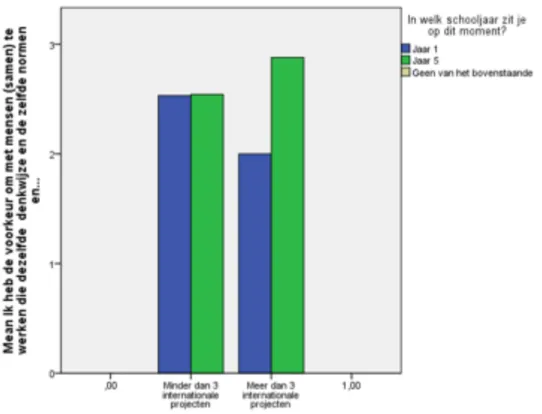
seve-ral meaningful increases. Three questions show a noticeable increase in means of all the answers
given. These questions are (4) “I prefer to work with people who have similar ways of thinking and
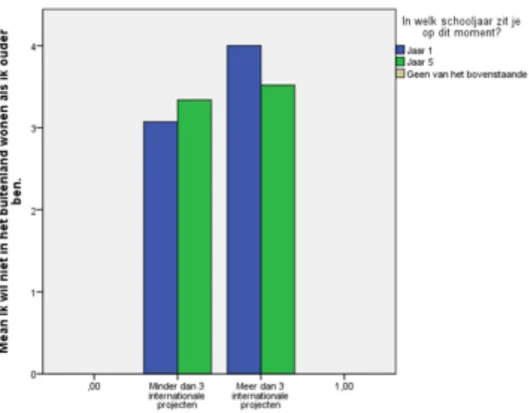
values to mine," (13) “I would consider taking an international internship” and (14) “I do not want
to live outside of the Netherlands when I am older (R)”. The compared means of the answers to
the-se questions are as well as the prior mentioned questions not significant due to the low amount of
participants per group.
All three questions show a positive increase in means of the answers that point towards a
positive influence of internationally oriented activities towards the attitude of globalization. In
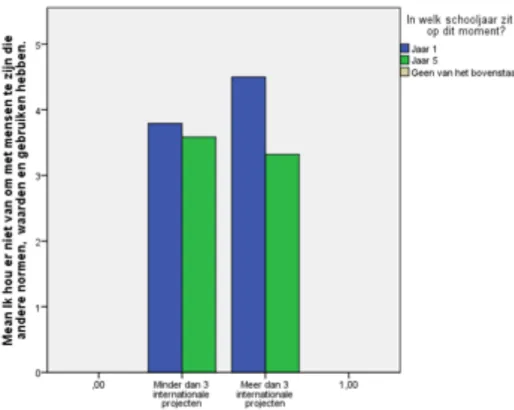
con-trast with these three questions there are also several questions that indicate a negative influence.
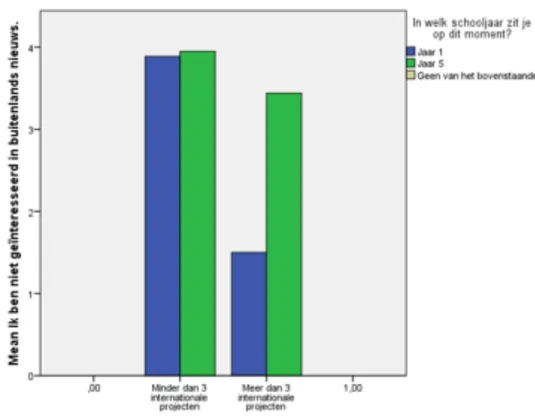
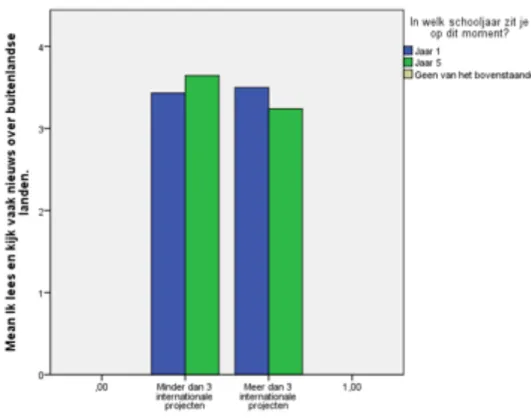
values," (9) “I am not very interested in overseas news (R)” and (6) “I often read and watch news
about foreign affairs” are highlighted as questions that show a negative score for the compared
means of the answers.
The analysis only focuses on three of the four groups. Thus, the group of students who are
junior students and who have done more than three internationally oriented activities is shown in
Figure 1 till 6 but have not been taken into account in the analysis. This group is too small, as there
are almost no students who have already completed three or more internationally oriented activities
when they are in the first year. In addition, the tables are in Dutch as the questionnairewas
answe-red in Dutch.
5.2 General analysis
Within a three week period 259 students responded from which 240 responses were usable for
ana-lysis. The other responses were either invalid or unreliable. The students who participated varied in
age among 12 - 19. Most students in the junior year are 12 or 13 years old. There are 95
twelve-year-old students and 48 thirteen-twelve-year-old students. The other students in the junior year are nine —
one exceptional prodigy- and fourteen. The students in the senior year vary between 15 and 19
ye-ars old, with most of them being 16 or 17 yeye-ars old. The questionnaire was answered by 43
sixteen-year-old students and 30 seventeen-sixteen-year-old students. The other students in the senior year are
fifteen, eighteen and nineteen. The respondents come close to a perfect balance between men and
women. 124 students who participated are male and 113 are female. Three students did not want or
forget to mention their gender.
In the questionnaire 101 Havo, 95 VWO and 44 bilingual (TTO) students participated. The
year division was as follows: Junior year provided 149 students, which is 62,3% of the total number
of students who participated in the questionnaire. Senior year thus contributed 90 that is 37.7% of
the number of students who participated in the questionnaire. The other three students are probably
gymnasium students (VWO with classical languages), as this option was not indicated specifically.
Two students gave as feedback that they had filled in “none of the above” as they were in
gymnasi-um. One student did not answer this question.
Social science is taken by 31 students. This implies that 207 do not study social science.
so-cial science and therefore only have soso-cial studies. This means that most students do not have extra
education in class where they may acquire political attitudes.
The nationalities of the participants show a diverse range of origins. The predominant
natio-nality is Dutch. 152 students say that they are Dutch. The other students give diverse answers.
Fourteen students say that they have more than one nationality. These students say that they have
both a Dutch and another nationality. Most likely these are students with a Moroccan, Turkish and
Surinam ethnicity, who often have two passports. One student has three nationalities including
Dut-ch. Three students did not fill in their nationality.
Among all students only 35 students have joined more than three activities. The other 187
have joined fewer than three activities. Strikingly, a high number of students, eighteen, did not or
not correctly fill in this question. A possible explanation might be that students did not know in how
many internationally oriented activities they have participated, or they did not know if a project that
they participated in was labeled as international so they chose not to answer this question.
5.3 Outcome per question
This section analyses the outcome of the questionnaire per question by year and by amount of
inter-nationally oriented activities. For all questions the results that show a positive influence of taking
part in more than three internationally oriented activities are discussed by year and amount of
inter-nationally oriented activities. First, the outcome by year/amount of interinter-nationally oriented
activi-ties and both combined is discussed in the following order: first 13 and 14, then question 4. Third,
question 7 is discussed for the divide by year. Last, question 8 is discussed for the amount of
inter-nationally oriented activities.
The results that seem to show a more negative influence of taking part in more than three
internationally oriented activities are discussed by year and amount of internationally oriented
acti-vities. First, the outcome by year/amount of internationally oriented activities and both combined
are discussed for question 5. Second, question 10 and 11 are discussed per year and for the amount
of internationally oriented activities. Last, question 6 and 9 are only discussed by year and for the
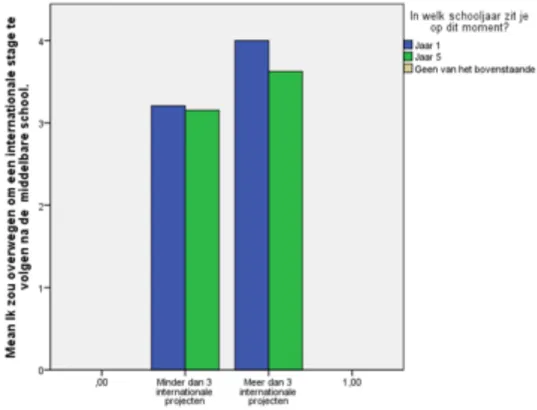
Question (13) “I would consider taking an international internship," shows a slight increase
in compared means of the answers divided by year. The junior year students show an average score
of 3,18. The senior year students have a slightly higher score of 3,32 in table 4. This makes students
more willing to do an international internship. A possible explanation might be the higher age and
international experience. Almost all students in the junior year have the age of eleven till thirteen.
At this stage of their life you are very attached to your parents and their homes. In other words, they
are mostly not yet thinking about their future in the sense of “place to live” and are less able to
think of themselves living separated from their parents. On the other hand, students who are in the
senior year are orientating themselves on studies and places to study. Therefore, students who find
out their preferences in study and place to study may more actively consider taking an internship
abroad. In addition, students become less attached to their parents and tend to choose their own path
in life. These students become freer and less detached to home, that might make it easier for
stu-dents to do an internship in another country. Moreover, as stustu-dents get older they have seen more of
the world through internationally oriented school activities and personal activities. This could create
a better understanding of the life in other countries which makes it more conceivable for students to