Cover Page
The handle http://hdl.handle.net/1887/70036 holds various files of this Leiden University
dissertation.
Author
: Fillinger, M.J.
T
wo-Prover Bit-Commitments Max Fillinger
Two-Prover Bit-Commitments:
Classical, Quantum and Non-Signaling
529291-L-bw-Fillinger 529291-L-bw-Fillinger 529291-L-bw-Fillinger
529291-L-bw-Fillinger Processed on: 27-2-2019 Processed on: 27-2-2019 Processed on: 27-2-2019
Processed on: 27-2-2019 PDF page: 1PDF page: 1PDF page: 1PDF page: 1
Two-Prover Bit-Commitments:
Classical, Quantum and Non-Signaling
Proefschrift
ter verkrijging van
de graad van Doctor aan de Universiteit Leiden
op gezag van Rector Magnificus prof. mr. C.J.J.M. Stolker,
volgens besluit van het College voor Promoties
te verdedigen op dinsdag 19 maart 2019
klokke 10:00 uur
door
Maximilian Johannes Fillinger
529291-L-bw-Fillinger 529291-L-bw-Fillinger 529291-L-bw-Fillinger
529291-L-bw-Fillinger Processed on: 27-2-2019 Processed on: 27-2-2019 Processed on: 27-2-2019
Processed on: 27-2-2019 PDF page: 2PDF page: 2PDF page: 2PDF page: 2
Prof. dr. Serge Fehr (CWI, Amsterdam & Universiteit Leiden)
Samenstelling van de promotiecommissie:
Dr. Stacey Jeffery (CWI, Amsterdam)
Prof. dr. Adrian Kent (University of Cambridge)
Prof. dr. Bart de Smit (Universiteit Leiden)
Prof. dr. Aad van der Vaart (Universiteit Leiden)
Prof. dr. Stefan Wolf (Università della Svizzera italiana, Lugano)
529291-L-bw-Fillinger 529291-L-bw-Fillinger 529291-L-bw-Fillinger
529291-L-bw-Fillinger Processed on: 27-2-2019 Processed on: 27-2-2019 Processed on: 27-2-2019
Processed on: 27-2-2019 PDF page: 3PDF page: 3PDF page: 3PDF page: 3
Contents
1 Introduction 1
1.1 Background . . . 1
1.2 Two-Prover Commitment Schemes . . . 6
1.3 Relativistic Cryptography . . . 9
1.4 Contributions of this Thesis . . . 12
2 Preliminaries 19 2.1 Probabilities . . . 19
2.2 Two-Prover Commitment Schemes . . . 23
3 The Hiding and Binding Properties 27 3.1 Introduction . . . 27
3.2 Defining The Binding Property . . . 28
4 The Composition Theorem 41 4.1 Composition of Commitment Schemes . . . 41
4.2 The Composition Theorems . . . 46
4.3 Variations . . . 50
4.4 Tightness . . . 53
5 Towards Quantum Safety 59 5.1 Introduction . . . 59
5.2 Quantum Information Theory . . . 60
5.3 Protocols . . . 65
5.4 Binding Properties . . . 66
5.5 The Composition Theorem . . . 70
6 Bit-commitment with Non-signaling Adversaries 73 6.1 Introduction . . . 73
6.2 Bipartite Systems and Two-Prover Commitments . . . 74
6.3 Impossibility of Two-Prover Commitments . . . 80
6.4 Possibility of Three-Prover Commitments . . . 89
529291-L-bw-Fillinger 529291-L-bw-Fillinger 529291-L-bw-Fillinger
529291-L-bw-Fillinger Processed on: 27-2-2019 Processed on: 27-2-2019 Processed on: 27-2-2019
529291-L-bw-Fillinger 529291-L-bw-Fillinger 529291-L-bw-Fillinger
529291-L-bw-Fillinger Processed on: 27-2-2019 Processed on: 27-2-2019 Processed on: 27-2-2019
Processed on: 27-2-2019 PDF page: 5PDF page: 5PDF page: 5PDF page: 5
Chapter 1
Introduction
1.1
Background
1.1.1
Cryptography with Mutually Distrusting Parties
Cryptology began as the art of designing and breaking ciphers that allow two parties to communicate in such a way that an outsider who observes the messages does not learn the actual content. During the second half of the 20th century, cryptology has changed significantly: it became more rigorous and scientific, and also expanded its scope.
Replacing mechanical with digital ciphers made it possible to create much stronger encryption schemes. Also, entirely new concepts of encryption were introduced: While previous encryption schemes all required both parties to have the same secret key,public-key cryptographymakes it possible to generate a key pair consisting of apublic keyand aprivate keyso that messages can be encrypted using the public key but decryptedonlywith the private key. Thus, the receiver can safely publish the public key and receive encrypted messages from anyone.
In traditional cryptographic applications, we want to protect two commu-nicating parties from outside attackers. However, modern cryptography also considers situations where mutually distrusting parties want to cooperate in a secure way, meaning that no party needs to disclose more information than strictly necessary and that each party is protected if the other one turns out to be dishonest. A classic example is the Millionaires’ Problem where two millionaires want to know who is richer, without disclosing any additional information about their wealth to the other one. Situations like this are con-sidered inmulti-party computationwherenplayers each hold one inputxi to a functionf and want to computef(x1, . . . , xn)so that the other parties do not
learn anything about xi except for what they can deduce from the function value.
529291-L-bw-Fillinger 529291-L-bw-Fillinger 529291-L-bw-Fillinger
529291-L-bw-Fillinger Processed on: 27-2-2019 Processed on: 27-2-2019 Processed on: 27-2-2019
Processed on: 27-2-2019 PDF page: 6PDF page: 6PDF page: 6PDF page: 6
Another example of such a situation is a so-called coin-flipping protocol, i.e., a protocol between two parties, called Alice and Bob, that generates a uniformly random bit b which is output to both of them. A coin-flipping protocol needs to ensure that neither party can bias the “coin”: if one party is dishonest and deviates from the protocol, the output distribution for the honest party must still be a uniformly random bit.
If we can ensure that both parties send their messages simultaneously, this problem is easy to solve: each of them sends a uniformly random bit to the other and then outputs the XOR of the bit they sent and the one they received. The output will then be a uniformly random bit, as long as at least one party is honest. However, if we cannot ensure that the messages are sent simultaneously, this protocol is not secure. Suppose that Bob receives Alice’s message before sending his own. If he is dishonest, he can then choose his bit depending on the one he received from Alice and enforce any output distribution he likes for the protocol.
In both of the applications that we discussed so far, all participants have the same security concerns. However, there are also applications where that is not the case, such as zero-knowledge proofs: Suppose that one party (called the prover) knows a satisfying assignment for a Boolean formula. In a zero-knowledge proof system for the satisfiability problem, the prover wants to con-vince another party (theverifier) that a formula is satisfiable, but he does not want to reveal any further information (such as the satisfying assignment). The verifier on the other hand wants to be certain that a dishonest prover cannot deceive him about the satisfiability of the formula, but is not concerned with the secrecy of the satisfying assignment.
Traditional cryptographic primitives, like encryption or message authenti-cation, can still be useful in the context of mutually distrusting parties – for example, multi-party computation protocols generally require that each par-ticipant has a confidential and authenticated channel to each other parpar-ticipant. However, on their own, these tools are not sufficient for building protocols for coin-flipping, multi-party computation, or zero-knowledge proofs. New crypto-graphic primitives were required to solve these problems. In the next section, we introduce such a cryptographic primitive.
1.1.2
Commitment Schemes
529291-L-bw-Fillinger 529291-L-bw-Fillinger 529291-L-bw-Fillinger
529291-L-bw-Fillinger Processed on: 27-2-2019 Processed on: 27-2-2019 Processed on: 27-2-2019
Processed on: 27-2-2019 PDF page: 7PDF page: 7PDF page: 7PDF page: 7
1.1. BACKGROUND 3
EGL83].
A commitment scheme allows aproverto select an elementsof a publicly known setDso that he can later reveal it to another party, called theverifier, in such a way that the verifier can be certain that the revealed value is the same as the originally selected one. If D is the set {0,1} we speak of a bit-commitment scheme. If we want to emphasize that a commitment scheme has a larger domain, we call it a string-commitment scheme (even when the elements of D are not actually strings). If the domain has size (at least) 2n, we call the commitment scheme ann-bit string commitment scheme.
More formally, a commitment scheme consists of two interactive protocols between the prover and the verifier, called the commit phase and opening phase. The commit phase takes as input an element s∈ D from the prover and no input from the verifier. It outputs some state information to the two parties. The verifier’s state is commonly called the commitment to s. The opening phase takes the state information of the prover and verifier as input, and outputs an elements0 ∈D or the failure symbol⊥to the verifier; we say that the prover opened the commitment to s0, or if the output is ⊥, that he failed to open the commitment. The opening phase is often non-interactive in the sense that the prover sends some opening informationto the verifier who then determines the output by local computation.
A basic requirement of a commitment scheme is that if both parties follow the protocols, the inputsto the commit phase and the outputs0of the opening
phase are identical. This property is called completeness. Informally, the security requirements for a commitment scheme are as follows:
• Thehidingproperty: by the execution of the commit phase, the verifier does not learn the prover’s inputs. In particular, this holds even if the verifier is dishonest and deviates from the commit protocol in arbitrary ways.
• Thebindingproperty: after the commit phase has been executed, there isat most oneelements0∈Dthat the prover can open to in the opening
phase. This holds even if the prover is dishonest and deviates from the protocols in arbitrary ways.
To see how bit-commitment schemes can be used for coin-flipping, consider the following protocol, which does not require that the parties send their mes-sages simultaneously: First, Alice samples a random bit and commits to it. Then, Bob samples a random bit and sends it to Alice. Finally, Alice opens the commitment and both parties output the XOR of the two random bits. In this protocol, the hiding property of the commitment scheme ensures that Bob does not know Alice’s bit before sending his bit. The binding property ensures that Alice can not choose her bit after learning Bob’s: after the commit phase, there is at most one value she can open to.
529291-L-bw-Fillinger 529291-L-bw-Fillinger 529291-L-bw-Fillinger
529291-L-bw-Fillinger Processed on: 27-2-2019 Processed on: 27-2-2019 Processed on: 27-2-2019
Processed on: 27-2-2019 PDF page: 8PDF page: 8PDF page: 8PDF page: 8
knows what the outcome of the coin flipping protocol will be, but Bob does not. A dishonest Alice could thus decide whether or not to open the commitment depending on the outcome. If one outcome of the coin-flipping protocol is considered favorable for Alice, and the other unfavorable, it makes sense to stipulate that the protocol outputs the unfavorable outcome in that case. But then, the protocol only implementsweakcoin-flipping, meaning that dishonest partiescanbias the output distribution, but only towards the outcome that is unfavorable for them.
1.1.3
Capabilities of Adversaries
Rigorous security claims of cryptographic schemes always require some model that specifies the capabilities and limitations of the honest parties and of the adversaries. Most commonly, the honest parties and adversaries are modeled as Turing machines that are limited toefficientcomputations. Efficiency here is understood asymptotically: algorithms and protocols are parametrized by a security parameter n, and the running time for the honest parties must be polynomial inn, while the adversaries must not be able to break the scheme in time polynomial inn. Security proofs in this model typically usecomputational hardness assumptions, i.e., assumptions that certain computational problems, such as factoring large integers, can not be solved efficiently. We then speak of computational security. No such assumptions have been proven.
The security of cryptographic primitives that are relied on in practice is typically based on problems that have been studied for a long time, without an efficient solution being discovered. This is considered empirical evidence that the problem in fact does not have an efficient solution.
The security of many popular cryptosystems (e.g., RSA and the Diffie-Hellman Key Exchange) is based on problems that are believed to have no efficient solution in the Turning machine model, but do have an efficient so-lution on a quantum computer [Sho97]. Since quantum computers might be-come practical in the near future, there is a lot of interest in quantum-safe
(also calledpost-quantum) cryptosystems which are hard to break even with a quantum computer, but can be executed on classical computers. Formally, one would then model the honest parties as Turing machines and the adversary as a family of quantum circuits with a polynomial number of gates.
In the information-theoretic model, we remove the efficiency requirement from the adversary – we say that the adversary iscomputationally unbounded. For example, an encryption scheme would only be considered secure in the information-theoretic model if the adversary cannot recover any amount of information about the message, even given unlimited time.1 In other words,
the plaintext is (almost) statistically independent of the information that the adversary has. If a scheme is proven to be secure in the information-theoretic
1One can also relax this requirement and allow the adversary to obtain a very small
529291-L-bw-Fillinger 529291-L-bw-Fillinger 529291-L-bw-Fillinger
529291-L-bw-Fillinger Processed on: 27-2-2019 Processed on: 27-2-2019 Processed on: 27-2-2019
Processed on: 27-2-2019 PDF page: 9PDF page: 9PDF page: 9PDF page: 9
1.1. BACKGROUND 5
model, it is secure against adversaries with unlimited computing power. We also call such schemes unconditionallysecure.
Most schemes that are used in practice are not unconditionally secure. For example, if we consider a symmetric cipher with an n-bit key, a computa-tionally unbounded adversary could decrypt a given ciphertext under every possible key. He then knows that one of the 2n outputs must be the original plaintext. If the size of the plaintext space is greater than 2n, this gives the adversary a significant amount of information. Furthermore, if the plaintext is known to be, e.g., English text, the adversary is likely able to rule out all but one of the candidate keys. Unconditionally secure encryption is only possible if the key has at least as much entropy as the message, as Claude Shannon proved in 1949 [Sha49].
Note that up to now, we discussed thestandard model where the partici-pants in the scheme or protocol can only communicate classical information via a completely unsecured channel. More results can be achieved if the hon-est parties have access to additional resources. An example is Quantum Key Distribution (QKD), introduced by Charles Bennett and Gilles Brassard in 1984 [BB84]. It allows two parties to securely establish a shared random key using an authenticated classical channel and a completely insecure channel for quantum information. The generated key can then be used for a classi-cal information-theoreticlassi-cally secure encryption scheme like the One-time Pad. QKD offers information-theoretic security beyond the Shannon bound, but it requires that the honest parties are able to produce, transmit, and measure quantum states, e.g., in the form of polarized photons.2
As another example, if two parties can communicate via a noisy channel, they can also transmit messages securely, as Aaron Wyner proved in [Wyn75]. The noisy channel here is modeled as a channel that flips every bit that is sent with a known probability εand leaves it unchanged otherwise. In particular, if an adversary taps the channel, the bits he receives are flipped with the same probability, but independently of the bits received by the intended recipient. Cryptographic primitives that are useful for cryptography with mutually dis-trusting parties, like oblivious transfer, can be implemented as well using a noisy channel [CK88].
One can also impose non-computational restrictions on the adversary, such as limited classical memory [CM97, CCM98], or limited or noisy quantum memory [DFSS05, WCSL10]. Storing quantum information is a difficult prob-lem, and thus schemes where an adversary needs to store large amounts of quantum information while the honest parties can measure the quantum states as they arrive are of interest. A different kind of restriction is to split the prover into two separate parties and restrict the communication between them. We discuss this in more detail in Section 1.2.2.
2Note that QKD does not require the honest parties to have a quantum computer or
529291-L-bw-Fillinger 529291-L-bw-Fillinger 529291-L-bw-Fillinger
529291-L-bw-Fillinger Processed on: 27-2-2019 Processed on: 27-2-2019 Processed on: 27-2-2019
Processed on: 27-2-2019 PDF page: 10PDF page: 10PDF page: 10PDF page: 10
1.2
Two-Prover Commitment Schemes
1.2.1
(In)security of Commitment Schemes
The existence of commitment schemes in the computational model follows from very week assumptions: if a pseudo-random generator3exists, then there
exists a commitment scheme that is both hiding and binding [Nao91]. The existence of pseudo-random generators has not been proven, although there are many candidates in both theory and practice. But if they do not exist, then there are no secure cryptographic schemes in the computational model [IL89].4 Or conversely, if computational cryptography is at all possible, then
commitment schemes exist.
Let us now consider commitment schemes in the information-theoretic model, typically referred to as unconditionally secure commitment schemes. It is well known that in the standard communication model, bit-commitment schemes can not be both unconditionally hiding and unconditionally bind-ing. Consider a bit-commitment scheme that is unconditionally bindbind-ing. It is easy to see that a computationally unbounded dishonest verifier can break the hiding property as follows.
First, both parties execute the commit phase, which outputs state
informa-tionstateP andstateV to the prover and verifier, respectively. If the opening
phase is executed with inputsstateP andstateV, the output is the bitb that the prover committed to. The binding property requires that the prover can open to at most one bit, so if stateP is replaced with a different input, the output will be either ⊥ or b (except possibly with some small probability). A computationally unbounded verifier can simulate the opening phase for ev-ery possible value of stateP, and thus determine the bit b that the prover committed to.
Since unconditionally secure bit-commitment is impossible in the standard communication model, we have to move to a different one. There was some hope that unconditionally secure bit-commitment schemes could be achieved using quantum communication, but eventually, an impossibility result was proved also in that setting [May97, LC97]. If the dishonest players have
bounded memory [CCM98], then unconditionally secure bit-commitment is possible.5 The same holds in thebounded quantum storagemodel where
adver-saries have unlimited classical memory, but only a limited amount of quantum memory [DFSS05].
3A function that maps a short string of random bits to a longer string so that the longer
string cannot be distinguished from a truly random string in polynomial time.
4The cited paper argues that computational cryptography cannot exist if there are no
one-way functions; it is possible to implement a pseudo-random generator with one-way functions.
5The topic of the cited paper is not bit-commitment, but a different cryptographic
529291-L-bw-Fillinger 529291-L-bw-Fillinger 529291-L-bw-Fillinger
529291-L-bw-Fillinger Processed on: 27-2-2019 Processed on: 27-2-2019 Processed on: 27-2-2019
Processed on: 27-2-2019 PDF page: 11PDF page: 11PDF page: 11PDF page: 11
1.2. TWO-PROVER COMMITMENT SCHEMES 7
1.2.2
Adding a Second Prover
Another way to circumvent the impossibility result is to split up the prover into two entities that are assumed to be unable to communicate with each other. This so-called two-prover setting was introduced by Michael Ben-Or, Shafrira Goldwasser, Joe Kilian and Avi Wigderson [BGKW88]. The provers
can communicate before the start of the commit phase to generate shared randomness, and, if they are dishonest, agree on a cheating strategy, but from the start of the commit phase until the end of the opening phase, they cannot communicate.
As an example for a scheme in this model, we consider a scheme that was introduced by Jean-Raymond Simard in [Sim07] and further explored by Claude Crépeau, Louis Salvail, Simard and Alain Tapp in [CSST11]. This scheme will also play an important role in the remainder of this thesis. We call this scheme CHSHq where q is a prime power. It works as follows: Let
b be the bit that the provers want to commit to and r a uniformly random element of the finite field Fq that the provers agree on as shared randomness before the execution of the commit phase. In the commit phase, the verifier
V sends a uniformly random elementaof the finite fieldFq to the first prover
P, who sends back x=a·b+r. In the opening phase, the second prover Q
sends the bit b and y =r to V. Then,V outputsb if x−y =a·b, and the failure symbol ⊥otherwise.6
Let us verify that this scheme satisfies the properties that we want a com-mitment scheme to have. The hiding property requires that a (possibly dis-honest) verifier can learn nothing about the committed bit before the opening phase. The scheme isperfectly hiding becauseP’s messagexis always a uni-formly random field element, independent of the value ofb.
Completeness requires that if all parties are honest, the verifier opens to the bit that the provers committed to. It is easy to see that this requirement is satisfied.
Thebinding property requires that even dishonest provers can open to at most one value. Let aandxbe the messages exchanged betweenV andP in the commit phase. Since we consider dishonest provers, x does not have to be computed as specified in the protocol – in fact, the dishonest provers do not need to have any specific bitbin mind while executing the commit phase. The following argument works for any value ofxand makes no assumptions on how it is computed. IfQwants to open tob= 0, he needs to sendb= 0and
y=xtoV; if he wants to open tob= 1, he needs to sendb= 1andy=x−a. Thus, if Q can open toboth bits, it follows that he knowsa. But awas sent only to P, and by assumption, P andQ cannot communicate. Therefore, Q
can only open to both bits if he correctly guesses a. This happens only with
6This version ofCHSHq differs slightly from the version we use later on, whereQdoes
529291-L-bw-Fillinger 529291-L-bw-Fillinger 529291-L-bw-Fillinger
529291-L-bw-Fillinger Processed on: 27-2-2019 Processed on: 27-2-2019 Processed on: 27-2-2019
Processed on: 27-2-2019 PDF page: 12PDF page: 12PDF page: 12PDF page: 12
probability q−1.
We emphasize thatCHSHq as described above and as analyzed in previous work is a bit-commitment scheme, but it can be naturally extended to a string-commitment scheme by lettingbbe an arbitrary element ofFq. This extension has been used as part of a larger protocol in [LKB+15], but prior to our work in
[FF16], it has not been analyzed as a stand-alone string-commitment scheme. Analyzing it as a string commitment scheme turns out to be somewhat subtle: for instance, it is not clear a priori what the right formal definition of the binding property is for a string-commitment scheme in the two-prover setting. This thesis will answer those kinds of questions.
1.2.3
Capabilities of the Provers
As discussed above, the security of CHSHq relies on the assumption that the provers cannot communicate. However, it turns out that what this pre-cisely means is more subtle than the previous section makes it appear. As in [BGKW88], we implicitly assumed in the argument above that the only type of information that the provers can share before the commit phase is classical information. However, as pointed out in [Sim07, CSST11], the argument falls apart when we consider provers that share an entangled quantum state. The reason for that isnon-locality, one of the counterintuitive properties of quan-tum mechanics, which is studied by means of Bell inequalities and non-local games [EPR35, Bel64, CHSH69].
Formally, the point where the argument from the previous section fails in the quantum case is the part where we conclude that a prover who can
choose to output either x or x−a must also know a. This does not follow in the quantum case. It is generally not possible to measure (i.e., extract information from) a quantum state without irreversiblychanging the state. If
Q could producey =xusing one measurement andy =x−ausing another measurement, then he could open to any bit he likes, but it does not follow that he could produceboth xandx−aat the same time. Hence, it does not follow that he knows a.
[CSST11] shows that CHSH2n is secure in the quantum case. On the other hand, the same paper also shows that a slight variation of this scheme is secure only against classical adversaries: an error-tolerant version where
V only checks that 85% of the bits in xand y or x and y+a are equal is secure against classical adversaries, but completely insecure against quantum adversaries. This is a consequence of the fact that players with an entangled quantum state can win the non-local game known as the CHSH game with probability ≈0.85(see Section 5.2.4). This connection with the CHSH game is the reason why we refer to the commitment scheme asCHSHq.
529291-L-bw-Fillinger 529291-L-bw-Fillinger 529291-L-bw-Fillinger
529291-L-bw-Fillinger Processed on: 27-2-2019 Processed on: 27-2-2019 Processed on: 27-2-2019
Processed on: 27-2-2019 PDF page: 13PDF page: 13PDF page: 13PDF page: 13
1.3. RELATIVISTIC CRYPTOGRAPHY 9
general non-signalingadversaries, i.e., adversaries that are equipped with a hy-pothetical resource that allows them to correlate their behavior in arbitrary ways as long as no communication is implied. Such hypothetical resources are known as non-local boxes.
1.3
Relativistic Cryptography
1.3.1
Enforcing the No-Communication Assumption
There are two-prover commitment schemes that are secure if the two provers cannot communicate and can correlate their behavior only through shared randomness or entangled quantum states. This leaves open the question of how one might actually prevent the provers from communicating. In relativistic commitment schemes, we exploit the fact that information does not travel faster than light, and thus, messages from one prover to the other arrive only with some delay.
In [BC96], Gilles Brassard and Claude Crépeau briefly discuss the idea, communicated by Louis Salvail, of applying special relativity to two-prover bit-commitment schemes that rely on the no-communication assumption, as described in Section 1.2.2. If the provers are n light-seconds apart, the laws of physics ensure that the commitment is binding,but only for a limited time: The commitment will “live” for n seconds, starting when the first message from the verifier arrives at a prover. If the provers open within this time-span, the verifier can be assured that the provers can open to at most one value, since the no-communication assumption is guaranteed by the fact that information can not be transmitted faster than the speed of light. If the commitment is not opened within this time-span, it is possible that the provers have communicated with each other. Thus, they might be able to open to multiple values.
Adrian Kent introduced the concept of relativistic commitment schemes that can remain binding indefinitely as long as the provers can only commu-nicate with some delay [Ken99, Ken05]. This is achieved by introducing an additionalsustain phasebetween the commit and opening phase. During this phase, additional communication between the verifier and the provers takes place that is meant to ensure that the commitment remains binding. The hiding property should still apply during this phase.
1.3.2
Previous and Related Work
529291-L-bw-Fillinger 529291-L-bw-Fillinger 529291-L-bw-Fillinger
529291-L-bw-Fillinger Processed on: 27-2-2019 Processed on: 27-2-2019 Processed on: 27-2-2019
Processed on: 27-2-2019 PDF page: 14PDF page: 14PDF page: 14PDF page: 14
A major issue with Kent’s original scheme is that the length of the mes-sages that need to be communicated in each round of the sustain phase grows exponentially in the number of rounds. Furthermore, the security arguments are rather informal and not in terms of rigorous definitions. As such, it cannot be considered a mathematical security proof. However, his work demonstrated that it is possible, or at least plausible, to base the security of a commitment scheme on the fact that information does not travel faster than light and thus laid the foundation for subsequent work in this area.
In [Ken05], he introduced an improved scheme where the same number of bits is communicated in every round. Additionally, the security proofs are more formal, using the sum-binding definition (see Definition 2.14). However, the results are mostly of an asymptotic nature and clearly not practical, although some concrete parameter choices are also discussed.
Kent also considered commitment schemes that involve quantum communi-cation. Concretely, he presented a scheme where the players transmit quantum states instead of classical bits [Ken11], and a scheme where the verifier sends a quantum state to the provers, and the provers return classical bits [Ken12]. These schemes do not require a sustain phase. Furthermore, the former one requires only one prover and one verifier. The latter requires a prover that is split intothreeagents.
A security proof for the latter scheme was later published in a joint work of Sarah Croke and Kent [CK12]. See [KTHW13] for an alternative proof. This scheme was implemented in 2013 by Tomaso Lunghi, Jędrzej Kaniewski, Felix Bussières, Raphael Houlmann, Marco Tomamichel, Adrian Kent, Nicolas Gisin, Stephanie Wehner and Hugo Zbinden [LKB+13, Kan15].
In later work [Ken13], Kent isolated the “game” whose hardness underlies the security of the quantum bit-commitment schemes. In the summoning
problem, Alice gives a quantum state to Bob. The description of the state is known to her, but not to Bob. She will later ask Bob to “summon” it to some point. For simplicity, one may assume that she fixes two points P0 and
P1 that are known to Bob, and selects one of them uniformly at random.
After receiving Alice’s summoning request, Bob has a short amount of time to produce a quantum state at this point that Alice can not distinguish from her original state.
Kent shows that this task is (in general) impossible by combining the no-cloning theorem [Par70, WZ82], which states that it is in general not possible to create a perfect copy of quantum states, with special relativity: Bob cannot send copies of the state to both locations due to the no-cloning theorem. But if the two points are far enough apart, he cannot position the state in such a way that he can always “summon” it to the point Alice chooses within the time constraint. Further work on the summoning problem can be found in [AK16, Ken18].
se-529291-L-bw-Fillinger 529291-L-bw-Fillinger 529291-L-bw-Fillinger
529291-L-bw-Fillinger Processed on: 27-2-2019 Processed on: 27-2-2019 Processed on: 27-2-2019
Processed on: 27-2-2019 PDF page: 15PDF page: 15PDF page: 15PDF page: 15
1.3. RELATIVISTIC CRYPTOGRAPHY 11
curity proofs are based on relativity and monogamy of entanglement [CKW00]. For many quantum-cryptographic tasks, such as Quantum Key Distribu-tion, device-independent protocols have been discovered [MY98]. In such pro-tocols, the participants do not even need to trust the devices that carry out the preparation and measurement of quantum states. Quantum bit-commitment schemes with this property have been discovered as well [AK15b].
But there also has been progress for classical schemes: Lunghi, Kaniewski, Bussières, Houlman, Tomamichel, Wehner and Zbinden proposed a new multi-round commitment scheme where the honest parties communicate classically [LKB+15]. They provided a rigorous, non-asymptotic, security analysis with
respect to the sum-binding definition. However, their analysis only guarantees an error term that worsens double-exponentially in the number of rounds of communication. Furthermore, their security proof only applies to classical provers, i.e., provers with no quantum capabilities.
The fact that information does not travel faster than light has also been applied in related areas of cryptography: Roger Colbeck and Adrian Kent in-troduced variable-bias coin-tossing schemes, where the probability distribution of the outcome is secretly determined by one of the parties [CK06, Col06]. On the other hand, Colbeck showed that unconditionally secure two-party com-putation is not possible (for most functions) even with the combined power of quantum information and relativity [Col06, Col07].
A relativistic quantum key distribution scheme has also been proposed [RKKM14]. While QKD schemes like the one introduced by Charles Bennet and Gilles Brassard [BB84] can be proven secure only on the basis of quantum mechanics, implementations can often be broken due to imperfections in the physical apparatus (see e.g. [LWW+10]). While not being device-independent,
the relativistic scheme has a higher tolerance for the type of imperfections that occur in practice, and is more efficient than device-independent protocols.
A different conjectured application of relativity isposition-based quantum cryptography, also known asquantum tagging. Here, a prover wants to demon-strate that he is at a specific location. This claim is checked by a set of verifiers which are positioned at different points in space. The verifiers use the response time of the prover to determine his position. However, just sending a nonce to the prover and requiring him to send it back is insufficient: a group of adver-saries could pretend to be a single prover at the correct position, even though none of them are actually there. Therefore, techniques to prevent this attack using quantum information have been studied.
Chan-529291-L-bw-Fillinger 529291-L-bw-Fillinger 529291-L-bw-Fillinger
529291-L-bw-Fillinger Processed on: 27-2-2019 Processed on: 27-2-2019 Processed on: 27-2-2019
Processed on: 27-2-2019 PDF page: 16PDF page: 16PDF page: 16PDF page: 16
dran, Serge Fehr, Ran Gelles, Vipul Goyal, Rafail Ostrovsky and Christian Schaffner proved a general impossibility result: position-based cryptography schemes cannot be secure if dishonest provers can have an unlimited amount of pre-shared entanglement [BCF+11]. Further research in the field of position-based cryptography aimed at finding a scheme where dishonest provers need large amounts of pre-shared entanglement compared to the number of qubits that the honest parties need to exchange.
1.4
Contributions of this Thesis
This thesis is based on the following publications and follow-up work:
• Serge Fehr and Max Fillinger. Multi-Prover Commitments Against Non-Signaling Attacks. InAdvances in Cryptology - CRYPTO 2015, part II, pages 403-421.
Also presented atQCRYPT 2015.
• Serge Fehr and Max Fillinger. On the Composition of Two-Prover Com-mitments, and Applications to Multi-round Relativistic Commitments.
InAdvances in Cryptology - EUROCRYPT 2016, part II, pages 477-496. An earlier version was presented atQCRYPT 2015. An extended version is available at
https://arxiv.org/abs/1507.00240.
The author published two other papers during his PhD studies. These are not featured in this thesis because they are about very different subjects and would not allow for a coherent presentation. A full list of publications can be found on page 109.
1.4.1
New Definitions for the Binding Property
Finding good security definitions is a crucial part of cryptography. A good definition has to capture the intuitive notion of the desired security property in a precise mathematical way. It should be as strong as possible, but it also should be possible to prove that this definition can be met, or to reduce it to standard hardness assumptions in the case of computational security.
529291-L-bw-Fillinger 529291-L-bw-Fillinger 529291-L-bw-Fillinger
529291-L-bw-Fillinger Processed on: 27-2-2019 Processed on: 27-2-2019 Processed on: 27-2-2019
Processed on: 27-2-2019 PDF page: 17PDF page: 17PDF page: 17PDF page: 17
1.4. CONTRIBUTIONS OF THIS THESIS 13
dishonest provers may use, it holds that p0+p1 ≤ 1 + 2ε, where pb is the probability that the provers successfully open to b. However, this definition suffers from several limitations. An immediately obvious limitation is that this definition only applies to bit-commitment schemes, and there is some ambiguity in how to extend it to string-commitment schemes. It also does not fully capture the intuitive requirement of the binding property: Suppose that a scheme rejects all opening attempts of dishonest provers with probability 1/2 and allows dishonest provers to open to an arbitrary bit with probability 1/2. This scheme then has a “perfect” parameter ofε= 0(see Remark 3.13), but the intuitive requirement that the provers should only be able to open a commitment to at most one value is violated with probability1/2. Finally, it turns out that the sum-binding definition is inconvenient to work with, e.g., it does not seem to compose well.
Contribution 1.1. We propose several new definitions for the binding prop-erty of bit and string commitment schemes and analyze their relations with each other and with the sum-binding definition.
These definitions overcome many of the shortcomings of the sum-binding definition. They are applicable to bit and string commitment schemes, they are closer to the intuitive definition that a commitment has only one bit or string “inside” and they are more convenient to work with. Indeed, one of the main results of this thesis crucially relies on the use of these new definitions.
Depending on the version of our definition, we end up with weaker or stronger notions of the binding property. When we restrict the domain to one bit, the weaker definition is equivalent to the sum-binding definition, while the stronger definition isstrictlystronger.
Our definitions also include relaxed versions, called fairly-binding, which allow dishonest provers to open to a value other than the one they committed to, but if they do, the resulting string will be random and out of their control. This relaxation will play an important role later on.
Naturally, a new definition is only useful if there are schemes that actually satisfy it:
Contribution 1.2. We show that for every binding property that we define, there exists a variant of CHSHq that satisfies it. In particular, this is the first time that the security of this scheme is analyzed as a string-commitment
scheme.
Recall that CHSHq is easily understood as a string-commitment scheme when the bit b is replaced with an arbitrary field element. We show in Sec-tion 3.2.6 that this scheme satisfies the fairly-binding property. This in turn allows us to analyze the scheme from [LKB+15] using our composition the-orem (see Section 1.4.2 and Chapter 4). Furthermore, if we change CHSHq
529291-L-bw-Fillinger 529291-L-bw-Fillinger 529291-L-bw-Fillinger
529291-L-bw-Fillinger Processed on: 27-2-2019 Processed on: 27-2-2019 Processed on: 27-2-2019
Processed on: 27-2-2019 PDF page: 18PDF page: 18PDF page: 18PDF page: 18
with the opening information, it satisfies our stronger definition of the binding property.
1.4.2
Composition Theorem for Multi-Round Schemes
Contribution 1.3. We prove a composition theorem for two-prover commit-ment schemes: if a pair of two-prover commitcommit-ment schemesS andS0 satisfies
some mild requirements, they can be composed into a new secure commitment scheme with delayed opening.
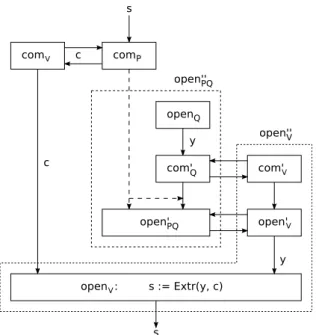
The composition works as follows: In the first round, the first prover com-mits to some string s using S. In the second round, instead of sending the opening information, the second prover commits to the opening information using S0. Then, the opening phase of S0 is executed, the verifier learns the
opening information and uses it to open the commitment produced byS. Note that the opening phase inS0 can itself be multi-round, so this composition
op-eration can be applied iteratively.
Intuitively, one would expect such a composition to work. Committing to the opening information before revealing it should not affect the security of the commitment, as long as S0 is secure. However, proving that this is
indeed the case turns out to be nontrivial. In particular, there seems to be no straightforward way to prove this result using the sum-binding definition.
As we mentioned in Section 1.3.1, a two-prover commitment scheme that is binding for non-communicating provers is binding for a limited time in the relativistic setting, i.e., when the provers can only communicate with some delay. By means of the above composition, it is possible todelay the opening of the original commitment. Thus, the multi-round schemes that are generated by the composition operation are binding in the relativistic setting, if the rounds are timed correctly.
Using our new definitions of the binding property, we formally prove this composition theorem. The failure probabilities of the component schemes add up. That is, if the binding property in S fails with probability at mostεand in S0 with probability at mostε0, the composed scheme fails with probability
at mostε+ε0.
Given that, the bit-commitment scheme presented in [LKB+15] can be viewed as a composition of multiple instances of CHSHq. Contribution 1.3 gives us a means to analyze that scheme. Thus, we obtain the following result:
Contribution 1.4. The binding error of the Lunghiet al. relativistic com-mitment scheme grows linearly in the number of rounds, instead of double-exponentially, as previously proven in [LKB+15]. Furthermore, security holds with respect to a stronger definition of the binding property instead of the commonly-used sum-binding definition.
529291-L-bw-Fillinger 529291-L-bw-Fillinger 529291-L-bw-Fillinger
529291-L-bw-Fillinger Processed on: 27-2-2019 Processed on: 27-2-2019 Processed on: 27-2-2019
Processed on: 27-2-2019 PDF page: 19PDF page: 19PDF page: 19PDF page: 19
1.4. CONTRIBUTIONS OF THIS THESIS 15
km). Based on their analysis, they concluded that this commitment would stay binding for at least 2 ms. Based on our analysis, this time can be scaled up to 1056 years, or, speaking more practically, until the devices run out of memory. Alternatively, one can also decrease the distance: Verbaniset al. ex-ecuted the Lunghiet al. scheme for24hours across a distance of7 km, based on our security analysis [VMH+16].
Finally, we also show that our analysis of the scheme is essentially tight, i.e., the binding error probability can not be better than linear inm.
1.4.3
Partial Progress towards Quantum Safety
So far, no multi-round relativistic commitment scheme has been proven to be “post-quantum” or quantum-safe in the sense that honest parties are protected against adversaries with quantum capabilities, while not having such capabil-ities themselves. Our notion of quantum-safety is different from the one used in computational cryptography: In the computational setting, quantum-safe cryptography is concerned with adversaries that use a quantum computer. In the information-theoretic setting, quantum computers are irrelevant because the set of computable functions is the same for classical and quantum com-puters. Quantum computers are believed to provide speedups for computing some functions, e.g., factoring integers, but this makes no difference when we consider computationally unbounded adversaries. However, when we impose restrictions on the communication between adversaries, a different aspect of quantum information becomes relevant: using quantum entanglement, the ad-versaries can correlate their behavior in ways that are not possible with shared randomness only.
The basic intuition of the composition theorem still applies. If we have two commitment schemes that are binding for provers with shared entanglement, then the composed scheme should be binding as well: the provers commit to the opening information of the first scheme, so they can delay revealing it without being able to change it. In Chapter 5, we show some partial progress towards proving that the Lunghiet al. scheme is quantum safe.
The first hurdle for proving quantum-safety is that some of our new defini-tions do not make sense for entangled adversaries, since they assume that the provers can only use shared randomness.
Contribution 1.5. We provide quantum analogues for our new definitions of the binding property and prove a composition theorem for these definitions with respect to adversaries that have a shared entangled quantum state.
We define a quantum analogue for our stronger binding property and show a composition theorem based on this definition. We also show that CHSHq
529291-L-bw-Fillinger 529291-L-bw-Fillinger 529291-L-bw-Fillinger
529291-L-bw-Fillinger Processed on: 27-2-2019 Processed on: 27-2-2019 Processed on: 27-2-2019
Processed on: 27-2-2019 PDF page: 20PDF page: 20PDF page: 20PDF page: 20
The proof of the composition theorem for the quantum case follows an ap-proach that is slightly different from the composition theorem for the classical case: In the classical case, we extend a multi-round scheme by prefixing it with a one-round scheme. Both schemes are assumed to be binding according to the same definition, and the composed scheme is binding according to that definition as well.
In the quantum case, we start with a multi-round scheme that is ing according to the weaker definition and a one-round scheme that is bind-ing accordbind-ing to the stronger one. The one-round scheme is appended to the multi-round scheme. The composed scheme is binding according to theweaker
definition.
There remains one missing piece for actually proving that there is a multi-round scheme which is binding in the quantum setting: we do not know if
CHSHq (or any other one-round scheme) also satisfies the stronger binding property and thus, the question whether the composed scheme is binding for provers with quantum capabilities is left open.
1.4.4
Impossibility of Two-Prover Commitments with
Se-curity against Non-Signaling Attacks
In Chapter 6, we leave the topic of relativistic commitment schemes and discuss whether there are two-prover commitment schemes whose security depends
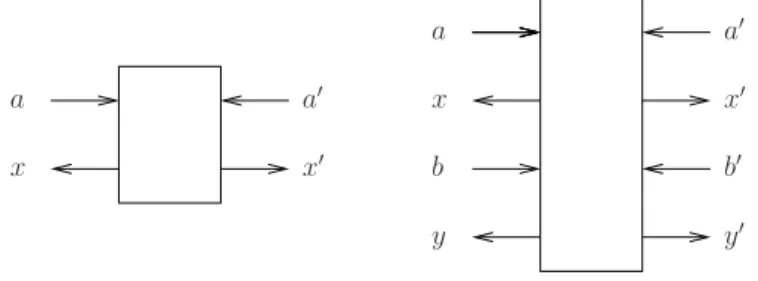
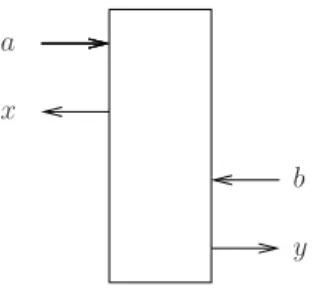
onlyon the assumption that the provers can not communicate. In the classical and quantum case, we make assumptions about the physical laws that the provers can use to correlate their behavior. To remove these assumptions, we need to consider non-signaling provers. That is, we allow any input-output behavior of the provers as long as it does not imply transmission of information. An example of a non-signaling system is theNL-box(non-local box), also known as the PR-box which was introduced by Sandu Popescu and Daniel Rohrlich in [PR94]. Let p(x, y|a, b) be a conditional distribution wherex, y,
a andb are bits. Suppose that the marginals p(x|a, b)and p(y|a, b) are both uniformly random, but for any values of a and b, p(x⊕y = a·b|a, b) = 1. Now consider two provers with joint access to a “black box” that samples this distribution. The first prover supplies the inputa and receives the outputx. The second prover suppliesb and receives the outputy. We assume that the box immediately returns the output once the input is entered. It is impossible for them to use this box to communicate with each other, since each prover only sees a uniformly random bit, no matter what input the other prover has entered. However, both provers know that the outputs they receive are always correlated so thatx⊕y=a·b.
529291-L-bw-Fillinger 529291-L-bw-Fillinger 529291-L-bw-Fillinger
529291-L-bw-Fillinger Processed on: 27-2-2019 Processed on: 27-2-2019 Processed on: 27-2-2019
Processed on: 27-2-2019 PDF page: 21PDF page: 21PDF page: 21PDF page: 21
1.4. CONTRIBUTIONS OF THIS THESIS 17
we are not willing to make any assumptions about the laws of physics that constrain them, we need to assume that the provers could use such a box. Note that this box renders the CHSHq scheme non-binding: If the verifier’s first message isa=a1. . . an, the first prover puts each bit in an independent
copy of the box and receives x=x1. . . xn as output. The second prover then can open to b∈ {0,1} by inputtingb to every copy. The outputy=y1. . . yn then satisfies xi⊕yi=ai·b, so the provers can open to any bit they want.
This shows thatCHSHq is insecure against general non-signaling provers. This is related to the fact that theCHSHgame, like all XOR games7, has
non-signaling value of 1, meaning that there is a non-non-signaling strategy for this game that always wins. However, there exist two-player non-local games that have a non-signaling value strictly lower than 1. For example, the Fortnow-Feige-Lovász game [For98, FL92] has a non-signaling, quantum and classical value of 2/3 (see Appendix A in [Hol09] for a proof). Thus, one might hope that there is a commitment scheme that is secure against general non-signaling provers. However, we show that this is not the case.
Contribution 1.6. We show that a two-prover commitment scheme that is hiding can not be binding for general non-signaling provers.
If the scheme is perfectly hiding, then non-signaling dishonest provers can perfectly emulate the behavior of honest provers. As an example, consider a simple bit-commitment scheme where, in the commit phase, the verifier sends a messageato the first prover who replies with a messagex, and in the opening phase, the second prover sends some opening informationyto the verifier. The verifier then computes his output as a function ofa, xandy.
Letpb(x, y|a)be the distribution that describes the input-output behavior of the honest provers when committing and opening to b ∈ {0,1}. Then, if the scheme is perfectly hiding, p(x, y|a, b) := pb(x, y|a) is a bi-partite non-signaling distribution, whereais the input forP andbthe input forQ. Thus, it is possible for non-signalling provers to sample this distribution and exactly replicate the input-output behavior of the honest provers. But unlike the honest provers, they can choose the bit that they want to open to after the commit phase, since bis an input for the second prover who is inactive in the commit phase.
Furthermore, we show that if the scheme is close to perfectly hiding, there is a bi-partite non-signaling distribution that isstatistically closeto the input-output behavior of the honest provers. Thus, the dishonest provers can emulate the honest provers almostperfectly in that case.
We prove similar results for more general schemes where both provers are active in the commit and opening phase. Here, the proof is somewhat more involved, because when we adapt the approach used in simple schemes to this problem, the outcome is nota non-signaling distribution. We also investigate
7A XOR game is a two-player non-local game where the players output bits and the
529291-L-bw-Fillinger 529291-L-bw-Fillinger 529291-L-bw-Fillinger
529291-L-bw-Fillinger Processed on: 27-2-2019 Processed on: 27-2-2019 Processed on: 27-2-2019
Processed on: 27-2-2019 PDF page: 22PDF page: 22PDF page: 22PDF page: 22
the case where the commit phase can consist of multiple rounds of commu-nication. Here, we again show an impossibility result, but only for perfectly hiding schemes.
We also present a positive result:
Contribution 1.7. We show the existence of a three-prover commitment scheme that is perfectly hiding and at the same time binding for non-signalling provers.
A scheme that achieves this property works as follows: Take theCHSHq bit-commitment scheme and add a third prover that mimics the behavior of the second prover in the opening phase. In the opening phase, the verifier computes the output as usual from the messages of the first two provers, and also checks if the second and third prover sent the same message. If that is not the case, he outputs⊥.
This construction is reminiscent of a result by Masanes, Acin and Gisin [MAG06] which implies that for every two-player game G where the second player has two possible inputs, there is a three-player game G0 whose
non-signaling value is the same as the classical value of G. That is, non-signaling provers have the same chance of winningG0as classical provers have of winning G. The scheme G0 is constructed by having the first two players play G and
529291-L-bw-Fillinger 529291-L-bw-Fillinger 529291-L-bw-Fillinger
529291-L-bw-Fillinger Processed on: 27-2-2019 Processed on: 27-2-2019 Processed on: 27-2-2019
Processed on: 27-2-2019 PDF page: 23PDF page: 23PDF page: 23PDF page: 23
Chapter 2
Preliminaries
2.1
Probabilities
2.1.1
Basic Notation
A (finite) probability distribution is a function p : X → [0,1], x 7→ p(x), where X is a finite non-empty set such that P
x∈Xp(x) = 1. Forx◦ ∈ X, we
write p(x=x◦)instead of p(x◦). For any subsetΛ ⊂ X, called an event, the
probability p(Λ)(orp(x∈Λ)) is naturally defined asp(Λ) =P
x∈Λp(x), and
it holds that
p(Λ) +p(Γ) =p(Λ∪Γ) +p(Λ∩Γ)≤1 +p(Λ∩Γ) (2.1)
for allΛ,Γ⊂ X, and, more generally, that k
X
i=1
p(Λi)≤p(Λ1∪. . .∪Λk) +
X
i<j
p(Λi∩Λj)≤1 +X
i<j
p(Λi∩Λj) (2.2)
for allΛ1, . . . ,Λk⊂ X. For a distributionp:X × Y →Ron two variables and
a relationR onX × Y (e.g., x=y,x=f(y),x6=y) the probabilityp(R(x, y)) is defined by
p(R(x, y)) =p {(x, y)∈ X × Y |R(x, y)}
= X
x∈X,y∈Y
s.t.R(x,y)
p(x, y).
The marginals p(x) and p(y) are given by p(x) = P
yp(x, y) and p(y) =
P
xp(x, y), respectively. Vice versa, given two distributionsp(x)andp(y), we say that a distributionp(x, y)on two variables is aconsistent joint distribution
if the two marginals ofp(x, y)coincide with p(x)and p(y), respectively.
529291-L-bw-Fillinger 529291-L-bw-Fillinger 529291-L-bw-Fillinger
529291-L-bw-Fillinger Processed on: 27-2-2019 Processed on: 27-2-2019 Processed on: 27-2-2019
Processed on: 27-2-2019 PDF page: 24PDF page: 24PDF page: 24PDF page: 24
Definition 2.1. Letp(x)andp(y)be two distributions over a common setX. The statistical distanceof the two distributions is defined as
d(p(x), p(y)) = 1
2
X
x◦∈X
|p(x=x◦)−p(y=x◦)|
2.1.2
Some Basic Technical Results
We will make use of the following lemma regarding the existence of a consistent joint distribution that maximizes the probability thatx=y.
Lemma 2.2. Let p(x) and p(y) be two distributions on a common set X. Then there exists a consistent joint distribution p(x, y) such that p(x=y =
x◦) = min{p(x=x◦), p(y=x◦)}for all choices ofx◦∈ X. Additionally,p(x, y)
satisfies p(x, y|x6=y) =p(x|x6=y)·p(y|x6=y).
Proof. We first extend the respective probability spaces given by the distribu-tionsp(x)andp(y)by introducing an event∆ and declaring that
p(x=x◦∧∆) = min{p(x=x◦), p(y=x◦)}=p(y=x◦∧∆)
for everyx◦∈ X. Note thatp(∆)is well defined (by summing over allx◦). As
we will see below, ∆ will become the eventx=y. In order to find a consis-tent joint distribution p(x, y), it suffices to find a consistent joint distribution
p(x, y|∆)forp(x|∆)andp(y|∆), and a consistent joint distributionp(x, y|¬∆) forp(x|¬∆)and p(y|¬∆). The former, we choose as
p(x=x◦∧y=x◦|∆) := min{p(x=x◦), p(y=x◦)}/p(∆)
for all x◦ ∈ X, and p(x=x◦∧y =y◦|∆) := 0for all x◦ 6=y◦ ∈ X, and the
latter we choose as
p(x=x◦∧y=y◦|¬∆) :=p(x=x◦|¬∆)·p(y=y◦|¬∆)
for all x◦, y◦ ∈ X. It is straightforward to verify that these are indeed
con-sistent joint distributions, as required, so that p(x, y) = p(x, y|∆)·p(∆) +
p(x, y|¬∆)·p(¬∆) is also consistent. Furthermore, note thatp(x=y|∆) = 1 andp(x=y|¬∆) = 0; the latter holds because we havep(x=x◦∧∆) =p(x=
x◦)orp(y=x◦∧∆) =p(y =x◦)for eachx◦∈ X, and thusp(x=x◦∧ ¬∆) = 0
or p(y =x◦ ∧ ¬∆) = 0. As such, ∆ is the event x = y, and therefore
p(x = y = x◦) = p(x=x◦ ∧∆) = min{p(x = x◦), p(y = x◦)} for every
x◦ ∈ X as required. Finally, the claim regarding p(x, y|x6=y)holds by
con-struction.
529291-L-bw-Fillinger 529291-L-bw-Fillinger 529291-L-bw-Fillinger
529291-L-bw-Fillinger Processed on: 27-2-2019 Processed on: 27-2-2019 Processed on: 27-2-2019
Processed on: 27-2-2019 PDF page: 25PDF page: 25PDF page: 25PDF page: 25
2.1. PROBABILITIES 21
Corollary 2.3. Let p(x) and p(y) be two distributions over the same set X
with statistical distanced p(x), p(y)=ε. Then, there exists a consistent joint distributionp(x, y)overX × X such that p(x6=y) =ε.
Proof. We apply Lemma 2.2 to obtain a consistent joint distribution p(x, y) such that for allx◦∈ X, p(x=y=x◦) = min{p(x=x◦), p(y=x◦)}. We then
have
p(x6=y) = 1− X
x◦∈X
p(x=y=x◦)
= 1− X
x◦∈X
min{p(x=x◦), p(y=x◦)}
= 1 2
X
x◦∈X
p(x=x◦)−min{p(x=x◦), p(y=x◦)}
+1 2
X
x◦∈X
p(y=x◦)−min{p(x=x◦), p(y=x◦)}
= 1 2
X
x◦∈X
|p(x=x◦)−p(y=x◦)|
=ε
as claimed.
The following is an immediate consequence.
Lemma 2.4. Letp(x0, y0)andp(x1, y1)be distributions withd p(x0), p(x1)
=
ε. Then, there exists a consistent joint distribution p(x0, x1, y0, y1) such that
p0(x06=x1) =εand, as a consequence, d p(x0, y1), p(x1, y1)
≤ε.
Proof. We first apply Corollary 2.3 top(x0)andp(x1)to obtain a consistent
joint distribution p(x0, x1), and then we set
p(x0, x1, y0, y1) =p(x0, x1)·p(y0|x0)·p(y1|x1).
It is easy to see that this distribution is consistent withp(x0, y0)andp(x1, y1).
For the last claim, we note that
p(x0, y1) =p(x0=x1)·p(x0, y1|x0=x1) +p(x06=x1)·p(x0, y1|x06=x1)
=p(x0=x1)·p(x1, y1|x0=x1) +p(x06=x1)·p(x0, y1|x06=x1)
and
p(x1, y1) =p(x0=x1)·p(x1, y1|x0=x1) +p(x06=x1)·p0(x1, y1|x06=x1)
529291-L-bw-Fillinger 529291-L-bw-Fillinger 529291-L-bw-Fillinger
529291-L-bw-Fillinger Processed on: 27-2-2019 Processed on: 27-2-2019 Processed on: 27-2-2019
Processed on: 27-2-2019 PDF page: 26PDF page: 26PDF page: 26PDF page: 26
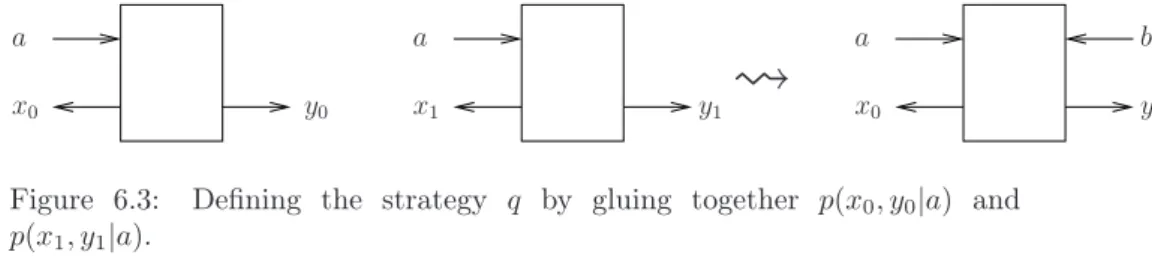
When applying the above lemma, we say that we “glue together” the dis-tributionsp(x0, y0)andp(x1, y1)alongx0 andx1.
Remark 2.5. In the special case wherep(x0)andp(x1)are distributed iden-tically, we obviously have p(x0, y1) =p(x1, y1).
Remark 2.6. It is easy to see from the proof of Lemma 2.4 that the fol-lowing natural property holds. If p(x0, x1, y0, y1, y00, y10) is obtained by glu-ing together p(x0, y0, y00)and p(x1, y1, y01)along x0 andx1, then the marginal
p(x0, x1, y0, y1) coincides with the distribution obtained by gluing together the marginals p(x0, y0)andp(x1, y1)along x0 andx1.
Letp(x, y, z) be a distribution overX × Y × Z and let Λ⊆ X × Y × Z.
We then writex→y→zto express thatp(x)andp(z)are independent when conditioned ony, i.e.,p(x, z|y) =p(x|y)p(z|y). Similarly, we writex→Λ→y
to express thatp(x, y|Λ) =p(x|Λ)p(y|Λ), etc. We show the following property for conditionally independent variables.
Lemma 2.7. Ifx→y→z andx→x6=y→y, thenx→x6=y→z. Proof. We assume thatx→y→zandx→x6=y→y. We first observe that
p(x, x6=y, z|y) =p(x, x=6 y|y)p(z|x, y, x6=y)
=p(x, x6=y|y)p(z|x, y) =p(x, x6=y|y)p(z|y),
which means that (x, x 6= y) → y → z, and, by summing over x, implies
x6=y→y→z. It follows that
p(z|x, y, x6=y) =p(z|y) =p(z|y, x6=y),
which actually means thatx→(y, x6=y)→z. Therefore,
p(x, z|x6=y) =X
y
p(x, y, z|x6=y) =X
y
p(x, y|x6=y)p(z|x, y, x6=y)
=p(x|x6=y)X y
p(y|x6=y)p(z|y, x6=y)
=p(x|x6=y)X y
p(y, z|x6=y)
=p(x|x6=y)p(z|x6=y),
529291-L-bw-Fillinger 529291-L-bw-Fillinger 529291-L-bw-Fillinger
529291-L-bw-Fillinger Processed on: 27-2-2019 Processed on: 27-2-2019 Processed on: 27-2-2019
Processed on: 27-2-2019 PDF page: 27PDF page: 27PDF page: 27PDF page: 27
2.2. TWO-PROVER COMMITMENT SCHEMES 23
2.2
Two-Prover Commitment Schemes
2.2.1
Protocols
In this work, we will consider 3-party interactive protocols, where the par-ties are named P, Q and V (the two “provers” and the “verifier”). Such a protocolprotP QV consists of a triple(protP,protQ,protV)of L-round interac-tive algorithms for some L ∈ N. Each interactive algorithm takes an input, and for every round ` ≤ L computes the messages to be sent to the other algorithms/parties in that round as deterministic functions of its input, the messages received in the previous rounds, and the local randomness. In the same way, the algorithms produce their respective outputs after the last round. We write
(outPkoutQkoutV)← protP(inP)kprotQ(inQ)kprotV(inV)
to denote the execution of the protocol protP QV on the respective inputs
inP, inQ and inV, and that the respective outputs outP, outQ and outV are produced. Clearly, for any protocol protP QV and any input inP, inQ, inV, the probability distributionp(outP, outQ, outV)of the output is naturally well defined.
If we want to make the local randomness explicit, we writeprotP[ξP](inP) etc., and understand that ξP is correctly sampled. Furthermore, we write
protP[ξP Q](inP)andprotQ[ξP Q](inQ)to express thatprotP andprotQ usethe
samerandomness, in which case we speak ofjoint randomness. We can compose two interactive algorithms protP and prot0
P in the ob-vious way, by applying prot0P to the output of protP. The resulting inter-active algorithm is denoted as prot0P ◦protP. Composing the respective al-gorithms of two protocols protP QV = (protP,protQ,protV) and prot0P QV = (prot0P,prot0Q,prot0V) results in the composed protocolprot0P QV ◦protP QV. If
protP is a non-interactive algorithm, then prot0P QV ◦protP is naturally un-derstood as the protocol prot0P QV ◦protP = (prot0P◦protP,prot0Q,prot0V), and similarly prot0P QV ◦protQV in caseprotQV is a protocol amongQandV only.
2.2.2
Defining Commitment Schemes
We model a two-prover commitment scheme as two protocols, one for the commit phase, one for the opening phase. In the commit phase, the input for the provers is an element s of the scheme’s domain D which is the value they want to commit to. The verifier has no input. All three participants may output some state information. The protocol for the opening phase then takes this state information as input, and the verifier outputs an element of
529291-L-bw-Fillinger 529291-L-bw-Fillinger 529291-L-bw-Fillinger
529291-L-bw-Fillinger Processed on: 27-2-2019 Processed on: 27-2-2019 Processed on: 27-2-2019
Processed on: 27-2-2019 PDF page: 28PDF page: 28PDF page: 28PDF page: 28
Dishonest parties may execute arbitrary protocols. Dishonest provers do not have an input in the commit phase: intuitively speaking, they do not know which value they eventually want to open to at this time.
Definition 2.8. A 2-prover (string) commitment scheme S with domain D
consists of a pair of interactive protocolscomP QV = (comP,comQ,comV)and
openP QV = (openP,openQ,openV)between the proversP andQand the veri-fierV, with the following syntactics. Thecommit protocolcomP QV uses joint
randomness ξP Q for P and Q and takes an element s ∈ D as input for P
and Q (and independent randomness and no input for V), and it outputs a
commitmentcom toV and some state information toP andQ:
(statePkstateQkc)← comP[ξP Q](s)kcomQ[ξP Q](s)kcomV(∅).
The opening protocol openP QV uses joint randomness ηP Q and outputs a
string or a rejection symbol to V, and nothing toP andQ:
(∅k∅ks)← openP[ηP Q](stateP)kopenQ[ηP Q](stateQ)kopenV(c)
with s ∈ {0,1}n∪ {⊥}. If D = {0,1}, we refer to S as a bit-commitment
scheme instead, and we tend to use b rather than s to denote the committed bit.
Remark 2.9. Note that we still speak of string-commitment schemes even if the domain D does not consist of bit-strings.
Remark 2.10. By convention, we assume throughout the paper that the com-mitment c output by V equals the communication that takes place between V
and the provers during the commit phase. This is without loss of generality since, in general, c is computed as a (possibly randomized) function of the communication, which V just as well can apply in the opening phase.
Remark 2.11. Note that we specify thatP andQusefreshjoint randomness
ηP Q in the opening phase, and, if necessary, the randomness ξP Q from the
commit phase can be “handed over” to the opening phase viastateP andstateQ;
this will be convenient later on.
Whenever we refer to such a 2-prover commitment scheme, we take it as understood that the scheme is complete and hiding, as defined below, for “small” values ofγ andδ. Since our focus will be on the binding property, we typically do not make the parameters γandδ explicit.
Definition 2.12. A 2-prover commitment scheme isγ-completeif in an hon-est execution V’s output s of openP QV equals P and Q’s input s tocomP QV
except with probability η, for any choice of P andQ’s inputs∈D.
529291-L-bw-Fillinger 529291-L-bw-Fillinger 529291-L-bw-Fillinger
529291-L-bw-Fillinger Processed on: 27-2-2019 Processed on: 27-2-2019 Processed on: 27-2-2019
Processed on: 27-2-2019 PDF page: 29PDF page: 29PDF page: 29PDF page: 29
2.2. TWO-PROVER COMMITMENT SCHEMES 25
Definition 2.13. A 2-prover commitment scheme isδ-hidingif for any com-mit strategy comV and any two stringss0 ands1, the distribution of the com-mitments c0,c1, produced as
(statePkstateQkcb)←(comP[ξP Q](sb)kcomQ[ξP Q](sb)kcomV(∅)),b= 0,1
have statistical distance at most δ. A 0-hiding scheme is also called perfectly hiding.
Defining the binding property is more subtle. First, note that an attack against the binding property consists of a possible commit strategycomP Q= (comP,comQ) and a possible opening strategyopenP Q = (openP,openQ) for
P and Q. Any such attack fixes p(s), the distribution of s ∈ {0,1}n∪ {⊥} that is output by V after the opening phase, in the obvious way.
A somewhat accepted definition for the binding property of a 2-proverbit
commitment scheme, as it is for instance used in [CSST11, LKB+15, FF15] (up to the factor 2 in the error parameter), is the probability sum-binding
property defined below. Here, we assume it has been specified which attacks arepossible, e.g., those whereP andQdo not communicate during the course of the scheme.
Definition 2.14. A 2-prover bit-commitment scheme is ε-sum-bindingif for every possible commit strategy comP Q, and for every pair of possible opening
strategiesopen0
P Q andopen1P Q, which fix distributionsp(b0)andp(b1)forV’s respective outputs, it holds that
p(b0= 0) +p(b1= 1)≤1 + 2ε .
In the literature (see e.g. [CSST11] or [LKB+15]), the two probabilities
p(b0= 0)andp(b1= 1)above are usually referred to asp0andp1, respectively.
In the information theoretic setting, a commitment scheme can not be both hiding and binding with good (i.e., low) parameters. Thus, we have to assume some restriction on the provers, e.g., that they are unable to communicate during the execution of the scheme. However, we might also be more liberal and allow some limited communication during the protocol, as in the Lunghi
et al. multi-round scheme.
529291-L-bw-Fillinger 529291-L-bw-Fillinger 529291-L-bw-Fillinger
529291-L-bw-Fillinger Processed on: 27-2-2019 Processed on: 27-2-2019 Processed on: 27-2-2019
Processed on: 27-2-2019 PDF page: 30PDF page: 30PDF page: 30PDF page: 30
Our proof of the commitment scheme relies on different, but stronger or equivalent, notions of a binding commitment. We explain these, and the rela-tions among them in Chapter 3.
2.2.3
The
CHSH
qScheme
Our main example is a generalization of the bit-commitment scheme by Cré-peau et al. [CSST11]. Let q be a prime power and let Fq be the finite field with qelements. The bit-commitment scheme CHSHq works as follows: The commit phase comP QV instructsV to sample and send toP a uniformly ran-dom a∈ Fq, and it instructsP to return x:=r+a·b to V, wherer ∈ Fq is the provers’ joint randomness and b is the bit to commit to. The opening phaseopenP QV instructsQto sendy:=−rtoV, andV outputs the (smaller) bit b that satisfies x+y =a·b, andb :=⊥in case no such bit exists. Note that the provers in this scheme use the same randomness in the commit and opening phase; thus, formally, Q needs to output the shared randomness as
stateQ. The opening phase uses no fresh randomness.
It is easy to see that this scheme isq−1-complete and perfectly hiding
(com-pleteness fails in case a= 0). Forclassical provers that do not communicate at all, the scheme is q−1/2
-sum-binding. As for quantumprovers, Crépeau
et al. showed that the scheme CHSH2n is 2−n/2-binding; this was recently
minorly improved to2−(n+1)/2 by Sikora, Chailloux and Kerenidis [SCK14].
We also want to consider an extended version of the scheme where, instead of a bit, the provers commit to an arbitrary field elements∈Fq, thus making Fq the domain of the scheme. In the opening phase, the verifier’s output is picked as above, except that it is selected from the setFq instead of{0,1}. If
a 6= 0, the output is s =a−1(x+y). In general, we will thus viewCHSHq as a string-commitment scheme, and explicitly mention when we restrict its domain to {0,1}.
However, it is a priori not clear what a suitable definition for the binding property is, especially because for this particular scheme, the dishonest provers can always honestly commit to a strings, and can then decide to correctly open the commitment to s by announcing y :=r, or open to a random string by announcing a randomly chosen y— any y satisfies x+y = a·s for some s
(unlessa= 0, which almost never happens).1
Due to its close relation to the CHSH game [CHSH69], in particular to the arbitrary-finite-field version considered in [BS15], we will refer to this string
commitment scheme as CHSHq.
1This could easily be prevented by requiring Qto announce s(rather than letting V