RE-INTERPRETING RACIAL ATTITUDES: A PSYCHOLOGICAL CONSTRUCTIONIST MODEL OF RACIAL ATTITUDES
Kent M. Lee
A thesis submitted to the faculty at the University of North Carolina at Chapel Hill in partial fulfillment of the requirements for the degree of Master of Arts in the Department of Psychology
(social psychology).
Chapel Hill 2014
© 2015 Kent M. Lee
ABSTRACT
Kent M. Lee: Re-Interpreting Racial Attitudes: A Psychological Constructionist Model of Racial Attitudes
(Under the direction of B. Keith Payne and Kristen A. Lindquist)
Previous theories of racial attitudes have viewed attitudes as fixed associations between the subject of the attitude and an evaluation. According to these theories negative racial attitudes inevitably lead to negative evaluations of racial minorities. However, I propose a model in which attitudes are constructed dynamically and negative evaluations of racial minorities are not
TABLE OF CONTENTS
LIST OF TABLES ...v
LIST OF FIGURES ... vi
LIST OF ABBREVIATIONS ... vii
LITERATURE REVIEW ...1
Introduction ...1
Automatic Racial Attitudes and Their Measurement...1
Attitudes as Stable Representations in Memory ...3
Negative Attitudes or Negative Affect? ...6
Psychological Constructionism ...10
The Current Studies ...14
STUDY 1 ...16
Method ...16
Participants ...16
Procedure ...16
Results ...18
Preliminary Analyses ...18
Primary Analyses ...19
Discussion ...21
Method ...23
Participants ...23
Emotion Questions ...23
Procedure ...24
Results ...24
Preliminary Analyses ...24
Replication with Previous Emotion Scales ...25
Analysis of Expanded Emotion Scales ...26
Explicit Affect ...27
Discussion ...28
General Discussion ...30
Theoretical Implications ...33
Conclusions ...36
APPENDIX A: FIGURES ...37
APPENDIX B: TABLE OF QUESTIONNAIRE ITEMS ...40
LIST OF FIGURES
LITERATURE REVIEW
Many Americans would like to believe that racial inequality is a problem of the past. Indeed, in the past few decades the number of Americans who report hostility toward racial minorities have steadily declined (Sniderman & Carmines, 1997). Concurrently, Americans have increasingly endorsed support racial equality (Bobo, 2001). Yet, a large number of Americans still tend to evaluate African-Americans more negatively than Whites (Nosek et al., 2007). To reconcile this apparent contradiction, many researchers have argued that despite people’s best intentions negative evaluations of African-Americans might still come to mind automatically and unintentionally (Banaji, Nosek, & Greenwald, 2004; Devine, 1989; Greenwald & Banaji, 1995). According to researchers, many people have difficulty preventing automatically occurring negative evaluations of African-Americans from influencing their thoughts and behaviors. Therefore, much of the contemporary literature on this topic has focused on the existence of these automatic negative evaluations of African-Americans. In this paper, I examine some of the research and theoretical background informing current theories about these automatic negative evaluations. I then propose a novel model for understanding the nature of these automatic negative evaluations and provide empirical support for this model. Specifically, I argue that the interpretation of automatic negative evaluations of African-Americans determines their influence on subsequent thoughts and behaviors.
Automatic Racial Attitudes and Their Measurement
1995). Some researchers have adopted the definition that an attitude is an association between the subject of the attitude and a positive or negative evaluation (Fazio, 1990, 2007; Petty, 2006; Petty, Briñol, & DeMarree, 2007). The subject of an attitude is known as an attitude object. An attitude object can be a person, idea, object, etc. Given this definition of an attitude, negative racial attitudes can be defined as an association between racial minorities and negative evaluations. Many contemporary theories of negative racial attitudes have focused on the automated and unintentional way in which these attitudes come to mind (Banaji et al., 2004; Devine, 1989; Fazio, Jackson, Dunton, & Williams, 1995; Greenwald & Banaji, 1995).
Researchers hypothesize that the formation of automatic negative racial attitudes is the inevitable result of exposure to negative stereotypes about racial minorities that exist within a culture. Stereotypes are “exaggerated beliefs associated with a category” (Allport, 1979, p. 191). For example, the portrayal of Black individuals as violent criminals in Western media may contribute to negative attitudes about African-Americans. Devine (1989) noted that even participants who intended to be fair to racial minorities (“low-prejudice” participants) were aware of negative stereotypes about African-Americans (e.g., Blacks are aggressive).
Of course, measuring racial attitudes can be difficult. For example, self-report questionnaires, which directly ask participants about their attitudes toward racial minorities, provide participants the opportunity to modify or conceal the influence of automatically activated racial attitudes on their verbal reports. In other words, self-report questionnaires afford
to as indirect measures. Indirect measures do not rely on introspective access or self-report (Greenwald & Banaji, 1995). Instead, indirect measures work primarily because they make it difficult for participants to control or modify their performance on these measures (Fazio & Olson, 2003). To put it in another way, indirect measures make it difficult for participants to overriding the influence of their automatically activated attitudes on their responses in these measures.
One example of such an indirect measure is Implicit Association Test (IAT; Greenwald, McGhee, & Schwartz, 1998). In a typical IAT examining racial attitudes toward
Attitudes as Stable Representations in Memory
Much of the reasoning indirect measures such as the IAT originates from the perspective that attitudes are stable representations stored in memory (Fazio, 1990, 2007; Petty, 2006; Petty et al., 2007). Researchers who adopt the perspective that attitudes are stable representations have viewed attitudes as entities, which exist within long-term memory and are relatively resistant to change. These researchers have also argued that attitudes are automatically activated when encountering a relevant attitude object. Thus, a person who possesses negative attitudes toward African-Americans will have these attitudes automatically come to mind whenever he or she encounters an African-American individual. For these reasons some attitudes researchers have viewed indirect measures as able to capture “true” attitudes.
For example, a classic paper describes indirect measures as a “bona-fide pipeline” to participants’ attitudes (Fazio et al., 1995). In a series of studies Fazio and colleagues examined participants’ racial attitudes using both self-report questionnaires and indirect measures.
Participants tended to evaluate African-Americans more negatively on the indirect measure, but not in self-report. Importantly, participants who possessed greater motivation to appear non-prejudiced showed the greatest differences in terms of their responses on indirect compared to direct measures. In contrast, participants who were less motivated to conceal negative racial attitudes showed a similar degree of negative racial attitudes on indirect and self-report measures of negative racial attitudes. Fazio et al. concluded that indirect measures, unlike self-report measures, provided a direct line to participants’ attitudes.
the relationship between automatically and deliberately activated attitudes (Fazio, 1990, 2007). Consistent with the assumption that attitudes are stable representations, the MODE model views attitudes as associations between an evaluation and an attitude object. Fazio (2007) argued that the link between evaluation and attitude object strengthens as attitudes become well learned. Attitudes with stronger links between evaluations and attitude objects will be more likely to be activated when a person encounters an attitude object. According to Fazio (1990, 2007), attitudes can spontaneous guide behavior. However, Fazio argued that controlled processes can also direct behavior. Thus, the ability of attitudes to influence behavior depends on whether a person is motivated to alter the behavior guided by an automatically activated attitude and whether the person has the opportunity to do so. Fazio’s (1990, 2007) logic is that because indirect measures deny or limit the ability of sufficiently motivated participants to conceal or override the influence of their racial attitudes on responses, indirect measures directly tap into activated attitudes. Further, Fazio (1990, 2007) argued that verbal report on direct measures of racial attitudes reflects verbal behavior, which offers the opportunity for sufficiently motivated participants to conceal or alter the responses prompted by their racial attitudes. In this way, the MODE model interprets responses on indirect measures as indices of the well-learned and enduring racial attitudes that participants have developed over the course of their lives.
Similarly, the Meta-Cognitive Model also views attitudes as associations between
measures capture activation of attitudes with the strongest attitude object-evaluative links, which are spontaneously and rapidly activated. Unlike the MODE model, however, the Meta-Cognitive Model argues that an individual can have “metacognitive tags.” Metacognitive tags reflect additional information associated with the attitude (i.e., the attitude object-evaluation
association) as a whole. Petty and colleagues have argued that these metacognitive tags might include information about whether one believes an attitude is true, valid, socially acceptable to express, etc. Further, they have posited that it takes longer to activate metacognitive information about an attitude. Therefore, according to Petty et al., the deliberative nature of explicit measures allows individuals to access this metacognitive information. In contrast, indirect measures, which require rapid and spontaneous responses, do not allow enough time for metacognitive
information to be accessed. Thus, the metacognitive model argues that it is the opportunity to draw information from metacognitive tags which determines the differences between indirect and direct measures of racial attitudes.
Despite the differences that exist between them, the metacognitive model and the MODE model, ultimately predict that indirect measures capture automatically activated attitudes. These automatically activated attitudes reside in memory as entities which are well-established and stable. Further, both models argue that these attitudes reflect tendencies to evaluate attitude objects in a particular way. Therefore, both models interpret indirect measures as revealing “true” negative attitudes about racial minorities.
Negative Attitudes or Negative Affect?
attitudes are activated automatically (Banaji et al., 2004; Devine, 1989; Fazio, 1990, 2007; Greenwald & Banaji, 1995; Petty, 2006; Petty et al., 2007), then negative racial attitudes are inescapable. Yet, there is a question of whether indirect measures are capturing fixed negative evaluations arising from activation of attitudes or general negative core affect. Core affect is a source of bodily information that reflects a mental representation of one’s homeostatic state, which is experienced as pleasure or displeasure with some degree of arousal (Russell, 2005, 2009; Russell & Barrett, 1999). Pleasure or displeasure might also be referred to positive and negative affect.
The question of whether indirect measures capture negative racial attitudes or negative affect is important because many indirect measures of attitudes examine global evaluations, such positive or negative associations with racial minorities. Yet, the presence of negative associations with African-Americans might not be an evaluation of African-Americans at all. Instead, it might reflect anxiety about interacting with a group that one is unfamiliar with or even anxiety that one will be perceived as racist. For example, White participants often possess anxiety about being perceived as racist by minority group members (Vorauer, Main, & O’Connell, 1998). When White participants believed they are being stereotyped as racist by minority group members, they find intergroup interactions to be more unpleasant (Vorauer et al., 1998). Thus, negative
associations with racial minorities could stem from negative core affect in response to the situation, rather than the individuals involved. This finding calls into question whether indirect measures are capturing negative racial attitudes or general negative core affect.
indirect measure of stereotyping, the Weapons Identification Task (WIT; Payne, 2001), would be private or public. In the WIT, participants see a pair of images: a picture of a Black or White individual and a picture of a tool or weapon. Participants are instructed to ignore the picture of the person and to judge whether the object presented was a tool or a weapon. Lambert et al. found the typical stereotype priming effect. That is, White participants were more likely to mistake a harmless tool for a weapon after being shown a picture of a Black individual,
compared to a picture of a White individual. However, participants showed a greater stereotype priming effect on the WIT when they believed that their responses would be made public rather than kept private. Further, participants in the public condition demonstrated greater anxiety and decreased ability to control stereotyping compared to participants in the private condition. Interestingly, participants in the public condition demonstrated poorer control on the WIT if they had greater anxiety. Consistent with more traditional perspectives of attitudes (Fazio, 1990; Petty, 2006; Petty et al., 2007), these findings suggest that when the opportunity to exert controlled process is reduced, via anxiety, participants are likely to be guided by their
automatically activated stereotypes. Thus, stereotype-consistent priming in the public condition likely reflects the presence of automatically activated negative racial attitudes. However, these findings by Lambert and colleagues are also consistent with findings demonstrating that anxiety about being perceived as prejudiced contributes to negative affect felt during encounters with racial minority group members that may have nothing to do with negative stereotypes about these racial minorities (Vorauer et al., 1998).
Uhlmann and colleagues (2005) directly tested the hypothesis that indirect measures such as the IAT may not differentiate between dislike of African-Americans and sympathy for
participants were faster to associate negative words with African-Americans than Whites, they were also more likely to associate words related to oppression with African-Americans compared to Whites. Taking this a step further, the researchers presented participants with information about two fictional groups. One group was given a history of oppression, while the other was not. On a subsequent IAT, participants were quicker to associate the fictional group that had faced a history of oppression with negative words, compared to the group that had not faced oppression. Uhlmann and colleagues interpreted their findings as demonstrating that the IAT might not differentiate between anti-social negative emotions (e.g., antipathy, fear) and more prosocial emotions characterized by negative affect (e.g., sympathy). These findings call into question the interpretation that negative associations on indirect measures reflect negative racial attitudes per se. Instead, these results suggest that negative associations toward a minority group may be indicative of negative core affect generally, rather than negative racial attitudes. This is an important distinction, because negative core affect characterizes the experience of both dislike as well as sympathy.
Interestingly, there is direct evidence that negative core affect to a minority group can have multiple meanings. Specifically, the way in which participants interpreted their negative core affect determines the meaning of their core affective state (Cooley, Payne, & Phillips, 2014). In one study, participants completed an indirect measure of their feelings to pictures of straight and gay couples. Cooley et al. then led participants to believe that negative core affect in response to pictures of gay couples were intentional in one condition, and that they were
instructed to judge whether they find the Chinese pictograph pleasant by pressing one key (e.g., “I”) or unpleasant by pressing a different key (e.g., “E”). Participants are also instructed to do their best not to be influenced by the real life image in their judgments. The logic of the AMP is that participants will have an affective reaction to the real life image regardless of instructions, but misattribute this reaction to the Chinese pictograph. The pictograph functions as an
ambiguous stimulus and it is assumed that participants who cannot read Chinese will have no consistent affective reactions to the pictographs. Cooley et al. found that participants with more negative core affect in response to pictures of gay couples (as measured by AMP performance) tended endorse greater homophobia, but only if they interpreted their negative core affect as intentional. In contrast, participants who demonstrated negative core affect in response to pictures of gay couples endorsed less homophobia when they interpreted negative core affect as unintended. In other words, only when participants interpreted their negative core affect as intentional, did they endorse greater homophobia. The findings of Cooley et al. suggest that the meaning of negative core affective responses to minority group members can be malleable. This is consistent with a psychological constructionist perspective, described next.
Psychological Constructionism
Much of the evidence supporting the psychological constructionist framework comes from the field affective science. Psychological constructionist theories of emotion posit that emotions do not exist as entities in the mind, but rather are constructed from more basic
components (Barrett, 2006, 2009, 2012; Lindquist, 2013). Core affective information is one key component in the construction of emotions. Situational information is another important
Less intuitively, however, situational information also includes the actions and experiences of the individuals who are a part of the current situation. In addition to core affect and situational information, conceptual knowledge also plays a key role in the construction of emotions (Barrett, 2006, 2009; Lindquist, 2013).Broadly defined, a concept can be thought of as information about categories (Barsalou, Simmons, Barbey, & Wilson, 2003). For example, in the case of emotions, relevant conceptual knowledge might include knowledge about emotion categories (e.g., fear, sadness, anger; Barrett, 2009; Lindquist, 2013).
Emotions are constructed through interpretation of core affect, situational information, and conceptual knowledge about emotions. In an illustrative study, researchers manipulated participants’ core affective state and their access to conceptual knowledge about emotion categories (Lindquist & Barrett, 2008). Specifically, the researchers induced negative affect in participants in one condition and neutral affect in another condition. Following affective induction, all the participants then were randomly assigned to receive a fear prime in one condition, an anger prime in a second condition, or a neutral prime in a third condition. Afterward, as a measure of participants’ experience of fear, participants rated how likely they were to engage in risky behavior. Overall, the participants induced to experience negative affect and primed with fear endorsed less risky activity than the other groups. The findings from this study demonstrate how emotions (e.g., fear) are constructed using core affective information and conceptual knowledge. Specifically, when participants experienced a negative core affective state and conceptual knowledge about fear was activated, they interpreted their core affective state as fear.
domain general (Barrett, 2006, 2009, 2012; Lindquist, 2013). Psychological constructionist theories hypothesize that many of the psychological phenomena commonly studied in psychology (e.g., emotions, attitudes, prejudice) are constructed from these domain general processes. From a psychological constructionist perspective, attitudes are not simply entities that are stored in long-term memory, waiting to be activated. Instead, attitudes may emerge from core affect and relevant situational information. In other words, attitudes may be dynamically
constructed to fit the present situation, just as emotions are.
Indeed, evidence that situational information can influence responses on indirect
measures of racial attitudes provides suggestive evidence that attitudes may be constructed. For example, Wittenbrink, Judd, and Park (2001) found that participants’ responses on an indirect measure are sensitive to the setting in which an individual is presented. Wittenbrink and colleagues presented participants with images of Black and White individuals with either a church interior or a graffiti covered street corner as the background. Demonstrating the influence of context on of racial attitudes, participants tended to respond negatively to images of Black individuals on a street corner. In contrast, participants tended to respond positively to images of Black individuals in a church interior. Wittenbrink et al.’s findings challenge the perspective that attitudes are stable representations, which are stored in long-term memory and await activation. In sum, Wittenbrink and colleagues’ findings suggest that attitudes are flexible phenomena that are sensitive to contextual information.
background. In contrast, participants tended to make negative evaluations about Black
individuals when the background was a classroom. In other words, participants’ evaluations of African-Americans were contingent on whether their role was implied to be that of an athlete or student. Similarly, in a second study, Barden and colleagues found that participants made negative evaluations of African-Americans in a prison setting led to negative evaluations if the African-American individuals were wearing prison uniforms. If the African-American
individuals were wearing suits instead of prison uniforms, however, participants tended to evaluate them positively. In other words, participants evaluated African-American individuals negatively if the clothes they were wearing implied a prisoner role, rather than a lawyer role.
These findings are supportive of a psychological constructionist model of racial attitudes. That is, attitudes are dynamically constructed to fit the present moment via interpretation of core affect, situational information, and conceptual knowledge. When a setting appeared dangerous (e.g., graffiti street), participants likely drew on negative stereotypes (e.g., graffiti as sign of criminal activity) to evaluate the individual in that setting. Similarly, when a Black individual was presented in a basketball court, rather than a classroom, participants used this information to infer their roles athletes. This inference led participants to make positive judgments about these American individuals. The participants likely drew on the stereotypes that Americans are good at sports, but bad at academics, to inform their evaluations of the African-Americans they viewed in the pictures. One interpretation of the findings of Wittenbrink et al. (2001) and Barden et al. (2004) is that situational information altered the types of conceptual knowledge (stereotypes in this case) that participants used to construct an attitudes about the Black individuals that they saw. Therefore findings provide suggestive support for a
psychological constructionist model would include a demonstration of how interpretation can shape pre-existing core affective responses. Specifically, can interpretation shape whether pro-social, rather than anti-pro-social, emotions emerge from participants’ core affective reactions to African-Americans? The purpose of the present studies is to investigate this question. The Current Studies
My psychological constructionist approach to prejudice suggests that negative affect does not reflect negative racial attitudes per se. Similarly, negative affect does not necessarily result in emotions (e.g., fear, antipathy) that might motivate anti-social behavior harmful to racial
minorities. Instead, interpretation of core affect and situational information is what determines which emotions emerge from negative affect. Specifically, the interpretation process may draw from conceptual knowledge about emotions to make meaning of core affect and situational information. My psychological construction theory also suggests that one way to reduce anti-social emotions toward racial minorities would be to change how individuals interpret their negative core affect. I predict that increasing participants’ accessibility to conceptual knowledge about sympathy, as opposed to fear, will result reduced fear toward African-Americans.
STUDY 1
Method
Participants. I recruited 201 adult online participants from Amazon Mechanical Turk. I
excluded 17 of these participants from analyses. Of these participants, nine did not complete the study, four indicated they could speak Chinese which reduces the ambiguity of the stimuli in the AMP, one participant’s responses on the AMP were not correctly recorded due to a computer error, and one participant correctly guessed the hypothesis of the study. Additionally, two participants did not follow instructions and only responded by pressing the same key on all trials of the AMP (e.g., they only pressed “Q” on all trials) so their data were not valid. The remaining 183 participants ranged in age from 18 to 72 years (M = 36.07, standard deviation [SD] = 13.13) and 53% were female (47% male). Of these participants, 82.6% identified as White, 6.6% as African-American, 3.8% as Asian, 4.4% as Hispanic/Latino, 1.1% Native American/Pacific Islander and 1.5% as “Other.” I computed the analyses with and without African-American participants and found no differences. Additionally, African-Americans participants have been exposed to the same cultural stereotypes about members of their own racial group as participants identifying as other races. For these reasons I decided to include these participants in my
analyses.
Procedure. Following the consent process, I administered the AMP to participants to
included 20 photographs of Black individuals and 20 photographs of White individuals. I instructed participants to judge the Chinese characters as either pleasant or unpleasant. I warned the participants that the primes (“the real life pictures”) might influence their judgment of the Chinese character and so they should do their best not to be influenced by the photographs. Participants pressed the “Q” key if they found the character unpleasant and the “P” key if they found the character pleasant.
Following the AMP, I manipulated participants’ interpretations of their feelings toward African-Americans. I drew my manipulation from previous studies demonstrating that
interpretations about one’s automatic thoughts about homosexual couples can influence self-reported homophobia (Cooley et al., 2014). In one condition, I informed the participants that their automatic negative affect reflected sympathy for Black Americans while in another condition I told the participants that their automatic negative affect reflected fear. The instructions I used are below:
Research has demonstrated that White Americans commonly hold negative associations with Blacks compared to Whites (i.e., Whites often are quicker to associate “Bad” with a picture of a Black face compared to a White face). Empirical evidence suggests that these negative associations are often due to feelings of sympathy [fear] because of beliefs about the status of Blacks in American society. Please generate two or three reasons why any negative feelings you may have felt toward Black faces might reflect sympathy for [fear of] Black Americans. Type the reasons you generate in the box below.
After the manipulation I asked participants to rate three statements regarding fear of African-Americans (“Blacks are threatening,” “Blacks are scary,” “Blacks are frightening) and three statements regarding sympathy for African-Americans (“Blacks continue to face
Next, I examined explicit affect by having participants rate how pleasant or unpleasant they found the Black and White individuals from the real life images used in the AMP.
Participants responded using a -4 to +4 scale, with -4 being “Very unpleasant,” 0 being “Neutral” and +4 being “Very pleasant.”
Afterwards I asked participants for demographic information including age, race, sex, and whether they were able to read Chinese. Finally I asked participants to guess the purpose of the study to gauge for suspicion before debriefing them.
Results
Preliminary analyses. As preliminary analyses, I first examined the overall responses of
my sample on the AMP, participants’ explicit affect ratings, and the dependent measure of fear and sympathy toward Blacks. I also examined the reliability of the fear and sympathy toward Blacks scales. On the AMP, participants made a greater proportion of “unpleasant” responses following Black primes (M = .47, SD = .22) compared to White primes (M = .39, SD = .20), F (1, 182) = 16.99, p < .001, η2 = .08. I computed an overall AMP score by subtracting the proportion of “unpleasant” responses following White primes from the proportion of “unpleasant” responses following Black primes. Thus, a higher score on the AMP reflects more automatic negative affect toward African-Americans.
= 1.10) as more unpleasant than photos of White individuals (M = 4.72, SD = .93), F (1, 182) = 6.86, p = .01, η2 = .04 overall.
I took the average of the relevant items that composed the fear toward Blacks scale and sympathy toward Blacks scale to compute a score for each scale. As a whole, participants expressed more sympathy for African-Americans (M = 2.96, SD = .96) than fear (M = 2.05, SD =.72), F (1, 182) = 92.30, p < .001, η2 = .34 overall. I also examined the reliability of the scales. The measures of fear (Cronbach’s α = .89) and sympathy (α = .87) toward African-Americans demonstrated good reliability.
Primary analyses. After completing preliminary analyses, I tested my primary
hypotheses. I was primarily interested in whether interpretation of automatic negative affect toward African-Americans as sympathy, or fear, would moderate the relationship between automatic negative affect and self-reported sympathy and fear toward African-Americans. I estimated the parameters of a regression model predicting fear of African-Americans from automatic negative affect, emotion condition, and their interaction. Prior to the analysis, I converted all of my variables to z-scores in order to standardize them.
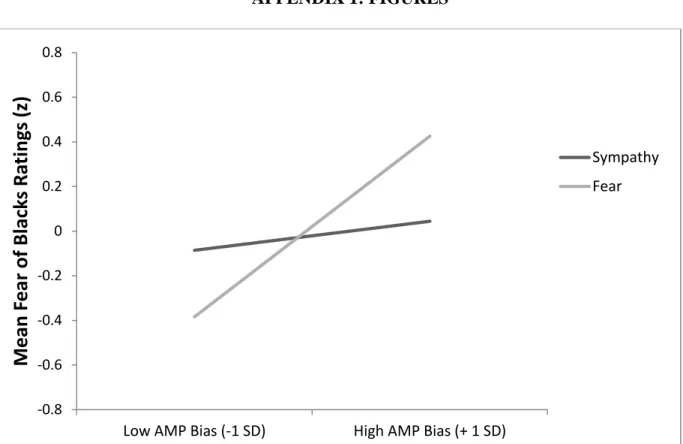
I plotted the regression slopes for automatic core affect and fear of African-Americans for each emotion condition in Figure 1. There was a main effect of automatic negative affect, b = .24, t (179) = 3.23, p = .001, but not emotion condition, b = .02, t (179) = .29, p = .77.
Importantly, the predicted interaction between automatic negative affect and emotion condition was significant, b = .17, t (179) = 2.34, p = .02. The simple slopes analysis revealed that
participants with more automatic negative affective responses toward Blacks reported
significant in the sympathy condition, b = .05, t (93) = .44, p = .66. Comparison of the simple slopes revealed that participants with higher levels of automatic negative affect responses to African-Americans reported significantly more fear toward Blacks in the fear condition, relative to the sympathy condition, t (179) = 2.34, p < .05.
I also examined the effect of the interpretation on the relationship between automatic core affect and sympathy. I estimated the regression parameters for a model predicting sympathy for Blacks from automatic core affect and the interaction of automatic negative affect x emotion condition. There was a main effect of automatic negative affect, such that participants lower in automatic negative affect toward African-Americans endorsed more sympathy for Blacks, b = -.24, t (179) = 3.33, p = .001. However, differences in sympathy ratings did not differ by emotion condition, b = -.03, t (179) = .36, p = .72. Additionally, the predicted interaction of automatic negative affect and emotion condition was not significant, b = -.01, t (179) = .84, p = .93.
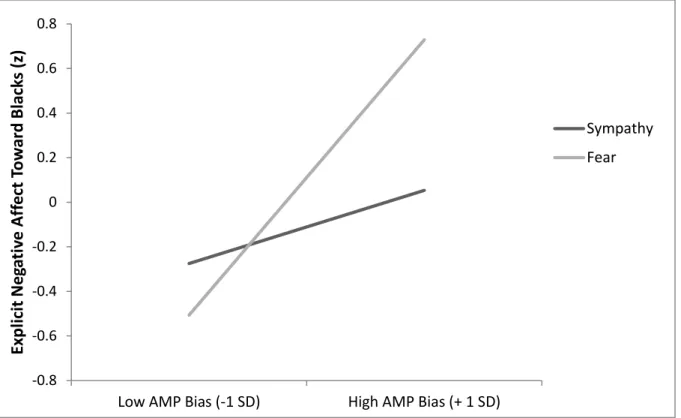
participants with greater automatic negative affect reported significantly more explicit negative affect toward pictures of Black individuals in the fear condition compared to the sympathy condition t (179) = 3.41, p < .001.
Discussion
The results of Study 1 are consistent with my hypothesis that interpretation of automatic negative affect toward African-Americans as sympathy, as opposed to fear, can reduce the amount of fear and explicit negative affect toward African-Americans. Interpretation of automatic negative affect as sympathy, however, did not increase endorsed sympathy for African-Americans. However, it is unclear why participants’ reported sympathy for Blacks would not show a corresponding pattern to reported fear. One possibility may be that the fear items used direct synonyms with fear (e.g., threatening, scary, frightening), while the sympathy items did not. Indeed, there are few words that are synonymous with “deserving of sympathy” in same the way that there are synonyms for “frightening.” This may have meant that my measure of sympathy was less able to capture sympathy as consistently compared to the fear’s ability to capture fear of Blacks. For example, participants may have interpreted each sympathy item differently compared to the other sympathy items.
Despite not finding increased sympathy when participants interpreted their negative affect as sympathy, the results are still promising. These findings demonstrate that interpretation can change the meaning of automatic negative affect toward a racial minority group for
participants. Particularly, the results show that interpretation can reduce the amount of expressed fear of African-Americans. By illustrating that the meaning of automatic negative affect toward African-Americans is malleable rather than fixed, the results of Study 1 speak against the
psychological constructionist model, which proposes interpretation of core affect can shape the evaluations made about racial minorities. Next, I sought to replicate and extend these findings in Study 2.
In particular, I was interested in whether participants experienced changes in their affective experience as self-focused or world-focused (see Lambie & Marcel, 2002; Lindquist, 2013; and Lindquist & Barrett, 2008 for discussions). Self-focused experiences can be thought of as a person’s interpretation of his or her own reactions to stimuli (e.g., I am afraid of Black people). In contrast, world-focused experiences can be thought of as our perceptions of the stimuli themselves (e.g., Black people are frightening). Psychological constructionist theories of emotion view self-focused and world-focused experiences to be different aspects of the same phenomenon (Lindquist, 2013). According to Lindquist (2013) the difference is whether bodily (self-focused) or situational (world-focused) information is placed in the foreground.
STUDY 2 Method
Participants. I recruited 202 adult participants online through Amazon Mechanical Turk.
Of these participants, 251 did not finish the study, nine participants pressed the same key on the AMP for every trial, and five indicated that they were able to read Chinese. These participants were excluded from analyses, leaving 163 participants. Of the remaining participants (53.4% female, 46.6% male), ages ranged from 18 to 73 (M = 35.90, SD = 12.29) and 90.2% identified as White, 1.8% identified as African-American, 1.2% identified as Hispanic/Latino, 1.2% identified as Asian, 1.8% identified as “Other,” and 3.7% opted not to provide their race. As in Study 1, I conducted analyses with and without African-American participants and found no differences between the two sets of analyses. As a result, I included the African-American participants’ responses in the analyses, just as I did in Study 1.
Emotion questions. The only element that differed from Study 1 was the addition of new
questions examining feelings of fear and sympathy toward African-Americans. Specifically,
1 Twenty-four of the 25 participants who did not complete the study were all from the “fear” condition. Further,
these 24 participants either stopped after completing the AMP or after completing the task in the manipulation.
There were no differences in their proportion of unpleasant responses following Black primes, F (1, 200) = .52, p =
.47, η2< .01, or White primes, F (1, 200) < .01, p = .95, η2< .01. Participants who generated responses for the task in
these were questions about world focused and self-focused emotions (see Appendix). In doing so, I also expanded the original scales, which were comprised of only world-focused items.
Procedure. As in Study 1, participants first completed the AMP after the consent
process. They were then randomly assigned to receive either the fear or sympathy emotion manipulation. After the emotion manipulation, participants answered questions about fear and sympathy toward African-Americans. Next, participants provided ratings of the pleasantness of the photos of White and Black individuals used as primes in the AMP. I then asked participants to provide demographic information including age, sex, race, and ability to read Chinese. Finally participants were asked to guess the purpose of the study. No participants were able to accurately guess the hypothesis of the experiment.
Results
Preliminary analyses. As in Study 1, I first conducted preliminary analyses examining
the overall responses of the sample on the AMP, the explicit affect measure, and the dependent measures of fear and sympathy toward Blacks. I also examined the reliability of the original and expanded scales for fear and sympathy toward Blacks. For the AMP, I computed scores for Black and White primes by taking the proportion of negative responses for each type of prime. Overall, participants made a greater proportion of “unpleasant” responses following Black primes (M = .44, SD = .24) than after White primes (M = .36, SD = .20), F (1, 162) = 13.33, p < .001, η2 = .08 on the AMP.
than fear (M = 2.02, SD = .63), F (1, 162) = 14.56, p < .001, η2 = .08 overall. As in Study 1, the fear (α = .89) and sympathy (α = .83) toward Blacks scales showed good reliability.
As with Study 1, the scale for the affect judgments of the pictures of Black and White individuals ranged from -4 (Very unpleasant) to +4 (Very pleasant). I recoded the scale into a 1-9 scale, with 9 being “Very unpleasant” and 1 being “Very pleasant.” Thus higher numbers reflect greater negative affect. I then took separate averages for the ratings of the images of White individuals and Black individuals. As in Study 1, I created a difference score by subtracting the average rating for images of White individuals from the average rating for images of Black individuals. Thus, higher scores reflect greater explicit negative affect toward Blacks. The participants rated photos of Black individuals (M = 5.04, SD = 1.23), as more unpleasant than photos of White individuals (M = 4.78, SD = .86), F (1, 162) = 5.45, p = .02, η2 = .03 overall.
Replication with previous emotion scales. Before the analyses, I standardized all of the
variables by converting them to z-scores. To replicate the findings from Study 1, I computed a score reflecting fear of African-Americans by taking the mean of responses to the three fear items that I used in the original scale (see Appendix). Similarly, I computed a score for sympathy toward African-Americans by taking the mean of the responses to items the in the original sympathy scale (see Appendix). I also computed a difference score reflecting automatic core affect toward African-Americans by subtracting the proportion of “unpleasant” responses following White primes from the proportion of “unpleasant” responses following Black primes. Thus, higher numbers reflect greater automatic negative affect toward African-Americans, relative to White Americans.
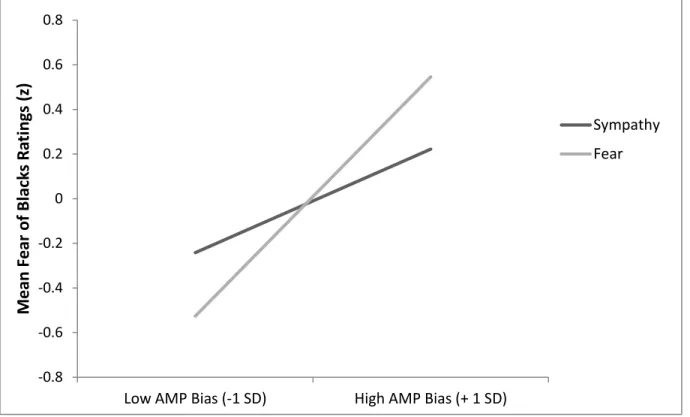
was interpreted as sympathy, as opposed to fear. I conducted a regression analysis predicting fear of African-Americans from automatic negative affect, emotion condition, and their interaction. I plotted the regression slopes in Figure 3. I found a main effect of automatic negative affect, b = .38, t (159) = 5.25, p < .001, but no main effect of emotion condition, b = .01, t (159) = .14, p = .89. Importantly, I found an interaction between automatic negative affect and emotion
condition, b = .15, t (159) = 2.10, p = .037. Simple slopes analysis revealed that participants with greater automatic negative affective responses toward African-Americans reported significantly more fear of African-Americans in the fear condition, b = .54, t (78) = 5.28, p < .001 and in the sympathy condition, b = .24, t (81) = 2.29, p = .025. Comparisons of the simple slopes, however, revealed that participants with greater automatic negative affective responses African-Americans reported less fear of African-Americans when in the sympathy condition rather than the fear condition, t (159) = 2.10, p < .05.
Additionally, I regressed endorsed sympathy for African-Americans onto automatic negative affect, emotion condition, and their interaction. As in Study 1, there was a main effect of automatic negative affect, b = -.39, t (159) = 5.38, p < .001. However, there was neither a main effect of emotion condition, b = .08, t (159) = 1.14, p = .25, nor an interaction effect, b = .02, t (159) = .20, p = .84.
Analysis of expanded emotion scales. Next, I examined the expanded world-focused
would endorse less fear of African-Americans if encouraged to interpret their feelings as sympathy, rather than fear.
For world-focused fear, participants with greater automatic negative affect toward African-Americans also endorsed more world-focused fear of African-Americans, b = .46, t (159) = 6.63, p < .001. There was no main effect of emotion condition, b = -.01, t (159) = .16, p = .87. Contrary to my predictions, there was no interaction effect, b = .09, t (159) = 1.29, p = .20. Similarly, for self-focused fear there was only a significant main effect of automatic negative affect, such that greater negative core affect predicted greater endorsement of self-focused fear of African-Americans b = .39, t (159) = 5.41, p < .001. But there was neither a main effect of emotion condition, b < -.01, t (159) = -.08, p = .93, nor the predicted interaction between automatic negative affect and emotion condition, b = .10, t (159) = 1.43, p = .15.
Participants also tended to endorse less world-focused sympathy for African-Americans if they showed greater automatic negative affect on the AMP, b = -.39, t (159) = 5.38, p < .001. But their responses on the world-focused sympathy items were not affected by emotion
condition, b = .08, t (159) = 1.14, p = .25, or the interaction effect b = .02, t (159) = .20, p = .84. Similarly, for self-focused sympathy toward African-Americans, there was a main effect of automatic negative affect, b = -.40, t (159) = 5.54, p < .001, but no main effect of emotion condition, b = .01, t (159) = .17, p = .87. There was also no interaction effect, b < -.01, t (159) = .01, p < .95.
Discussion
As in Study 1, interpretation of automatic negative affect toward African-Americans as sympathy reduced the amount of reported fear toward African-Americans, but did not moderate the amount of reported sympathy on the original scales. Instead, reported sympathy was more directly related to automatic negative affect toward African-Americans in general. However, interpretation of automatic negative affect did not affect reports on the expanded scales examining world-focused fear and sympathy toward Blacks. Consistent with Study 1, I also found that participants with greater automatic negative affect toward African-Americans reported more negative explicit affect toward African-Americans in the fear condition. This finding, however, did not reach significance (p = .15). The additional items on the world-focused scales were broader than the original items. For example, the original items on the fear scale used language that was directly synonymous with fear (e.g., Blacks are threatening). In contrast, the additional items on the fear scale were broader and instead related to instances of fear or potentially causal of fear (e.g., Blacks are aggressive). This suggests that perhaps participants interpreted their automatic negative affect toward African-Americans in a way specific to fear and participants’ interpretations did not generalize beyond fear. Additionally, the fact that interpretation of automatic negative affect did not influence reported world-focused sympathy toward Blacks is consistent with the findings of Study 1.
GENERAL DISCUSSION
In the current studies, I test a novel psychological constructionist theory of implicit prejudice. Consistent with previous studies (Cooley et al., 2014; Uhlmann, Brescoll, & Paluck, 2006; Vorauer et al., 1998; Vorauer & Turpie, 2004) I found evidence that negative affect toward a racial minority group might have multiple meanings and that interpretation can shape the meaning of negative affect. Taken together, these findings support a psychological
constructionist model of racial attitudes. In my proposed model, I argue that interpretation of core affect, situational information, and conceptual knowledge dynamically constructs an attitude to fit the present situation. My proposed model stands in contrast to previous assumptions that automatically activated racial attitudes produced fixed responses.
The results from Studies 1 and 2 demonstrate that interpretation of negative affect toward African-Americans as sympathy reduces the relationship between automatic negative affect and self-reported fear of African-Americans. In Study 1, when participants interpreted their
relationship between automatic negative affect and self-reported self-focused or world-focused emotions toward African-Americans.
The findings from Studies 1 and 2 are ultimately consistent with my psychological constructionist model. Specifically, these findings suggest that automatic negative affect is one source of information that people use to inform their attitudes about racial minorities. Although I did not manipulate automatic negative affect, the results demonstrate that automatic negative affect alone is not the determining factor influencing evaluations of racial minorities. Instead, interpretation can shape the evaluations that emerge from automatic negative affect toward African-Americans. Supportive of my psychological constructionist model, previous studies have demonstrated that situational information is another important factor that shapes evaluations of racial minorities. For example, in past studies participants evaluated African-Americans positively on an indirect measure if they are presented in a church setting, rather than a prison setting (Wittenbrink et al., 2001). Similarly, participants made more positive evaluations of African-Americans presented in a prison setting if they appeared to be lawyers rather than prisoners (Barden et al., 2004).
The role of situational information in shaping our evaluations of others is also consistent with findings from studies of visual perception. For example recent work suggests that the brain extracts salient context cues in scene perception to help facilitate visual perception of objects (e.g., Aminoff, Kveraga, & Bar, 2013; Bar, 2004; Bar et al., 2006; Bar, Aminoff, Mason, & Fenske, 2007). These context cues activate related concepts and associations stored in memory, which in turn shape how we make sense of visual information. In other words, Bar and
When the object is placed in the context of a bathroom, it looks like a hair dryer, but when it is on a tool bench the object looks like a drill.
Bar’s (2004) theory of visual perception suggests that physical features of an individual, such as skin tone, might also act as a context cue. For example, participants are more likely to mistake a harmless object for a weapon if a face of an African-American is flashed before the object than if a White face is flashed (Payne, 2001). The physical features of person can also act as a context cue for making judgments about the mental state of individuals. For example, White participants who showed greater negative racial attitudes on an indirect measure were faster to judge African-American faces as angry compared to White faces (Hugenberg & Bodenhausen, 2003). Participants are also more likely to judge neutral African-American faces as angry compared to White faces (Shapiro et al., 2009). Study 2 yielded information partially consistent with these findings. In Study 2 the manipulation moderated the relationship between negative affect and the fear items from the original scale in Study 1, which involved direct synonyms of fear in a world-focused way. However, this effect did not extend to the expanded world-focused fear scale or self-focused fear scale. So, it is difficult to determine whether interpretation of negative affect changed participants’ perceptions of African-Americans or their feelings toward African-Americans. In other words, it is unclear whether interpretation of automatic negative affect as sympathy, rather than fear, led to world-focused or self-focused changes in participants’ experiences. Did interpretation reduce participants’ experiences of fear toward
Theoretical Implications
Taken together, the findings from Studies 1 and 2 provide evidence consistent with the proposed psychological constructionist model of racial attitudes. Specifically, these findings provide empirical evidence that interpretation and application of conceptual knowledge can shape the meaning of automatic negative affect. Consistent with the psychological
constructionist theories of emotion (Barrett, 2009; Lindquist, 2013), past research has also provided evidence that situational information such as perceived role, setting, and even skin tone play key roles in shaping the evaluations people make about racial minorities (Barden et al., 2004; Bar, 2004; Hugenberg & Bodenhausen, 2003; Payne, 2001; Shapiro et al., 2009;
Wittenbrink et al., 2001). The proposed model is consistent with theories which view attitudes as products of dynamic processes, rather than fixed entities awaiting activation. For example, the Associative-Propositional Evaluation model views automatic processes as associations stored in memory (Gawronski & Bodenhausen, 2006, 2011). Gawronski and Bodenhausen argue that indirect measures capture the associations which are activated by stimuli. But, unlike the perspective where a stimulus has a set evaluation, Gawronski and Bodenhausen argue that the activation of associations is also dependent on the context in which one encounters a stimulus. In the Associative-Propositional Evaluation model, contextual cues determine which associations are activated when encountering a stimulus. According to Gawronski and Bodenhausen (2011), the associations stored in memory comprise information that is initially learned about an attitude object, information that is learned subsequently, and a mixture of the two. Importantly,
encode information about African-Americans in a church setting as friendly. According to Bodenhausen and Gawronski contextual information would therefore determine which associations are activated.
Overall, my model proposes that racial attitudes, and perhaps attitudes more broadly might be best characterized using a psychological constructionist framework. A psychological constructionist framework may provide a solution to the problem that attitudes appear both to be stable over time and sensitive to contextual information (Fazio, 2007; Petty et al., 2007;
Schwarz, 2007). My model predicts that consistency of attitudes over time is the result
interpretations of affective, situational, and conceptual information in similar ways. In contrast, changes in context may change how people interpret these different sources of information. For example, in a church setting, a person’s skin tone might be a less salient factor in generating an evaluation about that person. Alternatively, one might draw on different conceptual knowledge (e.g., African-Americans as church-goers) in generating an evaluation.
Finally, my proposed model may provide a tractable solution for the seemingly intractable problems of prejudice and discrimination. Even the most optimistic theories of
consequences of simply existing in our society. According to my proposed model, however, negative racial attitudes may reflect an automatic tendency to interpret affective, situational, and conceptual information in a way that forms unfavorable or harmful evaluations of racial
minorities emerge. Yet, the tendency to interpret information in a way that is hostile to racial minorities is far from immutable. The way in which individuals interpret affective and situational information is malleable. Therefore, through changing how they interpret this information a person might be able to interpret negative affect toward racial minorities in a way that results in pro-social rather than harmful evaluations of racial minorities.
Conclusions
The traditionally, evidence of negative affect toward minority groups on indirect measures are interpreted as evidence ofpersistent negative racial attitudes stored in long-term memory. According to this perspective, these attitudes become active when one encounters a member of the minority group in question. But, the broader literature suggests a different
interpretation of the data. Reponses on indirect measures might reflect general negative affective responses, which are not directed at minority group members. For example, negative affect might be tied to the anxiety or reflect sympathy. Further, indirect measures are sensitive to contextual cues, which challenge the idea that indirect measures reflect inflexible activation of evaluations stored in long-term memory. Rather, the current studies suggest that subjective interpretation of negative affect toward a minority group can alter the meaning of this negative affect. In
opportunity, however, a person can choose to interpret negative affective reactions to minority group members in pro-social ways. Ultimately, examining how individuals construct evaluations of racial minority groups may provide novel insight into the processes that drive negative
APPENDIX 1: FIGURES
Figure 1. Relationship between standardized AMP scores and standardized mean ratings score of fear of Blacks moderated by emotion condition, Study 1
-0.8 -0.6 -0.4 -0.2 0 0.2 0.4 0.6 0.8
Low AMP Bias (-1 SD) High AMP Bias (+ 1 SD)
Mean
Fea
r
of
B
la
ck
s
Ra
tin
gs
(z
)
Sympathy
Figure 2. Relationship between standardized AMP scores and standardized difference scores for negative affect toward Blacks moderated by emotion condition, Study 1
-0.8 -0.6 -0.4 -0.2 0 0.2 0.4 0.6 0.8
Low AMP Bias (-1 SD) High AMP Bias (+ 1 SD)
Figure 3. Relationship between standardized AMP scores and standardized mean ratings score of fear of Blacks scale used in Study 1 moderated by emotion condition, Study 2
-0.8 -0.6 -0.4 -0.2 0 0.2 0.4 0.6 0.8
Low AMP Bias (-1 SD) High AMP Bias (+ 1 SD)
M
ea
n
Fe
ar
of
Bla
ck
s
R
ati
ng
s
(z)
Sympathy
APPENDIX B: TABLE OF QUESTIONNAIRE ITEMS
Fear and Sympathy for Blacks Scales
World-Focused Fear
1. Blacks are threatening.*
2. Blacks are scary.*
3. Blacks are frightening.*
4. Blacks are aggressive
5. Blacks are hostile.
6. Blacks are intimidating.
7. Blacks are dangerous.
8. Blacks are violent.
World-Focused Sympathy
9. Blacks continue to face oppression.*
10. Blacks are unfairly looked down upon.*
11. Blacks are unfairly harassed.*
12. Blacks are warm.
13. Blacks are dehumanized
14. Blacks are exploited.
15. Blacks are neglected.
16. Blacks are marginalized
Self-Focused Fear
17. I am frightened by Blacks.
18. I feel afraid around Blacks.
19. I feel threatened when I am around Blacks.
20. I feel anxious around Blacks.
21. I feel nervous around Blacks.
22. I feel suspicion toward Blacks.
23. Seeing a group of Blacks makes me anxious.
24. Encounters with Blacks make me uneasy.
Self-Focused Sympathy
25. I feel sympathetic towards Blacks.
26. I feel warmth towards Blacks.
27. I feel compassion towards Blacks.
28. I feel bad for Blacks.
29. I feel sorry for Blacks.
30. I feel concern for Blacks.
31. I feel pity for Blacks.
32. I empathize with Blacks.
Note. Items with * beside them reflect original scale used in Study 1 and the replication analyses in Study 2.
REFERENCES
Allport, G. W. (1979). The Nature of Prejudice (Unabridged edition.). Reading, Mass: Basic Books.
Aminoff, E., Kveraga, K., & Bar, M. (2013). The role of the parahippocampal cortex in cognition. Trends in Cognitive Sciences, 17, 379–390.
Banaji, M. R., Nosek, B. A., & Greenwald, A. G. (2004). No place for nostalgia in science: A response to Arkes and Tetlock. Psychological Inquiry, 15, 279–289.
Barden, J., Maddux, W. W., Petty, R. E., & Brewer, M. B. (2004). Contextual moderation of racial bias: the impact of social roles on controlled and automatically activated attitudes. Journal of Personality and Social Psychology, 87, 5–22.
Bar, M. (2004). Visual objects in context. Nature Reviews Neuroscience, 5, 617–629.
Bar, M., Aminoff, E., Mason, M., & Fenske, M. (2007). The units of thought. Hippocampus, 17, 420–428.
Bar, M., Kassam, K. S., Ghuman, A. S., Boshyan, J., Schmid, A. M., Dale, A. M., … Halgren, E. (2006). Top-down facilitation of visual recognition. Proceedings of the National
Academy of Sciences of the United States of America, 103, 449–454.
Barrett, L. F. (2006). Solving the emotion paradox: Categorization and the experience of emotion. Personality and Social Psychology Review, 10, 20–46.
Barrett, L. F. (2009). Variety is the spice of life: A psychological construction approach to understanding variability in emotion. Cognition and Emotion, 23, 1284–1306.
Barrett, L. F. (2012). Emotions are real. Emotion, 12, 413–429.
Barsalou, L. W., Simmons, W. K., Barbey, A. K., & Wilson, C. D. (2003). Grounding
Bobo, L. (2001). Racial attitudes and relations at the close of the twentieth century. America Becoming: Racial Trends and Their Consequences, 1, 264–301.
Cooley, E., Payne, B. K., & Phillips, K. J. (2014). Implicit bias and the illusion of conscious ill will. Social Psychological and Personality Science, 5, 500–507.
Devine, P. G. (1989). Stereotypes and prejudice: Their automatic and controlled components. Journal of Personality and Social Psychology, 56, 5–18.
Evans, J. S. B. T. (2008). Dual-processing accounts of reasoning, judgment, and social cognition. Annual Review of Psychology, 59, 255–278.
Fazio, R. H. (1990). Multiple processes by which attitudes guide behavior: The MODE model as an integrative framework. Advances in Experimental Social Psychology, 23, 75–109.
Fazio, R. H. (2007). Attitudes as object–evaluation associations of varying strength. Social Cognition, 25, 603–637.
Fazio, R. H., Jackson, J. R., Dunton, B. C., & Williams, C. J. (1995). Variability in automatic activation as an unobtrusive measure of racial attitudes: A bona fide pipeline? Journal of Personality and Social Psychology, 69, 1013–1027.
Fazio, R. H., & Olson, M. A. (2003). Implicit measures in social cognition research: Their meaning and use. Annual Review of Psychology, 54, 297–327.
Gawronski, B., & Bodenhausen, G. V. (2006). Associative and propositional processes in evaluation: An integrative review of implicit and explicit attitude change. Psychological Bulletin, 132, 692–731.
Gawronski, B., & Bodenhausen, G. V. (2011). The associative-propositional evaluation model: Theory, evidence and open question. Advances in Experimental Social Psychology, 44, 59–127.
Greenwald, A. G., McGhee, D. E., & Schwartz, J. L. (1998). Measuring individual differences in implicit cognition: The Implicit Association Test. Journal of Personality and Social Psychology, 74, 1464–1480.
Hugenberg, K., & Bodenhausen, G. V. (2003). Facing prejudice: Implicit prejudice and the perception of facial threat. Psychological Science, 14, 640–643.
Lambert, A. J., Payne, B. K., Jacoby, L. L., Shaffer, L. M., Chasteen, A. L., & Khan, S. R. (2003). Stereotypes as dominant responses: on the “social facilitation” of prejudice in anticipated public contexts. Journal of Personality and Social Psychology, 84, 277.
Lambie, J. A., & Marcel, A. J. (2002). Consciousness and the varieties of emotion experience: A theoretical framework. Psychological Review, 109, 219–259.
Lindquist, K. A. (2013). Emotions emerge from more basic psychological ingredients: A modern psychological constructionist model. Emotion Review, 5, 356–368.
Lindquist, K. A., & Barrett, L. F. (2008). Constructing emotion: The experience of fear as a conceptual act. Psychological Science, 19, 898–903.
Nosek, B. A., Smyth, F. L., Hansen, J. J., Devos, T., Lindner, N. M., Ranganath, K. A., … Banaji, M. R. (2007). Pervasiveness and correlates of implicit attitudes and stereotypes. European Review of Social Psychology, 18, 36–88.
Payne, B. K. (2001). Prejudice and perception: The role of automatic and controlled processes in misperceiving a weapon. Journal of Personality and Social Psychology, 81, 181–192.
Payne, B. K., Cheng, C. M., Govorun, O., & Stewart, B. D. (2005). An inkblot for attitudes: Affect misattribution as implicit measurement. Journal of Personality and Social Psychology, 89, 277–293.
Petty, R. E. (2006). A metacognitive model of attitudes. Journal of Consumer Research, 33, 22– 24.
Russell, J. A. (2005). Emotion in human consciousness is built on core affect. Journal of Consciousness Studies, 12, 26–42.
Russell, J. A. (2009). Emotion, core affect, and psychological construction. Cognition and Emotion, 23, 1259–1283.
Russell, J. A., & Barrett, L. F. (1999). Core affect, prototypical emotional episodes, and other things called emotion: Dissecting the elephant. Journal of Personality and Social Psychology, 76, 805–819.
Schwarz, N. (2007). Attitude construction: Evaluation in context. Social Cognition, 25(5), 638– 656.
Shapiro, J. R., Ackerman, J. M., Neuberg, S. L., Maner, J. K., Becker, D. V., & Kenrick, D. T. (2009). Following in the wake of anger: When not discriminating is discriminating. Personality and Social Psychology Bulletin, 35, 1356–1367.
Sniderman, P. M., & Carmines, E. G. (1997). Reaching beyond race. PS: Political Science & Politics, 30(03), 466–471.
Uhlmann, E. L., Brescoll, V. L., & Paluck, E. L. (2006). Are members of low status groups perceived as bad, or badly off? Egalitarian negative associations and automatic prejudice. Journal of Experimental Social Psychology, 42, 491–499.
Vorauer, J. D., Main, K. J., & O’Connell, G. B. (1998). How do individuals expect to be viewed by members of lower status groups? Content and implications of meta-stereotypes. Journal of Personality and Social Psychology, 75, 917–937.
Vorauer, J. D., & Turpie, C. A. (2004). Disruptive effects of vigilance on dominant group members’ treatment of outgroup members: choking versus shining under pressure. Journal of Personality and Social Psychology, 87, 384–399.