Randomizing world trade. II. A weighted network analysis
Tiziano Squartini
CSC and Department of Physics, University of Siena, Via Roma 56, 53100 Siena, Italy, and Lorentz Institute
for Theoretical Physics, Leiden Institute of Physics, University of Leiden, Niels Bohrweg 2, NL-2333 CA Leiden, The Netherlands
Giorgio Fagiolo
LEM, Sant’Anna School of Advanced Studies, 56127 Pisa, Italy
Diego Garlaschelli
Lorentz Institute for Theoretical Physics, Leiden Institute of Physics, University of Leiden, Niels Bohrweg 2, NL-2333 CA Leiden, The Netherlands
(Received 27 April 2011; published 31 October 2011)
Based on the misleading expectation that weighted network properties always offer a more complete description than purely topological ones, current economic models of the International Trade Network (ITN) generally aim at explaining local weighted properties, not local binary ones. Here we complement our analysis of the binary projections of the ITN by considering its weighted representations. We show that, unlike the binary case, all possible weighted representations of the ITN (directed and undirected, aggregated and disaggregated) cannot be traced back to local country-specific properties, which are therefore of limited informativeness. Our two papers show that traditional macroeconomic approaches systematically fail to capture the key properties of the ITN. In the binary case, they do not focus on the degree sequence and hence cannot characterize or replicate higher-order properties. In the weighted case, they generally focus on the strength sequence, but the knowledge of the latter is not enough in order to understand or reproduce indirect effects.
DOI:10.1103/PhysRevE.84.046118 PACS number(s): 89.65.Gh, 89.70.Cf, 89.75.−k, 02.70.Rr
I. INTRODUCTION
In this paper we extend our analysis of the binary projection of the International Trade Network (ITN) reported in the
previous paper [1] to the weighted representation of the same
network. As in the binary case, we employ a recently proposed
randomization method [2] to assess in detail the role that
local properties have in shaping higher-order patterns of the weighted ITN in all its possible representations (directed or undirected, aggregated or disaggregated) and across several years. In the weighted case, we employ a null model that preserves on average the strengths of the vertices only. More specifically, when the network is undirected, node strength is preserved on average, whereas when the network is directed, in- and out-strengths are conserved separately on average. From a trade perspective, this means that the null model controls for country total trade in the undirected case, and for country total imports and exports (as a share of total world yearly trade) in the directed case. This implies that degrees are not preserved on average in either case. For example, in the undirected case, a country preserves on average (over all graphs accounted for by the null model) its total observed trade flow, but not its observed number of partners. Preserving total trade and number of partners simultaneously for each country is a more severe constraint that goes beyond the scope of this paper, since it would not allow us to compare our results with well-established international-economics approaches that take only total trade, and not the number of partners, into account. We find that, unlike the binary case, higher-order patterns of weighted (either directed or undirected, either aggregated or disaggregated) representations of the ITN cannot be merely traced back to local properties alone (i.e., node strength sequences). In particular, when compared to its randomized
variants, the observed weighted ITN displays a different and sparser topology (despite that the ITN is usually considered denser than most studied networks), stronger disassortativ-ity, and larger clustering. As sparser and less aggregated commodity-specific representations are considered, the accor-dance between the real and randomized networks gets even worse. All these results hold for both undirected and directed projections and are robust throughout the time interval we consider (from year 1992 to 2002).
From an international-trade perspective, our results indicate that a weighted network description of trade flows, by focusing on higher-order properties in addition to local ones, captures novel and fresh evidence. Therefore, traditional analyses of country trade profiles focusing only on local properties and country-specific statistics convey a partial description of the richness and details of the ITN architecture. Moreover, economic models and theories that aim at only explaining the local properties of the weighted ITN (i.e., the total values of imports and exports of world countries) are limited, as such properties have no predictive power on the rest of the structure of the network.
We refer the reader to the companion paper [1] for a
description of the data, the notation used, the meaning and economic importance of local topological properties, and the randomization method that we have adopted.
II. THE ITN AS A WEIGHTED UNDIRECTED NETWORK
The weighted representation of the ITN takes into account the intensity (dollar value) of trade relationships and can be either directed or undirected. The structure of the network
entries {wij} have been defined in Ref. [1] in the directed and undirected case. In the weighted undirected case, an
edge between vertices i and j represents the presence of
at least one of the two possible trade relationships between
the two countriesiandj, and the weightwij represents the
average trade value (or equivalently half the total bilateral trade
value) [1]. Clearly, if no trade occurs in either direction, then
wij =0 and no link exists. The weight matrixWis therefore
symmetric:wij =wj i. One can still define an adjacency matrix
A, describing the purely binary topology of the network, with
entriesaij =(wij) where(x)=1 ifx >0 and(x)=0
otherwise. Clearly the symmetry ofWimplies the symmetry
ofA.
In the case considered, the local constraints{Ca}are the
strengths of all vertices, i.e., thestrength sequence{si}[1]. The
randomization method we adopted [2] proceeds in this case
by specifying the constraints{Ca} ≡ {si}(see Appendix A)
and yields the ensemble probability of any weighted graphG,
which now is uniquely specified by its generic weight matrix
W. For any weighted topological propertyX, it is therefore
possible to easily obtain the expectation value X across
the ensemble of weighted undirected graphs with specified
strength sequence. By construction, the expected strengthsi
across the randomized ensemble is equal to the empirical
value si, and therefore in the weighted undirected case the
strength values {si}are the natural independent variables in
terms of which other weighted propertiesXcan be visualized.
By contrast, other properties such as the degree of vertices, and consequently the total number of links, are not preserved on average.
In our analysis we first use the matrixW, and the strength
sequence {si} obtained from it, as the starting point for
the randomization method. However, as we mentioned in
the companion paper [1], in order to allow a consistent
temporal analysis we need to focus on the rescaled weights ˜
wij ≡wij/wtot, wherewtot=
i
j <iwij is the total yearly weight. Consistently we define the rescaled strength
˜
si≡
j=i ˜
wij =
si
wtot
, (1)
and we similarly use ˜wij instead ofwij in the definition of all
other weighted topological quantities. This procedure allows for homogeneous comparisons between real and randomized webs, and across different years and commodities. In particu-lar, it filters out the increase of world trade in nominal terms.
Note that, across the randomized ensemble,wtotis a random
variable, since so are the weightswij. However, we can rewrite
wtot=
isi/2, and sincesi =si we have
wtot =
isi
2 =
isi
2 =wtot. (2)
The above result shows that the expectation value of the total weight across the randomized ensemble is constrained by the
method to be strictly equal to the observed valuewtot. In other
words, the constraint on the strengths is automatically reflected also in a constraint on the total weight, and we can therefore use the the latter to rescale all weights, both in the real network and in its randomized variants.
In economic terms, specifying the strength sequence amounts to investigating the properties of the trade network
once total trade of all countries is controlled for. It must be noticed that, by controlling for the strength of vertices, one automatically takes at least partially on board considerations related to country-size effects. Indeed, it is common wisdom that bilateral trade flows, and therefore weighted network statistics, should depend on (at the very least) country-specific variables like country gross-domestic product (GDP) and some
additional pairwise factors like geographical distance [3,4].
Since total trade (and total imports or exports) are known to be positively and strongly correlated with country GDP, our analysis already controls for some size effect. As we discuss in the concluding remarks, a further exercise to be carried out may concern understanding the extent to which other determinants of trade (such as distance) may explain the observed properties of the ITN, i.e., building more economically meaningful models of trade that start explaining ITN properties rather than statistically reproducing them only.
A. Edge weights
We start with the analysis of the completely aggregated
network (i.e., c=0 according to our notation described
in Ref. [1]). Therefore, in the following formulas, we set
W≡W0 and drop the superscript for brevity. Our aim is
to understand how specifying the strength sequence affects higher-order network properties. Therefore we will consider the weighted counterparts of the topological properties we
have already studied in the binary case [1]. However, due to
the larger number of degrees of freedom, in the weighted case there are also additional quantities to study that have no binary analog. In particular, it is important to understand the effect that the enforcement of local constraints (strength sequence) has on the weights of the network, as well as on its purely binary topology. It is useful to perform this analysis as a preliminary step, before discussing other results.
To this end, we start by comparing the empirical weight distribution with the expected one. Importantly, one should not confuse the expected weight distribution with the distribution of expected weights. In the spirit of our analysis, the empirical network (and so its weight distribution) is regarded as a particular possible realization of the null model with given strengths, and the comparison with the expected properties aims at assessing how unlikely that particular realization is. Therefore the observed number of edges with weight equal to
w(i.e., the empirical weight distribution) should be compared
with the expected number of such edges in a single realization (the expected weight distribution), rather than with the number of edges whose expected weight across realizations is equal
to w (the distribution of expected weights). The difference
between the two expected quantities is evidenced by the fact that the expected edge weight between vertices is always
positive (see Appendix A), whereas in a single realization
there are a number of zero-weight edges (i.e., missing links).
In Fig.1(a)we therefore compare the cumulative
distribu-tion of observed weightsP<(w) (the fraction of edge weights
smaller thanw) with the expected numberP<(w)(see
Ap-pendixA), both including missing links (w=0) and therefore
normalized to the number of pairs of vertices. As an alternative,
in Fig.1(b) we also compare the cumulative distribution of
1 100 104 106 108 0
0.2 0.4 0.6 0.8 1.0
w 0
P
w
,
P
w
(a)
1 100 104 106 108 0
0.2 0.4 0.6 0.8 1.0
w 0
P
w
,
P
w
(b)
1990 1992 1994 1996 1998 2000 2002 0
10 20 30 40 50 60
year
zeros
,
zeros
(c)
FIG. 1. (Color online) Edge weights in the weighted undirected ITN. (a) Cumulative distributions of edge weights, for all years from 1992 (top) to 2002 (bottom). Orange (upper curves): real network; blue (lower curves): expectation for the maximum-entropy null model with specified strengths. (b) Same as the previous panel, but excluding zero weights (missing links). Orange (dark gray): real network; green (light gray): null model. (c) Percentage of missing links as a function of time. Red (upper points): real network; blue (lower points): null model.
therefore normalized to the total number of links) with the expected numberP<+(w)(see AppendixA). We find that, for all years in our time window, the real distributions are always different from the expected ones. To rigorously confirm this, we have performed Kolmogorov-Smirnov and Lilliefors tests, and for all years we always had to reject the hypothesis that real and expected distributions are the same (5% significance level). For the positive weight distributionsP<+(w) andP<+(w)we also separately tested the hypothesis of the log-normality of the distributions, and again we always had to reject it (5% significance level).
The above results, besides highlighting large differences in the weighted structure of real and randomized networks, also convey important information about remarkable deviations in their topology. The largest difference between the curves
P<(w) andP<(w)is found atw=0, and the corresponding pointsP<(0) andP<(0) represent the fractions %zeros and
%zeros of zero weights (missing links) in the network. In
Fig.1(c)we show the evolution of these fractions over time.
We find that the fraction of missing links in the real network decreases in time over the time interval considered (i.e., the link density increases), but its value is always much larger than the corresponding expected value. Thus, despite it is usually considered a very dense graph, with more links per node than most other real-world networks, we find that the ITN turns out to be surprisingly sparser than random weighted networks with the same strength sequence. This fixes a previously unavailable benchmark for the density of the empirical ITN and implies that the high percentage of missing trade relations among world countries is not explained by size effects (i.e., the total
trade value of all countries). Note that this result would be trivial if we were considering trade magnitudes as real-valued, rather than integer-valued, weights. For real-valued weights, the volume of the configuration space (the number of networks in the ensemble) would be infinite, and the probability of networks with zero-valued weights would be zero. So, topologically, almost all networks in the random ensemble would be complete graphs, making every real network sparser than (or at most as sparse as) its randomized counterpart. Instead, in our analysis we consider integer-valued weights (as discussed in detail when presenting our data and methods
in the companion paper [1]) reflecting more correctly the fact
that money has indivisible units. This always gives a positive
probabilityqij(0)>0 (see AppendixA) to missing links, and
as a result the expected density of links is always smaller than one.
In what follows, we study the effects of the strength sequence on higher-order topological properties, in analogy
with our binary analysis [1]. We first report detailed results
for the 2002 snapshot of the commodity-aggregated network
(Secs. II B and II C), then consider the temporal evolution
of the aggregated network (Sec.II D), and finally perform a
commodity-specific analysis (Sec.II E).
B. Average nearest-neighbor strength
We start with the weighted counterpart of the
10 5 10 4 0.001 0.01 0.1 0.01
0.02 0.03 0.04 0.05
s
s
nn
,
s
nn
FIG. 2. (Color online) Average nearest-neighbor strength ˜snn i
versus strength ˜siin the 2002 snapshot of the real weighted undirected
ITN (red points), and corresponding average over the maximum-entropy ensemble with specified strengths (blue solid curve).
nearest-neighbor strength(ANNS) of vertexi, defined as
˜
sinn≡
j=iaijs˜j
ki =
j=i
k=jaijw˜j k
j=iaij
. (3)
The ANNS measures the average strength of the neighbors of a given vertex. Similarly to the ANND, the ANNS involves indirect interactions of length 2, however (as happens for most weighted quantities), mixing both weighted and purely topological information: in particular, terms of the typeaijw˜j k appear in the definition.
The correlations between the strength of neighboring
countries can be inspected by plotting ˜snn
i versus ˜si. This
is shown in Fig. 2. Even if the points are now significantly
more scattered, we find a decreasing trend as previously
observed for the corresponding binary quantities [1]. This
trend signals that highly trading countries trade typically with poorly trading ones (and vice versa), confirming on a weighted basis the disassortative character observed at the binary level. However, in this case the null model behaves in a completely different way: Over the randomized ensemble with specified
strength sequence, the expectation values˜inn of the ANNS
(see AppendixA) decreases over a much narrower range (see
Fig.2) and is always different from the observed value.
This important results implies that, even if we observe disassortativity in both cases (binary and weighted), we find that in the binary case this property is completely explained by the degree sequence, whereas in the weighted case it is not explained by the strength sequence. This has implications for economic models of international trade: While no theoretical explanation is required in order to explain why poorly connected countries trade with highly connected ones on a binary basis (once the number of trade partners is specified), additional explanations are required in order to explain the same phenomenon at a weighted level, even after controlling for the total trade volumes of all countries. This result could look counterintuitive, as a simple visual inspection would suggest that in the binary case the disassortative behavior is in absolute terms less noisy, and sometimes more pronounced, than in the weighted one.
10 5 10 4 0.001 0.01 0.1 1 10 6
2 10 6 5 10 6 1 10 5 2 10 5 5 10 5 1 10 4
s
c
,
c
FIG. 3. (Color online) Weighted clustering coefficient ˜ci versus
strength ˜siin the 2002 snapshot of the real weighted undirected ITN
(red points), and corresponding average over the maximum-entropy ensemble with specified strengths (blue solid curve).
C. Weighted clustering coefficient
We now consider the weighted version of the clustering coefficient. In particular, we choose the definition proposed
in Ref. [5], which has a more direct extension to the directed
case [6]. According to that definition, the (rescaled)weighted
clustering coefficientc˜irepresents the intensity of the triangles
in which vertexiparticipates:
˜
ci ≡
j=i
k=i,j( ˜wijw˜j kw˜ki)1/3
ki(ki−1)
,
(4)
=
j=i
k=i,j( ˜wijw˜j kw˜ki)1/3
j=i
k=i,jaijaik
.
Note that ˜ci takes into account indirect interactions of length
3, corresponding to products of the type ˜wijw˜j kw˜kiappearing
in the above formula. In Fig. 3 we plot ˜ci versus ˜si. This
time we find an increasing trend of ˜ci as a function of ˜si,
indicating that countries with larger total trade participate in more intense trade triangles. We also show the trend followed
by the randomized quantityc˜i(see AppendixA), which is
found to approximately reproduce the empirical data. Despite the partial accordance between the clustering profile of real and randomized networks, the total level of clustering of the real ITN is, however, larger than its randomized counterpart,
as we show below (Sec.II D) for all the years considered.
D. Evolution of weighted undirected properties
The results we have reported above are qualitatively similar for each of the 11 snapshots of the ITN from year 1992 to
2002. As for our binary analyses [1], we can therefore
com-pactly describe the temporal evolution of weighted undirected properties in terms of simple indicators.
We start with the analysis of the ANNS (Fig.4). In Fig.4(a)
we report the average (across vertices) and the associated 95% confidence interval of both real and randomized values ({s˜nn
i }and {s˜
nn
i }) as a function of time. We find that the
average of ˜snn
i has been first decreasing rapidly and has then
remained almost constant. This behavior is already clean from trends in the total volume of trade, since all weights have
been rescaled and divided by wtot. By contrast, the average
of the randomized quantity s˜nn
i displays a constant trend
1990 1992 1994 1996 1998 2000 2002 0
0.01 0.02 0.03 0.04
year
m s
nn,
m
s
nn
(a)
1990 1992 1994 1996 1998 2000 2002 0
0.005 0.010 0.015 0.020
year
s s
nn,
s s
nn
(b)
1990 1992 1994 1996 1998 2000 2002 1.0
0.8 0.6 0.4 0.2
year
rs
nn ,
s
,
rs
nn
,
s
(c)
1990 1992 1994 1996 1998 2000 2002 1.0
0.5 0.0 0.5 1.0
year
r s
nn ,
s
nn
(d)
FIG. 4. (Color online) Temporal evolution of the properties of the (rescaled) average nearest-neighbor strength ˜snn
i in the 1992–2002
snapshots of the real weighted undirected ITN and of the corresponding null model with specified strengths. (a) Average of ˜snn
i across all
vertices (red, upper symbols: real data; blue, lower symbols: null model). (b) Standard deviation of ˜snn
i across all vertices (red, upper symbols:
real data; blue, lower symbols: null model). (c) Correlation coefficient between ˜snn
i and ˜si(red, upper symbols: real data; blue, lower symbols:
null model). (d) Correlation coefficient between ˜snn
i ands˜inn. The 95% confidence intervals of all quantities are represented as vertical bars.
1990 1992 1994 1996 1998 2000 2002 0
0.00001 0.00002 0.00003 0.00004 0.00005
year
mc
,
m
c
(a)
1990 1992 1994 1996 1998 2000 2002 0
0.00002 0.00004 0.00006 0.00008
year
sc
,
sc
(b)
1990 1992 1994 1996 1998 2000 2002 0
0.2 0.4 0.6 0.8 1.0
year
rc,
s
,
rc
,
s
(c)
1990 1992 1994 1996 1998 2000 2002 0
0.2 0.4 0.6 0.8 1.0
year
rc,
c
(d)
FIG. 5. (Color online) Temporal evolution of the properties of the (rescaled) weighted clustering coefficient ˜ciin the 1992–2002 snapshots
of the real weighted undirected ITN and of the corresponding null model with specified strengths. (a) Average of ˜ciacross all vertices (red,
upper symbols: real data; blue, lower symbols: null model). (b) Standard deviation of ˜ciacross all vertices (red, upper symbols: real data; blue,
lower symbols: null model). (c) Correlation coefficient between ˜ciand ˜si(red, initially lower symbols: real data; blue, initially upper symbols:
binary case, the null model does not reproduce the average values of the correlations considered and does not capture their temporal evolution. A similar behavior is observed for the evolution of the standard deviation of the ANNS across
vertices [Fig. 4(b)]. In Fig. 4(c) we show the correlation
coefficient between the empirical quantities {s˜inn} and {s˜i},
whose value (fluctuating around−0.4) compactly summarizes
the disassortativity of the noisy scatter plot that we have shown
previously in Fig.2, and the correlation coefficient between the
randomized quantities{s˜nn
i }and{s˜i} = {s˜i}, which instead
displays a different value close to−1 (due to the noise-free,
even if much weaker, decrease of the randomized curve in
Fig.2). The discrepancy between the null model and the real
network is finally confirmed by the small correlation between
{s˜nn
i }and{s˜ nn
i }[Fig.4(d)], which is in marked contrast with
the perfect correlation between{knn
i }and{k
nn
i }we found in
the binary case.
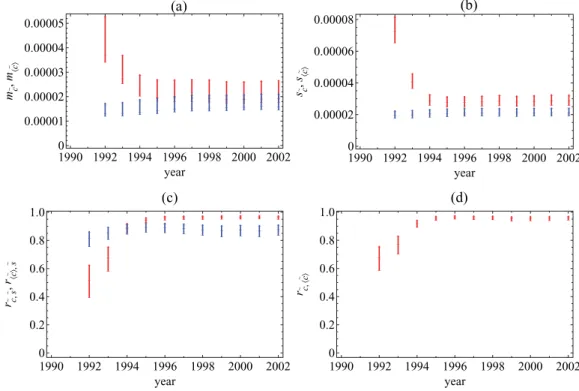
In Fig. 5 we report a similar analysis for the evolution
of the weighted clustering coefficient. We find that, despite the partial accordance of the real and randomized clustering
profiles shown in Fig. 3, the average level of clustering of
the real network is always higher than its randomized variant
[Fig.5(a)], even if the two values have become closer through
time. The same is true for the standard deviation of the
weighted clustering coefficient [Fig.5(b)]. We also find that
the correlation coefficient between the empirical quantities
{c˜i} and {s˜i} [Fig. 5(c)] has rapidly increased between the
years 1992 and 1995 (from about 0.5 to more than 0.95) and
has then remained stable in time. This indicates that the scatter
plot shown in Fig.3for the year 2002 becomes noisier in the
first snapshots of our time window, as we confirmed through an explicit inspection (not shown). By contrast, the correlation
coefficient between the randomized quantities {c˜i} and
{s˜i} = {s˜i}displays much smaller variations about the value
0.85 and is therefore initially larger, and eventually smaller,
than the corresponding empirical value. Finally, in Fig.5(d)we
show the correlation coefficient between{c˜i}and{c˜i}. The increasing trend confirms the growing agreement between the real and randomized clustering coefficients, already suggested by the previous plots. Note, however, that even two perfectly correlated lists of values (correlation coefficient equal to 1) are equal only if their averages are the same (otherwise they are simply proportional to each other). Thus large correlation coefficients between two quantities can be interpreted only in conjunction with a comparison of the average values of the same quantities. While in the binary case we simultaneously found perfect correlation and equal average values between
real and randomized quantities [1], in this case we find
large correlation but different average values, systematically confirming only a partial accordance between the real network and the null model.
E. Commodity-specific weighted undirected networks
We now focus on the disaggregated commodity-specific versions of the weighted undirected ITN, representing the trade of single classes of products. We therefore repeat the
previous analyses after settingW≡Wcfor various individual
commoditiesc >0. As we did for the binary case [1], we show
our results for a subset of 6 commodities taken from the top 14 categories, namely, the two commodities with the smallest
traded volume (c=93,9), two ones with intermediate volume
(c=39,90), the one with the largest volume (c=84), plus the
aggregation of all the top 14 commodities (similar results hold also for the other commodities). Together with the completely
aggregated data (c=0) considered above, this data set consists
of seven networks with increasing trade volume and level of aggregation.
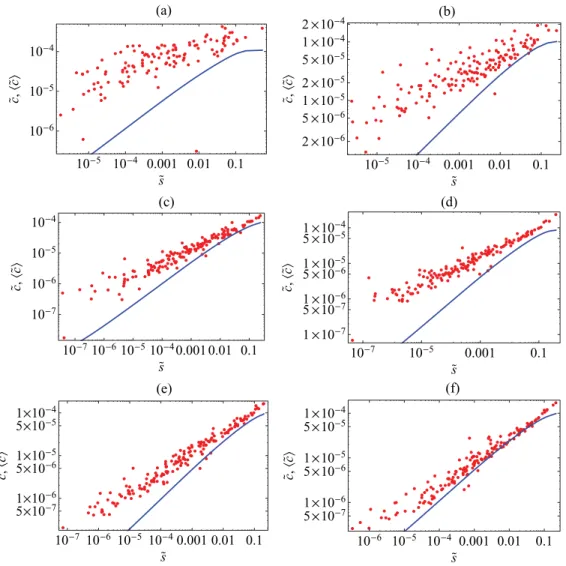
In Fig.6we show the scatter plot of the average
nearest-neighbor strength as a function of the strength. Similarly, in
Fig.7 we report the scatter plot for the weighted clustering
coefficient. Both are shown for the 2002 snapshots of the six commodity-specific networks. When compared with the
aggregated network (shown previously in Figs. 2 and 3),
these results lead to interesting conclusions. In general, as
happens in the binary case [1], we find that commodities
with a lower traded volume feature more dispersed scatter plots, with larger fluctuations of the empirical data around the average trend. The effect is more pronounced here than in the binary case. However, while in the latter the real networks are always well reproduced by the null model, in the weighted case the disagreement between empirical and randomized data remains strong across different levels of commodity aggregation. Moreover, the weighted clustering coefficient is the quantity that displays the largest differences between aggregated and disaggregated networks. We see that, for all commodity classes considered, the observed weighted clustering coefficient is generally larger than its randomized counterpart. However, the deviation is larger for sparser commodities, and decreases as commodity classes with larger trade volumes and higher levels of aggregation are considered. This shows that the partial agreement between real and randomized networks in the completely aggregated
case (see Fig. 3) is not robust to disaggregation. In other
words, the accordance between empirical data and null model,
which according to our discussion in Sec. II D is already
incomplete in the aggregated case, becomes even worse for sparser commodity-specific networks.
The above results confirm that, unlike the binary case, the properties of the weighted undirected version of the ITN are not completely reproduced by simply controlling for the local properties. The presence of higher-order mechanisms is required as an explanation for the onset and evolution of the observed patterns. This result holds across different years and is enhanced as lower levels of commodity aggregation are considered. This shows that a weighted network approach to the analysis of international trade conveys additional information with respect to traditional economic studies that describe trade in terms of local properties alone (total trade,
openness, etc.) [7]. Interestingly, a major deviation between
10 5 0.001 0.1 0.05
0.10 0.15 0.20 0.25
s
s
nn
,
s
nn
(a)
10 710 610 510 40.001 0.01 0.1 0
0.02 0.04 0.06 0.08 0.10 0.12
s
s
nn ,
s
nn
(b)
10 6 10 4 0.01
0 0.02 0.04 0.06 0.08 0.10
s
s
nn ,
s
nn
(c)
10 7 10 5 0.001 0.1
0.05 0.10 0.15 0.20
s
s
nn ,
s
nn
(d)
10 710 610 510 40.001 0.01 0.1 0.02
0.04 0.06 0.08
s
s
nn
,
s
nn
(e)
10 6 10 5 10 4 0.001 0.01 0.1 0.02
0.03 0.04 0.05
s
s
nn ,
s
nn
(f) 0
FIG. 6. (Color online) Average nearest-neighbor strength ˜snn
i versus strength ˜si in the 2002 snapshots of the commodity-specific
(disaggregated) versions of the real weighted undirected ITN (red points), and corresponding average over the maximum-entropy ensemble with specified strengths (blue solid curves). (a) Commodity 93; (b) commodity 09; (c) commodity 39; (d) commodity 90; (e) commodity 84; (f) aggregation of the top 14 commodities (see Ref. [1] for details). From (a) to (f), the intensity of trade and level of aggregation increases.
III. THE ITN AS A WEIGHTED DIRECTED NETWORK
We now turn to the weighted directed analysis of the ITN. A
single graphGin the ensemble of weighted directed networks
is completely specified by its generic weight matrixW, which
is in general not symmetric, and whose entrywij represents
the intensity of the directed link from vertex i to vertex j
(wij =0 if no directed link is there). The binary adjacencyA,
with entriesaij =(wij), is in general not symmetric as well.
Theout-strength sequence{sout
i }and thein-strength sequence
{sin
i } represent the local constraints {Ca} in the weighted
directed case [1]. The randomization method [2] yields the
expectation valueX of a propertyXacross the maximally
random ensemble of weighted directed graphs with in-strength and out-strength sequences equal to the observed ones (see
AppendixB). The quantities{sout
i }and{siin}(or combinations of them) are now the natural independent variables against which other properties can be visualized in both the real and
randomized case, since their expected value coincides with the observed one by construction.
As for the weighted undirected case, we will consider the
rescaled weights ˜wij =wij/wtot(wherewtot=
i
j=iwij) in order to wash away trends due to an overall change in the volume of trade across different years. Correspondingly we consider the rescaled strengths:
˜
siout≡
j=i ˜
wij =
siout wtot
, (5)
˜
siin≡
j=i ˜
wj i =
sin i
wtot, (6)
and we analogously use ˜wij instead ofwij in the definition
of all quantities. Note thatwtot=
isiin=
isiout, and since sini =sini andsiout =sioutwe have
wtot =
i
siin=
i
10 5 10 4 0.001 0.01 0.1
10 6
10 5
10 4
s
c
,
c
10 5 10 4 0.001 0.01 0.1
2 10 6
5 10 6
1 10 5
2 10 5
5 10 5
1 10 4
2 10 4
s
c
,
c
10 710 610 510 40.001 0.01 0.1
10 7
10 6
10 5
10 4
s
c
,
c
10 7 10 5 0.001 0.1
1 10 7
5 10 7
1 10 6
5 10 6
1 10 5
5 10 5
1 10 4
s
c
,
c
10 7 10 6 10 5 10 40.001 0.01 0.1
5 10 7
1 10 6
5 10 6
1 10 5
5 10 5
1 10 4
s
c
,
c
10 6 10 5 10 4 0.001 0.01 0.1
5 10 7
1 10 6
5 10 6
1 10 5
5 10 5
1 10 4
s
c
,
c
(a) (b)
(c) (d)
(e) (f)
FIG. 7. (Color online) Weighted clustering coefficient ˜civersus strength ˜siin the 2002 snapshots of the commodity-specific (disaggregated)
versions of the real weighted undirected ITN (red points), and corresponding average over the maximum-entropy ensemble with specified strengths (blue solid curves). (a) Commodity 93; (b) commodity 09; (c) commodity 39; (d) commodity 90; (e) commodity 84; (f) aggregation of the top 14 commodities (see Ref. [1] for details). From (a) to (f), the intensity of trade and level of aggregation increases.
Therefore, as for the undirected case, the expected value of
wtot coincides with its empirical value, and the total weight
can therefore be safely used to rescale the weights of both real and randomized networks.
A. Directed edge weights
As we did in Sec.II Afor the weighted undirected case, we
first study the consequences that the specification of the in-and out-strength sequences has on the weights of the network and on its density.
In Fig. 8(a) we show the cumulative distribution of
observed weightsP<(w) (including missing links withw=0)
and its randomized counterpartP<(w) (see Appendix B).
Similarly, in Fig.8(b)we show the cumulative distribution of
observed positive weights P<+(w) (excluding missing links)
and the randomized oneP<+(w) (see Appendix B). As in
the undirected case, we find that the empirical distributions are always different from the randomized ones, and we confirmed that the hypothesis of equality of real and expected distributions is always rejected by both Kolmogorov-Smirnov
and Lilliefors tests (5% significance level). Similarly, the hypothesis of log-normality of the positive weight distributions
P<+(w) and P<+(w) is always rejected (5% significance level).
In this case too, we can monitor the important difference between the topological density of the real and randomized
ITN by plotting the fractions of missing links %zeros=P<(0)
and%zeros = P<(0)as a function of time [Fig.8(c)]. Even
if the difference is smaller than in the undirected case, we can confirm on a directed basis that, despite it is usually considered a dense graph, the observed ITN is surprisingly sparser than random directed weighted networks with the same in- and out-strength sequences. Thus the density of (missing) links in the real trade network is not accounted for by size considerations (total imports and total exports of world countries). Again, our use of integer-valued weights ensures that this is not a trivial
effect, since the probabilityqij(0) of missing links is always
positive (see AppendixB), and the expected density of links
is always strictly smaller than one.
1 100 104 106 108 0.2
0.4 0.6 0.8 1.0
w 0
P
w
,
P
w
(a)
1 100 104 106 108 0
0.2 0.4 0.6 0.8 1.0
w 0
P
w
,
P
w
(b)
1990 1992 1994 1996 1998 2000 2002 0
20 40 60 80
year
zeros
,
zeros
(c)
FIG. 8. (Color online) Edge weights in the weighted directed ITN. Red (light gray, upper curves and points): real network; blue (dark gray, lower curves and points): expectation for the maximum-entropy ensemble with specified out-strengths and in-strengths. (a) Cumulative distributions of edge weights in all years from 1992 (top) to 2002 (bottom). (b) Same as the previous panel, but excluding zero weights (missing links). (c) Percentage of missing links as a function of time.
consider the aggregated snapshot for year 2002 in more detail, then discuss the temporal evolution of the results, and finally perform a study of disaggregated networks.
B. Directed average nearest-neighbor strengths
We consider four generalizations of the definition of the average nearest-neighbor strength of a vertex in a directed weighted network:
˜
siin/in≡
j=iaj is˜jin
kiin =
j=i
k=jaj iw˜kj
j=iaj i
, (8)
˜
siin/out ≡
j=iaj is˜jout
kiin =
j=i
k=jaj iw˜j k
j=iaj i
, (9)
˜
siout/in≡
j=iaijs˜jin
kout i
=
j=i
k=jaijw˜kj
j=iaij
, (10)
˜
siout/out≡
j=iaijs˜jout
kout i
=
j=i
k=jaijw˜j k
j=iaij
. (11)
Indirect interactions due to chains of length two (products
of the type aijw˜kl) contribute to the above quantities. A
fifth aggregated quantity, which is the natural analog of the undirected ANNS, is based on the (rescaled) total strength ˜
stoti ≡s˜iin+s˜iout:
˜
sitot/tot≡
j=i(aij+aj i)˜stotj
kitot . (12)
As in the binary case [1], it must be noted that the total (in+out) directed quantities such as ˜sitot and ˜sitot/tot are not trivially
related to, and carry more information than, the corresponding undirected properties ˜si and ˜sinn. In this case, the difference
between them is given by the weightedreciprocity structure
of the network. Unfortunately, there are no well-established measures of reciprocity in the weighted case, and introducing a weighted theory of reciprocity is beyond the scope of the present paper. However, as in the binary case, it is still possible for us to assess, by comparing undirected and total directed weighted properties, whether the reciprocity structure of the directed network changes the results obtained in the undirected case.
In Fig.9we show ˜sitot/tot, together with its randomized value
s˜tot/toti (obtained as in AppendixB), as a function of ˜sitotin the aggregated snapshot for year 2002. There are no significant
differences with respect to Fig.2, apart from a “double” series
of randomized values due to the two possible directions (the terms aij andaj i) that contribute to the definition of ˜sitot/tot
in Eq. (12). Thus we still observe a disassortative behavior
in the empirical network, which is not paralleled by the null model. We now turn to the four directed versions of the ANNS
defined in Eqs. (8)–(11), as well as their randomized values
(see AppendixB). As shown in Fig.10, we find that the four
empirical quantities all display the same disassortative trend, whereas the four randomized ones are always approximately
flat (and no longer switch between two trends as in Fig. 9).
10 5 10 4 0.001 0.01 0.1 0.02
0.03 0.04 0.05
stot
s
tot
tot
,
s
tot
tot
FIG. 9. (Color online) Total average nearest-neighbor strength ˜
stot/tot
i versus total strength ˜s
tot
i in the 2002 snapshot of the real
weighted directed ITN (red, upper points), and corresponding average over the null model with specified out-strengths and in-strengths (blue, lower points).
negative correlations between the total trade values (in any direction) of neighboring countries, even after controlling for the heterogeneities in the total trade values themselves. This is in marked contrast with the binary case, where we showed that the observed disassortativity is completely explained by
controlling for the empirical degree sequence [1].
C. Directed weighted clustering coefficients
In Figs. 11 and 12 we report a similar analysis for the
clustering coefficient. The four weighted versions of the
inward, outward, cyclic, and middleman directed clustering coefficients considered in Ref. [1] read [6]
˜
cini ≡
j=i
k=i,j( ˜wkiw˜j iw˜j k)1/3
kin i
kin
i −1
, (13)
˜
couti ≡
j=i
k=i,j( ˜wikw˜j kw˜ij)1/3
kioutkiout−1 , (14)
˜
ccyci ≡
j=i
k=i,j( ˜wijw˜j kw˜ki)1/3
kin
i kiout−ki↔
, (15)
˜
cmidi ≡
j=i
k=i,j( ˜wikw˜j iw˜j k)1/3
kiinkouti −ki↔ . (16)
The above quantities capture indirect interactions of length 3 according to their directionality, appearing as products of the type ˜wijw˜klw˜mn. A fifth measure aggregates all directions:
˜
ctoti ≡
j=i
k=i,j
˜
wij1/3+w˜j i1/3w˜1j k/3+w˜1kj/3w˜ki1/3+w˜1ik/3
2ktot i
ktot
i −1
−2k↔i .
We show the latter in Fig.11, and the four directed quantities
defined in Eqs. (13)–(16) in Fig.12. All properties are shown
together with their randomized values (see Appendix B),
and plotted against the natural independent variables (or combinations of them). Again, there is no significant difference
with respect to the weighted undirected plot (Fig.3), apart from
the switching behavior ofc˜tot
i between two trends as already
discussed for s˜itot/tot. We find an approximate agreement
between real and randomized clustering profiles.
10 5 10 4 0.001 0.01 0.1 0.010
0.015 0.020 0.025
sin
s
in
in ,
s
in
in
(a)
10 5 10 4 0.001 0.01 0.1 0.010
0.015 0.020 0.025
sout
s
in
out
,
s
in
out
10 5 10 4 0.001 0.01 0.1 0.008
0.010 0.012 0.014 0.016 0.018 0.020
sin
s
out
in ,
s
out
in
10 5 10 4 0.001 0.01 0.1 0.010
0.015 0.020 0.025
sout
s
out
out
,
s
out
out
(b)
(c) (d)
FIG. 10. (Color online) Directed average nearest-neighbor strengths versus vertex strengths in the 2002 snapshot of the real weighted directed ITN (red points), and corresponding averages over the null model with specified out-strengths and in-strengths (blue solid curves). (a) ˜
sin/in
i versus ˜s
in
i ; (b) ˜s
in/out
i versus ˜s
in
i; (c) ˜s
out/in
i versus ˜s
out
i ; (d) ˜s
out/out
i versus ˜s
out
10 5 10 4 0.001 0.01 0.1
1 10 6 2 10 6 5 10 6 1 10 5 2 10 5 5 10 5 1 10 4
stot
c
tot
,
c
tot
FIG. 11. (Color online) Total weighted clustering coefficient ˜ctot
i
versus total strength ˜stot
i in the 2002 snapshot of the real weighted
directed ITN (red, lighter points), and corresponding average over the null model with specified out-strengths and in-strengths (blue, darker points).
D. Evolution of weighted directed properties
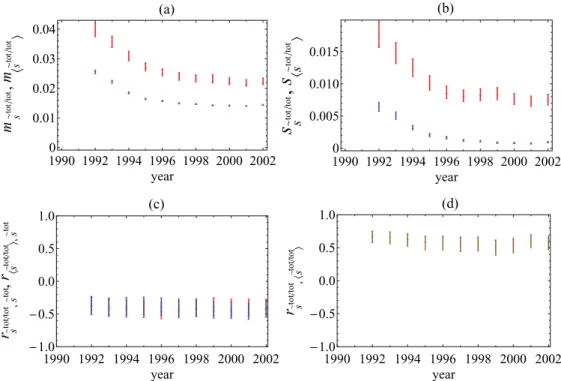
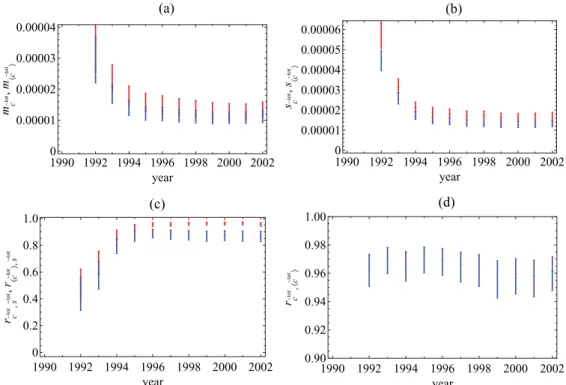
In Figs. 13–16 we show the temporal evolution of the
structural properties considered. Figure13reports the average,
standard deviation, and correlation coefficients for ˜sitot/totas a
function of time, and Fig. 14 reports (for brevity) only the
average of the four directed variants ˜siin/in, ˜siin/out, ˜sout/ini , ˜siout/out. We find that the detailed description offered by the directed structural properties portrays a different picture with respect
to the undirected results shown in Fig.4. In particular, we find
that the empirical trends are not always decreasing and the randomized trends are not always constant, in contrast with what previously observed for the undirected ANNS. Both the
empirical and randomized values of ˜stot/tot
i [Fig. 13(a)] and
˜
sout/in
i [Fig.14(c)] display decreasing averages, whereas ˜siin/in
[Fig.14(a)] and ˜sin/outi [Fig.14(b)] display constant randomized
values and first increasing, then slightly decreasing empirical values. In addition, ˜siout/out [Fig. 14(d)] displays a different behavior where both real and randomized averages first increase and then decrease. These fine-level differences are all washed away in the undirected description considered in
Sec. II, signaling a loss of information like the one we also
observed in the binary case [1]. However, while in the latter
the null model was always in agreement with the empirical data, here we always observe large deviations. In particular, the averages and standard deviations of all empirical quantities are different from their randomized counterparts, and the analysis of the correlation coefficients confirms that the disassortative behavior of the real network is robust in time, and its intensity is systematically not reproduced by the null model.
Different considerations apply to the evolution of the weighted directed clustering coefficients ˜ctot
i , ˜ciin, ˜ciout, ˜c cyc
i and
˜
cmidi , shown in Figs.15and16. In this case we find that the
undirected trend we observed in Fig.5is still not representative
of the individual trends of the directed coefficients studied here. However, the empirical and randomized values of the latter are found to be closer here than in the undirected case, and to follow similar temporal behaviors. The null model is however only marginally consistent with the real network, and the knowledge of the strength sequences remains of limited informativeness.
E. Commodity-specific weighted directed networks
We finally come to the analysis of disaggregated commodity-specific representations of the weighted directed ITN. We show results for the usual subset of six commodity classes ordered by increasing trade intensity ad level of
105 10 4 0.001 0.01 0.1 1 106
2 106 5 106 1 105 2 105 5 105
sin
c
in ,
c
in
(a)
10 5 10 4 0.001 0.01 0.1 1 10 6
2 10 6 5 10 6 1 10 5 2 10 5 5 10 5 1 10 4
sout
c
out
,
c
out
(b)
10 9 10 7 105 0.001 1 106
2 106 5 106 1 105 2 105 5 105 1 104
sinsout
c
cyc
,
c
cyc
(c)
10 9 107 10 5 0.001 1 10 6
2 10 6 5 10 6 1 10 5 2 10 5 5 10 5 1 10 4
sinsout
c
mid
,
c
mid
(d)
FIG. 12. (Color online) Weighted clustering coefficients versus vertex strengths in the 2002 snapshot of the real weighted directed ITN (red points), and corresponding averages over the null model with specified out-strengths and in-strengths (blue solid curves). (a) ˜cin
i versus ˜sini; (b)
˜ cout
i versus ˜s
out
i ; (c) ˜c
cyc
i versus ˜s
in
i ·s˜
out
i ; (d) ˜c
mid
i versus ˜s
in
i ·s˜
out
1990 1992 1994 1996 1998 2000 2002 0
0.01 0.02 0.03 0.04
year
m
s
tot
tot
,
m
s
tot
tot
(a)
1990 1992 1994 1996 1998 2000 2002 0
0.005 0.010 0.015
year
s
stot
tot
,
s
stot
tot
1990 1992 1994 1996 1998 2000 2002 1.0
0.5 0.0 0.5 1.0
year
r s
tot
tot ,
s
tot,
r s
tot
tot
,
s
tot
1990 1992 1994 1996 1998 2000 2002 1.0
0.5 0.0 0.5 1.0
year
r s
tot
tot ,
s
tot
tot
(b)
(c) (d)
FIG. 13. (Color online) Temporal evolution of the properties of the (rescaled) total average nearest-neighbor strength ˜stot/tot
i in the 1992–2002
snapshots of the real weighted directed ITN and of the corresponding null model with specified out-strengths and in-strengths. (a) Average of ˜
stot/tot
i across all vertices (red, upper symbols: real data; blue, lower symbols: null model). (b) Standard deviation of ˜sitot/totacross all vertices
(red, upper symbols: real data; blue, lower symbols: null model). (c) Correlation coefficient between ˜stot/tot
i and ˜s
tot
i (red: real data; blue: null
model, indistinguishable from real data). (d) Correlation coefficient between ˜stot/tot
i ands˜itot/tot. Vertical bars are 95% confidence intervals.
commodity aggregation, to which we can add the completely aggregated case already discussed (again, we found similar results for all commodities).
Figures17and18report the total average nearest-neighbor
strength and total weighted clustering coefficient as functions of the total strength, for the six selected commodity classes
1990 1992 1994 1996 1998 2000 2002 0
0.002 0.004 0.006 0.008 0.010
year
m s
in
in
,
m
s
in
in
(a)
1990 1992 1994 1996 1998 2000 2002 0
0.002 0.004 0.006 0.008 0.010
year
m s
in
out
,
m
s
in
out
1990 1992 1994 1996 1998 2000 2002 0
0.005 0.010 0.015 0.020 0.025
year
m s
out
in
,
m
s
out
in
1990 1992 1994 1996 1998 2000 2002 0
0.005 0.010 0.015
year
m s
out
out
,
m
s
out
out
(b)
(c) (d)
FIG. 14. (Color online) Averages and their 95% confidence intervals (across all vertices) of the directed average nearest-neighbor strengths in the 1992–2002 snapshots of the real weighted directed ITN (red, upper symbols), and corresponding averages over the maximum-entropy ensemble with specified out-strengths and in-strengths (blue, lower symbols). (a) ˜sin/in
i ; (b) ˜s
in/out
i ; (c) ˜s
out/in
i ; (d) ˜s
out/out
1990 1992 1994 1996 1998 2000 2002 0
0.00001 0.00002 0.00003 0.00004
year
m c
tot
,
m
c
tot
(a)
1990 1992 1994 1996 1998 2000 2002 0
0.00001 0.00002 0.00003 0.00004 0.00005 0.00006
year
s c
tot
,
s c
tot
(b)
1990 1992 1994 1996 1998 2000 2002 0
0.2 0.4 0.6 0.8 1.0
year
r c
tot
,
s
tot
,
r c
tot
,
s
tot
(c)
1990 1992 1994 1996 1998 2000 2002 0.90
0.92 0.94 0.96 0.98 1.00
year
r c
tot
,
c
tot
(d)
FIG. 15. (Color online) Temporal evolution of the properties of the (rescaled) total weighted clustering coefficient ˜ctot
i in the 1992–2002
snapshots of the real weighted directed ITN and of the corresponding null model with specified out-strengths and in-strengths. (a) Average of ˜
ctot
i across all vertices (red, upper symbols: real data; blue, lower symbols: null model). (b) Standard deviation of ˜citotacross all vertices (red,
upper symbols: real data; blue, lower symbols: null model). (c) Correlation coefficient between ˜ctot
i and ˜s
tot
i (red, upper symbols: real data; blue,
lower symbols: null model). (d) Correlation coefficient between ˜ctot
i andc˜toti . The 95% confidence intervals of all quantities are represented
as vertical bars.
in year 2002. The corresponding plots for the aggregated
networks were shown previously in Figs.9 and11. We find
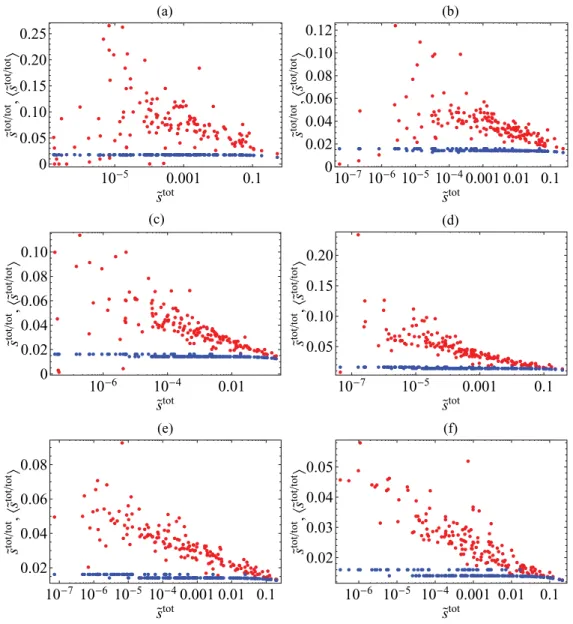
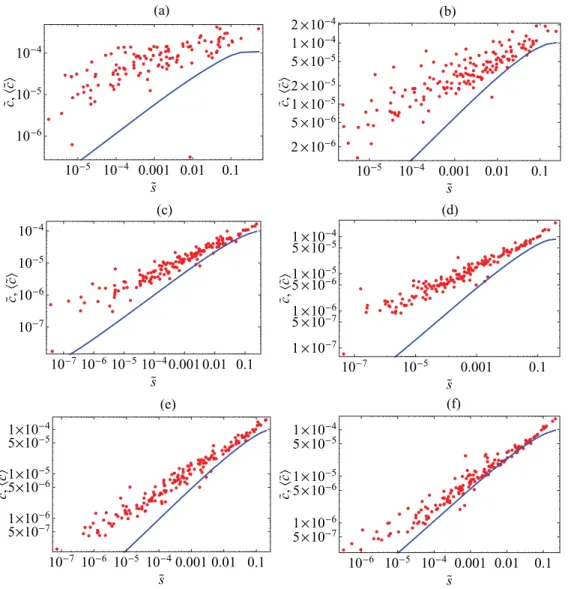
once again that, as more intensely traded commodities and
higher levels of aggregation are considered, the empirical data become less scattered around their average trend. In this case, the same effect holds also for the randomized
1990 1992 1994 1996 1998 2000 2002 0
5 10 6
0.00001 0.000015 0.00002
year
m c
in
,
m
c
in
(a)
1990 1992 1994 1996 1998 2000 2002 0
0.00001 0.00002 0.00003 0.00004 0.00005 0.00006
year
m c
out
,
m
c
out
(b)
1990 1992 1994 1996 1998 2000 2002 0
5 106
0.00001 0.000015 0.00002 0.000025 0.00003 0.000035
year
mc
cyc
,
m
c
cyc
(c)
1990 1992 1994 1996 1998 2000 2002 0
0.00001 0.00002 0.00003 0.00004 0.00005 0.00006 0.00007
year
m c
mid
,
m
c
mid
(d)
FIG. 16. (Color online) Averages and their 95% confidence intervals (across all vertices) of the directed weighted clustering coefficients in the 1992–2002 snapshots of the real weighted directed ITN (red, upper symbols), and corresponding averages over the null model with specified out-strengths and in-strengths (blue, lower symbols). (a) ˜cin
i; (b) ˜c
out
i ; (c) ˜c
cyc
i ; (d) ˜c
mid
10 5 0.001 0.1 0
0.05 0.10 0.15 0.20 0.25
stot
s
tot
tot
,
s
tot
tot
(a)
10 7 10 6 10 5 10 40.001 0.01 0.1 0
0.02 0.04 0.06 0.08 0.10 0.12
stot
s
tot
tot
,
s
tot
tot
(b)
10 6 10 4 0.01
0 0.02 0.04 0.06 0.08 0.10
stot
s
tot
tot
,
s
tot
tot
10 7 10 5 0.001 0.1
0.05 0.10 0.15 0.20
stot
s
tot
tot
,
s
tot
tot
(d)
10 7 10 6 10 5 10 40.001 0.01 0.1 0.02
0.04 0.06 0.08
stot
s
tot
tot
,
s
tot
tot
(e)
10 6 10 5 10 4 0.001 0.01 0.1 0.02
0.03 0.04 0.05
stot
s
tot
tot
,
s
tot
tot
(f) (c)
FIG. 17. (Color online) Total average nearest-neighbor strength ˜stot/tot
i versus total strength ˜s
tot
i in the 2002 snapshots of the
commodity-specific (disaggregated) versions of the real weighted directed ITN (red, upper points), and corresponding average over the maximum-entropy ensemble with specified out-strengths and in-strengths (blue, lower points). (a) Commodity 93; (b) commodity 09; (c) commodity 39; (d) commodity 90; (e) commodity 84; (f) aggregation of the top 14 commodities (see Ref. [1] for details). From (a) to (f), the intensity of trade and level of aggregation increases.
data. As for the weighted undirected case, and unlike the binary representation, there is no agreement between empirical networks and the null model. The accordance becomes even worse as commodity classes with smaller trade volume and lower level of aggregation are considered.
The above results extend to the directed case what we found in the analysis of weighted undirected properties. In particular, unlike the binary case, the knowledge of local properties conveys only limited information about the actual structure of the network. Higher-order properties are not explained by local constraints, and indirect interactions cannot be decomposed to direct ones. This holds irrespective of the commodity aggre-gation level and the particular year considered. This implies that a weighted network approach captures more information than simpler analyses focusing on country-specific local properties. Moreover, simple purely topological properties
such as link density are not reproduced by the null model. This implies that, even in weighted analyses, the binary structure is an important property to explain, because it is responsible of major departures of the empirical network from the null model. Therefore, both binary and weighted analyses highlight, for completely different reasons, the importance of reproducing the ITN topology and devoting it more consideration in models of trade.
IV. CONCLUSIONS
In this paper and in the preceding one [1] we have derived
a series of results about the structure of the ITN and the role that local topological properties have in constraining it. Our
findings area prioriunpredictable without a comparison with
10 5 10 4 0.001 0.01 0.1 10 6
10 5 10 4
s
c
,
c
10 5 10 4 0.001 0.01 0.1 2 10 6
5 10 6 1 10 5 2 10 5 5 10 5 1 10 4 2 10 4
s
c
,
c
10 710 610 510 40.001 0.01 0.1 10 7
10 6 10 5 10 4
s
c
,
c
10 7 10 5 0.001 0.1 1 10 7
5 10 7 1 10 6 5 10 6 1 10 5 5 10 5 1 10 4
s
c
,
c
10 7 10 6 10 5 10 40.001 0.01 0.1 5 10 7
1 10 6 5 10 6 1 10 5 5 10 5 1 10 4
s
c
,
c
10 6 10 5 10 4 0.001 0.01 0.1 5 10 7
1 10 6 5 10 6 1 10 5 5 10 5 1 10 4
s
c
,
c
(a) (b)
(c) (d)
(e) (f)
FIG. 18. (Color online) Total weighted clustering coefficient ˜ctot
i versus total strength ˜s
tot
i in the 2002 snapshots of the commodity-specific
(disaggregated) versions of the real weighted directed ITN (red, upper points), and corresponding average over the maximum-entropy ensemble with specified our-strengths and in-strengths (blue, lower points). (a) Commodity 93; (b) commodity 09; (c) commodity 39; (d) commodity 90; (e) commodity 84; (f) aggregation of the top 14 commodities (see Ref. [1] for details). From (a) to (f) the intensity of trade and level of aggregation increases.
In the binary description (in both the directed and undirected cases), we found that specifying the degree sequence(s) (a first-order topological property) is enough
to explain higher-order properties [1]. This result has two
consequences. First, it implies that all the observed patterns (disassortativity, clustering, etc.) should not be interpreted as genuine higher-order stylized facts and do not require additional explanations besides those accounting for the different specific numbers of trade partners of all countries. Second, it indicates that the degree sequence encodes virtually all the binary information and is therefore a key structural property that economic models of trade should try to explain in detail.
By contrast, in the weighted description (again, both in the directed and undirected cases) specifying the strength
sequence(s) is not enough in order to reproduce the other
properties of the network. Therefore the knowledge of total
trade volumes of all countries is of limited informativeness. A weighted network description of trade, by taking into account indirect interactions besides direct ones, succeeds in conveying additional, nontrivial information with respect to standard economic analyses that explain international trade in terms of local country-specific properties only. In particular, in this case the disassortative character of the network and the high level of clustering cannot be simply traced back to the observed local trade volumes and require additional explanations. Moreover, the purely binary topology of the real trade network is different and sparser (despite the ITN is traditionally considered an unusually dense network) than the one predicted by the null model with the same strength sequence.
Our results bear important consequences for the theory of international trade. The most commonly used modeling