Journal of Athletic Training 2017;52(3):245–255 doi: 10.4085/1062-6050-52.1.13
Óby the National Athletic Trainers’ Association, Inc
www.natajournals.org original research
Evaluation of Nintendo Wii Balance Board as a
Tool for Measuring Postural Stability After
Sport-Related Concussion
Kian Merchant-Borna, MPH, MBA*; Courtney Marie Cora Jones, PhD, MPH*†;
Mattia Janigro*; Erin B. Wasserman, PhD‡; Ross A. Clark, PhD§;
Jeffrey J. Bazarian, MD, MPH*†||
Departments of *Emergency Medicine, †Public Health Sciences, and ||Neurology, Neurosurgery, and Physical Medicine and Rehabilitation, University of Rochester School of Medicine and Dentistry, NY; ‡Matthew Gfeller Sport-Related Traumatic Brain Injury Research Center, Department of Exercise and Sport Science, University of North Carolina at Chapel Hill; §School of Exercise Science, Australian Catholic University, Fitzroy, Victoria
Context: Recent changes to postconcussion guidelines indicate that postural-stability assessment may augment tradi-tional neurocognitive testing when making return-to-participation decisions. The Balance Error Scoring System (BESS) has been proposed as 1 measure of balance assessment. A new, freely available software program to accompany the Nintendo Wii Balance Board (WBB) system has recently been developed but has not been tested in concussed patients.
Objective: To evaluate the feasibility of using the WBB to assess postural stability across 3 time points (baseline and postconcussion days 3 and 7) and to assess concurrent and convergent validity of the WBB with other traditional measures (BESS and Immediate Post-Concussion Assessment and Cog-nitive Test [ImPACT] battery) of assessing concussion recovery.
Design: Cohort study.
Setting: Athletic training room and collegiate sports arena. Patients or Other Participants: We collected preseason baseline data from 403 National Collegiate Athletic Association Division I and III student-athletes participating in contact sports and studied 19 participants (age¼19.26 1.2 years, height¼ 177.768.0 cm, mass¼75.3616.6 kg, time from baseline to day 3 postconcussion¼ 27.1 6 36.6 weeks) who sustained concussions.
Main Outcome Measure(s): We assessed balance using single-legged and double-legged stances for both the BESS and WBB, focusing on the double-legged, eyes-closed stance for the WBB, and used ImPACT to assess neurocognition at 3 time points. Descriptive statistics were used to characterize the sample. Mean differences and Spearman rank correlation coefficients were used to determine differences within and between metrics over the 3 time points. Individual-level changes over time were also assessed graphically.
Results: The WBB demonstrated mean changes between baseline and day 3 postconcussion and between days 3 and 7 postconcussion. It was correlated with the BESS and ImPACT for several measures and identified 2 cases of abnormal balance postconcussion that would not have been identified via the BESS.
Conclusions: When accompanied by the appropriate ana-lytic software, the WBB may be an alternative for assessing postural stability in concussed student-athletes and may provide additional information to that obtained via the BESS and ImPACT. However, verification among independent samples is required.
Key Words: mild traumatic brain injury, athletes, balance, recovery, return-to-play guidelines, neurocognitive testing
Key Points
Using an analytic software program with the Nintendo Wii Balance Board may be an alternative method for assessing balance postconcussion and may provide information to supplement the Balance Error Scoring System and Immediate Post-Concussion Assessment and Cognitive Test.
More research and verification among independent samples is needed to determine whether the Wii Balance Board can be used as a powerful multisetting tool to evaluate balance.
The Nintendo Wii Balance Board had better sensitivity for identifying minor balance problems postconcussion than the error-counting system used by the BESS.
T
he physical and neurocognitive effects of sport-related concussion, such as decreased performance in postural stability, concentration, and recall, are well documented.1,2Premature return-to-sport participationafter concussion has several potential risks, including second-impact syndrome, chronic neurocognitive impair-ment, dementia, and possibly chronic traumatic
symptoms are multifaceted, testing batteries would opti-mally span all aspects of an athlete’s recovery rather than rely on symptoms and cognitive function alone.
In addition to standard assessments of cognition, a test of standing balance to measure impaired vestibular function is now included in return-to-participation guidelines.3,4
Sev-eral sophisticated methods to accurately measure balance are available but impractical for widespread implementa-tion. A key characteristic for an on-site balance-evaluation method is portability. Whereas force-platform postural-stability tests represent the criterion standard for balance assessment, they are not feasible in most sport contexts and are cost prohibitive for many nonprofessional, academic, and high school organizations.
The Balance Error Scoring System (BESS) has been established as a cost-effective alternative to rigorous laboratory balance testing and has been shown to be a useful tool for tracking balance recovery in athletes after concussion.2,5,6 However, despite its practicality and
convenience, it has limitations. Whereas the BESS provides rigorous scoring criteria, the test administrator makes subjective assessments. Researchers7 have found that
certain subcategories of the BESS (eg, single-legged stance on a firm surface) are sufficiently reliable among raters, but the BESS as a whole has displayed poor interrater and intrarater reliability. Investigators8 have also demonstrated
a learning effect after repeated administrations of the BESS. Furthermore, it is most sensitive immediately (within 20 minutes) postconcussion, heightening its appeal as a sideline test but perhaps diminishing its usefulness in subsequent follow-up evaluations to inform return-to-participation decisions.9,10
The Nintendo Wii Balance Board (WBB; Nintendo of America Inc, Redmond, WA) is a portable and relatively inexpensive force platform that, although originally de-signed as part of a video-game console system, can be used as an indirect method to assess postural center of pressure (COP).11 Whereas the BESS relies on discrete error
counting by the test administrator, the WBB tracks COP using internal components similar to laboratory-grade force platforms. The WBB has also demonstrated good to excellent test-retest reliability (intraclass correlation coef-ficient ¼ 0.66–0.94) and excellent concurrent validity (intraclass correlation coefficient¼ 0.77–0.89) compared with a laboratory-grade force platform,11 with nearly
identical COP traces reported.12 In addition, when
com-pared with scientific-grade force plates, the WBB has demonstrated better validity and test-retest reliability than the BESS.13 Thus, the WBB may be a useful tool for
assessing postconcussion balance impairments, given that force platforms have previously shown their utility.11,14
However, few researchers have quantified postconcussion balance symptoms using a WBB,15–17 and no studies have
included prospective data, with preinjury and postconcus-sion balance assessments. Furthermore, given that cognitive testing is widely used in concussion management, we aimed to determine the extent to which the WBB measures provide additional information about concussion recovery that is not captured by cognitive testing. Whereas a biological connection between cognition and postural stability may exist, perhaps via the cerebellum,18 this aim
was motivated more by the practical need to determine whether both tests are necessary to track concussion
recovery. Therefore, the purpose of our study was to evaluate WBB performance for assessing temporal changes in postural stability among concussed student-athletes by comparing balance metrics at 3 time points: preinjury, 3 days postconcussion, and 7 days postconcussion. We compared metrics from the WBB with those from the BESS and symptom reporting and neurocognitive function as measured by the Immediate Post-Concussion Assess-ment and Cognitive Test (ImPACT; ImPACT Applications, Inc, Pittsburgh, PA). We hypothesized that the BESS and WBB would demonstrate changes from baseline to the follow-up time points and positive correlations. We also hypothesized that both balance measures would be correlated with ImPACT but that the magnitude of these correlations would be lower because they measure unique, yet related, constructs of interest. Last, we assessed temporal trends in balance and neurocognition using participant-specific (ie, paired) data.
METHODS
Participants
We performed a prospective study comparing the WBB with the BESS and ImPACT at 2 universities in Rochester, New York, from 2010 to 2013. Over this period, a total of 403 National Collegiate Athletic Association Division I and III student-athletes participating in contact sports (ie, basketball, football, ice hockey, lacrosse, and soccer) were enrolled before the beginning of each respective sport season. Both men and women aged 18 years and older were invited to participate, and we placed no restrictions on race or ethnicity. We excluded individuals who were unable to speak and read English or Spanish because the ImPACT is available in only these languages. Additional exclusion criteria were use of drugs or alcohol on the day of consent or at baseline, pregnancy, or a history of traumatic brain injury (TBI) within 2 weeks before the baseline measures. We documented a history of TBI more than 2 weeks before baseline. Participants did not have concomitant extremity injuries at baseline or any follow-up assessments. All participants provided written informed consent, and the institutional review boards at the University of Rochester and Rochester Institute of Technology approved the study.
Procedures
During the preseason, a comprehensive baseline assess-ment, including the collection of demographic information and a battery of tests to measure balance (BESS and WBB) and symptoms and cognitive function (ImPACT), was performed on all participating athletes. Athletes were followed throughout their sport participation and evaluated for concussion by team certified athletic trainers using a standardized assessment. Players were diagnosed with a sport-related concussion if the following criteria were met2:
raters (K.M.B., J.J.B., and nonauthors) collected the BESS and WBB data at baseline and postconcussion. These individuals were not always the same raters for individual participants preconcussion and postconcussion. All raters were similarly trained in standardized procedures for conducting the assessments.
Balance and Cognition Testing
Balance.We used the BESS and WBB to assess balance. Each BESS assessment consists of 3 stances (double legged, single legged, and tandem) in 2 conditions (firm surface and foam surface) that were performed with the eyes closed for 20 seconds per stance.4 A trained member
of the study staff (K.M.B., J.J.B., and nonauthors) followed the standard procedures for administering the BESS. All stances were observed, and errors were documented.
Each WBB test consisted of 4 stances in the following order: double-legged standing with eyes open, single-legged standing (on the dominant limb) with eyes open, double-legged standing with eyes closed (DLEC), and single-legged standing (on the dominant limb) with eyes closed. Participants indicated their dominant limb. They were instructed to complete the balance assessments without shoes, with or without socks, and with all contents removed from their pockets. Data were collected for 10 seconds during the single-legged–stance trials and for 30 seconds during the double-legged–stance trials, with 15 seconds of rest between trials. For the double-legged stances, the left and right feet were placed on the WBB on the center line of the left third and the center line of the right third, respectively, of the board; for single-legged stances, the foot was placed on 1 of these center lines. During each trial, participants were instructed to keep their hands on their hips and to remain as still as possible for the duration of the trial. Tests were required to be successfully completed (ie, no falling or touching equipment). If a participant could not complete the trial, he or she repeated it until successful for that stance. The WBB was connected to a computer with a Windows operating system (version 7; Microsoft Corporation, Redmond, WA) using Bluetooth technology (version 2.0; Bluetooth SIG, Inc, Kirkland, WA). The same WBB was used across all test sessions. The Wii software calculated the motion of a player’s COP throughout the trial and sampled points from this path at a frequency of 40 Hz per Clark et al.11 The result was a
collection of coordinates specific to each stance, where the x-axis represented the mediolateral (ML) direction and the
y-axis represented the anteroposterior (AP) direction. From these sets of coordinates, the following measures were determined for each stance:
1. Path velocity, which was calculated as the total COP path length divided by the duration of the test. This was analyzed for the total signal and for the AP and ML axes independently.
2. Path amplitude, which was calculated as the farthest difference between coordinates on each of the AP and ML axes independently.
3. Standard deviation (SD), which was calculated as the SD of the COP trace on each of the AP and ML axes independently.
Cognition. The ImPACT provides a well-validated measure of neurocognitive function that can be affected by concussion and includes the following subcomponents: visual and verbal memory, visual motor speed, reaction time, and impulse control. It also measures 22 postconcussive symptoms and provides an overall index of cognitive efficiency based on the scores from all domains.19 We administered ImPACT at baseline and at
days 3 and 7 postconcussion. Athletes were not group tested for the ImPACT but rather were instructed to complete the test on a desktop computer in a quiet room. They were
Table 1. Metrics Analyzed
Immediate Post-Concussion
Assessment and Cognitive Testa Balance Error Scoring System Wii Balance Boardb,c
Verbal memory Double-legged stance on a firm surface log path velocity (overall) Visual memory Single-legged stance on a firm surface log anterior-posterior path velocity Visual-motor speed Tandem stance on a firm surface log anterior-posterior amplitude Reaction time Double-legged stance on foam surface log anterior-posterior SD Impulse control Single-legged stance on foam surface log medial-lateral path velocity Total symptom score Tandem stance on foam surface log medial-lateral amplitude Cognitive efficiency Balance Error Scoring System Total log medial-lateral SD
Abbreviation: SD, standard deviation. aImPACT Applications, Inc, Pittsburgh, PA. bNintendo of America Inc, Redmond, WA. cDouble-legged, eyes-closed stance.
Table 2. Participant Demographics
Characteristic n (%)a
Sex
Female 9 (47)
Male 10 (53)
Race
White 14 (74)
African American 1 (5)
Biracial 2 (11)
Unknown 2 (11)
Sport
Basketball 2 (11)
Football 6 (32)
Ice hockey 3 (16)
Lacrosse 2 (11)
Soccer 6 (32)
History of concussion?
No 13 (68)
Yes 6 (32)
unsupervised by study staff or athletic trainers while completing the test.
Statistical Analysis
Descriptive statistics were used to characterize the study sample. All WBB variables were log transformed due to their positively skewed distribution. Preliminary analysis was performed on the WBB data to focus on the most meaningful variables from a single stance. After evaluating all 4 stances, we found the determinant of the covariance matrix was very small (2.086e-44), suggesting a high level of collinearity among stances. Using pairwise regression of all variables within each of the 4 stances revealed a high correlation among variables. For ease of analysis and interpretation, we limited our analyses to the DLEC stance due to the high level of collinearity among stances and the ease with which this stance is completed relative to the single-legged stances. A total of 21 variables (7 each from the ImPACT, BESS, and WBB) were recorded for each concussed participant at each time postconcussion (Table 1).
Paired t tests were conducted to compare the mean change between times for the WBB, BESS, and ImPACT metrics (baseline to day 3, baseline to day 7, and day 3 to 7). We performed separate t tests because we wanted to explore the temporal pattern; this enabled us to discuss trends in balance performance over time. To explore similarities among the BESS, WBB, and ImPACT, we performed Spearman correlations among variables from the
different tests using pairwise correlations of changes in scores from baseline to day 3. We focused on changes from baseline to day 3 because we thought these changes would yield the most meaningful data (difference in score from preconcussion at baseline to the acute postconcussion period when balance problems peak).20–22 We used a
1-sidedalevel of .05 to test the mean differences over the 3 time points and a 2-sidedalevel of .05 for the correlation analyses. We constructed figures to illustrate changes in scores among times. No outliers were removed from analyses. All data analysis was performed using SAS (version 9.3; SAS Institute Inc, Cary, NC).
RESULTS
Of the 403 participants followed, a total of 19 athletes (age¼19.261.2 years, height¼177.768.0 cm, mass¼
75.3616.6 kg, time from baseline to day 3 postconcussion
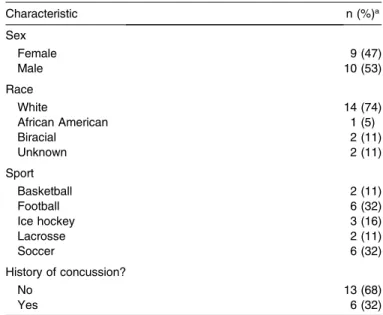
¼27.1 6 36.6 weeks) were concussed and had complete data on the ImPACT, BESS, and WBB at all 3 times. Characteristics of this sample are provided in Table 2.
Mean Changes in Balance Metrics Over Time
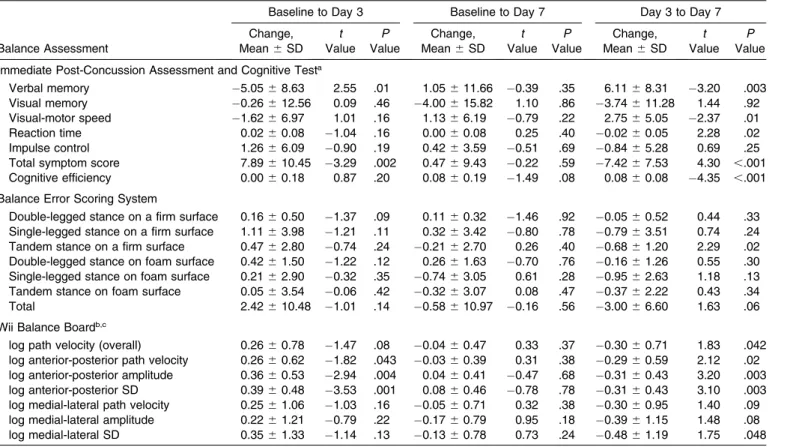
Of the 7 BESS variables examined, only 1 displayed a change postconcussion (Table 3). The number of errors in the tandem stance on a firm surface decreased at day 7 postconcussion compared with day 3 postconcussion (difference ¼ 0.68 6 1.20; P ¼ .02). However, it was not different from baseline to day 3 postconcussion
Table 3. Mean Changes in Balance Assessment Scores and Neurocognition After Concussion
Balance Assessment
Baseline to Day 3 Baseline to Day 7 Day 3 to Day 7
Change, Mean6SD
t Value
P Value
Change, Mean6SD
t Value
P Value
Change, Mean6SD
t Value
P Value
Immediate Post-Concussion Assessment and Cognitive Testa
Verbal memory 5.0568.63 2.55 .01 1.05611.66 0.39 .35 6.1168.31 3.20 .003 Visual memory 0.26612.56 0.09 .46 4.00615.82 1.10 .86 3.74611.28 1.44 .92 Visual-motor speed 1.6266.97 1.01 .16 1.1366.19 0.79 .22 2.7565.05 2.37 .01 Reaction time 0.0260.08 1.04 .16 0.0060.08 0.25 .40 0.0260.05 2.28 .02 Impulse control 1.2666.09 0.90 .19 0.4263.59 0.51 .69 0.8465.28 0.69 .25 Total symptom score 7.89610.45 3.29 .002 0.4769.43 0.22 .59 7.4267.53 4.30 ,.001 Cognitive efficiency 0.0060.18 0.87 .20 0.0860.19 1.49 .08 0.0860.08 4.35 ,.001
Balance Error Scoring System
Double-legged stance on a firm surface 0.1660.50 1.37 .09 0.1160.32 1.46 .92 0.0560.52 0.44 .33 Single-legged stance on a firm surface 1.1163.98 1.21 .11 0.3263.42 0.80 .78 0.7963.51 0.74 .24 Tandem stance on a firm surface 0.4762.80 0.74 .24 0.2162.70 0.26 .40 0.6861.20 2.29 .02 Double-legged stance on foam surface 0.4261.50 1.22 .12 0.2661.63 0.70 .76 0.1661.26 0.55 .30 Single-legged stance on foam surface 0.2162.90 0.32 .35 0.7463.05 0.61 .28 0.9562.63 1.18 .13 Tandem stance on foam surface 0.0563.54 0.06 .42 0.3263.07 0.08 .47 0.3762.22 0.43 .34 Total 2.42610.48 1.01 .14 0.58610.97 0.16 .56 3.0066.60 1.63 .06
Wii Balance Boardb,c
log path velocity (overall) 0.2660.78 1.47 .08 0.0460.47 0.33 .37 0.3060.71 1.83 .042 log anterior-posterior path velocity 0.2660.62 1.82 .043 0.0360.39 0.31 .38 0.2960.59 2.12 .02 log anterior-posterior amplitude 0.3660.53 2.94 .004 0.0460.41 0.47 .68 0.3160.43 3.20 .003 log anterior-posterior SD 0.3960.48 3.53 .001 0.0860.46 0.78 .78 0.3160.43 3.10 .003 log medial-lateral path velocity 0.2561.06 1.03 .16 0.0560.71 0.32 .38 0.3060.95 1.40 .09 log medial-lateral amplitude 0.2261.21 0.79 .22 0.1760.79 0.95 .18 0.3961.15 1.48 .08 log medial-lateral SD 0.3561.33 1.14 .13 0.1360.78 0.73 .24 0.4861.19 1.75 .048
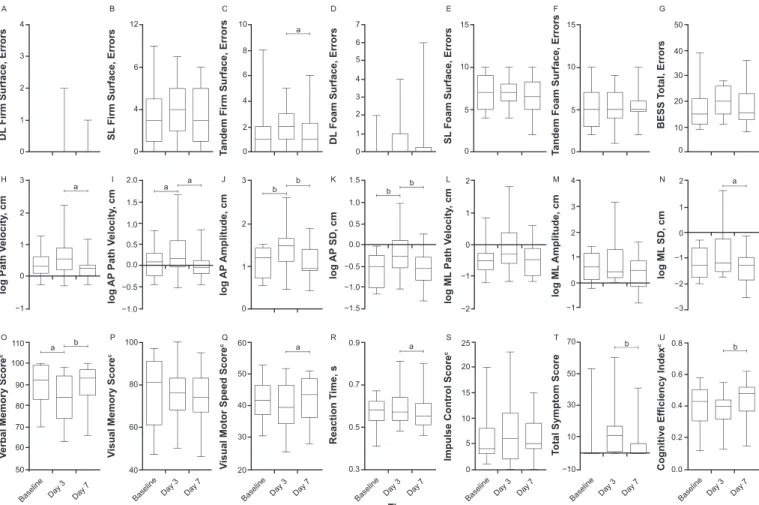
(difference¼0.4762.80;P¼.24) or from baseline to day 7 postconcussion (difference¼0.2162.70;P¼.40). The aggregate results of each test and the corresponding percentiles are presented using box-and-whisker plots in Figure 1.
Five of the 7 WBB variables examined had a change at one or more of the time comparisons. Three of the 7 WBB variables had increases (deficits) from baseline to day 3 postconcussion (Table 3). The AP amplitude (difference¼
0.3660.53;P¼.004), AP SD (difference¼0.39 60.48;
P¼.001), and AP path velocity (difference¼0.2660.62;
P¼ .043) were greater at day 3 postconcussion than at baseline. In addition, 5 WBB variables displayed mean decreases (improvements) between days 3 and 7 post-concussion. None of the WBB variables displayed a change from baseline to day 7 postconcussion (Table 3). These findings are presented using box-and-whisker plots (Figure 1).
Correlation of Balance Measures With ImPACT
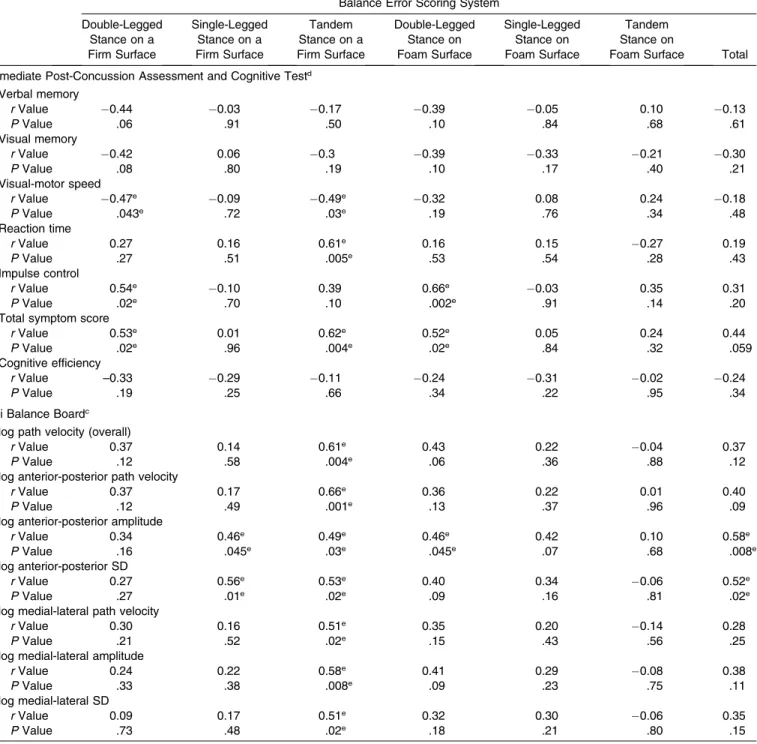
We found several correlations (P,.05) from baseline to day 3 postconcussion changes in the BESS and ImPACT (Table 4). A negative correlation was observed between double-legged stance on a firm surface and visual-motor
speed (R¼0.47,P¼.043), and a positive correlation was observed between impulse control (R¼0.54,P¼.02) and total symptom score (R¼.53,P¼.02). In addition, tandem stance on a firm surface had a negative correlation with visual-motor speed (R ¼ 0.49, P¼ .03) and a positive correlation with reaction time (R¼0.61,P¼.005) and total symptom score (R¼0.62, P¼.004). The double-legged stance on a foam surface was positively correlated with both impulse control (R ¼ 0.66, P ¼ .002) and total symptom score (R¼0.52, P¼.02). This information is presented in Table 4, where results of the correlation analysis are plotted for each combination of variables from the ImPACT and BESS.
Multiple correlations (P , .05) were observed from baseline to day 3 postconcussion changes in WBB and ImPACT (Table 4). In particular, 6 of the 7 WBB variables had positive correlations with reaction time, and 4 were negatively correlated with verbal memory.
Comparison of Balance Metrics
We observed several correlations (P,.05) from baseline to day 3 postconcussion changes in the BESS and WBB (Table 4). A positive correlation was found between tandem stance on a firm surface and all 7 WBB variables.
Figure 1. Mean changes in metrics over time. A–G, Balance Error Scoring System (BESS). H–N, Wii Balance Board (Nintendo of America Inc, Redmond, WA). O–U, Immediate Post-Concussion Assessment and Cognitive Test (ImPACT Applications, Inc, Pittsburgh, PA). Boxes represent the 25th to 75th percentiles, and the midline represents the median values. Whiskers represent the minimum and maximum values.aDifferent from matched pairedttests (P,.05).bDifferent from matched pairedttests (P,.01).cIndicates variables for which
In addition, single-legged stance on a firm surface and the BESS total were both positively correlated with 2 of the 7 WBB variables. The individual-level longitudinal changes for each measure (ImPACT, BESS, and WBB) are shown in Figure 2. The WBB displayed the biggest decrease in performance (black) from baseline to day 3 postconcussion and the best improvement in performance (blue) from days 3 to 7 postconcussion. Changes from baseline to day 3
postconcussion that were greater than 1 SD from the mean were more frequent with the WBB than the BESS. Assuming that a change greater than 1 SD indicated a meaningful change in balance, the WBB identified 1 athlete (participant 12) at day 3 postconcussion as having greater than 1-SD change from baseline, but the BESS and ImPACT did not. Similarly, at day 7 postconcussion, the WBB identified a different athlete (participant 5) who
Table 4. Correlationaof Changes in Assessment Scores From Baseline to Day 3 Postconcussion for Balance and Neurocognition Metrics
Extended on Next Page
Balance Error Scoring System
Double-Legged Stance on a Firm Surface
Single-Legged Stance on a Firm Surface
Tandem Stance on a Firm Surface
Double-Legged Stance on Foam Surface
Single-Legged Stance on Foam Surface
Tandem Stance on
Foam Surface Total
Immediate Post-Concussion Assessment and Cognitive Testd Verbal memory
rValue 0.44 0.03 0.17 0.39 0.05 0.10 0.13
PValue .06 .91 .50 .10 .84 .68 .61
Visual memory
rValue 0.42 0.06 0.3 0.39 0.33 0.21 0.30
PValue .08 .80 .19 .10 .17 .40 .21
Visual-motor speed
rValue 0.47e 0.09 0.49e 0.32 0.08 0.24 0.18 PValue .043e .72 .03e .19 .76 .34 .48 Reaction time
rValue 0.27 0.16 0.61e 0.16 0.15 0.27 0.19
PValue .27 .51 .005e .53 .54 .28 .43
Impulse control
rValue 0.54e 0.10 0.39 0.66e 0.03 0.35 0.31 PValue .02e .70 .10 .002e .91 .14 .20 Total symptom score
rValue 0.53e 0.01 0.62e 0.52e 0.05 0.24 0.44 PValue .02e .96 .004e .02e .84 .32 .059 Cognitive efficiency
rValue –0.33 0.29 0.11 0.24 0.31 0.02 0.24
PValue .19 .25 .66 .34 .22 .95 .34
Wii Balance Boardc log path velocity (overall)
rValue 0.37 0.14 0.61e 0.43 0.22 0.04 0.37
PValue .12 .58 .004e .06 .36 .88 .12
log anterior-posterior path velocity
rValue 0.37 0.17 0.66e 0.36 0.22 0.01 0.40
PValue .12 .49 .001e .13 .37 .96 .09
log anterior-posterior amplitude
rValue 0.34 0.46e 0.49e 0.46e 0.42 0.10 0.58e PValue .16 .045e .03e .045e .07 .68 .008e log anterior-posterior SD
rValue 0.27 0.56e 0.53e 0.40 0.34 0.06 0.52e PValue .27 .01e .02e .09 .16 .81 .02e log medial-lateral path velocity
rValue 0.30 0.16 0.51e 0.35 0.20 0.14 0.28
PValue .21 .52 .02e .15 .43 .56 .25
log medial-lateral amplitude
rValue 0.24 0.22 0.58e 0.41 0.29 0.08 0.38
PValue .33 .38 .008e .09 .23 .75 .11
log medial-lateral SD
rValue 0.09 0.17 0.51e 0.32 0.30 0.06 0.35
PValue .73 .48 .02e .18 .21 .80 .15
Abbreviation: SD, standard deviation.
arValues were calculated using Spearman correlations. bNintendo of America Inc, Redmond, WA.
cDouble-legged stance with eyes closed. dImPACT Applications, Inc, Pittsburgh, PA.
would not have been identified using either the BESS or ImPACT.
DISCUSSION
Valid outcome measures are critical to tracking athletes’ recoveries postconcussion. Return-to-participation proto-cols rely on objective methods to monitor sequelae, including balance and neurocognitive deficiencies. Of the methods we analyzed, ImPACT and BESS have been established as viable tests to assess postconcussion recovery.23–25 However, our findings suggested that
post-concussion, testing the DLEC stance on the WBB with analytic balance software may be an alternative to the BESS for assessing postural stability and may provide information to supplement the neurocognitive information provided by ImPACT. Furthermore, the WBB may be more sensitive than the BESS to postconcussion changes in balance.
Given the limited opportunity for extensive postconcus-sive evaluations under realistic conditions, the balance test must be used in addition to the currently administered cognitive testing to provide unique information about postconcussion recovery. Researchers3,26 have shown that,
after a concussion, the clinical values of postural stability and neurocognitive function are not necessarily synony-mous. For example, not every participant presenting with neurocognitive dysfunction displays balance problems and vice versa. Furthermore, the recoveries in each of these domains may follow separate timelines.6 Therefore, the
purpose of balance evaluation in this context is not to confirm incomplete concussion recovery detected via neurocognitive testing but rather to augment cognitive testing and identify athletes with subtle deficits in postural
stability who otherwise might have received clearance to return to participation based on cognitive testing alone.
The BESS was designed as a low-cost, pragmatic alternative to the laboratory-grade force platform. Re-searchers3–5,15,27 have demonstrated an adequate
relation-ship between BESS scores and true balance results from a force platform. However, the BESS involves a level of subjectivity from the test administrator who is counting an athlete’s errors. Depending on the administrator’s atten-tiveness, the test may acquire a bias from undercounting or overcounting of errors. In addition, some errors are difficult to measure in the testing environment (eg, moving the hip into more than 308of flexion or abduction). Given that the WBB measures COP similarly to laboratory-grade equip-ment, it reduces the potential for human error. In addition, the time burden associated with the WBB is comparable with that of the BESS: double-legged stances each take 30 seconds and single-legged stances each take 10 seconds to complete. To improve the efficiency of a sideline assessment, our findings indicated that only 1 assessment (DLEC) using the WBB may be required, given that strong associations exist among the different testing conditions. Another benefit of a WBB-based system is the potential for widespread applicability. Software designed by an author of this paper (R.A.C.) provides the outcome measures reported in this study and is available to download (http://www. instrumentedmovement.com) for free; at the time of writing, a new WBB and a Windows tablet, which will interface the software with the WBB, can be purchased for less than $50 and less than $100, respectively. Taken together, our results indicate that, when accompanied by the appropriate analytic software, the WBB is feasible for use in the student-athlete setting to assess postural stability at baseline and postconcussion and may be more sensitive
Table 4. Extended From Previous Page
Wii Balance Boardb,c
log Path Velocity
log Anterior-Posterior
Path Velocity
log Anterior-Posterior
Amplitude
log Anterior-Posterior
SD
log Medial-Lateral
Path Velocity
log Medial-Lateral
Amplitude
log Medial-Lateral
SD
0.52e 0.45 0.52e 0.52e 0.56e 0.36 0.23
.02e .051 .02e .02e .01e .13 .34
0.45 0.39 0.29 0.32 0.44 0.40 0.35
.052 .10 .23 .18 .057 .09 .14
0.55e 0.54e 0.29 0.40 0.54e 0.42 0.39
.02e .02e .23 .09 .02e .08 .10
0.50e 0.50e 0.33 0.54e 0.53e 0.52e 0.49e .03e .03e .17 .02e .02e .02e .03e
0.02 0.07 0.04 0.05 0.07 0.00 0.04
.93 .79 .87 .84 .78 ..99 .86
0.41 0.40 0.22 0.25 0.30 0.36 0.33
.08 .09 .38 .32 .22 .14 .17
0.34 0.28 0.32 0.34 0.44 0.35 0.32
than the BESS to postconcussion changes in balance. In addition, whereas all WBB measures were correlated with at least 1 of 3 ImPACT scores (verbal memory, visual-motor speed, reaction time), the WBB would not be a useful substitute for the ImPACT but rather would be a helpful addition to neurocognitive testing, because these tests appear to be measuring different domains of concussion recovery. Whether a biologic connection exists between neurocognitive domains and balance variables that are correlated should be investigated. The injured brain areas responsible for post-TBI deficits in cognition and balance have not been clearly elucidated. These deficits may be due to widely dispersed axonal injury affecting multiple white-matter tracks involved in cognition and balance or, as some have suggested, injury to 1 area, such as the cerebellum, that is potentially involved in both activities. Correlation of cognitive and balance deficits with structural and functional brain imaging may provide insight into the biologic underpinnings of these postconcussive deficits.
Our results consistently showed that the WBB may be a useful method of assessing postural stability postconcus-sion. In all our analyses, the direction of the effect was consistent with our expectations. For example, we observed a deficit in the mean performance on each metric from baseline to day 3 postconcussion and an improvement from days 3 to 7 postconcussion. Thus, the WBB may be sensitive enough to measure a deficit in balance perfor-mance in the days immediately postconcussion and recovery from days 3 to 7 postconcussion. However, a limitation of our study was the lack of a criterion standard to assess balance. As such, the WBB possibly did not identify lingering balance impairments that would have been identified by a criterion-standard platform. Research-ers13have compared the WBB with a criterion standard and
found high agreement, but they did not assess the ability to detect temporal changes. In our data, the AP axis was the most sensitive to differences across time, and this finding was not surprising because this is the plane in which the most movement is expected during the inverted-pendulum balance-control mechanism associated with double-legged stance.28In addition, this plane has also been shown to be
sensitive to time postconcussion in a pediatric hospital setting.17
A similar pattern emerged on the individual level. Whereas the BESS and ImPACT were also sensitive to changes in balance and neurocognition, respectively, across the 3 time points, our individual-level analysis (Figure 2) showed that, at day 3 postconcussion, the WBB classified 1 athlete (participant 12) as nonrecovered who would have been classified as recovered by the BESS and ImPACT. Furthermore, at day 7 postconcussion, the WBB identified a different athlete (participant 5) as nonrecovered who would have been classified as recovered by the BESS and ImPACT. This observation indicated that the WBB may be more useful in return-to-participation decisions than the BESS or ImPACT. Conversely, it may also mean that these athletes were incorrectly identified as having concussion-related balance impairments by the WBB. However, the risk of obtaining false-positives (ie, being overly cautious with return to participation) must be considered in the context of the potentially severe long-term effects of an
early return to participation in contact sports postconcus-sion.
Overall, using the WBB and accompanying software during the DLEC stance demonstrated the ability to identify balance changes over time. These findings may indicate that the WBB has improved sensitivity to identify minor balance deficits relative to the error-counting system used by the BESS or may offer a more objective balance assessment with less chance of human error than is available with the BESS, which relies on a test adminis-trator. Our results cannot discern between these 2 hypotheses, and this is an area in which future research is warranted. Nevertheless, our findings suggested that the WBB may be a useful balance measure.
Our study had limitations. An obvious limitation was the lack of a comparison with a criterion-standard balance platform. However, our results combined with previous research indicated that the WBB may be an alternative to traditional balance platforms and may improve on other balance-assessment methods. Furthermore, we demonstrat-ed that the WBB provides additional data for the assessment of temporal changes in balance postconcussion. Another limitation was our relatively small sample size, which limited our ability to conduct stratified analyses. To reduce the confounding effect of interindividual variations in balance and cognition, we compared these metric changes in individual athletes preconcussion and postcon-cussion. This longitudinal study design necessitated obtaining baseline assessments on hundreds of athletes and following them prospectively for concussion develop-ment. The typical concussion rate is about 4% to 5% per year, which we observed (19/403, 4.7% players concussed). Thus, in light of this study’s unique design, the small sample size likely did not indicate a selection bias or other threat to internal validity. The lack of a nonconcussed control group was also a limitation; however, a substantial strength was our preinjury baseline data on all participants as well as 2 postconcussion data-collection periods. Despite the small sample size and lack of control group, compelling evidence illustrated a consistent response among the injured participants in our sample in WBB performance postcon-cussion. The patterns of results from baseline to day 3 postconcussion showed a trend toward worse balance, and when comparing days 3 and 7 postconcussion, we observed the opposite effect, indicating changing balance symptoms over time. Given the small sample size, we were unable to assess differences in performance on the basis of participant characteristics. Nevertheless, this lack of adjustment for participant characteristics was consistent across the BESS, WBB, and ImPACT, and we do not suspect that performance of any 1 test would be influenced by such characteristics. In addition, our data were collected from 2 universities, and so the generalizability of our findings may be limited. However, our participants included a diverse sample of student-athletes from various sports.
experimenter bias. In addition, the interval from baseline to postconcussion testing, ranging from several weeks to 18 months, varied substantially and potentially affected our results. A practice effect has been demonstrated for repeat BESS testing, which may be related to the interval of time between tests. Broglio et al29showed a practice effect when
the BESS was repeated in uninjured athletes at 50 days; scores improved by about 4 points. Given that other intertest time intervals were not examined, it is unclear whether the magnitude of this practice effect would have been different with intertest intervals shorter or longer than 50 days.29 We do not believe this test-interval variation
influenced our findings, given that the postconcussion balance assessments were conducted concurrently. As such, the time between baseline and postconcussion assessments was the same for the WBB, BESS, and ImPACT.
Furthermore, we assessed only 1 WBB stance. Therefore, our results are limited to the DLEC, but other WBB stances may yield important information. This is an area in which future research is warranted.
Our balance-testing study protocol may not reflect the environmental conditions in which testing is typically performed. We did not conduct testing immediately postconcussion or on the sideline of an athletic field. All assessments were performed in an athletic training facility or a laboratory where the surface was a tiled floor (not turf) and few distractions were present. Onate et al30
demonstrated that BESS testing performed on uninjured athletes on the sideline of an athletic field was impaired when compared with testing conducted several days later in a clinic setting. This suggests that BESS testing should be conducted in the setting or environment in which testing after injury will most likely be performed. We did not make a similar comparison using the WBB, so it is unclear if this same environmental effect occurs. More-over, in our experience, athletes suspected of having concussions are typically moved from the sideline to the locker room or athletic training facility for concussion assessment, such as the Sport Concussion Assessment Tool, in a distraction-free environment. Nevertheless, making this comparison for the WBB would be a fruitful avenue for future research.
CONCLUSIONS
Balance testing has been incorporated into postconcus-sion assessments and can bolster the results of traditional neurocognitive tests. Our findings indicated that using an analytic software program based on the WBB data is a potential alternative method for assessing balance post-concussion and may provide supplemental information to that from the BESS and ImPACT. The potential of the WBB as a powerful multisetting balance evaluation tool warrants further research and verification in independent samples.
REFERENCES
1. Broglio SP, Puetz TW. The effect of sport concussion on neurocognitive function, self-report symptoms and postural control: a meta-analysis.Sports Med. 2008;38(1):53–67.
2. McCrory P, Meeuwisse W, Johnston K, et al. Consensus statement on concussion in sport: the Third International Conference on
Concussion in Sport held in Zurich, November 2008. Phys Sportsmed. 2009;37(2):141–159.
3. Guskiewicz KM. Postural stability assessment following concussion: one piece of the puzzle.Clin J Sport Med. 2001;11(3):182–189. 4. Guskiewicz KM, Ross SE, Marshall SW. Postural stability and
neuropsychological deficits after concussion in collegiate athletes.J Athl Train. 2001;36(3):263–273.
5. Riemann BL, Guskiewicz KM. Effects of mild head injury on postural stability as measured through clinical balance testing.J Athl Train. 2000;35(1):19–25.
6. McCrea M, Guskiewicz KM, Marshall SW, et al. Acute effects and recovery time following concussion in collegiate football players: the NCAA Concussion Study.JAMA. 2003;290(19):2556–2563. 7. Finnoff JT, Peterson VJ, Hollman JH, Smith J. Intrarater and
interrater reliability of the Balance Error Scoring System (BESS). PM R. 2009;1(1):50–54.
8. Valovich TC, Perrin DH, Gansneder BM. Repeat administration elicits a practice effect with the Balance Error Scoring System but not with the Standardized Assessment of Concussion in high school athletes.J Athl Train. 2003;38(1):51–56.
9. McCrea M, Barr WB, Guskiewicz K, et al. Standard regression-based methods for measuring recovery after sport-related concussion.J Int Neuropsychol Soc. 2005;11(1):58–69.
10. Susco TM, Valovich McLeod TC, Gansneder GM, Shultz SJ. Balance recovers within 20 minutes after exertion as measured by the Balance Error Scoring System.J Athl Train. 2004;39(3):241–246. 11. Clark RA, Bryant AL, Pua Y, McCrory P, Bennell K, Hunt M.
Validity and reliability of the Nintendo Wii Balance Board for assessment of standing balance.Gait Posture. 2010;31(3):307–310. 12. Huurnink A, Fransz DP, Kingma I, van Dieen JH. Comparison of a
laboratory grade force platform with a Nintendo Wii Balance Board on measurement of postural control in single-leg stance balance tasks.J Biomech. 2013;46(7):1392–1395.
13. Chang JO, Levy SS, Seay SW, Goble DJ. An alternative to the Balance Error Scoring System: using a low-cost balance board to improve the validity/reliability of sports-related concussion balance testing.Clin J Sport Med. 2014;24(3):256–262.
14. Clark RA, Vernon S, Mentiplay BF, et al. Instrumenting gait assessment using the Kinect in people living with stroke: reliability and association with balance tests.J Neuroeng Rehabil. 2015;12:15. 15. Murray N, Salvatore A, Powell D, Reed-Jones R. Reliability and validity evidence of multiple balance assessments in athletes with a concussion.J Athl Train. 2014;49(4):540–549.
16. Rhine T, Byczkowski TL, Clark RA, Babcock L. Investigating the feasibility and utility of bedside balance technology acutely after pediatric concussion: a pilot study. Clin J Sport Med. 2016;26(3): 221–225.
17. Rhine T, Quatman-Yates C, Clark RA. A longitudinal examination of postural impairments in children with mild traumatic brain injury: implications for acute testing [published online November 17, 2015]. J Head Trauma Rehabil. doi: 10.1097/HTR.0000000000000192. 18. Baillieux H, De Smet HJ, Paquier PF, Deeyn PP, Marien P.
Cerebellar neurocognition: insights into the bottom of the brain.Clin Neurol Neurosurg. 2008;110(8):763–773.
19. Maas AI, Murray GD, Roozenbeek B, et al. Advancing care for traumatic brain injury: findings from the ImPACT studies and perspectives on future research. Lancet Neurol. 2013;12(12):1200– 1210.
21. Asplund CA, McKeag DB, Olsen CH. Sport-related concussion: factors associated with prolonged return to play.Clin J Sport Med. 2004;14(6):339–343.
22. Ponsford J, Willmott C, Rothwell A, et al. Factors influencing outcome following mild traumatic brain injury in adults. J Int Neuropsychol Soc. 2000;6(5):568–579.
23. Henry LC, Sandel N. Adolescent subtest norms for the ImPACT neurocognitive battery. Appl Neuropsychol Child. 2015;4(4):266– 276.
24. Kerr ZY, Snook EM, Lynall RC, et al. Concussion-related protocols and preparticipation assessments used for incoming student-athletes in National Collegiate Athletic Association member institutions. J Athl Train. 2015;50(11):1174–1181.
25. Bell DR, Guskiewicz KM, Clark MA, Padua DA. Systematic review of the Balance Error Scoring System.Sports Health. 2011;3(3):287– 295.
26. Parker TM, Osternig LR, van Donkelaar P, Chou LS. Recovery of cognitive and dynamic motor function following concussion. Br J Sports Med. 2007;41(12):868–873.
27. Valovich McLeod TC, Barr WB, McCrea M, Guskiewicz KM. Psychometric and measurement properties of concussion assessment tools in youth sports.J Athl Train. 2006;41(4):399–408.
28. Winter DA. Human balance and posture control during standing and walking.Gait Posture. 1995;3(4):193–214.
29. Broglio SP, Zhu W, Sopiarz K, Park Y. Generalizability theory analysis of Balance Error Scoring System reliability in healthy young adults.J Athl Train. 2009;44(5):497–502.
30. Onate JA, Beck BC, Van Lunen BL. On-field testing environment and balance error scoring system performance during preseason screening of healthy collegiate baseball players.J Athl Train. 2007; 42(4):446–451.