i
WHAT HAPPENS AFTER CONCEDING:
THREE-STATE EXTENDED NUCLEAR
DETERRENCE
D.M. Vossenberg
BSc Political Science: International Relations and Organisations Bachelor thesis on Nuclear Deterrence Theory
Tutor: dr. H. Pellikaan
ii In contemporary international relations, states attempt both direct and
3 CONTENTS
Introduction ... 1
Deterrence in international relations ... 2
Nuclear deterrence theory ... 3
Rationality ... 4
Quackenbush’s extended deterrence game ... 5
Premises for nuclear deterrence ... 5
Two state nuclear deterrence game ... 7
Three-state nuclear deterrence game ... 7
Methodology ... 9
Case 1 – nominal nuclear deterrence ... 9
Case 2 – nonviolent protégé... 11
Analysis of the cases ... 12
Analysis questions ... 12
Analysis – nominal deterrence case ... 12
Analysis – nonviolent protégé case ... 14
Results of the analysis ... 17
Conclusion ... 17
Discussion ... 18
References ... 20
4 LIST OF FIGURES
Figure 1: Quackenbush’s model adapted version ... 6
Figure 2: Two state nuclear deterrence model ... 7
Figure 3: Original nuclear deterrence model ... 8
Figure 4: Quackenbush’s game – Protégé attacked case 1 ... 13
Figure 5: Quackenbush’s game – defender attacked case 1 ... 13
Figure 6: Original game – Protégé attacked case 1 ... 14
Figure 7 Original game – defender attacked case 1 ... 14
Figure 8: Quackenbush’s game – protégé attacked case 2 ... 15
Figure 9: Quackenbush’s game – defender attacked case 2 ... 15
Figure 10: Original model – Protégé attacked case 2 ... 16
5
INTRODUCTION
In the international political spectrum there is the prevailing view that the amount of nuclear warheads in
the world should be structurally reduced in order to reduce the chances of a nuclear conflict. There has
been a global paradigm shift from the traditional necessity for nuclear weapons as a requirement for
nuclear deterrence to the contemporary multipolar world in which there is a demand for the reduction of
the amount of warheads (UN General Assembly, 2016). One of the significant factors in this is the greatly
increased amount of nuclear powers. This horizontal expansion has led to a total of nine nuclear powers:
the United States, Russia, China, the United Kingdom, France, Israel, India, Pakistan and North Korea
(Van der Meer, 2016). More states than these nine have made an effort to build their own nuclear arsenal,
yet have either failed or lost the ambition to do so. This reality that not every state has nuclear capabilities
causes nuclear deterrence to be divided into two types (Morgan, 1983; Huth 1988).
These types are direct and extended deterrence. This causes nuclear deterrence to have two
features. It deters a challenger from challenging the defender. The other utility is that it grants the ability to
deter a challenger from challenging a third state, such as an ally. An evident example of the coexistence of
the two has been the conflict between the United States and the Soviet Union during the Cold War. The
United States had the objective to not only prevent itself from being struck, but also saw it as vital to deter
any attacks on its NATO allies in Europe (Pellikaan, 2017). This example also shows that direct deterrence
and extended deterrence are equal in its usage. Evidently, they are not in terms of their impact.
Several scholars have attempted to model the abovementioned events into models. Quackenbush
came with the extended-deterrence game involving three actors in 2006. However, Quackenbush’s
extended deterrence game does not allow for a retaliation by a third state after the struck state has
conceded (2006). The newly constructed ‘original nuclear deterrence game’ does allow for this reaction.
The difference between these games is, thus, that the original game has integrated the possibility for a third
state to retaliate, even if the protégé is not willing to do it itself. This, in turn, could lead to a better
understanding of extended nuclear deterrence on a game theoretical level. The proposition is that Quackenbush’s model does not allow for the retaliation of third safeguarding states if the defender
immediately concedes.
Due to the great importance of nuclear deterrence for the sake of the entire world, it is vital that
there is a grounded understanding of it within the fields of international relations and game theory. In order
to perfect the model of Quackenbush it is important to expose its flaws (2006). The research question is
therefore: ‘How does the strategic interaction of the challenger change in nuclear deterrence when a
retaliation by the defender is allowed after the concession of the protégé?’ The aim of this thesis is to
determine the difference in the outcomes of nuclear deterrence between two nuclear deterrence games.
The structure of the thesis is as follows. Firstly, the important contemporary literature is
elaborated upon. The relevant subjects vary from the grand theories up to the usage of game theory as a
method of analysis. After this, the concepts that are utilised are explained in detail. Moreover, the new
concepts of nuclear collateral damage, the safeguarding state and the, original, three-state nuclear
6 backwards induction can determine the outcome of the nuclear deterrence games. Moreover, the case
selection and analysed cases are elaborated upon in order to demonstrate their motives and preference
orderings. Next in order is the analysis of the cases. The three aforementioned cases are exposed to the two
nuclear deterrence games. Finally, the conclusion and discussion are drawn up.
DETERRENCE IN INTERNATIONAL RELATIONS
Waltz and Mearsheimer recognize in their works that states act within the structure of several concepts
with the grand theory of neorealism (1979; 2001). These being self-defence, rationality, relative gains and
the security dilemma. The premises behind these behaviour-explaining concepts is that states are
inherently in constant conflict and act in a world of anarchy. There is no single supranational organ that
rules over all. Oneof the key features of neorealism is the assumption that states act rationally. The concept
of rationality is a vast component of game theory.
The theory of deterrence has been extensively investigated in the past (Pellikaan, 2017). It is
widely researched in international relations theory (Lebow and Stein, 1995; Huth, 1988; Stein 1987). The
aforementioned articles are all focussed on conventional deterrence with two actors: a challenger and a
defender. In the past, scholars included only the challenger and the defender in their models. Werner
follows the nominal route as she encompasses only the two actors in her model (2000). This results in a
model that puts an emphasis on the available choices of the target. However, by ignoring the environment
in which the defender exists she neglects the role of the defender in the strategic calculation of the
challenger.
Kilgour and Zagare include the “the role of the pawn in extended deterrence” (1994). However,
the scholars do not include this as an actual actor in their model. This evidently leads to a different
outcome than when the pawn or protégé is included. The addition of the third actor in the game is the vast
difference between all the aforementioned models and the models of Quackenbush and the newly
presented model in this research.
Quackenbush himself includes three actors in his model: the challenger, defender and protégé.
According to Quackenbush his model provides three benefits. Firstly, it grants a formal model of extended
deterrence that is in line with the rationale behind extended deterrence. Next to this, it complies with the
argument that extended and direct deterrence are administered simultaneously by the actors (Snyder,
1961). On a third note, it includes all three actors. Unlike Kilgour and Zagare’s model it allows for the
analysis of whom the challenger should strike first. This issue has seldom been addressed in literature
before.
Powell has researched the concern whom the challenger should strike in a model with aligned
decisions (1999). He concludes that the challenger attacks the larger state. The third state will then
‘bandwagon’ with the challenger. This splits the alliance. Powel uses the premise that every strike turns
into a full-blown war. Realistically, states can concede or compel the challenger to back down after a first
strike has been performed. The model that is introduced and Quackenbush’s model allow for the struck
actor to concede.
7 He came to the conclusion that the challenger should attack the strongest ally. This would be the defender.
One of his premises, however, is that the fighting will take place on the territory of the attacked. This
premise, however, is too restrictive for a nuclear deterrence model. There would be no fighting at all, as a
nuclear strike should demobilize the army of the struck state. Moreover, it would be useless for the third
actor to send its reinforcements to the struck territory, as there are no opposing forces present.
Zagare and Kilgour have used game theoretical analyses by use of their extended-deterrence game
to give insights into the British policymaking in the countdown to World War 1 (2006). The
extended-deterrence game is closely related to the three-state nuclear extended-deterrence game utilised in this research. Moreover, Wu has revised Huth’s similar model of deterrence in order to improve its prediction rate of
successful deterrence (1990; 1988). Game theory has thus proven to be of relevance especially the field of
deterrence theory.
The new model also allows the third state to retaliate in the case of the capitulation of the struck
state. This is also the foundation of this thesis. It is devoted to the construction of a game theoretical model
that allows for the retaliation by the nuclear state, the defender, to retaliate even after the protégé has
conceded.
NUCLEAR DETERRENCE THEORY
What is the sole reason that you do not go over the speed limit on a completely empty road? It is the
deterrence of the possibility of a fine. This occurs between states in a similar manner. Instead of a fine, an
unwanted action ‘D’ by state A can be retaliated by state B. Originally, there were two state actors
involved in deterrence. The first state, state A, is the challenger. It has the intention to attack state B, the
defender, with a first strike. The challenger has to have the intention to gain utility of the attack. This can
range from resourceful territory to prestige for the politicians. The optimal operation would yield the
objective with as little costs as possible, so presumably a quick and effective strike. The defender on the
other hand has the exact opposite objective. It wants to decrease the likelihood of an attack by the
challenger. It would be a strategy to make the challenger struggle as much as possible in his objective. A
long-lasting and costly war could be a turning point in the cost-benefit analysis of the challenger.
The roles of the actors do not change when there is a defender with nuclear capabilities. The
challenger yet has to have an incentive to do a first strike on the defender that will result in more gains than
losses. It is important to note, however, that it is not always the case that the challenger will use their
nuclear weapons as a first strike. The notion of deterrence is fully about the possibility of a retaliation or
strike-back from the defender. The difference now is that a nuclear-capable defender has the capability to
annihilate entire cities of the challenger. This will deter the challenger even more, as the costs of war have
increased.
In the scenario that the challenger would be the only state to have nuclear capabilities, its costs for
attacking the defender would be minimal. This would cause the tables to turn and let the challenger favour
a war. Moreover, it is possible for both parties to have acquired nuclear weapons. This gives the defender
8 The credible strike-back accounts for the likelihood that the challenger deems the defender to
retaliate if it were to be struck by nuclear arms first (Morgan, 2003). Without a strike-back credibility,
there is no nuclear deterrence possible, as the challenger simply does not believe that it will be struck back
with a nuclear weapon. Therefore, it is important for the defender to create a status that shows that it is not
afraid to use its arsenal. This way, the status quo can be maintained. As the first strikes and strikes-back
have become catastrophically destructive, states actors are forced to determine their set of overriding
preferences (Morgan, 2003). This set of limits can serve as the starting point for a rational decision
method.
RATIONALITY
Rationality is a fundamental part of the school of rational choice theory and is a defining part of the
decision-making process of an actor with limited resources that uses a cost-benefit analysis (Morgan,
2009). This actor can be a person, state or anything that has to make a decision. All these actors have a
selection of choices to pick from.
Arrow found that in order to be deemed rational an actor has to suffice to two axioms, Axioms I
and Axiom II (1995). In other words, if the decision of an actor does not fulfil both requirements, the actor
is irrational and has not maximized its utility. Axiom I is formulated by Arrow as follows:
(1) Axiom I: For all x and y, either x R y or y R x
This formal statement exerts on the rational choice theory that all actors must be able to formulate a
preference or indifference in every pair of two options (Arrow, 1995). This means that there must a
relationship in terms of preference between all possible options. For example, a customer in a café must be
able to distinguish his preferences between coffee, tea and water. There has to be a relationship between
the tea and coffee, tea and water, and coffee and water. Thus, all options have to be interconnected.
The second requirement, Axiom II, prescribes that all preference orderings must be transitive.
Transitivity means that a logical preference relationship between the options is achieved. It is presented
formally by Arrow in the following manner:
(2) Axiom II: For all x, y and z, x R y and y R z implies x R z
Accordingly to the previous example, if someone prefers tea over coffee, and coffee over water, he or she
must prefer tea over water. This forms the transitive relationship T > C > W. Axiom II defines it as
irrational to have the relationship W > C > T if the abovementioned pairwise relations are present. This
premise of rationality means that actors are effectively free in their motives and the defining of utilities.
The two axioms do not define a certain base from which all humans or states make their decisions.
The reason that Arrow’s definition of rationality is chosen over other theories is that it does not
predefines the motives of states. This is the thin theory within rational choice theory. An option could be to
9 reject the fact that states have addressed non-economically viable policies in the past, such as humanitarian
law.
QUACKENBUSH’S EXTENDED DETERRENCE GAME
In his paper Not Only Whether but Whom: Three-Party Extended Deterrence Quackenbush elaborates on
his extended deterrence model (2006). This model is seen in the appendix. The model is based on the
asymmetrical power relationship between a defender and a protégé. The defender can be seen is presumed
to be a great military power in its region or alliance. The protégé, on the other hand, is its inferior on that
aspect. Therefore, the defender might act as an immediate ally in the case of an attack. The defender is
comparable to the role of the United States in the Cold War. The Netherlands would, in this case, project
the role of the protégé.
The other state in this game is defined as the challenger (Quackenbush, 2006). In the model of
Quackenbush, the challenger has the possibility to either attack the defender, attack the protégé or to
maintain the status quo. These are the options at Quackenbush’s first decision node. It depends fully on the
decision of the challenger made at this point that sets the possible reactions by the defender and protégé.
The challenger can choose to execute a first strike on either the defender or the protégé
(Quackenbush, 2006). This moves the game up to the second decision node. If the challenger chooses to
attack the protégé, the protégé has the two options. The first option is to concede. Conceding in this model
means that the protégé surrenders to the challenger. The other option is to fight back to the challenger. If
the challenger would strike the defender first instead, the defender has the same two options. It can either
concede or fight back. If either actor chooses to fight back, the game will continue to the third decision
node.
On the third decision node the actor that has not yet made a decision now comes into play. If the
challenger would have struck the protégé first, it is the turn of the defender. However, if the defender has
previously been attacked, the turn is to the protégé. Both the protégé and the defender have the option to
join the attacked actor or to take on a passive role. If either state chooses to intervene, the result will be a
multilateral war between the challenger, the protégé and the defender. The passive role means that the
actor does not intervene. If the third actor chooses to intervene, the game advances to the fourth and last
decision node.
PREMISES FOR NUCLEAR DETERRENCE
In this research there is the aim to determine whether Quackenbush’s model is usable in the contemporary
world. Therefore it is necessary to set certain additional preferences for this model. These premises include
that the implementation of nuclear strikes and nuclear strike back possibilities. Moreover, the last decision
10 Premise 1
Instead of conventional interstate warfare the nuclear model uses nuclear strikes. This means that at least
the challenger and defender are nuclear powers. It reality it can occur that the protégé has nuclear
capabilities as well. However, this is the case in this analysis. As analysing conventional warfare is not the
aim of this research non-nuclear warfare by the challenger and defender is excluded from the deterrence
model. This means that the first strike by the challenger on an actor will be a nuclear strike. The struck
actor will then have two options. It can either retaliate or concede.
Premise 2
The protégé state actor has two options. The first option is to concede and allow its unilateral destruction.
The other option would be to execute a nuclear strike as a means of retaliation. In Quackenbush’s model
this results in the bilateral nuclear war instead of a conventional bilateral war.
Premise 3
The third premise is that the last decision node is removed from the game. If this node is included in the
method of backwards induction becomes impossible to use. It is unclear whether the challenger would
prefer multilateral war (MW) over challenger defeated (CD). Therefore it is not possible to use backwards
induction on from the fourth node as a starting point.
11
TWO STATE NUCLEAR DETERRENCE GAME
The two person nuclear deterrence game is a sequential game in which the second player reacts to the
actions of the first player. Powell publishes the deterrence game in his book Nuclear Deterrence Theory:
The Search for Credibility (1990). The advantage of the two-person nuclear deterrence game is that it
shapes this into a formal model. Moreover, it is a pure form of direct deterrence (Morgan, 2003). This
means that the defender is focussed only on protecting himself via deterrence. The two-person nuclear
deterrence game can be seen in figure 2.
THREE-STATE NUCLEAR DETERRENCE GAME
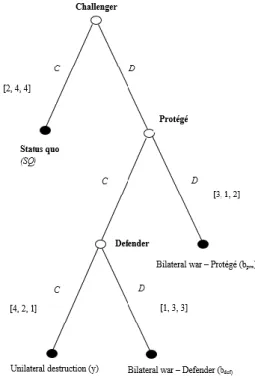
The three-state nuclear deterrence game has been
inspired by the Powel’s nuclear deterrence game. It
allows for a third bloc or actor to function within the
nuclear deterrence game, allowing it to emulate the
current world system better. The fundamental change
is that this model accounts for that no state wants to
be affected by the nuclear battles of two other states.
If state C would attack state P with a nuclear strike,
the odds for an effect on state D are significant. This
third state nuclear collateral damage could affect the
state in terms of, for example, a nuclear pollution
due to the spread of particles, an economic
downfall due to the loss of a trading partner, or
refugee crises. It emulates the willingness of non-threatened states to safeguard the protégé (P) from being
struck. The challenger has the option to maintain the status quo, attack the defender or attack the
protégé. This is illustrated in figure 2. The struck actor can then decide whether or not to retaliate upon the
challenger. The defender can strike back and cause mutual destruction (bdef) or stay passive and allow for
its unilateral destruction (y). If the protégé were to be struck, the protégé can choose either to allow for
unilateral destruction (y) or to fight back (bpro).
In this model the protégé does not have nuclear capabilities. The defender does have nuclear
capabilities. This causes a retaliation by the protégé to be far less effective than that of the defender.
Therefore, it is likely that the challenger is not concerned with the retaliation with conventional forces by
the protégé if it were to strike the defender. The defender’s own retaliation is far more concerning.
This results in the defender acting as a safeguarding actor. It is the actor that can deter the
challenger from attacking the protégé. In reality, the safeguarding actor would be a state that has nuclear
capabilities. The safeguarding state can act as an increase in credibility for the strike back. This will, in the
end, make successful deterrence more likely.
12 The disincentive is caused by the option of the safeguarding state or defender to retaliate once the
protégé has chosen not to retaliate for the first strike by the challenger. The defender has the option to cooperate, and allow the unilateral destruction of the protégé. This results in the outcome of ‘y’. The other
option is to defect. This means that the defender will retaliate for the strike on the protégé. This will lead to
outcome ‘w’. These options are illustrated in the lower part of the tree in figure 3. The attacking state might prefer outcome ‘y’ over x, but not over ‘w’ or ‘z’. In order to be able to fully explain any case in this
deterrence game, a distinction has to be made between the outcomes ‘w’ and ‘z’.
The trustworthiness or dependability on the defender is demonstrated by the concept of
safeguarding credibility. This concept is similar to the concept of the credible strike back. Both concepts
qualify states as being able and willing to retaliate with nuclear arms if the defender is struck by a first
strike.
However, safeguarding credibility concerns the
likelihood that the defender will retaliate if the protégé has
had the capability to strike back. The safeguarding credibility
is heavily characterized by the stakes of the defender in the
game. The more interdependent or near the defender and the
protégé are, the higher the odds are that the former retaliates.
A high safeguarding credibility influences both the
challenger as well as the protégé. The higher the odds are
that the safeguard retaliates, the more likely the challenger
will cause the annihilation of both itself and the defender.
The effect on the protégé works differently. The protégé
could choose to prefer a retaliation by the safeguard over one
by itself. This preference relies heavily on the credibility of
the safeguard. For example, if the safeguard is not deemed
credible, the odds are high that the defender will choose to
defect and cause outcome ‘z’. The defender could be taking
an unnecessary risk if it choose to cooperate.
On the other hand, both the safeguard and the defender can deliberately choose outcome ‘y’. The
result ‘y’ can be chosen by both actors by cooperating in the game. They are deemed equal as the result is
the same. The outcomes are identical as they result in the unilateral destruction of the defender. Moreover,
there is no difference in their meaning in the preference orderings for both actors. For both the safeguard
and conjointly the defender, the ‘y’-outcome means that the defender will be unilaterally destroyed. There
is no action required by either state.
13 METHODOLOGY
In order to determine the differences between the protégé mode and the safeguard model, a
comparison is made between the two games which correspond with a non-nuclear protégé and a nuclear
protégé. This means that is solely based game theory on a game theoretical analysis. An analysis as such
allows the researcher to construct a theory in its purest form, as a formal model. No white noise, such as
irrelevant historical data will interfere with the conclusion. Moreover, a game theoretical comparison
allows for a clear and fast analysis of the differences between the games. Unlike historical analyses, game
theory follows rational choice theory, thus allowing its games to predict the outcomes of future cases of
equal games.
There are specific minimal requirements for these games in order to correctly define a game
within game theory (Rusmussen, 2006). These requirements are the actors of the game, and the available
actions and information to each player at each player at each decision point. These requirements are
specifically intended to define and select usable right cases. For the protégé model the three actors are the
challenger, the protégé and the defender. For the three-state deterrence game the three actors are the
challenger, the defender and the safeguarding state. The available actions in the safeguard model are of the
challenger, defender, protégé and safeguard are illustrated in figure 3.
In order to determine the results and actions of each game the method of backwards induction is
utilised. Backwards induction is a bottom-up method that first determines the actions of the last player. It
then works its way up to the top. Each node in the sequential game allows for the options of cooperating or
defecting. If an actor rationally chooses the option of cooperating, the actor above will have a different set
of options to select from than when the first actor would have chosen to defect. Backwards induction in
this way allows the outcomes of the cases to be predetermined. The selected cases are based on their
likelihood in the contemporary world system. The defined cases are the nominal deterrence case and the
14 CASE 1– NOMINAL NUCLEAR DETERRENCE
Quackenbush’s model
In Quackenbush’s game it is presumed that the Challenger has the preference of unilaterally destroying the
protégé. Note that the protégé in this game has no nuclear capabilities. The actor also prefers a bilateral
war with the protégé over the status quo. This is mainly due to the fact that the protégé only has
conventional armed forces. Moreover, most of the protégé’s forces have probably been wiped out by use of
the first nuclear strike. This leads to the preference of the bilateral war over the maintaining of the status
quo. As the defender has nuclear capabilities in this game, the challenger prefers not to be struck by its
nuclear retaliation. This causes the challenger to prefer the maintaining of the status quo over a nuclear
retaliation by the defender (w).
The protégé above all prefers to maintain the status quo (x). If it were to be attacked by the
challenger with a first strike by the challenger, it would prefer the defender to retaliate and disable the
challenger (w). If the defender would not execute this retaliation, the protégé would prefer to start a
bilateral war (b). It will send what is left of its conventional armed forces in order to deter the challenger
from doing more damage and from annexing its resources. The least preferred outcome is its unilateral
destruction (y).
Lastly, the defender in Quackenbush’s model prefers to maintain the status quo. As a second
preference it wants to see the defender make an effort before it will, as the usage of nuclear weapons
comes with a large amount of political turmoil. The least preferred outcome, however, would be for the
protégé to be annihilated unilaterally. These aforementioned motives determine the preference of this case
orderings as follows:
[C] y > bpro > x > bdef = mw
[P] x > bdef > MW > bpro > y
[D] x > bdef = MW > bpro > y
Original model
In the nominal nuclear deterrence preferences it is assumed that the challenger prefers unilateral
destruction over maintaining the status quo, yet sees mutual destruction as the least preferred outcome. It
also prefers a bilateral war with the weak protégé over the status quo.
The preference ordering of the protégé is in contrast with that of the challenger. The protégé
prefers the status quo above all other options. The second preference is that of mutual destruction, while its
own unilateral destruction is the least preferred. With the addition of the third safeguarding the states have
to add the additional outcome of w to their preference ordering. Moreover, the preferences of the protégé
have to be described corresponding to its motive. The defender prefers mutual destruction over unilateral
destruction. However, the distinction between the outcomes w and z is relevant for the defender. It is
15 to maintain its strike back credibility.
The safeguarding state prefers the maintaining of the status quo above all. The defender is a state
that has only disadvantages from the destruction of the protégé. The motives behind this preferences are
exemplified by refugee crises, economic backlashes and political instability. It is evident that the safeguard
prefers the mutual destruction above the unilateral destruction, as the safeguard wants to deter the
challenger from attacking the defender. Similarly to the defender, the distinction between w and z is
relevant to the safeguard. The disposition of the safeguard is that it prefers the retaliation by the defender. By not executing the nuclear arms operation, the safeguard’s government stays clear from any political instability caused by its interference in another state’s conflict. However, the defender does realize that a
retaliation by the protégé is ineffective and will not be deemed credible by the challenger. In conclusion,
the preference orderings of the three state actors are as follows:
[C] y > bpro > x > bdef
[P] x > bdef > bpro > y
[D] x > bdef > bpro > y
CASE 2– NONVIOLENT PROTÉGÉ
Quackenbush’s model
The pacifistic defender case is a slightly different version of the nominal deterrence case. In this case the
protégé prefers not to start a bilateral war at al. It prefers unilateral destruction over it. Several motives that
can be used to explain this behaviour are that the challenger does not intend to annex the protégé’s
resources or that the protégé does not want to make its forces suffer more. The preference orderings of the
other actors stay the same. This results in the following preference orderings:
[C] y > bpro > x > bdef = MW
[P] x > bdef > y > MW = bpro
[D] x > bdef = MW > bpro > y
Original model
The second case is again an alternative version of the first case and analogous to the protégé case
mentioned above. In this scenario the defender does not prefer executing a retaliation. It prefers not to
strike back. All other preferences stay equal. This scenario is possible in reality as not all states will see the
16 necessity to strike back on the innocent civilians of the challenger. Moreover, its nuclear arms systems can
fail to operate, leading to no retaliation. Next to this, the safeguard has the same preference orderings as in
the last case. The state prefers to maintain the status quo, as it yields a utility of 4. The retaliation by the
defender is still preferred above the execution of a retaliation by itself. The unilateral destruction of the
defender is the least preferred outcome, as it yields a utility of 1. The defender will still prefer a retaliation
by the safeguard over a retaliation by itself. The rationale behind this is that if the defender chooses to not
retaliate, it knows that the safeguard will instead. This leads to the following preference orderings:
[C] y > bpro > x > bdef
[P] x > bdef > y > bpro
[D] x > bdef > bpro > y
ANALYSIS OF THE CASES
In this section the analysis of the two models is discussed. The two selected cases are each used as input
for the extended nuclear deterrence game and the original nuclear deterrence game. Firstly, the standard
analysis questions are introduced. Secondly, the case of the nominal nuclear deterrence case is discussed.
Next to this, the case of the nonviolent defender case is elaborated upon.
ANALYSIS QUESTIONS
In order to be able to compare the cases to each other, several two are posed. The answers to these
questions are answered both dichotomously, by the use of yes and no, and in a more elaborate manner. The
latter resulting in the motivation behind the answer. These questions are as follows:
1. Has the challenger been deterred from executing a first strike on the defender?
17 ANALYSIS – NOMINAL DETERRENCE CASE
QUACKENBUSH’S MODEL
In the nominal deterrence case the preference orderings of the
challenger, defender and protégé are as follows:
[C] y > bpro > x > bdef
[P] x > bdef > y > bpro
[D] x > bdef > bpro > y
If the challenger would strike first on the protégé, the
backwards induction for that tree will yield the following
results. The game tree is illustrated in figure 4. Firstly, the
defender has to choose whether to do a nuclear retaliation (bdef)
or stay passive and let the protégé handle the fight himself with
conventional warfare (b). The former yields a utility of 4, while
the second yields a utility of 2. As the retaliation yields more
utility, it will be the option chosen by the defender.
Consecutively, the protégé has to select whether to let the defender to retaliate (bdef) or to concede (y). As
the outcome of bdef yields more utility, the protégé will choose to defect and fight back. However, the
protégé does not have the capability to fight back after a nuclear strike. This causes the protégé to be
forced to select the option of conceding. This results in the outcome y in this decision node. Now, the
challenger has to choose whether to cooperate, and maintain the status quo (x), or to defect and unilaterally
destroy the protégé (y). The latter option yields the most utility and, thus, has the preference of the
challenger.
On the other hand, if the challenger would strike the
defender first, the backwards induction starts at the
protégé. The game tree is illustrated in figure 4. The
protégé has to choose whether to let the defender
fight back alone (bdef), or to start a multilateral war
(MW). The As the multilateral war yields more
utility, the protégé will aid the defender in its battle
with the challenger. Consecutively, the nuclear
armed-defender chooses either the option of the
multilateral war (MW) with the challenger or to
fight back alone in a bilateral war (bdef). The
FIGURE 4:QUACKENBUSH’S GAME
–PROTÉGÉ ATTACKED CASE 1
18 defender chooses the multilateral war. This leads to the challenger having to determine whether to defect
and start a multilateral war (MW) and being retaliated upon by the defender or maintaining the status quo
(x). Evidently, the challenger embraces the option of maintaining the status quo as it yields more utility
over being annihilated by the defender.
ORIGINAL MODEL
The preference orderings in the original model are as follows:
[C] y > bpro > x > bdef
[P] x > bdef > bpro > y
[D] x > bdef > bpro > y
If the protégé is targeted by the challenger in the three-state
variant, the defender has the options of either cooperating or
letting the challenger unilaterally destroy the protégé, or to defect
by retaliating onto the challenger. The corresponding utility values
and the game are illustrated in figure 5. Cooperating yields a utility
of 1. Defecting yields a utility of 2. The defender thus chooses to
defect at that decision node and will retaliate. The protégé now has to choose between a retaliation by the
defender and the retaliation via its own arsenal. Cooperating and defecting respectively lead to utilities of 3
and 2. The protégé thus chooses to let the defender retaliate instead. The challenger in turn has to
determine whether to cooperate and maintain the status quo or to
defect. Defecting will cause employ a first strike on the protégé, yet
causes a retaliation by the defender. The challenger has thus been
deterred by the defender.
On the contrary, the challenger can also strike the defender first.
This is shown in figure 6. This would result in the protégé being the
first actor to make a decision in the backwards induction analysis.
The protégé has to choose whether to retaliate itself (z) or to
neglect its ally and allow for the unilateral destruction (y) of the
defender. The first outcome yields the protégé a utility of 2, while
the second grants a utility of 1. The protégé, thus, prefers the
outcome of z. The defender now has the option whether to allow
for a conventional retaliation (z) by the protégé or its own
FIGURE 6:ORIGINAL GAME – PROTÉGÉ ATTACKED CASE 1
19 retaliation that causes a mutual destruction (bdef). This results in the defender preferring the outcome bdef.
Subsequently, the challenger has to adhere either the maintaining of the status quo (x) or the mutual
destruction (bdef). The current status quo yields a utility of 3, while the mutual destruction yields a utility of
1. Accordingly, the challenger rationally maintains the status quo. This means that the challenger has been
deterred by the threat of retaliation by the defender.
ANALYSIS – NONVIOLENT PROTÉGÉ CASE
QUACKENBUSH’S MODEL
In the Quackenbush model for the nonviolent defender the preference orderings of the challenger, protégé
and defender are defined as follows:
[C] y > bpro > x > bdef = MW
[P] x > bdef > y > MW = bpro
[D] x > bdef = MW > bpro > y
If the situation arises in which the challenger determines
to strike the defender first, the backwards induction
process again starts at the protégé. This is illustrated in
figure 7. The protégé has to decide whether to retaliate via
conventional warfare and start a multilateral war (w) or to
allow the defender to retaliate on its own and start a
bilateral war (bdef). The first option yields a utility of 2,
while the latter yields a utility of 3. Therefore, the protégé
chooses to take on a passive role. The defender has to
promptly establish whether it prefers to retaliate and cause
a bilateral war (bdef) or to stay nonviolent and allow for its
unilateral destruction (y). The former yields a utility of 3.
The unilateral destruction outcome yields a utility of 1.
Therefore, the defender chooses to retaliate and establish a
bilateral war. Ultimately, the challenger has to decide
whether to retain the status quo (x) or to start a bilateral war
with the defender (bdef). For the challenger the status quo
yields a utility of 3, while the bilateral war-defender yields a
utility of 1. Therefore, the challenger will maintain the
status quo. This result causes the challenger to be
successfully deterred by the defender.
FIGURE 9:QUACKENBUSH’S GAME –
DEFENDER ATTACKED CASE 2
FIGURE 8:QUACKENBUSH’S GAME –
20 In the situation where the attack would execute a first strike on the protégé, the backwards induction starts
at the third decision node of the right side of the game tree. This is illustrated in figure 8. Here the defender
has to decide whether to retaliate onto the challenger (w) and start a multilateral war or to stay passive and
allow the protégé to fight a bilateral war with the challenger (bpro). The defender chooses to retaliate and
start a multilateral war as this yields him utility of 4 instead of 2. This leads to the protégé-actor that has to
distinguish between fighting a multilateral war (w) and allowing for its own unilateral destruction (y), and
therefore cooperating. The latter option yields the most utility towards the protégé. This causes the protégé
to surrender to the challenger and allow for the outcome of unilateral destruction. The challenger now has
to determine whether to gain a utility of 4 by unilaterally destructing the protégé or gaining a utility of 3 by
maintaining the status quo. The challenger will rationally choose to unilaterally destruct the protégé. This
means that protégé will unilaterally be destructed as deterrence has failed.
ORIGINAL MODEL
In this case for the original model the preference orderings
are determined as follows:
[C] y > bpro > x > bdef
[P] x > bdef > y > bpro
[D] x > bdef > bpro > y
In this case the protégé is struck first. This is depicted in
figure 9. Note that the protégé does not have nuclear arms.
The defender at the third node has to decide whether to
retaliate onto the challenger (w) or to stay passive and allow for the unilateral destruction (y) of the
protégé. The retaliation allows for more utility. Thus, the defender retaliates onto the challenger. The
protégé now decides whether to allow the defender to retaliate (w) or to retaliate himself (z). The
retaliation by the defender yields the protégé more utility. Therefore, it chooses to stay passive itself and
let the defender retaliate in its place. Finally, the challenger has to decide whether to maintain the status
quo (x) or to cause mutual destruction (w) via a nuclear retaliation by the defender. The maintaining of the
status quo yields a utility of 3, while the yielded utility of mutual destruction by the defender is 1.
Therefore, the challenger decides to retain the status quo. This means that the challenger has been deterred
from striking upon the protégé in the case of the nonviolent defender.
21 In the event of a first strike upon the defender, the protégé
is the first actor to determine its actions. This is illustrated
in figure 10 for this case. The protégé chooses between
retaliating (z) and allowing for the unilateral destruction (y)
of the struck actor, the defender. At this decision node, the
protégé-actor chooses to allow for the unilateral destruction
of the defender, as it yields a utility of 3. The retaliation
yields only 1. This causes the defender to have to choose
between retaliating himself (w) and permitting its own
unilateral destruction (y). The defender chooses to defect,
and retaliate (w). The challenger now has to determine
whether to maintain the status quo (x) or to tolerate mutual
destruction. The challenger chooses to maintain the status
quo, as it grants a utility of 3. This is more than the mutual
destruction-outcome. This causes the challenger to
recognize the low possible utility and permits its deterrence
via the threat of a mutual destruction.
R
ESULTS OF THE ANALYSISTable 1 depicts the results of the analysis in a schematic manner. The columns show the case that is
described. The rows illustrate the subject of the content of the cells.
Quackenbush model case #1.1 Quackenbush model case #1.2 Quackenbush model case #2.1 Quackenbush model case #2.2 Original model case #1.1 Original model case #1.2 Original model case 2.1 Original model case #2.2 TARGETED STATE
Protégé Defender Protégé Defender Protégé Defender Protégé Defender Deterrence
successful?
Yes Yes No Yes Yes Yes Yes Yes Deterring
actor
N/A Defender N/A Defender Defender Defender Defender Defender Outcome if
SQ is not considered
w w y bdef w W w w
TABLE 1: RESULTS OF THE ANALYSIS
22 CONCLUSION
The aim of this thesis is to determine the difference in the outcomes of nuclear deterrence between Quackenbush’s extended deterrence game and the newly constructed ‘original nuclear deterrence game’.
This questions whether the success rate of deterrence is increased by allowing for this action after the
protégé has conceded. Firstly, this provides an original formal model that includes this action within its
game tree. Secondly, it shows that the nonviolent protégé is protected by the defender in this game tree.
This permits us to examine the results concerning the most viable target of the challenger and the
reliability of the alliance.
The analysis shows that the challenger’s target in the case of a nonviolent protégé differs per model. This result that is found in the fifth column of table 1. When using Quackenbush’s model for the
determination of the outcome of the nonviolent protégé case, the protégé causes the deterrence to fail.
Quackenbush’s model allows an idiosyncratic feature to be reflected in the outcome. It shows that, despite
the preference of the defender to retaliate onto the challenger, the preference of the protégé to concede
cancels out the option of a retaliation. Hence, the challenger is not deterred in this game. The analysis
shows not only whether to strike, but also whom. In this case, it is the nonviolent protégé.
In the original model, the same case has a different result. Though the protégé prefers its own
unilateral destruction, the defender has the option to retaliate. This is reflected in the outcome of the game.
The result is the deterrence of the challenger by the threat of a mutual destruction from the defender. This
is turn is in great contrast with the result of Quackenbush’s model. In this case, the challenger is deterred
by the defender from attacking both the defender and the protégé. This results in that the challenger is
deterred in every case in the original model.
All other comparable analysed cases have the maintaining of the status quo as their outcome. It
can be stated that the odds of the challenger utilising a nuclear first strike on either state have therefore
decreased in the original game compared to Quackenbush’s game for these two cases. Therefore, it can be
stated that the including of the option of retaliation for the defender in the case of a nonviolent protégé will
result in lower odds for an act of aggression by the challenger.
DISCUSSION
The conclusion shows that there is a significant difference in the way nuclear deterrence is performed
when the third state can retaliate at all times. It is evident that the addition of such a feature changes the
dynamic of the nuclear deterrence game. The defender can take over the role of the deterring actor from
the protégé. This is proven in the nominal nuclear deterrence case. An example of this is the reluctant
protégé case in the analysis.
The defender’s strike back credibility and nuclear collateral damage appear to be of use in the
original three-state nuclear deterrence game. Simultaneously, the challenger and the protégé have to
determine whether the third state will function as the protégé’s defender. The challenger requires this
23 success of the deterrence is entirely dependent on the defender. The protégé on the other hand changes its
preference ordering in the case of a credible defender. Thus, the third-state strike back credibility is
evidently an important variable in the three-state nuclear deterrence game.
The impact of the knowledge of these concepts might have an impact on the contemporary
international relations theories. The concepts fit seamlessly into the school of neorealism. Neorealism
assumes states to be rational, act in a state of international anarchy and self-helping. Moreover, the striving
for relative gains is displayed by the concept of nuclear collateral damage. If the nuclear collateral damage
is deemed too great by the defender, it will retaliate onto the challenger. In other words, the defender does
not allow the challenger to shift the balance of power too much towards to itself by annihilating a great
power and making another one dysfunctional. Therefore, the defender will even out this advantage and
retaliate upon the challenger.
Clearly, as the abovementioned concepts are original in deterrence theory, the concepts are to be
researched more extensively in the future. The concepts of nuclear collateral damage, third-state strike
back credibility and the new role of the defender in the nuclear deterrence game have to be elaborated
upon. Nuclear collateral damage is to be researched as it can mean the difference between a nuclear
conflict between two nuclear states and three nuclear states. The amount of collateral damage can
essentially determine the pace at which an annihilated region modernize itself again. The third-state strike
back credibility is influenced by the aforementioned concept. Nonetheless, it is probable that there are
more factors that influence the tendency to defender. In international relations, knowledge of this subject
can again be the disparity between a conflict with two or with three states. Overall, the significance of the
24
REFERENCES
Arrow, Kenneth J. (1963): Social Choice and Individual Value, 2. Auflage, New York: John
Wiley and Sons. https://www.unihamburg.de/onTEAM/grafik/1164287680/Arrow's%20Axioms.pdf
Bueno de Mesquita, Bruce. 1981. The war trap. New Haven, CT: Yale University Pre
Frank C. Zagare. (2014). A Game-Theoretic History of the Cuban Missile Crisis. Economies, 2(1),
20-44.
Huth, P. (1988). Extended deterrence and the prevention of war. New Haven ; London: Yale
University Press.
Keohane, R. (1986). Reciprocity in international relations. International Organization, 40(1), 1-27.
Kraig, M. (1999). Nuclear Deterrence in the Developing World: A Game-Theoretic Treatment.
Journal of Peace Research, 36(2), 141.
Kilgour, D. M., and F. C. Zagare. "Uncertainty and the Role of the Pawn in Extended Deterrence."
Synthese 100.3 (1994): 379-412.
Lebow, R., & Stein, J. (1995). Deterrence and the Cold War. Political Science Quarterly, 110(2),
157-181.
Mearsheimer, J. (1984). Nuclear weapons and deterrence in Europe. International Security, 9(3),
19-46.
Mearsheimer, J. (2001). The tragedy of great power politics (The Norton series in world politics).
New York, NY: Norton.
Michener, H. Andrew, Choi, Young C., & Dettman, David C. (1986). Stability by deterrence in
cooperative non-side payment n-person games. Journal of Economic Behavior & Organization,7, 375.
(05-04)
Morgan, P. (2003). Deterrence Now. Cambridge: Cambridge University Press.
Pellikaan, H. (2017). A new introduction to game theory with applications in international
relations. Unpublished manuscript, Department of Political Science, Leiden University, Leiden, The
Netherlands.
Powell, R. (1989). Nuclear deterrence and the strategy of limited retaliation. American Political
Science Review, 83(2), 503-520.
Powell, Robert. "Bargaining in the Shadow of Power." Games and Economic Behavior 15.2
25 Quackenbush, S. (2006). Not Only Whether but Whom: Three-Party Extended Deterrence. The
Journal of Conflict Resolution, 50(4), 562-583.
Rasmusen, E. (2007). Games and information: An introduction to game theory (4th ed.). Malden,
MA : Blackwell.
Van der Meer, S. (2016). States’ Motivations to Acquire or Forgo Nuclear Weapons: Four Factors
of Influence. Journal of Military and Strategic Studies, 17(1). Retrieved from
http://jmss.org/jmss/index.php/jmss/article/view/585
Waltz, K. (1964). The Stability of a Bipolar World. Daedalus, 93(3), 881-909.
Waltz, K. (1979). Theory of international politics. Long Grove, I.: Waveland Press.
Waltz, K. (1981). The spread of nuclear weapons: More may be better (Adelphi papers ; 171.
822386682). London: International Institute for Strategic Studies.
Wagner, R. (1991). Nuclear deterrence, counterforce strategies, and the incentive to strike 1st.
American Political Science Review, 85(3), 727-749.
Werner, Suzanne. "Deterring Intervention: The Stakes of War and Third-Party Involvement."
American Journal of Political Science 44.4 (2000): 720-32. Web.
Saperstein, A. (1991). The "Long Peace" RESULT OF A BIPOLAR COMPETITIVE WORLD?
The Journal of Conflict Resolution (1986-1998), 35(1), 68.
Stein, J. (1987). Extended deterrence in the Middle East. World Politics, 39(3), 326-352.
Snyder, G.H. (1961). Deterrence and Defense. Princeton UP.
Szilagyi, M. (2012). Analytical solutions of N‐person games. Complexity,17(4), 54-62. (05-04)
UN General Assembly. (2016). Taking forward multilateral nuclear disarmament negotiations.
Retrieved October 08, 2017, from
http://reachingcriticalwill.org/images/documents/Disarmament-fora/1com/1com16/resolutions/L41.pdf
Wu, Samuel S.G. (1990). To attack or not to attack - a theory and empirical assessment of
Extended Immediate Deterrence. Journal of Conflict Resolution, 34(3), 531-552.
Zagare, F., & Kilgour, D. (2006). The Deterrence‐Versus‐Restraint Dilemma in Extended
26