GENDER, BODIES, SEX, TECHNOLOGY: DISMANTLING HETEROSEXUAL MALE SUBJECTIVITY AND DESIRE IN TRANSNATIONAL FILM
Stella Soojin Kim
A dissertation submitted to the faculty at the University of North Carolina at Chapel Hill in partial fulfillment of the requirements for the degree of Doctor of Philosophy in the Department
of Romance Studies (Spanish).
Chapel Hill 2015
Approved by: Samuel Amago
Emilio del Valle Escalante Irene Gómez Castellano Laura Halperin
ABSTRACT
Stella Soojin Kim: Gender, Bodies, Sex, Technology: Dismantling Heterosexual Male Subjectivity and Desire in Transnational Film
(Under the direction of Samuel Amago)
For my Juicy J
ACKNOWLEDGEMENTS
I want to first thank my parents, Michelle Kim, Hyun Ho Kim, and Jung Ja Kim, for their unwavering love and support and for the numerous sacrifices that each has made in order for me to arrive at this point in my educational journey. Most people are lucky enough to have one great set of parents, but I have been fortunate enough to have been gifted with two, and I also want to thank Janice Lee and Young Lee for the love, encouragement, and selfless generosity that both have shown me during the entire eight years that I been in Chapel Hill. A special thanks to my most excellent siblings, Anne Kim, David Kim (MC Joonz), and David Ahn as well. Stay cool.
I want to thank the members of my committee, Emilio del Valle Escalante, Irene Gómez Castellano, Laura Halperin, and Jordi Marí, not only for their careful readings and thoughtful comments, but more importantly, for leading by life and by example. I feel truly grateful to have found such a dedicated group of professors who have taken an interest in my growth as a scholar and as a person and each of whom has also contributed through more intangible means along the way. A special thanks also to Juan Carlos González Espitia, whose mentorship during the
doctoral program has been sincerely appreciated. Lastly, a very special and heartfelt thank you to my dissertation adviser, Sam Amago, for his guidance and mentorship throughout the entirety of the writing process and in particular, for making the last moments of my graduate career so wonderfully positive. You stay cool as well.
this journey. In particular, I want to thank Nancy Grace Aaron, Zully Amaya, Rosario Colchero Dorado, Maria Fellie, Becka Garonzik, Ken Gorfkle, Mary Greenwood, Anca Koczkas, Hosun Kim, Tacia Kohl, Lance Lee, Jonathan O’Connor, Eric Schlotterbeck, and Alison Zink for their continued friendship and support.
My FABs, by virtue of existence, deserve a paragraph unto themselves, and this they shall have. Lorelei Dennis, Jin Ju Choi, and Lori Liu, you three are the veritable shit.
TABLE OF CONTENTS
INTRODUCTION...1
CHAPTER 1: ‘TWIXT FEAR AND DESIRE: THE INTERSEXED BODY, THE DIVIDED SUBJECT, AND THE DISSENTING GAZE IN LUCÍA PUENZO’S XXY (2007)...25
Alex as Social Construction………...34
Althusser and Ideology………..37
Habit………...43
Cognitive Dissonance………....49
Alex as Linguistic Construction………...54
Mirrors………...61
Sex/Sexuality……….64
CHAPTER 2: QUEERING THE “DEFAULT” SPECTATOR: GENDER-BENDING, RAPE, AND SHIFTING SUBJECT POSITIONS IN PEDRO ALMODÓVAR’S LA PIEL QUE HABITO / THE SKIN I LIVE IN (2011)...69
Identification with Robert………..71
The Nude………80
Robert as the Viewer’s Surrogate………..85
Reflexivity as Political and Narrative Strategy………..90
Vera Cut to the Measure of the Spectator’s Desire………93
Empathy with Vicente………96
Flashbacks as Representations of Subjective Truth……….106
Specularizing Visions of Violence………...117
Conclusion………...128
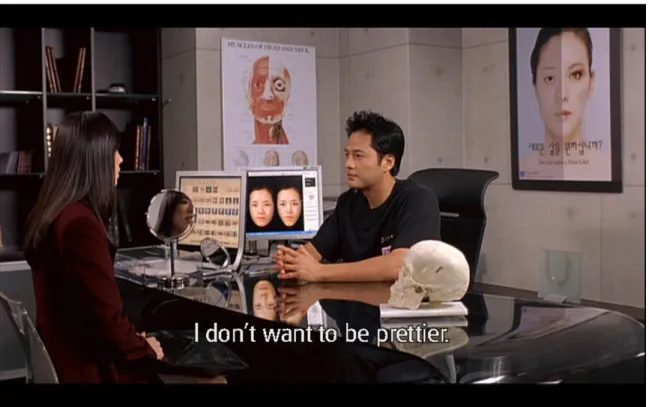
CHAPTER 3: SEEING IN CIRCLES: NARRATIVE CIRCULARITY, CRAZY, AND THE COSMETIC GAZE IN KIM KI-DUK’S TIME / SIGAN (2006)...130
The Cosmetic Gaze………...135
Cosmetic Surgery as Feminist Dilemma………...139
The Destruction of Pleasure is a Radical Weapon………...149
Narrative Circularity………157
Crazy as Boner-Shrinking Strategy………...159
The Science of Desire………...167
Conclusion………...173
CONCLUSION………175
LIST OF ILLUSTRATIONS
FIGURE 1.1...57
FIGURE 1.2...62
FIGURE 2.1...81
FIGURE 2.2...85
FIGURE 2.3...86
FIGURE 2.4...88
FIGURE 2.5...123
FIGURE 3.1...140
FIGURE 3.2...142
INTRODUCTION
“Where there is power, there is resistance.” –Michel Foucault
“Invest in resistance.” –Judith Halberstam
The first time I read Laura Mulvey’s “Visual Pleasure and Narrative Cinema,” I was absolutely stunned. It was as if I had been given the explicit grammar rules for a usage and expression I saw everywhere around me, but I had not yet the vocabulary to express.
In the years since then, I’ve watched a lot of movies with this essay in the back of my mind. The three movies discussed here have each been chosen because each does something to the spectator identified by Mulvey, and because each goes through mainstream cinema’s default assumptions to do so.
Through every epoch from the beginning of time, thinkers have sought to theorize subjectivity. They have said that subjectivity resides in the body, that it exists in thought and in consciousness, that many things lurk beneath its depths that are unaccounted for, that it resides in language and in signs and in utterances, that it exists within a network of infinite power relations of subjects exerting power inward, on themselves, and directing power outward, in as many number of resistances. They have said that subjectivity is gendered, that it is marked by
likewise been compared to cyborgs and rhizomes as the lines between humans, animals, and machines become increasingly blurred; it has been called schizophrenic, fragmented, nomadic, postmodern.
In short, this is a dissertation about subjectivity and desire. More specifically, this dissertation builds on the idea that if dominant narrative cinema—that is, Hollywood and its derivatives—create a perspective that “naturalizes” a heterosexual male viewpoint as the universal and the norm, then the specificity of this position may also be used as a starting point to subvert cinematic desire.
The three films discussed in this dissertation—XXY (2007; Argentina) by Lucía Puenzo;
La piel que habito / The Skin I Live In (2011; Spain) by Pedro Almodóvar; and Time / Sigan
(2006; South Korea) by Kim Ki-duk—all do something interesting to the cinematic gaze, and they do it by blurring, destabilizing, or otherwise problematizing the traditional self/other dichotomy on which subjectivity is based.
Chapter 1 examines the issue of sexual difference through a perspective that fuses male and female in a dual and irreducible embodiment that destabilizes the position of the spectator
that gazes at the image.
Chapter 3 examines the use of cosmetic surgery as both a critique and an illustration of how the female body has literally embodied the burdens of the male gaze while at once using narrative circularity, interchangeable subject and object positions, and film form to illustrate the interconnectedness of self and other. At the same time, I demonstrate that female madness is indeed an effective strategy for inhibiting the spectatorial desire produced by the defaults of the cinematic gaze.
Teresa de Lauretis writes that if theorists have been particularly insistent on the
transformation of cinema as an imaging practice, it's because the stakes themselves are especially high. Similarly, Marian Wright Edleman has made the equally compelling point that “you can't be what you can't see.”
In the following pages, I situate the specifics of my dissertation in the body of feminist film theory. The three chapters that follow offer variations on a single theme: how, by
decentering the subject position of the traditional male spectator interpellated by the gaze, we can begin building a qualitatively different kind of cinema—one that extends significantly beyond just what meets the eye.
* * *
from herself. As Laura Mulvey observes, positioned within the structure of story-based cinema, the female spectator is not only given to identification with the male hero, in doing so, she indirectly appropriates his subjectivity and actions, despite (and including) his treatment of women.
In this project, which focuses on three contemporary narrative films: XXY (2007) by Lucía Puenzo, La piel que habito (2011) by Pedro Almodóvar, and Time (2006) by Kim Ki-duk, I analyze the ways in which the subject of each challenges traditional ways of looking. Through the frameworks of feminist film theory, which calls on a combination of approaches to address both the representation of women in film as well as spectator positioning in reference to these constructions, I will set a historical and social framework for the approaches that I use in my analysis, justify the use of said approaches in reference to the chosen texts, and situate my project in the current body of film studies. The questions that inform my analysis are: How does the presence of the non-normative or ambiguously defined body at the heart of each filmic text affect spectatorial desire? If it has been suggested that non-narrative cinema holds the greatest possibility for a rupture in hegemonic structures of looking, how does each film’s adherence to a traditional narrative structure (or appearance thereof) affect the movement and orientation of spectatorial desire? Lastly, if the non-normative or ambiguously defined body does indeed alter the gaze, does it also permit a qualitatively different way of looking beyond the inversion of existing dichotomies?
influenced, and was influenced by, the ideas and events of its social and historical context. At the same time, however, an inevitable consequence of “following the theory,” as I have done, means that the ideas employed often reflect the Eurocentric biases of feminist scholarship itself, a limitation that also mirrors the inescapable paradox of marginalized subjects within the academy, which demands that one buttress oneself on the authority of hegemonic others before one is able to speak. However, by highlighting prominent arguments and debates in the field, as well as sites of elision, omission, and possible points of expansion, I hope to justify why my approach— which revisits and modifies an earlier theory—merits a re-visitation and a re-working of arguments past.
Feminist Film Theory: An Overview
Feminist film theory came about at the end of the 1960s and the early 1970s alongside the second wave of feminism1, which itself grew out of a period of intense social and political
change. Indeed, 1968, the year often marked as heralding the “birth” of feminist film theory, was a landmark year in many respects. In the United States, growing opposition to the Vietnam War, punctuated by student demonstrations and anti-war protests, fomented a mood of civil unrest. The shock of the Vietnamese Tet offensive—a military attack led by North Vietnamese forces on South Vietnamese and U.S. troops despite the ceasefire agreed upon by both sides for the Tet (lunar New Year) festivities—left the U.S. public reeling. As Max Elbaum observes, the
1The first wave of feminism is associated with women’s suffrage in the early 1900s in places such as the United
Kingdom, Canada, the Netherlands, and the United States; the second wave takes place starting in the late 1960s and addresses equality in the home, the workplace, in politics, sexuality, and society. In contrast to third wave feminism, which has also been dubbed “lipstick feminism,” third world feminism, the boundaries of which are widely
significance of the Tet Offensive was that in a solitary act, it singlehandedly “shattered the illusion of an invincible U.S. empire” (1), forcing Americans to rethink and reevaluate the importance of the U.S. (and consequently, themselves) in the world.
On the domestic front, 1968 found the Civil Rights Movement in full swing. Catalyzed by the Montgomery bus boycott of 1955 and spurred on by other, highly publicized “enactments of popular protest” (Russo 56), the unease of those on the bottom fighting for change was mirrored in those on the top who stood to lose terrain if change were indeed to take place. Still, perspectives were changing. The enactment of two landmark pieces of legislation—the Civil Rights Act of 1964, which ended racial segregation and outlawed discriminatory employment practices against blacks and women, and the Voting Rights Act of 1965, which banned
discriminatory voting practices which had been used to disenfranchise black voters—legitimized and incorporated, legally and symbolically, previously marginalized perspectives into the
discourse of the nation. Adding yet another dimension to the period, Max Elbaum explains that: The energy of protest movements was also buoyed by the tremendous cultural ferment taking place among youth of all backgrounds. During the late 1960s political protest overlapped and intersected with a generalized youth rebellion and a burgeoning “counter-culture” in complicated ways, with folk music, rock n’ roll, and rhythm and blues often serving as a sound track for a generational challenge to existing social mores and culture as well as to political authority. (Elbaum) Everywhere, and in diverse levels of society, the mood was “suggestive of the energies and possibilities of unlimited cultural and social transformation” (Russo 56).
However, the overwhelming and astonishing assassination of Civil Rights leader, Martin Luther King, Jr., in April of 1968, triggered an important ideological shift. For many, Dr. King’s assassination marked a significant turning point in the public imagination, for in effect, it
succeeded in convincing “tens of thousands who had taken part in or supported protest
had to be forcibly overturned” (Elbaum). In more than a hundred cities across the nation, black riots broke out in an expression of the rage, helplessness, and frustration known intimately to the downtrodden at having their sincerest efforts for an imminent black equality—embodied in the figure of Dr. King—so abruptly and unceremoniously truncated.
Nevertheless, despite the rupture caused Dr. King’s assassination, the consequences of these two events—the re-evaluation and re-ordering of identity initiated by the Vietnamese Tet Offensive, and the legal and symbolic inclusion of hitherto marginalized perspectives brought about by the Civil Rights Movement—led to a widening of mainstream views which would find expression at all levels of society.
It was in this context that the Women’s Movement of the 1960s and 1970s first found its voice. During the 1960s, women (mostly students), rallied by the political debate and the sexual liberation movement, reacted against seeing their efforts for political change consistently
subordinated to the work of their male peers. As Susan Hayward explains, “the failure of radicalism . . . to produce any substantive change for women led them to form consciousness-raising groups that effectively galvanized women into forming a women’s movement” (134-35).
With this second wave of feminism, diverse areas of study were opened up for renewed examination from the new perspectives afforded by the shift in society. As feminists turned to examine the community at large, the cinema, as a predominantly male-made and male-operated institution, became a distinct area of focus. The resultant feminist film theory—a discipline borne from the crossroads of feminism and film—would prove to be an integral contribution to film studies, not only in the 20th century, but in the 21st as well.
unified approach suggested by a single theory, feminist film theory encompasses many different fields and perspectives, resembling the dynamic nature of feminism itself. In her work, Women’s
Pictures: Feminism and Cinema (1982), Annette Kuhn highlights the importance of
understanding feminism as a highly adaptive, ever-changing series of perspectives—perhaps better understood as a process—as opposed to a rigid devotion to a single, consolidated approach. According to Kuhn:
Feminism is a political practice, or a set of practices, with its own history and forms of organisation, with its own bodies of theory constructed in and through that history and organisation. And it is not a monolith; it comes in different varieties, offers a range of analyses of the position of women, and different strategies for social change. Because of the forms of organisation it has adopted and developed over the years, and also perhaps because of its current cultural and political marginality, feminism presents itself very clearly as a process, and is therefore hard to pin down. (3)
Not surprisingly, then, the theory borne from this labor is distinguished by the same variety and multiplicity that characterizes feminism itself. Kuhn’s work, which is informed by a series of responses to a single question, asks: “What is, can be, or should be, the relationship between feminism and cinema?” (4). While Kuhn does not offer any facile definitions, she does concede that: “given that feminism is itself many-sided, the possible dimensions and
permutations of interrelations between it and cinema become enormous” (4). Similarly,
or a set of practices, “founded in analyses of the social/historical position of women as subordinated, oppressed or exploited either within dominant modes of production (such as capitalism) and/or by the social relations of patriarchy or male domination” (4); in my
conception, feminist film theory is dynamic, highly adaptive, and ever-changing, calling for a broad spectrum of analyses surrounding all levels of the representation of women in film, including, but not limited to: 1) the films themselves, 2) the social and historical specificity of their production, exhibition, distribution, and reception, and 3) the variety of individual viewer responses, with careful attention directed toward the intersections of race, class, sex, sexuality, gender, and embodiment. To this tentative definition, following the ever-widening possibilities of inclusion provided by postmodernism and poststructuralism, I will add that in its present form, feminist film theory is simultaneously multiply positioned, offers multiple perspectives, and is polyvalent, accepting and accommodating of its various contradictions while offering different strategies for social change.
As we shall see, this wide-ranging scope of feminist film theory, a defining characteristic of the approach from its very inception, would lead to vastly different forms of expression in groups on either side of the Atlantic.
Feminist Film Theory: 1968-1974
In its first period, 1968-1974, the two divergent branches of feminist film theory may be associated with two distinct groups: those writing in the United States, such as Marjorie Rosen (1973)2, Joan Mellen (1974)3, and Molly Haskell (1974)4, who adopted a sociological approach
2
Marjorie Rosen - Popcorn Venus: Women, Movies and the American Dream (1973).
to the representation of women in film—that is to say, by examining dominant Hollywood films and drawing conclusions from their observations—and those writing in Europe, particularly the United Kingdom, such as Claire Johnston, Laura Mulvey, Pam Cook, and Annette Kuhn, who were influenced by semiotics and structuralism and argued against the feminine “essence” advocated by their U.S. counterparts. Because cinema was seen to reflect reality, U.S. feminists believed that if they were to use systematic analysis to reveal filmic images of women to be stereotypes (which they did), they would also be able to show that film was a biased institution ruled by, and generative of, patriarchal ideology—hence the stereotypes. In their line of thinking, by exposing the images of women created by Hollywood to be stereotypical constructions—and conversely, by having filmmakers show images of “real” women, and not stereotypes, in the movies—they would be able to reverse the ideology created by patriarchal films, and
consequently, transform society itself.
While in theory the plan seemed simple enough, in practice, the logistics of showing “real” women in the movies turned out to be highly problematic for several reasons. To begin with, it took as a point of departure the transformation of extant (patriarchal) representations. Secondly, the strategy, which proposed stripping these representations of bias, also presumed that by removing these biases, one could in fact arrive at pure filmic representation—an
unmediated image of “real” woman, unfettered by predetermined trajectories or constraints. For the British feminists, however, the inherent flaw in this approach was that by suggesting a return to unbiased representation—an imagined “natural” pre-patriarchal state—U.S. feminists were also obliquely affirming their belief in a feminine essence, or an original “feminine” quality.
According to the British feminists, the strategy of stripping masculine bias from the female image (and the consequent imagining of ‘woman-free-from-patriarchy’ as equal to
‘natural woman’ or ‘woman-in-her-natural-state’ that such removal would entail) was inadequate because of its underlying assumptions. They argued that because the institution of patriarchy had always used the inherent “naturalness” of sexual difference (i.e., anatomical sexual difference rooted in biology) to support the status quo and to justify its hegemony (“things”—i.e., the current division of gender with men on top—are the way they are because there is a biological basis for the divide), for the British feminists, “belief in a fixed feminine essence” would amount to nothing less than “legitimizing patriarchy through the back door” (Hayward 136). In other words, the reason why female essentialism was so vehemently refused by these theorists was because “by accepting the fixed essence of woman as a predetermined ‘given order of things,’ implicitly, what was also being accepted was the ‘naturalness’ of the patriarchal order”
(Hayward 136).
In retrospect, while the essentialist underpinnings of Rosen, Mellen, and Haskell’s theories would eventually be discarded in favor of new directions, these women’s meticulous work in analyzing a significant number of Hollywood films was nevertheless invaluable. First, by providing concrete evidence that supported the existence of patriarchal bias in the
construction of female images (seen in Hollywood stereotypes such as the virgin or the whore), Rosen, Mellen, and Haskell’s success lay in the construction of a tangible base—an initial point of departure—for feminist film theory to follow. By systematically proving that patriarchal bias was there, they consequently set the groundwork for future discussion and strategies about why it was there, how it got there, and, more significantly, what could be done about it.
roots in Ferdinand de Saussure’s theories on structural linguistics (1907-1911) as popularized by Roland Barthes’s Mythologies (1957). Semiotics was useful because it took the question of gender representation out of biology and placed it into the realm of language, bringing with it a variety of fresh possibilities stemming from the study of cinema as language.
As a language, the images seen in the cinema (indeed, the entirety of cinema itself) were understood to convey meaning. However, because semiotics also exposed the link between signifier and signified as an arbitrary one (by demonstrating a lack of one-to-one correspondence between signifier and signified), the influence of semiotics on film studies was that the cinema was no longer seen as merely reflective of reality, but productive, rather, of ideology. Indeed, Jean-Louis Baudry’s 1970 essay, “Ideological Effects of the Basic Cinematographic Apparatus,” published during this period, had argued precisely the same point. Baudry’s claim that the cinema produces ideology (as opposed to reproducing reality), along with his insistence that the apparatus of film is (and functions at the level of the) unconscious, had significant influence on feminist thought: the former, because of the exchange it stimulated between semiotics and film, and the latter, because of its similar introduction of psychoanalysis as a critical approach to the area of film studies.
Feminist Film Theory: 1975-1983
Johnston’s essay, building on the arguments brought forth in Baudry’s “Ideological Effects” essay, pointed out that the cinema was not only productive of ideology, but— reinterpreting the implications of ideology within a feminist context—of capitalist bourgeois ideology. As she notes in her essay:
All films or works of art are products: products of an existing system of economic relations, in the final analysis. This applies equally to experimental films, political films and commercial entertainment cinema. Film is also an ideological
product . . . The idea that art is universal and thus potentially androgynous is basically an idealist notion: art can only be defined as a discourse within a
particular conjuncture—for the purpose of women's cinema, the bourgeois, sexist ideology of male dominated capitalism. (28)
In her analysis, Johnston posits that only by deconstructing the technical aspects of a film’s production (such as framing, lighting, wardrobe, editing, proxemics, mise-en-scène, perspective, camera angles, and so on) to show how the image is coded—we would be able to understand the effect of the female image being coded that way. In other words, only by
extricating each factor involved in the construction of woman and examining it in isolation, apart from the effect of the representation as a whole, would we be able to accurately identify and combat destructive ideology. Quoting Hans Magnus Enzensberger’s strategy that “a
revolutionary plan should not require the manipulators to disappear . . . [but instead] make everyonea manipulator” (28), Johnston asserts that at the same time dominant meanings
objectification in the cinema, our collective fantasies must be released: women’s cinema must embody the working through of desire” (32).
While Johnston does not detail how this cinema is to be constructed nor the particulars of how it should function, in its context, her essay was nonetheless significant for extending
Baudry’s ideas on ideology to dominant cinema’s construction of women, generating critical discussion about the implications of ideology within a feminist context. Furthermore, Johnston’s essay—anticipating forthcoming questions of female fantasy and desire—likewise set the stage for future investigation regarding not only the mechanisms by which desire is represented, but the consequences of such representation in the cinema as well.
While Johnston’s essay explored the implications of semiotics, Laura Mulvey’s essay, “Visual Pleasure and Narrative Cinema” (1975), took, instead, to psychoanalysis. At this
particular conjuncture in feminist film theory, Maggie Humm explains that what psychoanalysis offered film was “a reading of the feminine rooted neither entirely in the social construction of femininity (which nevertheless organises the feminine) nor entirely in biology, but, rather, seen through language and subjectivity” (15).
In And the Mirror Cracked: Feminist Cinema and Film Theory (1998), Anneke Smelik explains thus the shift to psychoanalysis:
From psychoanalysis . . . [feminists] learned to analyze structures of desire and subjectivity. Feminist film theory shifted its focus from the critique of the
ideological content of films to the analysis of the mechanisms and devices for the production of meaning in films. Film is no longer seen as reflecting meanings, but as constructing them; thus cinema as a cultural practice actively produces
meanings about women and femininity. (9)
how these mechanisms are reinforced. Advocating, furthermore, the propitiousness of the theory’s application to film, Mulvey likewise espouses its use “as a political weapon” to reveal “the way the unconscious of patriarchal society has structured film form” (837).
Mulvey asserts that the pleasure of classical narrative cinema comes from the way it caters to, and satisfies, the unconscious desires of the spectator. More specifically, Mulvey demonstrates that the prevailing techniques of dominant cinema provide the perfect conditions through which the divided self—which both Freud and Lacan assert is indeed the case—is able to achieve unity, however illusory or fleeting, once again with himself.5 The attendant problem, however, is that the same mechanisms that make the movie-going experience so pleasurable for everyone also oblige the viewer—regardless of gender or sexuality—to align with a male, heterosexual point of view. Consequently, for the spectator that falls outside the limits of this established paradigm, the pleasure of the movies comes also at an intense psychic cost, for in order to fully experience the “magic” of the movies, the viewer must identify with a viewpoint that is alien to herself (himself); identify, furthermore, with a viewpoint (which, being white, male, and heterosexual), may be in direct conflict with the viewer’s lived experience as not -white, or not-male, or not-heterosexual, thus confirming the alien and conflicting viewpoint at the expense (denial) of self.
In her essay, Mulvey argues that the narrative structure of dominant cinema caters to the desires—or perhaps more aptly, the unconscious desires and anxieties—of the (heterosexual) male spectator, and that the pleasure of this cinema hinges on two contradictory mechanisms: the viewer’s identification with the male image (the protagonist on-screen) and the same viewer’s objectification of the female image, mechanisms which she argues are the same for all spectators,
5 The use of the masculine pronoun is intentional, as both Freud and Lacan focus (almost exclusively) on the
regardless of the spectator’s gender or sexual identity. The contradiction of these mechanisms lies in the fact that while one (identification) requires an association with the image, the other (objectification) requires a separation from it. Per Mulvey’s observation, the mechanisms of dominant cinema unite these two contradictory practices without any apparent problem. Likening the viewer in front of the screen to the child in front of the mirror, Mulvey demonstrates that like the child in Lacan’s mirror stage, who lacks mastery of his body and appropriates his specular image as an external ideal, the viewer, through identification with the male hero on-screen, can likewise master the protagonist’s actions and as such, control the outcome of the story. For the viewer as for the child, the image stands for the convergence of mastery and desire.
If, however, in psychoanalytic terms, the image of woman (at least for the male spectator) always threatens to evoke the original anxiety and loss occasioned by the recognition of her “castrated” body, Mulvey identifies two specific mechanisms of dominant narrative cinema used to allay that anxiety: voyeurism and fetishistic scopophilia.
The first approach, which Mulvey explains as having to do with “investigating the woman, demystifying her mystery,” is a technique at once “counterbalanced by the devaluation, punishment or saving of the guilty object” (844)—a strategy which Mulvey observes is closely related to sadism and often typified in the project of film noir. In contrast, the second approach, fetishistic scopophilia, emphasizes the physical beauty of the object in question—woman—thus
gaze. As she explains, through this mechanism, “the beauty of the woman as object and the screen space coalesce; she is no longer the bearer of guilt but a perfect product, whose body, stylised and fragmented by close-ups, is the content of the film, and the direct recipient of the spectator’s look” (845).
In other words, by structuring the plot of the film around an “ego ideal” (842), or a main male character with whom the viewer can identify, the cinema reinforces the narcissistic aspect of the ego by leading the spectator to believe that he is gazing at his own likeness. However, by identifying with the protagonist, the viewer also assumes his sexual viewpoint—one in which the eroticized female is necessarily the object of his desiring gaze.
In terms of spectator positioning and ideology, the default position of this cinema, which encompasses the majority of mainstream films, both inside and outside Hollywood, historically and presently, including films that are continuing to be made—is extremely troubling for many reasons, and brings with it a number of attendant questions.
The first, which has to do with the prevalence, and in fact, the dominanceof this cinema which shapes so many aspects of our daily lives, begs the following question: how do
Furthermore, in a system in which the designation of woman as object of the gaze necessarily excludes her from a subject position, how can woman speak? How can she
participate in her own subjectivity? What options are available to her to exert herself as subject apart from the phantom position conferred on her by identification with the male hero, an entity alien to herself? Furthermore, given that many spectators identify in ways that are not authorized by the text, how do personal agency, subversion, and individual viewer response factor into the position of the spectatorial subject produced by the film? Lastly, what possibilities, if any, are available for a women’s cinema that foreground the notion of pleasure apart from alienating the subjectivity of the viewer?
After Mulvey
In many ways, feminist film theory can be said to be divided into a “Before Mulvey” and an “After Mulvey,” owing to both the originality of the Mulvey’s argument (which was not, as we will see, without criticism), as well as to the enormous scholarship and debate that the essay generated in its aftermath. After 1975, following Mulvey’s analysis of the narrative structures and strategies used in dominant Hollywood cinema, theorists began to examine the textual operations in different genres and the role of these devices in the construction of ideology (Hayward 139). Different categories of film, such as the Western, melodrama, film noir, and horror, are picked apart, formally and ideologically, to uncover the genre-specific construction of woman and the teleology of such constructions within the context of narrative.
with little variation in between.6 Film noir, developing Mulvey’s observation of the sadism inherent in the genre, is also scrutinized. As Christine Gledhill (1978)7 shows, in this genre, of which the investigative structure forms a key, “woman becomes the object of the hero’s
investigation” (77). However, as Gledhill makes clear, in film noir, it is not so much woman as her sexuality that is interrogated. Female characters fall into one of two categories, with barflies, nightclub singers, mistresses, gold-diggers, and the ubiquitous femme fatale on one hand, and wives, long-suffering girlfriends, and would-be fiancées on the other (Gledhill 76-77). If film noir, by its absence, suppresses the place of woman in the home and at the heart of the bourgeois family, it also shows that in terms of survival, there are only two options available to women: work, or live off a man (Gledhill 78). As Gledhill points out: “in film noir both options emphasise the sexual objectification of women, for its criminal ambience situates working women in bars and nightclubs rather than in professions or factories” (78).
Along the same lines, the structural and textual mechanisms of horror as a genre are also investigated, leading to an explosion of feminist scholarship in the genre.8
However, the brunt of the attention and scrutiny in the aftermath of Mulvey’s essay falls on melodrama and the woman’s film, with the work of Mary Ann Doane,9
Annette Kuhn,
6 In Latino Images in Film: Stereotypes, Subversion, and Resistance (2002), Charles Ramírez Berg draws a direct
correlation between the racialized non-white (specifically Latina) imagery of the harlot in the Western and the depiction of her insatiable sexuality.
7 Both Christine Gledhill’s “Klute 1: A Contemporary Film Noir and Feminist Criticism” and Janey Place’s
“Women in Film Noir,” found in E. Ann Kaplan’s edition of Women in Film Noir (1978), are particularly useful for an understanding of the genre.
8 For further reading, see: Linda Williams – “Film Bodies: Gender, Genre and Excess” (1984) and “When the
Woman Looks” (1984); Tania Modleski – “The Terror of Pleasure: The Contemporary Horror Film and Postmodern Theory” (1986); Carol Clover – Men, Women, and Chain Saws: Gender in the Modern Horror Film (1992); Cynthia A. Freeland – “Feminist Frameworks for Horror Films” (1996).
Christine Gledhill, E. Ann Kaplan, Tania Modleski, and Mulvey10 herself leading the way. Susan Hayward contextualizes the rise of melodrama in the following way:
[A]s a genre, melodrama . . . developed alongside nineteenth-century capitalism – and . . . capitalism gave rise to the need of the family to protect, through the inheritance system, the bourgeoisie’s newly acquired possessions (including property). The family becomes the site of patriarchy and capitalism – and, therefore, reproduces it” (236).
The specificities of melodrama and the women’s film were of particular interest to feminist theorists because of their setting in the domestic sphere, at the heart of the family. Furthermore, in contrast to other genres, such as the Western or film noir, which were observed to marginalize female characters, melodrama distinguished itself by placing its female characters at the forefront. Of even greater interest to theorists from an ideological standpoint, however, was the metonymic stand-in of the family for society; the family as a site on which conflicting opinions and ideologies are played out. In this aspect, the study of melodrama and the women’s film was especially instructive, with the work of such scholars helping render visible on a smaller scale the clashes and apparent contradictions of ideology not so easily seen at the greater level of society.11
Feminist Film Theory: 1984-2000s
Consequently, for feminist film theory, the third and final period, from 1984 onward— which Hayward broadly delineates as continuing into the 2000s, but the limits of which may be thought of as extending into the present to include postfeminist perspectives—has resulted in a
10 Laura Mulvey – “Notes on Sirk and Melodrama” (1977).
11
garden of forking paths, due to the influence of postmodernism and poststructuralism as well as to the questions of spectatorship opened up in the previous period.
Looking back, by the mid-1980s, feminists started to feel that the focus on the textual analysis of films (such as narrative structure or genre) was too narrow and that films needed to be examined once again in the social and historical context of their production and reception. Since Mulvey’s essay claiming that the female spectator occupies a masculine position, there has been considerable debate around the issue of female spectatorship, with theorists after Mulvey positioning the female viewer as masochistic (1981),12 conceptualizing femininity as a masquerade (1982),13 or, according to Teresa De Lauretis’ re-reading (1984)14 of Tania
Modleski’s earlier essay (1982), 15
as doubly-desiring.
As the analyses surrounding spectator positioning began to broaden, black feminist advocates, such as Barbara Smith, Patricia Hill Collins, bell hooks, and Jane Gaines, among others, accurately pointed out that the issue of race had thus far been completely ignored. Ironically, the omission of race (and the consequent default assumption of whiteness) had, as an effect, the exclusion of black women, as both subjects and participants, from the realm of
theoretical discourse, implicating these same theorists that had accused the greater community of patriarchal assumptions of the same exclusionary practices.
In her essay, “White Privilege and Looking Relations” (1986), Jane Gaines aptly points out the necessity of feminist theory to take into account the social and historical specificity of both race and class in the construction of theory. Furthermore, she asserts that certain theories,
12
Kaja Silverman – “Masochism and Subjectivity” (1981); “Masochism and Male Subjectivity” (1988)
13 Mary Ann Doane – “Film and the Masquerade: Theorising the Female Spectator” (1982)
14 Teresa de Lauretis – Alice Doesn’t: Feminism, Semiotics, Cinema (1984)
such as those underwritten by Lacanian psychoanalysis on the one hand, or Marxist-feminism on the other, are either markedly ahistorical or simply incapable of addressing race and sexuality from a perspective that views sexual difference in terms of class. As Gaines aptly notes:
As feminists have theorized women’s sexuality, they have universalized from the particular experience of white women . . . While white women theorize the female image in terms of objectification, fetishization, and symbolic absence, their black counterparts describe the body as the site of symbolic resistance and the “paradox of nonbeing,” a reference to the period in African-American history when black female did not signify “woman.” What strikes me still in this comparison is the stubbornness of the terms of feminist discourse analysis, which has not been able to deal, for instance, with what it has meant historically to be designated as not-human, and how black women, whose bodies were legally not their own, fought against treatment based on this determination. (186)
In the wake of black feminist critique and spectatorship studies, categories that have been sidelined are once again opened up for analysis and the issue of gender, which has heretofore occupied a central place in the debate, opens up again to address the multiplicity and
intersectionality of female spectatorship, reintroducing the elements of race, class, sexual identity, and individual viewer experience to broaden analysis. In this period, questions of lesbian desire as well as the need for representation of othersubjectivities outside the dichotomy of black and white, such as Asian, Latina, Indigenous, and Middle Eastern perspectives are again introduced. Furthermore, in this period, of which the present historical moment forms a part, there is a return to the importance of context—the social and historical specificity of a film’s production and reception—along with a renewed emphasis on the interpretation of films as products of a specific historical moment.
Situating the Specificities of My Project
examines films from Argentina, Spain, and South Korea with an eye to how different embodied realities—such as the intersexed body, forced gender reassignment surgery, rape, female
madness, and cosmetic surgery—address themselves to the heterosexual male viewer in a way that subverts, destabilizes, or otherwise problematizes this viewer’s privileged position.
The three films that I have selected have been chosen for specific reasons. First, all three films, which have been produced in the last ten years, point to a wider interest in cinematic themes that demonstrate a significant departure from traditional binaries such as self/other, male/female, straight/queer by calling attention to, and highlighting, the concept of “bothness.”
Secondly, and along the same lines, the three films have been selected for their visibility, with Almodóvar’s success and renown as an established filmmaker at the forefront, leading the way. Like Almodóvar, Kim Ki-duk’s work addresses larger societal themes in a specifically national context, and his films have garnered critical acclaim on the international film circuit, earning awards at festivals in Pusan, Dubai, Tokyo, Moscow, San Sebastian, Cannes, Venice, and Berlin. Lucía Puenzo, though certainly lesser-known commercially, has also earned significant critical acclaim, garnering twenty different prizes and distinctions for her work on
XXY (2007), after which she goes on to make El niño pez / The Fish Child (2009) and Wakolda /
Lastly, and perhaps most importantly, in all three films, (the threat of) surgery or body modification plays an integral part in blurring or challenging the traditional distinction between subject and object, male and female, self and other. Moreover, at first glance, all three texts (appear to) adhere to a traditional narrative structure, which is indicative of their commitment to and immersion in mainstream culture. As Anneke Smelik observes, one of the historical
shortcomings of feminist film has been to categorically dismiss participation in mainstream culture:
The neglect of the female spectator, as individual or as social group, has resulted in a feminist endorsement of alternative cinema and,
simultaneously, in a dismissal of mainstream cinema. Gamman and Marshment and Pribam argue that these normative views reinforce women’s exclusion from cultural production and reception and are therefore politically unproductive. Instead, they are interested in feminist interventions in mainstream culture and in empowering women’s presence in popular culture and, accordingly, address the issue of female audience as a historical participant in popular culture. (Smelik 24)
The particular combination of the non-normative body, together with the dual
mechanisms of identification and objectification frequently seen in mainstream cinema, sets into motion a unique set of circumstances which at once employ, but simultaneously call into
question, the assumptions of the gaze.
In short, it is my belief that these films—all of which call on, and play to, the
CHAPTER 1: ‘TWIXT FEAR AND DESIRE: THE INTERSEXED BODY, THE DIVIDED SUBJECT, AND THE DISSENTING GAZE IN LUCÍA PUENZO’S XXY (2007)
One of the most urgent issues in film theory today continues to be the problem of the female body in film. A cursory look at different types of big budget, protagonist centered, story-driven films in circulation today—contemporary films intended for mass consumption
originating from within, and even outside, Hollywood—reveals that the trope of woman as object of the gaze is one that is both deeply rooted and pervasive.
Despite the fact that looking at erotic images of women may be pleasurable for both male and female spectators, the representation of woman as sexual object of male-centered,
heteronormative desire presents two major problems. The first is one of subjectivity. As semiotician and film theorist Teresa de Lauretis writes:
If feminists have been so insistently engaged in practices of cinema, as film makers, critics, and theorists, it is because there the stakes are especially high. The representation of woman as image (spectacle, object to be looked at, vision of beauty—and the concurrent representation of the female body as the locus of sexuality, site of visual pleasure, or lure of the gaze) is . . . pervasive in our culture, well before and beyond the institution of cinema. (37-38)
By naturalizing woman as object of personal, spectatorial, and narrative desire, such films contribute to the seamless and invisible pervasiveness of heteronormative male subjectivity as the default, universal, and the norm: manifest, ubiquitous, self-evident. What’s more, they do so while fabricating “an impression of innocence, in which all becomes ‘natural’” (Johnston 32).
mystification. The sign is always a product. What the camera in fact grasps is the ‘natural’ world of the dominant ideology” (29).
De Lauretis, further illuminating the relationship between cinema, subject, and ideology, observes:
Insofar as cinema is directly implicated in the production and reproduction of meanings, values, and ideology in both sociology and subjectivity, it should be better understood as a signifying practice, a work of semiosis: a work that
produces effects of meaning and perception, self-images and subject positions for all those involved, makers and viewer; and thus a semiotic process in which the subject is continually engaged, represented, and inscribed in ideology. (37, emphasis original)
The paradox, however, is that structural linguistics and psychoanalysis, the two main currents that have influenced film theory since the 1970s, nevertheless make no allowance for woman as subject: structural linguistics, because it “excludes any consideration of address and of the social differentiation of spectators (that is to say, [because] it excludes the whole issue of ideology and the subject’s construction in it)” (de Lauretis 16); and also because it takes sexual difference as a given. On the other hand, some have deemed psychoanalysis an insufficient theoretical framework because it is only able to account for woman as a negative value, an absence, a lack. “In the two models under consideration, then, the relation of woman to sexuality is either reduced and assimilated to, or contained within, masculine sexuality” (de Lauretis 16). In both, women are denied status as subjects. Thus:
As de Lauretis points out, woman and text, following a circular logic, reveal an inherent contradiction: “first, sexual difference is supposed to a meaning-effect produced in
representation; then paradoxically, it turns out to be the very support of representation” (24). De Lauretis reveals important limitations posed by both the structural-linguistic and psychoanalytic models of spectatorship. However, instead of abandoning the gains that each has contributed to our understanding of film, text, and representation, following the theorist’s own admission that woman’s exclusion from language means that “the woman cannot transform the codes; she can only transgress them” (35), this dissertation proposes a close examination of different sites of contradiction, paradox, and ambiguity in contemporary film in order to see how these liminal spaces may be appropriated in order to bring about social change.
Lucía Puenzo’s film, XXY (2007; Argentina), is a particularly useful text for this type of analysis because the subject of the film, an intersex adolescent born with the genital anatomy of both sexes—both penis and vagina—presents an “irreducible contradiction” (de Lauretis 7) quite literally embodied in the material physical reality of the protagonist Alex’s flesh. However, in contrast to Pedro Almodóvar’s La piel que habito (2011; Spain) discussed in Chapter 2, which relies on a trick of mistaken identity to compel male spectatorial desire and to invite the
sexualized gaze; and Kim Ki-Duk’s Time (2006; South Korea) seen in Chapter 3, which uses a combination of narrative circularity, female madness, and the use of body modification
of who is speaking; and second, because the structural-linguistic model, which takes sexual difference as “biological fact rather than sociocultural process” (de Lauretis 16)—presents a “fact” that the embodied reality of the intersex protagonist clearly defies. On the other hand, XXY
also problematizes the psychoanalytic model of film theory which only accounts for woman in negative terms—as lack—by inextricably fusing the female’s “lack” to the positive value attributed to the phallus.
Indeed, if the base and support of representation is founded on the notion of sexual difference, whether biologically, socially, or culturally defined—I propose that the intersexed body, introduced as a third point of articulation in a binary system at the precise midpoint between “self” and “other”—presents a productive challenge to hegemonic structures of looking by blurring the traditionally clear distinction between self and other.
It is from this theoretical context that I propose an examination of XXY, a 2007 film by Argentine filmmaker Lucía Puenzo that centers on a 15-year-old intersex protagonist named Alex. The plot, which is based on Alex’s search for identity, presents the crucial dilemma of whether or not Alex will have the recommended operative surgery to “normalize” her intersex genitals. My analysis presents three main arguments. First, I argue that the way the film plays on the dissonant simultaneity of Alex’s body places the heterosexual male viewer in an impossible position in reference to desire. Relying on the force of habit, the viewer’s associative memory, and the spectator’s intrinsic fascination with erotic images, on the one hand—all of which occur at a subconscious level—the film elicits the viewer’s sexual objectification of Alex as an
Second, I argue that this division works on simultaneous and interconnected levels, all of which challenge the stability and thus, the psychic wholeness, of the viewer. The refusal to definitively “fix” Alex, whether in reference to body, sex, or sexuality, results in a proliferation of multiple, simultaneous, and dissonant subject/object positions that destabilize three
interconnected axes of identity: male/female, heterosexual/homosexual, self/other. However, although the film first obscures these categories in reference to Alex, the ambiguity of such categories ultimately impinge on the boundaries of the viewer by eventually extending to him (her) as well. As a result, the ambiguity of the image at which the spectator gazes blurs the identity of the spectator that gazes at it.
Third, I contend that the refusal to “fix” Alex in either image or language leads to an inability on the part of the spectator to experience uncomplicated viewing pleasure. My analysis argues that by continuing to displace the defining image of Alex’s bodily identity—an image that is continually deferred, yet never produced—the spectator is denied access to what Laura
Mulvey has identified as two traditional routes to pleasure: identification and objectification. As I show, the problematization of both processes within a protagonist-centered, story-driven narrative structure results in the viewer’s inability to successfully complete the male Oedipal trajectory, likewise hindering pleasure.
Turning to the concept of interpellation proposed by Louis Althusser, I show that although XXY constructs the viewer as a heterosexual male, it does so paradoxically: that is, by incorporating same-sex desire as a condition of the very heterosexuality that it calls into
created by the incongruity between identity and behavior simultaneously positions the viewer to disavow his desire and to denythe sexualized gaze. As such, the image not only elicits two parallel and contradictory reactions, it does so by opposing the viewer’s conscious logic against his unconscious behavior, dividing the spectator from within. Moreover, because the narrative provides no possibility of resolving the central question posed by the film—that is, who or what
Alex is—the viewer is left enacting an infinite vacillation that keeps him perpetually suspended between two contradictory poles. Instead of fulfilling the promise of wholeness and unity offered by the illusion of cinematic spectatorship, the image disperses the coherence of the spectator.
The fourth and final part of the chapter returns to the impossible situation of women in representation and argues that the way that Alex—as word, as image—inhabits the text
successfully enacts the paradox identified by semiotics and psychoanalysis and thus, illustrates the question posed by feminist film theory itself—namely, how woman, existing outside of language, can be represented by it.
Set against the sprawling sea lines and cloudscapes surrounding Alex’s family home in Uruguay, XXY tells the story of one intersex adolescent’s search for identity. As the story begins, the viewer witnesses the arrival of family friends Erika and Ramiro (Carolina Peleritti and Germán Palacios), along with their teenage son, Álvaro (Martín Piroyansky), in Uruguay from Buenos Aires, where they are greeted by Alex’s parents, Suli and Kraken (Valeria Bertuccelli and Ricardo Darín).
sense, contradiction. As the plot unfolds, the viewer finds that due to mounting social pressures as well as her own concern to secure for Alex as “normal” a future as possible, Suli has invited Ramiro, a renowned plastic surgeon and the husband of her childhood friend Erika, to visit the family in Uruguay. The implication is that by cutting off Alex’s penis, Alex will be able to transition from the mere designation of female to embodying the regulatory norms of femininity itself. However, when discovered, the idea is met with resistance from Alex’s father, Kraken, a marine biologist.
Further complicating matters are two recent occurrences: first, two weeks prior to the beginning of the film, Alex has stopped taking the hormones that gender her female. Without them, her body will “masculinize” (“virilizar”), a concern expressed by Ramiro and confirmed by Suli and Erika. Second, the viewer learns that Alex has recently had a fight with her best friend, Vando, which is directly related to Vando’s discovery of Alex’s intersexuality. This, as we will see, will lead to a series of unintended consequences.
From a formal perspective, the sweeping panoramas of sea and sky play an important part in setting the tone of the film. The aquatic blues and grays of the mise-en-scène, together with the expansive stretches of natural wilderness, either alone or as a backdrop for the characters, lend a boundless quality to the cinematography. Moreover, the content of the film, which
bounded only by the receptacle that contains it. Moreover, the glass, windows, aquariums, and mirrors seen throughout the film contribute to the play on (and confusion of) boundaries.
However, in contrast to what we see in La piel que habito, in which heterosexuality of the viewer is called into question through a gender-bending trick of identity, XXY parts from a full narrative disclosure as to the nature of the body seen, beginning with the title of the film itself: XXY—a reference to a sex neither wholly male nor wholly female, but even at the chromosomal level, quite literally, both.16
With this knowledge comes an ambivalence about Alex that directs the viewer in dual and contradictory ways. Through formal and narrative cues, the film draws on different aspects of the intersex body, emphasizing one, or another, the androgyny, or the dissonant simultaneity, of Alex’s embodied reality in order to suit the purposes of the narrative.
For example, the first sequence of the film, which takes place during the opening credits, opens to a tracking shot of Alex’s feet—a decidedly androgynous part of the body—stalking an unseen prey in the forest. The image, still focused on Alex’s feet, then readjusts to reveal the tip of a machete at the left of the frame. As the image unfolds, we see the first pair of feet joined by a second pair of feet belonging to Alex’s friend, a conventionally more “feminine” friend who appears sporadically at different times during the film, yet remains nameless throughout. As the friends chase their prey, images of the girls running through the forest are crosscut with a series of computer generated images of what appear to be sea anemones or underwater flora that are equally reminiscent of internal reproductive organs. The images of the girls running, which are accompanied on an aural register by the sound of heavy breathing, provide a sharp juxtaposition to the muffled subaquatic sounds that accompany the underwater shots. The final image of the
16 Charlotte Gloghorn remarks that “the figure of the intersex adolescent recognizes the limitations of sexual
sequence shows Alex rushing toward an unseen target, machete held high, before bringing it down with an emphatic grunt. As she does, the screen goes completely black for a moment before it cuts to a subaquatic image as “XXY” appears on the screen.
However, even in this opening sequence, the way that Alex, as a decidedly intersex individual, is formally presented to the viewer differs from the way that her female friend inhabits the screen. In it, Alex, who appears with her dark hair cut to her shoulders, is seen running, wearing a dark, loose-fitting tank top. However, the way that her body is angled away from the viewer as the camera moves to incorporate her into the frame means that Alex enters the shot ahead of the viewer, with the result that the entire front side of her body—and in particular, her breasts—remain crucially outside the spectator’s view.
This, in turn, contrasts with the way that Alex’s friend, an unequivocally female character who, wearing a form-fitting tank top decorated with orange flowers, is semiotically constructed and formally introduced. In contrast to Alex, whose shoulder length hair and androgynous clothing reinforce the ambiguity of her gender, the friend’s hair is worn long and loose and waves in the wind as she runs, a detail which, together with her more “feminine” wardrobe choices, serves as a semiotic marker of her uncontested femininity. Moreover, the friend, who is shot from the front as she is running, continues to move past the viewer in a way that allows the eye of the camera to move across the entire front of her body, highlighting her incipient breasts as well as obliging the viewer to participate in a visual exploration of her body.
that might provide a clue as to the “mystery” of her sex. On yet another level, Alex’s wardrobe, which consists of a series of loose fitting, chromatically androgynous, gender-neutral clothing, such as her standard outfit of shirt, cutoffs, sweatshirt, and boots—is from the first semiotically constructed as a site of ambivalence.
Consequently, even as the narrative establishes Alex as the center of the film, film form sutures the viewer into a highly restricted way of looking.
Alex as Social Construction
However, Alex’s formal construction as female, which is buttressed in turn by her social and linguistic construction as female, combine to emphasize Alex’s sexual difference in a way that assures the viewer of her femininity and invites the objectifying gaze. Although the film is quite frank about the fact of Alex’s intersexuality, it is also clear that she has been socially constructed as female—that is, that Alex has been raised by her parents as a girl—a detail that is first brought to the viewer’s attention via a series of childhood photos that Álvaro sees upon first entering Alex’s family home. In the photographs, which depict various images from Alex’s childhood and adolescence as the filmic eye moves from one framed image to another, Alex is shown exhibiting one of the most universally-accepted signs of femininity: long hair. By observing the length and style of Alex’s hair at different stages of her life, and by considering these images together, in the context of the larger whole, the viewer is able to piece together a trajectory of Alex’s changing attitudes toward the identity that has been imposed upon her.
of water. The combination of Alex’s long hair, which falls to her waist, and her carefree smile, which is directed away from the camera toward an entity that remains outside the frame, points to a time prior to the diegetic ‘now’ established by the narrative—one in which the viewer finds Alex entirely unencumbered by the unique distinction of her sex. At the same time, even though the viewer knows that Alex is intersex, the pool of water in which she sits obscures her genitals from view, denying the viewer access to what s/he most desire to see.
In contrast, the last two pictures of the series, which depict an older, adolescent Alex, convey an entirely different mood. Although Alex appears in both with longer hair, in both photographs, her hair is pulled back and tied away from her face, as if suggesting an increasing discomfort with her designated identity. More importantly, however, Alex’s posture and body language also reveal a changing attitude toward the gaze. In contrast to the earlier pictures, in which she is seen smiling, Alex’s expression in the later photographs grows increasingly somber. In the first of these photographs, Alex holds her hand up to the camera, as if instructing the photographer not to take the picture; in the second, she refuses to meet the photographer’s gaze altogether, looking down and away from the camera instead. In short, the photographs provide a succinct and concise pictorial illustration that the knowledge of sexual difference has made the gaze intrusive.
In short, rather than fixing Alex as just a body—as nothing more than the sight of her intersex genitals—the photographs establish Alex within the context of a rich personal history, providing the viewer with an intimate look at the specifics of Alex’s journey as well as inviting a deeper reflection on the challenges faced by Alex’s life on the sexual boundary. At the same time, consonant with Alex’s formal unfolding as female, the images also establish Alex’s social
construction to be female, thus inviting the viewer to treat Alex in a normatively female way. At the same time the photographs make the case for Alex’s social construction as female, the film begins to employ spoken signifiers of sex to reinforce Alex’s construction as female on another level—the level of language. Indeed, with the word “hembra” (“female”), the first utterance of the film, the movie exerts its influence on the viewer and begins to make a case for the “femaleness” of a body that the viewer knows to be both.
Althusser and Ideology
In “Ideology and Ideological State Apparatuses” (1969), Louis Althusser argues that Ideological State Apparatuses, or ISAs, which he identifies as dominant state and societal institutions that dictate individual norms of conduct, such as one’s parents, education, religion, culture, society, and the law, for example—act in a way that addresses distinct individuals and in the act of addressing them, converts the individuals into subjects. This idea is most succinctly expressed in his famous statement, “ideology interpellates individuals as subjects” (48).
According to Althusser, in the act of addressing, or “hailing” the person—a process he identifies as ‘interpellation’—the individual is called into existence as a subject.
Using the example of a police officer hailing a person in the street by saying, “Hey, you there!” Althusser elaborates his argument in the following way:
Assuming that the theoretical scene I have imagined takes place in the street, the hailed individual will turn round. By this mere one-hundred-and-eighty-degree physical conversion, he becomes a subject. Why? Because he has recognized that the hail was ‘really’ addressed to him, and that ‘it was really him who was hailed’ (and not someone else). (48)
In this context, Althusser’s assertion declaring “an individual is always-already a subject, even before he is born” (50)—makes perfect sense, especially in regard to cinematic
spectatorship.
With the publication of Laura Mulvey’s now seminal essay, “Visual Pleasure and
Narrative Cinema” (1975), feminist film theory was solidified as a field of analysis and the seed for the myriad directions that it would take in response to her essay was planted. Drawing on Althusser’s theory of interpellation as well as the theories of French psychiatrist and
psychoanalyst Jacques Lacan to support her analysis, Mulvey argued that the fascinations in film reflect the fascinations already present in society, at the level of the individual, while using psychoanalysis as a tool to uncover the where and how these mechanisms are reinforced.
Mulvey’s argument asserts that the pleasure of classical17 narrative cinema comes from the way it addresses itself to, and satisfies, the unconscious desires of the spectator, who is interpellated by the film as a heterosexual male. Moreover, in the context of dominant narrative cinema, Mulvey identifies the processes of identification and objectification as two traditional avenues that that lead to the fulfillment of the viewer’s pleasure.
In the nearly forty years that have transpired since the publication of her essay, Mulvey’s article has inspired much scholarship that has sought to defend her assertions, refute them, or to expand her ideas, opening up rich areas of inquiry and debate for film theory and feminist scholarship. The major complaint expressed in response to her essay, however, has been that Mulvey’s analysis of the way classical cinema constructs a heterosexual male spectator has sidestepped the issue of female spectatorship entirely.18 In response, feminist film theorists have argued for an understanding of the female spectator as masochistic (Silverman)19, the
17 Defined as narrative centered Hollywood films of the 1940s and 1950s. In her essay, “Film Bodies: Gender,
Genre, Excess” (1991), Linda Williams provides a more succinct definition of classical narrative cinema: “efficient action-centered, goal-oriented linear narratives driven by the desire of a single protagonist, involving one or two lines of narrative action leading to definitive closure” (728).
18
Mulvey addresses the issue of female spectatorship in a subsequent essay published in 1981 entitled “Afterthoughts on ‘Visual Pleasure and Narrative Cinema’ Inspired by King Vidor’s Duel in the Sun (1946).”