Changing the Way Women Interact with Personal Finance Education Through Social Influencers
By: Emily Kupec
Senior Honors Thesis School of Media and Journalism University of North Carolina at Chapel Hill
April 9, 2018
Approved:
Acknowledgments
To my role model, back bone and number one fan: my Mother, thank you for everything you have done for me over the course of my life. Thank you for encouraging me to never sell myself short and to go out there and compete and fight for what I deserve. I also would not have been able to successfully complete this research without the support of my father, my sisters Elizabeth and Olivia and brother Matthew.
I want to pay special thanks to Professor Richard Clancy in the School of Media and Journalism. Thank you for your time, mentorship and assistance in completing this research. Your commitment to students and their growth both professionally and personally is impressive. I would also like to thank Professor Christopher Roush for his insight and advice throughout this process, and pushing me to use this research to elicit change. I appreciate the school’s
Table of Contents
Introduction 4
Background 7
Studies on Women’s Financial Acumen 9
Studies on Social Influencers 15
Attributions Drive Endorser Effectiveness 18
Summary of the Study 21
Methodology 22
Selection of Qualitative Methodology 22
Procedure 23
Case Selection: Fashion 23
Case Selection: Beauty 24
Case Selection: Personal Finance 25
Sample Description 26
Results: Thematic Analysis 27
Results: Survey and Focus Group Insights 31
Conclusion 45
Discussion 45
Implications 48
Limitations 49
Future Directions 51
Introduction
“Financial services wins the prize as the industry least sympathetic to women—and one in which companies stand to gain the most if they can change their approach” (Silverstein &
Sayre, 2017, para. 26). Women account for almost 47% of the United States work force—74.6 million women in the civilian labor force (DeWolf, 2017). Although women have consistently earned less than men (Ten Facts About Women), they create, control and influence a substantial amount of wealth around the globe. Women command upward of $20 trillion, or 27% of the world’s total wealth. In the United States alone, women exercise decision-making control over $11.2 trillion. In perspective, that is 39% of the nation’s estimated $28.6 trillion of investable assets, and nearly half of that is managed solely by women (Hewlett, Moffitt, & Marshall, 2014).
But when women want investment advice, where do they turn? Men dominate investment conversations. Resources and advice tend to be offered with men in mind. Historically, men have been ‘in charge’ of financial decisions as gendered ‘heads of household’ and thus, the financial industry has long focused on them, even as advertisers learned to target women as consumers as early as the 1900s. However, research by the investment firm Fidelity found that female
investors exceeded men by 0.3 percent in 2016, and female investors have outperformed men for the past decade (Farber, 2017). And yet, 86% of investment advisors are men with an average age of 50 and over. This suggests conversations in the financial industry focus on the ways that men tend to prioritize their goals and career paths. As a result, women have less financial literacy than men—a problem as they become financially independent, make spending decisions and marry if they choose (Hewlett, Moffitt, & Marshall, 2014).
example, Dell Computer Corporation leadership launched its short-lived Della website in May 2009 with an emphasis on colors, computer accessories and tips for counting calories and finding recipes (Silverstein & Sayre, 2009). Women were quick to condemn the effort, describing it as “slick but disconcerting” and “condescending” (Silverstein & Sayre, 2009). In the Female Economy, Michael J. Silverstein and Kate Sayre (2009) state that:
Women feel vastly underserved. Despite the remarkable strides in market power and social position that they have made in the past century, they still appear to be undervalued in the marketplace and underestimated in the workplace. They have too many demands on their time and constantly juggle conflicting priorities—work, home, and family. Few companies have responded to their need for time-saving solutions or for products and services designed specifically for them.
As the media environment changes, communication with target audiences must change too. It is essential to reach the female market in the formative years, as creating this financial mindset early leads to an engrained and sustainable savings mentality. Research suggests that children are “developmentally capable” of saving by age five. A piggy bank or savings account gives them a hands-on way to build a savings mindset (Schlachtmeyer, 2015). Young adults learn financial skills more readily and benefit when they have opportunities to make their own financial decisions while still receiving guidance and feedback (Schlachtmeyer, 2015).
clothing industry, while only one percent of women in the survey interacted with insurance and finance brands digitally (Cummings, 2016).
Digital tools have changed the beauty and fashion world, particularly, they have done this through the use of social influencers. Moss (2017) has identified two categories of social
influencers. A digital influencer is an individual on the internet who has gained a significant following of people and a heightened digital presence through digital means. Influencers gain their followings through the capabilities of digital networks, such as being able to speak directly to viewers or connect with them through emotional appeals without geographical restrictions (Gnegy, 2017).
Micro-influencers on the other hand, typically have fewer followers. They are tastemakers, opinion-shapers and trend-forecasters who generally have between 1,000 and 50,000 followers. While micro-influencers’ have fewer followers, the loyalty and engagement they demand has been proven to be higher, averaging around an eight percent “like rate,” compared to four percent for influencers with more than one million followers (Moss, 2017).
The effect of micro-influencers is becoming increasingly clear in consumer habits related to, for example, clothing and beauty. Conceivably, influencers could be identified among
financial educators, too. Brand marketers used to rely on billboards, TV spots and print ads to get their name and products in front of consumers. That said, today’s marketers have come to
However, the platforms and people conveying financial education have yet to apply this lesson to their own communication. Social influencers have been highly effective at breaking through the glut of information to promote beauty and fashion brands via digital media to consumers. Might it be possible to isolate the traits that make them successful and translate this to the area of financial education? This study examines what makes social influencers successful, and formulates recommendations for how to incorporate influencers into the financial education process.
Background
Historically, the lack of or minimal financial literacy has had a more noticeable and damaging effect on woman than men (Hira, Jarecke, & Taylor, 2014). When women feel
patronized while engaging with their finances, they may be discouraged from revisiting the issue. Research suggests that women feel less confident about managing their money, and therefore, are less likely to seek out financial education (Hira, Jarecke, & Taylor, 2014). “Many women find it more difficult than men to successfully manage their money and attain financial independence. . . .Women tend to be more anxious about their financial future and more uninformed about the ways to secure it, and they typically face more financial challenges than men” (Anthes & Most, 2000, p. 130).
However, this market is untapped and underutilized—for example, 53% of the women surveyed reported that they did not have a financial advisor. Nearly half (47%) of United States wealth creators and 75% of women under 40 in the United States report not having an advisor. This unmanaged group, or “purse,” represents a tremendous missed opportunity for banks, which, in this country alone, amount to more than $5 trillion in assets “left on the table” (Hewlett, Moffitt & Marshall, 2014).
Not only is the female market lucrative financially, but woman are engaging more steadily in the labor force than in the past. Today, 70% of mothers with children under 18 participate in the labor force, and of those women 75% are employed full time (DeWolf, 2017). Mothers are also the primary or sole earners for 40% of households with children under 18, compared with 11% in 1960.
Women are also more likely than men to have earned a bachelor’s degree by age 29 (DeWolf, 2017). Education and workforce participation are not the causes of the financial literacy discrepancy between men and women. This subgroup is busy handling their jobs and children and do not have time to meet with a financial advisor or engage in educational endeavors. The industry has failed to adequately adapt to the modern life of a woman.
Financial advisory firms understand the potential in recruiting more female clients. According to the Center for Talent Innovation, 70% of women in the United States leave their financial advisor after their spouse dies, while holding 39% of the estimated $28.6 trillion in investable assets. This discrepancy forms the largest market opportunity for financial advisors today (Hewlett, Moffitt & Marshall, 2014).
Indeed, the most lucrative and advantageous opportunities for financial advisors to build relationships with women stem from transition points in their lives (Silverstein & Sayre, 2009). Examples include college graduation, marriage, divorce, childbirth and a job change because women are more likely to make investment decisions around such pivotal turns. This point has led me to focus on the financial education opportunities for women following the typical age of their undergraduate matriculation, 22 to 29 years of age, which typically incorporates the launch of their careers.
Studies on Women’s Financial Acumen
Many investment firms today understand the opportunity of gaining more female clients. Investment company Edward Jones released a report stating that 64% of its financial advisors believe that the most critical strategy to retain more women clients is to ensure both spouses are in the meeting. This strategy is deemed paramount across all age groups (65% ages 29-44, 64% ages 45-63, and 67% ages 63 plus). Other leading strategies include leveraging existing client relationships (29%), creating women’s networks (four percent) and using advertising and social media (three percent). A staggering 100% of those participants ages 45-63 stated women’s networks as the most impactful strategy.
women were surveyed from more than 40 geographic locations, various income levels and walks of life. The respondents answered 120 questions regarding their “education and finances, homes
and possessions, jobs and careers, activities and interests, relationships, and hopes and fears, along with their shopping behavior and spending patterns in some three dozen categories of goods and services” (Silverstein & Sayre, 2017). Hundreds of interviews and studies of women
working in 50 organizations in 13 various fields were also conducted in addition to the surveys. The survey respondent’s depiction of their relationship with financial institutions left a
detailed picture citing a lack of respect, poor advice, a one-size-fits-all approach, conflicting policies and an infinite “tangle of red tape,” leaving women exhausted and frustrated.
One participant from the interview revealed, “I hate being stereotyped because of my gender and age, and I don’t appreciate being treated like an infant.” Another proclaimed, “As a single woman, I often feel that financial services institutions aren’t looking for my business.”
Another respondent said, “Financial services reps talk down to women as if we cannot
understand more than just the basics.” And a different woman stated, “I’m earning close to $1 million a year and should retire with $20 million plus in assets, so I’m not right for a cookie-cutter discount broker, nor qualified for high-end wealth management services” (Silverstein & Sayre, 2017, para. 28). Women feel undervalued within the industry, whether they are just making ends meet or earning nearly $1 million annually.
graduate struggling to find a job; “Evelyn,” a recent widow; and their instructor “Samantha.” A critical aspect of this study was ensuring that the learning environment, provided by the
instructors and classroom, was supportive of women’s learning needs. Strategies to support this effort included valuing relationships, time for sharing and inclusivity, along with a gender-neutral classroom.
A large portion of the success of all the programs was their ability to provide women with an environment conducive for fostering relationships with one another and sharing their experiences (Jarecke, Taylor & Hira, 2014). The primary goal of these programs was to both empower
women and assist them in taking control of their finances. These were not mutually exclusive, and the researchers believed there was a relationship between the two variables.
One strategy found to be successful for increasing women’s financial literacy was to incorporate a constructive approach (Jarecke, Taylor & Hira, 2014). A constructivist approach deems learning to be an active and contextualized process of developing knowledge rather than acquiring it. Learners continuously develop their knowledge based on hypotheses and personal experiences in the environment, which are constantly questioned and altered (Cooper, 1993; Ertmer & Newby, 1993). The central goal for this approach is to assure the material is meaningful and relatable to the student.
have engaged with their finances, say the authors, nor how women can improve and what they should aim to do moving forward.
Although some programs did allow participants to engage with one another, it seemed as though this was to make the information more digestible rather than to encourage women to learn vicariously through one another. Through observation Jarecke, Taylor & Hira (2014) said they “suggest that taking a constructivist stance is not simply about incorporating activities to make learning more enjoyable, but that constructivist pedagogical strategies must be
purposeful—intended to create opportunities for understanding alternative perspectives and engaging in critical refection” (p. 41).
Certainly, the content still has to be incorporated into the curriculum, but the objectives and goals of the students must be integrated into the study in order for them to fully digest and accept the information as it pertains to these women’s particular financial situations.
Another necessary component to improve financial literacy programs for women is to create opportunities for contextualizing learning (Jarecke, Taylor & Hira, 2014). Before instructors can expect their students to integrate teachings into everyday life, they must be taught how this classroom knowledge translates into their unique financial situations at home. The research notes that this is extremely important when instructing women due to the unique challenges females face and their lack of confidence about how to conquer them (Anthes & Most, 2000; Lusardi & Mitchell, 2008).
Hira, 2014). This is especially pertinent for women due to the fact they have less confidence about managing money than their male counterparts.
Through analysis of these literacy programs it is evident that women need a very personalized approach to their financial education due to their lack of confidence (Jarecke, Taylor & Hira, 2014). Another avenue to assure women that they are on the right path is to provide them with the opportunity to develop relationships through these events.
Previous research suggests that women prefer learning about financial literacy concepts with others (Hira & Loibl, 2007). There have been many studies that highlight the importance of relationships for women in their academic endeavors. When there are relationships, students and peers are faster to share their varying perspectives and experiences due to this empathetic and comforting environment (Barlas, 2001). This means relationships should be fostered and developed as quickly as possible for the most rewarding and engaging learning environment.
This step takes the constructivist approach one step further by not only acknowledging student experiences but also by allowing them to engage in open dialogue with one another about their financial concerns (Hira, Jarecke, & Taylor, 2014). This does not merely apply to the students, but “such role modeling by instructors is critical, as we believe that a thoughtful and transparent educator incorporating a relational pedagogical approach provides opportunities for individuals to engage an empathize with one another in an authentic way leading to
empowerment and minimization of power differentials in the classroom” (Hira, Jarecke, & Taylor, 2014, p. 43).
and strategies apply to today’s world. They must visualize the implications on the modern woman: “It is important not only to reflect, but also to explore those dimensions of our curriculum that appear to be common sense by educating ourselves about various radical or critical perspectives that exist in regard to the course content, explore literature outside the content area, and understand our perspective on the topic through various theoretical lenses” (Hira, Jarecke & Taylor, 2014, p. 43). Critical reflection in the classroom is necessary as the process encourages students and learners to contemplate their assumptions about finance, the role they play in shaping the situation and thoe actions best suited for them moving forward. Hira, Jarecke & Taylor (2014) believe there are two pertinent areas that must be critically explored in women’s financial literacy education in order to improve its relevancy and effectiveness. The first is that instructors, institutions and anyone presenting the information must recognize how the content is being framed and shaped.
Historically, when learning about financial issues for women the issues were associated and defined by female roles in marriage and women’s marital status. Although programs then highlighted the need for this type of education due to the societal constraints, the curriculums failed to promote the change in structural forces that contribute to these limitations placed on women from furthering themselves in the financial sphere. It is inherent that instructors understand the content and what is impacting the field, “to enhance awareness of alternative critical perspectives of finance and financial education” (Hira, Jarecke, & Taylor, 2014).
potential power structures in the classroom setting. Instructors and students must recognize the divisions due to race, socioeconomic class, gender and other social categories, as each has the potential to impact the power dynamics in educational settings. This means that instructors need to closely examine their content so that it equally applies to all demographics that could be present, even in a single-gender classroom.
Studies on Social Influencers
Influencers are the new celebrity endorsers. Data from influencer marketing platform MuseFind found that 92% of consumers trust an influencer more than a paid advertisement or traditional celebrity endorsement (Weinswig, 2016). Globally, 77% of consumers would take action following an earned endorsement or a recommendation from family, friends, or online user reviews – an increase compared to traditional television and magazine advertisements in the 2000s (Neilsen 2013).
These social influencers are new avenues for brand marketers to reengage with their customers (Weinswig, 2016). “Influencer marketing is based on the economy of trust. What that means is, as a follower, I can just as easily unfollow an influencer as I can follow them,”
explained Jennifer Li, CEO of MuseFind. Essentially, this means that these individuals’ power of influence does not lie in their follower count but in their ability to engage and impact their
followers through authenticity and curation of content (Weinswig, 2016).
socialites when shopping for beauty care products. As the tolerance for irrelevant content is diminishing, with ad blocking having grown 30% globally in 2016, consumers only have an appetite for information that is applicable and honest (Cortland, 2017). Influencer marketing was the beauty industry’s response, with its ability to embed brand messages more authentically into content – despite having to pay the influencer with product or money. Due to this nuance, an influencer social media post reaches its target market quicker than a paid 30-second media spot that may be seen by a more general audience (Sharma, 2017).
Sourbah Sharma has developed multiple aspects of influencer marketing campaigns and believes there are four principles that highlight how brands can achieve measureable success. First, a brand cannot simply sell the product. “A brand has to fit into the lifestyle of the influencer, which is the basis on which his or her community has grown. As such, selling the product becomes a secondary goal,” said Sharma (2016, p. 47). For example, when TREsseme created a video advertisement with model Chrissy Teigen, the audience members did not feel manipulated as they were still able to watch the celebrity they had grown to “know.” This represents a shift from traditional sales-oriented and call-to-action based marketing (Sharma, 2017).
Secondly, social influencers also have the capacity to make brands relatable. Marketing is most effective when its messages or core emotional sentiment resonate with the target
community (Sharma, 2017).
Thirdly, an imperative aspect of influencer marketing is focusing on positioning the influencer as the enabler rather than the brand. When consumer trust is associated with product ideation to some degree they are more likely to engage with the content, which attests to transparency and authenticity (Sharma, 2017).
Finally, brands can achieve success with the launch of new products by using influencers to deliver the message. “When a shopper sees their favorite icon or trustworthy source with a hot new product, their awareness and recall levels are higher compared to seeing an ad, which induces trial or purchase” (Sharma, 2017, p. 47). Through incorporating social influencers into the marketing mix, various beauty brands have had success in creating more meaningful relationships with their consumers that go beyond the mere transaction of various beauty products.
One social influencer who has had great success incorporating brands into the lives of her followers is Arielle Charnas, who blogs as SomethingNavy. Charnas has used her social brand to connect with her fans and accelerate sales for products she endorses.
In June 2016, Charnas posted about the Peter Thomas Roth Rose Stem Cell Bio-Repair Gel Mask on her Snapchat story. Within 24 hours, the post was responsible for the sale of 502 masks, or $17,565 worth of product (Strugatz, 2016). That is equal to $123,000 sales in a week, $527,000 in a month, or almost $6.4 million in a year.
Her brand and influence does not cease as a beauty guru, and in fact Charnas does not characterize herself that way. She partnered with Koral, an active wear brand, to release her own collection. More than 1,000 of her fans traveled to the launch (Stugartz, 2016). Clearly,
Charnas’s influence extends to various aspects of her follower’s lives.
This trend has unfolded over the past several years, and now bloggers or influencers such as Charnas – once seen as “pretend journalists” – have overtaken the prestige of beauty editors. In the eye of the consumer, trusted influencers are as credible as magazines – perhaps more so. “Blogger followers trust them, said nearly every person interviewed for this story, and as long as sponsored posts are clearly labeled as such, an influencer’s individuality and authentic voice allows them to connect to readers in a way that magazines are struggling to do” (Stugartz, 2016, para 11).
Michelle Lee, a former editor of Nylon and now editor in chief of Allure, noted that the rigorous reporting, research and fact-checking of an editor can work in tandem with the distinct opinions of a social influencer. In her estimation, they are both powerful means of connecting with an audience and work in cohesion (Stugartz, 2016).
Attributions Drive Endorser Effectiveness
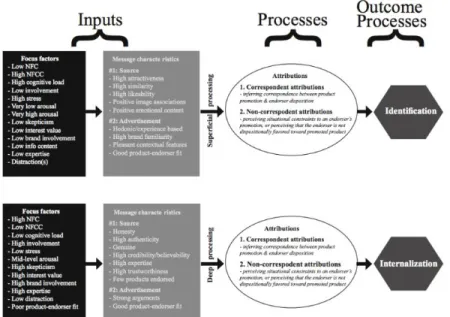
Kapitan and Silvera suggest a process in which inputs are processed via attributions consumers make about the endorser’s belief in the product. This results in outcomes of social influence first proposed by Kelman (1961): (1) identification with the message source through superficial mechanisms such as attractiveness and familiarity, and (2) internalization of the message content as consumers weigh an endorser’s authenticity and adopt the message as if it were their own. Endorser effectiveness is then positioned as a process that, given the correct procedure, results in influence (Kapitan & Silvera, 2016; Kelman, 1961).
Influence and opinion change arise following three different processes, according to Kelman (1961). Compliance is the most superficial, or surface level, variation of opinion change. This is where an individual changes their opinion with the purpose of acquiring a desired
outcome from a source. Identification processes are then based off the pursuit of becoming like the endorser or influencer, and therefore mimicking their behavior. Internalization is focused on the message, and when consumers do internalize a message it means they have been adequately allured by the content of a particular statement.
As the framework suggests (Figure 1), these processes are impacted due to particular situational characteristics. The processes are dependent on the consumer’s motivation, ability, and opportunity to decode the advertising message. Note that Figure 1 provides a representation of the types of characteristics that have been used in previous research; however, the list is not exhaustive (Kapitan & Silvera, 2016).
analyze the information (Petty & Cacioppo, 1986a; Petty & Cacioppo, 1986b). This prompts an individual to internalize the message and develop a set of strong, lasting, and easily operative attitudes (Kapitan & Silvera, 2016).
In the internalization process, consumers knowingly accept an influencer’s thoughts and belief system as their own (Kelman 1961). “For internalization to occur, therefore, consumers must be cognitively engaged with the message and endorsers must be perceived as believable, honest, and credible. When consumers internalize the endorsement messages authentic others bear, they are more likely to form strongly held attitudes that are highly accessible, that influence behavior, and that persist over time,” Kapita and Silvera (2016) reiterate (pp. 558-559).
Consumers with higher levels of motivation, more engagement within the category and a thirst for knowledge are more likely to mindfully interpret an advertising message. In doing so, they also rely less on superficial source attributes and possibly internalize the message (St. James, 2004). Not only do the consumer’s individual traits influence the digestibility of a message but also the number of persuasive sources used in the messaging.
The use of varied versus non-varied claims and decision complexity foster a more
Figure 1. An attribution-based framework for internalization. Kapitan, S., & Silvera, D. (2016). From digital media influencers to celebrity endorsers: attributions drive endorser
effectiveness. Marketing Letters, 27(3), 553-567. doi:10.1007/s11002-015-9363-0
Summary of the Study
It is evident that women have particular preferences and unique needs for their financial situations and educational practices. The target market needs to be communicated with, for educational and actionable measures, where they feel most comfortable. (Hira & Loibl). As previously mentioned, 77% of consumers take action following an earned endorsement or recommendation from family, friends or from online user reviews (Neilsen 2013). While
individuals may have first desired simple information from an endorser, the forged connection to his or her authenticity and influence can become the foundation for an emotional connection over time (Valenzuela, Park & Kee, 2009). If we know how people become influential in
Methodology
This study will explore the opportunity to alter the way that young women, ages 22-29, interact with their finances, and in particular, if influencers have the capability to do so. After reviewing what is known already about women’s dissatisfaction with financial education, this research will utilize a qualitative study design to explore the main research question (RQ) and four sub-questions (SQ):
RQ1: How do we change the way that women interact with their financial education programs?
SQ1: What techniques do social influencers utilize in the beauty and fashion industries to develop authentic and powerful relationships with their viewers? SQ2: How do influencers or micro-influencers fit into financial education, and could they allow young women to feel more confident when interacting with their personal finances?
SQ3: How do women respond to financial advice relative to the age of the instructor?
SQ4: How do young women (22-29) prefer to engage in financial education programs and through what platforms?
Selection of Qualitative Methodology
question. Codes then become the foundation for themes, which contain the larger patterns of meaning united by a central core idea (Clarke, Braun, 2017). An important component of this research method is its flexibility. TA can identify patterns within and across data, in connection with participant experiences, views, perspectives, behavior and practices. The method seeks to gain insight into what participants’ think, feel and do. It also can be applied within a framework, to clarify patterns within personal or social meaning around a topic, and to discuss and question those implications (Clarke & Braun, 2017).
Procedure
In order to analyze the potential of social influencers on the financial education sphere, this study will begin with the analysis of the top three beauty and fashion bloggers. Forbes’ top beauty and fashion bloggers will be considered to create a framework for a possible thematic analysis of financial bloggers, to begin to isolate the traits with which they successfully attract and retain the attention of young women.
Case Selection: Fashion
Fashion influencers were selected based on the following criteria: (1) Utilize a blog, (2) Frequency of their posts, and (3) Demographics. Using Forbes’ list of Top Influencers of 2017: Fashion, the first criterion for selecting influencers was if they utilize a blog to communicate with their followers. This guideline was used in order to ensure comparability when cross
interaction have to include a blog. After reviewing the names and associated blogs, nine influencers were identified.
To further refine the channels for inclusion in this study, blogs were analyzed focusing on the frequency of posts. The parameter for this study of at least 52 posts per year, or once a week, was based on suggestions that individuals should maintain consistency in sender-receiver
message functions (Abidin & Ots, 2015; Booth & Matic, 2011).
The final criterion focused on demographics. As the point of this study is to change the way that women interact with their finances, it was necessary to limit the geographic regions of the influencers to one location. This framework was set in an effort to reduce the disparities between culturally specific definitions of financial literacy. The blogs were confined to those where the fashion influencer had lived in the United States for at least 10 years. Other studies involving social influencers have included this criterion in order to ensure that endorsers engage in understandable cultural practices (Gnegy, 2017). Of the four blogs remaining, each social influencer had lived in the United States for at least 10 years.
In reviewing the four remaining blogs it was noted that Danielle Bernstein and Aimee Song had been on other Forbes’ top influencer lists – one the previous year and the other in a different category. Also, of the four remaining bloggers Bernstein, 25, and Song, 30, had the largest age gap, which could provide insights into communication styles and preferences of the different age cohorts.
Case Selection: Beauty
criterion was if the individuals used a blog to communicate with their followers. After screening for this characteristic, there were five bloggers remaining. Then, blog post frequency was screened, leaving Huda Kattan and Michelle Phan. Further screening demographics and people who had lived in the United States for at least 10 years (due to the culture-focus of this study), left only with Michelle Phan in this category.
Case Selection: Personal Finance
For the financial bloggers, Kiplinger’s list of the “10 Personal Finance Blogs Worth Reading” was used (Huddleston, 2012). To screen the list, similar criteria was utilized as with the beauty and fashion influencers. As the first criterion was having a blog, all ten authors were left. To further refine the bloggers, their blog frequency, of 52 posts per year or one per week, was analyzed. If the posts did not contain dates, they were eliminated because there was no way to track how many posts have been written in a year. Based on this criterion, five blogs were eliminated.
Sample Description
With the results of this analysis in mind, a focus group was conducted comprised of female graduate students at the University of North Carolina at Chapel Hill. The decision to use graduate students was based on their capacity to learn. In order to be admitted into graduate school, or advanced degree programs, individuals must pass complementary exams. A number of graduate students have previous professional experience that may have exposed them to the topic of financial literacy. These students will soon be departing school and launching their careers and thus are likely to be more financially independent than undergraduates.
The cohort is committed to various fields and subjects as demonstrated by their commitment to furthering their education. However, they may have neglected or ignored enhancing their financial literacy. The proposed study aims to uncover whether preventative barriers exist (either internally or externally), which prohibit these women from expanding their financial education, and if so, what those are.
A mixture of methods were used in the research study. In addition to the focus groups, a survey was distributed to UNC – Chapel Hill alumnae and online master’s students at the
university – still within the targeted groups of women ages 22 to 29. This contributed input from individual’s in full-time jobs, with some furthering their education at the same time.
Rooij, 2017). They found not only are female respondents less likely to answer financial literacy questions correctly, but they are also more likely to state that they do not know the answers to the questions. Equally important, they found a persistent literacy gap independent of age, even with younger women’s higher education levels and labor force participation rates (Bucher-Koenen, Lusardi, Alessie, & Rooij, 2017).
An IRB application was completed and submitted in January. In the UNC – CH graduate student focus groups, two groups of five were used. Ideally, a focus group should have six to 12 participants; groups with fewer than six participants tend to reveal less meaningful information (Gibbs, 1997; Stewart, Shamadasani & Rock, 2007). More focus groups are needed when the questions are complex (Stewart, Shamadasani & Rock, 2007). Due to the nature of this study, and the collection of more personal information, two focus groups were conducted from the UNC – CH graduate pool with a population of 30.
Results: Thematic Analysis
There is a plethora of research available stating the preferences of women for both brands and their financial advisors. Women investors want to know they are working with someone who understands and listens to them - they want to talk to a woman (Riggs, 2012). It has also been
In examining the beauty and fashion blogs of Danielle Bernstein, Aimme Song and Michelle Phan compared to the personal finance blogs titled Get Rich Slowly, Money Crashers and The Simple Dollar. Five factors seemed to separate them in terms of audience engagement. The fashion and beauty blogs developed: a connection to their readers, the opportunity to look up to someone or something attainable, a relaxed and intimate tone; a personal connection; and they presented a diverse archive of content.
First, the beauty and fashion bloggers seemed more connected to their audience. The blogs of both Danielle Bernstein and Aimme Song provided their audience with not just a brand but a story. Although the financial blogs provided a short about me section, the beauty and fashion bloggers continued to incorporate themselves in further articles. This allows the reader to feel a continued connection with the author/brand as they immerse themselves in the content over time. This is pertinent to women because trust is vitally important to women in any aspect of their life as has been noted in this research.
Women tend to prefer to weigh qualitative means more heavily when selecting a financial advisor, as 61% cite a feeling of trust and respect as the top factor, while men focus on
performance. Women also typically tend to continue their trust through turmoil (Mishra & Matilda, 2015). These bloggers could post something that the reader does not agree with; however, if they have provided women with a feeling and atmosphere that facilities trust they will ride out this patch with them.
might be challenging, when you manage to recruit trust of women they will stick with you (Hall). In the beauty and fashion blogs for example, Danielle Bernstein provides readers with her
experiences on travel, beauty and other lifestyle counterparts. This holistic approach to education her followers allow them to trust her opinion on subjects that they did not necessarily seek her out for in the beginning.
Another difference between the beauty and fashion bloggers and the financial bloggers was their ability to provide women with a figure that they can strive to emulate, someone that they can actually become. Danielle Bernstein, 25, and Aimee Song, 30, are not only standouts in their industry, but their accomplishments are not outside the realm of possibility for their readers. They provided their readers with a lifestyle and goals that are attainable. It is hard for the
majority of young females to see someone of the opposite gender, outside of their age range, with different personal goals to look up to or want to work to become. For example, a majority of the financial education blogs have segments on saving for children, but for young adults in their 20s that information might distance them from the source.
Not only are the age, genders and goals different on the financial blogs different, but they have multiple authors. You never have the ability to connect with a person, which leaves you less likely to feel committed and empowered to follow through with their instructions or dissect their teachings.
indicate they trust "no one" when it comes to advice about money, making it the second-most common response (Fidelity’s Millennials & Money Study).
With the abundance of information and resources available to individuals today, when young people ask for advice they are not just looking to you for an answer but the best answer that is most tailored to their needs. Throughout the financial blogs there were small elemental jokes that made it seem like the reader is being undermined or treated with assumed little intelligence. This also is further articulated by the difference in age and gender in the financial blogs, as women are now more aware of gender stereotypes.
Today’s generations are more informed than ever before and due to that they are more entitled than previous generations. That means that communication styles and tactics matter more than ever. According to world-renowned gender communication expert Deborah Tannen, men speak to determine and achieve power and status. Women talk to determine and achieve connection. (Shore, 2017). This difference in communication tactics can be seen in the writing of the bloggers. Although the topics are different the qualities noted above can be observed in the pieces.
When Bernstein is recommending clothes, movies and various other products, she is employing colloquial language and trying to develop a conversation with her readers. Although extremely informative, the financial blogs are not as inviting. They are pushing their intelligence onto their readers, but with nothing to relate or respond to. They present the facts, which
Survey Results and Focus Group Insights
The survey was distributed to UNC – CH alumnae and online master’s students at the university – still within the targeted groups of women ages 22 to 29. The survey was distributed on March 5, 2018, and closed on March 18, 2018. Three hundred and sixty-four individuals participated in the survey.
P-Value
While determining the P-value, and significance of interpreting this data onto a population, a cross-tabulation of the question identifying if one is in charge of their finances (yes, sometimes, no) and why one seeks out financial education (interest, in-charge of household finances, investment tips, feel like I have to). The P-value was 0.03, which is statistically
significant as it is less than 0.05. However, the P-values ranged and some showed to be very high, likely due to the homogeneity of the group, and the ability for the information to be projected onto further populations.
Two Types of Trust – Through Personal Connection and Expertise
Respondents were presented with a series of questions asking their levels of agreement with various statements (one being strongly disagree, seven being strongly agree).
Please state your level of agreement with the following statements:
Mean (Scale 1-7) Classification
I seek out financial advice because I feel connected to my advisor/teacher
3.72 Somewhat Disagree
I seek out financial advice because it allows me to look up to someone
3.21 Somewhat Disagree
I seek out financial advice because the person speaks on terms I can understand
5.28 Somewhat Agree
I seek out financial advice to hear personal anecdotes
4.39 Neither Agree Nor Disagree
I seek out financial advice because my advisor/teacher knows what is important to me
4.77 Neither Agree Nor Disagree
I seek out financial advice because my advisor/teacher is on top of current trends
5.10 Somewhat Agree
I seek out financial advice because my advisor/teacher has the ability to relate to me
5.03 Somewhat Agree
neither agree nor disagree classification. Respondents dissented the most with they seek out financial advice because they feel connected to their advisor/teacher and it provides them with someone to look up to, with mean scores of 3.72 and 3.21.
The question was then filtered to only include respondents who selected that they seek out financial advice or tips once a month, two to three times a year or less than once a year or never.
Please state your level of agreement with the following statements:
Mean (Scale 1-7) Classification
I seek out financial advice because I feel connected to my advisor/teacher
3.36 Somewhat Disagree
I seek out financial advice because it allows me to look up to someone
2.61 Disagree
I seek out financial advice because the person speaks on terms I can understand
4.93 Neither Agree Nor Disagree
I seek out financial advice to hear personal anecdotes
3.94 Somewhat Disagree
I seek out financial advice because my advisor/teacher knows what is important to me
4.13 Neither Agree Nor Disagree
I seek out financial advice because my advisor/teacher is on top of current trends
4.23 Neither Agree Nor Disagree
I seek out financial advice because my advisor/teacher has the ability to relate to me
4.33 Neither Agree Nor Disagree
relate jumped in rank of statement importance; however, the mean score of 4.33, neither agree nor disagree, and a standard deviation of 1.62 was again slightly lower than for the previous group. This group then responded to an advisor who is on top of current trends with a mean of 4.23, neither agree nor disagree, and a standard deviation of 1.57 and someone who knows what is important to them with a mean of 4.13, neither agree nor disagree, and a standard deviation of 1.68. Both of these statements fell within the neither agree nor disagree selection while they fell within the slightly agree category for the “weekly” group. This may be due to people who engage with their finances more frequently are ready to stay on top of trends, while the other group is still just trying to start engaging with their finances and do not want to take on too much information. The statement I seek out financial advice to hear personal anecdotes had a mean score of 3.94 and a standard deviation of 1.75 and the statement I seek out financial advice to feel connected to my teacher/advisor had a mean score of 3.36 and a standard deviation 1.80.
Although both of these statements fell within the somewhat disagree category, the responses varied with a high standard deviation. This may be due to the fact that this group has not experimented with a lot of different financial communication styles so they may be clinging to what they are familiar with.
These lower mean scores, higher standard deviations and seemingly impartial opinions on the various statements may be related to the fact that these individuals do not interact and engage with their personal finances as often as the “weekly” group and are less familiar with the
characteristics they prefer for this kind of information.
Women’s Fear of Manipulation Proves Challenging for Finding Expertise and Trust in an Advisor
The history of wrongdoings toward women in society have been continuously deployed on this demographic, women aged 22 to 29. In response, women feel as though they are being manipulated in various aspects of their lives, especially when it comes to their personal finance.
The survey then moved on to understand the beauty and fashion communication
preferences for these women. In question nine, participants were asked what is most important to them in a beauty/fashion mentor with the answer choices being confidence, credibility, expertise, reliability and trust. For this group, 50.61% of respondents said that for their beauty and fashion information relatability is the most important factor. This was followed by expertise with
20.82%. When compared to the same question for financial advisors specifically, credibility was the most important factor with 45.42% followed by expertise 26.69% and trust with 20.32%. This pool sees a difference between credibility and expertise. In the focus groups, respondents highlighted that they do not want to hear from someone wearing a suit that creates the impression that finance is their life, as that does not match their own lifestyle or values.
12.82% ranked trust as the most important attribute, while 21.70% of the other population believed it to be the most important factor. This point is similar to the focus group discussion. The women continued to bring up the idea that men are always trying to deceive them, especially when it came to cars, finance and insurance. However, once these women had engaged with their finances more frequently, trust was less important, as their confidence increased, and they felt more capable to recognize and navigate advice they were being provided.
The Confidence in Beauty
The confidence and familiarity women feel in the beauty industry translates to their pursuit to stay up to date with current trends. The lack of these traits in dealing with their finances keeps these women from feeling that their financial goals and education are attainable.
In question 10, respondents were presented with the same series of questions as question four asking their levels of agreement with various statements, but now for their beauty and fashion advisors (one being strongly disagree, seven being strongly agree). Feeling personally connected to an advisor and having someone to look up to, like the financial advisor statements, again had the lowest mean scores. For those respondents who seek out financial advice weekly, their advisor being on top of current trends had a mean score of 5.00 and a standard deviation of 1.88. Not only is it the most important factor for them, but also for those who do not seek out financial information weekly with a mean of 4.70 and a standard deviation of 1.69.
with them in other industries in their lives. At a young age, society hands young girls Barbies and dolls to play with, which inevitably allows them to feel more at ease around the topic. In the focus group, even if beauty and fashion were not relevant or large components of the women’s everyday lives, they all felt comfortable discussing them.
Another characteristic that jumps in importance for the non-weekly finance consuming respondents, compared to their answers for personal finance advisors, is the teacher’s ability to relate to them. For beauty and fashion advisors, the mean score is 4.30 with a standard deviation of 1.71. In terms of mean scores, this was the second most important for this group of
respondents. In the focus group, women noted that because they feel comfortable and
experienced with fashion and beauty they feel confident in perusing the plethora of information online. This gives them the ability to seek out someone that relates to them and shares their same outlook and principles on beauty and fashion. This allows them to seek out more specific and tailored advice as they understand their own preferences.
The Misconception of Personal Connection
Women value personal connection in other areas of their life; however, they do not believe this level of intimacy is attainable in personal finance. Therefore, in seeking out financial advisors they do not have a personal connection and are less likely to seek out further
information continually.
Do you have an easier time taking advice from someone that…
Mean (Scale 1-7) Classification
Has the same communication style as you
5.77 Somewhat Agree
Understands you personally 5.81 Somewhat Agree
Understands your interests 5.91 Somewhat Agree
Provides personal examples 5.66 Somewhat Agree
Is your same gender 4.91 Neither Agree Nor Disagree
Is in your same age range 4.72 Neither Agree Nor Disagree
Speaks to your level 5.38 Somewhat Agree
Is a different gender 3.21 Somewhat Disagree
Is in a different age range 3.49 Somewhat Disagree
Has authority 4.74 Neither Agree Nor Disagree
Years of expertise 5.26 Somewhat Agree
Someone that understands one’s interests had the highest mean score of 5.91, somewhat
agree, and a standard deviation of 0.94. This was followed by someone that understands you personally with a mean of 5.81 and a standard deviation of 1.14. An advisor or person who shares the same communication style as one had a mean score of 5.77 and 0.88 then followed. In looking at these characteristics, they revolve around being personally connected to an individual. However, it is interesting to note that for financial advisors for both the weekly and non-weekly financial advice seekers I seek out financial advice to feel personally connected to my
The statement regarding the ability to take advice from someone who used personal examples had a mean score of 5.66, still somewhat agree, with a standard deviation of 1.08. This seemingly contradicts the results provided for financial advisors specifically, as the advisors who include personal anecdotes did not receive a high mean score of agreement from respondents. In the focus group, respondents continually discussed how personal finance was always framed as a taboo subject in our culture and something that is extremely personal and private. This
discrepancy in the importance of this characteristic could be because these women don’t expect anyone to ever provide them with their own personal examples so they do not seek it out as much as they do for other industries. The ability to speak to one’s level had a mean score of 5.38 and a standard deviation of 1.13 and years of expertise had a mean score of 5.28 and a standard deviation of 1.13.
Years of expertise had a mean score of 5.28, somewhat agree, while authority had a mean score of 4.74, neither agree nor disagree. Although these mean scores are similar it highlights that women interpret expertise and authority differently. In the focus group, women outlined scenarios in which they asked for financial advice and were typically provided with a series of “must-dos” rather than a list of options. These women understood that they intentionally opened themselves up for critique and advice, but they did not want the individual to tell them what they must do. They stressed the need to ask questions and seek out information to one day be able to make these decisions on their own. This may be why someone with expertise appealed more to the survey respondents rather than someone with authority.
disagree, with a standard deviation of 1.05. In the focus group, a participant explained that she trusted her mother and female figures in her life more for financial advice because they provided her with different option, but ultimately let her decide her next move. However, her father would provide an ultimatum, which she noted was usually correct; however, she wasn’t credited with being able to make the decision for herself. The ability to learn for oneself outweighed being instructed of the correct decision to make. It is an interesting juxtaposition that besides the above participant, all women detailed that they turned to their fathers for personal finance advice but would be more inclined to trust a women’s financial community or group. This detail may be because all participants were enrolled in graduate school and still relying on their parents for advice.
Foundational Knowledge Allows for the Use of Online Resources
A strong foundation of personal finance education allows women to look to online resources for support. They feel comfortable in trusting themselves to interpret the given information accurately. However, for those who engage less frequently with their finances they tend to turn to people because they do not yes trust themselves.
A portion of the survey was geared to understand through which outlets respondents consume their financial and beauty and fashion information. The question included a select all that apply option with the choices of books, blogs, family and friends, financial advisor,
podcasts, online videos and other. For financial information, when filtered to analyze the outlets used by those who seek out information weekly, the most selected answer choice was blogs, with 24.68% of respondents having chosen the option. This was followed by family and friends with 24.05%, financial advisors with 8.86% and online videos with 8.86%. Then, the question was filtered to include all respondents who do not consume financial information weekly. Family and friends was the most selected choice with 34.37% of participants. This was followed by blogs with 26.07%, financial advisors with 10.77% and online videos with 6.87%.
complicated. They feel comfortable doing that because they learned about the technique in person. One participant used makeup as an example. The respondent explained that she learned how to apply foundation in person at a Mac counter. She then turned to online resources to learn how to further contour her face and apply highlight as she felt confident in her baseline
knowledge.
With Less Knowledge Comes a Greater Pursuit for Personal Connection Not only do these segments look to different outlets for their personal finance information, but some characteristics garner a relative higher importance. Personable characteristics are more appreciated by the non-weekly finance engagers, while the weekly engagers continue to focus on the credibility and expertise. The non-weekly engagers appreciate the technical attributes of their advisors, but they need to feel a sense of connection and trust to open themselves up to something new.
Survey results also proved that the mentor characteristic preferences of the weekly and non-weekly groups are different in both beauty and fashion and finance. In question seven, respondents were asked what is most important to you in a financial advisor/mentor. Answer choices included confidence, credibility, expertise, relatability and trust.
What is most important to you in a financial advisor/mentor?
Weekly Engagers Non-Weekly Engagers
Confidence 0% 2.36%
Credibility 48.72% 44.81%
Expertise 33.33% 25.47%
Relatability 5.13% 5.66%
Trust 12.82% 21.70%
For those individuals who engaged with their finances weekly the mean was 2.82,
expertise was selected by 33.33%, trust 12.82%, relatability 5.13% and confidence 0%. For the respondents who did not engage with their personal finances weekly they had a mean score of 3.0, expertise, with a standard deviation of 1.21. Credibility was selected 44.81%, expertise 25.47%, trust 21.70%, relatability 5.66% and confidence 2.36%. For this group, the relative importance or selection of credibility and expertise went down while the selection or importance of trust, relatability and confidence increased in terms of percentages.
The same question, what is most important to you in an advisor, was then asked but for beauty and fashion mentors. The answer choices again included confidence, credibility,
expertise, relatability and trust. What is most important to you in a financial advisor/mentor?
Weekly Engagers Non-Weekly Engagers
Confidence 12.82% 16.02%
Credibility 12.82% 6.31%
Expertise 28.21% 28.21%
Relatability 43.59% 51.94%
Trust 2.56% 6.31%
Interest in Financial Success Affect the Factors Women Look for in Advisors
As the financial industry has been framed as a win or lose game, women who do not have a genuine interest in the subject are terrified of forfeiting it all. Therefore, in seeking out advice, trust is crucial to them in comparison to their counterparts who not only engage with the subject more frequently but have a passion for it.
In question one, survey participants were asked how often they seek out financial education. The question allowed them to select all answer choice that apply with interest, in-charge of household finances, and feel like I have to. When cross-tabulating that question with that asking participants how often they interact with their finances, but filtering it to only include those who selected having an interest in the subject the answers were interesting. Of those people who were interested in the subject, still only 20.43% engaged weekly. While 45.70% of
respondents engaged once a month, 30.65% two to three times a year and 3.22% never or once a year. For these individuals, 43.45% said credibility was their most important factor in a financial advisor and 33.79% said expertise. However, for those who did not include personal finance as an interest with a mean of 2.60, about two to three times a year, and a standard deviation of 0.63. 47.78% of respondents said they engaged with their finances about once a month, 44.03% about two to three times a year and 8.19% said less than once a year or never. For this subgroup, 48.11% of respondents selected credibility as the most important attribute. However, unlike the weekly engagers 26.42% of these participants picked trust, which was then followed by expertise with 16.98%.
personal finances besides paying off their debt and credit card bills. In the focus groups, women mentioned the need to go into an office when they first engage in a conversation with someone about their finances. A participant mentioned that one can’t form this trust from one personal visit. Going in person allowed the focus group participant the opportunity for her instinct to kick in and tell her to get out if she was being misguided. In both focus groups, all participants agreed that they needed to learn about something for the first time in person before ever considering looking to online information or trusting it enough to act upon.
Conclusion
The aim of this thesis has been to uncover communication strategies to alter the way women interact with their personal finance education. Women’s longer life expectancies, the higher divorce rates and the gender pay gap continue to be cited as critical motivation for women to become more engaged with their personal finances. Women value different qualifications and characteristics from their advisors when it comes to receiving advice in various fields to that of their personal finance. Expertise and credibility is important to all women; however, those that interact less frequently with their finances find trust to be more imperative in their learning endeavors. These women feel manipulated by the industry and need a personal connection with an advisor before they can seek out online sources.
Discussion
outlet for them to consume information is blogs. These women have a baseline knowledge of their finances and feel more comfortable with the jargon and concepts. This group trusts themselves to adequately navigate the industry and therefore do not demand personal contact with their instructor in order to feel capable of deciphering the information they receive.
For the other cohort, who does not digest financial literature and discussion weekly, seeking out information from friends and family is their primary outlet for this dialogue. This cohort needs the personal interaction in order to trust the person presenting them with the information. They do not feel capable of deciphering the information without someone sitting in front of them.
Whether it is beauty or finance, women need a personal connection or a strong
foundational knowledge before they are going to feel comfortable accepting information from various online sources. For women who do not interact with their personal finances often, they rely on their friends and family because there is a convenient trust that has already been formed. These people have the ability to understand one’s life seemingly better than any financial advisor or blog ever could. However, those who understand their financial situations, have a strong baseline knowledge that allows them to target specific information they are interested in.
In current financial communication research and in the literature review of this
with the most. That harmonious balance must be noted. Speaking to one’s level may not mean that these women want you to use dialect that imitates their everyday friendships. However, they also do not want their advisors to spurt out words that cause them further confusion. They prefer a seemingly challenging balance of speaking in terms one can comprehend while not dumbing down the information.
Women view trust and expertise equally. However, the juxtaposition between expertise and authority outlined in the survey results is more complex. Women value someone with expertise more highly than someone with authority. Through the focus group conversations, it is evident that authoritative habits and communication styles intimidate these women and get in the way of any foundational trust that might be able to develop no matter the accuracy of the
information provided. This group is aware of the societal constraints and stereotypes that have been put on their gender since birth, and maintain a “you vs. us” mentality. They are skeptical of those trying to make decisions for them as they believe they are being wrongly manipulated. Instead, these women want to be presented with the information and ask questions so they can develop the knowledge to answer the questions on their own. The freedom to make a decision for themselves is a large factor in the success of their educational relationships.
While credibility and expertise are extremely pertinent for women in embarking on their path to becoming financially literate or continuing their education pursuit, typically, the
Implications/Significance
In order to achieve the relationship that women are yearning for in their personal finance education, companies need to make an effort to meet personally with this group before engaging in online conversations. These women find it pertinent that they first meet with a financial advisor, and form that trust, before they engage in online activity frequently. It is improbable to believe that these companies have the human capital and financial resources to meet personally with every client. However, they could attempt to use Skype or hold seminars with their new clients to understand their situations and their current financial literacy. These could be
accompanied by an anonymous question box so that new clients could feel free to ask questions without feeling judged by their peers or instructor. Then, these companies could continue to engage with clients online and through blogs and e-newsletters.
Another opportunity for companies to accomplish the necessary personal connection is by implementing a program in which female instructors, disaffiliated with the school, attend college campuses and hold educational seminars for women about money. This would allow women to gain personal finance knowledge, have their questions answered and they may ultimately choose to invest their money with that teacher’s larger company. For example,
Vanguard could delegate some of its female employees to hold monthly seminars about personal finance.
seeking, typically comes from those who have worked on Wall Street. Women are looking for this information from individuals of their same gender and age range to provide them with the ins, outs and trends of the industry to make their own decisions.
Much of the conversation surrounding personal finance focuses on going to see a financial advisor. While women prefer to make that initial meeting in person, to frequently engage with a personal advisor as often as women should be thinking about their finances is unrealistic both for the time commitment and monetary reasons. These organizations need to focus just as much on promoting their blogs as they do their financial advisors.
Another communication strategy to get young women more engaged in their finances is to implement the information into educational programs for K-12 students. Students are required to learn math, science, language arts, social studies and their physical and health education. Why should students not be required to learn about their personal finance education? These women saw personal finance and the conversations surrounding the topic to be taboo, some of the most intimate information one could forgo about themselves. They feel judged in this industry more than any other aspect of their lives, which confidence coming from experience could help to overcome.
Limitations
Focus Group Size
challenging. Although this sample might be reflective of the small group of graduate students, it might not represent a larger population. In future research a larger, more diverse, pool of
participants may be used to increase the research representation of various populations.
Demographics of Focus Group vs. Survey
The demographics of the participants in the focus group and survey were different, which could have impacted some of the variations in answer selection and insights. Due to the fact that these populations had different demographic qualifications, it is hard to be sure what caused these similarities and differences. In the future, in order to better interpret and expand upon specific data points subjects with the same demographics should be used in the focus groups and surveys. This way the researcher can be certain that answers are not due to particular situational experiences of one group.
Homogeneity of the Group
The homogeneity of the group also proved to be a limiting factor in this research. The research was limited to female residential graduates, online graduates and alumnae of the UNC – CH School of Media and Journalism between the ages of 22 to 29. A majority of these
Future Directions:
To further examine the communication preferences of women in regard to their personal finance information a study could be conducted to uncover if short videos by various instructors had more of an impact on this group than blogs. Social influencers are taking over social media platforms with short-form videos in various fields, and the age group identified in this study may have been too removed from these platforms.
Ethnic differences may impact communication preferences in financial education. These
differences could be examined to see if alternative resources need to be constructed for the
various groups.
Another avenue that could be examined to further this research is determining if