December, 2011. 58 pages. Advisor: Dr. Sandra Hughes-Hassell
Multicultural literature refers to books by and about people of color. Since the 1960’s the existence of multicultural literature has increased, but not substantially. There is still a need for more books that provide positive and authentic portrayals of diverse people and cultures especially African-American males. Such positive representation can provide these males with a greater connection to the literature and greater reading achievement. In this study, a content analysis of books with African-American male protagonists from the Cooperative Children’s Book Center was conducted to illustrate the need for more quality multicultural picture books featuring African-American males.
Headings:
Children’s Literature
Children’s Literature/Evaluation/Multiculturalism African-Americans/Children’s Literature
THE REPRESENTATION OF AFRICAN-AMERICAN MALE PROTAGONISTS IN PICTURE BOOKS: A CONTENT ANALYSIS
by
Heather C. Cunningham
A Master’s paper submitted to the faculty of the School of Information and Library Science of the University of North Carolina at Chapel Hill
in partial fulfillment of the requirements for the degree of Master of Science in
Library Science.
Chapel Hill, North Carolina December 2011
Approved by
Introduction
I work at a small public library in the heart of an historic black neighborhood. Most of the patrons who frequent this library branch are African-American, and most of our collection is specifically tailored to this population's literary needs and demands. One afternoon as I was working at the children's desk, a library patron asked for popular children's book recommendations. I suggested books by Mo Willems and Dr. Seuss. This patron thanked me but said she really wanted some books that her son could identify with, books that showed young black males as the main characters. I was slightly
stupefied for a moment and realized that I could not give her a list of books off the top of my head.
I took her telephone number and began my search for children's books with African-American male protagonists. Just browsing the shelves I noticed that our library housed many books with white protagonists, some books with black female protagonists, and very few books with black male protagonists. I did, however, find a very helpful reference book titled Black Books Galore! Guide to Great African-American Children's Books About Boys (1998). With this book in hand I was able to pull quite a few good children's books off the shelves for this patron, but her question left me thinking about the importance of black male representation in literature. Is there enough multicultural literature representing this group and are they being represented accurately?
series for local school librarians that specifically targeted adolescent black males. The professional development series was focused on closing the achievement gap for this group through literacy initiatives. The session information was based on the book
Reading for Their Life by Alfred W. Tatum. In his book, Tatum stresses the need for engaging texts that enable African-American males to connect to the literature which in turn, he argues, helps them develop more positive relationships, a more positive life trajectory, and improved lives (A. Tatum, 2006, p. 55)
Tatum's focus is geared towards adolescent males, but in this particular
professional development series, we focused on younger male children as well. The goal was to provide texts that black males could identify with, texts that recognized their unique history and culture, texts that were engaging. Librarians then discussed these texts with students in such a way that they could participate fully in the reading process and make personal connections with the reading material. The informal results of this initiative provided evidence that the students were indeed more engaged with reading when the books they read and discussed were culturally relevant. The students developed a connection with the texts and actively participated in the reading process, something that did not often occur. The important fact to note is that all of these texts were titles that featured black males.
Thus it is clear that multicultural literature that features black males has a place on library shelves. The need is there, but how well is that need currently being met? In this study, I delved into this issue by examining picture books written by and about African-Americans1 and recommended by the Cooperative Children’s Book Center (CCBC)
1
Literature Review
Multicultural Literature
According to the CCBC, "there is no single definition of the term 'multicultural literature'… [however] the term [is often used] to mean books by and about people of color” (CCBC, 2011). The idea of multicultural literature has been around since the 1960’s. Before this time the majority of children’s books published in the United States contained only white characters as shown in a study by Nancy Larrick (Hughes-Hassell, 2010, p. 215). Larrick analyzed over 5,000 children’s books published between 1962 and 1964. The results of this study showed that only 6.6 percent included one or more black character (Hughes-Hassell and Cox, 2010, p. 215). Almost two decades later, Rudine Sims Bishop conducted another study to determine how the portrayal of blacks in children’s literature had changed. Bishop found that the percentage of books including blacks had increased but “many of the representations continued to be stereotypical and negative” (Hughes-Hassell and Cox, 2010, p. 215).
1985 when the CCBC first began to document the number of books published by or about African-Americans; in 1985 an estimated 2,500 books were published for children and teens with 18 created for African-Americans (CCBC, 2011). These statistics show that although the number of multicultural titles published each year is increasing, there is still a need for more children's books by and about people of color. It is also interesting to note that the numbers cited for books by people of color do not represent the number of individual book creators. A single individual may have written or illustrated more than one title (CCBC, 2011).
Children receive messages through the literature they read about who they are and what they can become in society; both self-concept and self-esteem develop from the interaction of these messages (Hughes-Hassell and Cox, 2010). It is important for children of color to see themselves in what they read, so that they receive positive messages about their racial identity and self worth. As Hughes-Hassell and Cox state, “countering the story of white superiority is critical to the positive growth and
cultural understanding, as "good literature can reflect many aspects of a culture - its values, beliefs, ways of life, and patterns of thinking" (Lu, 1998, p. 2).
Multicultural literature, however, does not just mean that characters of color are present. The culture of the minority group needs to be accurately portrayed as well for a true reading connection to be made. It is important for the author to present an authentic portrayal of the culture, while still producing a developmentally appropriate, quality children's book. Barksdale-Ladd and Heflin (2001) make the statement that, "very few books with African-American protagonists are published for children" (p. 813) and out of these books, not all of them may be high quality works of literature. When selecting multicultural literature, it is important to look not only for diversity of race in the characters but also an accurate portrayal of the selected culture. Multicultural literature should be selected for quality of plot development, character development, setting, themes, style, as well as the multicultural content (Reddish, 2000). Lu gives a list of guidelines for selecting multicultural literature for the elementary classroom based on recommendations from various language arts and multicultural educators:
1. Positive portrayals of characters with authentic and realistic behaviors, to avoid stereotypes of a particular cultural group.
2. Authentic illustrations to enhance the quality of the text, since illustrations can have a strong impact on children.
3. Pluralistic themes to foster belief in cultural diversity as a national asset as well as to reflect the changing nature of this country's population.
4. Contemporary as well as historical fiction that captures changing trends in the roles played by minority groups in America.
5. High literary quality, including strong plots and well-developed characterization. 6. Historical accuracy when appropriate.
7. Reflections of the cultural values of the characters.
All of these criteria are important aspects of developing a quality work of multicultural literature.
Black Males and Reading
The relationship between black males and reading is especially significant. The National Assessment of Educational Progress's [NAEP] assessment of reading in 2009 showed that 4th graders in the U.S. had an average reading score of 220; the average score for Blacks was 205. For 8th graders, the average score in the U.S. was 262; the average score for Blacks was 246. For 12th graders, the average score in the U.S. was 284 and the average score for Blacks was 269. In both the 8th and 12th grades, Blacks scored the lowest of all the racial groups, and in the 4th grade Blacks and Hispanics tied for the lowest score of 205, with the highest score being 235 (NAEP, 2011).
Based on dropout statistics provided by the NAEP, the dropout rate in 2009 was 8.1% of students age 16-24. Out of this 8.1%, 5.2 were white, 9.3 were Black, 17.6 were Hispanic, 3.4 were Asian/Pacific Islander, and 13.2 were American Indian/Alaska Native (NAEP, 2011). Thus the majority of high school dropouts are people of color, 43.5%, while the white majority group represents only 5.2%. These statistics show that there is a disparity in the reading achievement and academic success between whites and people of color, specifically blacks. Could these statistics be related? Are poor reading
performance and high dropout rates among children of color somehow connected to the lack of quality multicultural literature published each year?
reading instruction. He gives the following specific suggestions to encourage males to read:
1. Use male-oriented texts with male characters (as opposed to more female oriented texts).
2. Use texts that are apt to engage boys emotionally with the characters, that deal with issues boys care about, and that honor their identity.
3. Expose boys to nonfiction that involves learning something new. 4. Use texts that legitimize the male experience and support boys’ view of
themselves. (Tatum, 2005, p. 11).
To further develop this idea, Tatum expanded his research to include a focus on black males and reading, identifying risk factors for this group as well as proposing solutions to close the reading achievement gap. One main point he makes is that “positive images of black male readers are hard to find, whether one looks in books, on television, or in professional research” (Tatum, 2005, p. 13). This lack of positive images not only affects black males’ relationship with reading, but also the way teachers and the broader society view black males and their relationship with reading; that most adults believe that black males do not and will not read.
Tatum focuses on black males who are learning to read amid a challenging, hostile environment because of the effect increased reading achievement and literacy development can have for these youth. Increased literacy and reading achievement can lead to greater opportunities such as higher levels of college enrollment and lower levels of crime, unemployment, and incarceration (Tatum, 2005, p. 15). To address these concerns, Tatum writes of engaging black male readers with meaningful literacy
instruction that nurtures their resiliency and encourages them to value the written word. This means using texts that black males can relate to, books that offer shared experiences, and serve as a road map to “sidestep the turmoil” they may be experiencing (2005, p. 21).
In the book, Why are All The Black Kids Sitting Together In The Cafeteria?, Beverly Daniel Tatum discusses the need for multicultural literature based on the fact that racism is alive and well today. She defines racism as a system of advantage based on race (1997, p. 7). Using this definition, she gives examples of how people of color do not receive the same advantages as those who are white based on a history of prejudice in the United States. She writes that, "the impact of racism begins early. Even in our preschool years we are exposed to misinformation about people different from ourselves” (Tatum, 1997, p. 3). One clear example is the lack of people of color in the literature. As Hefflin (2004) states, to read for years and not encounter stories that connect closely with one's own cultural understandings and life experiences is problematic… If teachers continually present African-American children with texts in which the main characters are
predominantly animals and white people, it stands to reason that these children may begin to wonder whether they, their families, and their communities fit into the world of
The effect of seeing oneself in what we read is tremendous. It helps children shape an understanding for the world around them and to see their place in that world. Some may wonder if focusing on the needs of a specific group is truly beneficial or necessary based on the idea that all children, students, or individuals should be treated equally. Alfred Tatum addresses this belief by discussing the existence of a false dichotomy in which educators, administrators, and parents fear focusing on certain texts geared specifically for African-American males because of a backlash that might occur from white parents and students (2009, p. 61). He writes that “...switching the focus to the literacy needs of all students prevents or obscures the literacy development of certain
students. The literacy development of the collective cannot be addressed without addressing the literacy development of the individual” (Tatum, 2009, p. 61).
Tatum also discusses the false belief that African-American students devalue reading. He proves this untrue many times through personal statements from African-American males about the excitement particular texts evoked. As he states, “...I have not seen them devalue reading when the texts are interesting and provocative. This suggests that these young men do not devalue reading but devalue what they are required to read or how literary and nonliterary texts are mediated. This is an important distinction” (2009, p. 27). When black males are presented with texts they can relate to, they become more interested and invested in what they are reading.
Connecting to the Literature
their cultures and roles in society…When children read books that are interesting and meaningful to them, they can find support for the process of defining themselves as individuals and understanding their developing roles within their families and
communities” (p. 810). When children see themselves and their culture reflected in what they are reading, they form a stronger connection with the characters and the book. With this connection, children are more likely to develop a desire for reading and a positive sense of self.
Ferdman (1990) concurs stating: Literacy…touches us at our core in that part of ourselves that connects with the social world around us. It provides an important medium through which we interact with the human environment. For this reason, a consideration of the relationship of literacy and culture must be a fundamental component of any analysis of literacy and the individual (p. 181). Through the connection of literacy and culture, the individual is able to form a stronger relationship with literature, thus forming a stronger relationship with reading and all the positive effects thereof.
reading is “one of the most important skills that young people can acquire and develop throughout their lives” (2011).
Research has also shown that attitudes toward reading do have an effect on achievement level (Diamond, 2001). In a study investigating reading achievement and attitudes in 1,968 kindergarten through fifth graders, the following results were found: there was a small yet statistically significant relationship between reading achievement and attitudes toward reading, ethnic differences in reading achievement were present with African-Americans exhibiting lower levels of achievement than whites, gender
differences were present favoring females, and less positive attitudes toward reading started at the fourth grade level (Diamond, 2001). When children are presented with books they can connect with on a more personal level, positive attitudes result, thereby creating greater reading achievement. If such positive attitudes are developed and
fostered at an early level, perhaps the reading achievement gap can finally be eliminated. The development of self-esteem and self-concept presents yet another positive reason for reading because through this medium, children construct messages about who they are and where they fit as individuals in society (Hefflin & Barksdale-Ladd, 2001). “When readers frequently encounter texts that feature characters with whom they can connect, they will see how others are like them and how reading can play a role in their lives. A love of reading will result” (Hefflin & Barksdale-Ladd, 2001, p. 810);
Barksdale-Ladd (2001) write, many stories with African-American characters, “say little about African-American culture, or they present only the history of African-Americans as slaves without including any ‘nonslavery’ or modern representations” (p. 810). It is important for African-American children to see themselves in a positive light, so that they do not experience a sense of isolation within the world of books. The connection
between reading and self-concept is outlined very poignantly through the following quote from a third grader:
...nothing against white people, but you like to see blacks because [white authors] portray black people like they don’t got no manners or nothing. And white people, they know everything and they get a good education. But that’s not always true cause the black people, they get a good education too. But they portray us as not having any manners. When you see [black] people like that, [white] people think that we’re stupid (Marisa).
(Hefflin & Barksdale-Ladd, 2001, 811).
Reading does affect children deeply because they are presented with characters and situations that they relate to their own lives. If their culture and selves are reflected in a negative or inaccurate way, this is how they will perceive themselves and in turn be perceived by others.
Methodology
For this paper, a content analysis of a subset of the multicultural books
of children’s and young adult literature (CCBC, 2011). Content analysis is defined as “a technique for gathering and analyzing the content of text” (Neuman, 2007, p. 227). The books in the study sample were analyzed based on themes and characters to determine the portrayal of black male protagonists in the literature. The content of each book was analyzed based on predetermined criteria from past research on multicultural literature.
Sampling
A sampling of books from the CCBC was used for the analysis of how black male protagonists are represented in multicultural literature. This sampling was obtained from the CCBC’s searchable database of multicultural literature. Books are selected for inclusion in the database based on the CCBC’s Choices list, an annual best-of-the-year selection that is made by librarians and staff from the CCBC. These books are selected based on accuracy, authenticity, engaging text/storyline, and quality of prose (M. Schliesman, personal communication, September 27, 2011). The database does not include all multicultural picture book titles, only those that have been specifically recommended by the CCBC staff. The search categories Picture Books,
African-American, and Elementary Age were used, which resulted in 245 titles. These titles were then separated into books with male and female protagonists. The books with male protagonists were then analyzed based on the established set of criteria.
Unit of Analysis
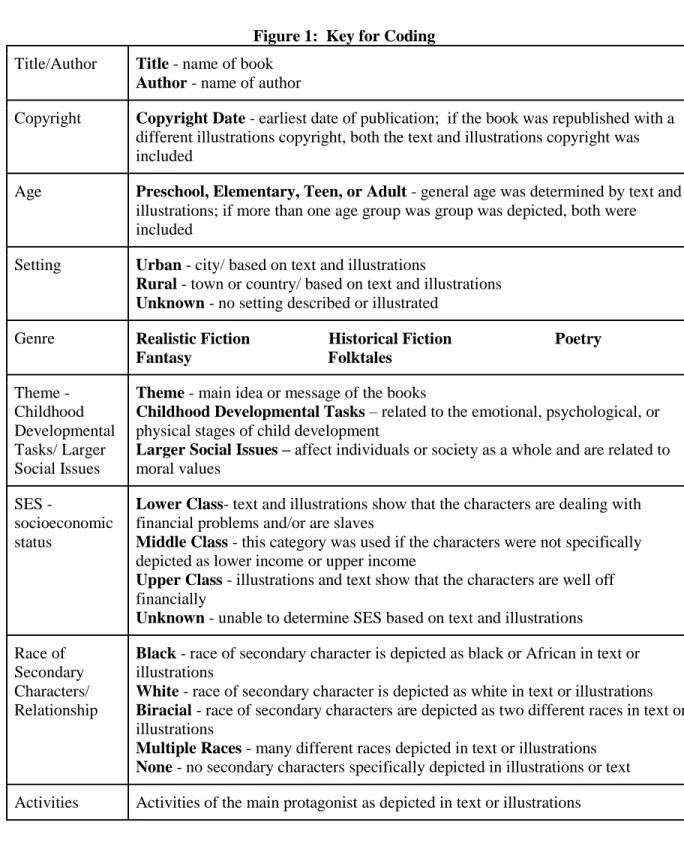
illustrations. Both were used to determine the following coding criteria: age, setting, genre, theme/childhood developmental tasks/larger social issues, socioeconomic status, race of secondary characters/relationship, and activities. The text and illustrations were analyzed together to obtain the most accurate results.
Categories and Coding
Figure 1: Key for Coding
Title/Author Title - name of book
Author - name of author
Copyright Copyright Date - earliest date of publication; if the book was republished with a different illustrations copyright, both the text and illustrations copyright was included
Age Preschool, Elementary, Teen, or Adult - general age was determined by text and illustrations; if more than one age group was group was depicted, both were included
Setting Urban - city/ based on text and illustrations
Rural - town or country/ based on text and illustrations
Unknown - no setting described or illustrated
Genre Realistic Fiction Historical Fiction Poetry Fantasy Folktales
Theme - Childhood Developmental Tasks/ Larger Social Issues
Theme - main idea or message of the books
Childhood Developmental Tasks – related to the emotional, psychological, or physical stages of child development
Larger Social Issues – affect individuals or society as a whole and are related to moral values
SES -
socioeconomic status
Lower Class- text and illustrations show that the characters are dealing with financial problems and/or are slaves
Middle Class - this category was used if the characters were not specifically depicted as lower income or upper income
Upper Class - illustrations and text show that the characters are well off financially
Unknown - unable to determine SES based on text and illustrations
Race of Secondary Characters/ Relationship
Black - race of secondary character is depicted as black or African in text or illustrations
White - race of secondary character is depicted as white in text or illustrations
Biracial - race of secondary characters are depicted as two different races in text or illustrations
Multiple Races - many different races depicted in text or illustrations
None - no secondary characters specifically depicted in illustrations or text
Activities Activities of the main protagonist as depicted in text or illustrations
book, both labels were included. If the category could not be specifically determined using one label, two labels were given. The category of setting was given as urban, rural, or unknown. Urban was used when the setting took place within a city, and rural was used when the setting took place in either a town or in the country. This category was largely determined based on the illustrations in the book. In the case where all of the illustrations occurred within a building or were abstract in nature, the setting was listed as unknown.
The genre of each book was determined based on popular reading genres. The genres included were realistic fiction, fantasy, historical fiction, poetry, and folktale. The category of theme/childhood developmental tasks/ larger social issues was determined based on the main idea or message of each book. Childhood developmental tasks were listed if the protagonist was engaged in activities that define normal childhood
development such as making friends, sharing, and dealing with emotions. Larger social issues were listed if there were larger social messages introduced within the content of the book; this included topics such as slavery, segregation, racism, or poverty.
The category of socioeconomic status, SES, was determined based on the social standing or economic class of the main character. SES was labeled as lower class,
The category of Race of Secondary Characters/ Relationship was determined based largely on the illustrations of each book. The labels for this category include Black, White, Biracial, Multiple Races, or None. Each label was determined largely from the illustrations of each book. The category of Activities was determined based on the actions of the main protagonist as depicted in the illustrations and text.
Validity and Reliability
The validity and reliability of any study using content analysis is based on using clear and consistent labels when coding the material. For this study, only one coder was used, so intercoder reliability does not have to be considered. The reliability of the study should be fairly consistent as I am the only coder of the material; however, the
subjectivity of using latent coding or semantic analysis does affect the reliability of the results. The categories for this study were created by one coder and were based on an analysis of text and illustrations. Latent coding also tends to be less reliable in general than other forms of analysis because it depends on the coder’s knowledge of language and social meaning (Neuman, 2007). Creating appropriate labels for the categories to be coded proved somewhat difficult based on the coder’s inexperience and a lack of
preexisting categories and labels. The reliability of this study could have been improved through the use of multiple coders.
recommended by the CCBC staff. This sample, however, can be considered a fairly good selection of children’s books published with African-American male protagonists as the CCBC receives 3,400 of the 5,000 children’s books published nationally each year.
Results
Age
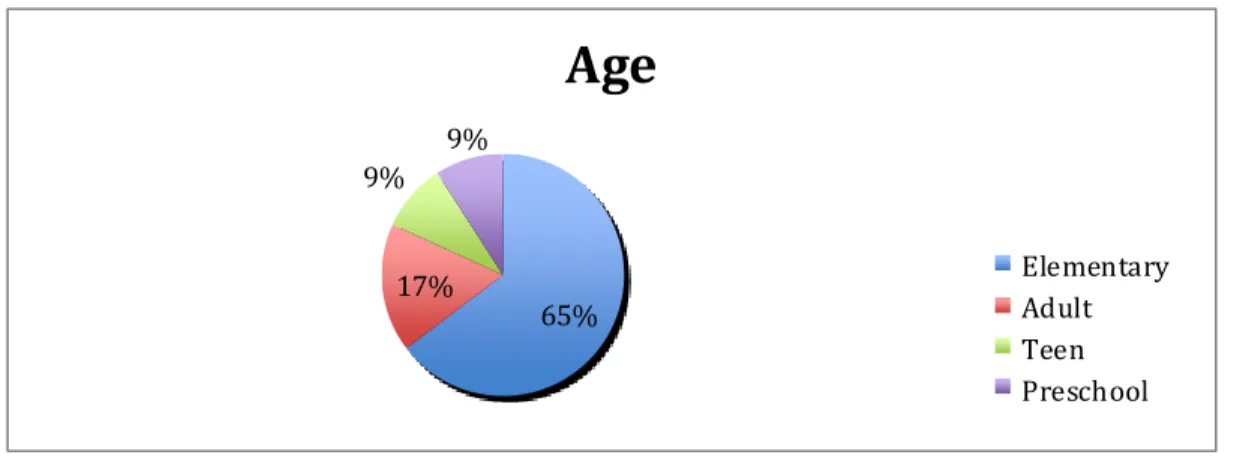
The age of the protagonists was determined based largely on the illustrations, but also from references in the text. Four main categories were used: Preschool, Elementary, Teen, and Adult. If more than one category appeared in one book, both were listed. As Figure 2 shows, the majority of the books featured elementary-aged protagonists.
65% 17%
9% 9%
Age
Elementary Adult Teen Preschool
Figure 2: Age of protagonists
Setting
for the purpose of analysis. Rural, which included small town or country, appeared to be the most predominant setting.
68% 32%
Setting
Rural Urban
Figure 3: Setting
Genre
As shown in figure 4, the books fell into five genre categories. The majority of the books were realistic fiction (43 titles or 54% of the books). Almost one-third of the books (23 titles) were historical fiction.
54% 29%
10%
5% 2%
Genre
Realistic Fiction Historical Fiction Folktale
Fantasy Poetry
Figure 4: Genre
Theme
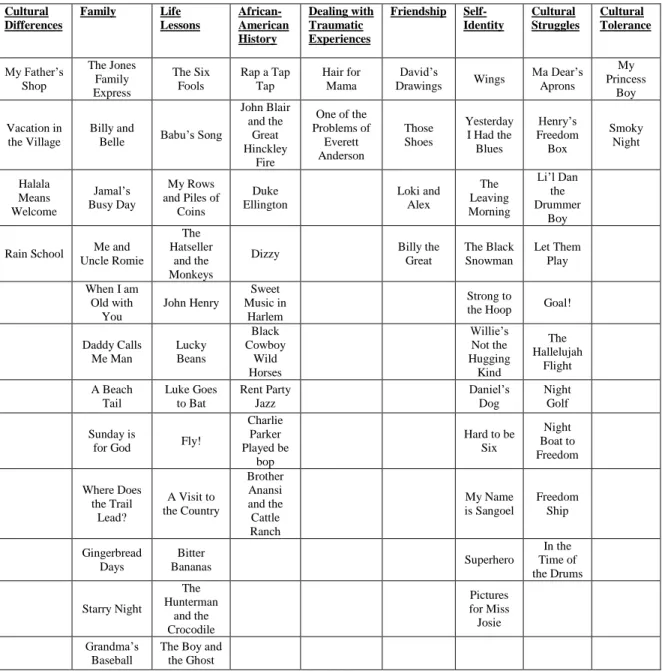
Differences, Family, Life Lessons, African-American History, Dealing with Traumatic Experiences, Friendship, Self-Identity, Cultural Struggles and Cultural Tolerance. Each book was added to one of the nine sub-categories based on the main theme for that work. No title was listed in more than one category, as only the main theme of the work was used. The main theme of the book Lucky Beans, for example, is getting by with few resources and using one’s intellect to succeed; therefore this title was placed in the sub-category Life Lessons. There is an underlying theme of facing discrimination, but as this theme was not major, it was not used for the purpose of analysis.
Another example is the book Henry’s Freedom Box that was placed in the sub-category of Cultural Struggles. The main theme of the book is slavery and the fight for freedom. Although the story does deal with African-American history, the only titles that were included in the African-American History sub-category were books that dealt solely with a historical person or event and did not have any other major themes or social issues. The descriptions for all of the sub-categories are listed in Figure 5.1 below:
Figure 5.1: Theme Sub-Category Definitions Cultural Differences Introduces new cultures, customs, ways of life
Family Love of family; family bonds; family relationships
Life’s Lessons Purpose of story is to teach the reader a lesson
African-American History Purpose of story is to introduce reader to a topic of AA history
Dealing with Traumatic Experiences
Teaches reader how to handle a traumatic situation
Friendship Making friends, sharing, relating to peers
Self-Identity Main character deals with understanding him/herself
Cultural Struggles Purpose of story is to illustrate the struggles of a particular group
Cultural Tolerance Purpose of story is to shed light on cultural persecution
titles or 20% of the books). Self-Identity was the third largest (11 titles or 14% of the books). Cultural Struggles had 10 titles (12.5 % of the books) and African American History had 9 titles (11% of the books). Both Cultural Differences and Friendship had 4 titles (5% of the books in each category) and Dealing with Traumatic Experiences and Cultural Tolerance both had 2 titles (2.5% of the books in each category).
Figure 5.2: Theme Sub-Categories
Cultural Differences
Family Life
Lessons African-American History Dealing with Traumatic Experiences
Friendship Self-Identity Cultural Struggles Cultural Tolerance My Father’s Shop The Jones Family Express The Six Fools
Rap a Tap Tap
Hair for Mama
David’s
Drawings Wings
Ma Dear’s Aprons My Princess Boy Vacation in the Village Billy and
Belle Babu’s Song
John Blair and the
Great Hinckley
Fire
One of the Problems of Everett Anderson Those Shoes Yesterday I Had the Blues Henry’s Freedom Box Smoky Night Halala Means Welcome Jamal’s Busy Day My Rows and Piles of
Coins Duke Ellington Loki and Alex The Leaving Morning Li’l Dan the Drummer Boy
Rain School Uncle Romie Me and
The Hatseller
and the Monkeys
Dizzy Billy the Great The Black Snowman Let Them Play
When I am Old with You John Henry Sweet Music in Harlem Strong to
the Hoop Goal!
Daddy Calls Me Man Lucky Beans Black Cowboy Wild Horses Willie’s Not the Hugging Kind The Hallelujah Flight A Beach Tail Luke Goes to Bat Rent Party Jazz Daniel’s Dog Night Golf Sunday is
for God Fly!
Charlie Parker Played be
bop
Hard to be Six Night Boat to Freedom Where Does the Trail Lead?
A Visit to the Country Brother Anansi and the Cattle Ranch My Name is Sangoel Freedom Ship Gingerbread Days Bitter
Bananas Superhero
In the Time of the Drums Starry Night The Hunterman and the Crocodile Pictures for Miss Josie Grandma’s Baseball
Cultural Differences
Family Life
Lessons
African-American History
Dealing with Traumatic Experiences
Friendship Self-Identity
Cultural Struggles
Cultural Tolerance
How Many Stars in the
Sky
The Adventures
of Sparrowboy Mac and
Marie and the Train
Toss Surprise
Everett Anderson’s
Christmas Coming
The Aunt in Our House
Gettin’ Through Thursday On the Day I
Was Born
The Hired Hand
My Mama Sings The Bat Boy
and His Violin The Boy on
the Beach
First Pink Light Calvin’s Christmas
Wish A Father Like That
Childhood Developmental Tasks
The childhood developmental tasks of the selected books included the following: making friends, fitting in, accepting others, dealing with emotions, sharing, family relationships, peer relationships, peer pressure, sibling relationships, separation, exploration, self-identity, self-esteem, and self-expression. These tasks were only
Larger Social Issues
The larger social issues of the books included the following: segregation, strength of the black community/positive self-identity, racism/slavery/discrimination,
poverty/financial issues, terminal illness, childhood abuse, safety, persecution,
acceptance of transgender identity and depression. Twenty-five of the 80 books analyzed contained larger social issues or 31% of the books. Some of the books contained more than one social issue. For the purpose of analysis, 27 social issues were identified (See Figure 6).
Segregation 7% Strength of Black Community/Posit ive Self-Identity
11%
Racism/ Discrimination/Sl
avery 44% Poverty/Financial
Issues 14% Terminal Illness
4%
Childhood Abuse 4%
Safety 4% Persecution
4% Acceptance of
Transgender Identity
4% Depression4%
Larger Social Issues
Figure 6: Social issues represented in the sample
Socioeconomic Status
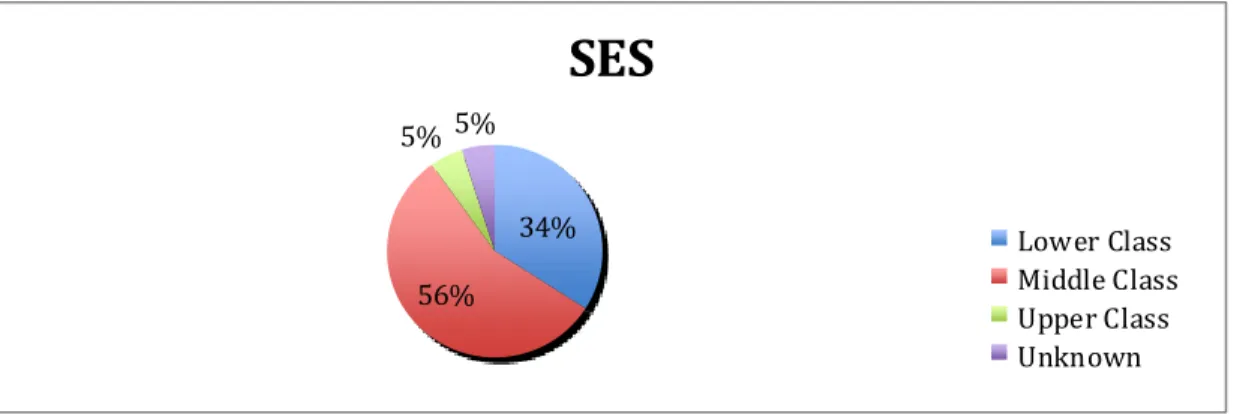
analysis. The greatest percentage of the books featured middle class protagonists (See Figure 7).
34%
56% 5% 5%
SES
Lower Class Middle Class Upper Class Unknown
Figure 7: Socioeconomic Status
Race of Secondary Characters/ Relationship
51% 41%
8%
Race of Secondary Characters
Black
Multiple Races None
Figure 8: Race of Secondary Characters
Activities
The activities in each book varied but for the purpose of analysis, this category will be broken down into two groups: Activities involving childhood developmental tasks and activities where the protagonist has adult experiences or takes on more of an adult role. Fifty-four out of 80 books, or 67.5%, contained a protagonist who was engaged in basic childhood developmental tasks. In 26 of the books or 32.5%, the protagonist played more of an adult role or had adult experiences (See Figure 9).
67% 33%
Activities
Childhod Developmental Tasks
Adult Roles or Experiences
Discussion
Age
The majority of the protagonists were elementary-aged boys. Since picture books are generally geared towards preschool and elementary-aged children, this is largely what would be expected from this analysis. Since it is necessary for all children, including black boys, to see themselves in what they read, it is important that the majority of the books included elementary and preschool-aged protagonists. It would be beneficial to have more books with preschool-aged protagonists because only 6% of the books were in this category. Children need to see themselves reflected in what they read in order to connect with the literature from an early age, because this is how they construct positive messages about themselves and where they fit into society (Barksdale Ladd and Heflin, 2001).
Setting
Genre
Most of the books in the sample were realistic fiction with over half of the books falling into this category. This was surprising, but a positive find as realistic fiction reflects directly what children are experiencing in their everyday life. Almost 40% of the books were included in the genres of historical fiction and folktales, while only 5% were fantasy and 2% were poetry. It would have been beneficial to have more books in the fantasy genre as well as other genres not included such as adventure or mystery simply to provide a more well-rounded selection.
Most of the Historical Fiction titles contained either heavy topics like slavery and racism in the U.S. or information about jazz legends. Although these topics of African-American history are important for young children to discuss and be aware of, it seems unnecessary for such a large percentage of the books to cover these topics. The fact that poetry made up only 2% of the books was expected, as many of the poetry titles within the original 245 books were not selected because they did not contain a main protagonist.
Theme
area that could have been represented more is the sub-category of Friendship as it only contained 4 titles, and this is a basic childhood developmental task.
That said, it is also important to provide African-American children with books about other themes such as cultural differences and dealing with traumatic experiences, and the selection probably could have included more of these titles. The sub-category of cultural struggles unexpectedly contained only 10 titles, although almost all of these were from the historical fiction genre. It’s important for children to read books that reflect their unique history, but too many books with heavy themes of racism or slavery can send a message that African-Americans are victims (Hefflin & Barksdale-Ladd, 2001). In the category of African-American history, which also contained books from the historical fiction genre, seven out of 10 of these books were about jazz or jazz musicians. This could be seen as a strong element of African-American history or the topic may simply be overrepresented within this selection of picture books.
Larger Social Issues
males can connect to without feeling like victims. The results, therefore, were mainly positive in that larger social issues made up less than half of the books selected.
Socioeconomic class
The average socioeconomic status of the protagonist was middle class at 54%. This was largely expected as middle class was used as the default choice when the
illustrations and text did not specify a lower or upper income bracket. The fact that upper class made up only 5% of the books was also expected, as those with a higher income tend to make up a small percentage of the population in general when looking at Census data (U.S. Census, 2011). The fact that lower class made up 34% of the books was somewhat surprising, but understandable as 29% of the titles fell within the historical fiction genre and dealt with themes of oppression. To accurately represent the black population it is necessary to include protagonists from all income brackets, so readers can see themselves represented in the literature. Overall the SES of the protagonists was represented fairly evenly.
Race of Secondary Characters
The race of the secondary characters was largely African-American, with over half of the books falling into this category. The remaining books included multiple races or did not have a human protagonist. Most of the books with all black secondary
can be used as tools for children to see themselves overcoming their own hardships and finding strength within their own communities. Also important to note is that only 11 of the 33 books that contained other races involved some sort of racial tension. This means that 67% of books with secondary characters of other races had a good relationship with the black male protagonist.
Activities
In the category of activities, 67.5% of the books illustrated a child engaged in basic childhood developmental experiences. This is largely what would be expected for picture books as they can be used as a guide for children as they encounter different stages of growing up. A little over thirty-two percent of the books either had adult protagonists or children dealing with adult experiences. This percentage seemed somewhat large for a selection of fiction picture books. Although, it is beneficial for children to read about adult role models or understand trying childhood experiences, such activities do not need to be represented in such a large percentage of books. Overall, however, basic childhood developmental tasks were focused on for the majority of the selected books, and this was a positive find.
Summary
self-identity, and life lessons, with a smaller percentage dealing with cultural struggles. The black male protagonists were largely represented within the genre of realistic fiction and within all black families and communities.
Overall, positive messages were provided about African-American male’s racial identity and self worth. There were fewer books than expected that dealt with themes of racial tension or struggle, and most of these titles exhibited strong male protagonists. There could have been more titles with positive interactions between blacks and
secondary characters of multiple races, but the cultural representations within the books seemed to be essentially accurate, providing authentic representations of black culture to minority and majority groups alike.
I was especially impressed with the number of books that focused on more modern representations of black families, as the area of historical fiction was not as large as expected. There were not too many books that portrayed blacks as victims of
oppression, but the historical fiction genre was somewhat lacking. Most of the books within this genre dealt with cultural struggles or jazz music, and there are many other aspects of black history and culture that could be explored within the world of picture books.
one black male protagonist. The remaining 165 books had a female protagonist, no protagonist, or were non-fiction, poetry, or biography. The representation of black males in the literature is still a topic that needs to be researched and supported, to ensure that such books with positive black male protagonists continue to be advocated for, published, and shared with children. Librarians can play a major role in this endeavor by purchasing these titles for their libraries, sharing these texts with children, and continuing to research this topic.
References
Barksdale-Ladd, M., & Hefflin, B. R. (2001). African-American Children's Literature that Helps Students Find Themselves: Selection Guidelines for Grade K-3.
Reading Teacher, 54(8), 810-19. Retrieved from EBSCOhost.
Colby, S. A., & Lyon, A. F. (2004). Heightening Awareness about the Importance of Using Multicultural Literature. Multicultural Education, 11(3), 24-28. Retrieved from EBSCOhost.
DeLeon, L. (2002). Multicultural Literature: Reading to Develop Self-worth.
Multicultural Education, 10(2), 49-51.
Diamond, P. J., & Onwuegbuzie, A. J. (2001). Factors Associated with Reading
Achievement and Attitudes Among Elementary School-aged Students. Research in the Schools, 8(1), 1-11. Retrieved from EBSCOhost.
Ferdman, B. (1990). Literacy and Cultural Identity. Harvard Educational Review, 60, 181-204. Retrieved from Education Full Text database
Hughes-Hassell, S., Barkley, H. A., & Koehler, E. (January 01, 2009). Promoting Equity in Children's Literacy Instruction: Using a Critical Race Theory Framework to Examine Transitional Books. School Library Media Research, 12.
Hughes-Hassell, S., & Cox, E.J. (2010). Inside Board Books: Representations of People of Color. Library Quarterly, 80(3), 211-230.
Hughes-Hassell, S., Koehler, E., & Barkley, H. A. (2010). Supporting the Literacy Needs of African-American Transitional Readers. Teacher Librarian, 37(5), 18-23. Retrieved from EBSCOhost.
Lempke, S. (1999). The Faces in the Picture Books. Horn Book Magazine, 75(2), 141-148. Retrieved from EBSCOhost.
Lu, M. (1998). Multicultural Children's Literature in the Elementary Classroom. ERIC Digest. Retrieved from EBSCOhost.
McKenna, M., Kear, D., & Ellsworth, R. (1995). Children's attitudes toward reading: A national survey. Reading Research Quarterly, 30(4), 934-956.
Mosely, J. J. (1997, July 1). Multicultural Diversity of Children's Picture Books: Robert Fulton Elementary School Library. Retrieved from EBSCOhost..
National Assessment of Educational Progress. (2009). More About NAEP Reading. Retrieved from http://nces.ed.gov/nationsreportcard/reading/moreabout.asp. National Center for Education Statistics. (2011). Fast facts. Retrieved from
http://nces.ed.gov/fastfacts/display.asp?id=147.
Neuman, W. L. (2007). Basics of Social Research: Qualitative and Quantitative Approaches. Boston: Pearson/Allyn and Bacon.
Petscher, Y. (2010). A meta-analysis of the relationship between student attitudes towards reading and achievement in reading. Journal of Research in Reading, 33(4), 335-355.
Rand, D., Parker, T.T., & Foster, S. (1998). Black Books Galore’s Guide to African
American Children’s Books. New York: Wiley.
Reddish, B. (2000). What Is Good Multicultural Children's Literature and How Do We Critique It? Distinguishing between Image and Value. Retrieved from
EBSCOhost.
Tatum, A. W. (2009). Reading for Their Life: (Re)building the Textual Lineages of African-American Adolescent Males. Portsmouth, NH: Heinemann.
Tatum, A. W. (2005). Teaching Reading to Black Adolescent Males: Closing the Achievement Gap. Portland, Me: Stenhouse Publishers.
Tatum, B. D. (2007). Can We Talk About Race? And Other Conversations in an Era of School Resegregation. Boston, Mass: Beacon Press.
Tatum, B. D. (1999). "Why Are All the Black Kids Sitting Together in the Cafeteria?": And Other Conversations About Race. New York: BasicBooks.
U.S. Census (2010). 2010 Census Data. Retrieved from http://2010.census.gov/2010census/data/.
Wang, A. H. (2008). A Pre-Kindergarten Achievement Gap? Scope and Implications.
Appendix A: Picture Book Criteria
Title/Author Copyright Age Setting Genre Theme/Childhood
Developmental Tasks/ Bigger social issue
SES Race of
Secondary Characters/ Relationship Activities Wings by Christopher Myers
2000 Teen Urban -
City and school
Fantasy Being Different/ Not fitting in/ Accepting yourself
Childhood Developmental Task - getting along with friends; fitting in; accepting others Larger Social Issues: none Unknown - Lower to Middle Class
Many Races/ Main character is outcast, not accepted Abstract-Flying, going to school, playing sports Ma Dear’s Aprons by Floyd Cooper
1997 Elemen
tary Rural - Countr y Historica l Fiction/ Early 1900’s Segregation/ Child’s role to work with parent/ Strength of the Black Community
Childhood Developmental Tasks: none
Larger Social Issues: segregation; showing strength of black community in spite of segregation
Lower Class - poor
White/Subservient Helps mother with wash, Visits sick, helps clean/do laundry for whites,
Rap a Tap Tap by Leo and Diane Dillon
2002 Adult Urban- City
Historica l Fiction/ 1930’s
Commemorating life of famous Black tap dancer
Larger Social Issues: subtly presents racism as an obstacle he had to overcome
Lower to Upper Class
White and Black - Honoring dancing skills of “Bojangles”
“Bojangles” dances in the streets
Yesterday I had the blues by Jeron Ashford Frame
2003 Elemen
tary Urban - City Realistic Fiction/ Rhythmi c Prose - Present day
Emotions/Feelings - dealing with the ups and downs of life
Childhood Developmental tasks: dealing with full range of emotions; importance of family
Larger social issues - None Middle Class Black/Family and neighbors Friendly relationship Daily family activities - eating breakfast, walking to school, spending time with family David’s Drawings by Cathryn Falwell
2001 Elemen
tary Rural - School Realistic Fiction Making friends, sharing, being creative Childhood Developmental Middle Class
Tasks: making friends; sharing
Larger Social Issues: none
My Father’s Shop by Satomi Ichikawa
2006 Elemen
tary Urban - Morroc co Realistic Fiction Different cultures, Father/son relationship Childhood Developmental Tasks: None Larger Social Issues: none
Middle Class
Many
Races/Nationalitie s - tourists Friendly relationship Selling carpets, speaking with tourists Those Shoes by Maribeth Boelts
2007 Elemen
tary
Urban - School
Realistic Fiction
Wants vs. needs, being
popular/making friends, giving vs. receiving
Childhood Developmental Tasks: peer relationships/peer pressure
Larger Social Issues: Financial problems
Lower Class
Many Races - Jeremy’s classmates Ridiculed by classmates/Friendl y relationship with Antonio Playing basketball, doing homework, going shoe shopping The Six Fools by Joyce Carol Thomas
2006 Adult Rural - country Adapted Folktale from the 1930’s Human nature, making mistakes, continuing to make them
Childhood Developmental Tasks: none
Larger Social Issues: none
Middle Class
Black family and neighbors Friendly relationship Proposing marriage, traveling, observing The Jones Family Express by Javaka Steptoe
2003 Teen Urban -
city Realistic Fiction Cherishing loved ones, family connections Childhood Developmental Tasks: family relationships
Larger Social Issues: none
Middle Class
Black Family and neighbors Friendly relationship Spending time with family, eating pancakes, shopping for gift for Aunt
Duke Ellington by Andrea Davis Pinkney
1998 Elemen
tary and Adult Urban - city Historica l Fiction - 1930’s
Story of the life of a famous jazz pianist/ composer - celebrating Black heritage and triumphs Childhood Developmental Tasks: none
Middle to Upper Class
Larger Social Issues: none
Billy and Belle by Sarah Garland
1992 Elemen
tary Urban - city Realistic Fiction New siblings, family relationships Childhood Developmental Tasks: sibling relationships
Larger Social Issues: none
Middle Class Biracial family, White mother, Black father/ Classmates of many races - good relationship Getting ready for school, doing schoolwork, interacting with baby sister, welcoming new brother The Leaving Morning by Angela Johnson
1992 Elemen
tary Urban - city Realistic Fiction Moving, feelings about leaving/saying goodbye, transitions Childhood Developmental Tasks: dealing with emotions
Larger Social Issues: none
Middle Class
Black family, neighbors many races - good relationship Saying goodbye to friends, family, and neighbors Jamal’s Busy Day by Wade Hudson
1991 Elemen
tary Urban - city Realistic Fiction Family relationships, working hard Childhood Developmental Tasks: family relationships
Larger Social Issues: none
Middle Class Black family, father’s coworkers and Jamal’s classmates of many races Getting ready for work (school), doing schoolwork/ho mework, playing basketball with father, setting the table Dizzy by Jonah Winter
2006 Elemen
tary and Adult Urban - city Historica l Fiction- Rhythmi c prose
Life story of Dizzy Gillespie, famous jazz musician - having the courage to be yourself
Childhood Developmental Tasks: peer relationships Larger Social Issues: none Lower class to Upper class Black family, neighbors, band members - Picked on by childhood bullies, doesn’t fit in with band members
Childhood fights, playing the trumpet, playing pranks in the band
Me and Uncle Romie by Claire Hartfield
2002 Elemen
tary Rural NC and Urban NY Historica l Fiction Introduces Harlem Renaissance painter Romare Bearden - Family relationships, African-American history Childhood Developmental Tasks: experiencing separation
Larger Social Issues: none
Middle Class
Black family, friends, neighbors - good relationship
Babu’s Song by Stephanie Stuve-Bodeen
2003 Elemen
tary Rural - contem porary Tanzani a Realistic Fiction
Want vs. need, reward for telling the truth
Childhood Developmental Tasks: none
Larger Social Issues: financial problems
Lower Class
Black family, friends, neighbors, white tourists - good relationship but poor/working class Playing soccer, selling toys, spending time with grandfather Sweet Music in Harlem by Debbie A. Taylor
2004 Middle grade to teen
Urban Historica l Fiction -Harlem circa 1958 (Harlem Renaissa nce) Community - Inspired by a picture taken of great jazz musicians in 1958 in Harlem
Childhood Developmental Tasks: none
Larger Social Issues: none
Middle Class Black family, neighbors - friendly relationship, sense of community Looking for grandfather’s hat, speaking with members of community, taking picture, playing the clarinet My Rows and Piles of Coins by Tolowa M. Mollel
1999 Elemen
tary Rural - Tanzani a 1960s Realistic Fiction - contemp orary Tanzania
The virtues of generosity and determination
Childhood Developmental Tasks: none; adult tasks Larger Social Issues: none Lower Class Black family, friends, townspeople - good relationship Learning to ride a bike, helping mother during market day, saving coins The Hatseller and the Monkeys by Baba Wague Diakite
1999 Adult Rural Africa - various villages African Folklore Life’s lessons, secret to success, Suffering before happiness Childhood Developmental Tasks: none Larger Social Issues: none
Lower Class African family, townspeople - good relationship Making and selling hats, outsmarting the monkeys who steal his hats
Hair for Mama by Kelly A. Tinkham
2007 Elemen
tary Rural - small town Realistic Fiction
Love of family, dealing with cancer, sacrifice for others
Childhood Developmental Tasks: family relationships
Larger Social Issues: terminal illness Middle Class Black Family, friends, neighbors Family photos, spending time with family, coping with serious illness, hair cuts
When I am Old with You by Angela Johnson
1990 Elemen
tary Rural - small town Realistic Fiction
Childhood Developmental Tasks: relationship with grandparents
Larger Social Issues: none
walks, fishing, playing cards, eating breakfast John Henry by Julius Lester
1994 Prescho ol, Adult
Rural African-America n Folklore - America circa 1870 African-American strength, determination, living life to the fullest
Childhood Developmental Tasks: none
Larger Social Issues: none
Lower Class
Black family, white and black townspeople, white and black railroad workers - no racial tension /black and white disbelievers of John Henry’s strength Building houses, cutting wood, running fast, hammering a boulder Daddy Calls Me Man by Angela Johnson
1997 Elemen
tary
Rural Realistic Fiction - rhythmic prose
Family
relationships, being a big brother
Childhood Developmental Tasks: family relationships
Larger Social Issues: none
Middle Class
Black family - loving relationship
Playing with big sister, sharing with little sister, looking up to parents
Henry’s Freedom Box by Ellen Levine
2007 Elemen
tary and Adult
Rural Historica l Fiction - Mid 1800s - true story of Henry “Box” Brown
Slavery, fighting for freedom
Childhood Developmental Tasks: none
Larger Social Issues: slavery; racism
Lower Class
Black family - loving
relationship, white masters - subservient relationship, white and black friends - friendly relationship Being sold, working in factory, spending time with family, mailing himself in a box
Lucky Beans by Becky Birtha
2010 Elemen
tary Rural - small town Historica l Fiction - 1930’s Great Depressi on
Getting by with few resources, using one’s intellect to succeed, facing discrimination
Childhood Developmental Tasks: relationships with peers Larger Social Issues: financial Problems, discrimination Lower Class Black family- good relationship, white classmates- some discrimination, white store owner - friendly relationship Eating beans for dinner, doing math homework, counting beans
A Beach Tail by Karen Lynn Williams
2010 Prescho ol Rural - beach Realistic Fiction Being creative, listening to your father
Childhood Developmental Tasks: exploration
Middle Class
Black father and son - good, loving, parental
relationship
Larger Social Issues: none
his way back to his father
Sunday is for God by Michael McGowan
2010 Elemen
tary Rural - small town Realistic Fiction Family traditions, religion Childhood Developmental Tasks: family relationships
Larger Social Issues: none
Middle Class
Black family - good relationship, congregation of many races, best friend Joey- white no real mention of race Eating breakfast, getting ready for church, daydreaming in church, eating dinner with family, playing with best friend Black Cowboy Wild Horses by Julius Lester
1998 Adult Rural - wild west Historica l Fiction- based on a true story of a former slave turned Texas cowboy-Bob Lemmon s Black history/black cowboys, the way of nature
Childhood Developmental Tasks: none
Larger Social Issues: none
Unknown No secondary character interaction, both white and black cowboys depicted in illustrations - no mention of race
Tracking the mustangs, becoming one of the mustangs, fighting for dominance, leading the mustangs back to the corral
Li’l Dan the drummer boy by Romare Bearden
2003 Elemen
tary Rural - on and near a plantati on Historica l Fiction - During the Civil War, circa 1863 Fighting for freedom, how a small thing can make a difference
Childhood developmental tasks: none
Larger Social Issues: fighting against slavery
Lower Class - slaves
Black fellow slaves, soldiers - good relationship, bond through fighting for freedom
Learning to play the drum, making his own drum, traveling with the soldiers, saving the troop from the confederate soldiers by using his talents on the drum
Let Them Play by Margot Theis Raven
2005 Elemen
tary Rural - South Carolin a Historica l Fiction - segregate d South Carolina, 1955 Segregation, equal rights Childhood Developmental tasks: none
Larger Social Issues: segregation, racism
Middle Class
Black managers, teammates, friends and family - good relationship, - Prejudice from other white teams and their managers, Supportive crowd at championships Playing stickball, traveling to the Little League Championship , warming up on the field
Luke Goes to Bat by Rachel Isadora
2005 Elemen
tary Urban - Brookl yn Historica l Fiction - based on game between Dodgers and Phillies in 1951
Never giving up, working hard for success
Childhood Developmental tasks: relating to other children
Larger Social Issues: none
Middle Class
Black friends and family - good relationship
Practicing baseball, playing stickball, going to see a professional baseball game
Fly! by Christopher Myers
2001 Elemen
tary
Urban Realistic Fiction
The power of listening, being different, respecting
Middle Class
Black neighbor on the rooftop - friendly
others
Childhood developmental tasks: making friends, relating to others
Larger Social Issues: none
relationship, imparts wisdom
birds, dancing with the birds
One of the Problems of Everett Anderson by Lucille Clifton
2001 Elemen
tary
Unkno wn
Realistic Fiction
Dealing with child abuse, how little things make a difference
Childhood Developmental Task: dealing with emotions
Larger Social Issues: Childhood Abuse
Middle Class
Black family and friend - stressful relationship between Everett and his friend who is sad and being abused, Loving, understanding relationship with mother who he is able to talk to about his feelings
Talking to sister and mother about his friend who has bruises
Rent Party Jazz by William Miller
2001 Middle to teen Urban - New Orleans Historica l Fiction - New Orleans 1930’s
Bonds of family and friendship, helping others in times of need
Childhood developmental tasks: none - adult role: working to help mother with bills
Larger Social Issues: subtle discrimination against blacks Lower Class Black mother/no father, black neighbors and friends - supportive relationship in time of need
Working in the mornings with the coal man, worrying about mother’s financial problems, throwing a rent party to raise money
The Black Snowman by Phil Mendez
1989 Teen Urban Fantasy Positive Self-identity, African history
Childhood developmental tasks: accepting, loving oneself, dealing with emotions
Larger Social Issues: effects of slavery, self-identity as a black person
Lower class Black family - loving but emotional issues between mother and son Dealing with emotional issues of self identify as a black person, making a snowman with younger brother, being introduced to his African ancestry, saving brother from fire
A Visit to the Country by Herschel Johnson
1989 Elemen
tary
Rural Realistic Fiction
Childhood pets, loving something by letting it go
Childhood developmental tasks: childhood pets; family relationships
Middle Class
Black grandparents - good loving relationship
Larger Social Issues: none
Strong to the Hoop by John Coy
1999 Elemen
tary
Urban Realistic Fiction
Childhood competition, developing confidence in one’s skills, determination
Childhood developmental tasks: relating to other kids, developing confidence
Larger Social Issues: none
Unknown Black kids on basketball court - friendly, competitive relationship Practicing basketball moves, playing a game with the older boys, winning the game
Loki & Alex by Charles R. Smith
2001 Prescho ol Rural - town Realistic Fiction Friendship, relationship between dogs and humans
Childhood Developmental Tasks: playing, making friends (dog)
Larger Social Issues: none
Middle Class
None Playing with
his dog - tug of war, fetch, running, giving dog a treat
Bitter Bananas by Isaac Olaleye
1994 Elemen
tary Rural - African village/ rain forest Realistic Fiction Ingenuity, using critical thinking to solve a problem
Childhood Developmental Tasks: none, Adult tasks
Larger Social Issues: none
Lower Class
None Drinking and
selling palm sap, building a scarecrow, tricking the baboons with wormwood sap and bananas The Hunterman and the Crocodile by Baba Wague Diakite
1997 Adult Rural - Africa
Folktale Importance of living in harmony with nature and all living things
Childhood Developmental Tasks: none
Larger Social Issues: none
Unknown None Carrying the
crocodiles to the river, asking the animals for help, taking tears from the crocodiles to save his wife
Goal! by Mna Javaherbin
2010 Teen Rural - South African townshi p Realistic Fiction Strength of friendship, resilient spirit of children, power of soccer
Childhood developmental tasks: dealing with bullies, friendship
Larger Social Issues: Safety in South Africa
Lower Class
African friends - good friendship, African bullies - power struggle
Charlie Parker Played be bop by Chris Raschka
1992 Adult Unkno
wn Historica l Fiction - about Charlie Parker jazz saxopho nist
The sound of jazz be bop
Childhood Developmental Tasks: none
Larger Social Issues: none
Middle class
None Playing
saxophone/ be bop
Where does the trail Lead? by Burton Albert
1991 Elemen
tary Rural - beach Realistic Fiction Family; Childhood exploration Childhood developmental tasks: family; exploration
Larger Social Issues: none
Middle Class
Black nuclear family - good relationship
Exploring a trail on the beach, finding his way back to his family to eat fish and watch the sunset Gingerbread Days by Joyce Carol Thomas
1995 Elemen
tary
Rural Poetry Love of family, importance of family
Childhood Developmental Tasks: connecting with family
Larger Social Issues: Strength of black community
Middle Class
Black nuclear family - loving relationship Making cookies, spending time with parents, celebrating birthday, going to church Willie’s Not the Hugging Kind by Joyce Durham Barrett
1989 Elemen
tary
Rural - town
Realistic Fiction
Being your own person, showing affection
Childhood Developmental Tasks: relationships with friends, learning to be yourself Larger Social Issues: none Middle Class Black nuclear family - good relationship, Asian best friend - friendly classmates of many races - good relationship
Going to school, going for a walk and hugging a tree, stop sign, bike, hugging his mom and dad
Starry Night by David Spohn
1992 Elemen
tary Rural - backyar d Realistic Fiction
Spending time with family
Childhood developmental tasks: family relationships
Larger Social Issues: none
Middle Class
White father, biracial children (black, white) - loving family relationship
Packing to go camping, gathering wood, telling ghost stories, looking at the stars
Daniel’s Dog by Jo Ellen Bogart
1990 Elemen
tary Rural/s uburba n Realistic Fiction Dealing with feelings about new siblings
Childhood Developmental tasks - dealing with emotions, imaginary friends/making
Middle Class
friends
Larger Social Issues - none to sister, helping friend Grandma’s Baseball by Gavin Curtis
1990 Elemen
tary Rural/s uburba n Realistic Fiction Family relationships, death in the family
Childhood developmental tasks - relating to family
Larger Social Issues - none
Middle Class
Black family - good relationship /develops friendship with grandmother Eating oatmeal, slamming door, finding grandfather’s baseball, throwing baseball with grandmother
The Boy and the Ghost by Robert D. San Souci
1989 Elemen
tary Rural South Folktale - African-America n
The rewards of kindness, honesty, generosity
Childhood developmental tasks - relationships with others, being the middle child
Larger Social Issues - none
Lower Class
Black family - good relationship
Helping a stranger, spending the night in the haunted house, offering soup to the ghost, finding the ghost’s treasure
How Many Stars in the Sky by Lenny Hort
1991 Elemen
tary Rural and Urban Realistic Fiction Bond between father and son
Childhood Developmental Tasks- dealing with a parent’s absence
Larger Social Issues - none
Middle Class
Black family - good relationship, strong bond between father and son
Counting the stars in the sky, climbing into his tree house, riding into the country to count the stars with his father
Billy the Great by Rosa Guy
1992 Prescho ol to Elemen tary
Rural Realistic fiction
Friendship
Childhood Developmental Tasks - being creative, expressing oneself, making friends
Larger Social Issues - none
Middle Class
White father and son/best friend Rod - tension between Rod and Billy’s fathers Eating pie, climbing trees, throwing mud, doing cartwheels
Hard to be Six by Arnold Adoff
1991 Elemen
tary - six Rural - suburba n Realistic fiction
Wanting to grow up, dealing with being the youngest, learning to do new things
Childhood Developmental Tasks - experience of growing up
Larger Social Issues - none
Middle Class
Biracial family / White father, Black mother, friends of many races Playing with mud, riding bikes, playing with trains, riding a carousel Vacation in the Village:
1999 Elemen
tary Rural - village/ Realistic fiction Discovering the customs of your
Middle Class
Black family and friends - good