Wanchun Zhao. Spam Detection on Twitter: A Comparison between Content-based and Graph-based Features. A Master’s Paper for the M.S. in I.S degree. March, 2016. 44 pages. Advisor: Bradley M. Hemminger
The popularity of social media has triggered the development of spammers, which produces useless information and costs normal user more time in information seeking process. In this paper, Twitter is studied as an example of spam detection in social media. Using Twitter APIs, content-based and graph-based features were extracted from datasets and analyzed with users’ level of spam. Combining two kinds of features with J48, NaïveBayes and SVM classifiers, content-based features with J48 have the best performance in evaluation.
Headings:
Spam Detection
Content-based
Graph-based
SPAM DETECTION ON TWITTER: A COMPARISON BETWEEN CONTENT-BASED AND GRAPH-CONTENT-BASED FEATURES
by Wanchun Zhao
A Master’s paper submitted to the faculty of the School of Information and Library Science of the University of North Carolina at Chapel Hill
in partial fulfillment of the requirements for the degree of Master of Science in
Information Science.
Chapel Hill, North Carolina April 2016
Approved by
Table of Contents
INTRODUCTION ... 2
LITERATURE REVIEW ... 4
A. Twitter Spam ... 4
B. Spam Analysis ... 5
C. Spam Detection ... 7
RESEARCH METHOD ... 10
A. Research Method ... 10
B. Data Collection ... 11
C. Spam Label ... 12
FEATURE ANALYSIS ... 14
A. Content-based Features ... 14
a. URL Rate... 14
b. Mention Rate ... 16
c. Hashtag Rate ... 18
d. Word Count ... 19
e. Spam Word Rate ... 20
B. Graph-based Features ... 22
a. Number of Followings ... 22
b. Number of Followers ... 23
c. Reputation ... 24
C. Platform ... 25
EXPERIMENT ... 26
A. Content-based Features ... 26
B. Graph-based Features ... 28
CONCLUSION ... 32
LIMITATIONS AND FUTURE WORK ... 33
Bibliography ... 34
Appendices ... 37
Appendix A: Python Scripts Used for Twitter API ... 37
I
NTRODUCTIONWith the development of Internet and Information technology, social media services have
become an irreplaceable part in people’s lives. Billions of users post messages, share
pictures and connect with other users through websites and mobile applications like
Facebook, Twitter or Instagram. The popularity of social media services has reflected a
new way for people to communicate with each other, but it also triggers a problem, which
is the rapid proliferation of spam among social media sites.
According to Wikipedia, spamming is the use of electronic messaging systems to send
unsolicited messages, especially advertising, as well as sending messages repeatedly on
the same site (Spamming, 2016). The most widely recognized form of spam is email
spam, but the flexibility and popularity of social network service has provided spammers
another way to spread spam messages.
There are several types of spammers existing in social media sites. The most common
ones attach a URL in their posts or messages. The links in the posts redirect users to
unrelated websites, illegal contents, or even computer viruses and phishing websites.
There are also spammers posting advertisements or inappropriate images for publication
or spreading rumors for attention. The existence of these spammers in social network
see, costing users more time in information seeking process and sometimes even get users
into financial loss and identity security issues. Therefore it is important to come up with a
way to filter those spammers and spam information to create clearer environment for
users.
Social media services like Twitter have already been working on the spam problem but
more work is needed to find effective spam filters. In addition, scholars have also focused
on this issue and tried to extract features to identify spam accounts utilizing machine
learning and data mining methods. However, there are few studies concentrating on
summarizing proposed approaches and compare the strengths and weaknesses of each
algorithm. Therefore this paper is aimed at finding and analyzing features that is able to
identify spam accounts, and also comparing two prediction methods employed by
researchers: content-based and graph-based, by using real Twitter data collection.
The remainder of the paper is organized as follows. In Section II, past studies on spam
analysis and spam detection are reviewed. How the data sets are collected and cleaned is
described in Section III. Then in Section IV and Section V, the results of descriptive
analysis of extracted features, the correlation test between features and spam level and the
accuracy of prediction are displayed. Finally, the Section VI and Section VII will
L
ITERATURER
EVIEWThis section provides an overview of spammers’ activities on Twitter, discusses the
results of spam analysis as well as approaches, mechanisms and systems to detect
spammers proposed by previous studies.
A.
Twitter Spam
One of the most successful and popular social networking services in United States is
Twitter, which is an online service that enables users to send and read short 140-character
messages (Twitter, 2015). The twitter platform’s main functions include:
(1) Tweet: users post short messages to let followers or sometime strangers see and
comment on. URL links and images are allowed to be included in tweets.
(2) Follow: a relationship that users maintain with which followers could see tweets
of the user he follows in his own twitter home page.
(3) Mention: users mention other users in the tweets so that either followings or
non-followings could see the contents of that certain tweet.
(4) Retweet: users repost of other users’ tweet.
(5) Direct message: users send messages to the user he follows privately and the
following user would get notification of message.
Based on twitter’s main functions, there are mainly four types of strategies that spammers
(1) Including malicious URLs in tweets. This type of spammers usually post a link in
the tweet. Some URLs redirect users to unrelated websites to gain website visits
while other URLs might get computer infected with virus and get users into
identity theft.
(2) Posting advertisements. This type of spammers usually post pictures or videos of
commercial products in tweets.
(3) Including inappropriate contents in tweets. This kind of spam constantly includes
inappropriate contents in tweets, like fake news, rumors or pornographic content
etc.
(4) Sending disturbing messages. Spammers send direct messages to users to
advertise their products or other disturbing contents.
Usually, spammers combine several strategies together in their daily activities.
B. Spam Analysis
Spam analysis usually focuses on the features of spam accounts and the comparison
between spam and normal users. In spam analysis studies, researchers extract features
and employ descriptive analysis or statistical analysis to study spam accounts’ activities,
show the difference and determine if one feature or a combination of features is able to
differentiate spammers with non-spammers.
Wang, Navathe et al. (Wang, et al., 2013) collected short URLs from Twitter and
retrieved click traffic data from Bitly. After analyzing and comparing the click traffic
generated and determining the top click sources for spam and non-spam short URLs, the
utilize popular websites to attract more attention by cross-posting the links. Similarly, Lin
and Huang (Lin & Huang, 2013) evaluated the common features to see how effective
they are to detect Twitter spam accounts with collected datasets and have found that
features like number of words per tweet do not show significant difference between
spammers and regular users while the URL rate and the interaction rate features are
effective in detecting spam. Song, Lee and Kim (Song, Lee, & Kim, 2011) proposed a
novel spam filtering system using relation features, such as the distance and connectivity
between a message sender and a receiver to decide whether the current message is spam
or not, because account features can easily be fabricated by spammers.
Some studies directly analyze the behavior of spammers, studying how they behave and
exist in Twitter. Thomas, Grier et al. studied over 1.1 million accounts suspended by
Twitter and observed the difference among human, bot, and cyborg in terms of tweeting
behavior, tweet content, and account properties (Thomas, Grier, Song, & Paxson, 2011).
The results showed that 77% of spam accounts identified by Twitter are suspended within
on day of their first tweet but new fraudulent accounts are created to take their places.
Less than 9% of spam accounts form social relationships with regular Twitter users. 17%
of spam accounts rely on hijacking trends, while 52% of accounts use unsolicited
mentions to reach an audience.
Stringhini, Kruegel and Vigna used another way to study spammers. They created a
number of honeypot-profiles in Facebook, MySpace and Twitter to attract spammers in
periodically connected to those accounts and collected spammers’ behavior data. After
analyzing anomalous behavior of spammers, they developed six features to identify spam
account, including FF ratio (ratio of followers over followings), URL ratio, message
similarity, choices of friends, messages sent and number of friends.
C.
Spam Detection
Spam detection studies proposed methods to identify or predict spam among social
networking sites, which are usually based on the analysis of spam account features.
Most of related studies extracted features to create user profile and apply to machine
learning or data mining methods to distinguish spammers with normal users.
Common features used in the models include user behavior features, content-based
features and graph-based features. User behavior features capture user activities on
Twitter network, like posting frequency, timeline of user activities and social interactions.
While content-based features focus more on the text of tweets submitted by users,
including URLs, keywords, mentions, hashtags etc. Graph-based features depict the
following/followed relationship between users in twitter and sometimes also classified as
user behavior features. Researchers usually combine multiple types of features to predict
spam.
Most of the studies employed supervised learning methods, usually classification.
Benevenuto, Magno et al. (Benevenuto, Magno, Rodrigues, & Almeida, 2010) picked
three trending topics in twitter and crawled relevant tweet and user information, manually
classifier with content attributes like number of hashtags per number of words on each
tweet, number of URLs per words, number of words of each tweet etc. and user behavior
attributes like number of tweets, age of the user account, number of times the user was
mentioned, number of times the user was replied to etc. for spam detection.
Approximately 70% of spammers and 96% of non-spammers were correctly classified in
their experiment.
Similarly, McCord and Chuah (McCord & Chuah, 2011) discussed some features that
differentiate spammers ad non-spammers, like number of followings and followers,
distribution of tweets over 24-hour period, replies/mentions, keywords/wordweight etc.
and used Twitter API methods to crawl active Twitter users, their followers/following
information and their most recent 100 tweets. Then they employed Random Forest, Naïve
Bayesian, Support Vector Machine and K-nearest neighbor four classifiers to identify
spammers with datasets and compared accuracy of each classifier. Their results show that
among the four classifiers, the Random Forest classifier produces the best results, which
can achieve 95.7% precision and 95.7% F- measure using the Random Forest classifier.
Some researchers emphasized more on graph-based features to create a network model
among users and detect spam. (Wang A. H., 2010) established a social graph model with
four kinds of relationships (follower, friend, mutual friend and stranger) between
accounts in Twitter, viewing each account as a node and relationship as edge. Then he
used Decision Tree, Neural Networks, Support Vector Machines and Naïve Bayesian
Besides classification, some studies applied unsupervised learning methods like
clustering. Miller et al. (Miller, Dickinson, Deitrick, Hu, & Wang, 2014) viewed spam
detection as an anomaly detection problem. It introduced 95 one-gram features from
tweet text alongside the user information analyzed in previous studies and used two
stream clustering algorithms: StreamKM++ and DenStream to cluster normal Twitter
users and treat outliers as spammers. Each of these algorithms performed well
individually and the conjunction reached 100% recall and a 2.8% false positive rate. Tan
and Guo et al. (Tan, Guo, Chen, Zhang, & Zhao, 2013) designed an unsupervised spam
detection scheme which works by deliberately removing non-spammers from the
network, leveraging both the social graph and the user-link graph. The underpinning of
the system is that while spammers constantly change their patterns to evade detection,
non-spammers do not have to do so and thus have a relatively non-volatile pattern, which
outperforms existing schemes.
The studies mentioned above have all come up with methods using features to detect
spam among social media sites but there are still not enough studies digging in the
strengths and weaknesses of each feature and method as well as comparison analysis of
existing algorithms. Therefore this paper will focus on comparing two main models used
in spam detection: content-based and graph-based and explained relative strengths and
R
ESEARCHM
ETHODThis section describes what methods will be used to compare two algorithms, how the
experiment data sets were collected from twitter and the preliminary analysis of the data
sets.
A.
Research Method
In order to study spam detection among social networking services, this paper employs
experimental methods to use Twitter as an example and collects user accounts and
interaction data from Twitter public API as datasets for analysis.
The datasets include user account information, tweet information, timeline, relationship
between users etc. Each account in datasets would be manually judged as several levels
of spam, from non-spam to total spam.
After data cleaning process, each feature from the datasets is analyzed to see if there is
significant association between the feature and if the user is spam or not, and why the
feature show/don’t show the differences between spammers and non-spammers. After
that, the experiment will implement two existing classification algorithms using
content-based and graph-content-based features accordingly, and combined with different classifiers
The metrics that evaluate the performance of each algorithm are the precision and recall
of predicting results compared with human judgments.
B.
Data Collection
Twitter has several public APIs for developers to access authorized users’ data on
Twitter. Among those APIs, the REST APIs provide programmatic access to read and
write Twitter data, including authoring a new tweet, reading author profile and following
data etc. (REST APIs, 2016). The Streaming APIs give developers low latency access to
Twitter’s global stream of Tweet data (Streaming APIs, 2016).
Due to the data sets needed in the experiment, I first used Streaming APIs to collect a list
of Twitter users’ id, which is unique to each user, and then selected samples from
collected list randomly. Then I employed REST APIs to extract sample users’ name,
tweets, tweet creation time, platform used to post tweets and the number of users’
followings and followers. In this process, I wrote Python scripts to connect to APIs and
automatically extract data. Specifically, StreamListener instance and tweepy.api’s
user_timeline function, friends_ids function and followers_ids function in tweepy
package were used to extract needed features. During the data acquiring process, the
extracted data was stored in text files and then used MySQL Bulk Loader to save in
MySQL database.
The Streaming process was conducted on December 25th, 2015 and extracted 646,032
user ids. Using python to generate random numbers, I selected 516 users as samples from
between January 19th, 2016 to January 21st, 2016. Extracted datasets include user id, user
name, 20 tweets of each user, tweet creation time and tweeting platform, total 10320
tweets. The following and follower numbers were extracted from APIs between February
7th, 2016 and February 8th, 2016. As some sampled accounts were suspended by Twitter
during the process, only 501 users’ following and follower information were acquired.
C.
Spam Label
As the boundary of spammers and non-spammers is ambiguous, it is sometimes difficult
to judge if an account is spammer or not. In order to manually label each account, I have
divided sample accounts in several spam level. Each level corresponds to several
situations and the higher level the account belongs to, the more it is likely to be spammer.
The level is defined based on the possible harm one account could do other accounts on
twitter. Descriptions of spam level are listed below:
(1) Level 0(Not Spam): normal twitter user accounts. Accounts only include normal
and regular activities of twitter users.
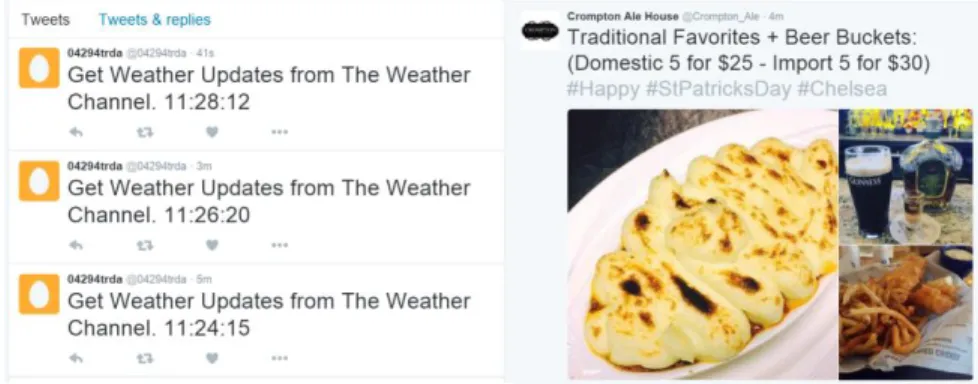
(2) Level 1(Slightly Spam): twitter accounts that contain meaningless/repeated
contents, but do not disturb other users’ activities. Or official publication accounts
post promotional contents.
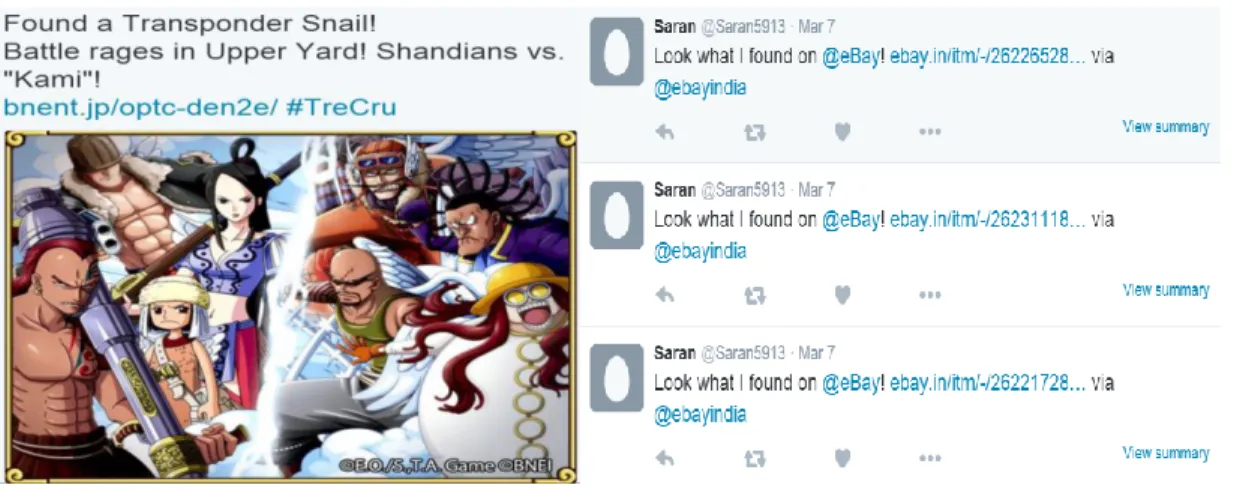
(3) Level 2(Likely Spam): twitter accounts that contain promotion contents but not
official account of one company or personal brand. Or accounts that contain
URLs linking to another website, trying to sell things to other users.
Figure 2 Examples of Level 2 Accounts
(4) Level 3(Spam): twitter accounts that post inappropriate contents, including
pornographic and violent images, or URLs link to viruses/dangerous/phishing
websites.
In summary, 242 users (46.90%) from samples were labelled as level 0, 167 users
(32.36%) users were level 1, 77 users (14.92%) were labelled as level 2, and 30 users
F
EATUREA
NALYSISBased on previous studies and extracted data sets, 9 features were used to detect spam on
Twitter. Among all features, 5 features belong to content-based features, including URL
rate, mention rate, hashtag rate, word count and spam word rate. 3 features belong to
graph-based features, including number of followings, number of followers and
reputation, and also the platform feature.
A.
Content-based Features
a. URL Rate
URL Rate is the average number of URLs contained in each user’s tweets. In the datasets
extracted, URL is formed as a string which begins with “http”. Therefore to calculate this
metric, I used python to sum up the total number of “http” string in tweet texts of each
user and divide this number by number of tweets. In addition, as some users used
third-party platform to post or share tweets, like Facebook, Youtube or Instagram, which will
automatically attach a URL linking to the original post, those URLs were deducted from
the total number of links appeared in tweets.
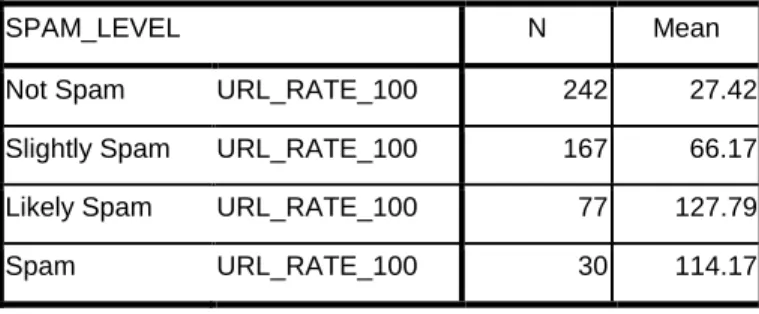
The results are listed below. According to Table 1, the average URL rate of users who
belong to level 0(Not Spam) and level 1(Slightly Spam) are relatively low compared with
Table 1 Average URL Rate of Different Spam Level(%)
SPAM_LEVEL N Mean
Not Spam URL_RATE_100 242 27.42
Slightly Spam URL_RATE_100 167 66.17
Likely Spam URL_RATE_100 77 127.79
Spam URL_RATE_100 30 114.17
Figure 3 displays users’ distribution by URL Rate. It is seen from the figure that regular
users aggregate at low URL rate level and most of slightly spam users have no URLs
while some of them attach one link on average. Most of likely spam users and spammers
attach one to two URLs in their posts.
The graphs above indicate that spammers are more likely to attach URL in their tweets
compared with regular users. The average number of URLs in their tweets are almost
twice as many as normal users.
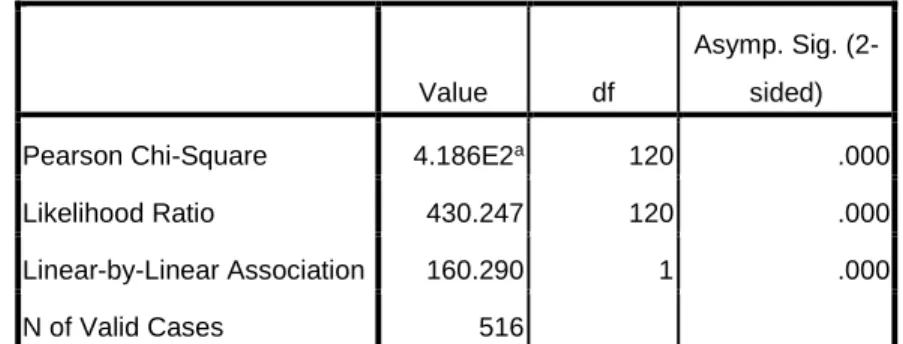
In order to see if the association in URL rate is statistically significant, a Chi-Square Test
was employed between URL Rate and Spam Level(See Table 2). According results
shown in the table, Pearson Chi-Square’s asymptotic significance is .000, less than .05,
which demonstrates that URL Rate is statistically significant associated with spam level.
The higher URL Rate is, the more likely tested user is spam. This might because
spammers on Twitter usually employ URLs to attract users to other websites or products
in order to generate traffic or revenue.
Table 2 Chi-Square Tests: URL Rate and Spam Label
Value df
Asymp. Sig. (2-sided)
Pearson Chi-Square 4.186E2a 120 .000
Likelihood Ratio 430.247 120 .000
Linear-by-Linear Association 160.290 1 .000
N of Valid Cases 516
a. 142 cells (86.6%) have expected count less than 5. The minimum expected count is .06.
b. Mention Rate
Similarly, mention rate is the average number of mentioning contained in each user’s
tweets. As mention always appears with symbol “@”, the metric was calculated by
mean value of mention rate, regular users’ mention rate is close to spammers while
slightly spam and likely spam users have lower mention rate compared with regular users
and spammers. However, based on the median value of mention rate, regular users have
the highest mention rate among all users and the remaining three categories of users’
mention rate is closed to 0. It possibly results from that spammers not usually use
mentioning as tactic on Twitter because Twitter does not support massive mentioning in
tweets. But regular users use mention to share their thoughts with friends or followers.
Table 3 Average and Median Mention Rate of Different Spam Level
Not Spam
Mean .4780991736
Median .3000000000
Slightly Spam
Mean .1377245509
Median .0000000000
Likely Spam
Mean .1922077922
Median .0000000000
Spam
Mean .4716666667
Median .0000000000
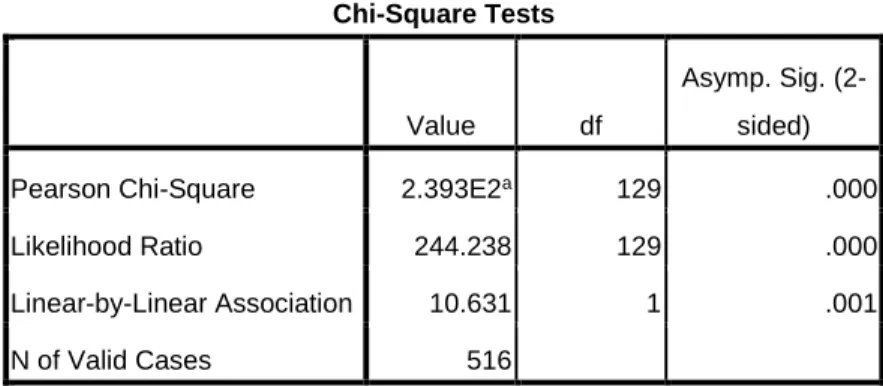
The Chi-Square Test shows that mention rate is statistically associated with spam level.
And the Goodman and Kruskal's gamma coefficient indicates that mention rate and spam
Table 4 Chi-Square Tests and Gamma Coefficent between Mention Rate and Spam Level
Chi-Square Tests
Value df
Asymp. Sig. (2-sided)
Pearson Chi-Square 2.393E2a 129 .000
Likelihood Ratio 244.238 129 .000
Linear-by-Linear Association 10.631 1 .001
N of Valid Cases 516
a. 165 cells (93.8%) have expected count less than 5. The minimum expected count is .06.
Symmetric Measures
Value
Asymp. Std.
Errora Approx. Tb Approx. Sig.
Ordinal by Ordinal Gamma -.520 .054 -10.154 .000
N of Valid Cases 516
a. Not assuming the null hypothesis.
b. Using the asymptotic standard error assuming the null hypothesis.
c. Hashtag Rate
Hashtag rate is the average number of hashtags contained in each user’s tweets and is
calculated by number of pound sign in tweets. The average hashtag rate of regular user is
16.22%, while the rest three categories are 79.58%, 74.42% and 149.67%. The average
number illustrates that regular users are likely to have low hashtag rates and spammers
probably use hashtags (trending topics) to attract normal users, which results in high
hashtag rate.
The Chi-Square Test shows a statistically significant association between hashtag rate
Table 5 Chi-Square Tests between Hashtag Rate and Spam Label
Chi-Square Tests
Value df
Asymp. Sig. (2-sided)
Pearson Chi-Square 3.192E2a 171 .000
Likelihood Ratio 260.576 171 .000
Linear-by-Linear Association 44.452 1 .000
N of Valid Cases 516
a. 220 cells (94.8%) have expected count less than 5. The minimum expected count is .06.
d. Word Count
Word count is the average number of words in each users’ tweets. From calculation, not
spam and spam users have the least number of words in their tweets, while likely spam
users are more likely to write more words in their tweets due to most of likely spam users
are unofficial promotion accounts.
Table 6 Average and Median Word Count of Different Spam Level
Not Spam
Mean 10.4917355
Median 9.85000000
Slightly Spam
Mean 10.7362275
Median 10.0000000
Likely Spam
Mean 13.1331168
Median 14.3000000
Spam
Mean 9.5983333
Median 9.7750000
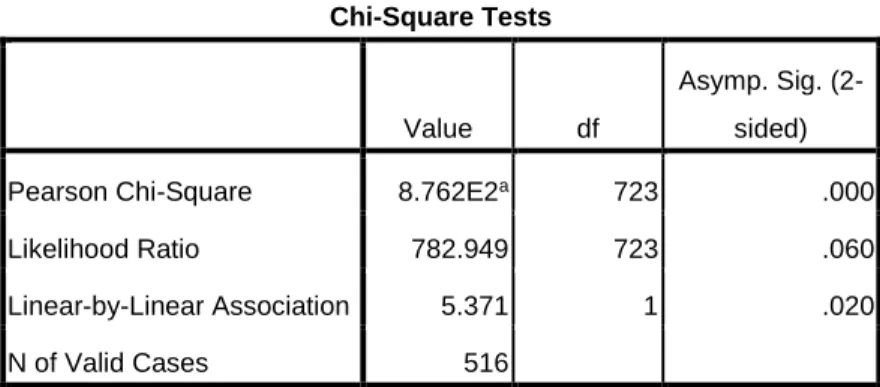
The Chi-Square test shows a significant association between word count and spam level
and the Gamma coefficient value is 0.133, displaying a positive correlation between two
Table 7 Chi-Square Tests between Word Count and Spam Label
Chi-Square Tests
Value df
Asymp. Sig. (2-sided)
Pearson Chi-Square 8.762E2a 723 .000
Likelihood Ratio 782.949 723 .060
Linear-by-Linear Association 5.371 1 .020
N of Valid Cases 516
a. 965 cells (99.7%) have expected count less than 5. The minimum expected count is .06.
e. Spam Word Rate
Spam word rate measures the ratio of number of spam words in each tweet and the tweet
length. Based on (Stop Spammers with a Custom Comment Blacklist, 2016),
(wordpress-blacklist-words, 2016) and (The Ultimate List of Email SPAM Trigger Words, 2016), I
created a list of words that are likely to be used in spam messages on Twitter (See
Appendix). The list of spam words contains 423 words and phrases, most of which are
promotional words or words involved with inappropriate contents. Then I calculated
spam word numbers in each tweet by tweet length in the light of this list.
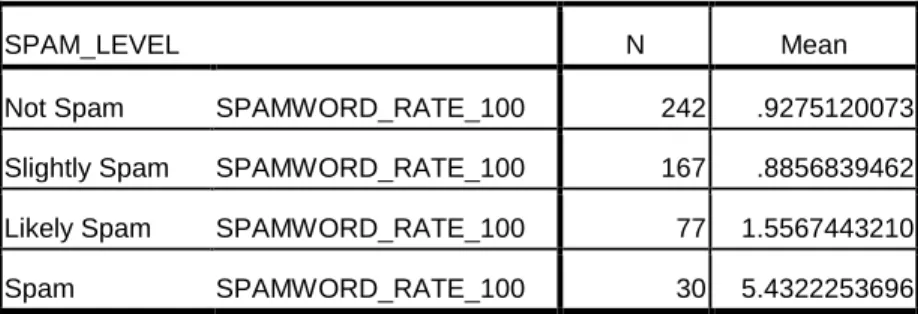
The results are shown in Table 8. The average spam word rate of not spam and slightly
spam users are 0.92% and 0.89%. In contrast, likely spam users and spam users’ spam
Table 8 Average Spam Word Rate of Different Spam Level(%)
SPAM_LEVEL N Mean
Not Spam SPAMWORD_RATE_100 242 .9275120073
Slightly Spam SPAMWORD_RATE_100 167 .8856839462
Likely Spam SPAMWORD_RATE_100 77 1.5567443210
Spam SPAMWORD_RATE_100 30 5.4322253696
According to Chi-Square Test, the asymptotic significance is .000, less than .05.
Therefore spam word rate and spam level have statistically significant association.
Table 9 Chi-Square Test between Spam Word Rate and Spam Level
Chi-Square Tests
Value df
Asymp. Sig. (2-sided)
Pearson Chi-Square 8.418E2a 678 .000
Likelihood Ratio 621.573 678 .940
Linear-by-Linear Association 46.270 1 .000
N of Valid Cases 516
a. 904 cells (99.6%) have expected count less than 5. The minimum expected count is .06.
Based on all findings listed above, five content-based features: URL Rate, Mention Rate,
Hashtag Rate, Word Count and Spam Word Rate could significantly differentiate users
from different spam level so that those five features could be used in spam detection
B.
Graph-based Features
a. Number of Followings
Number of Followings stands for the number of accounts that testing user follows. The
data could be directly extracted from Twitter API. According previous studies, some
spammers employ the strategy to follow other users in order to spread spam messages,
therefore number of followings is proposed to be a feature to detect spam. However,
based on results of sample data, regular users have 871.21 followings on average and
likely spam users have 799.91 followings while slightly spam and spam users have more
followings on average: 1727.1 and 1954.7. The abnormal results might be caused by
some outliers so I also calculated the median of each level. Slightly spam and likely
spam’s spam is less than not spam and spam users and spammers have the highest
median of followings.
Table 10 Average and Median Following of Different Spam Level
Not Spam
Mean 871.21
Median 232.00
Slightly Spam
Mean 1727.10
Median 35.00
Likely Spam
Mean 799.91
Median 59.50
Spam
Mean 1954.70
Median 458.50
The Chi-Square Test displays a statistically significant association between followings
and spam level. The gamma coefficient value is -0.192, indicating that number of
from the first three levels since spammers have the highest number of followings
measured with both median and mean value.
Table 11 Chi-Square Test between Followings and Spam Level
Chi-Square Tests
Value df
Asymp. Sig. (2-sided)
Pearson Chi-Square 1.100E3a 981 .005
Likelihood Ratio 828.230 981 1.000
Linear-by-Linear Association .431 1 .512
N of Valid Cases 501
a. 1307 cells (99.6%) have expected count less than 5. The minimum expected count is .04.
b. Number of Followers
Number of followers is the number that users follow the testing user’s account, which
could be extracted from Twitter datasets directly. Based on the Chi-Square Test, number
of followers is independent with spam level.
Table 12 The Chi-Square Test between Follower and Spam Level
Chi-Square Tests
Value df
Asymp. Sig. (2-sided)
Pearson Chi-Square 1.069E3a 1014 .113
Likelihood Ratio 850.701 1014 1.000
Linear-by-Linear Association .604 1 .437
N of Valid Cases 501
c. Reputation
Reputation is a metric generated from the number of followings and number of followers.
It is defined as follows:
𝑅𝑒𝑝𝑢𝑡𝑎𝑡𝑖𝑜𝑛 = 1 + 𝑁𝑢𝑚𝑏𝑒𝑟 𝑜𝑓 𝐹𝑜𝑙𝑙𝑜𝑤𝑒𝑟𝑠
1 + 𝑁𝑢𝑚𝑏𝑒𝑟 𝑜𝑓 𝐹𝑜𝑙𝑙𝑜𝑤𝑖𝑛𝑔𝑠 + 𝑁𝑢𝑚𝑏𝑒𝑟 𝑜𝑓 𝐹𝑜𝑙𝑙𝑜𝑤𝑒𝑟𝑠
, which is the ratio of followers by total number of followings and followers. As some
users have no followings and no followers, therefore the numerator and denominator all
plus 1.
The average reputation of not spam users and slightly spam users are 0.54 and 0.58,
higher than likely spam users’ reputation: 0.497. However, spammers have gotten the
highest reputation score: 0.604. The Chi-Square Test also demonstrates that there is no
statistically significant association between Reputation and Spam Level. This result
might due to that some spammers have large number of followers and do not need to
attract additional followers in order to attract users, like some accounts spread links of
porn movies.
Table 13 The Chi-Square Test between Reputation and Spam Level
Chi-Square Tests
Value df
Asymp. Sig. (2-sided)
Pearson Chi-Square 1.274E3a 1239 .237
Likelihood Ratio 966.824 1239 1.000
Linear-by-Linear Association .177 1 .674
N of Valid Cases 501
Unlike content-based features, graph-based features do not have significant association
with spammers’ behaviors. It is likely that graph-based features of spammers on Twitter
do not follow the traditional patterns of spammers, or they have employed strategies to
alter their following/follower structure.
C.
Platform
In the sample datasets, user have used 219 kinds of platforms to post their tweets.
Specifically, 44% of tweets in sample sets are posted from Twitter’s web or mobile
clients. 13% of tweets are from Certified Third-party Application, like Facebook, Google,
Instagram or Yelp etc. And the rest 43% are from other third-party applications or
websites.
Figure 4 Platform User Used in Tweets
There is no significant association between the platform user used and user’s spam level.
But based from the sample sets, promotion accounts tend to use third-party applications,
usually sharing from other websites or mobile apps.
22%
22%
13% 43%
Platform User Used in Tweets
Twiiter Web Client Twitter Mobile Client
E
XPERIMENTIn the experiment section, I used content-based features and graph-based features
combined with machine learning algorithms: J48 classification, NaïveBayes and SVM
provided by weka. The classification process employed 10-folds cross-validation to
reduce overfitting effect.
A.
Content-based Features
The weighted average classification results based on content-based features are listed
below,
Table 14 Predicting Result of Cotent-based Features
Classifier TP Rate FP Rate Precision Recall
F-Measure
ROC Area J48 0.711 0.142 0.699 0.711 0.704 0.792
NaïveBayes 0.595 0.244 0.567 0.595 0.567 0.775
SVM 0.585 0.273 0.561 0.585 0.542 0.705
From Table 14, J48 Classification algorithm has a precision of 0.699, a recall of 0.711
and the F-measure reaches 0.704. The precision, recall and F-Measure of NaïveBayes and
SVM are lower than J48.
In order to know the reliability of the results, I used weka’s Experimenter to compare
different classifiers with Paired T-Tester. As Figure 5 suggests, NaïveBayes(58.90%) and
significance. Therefore J48 outperforms the other two algorithms with content-based
feature datasets.
Figure 5 Classifier Comparison Results of Content-based Datasets
Looking into the details of prediction results of J48 Classification algorithm(Figure 6),
the performance of predicting level 0(not spam user) and level 1(slightly spam user) is
better than detecting likely spam and spam users in level 2 and 3. The former F-measure
is 0.842 and 0.663, and the performance of detecting spammers are 0.553 and 0.204.
Figure 6 Predicting Results of J48 Classification
In addition, NaïveBayes and SVM outperforms J48 in detecting level 3 users.
Figure 7 Predicting Results of NaiveBayes
SVM, on the other hand, does not perform well in detecting all spammers, but have a
high precision: 0.75, which indicates that SVM is relatively accurate in detecting
spammers.
Figure 8 Predicting Results of SVM
B.
Graph-based Features
For three graph-based features, two features showed no association with spam level of
users. Due to the lack of features, SVM would definitely have bad prediction
performance. Therefore in Graph-based algorithm, only J48 and NaïveBayes will be used
for experiment. As there are only three features for graph-based algorithms, therefore the
experiment will be conducted with three features (Following, Follower and Reputation)
Table 15 Prediction Results of Graph-based Features
Classifier TP
Rate
FP Rate Precision Recall
F-Measure
ROC Area J48- 3
features
0.571 0.313 0.526 0.571 0.53 0.648
NaiveBayes- 3 features
0.473 0.469 0.336 0.473 0.332 0.529
J48-1 feature 0.569 0.354 0.468 0.569 0.494 0.605
NaiveBayes-1 feature
0.479 0.47 0.348 0.479 0.331 0.514
From Table 15, J48 and NaïveBayes’s performance is similar when using three features
or 1 feature. The best performance is J48 with 3 features, which has a 0.526 precision,
0.571 recall and 0.53 F-Measure.
According to the results of t test, either one feature or three features, J48 decision tree’s
results are significantly better than NaïveBayes’ result at the 5% level of statistical
significance.
Figure 9 Classifier Comparison Results of Graph-based Datasets
The result of graph-based feature prediction is worse than the result of content-based
content-based features. The other reason is that it is likely that graph-content-based features are not
accurate and sensitive to detect spammers on Twitter compared with content-based
features.
The detailed predicting result of J48 classification also shows that with graph-based
features, the performance to classify regular and slightly spam users are better than
detecting real spammers. The performance of NaïveBayes in predicting different
categories is similar to J48.
Figure 10 Predicting Results of J48 Classification with Graph-based Features
The experiment results show that with sample datasets, algorithms based on
content-based features outperform algorithms content-based on graph-content-based features. One reason is that
the number of content-based features are more than the number of graph-based features
so that content based classification has more information to use. The other reason is that
the graph-based features used in the experiments might not accurately indicate spammers.
Number of followers and reputation features are not associated with spam level. And
there is no patterns that could be found in spammers’ relationship structures. Some
spammers have high following and high followers, while some spammers do not follow
reputation those graph-based features may not perform well in spam prediction
experiments.
In addition, J48 classification algorithm performs better than NaïveBayes and SVM with
both content-based and graph-based features. But when detecting if users belong to spam
level 2 and 3 with content-based features, NaïveBayes and SVM have better
performance, SVM’s precision is relatively high in particular.
With either content-based features or graph-based features, three classifiers all have
better performance in classifying regular and slightly spam users. The reason might be
that regular users usually have constant patterns in their information behavior, while
spammers employ different strategies to spread spam messages, which is difficult to
summarize and used for detection. Therefore, ruling out normal users repeatedly from
datasets is likely to be an effective way to target spammers existing in social networking
C
ONCLUSIONThis work employs experiment method, using datasets extracted from Twitter to compare
two different kinds of features on how they differentiate normal users and spammers as
well as how well they could perform to detect spammers.
The results show that content features URL rate, mention rate, hashtag rate, word count
and spam word rate have statistically significant association with users’ level of spam.
And those content-based features combined with J48 classifier perform best in detecting
spammers, which achieves a 0.699 in precision, a 0.711 in recall is 0.711 and a 0.704 in
F-measure.
On the other hand, among graph-based features, only number of followings is
significantly associated with users’ level of spam. Number of followers and reputation of
user are independent with users’ level of spam. Algorithms based on graph features’
performance are not as good as content-based features.
And finally, all algorithms combined with either content-based or graph-based features
L
IMITATIONS ANDF
UTURE WORKThis study has several limitations that could be improved in future work:
(1) Did not extract enough graph-based features for analysis.
In this study, I only extracted the number of followings and followers of each
sampled users. Whereas part of the features did not work well indicating spammers,
which affected the performance of graph-based algorithms. In the future work, some
other features could be included in as well, like the reply, retweet or like features
which showing interaction between users.
(2) Sample size is limited.
Due to the hard work to manually label each user as spam or not, I only sampled
around 500 users as sample for analysis. With this limited size of sample, only 30
users were categorized as level 3, the real spammers, which is difficult to summarize
patterns from the small sample. Therefore in the future work, I will try to find ways to
include more users in the sample as well as labelling users automatically to reduce
manual work.
(3) Lack deep analysis on how each factor works in machine learning algorithm.
The study only compares the performance of algorithms based on two kinds of
features while there lacks deeper analysis on how each feature or factor performs in
detecting spammers, like how much each feature contribute in the precision and recall
B
IBLIOGRAPHYAhmed, F., & Abulaish, M. (2012). An MCL-based approach for spam profile detection in online social networks. Proc. of the 11th IEEE Int. Conference on Trust, Security and Privacy in Computing and Communications, TrustCom-2012 - 11th IEEE Int. Conference on Ubiquitous Computing and Communications, IUCC-2012, 602–608.
Benevenuto, F., Magno, G., Rodrigues, T., & Almeida, V. (2010). Detecting spammers on twitter. Collaboration, Electronic Messaging, Anti-Abuse and Spam
Conference (CEAS).
Chu, Z., Gianvecchio, S., Wang, H., & Jajodia, S. (2012). Detecting automation of Twitter accounts: Are you a human, bot, or cyborg? IEEE Transactions on Dependable and Secure Computing, 9(6), 811–824.
Chu, Z., Widjaja, I., & Wang, H. (2012). Detecting social spam campaigns on Twitter.
Lecture Notes in Computer Science (including Subseries Lecture Notes in Artificial Intelligence and Lecture Notes in Bioinformatics), 7341 LNCS, 455– 472.
Delany, S. J., Buckley, M., & Greene, D. (2012). SMS spam filtering: Methods and data.
Expert Systems with Applications, 39(10), 9899–9908.
Grier, C., Thomas, K., Paxson, V., & Zhang, M. (2010). @ spam : The Underground on 140 Characters or Less ∗ Categories and Subject Descriptors. Proceedings of the
17th ACM Conference on Computer and Communications Security, 27–37.
Lin, P.-C., & Huang, P.-M. (2013). A study of effective features for detecting long-surviving Twitter spam accounts. Advanced Communication Technology (ICACT), 2013 15th International Conference on, 841-846.
Lumezanu, C., & Feamster, N. (2012). Observing common spam in tweets and email.
Proceedings of the 2012 ACM Conference on Internet Measurement Conference,
441–466.
McCord, M., & Chuah, M. (2011). Spam detection on twitter using traditional classifiers.
Miller, Z., Dickinson, B., Deitrick, W., Hu, W., & Wang, A. H. (2014). Twitter spammer detection using data stream clustering. Information Sciences, 64-73.
REST APIs. (2016, March 15). Retrieved from Twitter: https://dev.twitter.com/rest/public
S. Abu-Nimeh, T. Chen, and O. Alzubi, "Malicious and spam posts in online social networks." IEEE Computer Society, 44(9), Sep. 2011
Song, J., Lee, S., & Kim, J. (2011). Spam filtering in twitter using sender-receiver relationship. Lecture Notes in Computer Science (including Subseries Lecture Notes in Artificial Intelligence and Lecture Notes in Bioinformatics) (pp. 301– 317). 6961 LNCS.
Spamming. (2016, March 14). Retrieved from Wikipedia: https://en.wikipedia.org/wiki/Spamming
Stop Spammers with a Custom Comment Blacklist. (2016, March 7). Retrieved from Digging Into WordPress: https://digwp.com/2010/02/stop-spammers-custom-blacklist/
Streaming APIs. (2016, March 15). Retrieved from Twitter: https://dev.twitter.com/streaming/overview
Stringhini, G., Kruegel, C., & Vigna, G. (2010). Detecting spammers on social networks.
Annual Computer Security Applications Conference(ACSAC), 1-9.
Tan, E., Guo, L., Chen, S., Zhang, X., & Zhao, Y. (2013). UNIK: unsupervised social network spam detection. Proceedings of the 22nd ACM International Conference on Conference on Information & Knowledge Management, 479–488.
The Ultimate List of Email SPAM Trigger Words. (2016, March 7). Retrieved from HubSpot: http://blog.hubspot.com/blog/tabid/6307/bid/30684/The-Ultimate-List-of-Email-SPAM-Trigger-Words.aspx
Thomas, K., Grier, C., Song, D., & Paxson, V. (2011). Suspended accounts in retrospect: an analysis of twitter spam. Proceedings of the 2011 ACM SIGCOMM conference on Internet measurement conference, 243–258.
Thomas, K., Paxson, V., Mccoy, D., & Grier, C. (2013). Trafficking Fraudulent Accounts : The Role of the Underground Market in Twitter Spam and Abuse Trafficking Fraudulent Accounts : USENIX Security Symposium, 195–210.
Wang, A. (2010). Detecting spam bots in online social networking sites: a machine learning approach. Data and Applications Security and Privacy XXIV, 335–342.
Wang, A. H. (2010). Don't follow me: Spam detection in Twitter. Security and Cryptography (SECRYPT) (pp. 1-10). Proceedings of the 2010 International Conference.
Wang, D., Navathe, S. B., Liu, L., Irani, D., Tamersoy, A., & Pu, C. (2013). Click traffic analysis of short URL spam on Twitter. Collaborative Computing: Networking, Applications and Worksharing (Collaboratecom) (pp. 250-259). 9th International Conference Conference.
wordpress-blacklist-words. (2016, March 7). Retrieved from NotaGrouch:
http://notagrouch.com/wp-content/uploads/2009/12/wordpress-blacklist-words.txt
Yang, C., Harkreader, R. C., & Gu, G. (2011). Die free or live hard? Empirical evaluation and new design for fighting evolving twitter spammers. Lecture Notes in
Computer Science (including Subseries Lecture Notes in Artificial Intelligence and Lecture Notes in Bioinformatics), 6961 LNCS, 318–337.
A
PPENDICESAppendix A: Python Scripts Used for Twitter API
(1) Streaming API
import tweepy
import codecs
import sys
from time import clock
#OAuth Authentication
auth=tweepy.OAuthHandler(consumer_key,consumer_secret) auth.set_access_token(access_token,access_token_secret) api = tweepy.API(auth)
file = open("data.txt",'ab')
print api.me().name
start=clock()
print start
class StreamListener(tweepy.StreamListener):
def on_status(self,status): if(status.lang=="en"): try:
userid=status.author.id
print >> file, "%s" % (userid)
except Exception,e:
print >> sys.stderr, 'Encountered Exception:',e
pass
def on_error(self,status_code):
print 'Error:' + repr(status_code) return True
def on_timeout(self):
print >> sys.stderr, "Timeout..." time.sleep(10)
return True
public_stream=tweepy.Stream(auth=auth,listener=StreamListener())
file.close()
pass
(2) REST APIs
import tweepy
import sys
auth = tweepy.OAuthHandler(consumer_key, consumer_secret) auth.set_access_token(access_token, access_token_secret)
api = tweepy.API(auth)
file = open("data.txt",'a') id_file=open("IDS.txt","r") ids=id_file.readlines()
for id in ids: id=id.rstrip() try:
user_timeline = api.user_timeline(id)
for status in user_timeline: try:
tweet=status.text.encode('utf-8') tweet=tweet.replace('\n',' ')
user=status.author.screen_name.encode('utf-8') userid=status.author.id
time=status.created_at source=status.source tweetid=status.id
# print tweet
print >> file, "%s|%s|%s|%s|%s|%s" % (userid, user, time, tweetid, tweet, source)
except Exception,e:
print >> sys.stderr, 'Encountered Exception:',e
pass
except Exception,e:
print >> sys.stderr, 'Encountered Exception:',e
pass
id_file.close() file.close()
import tweepy
import sys
import time
auth = tweepy.OAuthHandler(consumer_key, consumer_secret) auth.set_access_token(access_token, access_token_secret)
api = tweepy.API(auth)
file = open("follow.txt",'ab') id_file=open("user_list.txt","r") ids=id_file.readlines()
for id in ids: id=id.rstrip() try:
followed = api.friends_ids(id) following=api.followers_ids(id) count_followed=str(len(followed)) count_following=str(len(following))
record=id+"|"+count_followed+"|"+count_following print record
file.write(record) file.write("\n") time.sleep(180 )
except Exception,e:
print >> sys.stderr, 'Encountered Exception:',e
pass
id_file.close() file.close()
Appendix B: Spam words list
$$$ [/url] [url= 100% free 100% Satisfied 4u 50% off Accept Credit
Cards
Access aceteminophen
Act Now! Ad adderall Additional Income
Addresses on CD
adipex advicer Affordable All natural All new Amazing ambien anime Apply now Apply Online As seen on ass augmentation Auto email
removal
Avoid bankruptcy
baccarat baccarrat Bargain bdsm Be your own boss Being a
member
Beneficiary Best price Beverage Big bucks
Billing address Billion dollars bitch blackjack bllogspot Bonus booker Brand new
pager
breast Bulk email
Buy direct Buying judgments
byob Cable converter Call free
Call now Calling creditors
Cannot be combined with any other offer
Can't live without
Cards accepted
carisoprodol car-rental-e-site car-rentals-e-site
Cash Casino
casinos Celebrity Cents on the dollar
cephalaxin Certified
chatroom Cheap Check money order cialis citalopram Claims Clearance Click clomid cock Collect Compare rates Compete for
your business
Confidentially on all orders
Congratulations
Consolidate debt and credit
Consolidate your debt
coolcoolhu coolhu
Copy DVDs Cost Credit cumshot Cures baldness cwas cyclen cyclobenzaprin
e
cymbalta dating
dating-e-site day-trading Deal debt debt-consolidation Diagnostics dick Dig up dirt on
friends
Direct email Direct marketing
Discount discreetorderin g
Do it today Don't delete Don't hesitate
Double your doxycycline Drastically reduced
dutyfree duty-free
Earn Easy terms Eliminate bad credit
Eliminate debt Email harvest
Email marketing
enhancement ephedra equityloans Expect to earn
Explode your business
Extra income facial Fantastic deal Fast cash
Fast Viagra delivery
femdom fetish finance Financial freedom
Financially independent
Financially independent
fioricet flowers-leading-site
For free
For instant access
Free freenet fuck Full refund gambling gdf gds Get it now Get out of debt Get paid Get started
now
Gift certificate Giving away Great offer Guarantee
hair-loss Have you been turned down?
Hidden assets hidden charges holdem
Home based Home employment Homebased business homeequityloan s homefinance
hotel hqtube Human growth hormone
hydrocodone If only it were that easy
Important information regarding
In accordance with laws
incest Income Increase sales
Increase traffic Increase your sales
Incredible deal Info you requested
Information you requested
Instant Insurance Internet market Investment It’s effective Join millions jrcreations Laser printer leading-site Legal levitra lexapro Life Insurance limited time lipitor loan Long distance
phone offer
lorazepam Lose weight Lower interest rate
Lower monthly payment Lower your mortgage rate Lowest insurance rates
Lowest price lunestra
Luxury car macinstruct Mail in order form
Make $ Make money
male Marketing Mass email Medicine Meet singles Member meridia Message
contains
Million dollars Money back
Money making Month trial offer
More Internet Traffic
mortgage Multi level marketing
naked Name brand New customers only
New domain extensions
No age restrictions
No catch No claim forms
No cost No credit check No disappointment
No experience No fees No gimmick No hidden Costs
No inventory
No investment No medical exams
No middleman No obligation No purchase necessary
No questions asked
No selling No strings attached
No-obligation Not intended
Notspam Now only nude Obligation Off shore Offer Once in
lifetime One hundred percent free One hundred percent guaranteed One time One time mailing Online biz opportunity
Online degree Online marketing
Online pharmacy
online-gambling
Only $ Opportunity Opt in Order now
Order status Order today Orders shipped by
ottawavalleyag Outstanding values
ownsthis oxycodone oxycontin palm-texas-holdem-game
paxil
Please read poker porn Potential earnings
poze
Pre-approved Price Priority mail Prize Produced and sent out Profits Promise you propecia Pure profit pussy
Quote Real thing Refinance Removal instructions
Removes wrinkles
rental rental-car-e-site Requires initial investment
Reserves the right
Reverses aging
ringtone Risk free Rolex roulette Sale Satisfaction
guaranteed
Save $ Save big money
Save up to Score with babes
Search engine listings
Search engines Sent in compliance
Serious cash sex
shemale shit shoes shopper Shopping spree slot-machine Social security
number
soma Special promotion
Stainless steel
Stock alert Stock disclaimer statement
Stock pick Stop snoring Stuff on sale
Subject to credit
Subscribe Supplies are limited
Take action now
Terms and conditions
texas holdem texas-holdem The best rates The following form
They keep your money -- no refund!
They’re just giving it away
This isn't junk This isn't spam thorcarlson Time limited
tits titties top-e-site top-site trading
tramadol Trial trim-spa ultram Undisclosed recipient University
diplomas
unlimited Unsecured credit
Unsecured debt Unsolicited
Unsubscribe Urgent US dollars Vacation valeofglamorganconservative s
valium valtrex viagra vicodin vicoprofen
vioxx visa Visit our
website
Warranty We hate spam
We honor all Web traffic Weekend getaway
Weight loss What are you waiting for?
While supplies last
While you sleep
Why pay more Will not believe your eyes
Win
won Work at home Work from home
xanax xenical
You have been selected
Your income zolus Б д