Kathleen A. Hall.Self-injury in Young Adult Literature: An Analysis of Realism.A Master’s Paper for the M.S. in L.S. degree.April, 2012.68pages.Advisor: Sandra Hughes-Hassell
Prompted by a recent claim that “darkness” was taking over the entire spectrum of young adult literature, this study examines the level of realism in the representation of self-injury – one of the so-called “dark” themes and known more commonly as cutting – in young adult literature. Using a background of psychology literature, each title was analyzed using content analysis and deemed to be realistic or unrealistic, and then measured on an original and included rubric determining its ability to provide a positive path for real teenage self-injurers who may choose to read it. Upon finding that all eight of the novels were realistic but only half of them provided supportive depictions of the healing process, implications for library practices are discussed, and an argument is made for keeping these books on the shelves for those who want to incorporate them into their road to recovery.
Headings:
Young adult literature
Young adult literature -- History and criticism
Self-mutilation
Readers’ advisory services
by
Kathleen A. Hall
A Master’s paper submitted to the faculty of the School of Information and Library Science of the University of North Carolina at Chapel Hill
in partial fulfillment of the requirements for the degree of Master of Science in
LibraryScience.
Chapel Hill, North Carolina
April 2012
Approved by
_______________________________________
Introduction
Both within and beyond the field of librarianship, a recent topic of much debate
has been the so-called prevalence of “darkness” in young adult (YA) literature. The
catalyst that sparked this discussion was an article by Wall Street Journal regular
children’s book reviewer Meghan Cox Gurdon, published this past June (Gurdon, 2011).
Gurdon’s piece, an editorial or opinion piece at heart, read as though it were a factual
account of the landscape of current YA literature, and was thus met with a powerful
response in the form of a flurry of articles, blog posts, listserv dialogues, and even a
Twitter hash tag (Burns, 2011; Farley, 2011; Holmes, 2011; Johnson, 2011; Lyons, 2011;
Springen, 2011). Authors, librarians, educators, parents, and adolescent readers debated
the merits of depictions of violence, pathologies, profanity, and various other types of
“ugliness” (Gurdon, 2011) in YA literature. On one side were those who were in
agreement with Gurdon, arguing that today’s YA literature ensconces readers in
extremely negative and rare views of what life is like, and – if they are not already under
some form of unfortunate circumstances – that these books will drive them to their own
unhappiness and poor choices. The opposing side, primarily made up of librarians,
authors, and teen readers themselves, contended that these topics teach readers empathy,
alternate perspectives, and how to cope with the struggles present in their own day-to-day
lives.
Throughout the debate, individuals shared their own experiences – loss of a loved
or would not want to read a novel addressing their personal struggle. Some said they
would not have been able to live without a book showing them that they were not alone,
and that there was a way out of their grief or hardship; others said that reading about their
own situations in such excruciating detail was unbearable for them, and would only lead
to further despondency. The fact remains, however, that some readers will want to use
books to push themselves through difficult circumstances or personal afflictions, and, as
librarians, it is our professional duty to be able to provide these materials when a patron
asks for them – and to be a trustworthy, helpful adult to the adolescents who come to us.
The danger of a piece like the one discussed above lies in the chance that books about the
more troubling parts of life will be removed from shelves – or, even worse, cease to be
written – and consequently removed from a teen reader’s arsenal of tools to use in getting
through a difficult situation.
Self-injury – known more commonly as cutting – emerged as one of the most
frequently mentioned examples of “darkness” in YA literature. It is an increasingly
widespread disorder among young adults from a wide variety of backgrounds and
circumstances (Walsh, 2006, p. 38-39), and a significant number of novels written for
them include it as a major theme. Despite these facts, no general overview of the
behavior or professional evaluative tool or guide exists specifically for librarians to
consult when these books are requested – or challenged – by their user populations. In a
time when complex topics such as self-injury are being questioned and even attacked by
adults in positions of authority and influence who can affect what teenagers can and
cannot read, librarians must have the foundational knowledge necessary to argue in favor
them. Representations of self-injury in YA literature are, for the most part, realistic in
their depictions of the behavior; therefore, arming librarians with knowledge of this
truthful storytelling, as well as a tool that will allow them to evaluate the level of realism
in future publications, will not only increase their abilities to conduct reader’s advisory
with parents and young adults, but will enable them to be trusted and knowledgeable
figures in the lives of teenagers who may be sorely missing just such an individual during
a time of crisis. Under circumstances that could ultimately elevate to matters of life and
death, librarians need to be equipped with the knowledge and skill necessary to evaluate
books about self-injury. This study will provide the librarian community with a detailed
glimpse into the psychological aspects of self-injury, an in-depth discussion of how
accurately and sensitively they are represented in recent YA novels, and a tool to use in
evaluating future YA fiction that features self-injuring characters. Self-injury can be an
intimidating topic, but if we begin to unfold the layers of what truly goes on in the minds
of teenagers engaging in it, we will be more than qualified to advocate for the books that
Literature Review Self-injury
Though a study of young adult fiction may seem significantly disparate from a
psychological study, no discussion of self-injury can take place without first laying out
the various definitions, terms, and concepts that make up the psychology literature about
the behavior. It is also the case that, because it is an increasingly common phenomenon,
each and every adult responsible for teenagers in any capacity should have a fundamental
knowledge of self-injury. Without a strong foundation already beneath our feet, we may
feel overwhelmed and ill-prepared when approached by a self-injuring patron, and could
miss our opportunity to do our part in helping them – and that is an opportunity that we
do not want to see slip through our fingers.
Non-suicidal self-injury is among the more complex behaviors within psychology,
and that complexity begins with its very name. There are a number of labels for the
notion of altering one’s own body intentionally, but these terms can vary based on
geographical region, the intent or meaning motivating the act, and the subjective
interpretations of each particular expert in the field (D’Onofrio, 2007, p. 21; Favazza,
1996, p. xviii; Nixon & Heath, 2008, p. 4; Tantum & Huband, 2009, p. x; Walsh, 2006, p.
4). The notion of self-injury that is relevant to this study is characterized by intentionally
causing harm to oneself for the purpose of relief from heightened emotional states, which
usually carries with it a sense of social unacceptability or stigma (Favazza, 1996, p. xix;
from other mutilative acts like tattooing or piercing, which alter the body, but are cultural
practices that are viewed as commonplace (Favazza, 1996, p. xviii-xix). Self-injurers
engage in practices that are viewed as irregular or odd by most, including burning,
cutting, strangulation, scratching, hair-pulling, head-banging, penetration with sharp
objects, or wound aggravation (Motz, 2009a, p. 2; Motz, 2009b, p. 15; Sim, Adrian,
Zeman, Cassano, & Friedrich, 2009, p. 82). Repetitive self-mutilation syndrome has been
introduced as a suggested diagnosis for individuals who frequently engage in
non-suicidal self-harming behaviors to release building mental tension, but some have pointed
out that the two central characteristics of this behavior – impetuosity and self-harm – are
symptomatic of other, preexisting diagnoses, rendering RSM slightly redundant (Favazza,
1996, p. 253-257).
While that may be true, it is anything but unusual for self-injury to be associated
with other disorders; in fact, that has quite often been the case, and these disorders are
described as co-occurring with self-injury (Klonsky & Glenn, 2008, p. 50). Studies have
linked self-injury to anxiety, dissociative disorders, antisocial personality disorders,
depression, and eating and substance disorders (Favazza, 1996, p. 246-250; Fortune,
Sinclair, & Hawton, 2008, p. 103; Klonsky & Glenn, 2008, p. 50-51). Self-injury has
been listed as symptomatic of all of these types of disorders, but it is by far the most
associated with borderline personality disorder, or BPD. While the temporal relationship
between the two is not clear, the driving force behind their link is emotion dysregulation,
or inability to cope with extreme emotions (Klonsky & Glenn, 2008, p. 50). Similar in the
sense that they can come about as a symptom of another disorder or stand on their own,
often aligned with or compared to self-injury. It is also the case that some cutters develop
eating disorders like bulimia or anorexia (Favazza, 1996, p. 254). These two behaviors
are linked by their common issues of control over one’s body, self-preservation at any
cost, and a ritualistic approach to emotional release (Motz, 2009a, p. 10).
The syndromes or disorders associated with self-injury are just one of the many
factors that can be considered when examining what causes someone to engage in
self-injury. Like so many other disorders, self-injury is referred to as a multidetermined
behavior, meaning that it is caused by a variety of inextricably-linked aspects of a teen’s
life (Favazza, 1996, p. 282). There is no one thing that can be pointed out as the “cause”
of self-injury. However, a biopsychosocial model of self-injury exists that names the five
dimensions to consider both independently and in relation to one another in order to make
any progress toward a determination of the roots of self-injurious behaviors. These
dimensions are environmental, biological, cognitive, affective, and behavioral (Heath &
Nixon, 2008, p. 144; Walsh, 2006, p. 57).
Within these dimensions, risk factors – circumstances or traits that make a teen
more likely to self-injure – and protective factors - circumstances or traits that make a
teen less likely to self-injure – can be identified (Klonsky & Glenn, 2008, p. 45-46).
While these factors can be useful indicators, they are not infallible guarantees as to how a
teen will behave or think (Klonsky & Glenn, 2008, p. 55). The uniquely personal and
interdependent nature of these dimensions and factors create a sense of indefinability that
often increases self-injury’s already mysterious or confusing aura (Norris & Maher, 2009,
One of the most dominant risk factors behind self-injury is a tenuous relationship
within a teen’s family (Grocutt, 2009, p. 112-113). In a study of self-injuring adolescents,
136 of the respondents listed family problems as related to their behaviors (Fortune,
Sinclair, & Hawton, 2008, p. 99). Stemming from as early as infancy, a child who does
not have his or her needs met by a caregiver unknowingly cultivates an incomplete sense
of self (Motz, 2009b, p. 22-23). If a child is not consistently comforted by another or
shown how to self-soothe, he or she matures without the necessary framework for coping
with emotions and without the sense that his or her emotions are important and worthy of
expression and attention (D’Onofrio, 2007, p. 31-47). Additionally, a child will emulate
what he or she sees: if a caregiver behaves self-destructively, the child will perceive this
behavior as not just acceptable, but a healthy and viable choice (Walsh, 2006, p. 59). As
they grow older, children are far more able to recognize and label the gaps in their
relationships with family members. Self-injuring teens have characterized their families
as hypercritical, alienating, absent, difficult to communicate with, excessively protective,
uncaring, dominant, and untrustworthy (Bureau et al., 2010, p. 491; Favazza, 1996, p.
269). In combination with these impressions of the people who are supposed to love them
most, teens are faced with a climbing divorce rate and, in some cases, the elimination of
the presence of trusted adults in their day-to-day lives (D’Onofrio, 2007, p. 32). While
some self-injuring teens do come from attentive, loving families, the majority come from
circumstances like these. Feeling unloved in their own homes, many teens carry with
them the sense that each day is a struggle, and they are ill-equipped to deal with that
Some teens carry the even heavier burden of past abuse. Both physical and sexual
abuse have been proven as links to later self-injury, with physical abuse being the more
prevalent of the two (Klonsky & Glenn, 2008, p. 48). These children are made to feel
unsafe in their own bodies, and often inflict injuries upon themselves as a result of that
lack of safety, in an effort to traverse the line between victim and aggressor and
counteract their own feelings of helplessness (Motz & Jones, 2009, p. 47). This approach
is most often taken by teenage girls who have been sexually abused, a group that has
been known to turn to cutting or burning themselves (Motz, 2009a, p. 2). While these
statements are true of some victims of abuse, it is important to remember that it is
certainly not true of all of them – and self-injury does not always imply that abuse has
taken place. In fact, clinicians who assume abuse has taken place can convince their
patients – who are desperate for any sort of progress or explanation – that they must have
repressed memories that need to be brought to light, resulting in the destruction of what
were, in reality, supportive relationships (Favazza, 1996, p. 268).
Though indicators like these can shed some light onto the circumstances of some
injuring teens, they are far from perfect or all-inclusive. In fact, describing the
self-injurer in broad strokes is next to impossible (Favazza, 1996, p. 70). As stated above,
there is no one event, trait, or diagnosis that can predict or explain self-injury (D’Onofrio,
2007, p. 43). In addition, many self-injurers never make their behavior known at all, or to
anyone outside of their immediate circle of family and friends (Favazza, 1996, p. 56).
Cutters, especially, can only be counted by volunteer studies, hospital visits wherein they
disclose what they have done to themselves, or stays in facilities or institutions (Motz,
or represent statistically. However, studies have been able to make generalizations –
always to be taken with a grain of salt – about the characteristics of most self-injurers.
The gender breakdown is anything but even: females self-injure far more often than
males (Motz, 2009a, p. 9). Within the group of males who do self-injure, confusion over
their sexual identity has been noted repeatedly (Favazza, 1996, p. 269). Adolescents –
especially those in foster care or orphanages – are among the most frequent to self-injure,
as are institutionalized women (Motz, 2009a, p. 1). Self-injuring young adults often
experience periods of hypersexuality, promiscuity, and depression, and earn poor grades
in school (Favazza, 1996, p. 269; Kaminski et al., 2010, p. 465). In a study asking teens
from various backgrounds and living situations if they had ever self-injured,
African-American teens were the least likely to claim such behavior, while White and Hispanic
teens reported nearly equivalent numbers (Kaminski et al., 2010, p. 465). Teens living
with a remarried parent and his or her new spouse were far more likely to self-injure than
teens living with both parents or a single parent (Kaminski et al., 2010, p. 465).
Economic status is somewhat unclear, as some studies point to middle- and upper-class
females as the most likely group to self-injure (D’Onofrio, 2007, p. 40), while others
indicate that most cutters come from the more disadvantaged population (Tantum &
Huband, 2009, p. 7). An explanation for this may be that those with the means to get
treatment for their self-injury are represented in the statistics, while those who cannot
seek professional help are numerous but without an opportunity to be counted
(D’Onofrio, 2007, p. 40). Within these groups, self-injurers are often depressed and
are purposefully avoiding certain situations to keep their bodies hidden (Favazza, 1996,
p. 271).
Much about self-injury is unknown by the public, but its essential difference from
suicide is among the top injury myths. Even historic studies failed to recognize
self-injury as its own behavior, formerly labeling it as failed suicide attempts (Favazza, 1996,
p. 56). It was not until the 1960s that cutting became a priority among psychiatric experts
in the US and Great Britain (Favazza, 1996, p. 163), and only more recently has it come
to be seen as its own distinct behavior, rather than solely as a symptom of another
syndrome (D’Onofrio, 2007, p. 7). In most cases, self-injurers whose lives end
prematurely are the result of an unintentionally deep wound (Norris & Maher, 2009, p.
85). Experts agree that the language of suicide is to be avoided, and it should not be a
foregone conclusion that a self-injurer wishes to die (Motz, 2009a, p. 3; Walsh, 2006, p.
71). Suicide should only be discussed with a self-injurer if that individual is beginning to
receive less and less relief from his or her usual cutting ritual – thus losing control over
their pain – and is indicating feelings of futility (Walsh, 2006, p. 15-16).
The crucial difference between self-injury and suicide may seem contradictory on
the surface, but upon further thought, makes quite a bit of sense: self-injury is an act of
self-preservation, while suicide is an act of self-destruction (Motz, 2009a, p. 6).
Self-injury provides those who engage in it with a sense of control and choice that suicidal
individuals do not feel, which ultimately drives them to take their own lives, while
self-injurers are able to gain periods of relief from their pain, and keep on living with the hope
and the knowledge that they will feel better in the future (Favazza, 1996, p. 271; Walsh,
any other chosen method of self-injury – as a way to reach out to those around them,
while suicide is the ultimate act of isolation (Motz, 2009b, p. 15-16). While it may not
seem that way from the outside, self-injuring teens use cutting as a way to hold onto life.
Cutting can be a gruesome and desperate activity – but it provides teens with an
immense sense of control, relief, and hope. Teens are drawn to it for a number of reasons,
and it serves a number of purposes for them, putting it into the category of an
overdetermined behavior (Lloyd-Richardson, Nock, & Prinstein, 2008, p. 31). The
purposes or goals of self-injury are referred to as functions, and they vary from teen to
teen, overlap with one another, and change over time (D’Onofrio, 2007, p. 78; Heath &
Nixon, 2008, p. 160; Lloyd-Richardson, Nock, & Prinstein, 2008, p. 35; Motz, 2009a, p.
6). The most common function among self-injurers is that of affect regulation (Heath &
Nixon, 2008, p. 160), which is the clinical name for dealing with one’s emotions. As
described above, many of the teens who self-injure are not equipped with the ability to
handle their feelings in a positive manner, and they turn to self-injury to turn their
emotional pain into physical pain, which translates it to a form they are capable of
controlling (D’Onofrio, 2007, p. 80). Communication is another one of the most common
functions of self-injury (Favazza, 1996, p. 62). When teens feel as if their voices are not
being heard, or are unable to put their feelings into words, they turn to communicating
through the marks they carve into their bodies (Motz, 2009b, p. 21-22). It has been
referred to as a language in and of itself (Motz, 2009b, p. 15), and as a way of releasing
unwanted emotions from the body (Favazza, 1996, p. 63).
Though effective for many teens, self-injury is undeniably an unhealthy coping
An initial assessment needs to be completed by a mental health professional, and is made
up of the following components: containment, engagement, assessment, and planning
next steps (D’Onofrio, 2007, p. 145). If the assessment indicates that it is necessary,
treatment follows. For self-injurers, treatment primarily takes the form of one-on-one
therapy sessions, due to the private nature of the behavior, and the difficulty self-injurers
have with interpersonal relationships; these things are much easier to tackle on the small
scale of one-on-one sessions (Favazza, 1996, p. 110). First and foremost in treatment is
the building of a positive alliance between the self-injurer and his or her therapist. Teens
need to feel safe, trusted, and understood before they can even begin to unravel the
turmoil behind their self-injury, and they cannot pursue this venture without establishing
a meaningful relationship with their therapist (D’Onofrio, 2007, p. 97; Grocutt, 2009, p.
108-109; Heath & Nixon, 2008, p. 144; Lieberman, Toste, & Heath, 2008, p. 208). While
the impulse may be to ask question after question, in order to get to the root of the issue
quickly and stop the self-injury as soon as possible, this is not a realistic expectation on
any level, and patience must be maintained throughout what can be a rather lengthy
healing process (D’Onofrio, 2007, p. 104-105). Due to the drawn out and intense nature
of this endeavor, some are convinced that no singular mental health professional can or
should take on the task alone, and there should be a circle of care or treatment team in
place (D’Onofrio, 2007, p. 95; Favazza, 1996, p. 318; Nixon, Aulakh, Townsend, &
Atherton, 2008, p. 219).
No matter who is involved, the ultimate goal of the treatment is to provide the
self-injurer with alternative coping mechanisms; in other words, these teenagers need to
honest, and dependable (D’Onofrio, 2007, p. 148). There are various opinions on the best
way to go about achieving this goal, but there is one common thread among them: there
is no medication that has been developed to target self-injury directly, so there is no
chance that a prescription alone could stop self-injurious behavior (Plener, Libal, &
Nixon, 2008, p. 276). Treatment of self-injury can only take place through the slow but
steady process of untangling whatever circumstances or events caused the client to begin
self-harming in the first place. In the meantime, some advocate for documents called No
Harm Contracts, which are agreements the self-injurer signs at the beginning of
treatment, promising to stop physically harming themselves. Some experts agree that
these contracts do more harm than good, due to the fact that they are suggested prior to
any alternative coping mechanisms are taught, they can seem forced onto the individual
without any involvement or choice on their part, and they can add to the client’s feelings
of guilt and lack of self-worth if they fail to live up to the contract’s terms (Favazza,
1996, p. 110-111; Nixon, Aulakh, Townsend, & Atherton, 2008, p. 219-220). Another
alternative for addressing the physical aspects of self-injury is harm minimization, which
provides self-injurers with alternative behaviors that still inflict pain, but to a lesser
degree – such as hitting a pillow or snapping one’s wrist with a rubber band – or with
supplies or techniques that make the behavior as safe as possible (Favazza, 1996, p.
111-112). The argument against harm minimization, however, is that it encourages the notion
that there must be some sort of physical act of release to truly cope with emotions, which
can dangerously reinforce a negative strategy (Favazza, 1996, p. 113).
While some of these methods may be useful in times of crisis or at the very
new ways to successfully deal with extreme emotions, and to remind the self-injurer that
others who used to cut or burn themselves to feel mental relief have left their self-injury
behind in favor of healthier behaviors (Walsh, 2006, p. 126-127). Some of the suggested
behavioral categories and skill types include:
Negative replacement behaviors (which are the sorts of acts described above in conjunction with harm minimization, and should only be used in the initial stages of transitioning to alternative outlets)
Mindful breathing skills
Visualization techniques
Physical exercise
Writing
Artistic expression
Playing or listening to music
Communicating with others
Diversion techniques (Walsh, 2006, p. 127)
Choosing which skills work best is up to the therapist-client team, and will vary from
individual to individual and change as treatment progresses (Walsh, 2006, p. 148-149).
Several studies have asked self-injuring teens directly what kind of help they
would most like to receive, and from whom. In the vast majority of these types of studies,
survey respondents stated that simply having an accepting, nonjudgmental listener to
recognize their suffering was of the utmost importance to their recovery (Fortune,
Sinclair, & Hawton, 2008, p. 98; Ryan, Heath, Fischer, & Young, 2008, p. 244).
However, teens have also stated that outside help is very unlikely to persuade a
self-injurer to stop engaging in the behavior before they are ready to do so (Fortune, Sinclair,
& Hawton, 2008, p. 102), highlighting the fact that this is a largely internal struggle, and
the will to move past it can only truly come from within. In one study, when asked to
choose between friends, family members, mental health professionals, and a few other
least helpful in the process of reducing self-injury (Ryan, Heath, Fischer, & Young, 2008,
p. 245). When asked by which group they would like to be asked for ways to provide
help, 41% chose their friends once again (Ryan, Heath, Fischer, & Young, 2008, p. 245).
When asked who they would like to stay with them to provide constant support, they
chose partners and ex-partners (Ryan, Heath, Fischer, & Young, 2008, p. 245), shedding
light on the importance of significant others. Other teen self-injurers have shared their
desire to be closer to their parents, and to live in more stable home environments
(Fortune, Sinclair, & Hawton, 2008, p. 99-102). Participants claimed that their
preexisting circle of family and friends would be more helpful to them than outside
sources, such as mental health professionals or hotlines, which were seldom brought up
organically, though the teens did say that they understood those sources’ capabilities and
appeal (Fortune, Sinclair, & Hawton, 2008, p. 101-103; Ryan, Heath, Fischer, & Young,
2008, p. 248). The respondents also noted that they were aware of the necessity of coping
mechanism development, as well as the importance of expressing one’s feelings verbally
rather than physically (Ryan, Heath, Fischer, & Young, 2008, p. 248). From this we can
conclude that while adolescent self-injurers understand how and why mental health
professionals can help them, and are aware of the skills and approaches they should be
taking, they do not immediately come to mind as their first source of support.
There is much to know about self-injury, but this overview provides us with
enough background knowledge to begin to evaluate YA literature’s representation of the
behavior. Information like this is readily available and should certainly be included in a
Self-injury in YA literature
Far too little attention has been paid to self-injury, broadly, and cutting,
specifically, in YA literature. Only one study (Miskec & McGee, 2007) has been
published on the latter subject. The topic of this article was not the level of realism
present in the depiction of self-injury; cutting was discussed in terms of what it
symbolized in the context of a selection of current YA books’ plots and settings. This is
an alarming gap in library science literature. While we are certainly not qualified – or
expected – to be psychologists, doctors, or counselors, we must be available for educated
and informed discussions, on even a basic level, with patrons who may trust and come to
us when they have no one else to turn to. So much of our role in readers’ lives is the
ability to put the right book in the right hand at the right time; how can we do that –
especially in terms of such a topic as important and weighty as self-injury – without
having the basic knowledge necessary to judge a book’s content? It is this void that this
paper aims to fill.
Much of the conversation that followed the publication of the Wall Street Journal article (Gurdon, 2011) revolved around what adults thought adolescents needed to be
exposed to versus what they needed to be sheltered from; in other words, adults –
whether they were librarians, parents, authors, or teachers – were placing themselves in
the role of decision-maker when it came to teenagers’ reading material. However, as far
as self-injury is concerned specifically, what the young adults engaged in this behavior
have to say about their own condition is invaluable – and this can be extended to novels
featuring cutting. By familiarizing ourselves with the articles, studies, and books that
novel has heavily distorted the truthfulness of the feelings behind self-injury, or if the
author has allowed the adolescent protagonist to stay aligned with what these studies tell
us about self-harmers’ attitudes and desires. We want to be able to recommend the books
that stay true to young adults’ perspectives on their own behaviors, and we cannot do that
without knowing just what it is they have to say.
Related to this issue of whose voice is dominating the narrative is the idea of
censorship. While many of the parents and other adults who have spoken against “dark”
YA literature believe that they are simply protecting their own children, by suggesting
that these books be removed from library and bookstore shelves, they are essentially
calling for censorship (Scales, 2011, p. 18;Book banners, 2011, p. 90-91;Scales, 2009,
p. 17;Anderson, 2002, p. 43;Shoemaker, 2011, p. 122-129). There is a fine line between
parenting and censoring, and it is the librarian’s job to make sure that what is ultimately a
family decision is not extended to an entire community. When a topic is already difficult
to discuss for personal reasons, it is made all the more difficult when it is labeled as
“dark” or “inappropriate” by adults in positions of authority (Adults’ attitudes, 2006, p.
5). The stigma that coexists with self-injury must be cast aside in order to help
adolescents feel brave enough to discuss their feelings and actions with parents or other
trusted adults (Freeman, 2010). Quite often, books that are seen as having controversial
material need only be supplemented with a discussion in order to help teen readers see
the complexity that exists within them. When adults are too busy or unwilling to facilitate
these discussions, they lazily label them as dangerous, and call for them to be removed
from teens’ hands entirely. This is why librarians must have the foresight to be
Methodology
In order to begin to craft a tool for librarians to use in the evaluation of books
addressing cutting, a list of terms and concepts have been culled from the psychological
literature that apply to self-injury and cutting’s definitions, causes, mental effects,
behaviors, and treatments. The representations of these terms and concepts were used to
evaluate the level of realism in each of eight works of YA literature. This purposive
sample of YA literature was comprised of novels published between the years of 2005
and 2011, with the intended audience of readers ages roughly 13 to 19, and having main
characters who regularly engage in self-injury for the majority of the narrative. The titles
were located by searching various library and bookseller catalogues for the following
subjects:
Self-mutilation -- (Young adult) Fiction
Cutting (Self-mutilation) -- (Young adult) Fiction
Though self-injury’s meaning is somewhat complex, as discussed above, this study uses
it to mean the habitual and intentional act of puncturing one’s own skin with an object in
order to relieve emotional distress, commonly known as cutting. Self-injury and cutting
are used interchangeably from this point forward, as cutting is the only form of
self-injury to be discussed.
Representations of self-injury in the YA literature sample were concluded to be
realistic or unrealistic, based on the inclusion or exclusion of actions, thoughts, and ideas
psychology literature. Using content analysis (Krippendorff, 2004), certain words,
phrases, and concepts were analyzed and discussed in terms of their functions within each
narrative. Helping librarians to learn which works of YA literature realistically depict
self-injury will be of invaluable use in and of itself. If a parent approached a YA librarian
and requested a work of fiction to help a son or daughter cope with self-injury, very few
of them would feel qualified or comfortable doing so – and the analysis, findings, and
discussion included here will allow them to increase their knowledge in this particular
area.
Enabling Text Rubric
More YA literature depicting self-injury will inevitably be published, so librarians
will need to be able to perform their own evaluations in the future. One of the primary
goals of this study was to meet this need – which led to the creation of a specialized
Enabling Text Rubric.
The concept of an enabling text comes from Tatum’s (2009) work with
African-American adolescent males, in which he calls for the engagement of these young men
with books that promote a positive outlook and life choices in an environment that
reflects their own. Tatum (2009) assigns the following characteristics to enabling texts:
The texts promote a healthy psyche.
They reflect an awareness of the real world.
They focus on the collective struggle of African-Americans.
In other words, Tatum’s (2009) enabling texts inspire readers to follow the positive
example set by protagonists in order to both engage them with characters to whom they
can relate and inspire them to change the courses of their lives (p. 55).
The concept of an Enabling Text Rubric was first developed by Dr. Sandra
Hughes-Hassell, who, along with her research team, received a Diversity Research Grant
from the American Library Association in 2010 (Hughes-Hassell & Rawson, 2011).
Hughes-Hassell and her colleagues had the following goals for their work, which was
conducted in Durham, North Carolina:
Provide an opportunity for African-American adolescent males to provide
their opinions of texts that we have identified as enabling.
Inform school and public librarians, as well as teachers and parents, of the
connection between the use of enabling texts and the literacy lives of
African-American male teens.
Develop strategies and tools that librarians, teachers, and parents can use to
select enabling texts and to mediate them with teens (Hughes-Hassell &
Rawson, 2011).
Tatum’s (2009) terms and criteria, along with Hughes-Hassell’s Rubric, have
been adapted to serve readers engaging in or considering self-injury, and applied to the
sample of YA literature dealing with self-injury. Within the context of this study, an
enabling text is one that accurately reflects the psychology literature enough to qualify as
a realistic portrayal and has the potential to inspire a self-harmer to stop engaging in the
behavior, or at least provide them with an awareness of how to receive help and support.
glamorizes the disorder (by couching it in terms that make it appear desirable, positive, or
beneficial) or fails to provide readers with strategies for stopping their self-injury. In
order to provide as much detail and evidence as possible, Tatum’s (2009) characteristics
have been subdivided to allow for the inclusion of concepts and terms specific to cutting.
While it is true that reading and evaluating individual titles is a major time
commitment and not a common practice for most librarians, self-injury is an important
topic that has been left largely unexplored in the field of library science, and it is one of
few subjects about which we must know as much as we can when asked to conduct
readers’ advisory. To that end, a blank Enabling Text Rubric can be found in the
Appendix, and can be used to evaluate future publications of YA literature about
self-injury.
The rubric itself is made up of three characteristics, elements comprising those
characteristics, and examples found within the texts. The characteristics are meant to
function as broad indicators of the text’s ability to positively influence readers, while the
elements within them serve as markers of the various aspects of self-injury, drawn from
the psychology literature. Lastly, positive or negative examples from the text are pulled
and noted in the appropriate spaces, in order to provide the fullest possible picture of the
representation of self-injury within the narrative. The fact that they can be positive or
negative is important to note; if only positive examples were given, the rubric would give
the impression that the text only depicted self-injury and its various components in
healthy, beneficial ways, and this sort of black-and-white, cut-and-dry representation is
John; on the other hand, she feels very alienated and disconnected from her own father. It
is crucial to note both of these things in the Enabling Text Rubric, so that, upon a single
glance, we can note that while Alice has relationships with adults that enrich her life, she
also has one – and a very important one at that – that causes her emotional distress. If one
were to be noted without the other, the overall impression of the book would be skewed.
Stated simply, if the majority of the examples of the elements are positive, then the
characteristics are present, and the text is enabling. If most of the examples of the
elements are negative, then the characteristics are not present, and the text is disabling. In
most cases, there is a mix, and one must decide between enabling and disabling based on
a much more complex set of examples. In these situations, it may be beneficial to ask a
second reader for his or her opinion. This could also be an interesting discussion for a
(carefully chosen) book group; members could read a text, fill out Enabling Text Rubrics
on their own, and then come together to discuss and make the decision together. This
could be applied to any number of themes within YA literature.
The first characteristic – “Promotes a healthy psyche” – has been borrowed
directly from Tatum (2009). Its elements speak primarily to the quality and quantity of
the interpersonal relationships in the protagonist’s life. Are they close with their parents?
Do they have friends or a significant other? Are there adults outside of their immediate
family upon whom they can depend? A teenager’s relationships are extremely important
to their identity formation even if they are not self-injurers, but they become even more
important when they are. This characteristic is also dependent upon the element
“Trauma”. While it is not true of all adolescent cutters, many of them have suffered - or
of a teenager’s impulse to self-injure can often be traced back to a trauma of some sort, so
it is crucial to make note of this element. Upon considering all of the relationships and/or
trauma in a character’s life, a determination can be made as to whether these elements
combine to provide the best possible chance for the adolescent to be in a healthy mental
state.
The second characteristic – “Reflects an awareness of the reality of self-harm” –
has been adapted from Tatum’s original criterion, “Reflects an awareness of the real
world” (2009). This characteristic essentially addresses whether the author has a clear
grasp of the psychology behind self-injury. Elements like “Characteristics”, “Risk
Factors”, and “Protective Factors” have all been discussed at length in the psychology
literature, and it seems reasonable to expect that authors of YA literature featuring
self-injury would have consulted this literature and stayed true to what studies have shown.
Do the characters share characteristics described of real self-injurers? Are there aspects of
their lives and environments that either increase or decrease the likelihood that they will
self-injure? Additionally, it is important to consider the descriptions of the act of cutting,
and others’ reactions to it. Is the cyclical pattern – trigger, cutting, temporary sense of
relief, new trigger – represented accurately? Do the characters’ family and friends
express calm but real concern, or do they react with potentially harmful shock and
disgust? While the latter reaction is certainly realistic, reading about it would not
encourage a current cutter to share his or her secret with a loved one. This is an example
of a realistic element causing a text to be categorized as disabling. If the majority of the
suggestions of best practices in handling the situation, then the second characteristic has
been met.
The third characteristic on the Enabling Text Rubric – “Focuses on the internal
struggle of self-harming adolescents” – has been changed from Tatum’s (2009) original
criterion, “They focus on the collective struggle of African-Americans.” Adolescent
cutters are usually grappling with emotional turmoil that they are not verbalizing, but
literature provides an opportunity for readers to gain access to a narrator’s innermost
thoughts. The elements of the third characteristic directly address this notion. As
described above, self-injury serves various functions or purposes for those who engage in
it, and several of the elements – “Control”, “Communication”, and “Relief from
emotional turmoil” – speak to these functions. What is the self-injurer gaining from his or
her behavior? Since self-injury is, in reality, an act of hope rather than unending despair,
it is important that these novels convey exactly how the adolescents are using cutting as a
means of self-preservation. The element of “Dissociation / depersonalization” refers to
the notion that self-injurers often experience a split identity during the act of cutting, and
even in the rest of their lives. Seeing oneself as other is therefore often a common theme
within literature about self-injury. Lastly, how well does the character take care of his or
her wounds? Do they have medical supplies as part of their cutting paraphernalia? Have
they ever had to go to a hospital or clinic to receive treatment for an infection? Has
another character ever treated their wounds for them? All of these concepts play
important roles in the depiction of self-injury, and, if present and accurate, contribute to
the sense that the book’s author has done his or her research and reflected that
The fourth and final characteristic is “Serves as a road map for being, doing,
thinking, and acting”, and employs Tatum’s (2009) original phrasing. This last
characteristic is possibly the most important, as it addresses the long road to recovery,
and ideally indicates a number of positive elements that can potentially help readers
begin their own journey toward healing. Does the self-injurer see a counselor or therapist,
or express the desire and intent to do so? Is the relationship between therapist and client
rich in trust and honesty? A positive portrait of the therapeutic experience is very
important – as it is crucial to overcoming self-injury – and most of the texts that
portrayed the process in a negative light were deemed disabling in this study. Finally,
does the protagonist engage in self-injury less and less as the narrative progresses? Do
they replace the behavior with alternative, healthier coping mechanisms? Is there
emphasis placed on the fact that the recovery process is long, with occasional relapses,
rather than an immediate and always forward-moving process? The inclusion of these
elements indicates that the text is capable of inspiring a reader to move away from
self-injury and towards healthier emotional expression.
Each novel from the sample has been labeled realistic or unrealistic, and enabling
or disabling, allowing librarians to see clearly the reasons for applying each term. These
labels allow for definitive decisions on the quality of YA literature’s depiction of
injury, and if/how these novels can act as coping mechanisms for adolescent
self-harmers. Completed Enabling Text Rubrics have been included for each title analyzed
within this study, in order to provide the clearest picture of what elements of the novels
Included titles
The most recently published of the eight titles, Blood Wounds (Pfeffer, 2011) tells the story of Willa, a junior in high school whose self-described “happy family” –
composed of Willa’s mother, stepfather, and two stepsisters – is shaken by news of a
murderous rampage. Willa’s long-estranged biological father, Dwayne Coffey, kills his
wife and two of their young daughters, then flees with their third child to – according to
the police force’s estimations – make the journey from Texas to Pennsylvania in order to
reach – and kill – Willa and her mother as well. Dwayne reaches their home, but is killed
by the police officers stationed outside, who find the third little girl dead in the backseat
of Dwayne’s car. This trauma prompts Willa to return to her childhood home of Pryor,
Texas, in order to pay her respects to the family members she never knew, and to learn
about where such a large part of her comes from. Her father’s weapon of choice – a
hunting knife – convinces Willa that her cutting is simply a part of her genetic make-up,
and that her family is not as happy as it may have seemed. Uncovering secrets that her
mother had hoped would stay buried forever, Willa replaces silence and repression with
brutal honesty and discussions of difficult subjects, and, in the process, redefines her
sense of family and her own ways of coping.
The only novel within the sample with fantasy elements, Rage (Kessler, 2011) takes the violence inherent in cutting and carries it to an entirely new level. Protagonist
Melissa Miller has always had a lot of turbulent emotions, mostly stemming from her
frustrating relationship with her polar opposite younger sister and her recent break-up
with a boyfriend about whom she cared very much. Adam dumped her after he saw the
status as a social outcast, however, disappears when she is on the soccer field: she can
take out her aggression and exercise a focus that she lacks elsewhere in her life. After
Adam convinces her to go to a party and sets her up for the ultimate humiliation –
enticing her to take off her clothes and then inviting the entire high school student body
into the room to call her names and take her picture – Melissa loses control. She commits
suicide that night, but is given a second chance at life when Death invites her to be War,
one of the Four Horsemen of the Apocalypse, allowing the themes of pain and suffering
so common to books about self-injury to be moved from the individual to the global.
An emotionally-charged story from the very beginning, Scars author Cheryl Rainfield shares an at least semi-autobiographical tale through protagonist Kendra, who
is grappling with repressed memories of childhood sexual abuse. Convinced that her
former abuser is following her, Kendra is constantly on edge, and suspicious of every
male in her life. She deals with her emotions in three ways: talks with her therapist of five
months, Carolyn; painting; and secretly cutting. As her abuser sends threatening
messages and Kendra remembers what he promised to do to her if she ever remembered –
and then revealed – his identity, she turns to cutting as her main coping method. Meghan,
a new love interest, brings Kendra a great deal of happiness just as her fear reaches its
peak, and she feels safe enough to retrieve the most hidden memory of all: her father had
been her abuser, and her mother had done nothing to protect her. Kendra learns that her
support system does not need to include self-harm or even her parents, as long as she has
people in her life who love her and encourage her to tell the truth, no matter how painful
Willow (Hoban, 2009) tells the story of a high school girl grappling with the overwhelming feelings of guilt and loss that have plagued her since the deaths of her
parents. After drinking a few too many glasses of wine at a restaurant, Willow’s parents
requested that she drive them home – despite the strong storm going on outside – and the
subsequent car accident left only Willow alive. The novel begins less than a year after the
accident, with Willow living with her older brother, David, his wife, Cathy, and their
infant daughter, Isabelle. David refuses to speak to Willow – or anyone else – about the
tragedy that has struck their family, and Willow interprets his silence as the incredible
blame he places squarely on her. With no outlet for her grief, Willow has turned to
self-injury, and cuts herself with a razor blade when the turmoil inside her becomes too much
to bear. Over time, however, she manages to forge connections with her classmates –
from whom she initially felt completely isolated – and begin to repair her relationship
with her older brother. The impetus for these changes is Guy, a classmate who, after
expressing an interest in her, becomes aware of Willow’s cutting, and becomes invested
in her both romantically and protectively. Willow has open and honest conversations with
Guy, even broaching the subject of her parents’ deaths several times, with each time
becoming easier than the last. Willow’s relinquishing of her self-injurious behavior is
inextricably linked to her feelings for Guy, culminating in their having sex in her parents’
old house and taking place just before an emotional breakthrough with David. While Guy
expects that their relationship and the happiness it brings Willow will enable her to stop
cutting completely, Willow makes it clear that it will not be quite so simple, and the book
In Shadow Boxing (Posesorski, 2009), Alice feels tremendous guilt over the fact that her mother died alone in hospice care, and she feels rage over the fact that her father
wants to rid their lives of any trace of her mother’s existence. Alice and her cousin Chloe
depend upon one another to provide the support system their parents cannot, but Alice
also deals with her feelings through cutting, something she and Chloe rarely discuss. She
finds respite in her job at a local bookstore and then in the creation of shadow boxes,
which she employs as tangible memories of her mother. As her father plans for her to
move away to boarding school for a “fresh start”, Alice confronts her cutting, the loss of
her mother, and the truth behind her father’s seemingly insensitive behavior.
Having grown up idolizing his old sister Michelle, The Perfect Cut’s(Burtinshaw, 2008) main character, Bryan, learned everything he could from her, ranging from
guitar-playing to how to cope with their father’s incessant berating. Bryan first sees Michelle
cutting accidentally, but she explains to him how to do it and why he might want to do it,
too – and Bryan eventually uses self-injury as a means of dealing with Michelle’s death.
The secrets he has carried for her in the years following the car accident they suffered
together have weighed on his mind, his relationship with his already broken parents, and
his ability to keep up with school, his peers, and life in general. As Bryan’s parents
continue to withdraw from each other and from Bryan, Bryan turns to increasingly
dangerous means in order to subdue his feelings of guilt and unhappiness. After a failed
suicide attempt, Bryan is admitted to a psychiatric institution, where he learns to use
writing to express himself, rather than self-harm. His father’s departure and his mother’s
up-and-down process marked by significant progress and small setbacks, rather than a
clearly-defined ending.
Floating between a hospitalized mother and a largely absent father,
seventeen-year-old Kia is desperate for a sense of belonging in Thicker than Water (Jablonski, 2006). She believes she has found it when she meets Hecate, a fellow Goth girl who
introduces her to a loose community of people who refer to themselves as Vampires,
holding invitation-only parties at clubs and apartments around New York City that
frighten Kia’s regular friends. As a cutter, Kia believes that she has finally found a group
that understands what her parents and small trio of high school friends cannot: an inner
desire for blood. Seeking acceptance of her fascination, Kia sheds her former
responsibilities and friendships to become a true part of the Vampire scene, connecting
specifically with Damon, a Vampire DJ who commands respect from the entire
community and allows Kia to quickly gain access to events of increasing violence and
oddity. After witnessing what she believes to be Damon’s true Vampire identity, Kia asks
Damon to “sire” herself and her dying mother – to turn them into Vampires – and
attempts to appeal to him with what she believes he wants: her blood. It is only after she
has violently slashed her arms that Damon drops his Vampire act and tells Kia that the
community she had held so dear was nothing more than pretend.
A first-person account of an artistic young girl’s troubled home life, Blade Silver: Color Me Scarred (Carlson, 2005) follows Ruth Wallace as she maneuvers the emotional rollercoaster ride of truly hoping and trying to eliminate cutting from her life, to falling
back to utter reliance on its relief once more. Ruth’s father is verbally abusive to her
brother to the safe haven of a distant relative’s home. Ruth tries to stay strong, despite the
loneliness and fear that dominate her home life, but her father’s constant tirades render
her unable to deal with the emotions she must keep bottled up. Her best friend suggests
that she visit the school counselor, who guesses Ruth’s circumstances immediately, and
refers her to a rehabilitation institution for teenage girls dealing with similar behaviors.
While there, Ruth learns that she is not as strange as she once thought, and embraces God
on her slow but inspired road to healing.
Study Limitations
There are several significant limitations of this study to be addressed. First, I am
not – nor have I ever been – a psychology student. My understanding of self-injury and
the various facets of the behavior are informed only by the books and articles I have
consulted on the topic. While I trust that they have provided me with valuable and true
information, my background is not in psychology, and therefore, my knowledge is
limited. Additionally, because there are so many facets to self-injury, it is inevitable that
not every aspect of the behavior and the circumstances surrounding it can be given the
importance they deserve.
The novels included here are limited in scope; the focus on cutting means that the
other “dark” themes attacked by Gurdon and her supporters are left unaddressed. While it
is our responsibility to make sure that books on other “dangerous” topics are not
banished, they cannot all be adequately discussed here. Additionally, due to the fact that
my YA literature sample contains only materials published between 2005 and 2011, I am
those that will be published after I have completed my work. Librarians will have to read
– or rely on someone else to read and share their findings about – both older and new
books that feature self-injury.
Lastly, there is no guarantee that the books I deem enabling will necessarily help
adolescents who engage in self-injury; there is no way to be absolutely certain of the
effect any book will have on any reader, and self-injury is not something that is easily left
behind. My labeling system will only be able to help librarians in pointing teen readers
and their parents to the YA literature that is most supportive of changing the behavior in
its portrayal of self-injury, and that is a subjective decision I am making on my own,
Resultsand Discussion
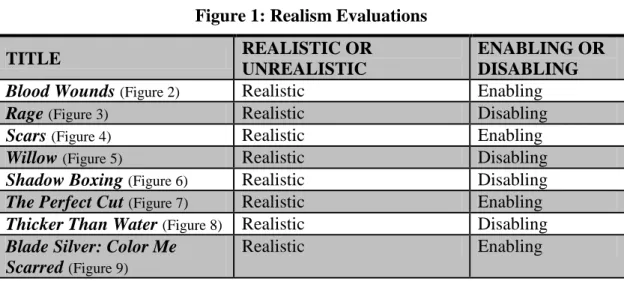
The level of realism of each of these titles (as seen in Figure 1: Realism
Evaluations) was judged not by the circumstances surrounding the cutting, but by the act itself and the situations that arose before, during, and after it. For example, Rage is
obviously not realistic fiction: Melissa meets Death personified and flies around the globe
on a horse with whom she can communicate. However, the fantasy elements are not what
is at stake here – it is Melissa’s self-injury with which we are concerned. To that end, the
books were deemed realistic if the characters’ cutting was presented in a manner that was
true to the elements introduced by the psychology literature, even if the book’s setting
were fantastical.
Figure 1: Realism Evaluations
TITLE REALISTIC OR
UNREALISTIC
ENABLING OR DISABLING
Blood Wounds(Figure 2) Realistic Enabling
Rage (Figure 3) Realistic Disabling
Scars (Figure 4) Realistic Enabling
Willow (Figure 5) Realistic Disabling
Shadow Boxing (Figure 6) Realistic Disabling
The Perfect Cut (Figure 7) Realistic Enabling
Thicker Than Water (Figure 8) Realistic Disabling
Blade Silver: Color Me Scarred (Figure 9)
All eight of the YA novels presented cutting in a realistic manner. The behaviors,
thought processes, and treatment options, when present, were portrayed accurately and
authentically. However, only four of the novels took their realistic depictions one step
further to qualify as enabling texts, splitting the sample right down the middle, with one
half being enabling and one half being disabling.
All four of these characteristics – along with their individual elements – have
been taken into consideration in the categorization of the eight novels in the sample.
Completed Enabling Text Rubrics for each of the titles in this study’s sample can be seen
Figure 2: Enabling Text Rubric for Blood Wounds by Susan Beth Pfeffer (2011)
ENABLING TEXT RUBRIC
CHARACTERISTIC POSSIBLE
ELEMENTS
EXAMPLES FROM TEXT
Promotes a healthy psyche
Trauma
Trusted adults
Family relationship
Peer connectedness
Family is happy on the
surface
Family friends Curt and
Pauline
Biological father murders
his family and then attempts to make journey to kill Willa and her mother too
Reflects an awareness of the reality of self-injury
Characteristics
Risk Factors
Protective Factors
Contagion and peer
influence
Act of cutting
Reactions to cutting
Stigma
Female
Lives with mother,
stepfather, and two stepsisters
Father stabbed his victims
– feels connected to him because of this
Her relief comes from
music, singing Focuses on the internal
struggle of self-harming adolescents
Control
Communication
Relief from emotional
turmoil
Dissociation /
depersonalization
Wound care
Feels family revolves
around her stepsisters but does not voice this
Upset that she never knew
the other side of her family, Mom never told her when her dad tried to contact her
Serves as a road map for being, doing, thinking, and acting
Therapy or counseling
Alliance-building
Decrease in cutting
Alternative coping
mechanisms
Admits that she cannot
stop on her own, wants to go to therapy for help to do that
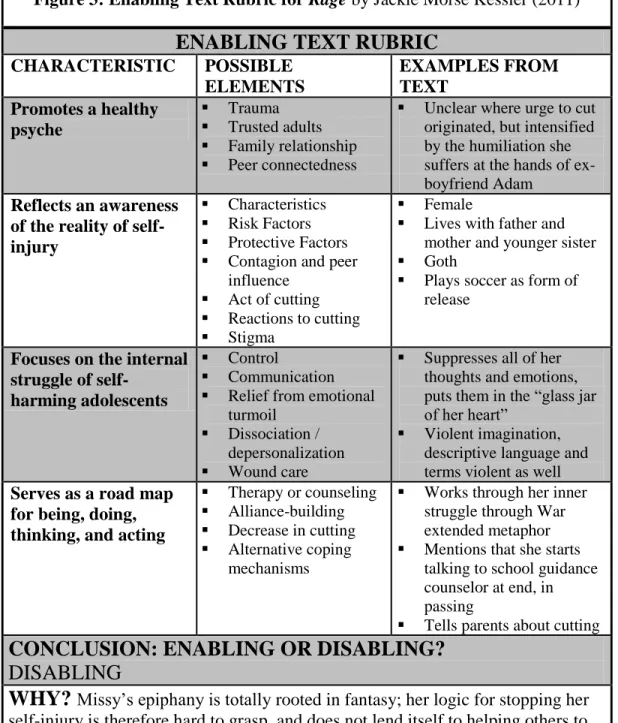
Figure 3: Enabling Text Rubric for Rage by Jackie Morse Kessler (2011)
ENABLING TEXT RUBRIC
CHARACTERISTIC POSSIBLE
ELEMENTS
EXAMPLES FROM TEXT
Promotes a healthy psyche
Trauma
Trusted adults
Family relationship
Peer connectedness
Unclear where urge to cut
originated, but intensified by the humiliation she suffers at the hands of ex-boyfriend Adam
Reflects an awareness of the reality of self-injury
Characteristics
Risk Factors
Protective Factors
Contagion and peer
influence
Act of cutting
Reactions to cutting
Stigma
Female
Lives with father and
mother and younger sister
Goth
Plays soccer as form of
release
Focuses on the internal struggle of
self-harming adolescents
Control
Communication
Relief from emotional
turmoil
Dissociation /
depersonalization
Wound care
Suppresses all of her
thoughts and emotions, puts them in the “glass jar of her heart”
Violent imagination,
descriptive language and terms violent as well Serves as a road map
for being, doing, thinking, and acting
Therapy or counseling
Alliance-building
Decrease in cutting
Alternative coping
mechanisms
Works through her inner
struggle through War extended metaphor
Mentions that she starts
talking to school guidance counselor at end, in passing
Tells parents about cutting
CONCLUSION: ENABLING OR DISABLING?
DISABLING
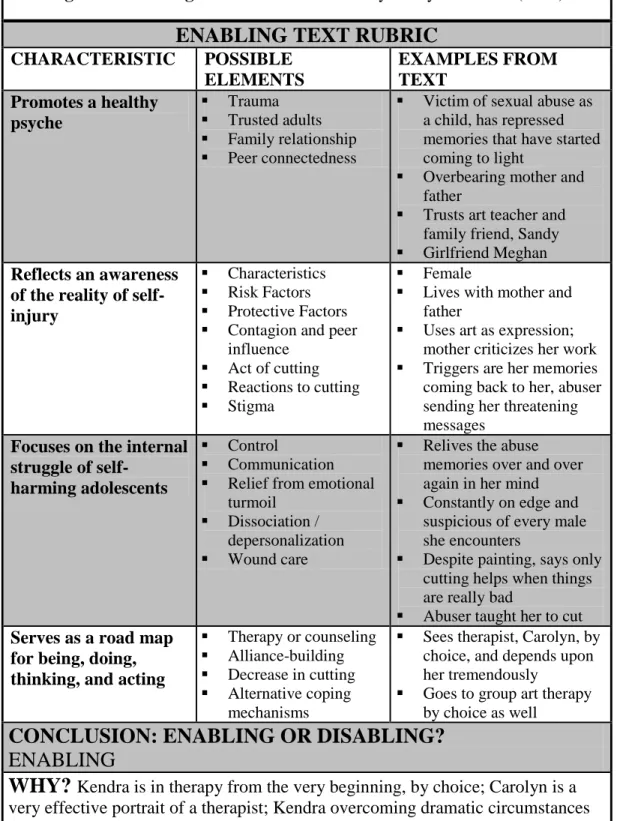
Figure 4: Enabling Text Rubric for Scars by Cheryl Rainfield (2010)
ENABLING TEXT RUBRIC
CHARACTERISTIC POSSIBLE
ELEMENTS
EXAMPLES FROM TEXT
Promotes a healthy psyche
Trauma
Trusted adults
Family relationship
Peer connectedness
Victim of sexual abuse as
a child, has repressed memories that have started coming to light
Overbearing mother and
father
Trusts art teacher and
family friend, Sandy
Girlfriend Meghan
Reflects an awareness of the reality of self-injury
Characteristics
Risk Factors
Protective Factors
Contagion and peer
influence
Act of cutting
Reactions to cutting
Stigma
Female
Lives with mother and
father
Uses art as expression;
mother criticizes her work
Triggers are her memories
coming back to her, abuser sending her threatening messages
Focuses on the internal struggle of
self-harming adolescents
Control
Communication
Relief from emotional
turmoil
Dissociation /
depersonalization
Wound care
Relives the abuse
memories over and over again in her mind
Constantly on edge and
suspicious of every male she encounters
Despite painting, says only
cutting helps when things are really bad
Abuser taught her to cut
Serves as a road map for being, doing, thinking, and acting
Therapy or counseling
Alliance-building
Decrease in cutting
Alternative coping
mechanisms
Sees therapist, Carolyn, by
choice, and depends upon her tremendously
Goes to group art therapy
by choice as well
CONCLUSION: ENABLING OR DISABLING?
ENABLING
Figure 5: Enabling Text Rubric for Willow by Julia Hoban (2009)
ENABLING TEXT RUBRIC
CHARACTERISTIC POSSIBLE
ELEMENTS
EXAMPLES FROM TEXT
Promotes a healthy psyche
Trauma
Trusted adults
Family relationship
Peer connectedness
Was driving the night her
parents died in a car crash
Disconnected from her
brother David
Uncomfortable talking to
classmates Reflects an awareness
of the reality of self-injury
Characteristics
Risk Factors
Protective Factors
Contagion and peer
influence
Act of cutting
Reactions to cutting
Stigma
Female
Lives with older brother
and his wife and daughter
Paranoia
Guilt
Friends’ discussion of
anorexic girl
Focuses on the internal struggle of self-harming adolescents
Control
Communication
Relief from emotional
turmoil
Dissociation /
depersonalization
Wound care
Does not want to discuss
parents’ death with David for fear of upsetting him
Guy tends to her wounds
Serves as a road map for being, doing, thinking, and acting
Therapy or counseling
Alliance-building
Decrease in cutting
Alternative coping
mechanisms
Guy in therapist role, but
interacts with no mental health professionals; states that she does not want this
Mentions in beginning that
she used to paint, but author does not suggest this as an alternative form of expression