ACKNOWLEDGEMENTS
I would like to thank all who have assisted me in the development and
completion of this report. I am particularly grateful to Dr. Watson and Dr.
Little, my co-advisors, for their direction and kind support.
Funding for this report was provided by the Governor's Waste Management
ABSTRACT
Willie J. Lee, Alternatives to Shallow Land Burial for the Management of
Low-Level Radioactive Waste (Under the direction of James E. Watson, Jr., Ph.D.
and Linda W. Little, Ph.D.)
The management of low-level radioactive waste involves 1) determining
volume and radioactivity content of waste generated, 2) reviewing methods
of minimizing waste generation, 3) assessing current disposal practices,
which happen to be shallow land burial at this time, and 4) proposing new
and better methods of waste disposal. Problems have been identified
regarding the use of shallow land burial in the disposal of low-level
radioactive waste. Thus, it is prudent to study alternative methods of
TABLE OF CONTENTS
Page
1.0 INTRODUCTION... 1-1
1.1 Purpose of Report... 1-2
1.2 Definition of Low-Level Radioactive Waste ... 1-2
REFERENCES AND GENERAL BIBLIOGRAPHY ... 1-4
2.0 LOW-LEVEL RADIOACTIVE WASTE GENERATION ... 2-1
2.1 Volume and Radioactivity Content ... 2-1
2.2 Waste Form... 2-5
REFERENCES... ... 2-7
3.0 CURRENT COMMERCIAL DISPOSAL PRACTICES ... 3-1
REFERENCES... 3-6
4.0 CURRENT STATUS OF SHALLOW LAND BURIAL OF LOW-LEVEL RADIOACTIVE
WASTE... 4-1
4.1 Siting Restrictions... 4-1
4.2 Problems Encountered ... 4-2
4.3 Future Capacity... 4-4
4.4 Cost... 4-6
REFERENCES... 4-8
5.0 MINIMIZATION OF LOW-LEVEL RADIOACTIVE WASTE ... 5-1
5.1 Prevention... 5-1
5.2 Volume Reduction ... 5-2
REFERENCES... . 5-9
6.0 INCINERATION: A UNIQUE METHOD OF VOLUME REDUCTION ... 6-1
6.1 General Application ... 6-1
6.2 Technology Development ... 6-2
6.3 Controlled - Air Incineration... 6-5
6.3.1 Engineering Concepts ... 6-6
6.3.2 Effectiveness... 6-7
6.3.3 Environmental Impact ... 6-9
6.3.4 Licensing... 6-10
6.3.5 Cost... 6-11
REFERENCES... 6-12
TABLE OF CONTENTS
Page
7.0 COMPARISON OF SUPERCOMPACTION AND INCINERATION AS A TREATMENT
METHOD FOR LOW-LEVEL RADIOACTIVE WASTE ... 7-1
7.1 Acceptable Waste Form... 7-1
7.2 Final Waste Product ... 7-27.3 Volume Reduction ... 7-2
7.4 Environmental Impact ... 7-2
7.5 Cost... 7-2 REFERENCES... 7-3 8.0 ALTERNATIVES TO SHALLOW LAND BURIAL... 8-18.1 General Application ... 8-1
8.2 Technology Development ... 8-2
8.3 Suitability of Alternative Methods ... 8-13
8.4 Radiological Impact ... 8-16
8.5 Licensing ... 8-31
8.6 Cost Comparison... 8-31
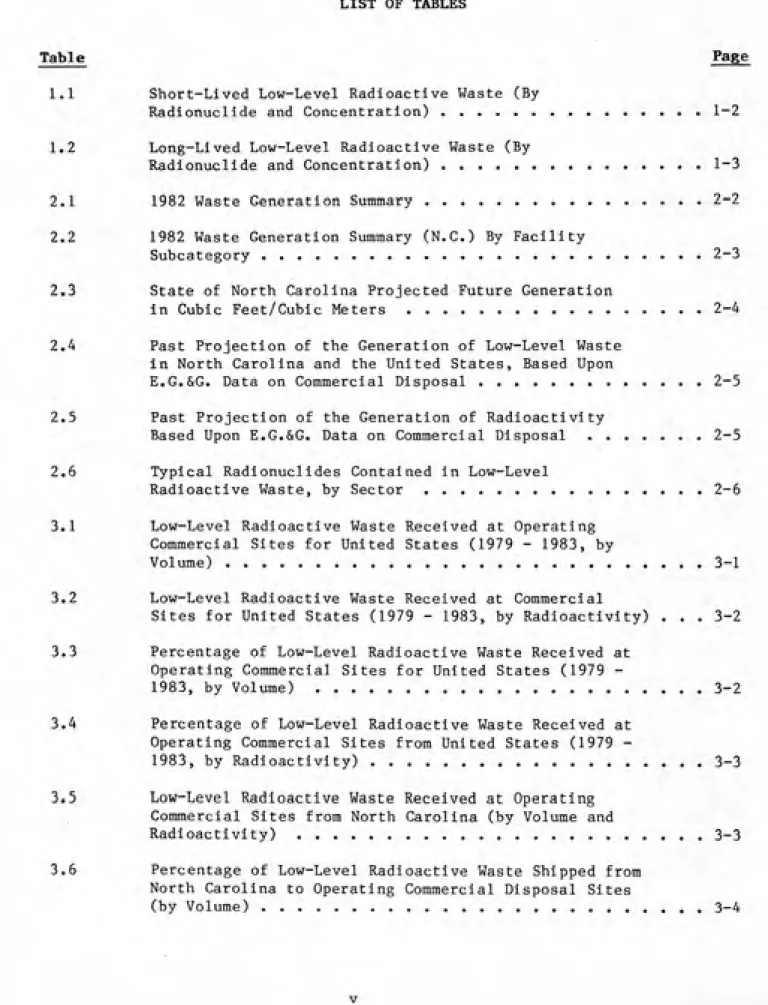
LIST OF TABLES
Table Page
1.1 Short-Llved Low-Level Radioactive Waste (By
Radionuclide and Concentration) ... 1-2
1.2 Long-Lived Low-Level Radioactive Waste (By
Radionuclide and Concentration) ... 1-3
2.1 1982 Waste Generation Summary ... 2-2
2.2 1982 Waste Generation Summary (N.C.) By Facility
Subcategory...2-3
2.3 State of North Carolina Projected Future Generation
in Cubic Feet/Cubic Meters ... 2-4
2.4 Past Projection of the Generation of Low-Level Waste
In North Carolina and the United States, Based Upon
E.G.&G. Data on Commercial Disposal ... 2-5
2.5 Past Projection of the Generation of Radioactivity
Based Upon E.G.&G. Data on Commercial Disposal...2-5
2.6 Typical Radionuclides Contained in Low-Level
Radioactive Waste, by Sector ... 2-6
3.1 Low-Level Radioactive Waste Received at Operating
Commercial Sites for United States (1979 - 1983, by
Volume)...3-1
3.2 Low-Level Radioactive Waste Received at Commercial
Sites for United States (1979 - 1983, by Radioactivity) ... 3-2
3.3 Percentage of Low-Level Radioactive Waste Received at
Operating Commercial Sites for United States (1979
-1983, by Volume)...3-2
3.4 Percentage of Low-Level Radioactive Waste Received at
Operating Commercial Sites from United States (1979
-1983, by Radioactivity)...3-3
3.5 Low-Level Radioactive Waste Received at Operating
Commercial Sites from North Carolina (by Volume and
Radioactivity) ... 3-3
3.6 Percentage of Low-Level Radioactive Waste Shipped from
North Carolina to Operating Commercial Disposal Sites
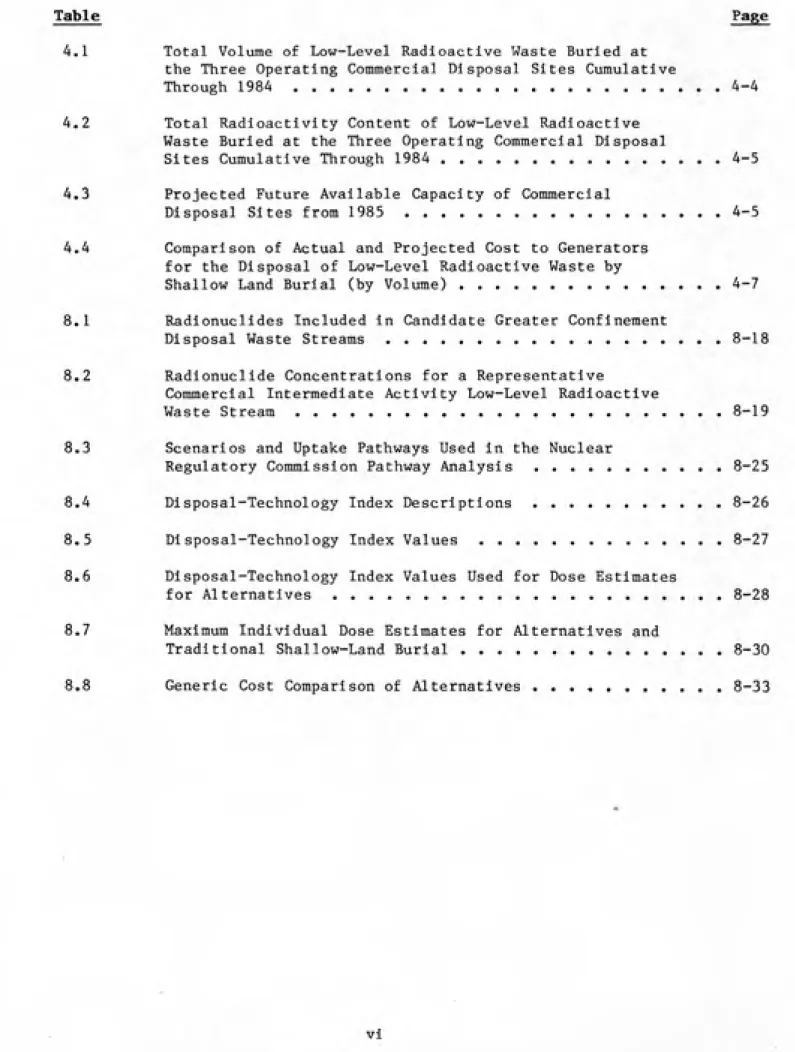
Table Page
4.1 Total Volume o£ Low-Level Radioactive Waste Burled at
the Three Operating Commercial Disposal Sites Cumulative
Through 1984...4-4
4.2 Total Radioactivity Content of Low-Level Radioactive
Waste Burled at the Three Operating Commercial Disposal
Sites Cumulative Through 1984...4-5
4.3 Projected Future Available Capacity of Commercial
Disposal Sites from 1985...4-5
4.4 Comparison of Actual and Projected Cost to Generators
for the Disposal of Low-Level Radioactive Waste by
Shallow Land Burial (by Volume)...4-7
8.1 Radionuclides Included in Candidate Greater Confinement
Disposal Waste Streams ... ... 8-18
8.2 Radionuclide Concentrations for a Representative
Commercial Intermediate Activity Low-Level Radioactive
Waste Stream...8-19
8.3 Scenarios and Uptake Pathways Used in the Nuclear
Regulatory Commission Pathway Analysis ... 8-25
8.4 Disposal-Technology Index Descriptions ... 8-26
8.5 Disposal-Technology Index Values ... 8-27
8.6 Disposal-Technology Index Values Used for Dose Estimates
for Alternatives...8-28
8.7 Maximum Individual Dose Estimates for Alternatives and
Traditional Shallow-Land Burial ... 8-30
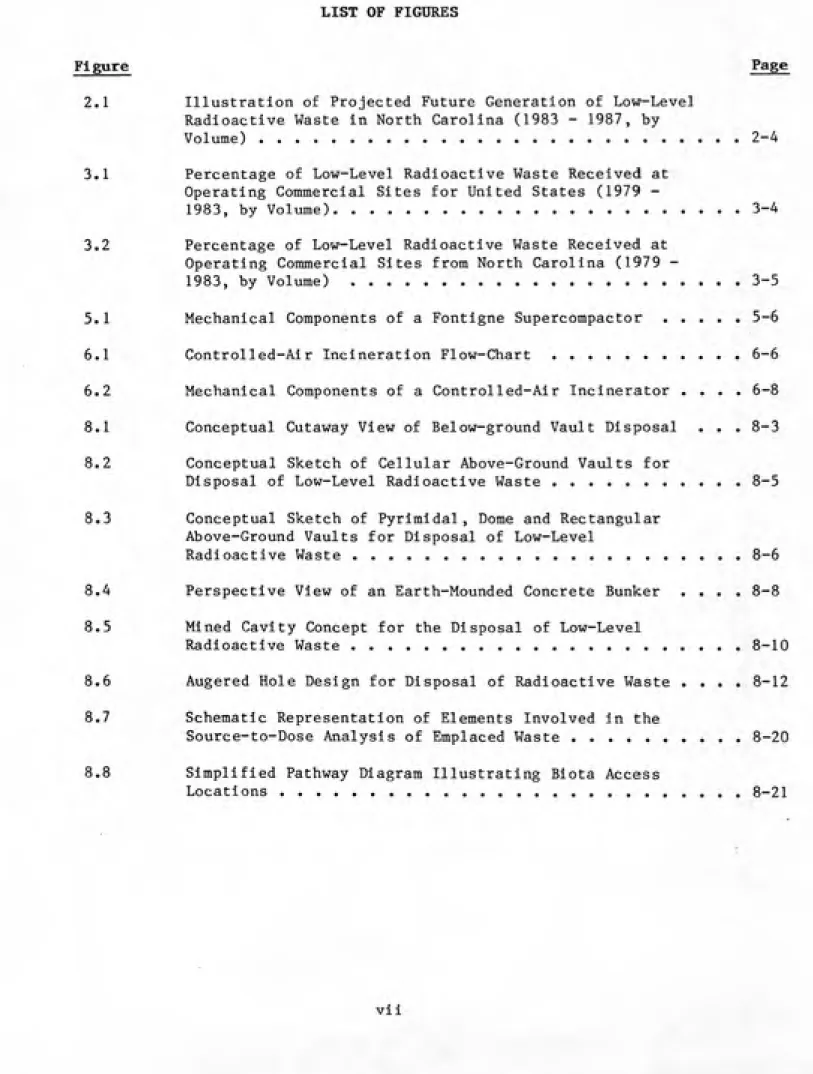
LIST OF FIGURES
Figure Page
2.1 Illustration of Projected Future Generation of Low-Level
Radioactive Waste in North Carolina (1983 - 1987, by
Volume)...2-4
3.1 Percentage of Low-Level Radioactive Waste Received at
Operating Commercial Sites for United States (1979
-1983, by Volume)...3-4
3.2 Percentage of Low-Level Radioactive Waste Received at
Operating Commercial Sites from North Carolina (1979
-1983, by Volume)...3-5
5.1 Mechanical Components of a Fontigne Supercompactor ... 5-6
6.1 Controlled-Air Incineration Flow-Chart ... 6-6
6.2 Mechanical Components of a Controlled-Air Incinerator .... 6-8
8.1 Conceptual Cutaway View of Below-ground Vault Disposal . . . 8-3
8.2 Conceptual Sketch of Cellular Above-Ground Vaults for
Disposal of Low-Level Radioactive Waste ... 8-5
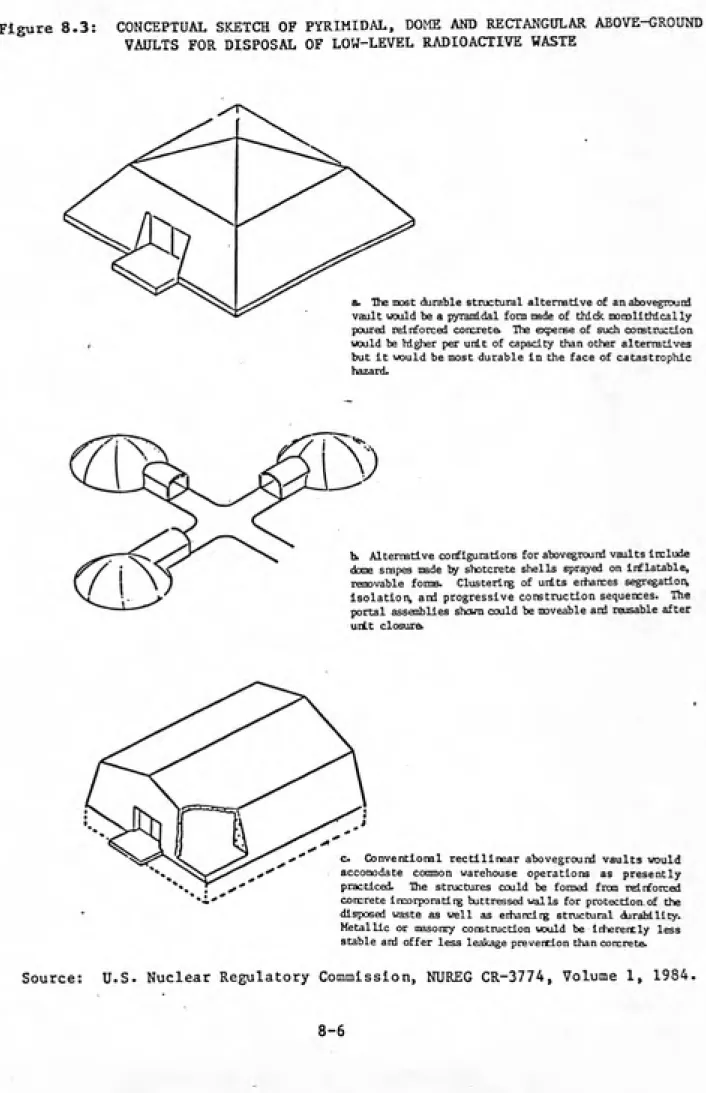
8.3 Conceptual Sketch of Pyrimidal, Dome and Rectangular
Above-Ground Vaults for Disposal of Low-Level
Radioactive Waste ... 8-6
8.4 Perspective View of an Earth-Mounded Concrete Bunker .... 8-8
8.5 Mined Cavity Concept for the Disposal of Low-Level
Radioactive Waste ... 8-10
8.6 Augered Hole Design for Disposal of Radioactive Waste .... 8-12
8.7 Schematic Representation of Elements Involved in the
Source-to-Dose Analysis of Emplaced Waste ... 8-20
8.8 Simplified Pathway Diagram Illustrating Biota Access
Locations...8-21
1.0 INTRODUCTION
The use of radioactive material in industry, research institutions, and
academic institutions, and the generation of electric power by nuclear reactors
unfortunately produces waste requiring special handling and disposal. Since
the 1940's it has been evident that the peaceful use of radioactive material
combined with its use for defense would necessitate the implementation of some
means of radioactive waste disposal.
The first method of low-level radioactive waste disposal was ocean dumping.
Wastes were packaged in steel drums, weighted with concrete, and dumped in deep
water (usually at depths of at least 1,000 fathoms). At that time the
alternative to ocean dumping was considered to be shallow land burial. It
consisted of burying packaged waste in shallow trenches. Trenches of
preference were those located in soils with low permeability and high
absorption properties.
Ocean dumping was expensive In comparison to shallow land burial. In 1960 the
former Atomic Energy Commission, since divided into the Nuclear Regulatory
Commission and Department of Energy, opened government-owned land disposal
sites to all generators of low-level radioactive waste. That, combined with
the Atomic Energy Commission's decision not to issue any new licenses for ocean
disposal, repositioned shallow land burial into the forefront. Existing
licenses Issued for ocean dumping were not cancelled at that time; therefore,
ocean dumping continued until 1970.
When federally owned land disposal sites were opened for use in Tennessee and
Idaho, they were to be made available until commercial, regional disposal sites
could be established. These regional sites were to be operated on either
federal or state-owned land and could be operated by licensed contractors.
In 1962 the first commercial low-level radioactive waste disposal site, using
shallow land burial techniques, was established at Beatty, Nevada. A second
site was opened at Maxey Flats, Kentucky in 1963. With the establishment of
the first two commercial sites, the Atomic Energy Commission stopped accepting
low-level radioactive waste at government-owned sites. Those government-owned
sites are now operated by the U.S. Department of Energy. From 1963 to 1971,
four more commercial sites were opened, those being West Valley, New York in
1963; Richland, Washington in 1965; Sheffield, Illinois in 1967; and Barnwell,
South Carolina in 1971.
Shallow land burial of low-level radioactive waste was performed in a manner
similar to the disposal of municipal waste in a sanitary landfill. Criteria
for siting and packaging did not exist in the early days. As a result, those
early practices, combined with uncertainties in soil geology and hydrology,
produced problems for shallow land burial which exist today. Problems
encountered will be discussed in more detail in Section 4.
Efforts are now underway to develop and Implement alternatives to shallow land
burial of low-level radioactive waste, even though regulations have been
established to set criteria for land disposal to protect the general population
from releases of radioactivity. The feasibility of alternatives emphasizing
1.1 Purpose of Report
The purpose of this report Is to review the current status of shallow land
burial of low-level radioactive waste with an emphasis placed on restrictions
for future use. Means of waste generation, prevention and volume reduction are
outlined and specific alternatives to shallow land burial are discussed and
compared to shallow land burial.
The ultimate goal of the report Is to outline the present system for the
management of low-level radioactive waste and to discuss future trends.
1.2 Definition of Low-Level Radioactive Waste
Radioactive waste is material contaminated with small, but potentially
hazardous, amounts of radioactivity. Such wastes range from dry trash, paper,
plastic, glass, clothing and discarded equipment to wet sludges and aqueous and
organic liquids.
The term "low-level radioactive waste" has been defined as radioactive waste
not classified as high level radioactive waste, transuranic waste, spent
nuclear fuel, or by product material as defined In Section lie.(2) of the
Atomic Energy Act of 195A. The definition has been Interpreted by the U.S.
Nuclear Regulatory Commission to mean those low-level radioactive wastes
containing source, special nuclear or by-product material acceptable for
disposal in a land disposal facility. With this concept In mind, low-level
waste can be categorized in two ways: (1) short-lived and (2) long-lived. The
generality of the present definition does not indicate that there are indeed
concentration limits placed on low-level radioactive waste. Concentration
limits for short-lived low-level radioactive waste are presented in Table 1.1
(Ref.l).
TABLE 1.1
SHORT-LIVED LOW-LEVEL RADIOACTIVE WASTE
(BY RADIONUCLIDE AND CONCENTRATION)
Radionuclide
Concentration (Curles/m )
Total of all radionuclides
with less than 5-years
half-life * No stated limit
Hydrogen 3 * No stated limit
Cobalt 60 * No
stated limit
Nickel 63 700
Nickel 63 In activated metal 7000
Strontium 90 7000
Cesium 137 4600
* No limits have been established for these radionuclides.
Practical considerations such as the effect of external radiation and Internal
heat generation or regulatory limits governing transportation will limit the
concentration of these wastes (Ref. 1).
The following is a table of long-lived radionuclides and concentration limits
of low-level radioactive waste (Ref. 1):
TABLE 1.2
LONG-LIVED LOW-LEVEL RADIOACTIVE WASTE
(BY RADIONUCLIDE AND CONCENTRATION)
Radionuclides Concentration (Cl/m )
Carbon - 14
Carbon - 14 in activated metal Nickel 59 in activated metal Niobium 94 in activated metal
Technltium 99 Iodine 129
Radium and alpha emitting
Transuranic radionuclides
with half-lives greater than
five years
Plutonium 241 Curium 242
8 80 220
0.2 3 0.08
100 Nanocurles/gm 3,500 Nanocuries/gm 20,000 Nanocurles/gm
Wastes containing radionuclides in concentrations exceeding those listed in
Table 1.1 and 1.2 may not be disposed of in a manner similar to other low-level
radioactive wastes. This creates an intermediate category of waste which is
neither high-level or low-level, by definition. This was once an official
category of radioactive waste in the United States, but this category has been
abandoned in recent years, leaving a component of low-level radioactive waste
unclassified.
Since some low-level waste presents both a chemical and radiological hazard,
work has been undertaken to classify waste by total hazard (Ref. 9). The
ultimate disposal of low-level radioactive waste depends upon how waste is
REFERENCES AND GENERAL BIBLIOGRAPHY
Code of Federal Regulations, 10 CFR Part 61, Licensing Requirements for
Land Disposal of Radioactive Waste.
2) Low-Level Radioactive Waste Policy Act of 1980. .
3) North Carolina General Statutes, Chapter 104E, North Carolina Radiation
Protection Act.North Carolina General Assembly, Chapter 704, Senate Bill 443, Waste
Management Act of 1981.
"Low-Level Radioactive Waste Disposal", Irvin L. White and John P. Spath,
Environment, Volume 26, Number 8.
Understanding Low-Level Radioactive Waste, prepared by E.G.&G. Idaho for
the U.S. Department of Energy.
Spent Fuel and Radioactive Waste Inventories, Projections and
Characteristics, Department of Energy Document NE-006, September 1984.
Final Waste Classification and Waste Form Position Papers, U.S. Nuclear
Regulatory Commission, May 11, 1983.
Waste Classification, A Proposed Methodology for Classifying Low-Level
Radioactive Waste, U.S. Department of Energy Report LLW-14T, December
1982.10) Low-Level Radioactive Waste Treatment Technologies, National Low-Level
Radioactive Waste Management Program, U.S. Department of Energy Document
LLW-13TC, July 1984.
2.0 LOW-LEVEL RADIOACTIVE WASTE GENERATION
A determination of the amount of low-level radioactive waste generated In North
Carolina and the Nation has been desired for several years. Not until 1982 was
this undertaken. The Conference of Radiation Control Program Directors, an arm
of the Agreement States Program, Initiated a survey designed to document the
generation of low-level radioactive waste. Forty-one states were persuaded to
participate In the distribution of questionnaires to waste generators in their
states. North Carolina was Included in that survey.
Questionnaires were sent to facilities thought to be generators of low-level
radioactive waste, such as those holding radioactive material licenses. The
survey requested information such as total volume generated, radioactivity
content and the physical properties of waste forms. The accuracy of the
figures generated greatly depended upon each facility's ability to document the
actual volume and radioactivity content generated at their facility.
A second attempt Is now underway by the Conference to determine the volume and
characteristics of low-level radioactive waste generation. This survey will
attempt to determine the impact of treatment technologies on low-level waste
generation and disposal. It will also attempt to determine the waste form,
total volume and radioactivity content of Incinerated waste.
2.1 Volume and Radioactivity Content
Table 2.1 shows the total volume of low-level radioactive waste generated and
the associated radioactivity content for North Carolina and the United States
(Ref. 1). It should be emphasized that the United States figures are for 41
states only. In addition, approximately 7,000,000 cubic feet (200,000 cubic
meters) of uranium mill tailings, containing approximately 1,000 curies of
radioactivity, is included in the United States figure. North Carolina's
generation constituted approximately 4 percent of the waste generated
nationally.
Table 2.2 breaks down the waste generation stimmary by facility subcategory
(Ref. 1). Of the waste volume generated in North Carolina in 1982, 93 percent
was a result of the fuel cycle. Of the radioactivity generated, 68 percent
was reported to be a result of operations in the medical community. It should
be noted that the 68 percent radioactivity content from the medical community
appears (from interviews) to be inaccurate and probably resulted from errors
made in documenting the actual radioactivity of the waste generated. For
example, some hospitals may list their entire inventory as waste while others
might list the amount purchased, but not used, for clinical purposes. The
latter is a more appropriate form of documentation.
Table 2.3 lists projections of future waste generation in North Carolina, based
upon the 1982 Conference survey (Ref. 1). It was reported that the projections
made were actually based upon amounts to be shipped to commercial sites rather
than amounts generated. Errors were made in interpreting this section of the
questionnaire. Figure 2.1 provides a bar graph of projected waste generation.
2,3,4). The figures are based on the report that 41 percent of the waste (by
volume) generated In 1982 was disposed of commercially. The percentage by
radioactivity was 36 percent. The extrapolation to years prior to 1982 assumed
that the percentages disposed of were the same as In 1982.
TABLE 2.1
1982 WASTE GENERATION SUMMARY
Volume Radioactivity Content
United States 9,608,961.5 ft^ 4.499 x 10^ Curies
(41 States) 274,542 m^
North Carolina 379,420 ft^ 1.525 x 10^ Curies
10,840 m-^
TABLE 2.2
1982 WASTE GENERATION SUMMARY (N.C.)
BY FACILITY SUBCATEGORY
Cubic Feet/Cubic Meters
Generated
Curies
Generated
Fuel Cycle
Nuclear Power Plant
Fuel Fabricator
Nuclear Power Plant Lab
160,471/4,585 192,330/5,495 105/3 *4.090E+03 3.153E+01 5.600E-03 Medical Hospltal/Clinic Research Private Office Laboratory 11,611/332 7,697/220 8/0.2 168/4.8 1.043E+04 6.335E+01 l.OOOE-10 2.501E-01 Industrial
Research & Development
Manufacturer
Non-Destructive Testing Devices and Gauges
4,559/130 28/0.8 5/0.14 0.1/0.003 1.302E+02 1.262E+01 5.260E+02 3.000E-03 Academic Research Education 1,172/34 19/0.5 5.248E-01 1.900E+D1 Government State Federal City-Municipal County 361/10 983/28 1/0.03 7/0.2
379,420/10,840
2.173E-02 4.119E+00 2.000E-09 6.000E-07 1.525E+04* Note: E + 03 Is equivalent to 1 x 10~
TABLE 2.3
STATE OF NORTH CAROLINA PROJECTED
FUTURE GENERATION IN CUBIC FEET/CUBIC METERS
TYPE OF FACILITY 1983 1984 1985 1986 1987
Fuel Cycle
Medical
Industrial Academic
Government
TOTAL
145,297/4,151 105,150/3,004 110,150/3,147 108,550/3,101 130,200/3,720
21,589/617 4,876/139
1,145/33
1,135/32
22,915/655
5,470/156
1,295/37 1,235/35
23,924/684
5,997/171
1,450/41
1,335/38
25,060/716
6,635/190
1,611/46
1,335/38
26,335/752
7,214/206
1,767/51
1,335/38
174,042/4,972 136,065/3,887 142,856/4,081 143,191/4,091 166,851/4,767
Figure 2.1: ILLUSTRATION OF PROJECTED FUTURE GENERATION OF
LOW-LEVEL RADIOACTIVE WASTE IN NORTH CAROLINA (1983-1987, by Volume)
5000
ro
J 4000
UJ
^ 3000
_l
>
2000-LlI
C^
1000-<
1983 1984 1985 1986 1987
TABLE 2.4
PAST PROJECTION OF THE GENERATION OF LOW-LEVEL
WASTE IN NORTH CAROLINA AND THE UNITED STATES,
BASED UPON E.G.&G. DATA ON COMMERCIAL DISPOSAL
1979 1980 1981
North Carolina 452,690 ft^ 788,200 ft^ 399,700 ft^
12,934 m^ 22,520 m^ 11,420 m^
United States 6,822,095 ft^ 9,114,245 ft^ 7,493,500 ft^
194,917 m^ 260,407 m^ 214,100 m^
TABLE 2.5
PAST PROJECTION OF THE GENERATION OF RADIOACTIVITY
BASED UPON E.G.&G. DATA ON COMMERCIAL DISPOSAL
1979 1980 1981
North Carolina 12,511 Curies 22,356 Curies 21,286 Curies
United States 1.326E+06 Curies 9.246E+05 Curies 7.774E+05 Curies
2.2 Waste Form
Typical radioactive wastes generated can be summarized, by category, in the
following manner: Fuel Cycle
- Compacted trash or solids - Dry activated waste
- Dewatered ion exchange resins
- Contaminated plant hardware
- Depleted Uranium MgF2
Academic
Liquid scintillation wastes
Compacted trash or solids
Institutional lab or biologlcal waste
Absorbed liquids
Animal carcasses
Medical
Liquid scintillation wastes
Compacted trash or solids
Animal carcasses
Institutional lab or biological waste
Absorbed liquids
Industrial
- Compacted trash or solids
- Contaminated plant hardware- Absorbed liquids
- Liquid scintillation wastes
Government
- Compacted trash or solids
- Contaminated hardware
- Liquid sclntillatlon wastes
- Absorbed liquids
The waste forms listed represent a general overview of waste generated In the
United States and North Carolina. Table 2-6 lists typical radionuclides
contained in low-level radioactive waste.
TABLE 2.6
TYPICAL RADIONUCLIDES CONTAINED
IN LOW-LEVEL WASTES, BY SECTOR
Reactors Academic Medical Industrial
Government
58co
51cr32p
32p
32p
90sr
152ir
57co
60co
51cr
.IS
35s
35s
i^c
58co
13^Cs
125i
51cr
238u
60co
"Zn
32p
99mTe
125j
3h
60co
l^C
90sr
3h
^"•Mg
226Rf
%
125j
REFERENCES
1) 1982 Low-Level Radioactive Waste Generation Summary, Conference of
Radiation Control Program Directors, U.S., 1983.
2) The 1979 State-by-State Assessment of Low-Level Radioactive Wastes Shipped
to Commercial Burial Grounds, for E.G.&G. Idaho by N.U.S. Corporation,
November 1980.
3) The 1980 State-by-State Assessment of Low-Level Radioactive Wastes Shipped
to Commercial Disposal Sites, E.G.&G. Idaho, The National Low-Level Waste
Management Program, U.S. Department of Energy, June 1982.
4) The 1981 State-by-State Assessment of Low-Level Radioactive Wastes Shipped
to Commercial Disposal Sites, E.G.&G. Idaho, National Low-Level
Radioactive Waste Management Program, U.S. Department of Energy, December
3.0 CURRENT COMMERCIAL DISPOSAL PRACTICES
Current disposal of low-level radioactive waste involves the shipment of
solidified liquids, slurries and other solid waste to a commercial low-level
radioactive waste management site. At this time the site would be a shallow
land burial facility.
Commercial disposal involves the transportation of waste to any of the three
existing shallow land burial facilities. Those facilities are located near (1)
Rlchland, Washington, (2) Beatty, Nevada, and (3) Barnwell, South Carolina.
Shippers of waste are required to classify waste In accordance with the degree
of hazard and physical properties. Shippers are also required to prepare a
waste manifest form which states (among other things) the waste classification
and radioactivity content.
Tables 3.1 (Ref. 1, 2, 3, 4, and 5) and 3.2 (Ref. 1, 2, 3, 4, and 5) and Figure
3.1 present the total volume of waste and radioactivity content received at the
three existing shallow land burial facilities. They represent totals for the
United States for the period 1979 through 1983. Tables 3.3 and 3.4 provide a
listing, by percentage, of the data given in Tables 3.1 and 3.2.
Tables 3.5 (Ref. 1, 2, 3, 4, and 5) and 3.6 and Figure 3.2 give the total
volume of low-level radioactive waste and associated radioactivity content
received from the state of North Carolina.
TABLE 3.1
LOW-LEVEL RADIOACTIVE WASTE RECEIVED AT
OPERATING COMMERCIAL SITES FOR UNITED STATES
(1979 - 1983, by Volume)
Disposal Site Location 1979 1980 1981 1982 1983
Barnwell, South Carolina
2,220,505 ft^
63,443 m^
2,422,70069,2291,529,710 43,706 1,217,265 34,779 1,229,620 35,132
Beatty, Nevada
227,185 ft^
6,491 m^
445,09512,717117,285 3,351 52,675 1,505 38,885 1,111
Rlchland, Washington
349,300 ft^
9,980 m^
868,665 24,819 1,425,620 40,732 1,386,210 36,606 1,416,030 40,458TOTALS
2,796,990 ft^
79,914 m^
3,736,810106,766TABLE 3.2
LOW-LEVEL RADIOACTIVE WASTE RECEIVED AT
COMMERCIAL SITES FOR UNITED STATES
(1979 - 1983, by Radioactivity)
Disposal Site Location
1979 1980 1981 1982 1983Bamwell, South Carolina
319,942 Curies 143,502 183,744 273,962 383,450Beatty, Nevada 8,932 Qirles 148,312 52,214
80,929 1,356
Rlchland, Washington 153,563 Curies 41,031 43,905
59,007 120,534
TOTALS 477,437 Curies
332,845 279,863 413,898 505,340
TABLE 3.3
PERCENTAGE OF LOW-LEVEL RADIOACTIVE WASTE RECEIVED
AT OPERATING COMMERCIAL SITES FOR UNITED STATES
(1979 - 1983, by Volume)
Disposal Site Location
1979 1980 1981 1982 1983Bamwell, South Carolina
79 65 50 46 46Beatty, Nevada 8 12 4 2 1
Rlchland, Washington
13 23 46 52 53TABLE 3.4
PERCENTAGE OF LOVJ-LEVEL RADIOACTIVE WASTE RECEIVED
AT OPERATING COMMERCIAL SITES FROM DNITED STATES
(1979 - 1983, by Radioactivity)
Disposal Site Location
1979 1980 1981 1982 1983Barnwell, South Carolina
66 43 65 66 76Beatty, Nevada 2 45 19 20 < 1
Richland, Washington 32 12 16 14 24
Total Percentage 100 100 100 100 100
TABLE 3.5
LOW-LEVEL RADIOACTIVE WASTE RECEIVED AT
OPERATING COMMERCIAL SITES FROM NORTH CAROLINA
(by Volume and Radioactivity)
Category 1979 1980 1981 1982 1983
Volume
185,605 ft^ 323,155 ft^ 163,870 ft^ 154,945 ft^ 164,430 ft^
5,303 m^ 9,233 m^ 4,682 m^ 4,427 m^ 4,698 m^
Radioactivity 4,504 Curies 8,048 Curies 7,663 Curies 5,450 Curies 6,160 Curies
TABLE 3.6
PERCENTAGE OF LOW-LEVEL RADIOACTIVE WASTE SHIPPED FROM
NORTH CAROLINA TO OPERATING COMMERCIAL DISPOSAL SITES .
(by Volume)
Disposal Site Location
1979 1980 1981 1982 1983Barnwell, South Carolina
97 88 92 69 79Beatty, Nevada 0 9 0 0 0
Richland, Washington
3 3 8 31 21Total Percentage 100 100 100 100 100
Figure 3.1: PERCENTAGE OF LOW-LEVEL RADIOACTIVE WASTE RECEIVED
AT OPERATING COMMERCIAL SITES FROM UNITED STATES (1979 - 1983, by Volume)
100 r
80
liJ
^ 60
UJ
O 40
cr LU Q.
20
--- Barnwell
---Richland
---Beatty
Figure 3.2: PERCENTAGE OF LOW-LEVEL RADIOACTIVE WASTE RECEIVED
AT OPERATING COMMERCIAL SITES FROM NORTH CAROLINA (1979 - 1983, by Volume)
LU
< 100
80
60
LU
O 40
cr
LlI CL
20
--- Barnwell
---Richland
---Beatty
P--^—r
J— ..-i.1979 1980 1981 1982 1983
REFERENCES
1) The 1979 State-by-State Assessment of Low-Level Radioactive Wastes Shipped
to Commercial Burial Grounds, for E.G.&G. Idaho by N.U.S. Corporation,
November 1980.
2) The 1980 State-by-State Assessment of Low-Level Radioactive Wastes Shipped
to Commercial Disposal Sites, E.G.&G. Idaho, The National Low-Level Waste
Management Program, U.S. Department of Energy, June 1982.
3) The 1981 State-by-State Assessment of Low-Level Radioactive Wastes Shipped
to Commercial Disposal Sites, E.G.&G. Idaho, National Low-Level
Radioactive Waste Management
4) The 1982 State-by-State Assessment of Low-Level Radioactive Wastes Shipped
to Commercial Disposal Sites, by E.G.&G. Idaho and the Conference of
Radiation Control Program Directors for the U.S. Department of Energy,
December 1983.
5) The 1983 State-by-State Assessment of Low-Level Radioactive Wastes Shipped
to Commercial Disposal Sites, by E.G.&G. Idaho and the Conference of
Radiation Control Program Directors for the U.S. Department of Energy,
4.0 CURRENT STATUS OF SHALLOW LAND BURIAL OF LOW-LEVEL RADIOACTIVE WASTE
Various forms of shallow land burial are being practiced at the three operating
commercial disposal sites. Ideally, sites are selected in areas with
substantial layers of loam, dust, clay and conglomerates. Areas containing
large amounts of gravel or coarse-grained sand are not suitable. The
continuous water table should be at a minimal depth of 5 meters below the
surface of the terrain and soil permeability should be within the range of 10
to 10" meters per second. Conditions such as these represent a sufficient
unsaturated layer where precipitation and groundwater cannot intermingle.
Areas receiving limited rainfall are favorable also.
Basic shallow land burial consists of the excavation of a trench into which
low-level radioactive waste Is placed and covered. Trench dimensions depend on
the form and volume of waste disposed. Transport and handling equipment Is
installed on the periphery of the trench or travels across it. In the former
case, the width of the trench should be such as to allow the arm of the filling
crane to reach easily beyond the longitudinal axis of the trench. The
transverse parameters of the trench depend on the soil load-bearing ability and
on the stability of the banks of the trench to secure safe transport, handling
and operation.
The dimensions of the trench must be optimized. Relatively narrow trenches
have a high proportion of unused space. Broad trenches do not allow adequate
control of deposited materials in the middle part of the trench. The depth of
the trench is governed by 1) the necessary height of the trench bed above the
water table, 2) the possibility of depositing materials in layers, and 3) the
economic utilization of filling machinery and handling efficiency. Trench
width is governed by 1) the reach of the filling equipment and 2) the efficient
use of trench space.
Waste in 55 gallon drums or special containers is placed in the trench. The
trench is filled gradually with each layer of deposited waste so as to fill the
whole of the storage space. Upon completion, the deposited material is covered
with earth and the earthflll is compacted and graded. The earthflll may also
be covered with a layer of Insulating material, such as clay, and capped with a
thin layer of earth and planted with turf. An underdraln or peripheral
drainage system may also be used. 4.1 Siting Restrictions
As implied previously in this section, the siting of a shallow land burial
facility involves the selection of a location with suitable characteristics for
waste disposal. Those characteristics can be summarized in the following
categories (Ref. 5):- Geography
- Meteorology - Hydrology - Geology
.JUiMWii .. ^^
4.1.1 Geography
Terrains located at altitudes between 200 and 600 meters above sea level are
very suitable. Terrains at altitudes of up to 200 meters above sea level will
be generally suitable In so far as the locality Is not In the proximity of
medium-sized or powerful water courses or water reservoir, which usually means
that there Is a low-land aluvliim with a high water table. Terrains with
altitudes between 600 and 800 meters are less suitable as they abound in steep
slopes along rivulets and streams with extensive groundwater circulation.
Altitudes greater than 800 meters combined with areas with a gradient of more
than 5 percent are excluded.
4.1.2 Meteorology
Meteorological factors are very important in selecting a suitable site.
Suitable climatic conditions and amount of precipitation falling in a
prospective area are crucial.
Climatic parameters include the average annual temperature, maximum and minimum
temperature deviations, number of days per annum with snow cover, and the
number of days per annum when the temperature drops below 0° C. Less suitable
areas are those with large temperature fluctuations, large number of days per
annum with temperatures below 0° C and large number of days per annum with snow
cover.
Concerning precipitation, the lower the level of precipitation in any
prospective area, the more suitable it is for waste disposal. Areas with
levels less than 0.5 meters of precipitation per year are desired, but higher
levels may have to be accepted.
4.1.3 HydrologyProspective sites in close proximity to drinking water reservoirs and rivers
are unsuitable. The absence of surface water-bearing conditions is desired.
Areas with extensive circulation of groundwater and a high permeability of
rocks are unsuitable. The velocity of the flow of groundwater is closely
linked to the permeability of rocks. A slow flow of groundwater indicates low
rock permeability. 4.1.4 Geology
Geological formations of a site Impact significantly on the ability to prevent
the migration of radioactive material into areas surrounding the site.
Suitable materials for that purpose are 1) clays for their sorportion
properties, 2) chernozemic soils, 3) some acid brown soils, and 4) weathered
rock. Less suitable are pseudogleylc soils, brown soils, podzollc and
llllmerized soils. Sands, slates, gravel, calcareous soils and almost all
Igneous rocks are unsuitable.
4.2 Problems Encountered
Of the six established commercial shallow land burial sites In the United
cost of conducting additional hydrogeologlc investigations became prohibitive.
The sites at Morehead (Maxey Flats), Kentucky and West Valley, New York were
both closed when radioactive materials were found on the surface of these
sites. This contamination resulted from the following processes:
- the trenches had been constructed over impervious strata;
- the construction of the trenches caused the surface to become
permeable;
- storm water infiltrated into the trenches;
- water accumulated in the trenches and became contaminated by the waste;
- vertical migration of the contaminated water carried the contamination
to the surface, and
- lateral migration of the contaminated water carried the contamination
to areas outside the site.
As a result of these conditions, remedial actions were necessary to reduce the
potential for off-site migration of the radioactivity.
These sites now require corrective measures and decommissioning to some extent.
The plan for such activities involves the following steps:
- the water is pumped from the trenches to reduce the potential for
migration;
- the water is processed with evaporators to reduce the quantities that
must be stored;
- the concentrate and sludge are solidified and buried in another
location;
- a permanent drainage system with lined channels is being constructed to
convey surface water from the site;
- plastic membranes are being used to cover the trenches to reduce
infiltration and the quantity of water that must be removed from the
trenches;
- after pumping, the trenches will be allowed to stabilize; and
- permanent intrusion barriers will be installed after the trenches
stabilize.It is obvious that if sites cannot continue to meet design objectives, the cost
of custodial care, decommissioning and perpetual care will be high. This
experience with shallow land burial facilities makes it wise to consider
alternative disposal methods. Although the physical state of waste burled has
improved with the development and implementation of new federal regulations
(e.g., 10 CFR Part 61), it may appear logical to assume that the problems
encountered In Kentucky and New York can be repeated at other sites. However,
it must be stated that the problems documented were site specific and would not
be necessarily applicable to other sites.
Alternatives may be considered to be improved versions of shallow land burial.
The concept of "enhanced shallow land burial" has been perpetuated, which
includes the Insertion of plastic liners in excavated trenches prior to the
introduction of waste. This is considered to be a simple form of enhanced
shallow land burial and is designed to reduce the infiltration of groundwater
Into the trench and prevent the subsequent migration of radionuclides from the
trench site. More advanced forms of enhanced shallow land burial make use of
concrete liners in the place of plastic liners.
4.3. Future Capacity
Prior to outlining the estimated future capacity of the three operating shallow
land burial facilities. It Is Important to review the total volume and
radioactivity content burled to-date. Table 4.1 (Ref. 13) provides an
accounting of the total volume of waste burial at the three operating shallow
land burial facilities through 1984. Table 4.2 (Ref. 13) gives the total
radioactivity content burial at the three commercial sites through 1984.
TABLE 4.1
TOTAL VOLOME OF LOW-LEVEL RADIOACTIVE WASTE BURIED AT THE THREE OPERATING COMMERCIAL DISPOSAL SITES
CDMDLATIVE THROUGH 1984
Site Total Volume First Year of Operation
Barnwell, South Carolina 16.436E-K)6 ft^ 1971
(4.496E+05 m^
Beatty, Nevada 3.437E+06 ft^ 1962
(9.83E+04 m^
Richland, Washington 7.78E+06 ft"^ 1965
TABLE 4.2
TOTAL RADIOACTIVITY CONTENT OF LOW-LEVEL RADIOACTIVE WASTE
BDRIED AT THE THREE OPERATING COMMERCIAL DISPOSAL SITES
CDMDLATIVE THROUGH 1984
Site
Special
Nuclear
Material
Source
Material Other
Barnwell, South Carolina
Beatty, Nevada
Rlchland, Washington
4028.74 Ibs^
(2014.37 kg)497.596 Ibs^
(226.18 kg)297.33 lbs
(135.15 kg) B
12.53E-K)6 lbs
(5.695E+06 kg)
1.71E406 lbs
(7.77E+05 kg)
9.80E-K)6 lbs
(4.455E+06 kg)
2.91E+06 Curies
0.45E+06 Curies
1.41E+06 Curies
A) No Plutonium
B) Includes Plutonium
As Indicated, Barnwell has received and burled the majority of the waste volume
and radioactivity content to-date, despite the fact that it has been operating
the shortest period of time.
Table 4.3 (Ref. 13) gives an estimate of future available capacity at two of
the three operating shallow-land burial facilities.
TABLE 4.3
PROJECTED FDTDRE AVAILABLE CAPACITY OP COMMERCIAL DISPOSAL SITES FROM 1985
Site
Future
Available Capacity Barnwell, South Carolina
Beatty, Nevada
Rlchland, Washington
18.1E+06 ft^
(5.17E+05 m^)
2.5-3.0E+06
ft-(7.14-8.57E+04 m^)
Information not available
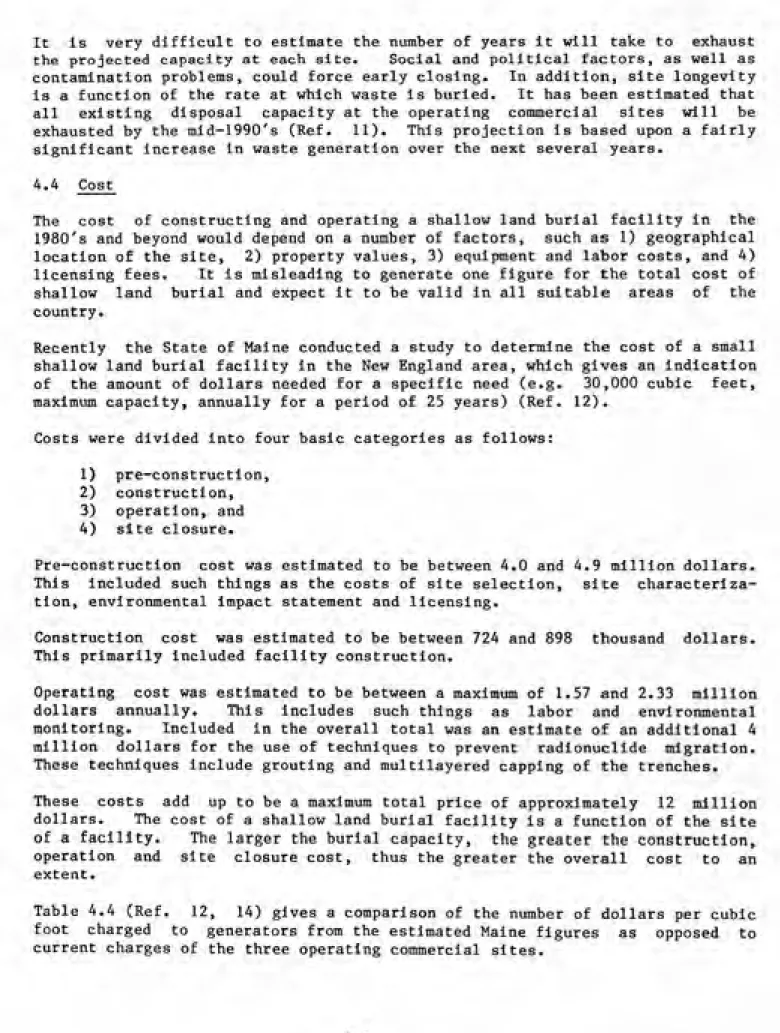
It is very difficult to estimate the number of years it will take to exhaust
the projected capacity at each site. Social and political factors, as well as
contamination problems, could force early closing. In addition, site longevity
is a function of the rate at which waste Is buried. It has been estimated that
all existing disposal capacity at the operating commercial sites will be
exhausted by the mid-1990's (Ref. 11). This projection is based upon a fairly
significant increase in waste generation over the next several years.
4.4 Cost
The cost of constructing and operating a shallow land burial facility in the
1980's and beyond would depend on a number of factors, such as 1) geographical
location of the site, 2) property values, 3) equipment and labor costs, and 4)
licensing fees. It is misleading to generate one figure for the total cost of
shallow land burial and expect it to be valid In all suitable areas of the
country.
Recently the State of Maine conducted a study to determine the cost of a small
shallow land burial facility in the New England area, which gives an Indication
of the amount of dollars needed for a specific need (e.g. 30,000 cubic feet,
maximum capacity, annually for a period of 25 years) (Ref. 12).
Costs were divided into four basic categories as follows:
1) pre-constructlon,
2) construction,
3) operation, and
4) site closure.
Pre-constructlon cost was estimated to be between 4.0 and 4.9 million dollars.
This Included such things as the costs of site selection, site characteriza¬
tion, environmental impact statement and licensing.
Construction cost was estimated to be between 724 and 898 thousand dollars.
This primarily Included facility construction.
Operating cost was estimated to be between a maximum of 1.57 and 2.33 million
dollars annually. This Includes such things as labor and environmental
monitoring. Included in the overall total was an estimate of an additional 4
million dollars for the use of techniques to prevent radionuclide migration.
These techniques include grouting and multilayered capping of the trenches.
These costs add up to be a maximum total price of approximately 12 million
dollars. The cost of a shallow land burial facility is a function of the site
of a facility. The larger the burial capacity, the greater the construction,
operation and site closure cost, thus the greater the overall cost to an
extent.
Table 4.4 (Ref. 12, 14) gives a comparison of the number of dollars per cubic
foot charged to generators from the estimated Maine figures as opposed to
TABLE 4.4
COMPARISON OF ACTUAL AND PROJECTED COST TO GENERATORS FOR THE DISPOSAL OF LOW-LEVEL RADIOACTIVE WASTE BT SHALLOW LAND BDRIAL
(by Volume)
Site
Cost
Barnwell, South Carolina
Beatty, Nevada
Rlchland, Washington
Maine (Ref. 12)
$24.90 per cubic foot
$17.85 per cubic foot$21.76 per cubic foot
$44.00 per cubic foot
These figures represent basic charges, which do not include additional taxes
and surcharges on weight and radioactivity content. It can be theorized that
the difference between the projected figure (Maine) and actual costs occur
because of 1) the reduction in overall capacity of the projected site as
opposed to operating sites and 2) the length of time the operating sites have
been in existence. Lower pre-constructlon and construction costs were incurred
when the three operating sites were placed in service.
REFERENCES
1) Dlouhy', Z., Disposal of Radioactive Wastes, Nuclear Research Institute,
Elsevler Scientific Publishing Company, New York, 1982.
2) Carter, M. Maghissl, A., Kahn, B., Management of Low-Level Radioactive
Waste, Volume One, Pergamon Press, 1979.
3) National Research Council, The Shallow Land Burial of Low-Level
Radioactively Contaminated Solid Waste, National Academy of Sciences,
Washington, D.C., 1976.
4) International Atomic Energy Agency, Radioactive Waste Management,
Proceedings of an International Conference, Seattle, Washington, 16-20
May, 1983, Volume 3 and 5.
5) Nuclear Energy Agency, Geochemical Processes; Geological Disposal of
Radioactive Waste, Organizational for Economic Co-operation and
Development, October 1982.
6) Blasewltz, A., Davis, J., Smith, M., The Treatment and Handling of
Radioactive Wastes, Battelle Press, 1983.
7) U.S. Department of Energy, Proceedings of the Sixth Annual Participants'^
Information Meeting, National Low-Level Radioactive Waste Management
Program, December 1984.
8) U.S. Department of Energy, Corrective Measures Technology for Shallow Land
Burial, National Low-Level Radioactive Waste Management Program, October
1984.9) Jordan, J., Low-Level Radioactive Waste Management: An Update, National
Conference of State Legislatures, October 1984.
10) U.S. Department of Energy, Directions in Low-Level Radioactive Waste
Management, National Low-Level Radioactive Waste Management Program,
October 1982.
11) Kearney, R., The Low-Level Radioactive Waste Compact, Research Exchange,
Vol. 2, No. 3, May-June 1984.
12) Lavallee, F., Seel, G., Payson, H., The Design and Economics of a Small
Shallow Land Burial Facility in a Humid Climate, State of Maine, 1984.
13) U.S. Nuclear Regulatory Commission, Total Volumes and Radioactivity
Content of Low-Level Radioactive Waste Buried at the Three Operating
Commercial Sites, Cumulative Through 1984, State Agreements Program, 1984.
5.0 MINIMIZATION OF LOW-LEVEL RADIOACTIVE WASTE
When considering the overall problems and controversy surrounding the final
disposition of low-level radioactive waste, the application of volume reduction
techniques prior to disposal becomes more and more Important. It Is desirable
to decrease the volume of low-level waste requiring disposal to a level as low
as possible. The information presented in this section describes how that goal
might be accomplished.
5.1 Prevention
The volume of low-level radioactive waste requiring disposal can be reduced by
(a) decreasing the rate of generation, and (b) reducing the volume of waste
after generation. Prevention falls within the confines of the first approach.
The four basic concepts of prevention can be summarized in the following
manner:
5.1.1 Design and Engineering
The design and engineering features of use areas should be considered early in
the conceptualization and planning phases of radioisotope utilization.
Significant reduction In waste generation can be realized by designing
facilities and purchasing equipment aimed at isolating contaminated, yet
reusable, items. Also, the operation of equipment according to specifications
and the identification of aging or out-of-date facilities and equipment can
lead to waste reduction.
5.1.2 Operation and Maintenance
Day to day operating and maintenance procedures can dictate the generation of
low-level radioactive waste in many Instances. Adequate training programs and
nonradioactive "mockups" help personnel feel more confident when performing
tasks, thereby helping to prevent accidents and waste generation. Routine
preventive maintenance is a logical method to reduce unexpected equipment
failure while working with radioactive material and it helps to extend the life
of the equipment.5.1.3 Decontamination
When required, the proper selection and use of decontamination methods can help
reduce the generation of low-level waste by minimizing the production of
secondary waste and allowing reuse of contaminated equipment or disposal as
nonradioactive waste. Prompt identification, collection and isolation of
contaminated materials and equipment can reduce the spread of contamination to
other areas. Decontamination agents should be selected on the basis of maximum
radioactive material removed per volume of agent used.
5.1.4 Admi ni s t rat1ve
The documentation of a comprehensive waste prevention plan allows personnel to
study the procedures which have been implemented to reduce volume. Strict
enforcement of administrative controls is necessary in order to maximize
benefits from the volume reduction plan. The correct application of prevention
methods requires continuous management overview. In addition, the
implementation of sound laboratory safety procedures is another means by which
administrative controls can help reduce the volume of low-level radioactive
waste generated.
5.2 Volume Reduction
Reducing the volume of low-level radioactive waste after generation can be
accomplished by taking advantage of the following methods:
a) Pre-treatment (segregation, sorting, shredding)
b) Treatment (filtration, evaporation, compaction. Incineration, size
reduction, melting-casting immobilization/solidification)
c) Deregulation or de minimis levels
d) Storage-for-decay
Incineration is discussed in detail in Section 6 of this report.
5.2.1 Pre-Treatment
General low-level radioactive waste consists of many materials, both
combustible and noncombustible. Combustible solids consist of a variety of
items such as paper, rags, plastic sheeting, protective clothing, gloves,
rubber shoes, wood and filter cartridges, as well as some partially combustible
items such as HEPA (high-efficiency particulate air) filters encased in wooden
frames. The noncombustible portion consists typically of metal, glassware,
construction and insulating materials, metal-encased HEPA filters, small
discarded equipment, tools, filters and other mechanical devices.
Pre-treatment of waste, (i.e., the physical or chemical processes necessary to
prepare waste for primary treatment and/or disposal) includes operations such
as segregation, sorting, and shredding. These methods are outlined as follows:
5.2.1.1 Segregation
Segregation is accomplished primarily by the designation of specific waste
containers for specific categories of waste. This operation is performed at
the time of waste generation. Waste containers can be labeled in accordance
with radionuclide, short or long-lived radionuclides, combustible or
noncombustible, class A, B or C, chemical or physical state, and chemical
toxicity. Segregation may encompass any or all of the above.
The segregation of nonradioactive from the radioactive components of waste is a
fundamental aspect of volume reduction also. This involves the implementation
of some method of screening waste to determine what components are radioactive
and which are not. Appropriate radiation detection instrumentation, such as
Geiger-Mueller survey instruments, can be used to perform the task. Other more
elaborate instrumentation is also available for use. This type of screening is
mostly limited to Items contaminated with energetic beta and/or gamma emitting
radionuclides. Segregation by screening can be done manually, or in the case
of large generators, a mechanical device can be put to use to work
5.2.1.2 Sorting
Sorting is considered to be the application of waste segregation. Hand sorting
is the simplest method of segregating mixed waste Into components that are
amenable to treatment by a particular technology. Hand sorting is used to
assure separation of compactlble from noncompactible or combustible from
noncombustlble, as well as material deleterious to the operation of volume
reduction equipment. It is also used to identify and remove hazardous
materials (e.g., pyrophoric or explosive substances) from the waste stream.
It is generally desirable to segregate and sort solid waste Into combustible
and noncombustlble fractions. Following suitable pretreatment, combustible
waste can be combusted, decontaminated, compacted or packaged. Similarly,
noncombustlble waste may be treated using methods which will be discussed later
in this report. The categories Into which wastes are sorted will be determined
by whatever primary treatment options are available for use.
The separation of solid from wet waste Is also an important sorting process.
Wet waste consists mainly of aqueous solutions and slurries, evaporator
concentrates, spent demlnerallzer resins, filter sludges and organic chemicals,
oils and solvents. Treatment options for wet waste range from simple
filtration to high temperature drying techniques.
5.2.1.3 ShreddingPotentially combustible waste materials can be shredded to produce small pieces
for subsequent treatment or disposal. The principal types of shredding
equipment are knife cutters, hammermllls, and variations or combinations
thereof. These devices have the capacity of crushing or shredding waste
depending on the required objective. Volume reduction factors of 4:1 have been
documented (Ref. 3).
5.2.2 Treatment
The treatment of low-level radioactive waste has evolved with the Increased
utilization of radioactive material in science, medicine and Industry.
Treatment is designed to volumetrlcally reduce waste and Improve the waste form
to restrict mobility during transport to a final disposal site. The most
common treatment modes are outlined as follows:
5.2.2.1 Filtration
Filtration is the most commonly used method for the removal of radioactive
particulates from liquid waste. In fuel-cycle facilities, filtration
techniques are a very Important component of overall waste treatment (Ref. 2).
High-efflclency particulate filters can be used as a basic means of removing
particulates. The filtered particulates are then Included with the filter
media as solid waste. Ion exchange and reverse osmosis are examples of more
advanced forms of filtration. Ion exchange Involves the removal of ionic
species, principally inorganic, from aqueous waste. The process consists of an
exchange of ions between the liquid and a solid matrix component, containing
lonizable polar groups. The exchangers can be regenerated or disposed of as
solid waste.
Reverse osmosis Involve removing a liquid from a solution by passing the
solution through a device (membrane or other) which retains the solid
components. Including dissolved solids. The extremely small pore size used
separates this process from basic filtration. Control of pressure,
temperature, and pH may be used to enhance separation.
5.2.2.2 Evaporation
Evaporation Is considered to be the most widely used technique for reducing the
volume of liquid radioactive waste in fuel cycle facilities. Through
evaporation, a solution or slurry is concentrated by vaporizing away the
solvent, normally water. An evaporator consists basically of a device to
transfer heat to the solution and a device to separate the vapor and liquid
phase. Vapor-liquid separation is the most important factor in the operation
of an evaporator. Evaporators can separate water from solids very effectively
and a decontamination factor of 10 to 10 can be expected from a single phase
operation (Ref. 2).
5.2.2.3 CompactionCompaction consists of compressing suitable dry waste into smaller volumes. A
compactor Includes a hydraulic or mechanical drive, a platen, a base plate,
structural supports, a drum positioning platform and a control panel. Waste is
loaded into a drum and the unit Is activated by bringing the platen down onto
the waste in the drum. The platen is raised, the drum is refilled, and the
process Is then repeated. Typically compaction pressures range from 30 to 150
Kg/cm depending on reduction factors required (Ref. 2). Very dense items such
as metal, pyrophorlc or explosive substances, and wastes containing free¬
standing liquids are not suitable for compaction.
Compaction is an Important component of volume reduction in non-fuel cycle
facilities. Compaction in 55-gallon drums is the most common application
although supercompactors are now being promoted. Supercompactors, commonly
called high tonnage compactors, are systems which process waste by high
pressure compaction to effect a higher net volume reduction. Compaction forces
of several hundreds of tons to thousands of tons may be applied.
Supercompactors can reduce the volume of compactlble waste by a factor of
approximately 7 to 1 (Ref. 8). They have been used in Europe for approximately
two and one-half years. There are two well known suppliers of supercompactors
used for volume reduction of low-level radioactive waste. These companies are
Gesellschaft Fur Nuklear-Service mbH (GNS) of West Germany and Machlnefabrlek
A. Fontljne of Holland. Both companies have In operation machines designed
specifically for processing dry active waste generated by nuclear power plants,
hospitals, and research facilities.
The 1500-ton rating of both machines was determined as a result of research and
development efforts designed to optimize press forces relative to the volume
reduction achieved for the type of waste processed. The GNS "FAKIR"
supercompactor is being marketed in the United States by representatives based
in Atlanta. Stock Equipment Company in Chagrin Falls, Ohio, is licensed to
The Fontljne supercompactor, showed In Figure 5.1, has been specifically designed to compact 55-gallon D.O.T. 17H drums containing dry active waste.
Design and construction of the compaction press allows for It to be operated In
an enclosure with remote controls. The principle of design Is for a 40 year
life with minimum maintenance requirements. The following basic components are required for the operation of the supercompactor:
1) Press - Welded base
Welded crown with main cylinder Welded press mold with guides
Welded plunger-construction with guides Guide columns for the mold and plunger
2) Hydraulic system - Hydralic fluid reservoir
Pump and motor
Oil cooler
3) Press loader
4) Drum piercing system
5) Drum unloader
6) Infeed conveyor
The main cylinder is mounted in the crown of the press. The total cycle for compaction of a drum takes about two minutes. The drum is compacted within a mold, fitted with an Interchangeable lining. The press mold is mounted to the
crown of the press and actuated by two double-acting cylinders. When the press
mold is lowered around the drum, it seats over a round hardened pressplate which is mounted to the base of the press. This forms a closed chamber for compacting the drum. The waste is then pressed into pellets which can be
packaged into 83 gallon drums. The dimensions of the press are as follows:
Press capacity Throughput capacity
Press stroke Height
Base dimensions
Weight
1500 tons
30 drums per hour
39 inches 236 inches
6 feet by 6 feet
40 tons
During operations, the compacting process can be performed under negative pressure, with the effluent air being vented through high efficiency particulate filters or impregnated charcoal filters. The prevention of the
release of radioactive particulates is the major concern. The possibility of
releases should be minimal.
Figure 5.1
Mechanical Components of a Fontlgne Supercompactor
Main Cylinder
Auxiliary Cylinder
Main Cylinder
m
P
L2J
Primary Piston •—
Guide Column
•-Waste Drum •"
^
a
Press
Base*-s
c
Source: Proceedings on Incineration of Low-Level Radioactive Waste, Tucson,
5.2.2.4 Size Reduction
Mechanical disassembly of contaminated equipment is the main constituent of
size reduction of low-level radioactive waste. Dismantling reduces the volume
of waste and simplifies handling. Shearing, cutting, and torching can be
viable means of size reduction.
Size reduction operations are applied to equipment too large to transport
directly. These operations tend to be time-consuming and costly. Typically,
size reduction is used only when required.
5.2.2.5 Melting/CastingMeltdown and casting of contaminated equipment, after decontamination or size
reduction, are treatment options not fully developed. Like size reduction,
these operations are costly and are not significant contributors to the overall
volume reduction effort In the majority of facilities. The process of melting
Incorporates the radioactive material into the matrix of the metal where it is
Immobilized. The process is considered to be an Important element in future
decommissioning of large fuel-cycle facilities.
5.2.2.6 Immobilization/Solidification
The objective of waste immobilization/solidification is to convert general or
pretreated liquid waste or incinerator ash into a stable form to minimize the
potential for release of radioactive material to the environment during
storage, transport and final disposal. Immobilizing or absorption media, such
as vermicullte or dlatomaceous earth, have been used to stabilize liquid waste.
Solidification agents, such as cement or polymers, have been used to contain
other waste in a solid, stable form. The solidification of waste requires a
certain amount of time for the solidification agent to harden after the
introduction of the liquid waste to the solidification media. Commercial
disposal facilities require a certain amount of immobilization or
solidification of liquid waste prior to accepting it for final disposal.
5.2.3 Deregulation or de minimis Levels
Various concentrations of waste generated in non-fuel cycle facilities (e.g.
institutional) have been deregulated or exempted from disposal requirements.
In the medical community, excreta from patients undergoing treatments that
require the administration of radioactivity is exempted from disposal
regulations. Also, hospital laboratories utilizing certain radioactive
materials manufactured and distributed for in vitro testing purposes, within a
quantity specified by state and federal regulations, are exempted from waste
disposal requirements. In institutions Involved in medical or bloresearch
there is now an exemption for liquid scintillation media and animal carcasses
containing 0.05 microcurle or less of C-14, H-3, and 1-125 per gram of media.
This material can be disposed of without regard to Its radioactivity provided
the generator Is able to measure and document that the waste does not exceed
the maximum concentration limits. The U.S. Nuclear Regulatory Commission has
amended 10 CFR 20 "Standards for Protection Against Radiation" to allow
licensees the ability to apply for, and obtain, NRC approval to dispose of
residual thorium or uranium (as natural ores or without daughters present) at
specific concentration limits in a manner specified by 10 CFR 20.302. Finally,
state and federal regulations allow the release of small quantities of specific
radionuclides to the air and sewer.Deregulation has not been advocated as a principal means of low-level
radioactive waste volume reduction. It has been debated whether or not the
introduction of the deregulated radionuclides into the environment poses a risk
to the general population.
5.2.4 Storage-For-Decay