Exploring the Effect of Scripted Roles on Cognitive
Presence in Asynchronous Online Discussions
Larisa Olesova
George Mason University
Margaret Slavin
George Mason University
Jieun Lim
Purdue University
Abstract
The purpose of this study was to identify the effect of scripted roles on students’ level of cognitive presence in asynchronous online threaded discussions. A quantitative content analysis was used to investigate: (1) what level of cognitive presence is achieved by students’ assigned roles in asynchronous online discussions; (2) differences between students’ cognitive presence when the asynchronous online discussions occur during a 5-week intensive summer class versus a 15-week regular class (fall and spring); and (3) the impact of the types of questions on students’ cognitive presence in role-based asynchronous online discussions across three semesters in an online introductory nutrition course. The participants in this study were 139 undergraduate students at a major public university in the mid-Atlantic region of the United States. The results of this research correspond to the findings of previous research that indicate scripted roles can be an effective strategy to improve both learning processes and outcomes. In addition, this study found differences in students’ level of cognitive presence (exploration and integration) based on the course length. Finally, this study found evidence that the types of questions asked related to the level of cognitive presence, i.e., higher level questions can lead to higher level of cognitive presence and vice versa.
Keywords: asynchronous online discussions; role assignment; scripted roles; cognitive presence; online teaching and learning.
Exploring the Effect of Scripted Roles on Cognitive Presence in Asynchronous Online Discussions
Introduction
As online courses and programs have increased, the online discussion board has become one of the most important spaces for knowledge construction through communication and social interactions between students and instructors in asynchronous online learning (Xie, Miller, & Allison, 2013; Xie, Yu, & Bradshaw, 2014; Wise & Chiu, 2012). Multiple studies have demonstrated the effectiveness of asynchronous online learning environments for knowledge acquisition by undergraduates in nutritional sciences, but effectiveness of discussion boards specifically were not addressed (Cohen, Carbone, & Beffa-Negrini, 2011; Franko, Cousineau, Trant, Green, Rancourt, Thompson, & Ciccazzo, 2008). In order to make decisions based on complex knowledge, students in nutritional science courses must achieve a high level of critical thinking to analyze and synthesize information from various sources. Therefore, to help students achieve a higher level of critical thinking in nutritional sciences, researchers and practitioners of online learning have explored the effectiveness of different instructional strategies including role assignment (De Wever, Van Keer, Schellens, & Valcke, 2010; Wise, Saghafian, & Padmanabhan, 2012). The implementation of role-based discussions encourages students to practice critical thinking in a structured, supervised environment, and achieve cognitive presence necessary to construct a meaningful response to complex nutritional questions (Cohen et al., 2011). In this study we define roles as stated functions and/or responsibilities that guide students’ behavior and group interaction (Strijbos & Weinberger, 2010, p.491). In addition, cognitive presence is defined as “the extent to which learners are able to construct and confirm meaning through sustained reflection and discourse in a critical community of inquiry” (Garrison, Anderson, & Archer, 2001, p. 11). However, simply assigning roles in asynchronous online discussions does not guarantee that students can reach higher levels of cognitive presence (Garrison et al., 2001).
Studies also investigated other instructional strategies such as the type of question prompts that might have an impact on students’ cognitive presence in asynchronous online discussions. Studies revealed that higher level question prompts such as problem-based prompts or case-based prompts are likely to lead to higher levels of cognitive presence (deNoyelles, Zydney, & Chen, 2014; Richardson, Sadaf, & Ertmer, 2012). Considering that improving cognitive thinking ability itself has become an important learning outcome which needs to be achieved through discussion activities, it would be necessary to explore the effects of the instructional strategies including role assignment and the types of question prompts on the levels of students’ cognitive presence in asynchronous online discussions.
For this reason, the authors of this study explored the effects of the role assignments, specifically, scripted role assignments, on the levels of students’ cognitive presence in asynchronous online discussions of students in a nutrition science course. Scripted role assignments are usually assigned by the instructor and involve a single weekly task, as they were originally developed to pre-structure asynchronous online discussions (Strijbos & De Laat, 2010). In this study, each student was assigned a specific task: starter, skeptic, or wrapper. A starter was responsible for posting a preliminary response to get the discussion started. A wrapper summarized the points that were made during the discussion. A skeptic challenged the points made by other students. This study also explored the effects of the types of question prompts on students’ level of cognitive presence in role-based asynchronous online discussions. For this study, the following types of questions were identified: (1) article summary, where
students were asked to read and summarize an article; (2) debate, where students were required to find a scientific reference and a non-scientific reference to support their assigned topic; (3)
design intervention, where students were asked to design an intervention to promote physical activity; (4) design study, where students practiced the scientific method and got additional practice at identifying strengths and weaknesses in a research study design; (5) scenario-based, where students were provided with scenarios to analyze based on provided criteria; and (6)
search and match, where students searched for resources and matched them with a supplied list of criteria. Therefore, the research questions in this study were:
RQ#1: What level of cognitive presence is achieved by students’ assigned roles in asynchronous online discussions?
RQ#2: Are there any differences between students’ cognitive presence when the asynchronous online discussions occur during 5-week intensive summer classes versus 15-week regular classes (fall and spring)?
RQ#3: What is the impact of the types of questions on students’ cognitive presence in role-based asynchronous online discussions across three semesters?
Literature Review
Post-Secondary Nutrition Science Education
Nutrition is the science of foods and their nutrients and their actions within the body, and the application of this knowledge is used to modify dietary intake to optimize health outcomes. Given the current obesity crisis (Flegal, Kruszon-Moran, Carroll, Fryar, & Ogden, 2016; Ogden Carroll, Lawman, Fryar, Kruszon-Moran, Kit, & Flegal, 2016), it has become increasing clear that certain environmental constraints raise the risks for obesity (Myers, Slack, Martin, Broyles, & Heymsfield, 2016), and that there is a remarkable amount of nutritional misinformation circulating in popular culture (Korownyk, Kolber, McCormack, Lam, Overbo, Cotton, & Allan, 2014; Wansink, 2005). Nutritional knowledge has thus become essential for maintaining a healthy lifestyle. Nonetheless, many young adults reach college age without adequately developing this life skill, and nearly 20% are obese by the time they reach adulthood (Ogden et al., 2016). Introductory nutrition courses are common on college campuses as a required course for students entering health-based disciplines or as a science or health elective. Research has already demonstrated the effectiveness of course-based nutrition knowledge on health outcomes and its predictors, such as body weight (Matvienko, Lewis, & Schafer, 2001).
Cognitive Presence in Online Discussions
To explore the level of deep cognitive thinking in learning, many researchers have focused on cognitive presence (Akyol & Garrison, 2011). Cognitive presence is one of the core components of the Community of Inquiry (CoI), a theoretical framework which conceptualizes online learning processes as consisting of three interdependent presences: social, teaching, and cognitive presence (Garrison et al., 2001). Specifically, cognitive presence includes four categories: (1) triggering event, (2) exploration, (3) integration, and (4) resolution. The triggering event indicates “a state of dissonance” or “feeling of unease resulting from an experience” (Garrison, Anderson, & Archer, 1999, p. 98). Exploration relates to investigating the divergence of ideas. It includes searching for new information, knowledge, and alternatives to address a problem. Integration focuses on the convergence of different ideas. Finally, resolution focuses on
Exploring the Effect of Scripted Roles on Cognitive Presence in Asynchronous Online Discussions
application of solutions in the real world and defending those solutions (Akyol & Garrison, 2011; Garrison et al, 1999).
Previous studies exploring cognitive presence found that cognitive presence has been associated with perceived and actual learning outcomes (Akyol & Garrison, 2008; Joo, Lim & Kim, 2011). Other studies have reported that exploration level was the most coded indicator while the rate of integration and resolution were relatively small (Garrison et al., 2001; Kanuka, Rourke, & Laflamme, 2007). These earlier studies indicate that students are not likely to reach a higher level of cognitive presence in online discussions (Kanuka et al., 2007). However, Swan, Garrison, and Richardson (2009) proposed that the integration and resolution stages might actually appear in students’ final assignments rather than in online discussions as students demonstrate their learning and knowledge construction from an entire course. Swan et al. (2009) and Akyol and Garrison (2008, 2011) found that integration was the mostly widely coded level in students’ online discussions facilitated by students, when the course instructor modeled how to facilitate discussions in an effective way.
Summarizing the research, we have found inconsistencies in the distribution of categories of cognitive presence, which may be due in part to other factors, including differences in instructional strategies, discussion topic choices, purpose of discussion boards (to introduce topics or demonstrate knowledge), and course design. It could also be related to the simple fact that one would expect more exploration, a little less integration because these posts build on two or more exploratory ones, and even fewer examples of resolution as these indicate a final decision reached regarding a problem or issue raised.
Role Assignments as an Instructional Strategy
Research has suggested that using scripted roles has a positive influence on learning within online discussions by improving the responsibility of each member and interdependence among group members (Brush, 1998; Hare, 1994; Mudrack & Farrell, 1995; Strijbos, Martens, Jochems, & Broers, 2004). Types of scripted or assigned roles have varied in the literature. For example, De Wever, Van Keer, Schellens, & Valcke (2009) suggested five roles: (1) starter, to get the discussion started and give new points to promote discussions; (2) moderator, to provide relevant prompts and questions and monitor the discussion; (3) theoretician, to provide appropriate theories to deepen the discussion; (4) source searcher, to provide external reading sources or materials about the topic of discussion, and (5) summarizer, to summarize the postings on discussion boards.
Other studies also examined the impact of a particular role on student learning. For example, Schellens, Van Keer, and Valcke (2005) found that students who played a summarizer role were able to achieve a higher level of knowledge construction. In addition, Xie et al. (2014) reported on the positive effects of assigning a role. They found that assigning a moderator role could promote greater student participation. Students who were assigned the moderator role posted more messages and stayed logged in longer than students who were not assigned a moderator role (Xie et al., 2014). Wise and Chiu (2012) focused on the influence of assigning various roles on the levels of knowledge construction including: (1) sharing information; (2) exploring dissonance; (3) negotiating meaning; (4) testing and modifying; and (5) agreeing and
applying by using the model developed by Gunawardena, Lowe, and Anderson (1997). They found that students who were assigned a synthesizer or a wrapper role contributed more and higher quality posts than other assigned roles.
Together, the results of previous research indicate that assigning scripted roles may have positive effects on students’ level of cognitive presence and the effects of scripted role assignments are likely to be varied according to the types of scripted roles.
Roles of Question Prompts in Facilitating Cognitive Presence
Researchers have explored the effects of different types of question prompts on students’ cognitive and critical thinking abilities in asynchronous online discussions (deNoyelles et al., 2014; Richardson et al., 2012). For example, Ertmer, Sadaf, and Ertmer (2011) examined the relations between different types of question prompts and the levels of critical thinking in students’ discussion postings based on Bloom’s taxonomy (knowledge, comprehension, application, analysis, evaluation, and synthesis). They found that higher level questions are likely to lead to responses which are categorized at higher levels of Bloom’s taxonomy while lower level questions led to lower level responses such as knowledge and comprehension (Ertmer et al., 2011). Furthermore, de Noyelles et al. (2014) suggested that the use of structured design in discussion prompts can be an effective strategy to improve students’ cognitive presence. They suggested three different types of prompts that can improve students’ higher level of cognitive presence than other traditional question-answer prompts (deNoyelles et al., 2014): (1) problem- based prompts—asking students to find solutions through discussion; (2) project-based prompts—asking students to create an artifact through participating in a problem solution process; and (3) debate prompts—choosing a position and making an argument to persuade other people who have different positions.
Richardson and Ice (2010) explored three different types of questions including case- based, debate, and open-ended questions. They found that integration indicators were most frequently found in all three discussion types, followed by exploration indicators. They also found that the rate of resolution indicators was higher in the case-based discussions than in the other two questions types. The rate of resolution was very low compared with indicators for other cognitive presence levels (Richardson & Ice, 2010). To summarize, previous research findings revealed that the types of question prompts play an important role and have an impact on the levels of cognitive presence developed in online discussions.
Methods
A quantitative content analysis research design was used to explore the effect of role assignment as an effective instructional strategy to promote the development of cognitive presence among students in asynchronous online discussions (Berelson, 1952). Content analysis, “a research technique for the objective, systematic, and quantitative description of the manifest content of communication” (Berelson, 1952, p. 18), has been widely used to analyze discussion postings in previous research (Garrison et al., 2001; Gorsky, Caspi, Blau, Vine, & Billet, 2011; Strijbos et al., 2006).
In this study, students in an online course “Introduction to Nutrition” played one of the assigned roles (starter, skeptic, or wrapper) when they participated in asynchronous online threaded discussions. Students rotated through the roles during the course with some students not
Exploring the Effect of Scripted Roles on Cognitive Presence in Asynchronous Online Discussions
assigned a role but still required to participate; the exception was students enrolled in Fall 2013 when all students were assigned a role. Therefore, in this study, we labeled “with the role assignment” when students were assigned a role during weekly online discussion and “without a role assignment” when students were not assigned a role during the same weekly online discussion but were still participating.
The collected discussion posts (n=2166) across all three semesters were coded using the cognitive presence indicators including triggering event, exploration, integration, and resolution. Then we transformed the qualitative data into frequencies. The frequencies were compared between the discussion posts generated by students “with the role assignment” and “without a role assignment.” The frequencies were analyzed to identify any associations between students’ level of cognitive presence and the types of assigned roles, no assigned roles, across all three semesters.
Participants
Three semesters of data included Fall 2013, Spring 2014, and Summer 2014. Across these semesters, one student was excused from discussion assignments. Otherwise, all students (n = 139) were included in the study. Each discussion occurred over the course of one week, to coincide with the weekly course module structure. The frequency of discussions and allotment of scores varied by semester (see Table 1). Participation in the online discussions was required and evaluated every semester.
Table 1
NUTR 295 Section Characteristics by Semester
Semesters Students Number of Groups
Number of Online
Discussions
Weeks of Online
Discussions
% of Final Grade from Discussion Fall 2013 (15-week
semester)
n=26 4 groups 3 discussions Weeks 2, 6, & 13
7% Spring 2014 (15-
week semester)
n=38 6 groups 6 discussions Weeks 2, 3, 4, 6, 8, & 13
18% Summer 2014 (6-
week semester)
n=76 (2 sections)
15 groups 4 discussions Weeks 2, 3, 4, & 5
25%
Students were randomly assigned to small groups of between five and seven students by using the Blackboard “random assign” function, regardless of overall class size. Across the three semesters, a total of 139 students participated in 25 groups, with a mean group size of 5.6. In each semester, seniors predominated among registered students, representing 41% of the students over the three semesters. Sophomores and juniors filled 21% and 22% of the seats, respectively. Remaining seats were divided among freshmen (5%), graduate students (8%) mostly fulfilling a pre-requisite for entry into the Nutrition MS program, and non-degree seeking students (3%).
The researchers for this study were the course instructor, an instructional designer who helped design the role assignments in this course, and a research assistant who helped code discussions. All were involved in the research process as well.
Context
This course introduces students to nutrition as a scientific discipline, providing a working knowledge of the food sources and bodily functions related to nutrients, the current guidelines for a health-promoting diet, and strategies for detecting nutritional misinformation. The course is a required course for several pre-health undergraduate degrees and the Nutrition minor, and is approved as a natural science core course by the university. It attracts a broad variety of students across the university, but a high concentration of pre-health undergraduate majors is present, and a predominance of female students is typical of students enrolled in nutrition courses.
Discussions occurred entirely asynchronously in the Blackboard Learning Management System, over the course of one week, from Wednesday through the following Tuesday. Each group of 5-7 students was assigned a private discussion board and could not see the other groups’ conversations. Three special roles were assigned randomly for each discussion at the beginning of the semester, via a table provided to students. Thus, students were aware of their upcoming roles in advance. Assigned roles were as follows: (1) the starter was responsible for reading the week’s discussion prompt, starting a conversation toward fulfilling the requirements of the prompt, and suggesting a structure/schedule of the group’s response; (2) the skeptic had to intellectually challenge the thoughts and assertions of group mates throughout the week (e.g., asked questions); (3) the wrapper summarized the group’s discussion at week’s end; and (4) no assigned role participated in the discussion without a specific role. The three roles seemed sufficient to start the online discussion, carry it forward, and end the weekly conversation.
At the beginning of each discussion week, a discussion prompt was provided to the group in a dedicated forum, such as Week 3 Online Discussion. Discussion prompts contained: (1) a description of the topic for the week; (2) a short background reading and video; and (3) an activity to accomplish by the end of the week, such as to answer a set of questions or design a hypothetical research study. Each group received the same discussion prompts within a semester, but prompts varied somewhat between semesters. Table 2 presents the types of questions with summarized examples.
Table 2
Examples of the Online Discussion Questions by the Type of Questions
Types of
Questions
Examples Semesters
Article Summary (AS)
As a group, you'll discuss the merits and drawbacks of the article, the methods the authors used, and what the results of the study mean in the real-world. What is the author's rationale for conducting the study? Do you agree that this is worth studying? Why or why not? Describe the research methodology used in the study. Did these methods allow the authors to answer their research question(s)? In your
Summer 2014, OD#1
Exploring the Effect of Scripted Roles on Cognitive Presence in Asynchronous Online Discussions
Types of
Questions
Examples Semesters
own words, summarize the results of the study. In your opinion, what is the *real* impact of these results? (Does it mean anything to you or your family?) What are some limitations to this research article that were not stated by the authors?
Debate (D) This debate will require you to find a scientific reference and a non-scientific reference to support your assigned topic. You'll present the information to your peers, then will ask and answer questions from your peers who were assigned an opposing topic.
Summer 2014, OD#4
Design
Intervention (DI)
As a group, select an age-group from the four choices below. As a group, name at least 3 interventions that we could do as a society to promote physical activity in your chosen age group. (For example, we could support the construction of bike paths and bike lanes to promote physical activity during one's commute to campus. This would obviously target the age group of college students.) As a group, choose one of your suggested interventions and describe how you would scientifically test if your intervention is successful in reducing or preventing obesity.
DI1 (Fall 2013, OD#3)
DI2 (Spring 2014, OD#6)
Design Study (DS)
The objective of this discussion is to continue practicing the scientific method and get additional practice at identifying the strengths and weaknesses in a research study design. Describe a basic research study that tests your hypothesis. Describe at least 2 strengths of your proposed research study. Describe at least 2 weaknesses of your proposed research study.
DS1 (Spring 2014, OD#2, OD#3)
DS2 (Summer 2014, OD#2)
Scenario-Based (SB)
You are a physician interested in whether increasing dietary selenium will decrease prostate cancer. You are recruiting 20-50 year-old males for your study. Half will be on a usual diet with 100% of the Recommended Dietary Allowance (RDA) per day and the other half will be on the experimental diet with 300% of the RDA per day (a level considered safe). You will measure the incidence of prostate cancer at the end of 5 years. What type of study is this (according to the list on page 3)? What aspects of the study design tell you this? Write a potential hypothesis for the study.
SB1 (Fall 2013, OD#1) SB2 (Spring 2014, OD#1)
Search and Match (SM)
Search the internet for nutrition products’ websites which you might consider to contain nutrition misinformation. Your team's task for the week is to identify examples of *each* of the 11 Earmarks of Nutrition Quackery on nutrition products' websites. For each earmark, you must
SM1 (Fall 2013, OD#2) SM2 (Spring 2014, OD#4, OD#5)
Types of Questions
Examples Semesters
provide a link to the website and provide a description of where the earmark appears on the website.
SM3 (Summer 2014, OD#3)
Students were provided with a grading rubric in advance, which allotted points for timeliness, quantity, pertinence of post content, demonstration of knowledge and assigned readings, and completion of the assigned special role. Examples of discussion posts of varying quality and role were also provided. A minimum of three total posts were required of each student each week, regardless of assigned role: one post by Saturday and two subsequent posts by Tuesday. The instructor limited feedback during discussion, except to provide guidance on structure. After each discussion, feedback and scores were provided via the electronic rubric.
Data Collection and Analysis
Qualitative data were collected from students’ discussion posts (n=2166) across all three semesters in Fall 2013 (n=285), Spring 2014 (n=878), and Summer 2014 (n=1003). Students’ discussion posts were coded and categorized according to the Practical Inquiry Model (Garrison et al., 2001). The discussion posts were determined as the unit of the analysis corresponding to what one student posted into one thread in the discussion boards. The posts were marked in each thread for coding analysis; the length and the content of each discussion post was decided by the students enrolled in the course in Fall 2013, Spring 2014, and Summer 2014. The codes were assigned exclusively, that is, each post could only be assigned one code. For example, we coded the post as a “triggering event” when it presented the sense of puzzlement and recognized the problem; “exploration” when it demonstrated information exchange and suggestions for consideration; “integration” when it created solutions and connected ideas and/or synthesis; and “resolution” when it tested and defended a solution (see Table 1). The posts with organizational questions, clarification issues, appreciation, and confirmation were not coded and were excluded from this study.
The coded data were tabulated into frequencies for the descriptive statistical analysis, the Chi-square test to analyze differences between roles and cognitive presence, the Mann-Whitney U test to analyze differences between semesters, and a Kruskal-Wallis test to compare differences between the three semesters.
Reliability and Validity
There were two coders (the instructional designer who was also a researcher in this study and a graduate student) for each online discussion to establish the reliability and validity of the coding process. An inter-rater reliability of 95% was reached. The inter-rater reliability was computed using the formula where reliability is equal to the number of agreements divided by the sum of agreements and disagreements (Miles & Huberman, 1994). In the content analysis approach, the training of the coders is important to establish improved reliability (De Wever, Schellens, Valcke, & Van Keer, 2006). The researchers, who were also coders in this study, were provided with the categories with which to code the posts and the tables with indicators and
Exploring the Effect of Scripted Roles on Cognitive Presence in Asynchronous Online Discussions
descriptions of socio-cognitive processes (see Table 2). A brief coding training meeting was also held to discuss the coding procedures before starting the individual coding.
Each coder independently coded posts. After coders finished their own coding, the coded and categorized discussion comments were compared with attention to the levels of cognitive presence outlined by Garrison et al. (2001). Initially, the researchers created a comparative table, arranging codes according to the levels of cognitive presence in order to find evidence related to the research questions. Following this, each researcher examined the data to determine differences across the three assigned roles and no roles across three semesters. Researchers also discussed the results to clarify individual interpretations to come to consensus.
Table 3
The Levels of Cognitive Presence by Indicators and Socio-cognitive Processes (Garrison et al., 2001)
Category Indicator Socio-cognitive processes
Triggering events Recognizing the problem Sense of puzzlement
Presenting background information that culminates in a question
Asking questions, messages that take discussion in new direction
Exploration Divergence – within the online community
Divergence – within a single message
Information exchange
Suggestion for consideration
Brainstorming
Leaps to conclusions
Unsubstantial contradiction of previous ideas
Many different ideas/themes presented in one message Personal
narrative/descriptions/facts (not used as evidence to support a conclusion)
Author explicitly
characterizes message as exploration – e.g., “Does that seem about right?” or “Am I way off the mark?”
Adds to established points but does not systematically defend/justify/develop
addition
Offers unsupported opinions Integration Convergence – among group
members
Convergence – within a
Reference to previous message followed by
substantiated agreement, e.g., “I agree because….”
single message
Connecting ideas, synthesis
Creating solutions
ideas
Justified, developed, defensible, yet tentative hypotheses
Integrating information from various sources – textbook, articles, personal experience Explicit characterization of message as a solution by participant
Resolution Vicarious application to real world
Testing solutions Defending solution
None Coded
*reprinted with permission
Results and Discussion Research Question #1
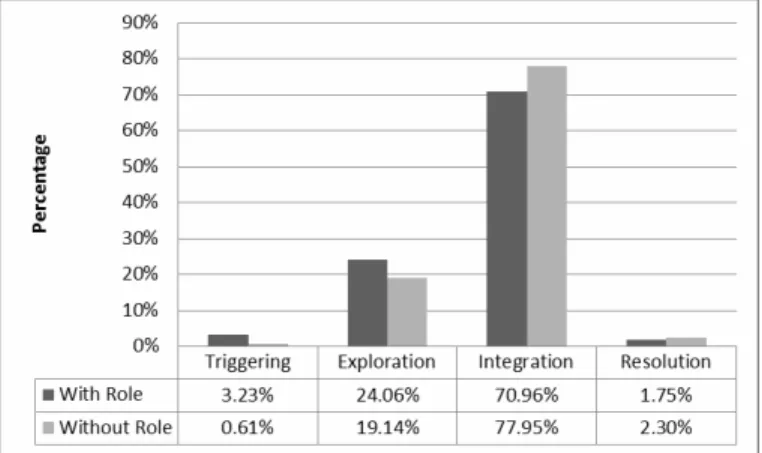
To answer the main research question on what level of cognitive presence was achieved by students’assigned roles in asynchronous online group discussions; the analysis of the percent of posts generated by role assignment during assigned weeks and without role assignment in subsequent weeks was run. Similar to Akyol and Garrison’s (2008, 2011) findings, the majority of cognitive presence indicators occurred at exploration and integration levels for the weeks when students performed the role (24.06% and 70.96%) and afterwards (19.14% and 77.95%) when they did not perform the role (Figure 1). However, triggering events and resolution were the least coded levels of cognitive presence for both conditions during the weeks when students performed the role (3.23% and 1.75%) and afterwards (0.61% and 2.30%) when they did not perform the role.
Figure 1. Percent of posts by the levels of cognitive presence with role assignment and without role assignment for all semesters.
Exploring the Effect of Scripted Roles on Cognitive Presence in Asynchronous Online Discussions
As the descriptive statistical analysis did not find differences between the levels of cognitive presence with and without role assignment, a chi-square test was conducted to examine associations between the levels of cognitive presence in the weeks when students performed the assigned role vs. in the weeks when the same students did not perform any role. The results of a chi-square test indicated a significant difference in the levels of cognitive presence between weeks when students performed the role and the weeks when they did not perform the role (χ² (3,
N=2199) = 21.57, p <.05).
To analyze what type of role (starter, skeptic, or wrapper) was the most effective, the percent of posts generated by each role were analyzed. The results of descriptive statistics revealed that all three roles were effective. The highest percent of posts for all three roles occurred at exploration and integration levels (Figure 2). Similarly, triggering and resolution were the least coded levels for all three roles. To examine differences between the types of roles and the levels of cognitive presence, a chi-square test was conducted. The results of a chi-square test indicated there was a significant difference between the types of roles and the levels of cognitive presence (χ² (6, N=1546) = 16.83, p <.05).
Figure 2. Percentages by the levels of cognitive presence and by three roles across fall 2013, spring 2014, and summer 2014 (combined).
Research Question #2
To answer the second research question as to whether the levels of students’ cognitive presence were different between when the asynchronous online group discussions occurred during the 5-week intensive summer course in Summer 2014 versus the 15-week regular semesters in Fall 2013 and Spring 2014, a Kruskal-Wallis test was run. The analysis did not find any statistically significant difference at triggering and resolution levels of cognitive presence when students participated in a 5-week intensive summer course or a 15-week regular semester in fall and spring. However, there were significant differences at exploration level (χ² (2, n= 314) = 7.84, p =.02) and integration level (χ² (2, n=551) =23.69, p=.00) across three semesters. The online discussion posts in Fall 2013 had the highest median scores at triggering level (Md = 1.50)
and exploration level (Md = 2.00) than the other two semesters, which both had median scores of 1.0 at both levels of cognitive presence. This might be explained that all students in Fall 2013 were assigned a role which means they all played one of the assigned duties compared to students in Spring 2014 and Summer 2014.
Research Question #3
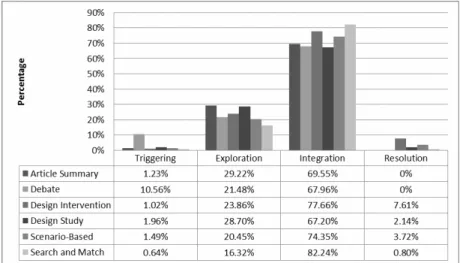
The descriptive statistical analysis was run to compare percent of posts for each type of question for all three semesters combined. Figure 3 shows that percent of posts at the exploration and integration levels were much higher than percent of posts at the triggering level and the resolution level. The highest percent of posts at resolution level (7.61%) occurred for the question when students were asked to design their own intervention. However, there were no posts found at the resolution level for the questions on the article summary and debates. Both questions were used in Summer, 2014. The question asking the students to summarize an article was used in the first online discussion where students were asked to summarize the results of the study and provide their opinion on the impact of the results. At the same time, this type of question had the highest percent of posts at the exploration level (29.22%). The indicators for the exploration level are different within the online community or within a single message, information exchange, and brainstorming. In this discussion, students mostly shared information, discussed the article, argued, or brainstormed their ideas. The debate question took place in the last online discussion. The debate question asked students to justify their topic and ask opposing sub-groups at least one question. That may be why this type of question received the highest percent of posts (10.56%) at the triggering event level. One of the socio-cognitive processes at the triggering event level is question asking. Thus, these findings showed that the types of questions have a direct relationship to the level of cognitive presence. For example, when students were asked to brainstorm and summarize ideas, their level of cognitive presence usually stayed at the exploration level. These findings agree with previous research that higher level questions are likely to lead to responses which are categorized at higher levels while lower level questions, such as the article summary in this study, led to lower level responses like knowledge and comprehension (Ertmer et al., 2011).
Exploring the Effect of Scripted Roles on Cognitive Presence in Asynchronous Online Discussions
Further, we examined whether there were differences between the three semesters (fall 2013, spring 2014, and summer 2014) in the levels of cognitive presence by the type of questions. To reveal the differences, a Mann-Whitney U test was applied. Table 4 presents the results where the differences were found.
Table 4
Comparison across semesters by the type of questions
*OD – Online Discussions
Students’ levels of cognitive presence differed when they were asked to design their own intervention. This type of question was used in Fall 2013 and Spring 2014 in the last online discussions. Students in both semesters answered the question differently. Figure 4 shows that
Types of
Question
Analysis Semesters
Design Intervention (DI)
The two samples were significantly different (p<.05) for the levels of cognitive presence at:
• Exploration for fall 2013 (Md=2.00, n=19) and spring 2014 (Md=1.00, n=8); U= 28.000, z=- 2.83, p=.005, r=.5).
• Integration for fall 2013 (Md=2.00, n=19) and spring 2014 (Md=3.00, n=35); U= 132.5, z=- 3.74, p=.000, r=.5).
DI1 (Fall 2013, OD#3)
DI2 (Spring 2014, OD#6)
Design Study (DS)
The two samples were significantly different (p<.05) for the levels of cognitive presence at integration for spring 2014 (Md=3.00; n=72) and summer 2014 (Md=2.00; n=66); U=1916.000, z=-2.034, p=.04,
r=.2).
DS1 (Spring 2014, OD#2, OD#3)
DS2 (Summer 2014, OD#2)
Scenario-Based (SB)
The two samples did not differ significantly for any of the four levels of cognitive presence.
SB1 (Fall 2013, OD#1)
SB2 (Spring 2014, OD#1)
Search and Match (SM)
The two samples did not differ significantly for any of the four levels of cognitive presence.
SM1 (Fall 2013, OD#2)
SM2 (Spring 2014, OD#4, OD#5)
The two samples were significantly different (p<.05) for the levels of cognitive presence at integration for spring 2014 (Md=3.00; n=70) and summer 2014 (Md=2.00; n=68); U=1474.500, z=-3.94, p=.000,
r=.3).
SM2 (Spring 2014, OD#4, OD#5)
SM3 (Summer 2014, OD#3)
The two samples were significantly different (p<.05) for the levels of cognitive presence at integration for fall 2013 (Md=3.00; n=24) and summer 2014 (Md=2.00; n=68); U=490.500, z=-2.97, p=.003,
r=.3).
SM1 (Fall 2013, OD#2)
SM3 (Summer 2014, OD#3)
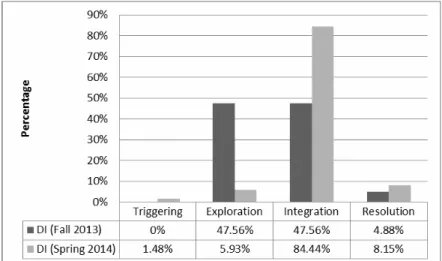
students’ posts in Spring 2014 mostly stayed at the integration level (84.44%) while posts in Fall 2013 were evenly distributed between the exploration (47.56%) and the integration (47.56%) levels. This difference might be explained by the fact that all students in Fall 2013 were assigned a role while students in Spring 2014 were either in the condition “with a role assignment” or “without a role assignment.” It seems that playing an assigned and required role, such as skeptic, might have prevented students from posting more at the integration level. Students taking the skeptic role usually provoked discussion by asking questions and brainstorming ideas. The findings of this study are similar to what Richardson and Ice (2010) found regarding case-based discussions, in our case designing a new intervention, having a higher percentage of resolution indicators than other types of questions in this study because the task is asking for resolution.
Figure 4. Comparison of Design Intervention (DI) question by percentages for the levels of cognitive presence.
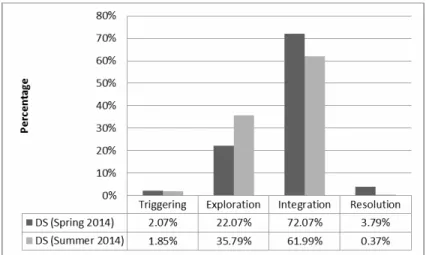
Next, the students’ posts were different between semesters when they were asked to design a study (Figure 5). This question was used in two discussions during Spring 2014 but in only one discussion in Summer 2014. During Spring 2014, students were asked to design their own study in online discussion #2 and they also discussed ethical considerations including consent form, recruitment, privacy, and confidentiality for their designed study in online discussion #3. Students who had two online discussions in Spring 2014 posted more messages at the integration level. Their posts showed a higher percentage of convergence among group members; they connected ideas or synthesized ideas, and/or created their own solutions more often than students in Summer 2014 who had only one discussion in which to design their study. It seems that having an extended time to discuss a research design can help students create more convergence and/or synthesis or ideas among group members instead of only brainstorming or exchanging ideas at exploration level.
Exploring the Effect of Scripted Roles on Cognitive Presence in Asynchronous Online Discussions
Figure 5. Comparison of Design Study (DS) question by percentages for the levels of cognitive presence.
The question that asked students to search for online resources on nutrition products to match them with the identified a supplied list of criteria was used across all three semesters. Across all three semesters students answered this type of question differently. Figure 6 shows that fewer of the students’ posts in Summer 2014 (SM3) were at the integration level (74.79%) as compared with Fall 2013 (SM1) (86.31%) and Spring 2014 (SM2) (86.99%). This finding suggests that students in 15-week classes in fall and spring posted more messages at the integration level than students who were enrolled in an intensive five-week summer course.
Figure 6. Comparison of Search and Match (SM) question by percentages for the levels of cognitive presence.
Implications and Future Research
This study found evidence that role assignment can be an effective instructional strategy to facilitate higher level learning when implemented in asynchronous online discussions. The results of this study found a significant difference between two conditions when students were assigned a role versus when they were not. Contrary to previous studies’ findings, the majority of students’ posts in this study remained at the integration level across all three semesters. This difference can be explained by the nature of this course in which students worked on their own research design or intervention. This difference can also be explained by the type of questions and the design of online discussions in which the discussion prompts contained: (1) a description of the topic for the week; (2) a short background reading and video; and (3) an activity to accomplish by the end of the week, e.g. answer a set of questions or design a hypothetical research study. The online discussions were also accompanied by the assessment rubric and examples for the quality of online postings. Therefore, online instructors, instructional designers, and other practitioners are encouraged to implement role assignment as an effective instructional strategy. However, role assignment should be supported by the type of questions that help students achieve higher levels of cognitive presence. Examples of questions that can support higher levels of cognitive presence could be those that focus on designing an intervention or search and match. Moreover, online discussions should also be supported by extra resources such as assessment rubrics and examples of posts.
Future research should include a comparison of online discussions in which role assignment as a treatment can be compared to a control group to find evidence of the effectiveness of role assignment to facilitate cognitive presence among students. More research across different disciplines and different role assignments is also needed.
Conclusion
The findings of this study revealed the effect of scripted role assignments on the levels of cognitive presence in asynchronous online discussions, in a natural science course. Findings revealed that the majority of students’ posts were at a higher level of cognitive presence— integration. Unlike findings from previous studies that found that the majority of students’ online postings are usually at a lower level of cognitive presence—exploration, this study’s findings are promising. In this study, the majority of discussion posts were at integration level across all three semesters. However, more research is needed to explore the differences between a control group with no role assignment and an experimental group with role assignment.
References
Akyol, Z., & Garrison, D. R. (2008). The development of a community of inquiry over time in an online course: Understanding the progression and integration of social, cognitive and teaching presence. Journal of Asynchronous Learning Networks, 12(3-4), 3-22.
Akyol, Z., & Garrison, D. R. (2011). Understanding cognitive presence in an online and blended community of inquiry: Assessing outcomes and processes for deep approaches to learning. British Journal of Educational Technology, 42(2), 233-250.
Exploring the Effect of Scripted Roles on Cognitive Presence in Asynchronous Online Discussions
Berelson, B. (1952). Content analysis in communications research. Glencoe, IL: The Free Press. Brush, T. A. (1998). Embedding cooperative learning into the design of integrated learning
systems: Rationale and guidelines. Educational Technology Research and Development, 46(3), 5-18.
Cohen, N. L., Carbone, E. T., & Beffa-Negrini, P. A. (2011). The design, implementation, and evaluation of online credit nutrition courses: A systematic review. Journal of Nutrition Education and Behavior, 43(2), 76–86. http://doi.org/10.1016/j.jneb.2010.04.001
De Wever, B., Van Keer, H., Schellens, T., & Valcke, M. (2009). Structuring asynchronous discussion groups: the impact of role assignment and self‐assessment on students' levels of knowledge construction through social negotiation. Journal of Computer Assisted Learning, 25(2), 177-188.
De Wever, B., Van Keer, H., Schellens, T., & Valcke, M. (2010). Roles as a structuring tool in online discussion groups: The differential impact of different roles on social knowledge construction. Computers in Human Behavior, 26(4), 516-523.
deNoyelles, A., Zydney, J. M., & Chen, B. (2014). Strategies for creating a community of inquiry through online asynchronous discussions. Journal of Online Learning and Teaching, 10(1), 153–165.
Ertmer, P. A., Sadaf, A., & Ertmer, D. J. (2011). Student-content interactions in online courses: The role of question prompts in facilitating higher-level engagement with course content.
Journal of Computing in Higher Education, 23(2-3), 157-186.
Flegal K.M, Kruszon-Moran, D, Carroll, M.D, Fryar, C.D, & Ogden, C.L. (2016). Trends in obesity among adults in the United States, 2005 to 2014. JAMA, 315(21), 2284–2291. http://doi.org/10.1001/jama.2016.6458
Franko, D. L., Cousineau, T. M., Trant, M., Green, T. C., Rancourt, D., Thompson, D., & Ciccazzo, M. (2008). Motivation, self-efficacy, physical activity and nutrition in college students: Randomized controlled trial of an internet-based education program. Preventive Medicine, 47(4), 369–377. http://doi.org/10.1016/j.ypmed.2008.06.013
Garrison, D. R., Anderson, T., & Archer, W. (1999). Critical inquiry in a text-based environment: Computer conferencing in higher education. The Internet and Higher Education, 2(2), 87-105.
Garrison, D. R., Anderson, T., & Archer, W. (2001). Critical thinking, cognitive presence, and computer conferencing in distance education. American Journal of Distance Education, 15(1), 7-23.
Gorsky, P., Caspi, A., Blau, I., Vine, Y., & Billet, A. (2011). Toward a CoI population parameter: The impact of unit (sentence vs. message) on the results of quantitative
content analysis. The International Review of Research in Open and Distributed Learning, 13(1), 17-37.
Gunawardena, C. N., Lowe, C. A., & Anderson, T. (1997). Analysis of a global online debate and the development of an interaction analysis model for examining social construction of knowledge in computer conferencing. Journal of Educational Computing Research, 17(4), 397-431.
Hare, A. P. (1994). Types of roles in small groups: A bit of history and a current perspective.
Small Group Research, 25(3), 433-448.
Joo, Y. J., Lim, K. Y., & Kim, E. K. (2011). Online university students' satisfaction and persistence: Examining perceived level of presence, usefulness and ease of use as predictors in a structural model. Computers & Education, 57(2), 1654-1664.
Kanuka, H., Rourke, L., & Laflamme, E. (2007). The influence of instructional methods on the quality of online discussion. British Journal of Educational Technology, 38(2), 260–271. Korownyk, C., Kolber, M. R., McCormack, J., Lam, V., Overbo, K., Cotton, C., & Allan, G. M.
(2014). Televised medical talk shows-what they recommend and the evidence to support their recommendations: a prospective observational study. British Medical Journal, 349. http://doi.org/http://dx.doi.org.mutex.gmu.edu/10.1136/bmj.g7346
Matvienko, O., Lewis, D. S., & Schafer, E. (2001). A college nutrition science course as an intervention to prevent weight gain in female college freshmen. Journal of Nutrition Education, 33(2), 95–101.
Mudrack, P. E., & Farrell, G. M. (1995). An examination of functional role behavior and its consequences for individuals in group settings. Small Group Research, 26(4), 542-571. Myers, C. A., Slack, T., Martin, C. K., Broyles, S. T., & Heymsfield, S. B. (2016). Change in
obesity prevalence across the United States is influenced by recreational and healthcare contexts, food environments, and Hispanic populations. PLOS ONE, 11(2), e0148394. http://doi.org/10.1371/journal.pone.0148394
Ogden, C.L, Carroll, M.D, Lawman, H.G, Fryar, C.D., Kruszon-Moran, D., Kit, B.K., & Flegal, K.M. (2016). Trends in obesity prevalence among children and adolescents in the United States, 1988-1994 through 2013-2014. JAMA, 315(21), 2292–2299. http://doi.org/10.1001/jama.2016.6361
Richardson, J. C., & Ice, P. (2010). Investigating students' level of critical thinking across instructional strategies in online discussions. The Internet and Higher Education, 13(1), 52-59.
Richardson, J. C., Sadaf, A., & Ertmer, P.A. (2012). Relationship between types of question prompts and critical thinking in online discussions. In Z. Akyol & D.R. Garrison (Eds.),
Exploring the Effect of Scripted Roles on Cognitive Presence in Asynchronous Online Discussions
Educational communities of inquiry: Theoretical framework, research and practice: (pp. 197-222). Hershey, PA: IGI Global.
Schellens, T., Van Keer, H., & Valcke, M. (2005). The impact of role assignment on knowledge construction in asynchronous discussion groups a multilevel analysis. Small Group Research, 36(6), 704-745.
Strijbos, J. W., & De Laat, M. F. (2010). Developing the role concept for computer-supported collaborative learning: An explorative synthesis. Computers in human behavior, 26(4), 495-505.
Strijbos, J. W., Martens, R. L., Jochems, W. M., & Broers, N. J. (2004). The effect of functional roles on group efficiency using multilevel modeling and content analysis to investigate computer-supported collaboration in small groups. Small Group Research, 35(2), 195- 229.
Strijbos, J. W., Martens, R. L., Prins, F. J., & Jochems, W. M. (2006). Content analysis: What are they talking about? Computers & Education, 46(1), 29-48.
Strijbos, J. W., & Weinberger, A. (2010). Emerging and scripted roles in computer-supported collaborative learning. Computers in Human Behavior, 26(4), 491-494.
Swan, K., Garrison, D. R., & Richardson, J. (2009). A constructivist approach to online learning: the Community of Inquiry framework. In C.R. Payne (Ed.), Information technology and constructivism in higher education: Progressive learning frameworks (pp. 43-57). Hershey, PA: IGI Global.
Wansink, B. (2005). Position of the American Dietetic Association: Food and nutrition misinformation. Journal of the American Dietetic Association, 106(4), 601–607.
Wise, A. F., & Chiu, M. M. (2012). Statistical discourse analysis of a role-based online discussion forum: Patterns of knowledge construction. In System Science (HICSS), 2012 45th Hawaii International Conference on (pp. 3378-3386). IEEE.
Wise, A., Saghafian, M., & Padmanabhan, P. (2012). Towards more precise design guidance: specifying and testing the functions of assigned student roles in online discussions.
Educational Technology Research & Development, 60(1), 55-82. doi:10.1007/s11423- 011-9212-7
Xie, K., Miller, N. C., & Allison, J. R. (2013). Toward a social conflict evolution model: Examining the adverse power of conflictual social interaction in online learning.
Computers & Education, 63, 404-415.
Xie, K., Yu, C., & Bradshaw, A. C. (2014). Impacts of role assignment and participation in asynchronous discussions in college-level online classes. The Internet and Higher Education, 20, 10-19.